

ISO 10333-1:2000/Amd 1:2002
(Amendment)Personal fall-arrest systems — Part 1: Full-body harnesses — Amendment 1
General Information
- Abstract
- Status
- Published
- Publication Date
- 13-Mar-2002
- Technical Committee
- ISO/TC 94/SC 4 - Personal equipment for protection against falls
- Drafting Committee
- ISO/TC 94/SC 4 - Personal equipment for protection against falls
- Current Stage
- 6060 - International Standard published
- Start Date
- 14-Mar-2002
- Completion Date
- 29-Aug-2026

Overview
ISO 10333-1:2000/Amd 1:2002 is an important amendment to the international standard governing personal fall-arrest systems, specifically focused on full-body harnesses. Published by ISO (International Organization for Standardization), this amendment refines requirements to improve safety, usability, and classification of full-body harnesses used in fall protection. It provides updated definitions and specifications that ensure harnesses support users effectively during and after a fall arrest, contributing to worker safety in hazardous environments.
This standard is essential for manufacturers, safety professionals, and users of fall-arrest equipment to maintain compliance and implement the latest safety improvements in protective clothing and equipment.
Key Topics
Harness Classification Updates
- Removal of Class L for ladder climbing fall arrest applications.
- Introduction and clarification of Class A full-body harnesses (FBH) designed to support the body during and after fall arrest. These must have at least one fall-arrest attachment element located centrally on the back (between shoulder blades) or front (sternum level).
- Introduction of Class P FBH, which combine fall-arrest capabilities with additional work-positioning attachment elements located around the waist, allowing connection into work-positioning systems.
Attachment Elements vs Attachment Points
- Terminology has been updated to replace “attachment points” with “attachment elements” throughout the standard for clarity and precision.
- Attachment elements refer to designated locations on the harness for fall arrest or work-positioning system connections, positioned specifically to optimize safety and ergonomics.
Material and Strength Requirements
- Updated performance requirements for harness materials, including minimum strength values, to enhance durability and reliability during fall arrests.
- Adjustment of technical parameters such as webbing tensile strength ensuring harness materials meet higher thresholds of safety performance.
Design and Positioning Specifications
- Precise positioning requirements for attachment elements to ensure load distribution and to prevent injury during fall arrest events.
- Symmetrical placement of work-positioning attachment elements when not placed centrally, ensuring safe use only in pairs.
Removal of Certain Subclauses
- Some clauses related to earlier requirements have been deleted or renumbered to streamline the standard and focus on current safety technologies.
Applications
This ISO amendment is highly relevant to any industry or scenario where workers are at risk of falls from height, including:
- Construction and Building Maintenance
- Ensures that harnesses used on construction sites meet rigorous international safety criteria.
- Industrial and Infrastructure Work
- Applies to workers performing inspection, maintenance, or operations at height on factories, bridges, towers, and plants.
- Wind Energy and Telecommunications
- Critical for technicians climbing wind turbines or communication towers, where fall protection is mandatory.
- Rescue and Emergency Services
- Supports the use of certified harness equipment in rescue operations involving heights.
By adhering to ISO 10333-1:2000/Amd 1:2002, organizations can enhance worker safety, reduce fall-related injuries, and comply with international safety regulations.
Related Standards
ISO 10333 Series
- Covers personal fall-arrest systems beyond just full-body harnesses, including connectors, lanyards, and fall arresters.
ISO/TC 94 - Personal Safety and Protective Clothing
- The broader technical committee responsible for developing standards related to personal protective equipment, including fall protection.
ANSI/ASSE Z359 Series (USA)
- North American standards on fall protection systems, often aligned with ISO requirements for global applicability.
EN 361:2002
- European standard on full-body harnesses providing complementary requirements important for harmonizing safety in European markets.
Keywords: ISO 10333-1 amendment, personal fall-arrest systems, full-body harness, fall protection standards, worker safety harness, fall arrest attachment, work-positioning system, fall protection equipment, harness classification, ISO standards safety.
Relations
- Effective Date
- 06-Jun-2022
- Effective Date
- 15-Apr-2008
Get Certified
Connect with accredited certification bodies for this standard

CIS Institut d.o.o.
Personal Protective Equipment (PPE) certification body. Notified Body NB-2890 for EU Regulation 2016/425 PPE.

Kiwa BDA Testing
Building and construction product certification.
Kmetijski inštitut Slovenije
Agricultural Institute of Slovenia. Soil testing, plant health, agricultural product analysis.
Sponsored listings
Frequently Asked Questions
ISO 10333-1:2000/Amd 1:2002 is a standard published by the International Organization for Standardization (ISO). Its full title is "Personal fall-arrest systems — Part 1: Full-body harnesses — Amendment 1". This standard covers: Personal fall-arrest systems — Part 1: Full-body harnesses — Amendment 1
Personal fall-arrest systems — Part 1: Full-body harnesses — Amendment 1
ISO 10333-1:2000/Amd 1:2002 is classified under the following ICS (International Classification for Standards) categories: 13.340.60 - Protection against falling and slipping. The ICS classification helps identify the subject area and facilitates finding related standards.
ISO 10333-1:2000/Amd 1:2002 has the following relationships with other standards: It is inter standard links to ISO 10333-1:2000; is excused to ISO 10333-1:2000. Understanding these relationships helps ensure you are using the most current and applicable version of the standard.
ISO 10333-1:2000/Amd 1:2002 is available in PDF format for immediate download after purchase. The document can be added to your cart and obtained through the secure checkout process. Digital delivery ensures instant access to the complete standard document.
Standards Content (Sample)
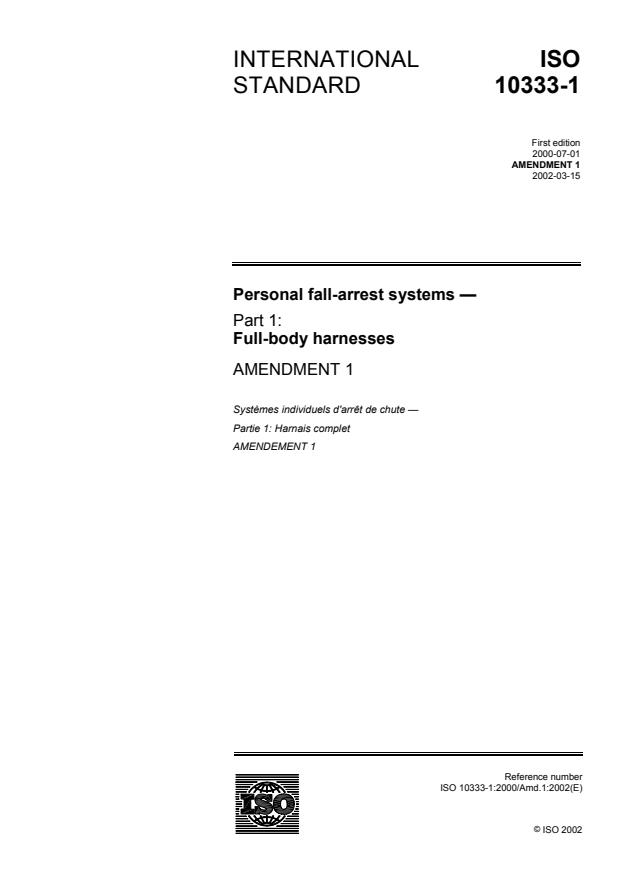
INTERNATIONAL ISO
STANDARD 10333-1
First edition
2000-07-01
AMENDMENT 1
2002-03-15
Personal fall-arrest systems —
Part 1:
Full-body harnesses
AMENDMENT 1
Systèmes individuels d'arrêt de chute —
Partie 1: Harnais complet
AMENDEMENT 1
Reference number
ISO 10333-1:2000/Amd.1:2002(E)
©
ISO 2002
ISO 10333-1:2000/Amd.1:2002(E)
PDF disclaimer
This PDF file may contain embedded typefaces. In accordance with Adobe's licensing policy, this file may be printed or viewed but shall not
be edited unless the typefaces which are embedded are licensed to and installed on the computer performing the editing. In downloading this
file, parties accept therein the responsibility of not infringing Adobe's licensing policy. The ISO Central Secretariat accepts no liability in this
area.
Adobe is a trademark of Adobe Systems Incorporated.
Details of the software products used to create this PDF file can be found in the General Info relative to the file; the PDF-creation parameters
were optimized for printing. Every care has been taken to ensure that the file is suitable for use by ISO member bodies. In the unlikely event
that a problem relating to it is found, please inform the Central Secretariat at the address given below.
© ISO 2002
All rights reserved. Unless otherwise specified, no part of this publication may be reproduced or utilized in any form or by any means, electronic
or mechanical, including photocopying and microfilm, without permission in writing from either ISO at the address below or ISO's member body
in the country of the requester.
ISO copyright office
Case postale 56 • CH-1211 Geneva 20
Tel. + 41 22 749 01 11
Fax + 41 22 749 09 47
E-mail copyright@iso.ch
Web www.iso.ch
Printed in Switzerland
ii © ISO 2002 – All rights reserved
ISO 10333-1:2000/Amd.1:2002(E)
Foreword
ISO (the International Organization for Standardization) is a worldwide federation of national standards bodies (ISO
member bodies). The work of preparing International Standards is normally carried out through ISO technical
committees. Each member body interested in a subject for which a technical committee has been established has
the right to be represented on that committee. International organizations, governmental and non-governmental, in
liaison with ISO, also take part in the work. ISO collaborates closely with the International Electrotechnical
Commission (IEC) on all matters of electrotechnical standardization.
International Standards are drafted in accordance with the rules given in the ISO/IEC Directives, Part 3.
The main task of technical committees is to prepare International Standards. Draft International Standards adopted
by the technical committees are circulated to the member bodies for voting. Publication as an International
Standard requires approval by at least 75 % of the member bodies casting a vote.
Attention is drawn to the possibility that some of the elements of this Amendment may be the subject of patent
rights. ISO shall not be held responsible for identifying any or all such patent rights.
Amendment 1 to International Standard ISO 10
...