

ISO/TS 13896:2012
(Main)Soil quality — Determination of linear alkylbenzene sulfonate (LAS) — Method by HPLC with fluorescence detection (LC-FLD) and mass selective detection (LC-MSD)
General Information
- Abstract
ISO/TS 13896:2012 specifies a method for the determination of linear alkylbenzene sulfonate (LAS) in sludge, treated biowaste and soil using high-performance liquid chromatography (HPLC) with a fluorescence detector (FLD) or a mass selective detector (MSD). ISO/TS 13896:2012 specifies the determination of the sum of LAS. Under the conditions specified in ISO/TS 13896:2012, typically a limit of detection of 20 mg/kg (expressed as dry matter) for sludge and of 0,2 mg/kg to 0,5 mg/kg for soil and treated biowaste may be achieved. Lower limits of detection may be achieved by concentrating the extract by solvent evaporation.
- Status
- Published
- Publication Date
- 21-Aug-2012
- Technical Committee
- ISO/TC 190/SC 3 - Chemical and physical characterization
- Drafting Committee
- ISO/TC 190/SC 3/WG 6 - Organic analysis
- Current Stage
- 9093 - International Standard confirmed
- Start Date
- 16-Feb-2024
- Completion Date
- 29-Aug-2026
Overview
ISO/TS 13896:2012 is a Technical Specification for soil quality that defines a laboratory method to determine the anionic surfactant linear alkylbenzene sulfonate (LAS) in sludge, treated biowaste and soil. The method uses high-performance liquid chromatography (HPLC) with either fluorescence detection (LC‑FLD) or mass selective detection (LC‑MSD / LC‑MS). ISO/TS 13896:2012 reports LAS as the sum of homologues (C10–C14) and provides validated limits of detection: typically ≈20 mg/kg (dry matter) for sludge and ≈0.2–0.5 mg/kg for soil and treated biowaste. Lower limits are achievable by concentrating extracts.
Key topics and technical requirements
- Scope & matrices: Validated for municipal sewage sludge, fresh compost (treated biowaste) and sludge‑amended soil.
- Analytical principle: Methanol extraction of the matrix, optional clean‑up (strong anion exchange or graphitized carbon black), HPLC separation on C8 or C18 reverse‑phase columns, and detection by FLD or MS.
- Column & mobile phase choices: Use C18 or C8 columns; mobile phases include ammonium acetate with acetonitrile (isomer separation on C18) or with methanol (homologue separation on C8).
- Identification & quantification: Based on retention times and homologues/isomer fingerprints; quantification by an internal standard (octylbenzene sulfonic acid sodium salt, C8‑LAS) carried through the full procedure.
- Performance: Typical detection limits given; precision and repeatability data included in annexes. Blank tests, calibration, and matrix‑specific clean‑up steps are specified.
- Storage of standards: Reference standards and internal standards are stored at (–18 ± 3) °C.
Practical applications and users
ISO/TS 13896:2012 is intended for:
- Environmental testing laboratories performing soil quality and sludge analyses.
- Wastewater treatment operators and municipalities monitoring LAS in sewage sludge destined for land application.
- Regulatory agencies and compliance monitoring programs assessing surfactant contamination in soils and composts.
- Environmental consultants and researchers studying surfactant fate, biodegradation and soil ecotoxicology.
Typical uses:
- Verifying compliance before land application of sludge/compost.
- Baseline and trend monitoring of LAS in agricultural soils.
- Research on LAS persistence and transport following biosolid amendments.
Related standards
Normative and related ISO documents referenced in ISO/TS 13896:2012 include:
- ISO 8466‑1 (calibration and evaluation of analytical methods)
- ISO 11465 (dry matter and water content determination)
- ISO 14507 (pretreatment for organic contaminants)
- ISO 22892 (GC‑MS identification guidelines)
Keywords: ISO/TS 13896:2012, soil quality, linear alkylbenzene sulfonate, LAS, HPLC, LC‑FLD, LC‑MSD, sludge, treated biowaste, detection limit, internal standard.
Get Certified
Connect with accredited certification bodies for this standard

CIS Institut d.o.o.
Personal Protective Equipment (PPE) certification body. Notified Body NB-2890 for EU Regulation 2016/425 PPE.

Kiwa BDA Testing
Building and construction product certification.
Kmetijski inštitut Slovenije
Agricultural Institute of Slovenia. Soil testing, plant health, agricultural product analysis.
Sponsored listings
Frequently Asked Questions
ISO/TS 13896:2012 is a technical specification published by the International Organization for Standardization (ISO). Its full title is "Soil quality — Determination of linear alkylbenzene sulfonate (LAS) — Method by HPLC with fluorescence detection (LC-FLD) and mass selective detection (LC-MSD)". This standard covers: ISO/TS 13896:2012 specifies a method for the determination of linear alkylbenzene sulfonate (LAS) in sludge, treated biowaste and soil using high-performance liquid chromatography (HPLC) with a fluorescence detector (FLD) or a mass selective detector (MSD). ISO/TS 13896:2012 specifies the determination of the sum of LAS. Under the conditions specified in ISO/TS 13896:2012, typically a limit of detection of 20 mg/kg (expressed as dry matter) for sludge and of 0,2 mg/kg to 0,5 mg/kg for soil and treated biowaste may be achieved. Lower limits of detection may be achieved by concentrating the extract by solvent evaporation.
ISO/TS 13896:2012 specifies a method for the determination of linear alkylbenzene sulfonate (LAS) in sludge, treated biowaste and soil using high-performance liquid chromatography (HPLC) with a fluorescence detector (FLD) or a mass selective detector (MSD). ISO/TS 13896:2012 specifies the determination of the sum of LAS. Under the conditions specified in ISO/TS 13896:2012, typically a limit of detection of 20 mg/kg (expressed as dry matter) for sludge and of 0,2 mg/kg to 0,5 mg/kg for soil and treated biowaste may be achieved. Lower limits of detection may be achieved by concentrating the extract by solvent evaporation.
ISO/TS 13896:2012 is classified under the following ICS (International Classification for Standards) categories: 13.080.10 - Chemical characteristics of soils. The ICS classification helps identify the subject area and facilitates finding related standards.
ISO/TS 13896:2012 is available in PDF format for immediate download after purchase. The document can be added to your cart and obtained through the secure checkout process. Digital delivery ensures instant access to the complete standard document.
Standards Content (Sample)
TECHNICAL ISO/TS
SPECIFICATION 13896
First edition
2012-09-01
Soil quality — Determination of linear
alkylbenzene sulfonate (LAS) —
Method by HPLC with fluorescence
detection (LC-FLD) and mass selective
detection (LC-MSD)
Qualité du sol — Détermination des sulfonates d’alkyl benzène
linéaires (SAL) — Méthode par chromatographie liquide à haute
performance (CLHP) avec détection par fluorescence (CL-DFL) et
détection sélective de la masse (CL-DSM)
Reference number
©
ISO 2012
© ISO 2012
All rights reserved. Unless otherwise specified, no part of this publication may be reproduced or utilized in any form or by any
means, electronic or mechanical, including photocopying and microfilm, without permission in writing from either ISO at the
address below or ISO’s member body in the country of the requester.
ISO copyright office
Case postale 56 • CH-1211 Geneva 20
Tel. + 41 22 749 01 11
Fax + 41 22 749 09 47
E-mail copyright@iso.org
Web www.iso.org
Published in Switzerland
ii © ISO 2012 – All rights reserved
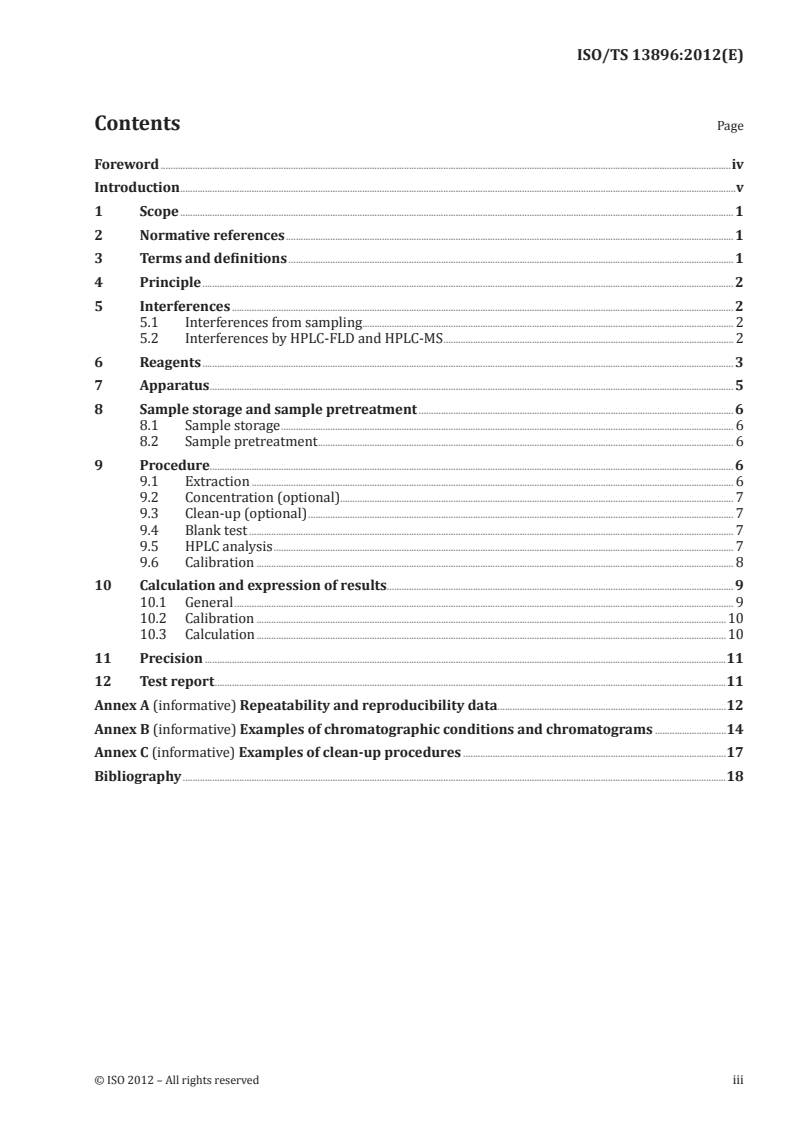
Contents Page
Foreword .iv
Introduction .v
1 Scope . 1
2 Normative references . 1
3 Terms and definitions . 1
4 Principle . 2
5 Interferences . 2
5.1 Interferences from sampling. 2
5.2 Interferences by HPLC-FLD and HPLC-MS . 2
6 Reagents . 3
7 Apparatus . 5
8 Sample storage and sample pretreatment . 6
8.1 Sample storage . 6
8.2 Sample pretreatment . 6
9 Procedure. 6
9.1 Extraction . 6
9.2 Concentration (optional). 7
9.3 Clean-up (optional) . 7
9.4 Blank test . 7
9.5 HPLC analysis . 7
9.6 Calibration . 8
10 Calculation and expression of results . 9
10.1 General . 9
10.2 Calibration .10
10.3 Calculation .10
11 Precision .11
12 Test report
................................................................................................................................................................................................................11
Annex A (informative) Repeatability and reproducibility data .12
Annex B (informative) Examples of chromatographic conditions and chromatograms .14
Annex C (informative) Examples of clean-up procedures .17
Bibliography .18
Foreword
ISO (the International Organization for Standardization) is a worldwide federation of national standards
bodies (ISO member bodies). The work of preparing International Standards is normally carried out
through ISO technical committees. Each member body interested in a subject for which a technical
committee has been established has the right to be represented on that committee. International
organizations, governmental and non-governmental, in liaison with ISO, also take part in the work.
ISO collaborates closely with the International Electrotechnical Commission (IEC) on all matters of
electrotechnical standardization.
International Standards are drafted in accordance with the rules given in the ISO/IEC Directives, Part 2.
The main task of technical committees is to prepare International Standards. Draft International
Standards adopted by the technical committees are circulated to the member bodies for voting.
Publication as an International Standard requires approval by at least 75 % of the member bodies
casting a vote.
In other circumstances, particularly when there is an urgent market requirement for such documents, a
technical committee may decide to publish other types of document:
— an ISO Publicly Available Specification (ISO/PAS) represents an agreement between technical
experts in an ISO working group and is accepted for publication if it is approved by more than 50 %
of the members of the parent committee casting a vote;
— an ISO Technical Specification (ISO/TS) represents an agreement between the members of a
technical committee and is accepted for publication if it is approved by 2/3 of the members of the
committee casting a vote.
An ISO/PAS or ISO/TS is reviewed after three years in order to decide whether it will be confirmed for
a further three years, revised to become an International Standard, or withdrawn. If the ISO/PAS or
ISO/TS is confirmed, it is reviewed again after a further three years, at which time it must either be
transformed into an International Standard or be withdrawn.
Attention is drawn to the possibility that some of the elements of this document may be the subject of
patent rights. ISO shall not be held responsible for identifying any or all such patent rights.
ISO/TS 13896 was prepared by Technical Committee ISO/TC 190, Soil quality, Subcommittee SC 3,
Chemical methods and soil characteristics.
iv © ISO 2012 – All rights reserved
Introduction
The anionic surfactant LAS (Linear Alkylbenzene Sulfonate) is found in the environment due to its use
in detergents. For more than 30 years, LAS has been the largest single surfactant used in detergents, and
the use continues on a high level.
Although LAS is readily biodegradable during wastewater treatment, considerable amounts may still
be found in sludge of municipal origin. By the use of sludge for soil improvement, LAS can end up in
agricultural soil, where a rapid biodegradation takes place.
The method describes the determination of LAS in sludge, soil, treated biowaste and neighbouring fields.
LAS is the sodium salt of alkylbenzene sulfonic acids, and it consists of a mixture of the homologues C -
LAS, C -LAS, C -LAS, C -LAS and C -LAS. LAS is determined as the sum of the homologues.
11 12 13 14
This Technical Specification is applicable and validated for several types of matrices as indicated in
Table 1 (see also Annex A for the results of the validation).
Table 1 — Matrices for which this Technical Specification is applicable and validated
Matrix Materials used for validation
Sludge Municipal sewage sludge
Biowaste Fresh compost
Soil Sludge amended soil
TECHNICAL SPECIFICATION ISO/TS 13896:2012(E)
Soil quality — Determination of linear alkylbenzene
sulfonate (LAS) — Method by HPLC with fluorescence
detection (LC-FLD) and mass selective detection (LC-MSD)
WARNING — Persons using this Technical Specification should be familiar with usual laboratory
practice. This Technical Specification does not purport to address all of the safety problems, if
any, associated with its use. It is the responsibility of the user to establish appropriate safety and
health practices and to ensure compliance with any national regulatory conditions.
IMPORTANT — It is absolutely essential that tests conducted according to this Technical
Specification be carried out by suitably trained staff.
1 Scope
This Technical Specification specifies a method for the determination of linear alkylbenzene sulfonate
(LAS) in sludge, treated biowaste and soil using high-performance liquid chromatography (HPLC) with
a fluorescence detector (FLD) or a mass selective detector (MSD).
This Technical Specification specifies the determination of the sum of LAS. Under the conditions specified
in this Technical Specification, typically a limit of detection of 20 mg/kg (expressed as dry matter) for
sludge and of 0,2 mg/kg to 0,5 mg/kg for soil and treated biowaste may be achieved.
Lower limits of detection may be achieved by concentrating the extract by solvent evaporation.
NOTE The single LAS homologues C to C can be determined by this Technical Specification.
10 14
2 Normative references
The following referenced documents are indispensable for the application of this document. For dated
references, only the edition cited applies. For undated references, the latest edition of the referenced
document (including any amendments) applies.
ISO 8466-1, Water quality — Calibration and evaluation of analytical methods and estimation of performance
characteristics — Part 1: Statistical evaluation of the linear calibration function
ISO 11465, Soil quality — Determination of dry matter and water content on a mass basis — Gravimetric method
ISO 14507, Soil quality — Pretreatment of samples for determination of organic contaminants
ISO 22892, Soil quality — Guidelines for the identification of target compounds by gas chromatography and
mass spectrometry
3 Terms and definitions
For the purposes of this document, the following terms and definitions apply.
3.1
analyte
mixture of homologues (i.e. C -LAS, C -LAS, C -LAS, C -LAS and C -LAS) where each homologue
10 11 12 13 14
consists of a mixture of four to six isomers depending on the length of the alkyl group
NOTE The dominant homologues in detergents and environmental samples are C -LAS and C -LAS. C to C
11 12 10 14
refers to the chain length of the linear alkyl group.
4 Principle
After pretreatment, the test sample is extracted by shaking with methanol. If necessary, interfering
compounds are removed from the extract by a clean-up on a suitable column.
The extract is analysed by high-performance liquid chromatography (HPLC) on a C - or C -column and
8 18
detection by fluorescence (FLD) or mass spectrometry (MS).
The identification is based on the retention times of the homologues and of the isomers of each homologue.
Another identification point is the pattern/fingerprint of the homologues, and the isomer fingerprint of
each homologue if a C -column is used for HPLC. By the use of MS detection the relative intensities of
two diagnostic ions may also be used for the identification (optional).
The quantification is based on an internal standard procedure. The internal standard (C -LAS) is taken
through the whole analytical procedure.
Depending on the type of matrices from which LAS is extracted, different analytical pathways can be
applied. An overview of the analytical procedure for the matrix of interest is shown in Table 2.
5 Interferences
5.1 Interferences from sampling
Use sampling containers of materials (preferably glass or steel) that do not significantly affect the
sample during the contact through sampling and storage. Plastic containers may be used if it has been
proven that they do not significantly affect the sample.
5.2 Interferences by HPLC-FLD and HPLC-MS
The chromatographic analysis can be done on a C - or a C -reverse phase column, and the choice of
8 18
column determines the separation obtained. On the C -column (with methanol in mobile phase) the
LAS homologues are separated; however, there is no separation of the isomers. On the C -column (with
acetonitrile in mobile phase) the homologues are separated and there is a partial separation of the
isomers of each homologue. This is illustrated by the chromatograms in Annex B.
The selectivity of the fluorescence as well as the mass selective detector is high; however, interference
from co-eluting substances may occur. It is essential that the interfering peaks not be included in the
calculations. A peak is excluded if the retention time differs from the LAS standard mixture. Interfering
peaks can best be detected when a C -column is used for the LC analysis, due to the partial separation
of the isomers. The C -column is mandatory when fluorescence is used, due to the higher selectivity
obtained. The interfering peaks can usually be detected by comparing the fingerprints of the sample
with the fingerprints of the LAS standard mixture, although the isomer and homologue distribution in
the environmental samples may differ from the distribution in the standard mixture.
The highest selectivity is obtained by the use of a C -column and the MS detector. However, for most
applications, the separation on a C -column is sufficient, when MS is used. When all isomers are eluted in
one peak, the integrations are less complicated, resulting in a higher precision and a lower limit of detection.
Table 2 — Choice of analytical procedure
Matrix FLD MS
C -column C -column C -column C -column
8 18 8 18
Sludge No Yes Yes Yes
a
Soil No (Yes) Yes Yes
a
Treated biowaste No (Yes) Yes Yes
a
For FLD, the limit of detection will generally be inadequate for this type of matrix.
2 © ISO 2012 – All rights reserved
6 Reagents
6.1 General
Use only reagents of recognized analytical grade, unless otherwise specified.
The purity of the reagents used shall be checked by running a blank determination as described in 9.4.
6.2 Methanol, CH OH; HPLC grade.
6.3 Acetonitrile, C H N; HPLC grade.
2 3
- +
6.4 Ammonium acetate, c(CH COO NH ) = 0,01 mol/l.
3 4
6.5 Mobile phases for HPLC
6.5.1 For isomeric separation on C -column
— Mobile phase A: 0,01 mol/l ammonium acetate (6.4);
— Mobile phase B: Acetonitrile (6.3).
6.5.2 For homologue separation on C -column
— Mobile phase A: 0,01 mol/l ammonium acetate (6.4);
— Mobile phase B: Methanol (6.2).
6.6 Reagents for clean-up procedures
6.6.1 Clean-up procedure based on strong anion exchange (SAX)
6.6.1.1 SAX column
6.6.1.2 Acetic acid, CH COOH
6.6.1.3 Hydrochloric acid, HCl
6.6.1.4 Methanol, CH OH
6.6.2 Clean-up procedure based on graphitized carbon black (GCB)
6.6.2.1 GCB column
6.6.2.2 Hydrochloric acid, HCl
1)
6.6.2.3 Tetramethylammonium hydroxide, C H NO (CAS-RN 10424-65-4 ) pentahydrate.
4 13
6.6.2.4 Formic acid, HCOOH
6.6.2.5 Dichloromethane, CH Cl
2 2
1) CAS-RN Chemical Abstracts Service Registry Number.
6.6.2.6 Methanol, CH OH
6.7 Nitrogen, N , for solvent evaporation of sufficient purity.
6.8 Standards for calibration
6.8.1 General
The standards shall be stored in a freezer at a temperature of (–18 ± 3) °C.
6.8.2 C -LAS, sodium linear undecylbenzene sulfonate, C H SO Na; 99 %.
11 17 27 3
6.8.3 C -LAS, sodium linear dodecylbenzene sulfonate, C H SO Na; 99 % (CAS-RN 2211-98-5).
12 18 29 3
6.8.4 C -LAS, sodium linear tridecylbenzene sulfonate, C H SO Na; 99 %.
13 19 31 3
6.8.5 C -C -LAS mixture of homologues and isomers, highest possible purity (CAS-RN 69669-44-
10 14
9, CAS-RN 25155-30-0).
6.9 Internal standard, C -LAS
Octylbenzene sulfonic acid, sodium salt C H SO Na (CAS-RN 6149-03-7).
14 21 3
The internal standard shall be stored in the freezer at a temperature of (–18 ± 3) °C.
6.10 Internal standard solution
Prepare the internal standard solution of the internal standard (6.9) by dilution to about 1 000 mg/l in
methanol (6.2).
It is essential that the same internal standard solution be used for calibration standard solutions and for
samples, blank tests and internal quality control samples.
Store the internal standard solution in a dark place at a temperature of (4 ± 3) °C. The solution is stable
for at least two years.
6.11 Stock solutions
Prepare individual stock solutions of 1 000 mg/l to 5 000 mg/l in methanol (6.2), either from solid
standard substances or from solutions with a certified concentration. Prepare stock solutions of C -
LAS (6.8.2), C -LAS (6.8.3) and C -LAS (6.8.4).
12 13
Prepare a calibration mixture by mixing stock solutions of C -LAS, C -LAS and C -LAS containing
11 12 13
equal concentrations of each homologue.
Prepare a stock solution of C to C -LAS mixture (6.8.5) of 1 000 mg/l to 5 000 mg/l in methanol (6.2).
10 14
This solution is only for identification.
Store the stock solutions and the calibration mixture in a dark place at a temperature of (4 ± 3) °C. The
solutions are stable for at least two years.
6.12 Calibration standard solutions
6.12.1 General
Calibration standard solutions are prepared from the calibration mixture (6.11) by diluting with a 1:1
mixture of methanol (6.2) and ammonium acetate (6.4).
4 © ISO 2012 – All rights reserved
The calibration ran
...