

ISO/TR 10993-33:2015
(Main)Biological evaluation of medical devices — Part 33: Guidance on tests to evaluate genotoxicity — Supplement to ISO 10993-3
General Information
- Abstract
There are differences between the views of regulatory bodies on the subject of genotoxicity testing. The purpose of this ISO/TR 10993-33: 2015 is to provide background information to facilitate the selection of tests and guidance on the performance of tests.
- Status
- Withdrawn
- Publication Date
- 05-Mar-2015
- Technical Committee
- ISO/TC 194 - Biological and clinical evaluation of medical devices
- Current Stage
- 9599 - Withdrawal of International Standard
- Start Date
- 06-Aug-2026
- Completion Date
- 29-Aug-2026
Buy Documents


ISO/TR 10993-33:2015 - Biological evaluation of medical devices
ISO/TR 10993-33:2015 - Biological evaluation of medical devices — Part 33: Guidance on tests to evaluate genotoxicity — Supplement to ISO 10993-3/6/2015
Overview
ISO/TR 10993-33:2015 - "Biological evaluation of medical devices - Part 33: Guidance on tests to evaluate genotoxicity - Supplement to ISO 10993-3" is a Technical Report from ISO that provides background and practical guidance to help select and perform genotoxicity tests for medical device biological evaluation. It recognizes differences among regulatory bodies on genotoxicity testing and complements ISO 10993-3 by describing test selection, test performance, data handling and reporting to support biocompatibility assessment.
Key topics and technical content
This TR organizes practical guidance across in vitro and in vivo genotoxicity testing, including:
- Selection of tests and recommended test batteries aligned with device risk and exposure routes.
- Use of in vitro tests: design, limitations and interpretation for assays used to detect genotoxic hazard.
- Use of in vivo tests: when in vivo follow-up is appropriate and how to design animal studies.
- Detailed procedural guidance for common genotoxicity assays, covering:
- Bacterial reverse mutation assay (Ames test): strain preparation, metabolic activation, solvents, exposure concentrations, controls, incubation, data collection and reporting.
- In vitro mammalian chromosome aberration test: cell lines, culture conditions, metabolic activation, chromosome preparation and analysis.
- In vitro micronucleus test: cytokinesis-block use, cell harvest, slide prep, scoring and interpretation.
- Mouse lymphoma (L5178Y) gene mutation assay: culture prep, survival and mutant frequency assessment.
- In vivo erythrocyte micronucleus test: species selection, dosing schedules, sampling and analysis.
- Common technical details: test sample preparation, solvents/vehicles, exposure concentration selection, positive/negative controls, acceptance criteria, statistical treatment of results and test reporting recommendations.
Practical applications
ISO/TR 10993-33:2015 is intended to:
- Guide selection of appropriate genotoxicity assays for medical device extracts and leachables.
- Support laboratory test method setup and quality control for genotoxicity testing.
- Provide context for interpreting positive, negative or equivocal genotoxicity findings.
- Aid regulatory submissions by harmonizing the rationale for test selection and reporting.
Who should use this standard
- Medical device manufacturers and R&D teams preparing biocompatibility dossiers.
- Regulatory affairs professionals assembling safety data for device approval.
- Toxicologists and biocompatibility scientists designing genotoxicity testing strategies.
- Third‑party test laboratories performing genotoxicity assays for medical devices.
Related standards
- ISO 10993-3 (physico-chemical and toxicological methods) - this TR is a supplement to that part of the ISO 10993 series on biological evaluation of medical devices.
Keywords: ISO 10993-33, genotoxicity testing, biological evaluation of medical devices, ISO 10993-3, Ames test, micronucleus test, chromosome aberration, mouse lymphoma assay, biocompatibility testing, medical device regulatory compliance.
Relations
- Effective Date
- 28-Feb-2026
Buy Documents
ISO/TR 10993-33:2015 - Biological evaluation of medical devices
ISO/TR 10993-33:2015 - Biological evaluation of medical devices — Part 33: Guidance on tests to evaluate genotoxicity — Supplement to ISO 10993-3/6/2015
Get Certified
Connect with accredited certification bodies for this standard

BSI Group
BSI (British Standards Institution) is the business standards company that helps organizations make excellence a habit.

TÜV Rheinland
TÜV Rheinland is a leading international provider of technical services.

TÜV SÜD
TÜV SÜD is a trusted partner of choice for safety, security and sustainability solutions.
Sponsored listings
Frequently Asked Questions
ISO/TR 10993-33:2015 is a technical report published by the International Organization for Standardization (ISO). Its full title is "Biological evaluation of medical devices — Part 33: Guidance on tests to evaluate genotoxicity — Supplement to ISO 10993-3". This standard covers: There are differences between the views of regulatory bodies on the subject of genotoxicity testing. The purpose of this ISO/TR 10993-33: 2015 is to provide background information to facilitate the selection of tests and guidance on the performance of tests.
There are differences between the views of regulatory bodies on the subject of genotoxicity testing. The purpose of this ISO/TR 10993-33: 2015 is to provide background information to facilitate the selection of tests and guidance on the performance of tests.
ISO/TR 10993-33:2015 is classified under the following ICS (International Classification for Standards) categories: 11.100.20 - Biological evaluation of medical devices. The ICS classification helps identify the subject area and facilitates finding related standards.
ISO/TR 10993-33:2015 has the following relationships with other standards: It is inter standard links to ISO 10993-3:2026. Understanding these relationships helps ensure you are using the most current and applicable version of the standard.
ISO/TR 10993-33:2015 is available in PDF format for immediate download after purchase. The document can be added to your cart and obtained through the secure checkout process. Digital delivery ensures instant access to the complete standard document.
Standards Content (Sample)
TECHNICAL ISO/TR
REPORT 10993-33
First edition
2015-03-01
Biological evaluation of medical
devices —
Part 33:
Guidance on tests to evaluate
genotoxicity — Supplement to ISO
10993-3
Évaluation biologique des dispositifs médicaux —
Partie 33: Directives sur les essais pour évaluer la génotoxicité —
Supplément à l’ISO 10993-3
Reference number
©
ISO 2015
© ISO 2015
All rights reserved. Unless otherwise specified, no part of this publication may be reproduced or utilized otherwise in any form
or by any means, electronic or mechanical, including photocopying, or posting on the internet or an intranet, without prior
written permission. Permission can be requested from either ISO at the address below or ISO’s member body in the country of
the requester.
ISO copyright office
Case postale 56 • CH-1211 Geneva 20
Tel. + 41 22 749 01 11
Fax + 41 22 749 09 47
E-mail copyright@iso.org
Web www.iso.org
Published in Switzerland
ii © ISO 2015 – All rights reserved
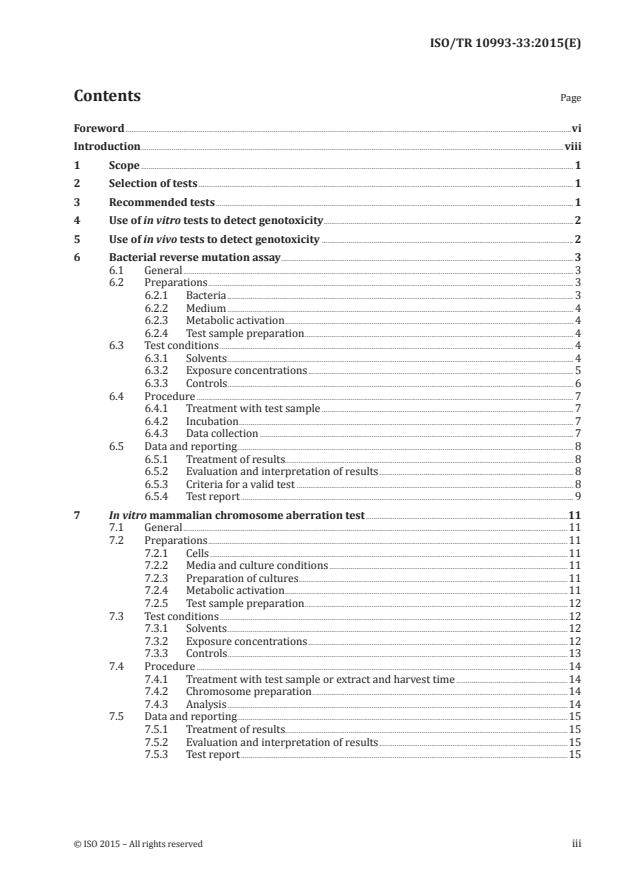
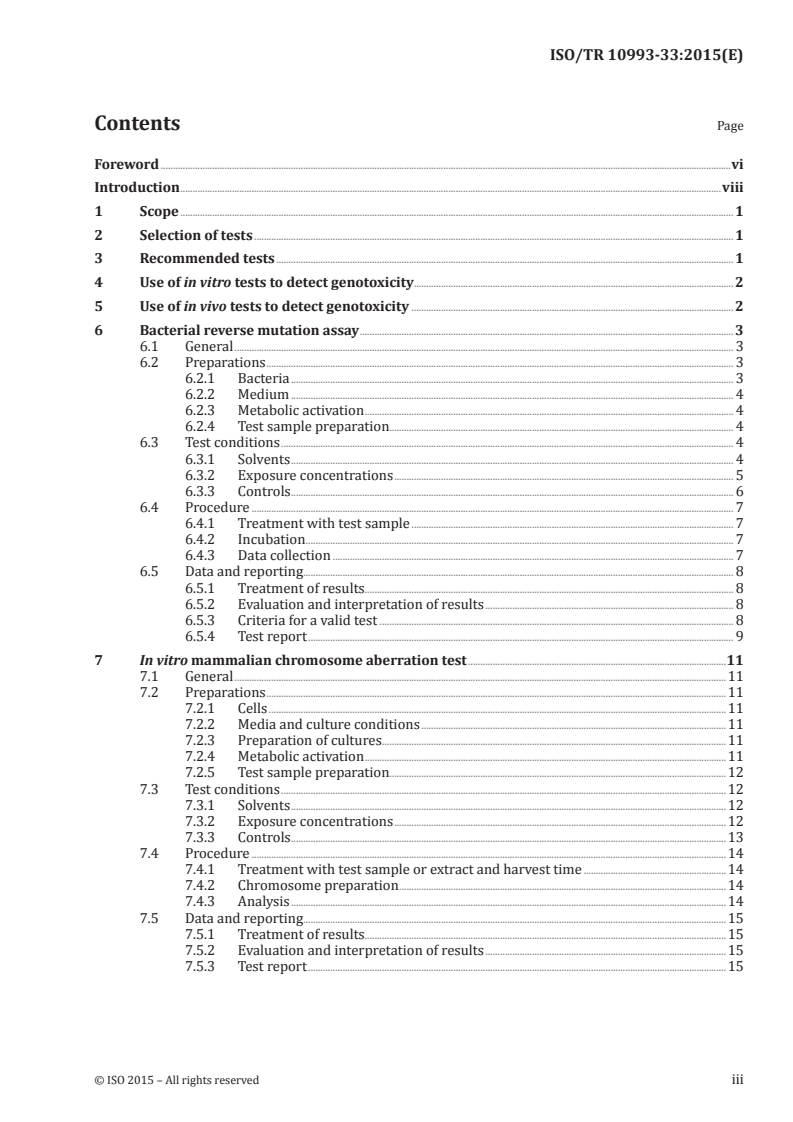
Contents Page
Foreword .vi
Introduction .viii
1 Scope . 1
2 Selection of tests . 1
3 Recommended tests . 1
4 Use of in vitro tests to detect genotoxicity. 2
5 Use of in vivo tests to detect genotoxicity . 2
6 Bacterial reverse mutation assay . 3
6.1 General . 3
6.2 Preparations . 3
6.2.1 Bacteria . 3
6.2.2 Medium . 4
6.2.3 Metabolic activation . 4
6.2.4 Test sample preparation. 4
6.3 Test conditions . 4
6.3.1 Solvents . 4
6.3.2 Exposure concentrations . 5
6.3.3 Controls . 6
6.4 Procedure . 7
6.4.1 Treatment with test sample . 7
6.4.2 Incubation . 7
6.4.3 Data collection . 7
6.5 Data and reporting . 8
6.5.1 Treatment of results. 8
6.5.2 Evaluation and interpretation of results . 8
6.5.3 Criteria for a valid test . 8
6.5.4 Test report . 9
7 In vitro mammalian chromosome aberration test .11
7.1 General .11
7.2 Preparations .11
7.2.1 Cells .11
7.2.2 Media and culture conditions .11
7.2.3 Preparation of cultures . .11
7.2.4 Metabolic activation .11
7.2.5 Test sample preparation.12
7.3 Test conditions .12
7.3.1 Solvents .12
7.3.2 Exposure concentrations .12
7.3.3 Controls .13
7.4 Procedure .14
7.4.1 Treatment with test sample or extract and harvest time .14
7.4.2 Chromosome preparation .14
7.4.3 Analysis .14
7.5 Data and reporting .15
7.5.1 Treatment of results.15
7.5.2 Evaluation and interpretation of results .15
7.5.3 Test report .15
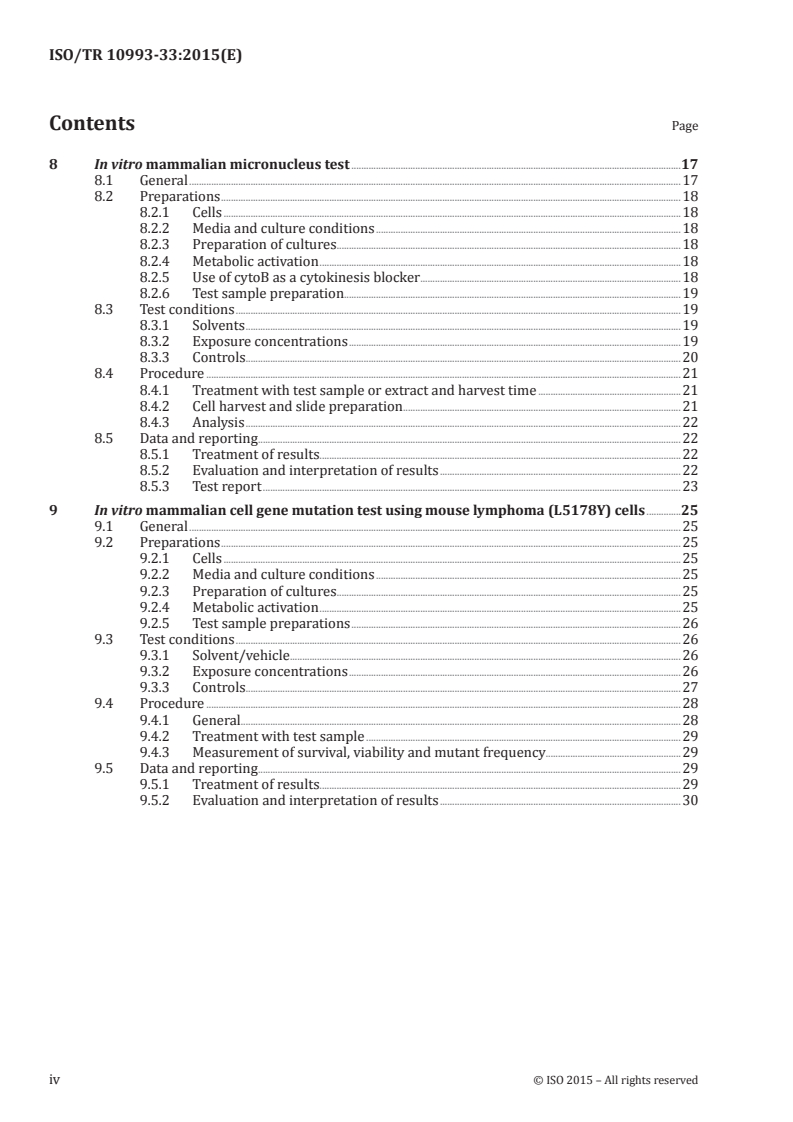
Contents Page
8 In vitro mammalian micronucleus test .17
8.1 General .17
8.2 Preparations .18
8.2.1 Cells .18
8.2.2 Media and culture conditions .18
8.2.3 Preparation of cultures . .18
8.2.4 Metabolic activation .18
8.2.5 Use of cytoB as a cytokinesis blocker .18
8.2.6 Test sample preparation.19
8.3 Test conditions .19
8.3.1 Solvents .19
8.3.2 Exposure concentrations .19
8.3.3 Controls .20
8.4 Procedure .21
8.4.1 Treatment with test sample or extract and harvest time .21
8.4.2 Cell harvest and slide preparation . .21
8.4.3 Analysis .22
8.5 Data and reporting .22
8.5.1 Treatment of results.22
8.5.2 Evaluation and interpretation of results .22
8.5.3 Test report .23
9 In vitro mammalian cell gene mutation test using mouse lymphoma (L5178Y) cells .25
9.1 General .25
9.2 Preparations .25
9.2.1 Cells .25
9.2.2 Media and culture conditions .25
9.2.3 Preparation of cultures . .25
9.2.4 Metabolic activation .25
9.2.5 Test sample preparations .26
9.3 Test conditions .26
9.3.1 Solvent/vehicle .26
9.3.2 Exposure concentrations .26
9.3.3 Controls .27
9.4 Procedure .28
9.4.1 General.28
9.4.2 Treatment with test sample .29
9.4.3 Measurement of survival, viability and mutant frequency.29
9.5 Data and reporting .29
9.5.1 Treatment of results.29
9.5.2 Evaluation and interpretation of results .30
iv © ISO 2015 – All rights reserved
Contents Page
10 In vivo mammalian erythrocyte micronucleus test .32
10.1 General .32
10.2 Preparations .33
10.2.1 Selection of animal species .33
10.2.2 Housing and feeding conditions .33
10.2.3 Preparation of the animals .33
10.2.4 Test sample preparation.33
10.3 Test conditions .34
10.3.1 Solvent/vehicle .34
10.3.2 Controls .34
10.4 Procedure .34
10.4.1 Number and sex of animals .34
10.4.2 Treatment schedule . .34
10.4.3 Limit test .35
10.4.4 Dose levels .35
10.4.5 Routes of administration and doses levels .36
10.4.6 Bone marrow/blood preparation .36
10.4.7 Analysis .36
10.5 Data and reporting .37
10.5.1 Evaluation of results .37
10.5.2 Evaluation and interpretation of results .37
10.5.3 Test report .37
11 Chromosome aberration test (in vivo) .39
11.1 General .39
11.2 Preparations .39
11.2.1 Selection of animal species .39
11.2.2 Housing and feeding conditions .39
11.2.3 Preparation of the animals .39
11.2.4 Test sample preparation.39
11.3 Test conditions .40
11.3.1 Solvent/vehicle .40
11.3.2 Controls .40
11.4 Procedure .40
11.4.1 Number and sex of animals .40
11.4.2 Treatment schedule . .40
11.4.3 Dose levels .41
11.4.4 Limit test .41
11.4.5 Dose levels and routes of exposure.41
11.4.6 Bone marrow collection and preparation of slides .42
11.4.7 Analysis of Metaphase Cells .42
11.5 Data and reporting .42
11.5.1 Treatment of results.42
11.5.2 Evaluation and interpretation of results .42
11.5.3 Test report .43
Bibliography .45
Foreword
ISO (the International Organization for Standardization) is a worldwide federation of national standards
bodies (ISO member bodies). The work of preparing International Standards is normally carried out
through ISO technical committees. Each member body interested in a subject for which a technical
committee has been established has the right to be represented on that committee. International
organizations, governmental and non-governmental, in liaison with ISO, also take part in the work.
ISO collaborates closely with the International Electrotechnical Commission (IEC) on all matters of
electrotechnical standardization.
The procedures used to develop this document and those intended for its further maintenance are
described in the ISO/IEC Directives, Part 1. In particular the different approval criteria needed for the
different types of ISO documents should be noted. This document was drafted in accordance with the
editorial rules of the ISO/IEC Directives, Part 2 (see www.iso.org/directives).
Attention is drawn to the possibility that some of the elements of this document may be the subject of
patent rights. ISO shall not be held responsible for identifying any or all such patent rights. Details of any
patent rights identified during the development of the document will be in the Introduction and/or on
the ISO list of patent declarations received (see www.iso.org/patents).
Any trade name used in this document is information given for the convenience of users and does not
constitute an endorsement.
For an explanation on the meaning of ISO specific terms and expressions related to conformity
assessment, as well as information about ISO’s adherence to the WTO principles in the Technical Barriers
to Trade (TBT), see the following URL: Foreword — Supplementary information.
The committee responsible for this document is ISO/TC 194, Biological and clinical evaluation of
medical devices.
ISO 10993 consists of the following parts, under the general title Biological evaluation of medical devices:
— Part 1: Evaluation and testing within a risk management process
— Part 2: Animal welfare requirements
— Part 3: Tests for genotoxicity, carcinogenicity and reproductive toxicity
— Part 4: Selection of tests for interactions with blood
— Part 5: Tests for in vitro cytotoxicity
— Part 6: Tests for local effects after implantation
— Part 7: Ethylene oxide sterilization residuals
— Part 9: Framework for identification and quantification of potential degradation products
— Part 10: Tests for irritation and delayed-type hypersensitivity
— Part 11: Tests for systemic toxicity
— Part 12: Sample preparation and reference materials
— Part 13: Identification and quantification of degradation products from polymeric medical devices
— Part 14: Identification and quantification of degradation products from ceramics
— Part 15: Identification and quantification of degradation products from metals and alloys
— Part 16: Toxicokinetic study design for degradation products and leachables
— Part 17: Establishment of allowable limits for leachable substances
vi © ISO 2015 – All rights reserved
— Part 18: Chemical characterization of materials
— Part 19: Physico-chemical, morphological and topographical characterization of materials (Technical
specification)
— Part 20: Principles and methods for immunotoxicology testing of medical devices (Technical specification)
— Part 33: Guidance on tests to evaluate genotoxicity - Supplement to ISO 10993-3 (Technical Report)
Introduction
Genotoxicity tests are designed to detect compounds which induce genetic damage directly or
indirectly by various mechanisms. These tests should enable hazard identification with respect to
genetic damages. Expression of gene mutations, large scale chromosomal damage, recombination, and
numerical changes are generally considered to be essential for heritable effects and the multi-step
carcinogenesis. A positive genotoxicity test provides an indication that further testing can be warranted
to determine the carcinogenic potential of the compound. Because the relationship between exposure
to particular chemicals and carcinogenesis is established for man, while a similar relationship has been
difficult to prove for heritable diseases, genotoxicity tests have been used mainly for the prediction of
carcinogenicity. Nevertheless, because germ line mutations are clearly associated with human disease,
the suspicion that a compound can induce heritable effects is considered to be just as serious as the
suspicion that a compound can induce cancer. In addition, the outcome of such tests can be valuable for
the interpretation of carcinogenicity studies.
viii © ISO 2015 – All rights reserved
TECHNICAL REPORT ISO/TR 10993-33:2015(E)
Biological evaluation of medical devices —
Part 33:
Guidance on tests to evaluate genotoxicity — Supplement
to ISO 10993-3
1 Scope
There are differences between the views of regulatory bodies on the subject of genotoxicity testing. The
purpose of this Technical Report is to provide background information to facilitate the selection of tests
and guidance on the performance of tests.
2 Selection of tests
Since chemicals can induce genetic damage by different mechanisms, a battery of tests sensitive to
different types of genetic damage are thought to provide the best assurance for detecting genotoxic
hazard. The tests selected usually include tests to detect point mutations and tests to detect chromosomal
aberrations. Both bacterial cells and cultured mammalian cells are used to detect genotoxic agents. in
vivo tests are sometimes incorporated into these test batteries. These tests are sometimes included in
the initial test battery or are used to clarify results from in vitro tests, see Reference [13].
3 Recommended tests
Although there are some variations in details, the same genotoxicity tests are commonly recommended
by most regulatory agencies. The following are commonly recommended tests:
[1]
— bacterial reverse mutation test (see OECD 471 and Clause 6);
[2]
— in vitro mammalian chromosome aberration test (see OECD 473 and Clause 7);
[6]
— in vitro mammalian micronucleus test (see OECD 487 and Clause 8);
[4]
— in vitro mammalian cell gene mutation test using mouse lymphoma (L5178Y) cells (see OECD 475
and Clause 9);
[3]
— in vivo mammalian erythrocyte micronucleus test (see OECD 474 and Clause 10);
[5]
— in vivo chromosome aberration test (see OECD 475 and Clause 11).
For medical devices, a battery of tests is commonly used for genotoxicity evaluations. The general
strategy identified in ISO 10993-3 is as follows:
[1]
a) test for gene mutations in bacteria. Bacterial Reverse Mutation Assay, OECD 471 technically
modified for medical devices to allow, for example, testing with extracts from devices (see Clause 6);
and either
b) an in vitro test with cytogenetic evaluation of chromosomal damage with mammalian cells,
[2]
Chromosome aberration test, OECD 473 technically modified for medical devices (see Clause 7), or
[5]
c) an in vitro mouse lymphoma tk assay, OECD 476 technically modified for medical devices
(see Clause 8) including detection of small (slow growing) and large colonies, or
d) an in vitro mammalian cell micronucleus test for chromosomal damage and aneugenicity, OECD 487
technically modified for medical devices, (see Clause 8).
The International Conference on Harmonization of Technical Requirements for Registration of
Pharmaceuticals for Human Use (ICH) recommends a three-test battery described in the ICH S2(R1)
Genotoxicity, which can be required for medical devices by some regulatory authorities.
4 Use of in vitro tests to detect genotoxicity
In vitro tests are commonly used for identifying the potential of chemicals to induce genotoxicity.
Multiple tests are used because no single test detects all known genotoxins. Genotoxins often lead to
different effects (e. g. large scale or chromosomal damage vs. small scale damage or point mutations or
different DNA sequence specificity). Also, the resulting genetic damage has differing susceptibility to
DNA repair. The “ICH test battery” was developed to cast a wider net for detecting genotoxins. Although
in vitro genotoxicity tests can be considered overly sensitive, these tests detect most rodent genotoxic
carcinogens. Comparisons of the “scorecards” of genotoxicity assay with those of rodent carcinogenicity
assays have found that the in vitro mammalian assays generated a number of “false positives” (i.e. agents
testing positive that were not rodent carcinogens). However, it is not clear that the rodent carcinogenicity
assay is the appropriate standard, rather than detection of genotoxicity per se.
Later work identified two new classes of pharmaceuticals causing DNA damage by interference with
topoisomerases. These are responsible for substantial numbers of the in vitro false positives, see
Reference [29]. Later work indicated much lower percentages of unexplained in vitro positive results with
pharmaceuticals, see Reference [16]. Unfortunately, all of the information on the ability of genotoxicity
to predict carcinogenicity and germ cell mutagenicity was developed from the analysis of industrial
chemicals and pharmaceuticals. Medical device testing usually includes the use of extracts, which often
contain complex mixtures of chemicals. Although future effects are unknown, device extracts have
generated limited number of positives with unknown constituents to date.
5 Use of in vivo tests to detect genotoxicity
The in vivo genotoxicity tests are an integral part of the ICH test battery and are used in a weight of
evidence approach in the evaluation of pharmaceuticals. For these tests, a demonstration that the
chemical or its metabolite has reached the target organ is required. For medical devices, the latter
requirement is often difficult to fulfil since complex mixtures are usually tested and the dose of agent(s)
in extracts can be below the detection level of the system.
The in vivo test for chromosomal damage using rodent haematopoietic cells is included in the test
battery to provide additional relevant factors (absorption, distribution, metabolism, excretion) that can
influence the genetic activity of chemicals, see Reference [14]. There are also a small number of genotoxic
carcinogens that are reliably detected by the in vivo bone marrow tests for chromosomal damage that
have yielded negative/weak/conflicting results in the pairs of in vitro tests outlined in the standard
battery options (e.g. bacterial reverse mutation plus one of a selection of possible tests with cytogenetic
evaluation of chromosomal damage or bacterial mutation plus the mouse lymphoma tk assay). A few
industrial chemical carcinogens such as urethane and benzene fall into this category, see Reference [31].
The value of including in vivo tests as part of the initial genotoxicity assessment is controversial. The
limited sensitivity of in vivo tests to detect a significant number of carcinogens (see Reference [10] and
Reference [27]) can argue against their use. However, the concern that a small group of biologically
active compounds that are known or suspected human carcinogens cannot be easily detected by in
vitro tests (see Reference [26]) argues for their use in circumstances where the extent of exposure to
biologically active constituents of a medical device indicates the need for greater reassurance.
2 © ISO 2015 – All rights reserved
6 Bacterial reverse mutation assay
6.1 General
The following procedure for the bacterial reverse mutation assay was adapted for medical devices from
[1]
OECD 471. For evaluation of genotoxic potential of medical devices, medical device material, extracts
or extracted and evaporated residues can be applied to test systems.
When two extracts are used, genetic potential of each extract should be evaluated in accordance
with this Clause.
Suspensions of bacterial cells are exposed to the test sample in the presence and in the absence of an
exogenous metabolic activation system. In the plate incorporation method, these suspensions are mixed
with an overlay agar and plated immediately onto minimal medium. In the preincubation method, the
treatment mixture is incubated and then mixed with an overlay agar before plating onto minimal
medium. For both techniques, after 48 h or 72 h of incubation, revertant colonies are counted and
compared to the number of spontaneous revertant colonies on solvent control plates.
6.2 Preparations
6.2.1 Bacteria
Cultures of bacteria in late exponential growth or early stationary phase of growth (approximately
10 cells/ml) should be used.
The recommended culture temperature is 37 °C.
The recommended combination of strains is
— S. typhimurium TA1535, and
— S. typhimurium TA1537 or TA97 or TA97a, and
— S. typhimurium TA98, and
— S. typhimurium TA100, and
— E. coli WP2 uvrA, or E. coli WP2 uvrA (pKM101), or S. typhimurium TA102.
Established procedures for stock culture preparation, marker verification, and storage should be used.
The amino-acid requirement for growth should be demonstrated for each frozen stock culture
preparation (histidine for S. typhimurium strains and tryptophan for E. coli strains).
The following phenotypic characteristics should be checked:
a) presence or absence of R-factor plasmids, where appropriate:
1) ampicillin resistance in strains TA98, TA100, and TA97a or TA97 and WP2 uvrA (pKM101);
2) ampicillin + tetracycline resistance in strain TA102;
b) the presence of characteristic mutations:
1) rfa mutation in S. typhimurium through sensitivity to crystal violet;
2) uvrA mutation in E. coli or uvrB mutation in S. typhimurium, through sensitivity to ultraviolet light.
The strains should also yield spontaneous revertant colony plate counts within the frequency ranges expected
from the laboratory’s historical control data and preferably within the range reported in the literature.
6.2.2 Medium
An appropriate minimal agar (e.g. containing Vogel-Bonner minimal medium E and glucose) and an
overlay agar containing histidine and biotin or tryptophan, to allow for a few cell divisions, is used.
6.2.3 Metabolic activation
Bacteria should be exposed to the test sample both in the presence and absence of an appropriate
metabolic activation system. The most commonly used system is a cofactor-supplemented post-
mitochondrial fraction S9 prepared from the livers of rodents treated with enzyme-inducing agents
such as Aroclor 1254 or a combination of phenobarbitone and ß-naphthoflavone. The post-mitochondrial
fraction is usually used at concentrations in the range from 5 % volume fraction to 10 % volume fraction
in the S9 mix.
The supplier and the S9 quality control information (e.g. preparation method, rodent strain, concentration
of P450 inducer, etc.) should be recorded. If the S9 is an in-house source, then source and method of
preparation should be documented. Regardless, the S9 activity should be verified using two reference
promutagens in a defined strain (e.g. S. typhimurium TA100) and compared to the historical control.
The concentration of S9 homogenate should be expressed as activity units per plate since different
suppliers can prepare S9 differently, e.g. use different co-factors in S9 mix, different ratio of tissue to
homogenizing fluid during S9 preparation.
The buffer and component concentrations should be defined.
Simple omission of the S9 mix component in the top agar is not recommended in the absence of metabolic
activation system, as the differing volumes of the agar overlay will alter the perceived dose of compound
(at least initially, depending on solubility and/or diffusion into the basal agar). The S9 mix should be
replaced with an appropriate buffer.
6.2.4 Test sample preparation
The selection of a sample preparation procedure for any medical device should consider the
chemical composition and physicochemical properties of the material(s) used in the medical device.
ISO 10993-12 should be consulted for sample preparation guidance. Additional information is provided
in ISO 10993-3, Annex A.
— Medical devices or materials that can be dissolved or suspended in a solvent can be dosed directly
to the assay (see ISO 10993-3, Annex A, Method A).
— Medical devices or materials that are not soluble in a solvent can be dosed using extracts as test
samples. The choice of extraction methods depends on the percentage of extractables obtained
from the test sample (see ISO 10993-3, Annex A, Method B and Method C).
Test extracts should be used within 24 h of preparation. Extracts should, if possible, be used immediately
after preparation to prevent adsorption on to the extraction container or other changes in composition.
If an extract is stored longer than 24 h, then the stability and homogeneity of the extract under the
storage conditions should be verified.
6.3 Test conditions
6.3.1 Solvents
The test solvent should be selected in accordance with ISO 10993-12 or ISO 10993-3, Annex A, and should
be compatible with the survival of the bacteria and the S9 activity. Rationale for solvent selection should
be documented. If the selected solvent has not been commonly used, evidence/data demonstrating
compatibility should be presented. If other than well-known solvents are used, their inclusion should be
supported by data indicating their compatibility.
4 © ISO 2015 – All rights reserved
6.3.2 Exposure concentrations
The maximum test concentrations will depend on the solubility and cytotoxicity of the test compound
or the cytotoxicity of the test sample extract.
Dose Range Finding Study (DRF study)
A DRF study may be conducted prior to the main study if cytotoxicity of the test sample is expected to
be significant, e.g. cytotoxicity or growth inhibition greater than 50 %.
Cytotoxicity can be detected by a reduction in the number of revertant colonies, a clearing or diminution
of the background lawn, or the degree of survival of treated cultures. The cytotoxicity of a test sample
can be altered in the presence of metabolic activation systems. Insolubility should be assessed as
precipitation in the final mixture under the actual test conditions and evident to the unaided eye.
Limit Study
For soluble, non-cytotoxic test compounds (determined in the DRF study), a single test at one dose level
of at least 5 mg/plate or
...
TECHNICAL ISO/TR
REPORT 10993-33
First edition
2015-03-01
Biological evaluation of medical
devices —
Part 33:
Guidance on tests to evaluate
genotoxicity — Supplement to ISO
10993-3
Évaluation biologique des dispositifs médicaux —
Partie 33: Directives sur les essais pour évaluer la génotoxicité —
Supplément à l’ISO 10993-3
Reference number
©
ISO 2015
© ISO 2015
All rights reserved. Unless otherwise specified, no part of this publication may be reproduced or utilized otherwise in any form
or by any means, electronic or mechanical, including photocopying, or posting on the internet or an intranet, without prior
written permission. Permission can be requested from either ISO at the address below or ISO’s member body in the country of
the requester.
ISO copyright office
Case postale 56 • CH-1211 Geneva 20
Tel. + 41 22 749 01 11
Fax + 41 22 749 09 47
E-mail copyright@iso.org
Web www.iso.org
Published in Switzerland
ii © ISO 2015 – All rights reserved
Contents Page
Foreword .vi
Introduction .viii
1 Scope . 1
2 Selection of tests . 1
3 Recommended tests . 1
4 Use of in vitro tests to detect genotoxicity. 2
5 Use of in vivo tests to detect genotoxicity . 2
6 Bacterial reverse mutation assay . 3
6.1 General . 3
6.2 Preparations . 3
6.2.1 Bacteria . 3
6.2.2 Medium . 4
6.2.3 Metabolic activation . 4
6.2.4 Test sample preparation. 4
6.3 Test conditions . 4
6.3.1 Solvents . 4
6.3.2 Exposure concentrations . 5
6.3.3 Controls . 6
6.4 Procedure . 7
6.4.1 Treatment with test sample . 7
6.4.2 Incubation . 7
6.4.3 Data collection . 7
6.5 Data and reporting . 8
6.5.1 Treatment of results. 8
6.5.2 Evaluation and interpretation of results . 8
6.5.3 Criteria for a valid test . 8
6.5.4 Test report . 9
7 In vitro mammalian chromosome aberration test .11
7.1 General .11
7.2 Preparations .11
7.2.1 Cells .11
7.2.2 Media and culture conditions .11
7.2.3 Preparation of cultures . .11
7.2.4 Metabolic activation .11
7.2.5 Test sample preparation.12
7.3 Test conditions .12
7.3.1 Solvents .12
7.3.2 Exposure concentrations .12
7.3.3 Controls .13
7.4 Procedure .14
7.4.1 Treatment with test sample or extract and harvest time .14
7.4.2 Chromosome preparation .14
7.4.3 Analysis .14
7.5 Data and reporting .15
7.5.1 Treatment of results.15
7.5.2 Evaluation and interpretation of results .15
7.5.3 Test report .15
Contents Page
8 In vitro mammalian micronucleus test .17
8.1 General .17
8.2 Preparations .18
8.2.1 Cells .18
8.2.2 Media and culture conditions .18
8.2.3 Preparation of cultures . .18
8.2.4 Metabolic activation .18
8.2.5 Use of cytoB as a cytokinesis blocker .18
8.2.6 Test sample preparation.19
8.3 Test conditions .19
8.3.1 Solvents .19
8.3.2 Exposure concentrations .19
8.3.3 Controls .20
8.4 Procedure .21
8.4.1 Treatment with test sample or extract and harvest time .21
8.4.2 Cell harvest and slide preparation . .21
8.4.3 Analysis .22
8.5 Data and reporting .22
8.5.1 Treatment of results.22
8.5.2 Evaluation and interpretation of results .22
8.5.3 Test report .23
9 In vitro mammalian cell gene mutation test using mouse lymphoma (L5178Y) cells .25
9.1 General .25
9.2 Preparations .25
9.2.1 Cells .25
9.2.2 Media and culture conditions .25
9.2.3 Preparation of cultures . .25
9.2.4 Metabolic activation .25
9.2.5 Test sample preparations .26
9.3 Test conditions .26
9.3.1 Solvent/vehicle .26
9.3.2 Exposure concentrations .26
9.3.3 Controls .27
9.4 Procedure .28
9.4.1 General.28
9.4.2 Treatment with test sample .29
9.4.3 Measurement of survival, viability and mutant frequency.29
9.5 Data and reporting .29
9.5.1 Treatment of results.29
9.5.2 Evaluation and interpretation of results .30
iv © ISO 2015 – All rights reserved
Contents Page
10 In vivo mammalian erythrocyte micronucleus test .32
10.1 General .32
10.2 Preparations .33
10.2.1 Selection of animal species .33
10.2.2 Housing and feeding conditions .33
10.2.3 Preparation of the animals .33
10.2.4 Test sample preparation.33
10.3 Test conditions .34
10.3.1 Solvent/vehicle .34
10.3.2 Controls .34
10.4 Procedure .34
10.4.1 Number and sex of animals .34
10.4.2 Treatment schedule . .34
10.4.3 Limit test .35
10.4.4 Dose levels .35
10.4.5 Routes of administration and doses levels .36
10.4.6 Bone marrow/blood preparation .36
10.4.7 Analysis .36
10.5 Data and reporting .37
10.5.1 Evaluation of results .37
10.5.2 Evaluation and interpretation of results .37
10.5.3 Test report .37
11 Chromosome aberration test (in vivo) .39
11.1 General .39
11.2 Preparations .39
11.2.1 Selection of animal species .39
11.2.2 Housing and feeding conditions .39
11.2.3 Preparation of the animals .39
11.2.4 Test sample preparation.39
11.3 Test conditions .40
11.3.1 Solvent/vehicle .40
11.3.2 Controls .40
11.4 Procedure .40
11.4.1 Number and sex of animals .40
11.4.2 Treatment schedule . .40
11.4.3 Dose levels .41
11.4.4 Limit test .41
11.4.5 Dose levels and routes of exposure.41
11.4.6 Bone marrow collection and preparation of slides .42
11.4.7 Analysis of Metaphase Cells .42
11.5 Data and reporting .42
11.5.1 Treatment of results.42
11.5.2 Evaluation and interpretation of results .42
11.5.3 Test report .43
Bibliography .45
Foreword
ISO (the International Organization for Standardization) is a worldwide federation of national standards
bodies (ISO member bodies). The work of preparing International Standards is normally carried out
through ISO technical committees. Each member body interested in a subject for which a technical
committee has been established has the right to be represented on that committee. International
organizations, governmental and non-governmental, in liaison with ISO, also take part in the work.
ISO collaborates closely with the International Electrotechnical Commission (IEC) on all matters of
electrotechnical standardization.
The procedures used to develop this document and those intended for its further maintenance are
described in the ISO/IEC Directives, Part 1. In particular the different approval criteria needed for the
different types of ISO documents should be noted. This document was drafted in accordance with the
editorial rules of the ISO/IEC Directives, Part 2 (see www.iso.org/directives).
Attention is drawn to the possibility that some of the elements of this document may be the subject of
patent rights. ISO shall not be held responsible for identifying any or all such patent rights. Details of any
patent rights identified during the development of the document will be in the Introduction and/or on
the ISO list of patent declarations received (see www.iso.org/patents).
Any trade name used in this document is information given for the convenience of users and does not
constitute an endorsement.
For an explanation on the meaning of ISO specific terms and expressions related to conformity
assessment, as well as information about ISO’s adherence to the WTO principles in the Technical Barriers
to Trade (TBT), see the following URL: Foreword — Supplementary information.
The committee responsible for this document is ISO/TC 194, Biological and clinical evaluation of
medical devices.
ISO 10993 consists of the following parts, under the general title Biological evaluation of medical devices:
— Part 1: Evaluation and testing within a risk management process
— Part 2: Animal welfare requirements
— Part 3: Tests for genotoxicity, carcinogenicity and reproductive toxicity
— Part 4: Selection of tests for interactions with blood
— Part 5: Tests for in vitro cytotoxicity
— Part 6: Tests for local effects after implantation
— Part 7: Ethylene oxide sterilization residuals
— Part 9: Framework for identification and quantification of potential degradation products
— Part 10: Tests for irritation and delayed-type hypersensitivity
— Part 11: Tests for systemic toxicity
— Part 12: Sample preparation and reference materials
— Part 13: Identification and quantification of degradation products from polymeric medical devices
— Part 14: Identification and quantification of degradation products from ceramics
— Part 15: Identification and quantification of degradation products from metals and alloys
— Part 16: Toxicokinetic study design for degradation products and leachables
— Part 17: Establishment of allowable limits for leachable substances
vi © ISO 2015 – All rights reserved
— Part 18: Chemical characterization of materials
— Part 19: Physico-chemical, morphological and topographical characterization of materials (Technical
specification)
— Part 20: Principles and methods for immunotoxicology testing of medical devices (Technical specification)
— Part 33: Guidance on tests to evaluate genotoxicity - Supplement to ISO 10993-3 (Technical Report)
Introduction
Genotoxicity tests are designed to detect compounds which induce genetic damage directly or
indirectly by various mechanisms. These tests should enable hazard identification with respect to
genetic damages. Expression of gene mutations, large scale chromosomal damage, recombination, and
numerical changes are generally considered to be essential for heritable effects and the multi-step
carcinogenesis. A positive genotoxicity test provides an indication that further testing can be warranted
to determine the carcinogenic potential of the compound. Because the relationship between exposure
to particular chemicals and carcinogenesis is established for man, while a similar relationship has been
difficult to prove for heritable diseases, genotoxicity tests have been used mainly for the prediction of
carcinogenicity. Nevertheless, because germ line mutations are clearly associated with human disease,
the suspicion that a compound can induce heritable effects is considered to be just as serious as the
suspicion that a compound can induce cancer. In addition, the outcome of such tests can be valuable for
the interpretation of carcinogenicity studies.
viii © ISO 2015 – All rights reserved
TECHNICAL REPORT ISO/TR 10993-33:2015(E)
Biological evaluation of medical devices —
Part 33:
Guidance on tests to evaluate genotoxicity — Supplement
to ISO 10993-3
1 Scope
There are differences between the views of regulatory bodies on the subject of genotoxicity testing. The
purpose of this Technical Report is to provide background information to facilitate the selection of tests
and guidance on the performance of tests.
2 Selection of tests
Since chemicals can induce genetic damage by different mechanisms, a battery of tests sensitive to
different types of genetic damage are thought to provide the best assurance for detecting genotoxic
hazard. The tests selected usually include tests to detect point mutations and tests to detect chromosomal
aberrations. Both bacterial cells and cultured mammalian cells are used to detect genotoxic agents. in
vivo tests are sometimes incorporated into these test batteries. These tests are sometimes included in
the initial test battery or are used to clarify results from in vitro tests, see Reference [13].
3 Recommended tests
Although there are some variations in details, the same genotoxicity tests are commonly recommended
by most regulatory agencies. The following are commonly recommended tests:
[1]
— bacterial reverse mutation test (see OECD 471 and Clause 6);
[2]
— in vitro mammalian chromosome aberration test (see OECD 473 and Clause 7);
[6]
— in vitro mammalian micronucleus test (see OECD 487 and Clause 8);
[4]
— in vitro mammalian cell gene mutation test using mouse lymphoma (L5178Y) cells (see OECD 475
and Clause 9);
[3]
— in vivo mammalian erythrocyte micronucleus test (see OECD 474 and Clause 10);
[5]
— in vivo chromosome aberration test (see OECD 475 and Clause 11).
For medical devices, a battery of tests is commonly used for genotoxicity evaluations. The general
strategy identified in ISO 10993-3 is as follows:
[1]
a) test for gene mutations in bacteria. Bacterial Reverse Mutation Assay, OECD 471 technically
modified for medical devices to allow, for example, testing with extracts from devices (see Clause 6);
and either
b) an in vitro test with cytogenetic evaluation of chromosomal damage with mammalian cells,
[2]
Chromosome aberration test, OECD 473 technically modified for medical devices (see Clause 7), or
[5]
c) an in vitro mouse lymphoma tk assay, OECD 476 technically modified for medical devices
(see Clause 8) including detection of small (slow growing) and large colonies, or
d) an in vitro mammalian cell micronucleus test for chromosomal damage and aneugenicity, OECD 487
technically modified for medical devices, (see Clause 8).
The International Conference on Harmonization of Technical Requirements for Registration of
Pharmaceuticals for Human Use (ICH) recommends a three-test battery described in the ICH S2(R1)
Genotoxicity, which can be required for medical devices by some regulatory authorities.
4 Use of in vitro tests to detect genotoxicity
In vitro tests are commonly used for identifying the potential of chemicals to induce genotoxicity.
Multiple tests are used because no single test detects all known genotoxins. Genotoxins often lead to
different effects (e. g. large scale or chromosomal damage vs. small scale damage or point mutations or
different DNA sequence specificity). Also, the resulting genetic damage has differing susceptibility to
DNA repair. The “ICH test battery” was developed to cast a wider net for detecting genotoxins. Although
in vitro genotoxicity tests can be considered overly sensitive, these tests detect most rodent genotoxic
carcinogens. Comparisons of the “scorecards” of genotoxicity assay with those of rodent carcinogenicity
assays have found that the in vitro mammalian assays generated a number of “false positives” (i.e. agents
testing positive that were not rodent carcinogens). However, it is not clear that the rodent carcinogenicity
assay is the appropriate standard, rather than detection of genotoxicity per se.
Later work identified two new classes of pharmaceuticals causing DNA damage by interference with
topoisomerases. These are responsible for substantial numbers of the in vitro false positives, see
Reference [29]. Later work indicated much lower percentages of unexplained in vitro positive results with
pharmaceuticals, see Reference [16]. Unfortunately, all of the information on the ability of genotoxicity
to predict carcinogenicity and germ cell mutagenicity was developed from the analysis of industrial
chemicals and pharmaceuticals. Medical device testing usually includes the use of extracts, which often
contain complex mixtures of chemicals. Although future effects are unknown, device extracts have
generated limited number of positives with unknown constituents to date.
5 Use of in vivo tests to detect genotoxicity
The in vivo genotoxicity tests are an integral part of the ICH test battery and are used in a weight of
evidence approach in the evaluation of pharmaceuticals. For these tests, a demonstration that the
chemical or its metabolite has reached the target organ is required. For medical devices, the latter
requirement is often difficult to fulfil since complex mixtures are usually tested and the dose of agent(s)
in extracts can be below the detection level of the system.
The in vivo test for chromosomal damage using rodent haematopoietic cells is included in the test
battery to provide additional relevant factors (absorption, distribution, metabolism, excretion) that can
influence the genetic activity of chemicals, see Reference [14]. There are also a small number of genotoxic
carcinogens that are reliably detected by the in vivo bone marrow tests for chromosomal damage that
have yielded negative/weak/conflicting results in the pairs of in vitro tests outlined in the standard
battery options (e.g. bacterial reverse mutation plus one of a selection of possible tests with cytogenetic
evaluation of chromosomal damage or bacterial mutation plus the mouse lymphoma tk assay). A few
industrial chemical carcinogens such as urethane and benzene fall into this category, see Reference [31].
The value of including in vivo tests as part of the initial genotoxicity assessment is controversial. The
limited sensitivity of in vivo tests to detect a significant number of carcinogens (see Reference [10] and
Reference [27]) can argue against their use. However, the concern that a small group of biologically
active compounds that are known or suspected human carcinogens cannot be easily detected by in
vitro tests (see Reference [26]) argues for their use in circumstances where the extent of exposure to
biologically active constituents of a medical device indicates the need for greater reassurance.
2 © ISO 2015 – All rights reserved
6 Bacterial reverse mutation assay
6.1 General
The following procedure for the bacterial reverse mutation assay was adapted for medical devices from
[1]
OECD 471. For evaluation of genotoxic potential of medical devices, medical device material, extracts
or extracted and evaporated residues can be applied to test systems.
When two extracts are used, genetic potential of each extract should be evaluated in accordance
with this Clause.
Suspensions of bacterial cells are exposed to the test sample in the presence and in the absence of an
exogenous metabolic activation system. In the plate incorporation method, these suspensions are mixed
with an overlay agar and plated immediately onto minimal medium. In the preincubation method, the
treatment mixture is incubated and then mixed with an overlay agar before plating onto minimal
medium. For both techniques, after 48 h or 72 h of incubation, revertant colonies are counted and
compared to the number of spontaneous revertant colonies on solvent control plates.
6.2 Preparations
6.2.1 Bacteria
Cultures of bacteria in late exponential growth or early stationary phase of growth (approximately
10 cells/ml) should be used.
The recommended culture temperature is 37 °C.
The recommended combination of strains is
— S. typhimurium TA1535, and
— S. typhimurium TA1537 or TA97 or TA97a, and
— S. typhimurium TA98, and
— S. typhimurium TA100, and
— E. coli WP2 uvrA, or E. coli WP2 uvrA (pKM101), or S. typhimurium TA102.
Established procedures for stock culture preparation, marker verification, and storage should be used.
The amino-acid requirement for growth should be demonstrated for each frozen stock culture
preparation (histidine for S. typhimurium strains and tryptophan for E. coli strains).
The following phenotypic characteristics should be checked:
a) presence or absence of R-factor plasmids, where appropriate:
1) ampicillin resistance in strains TA98, TA100, and TA97a or TA97 and WP2 uvrA (pKM101);
2) ampicillin + tetracycline resistance in strain TA102;
b) the presence of characteristic mutations:
1) rfa mutation in S. typhimurium through sensitivity to crystal violet;
2) uvrA mutation in E. coli or uvrB mutation in S. typhimurium, through sensitivity to ultraviolet light.
The strains should also yield spontaneous revertant colony plate counts within the frequency ranges expected
from the laboratory’s historical control data and preferably within the range reported in the literature.
6.2.2 Medium
An appropriate minimal agar (e.g. containing Vogel-Bonner minimal medium E and glucose) and an
overlay agar containing histidine and biotin or tryptophan, to allow for a few cell divisions, is used.
6.2.3 Metabolic activation
Bacteria should be exposed to the test sample both in the presence and absence of an appropriate
metabolic activation system. The most commonly used system is a cofactor-supplemented post-
mitochondrial fraction S9 prepared from the livers of rodents treated with enzyme-inducing agents
such as Aroclor 1254 or a combination of phenobarbitone and ß-naphthoflavone. The post-mitochondrial
fraction is usually used at concentrations in the range from 5 % volume fraction to 10 % volume fraction
in the S9 mix.
The supplier and the S9 quality control information (e.g. preparation method, rodent strain, concentration
of P450 inducer, etc.) should be recorded. If the S9 is an in-house source, then source and method of
preparation should be documented. Regardless, the S9 activity should be verified using two reference
promutagens in a defined strain (e.g. S. typhimurium TA100) and compared to the historical control.
The concentration of S9 homogenate should be expressed as activity units per plate since different
suppliers can prepare S9 differently, e.g. use different co-factors in S9 mix, different ratio of tissue to
homogenizing fluid during S9 preparation.
The buffer and component concentrations should be defined.
Simple omission of the S9 mix component in the top agar is not recommended in the absence of metabolic
activation system, as the differing volumes of the agar overlay will alter the perceived dose of compound
(at least initially, depending on solubility and/or diffusion into the basal agar). The S9 mix should be
replaced with an appropriate buffer.
6.2.4 Test sample preparation
The selection of a sample preparation procedure for any medical device should consider the
chemical composition and physicochemical properties of the material(s) used in the medical device.
ISO 10993-12 should be consulted for sample preparation guidance. Additional information is provided
in ISO 10993-3, Annex A.
— Medical devices or materials that can be dissolved or suspended in a solvent can be dosed directly
to the assay (see ISO 10993-3, Annex A, Method A).
— Medical devices or materials that are not soluble in a solvent can be dosed using extracts as test
samples. The choice of extraction methods depends on the percentage of extractables obtained
from the test sample (see ISO 10993-3, Annex A, Method B and Method C).
Test extracts should be used within 24 h of preparation. Extracts should, if possible, be used immediately
after preparation to prevent adsorption on to the extraction container or other changes in composition.
If an extract is stored longer than 24 h, then the stability and homogeneity of the extract under the
storage conditions should be verified.
6.3 Test conditions
6.3.1 Solvents
The test solvent should be selected in accordance with ISO 10993-12 or ISO 10993-3, Annex A, and should
be compatible with the survival of the bacteria and the S9 activity. Rationale for solvent selection should
be documented. If the selected solvent has not been commonly used, evidence/data demonstrating
compatibility should be presented. If other than well-known solvents are used, their inclusion should be
supported by data indicating their compatibility.
4 © ISO 2015 – All rights reserved
6.3.2 Exposure concentrations
The maximum test concentrations will depend on the solubility and cytotoxicity of the test compound
or the cytotoxicity of the test sample extract.
Dose Range Finding Study (DRF study)
A DRF study may be conducted prior to the main study if cytotoxicity of the test sample is expected to
be significant, e.g. cytotoxicity or growth inhibition greater than 50 %.
Cytotoxicity can be detected by a reduction in the number of revertant colonies, a clearing or diminution
of the background lawn, or the degree of survival of treated cultures. The cytotoxicity of a test sample
can be altered in the presence of metabolic activation systems. Insolubility should be assessed as
precipitation in the final mixture under the actual test conditions and evident to the unaided eye.
Limit Study
For soluble, non-cytotoxic test compounds (determined in the DRF study), a single test at one dose level
of at least 5 mg/plate or
...