

ISO 18639-3:2018
(Main)PPE ensembles for firefighters undertaking specific rescue activities — Part 3: Clothing
General Information
- Abstract
ISO 18639-3:2018 specifies test methods and minimum performance requirements for protective clothing for firefighters while engaged in rescue activities. Clothing related to specific rescue activities are documented in individual subclauses, see 6.2.1 or 6.2.2. NOTE For further guidance see ISO 18639‑1. Subclauses of this document cover general clothing design, the minimum performance level of the materials used and the methods of test for determining this performance level. ISO 18639-3:2018 does not cover special clothing for use in other high risk situations such as firefighting. ISO 18639-3:2018 does not cover protection for the head, hands and feet or protection against other hazards, e.g. chemical, biological, radiation and electrical hazards, except for limited, accidental exposure to some chemicals and contaminated blood or other body fluids.
- Status
- Published
- Publication Date
- 04-Jan-2018
- Technical Committee
- ISO/TC 94/SC 14 - Firefighters' personal equipment
- Drafting Committee
- ISO/TC 94/SC 14/WG 5 - Non-fire rescue incidents (Rescue)
- Current Stage
- 9093 - International Standard confirmed
- Start Date
- 03-Apr-2026
- Completion Date
- 29-Aug-2026
Buy Documents

ISO 18639-3:2018 - PPE ensembles for firefighters undertaking specific rescue activities

ISO 18639-3:2018 - PPE ensembles for firefighters undertaking specific rescue activities — Part 3: Clothing/5/2018
Overview
ISO 18639-3:2018 - "PPE ensembles for firefighters undertaking specific rescue activities - Part 3: Clothing" defines test methods and minimum performance requirements for protective clothing worn by firefighters during specified rescue operations. The standard addresses design, material performance and test procedures for garments used in scenarios such as Road Traffic Crash (RTC) and Urban Search and Rescue (USAR). It is focused on rescue-related accidental exposure (including limited contact with some chemicals and contaminated blood/body fluids) and explicitly does not cover firefighting turnout gear or dedicated head, hand and foot protection.
Key Topics and Requirements
- Design requirements: general garment design, size designation, closures, pockets, padding, collars, integrated PPE compatibility and conspicuity/visibility features.
- Sampling and pre-treatment: protocols for specimen selection, cleaning and conditioning before testing.
- Performance requirements: classified by rescue activity (see RTC and USAR subclauses). Main performance areas include:
- Thermal protection - flame resistance, radiant heat transfer and contact heat test methods (references to ISO test methods are specified).
- Mechanical protection - tensile strength, tear strength, abrasion resistance and dimensional stability.
- Environmental resistance - surface wetting, water vapour resistance, electrostatic properties.
- Biological/chemical - resistance to penetration by blood-borne pathogens (limited scope) and limited accidental chemical exposure.
- Visibility: high-visibility and conspicuity requirements for rescue scenarios.
- Marking and manufacturer information: mandatory labelling and user information requirements to ensure safe selection, use and maintenance.
Applications and Users
ISO 18639-3:2018 is intended for:
- PPE manufacturers and material suppliers developing clothing for firefighter rescue teams.
- Procurement and specification teams in fire and rescue services who select garments for RTC, USAR and other defined rescue roles.
- Testing laboratories and conformity assessors performing the standardized tests and validating compliance.
- Safety officers, trainers and risk assessors who must match PPE performance to operational hazards and user training.
This standard helps ensure garments are fit for rescue tasks, interoperable with other ensemble elements, and clearly labelled with performance and care information.
Related Standards
- ISO 18639-1 (general guidance for PPE for specific rescue activities)
- ISO 14116, ISO 15025 (flame protection tests)
- ISO 16604 (blood-borne pathogen resistance)
- ISO 20471 (high-visibility clothing)
- ISO/TS 11999-2 (PPE compatibility for high heat/flame exposures)
Keywords: ISO 18639-3, PPE ensembles, firefighters, protective clothing, rescue activities, performance requirements, test methods.
Buy Documents
ISO 18639-3:2018 - PPE ensembles for firefighters undertaking specific rescue activities
ISO 18639-3:2018 - PPE ensembles for firefighters undertaking specific rescue activities — Part 3: Clothing/5/2018
Get Certified
Connect with accredited certification bodies for this standard

CIS Institut d.o.o.
Personal Protective Equipment (PPE) certification body. Notified Body NB-2890 for EU Regulation 2016/425 PPE.

Kiwa BDA Testing
Building and construction product certification.
Kmetijski inštitut Slovenije
Agricultural Institute of Slovenia. Soil testing, plant health, agricultural product analysis.
Sponsored listings
Frequently Asked Questions
ISO 18639-3:2018 is a standard published by the International Organization for Standardization (ISO). Its full title is "PPE ensembles for firefighters undertaking specific rescue activities — Part 3: Clothing". This standard covers: ISO 18639-3:2018 specifies test methods and minimum performance requirements for protective clothing for firefighters while engaged in rescue activities. Clothing related to specific rescue activities are documented in individual subclauses, see 6.2.1 or 6.2.2. NOTE For further guidance see ISO 18639‑1. Subclauses of this document cover general clothing design, the minimum performance level of the materials used and the methods of test for determining this performance level. ISO 18639-3:2018 does not cover special clothing for use in other high risk situations such as firefighting. ISO 18639-3:2018 does not cover protection for the head, hands and feet or protection against other hazards, e.g. chemical, biological, radiation and electrical hazards, except for limited, accidental exposure to some chemicals and contaminated blood or other body fluids.
ISO 18639-3:2018 specifies test methods and minimum performance requirements for protective clothing for firefighters while engaged in rescue activities. Clothing related to specific rescue activities are documented in individual subclauses, see 6.2.1 or 6.2.2. NOTE For further guidance see ISO 18639‑1. Subclauses of this document cover general clothing design, the minimum performance level of the materials used and the methods of test for determining this performance level. ISO 18639-3:2018 does not cover special clothing for use in other high risk situations such as firefighting. ISO 18639-3:2018 does not cover protection for the head, hands and feet or protection against other hazards, e.g. chemical, biological, radiation and electrical hazards, except for limited, accidental exposure to some chemicals and contaminated blood or other body fluids.
ISO 18639-3:2018 is classified under the following ICS (International Classification for Standards) categories: 13.340.10 - Protective clothing. The ICS classification helps identify the subject area and facilitates finding related standards.
ISO 18639-3:2018 is available in PDF format for immediate download after purchase. The document can be added to your cart and obtained through the secure checkout process. Digital delivery ensures instant access to the complete standard document.
Standards Content (Sample)
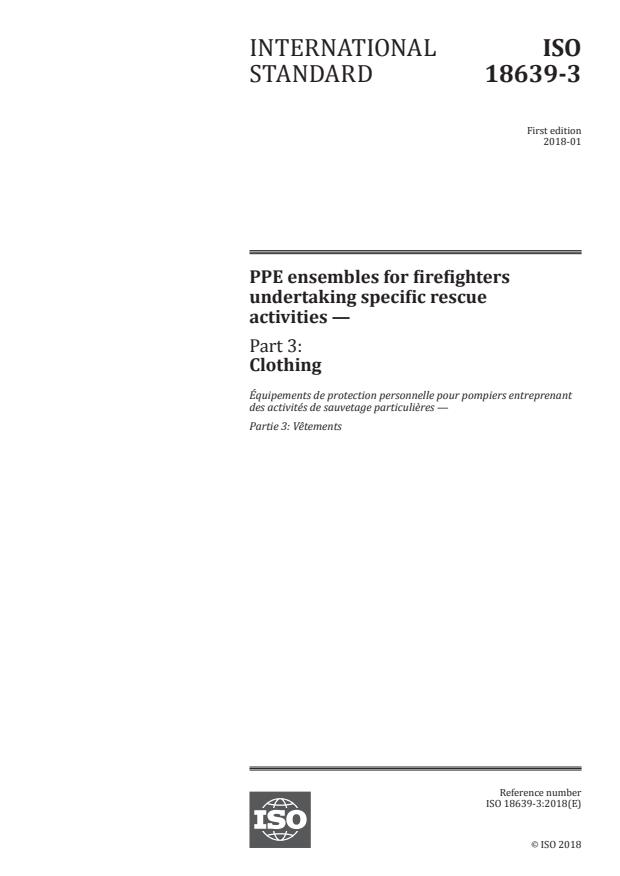
INTERNATIONAL ISO
STANDARD 18639-3
First edition
2018-01
PPE ensembles for firefighters
undertaking specific rescue
activities —
Part 3:
Clothing
Équipements de protection personnelle pour pompiers entreprenant
des activités de sauvetage particulières —
Partie 3: Vêtements
Reference number
©
ISO 2018
© ISO 2018, Published in Switzerland
All rights reserved. Unless otherwise specified, no part of this publication may be reproduced or utilized otherwise in any form
or by any means, electronic or mechanical, including photocopying, or posting on the internet or an intranet, without prior
written permission. Permission can be requested from either ISO at the address below or ISO’s member body in the country of
the requester.
ISO copyright office
Ch. de Blandonnet 8 • CP 401
CH-1214 Vernier, Geneva, Switzerland
Tel. +41 22 749 01 11
Fax +41 22 749 09 47
copyright@iso.org
www.iso.org
ii © ISO 2018 – All rights reserved
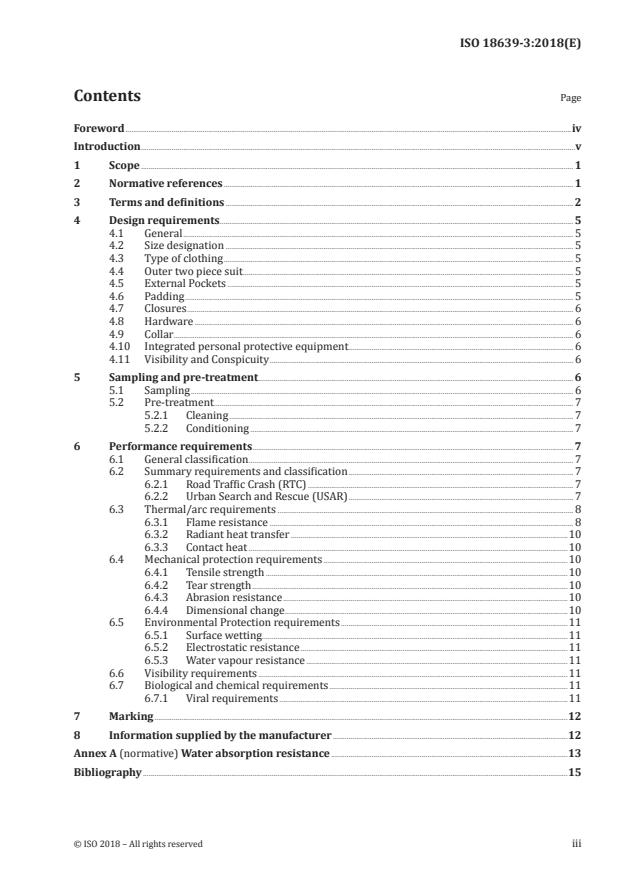
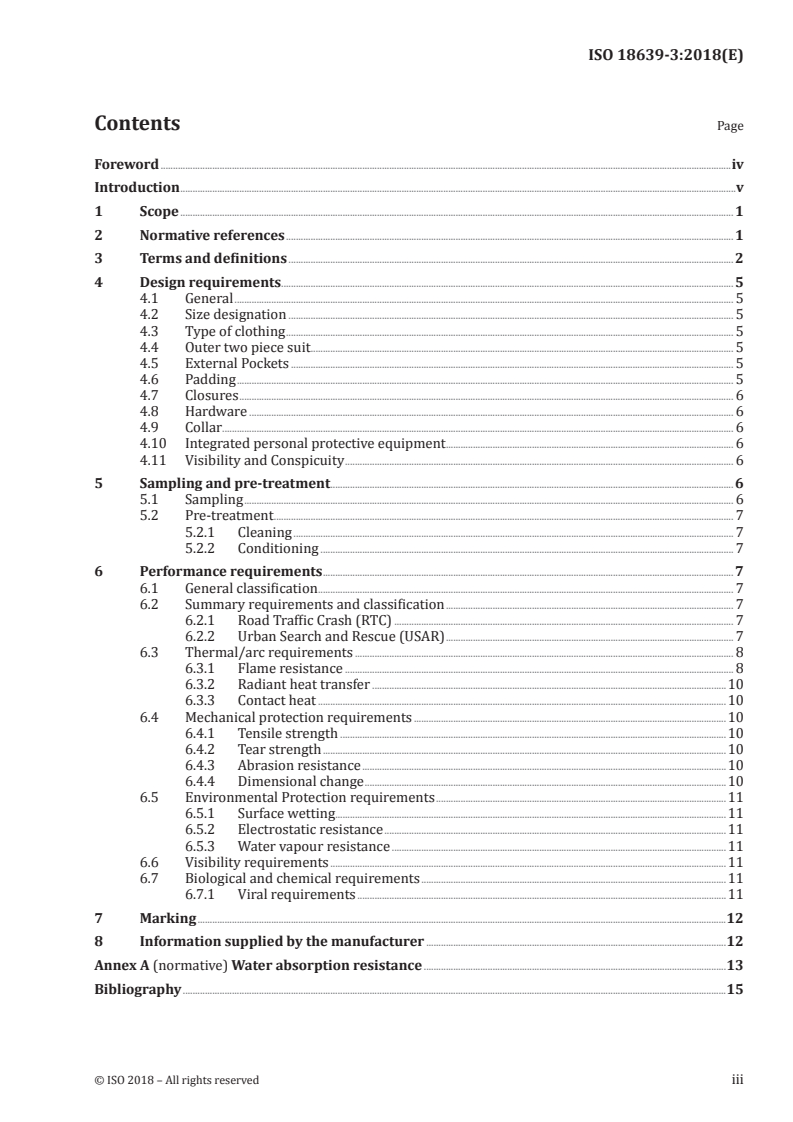
Contents Page
Foreword .iv
Introduction .v
1 Scope . 1
2 Normative references . 1
3 Terms and definitions . 2
4 Design requirements . 5
4.1 General . 5
4.2 Size designation . 5
4.3 Type of clothing . 5
4.4 Outer two piece suit . 5
4.5 External Pockets . 5
4.6 Padding . 5
4.7 Closures . 6
4.8 Hardware . 6
4.9 Collar . 6
4.10 Integrated personal protective equipment . 6
4.11 Visibility and Conspicuity . 6
5 Sampling and pre-treatment . 6
5.1 Sampling . 6
5.2 Pre-treatment . 7
5.2.1 Cleaning . 7
5.2.2 Conditioning . 7
6 Performance requirements . 7
6.1 General classification . 7
6.2 Summary requirements and classification . 7
6.2.1 Road Traffic Crash (RTC) . 7
6.2.2 Urban Search and Rescue (USAR) . 7
6.3 Thermal/arc requirements . 8
6.3.1 Flame resistance . 8
6.3.2 Radiant heat transfer .10
6.3.3 Contact heat .10
6.4 Mechanical protection requirements .10
6.4.1 Tensile strength .10
6.4.2 Tear strength .10
6.4.3 Abrasion resistance .10
6.4.4 Dimensional change .10
6.5 Environmental Protection requirements .11
6.5.1 Surface wetting . .11
6.5.2 Electrostatic resistance .11
6.5.3 Water vapour resistance .11
6.6 Visibility requirements .11
6.7 Biological and chemical requirements .11
6.7.1 Viral requirements .11
7 Marking .12
8 Information supplied by the manufacturer .12
Annex A (normative) Water absorption resistance .13
Bibliography .15
Foreword
ISO (the International Organization for Standardization) is a worldwide federation of national standards
bodies (ISO member bodies). The work of preparing International Standards is normally carried out
through ISO technical committees. Each member body interested in a subject for which a technical
committee has been established has the right to be represented on that committee. International
organizations, governmental and non-governmental, in liaison with ISO, also take part in the work.
ISO collaborates closely with the International Electrotechnical Commission (IEC) on all matters of
electrotechnical standardization.
The procedures used to develop this document and those intended for its further maintenance are
described in the ISO/IEC Directives, Part 1. In particular the different approval criteria needed for the
different types of ISO documents should be noted. This document was drafted in accordance with the
editorial rules of the ISO/IEC Directives, Part 2 (see www.iso.org/directives).
Attention is drawn to the possibility that some of the elements of this document may be the subject of
patent rights. ISO shall not be held responsible for identifying any or all such patent rights. Details of
any patent rights identified during the development of the document will be in the Introduction and/or
on the ISO list of patent declarations received (see www.iso.org/patents).
Any trade name used in this document is information given for the convenience of users and does not
constitute an endorsement.
For an explanation on the voluntary nature of standards, the meaning of ISO specific terms and
expressions related to conformity assessment, as well as information about ISO's adherence to the
World Trade Organization (WTO) principles in the Technical Barriers to Trade (TBT) see the following
URL: www.iso.org/iso/foreword.html.
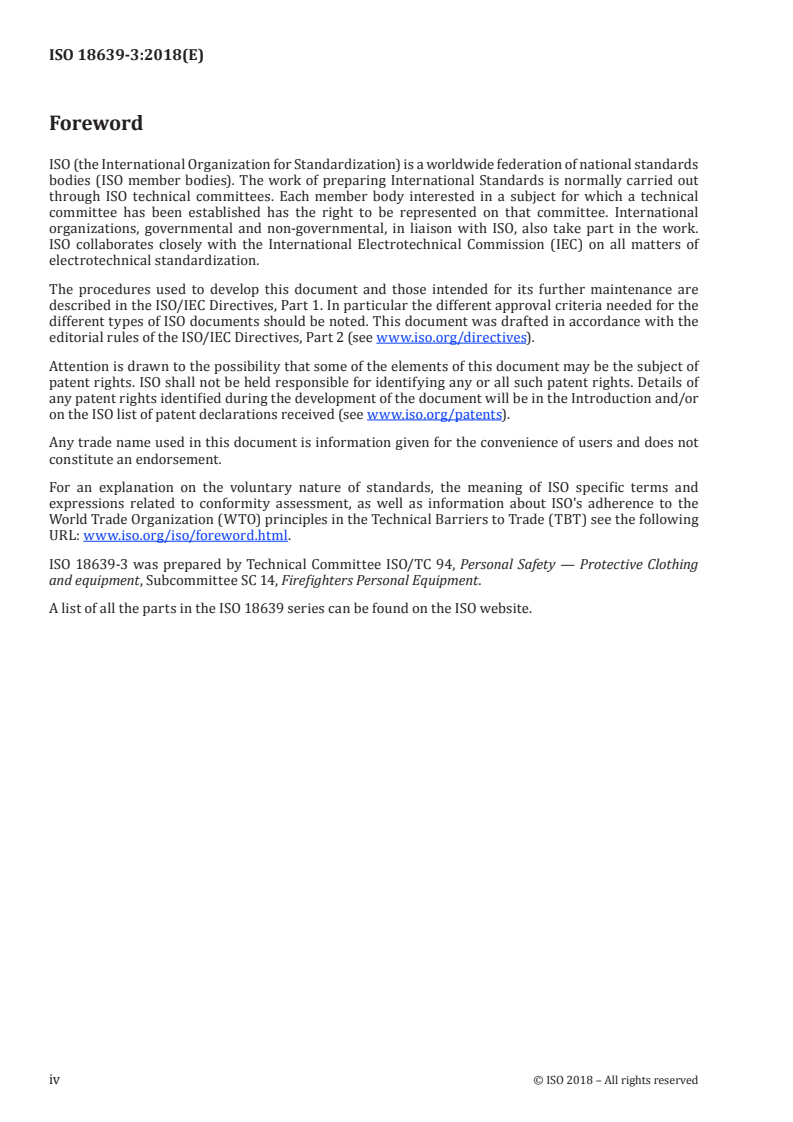
ISO 18639-3 was prepared by Technical Committee ISO/TC 94, Personal Safety — Protective Clothing
and equipment, Subcommittee SC 14, Firefighters Personal Equipment.
A list of all the parts in the ISO 18639 series can be found on the ISO website.
iv © ISO 2018 – All rights reserved
Introduction
ISO 18639 is a standard for personal protective equipment (PPE) for firefighters when engaged in
specific rescue activities. It is not possible to provide a standard for PPE to cover all of the diverse range
of rescue scenarios that firefighters are likely to encounter so it is important that risk assessments
be undertaken to determine if the PPE covered by ISO 18639 is suitable for its intended use and the
expected exposure to hazards. For complete protection against exposures, the risk assessment should
include protection of the whole body including the torso, arms and legs, head, face, hands and feet.
For certain rescue activities, safety ropes and harnesses can be required. For certain rescue situations,
special PPE for use in and on water may be required. In some cases, appropriate respiratory protection
may also be identified as being necessary.
The performance requirements in this document take account of accidental exposure to heat and flame,
but do not cover PPE for Firefighting. While this standard takes account of accidental exposure to some
common chemicals, it is not intended that PPE to this standard should be considered as providing
chemical protection as a primary function. It does not cover PPE to protect against biological, electrical
or radiation hazards. The risk assessment should determine whether PPE complying to this standard or
to the requirements of any other relevant standard is more suitable.
Firefighters should be trained in the use, care and maintenance of the PPE covered by this document,
including an understanding of its limitations.
INTERNATIONAL STANDARD ISO 18639-3:2018(E)
PPE ensembles for firefighters undertaking specific rescue
activities —
Part 3:
Clothing
1 Scope
This document specifies test methods and minimum performance requirements for protective clothing
for firefighters while engaged in rescue activities.
Clothing related to specific rescue activities are documented in individual subclauses, see 6.2.1 or 6.2.2.
NOTE For further guidance see ISO 18639-1.
Subclauses of this document cover general clothing design, the minimum performance level of the
materials used and the methods of test for determining this performance level.
This document does not cover special clothing for use in other high risk situations such as firefighting.
It does not cover protection for the head, hands and feet or protection against other hazards, e.g.
chemical, biological, radiation and electrical hazards, except for limited, accidental exposure to some
chemicals and contaminated blood or other body fluids.
2 Normative references
The following documents are referred to in the text in such a way that some or all of their content
constitutes requirements of this document. For dated references, only the edition cited applies. For
undated references, the latest edition of the referenced document (including any amendments) applies.
ISO 1421, Rubber- or plastics-coated fabrics — Determination of tensile strength and elongation at break
ISO 3175-1, Textiles – Professional care, dry cleaning and wet cleaning of fabrics and garments – Part 1:
Assessment of performance after cleaning and finishing
ISO 4674-1, Rubber- or plastics-coated fabrics — Determination of tear resistance — Part 1: Constant rate
of tear methods
ISO 4920, Textile fabrics — Determination of resistance to surface wetting (spray test)
ISO 5077, Textiles — Determination of dimensional change in washing and drying
ISO 6330, Textiles — Domestic washing and drying procedures for textile testing
ISO 6942, Protective clothing — Protection against heat and fire — Method of test: Evaluation of materials
and material assemblies when exposed to a source of radiant heat
ISO 11092, Textiles — Physiological effects — Measurement of thermal and water-vapour resistance under
steady-state conditions (sweating guarded-hotplate test)
ISO/TS 11999-2, PPE for firefighters — Test methods and requirements for PPE used by firefighters who
are at risk of exposure to high levels of heat and/or flame while fighting fires occurring in structures —
Part 2: Compatibility
ISO 12127-1, Clothing for protection against heat and flame — Determination of contact heat transmission
through protective clothing or constituent materials — Part 1: Contact heat produced by heating cylinder
ISO 12947-2, Textiles — Determination of the abrasion resistance of fabrics by the Martindale method —
Part 2: Determination of specimen breakdown
ISO 13688, Protective clothing — General requirements
ISO 13934-1, Textiles — Tensile properties of fabrics — Part 1: Determination of maximum force and
elongation at maximum force using the strip method
ISO 13935-2, Textiles — Seam tensile properties of fabrics and made-up textile articles — Part 2:
Determination of maximum force to seam rupture using the grab method
ISO 13937-2, Textiles — Tear properties of fabrics — Part 2: Determination of tear force of trouser-shaped
test specimens (Single tear method)
ISO 14116, Protective clothing — Protection against flame — Limited flame spread materials, material
assemblies and clothing
ISO 15025, Protective clothing — Protection against flame — Method of test for limited flame spread
ISO 16604, Clothing for protection against contact with blood and body fluids — Determination of
resistance of protective clothing materials to penetration by blood-borne pathogens — Test method using
Phi-X 174 bacteriophage
ISO 18639-1, PPE for firefighters undertaking specific rescue activities
ISO 17493, Clothing and equipment for protection against heat — Test method for convective heat
resistance using a hot air circulating oven
ISO 20471, High visibility clothing — Test methods and requirements
EN 1149-5, Protective clothing — Electrostatic properties. Material performance and design requirements
3 Terms and definitions
For the purposes of this document, the following terms and definitions apply.
ISO and IEC maintain terminological databases for use in standardization at the following addresses:
— ISO Online browsing platform: available at https://www.iso.org/obp
— IEC Electropedia: available at http://www.electropedia.org/
3.1
anti-wicking barrier
material used to prevent the transfer of liquid from outside the garment to inside the garment, usually
in addition to or replacing part of the moisture barrier at the edge(s)
3.2
clothing assembly
levels of performance specified in this document achieved by the use of a garment or a clothing
assembly, which may contain multilayer materials, material combinations in single layers, or a series of
separate garments
2 © ISO 2018 – All rights reserved
3.3
cleaning
process by which a PPE is made again serviceable and/or hygienically wearable by removing any dirt or
contamination
Note 1 to entry: A cleaning cycle is typically a washing plus drying or a dry cleaning treatment followed, if
required, by ironing or finishing.
3.4
closure system
method of fastening openings in the garment including combinations of more than one method of
achieving a secure closure
Note 1 to entry: This term does not cover seams.
3.5
component assembly
combination of all materials of a multi-layer garment presented exactly as the finished garment
construction
3.6
conditioning
keeping samples under standard conditions of temperature and relative humidity for a minimum
period of time
3.7
drain mesh material
permeable material designed to allow drainage of water between the moisture barrier and
innermost lining
3.8
garment
single item of clothing which may consist of single or multiple layers
3.9
hardware
non-fabric items used in protective clothing including those made of metal or plastic, e.g. touch and
close fasteners, buttons, zippers, embroideries, braces
3.10
high visibility trim
material exhibiting separate performance or combined performance of retroreflective and fluorescent
properties
Note 1 to entry: Retroreflective materials enhance night time visibility and fluorescent materials improve
daytime visibility.
3.11
interface area
area where two separate and adjacent items of PPE interface function together to provide continuity of
protection and performance
3.12
innermost lining
lining on the innermost face of a component assembly which is intended to be nearest to the wearer’s skin
Note 1 to entry: Where the innermost lining forms part of a material combination, the material combination is
regarded as the innermost lining.
3.13
interlining
layer between the outermost layer and the innermost lining in a multilayer garment
3.14
material
substances excluding hardware and labels, of which an item of clothing is made
3.15
material assembly
combination of all materials of a multi-layer garment presented exactly as the finished garment
construction
3.16
material combination
material produced from a series of separate layers, fixed together during the garment manufacturing
stage
3.17
moisture barrier
fabric or membrane used in a component assembly to achieve the properties of hydrostatic resistance
with water vapour permeability
Note 1 to entry: Moisture barriers may not prevent the passage of some chemical (except incidentally), biological,
or radiological agents. Appropriate PPE should be provided to protect the wearer in such instances.
3.18
multilayer material
material consisting of different layers intimately combined prior to the garment manufacturing stage,
e.g. by weaving, quilting, coating or gluing
3.19
outer garment
outermost garment of the clothing that will be exposed to the hazard(s)
3.20
outer material
outermost material (i.e., outer shell) of which the clothing assembly is made, with the exception of trim,
hardware, reinforcing materials and wristlet material
3.21
overlapping seam
any seam where all or parts of one or more layers of material cover any other layer or layers
3.22
pre-treatment
standard way of preparing the samples before testing
Note 1 to entry: This may include e.g. a number of cleaning cycles, submitting the sample to heat, mechanical
action or any other relevant exposure and is finished by conditioning.
3.23
rank markings
symbol or colour coding system denoting the rank or position within the hierarchy of an organisation
or group
EXAMPLE Embroideries, badges, patches, transfers.
3.24
seam
permanent fastening betwee
...
INTERNATIONAL ISO
STANDARD 18639-3
First edition
2018-01
PPE ensembles for firefighters
undertaking specific rescue
activities —
Part 3:
Clothing
Équipements de protection personnelle pour pompiers entreprenant
des activités de sauvetage particulières —
Partie 3: Vêtements
Reference number
©
ISO 2018
© ISO 2018, Published in Switzerland
All rights reserved. Unless otherwise specified, no part of this publication may be reproduced or utilized otherwise in any form
or by any means, electronic or mechanical, including photocopying, or posting on the internet or an intranet, without prior
written permission. Permission can be requested from either ISO at the address below or ISO’s member body in the country of
the requester.
ISO copyright office
Ch. de Blandonnet 8 • CP 401
CH-1214 Vernier, Geneva, Switzerland
Tel. +41 22 749 01 11
Fax +41 22 749 09 47
copyright@iso.org
www.iso.org
ii © ISO 2018 – All rights reserved
Contents Page
Foreword .iv
Introduction .v
1 Scope . 1
2 Normative references . 1
3 Terms and definitions . 2
4 Design requirements . 5
4.1 General . 5
4.2 Size designation . 5
4.3 Type of clothing . 5
4.4 Outer two piece suit . 5
4.5 External Pockets . 5
4.6 Padding . 5
4.7 Closures . 6
4.8 Hardware . 6
4.9 Collar . 6
4.10 Integrated personal protective equipment . 6
4.11 Visibility and Conspicuity . 6
5 Sampling and pre-treatment . 6
5.1 Sampling . 6
5.2 Pre-treatment . 7
5.2.1 Cleaning . 7
5.2.2 Conditioning . 7
6 Performance requirements . 7
6.1 General classification . 7
6.2 Summary requirements and classification . 7
6.2.1 Road Traffic Crash (RTC) . 7
6.2.2 Urban Search and Rescue (USAR) . 7
6.3 Thermal/arc requirements . 8
6.3.1 Flame resistance . 8
6.3.2 Radiant heat transfer .10
6.3.3 Contact heat .10
6.4 Mechanical protection requirements .10
6.4.1 Tensile strength .10
6.4.2 Tear strength .10
6.4.3 Abrasion resistance .10
6.4.4 Dimensional change .10
6.5 Environmental Protection requirements .11
6.5.1 Surface wetting . .11
6.5.2 Electrostatic resistance .11
6.5.3 Water vapour resistance .11
6.6 Visibility requirements .11
6.7 Biological and chemical requirements .11
6.7.1 Viral requirements .11
7 Marking .12
8 Information supplied by the manufacturer .12
Annex A (normative) Water absorption resistance .13
Bibliography .15
Foreword
ISO (the International Organization for Standardization) is a worldwide federation of national standards
bodies (ISO member bodies). The work of preparing International Standards is normally carried out
through ISO technical committees. Each member body interested in a subject for which a technical
committee has been established has the right to be represented on that committee. International
organizations, governmental and non-governmental, in liaison with ISO, also take part in the work.
ISO collaborates closely with the International Electrotechnical Commission (IEC) on all matters of
electrotechnical standardization.
The procedures used to develop this document and those intended for its further maintenance are
described in the ISO/IEC Directives, Part 1. In particular the different approval criteria needed for the
different types of ISO documents should be noted. This document was drafted in accordance with the
editorial rules of the ISO/IEC Directives, Part 2 (see www.iso.org/directives).
Attention is drawn to the possibility that some of the elements of this document may be the subject of
patent rights. ISO shall not be held responsible for identifying any or all such patent rights. Details of
any patent rights identified during the development of the document will be in the Introduction and/or
on the ISO list of patent declarations received (see www.iso.org/patents).
Any trade name used in this document is information given for the convenience of users and does not
constitute an endorsement.
For an explanation on the voluntary nature of standards, the meaning of ISO specific terms and
expressions related to conformity assessment, as well as information about ISO's adherence to the
World Trade Organization (WTO) principles in the Technical Barriers to Trade (TBT) see the following
URL: www.iso.org/iso/foreword.html.
ISO 18639-3 was prepared by Technical Committee ISO/TC 94, Personal Safety — Protective Clothing
and equipment, Subcommittee SC 14, Firefighters Personal Equipment.
A list of all the parts in the ISO 18639 series can be found on the ISO website.
iv © ISO 2018 – All rights reserved
Introduction
ISO 18639 is a standard for personal protective equipment (PPE) for firefighters when engaged in
specific rescue activities. It is not possible to provide a standard for PPE to cover all of the diverse range
of rescue scenarios that firefighters are likely to encounter so it is important that risk assessments
be undertaken to determine if the PPE covered by ISO 18639 is suitable for its intended use and the
expected exposure to hazards. For complete protection against exposures, the risk assessment should
include protection of the whole body including the torso, arms and legs, head, face, hands and feet.
For certain rescue activities, safety ropes and harnesses can be required. For certain rescue situations,
special PPE for use in and on water may be required. In some cases, appropriate respiratory protection
may also be identified as being necessary.
The performance requirements in this document take account of accidental exposure to heat and flame,
but do not cover PPE for Firefighting. While this standard takes account of accidental exposure to some
common chemicals, it is not intended that PPE to this standard should be considered as providing
chemical protection as a primary function. It does not cover PPE to protect against biological, electrical
or radiation hazards. The risk assessment should determine whether PPE complying to this standard or
to the requirements of any other relevant standard is more suitable.
Firefighters should be trained in the use, care and maintenance of the PPE covered by this document,
including an understanding of its limitations.
INTERNATIONAL STANDARD ISO 18639-3:2018(E)
PPE ensembles for firefighters undertaking specific rescue
activities —
Part 3:
Clothing
1 Scope
This document specifies test methods and minimum performance requirements for protective clothing
for firefighters while engaged in rescue activities.
Clothing related to specific rescue activities are documented in individual subclauses, see 6.2.1 or 6.2.2.
NOTE For further guidance see ISO 18639-1.
Subclauses of this document cover general clothing design, the minimum performance level of the
materials used and the methods of test for determining this performance level.
This document does not cover special clothing for use in other high risk situations such as firefighting.
It does not cover protection for the head, hands and feet or protection against other hazards, e.g.
chemical, biological, radiation and electrical hazards, except for limited, accidental exposure to some
chemicals and contaminated blood or other body fluids.
2 Normative references
The following documents are referred to in the text in such a way that some or all of their content
constitutes requirements of this document. For dated references, only the edition cited applies. For
undated references, the latest edition of the referenced document (including any amendments) applies.
ISO 1421, Rubber- or plastics-coated fabrics — Determination of tensile strength and elongation at break
ISO 3175-1, Textiles – Professional care, dry cleaning and wet cleaning of fabrics and garments – Part 1:
Assessment of performance after cleaning and finishing
ISO 4674-1, Rubber- or plastics-coated fabrics — Determination of tear resistance — Part 1: Constant rate
of tear methods
ISO 4920, Textile fabrics — Determination of resistance to surface wetting (spray test)
ISO 5077, Textiles — Determination of dimensional change in washing and drying
ISO 6330, Textiles — Domestic washing and drying procedures for textile testing
ISO 6942, Protective clothing — Protection against heat and fire — Method of test: Evaluation of materials
and material assemblies when exposed to a source of radiant heat
ISO 11092, Textiles — Physiological effects — Measurement of thermal and water-vapour resistance under
steady-state conditions (sweating guarded-hotplate test)
ISO/TS 11999-2, PPE for firefighters — Test methods and requirements for PPE used by firefighters who
are at risk of exposure to high levels of heat and/or flame while fighting fires occurring in structures —
Part 2: Compatibility
ISO 12127-1, Clothing for protection against heat and flame — Determination of contact heat transmission
through protective clothing or constituent materials — Part 1: Contact heat produced by heating cylinder
ISO 12947-2, Textiles — Determination of the abrasion resistance of fabrics by the Martindale method —
Part 2: Determination of specimen breakdown
ISO 13688, Protective clothing — General requirements
ISO 13934-1, Textiles — Tensile properties of fabrics — Part 1: Determination of maximum force and
elongation at maximum force using the strip method
ISO 13935-2, Textiles — Seam tensile properties of fabrics and made-up textile articles — Part 2:
Determination of maximum force to seam rupture using the grab method
ISO 13937-2, Textiles — Tear properties of fabrics — Part 2: Determination of tear force of trouser-shaped
test specimens (Single tear method)
ISO 14116, Protective clothing — Protection against flame — Limited flame spread materials, material
assemblies and clothing
ISO 15025, Protective clothing — Protection against flame — Method of test for limited flame spread
ISO 16604, Clothing for protection against contact with blood and body fluids — Determination of
resistance of protective clothing materials to penetration by blood-borne pathogens — Test method using
Phi-X 174 bacteriophage
ISO 18639-1, PPE for firefighters undertaking specific rescue activities
ISO 17493, Clothing and equipment for protection against heat — Test method for convective heat
resistance using a hot air circulating oven
ISO 20471, High visibility clothing — Test methods and requirements
EN 1149-5, Protective clothing — Electrostatic properties. Material performance and design requirements
3 Terms and definitions
For the purposes of this document, the following terms and definitions apply.
ISO and IEC maintain terminological databases for use in standardization at the following addresses:
— ISO Online browsing platform: available at https://www.iso.org/obp
— IEC Electropedia: available at http://www.electropedia.org/
3.1
anti-wicking barrier
material used to prevent the transfer of liquid from outside the garment to inside the garment, usually
in addition to or replacing part of the moisture barrier at the edge(s)
3.2
clothing assembly
levels of performance specified in this document achieved by the use of a garment or a clothing
assembly, which may contain multilayer materials, material combinations in single layers, or a series of
separate garments
2 © ISO 2018 – All rights reserved
3.3
cleaning
process by which a PPE is made again serviceable and/or hygienically wearable by removing any dirt or
contamination
Note 1 to entry: A cleaning cycle is typically a washing plus drying or a dry cleaning treatment followed, if
required, by ironing or finishing.
3.4
closure system
method of fastening openings in the garment including combinations of more than one method of
achieving a secure closure
Note 1 to entry: This term does not cover seams.
3.5
component assembly
combination of all materials of a multi-layer garment presented exactly as the finished garment
construction
3.6
conditioning
keeping samples under standard conditions of temperature and relative humidity for a minimum
period of time
3.7
drain mesh material
permeable material designed to allow drainage of water between the moisture barrier and
innermost lining
3.8
garment
single item of clothing which may consist of single or multiple layers
3.9
hardware
non-fabric items used in protective clothing including those made of metal or plastic, e.g. touch and
close fasteners, buttons, zippers, embroideries, braces
3.10
high visibility trim
material exhibiting separate performance or combined performance of retroreflective and fluorescent
properties
Note 1 to entry: Retroreflective materials enhance night time visibility and fluorescent materials improve
daytime visibility.
3.11
interface area
area where two separate and adjacent items of PPE interface function together to provide continuity of
protection and performance
3.12
innermost lining
lining on the innermost face of a component assembly which is intended to be nearest to the wearer’s skin
Note 1 to entry: Where the innermost lining forms part of a material combination, the material combination is
regarded as the innermost lining.
3.13
interlining
layer between the outermost layer and the innermost lining in a multilayer garment
3.14
material
substances excluding hardware and labels, of which an item of clothing is made
3.15
material assembly
combination of all materials of a multi-layer garment presented exactly as the finished garment
construction
3.16
material combination
material produced from a series of separate layers, fixed together during the garment manufacturing
stage
3.17
moisture barrier
fabric or membrane used in a component assembly to achieve the properties of hydrostatic resistance
with water vapour permeability
Note 1 to entry: Moisture barriers may not prevent the passage of some chemical (except incidentally), biological,
or radiological agents. Appropriate PPE should be provided to protect the wearer in such instances.
3.18
multilayer material
material consisting of different layers intimately combined prior to the garment manufacturing stage,
e.g. by weaving, quilting, coating or gluing
3.19
outer garment
outermost garment of the clothing that will be exposed to the hazard(s)
3.20
outer material
outermost material (i.e., outer shell) of which the clothing assembly is made, with the exception of trim,
hardware, reinforcing materials and wristlet material
3.21
overlapping seam
any seam where all or parts of one or more layers of material cover any other layer or layers
3.22
pre-treatment
standard way of preparing the samples before testing
Note 1 to entry: This may include e.g. a number of cleaning cycles, submitting the sample to heat, mechanical
action or any other relevant exposure and is finished by conditioning.
3.23
rank markings
symbol or colour coding system denoting the rank or position within the hierarchy of an organisation
or group
EXAMPLE Embroideries, badges, patches, transfers.
3.24
seam
permanent fastening betwee
...