


ISO/IEC 30118-10:2021
(Main)Information technology – Open Connectivity Foundation (OCF) Specification — Part 10: Cloud API for cloud services specification
Information technology – Open Connectivity Foundation (OCF) Specification — Part 10: Cloud API for cloud services specification
This document defines functional requirements for the OCF Cloud to Cloud Application Programming Interface (API).
Technologies de l'information — Specification de la Fondation pour la connectivité ouverte (Fondation OCF) — Partie 10: Spécification API nuage pour les services en nuage
General Information
Standards Content (Sample)
INTERNATIONAL ISO/IEC
STANDARD 30118-10
First edition
2021-10
Information technology — Open
Connectivity Foundation (OCF)
Specification —
Part 10:
Cloud API for cloud services
specification
Technologies de l'information — Specification de la Fondation pour la
connectivité ouverte (Fondation OCF) —
Partie 10: Spécification API nuage pour les services en nuage
Reference number
© ISO/IEC 2021
© ISO/IEC 2021
All rights reserved. Unless otherwise specified, or required in the context of its implementation, no part of this publication may
be reproduced or utilized otherwise in any form or by any means, electronic or mechanical, including photocopying, or posting on
the internet or an intranet, without prior written permission. Permission can be requested from either ISO at the address below
or ISO’s member body in the country of the requester.
ISO copyright office
CP 401 • Ch. de Blandonnet 8
CH-1214 Vernier, Geneva
Phone: +41 22 749 01 11
Email: copyright@iso.org
Website: www.iso.org
Published in Switzerland
ii
© ISO/IEC 2021 – All rights reserved
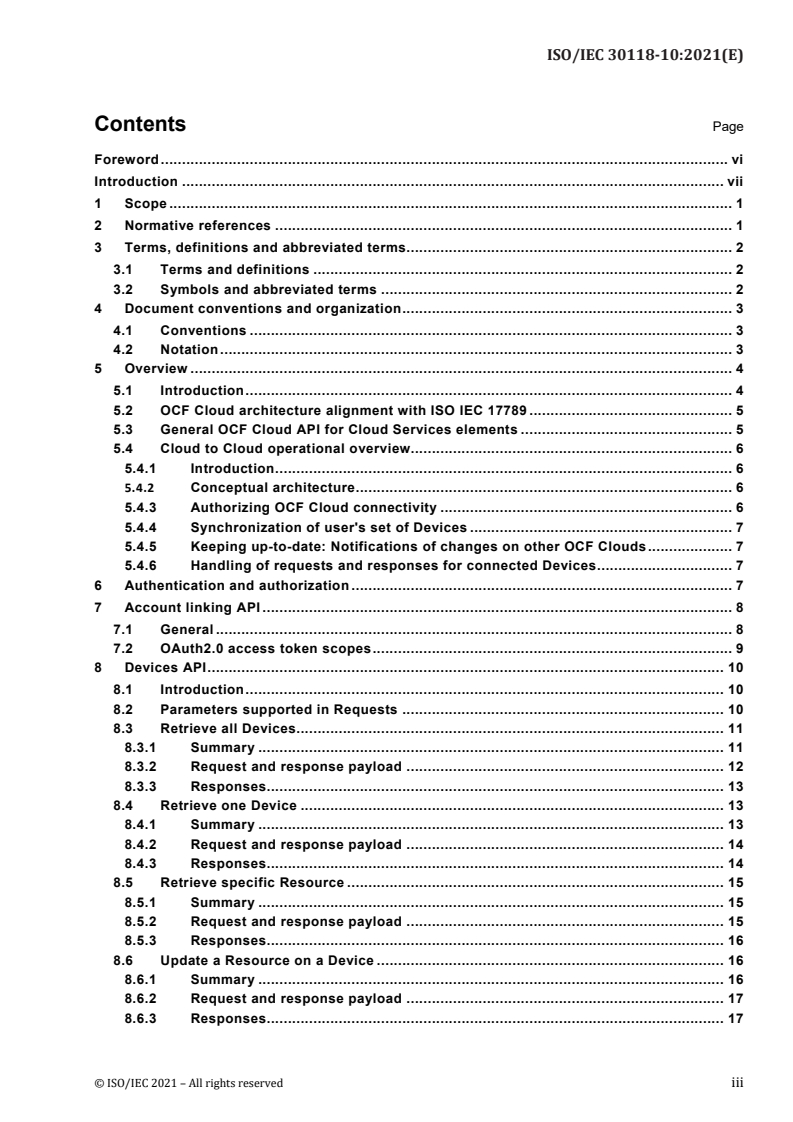
Contents Page
Foreword . vi
Introduction . vii
1 Scope . 1
2 Normative references . 1
3 Terms, definitions and abbreviated terms . 2
3.1 Terms and definitions . 2
3.2 Symbols and abbreviated terms . 2
4 Document conventions and organization . 3
4.1 Conventions . 3
4.2 Notation . 3
5 Overview . 4
5.1 Introduction . 4
5.2 OCF Cloud architecture alignment with ISO IEC 17789 . 5
5.3 General OCF Cloud API for Cloud Services elements . 5
5.4 Cloud to Cloud operational overview. 6
5.4.1 Introduction . 6
5.4.2 Conceptual architecture . 6
5.4.3 Authorizing OCF Cloud connectivity . 6
5.4.4 Synchronization of user's set of Devices . 7
5.4.5 Keeping up-to-date: Notifications of changes on other OCF Clouds . 7
5.4.6 Handling of requests and responses for connected Devices . 7
6 Authentication and authorization . 7
7 Account linking API . 8
7.1 General . 8
7.2 OAuth2.0 access token scopes . 9
8 Devices API . 10
8.1 Introduction . 10
8.2 Parameters supported in Requests . 10
8.3 Retrieve all Devices . 11
8.3.1 Summary . 11
8.3.2 Request and response payload . 12
8.3.3 Responses . 13
8.4 Retrieve one Device . 13
8.4.1 Summary . 13
8.4.2 Request and response payload . 14
8.4.3 Responses . 14
8.5 Retrieve specific Resource . 15
8.5.1 Summary . 15
8.5.2 Request and response payload . 15
8.5.3 Responses . 16
8.6 Update a Resource on a Device . 16
8.6.1 Summary . 16
8.6.2 Request and response payload . 17
8.6.3 Responses . 17
© ISO/IEC 2021 – All rights reserved iii
9 Events API . 18
9.1 Introduction . 18
9.2 Events authentication . 19
9.2.1 Introduction . 19
9.2.2 Create event signature . 19
9.2.1 Verify the event signature . 19
9.3 Parameters supported . 20
9.4 Events API subscription and notification payload definitions . 20
9.4.1 Subscription request . 20
9.4.2 Subscription response . 21
9.4.3 Notification request . 22
9.4.4 Notification response . 24
9.5 Subscribe and unsubscribe to devices level event types . 24
9.5.1 Summary . 24
9.5.2 Request and response payload . 25
9.5.3 Responses . 25
9.6 Subscribe and unsubscribe to device level events . 25
9.6.1 Summary . 25
9.6.2 Request and response payload . 26
9.6.3 Responses . 26
9.7 Subscribe and unsubscribe to resource level events . 27
9.7.1 Summary . 27
9.7.2 Request and response payload . 27
9.7.3 Responses . 28
9.8 Notification of devices level events . 28
9.8.1 Summary . 28
9.8.2 Request and response payload . 29
9.8.3 Responses . 29
9.9 Notification of Device level events . 29
9.9.1 Summary . 29
9.9.2 Request and response payload . 30
9.9.3 Responses . 30
9.10 Notification of Resource level events . 30
9.10.1 Summary . 30
9.10.2 Request and response payload . 31
9.10.3 Responses . 31
Representative flows . 32
A.1 Introduction . 32
A.2 OAuth2.0 application registration . 32
A.3 Account linking . 32
A.4 Retrieval of all Devices . 33
A.4.1 Summary . 33
A.4.2 Flow . 33
A.4.3 Flow description . 34
A.5 Retrieval of a single Device . 34
A.5.1 Summary . 34
A.5.2 Flow . 34
A.5.3 Flow description . 35
iv © ISO/IEC 2021 – All rights reserved
A.6 Retrieval of a single Resource . 35
A.6.1 Summary . 35
A.6.2 Flows . 35
A.7 Update of a single Resource . 37
A.7.1 Summary . 37
A.7.2 Flows . 37
A.8 Establishment of new subscription request . 38
A.8.1 Summary . 38
A.8.2 Flows . 38
A.9 Event generated for a subscription . 39
A.9.1 Summary . 39
A.9.2 Flows . 39
A.10 Addition of new registration . 40
A.10.1 Summary . 40
A.10.2 Flows . 40
A.11 Removal of existing device registration . 40
A.11.1 Summary . 40
A.11.2 Flows . 40
Open API Definition . 42
B.1 OCF Cloud API for Cloud Services . 42
B.1.1 Supported APIs . 42
B.1.2 OpenAPI 2.0 definition . 43
© ISO/IEC 2021 – All rights reserved v
Foreword
ISO (the International Organization for Standardization) and IEC (the International Electrotechnical
Commission) form the specialized system for worldwide standardization. National bodies that are members of
ISO or IEC participate in the development of International Standards through technical committees established
by the respective organization to deal with particular fields of technical activity. ISO and IEC technical
committees collaborate in fields of mutual interest. Other international organizations, governmental and non-
governmental, in liaison with ISO and IEC, also take part in the work.
The procedures used to develop this document and those intended for its further maintenance are described in
the ISO/IEC Directives, Part 1. In particular, the different approval criteria needed for the different types of
document should be noted (see www.iso.org/directives or www.iec.ch/members_experts/refdocs).
Attention is drawn to the possibility that some of the elements of this document may be the subject of patent
rights. ISO and IEC shall not be held responsible for identifying any or all such patent rights. Details of any
patent rights identified during the development of the document will be in the Introduction and/or on the ISO list
of patent declarations received (see www.iso.org/patents) or the IEC list of patent declarations received
(see patents.iec.ch).
Any trade name used in this document is information given for the convenience of users and does not constitute
an endorsement.
For an explanation of the voluntary nature of standards, the meaning of ISO specific terms and expressions
related to conformity assessment, as well as information about ISO's adherence to the World Trade
Organization (WTO) principles in the Technical Barriers to Trade (TBT), see www.iso.org/iso/foreword.html. In
the IEC, see www.iec.ch/understanding-standards.
This document was prepared by the Open Connectivity Foundation (OCF) (as OCF Cloud Open API for Cloud
Services Specification, version 2.2.0) and drafted in accordance with its editorial rules. It was adopted, under
the JTC 1 PAS procedure, by Joint Technical Committee ISO/IEC JTC 1, Information technology.
A list of all parts in the ISO/IEC 30118 series can be found on the ISO and IEC websites.
Any feedback or questions on this document should be directed to the user’s national standards body. A
complete listing of these bodies can be found at www.iso.org/members.html and www.iec.ch/national-
committees.
vi © ISO/IEC 2021 – All rights reserved
Introduction
This document, and all the other parts associated with this document, were developed in response to
worldwide demand for smart home focused Internet of Things (IoT) devices, such as appliances, door
locks, security cameras, sensors, and actuators; these to be modelled and securely controlled, locally
and remotely, over an IP network.
While some inter-device communication existed, no universal language had been developed for the
IoT. Device makers instead had to choose between disparate frameworks, limiting their market share,
or developing across multiple ecosystems, increasing their costs. The burden then falls on end users
to determine whether the products they want are compatible with the ecosystem they bought into, or
find ways to integrate their devices into their network, and try to solve interoperability issues on their
own.
In addition to the smart home, IoT deployments in commercial environments are hampered by a lack
of security. This issue can be avoided by having a secure IoT communication framework, which this
standard solves.
The goal of these documents is then to connect the next 25 billion devices for the IoT, providing secure
and reliable device discovery and connectivity across multiple OSs and platforms. There are multiple
proposals and forums driving different approaches, but no single solution addresses the majority of
key requirements. This document and the associated parts enable industry consolidation around a
common, secure, interoperable approach.
ISO/IEC 30118 consists of eighteen parts, under the general title Information technology — Open
Connectivity Foundation (OCF) Specification. The parts fall into logical groupings as described herein:
– Core framework
– Part 1: Core Specification
– Part 2: Security Specification
– Part 13: Onboarding Tool Specification
– Bridging framework and bridges
– Part 3: Bridging Specification
– Part 6: Resource to Alljoyn Interface Mapping Specification
– Part 8: OCF Resource to oneM2M Resource Mapping Specification
– Part 14: OCF Resource to BLE Mapping Specification
– Part 15: OCF Resource to EnOcean Mapping Specification
– Part 16: OCF Resource to UPlus Mapping Specification
– Part 17: OCF Resource to Zigbee Cluster Mapping Specification
– Part 18: OCF Resource to Z-Wave Mapping Specification
– Resource and Device models
– Part 4: Resource Type Specification
– Part 5: Device Specification
© ISO/IEC 2021 – All rights reserved vii
– Core framework extensions
– Part 7: Wi-Fi Easy Setup Specification
– Part 9: Core Optional Specification
– OCF Cloud
– Part 10: Cloud API for Cloud Services Specification
– Part 11: Device to Cloud Services Specification
– Part 12: Cloud Security Specification
viii © ISO/IEC 2021 – All rights reserved
INTERNATIONAL STANDARD ISO/IEC 30118-10:2021(E)
Information technology — Open Connectivity
Foundation (OCF) Specification —
Part 10:
Cloud API for cloud services specification
1 Scope
This document defines functional requirements for the OCF Cloud to Cloud Application Programming
Interface (API).
2 Normative references
The following documents are referred to in the text in such a way that some or all of their content
constitutes requirements of this document. For dated references, only the edition cited applies. For
undated references, the latest edition of the referenced document (including any amendments) applies.
IETF RFC 2818, HTTP over TLS, May 2000
https://tools.ietf.org/html/rfc2818
IETF RFC 5646, Tags for Identifying Languages, September 2009
https://www.rfc-editor.org/info/rfc5646
IETF RFC 6749, The OAuth 2.0 Authorization Framework, October 2012
https://tools.ietf.org/html/rfc6749
IETF RFC 6750, The OAuth 2.0 Authorization Framework: Bearer Token Usage, October 2012
https://www.rfc-editor.org/info/rfc6750
IETF RFC 7628, A Set of Simple Authentication and Security Layer (SASL) Mechanisms for OAuth,
August 2015
https://www.rfc-editor.org/info/rfc7628
ISO/IEC 17788 Information technology – Cloud computing – Overview and vocabulary
https://www.iso.org/standard/60544.html
ISO/IEC 17789 Information technology – Cloud computing – Reference architecture
https://www.iso.org/standard/60545.html
ISO/IEC 30118-1, Information technology -- Open Connectivity Foundation (OCF) Specification --
Part 1: Core specification
https://www.iso.org/standard/53238.html
ISO/IEC 30118-2, Information technology -- Open Connectivity Foundation (OCF) Specification --
Part 2: Security specification
https://www.iso.org/standard/74239.html
© ISO/IEC 2021 – All rights reserved 1
OCF Cloud Security, Open Connectivity Foundation Cloud Security, Version 2.2.0
Available at: https://openconnectivity.org/specs/OCF_Cloud_Security_Specification_v2.2.0.pdf
OCF Device to Cloud Services, Open Connectivity Foundation Device to Cloud Services Specification,
Version 2.2.0
Available at:
https://openconnectivity.org/specs/OCF_Device_To_Cloud_Services_Specification_v2.2.0.pdf
OCF Cloud API for Cloud Services
https://github.com/openconnectivityfoundation/core-extensions/blob/ocfcloud-
openapi/swagger2.0/oic.r.cloudopenapi.swagger.json
OpenAPI 2.0, fka Swagger RESTful API Documentation Specification, Version 2.0
https://github.com/OAI/OpenAPI-Specification/blob/master/versions/2.0.md
3 Terms, definitions and abbreviated terms
3.1 Terms and definitions
For the purposes of this document, the terms and definitions given in ISO/IEC 30118-1,
ISO/IEC 30118-2, OCF Device to Cloud Services and the following apply.
ISO and IEC maintain terminological databases for use in standardization at the following addresses:
– ISO Online browsing platform: available at https://www.iso.org/obp
– IEC Electropedia: available at http://www.electropedia.org/
3.1.1
API Endpoint
defined URL to which requests defined in this document are sent
3.1.2
Bearer Token
OAuth2.0 access token as defined within IETF RFC 6750
3.1.3
Origin Cloud
OCF Cloud through which the user works with his OCF Devices
3.1.4
Subscription ID
unique identity that is associated with an instance of a subscription to an event (or events)
3.1.5
Target Cloud
OCF Cloud to which OCF Servers (OCF Devices) are connected which the user wants to control via
the Origin Cloud (3.1.2)
3.2 Symbols and abbreviated terms
API Application Programming Interface
HMAC Hash-based Message Authentication Code
2 © ISO/IEC 2021 – All rights reserved
4 Document conventions and organization
4.1 Conventions
In this document a number of terms, conditions, mechanisms, sequences, parameters, events, states,
or similar terms are printed with the first letter of each word in uppercase and the rest lowercase (e.g.,
Network Architecture). Any lowercase uses of these words have the normal technical English meaning.
In this document, to be consistent with the IETF usages for RESTful operations, the RESTful operation
words CRUDN, CREATE, RETRIVE, UPDATE, DELETE, and NOTIFY will have all letters capitalized.
Any lowercase uses of these words have the normal technical English meaning.
4.2 Notation
In this document, features are described as required, recommended, allowed or DEPRECATED as
follows:
Required (or shall or mandatory)(M).
– These basic features shall be implemented to comply with Core Architecture. The phrases "shall
not", and "PROHIBITED" indicate behaviour that is prohibited, i.e. that if performed means the
implementation is not in compliance.
Recommended (or should)(S).
– These features add functionality supported by Core Architecture and should be implemented.
Recommended features take advantage of the capabilities Core Architecture, usually without
imposing major increase of complexity. Notice that for compliance testing, if a recommended
feature is implemented, it shall meet the specified requirements to be in compliance with these
guidelines. Some recommended features could become requirements in the future. The phrase
"should not" indicates behaviour that is permitted but not recommended.
Allowed (may or allowed)(O).
– These features are neither required nor recommended by Core Architecture, but if the feature is
implemented, it shall meet the specified requirements to be in compliance with these guidelines.
DEPRECATED.
– Although these features are still described in this document, they should not be implemented except
for backward compatibility. The occurrence of a deprecated feature during operation of an
implementation compliant with the current document has no effect on the implementation’s
operation and does not produce any error conditions. Backward compatibility may require that a
feature is implemented and functions as specified but it shall never be used by implementations
compliant with this document.
Conditionally allowed (CA)
– The definition or behaviour depends on a condition. If the specified condition is met, then the
definition or behaviour is allowed, otherwise it is not allowed.
Conditionally required (CR)
– The definition or behaviour depends on a condition. If the specified condition is met, then the
definition or behaviour is required. Otherwise the definition or behaviour is allowed as default
unless specifically defined as not allowed.
Strings that are to be taken literally are enclosed in "double quotes".
Words that are emphasized are printed in italic.
© ISO/IEC 2021 – All rights reserved 3
5 Overview
5.1 Introduction
This document defines the OCF Cloud API for Cloud Services. In this document Origin Cloud refers to
the OCF Cloud through which the user works with his OCF Devices, Target Cloud refers to the OCF
Cloud to which OCF Servers (OCF Devices) are connected which the user wants to control via the
Origin Cloud.
An OCF Device is a collection of Resources, each Resource being an OpenAPI 2.0 defined object that
represents a physical property or characteristic of the Device (e.g. temperature sensed, light colour,
power on switch). The Device itself has an associated Device Type that provides an indication of what
the Device is, for example a Light is represented as a Device Type of "oic.d.light".
Please see Figure 1 for a representation of the target architecture.
Figure 1 – OCF Cloud overview
The OCF Cloud API for Cloud Services supports the following cases:
– Account Linking API (clause 7)
– Initial Account Linking
– Removal of linked account
– Devices API (clause 8)
– Retrieval of all Devices associated with a User (clause 8.3)
– Retrieval of a single Device associated with a User (clause 8.4)
– Retrieval of a single Resource (clause 8.5)
– Update of a single Resource (clause 8.6)
– Events API (clause 9)
– Subscription to an event: establishment of a subscription (clause 9.4.1)
– Notification: event generated on an established subscription (clause 9.4.3)
4 © ISO/IEC 2021 – All rights reserved
5.2 OCF Cloud architecture alignment with ISO IEC 17789
Reference ISO/IEC 17789 defines a cloud computing reference architecture (CCRA) which can be
described in terms of one of four architectural viewpoints; user, functional, implementation, and
deployment. Of the four viewpoints, implementation and deployment are explicitly out of scope of
ISO/IEC 17789.
OCF defines an application capabilities type cloud service, providing Communication as a Service
(CaaS) (reference ISO/IEC 17788). This cloud service is provided by a cloud service provider, the
mechanisms used by the cloud service provider in managing their overall cloud infrastructure are
outside the scope of the OCF defined cloud service. The OCF definition is specific to the interface
offered by the cloud service to the cloud service customer, specifically the cloud service user.
There are three different user views defined. In the case where the cloud service customer is an OCF
Device as specified in OCF Device to Cloud Services then the views provided are:
- Interface for the OCF Device to provide information to the cloud service
- Interface for the OCF Device to retrieve information that has been provided to the cloud
service
In the case where the cloud service customer is another instance of a cloud service as specified in this
document then the view provided is:
- Interface for the other cloud service instance to retrieve and update the information that is
provided via the cloud service
The OCF Cloud service pertains specifically to a cloud service user, there is a single applicable cloud
service activity, that of "Use cloud service" defined in clause 8.2.21 of ISO/IEC 17789.
Credentials for the user of the cloud service are provided using OAUTH2.0 as defined by RFC 6749.
The cloud service, either itself, or leveraging an external authorization server, provides a bearer token
that is required in all requests from all cloud users. Please see clause 7 and OCF Cloud Security.
All connectivity between a cloud user and the OCFCloud service is via mutually authenticated TLS;
see clause 7.1 of OCF Cloud Security.
5.3 General OCF Cloud API for Cloud Services elements
The OCF Cloud API for Cloud Services is a RESTful API over HTTPS (IETF RFC 2818). The API is
defined using OpenAPI 2.0.
The Origin Cloud communicates with the Target Cloud using the domain name or URI it has obtained
from the initial OAuth 2.0 (IETF RFC 6749) Client Setup, covered in clause 7. Communication between
OCF Devices and OCF Clouds is defined in OCF Device to Cloud Services.
All URIs presented within a "href" Link Parameter present in any payload shall be in the form
"//"; where is the identity of the Device as provided in the "di"
Property of "/oic/d" and "resourcehref" is the "href" of the Resource as provided by the Target Cloud.
An Origin Cloud shall obtain a Bearer Token from the Target Cloud using standard OAuth2.0 (IETF
RFC 6749) mechanisms. All subsequent requests from an Origin Cloud to the Target Cloud shall
include this Bearer Token for the user in question.
Any query parameters received by an Origin Cloud in a request from an OCF Client shall be passed
through clean (i.e. are part of the URI) in any request that is sent to a Target Cloud.
© ISO/IEC 2021 – All rights reserved 5
Each request may contain an optional HTTP Correlation-ID header, which carries a unique identifier
value that provides a reference to a particular transaction or event chain in the Target Cloud. If the
request does contain a Correlation-ID header, a Correlation-ID populated with the same value shall be
present in any response to that request. If the request does not contain a Correlation-ID header, one
should be present in the response.
All requests shall include an HTTP Accept header with the exception of a DELETE (as there is no
payload expected in the response). All requests or responses that carry content shall include an HTTP
Content-Type header. At a minimum media-types "application/json" and "application/vnd.ocf+cbor"
shall be supported. If the recipient of a request cannot provide a response that is encoded according
to the content of the Accept header, then a HTTP 406 (not acceptable) response should be sent in
accordance with IETF RFC 2818. On reception of a 406 response the originator of the request may re-
attempt the request using an alternative Content-Type if supported.
5.4 Cloud to Cloud operational overview
5.4.1 Introduction
This clause provides an informative overview of the flows that are enabled by the detailed API defined
in clauses 6, 7, 8, and 9. Clause 5.4 provides references to the applicable clauses within this document
that define the API specifics.
5.4.2 Conceptual architecture
Figure 2 describes the overall conceptual architecture.
OAuth
OAuth
Server
Client
Devices &
API Client
Cloud A
Cloud B
Events API
RD
RD
D2C D2C
API API
Events Event
HTTPS (Cloud A authenticated)
Webhook stream
/oic/sec/account
/oic/sec/account
Cloud Information
Figure 2 – Conceptual architecture
5.4.3 Authorizing OCF Cloud connectivity
Consider a user who has accounts on two distinct, separately owned OCF Clouds, and devices
associated with each of those accounts on those OCF Clouds. The user wants to have a unified view
of all of their devices from a single client rather than having a client per cloud. The user via the client
they want to use for all devices indicates to the directly connected OCF Cloud (Origin Cloud) that they
want to link this account with an account on the other OCF Cloud (Target Cloud). This initiates a
6 © ISO/IEC 2021 – All rights reserved
standard OAuth2.0 authorization code grant type flow, see IETF RFC 6749, clause 1.3.1. Application
of this flow is described in clause 7.
5.4.4 Synchronization of user's set of Devices
After completion of the authorization code grant type flow from clause 5.4.3 the Origin Cloud (that is
the OCF Cloud to which the user is connected) is authorized to use the Device API to obtain on behalf
of the user the complete list of devices hosted on the Target Cloud for which the user has access. The
API is described in clause 8, and the flow is further illustrated in clause A.4.
The result of the invocation of the Device API is a complete set of device information that may then be
provided in a response to a RETRIEVE on "/oic/res" from the Origin Cloud.
5.4.5 Keeping up-to-date: Notifications of changes on other OCF Clouds
Once the set of devices has been obtained, the Origin Cloud can subscribe to the events to which it is
interested across the user's complete device set ("/devices"), or per device in that set
("/devices/{deviceid}"). See clause 9 for details of the API itself.
The subscription to "/devices" enables the Origin Cloud to be notified whenever a new device is added
or an existing device removed from the Target Cloud.
The subscription to "/devices/{deviceid}" enables the Origin Cloud to be notified whenever there is a
change in the state of a device (e.g. it has de-registered).
When a new Device registers on the Target Cloud, and a subscription exists for that event, then a
notification is sent to the Origin Cloud with an event type of "devices_registered" and a payload which
contains the "di" of the newly registered device. The Origin Cloud may then RETRIEVE the Links
exposed by the newly added device using "/devices/{deviceid}" where "deviceid" was provided in the
payload of the notification. See clause A.10 for a flow illustrating this interaction.
5.4.6 Handling of requests and responses for connected Devices
From the perspective of the client connected to the Origin Cloud there is no distinction between devices
and their Resources hosted by the Origin Cloud itself and devices and their resources that are hosted
by a Target Cloud reached via this API.
Thus all requests for a target resource are formed using the mechanisms described in OCF Device to
Cloud Services.
The Origin Cloud identifies the Target Cloud for the requested Resource via the "deviceid" that is in
the request URI which is matched to the "di" Property in "/oic/sec/account". The request is then
effectively proxied to the Target Cloud via the "/devices/{deviceid}/{resourcehref}" API exposed by the
Target Cloud (see clause 8.5 and 8.6). Any query parameters received over the Device to OCF Cloud
connection are included in the URI unaltered. The content-type of the payload in the request or
response is honoured. See clauses A.6 and A.7 for illustrative flows of this mechanism for both
RETRIEVE and UPDATE cases.
6 Authentication and authorization
A Target Cloud shall only expose secure endpoints; any requests received over an unsecured
connection (i.e. HTTP) shall be redirected to the secure equivalent of that endpoint. The Origin Cloud
shall use the "Bearer" authentication scheme inside the "Authorization" request header field to transmit
the access token, as per IETF RFC 6750 clause 2.1. For definition of the "Authorization" request header
field, see IETF RFC 2818.
Bearer Tokens issued by the Target Cloud shall identify the user as well as the client that is sending
requests on behalf of the user to the Target Cloud.
© ISO/IEC 2021 – All rights reserved 7
On the OCF Server side there is no distinction between requests forwarded from the Origin Cloud and
requests coming via the Target Cloud.
7 Account linking API
7.1 General
The account linking API is the mechanism by which Devices hosted on behalf of a user by the Target
Cloud are linked with a user identity on the Origin Cloud. Account linking is established solely between
the Origin Cloud and the Target Cloud; an Origin Cloud shall not proxy devices from the Target Cloud
to another third-party cloud (whether that is an OCF Cloud or some other realization of cloud hosted
functionality).
The OAuth 2.0 Origin Cloud Client has to be registered with the Target Cloud as a prerequisite to
initiating the Authorization Code Grant Type flow, which allows the user to link his Origin Cloud account
with the Target Cloud. This process is named OAuth application registration and is beyond the scope
of this document. Successful registration of the OAuth 2.0 Origin Cloud Client in the Target Cloud
relies on the two entities establishing trust and obtaining the required client parameters and OAuth2,0
Token Endpoints (e.g. client id, client secret, allowed redirect URIs). See IETF RFC 6749, clause 2.
The linking is then achieved via the use of an OAuth2.0 authorization code grant type. Part of the
linking process is the end-user consent, which is very important in cross-domain identity federation,
ensuring that a malicious OAuth 2.0 Origin Cloud Client cannot obtain authorization without the
awareness and explicit consent of the resource owner (that is the user) of the Target Cloud. The Target
Cloud presents to the user linking the account the precise scope of authorization information being
requested by the Client. Details about scopes are available in clause 7.2. After the user's consent and
subsequent authorization code exchange, the Bearer Token and refresh tokens (see IETF RFC 6749)
shall be obtained from the Target Cloud by the Origin Cloud, following the format and Content Type in
IETF RFC 6750 clause 4. The Bearer Token identifies a user identity on the Target Cloud. All requests
for a Bearer Token or a refresh token shall include the "client_id" and "client_secret" as defined by
IETF RFC 6749. IETF RFC 6749 clause 2.3.1 describes two schemes for inclusion of the "client_id"
and "client_secret", one using an Authorization header with a "Basic" scheme, and one that encodes
the client credentials in the request body which is not recommended by the referenced RFC. A Client
shall provide an Authorization header in requests using the “Basic” scheme, a Client should not encode
the information in the request body.
A Target Cloud may make use of the “offline_access” scope as defined by IETF RFC 7628, in such an
instance a Client requesting a token from such a Target Cloud shall include the scope in the token
request. How a Client determines what scopes the Target Cloud does or does not support is outside
of the scope of this document.
The "state" query parameter shall be present in each authorization request, see IETF RFC 6749
clause 4.1.1. State is an opaque value used by the Origin Cloud Client to maintain state between the
request and the callback during the account linking process, see clause A.3.
All requests, responses, and error codes that may be sent during Account Linking shall conform to
those defined in RFC 6749.
Once such a Bearer Token has been acquired, the Origin Cloud shall link the OAuth2.0 access and
refresh token with its known local "userid". The user who linked his Target Cloud account with the
Origin Cloud account is from this moment able to request all his devices through the Origin Cloud,
because the Origin Cloud can make requests to the Target Cloud on behalf of the Target Cloud user
account. However, if an Origin Cloud makes a request that is not included in the OAuth2.0 access
token scope granted by the Bearer Token, the Target Cloud shall reply with an appropriate error
response.
When a Bearer Token is first acquired, it is recommended that the Origin Cloud use the Device API to
retrieve the Device details for all Devices in OAuth2.0 access token scope of the Bearer Token.
8 © ISO/IEC 2021 – All rights reserved
If the Origin Cloud supports the behaviour defined in OCF Device to Cloud Services, then once the
Origin Cloud has the set of Devices from the Target Cloud it creates an instance of "/oic/sec/account"
per Device. The optional Property "cloudid" in "/oic/sec/account" is set to the OCF Cloud UUID of the
Target Cloud available in the Common Name field of the End-Entity certificate. If the Property is
missing, empty, or contains the same value as the UUID of the Origin Cloud, then the Device is local
to the Origin Cloud.
The Origin Cloud may use the Events API to establish a subscription with the Device(s) on the Target
Cloud; such that addition or deletion of Devices on the Target Cloud can be correctly reflected in the
Origin Cloud. When the Device is deregistered from the Target Cloud, that Device is no longer
accessible via the Origin Cloud. When the Bearer Token obtained from the Target Cloud expires and
the refresh token is still valid, the Origin Cloud may a
...
Questions, Comments and Discussion
Ask us and Technical Secretary will try to provide an answer. You can facilitate discussion about the standard in here.
Loading comments...