


ISO/IEC 30118-8:2021
(Main)Information technology – Open Connectivity Foundation (OCF) Specification - Part 8: OCF resource to oneM2M resource mapping specification
Information technology – Open Connectivity Foundation (OCF) Specification - Part 8: OCF resource to oneM2M resource mapping specification
This document provides detailed mapping information to provide equivalency between oneM2M defined Module Classes and OCF defined Resources. A oneM2M Bridge is Asymmetric Client Bridge, therefore this document provides unidirectional mapping for Device Types (oneM2M Devices to OCF Devices), identifies equivalent OCF Resources for specific oneM2M Module Classes, and defines the detailed Property by Property mapping using OCF defined extensions to JSON schema to programmatically define the mappings.
Technologies de l'information — Specification de la Fondation pour la connectivité ouverte (Fondation OCF) — Partie 8: Spécification du mapping entre ressources OCF et ressources oneM2M
General Information
- Status
- Published
- Publication Date
- 17-Oct-2021
- Technical Committee
- ISO/IEC JTC 1 - Information technology
- Drafting Committee
- ISO/IEC JTC 1 - Information technology
- Current Stage
- 6060 - International Standard published
- Start Date
- 18-Oct-2021
- Due Date
- 16-May-2022
- Completion Date
- 18-Oct-2021
Overview
ISO/IEC 30118-8:2021 - Information technology - Open Connectivity Foundation (OCF) Specification - Part 8: OCF resource to oneM2M resource mapping specification - defines how to map OCF resources to oneM2M module classes to achieve interoperability between OCF-enabled devices and oneM2M platforms. The standard documents a unidirectional, property‑by‑property mapping (oneM2M Devices → OCF Devices) appropriate for an Asymmetric Client Bridge (oneM2M Bridge). It uses OCF extensions to JSON Schema to programmatically describe mappings, enabling automated translation and on‑the‑fly interworking.
Key topics and requirements
- Unidirectional device type mapping: Specifies equivalency from oneM2M device types to corresponding OCF device types.
- Resource ↔ Module class equivalence: Identifies which OCF Resources correspond to oneM2M Module Classes (e.g., sensors, actuators, appliance jobs).
- Detailed mapping syntax: Defines mapping conventions including property naming, value assignment, arrays, and conditional mapping rules.
- Property‑level mapping using JSON Schema extensions: Uses OCF-defined JSON Schema extensions to describe each property’s mapping programmatically.
- Operational scenarios and interworking approach: Addresses enabling oneM2M applications to access OCF servers, OCF clients to access oneM2M devices, and on‑the‑fly translation techniques.
- Extensive API-level examples: The document contains detailed derived models and property definitions for many module classes (battery, air quality sensor, thermostat, 3D printer, etc.), supporting practical implementation.
Applications and who should use it
ISO/IEC 30118-8:2021 is intended for organizations and professionals involved in IoT interoperability:
- IoT platform vendors and system integrators implementing bridges/gateways between oneM2M and OCF ecosystems.
- Device manufacturers seeking OCF/oneM2M compatibility guidance for module classes and device types.
- Firmware and application developers who implement property mappings, JSON Schema-based translation, or on‑the‑fly protocol translation.
- Test labs and certification bodies validating conformance of translation bridges.
- Solution architects designing multi‑vendor, multi‑protocol IoT deployments that require deterministic resource mapping.
Related standards and keywords
Related specifications include core OCF resource and oneM2M service-layer documents that define resource models and module classes. Relevant search terms: ISO/IEC 30118-8:2021, OCF resource to oneM2M mapping, oneM2M, OCF, IoT interoperability, device mapping, JSON Schema extensions, module class mapping, asymmetric client bridge.
This standard is a practical reference for implementing interoperable bridges and for automating resource translation between OCF and oneM2M IoT domains.

Frequently Asked Questions
ISO/IEC 30118-8:2021 is a standard published by the International Organization for Standardization (ISO). Its full title is "Information technology – Open Connectivity Foundation (OCF) Specification - Part 8: OCF resource to oneM2M resource mapping specification". This standard covers: This document provides detailed mapping information to provide equivalency between oneM2M defined Module Classes and OCF defined Resources. A oneM2M Bridge is Asymmetric Client Bridge, therefore this document provides unidirectional mapping for Device Types (oneM2M Devices to OCF Devices), identifies equivalent OCF Resources for specific oneM2M Module Classes, and defines the detailed Property by Property mapping using OCF defined extensions to JSON schema to programmatically define the mappings.
This document provides detailed mapping information to provide equivalency between oneM2M defined Module Classes and OCF defined Resources. A oneM2M Bridge is Asymmetric Client Bridge, therefore this document provides unidirectional mapping for Device Types (oneM2M Devices to OCF Devices), identifies equivalent OCF Resources for specific oneM2M Module Classes, and defines the detailed Property by Property mapping using OCF defined extensions to JSON schema to programmatically define the mappings.
ISO/IEC 30118-8:2021 is classified under the following ICS (International Classification for Standards) categories: 35.200 - Interface and interconnection equipment. The ICS classification helps identify the subject area and facilitates finding related standards.
ISO/IEC 30118-8:2021 is available in PDF format for immediate download after purchase. The document can be added to your cart and obtained through the secure checkout process. Digital delivery ensures instant access to the complete standard document.
Standards Content (Sample)
INTERNATIONAL ISO/IEC
STANDARD 30118-8
First edition
2021-10
Information technology — Open
Connectivity Foundation (OCF)
Specification —
Part 8:
OCF resource to oneM2M resource
mapping specification
Technologies de l'information — Specification de la Fondation pour la
connectivité ouverte (Fondation OCF) —
Partie 8: Spécification du mapping entre ressources OCF et ressources
oneM2M
Reference number
© ISO/IEC 2021
© ISO/IEC 2021
All rights reserved. Unless otherwise specified, or required in the context of its implementation, no part of this publication may
be reproduced or utilized otherwise in any form or by any means, electronic or mechanical, including photocopying, or posting on
the internet or an intranet, without prior written permission. Permission can be requested from either ISO at the address below
or ISO’s member body in the country of the requester.
ISO copyright office
CP 401 • Ch. de Blandonnet 8
CH-1214 Vernier, Geneva
Phone: +41 22 749 01 11
Email: copyright@iso.org
Website: www.iso.org
Published in Switzerland
ii
© ISO/IEC 2021 – All rights reserved
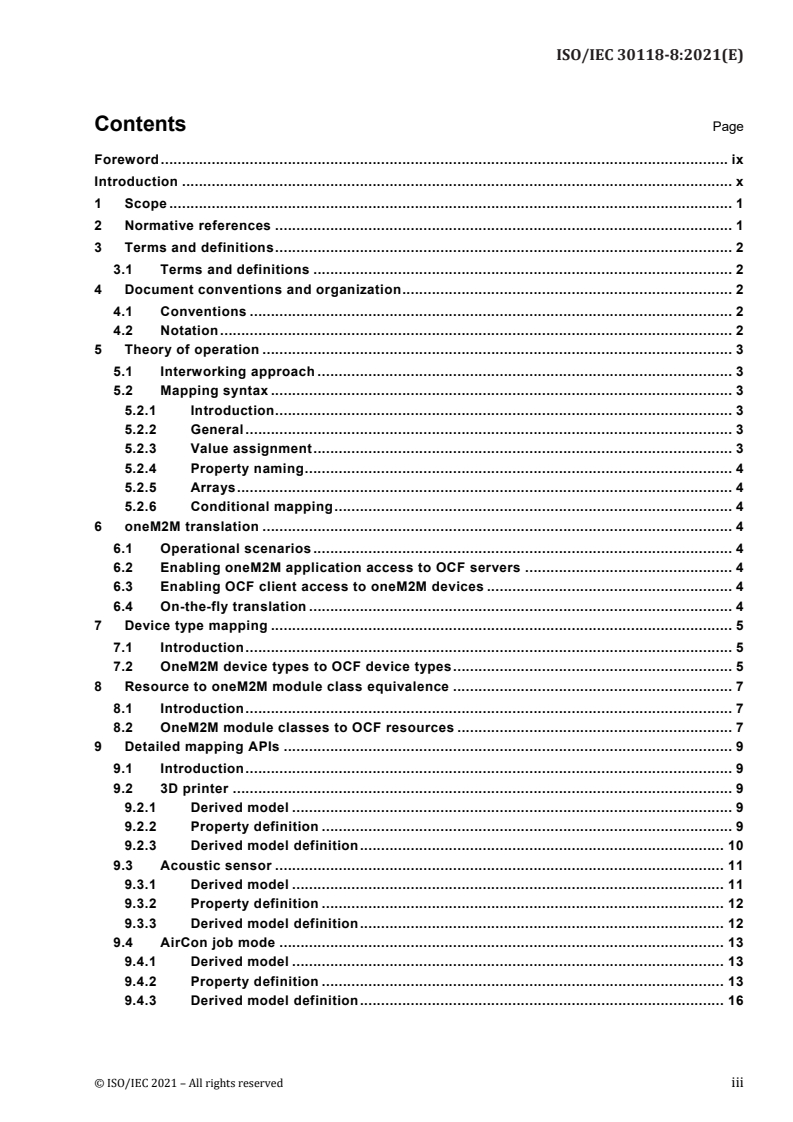
Contents Page
Foreword . ix
Introduction . x
1 Scope . 1
2 Normative references . 1
3 Terms and definitions . 2
3.1 Terms and definitions . 2
4 Document conventions and organization . 2
4.1 Conventions . 2
4.2 Notation . 2
5 Theory of operation . 3
5.1 Interworking approach . 3
5.2 Mapping syntax . 3
5.2.1 Introduction . 3
5.2.2 General . 3
5.2.3 Value assignment . 3
5.2.4 Property naming . 4
5.2.5 Arrays . 4
5.2.6 Conditional mapping . 4
6 oneM2M translation . 4
6.1 Operational scenarios . 4
6.2 Enabling oneM2M application access to OCF servers . 4
6.3 Enabling OCF client access to oneM2M devices . 4
6.4 On-the-fly translation . 4
7 Device type mapping . 5
7.1 Introduction . 5
7.2 OneM2M device types to OCF device types . 5
8 Resource to oneM2M module class equivalence . 7
8.1 Introduction . 7
8.2 OneM2M module classes to OCF resources . 7
9 Detailed mapping APIs . 9
9.1 Introduction . 9
9.2 3D printer . 9
9.2.1 Derived model . 9
9.2.2 Property definition . 9
9.2.3 Derived model definition . 10
9.3 Acoustic sensor . 11
9.3.1 Derived model . 11
9.3.2 Property definition . 12
9.3.3 Derived model definition . 12
9.4 AirCon job mode . 13
9.4.1 Derived model . 13
9.4.2 Property definition . 13
9.4.3 Derived model definition . 16
© ISO/IEC 2021 – All rights reserved iii
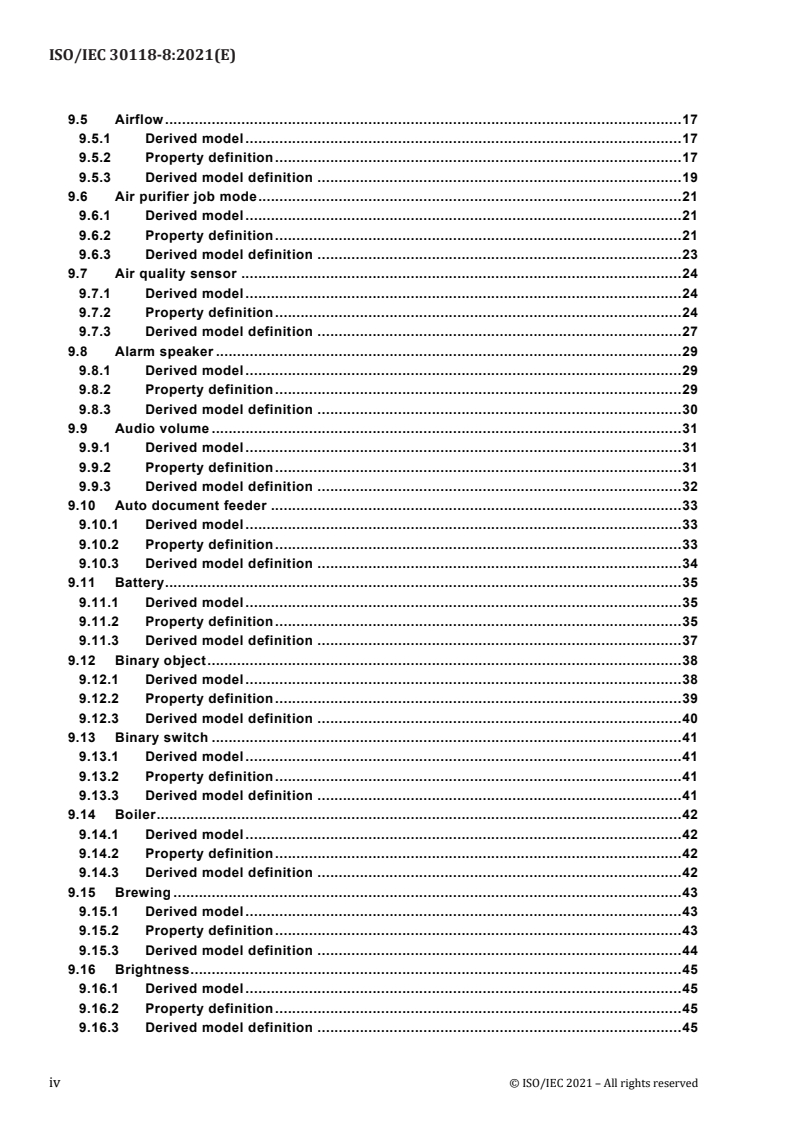
9.5 Airflow . 17
9.5.1 Derived model . 17
9.5.2 Property definition . 17
9.5.3 Derived model definition . 19
9.6 Air purifier job mode . 21
9.6.1 Derived model . 21
9.6.2 Property definition . 21
9.6.3 Derived model definition . 23
9.7 Air quality sensor . 24
9.7.1 Derived model . 24
9.7.2 Property definition . 24
9.7.3 Derived model definition . 27
9.8 Alarm speaker . 29
9.8.1 Derived model . 29
9.8.2 Property definition . 29
9.8.3 Derived model definition . 30
9.9 Audio volume . 31
9.9.1 Derived model . 31
9.9.2 Property definition . 31
9.9.3 Derived model definition . 32
9.10 Auto document feeder . 33
9.10.1 Derived model . 33
9.10.2 Property definition . 33
9.10.3 Derived model definition . 34
9.11 Battery . 35
9.11.1 Derived model . 35
9.11.2 Property definition . 35
9.11.3 Derived model definition . 37
9.12 Binary object . 38
9.12.1 Derived model . 38
9.12.2 Property definition . 39
9.12.3 Derived model definition . 40
9.13 Binary switch . 41
9.13.1 Derived model . 41
9.13.2 Property definition . 41
9.13.3 Derived model definition . 41
9.14 Boiler . 42
9.14.1 Derived model . 42
9.14.2 Property definition . 42
9.14.3 Derived model definition . 42
9.15 Brewing . 43
9.15.1 Derived model . 43
9.15.2 Property definition . 43
9.15.3 Derived model definition . 44
9.16 Brightness . 45
9.16.1 Derived model . 45
9.16.2 Property definition . 45
9.16.3 Derived model definition . 45
iv © ISO/IEC 2021 – All rights reserved
9.17 Clock . 46
9.17.1 Derived model . 46
9.17.2 Property definition . 46
9.17.3 Derived model definition . 47
9.18 Clothes dryer job mode . 48
9.18.1 Derived model . 48
9.18.2 Property definition . 48
9.18.3 Derived model definition . 51
9.19 Colour . 52
9.19.1 Derived model . 52
9.19.2 Property definition . 52
9.19.3 Derived model definition . 53
9.20 Colour saturation . 54
9.20.1 Derived model . 54
9.20.2 Property definition . 54
9.20.3 Derived model definition . 54
9.21 Credentials . 55
9.21.1 Derived model . 55
9.21.2 Property definition . 55
9.21.3 Derived model definition . 56
9.22 Dehumidifer job mode . 56
9.22.1 Derived model . 56
9.22.2 Property definition . 56
9.22.3 Derived model definition . 58
9.23 Door status . 59
9.23.1 Derived model . 59
9.23.2 Property definition . 60
9.23.3 Derived model definition . 60
9.24 Electric vehicle connector . 61
9.24.1 Derived model . 61
9.24.2 Property definition . 61
9.24.3 Derived model definition . 62
9.25 Energy consumption . 63
9.25.1 Derived model . 63
9.25.2 Property definition . 63
9.25.3 Derived model definition . 65
9.26 Energy generation . 67
9.26.1 Derived model . 67
9.26.2 Property definition . 67
9.26.3 Derived model definition . 68
9.27 Filter info . 69
9.27.1 Derived model . 69
9.27.2 Property definition . 69
9.27.3 Derived model definition . 70
9.28 Foaming . 71
9.28.1 Derived model . 71
9.28.2 Property definition . 71
9.28.3 Derived model definition . 71
© ISO/IEC 2021 – All rights reserved v
9.29 Grinder . 72
9.29.1 Derived model . 72
9.29.2 Property definition . 72
9.29.3 Derived model definition . 73
9.30 Heating zone . 74
9.30.1 Derived model . 74
9.30.2 Property definition . 74
9.30.3 Derived model definition . 75
9.31 Height . 76
9.31.1 Derived model . 76
9.31.2 Property definition . 76
9.31.3 Derived model definition . 76
9.32 Hot water supply . 77
9.32.1 Derived model . 77
9.32.2 Property definition . 77
9.32.3 Derived model definition . 78
9.33 Impact sensor . 78
9.33.1 Derived model . 78
9.33.2 Property definition . 79
9.33.3 Derived model definition . 80
9.34 Keep warm . 81
9.34.1 Derived model . 81
9.34.2 Property definition . 81
9.34.3 Derived model definition . 82
9.35 Keypad . 82
9.35.1 Derived model . 82
9.35.2 Property definition . 82
9.35.3 Derived model definition . 83
9.36 Liquid level. 84
9.36.1 Derived model . 84
9.36.2 Property definition . 84
9.36.3 Derived model definition . 85
9.37 Liquid remaining . 85
9.37.1 Derived model . 85
9.37.2 Property definition . 85
9.37.3 Derived model definition . 86
9.38 Lock . 87
9.38.1 Derived model . 87
9.38.2 Property definition . 87
9.38.3 Derived model definition . 87
9.39 Motion sensor . 88
9.39.1 Derived model . 88
9.39.2 Property definition . 88
9.39.3 Derived model definition . 89
9.40 Open level . 89
9.40.1 Derived model . 89
9.40.2 Property definition . 90
9.40.3 Derived model definition . 91
vi © ISO/IEC 2021 – All rights reserved
9.41 Operation mode . 92
9.41.1 Derived model . 92
9.41.2 Property definition . 92
9.41.3 Derived model definition . 92
9.42 Overcurrent sensor . 93
9.42.1 Derived model . 93
9.42.2 Property definition . 93
9.42.3 Derived model definition . 94
9.43 Power save . 95
9.43.1 Derived model . 95
9.43.2 Property definition . 95
9.43.3 Derived model definition . 95
9.44 Print queue . 96
9.44.1 Derived model . 96
9.44.2 Property definition . 96
9.44.3 Derived model definition . 97
9.45 Push button . 98
9.45.1 Derived model . 98
9.45.2 Property definition . 98
9.45.3 Derived model definition . 98
9.46 Refrigeration . 99
9.46.1 Derived model . 99
9.46.2 Property definition . 99
9.46.3 Derived model definition . 100
9.47 Relative humidity . 100
9.47.1 Derived model . 100
9.47.2 Property definition . 101
9.47.3 Derived model definition . 101
9.48 Robot cleaner job mode . 102
9.48.1 Derived model . 102
9.48.2 Property definition . 102
9.48.3 Derived model definition . 103
9.49 Steam closet job mode . 104
9.49.1 Derived model . 104
9.49.2 Property definition . 105
9.49.3 Derived model definition . 106
9.50 Temperature . 108
9.50.1 Derived model . 108
9.50.2 Property definition . 108
9.50.3 Derived model definition . 109
9.51 UV sensor . 111
9.51.1 Derived model . 111
9.51.2 Property definition . 111
9.51.3 Derived model definition . 112
9.52 Water Sensor . 112
9.52.1 Derived model . 112
9.52.2 Property definition . 113
9.52.3 Derived model definition . 113
© ISO/IEC 2021 – All rights reserved vii
9.53 Weight . 114
9.53.1 Derived model . 114
9.53.2 Property definition . 114
9.53.3 Derived model definition . 114
viii © ISO/IEC 2021 – All rights reserved
Foreword
ISO (the International Organization for Standardization) and IEC (the International Electrotechnical
Commission) form the specialized system for worldwide standardization. National bodies that are members of
ISO or IEC participate in the development of International Standards through technical committees established
by the respective organization to deal with particular fields of technical activity. ISO and IEC technical
committees collaborate in fields of mutual interest. Other international organizations, governmental and non-
governmental, in liaison with ISO and IEC, also take part in the work.
The procedures used to develop this document and those intended for its further maintenance are described in
the ISO/IEC Directives, Part 1. In particular, the different approval criteria needed for the different types of
document should be noted (see www.iso.org/directives or www.iec.ch/members_experts/refdocs).
Attention is drawn to the possibility that some of the elements of this document may be the subject of patent
rights. ISO and IEC shall not be held responsible for identifying any or all such patent rights. Details of any
patent rights identified during the development of the document will be in the Introduction and/or on the ISO list
of patent declarations received (see www.iso.org/patents) or the IEC list of patent declarations received
(see patents.iec.ch).
Any trade name used in this document is information given for the convenience of users and does not constitute
an endorsement.
For an explanation of the voluntary nature of standards, the meaning of ISO specific terms and expressions
related to conformity assessment, as well as information about ISO's adherence to the World Trade
Organization (WTO) principles in the Technical Barriers to Trade (TBT), see www.iso.org/iso/foreword.html. In
the IEC, see www.iec.ch/understanding-standards.
This document was prepared by the Open Connectivity Foundation (OCF) (as OCF Resource to OneM2M
Module Class Mapping Specification, version 2.2.0) and drafted in accordance with its editorial rules. It was
adopted, under the JTC 1 PAS procedure, by Joint Technical Committee ISO/IEC JTC 1, Information
technology.
A list of all parts in the ISO/IEC 30118 series can be found on the ISO and IEC websites.
Any feedback or questions on this document should be directed to the user’s national standards body. A
complete listing of these bodies can be found at www.iso.org/members.html and www.iec.ch/national-
committees.
© ISO/IEC 2021 – All rights reserved ix
Introduction
This document, and all the other parts associated with this document, were developed in response to
worldwide demand for smart home focused Internet of Things (IoT) devices, such as appliances, door
locks, security cameras, sensors, and actuators; these to be modelled and securely controlled, locally
and remotely, over an IP network.
While some inter-device communication existed, no universal language had been developed for the
IoT. Device makers instead had to choose between disparate frameworks, limiting their market share,
or developing across multiple ecosystems, increasing their costs. The burden then falls on end users
to determine whether the products they want are compatible with the ecosystem they bought into, or
find ways to integrate their devices into their network, and try to solve interoperability issues on their
own.
In addition to the smart home, IoT deployments in commercial environments are hampered by a lack
of security. This issue can be avoided by having a secure IoT communication framework, which this
standard solves.
The goal of these documents is then to connect the next 25 billion devices for the IoT, providing secure
and reliable device discovery and connectivity across multiple OSs and platforms. There are multiple
proposals and forums driving different approaches, but no single solution addresses the majority of
key requirements. This document and the associated parts enable industry consolidation around a
common, secure, interoperable approach.
ISO/IEC 30118 consists of eighteen parts, under the general title Information technology — Open
Connectivity Foundation (OCF) Specification. The parts fall into logical groupings as described herein:
– Core framework
– Part 1: Core Specification
– Part 2: Security Specification
– Part 13: Onboarding Tool Specification
– Bridging framework and bridges
– Part 3: Bridging Specification
– Part 6: Resource to Alljoyn Interface Mapping Specification
– Part 8: OCF Resource to oneM2M Resource Mapping Specification
– Part 14: OCF Resource to BLE Mapping Specification
– Part 15: OCF Resource to EnOcean Mapping Specification
– Part 16: OCF Resource to UPlus Mapping Specification
– Part 17: OCF Resource to Zigbee Cluster Mapping Specification
– Part 18: OCF Resource to Z-Wave Mapping Specification
– Resource and Device models
– Part 4: Resource Type Specification
– Part 5: Device Specification
x © ISO/IEC 2021 – All rights reserved
– Core framework extensions
– Part 7: Wi-Fi Easy Setup Specification
– Part 9: Core Optional Specification
– OCF Cloud
– Part 10: Cloud API for Cloud Services Specification
– Part 11: Device to Cloud Services Specification
– Part 12: Cloud Security Specification
© ISO/IEC 2021 – All rights reserved xi
INTERNATIONAL STANDARD ISO/IEC 30118-8:2021(E)
Information technology — Open Connectivity
Foundation (OCF) Specification —
Part 8:
OCF resource to oneM2M resource mapping
specification
1 Scope
This document provides detailed mapping information to provide equivalency between oneM2M defined
Module Classes and OCF defined Resources.
A oneM2M Bridge is Asymmetric Client Bridge, therefore this document provides unidirectional
mapping for Device Types (oneM2M Devices to OCF Devices), identifies equivalent OCF Resources
for specific oneM2M Module Classes, and defines the detailed Property by Property mapping using
OCF defined extensions to JSON schema to programmatically define the mappings.
2 Normative references
The following documents are referred to in the text in such a way that some or all of their content
constitutes requirements of this document. For dated references, only the edition cited applies. For
undated references, the latest edition of the referenced document (including any amendments) applies.
ISO/IEC 30118-1 Information technology -- Open Connectivity Foundation (OCF) Specification -- Part 1:
Core specification
https://www.iso.org/standard/53238.html
Latest version available at: https://openconnectivity.org/specs/OCF_Core_Specification.pdf
ISO/IEC 30118-2 Information technology – Open Connectivity Foundation (OCF) Specification – Part 2:
Security specification
https://www.iso.org/standard/74239.html
Latest version available at: https://openconnectivity.org/specs/OCF_Security_Specification.pdf
ISO/IEC 30118-3 Information technology – Open Connectivity Foundation (OCF) Specification – Part 3:
Bridging specification
https://www.iso.org/standard/74240.html
Latest version available at: https://openconnectivity.org/specs/OCF_Bridging_Specification.pdf
ISO/IEC 30118-4 Information technology – Open Connectivity Foundation (OCF) Specification – Part 4:
Resource type specification
https://www.iso.org/standard/74241.html
Latest version available at: https://openconnectivity.org/specs/OCF_Resource_Type_Specification.pdf
ISO/IEC 30118-5 Information technology – Open Connectivity Foundation (OCF) Specification – Part 5:
Smart home device specification
https://www.iso.org/standard/74242.html
Latest version available at: https://openconnectivity.org/specs/OCF_Device_Specification.pdf
© ISO/IEC 2021 – All rights reserved 1
Derived Models for Interoperability between IoT Ecosystems, Stevens & Merriam, March 2016
https://www.iab.org/wp-content/IAB-uploads/2016/03/OCF-Derived-Models-for-Interoperability-
Between-IoT-Ecosystems_v2-examples.pdf
3 Terms and definitions
3.1 Terms and definitions
For the purposes of this document, the terms and definitions given in ISO/IEC 30118-1,
ISO/IEC 30118-2, and ISO/IEC 30118-3 and the following apply.
ISO and IEC maintain terminological databases for use in standardization at the following addresses:
– ISO Online browsing platform: available at https://www.iso.org/obp
– IEC Electropedia: available at http://www.electropedia.org/
3.1.1
oneM2M Application
the oneM2M control point (i.e. client) being mapped to a Virtual OCF Client.
4 Document conventions and organization
4.1 Conventions
In this document a number of terms, conditions, mechanisms, sequences, parameters, events, states,
or similar terms are printed with the first letter of each word in uppercase and the rest lowercase (e.g.,
Network Architecture). Any lowercase uses of these words have the normal technical English meaning.
In this document, to be consistent with the IETF usages for RESTful operations, the RESTful operation
words CRUDN, CREATE, RETRIVE, UPDATE, DELETE, and NOTIFY will have all letters capitalized.
Any lowercase uses of these words have the normal technical English meaning.
4.2 Notation
In this document, features are described as required, recommended, allowed or DEPRECATED as
follows:
Required (or shall or mandatory).
– These basic features shall be implemented to comply with OIC Core Architecture. The phrases
"shall not", and "PROHIBITED" indicate behaviour that is prohibited, i.e. that if performed means
the implementation is not in compliance.
Recommended (or should).
– These features add functionality supported by OIC Core Architecture and should be implemented.
Recommended features take advantage of the capabilities OIC Core Architecture, usually without
imposing major increase of complexity. Notice that for compliance testing, if a recommended
feature is implemented, it shall meet the specified requirements to be in compliance with these
guidelines. Some recommended features could become requirements in the future. The phrase
"should not" indicates behaviour that is permitted but not recommended.
2 © ISO/IEC 2021 – All rights reserved
Allowed (or allowed).
– These features are neither required nor recommended by OIC Core Architecture, but if the feature
is implemented, it shall meet the specified requirements to be in compliance with these guidelines.
– Conditionally allowed (CA) The definition or behaviour depends on a condition. If the specified
condition is met, then the definition or behaviour is allowed, otherwise it is not allowed.
Conditionally required (CR)
– The definition or behaviour depends on a condition. If the specified condition is met, then the
definition or behaviour is required. Otherwise the definition or behaviour is allowed as default
unless specifically defined as not allowed.
DEPRECATED
– Although these features are still described in this document, they should not be implemented except
for backward compatibility. The occurrence of a deprecated feature during operation of an
implementation compliant with the current document has no effect on the implementation’s
operation and does not produce any error conditions. Backward compatibility may require that a
feature is implemented and functions as specified but it shall never be used by implementations
compliant with this document.
Strings that are to be taken literally are enclosed in "double quotes".
Words that are emphasized are printed in italic.
5 Theory of operation
5.1 Interworking approach
The interworking between oneM2M defined Module Classes and OCF defined Resource Types is
modelled using the derived model syntax described in Derived Models for Interoperability.
5.2 Mapping syntax
5.2.1 Introduction
Within the defined syntax fo
...
Questions, Comments and Discussion
Ask us and Technical Secretary will try to provide an answer. You can facilitate discussion about the standard in here.
Loading comments...