

IEC 60601-2-33:2002
(Main)Medical electrical equipment - Part 2-33: Particular requirements for the safety of magnetic resonance equipment for medical diagnosis
General Information
- Abstract
Establishes requirements for the safety of magnetic resonance equipment to provide protection for the patient. It establishes requirements to provide information to the operator, staff associated with magnetic resonance equipment and the general public. It also provides methods for demonstrating compliance with those requirements.
- Status
- Published
- Publication Date
- 13-Apr-2008
- Technical Committee
- SC 62B - Medical imaging equipment, software, and systems
- Drafting Committee
- WG 28 - TC 62/SC 62B/WG 28
- Current Stage
- DELPUB - Deleted Publication
- Start Date
- 10-Mar-2010
- Completion Date
- 28-Aug-2026
Buy Documents
IEC 60601-2-33:2002 - Medical electrical equipment - Part 2-33: Particular requirements for the safety of magnetic resonance equipment for medical diagnosis Released:5/22/2002
IEC 60601-2-33:2002 - Medical electrical equipment - Part 2-33: Particular requirements for the safety of magnetic resonance equipment for medical diagnosis Released:5/22/2002
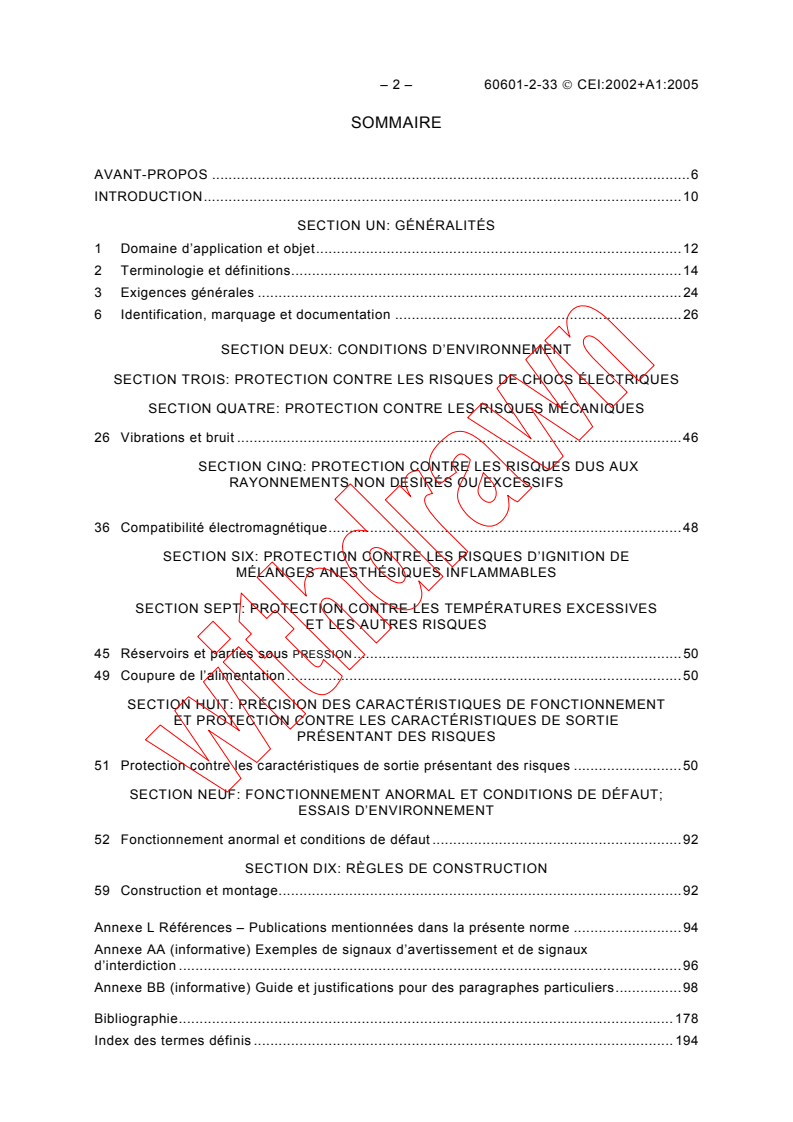
IEC 60601-2-33:2002+AMD1:2005 CSV - Medical electrical equipment - Part 2-33: Particular requirements for the safety of magnetic resonance equipment for medical diagnosis Released:2/21/2006
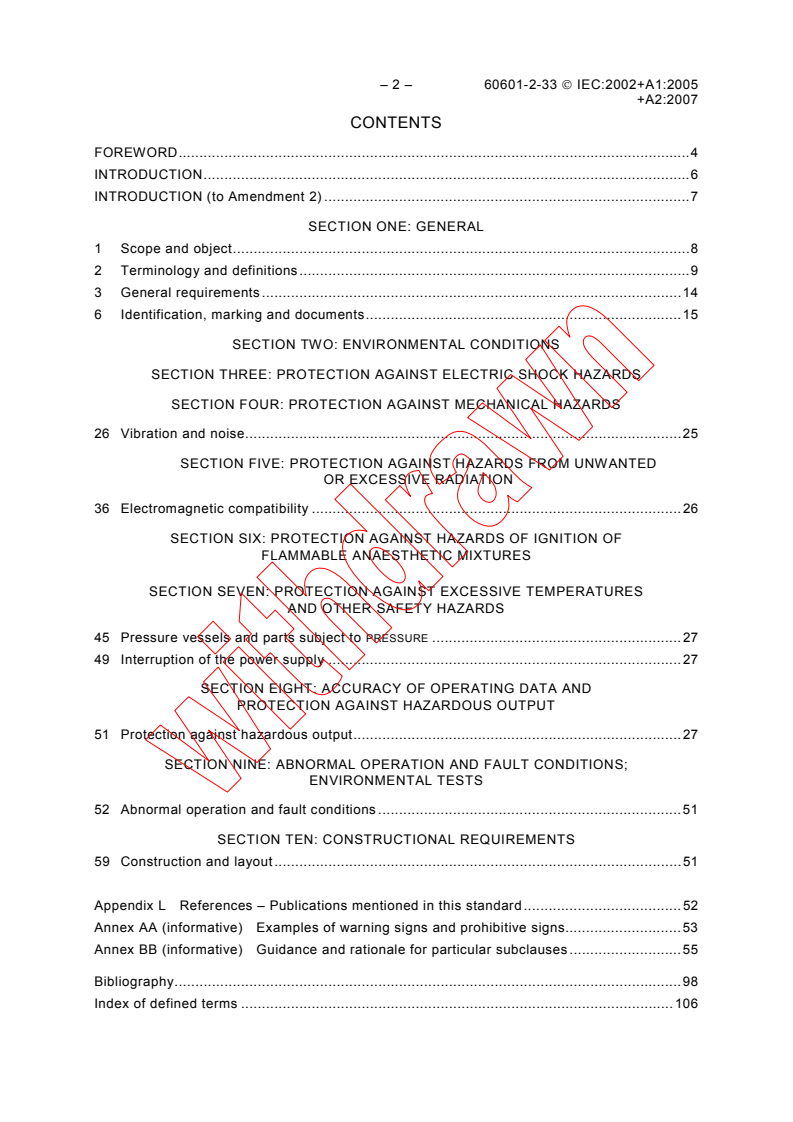
IEC 60601-2-33:2002+AMD1:2005+AMD2:2007 CSV - Medical electrical equipment - Part 2-33: Particular requirements for the safety of magnetic resonance equipment for medical diagnosis Released:4/14/2008
Overview
IEC 60601-2-33:2002 is the IEC Particular Standard that defines safety requirements for magnetic resonance (MR) equipment for medical diagnosis. It amends and supplements the general medical electrical equipment standard (IEC 60601-1) and relevant collateral standards to address MR‑specific hazards. The standard focuses on protecting the patient, informing operators, staff and the public, and on providing methods to demonstrate compliance.
Key topics and technical requirements
The standard covers MR‑specific hazards and test methods across multiple technical domains, including:
- Scope & definitions - clear definitions for MR equipment, MR systems, whole‑body MR equipment and controlled access areas.
- Patient protection - requirements addressing safety while the patient is in or near the MR system.
- Electromagnetic exposure - requirements and methods for assessing radiofrequency (RF) energy absorption (SAR) and hardware set‑ups for SAR measurement (e.g., pulse‑energy methods with quadrature or linear transmit coils).
- Gradient fields - limits and assessment methods related to gradient dB/dt waveforms, peripheral nerve stimulation (PNS) and cardiac stimulation (figures and rationale provided).
- Electromagnetic compatibility (EMC) - MR‑relevant EMC requirements and test guidance.
- Electrical & mechanical safety - protection against electric shock, mechanical hazards, vibration, noise and pressure‑related components.
- Hazardous outputs & abnormal operation - handling of hazardous output, fault conditions, interruption of power supply and environmental tests.
- Marking, documentation & labeling - identification and information for operators and users, including warnings and access control signage (informative examples in Annex AA).
- Guidance & rationale - informative Annex BB supplies scientific rationale and background for selected requirements.
Note: IEC 60601-2-33 provides methods for demonstrating compliance but does not replace organizational safety responsibilities (user training, access control, emergency procedures).
Applications
IEC 60601-2-33 is applied to:
- Design, development and manufacturing of MRI scanners, RF coils and MR system components.
- Type testing and conformity assessment for market approval and regulatory submissions.
- Clinical commissioning, acceptance testing and routine maintenance programs in hospitals and imaging centers.
- Risk assessments, labeling and operator instructions used by biomedical engineers and clinical safety officers.
- Test laboratories performing SAR, PNS and EMC measurements.
Who should use this standard
- MRI manufacturers and component suppliers (design, test, compliance teams)
- Regulatory bodies and certification labs performing conformity assessments
- Hospital biomedical engineers, MR safety officers and radiology managers for procurement and clinical safety verification
- Test laboratories specializing in RF, SAR and EMC for medical devices
Related standards
- IEC 60601-1 (General requirements for safety of medical electrical equipment)
- IEC 60601-1-1 and IEC 60601-1-4 (Collateral standards referenced by this Particular Standard)
Keywords: IEC 60601-2-33, MRI safety standard, magnetic resonance equipment, medical electrical equipment, SAR measurement, peripheral nerve stimulation, MR system compliance, IEC MRI standard.
Relations
- Effective Date
- 05-Sep-2023
- Effective Date
- 05-Sep-2023
- Effective Date
- 05-Sep-2023
Buy Documents
IEC 60601-2-33:2002 - Medical electrical equipment - Part 2-33: Particular requirements for the safety of magnetic resonance equipment for medical diagnosis Released:5/22/2002
IEC 60601-2-33:2002 - Medical electrical equipment - Part 2-33: Particular requirements for the safety of magnetic resonance equipment for medical diagnosis Released:5/22/2002
IEC 60601-2-33:2002+AMD1:2005 CSV - Medical electrical equipment - Part 2-33: Particular requirements for the safety of magnetic resonance equipment for medical diagnosis Released:2/21/2006
IEC 60601-2-33:2002+AMD1:2005+AMD2:2007 CSV - Medical electrical equipment - Part 2-33: Particular requirements for the safety of magnetic resonance equipment for medical diagnosis Released:4/14/2008
Get Certified
Connect with accredited certification bodies for this standard

BSI Group
BSI (British Standards Institution) is the business standards company that helps organizations make excellence a habit.

TÜV Rheinland
TÜV Rheinland is a leading international provider of technical services.

TÜV SÜD
TÜV SÜD is a trusted partner of choice for safety, security and sustainability solutions.
Sponsored listings
Frequently Asked Questions
IEC 60601-2-33:2002 is a standard published by the International Electrotechnical Commission (IEC). Its full title is "Medical electrical equipment - Part 2-33: Particular requirements for the safety of magnetic resonance equipment for medical diagnosis". This standard covers: Establishes requirements for the safety of magnetic resonance equipment to provide protection for the patient. It establishes requirements to provide information to the operator, staff associated with magnetic resonance equipment and the general public. It also provides methods for demonstrating compliance with those requirements.
Establishes requirements for the safety of magnetic resonance equipment to provide protection for the patient. It establishes requirements to provide information to the operator, staff associated with magnetic resonance equipment and the general public. It also provides methods for demonstrating compliance with those requirements.
IEC 60601-2-33:2002 is classified under the following ICS (International Classification for Standards) categories: 11.040.55 - Diagnostic equipment. The ICS classification helps identify the subject area and facilitates finding related standards.
IEC 60601-2-33:2002 has the following relationships with other standards: It is inter standard links to IEC 60601-2-33:2002/AMD1:2005, IEC 60601-2-33:2002/AMD2:2007, IEC 60601-2-33:2010. Understanding these relationships helps ensure you are using the most current and applicable version of the standard.
IEC 60601-2-33:2002 is available in PDF format for immediate download after purchase. The document can be added to your cart and obtained through the secure checkout process. Digital delivery ensures instant access to the complete standard document.
Standards Content (Sample)
INTERNATIONAL IEC
STANDARD
60601-2-33
Second edition
2002-05
Medical electrical equipment –
Part 2-33:
Particular requirements for the safety
of magnetic resonance equipment
for medical diagnosis
Appareils électromédicaux –
Partie 2-33:
Règles particulières de sécurité relatives
aux appareils à résonance magnétique
pour diagnostic médical
Reference number
Publication numbering
As from 1 January 1997 all IEC publications are issued with a designation in the
60000 series. For example, IEC 34-1 is now referred to as IEC 60034-1.
Consolidated editions
The IEC is now publishing consolidated versions of its publications. For example,
edition numbers 1.0, 1.1 and 1.2 refer, respectively, to the base publication, the
base publication incorporating amendment 1 and the base publication incorporating
amendments 1 and 2.
Further information on IEC publications
The technical content of IEC publications is kept under constant review by the IEC,
thus ensuring that the content reflects current technology. Information relating to
this publication, including its validity, is available in the IEC Catalogue of
publications (see below) in addition to new editions, amendments and corrigenda.
Information on the subjects under consideration and work in progress undertaken
by the technical committee which has prepared this publication, as well as the list
of publications issued, is also available from the following:
• IEC Web Site (www.iec.ch)
• Catalogue of IEC publications
The on-line catalogue on the IEC web site (www.iec.ch/catlg-e.htm) enables
you to search by a variety of criteria including text searches, technical
committees and date of publication. On-line information is also available on
recently issued publications, withdrawn and replaced publications, as well as
corrigenda.
• IEC Just Published
This summary of recently issued publications (www.iec.ch/JP.htm) is also
available by email. Please contact the Customer Service Centre (see below) for
further information.
• Customer Service Centre
If you have any questions regarding this publication or need further assistance,
please contact the Customer Service Centre:
Email: custserv@iec.ch
Tel: +41 22 919 02 11
Fax: +41 22 919 03 00
INTERNATIONAL IEC
STANDARD
60601-2-33
Second edition
2002-05
Medical electrical equipment –
Part 2-33:
Particular requirements for the safety
of magnetic resonance equipment
for medical diagnosis
Appareils électromédicaux –
Partie 2-33:
Règles particulières de sécurité relatives
aux appareils à résonance magnétique
pour diagnostic médical
IEC 2002 Copyright - all rights reserved
No part of this publication may be reproduced or utilized in any form or by any means, electronic or
mechanical, including photocopying and microfilm, without permission in writing from the publisher.
International Electrotechnical Commission, 3, rue de Varembé, PO Box 131, CH-1211 Geneva 20, Switzerland
Telephone: +41 22 919 02 11 Telefax: +41 22 919 03 00 E-mail: inmail@iec.ch Web: www.iec.ch
PRICE CODE
Commission Electrotechnique Internationale
XC
International Electrotechnical Commission
Международная Электротехническая Комиссия
For price, see current catalogue
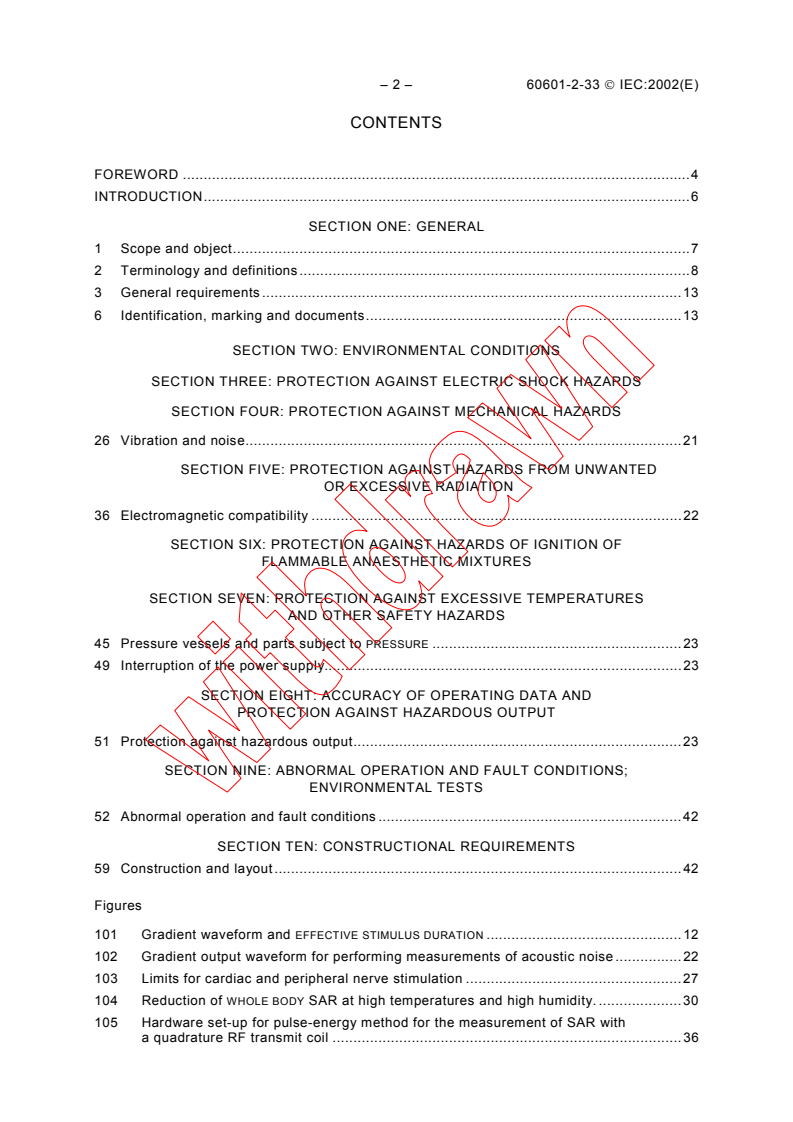
– 2 – 60601-2-33 IEC:2002(E)
CONTENTS
FOREWORD .4
INTRODUCTION.6
SECTION ONE: GENERAL
1 Scope and object.7
2 Terminology and definitions.8
3 General requirements .13
6 Identification, marking and documents.13
SECTION TWO: ENVIRONMENTAL CONDITIONS
SECTION THREE: PROTECTION AGAINST ELECTRIC SHOCK HAZARDS
SECTION FOUR: PROTECTION AGAINST MECHANICAL HAZARDS
26 Vibration and noise.21
SECTION FIVE: PROTECTION AGAINST HAZARDS FROM UNWANTED
OR EXCESSIVE RADIATION
36 Electromagnetic compatibility .22
SECTION SIX: PROTECTION AGAINST HAZARDS OF IGNITION OF
FLAMMABLE ANAESTHETIC MIXTURES
SECTION SEVEN: PROTECTION AGAINST EXCESSIVE TEMPERATURES
AND OTHER SAFETY HAZARDS
45 Pressure vessels and parts subject to PRESSURE .23
49 Interruption of the power supply.23
SECTION EIGHT: ACCURACY OF OPERATING DATA AND
PROTECTION AGAINST HAZARDOUS OUTPUT
51 Protection against hazardous output.23
SECTION NINE: ABNORMAL OPERATION AND FAULT CONDITIONS;
ENVIRONMENTAL TESTS
52 Abnormal operation and fault conditions .42
SECTION TEN: CONSTRUCTIONAL REQUIREMENTS
59 Construction and layout.42
Figures
101 Gradient waveform and EFFECTIVE STIMULUS DURATION .12
102 Gradient output waveform for performing measurements of acoustic noise .22
103 Limits for cardiac and peripheral nerve stimulation .27
104 Reduction of WHOLE BODY SAR at high temperatures and high humidity. .30
105 Hardware set-up for pulse-energy method for the measurement of SAR with
a quadrature RF transmit coil .36
60601-2-33 IEC:2002(E) – 3 –
106 Hardware set-up for pulse-energy method for the measurement of SAR
with a linear RF transmit coil .36
BB.1 Static magnetic fields: flow potentials and retardation.57
BB.2 Experimental data on PNS threshold of human volunteers in WHOLE BODY
MR EQUIPMENT.63
BB.3 Double logarithmic plot of experimental threshold values for peripheral nerve
stimulation.64
BB.4 Response value R(t) generated by convolution of a rectangular stimulus dB/dt
and a nerve impulse response function n(t-θ).68
BB.5 Gradient waveform G, stimulus waveform dB/dt and response value R,
for a trapezoid EPI waveform starting at t = 0 .69
BB.6 Threshold values dB/dt for two gradient waveforms, plotted against EFFECTIVE
STIMULUS DURATION .69
BB.7 Threshold value of dB/dt for a sinusoid gradient waveform, as function of the
number of half periods in the waveform .70
BB.8 SAR limits for the exposed mass of a PATIENT.73
Tables
101 List of symbols .12
102 Rheobase values per type of gradient system.27
103 Weight factors for summation of the maximum output O per gradient unit .28
i
104 Temperature limits.28
105 SAR limits.29
BB.1 Static field occupational standards .55
Appendix L References – Publications mentioned in this standard.43
Annex AA (informative) Examples of warning signs and prohibitive signs.44
Annex BB (informative) Guidance and rationale for particular subclauses .45
Bibliography.75
Index of defined terms .82
– 4 – 60601-2-33 IEC:2002(E)
INTERNATIONAL ELECTROTECHNICAL COMMISSION
____________
MEDICAL ELECTRICAL EQUIPMENT –
Part 2-33: Particular requirements for the safety of
magnetic resonance equipment for medical diagnosis
FOREWORD
1) The IEC (International Electrotechnical Commission) is a worldwide organization for standardization comprising
all national electrotechnical committees (IEC National Committees). The object of the IEC is to promote
international co-operation on all questions concerning standardization in the electrical and electronic fields. To
this end and in addition to other activities, the IEC publishes International Standards. Their preparation is
entrusted to technical committees; any IEC National Committee interested in the subject dealt with may
participate in this preparatory work. International, governmental and non-governmental organizations liaising
with the IEC also participate in this preparation. The IEC collaborates closely with the International
Organization for Standardization (ISO) in accordance with conditions determined by agreement between the
two organizations.
2) The formal decisions or agreements of the IEC on technical matters express, as nearly as possible, an
international consensus of opinion on the relevant subjects since each technical committee has representation
from all interested National Committees.
3) The documents produced have the form of recommendations for international use and are published in the form
of standards, technical specifications, technical reports or guides and they are accepted by the National
Committees in that sense.
4) In order to promote international unification, IEC National Committees undertake to apply IEC International
Standards transparently to the maximum extent possible in their national and regional standards. Any
divergence between the IEC Standard and the corresponding national or regional standard shall be clearly
indicated in the latter.
5) The IEC provides no marking procedure to indicate its approval and cannot be rendered responsible for any
equipment declared to be in conformity with one of its standards.
6) Attention is drawn to the possibility that some of the elements of this International Standard may be the subject
of patent rights. The IEC shall not be held responsible for identifying any or all such patent rights.
International Standard IEC 60601-2-33 has been prepared by subcommittee 62B: Diagnostic
imaging equipment, of IEC technical committee 62: Electrical equipment in medical practice.
This second edition cancels and replaces the first edition published in 1995 and constitutes
a technical revision.
The text of this Particular Standard is based on the following documents:
FDIS Report on voting
62B/462/FDIS 62B/467/RVD
Full information on the voting for the approval of this standard can be found in the report on
voting indicated in the above table.
Annexes AA and BB are for information only.
60601-2-33 IEC:2002(E) – 5 –
In this standard, the following print types are used:
− requirements, compliance with which can be tested, and definitions: roman type;
− explanations, advice, notes, general statements and exceptions: smaller roman type;
− test specifications: italic type;
− TERMS DEFINED IN CLAUSE 2 OF THE GENERAL STANDARD, IN THIS STANDARD OR IN IEC 60788: SMALL CAPITALS
The committee has decided that the contents of this publication will remain unchanged
until 2005-06. At this date, the publication will be
• reconfirmed;
• withdrawn;
• replaced by a revised edition, or
• amended.
– 6 – 60601-2-33 IEC:2002(E)
INTRODUCTION
This Particular Standard is written at a moment in which the technical evolution of MAGNETIC
RESONANCE EQUIPMENT is in rapid progress and the scientific foundation of its safe use is still
expanding.
The standard addresses technical aspects of the medical diagnostic MR SYSTEM and the MR
EQUIPMENT therein, related to safety of PATIENTS examined with this system and personnel
involved with its operation. Where limits of exposure of PATIENTS and medical staff are stated,
these limits do not imply that such levels of exposure can be assumed to be acceptable for
the population at large. Rather the implication is that the limits provide for the PATIENT a
sensible balance between risk and benefit and for the medical staff a balanced risk, given
their responsibility for the wellbeing of the PATIENT.
Organisational aspects of safety are the task of the USER. This task includes adequate training
of staff, rules of access to the MR SYSTEM, qualification of staff for decisions that are related
to safety, definition of medical responsibility and specific requirements for personnel following
from that responsibility when the PATIENT is in or near the MR SYSTEM.
Examples of such organisational aspects are:
− operation in first controlled mode;
− emergency procedures for resuscitation of the PATIENT who is in the MR SYSTEM,
− emergency procedures after a QUENCH of the superconductive magnet when present;
− set-up and maintenance of a protocol for screening the PATIENT for contraindications or for
conditions that may affect acceptable exposure;
− rules for ROUTINE MONITORING and for MEDICAL SUPERVISION of the PATIENT during the exam.
Extensive rationale is provided in Annex BB for some of the definitions and requirements in
order to provide the USER of this standard with a reasonably complete access to the source
material that was used in support of the considerations during drafting.
The relationship of this Particular Standard with IEC 60601-1 (including its amendments) and
the Collateral Standards is explained in 1.3.
60601-2-33 IEC:2002(E) – 7 –
MEDICAL ELECTRICAL EQUIPMENT –
Part 2-33: Particular requirements for the safety of
magnetic resonance equipment for medical diagnosis
SECTION ONE: GENERAL
The clauses and subclauses of this section of the General Standard apply except as follows:
1 Scope and object
This clause of the General Standard applies except as follows:
1.1 Scope
Addition:
This Particular Standard applies to MAGNETIC RESONANCE EQUIPMENT as defined in 2.2.101 and
MAGNETIC RESONANCE SYSTEMS as defined in 2.2.102.
This Standard does not cover the application of MAGNETIC RESONANCE EQUIPMENT beyond the
INTENDED USE.
1.2 Object
Replacement:
This Particular Standard establishes requirements for the safety of MAGNETIC RESONANCE
EQUIPMENT to provide protection for the PATIENT.
It establishes requirements to provide information to the OPERATOR, staff associated with
MAGNETIC RESONANCE EQUIPMENT and the general public.
It also provides methods for demonstrating compliance with those requirements.
1.3 Particular Standards
Addition:
This Particular Standard amends and supplements a set of IEC publications, hereinafter
referred to as the "General Standard", consisting of
IEC 60601-1:1988, Medical electrical equipment – Part 1: General requirements for safety,
and its amendments 1 (1991) and 2 (1995),
IEC 60601-1-1:2000, Medical electrical equipment – Part 1-1: General requirements for safety
– Collateral Standard: Safety requirements for medical electrical systems, and
IEC 60601-1-4:1996, Medical electrical equipment – Part 1: General requirement for safety –
4. Collateral Standard: Programmable electronic medical systems.
– 8 – 60601-2-33 IEC:2002(E)
For brevity, IEC 60601-1 is referred to in this Particular Standard either as the "General
Standard" or as the "General Requirement(s)", and IEC 60601-1-1 and IEC 60601-1-4 as
"Collateral Standards".
The term "this Standard" covers this Particular Standard, used together with the General
Standard and any Collateral Standards.
The numbering of sections, clauses and subclauses of this Particular Standard corresponds
with that of the General Standard. The changes to the text of the General Standard are
specified by the use of the following words:
"Replacement" means that the clause or subclause of the General Standard is replaced
completely by the text of this Particular Standard.
"Addition" means that the text of this Particular Standard is additional to the requirements of
the General Standard.
"Amendment" means that the clause or subclause of the General Standard is amended as
indicated by the text of this Particular Standard.
Subclauses or figures which are additional to those of the General Standard are numbered
starting from 101, additional annexes are lettered AA, BB, etc., and additional items aa), bb), etc.
Clauses and subclauses for which there is a rationale are marked with an asterisk *. These
rationales can be found in informative annex BB. Annex BB does not form an integral part of this
Particular Standard and only gives additional information; it can never be the subject of testing.
Where there is no corresponding section, clause or subclause in this Particular Standard, the
section, clause or subclause of the General Standard or of a specified Collateral Standard
applies without modification.
Where it is intended that any part of the General Standard or the Collateral Standard,
although possibly relevant, is not to be applied, a statement to that effect is given in this
Particular Standard.
A requirement of this Particular Standard replacing or modifying requirements of the General
Standard or a specified Collateral Standard takes precedence over the corresponding General
Requirement(s).
2 Terminology and definitions
This clause of the General Standard applies except as follows:
Additional definitions:
2.2 Equipment types (classification)
2.2.101
MAGNETIC RESONANCE EQUIPMENT (MR EQUIPMENT)
MEDICAL ELECTRICAL EQUIPMENT which is intended for in-vivo MAGNETIC RESONANCE EXAMINATION
of a PATIENT. The MR EQUIPMENT comprises all parts in hardware and software from the
SUPPLY MAINS to the display monitor. The MR EQUIPMENT is a Programmable Electrical Medical
System (PEMS)
60601-2-33 IEC:2002(E) – 9 –
2.2.102
MAGNETIC RESONANCE SYSTEM (MR SYSTEM)
ensemble of MR EQUIPMENT, ACCESSORIES including means for display, control, energy
supplies, and the CONTROLLED ACCESS AREA, where provided
2.2.103
WHOLE BODY MAGNETIC RESONANCE EQUIPMENT (WHOLE BODY MR EQUIPMENT)
MR EQUIPMENT of sufficient size to allow whole body MR-EXAMINATION and partial body
MR-EXAMINATION of adult PATIENTS. It may be equipped with VOLUME RF TRANSMIT COILS,
LOCAL RF TRANSMIT COILS and with a SPECIAL PURPOSE GRADIENT SYSTEM
2.2.104
WOLE BODY MAGNET
magnet suitable for use in WHOLE BODY MR EQUIPMENT
2.2.105
TRANSVERSE FIELD MAGNET
magnet for which the field is at right angles to the axial direction of the PATIENT
2.2.106
WHOLE BODY GRADIENT SYSTEM
a gradient system suitable for use in WHOLE BODY MR EQUIPMENT
2.2.107
SPECIAL PURPOSE GRADIENT SYSTEM
a gradient system suitable for use in MR EQUIPMENT for a special purpose.
An example of a SPECIAL PURPOSE GRADIENT SYSTEM is a gradient system that can be
incorporated in MR EQUIPMENT to allow special examination of the head of the PATIENT
2.2.108
GRADIENT UNIT
all gradient coils and amplifiers that together generate a magnetic field gradient along one of
the axes of the coordinate system of the MR EQUIPMENT
2.2.109
VOLUME RF TRANSMIT COIL
an RF transmit coil suitable for use in MR EQUIPMENT that produces a homogeneous RF field
over an extended volume encompassed by the coil. The VOLUME RF TRANSMIT COIL can be a
WHOLE BODY RF TRANSMIT COIL, a HEAD RF TRANSMIT COIL or a RF transmit coil designed for
homogeneous exposure of a specific part of the body. A single loop coil enclosing the
body or a part of the body is considered to be a VOLUME RF TRANSMIT COIL (example:
single loop wrist coil)
2.2.110
WHOLE BODY RF TRANSMIT COIL
A VOLUME RF TRANSMIT COIL of sufficient size for whole body examinations of adult PATIENTS
2.2.111
HEAD RF TRANSMIT COIL
a VOLUME RF TRANSMIT COIL suitable for use in MR EQUIPMENT for a MAGNETIC RESONANCE
EXAMINATION of the head of PATIENTS
2.2.112
LOCAL RF TRANSMIT COIL
an RF transmit coil other than a VOLUME RF TRANSMIT COIL. The LOCAL RF TRANSMIT COIL can
be a coil for spectroscopy
– 10 – 60601-2-33 IEC:2002(E)
2.10 Operation of equipment
2.10.101
NORMAL OPERATING MODE
mode of operation of the MR EQUIPMENT in which none of the outputs have a value that may
cause physiological stress to PATIENTS
2.10.102
FIRST LEVEL CONTROLLED OPERATING MODE
mode of operation of the MR EQUIPMENT in which one or more outputs reach a value that may
cause physiological stress to PATIENTS which needs to be controlled by MEDICAL SUPERVISION
2.10.103
SECOND LEVEL CONTROLLED OPERATING MODE
mode of operation of the MR EQUIPMENT in which one or more outputs reach a value that
may produce significant risk for PATIENTS, for which explicit ethical approval is required
(i.e. a human studies protocol approved to local requirements)
* 2.10.104
MAGNETIC RESONANCE EXAMINATION (MR EXAMINATION)
process of acquiring data by MAGNETIC RESONANCE from a PATIENT
2.11 Mechanical safety
2.11.101
CONTROLLED ACCESS AREA
area to which access is controlled for safety reasons
2.11.102
EMERGENCY FIELD SHUT DOWN UNIT
device for de-energizing a superconducting or resistive magnet in case of an emergency
situation
2.11.103
QUENCH
transition of the electrical conductivity of a coil that is carrying a current from a super-
conducting state to normal conductivity, resulting in rapid boil-off of fluid cryogen and decay
of the magnetic field
2.12 Miscellaneous
* 2.12.101
MAGNETIC RESONANCE (MR)
resonant absorption of electromagnetic energy by an ensemble of atomic particles situated in
a magnetic field
2.12.102
ROUTINE MONITORING
routine PATIENT monitoring which is carried out by responsible personal such as the OPERATOR
and staff of the MR EQUIPMENT and consisting of audio and/or visual contact, as appropriate
with the PATIENT during the MR EXAMINATION
* 2.12.103
MEDICAL SUPERVISION
adequate medical management of PATIENTS who may be at risk from some parameters of
exposure to the MR EQUIPMENT, either because of the medical condition of the PATIENT, the
levels of exposure or a combination
60601-2-33 IEC:2002(E) – 11 –
2.12.104
COMPLIANCE VOLUME
area of PATIENT accessible space in which compliance of GRADIENT OUTPUT is inspected
In MR EQUIPMENT with a cylindrical WHOLE BODY MAGNET, the COMPLIANCE VOLUME is a cylinder
with its axis coinciding with the magnet axis and with a radius of 0,20 m.
In MR EQUIPMENT with a TRANSVERSE FIELD MAGNET and a WHOLE BODY GRADIENT SYSTEM, the
COMPLIANCE VOLUME is a volume bound by planes parallel to the magnet poles and separated
by a distance that is either the largest dimension of the accessible space between the poles
of the magnet, or 0,40 m, whichever is less.
In all other MR EQUIPMENT the COMPLIANCE VOLUME is the volume where any part of a PATIENT
body can be properly located according to the intended use of the MR EQUIPMENT.
2.12.105
MAXIMUM GRADIENT SLEW RATE
the rate of change of the gradient obtained by switching the GRADIENT UNIT between its
maximum specified gradient strengths G and G in the shortest possible ramp time
+max −max
obtainable under normal scan conditions
2.12.106
SEARCH COIL
a small diameter coil used in a compliance test to measure GRADIENT OUTPUT
2.101 Output
* 2.101.1
SPECIFIC ABSORBTION RATE (SAR)
radio frequency power absorbed per unit of mass of an object (W/kg)
2.101.2
WHOLE BODY SAR
SAR averaged over the total mass of the PATIENTS body and over a specified time
2.101.3
PARTIAL BODY SAR
SAR averaged over the mass of the PATIENTS body that is exposed by the VOLUME RF
TRANSMIT COIL and over a specified time
2.101.4
HEAD SAR
SAR averaged over the mass of the PATIENTS head and over a specified time
2.101.5
LOCAL SAR
SAR averaged over any 10 g of tissue of the PATIENT body and over a specified time
2.101.6
TIME RATE OF CHANGE OF THE MAGNETIC FIELD (dB/dt)
rate of change of the magnetic flux density with time (T/s)
2.101.7
GRADIENT OUTPUT
parameter characterizing the gradient performance such as rate of change of the magnitude
of the magnetic field, or electric field induced by one or more GRADIENT UNITS under specified
conditions and at a specified position
– 12 – 60601-2-33 IEC:2002(E)
2.101.8
EFFECTIVE STIMULUS DURATION (t )
s,eff
duration of any period of the monotonic increasing or decreasing gradient, used to
describe its limits for cardiac or peripheral nerve stimulation. It is defined as the ratio of
the peak-to-peak field variation and the maximum value of the time derivative of the
gradient in that period
G
G Graph a
max
a
G magnetic field gradient
G maximum of gradient
max
Graph b
dB/dt
dB/dt time rate of change of magnetic
field
t
b s,eff
t
s,eff
(dB/dt) maximum of time rate of change
max
of magnetic field
(dB/dt)
max
t effective stimulus duration
s,eff
Time
IEC 1129/02
Three periods of monotonic change of the gradient G are shown in graph a. The corresponding gradient output
dB/dt is shown in graph b and the effective stimulus duration t is indicated.
s,eff
Figure 101 – Gradient waveform and EFFECTIVE STIMULUS DURATION
Table 101 – List of symbols
Symbol SI-Unit Definition
T Static magnetic field
B
T Magnetic induction of the radio frequency magnetic field
B
TIME RATE OF CHANGE OF THE MAGNETIC FIELD (dB/dt)
T/s
dB/dt
V/m Electric field induced by gradient switching
E
G
T/m Magnetic field gradient
V/m or T/s Limit of the GRADIENT OUTPUT for the NORMAL OPERATING MODE
L01
V/m or T/s Limit of the GRADIENT OUTPUT for the FIRST LEVEL CONTROLLED OPERATING MODE
L12
depending on context GRADIENT OUTPUT
O
depending on context GRADIENT OUTPUT per GRADIENT UNIT
O
i
V/m or T/s Rheobase
rb
W/kg SPECIFIC ABSORBTION RATE (SAR)
SAR
ms EFFECTIVE STIMULUS DURATION
t
s,eff
min Averaging time for the determination of SAR
t
SAR
o
C Temperature
T
none GRADIENT UNIT GRADIENT OUTPUT
Weight factor per relating the of that unit
w
i
to the limit
60601-2-33 IEC:2002(E) – 13 –
3 General requirements
This clause of the General Standard applies except as follows:
3.1 Addition:
The MR EQUIPMENT shall not cause an unacceptable SAFETY HAZARD to the PATIENT, the
OPERATOR, staff and the general public.
Compliance is considered to be fulfilled, when the MR EQUIPMENT meets the relevant
requirements of this Standard.
General safety aspects of MEDICAL ELECTRICAL SYSTEMS are covered by IEC 60601-1-1.
Compliance to IEC 60601-1-4 requires identification of hazards, assessment of their risks,
and appropriate verification and validation of risk controls. Demonstration of compliance to
the requirements of this standard shall be included as part of these processes and retained by
the MANUFACTURER as a permanent record. All tests shall include, in sufficient detail for the
test to be exactly repeatable, a test protocol, all input data and the expected result.
6 Identification, marking and documents
This clause of the General Standard applies except as follows:
* 6.8 ACCOMPANYING DOCUMENTS
6.8.1 General
Addition:
The ACCOMPANYING DOCUMENTS should provide sufficient information to the USER to enable him
to comply with the local regulations and requirements for exposure limits appropriate to the
OPERATOR, staff associated with the facility, and the general public.
* 6.8.2 INSTRUCTIONS FOR USE
Addition:
* aa) Pre-screening prior to an MR EXAMINATION
INSTRUCTIONS FOR USE shall provide clear recommendations to the USER regarding pre-
screening of PATIENTS. This specifically applies to those PATIENTS who could be placed at
risk due to their professional activity, past medical history, present medical state and/or
the physical environment of the MR EQUIPMENT. These instructions shall indicate the need
for a pre-screening programme to identify such PATIENTS at risk, and shall provide
recommendations to adequately safeguard these PATIENTS from injury.
The following specific classes of PATIENTS shall be mentioned:
– classes of PATIENTS for whom MR EXAMINATIONS are considered to be contraindicated;
– classes of PATIENTS having higher than normal likelihood of needing emergency
medical treatment, independent of the physical environment of the MR EQUIPMENT;
– classes of PATIENTS having a higher than normal likelihood of needing emergency
medical treatment due to the elevated values of the applied fields, when the MR
EQUIPMENT is capable of operating within the FIRST LEVEL CONTROLLED OPERATING MODE
as described in clause 51.
– 14 – 60601-2-33 IEC:2002(E)
* bb) MEDICAL SUPERVISION of PATIENTS
INSTRUCTIONS FOR USE shall provide clear recommendations to the USER to establish a
programme for the supervision appropriate to the classes of PATIENTS described in
6.8.2 aa) and to the controlled modes of operation of the MR EQUIPMENT as defined in 2.10
(see also rationale to 2.12.103).
INSTRUCTIONS FOR USE shall:
– include the recommendation that all PATIENTS should receive at least ROUTINE
MONITORING;
– if the MR EQUIPMENT is capable of operating within the FIRST LEVEL CONTROLLED
OPERATING MODE: give recommendation that procedures should be established to
ensure that MEDICAL SUPERVISION is provided when entering the FIRST LEVEL
CONTROLLED OPERATING MODE;
– if the MR EQUIPMENT is provided with a SECOND LEVEL CONTROLLED OPERATING MODE:
include notification that operation in the SECOND LEVEL CONTROLLED OPERATING MODE
requires approval of investigational human studies protocol according to local
requirements (e.g. ethics committee, investigational review board, etc.).
In addition it shall be stated that the local approval should specifically state limits for
gradient output, SAR and static field strength.
* cc) Emergency medical procedures
INSTRUCTIONS FOR USE shall give clear recommendation to the USER to define and
implement specific emergency medical procedures that apply to the PATIENT and that take
into account the existence of the magnetic field, so that if during MR EXAMINATION the
PATIENT feels ill or is injured by external causes, medical treatment can be given as soon
as possible.
These instructions shall include recommendations to establish a procedure for removing
PATIENTS rapidly from the magnet's influence (if necessary by using the EMERGENCY FIELD
SHUT DOWN UNIT.
* dd) Excessive acoustic noise
For MR EQUIPMENT that are capable of producing more than an A-weighted r.m.s.
sound pressure level (L ) of 99 dB(A), the INSTRUCTIONS FOR USE:
Aeq, 1 h
– shall state that the A-weighted r.m.s. sound pressure level is measured according to
26 e) and 26 g);
– shall state that hearing protection shall be used for the safety of the PATIENT and that
this hearing protection shall be sufficient to reduce the A-weighted r.m.s. sound
pressure level below 99 dB(A);
– shall state that special attention and special training for the OPERATOR is required for
proper positioning of the hearing protection, especially when the standard ear cuffs
cannot be applied, or no protection at all can be applied, as for neonates and
premature infants;
– shall draw attention to a warning that due to increased anxiety, accepted sound
pressure levels may still be of concern to pregnant women and the foetus, to new-
borns, infants and young children and to the elderly;
– shall state clearly the sound level at the CONTROL PANEL for the safety of the OPERATOR
and staff;
– shall draw attention to the possibility that anaesthetised PATIENTS can have less than
normal protection against high sound pressure, so that ear protection for these
PATIENTS should not be omitted even at moderate sound levels;
– shall draw attention to the fact that in some countries legislation may exist covering the
exposure of employed persons to noise.
NOTE A suitable warning sign is specified in ISO 7731.
60601-2-33 IEC:2002(E) – 15 –
* ee) CONTROLLED ACCESS AREA
When the installation of a CONTROLLED ACCESS AREA is required for the MR EQUIPMENT (see
6.8.3.aa) and 36.101), the INSTRUCTIONS FOR USE
– shall state clearly, that it is the responsibility of the USER to follow local statutory
requirements with respect to access to the CONTROLLED ACCESS AREA;
– shall specify, preferably accompanied by a sketch, the size and shape of the
CONTROLLED ACCESS AREA;
– shall indicate the need to establish adequate rules for controlling access to the
CONTROLLED ACCESS AREA in terms of the potential risk to PATIENTS and staff within
the CONTROLLED ACCESS AREA from the attraction of objects containing iron or other
magnetically active materials or from torque on such metallic materials and the
potential risk to persons inadvertently entering the area who may be affected by the
possible dysfunction of their medical implants such as pacemakers;
NOTE For magnetic field strengths less than 0,5 mT no administrative controls are required.
– shall list EQUIPMENT and tools specified or recommended by the MANUFACTURER for use
in the CONTROLLED ACCESS AREA. For all EQUIPMENT, ACCESSORIES or tools listed, a
description should be given of special measures that are needed, if any, for their
installation as well as special precautions, if any, for their use;
– shall state clearly that peripheral equipment, including PATIENT monitoring, life
supporting devices and emergency care equipment, which is not specified or
recommended for use in the CONTROLLED ACCESS AREA, may be disturbed by the radio
frequency field or the magnetic fringe field of the MR EQUIPMENT and that this
peripheral equipment may also disturb the proper functioning of the MR EQUIPMENT.
* ff) Liquid and gaseous cryogens
For MR EQUIPMENT equipped with superconducting magnets, INSTRUCTIONS FOR USE shall,
in order to prevent accidents and QUENCH:
– require adequate provisions for supply of liquid cryogen;
– recommend that cryogen refilling be performed by trained and experienced personnel
only;
– provide information on maintenance and inspection of the magnet including the liquid
cryogen level(s);
– provide information on the minimum cryogen level(s) required for normal operation;
– require that frequent checks of cryogen level(s) be carried out by the USER;
– give clear information on potential hazards of the use of liquid cryogen as well as
information on proper handling of these liquids. This shall include information
concerning:
• the wearing of protective clothing to prevent frostbite;
• procedures to be performed after gas release;
• precautions against lack of oxygen;
• the use of non-magnetic containers for the cryogen that are being supplied;
• procedures to be followed if flammable materials are found near the cryogen
container.
NOTE Liquid oxygen may accumulate, or the gaseous oxygen concentration may become high in the
vicinity of the cryogen.
– 16 – 60601-2-33 IEC:2002(E)
* gg) Operating modes
INSTRUCTIONS FOR USE shall provide information concerning the meaning and background
of each mode of operation: NORMAL OPERATING MODE, FIRST LEVEL CONTROLLED OPERATING
MODE, and SECOND LEVEL CONTROLLED OPERATING MODE, as they are defined in 51.101. The
INSTRUCTIONS FOR USE shall also give the explanation that GRADIENT OUTPUT and SAR
levels for PATIENTS are based on current scientific literature related to safety, and that the
level of exposure , the decision of leaving the NORMAL OPERATING MODE and the possible
need for physiological monitoring of the PATIENTS shall be a medical judgement as to the
PATIENTS’ potential risk versus benefit.
INSTRUCTIONS FOR USE shall clearly explain the requirements of each operating mode:
–For MR EQUIPMENT operating within the NORMAL OPERATING MODE, no specific indication
or measure is required to be displayed and only ROUTINE MONITORING is recommended.
–For MR EQUIPMENT capable of operation in FIRST LEVEL CONTROLLED OPERATING MODE,
the properties of the MR EQUIPMENT with respect to displayed indication before
entering this mode and to deliberate action when entering this mode, as required in
51.101.3, shall be described. Also, MEDICAL SUPERVISION shall be recommended as
required in 6.8.2 bb).
–For MR EQUIPMENT capable of operating within the SECOND LEVEL CONTROLLED
OPERATING MODE, specific security measures shall be provided as required in
51.101.4 to prevent unauthorised operation in the SECOND LEVEL CONTROLLED
OPERATING MODE. Operation in the SECOND LEVEL CONTROLLED OPERATING MODE is
only permitted under a human studies protocol approved according to local
requirements as required in 6.8.2 bb).
INSTRUCTIONS FOR USE shall recommend that attention should be paid to the safety of
PATIENTS in terms of the deliberate action and MEDICAL SUPERVISION which is required for
entering the FIRST LEVEL CONTROLLED OPERATING MODE, or in terms of the specific security
measures and approval of investigational human studies protocol according to local
requirements required for entering the SECOND LEVEL CONTROLLED OPERATING MODE.
* hh) Static magnetic field
For MR EQUIPMENT that is capable of operation in the FIRST LEVEL CONTROLLED OPERATING
MODE or the SECOND LEVEL CONTROLLED OPERATING MODE for static magnetic field, the
INSTRUCTIONS FOR USE shall:
– explain the possible effects that PATIENTS may experience when the main static
magnetic field is above the level of the NORMAL OPERATING MODE, paying particular
attention to the effects that may be experienced if the PATIENT’s head is moved rapidly
while in the MR EQUIPMENT, including dizziness, vertigo, and a metallic taste in the
mouth;
– recommend that the PATIENT remains still while in the region of high static magnetic
field;
– provide information on the values of B which the MR EQUIPMENT is capable of.
ii) Time varying magnetic fields
For MR EQUIPMENT that is capable of operation at levels of GRADIENT OUTPUT above the
NORMAL OPERATING MODE the INSTRUCTIONS FOR USE shall:
– explain the possible effects on the PATIENTS of the level of GRADIENT OUTPUT in each of
the operating modes with which the MR EQUIPMENT is provided, paying particular
attention to possible effects on the peripheral nervous system and on the heart;
– provide information on the GRADIENT OUTPUT of which the MR EQUIPMENT is capable in
each operating mode;
– explain that the MR EQUIPMENT will display an indication of the appropriate operating
mode when the value of GRADIENT OUTPUT exceeds the limits of the NORMAL OPERATING
MODE;
60601-2-33 IEC:2002(E) – 17 –
– describe the gradient system as either a WHOLE BODY GRADIENT SYSTEM or as a SPECIAL
PURPOSE GRADIENT SYSTEM and describe the volume in which the GRADIENT OUTPUT is in
compliance.
jj) Radio frequency magnetic fields
The INSTRUCTIONS FOR USE shall draw attention to risk factors which may increase the
potential for local excessive RF heating and they shall describe ways for the USER to
mitigate these risk factors. These factors to draw attention to include:
– the presence of conductive (metallic) objects or implants within the sensitivity region of
the RF transmit coil. All clothing containing metallic thread or components and all other
metallic objects such as watches, coins, etc. must be removed from the PATIENT;
– the use of medicinal products in transdermal patches which may cause burns to the
underlying skin;
– the fact that skin-to-skin contact may form a conductive loop through part of the body, e.g.,
inner thigh-to-thigh, calf-to-calf, hand-to-hand, hand-to-body, ankle-to-ankle contact;
– the presence of damp clothing;
– the placement of the body or extremities against the RF transmit coil surface;
– the contact between PATIENT and RF receive coil cable and the routing of the RF coil
cable in proximity to RF transmit coil;
– the formation of loops with RF receive coil cables and ECG leads;
– the use of incompatible ECG electrodes and leads. Inform the OPERATOR to only use
MR compatible ECG leads and electrodes, such as provided or specified by the
MANUFACTURER of the MR EQUIPMENT. Inform the OPERATOR to always use electrodes
that have not passed their expiration date.
– the scanning of sedated or unconscious PATIENTS, or PATIENTS with loss of feeling in
any body part, e.g., paralysis of arms or legs, and who would therefore not be able to
alert the OPERATOR as to excessive heating and associated tissue damage;
– the presence of unconnected receive coils or electric cables that remain in the
RF transmit coil during the examination.
For MR EQUIPMENT that is capable of operation at SAR levels above the NORMAL
OPERATING MODE, the INSTRUCTIONS FOR USE shall:
– explain the possible effects of elevated values of the different types of SAR that are
limited by the MR EQUIPMENT as required in 51.103;
– explain the possible effects of the SAR on the PATIENTS in each of the operating modes
provided by the MR EQUIPMENT, paying particular attention to the safety of PATIENTS
who may have reduced thermal regulatory capabilities and increased sensitivity to
raised body temperature (e.g. febrile and cardiac decompensated PATIENTS, those with
compromised ability to perspire, and pregnant women). In addition, information
describing the importance of environmental controls and the effect of ambient
temperature on PATIENT core temperature rise shall be provided, along with
recommendations for environmental conditions for the PATIENT;
– provide information on the values of each type of SAR the MR EQUIPMENT is capable of;
– state the accuracy of the predicted value of the different types of SAR;
– explain that the limits for the operating modes for WHOLE BODY SAR given in 51.103
assume that the examination room temperature is not more than 24 °C and the
relative humidity is not more than 60 %. In addition, the INSTRUCTIONS FOR USE shall
explain how the SAR is controlled outside these environmental specifications. This
explanation may
• specify that the MR EQUIPMENT shall not be used when the temperature is greater
than 24 °C or the humidity is greater than 60 %, or
• explain that the limits of the operating modes for SAR are being automatically
reduced according to 51.103.2 (only for MR EQUIPMENT that has the capability to
measure the temperature and humidity);
– 18 – 60601-2-33 IEC:2002(E)
– draw attention to means to reduce the risk from high SAR scanning, such as the need
for breaks for the PATIENT to cool down, light clothing for the PATIENT and adequate
ventilation of the PATIENT space.
* kk) Occupational exposure
INSTRUCTIONS FOR USE shall draw attention to the fact that in some countries legislation
may exist covering occupational limits for exposure to static magnetic fields and time-
varying magnetic fields. However, the INSTRUCTIONS FOR USE may inform the USER that
no
...
NORME CEI
INTERNATIONALE
IEC
60601-2-33
INTERNATIONAL
Deuxième édition
STANDARD
Second edition
2002-05
Appareils électromédicaux –
Partie 2-33:
Règles particulières de sécurité relatives aux
appareils à résonance magnétique utilisés
pour le diagnostic médical
Medical electrical equipment –
Part 2-33:
Particular requirements for the safety of
magnetic resonance equipment for
medical diagnosis
Numéro de référence
Reference number
CEI/IEC 60601-2-33:2002
Numérotation des publications Publication numbering
Depuis le 1er janvier 1997, les publications de la CEI As from 1 January 1997 all IEC publications are
sont numérotées à partir de 60000. Ainsi, la CEI 34-1 issued with a designation in the 60000 series. For
devient la CEI 60034-1. example, IEC 34-1 is now referred to as IEC 60034-1.
Editions consolidées Consolidated editions
Les versions consolidées de certaines publications de la The IEC is now publishing consolidated versions of its
CEI incorporant les amendements sont disponibles. Par publications. For example, edition numbers 1.0, 1.1
exemple, les numéros d’édition 1.0, 1.1 et 1.2 indiquent and 1.2 refer, respectively, to the base publication,
respectivement la publication de base, la publication de the base publication incorporating amendment 1 and
base incorporant l’amendement 1, et la publication de the base publication incorporating amendments 1
base incorporant les amendements 1 et 2. and 2.
Informations supplémentaires Further information on IEC publications
sur les publications de la CEI
Le contenu technique des publications de la CEI est The technical content of IEC publications is kept
constamment revu par la CEI afin qu'il reflète l'état under constant review by the IEC, thus ensuring that
actuel de la technique. Des renseignements relatifs à the content reflects current technology. Information
cette publication, y compris sa validité, sont dispo- relating to this publication, including its validity, is
nibles dans le Catalogue des publications de la CEI available in the IEC Catalogue of publications
(voir ci-dessous) en plus des nouvelles éditions, (see below) in addition to new editions, amendments
amendements et corrigenda. Des informations sur les and corrigenda. Information on the subjects under
sujets à l’étude et l’avancement des travaux entrepris consideration and work in progress undertaken by the
par le comité d’études qui a élaboré cette publication, technical committee which has prepared this
ainsi que la liste des publications parues, sont publication, as well as the list of publications issued,
également disponibles par l’intermédiaire de: is also available from the following:
• Site web de la CEI (www.iec.ch) • IEC Web Site (www.iec.ch)
• Catalogue des publications de la CEI • Catalogue of IEC publications
Le catalogue en ligne sur le site web de la CEI The on-line catalogue on the IEC web site
(www.iec.ch/searchpub) vous permet de faire des (www.iec.ch/searchpub) enables you to search by a
recherches en utilisant de nombreux critères, variety of criteria including text searches,
comprenant des recherches textuelles, par comité technical committees and date of publication. On-
d’études ou date de publication. Des informations en line information is also available on recently
ligne sont également disponibles sur les nouvelles issued publications, withdrawn and replaced
publications, les publications remplacées ou retirées, publications, as well as corrigenda.
ainsi que sur les corrigenda.
• IEC Just Published • IEC Just Published
Ce résumé des dernières publications parues This summary of recently issued publications
(www.iec.ch/online_news/justpub) est aussi dispo- (www.iec.ch/online_news/justpub) is also available
nible par courrier électronique. Veuillez prendre by email. Please contact the Customer Service
contact avec le Service client (voir ci-dessous) Centre (see below) for further information.
pour plus d’informations.
• Service clients • Customer Service Centre
Si vous avez des questions au sujet de cette If you have any questions regarding this
publication ou avez besoin de renseignements publication or need further assistance, please
supplémentaires, prenez contact avec le Service contact the Customer Service Centre:
clients:
Email: custserv@iec.ch Email: custserv@iec.ch
Tél: +41 22 919 02 11 Tel: +41 22 919 02 11
Fax: +41 22 919 03 00 Fax: +41 22 919 03 00
.
NORME CEI
INTERNATIONALE
IEC
60601-2-33
INTERNATIONAL
Deuxième édition
STANDARD
Second edition
2002-05
Appareils électromédicaux –
Partie 2-33:
Règles particulières de sécurité relatives aux
appareils à résonance magnétique utilisés
pour le diagnostic médical
Medical electrical equipment –
Part 2-33:
Particular requirements for the safety of
magnetic resonance equipment for
medical diagnosis
IEC 2002 Droits de reproduction réservés Copyright - all rights reserved
Aucune partie de cette publication ne peut être reproduite ni No part of this publication may be reproduced or utilized in any
utilisée sous quelque forme que ce soit et par aucun procédé, form or by any means, electronic or mechanical, including
électronique ou mécanique, y compris la photocopie et les photocopying and microfilm, without permission in writing from
microfilms, sans l'accord écrit de l'éditeur. the publisher.
International Electrotechnical Commission, 3, rue de Varembé, PO Box 131, CH-1211 Geneva 20, Switzerland
Telephone: +41 22 919 02 11 Telefax: +41 22 919 03 00 E-mail: inmail@iec.ch Web: www.iec.ch
CODE PRIX
XD
PRICE CODE
Commission Electrotechnique Internationale
International Electrotechnical Commission
МеждународнаяЭлектротехническаяКомиссия
Pour prix, voir catalogue en vigueur
For price, see current catalogue
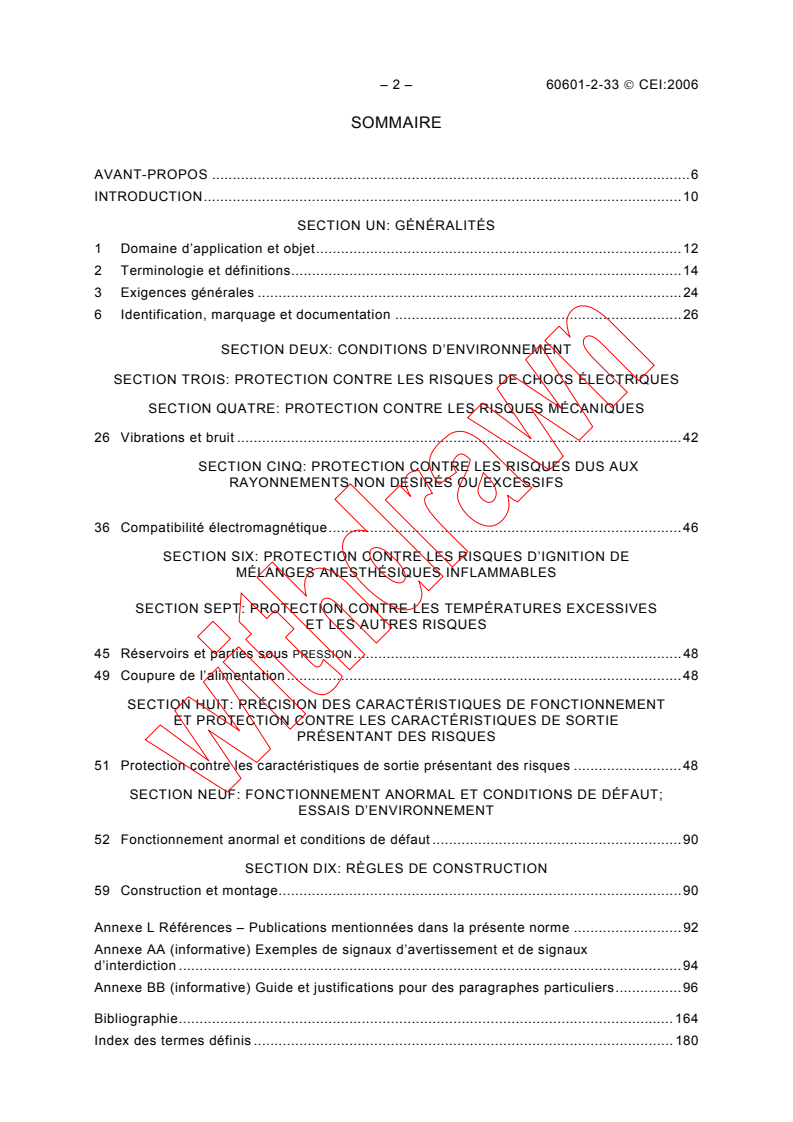
– 2 – 60601-2-33 CEI:2006
SOMMAIRE
AVANT-PROPOS .6
INTRODUCTION.10
SECTION UN: GÉNÉRALITÉS
1 Domaine d’application et objet.12
2 Terminologie et définitions.14
3 Exigences générales .24
6 Identification, marquage et documentation .26
SECTION DEUX: CONDITIONS D’ENVIRONNEMENT
SECTION TROIS: PROTECTION CONTRE LES RISQUES DE CHOCS ÉLECTRIQUES
SECTION QUATRE: PROTECTION CONTRE LES RISQUES MÉCANIQUES
26 Vibrations et bruit .42
SECTION CINQ: PROTECTION CONTRE LES RISQUES DUS AUX
RAYONNEMENTS NON DESIRÉS OU EXCESSIFS
36 Compatibilité électromagnétique.46
SECTION SIX: PROTECTION CONTRE LES RISQUES D’IGNITION DE
MÉLANGES ANESTHÉSIQUES INFLAMMABLES
SECTION SEPT: PROTECTION CONTRE LES TEMPÉRATURES EXCESSIVES
ET LES AUTRES RISQUES
45 Réservoirs et parties sous PRESSION.48
49 Coupure de l’alimentation.48
SECTION HUIT: PRÉCISION DES CARACTÉRISTIQUES DE FONCTIONNEMENT
ET PROTECTION CONTRE LES CARACTÉRISTIQUES DE SORTIE
PRÉSENTANT DES RISQUES
51 Protection contre les caractéristiques de sortie présentant des risques .48
SECTION NEUF: FONCTIONNEMENT ANORMAL ET CONDITIONS DE DÉFAUT;
ESSAIS D’ENVIRONNEMENT
52 Fonctionnement anormal et conditions de défaut .90
SECTION DIX: RÈGLES DE CONSTRUCTION
59 Construction et montage.90
Annexe L Références – Publications mentionnées dans la présente norme .92
Annexe AA (informative) Exemples de signaux d’avertissement et de signaux
d’interdiction .94
Annexe BB (informative) Guide et justifications pour des paragraphes particuliers.96
Bibliographie.164
Index des termes définis .180
60601-2-33 IEC:2006 – 3 –
CONTENTS
FOREWORD .7
INTRODUCTION.11
SECTION ONE: GENERAL
1 Scope and object.13
2 Terminology and definitions.15
3 General requirements .25
6 Identification, marking and documents.27
SECTION TWO: ENVIRONMENTAL CONDITIONS
SECTION THREE: PROTECTION AGAINST ELECTRIC SHOCK HAZARDS
SECTION FOUR: PROTECTION AGAINST MECHANICAL HAZARDS
26 Vibration and noise.43
SECTION FIVE: PROTECTION AGAINST HAZARDS FROM UNWANTED
OR EXCESSIVE RADIATION
36 Electromagnetic compatibility.47
SECTION SIX: PROTECTION AGAINST HAZARDS OF IGNITION OF
FLAMMABLE ANAESTHETIC MIXTURES
SECTION SEVEN: PROTECTION AGAINST EXCESSIVE TEMPERATURES
AND OTHER SAFETY HAZARDS
45 Pressure vessels and parts subject to PRESSURE .49
49 Interruption of the power supply .49
SECTION EIGHT: ACCURACY OF OPERATING DATA AND
PROTECTION AGAINST HAZARDOUS OUTPUT
51 Protection against hazardous output.49
SECTION NINE: ABNORMAL OPERATION AND FAULT CONDITIONS;
ENVIRONMENTAL TESTS
52 Abnormal operation and fault conditions .91
SECTION TEN: CONSTRUCTIONAL REQUIREMENTS
59 Construction and layout.91
Appendix L References – Publications mentioned in this standard.93
Annex AA (informative) Examples of warning signs and prohibitive signs.95
Annex BB (informative) Guidance and rationale for particular subclauses.97
Bibliography.165
Index of defined terms .181
– 4 – 60601-2-33 CEI:2006
Figure 101 – Forme d’onde de gradient et DURÉE DE STIMULATION EFFECTIVE.22
Figure 102 – Forme d’onde de gradient d’amplitude de sortie du champ magnétique
pour effectuer les mesures de bruit acoustique .46
Figure 103 – Limites de stimulation cardiaque et du système nerveux périphérique .58
Figure 104 – Réduction des limites du TAS POUR LE CORPS ENTIER pour des
températures et une humidité élevées.64
Figure 105 – Montage matériel pour la méthode à impulsion d'énergie pour la mesure
du TAS avec une bobine d’émission RF en quadrature .78
Figure 106 – Montage matériel pour la méthode à impulsion d'énergie pour la mesure
du TAS avec une bobine d’émission RF linéaire .78
Figure BB.2 – Données expérimentales sur le seuil de PNS de volontaires humains
dans les APPAREILS À RM POUR LE CORPS ENTIER .138
Figure BB.3 – Tracé logarithmique double des valeurs de seuil expérimentales pour la
stimulation du nerf périphérique.140
Figure BB.4 – Valeur de réponse R(t) produite par convolution d’un stimulus
rectangulaire dB/dt et d’une fonction de réponse d’impulsion nerveuse n(t-θ).150
Figure BB.5 – Forme d’onde de gradient G, forme d’onde de stimulus dB/dt et valeur
de réponse R, pour une forme d'onde trapézoïdale d’EPI commençant à t = 0 .150
Figure BB.6 – Valeurs de seuil dB/dt pour deux formes d’ondes de gradient, tracées
par rapport à la DURÉE DE STIMULATION EFFECTIVE .152
Figure BB.7 – Valeur de seuil de dB/dt pour une forme d’onde de gradient sinusoïdale,
en fonction du nombre de demi-périodes dans la forme d’onde.152
Figure BB.8 – Limites du TAS pour la masse exposée d’un PATIENT.160
Tableau 101 – Liste des symboles .24
Tableau 102 – Valeurs de rhéobase par type de système de gradient.58
Tableau 103 – Coefficients de pondération pour la sommation de la sortie maximale O
i
par UNITÉ DE GRADIENT.60
Tableau 104 – Limites de températures .60
Tableau 105 – Limites du TAS .62
Tableau BB.1 – Normes professionnelles de champ statique .120
60601-2-33 IEC:2006 – 5 –
Figure 101 – Gradient waveform and EFFECTIVE STIMULUS DURATION.23
Figure 102 – Gradient output waveform for performing measurements of acoustic noise.47
Figure 103 – Limits for cardiac and peripheral nerve stimulation .59
Figure 104 – Reduction of WHOLE BODY SAR limits at high temperatures and humidity.65
Figure 105 – Hardware set-up for pulse-energy method for the measurement of SAR
with a quadrature RF transmit coil .79
Figure 106 – Hardware set-up for pulse-energy method for the measurement of SAR
with a linear RF transmit coil.79
Figure BB.1 – Static magnetic fields: flow potentials and retardation.123
Figure BB.2 – Experimental data on PNS threshold of human volunteers in WHOLE
BODY MR EQUIPMENT.139
Figure BB.3 – Double logarithmic plot of experimental threshold values for peripheral
nerve stimulation .141
Figure BB.4 – Response value R(t) generated by convolution of a rectangular
stimulus dB/dt and a nerve impulse response function n(t-θ).151
Figure BB.5 – Gradient waveform G, stimulus waveform dB/dt and response value R,
for a trapezoid EPI waveform starting at t = 0 .151
Figure BB.6 – Threshold values dB/dt for two gradient waveforms, plotted against
EFFECTIVE STIMULUS DURATION .153
Figure BB.7 – Threshold value of dB/dt for a sinusoid gradient waveform, as function
of the number of half periods in the waveform.153
Figure BB.8 – SAR limits for the exposed mass of a PATIENT.161
Table 101 – List of symbols .25
Table 102 – Rheobase values per type of gradient system.59
Table 103 – Weight factors for summation of the maximum output O per GRADIENT UNIT.61
i
Table 104 – Temperature limits.61
Table 105 – SAR limits .63
Table BB.1 – Static field occupational standards.121
– 6 – 60601-2-33 CEI:2006
COMMISSION ÉLECTROTECHNIQUE INTERNATIONALE
____________
APPAREILS ÉLECTROMÉDICAUX –
Partie 2-33: Règles particulières de sécurité
relatives aux appareils à résonance magnétique
utilisés pour le diagnostic médical
AVANT-PROPOS
1) La Commission Électrotechnique Internationale (CEI) est une organisation mondiale de normalisation
composée de l'ensemble des comités électrotechniques nationaux (Comités nationaux de la CEI). La CEI a
pour objet de favoriser la coopération internationale pour toutes les questions de normalisation dans les
domaines de l'électricité et de l'électronique. A cet effet, la CEI – entre autres activités – publie des Normes
internationales, des Spécifications techniques, des Rapports techniques, des Spécifications accessibles au
public (PAS) et des Guides (ci-après dénommés "Publication(s) de la CEI"). Leur élaboration est confiée à des
comités d'études, aux travaux desquels tout Comité national intéressé par le sujet traité peut participer. Les
organisations internationales, gouvernementales et non gouvernementales, en liaison avec la CEI, participent
également aux travaux. La CEI collabore étroitement avec l'Organisation Internationale de Normalisation (ISO),
selon des conditions fixées par accord entre les deux organisations.
2) Les décisions ou accords officiels de la CEI concernant les questions techniques représentent, dans la mesure
du possible, un accord international sur les sujets étudiés, étant donné que les Comités nationaux de la CEI
intéressés sont représentés dans chaque comité d’études.
3) Les Publications de la CEI se présentent sous la forme de recommandations internationales et sont agréées
comme telles par les Comités nationaux de la CEI. Tous les efforts raisonnables sont entrepris afin que la CEI
s'assure de l'exactitude du contenu technique de ses publications; la CEI ne peut pas être tenue responsable
de l'éventuelle mauvaise utilisation ou interprétation qui en est faite par un quelconque utilisateur final.
4) Dans le but d'encourager l'uniformité internationale, les Comités nationaux de la CEI s'engagent, dans toute la
mesure possible, à appliquer de façon transparente les Publications de la CEI dans leurs publications
nationales et régionales. Toutes divergences entre toutes Publications de la CEI et toutes publications
nationales ou régionales correspondantes doivent être indiquées en termes clairs dans ces dernières.
5) La CEI n’a prévu aucune procédure de marquage valant indication d’approbation et n'engage pas sa
responsabilité pour les équipements déclarés conformes à une de ses Publications.
6) Tous les utilisateurs doivent s'assurer qu'ils sont en possession de la dernière édition de cette publication.
7) Aucune responsabilité ne doit être imputée à la CEI, à ses administrateurs, employés, auxiliaires ou
mandataires, y compris ses experts particuliers et les membres de ses comités d'études et des Comités
nationaux de la CEI, pour tout préjudice causé en cas de dommages corporels et matériels, ou de tout autre
dommage de quelque nature que ce soit, directe ou indirecte, ou pour supporter les coûts (y compris les frais
de justice) et les dépenses découlant de la publication ou de l'utilisation de cette Publication de la CEI ou de
toute autre Publication de la CEI, ou au crédit qui lui est accordé.
8) L'attention est attirée sur les références normatives citées dans cette publication. L'utilisation de publications
référencées est obligatoire pour une application correcte de la présente publication.
9) L’attention est attirée sur le fait que certains des éléments de la présente Publication de la CEI peuvent faire
l’objet de droits de propriété intellectuelle ou de droits analogues. La CEI ne saurait être tenue pour
responsable de ne pas avoir identifié de tels droits de propriété et de ne pas avoir signalé leur existence.
La Norme internationale CEI 60601-2-33 a été établie par le sous-comité 62B: Appareils
d'imagerie de diagnostic, du comité d’études 62 de la CEI: Equipements électriques dans la
pratique médicale.
Cette seconde édition annule et remplace la première édition publiée en 1995. Elle constitue
une révision technique.
Cette version bilingue (2006-02) remplace la version monolingue anglaise.
60601-2-33 IEC:2006 – 7 –
INTERNATIONAL ELECTROTECHNICAL COMMISSION
____________
MEDICAL ELECTRICAL EQUIPMENT –
Part 2-33: Particular requirements for the safety of
magnetic resonance equipment for medical diagnosis
FOREWORD
1) The International Electrotechnical Commission (IEC) is a worldwide organization for standardization comprising
all national electrotechnical committees (IEC National Committees). The object of IEC is to promote
international co-operation on all questions concerning standardization in the electrical and electronic fields. To
this end and in addition to other activities, IEC publishes International Standards, Technical Specifications,
Technical Reports, Publicly Available Specifications (PAS) and Guides (hereafter referred to as “IEC
Publication(s)”). Their preparation is entrusted to technical committees; any IEC National Committee interested
in the subject dealt with may participate in this preparatory work. International, governmental and non-
governmental organizations liaising with the IEC also participate in this preparation. IEC collaborates closely
with the International Organization for Standardization (ISO) in accordance with conditions determined by
agreement between the two organizations.
2) The formal decisions or agreements of IEC on technical matters express, as nearly as possible, an international
consensus of opinion on the relevant subjects since each technical committee has representation from all
interested IEC National Committees.
3) IEC Publications have the form of recommendations for international use and are accepted by IEC National
Committees in that sense. While all reasonable efforts are made to ensure that the technical content of IEC
Publications is accurate, IEC cannot be held responsible for the way in which they are used or for any
misinterpretation by any end user.
4) In order to promote international uniformity, IEC National Committees undertake to apply IEC Publications
transparently to the maximum extent possible in their national and regional publications. Any divergence
between any IEC Publication and the corresponding national or regional publication shall be clearly indicated in
the latter.
5) IEC provides no marking procedure to indicate its approval and cannot be rendered responsible for any
equipment declared to be in conformity with an IEC Publication.
6) All users should ensure that they have the latest edition of this publication.
7) No liability shall attach to IEC or its directors, employees, servants or agents including individual experts and
members of its technical committees and IEC National Committees for any personal injury, property damage or
other damage of any nature whatsoever, whether direct or indirect, or for costs (including legal fees) and
expenses arising out of the publication, use of, or reliance upon, this IEC Publication or any other IEC
Publications.
8) Attention is drawn to the Normative references cited in this publication. Use of the referenced publications is
indispensable for the correct application of this publication.
9) Attention is drawn to the possibility that some of the elements of this IEC Publication may be the subject of
patent rights. IEC shall not be held responsible for identifying any or all such patent rights.
International Standard IEC 60601-2-33 has been prepared by subcommittee 62B: Diagnostic
imaging equipment, of IEC technical committee 62: Electrical equipment in medical practice.
This second edition cancels and replaces the first edition published in 1995 and constitutes
a technical revision.
This bilingual version (2006-02) replaces the English version.
– 8 – 60601-2-33 CEI:2006
Le texte anglais de cette norme est issu des documents 62B/462/FDIS et 62B/467/RVD. Le
rapport de vote 62B/467/RVD donne toute information sur le vote ayant abouti à l’approbation
de cette norme.
La version française de cette norme n’a pas été soumise au vote.
Dans la présente norme, les caractères d’imprimerie suivants sont utilisés:
− exigences dont la conformité peut être vérifiée par un essai et définitions: caractères
romains;
− explications, conseils, notes, énoncés de portée générale et exceptions: petits caractères romains;
− modalités d'essais: caractères italiques;
− TERMES DÉFINIS À L’ARTICLE 2 DE LA NORME GÉNÉRALE, DANS LA PRÉSENTE NORME OU DANS LA CEI 60788: PETITES
MAJUSCULES
Le comité a décidé que le contenu de cette publication ne sera pas modifié avant la date de
maintenance indiquée sur le site web de la CEI sous «http://webstore.iec.ch» dans les
données relatives à la publication recherchée. A cette date, la publication sera
• reconduite;
• supprimée;
• remplacée par une édition révisée, ou
• amendée.
60601-2-33 IEC:2006 – 9 –
The text of this Particular Standard is based on the following documents:
FDIS Report on voting
62B/462/FDIS 62B/467/RVD
Full information on the voting for the approval of this standard can be found in the report on
voting indicated in the above table.
The French version of this standard has not been voted upon.
In this standard, the following print types are used:
− requirements, compliance with which can be tested, and definitions: roman type;
− explanations, advice, notes, general statements and exceptions: smaller roman type;
− test specifications: italic type;
− TERMS DEFINED IN CLAUSE 2 OF THE GENERAL STANDARD, IN THIS STANDARD OR IN IEC 60788:
SMALL CAPITALS
The committee has decided that the contents of this publication will remain unchanged until
the maintenance result date indicated on the IEC web site under "http://webstore.iec.ch" in
the data related to the specific publication. At this date, the publication will be
• reconfirmed;
• withdrawn;
• replaced by a revised edition, or
• amended.
– 10 – 60601-2-33 CEI:2006
INTRODUCTION
La présente Norme Particulière est écrite à un moment où l'évolution technique des APPAREILS
À RM est en rapide progrès et les fondements scientifiques de leur utilisation sûre sont
constamment en évolution.
Cette norme traite des aspects techniques des SYSTÈMES À RM et des APPAREILS À RM destinés
au diagnostic médical, relatifs à la sécurité des PATIENTS examinés avec ce système et du
personnel associé à son fonctionnement. Lorsque les limites d’exposition des PATIENTS et du
personnel médical sont établies, ces limites n’impliquent pas que de tels niveaux d’exposition
puissent être considérés comme acceptables pour le grand public. Leur incidence réside
davantage dans le fait que ces limites offrent au PATIENT un équilibre raisonnable entre les
risques et les bénéfices, et au personnel médical un risque équilibré, compte tenu de sa
responsabilité dans le bien-être du PATIENT.
Les aspects d’organisation de la sécurité relèvent de l’UTILISATEUR. Cette tâche comprend une
formation appropriée du personnel, des règles d’accès aux SYSTÈMES À RM, une qualification
du personnel concernant les décisions relatives à la sécurité, une définition de la respon-
sabilité médicale et des exigences spécifiques pour le personnel en raison de la
responsabilité qu’il a lorsque le PATIENT se trouve à l’intérieur ou à proximité du SYSTÈME À
RM.
Des exemples de tels aspects d’organisation sont:
− un fonctionnement dans un mode contrôlé de premier niveau;
− des procédures d’urgence pour la réanimation du PATIENT qui se trouve dans le SYSTÈME
À RM,
− des procédures d’urgence après un ÉTOUFFEMENT (QUENCH en anglais) de l’aimant
supraconducteur lorsqu’il se produit;
− l’établissement et le maintien d’un protocole pour l’examen du PATIENT afin de rechercher
des contre-indications ou des conditions susceptibles d’affecter l’exposition acceptable;
SURVEILLANCE COURANTE et pour la SURVEILLANCE MÉDICALE du PATIENT
− des règles pour la
pendant l’examen.
Une justification complète est donnée à l’Annexe BB pour certaines définitions et exigences
afin de fournir à l'UTILISATEUR de cette norme l'accès le plus complet possible aux documents
sources qui ont été utilisés en appui des différentes considérations, pendant la rédaction.
Les relations entre cette Norme Particulière et la CEI 60601-1 (amendements compris) et les
Normes Collatérales sont expliquées en 1.3.
60601-2-33 IEC:2006 – 11 –
INTRODUCTION
This Particular Standard is written at a moment in which the technical evolution of
MR EQUIPMENT is in rapid progress and the scientific foundation of its safe use is still
expanding.
The standard addresses technical aspects of the medical diagnostic MR SYSTEM and the
MR EQUIPMENT therein, related to safety of PATIENTS examined with this system and personnel
involved with its operation. Where limits of exposure of PATIENTS and medical staff are stated,
these limits do not imply that such levels of exposure can be assumed to be acceptable for
the population at large. Rather the implication is that the limits provide for the PATIENT a
sensible balance between risk and benefit and for the medical staff a balanced risk, given
their responsibility for the wellbeing of the PATIENT.
Organisational aspects of safety are the task of the USER. This task includes adequate training
of staff, rules of access to the MR SYSTEM, qualification of staff for decisions that are related to
safety, definition of medical responsibility and specific requirements for personnel following
from that responsibility when the PATIENT is in or near the MR SYSTEM.
Examples of such organisational aspects are:
− operation in first controlled mode;
− emergency procedures for resuscitation of the PATIENT who is in the MR SYSTEM,
− emergency procedures after a QUENCH of the superconductive magnet when present;
− set-up and maintenance of a protocol for screening the PATIENT for contraindications or for
conditions that may affect acceptable exposure;
− rules for ROUTINE MONITORING and for MEDICAL SUPERVISION of the PATIENT during the exam.
Extensive rationale is provided in Annex BB for some of the definitions and requirements in
order to provide the USER of this standard with a reasonably complete access to the source
material that was used in support of the considerations during drafting.
The relationship of this Particular Standard with IEC 60601-1 (including its amendments) and
the Collateral Standards is explained in 1.3.
– 12 – 60601-2-33 CEI:2006
APPAREILS ÉLECTROMÉDICAUX –
Partie 2-33: Règles particulières de sécurité
relatives aux appareils à résonance magnétique
utilisés pour le diagnostic médical
SECTION UN: GÉNÉRALITÉS
Les articles et paragraphes de la présente section de la Norme Générale s’appliquent avec
les exceptions suivantes:
1 Domaine d’application et objet
Le présent article de la Norme Générale s’applique avec les exceptions suivantes:
1.1 Domaine d’application
Addition:
La présente Norme Particulière s'applique aux APPAREILS À RM tels que définis en 2.2.101 et
aux SYSTÈMES À RM tels que définis en 2.2.102.
La présente Norme ne prend pas en compte l’application des APPAREILS À RM au-delà de leur
UTILISATION PRÉVUE.
1.2 Objet
Remplacement:
La présente Norme Particulière établit les exigences de sécurité des APPAREILS À RM afin
d'assurer la protection du PATIENT.
Elle établit des exigences pour fournir des informations à l’OPÉRATEUR, au personnel associé
aux APPAREILS À RM et au grand public
Elle fournit également des méthodes pour démontrer la conformité à ces exigences.
1.3 Normes Particulières
Addition:
La présente Norme Particulière modifie et complète un ensemble de publications de la CEI,
ci-après désignées sous le nom de "Normes horizontales", se composant de:
CEI 60601-1:1988, Appareils électromédicaux – Partie 1: Règles générales de sécurité
Amendements 1 (1991) et 2 (1995),
CEI 60601-1-1:2000, Appareils électromédicaux – Partie 1-1: Règles générales de sécurité –
Norme Collatérale: Règles de sécurité pour systèmes électromédicaux,
CEI 60601-1-4:1996, Appareils électromédicaux – Partie 1: Règles générales de sécurité –
4. Norme Collatérale: Systèmes électromédicaux programmables.
60601-2-33 IEC:2006 – 13 –
MEDICAL ELECTRICAL EQUIPMENT –
Part 2-33: Particular requirements for the safety of
magnetic resonance equipment for medical diagnosis
SECTION ONE: GENERAL
The clauses and subclauses of this section of the General Standard apply except as follows:
1 Scope and object
This clause of the General Standard applies except as follows:
1.1 Scope
Addition:
This Particular Standard applies to MR EQUIPMENT as defined in 2.2.101 and MR SYSTEMS as
defined in 2.2.102.
This Standard does not cover the application of MR EQUIPMENT beyond the INTENDED USE.
1.2 Object
Replacement:
This Particular Standard establishes requirements for the safety of MR EQUIPMENT to provide
protection for the PATIENT.
It establishes requirements to provide information to the OPERATOR, staff associated with
MR EQUIPMENT and the general public.
It also provides methods for demonstrating compliance with those requirements.
1.3 Particular Standards
Addition:
This Particular Standard amends and supplements a set of IEC publications, hereinafter
referred to as the "General Standard", consisting of
IEC 60601-1:1988, Medical electrical equipment – Part 1: General requirements for safety,
and its amendments 1 (1991) and 2 (1995),
IEC 60601-1-1:2000, Medical electrical equipment – Part 1-1: General requirements for safety
– Collateral Standard: Safety requirements for medical electrical systems, and
IEC 60601-1-4:1996, Medical electrical equipment – Part 1: General requirement for safety –
4. Collateral Standard: Programmable electronic medical systems.
– 14 – 60601-2-33 CEI:2006
Pour plus de concision, la CEI 60601-1 est désignée dans la présente Norme Particulière soit
comme “Norme Générale”, soit comme “Exigence(s) Générale(s)”, et la CEI 60601-1-1 et la
CEI 60601-1-4 comme “Normes Collatérales”.
L’expression “la présente Norme” couvre cette Norme Particulière, utilisée conjointement avec
la Norme Générale et toutes les Normes Collatérales.
La numérotation des sections, articles et paragraphes de la présente Norme Particulière
correspond à celle de la Norme Générale. Les modifications apportées au texte de la Norme
Générale sont indiquées par les expressions suivantes:
“Remplacement” signifie que l’article ou le paragraphe de la Norme Générale est remplacé
complètement par le texte de la présente Norme Particulière.
“Addition” signifie que le texte de la présente Norme Particulière doit être ajouté aux
exigences de la Norme Générale.
“Amendement” signifie que l’article ou le paragraphe de la Norme Générale est modifié
comme indiqué dans la présente Norme Particulière.
Les paragraphes ou figures ajoutés à la Norme Générale sont numérotés à partir de 101, les
annexes supplémentaires sont appelées AA, BB, etc., et les points complémentaires aa), bb), etc.
Les articles et paragraphes faisant l’objet de justifications sont signalés par un astérisque *. Ces
justifications peuvent être trouvées à l’Annexe BB. L'Annexe BB ne fait pas partie intégrante de
cette Norme Particulière et ne fournit que des informations supplémentaires; elle ne peut
jamais faire l'objet d'essais.
Lorsqu’il n’existe aucune section, aucun article ou paragraphe correspondant dans la
présente Norme Particulière, la section, l’article ou le paragraphe de la Norme Générale ou
d’une Norme Collatérale spécifiée s’applique sans modification.
Lorsqu’il est prévu qu’une partie de la Norme Générale ou de la Norme Collatérale, bien
qu’éventuellement pertinente, ne doit pas être appliquée, une indication dans ce sens doit
être donnée dans la présente Norme Particulière.
Une exigence de la présente Norme Particulière, remplaçant ou modifiant les exigences de la
Norme Générale ou d’une Norme Collatérale spécifiée, prévaut sur la ou les Exigence(s)
Générale(s) correspondante(s).
2 Terminologie et définitions
Le présent article de la Norme Générale s’applique avec les exceptions suivantes:
Définitions supplémentaires:
2.2 Types d’appareils (classification)
2.2.101
APPAREIL À RÉSONANCE MAGNÉTIQUE (APPAREIL À RM)
APPAREIL ÉLECTROMÉDICAL qui est prévu pour des EXAMENS PAR RM in vivo d’un PATIENT.
L'APPAREIL À RM comprend tous les composants matériel et logiciel, du RÉSEAU D’ALIMENTATION
à l'image affichée sur le moniteur. L’APPAREIL à RM est un système électromédical
programmable (PEMS, Programmable Electrical Médical System)
60601-2-33 IEC:2006 – 15 –
For brevity, IEC 60601-1 is referred to in this Particular Standard either as the "General
Standard" or as the "General Requirement(s)", and IEC 60601-1-1 and IEC 60601-1-4 as
"Collateral Standards".
The term "this Standard" covers this Particular Standard, used together with the General
Standard and any Collateral Standards.
The numbering of sections, clauses and subclauses of this Particular Standard corresponds
with that of the General Standard. The changes to the text of the General Standard are
specified by the use of the following words:
"Replacement" means that the clause or subclause of the General Standard is replaced
completely by the text of this Particular Standard.
"Addition" means that the text of this Particular Standard is additional to the requirements of
the General Standard.
"Amendment" means that the clause or subclause of the General Standard is amended as
indicated by the text of this Particular Standard.
Subclauses or figures which are additional to those of the General Standard are numbered
starting from 101, additional annexes are lettered AA, BB, etc., and additional items aa), bb), etc.
Clauses and subclauses for which there is a rationale are marked with an asterisk *. These
rationales can be found in informative annex BB. Annex BB does not form an integral part of this
Particular Standard and only gives additional information; it can never be the subject of testing.
Where there is no corresponding section, clause or subclause in this Particular Standard, the
section, clause or subclause of the General Standard or of a specified Collateral Standard
applies without modification.
Where it is intended that any part of the General Standard or the Collateral Standard,
although possibly relevant, is not to be applied, a statement to that effect is given in this
Particular Standard.
A requirement of this Particular Standard replacing or modifying requirements of the General
Standard or a specified Collateral Standard takes precedence over the corresponding General
Requirement(s).
2 Terminology and definitions
This clause of the General Standard applies except as follows:
Additional definitions:
2.2 Equipment types (classification)
2.2.101
MAGNETIC RESONANCE EQUIPMENT (MR EQUIPMENT)
MEDICAL ELECTRICAL EQUIPMENT which is intended for in vivo MAGNETIC RESONANCE EXAMINATION
of a PATIENT. The MR EQUIPMENT comprises all parts in hardware and software from the SUPPLY
MAINS to the display monitor. The MR EQUIPMENT is a Programmable Electrical Medical System
(PEMS)
– 16 – 60601-2-33 CEI:2006
2.2.102
SYSTÈME À RÉSONANCE MAGNÉTIQUE (SYSTÈME À RM)
ensemble d'APPAREILS À RM, d'ACCESSOIRES comprenant des moyens d'affichage, de commande,
d'approvisionnement en énergie et la ZONE À ACCÈS CONTRÔLÉ le cas échéant
2.2.103
APPAREIL À RÉSONANCE MAGNÉTIQUE POUR LE CORPS ENTIER
APPAREIL À RM de taille suffisante pour permettre un EXAMEN PAR RM du corps entier et un
EXAMEN PAR RM d'une partie du corps de PATIENTS adultes. Il peut être équipé de BOBINES
D'ÉMISSION RF VOLUMIQUES, de BOBINES D'ÉMISSION RF LOCALISÉES et d'un SYSTÈME DE
GRADIENT À USAGE SPÉCIFIQUE
2.2.104
AIMANT POUR LE CORPS ENTIER
aimant pouvant être utilisé dans un APPAREIL À RM POUR LE CORPS ENTIER
2.2.105
AIMANT À CHAMP TRANSVERSAL
aimant pour lequel le champ est perpendiculaire à la direction axiale du PATIENT
2.2.106
SYSTÈME DE GRADIENT POUR LE CORPS ENTIER
système de gradient pouvant être utilisé dans un APPAREIL À RM POUR LE CORPS ENTIER
2.2.107
SYSTÈME DE GRADIENT À USAGE SPÉCIFIQUE
système de gradient pouvant être utilisé dans un APPAREIL À RM pour un usage spécifique
Un exemple de SYSTÈME DE GRADIENT À USAGE SPÉCIFIQUE est un système de gradient qui peut
être incorporé dans un APPAREIL À RM pour permettre l'examen spécial de la tête du PATIENT
2.2.108
UNITÉ DE GRADIENT
toutes les bobines et les amplificateurs de gradient qui produisent ensemble un gradient de
champ magnétique le long de l'un des axes du système de coordonnées de l’APPAREIL À RM
2.2.109
BOBINE D’ÉMISSION RF VOLUMIQUE
bobine d'émission RF, pouvant être utilisée dans un APPAREIL À RM, qui produit un champ RF
homogène sur un volume étendu englobé par la bobine. La BOBINE D’ÉMISSION RF VOLUMIQUE
peut être une BOBINE D'ÉMISSION RF POUR LE CORPS ENTIER, une BOBINE D'ÉMISSION RF POUR LA
TÊTE ou une bobine d'émission RF conçue pour l'exposition homogène d'une partie spécifique
du corps. Une bobine à simple boucle entourant le corps ou une partie du corps est
considérée comme une BOBINE D’ÉMISSION RF VOLUMIQUE (exemple: bobine de poignet à
simple boucle)
2.2.110
BOBINE D'ÉMISSION RF P
...
NORME CEI
INTERNATIONALE
IEC
60601-2-33
INTERNATIONAL
Edition 2.1
STANDARD
2006-02
Edition 2:2002 consolidée par l'amendement 1:2005
Edition 2:2002 consolidated with amendment 1:2005
Appareils électromédicaux –
Partie 2-33:
Règles particulières de sécurité relatives aux
appareils à résonance magnétique utilisés
pour le diagnostic médical
Medical electrical equipment –
Part 2-33:
Particular requirements for the safety
of magnetic resonance equipment
for medical diagnosis
Numéro de référence
Reference number
CEI/IEC 60601-2-33:2002+A1:2005
Numérotation des publications Publication numbering
Depuis le 1er janvier 1997 , les publications de la CEI As from 1 January 1997 all IEC publications are
sont numérotées à partir de 60000. Ainsi, la CEI 34-1 issued with a designation in the 60000 series. For
devient la CEI 60034-1. example, IEC 34-1 is now referred to as IEC 60034-1.
Editions consolidées Consolidated editions
Les versions consolidées de certaines publications de la The IEC is now publishing consolidated versions of its
CEI incorporant les amendements sont disponibles. Par publications. For example, edition numbers 1.0, 1.1
exemple, les numéros d’édition 1.0, 1.1 et 1.2 indiquent and 1.2 re fer, respectively, to the ba se publication,
respectivement la publication de base, la publication de the base publication incorporating amendment 1 and
base incorporant l’amendement 1, et la publication de the base pu blication incorporating amendments 1
base incorporant les amendements 1 et 2. and 2.
Informations supplémentaires Further information on IEC publications
sur les publications de la CEI
Le contenu technique des publications de la CEI est The technical content of IEC publications is kept
constamment revu par la CEI afin qu'il reflète l'état under constant review by the IEC, thus ensuring that
actuel de la technique. Des renseignements relatifs à the content reflects current technology. Information
cette publication, y compris sa validité, sont dispo- relating to this publication, including its validity, is
nibles dans le Catalogue des publications de la CEI available in the IEC C atalogue of pu blications
(voir ci-dessous) en plus des nouvelles éditions, (see below) in addition to new editions, amendments
amendements et corrigenda. Des informations sur les and corrigenda. Information on the subjects under
sujets à l’étude et l’avancement des travaux entrepris consideration and work in progress undertaken by the
par le comité d’études qui a élaboré cette publication, technical committee which has prepared this
ainsi que la liste des publications parues, sont publication, as well as the list of publications issued,
également disponibles par l’intermédiaire de: is also available from the following:
• Site web de la CEI (www.iec.ch) • IEC Web Site (www.iec.ch)
• Catalogue des publications de la CEI • Catalogue of IEC publications
Le catalogue en ligne sur le site web de la CEI The on-line catalogue on the IEC w eb site
(www.iec.ch/searchpub) vous permet de faire des (www.iec.ch/searchpub) enables you to search by a
recherches en utilisant de nombreux critères, variety of cr iteria including text searches,
comprenant des re cherches textuelles, par comité technical committees and date of publication. On-
d’études ou date de publication. Des informations en line information is a lso available on re cently
ligne sont également disponibles sur les nouvelles issued publications, withdrawn and repla ced
publications, les publications remplacées ou retirées, publications, as well as corrigenda.
ainsi que sur les corrigenda.
• IEC Just Published • IEC Just Published
Ce résumé des dernières publications parues This summary of re cently issued pu blications
(www.iec.ch/online_news/justpub) est aussi dispo- (www.iec.ch/online_news/justpub) is also available
nible par courrier électronique. Veuillez prendre by email. Plea se contact the Customer Se rvice
contact avec le Service client (voir ci-dessous) Centre (see below) for further information.
pour plus d’informations.
• Service clients • Customer Service Centre
Si vous avez des qu estions au sujet de cette If you have any questions regarding this
publication ou avez be soin de rense ignements publication or need furth er assistance, please
supplémentaires, prenez contact avec le Service contact the Customer Service Centre:
clients:
Email: custserv@iec.ch Email: custserv@iec.ch
Tél: +41 22 919 02 11 Tel: +41 22 919 02 11
Fax: +41 22 919 03 00 Fax: +41 22 919 03 00
.
NORME CEI
INTERNATIONALE
IEC
60601-2-33
INTERNATIONAL
Edition 2.1
STANDARD
2006-02
Edition 2:2002 consolidée par l'amendement 1:2005
Edition 2:2002 consolidated with amendment 1:2005
Appareils électromédicaux –
Partie 2-33:
Règles particulières de sécurité relatives aux
appareils à résonance magnétique utilisés
pour le diagnostic médical
Medical electrical equipment –
Part 2-33:
Particular requirements for the safety
of magnetic resonance equipment
for medical diagnosis
IEC 2006 Droits de reproduction réservés Copyright - all rights reserved
Aucune partie de cette publication ne peut être reproduite ni No part of this publication may be reproduced or utilized in any
utilisée sous quelque forme que ce soit et par aucun procédé, form or by any means, electronic or mechanical, including
électronique ou mécanique, y compris la photocopie et les photocopying and microfilm, without permission in writing from
microfilms, sans l'accord écrit de l'éditeur. the publisher.
International Electrotechnical Commission, 3, rue de Varembé, PO Box 131, CH-1211 Geneva 20, Switzerland
Telephone: +41 22 919 02 11 Telefax: +41 22 919 03 00 E-mail: inmail@iec.ch Web: www.iec.ch
CODE PRIX
CR
Commission Electrotechnique Internationale
PRICE CODE
International Electrotechnical Commission
МеждународнаяЭлектротехническаяКомиссия
Pour prix, voir catalogue en vigueur
For price, see current catalogue
– 2 – 60601-2-33 CEI:2002+A1:2005
SOMMAIRE
AVANT-PROPOS .6
INTRODUCTION.10
SECTION UN: GÉNÉRALITÉS
1 Domaine d’application et objet.12
2 Terminologie et définitions.14
3 Exigences générales .24
6 Identification, marquage et documentation .26
SECTION DEUX: CONDITIONS D’ENVIRONNEMENT
SECTION TROIS: PROTECTION CONTRE LES RISQUES DE CHOCS ÉLECTRIQUES
SECTION QUATRE: PROTECTION CONTRE LES RISQUES MÉCANIQUES
26 Vibrations et bruit .46
SECTION CINQ: PROTECTION CONTRE LES RISQUES DUS AUX
RAYONNEMENTS NON DESIRÉS OU EXCESSIFS
36 Compatibilité électromagnétique.48
SECTION SIX: PROTECTION CONTRE LES RISQUES D’IGNITION DE
MÉLANGES ANESTHÉSIQUES INFLAMMABLES
SECTION SEPT: PROTECTION CONTRE LES TEMPÉRATURES EXCESSIVES
ET LES AUTRES RISQUES
45 Réservoirs et parties sous PRESSION.50
49 Coupure de l’alimentation.50
SECTION HUIT: PRÉCISION DES CARACTÉRISTIQUES DE FONCTIONNEMENT
ET PROTECTION CONTRE LES CARACTÉRISTIQUES DE SORTIE
PRÉSENTANT DES RISQUES
51 Protection contre les caractéristiques de sortie présentant des risques .50
SECTION NEUF: FONCTIONNEMENT ANORMAL ET CONDITIONS DE DÉFAUT;
ESSAIS D’ENVIRONNEMENT
52 Fonctionnement anormal et conditions de défaut .92
SECTION DIX: RÈGLES DE CONSTRUCTION
59 Construction et montage.92
Annexe L Références – Publications mentionnées dans la présente norme .94
Annexe AA (informative) Exemples de signaux d’avertissement et de signaux
d’interdiction .96
Annexe BB (informative) Guide et justifications pour des paragraphes particuliers.98
Bibliographie.178
Index des termes définis .194
60601-2-33 IEC:2002+A1:2005 – 3 –
CONTENTS
FOREWORD .7
INTRODUCTION.11
SECTION ONE: GENERAL
1 Scope and object.13
2 Terminology and definitions.15
3 General requirements .25
6 Identification, marking and documents.27
SECTION TWO: ENVIRONMENTAL CONDITIONS
SECTION THREE: PROTECTION AGAINST ELECTRIC SHOCK HAZARDS
SECTION FOUR: PROTECTION AGAINST MECHANICAL HAZARDS
26 Vibration and noise.47
SECTION FIVE: PROTECTION AGAINST HAZARDS FROM UNWANTED
OR EXCESSIVE RADIATION
36 Electromagnetic compatibility.49
SECTION SIX: PROTECTION AGAINST HAZARDS OF IGNITION OF
FLAMMABLE ANAESTHETIC MIXTURES
SECTION SEVEN: PROTECTION AGAINST EXCESSIVE TEMPERATURES
AND OTHER SAFETY HAZARDS
45 Pressure vessels and parts subject to PRESSURE .51
49 Interruption of the power supply .51
SECTION EIGHT: ACCURACY OF OPERATING DATA AND
PROTECTION AGAINST HAZARDOUS OUTPUT
51 Protection against hazardous output.51
SECTION NINE: ABNORMAL OPERATION AND FAULT CONDITIONS;
ENVIRONMENTAL TESTS
52 Abnormal operation and fault conditions .93
SECTION TEN: CONSTRUCTIONAL REQUIREMENTS
59 Construction and layout.93
Appendix L References – Publications mentioned in this standard.95
Annex AA (informative) Examples of warning signs and prohibitive signs.97
Annex BB (informative) Guidance and rationale for particular subclauses.99
Bibliography.179
Index of defined terms .195
– 4 – 60601-2-33 CEI:2002+A1:2005
Figure 101 – Forme d’onde de gradient et DURÉE DE STIMULATION EFFECTIVE.22
Figure 102 – Forme d’onde de gradient d’amplitude de sortie du champ magnétique
pour effectuer les mesures de bruit acoustique .48
Figure 103 – Limites de stimulation cardiaque et du système nerveux périphérique .60
Figure 104 – Réduction des limites du TAS POUR LE CORPS ENTIER pour des
températures et une humidité élevées.66
Figure 105 – Montage matériel pour la méthode à impulsion d'énergie pour la mesure
du TAS avec une bobine d’émission RF en quadrature .80
Figure 106 – Montage matériel pour la méthode à impulsion d'énergie pour la mesure
du TAS avec une bobine d’émission RF linéaire .80
Figure BB.1 – Champs magnétiques statiques: potentiels de flux et réaction .124
Figure BB.2 – Données expérimentales sur le seuil de PNS de volontaires humains
dans les APPAREILS À RM POUR LE CORPS ENTIER .152
Figure BB.3 – Tracé logarithmique double des valeurs de seuil expérimentales pour la
stimulation du nerf périphérique.154
Figure BB.4 – Valeur de réponse R(t) produite par convolution d’un stimulus
rectangulaire dB/dt et d’une fonction de réponse d’impulsion nerveuse n(t-θ).164
Figure BB.5 – Forme d’onde de gradient G, forme d’onde de stimulus dB/dt et valeur
de réponse R, pour une forme d'onde trapézoïdale d’EPI commençant à t = 0 .164
Figure BB.6 – Valeurs de seuil dB/dt pour deux formes d’ondes de gradient, tracées
par rapport à la DURÉE DE STIMULATION EFFECTIVE .166
Figure BB.7 – Valeur de seuil de dB/dt pour une forme d’onde de gradient sinusoïdale,
en fonction du nombre de demi-périodes dans la forme d’onde.166
Figure BB.8 – Limites du TAS pour la masse exposée d’un PATIENT.174
Tableau 101 – Liste des symboles .24
Tableau 102 – Valeurs de rhéobase par type de système de gradient.60
Tableau 103 – Coefficients de pondération pour la sommation de la sortie maximale O
i
par UNITÉ DE GRADIENT.62
Tableau 104 – Limites de températures .62
Tableau 105 – Limites du TAS .64
Tableau BB.1 – Normes professionnelles de champ statique .122
60601-2-33 IEC:2002+A1:2005 – 5 –
Figure 101 – Gradient waveform and EFFECTIVE STIMULUS DURATION.23
Figure 102 – Gradient output waveform for performing measurements of acoustic noise.49
Figure 103 – Limits for cardiac and peripheral nerve stimulation .61
Figure 104 – Reduction of WHOLE BODY SAR limits at high temperatures and humidity.67
Figure 105 – Hardware set-up for pulse-energy method for the measurement of SAR
with a quadrature RF transmit coil .81
Figure 106 – Hardware set-up for pulse-energy method for the measurement of SAR
with a linear RF transmit coil.81
Figure BB.1 – Static magnetic fields: flow potentials and retardation.125
Figure BB.2 – Experimental data on PNS threshold of human volunteers in WHOLE
BODY MR EQUIPMENT.153
Figure BB.3 – Double logarithmic plot of experimental threshold values for peripheral
nerve stimulation .155
Figure BB.4 – Response value R(t) generated by convolution of a rectangular
stimulus dB/dt and a nerve impulse response function n(t-θ).165
Figure BB.5 – Gradient waveform G, stimulus waveform dB/dt and response value R,
for a trapezoid EPI waveform starting at t = 0 .165
Figure BB.6 – Threshold values dB/dt for two gradient waveforms, plotted against
EFFECTIVE STIMULUS DURATION .167
Figure BB.7 – Threshold value of dB/dt for a sinusoid gradient waveform, as function
of the number of half periods in the waveform.167
Figure BB.8 – SAR limits for the exposed mass of a PATIENT.175
Table 101 – List of symbols .25
Table 102 – Rheobase values per type of gradient system.61
Table 103 – Weight factors for summation of the maximum output O per GRADIENT UNIT.63
i
Table 104 – Temperature limits.63
Table 105 – SAR limits .65
Table BB.1 – Static field occupational standards.123
– 6 – 60601-2-33 © CEI:2002+A1:2005
COMMISSION ÉLECTROTECHNIQUE INTERNATIONALE
____________
APPAREILS ÉLECTROMÉDICAUX –
Partie 2-33: Règles particulières de sécurité
relatives aux appareils à résonance magnétique
utilisés pour le diagnostic médical
AVANT-PROPOS
1) La Commission Électrotechnique Internationale (CEI) est une organisation mondiale de normalisation
composée de l'ensemble des comités électrotechniques nationaux (Comités nationaux de la CEI). La CEI a
pour objet de favoriser la coopération internationale pour toutes les questions de normalisation dans les
domaines de l'électricité et de l'électronique. A cet effet, la CEI – entre autres activités – publie des Normes
internationales, des Spécifications techniques, des Rapports techniques, des Spécifications accessibles au
public (PAS) et des Guides (ci-après dénommés "Publication(s) de la CEI"). Leur élaboration est confiée à des
comités d'études, aux travaux desquels tout Comité national intéressé par le sujet traité peut participer. Les
organisations internationales, gouvernementales et non gouvernementales, en liaison avec la CEI, participent
également aux travaux. La CEI collabore étroitement avec l'Organisation Internationale de Normalisation (ISO),
selon des conditions fixées par accord entre les deux organisations.
2) Les décisions ou accords officiels de la CEI concernant les questions techniques représentent, dans la mesure
du possible, un accord international sur les sujets étudiés, étant donné que les Comités nationaux de la CEI
intéressés sont représentés dans chaque comité d’études.
3) Les Publications de la CEI se présentent sous la forme de recommandations internationales et sont agréées
comme telles par les Comités nationaux de la CEI. Tous les efforts raisonnables sont entrepris afin que la CEI
s'assure de l'exactitude du contenu technique de ses publications; la CEI ne peut pas être tenue responsable
de l'éventuelle mauvaise utilisation ou interprétation qui en est faite par un quelconque utilisateur final.
4) Dans le but d'encourager l'uniformité internationale, les Comités nationaux de la CEI s'engagent, dans toute la
mesure possible, à appliquer de façon transparente les Publications de la CEI dans leurs publications
nationales et régionales. Toutes divergences entre toutes Publications de la CEI et toutes publications
nationales ou régionales correspondantes doivent être indiquées en termes clairs dans ces dernières.
5) La CEI n’a prévu aucune procédure de marquage valant indication d’approbation et n'engage pas sa
responsabilité pour les équipements déclarés conformes à une de ses Publications.
6) Tous les utilisateurs doivent s'assurer qu'ils sont en possession de la dernière édition de cette publication.
7) Aucune responsabilité ne doit être imputée à la CEI, à ses administrateurs, employés, auxiliaires ou
mandataires, y compris ses experts particuliers et les membres de ses comités d'études et des Comités
nationaux de la CEI, pour tout préjudice causé en cas de dommages corporels et matériels, ou de tout autre
dommage de quelque nature que ce soit, directe ou indirecte, ou pour supporter les coûts (y compris les frais
de justice) et les dépenses découlant de la publication ou de l'utilisation de cette Publication de la CEI ou de
toute autre Publication de la CEI, ou au crédit qui lui est accordé.
8) L'attention est attirée sur les références normatives citées dans cette publication. L'utilisation de publications
référencées est obligatoire pour une application correcte de la présente publication.
9) L’attention est attirée sur le fait que certains des éléments de la présente Publication de la CEI peuvent faire
l’objet de droits de propriété intellectuelle ou de droits analogues. La CEI ne saurait être tenue pour
responsable de ne pas avoir identifié de tels droits de propriété et de ne pas avoir signalé leur existence.
La Norme internationale CEI 60601-2-33 a été établie par le sous-comité 62B: Appareils
d'imagerie de diagnostic, du comité d’études 62 de la CEI: Equipements électriques dans la
pratique médicale.
La présente version consolidée de la CEI 60601-2-33 comprend la deuxième édition (2002)
[documents 62B/462/FDIS et 62B/467/RVD] et son amendement 1 (2005) [documents
62B/573/FDIS et 62B/586/RVD].
Le contenu technique de cette version consolidée est donc identique à celui de l'édition de
base et à son amendement; cette version a été préparée par commodité pour l'utilisateur.
Elle porte le numéro d'édition 2.1.
Une ligne verticale dans la marge indique où la publication de base a été modifiée par
l'amendement 1.
60601-2-33 © IEC:2002+A1:2005 – 7 –
INTERNATIONAL ELECTROTECHNICAL COMMISSION
____________
MEDICAL ELECTRICAL EQUIPMENT –
Part 2-33: Particular requirements for the safety of
magnetic resonance equipment for medical diagnosis
FOREWORD
1) The International Electrotechnical Commission (IEC) is a worldwide organization for standardization comprising
all national electrotechnical committees (IEC National Committees). The object of IEC is to promote
international co-operation on all questions concerning standardization in the electrical and electronic fields. To
this end and in addition to other activities, IEC publishes International Standards, Technical Specifications,
Technical Reports, Publicly Available Specifications (PAS) and Guides (hereafter referred to as “IEC
Publication(s)”). Their preparation is entrusted to technical committees; any IEC National Committee interested
in the subject dealt with may participate in this preparatory work. International, governmental and non-
governmental organizations liaising with the IEC also participate in this preparation. IEC collaborates closely
with the International Organization for Standardization (ISO) in accordance with conditions determined by
agreement between the two organizations.
2) The formal decisions or agreements of IEC on technical matters express, as nearly as possible, an international
consensus of opinion on the relevant subjects since each technical committee has representation from all
interested IEC National Committees.
3) IEC Publications have the form of recommendations for international use and are accepted by IEC National
Committees in that sense. While all reasonable efforts are made to ensure that the technical content of IEC
Publications is accurate, IEC cannot be held responsible for the way in which they are used or for any
misinterpretation by any end user.
4) In order to promote international uniformity, IEC National Committees undertake to apply IEC Publications
transparently to the maximum extent possible in their national and regional publications. Any divergence
between any IEC Publication and the corresponding national or regional publication shall be clearly indicated in
the latter.
5) IEC provides no marking procedure to indicate its approval and cannot be rendered responsible for any
equipment declared to be in conformity with an IEC Publication.
6) All users should ensure that they have the latest edition of this publication.
7) No liability shall attach to IEC or its directors, employees, servants or agents including individual experts and
members of its technical committees and IEC National Committees for any personal injury, property damage or
other damage of any nature whatsoever, whether direct or indirect, or for costs (including legal fees) and
expenses arising out of the publication, use of, or reliance upon, this IEC Publication or any other IEC
Publications.
8) Attention is drawn to the Normative references cited in this publication. Use of the referenced publications is
indispensable for the correct application of this publication.
9) Attention is drawn to the possibility that some of the elements of this IEC Publication may be the subject of
patent rights. IEC shall not be held responsible for identifying any or all such patent rights.
International Standard IEC 60601-2-33 has been prepared by subcommittee 62B: Diagnostic
imaging equipment, of IEC technical committee 62: Electrical equipment in medical practice.
This consolidated version of IEC 60601-2-33 consists of the second edition (2002)
[documents 62B/462/FDIS and 62B/467/RVD] and its amendment 1 (2005) [documents
62B/573/FDIS and 62B/586/RVD].
The technical content is therefore identical to the base edition and its amendment and has
been prepared for user convenience.
It bears the edition number 2.1.
A vertical line in the margin shows where the base publication has been modified by
amendment 1.
– 8 – 60601-2-33 CEI:2002+A1:2005
La version française de cette norme n’a pas été soumise au vote.
Dans la présente norme, les caractères d’imprimerie suivants sont utilisés:
− exigences dont la conformité peut être vérifiée par un essai et définitions: caractères
romains;
− explications, conseils, notes, énoncés de portée générale et exceptions: petits caractères romains;
− modalités d'essais: caractères italiques;
− TERMES DÉFINIS À L’ARTICLE 2 DE LA NORME GÉNÉRALE, DANS LA PRÉSENTE NORME OU DANS LA CEI 60788: PETITES
MAJUSCULES
Le comité a décidé que le contenu de la publication de base et de ses amendements ne sera
pas modifié avant la date de maintenance indiquée sur le site web de la CEI sous
"http://webstore.iec.ch" dans les données relatives à la publication recherchée. A cette date,
la publication sera
• reconduite,
• supprimée,
• remplacée par une édition révisée, ou
• amendée.
60601-2-33 IEC:2002+A1:2005 – 9 –
The French version of this standard has not been voted upon.
In this standard, the following print types are used:
− requirements, compliance with which can be tested, and definitions: roman type;
− explanations, advice, notes, general statements and exceptions: smaller roman type;
− test specifications: italic type;
− TERMS DEFINED IN CLAUSE 2 OF THE GENERAL STANDARD, IN THIS STANDARD OR IN IEC 60788:
SMALL CAPITALS
The committee has decided that the contents of the base publication and its amendments will
remain unchanged until the maintenance result date indicated on the IEC web site under
"http://webstore.iec.ch" in the data related to the specific publication. At this date,
the publication will be
• reconfirmed,
• withdrawn,
• replaced by a revised edition, or
• amended.
– 10 – 60601-2-33 CEI:2002+A1:2005
INTRODUCTION
La présente Norme Particulière est écrite à un moment où l'évolution technique des APPAREILS
À RM est en rapide progrès et les fondements scientifiques de leur utilisation sûre sont
constamment en évolution.
Cette norme traite des aspects techniques des SYSTÈMES À RM et des APPAREILS À RM destinés
au diagnostic médical, relatifs à la sécurité des PATIENTS examinés avec ce système et du
personnel associé à son fonctionnement. Lorsque les limites d’exposition des PATIENTS et du
personnel médical sont établies, ces limites n’impliquent pas que de tels niveaux d’exposition
puissent être considérés comme acceptables pour le grand public. Leur incidence réside
davantage dans le fait que ces limites offrent au PATIENT un équilibre raisonnable entre les
risques et les bénéfices, et au personnel médical un risque équilibré, compte tenu de sa
responsabilité dans le bien-être du PATIENT.
Les aspects d’organisation de la sécurité relèvent de l’UTILISATEUR. Cette tâche comprend une
formation appropriée du personnel, des règles d’accès aux SYSTÈMES À RM, une qualification
du personnel concernant les décisions relatives à la sécurité, une définition de la respon-
sabilité médicale et des exigences spécifiques pour le personnel en raison de la
responsabilité qu’il a lorsque le PATIENT se trouve à l’intérieur ou à proximité du SYSTÈME À
RM.
Des exemples de tels aspects d’organisation sont:
− un fonctionnement dans un mode contrôlé de premier niveau;
− des procédures d’urgence pour la réanimation du PATIENT qui se trouve dans le SYSTÈME
À RM;
− des procédures d’urgence après un ÉTOUFFEMENT (QUENCH en anglais) de l’aimant
supraconducteur lorsqu’il se produit;
− l’établissement et le maintien d’un protocole pour l’examen du PATIENT afin de rechercher
des contre-indications ou des conditions susceptibles d’affecter l’exposition acceptable;
SURVEILLANCE COURANTE et pour la SURVEILLANCE MÉDICALE du PATIENT
− des règles pour la
pendant l’examen.
Une justification complète est donnée à l’Annexe BB pour certaines définitions et exigences
afin de fournir à l'UTILISATEUR de cette norme l'accès le plus complet possible aux documents
sources qui ont été utilisés en appui des différentes considérations, pendant la rédaction.
Les relations entre cette Norme Particulière et la CEI 60601-1 (amendements compris) et les
Normes Collatérales sont expliquées en 1.3.
60601-2-33 IEC:2002+A1:2005 – 11 –
INTRODUCTION
This Particular Standard is written at a moment in which the technical evolution of
MR EQUIPMENT is in rapid progress and the scientific foundation of its safe use is still
expanding.
The standard addresses technical aspects of the medical diagnostic MR SYSTEM and the
MR EQUIPMENT therein, related to safety of PATIENTS examined with this system and personnel
involved with its operation. Where limits of exposure of PATIENTS and medical staff are stated,
these limits do not imply that such levels of exposure can be assumed to be acceptable for
the population at large. Rather the implication is that the limits provide for the PATIENT a
sensible balance between risk and benefit and for the medical staff a balanced risk, given
their responsibility for the wellbeing of the PATIENT.
Organisational aspects of safety are the task of the USER. This task includes adequate training
of staff, rules of access to the MR SYSTEM, qualification of staff for decisions that are related to
safety, definition of medical responsibility and specific requirements for personnel following
from that responsibility when the PATIENT is in or near the MR SYSTEM.
Examples of such organisational aspects are:
− operation in first controlled mode;
− emergency procedures for resuscitation of the PATIENT who is in the MR SYSTEM;
− emergency procedures after a QUENCH of the superconductive magnet when present;
− set-up and maintenance of a protocol for screening the PATIENT for contraindications or for
conditions that may affect acceptable exposure;
− rules for ROUTINE MONITORING and for MEDICAL SUPERVISION of the PATIENT during the exam.
Extensive rationale is provided in Annex BB for some of the definitions and requirements in
order to provide the USER of this standard with a reasonably complete access to the source
material that was used in support of the considerations during drafting.
The relationship of this Particular Standard with IEC 60601-1 (including its amendments) and
the Collateral Standards is explained in 1.3.
– 12 – 60601-2-33 CEI:2002+A1:2005
APPAREILS ÉLECTROMÉDICAUX –
Partie 2-33: Règles particulières de sécurité
relatives aux appareils à résonance magnétique
utilisés pour le diagnostic médical
SECTION UN: GÉNÉRALITÉS
Les articles et paragraphes de la présente section de la Norme Générale s’appliquent avec
les exceptions suivantes:
1 Domaine d’application et objet
Le présent article de la Norme Générale s’applique avec les exceptions suivantes:
1.1 Domaine d’application
Addition:
La présente Norme Particulière s'applique aux APPAREILS À RM tels que définis en 2.2.101 et
aux SYSTÈMES À RM tels que définis en 2.2.102.
La présente Norme ne prend pas en compte l’application des APPAREILS À RM au-delà de leur
UTILISATION PRÉVUE.
1.2 Objet
Remplacement:
La présente Norme Particulière établit les exigences de sécurité des APPAREILS À RM afin
d'assurer la protection du PATIENT.
Elle établit des exigences pour fournir des informations à l’OPÉRATEUR, au personnel associé
aux APPAREILS À RM et au grand public.
Elle fournit également des méthodes pour démontrer la conformité à ces exigences.
1.3 Normes Particulières
Addition:
La présente Norme Particulière modifie et complète un ensemble de publications de la CEI,
ci-après désignées sous le nom de "Normes horizontales", se composant de:
CEI 60601-1:1988, Appareils électromédicaux – Partie 1: Règles générales de sécurité
Amendements 1 (1991) et 2 (1995),
CEI 60601-1-1:2000, Appareils électromédicaux – Partie 1-1: Règles générales de sécurité –
Norme Collatérale: Règles de sécurité pour systèmes électromédicaux,
CEI 60601-1-4:1996, Appareils électromédicaux – Partie 1: Règles générales de sécurité –
4. Norme Collatérale: Systèmes électromédicaux programmables.
60601-2-33 IEC:2002+A1:2005 – 13 –
MEDICAL ELECTRICAL EQUIPMENT –
Part 2-33: Particular requirements for the safety of
magnetic resonance equipment for medical diagnosis
SECTION ONE: GENERAL
The clauses and subclauses of this section of the General Standard apply except as follows:
1 Scope and object
This clause of the General Standard applies except as follows:
1.1 Scope
Addition:
This Particular Standard applies to MR EQUIPMENT as defined in 2.2.101 and MR SYSTEMS as
defined in 2.2.102.
This Standard does not cover the application of MR EQUIPMENT beyond the INTENDED USE.
1.2 Object
Replacement:
This Particular Standard establishes requirements for the safety of MR EQUIPMENT to provide
protection for the PATIENT.
It establishes requirements to provide information to the OPERATOR, staff associated with
MR EQUIPMENT and the general public.
It also provides methods for demonstrating compliance with those requirements.
1.3 Particular Standards
Addition:
This Particular Standard amends and supplements a set of IEC publications, hereinafter
referred to as the "General Standard", consisting of
IEC 60601-1:1988, Medical electrical equipment – Part 1: General requirements for safety,
and its amendments 1 (1991) and 2 (1995),
IEC 60601-1-1:2000, Medical electrical equipment – Part 1-1: General requirements for safety
– Collateral Standard: Safety requirements for medical electrical systems, and
IEC 60601-1-4:1996, Medical electrical equipment – Part 1: General requirement for safety –
4. Collateral Standard: Programmable electronic medical systems.
– 14 – 60601-2-33 CEI:2002+A1:2005
Pour plus de concision, la CEI 60601-1 est désignée dans la présente Norme Particulière soit
comme “Norme Générale”, soit comme “Exigence(s) Générale(s)”, et la CEI 60601-1-1 et la
CEI 60601-1-4 comme “Normes Collatérales”.
L’expression “la présente Norme” couvre cette Norme Particulière, utilisée conjointement avec
la Norme Générale et toutes les Normes Collatérales.
La numérotation des sections, articles et paragraphes de la présente Norme Particulière
correspond à celle de la Norme Générale. Les modifications apportées au texte de la Norme
Générale sont indiquées par les expressions suivantes:
“Remplacement” signifie que l’article ou le paragraphe de la Norme Générale est remplacé
complètement par le texte de la présente Norme Particulière.
“Addition” signifie que le texte de la présente Norme Particulière doit être ajouté aux
exigences de la Norme Générale.
“Amendement” signifie que l’article ou le paragraphe de la Norme Générale est modifié
comme indiqué dans la présente Norme Particulière.
Les paragraphes ou figures ajoutés à la Norme Générale sont numérotés à partir de 101, les
annexes supplémentaires sont appelées AA, BB, etc., et les points complémentaires aa), bb), etc.
Les articles et paragraphes faisant l’objet de justifications sont signalés par un astérisque *. Ces
justifications peuvent être trouvées à l’Annexe BB. L'Annexe BB ne fait pas partie intégrante de
cette Norme Particulière et ne fournit que des informations supplémentaires; elle ne peut
jamais faire l'objet d'essais.
Lorsqu’il n’existe aucune section, aucun article ou paragraphe correspondant dans la
présente Norme Particulière, la section, l’article ou le paragraphe de la Norme Générale ou
d’une Norme Collatérale spécifiée s’applique sans modification.
Lorsqu’il est prévu qu’une partie de la Norme Générale ou de la Norme Collatérale, bien
qu’éventuellement pertinente, ne doit pas être appliquée, une indication dans ce sens doit
être donnée dans la présente Norme Particulière.
Une exigence de la présente Norme Particulière, remplaçant ou modifiant les exigences de la
Norme Générale ou d’une Norme Collatérale spécifiée, prévaut sur la ou les Exigence(s)
Générale(s) correspondante(s).
2 Terminologie et définitions
Le présent article de la Norme Générale s’applique avec les exceptions suivantes:
Définitions supplémentaires:
2.2 Types d’appareils (classification)
2.2.101
APPAREIL À RÉSONANCE MAGNÉTIQUE (APPAREIL À RM)
APPAREIL ÉLECTROMÉDICAL qui est prévu pour des EXAMENS PAR RM in vivo d’un PATIENT.
L'APPAREIL À RM comprend tous les composants matériel et logiciel, du RÉSEAU D’ALIMENTATION
à l'image affichée sur le moniteur. L’APPAREIL à RM est un système électromédical
programmable (PEMS, Programmable Electrical Médical System)
60601-2-33 IEC:2002+A1:2005 – 15 –
For brevity, IEC 60601-1 is referred to in this Particular Standard either as the "General
Standard" or as the "General Requirement(s)", and IEC 60601-1-1 and IEC 60601-1-4 as
"Collateral Standards".
The term "this Standard" covers this Particular Standard, used together with the General
Standard and any Collateral Standards.
The numbering of sections, clauses and subclauses of this Particular Standard corresponds
with that of the General Standard. The changes to the text of the General Standard are
specified by the use of the following words:
"Replacement" means that the clause or subclause of the General Standard is replaced
completely by the text of this Particular Standard.
"Addition" means that the text of this Particular Standard is additional to the requirements of
the General Standard.
"Amendment" means that the clause or subclause of the General Standard is amended as
indicated by the text of this Particular Standard.
Subclauses or figures which are additional to those of the General Standard are numbered
starting from 101, additional annexes are lettered AA, BB, etc., and additional items aa), bb), etc.
Clauses and subclauses for which there is a rationale are marked with an asterisk *. These
rationales can be found in informative annex BB. Annex BB does not form an integral part of this
Particular Standard and only gives additional information; it can never be the subject of testing.
Where there is no corresponding section, clause or subclause in this Particular Standard, the
section, clause or subclause of the General Standard or of a specified Collateral Standard
applies without modification.
Where it is intended that any part of the General Standard or the Collateral Standard,
although possibly relevant, is not to be applied, a statement to that effect is given in this
Particular Standard.
A requirement of this Particular Standard replacing or modifying requirements of the General
Standard or a specified Collateral Standard takes precedence over the corresponding General
Requirement(s).
2 Terminology and definitions
This clause of the General Standard applies except as follows:
Additional definitions:
2.2 Equipment types (classification)
2.2.101
MAGNETIC RESONANCE EQUIPMENT (MR EQUIPMENT)
MEDICAL ELECTRICAL EQUIPMENT which is intended for in vivo MAGNETIC RESONANCE EXAMINATION
of a PATIENT. The MR EQUIPMENT comprises all parts in hardware and software from the SUPPLY
MAINS to the display monitor. The MR EQUIPMENT is a Programmable Electrical Medical System
(PEMS)
– 16 – 60601-2-33 CEI:2002+A1:2005
2.2.102
SYSTÈME À RÉSONANCE MAGNÉTIQUE (SYSTÈME À RM)
ensemble d'APPAREILS À RM, d'ACCESSOIRES comprenant des moyens d'affichage, de commande,
d'approvisionnement en énergie et la ZONE À ACCÈS CONTRÔLÉ le cas échéant
2.2.103
APPAREIL À RÉSONANCE MAGNÉTIQUE POUR LE CORPS ENTIER
APPAREIL À RM de taille suffisante pour permettre un EXAMEN PAR RM du corps entier et un
EXAMEN PAR RM d'une partie du corps de PATIENTS adultes. Il peut être équipé de BOBINES
D'ÉMISSION RF VOLUMIQUES, de BOBINES D'ÉMISSION RF LOCALISÉES et d'un SYSTÈME DE
GRADIENT À USAGE SPÉCIFIQUE
2.2.104
AIMANT POUR LE CORPS ENTIER
aimant pouvant être utilisé dans un APPAREIL À RM POUR LE CORPS ENTIER
2.2.105
AIMANT À CHAMP TRANSVERSAL
aimant pour lequel le champ est perpendiculaire à la direction axiale du PATIENT
2.2.106
SYSTÈME DE GRADIENT POUR LE CORPS ENTIER
système de gradient pouvant être utilisé dans un APPAREIL À RM POUR LE CORPS ENTIER
2.2.107
SYSTÈME DE GRADIENT À USAGE SPÉCIFIQUE
système de gradient pouvant être utilisé dans un APPAREIL À RM pour un usage spécifique
Un exemple de SYSTÈME DE GRADIENT À USAGE SPÉCIFIQUE est un système de gradient qui peut
être incorporé dans un APPAREIL À RM pour permettre l'examen spécial de l
...
IEC 60601-2-33
Edition 2.2 2008-04
INTERNATIONAL
STANDARD
NORME
INTERNATIONALE
Medical electrical equipment –
Part 2-33: Particular requirements for the safety of magnetic resonance
equipment for medical diagnosis
Appareils électromédicaux –
Partie 2-33: Règles particulières de sécurité relatives aux appareils à résonance
magnétique utilisés pour le diagnostic médical
All rights reserved. Unless otherwise specified, no part of this publication may be reproduced or utilized in any form or by
any means, electronic or mechanical, including photocopying and microfilm, without permission in writing from either IEC or
IEC's member National Committee in the country of the requester.
If you have any questions about IEC copyright or have an enquiry about obtaining additional rights to this publication,
please contact the address below or your local IEC member National Committee for further information.
Droits de reproduction réservés. Sauf indication contraire, aucune partie de cette publication ne peut être reproduite
ni utilisée sous quelque forme que ce soit et par aucun procédé, électronique ou mécanique, y compris la photocopie
et les microfilms, sans l'accord écrit de la CEI ou du Comité national de la CEI du pays du demandeur.
Si vous avez des questions sur le copyright de la CEI ou si vous désirez obtenir des droits supplémentaires sur cette
publication, utilisez les coordonnées ci-après ou contactez le Comité national de la CEI de votre pays de résidence.
IEC Central Office
3, rue de Varembé
CH-1211 Geneva 20
Switzerland
Email: inmail@iec.ch
Web: www.iec.ch
About the IEC
The International Electrotechnical Commission (IEC) is the leading global organization that prepares and publishes
International Standards for all electrical, electronic and related technologies.
About IEC publications
The technical content of IEC publications is kept under constant review by the IEC. Please make sure that you have the
latest edition, a corrigenda or an amendment might have been published.
ƒ Catalogue of IEC publications: www.iec.ch/searchpub
The IEC on-line Catalogue enables you to search by a variety of criteria (reference number, text, technical committee,…).
It also gives information on projects, withdrawn and replaced publications.
ƒ IEC Just Published: www.iec.ch/online_news/justpub
Stay up to date on all new IEC publications. Just Published details twice a month all new publications released. Available
on-line and also by email.
ƒ Electropedia: www.electropedia.org
The world's leading online dictionary of electronic and electrical terms containing more than 20 000 terms and definitions
in English and French, with equivalent terms in additional languages. Also known as the International Electrotechnical
Vocabulary online.
ƒ Customer Service Centre: www.iec.ch/webstore/custserv
If you wish to give us your feedback on this publication or need further assistance, please visit the Customer Service
Centre FAQ or contact us:
Email: csc@iec.ch
Tel.: +41 22 919 02 11
Fax: +41 22 919 03 00
A propos de la CEI
La Commission Electrotechnique Internationale (CEI) est la première organisation mondiale qui élabore et publie des
normes internationales pour tout ce qui a trait à l'électricité, à l'électronique et aux technologies apparentées.
A propos des publications CEI
Le contenu technique des publications de la CEI est constamment revu. Veuillez vous assurer que vous possédez
l’édition la plus récente, un corrigendum ou amendement peut avoir été publié.
ƒ Catalogue des publications de la CEI: www.iec.ch/searchpub/cur_fut-f.htm
Le Catalogue en-ligne de la CEI vous permet d’effectuer des recherches en utilisant différents critères (numéro de référence,
texte, comité d’études,…). Il donne aussi des informations sur les projets et les publications retirées ou remplacées.
ƒ Just Published CEI: www.iec.ch/online_news/justpub
Restez informé sur les nouvelles publications de la CEI. Just Published détaille deux fois par mois les nouvelles
publications parues. Disponible en-ligne et aussi par email.
ƒ Electropedia: www.electropedia.org
Le premier dictionnaire en ligne au monde de termes électroniques et électriques. Il contient plus de 20 000 termes et
définitions en anglais et en français, ainsi que les termes équivalents dans les langues additionnelles. Egalement appelé
Vocabulaire Electrotechnique International en ligne.
ƒ Service Clients: www.iec.ch/webstore/custserv/custserv_entry-f.htm
Si vous désirez nous donner des commentaires sur cette publication ou si vous avez des questions, visitez le FAQ du
Service clients ou contactez-nous:
Email: csc@iec.ch
Tél.: +41 22 919 02 11
Fax: +41 22 919 03 00
IEC 60601-2-33
Edition 2.2 2008-04
INTERNATIONAL
STANDARD
NORME
INTERNATIONALE
Medical electrical equipment –
Part 2-33: Particular requirements for the safety of magnetic resonance
equipment for medical diagnosis
Appareils électromédicaux –
Partie 2-33: Règles particulières de sécurité relatives aux appareils à résonance
magnétique utilisés pour le diagnostic médical
INTERNATIONAL
ELECTROTECHNICAL
COMMISSION
COMMISSION
ELECTROTECHNIQUE
PRICE CODE
INTERNATIONALE
CT
CODE PRIX
ICS 11.040.55 ISBN 2-8318-9626-6
– 2 – 60601-2-33 © IEC:2002+A1:2005
+A2:2007
CONTENTS
FOREWORD.4
INTRODUCTION.6
INTRODUCTION (to Amendment 2) .7
SECTION ONE: GENERAL
1 Scope and object.8
2 Terminology and definitions.9
3 General requirements .14
6 Identification, marking and documents.15
SECTION TWO: ENVIRONMENTAL CONDITIONS
SECTION THREE: PROTECTION AGAINST ELECTRIC SHOCK HAZARDS
SECTION FOUR: PROTECTION AGAINST MECHANICAL HAZARDS
26 Vibration and noise.25
SECTION FIVE: PROTECTION AGAINST HAZARDS FROM UNWANTED
OR EXCESSIVE RADIATION
36 Electromagnetic compatibility.26
SECTION SIX: PROTECTION AGAINST HAZARDS OF IGNITION OF
FLAMMABLE ANAESTHETIC MIXTURES
SECTION SEVEN: PROTECTION AGAINST EXCESSIVE TEMPERATURES
AND OTHER SAFETY HAZARDS
45 Pressure vessels and parts subject to PRESSURE .27
49 Interruption of the power supply .27
SECTION EIGHT: ACCURACY OF OPERATING DATA AND
PROTECTION AGAINST HAZARDOUS OUTPUT
51 Protection against hazardous output.27
SECTION NINE: ABNORMAL OPERATION AND FAULT CONDITIONS;
ENVIRONMENTAL TESTS
52 Abnormal operation and fault conditions .51
SECTION TEN: CONSTRUCTIONAL REQUIREMENTS
59 Construction and layout.51
Appendix L References – Publications mentioned in this standard.52
Annex AA (informative) Examples of warning signs and prohibitive signs.53
Annex BB (informative) Guidance and rationale for particular subclauses.55
Bibliography.98
Index of defined terms .106
60601-2-33 © IEC:2002+A1:2005 – 3 –
+A2:2007
Figure 101 – Gradient waveform and EFFECTIVE STIMULUS DURATION.13
Figure 102 – Gradient output waveform for performing measurements of acoustic noise.26
Figure 103 – Limits for cardiac and peripheral nerve stimulation .32
Figure 104 – Reduction of WHOLE BODY SAR limits at high temperatures and humidity.35
Figure 105 – Hardware set-up for pulse-energy method for the measurement of SAR
with a quadrature RF transmit coil .43
Figure 106 – Hardware set-up for pulse-energy method for the measurement of SAR
with a linear RF transmit coil.43
Figure 107 – Determination of the spatial maximum of the gradient output.40
Figure 108 – Determination of the B stray field.50
Figure BB.1 – Static magnetic fields: flow potentials and retardation.69
Figure BB.2 – Experimental data on PNS threshold of human volunteers in WHOLE
BODY MR EQUIPMENT.84
Figure BB.3 – Double logarithmic plot of experimental threshold values for peripheral
nerve stimulation .85
Figure BB.4 – Response value R(t) generated by convolution of a rectangular
stimulus dB/dt and a nerve impulse response function n(t-θ).90
Figure BB.5 – Gradient waveform G, stimulus waveform dB/dt and response value R,
for a trapezoid EPI waveform starting at t = 0 .90
Figure BB.6 – Threshold values dB/dt for two gradient waveforms, plotted against
EFFECTIVE STIMULUS DURATION .91
Figure BB.7 – Threshold value of dB/dt for a sinusoid gradient waveform, as function
of the number of half periods in the waveform.91
Figure BB.8 – SAR limits for the exposed mass of a PATIENT.95
Table 101 – List of symbols .14
Table 102 – Rheobase values per type of gradient system.32
Table 103 – Weight factors for summation of the maximum output O per GRADIENT UNIT.33
i
Table 104 – Temperature limits.33
Table 105 – SAR limits .34
Table BB.1 – Static field occupational standards.68
– 4 – 60601-2-33 © IEC:2002+A1:2005
+A2:2007
INTERNATIONAL ELECTROTECHNICAL COMMISSION
____________
MEDICAL ELECTRICAL EQUIPMENT –
Part 2-33: Particular requirements for the safety of
magnetic resonance equipment for medical diagnosis
FOREWORD
1) The International Electrotechnical Commission (IEC) is a worldwide organization for standardization comprising
all national electrotechnical committees (IEC National Committees). The object of IEC is to promote
international co-operation on all questions concerning standardization in the electrical and electronic fields. To
this end and in addition to other activities, IEC publishes International Standards, Technical Specifications,
Technical Reports, Publicly Available Specifications (PAS) and Guides (hereafter referred to as “IEC
Publication(s)”). Their preparation is entrusted to technical committees; any IEC National Committee interested
in the subject dealt with may participate in this preparatory work. International, governmental and non-
governmental organizations liaising with the IEC also participate in this preparation. IEC collaborates closely
with the International Organization for Standardization (ISO) in accordance with conditions determined by
agreement between the two organizations.
2) The formal decisions or agreements of IEC on technical matters express, as nearly as possible, an international
consensus of opinion on the relevant subjects since each technical committee has representation from all
interested IEC National Committees.
3) IEC Publications have the form of recommendations for international use and are accepted by IEC National
Committees in that sense. While all reasonable efforts are made to ensure that the technical content of IEC
Publications is accurate, IEC cannot be held responsible for the way in which they are used or for any
misinterpretation by any end user.
4) In order to promote international uniformity, IEC National Committees undertake to apply IEC Publications
transparently to the maximum extent possible in their national and regional publications. Any divergence
between any IEC Publication and the corresponding national or regional publication shall be clearly indicated in
the latter.
5) IEC provides no marking procedure to indicate its approval and cannot be rendered responsible for any
equipment declared to be in conformity with an IEC Publication.
6) All users should ensure that they have the latest edition of this publication.
7) No liability shall attach to IEC or its directors, employees, servants or agents including individual experts and
members of its technical committees and IEC National Committees for any personal injury, property damage or
other damage of any nature whatsoever, whether direct or indirect, or for costs (including legal fees) and
expenses arising out of the publication, use of, or reliance upon, this IEC Publication or any other IEC
Publications.
8) Attention is drawn to the Normative references cited in this publication. Use of the referenced publications is
indispensable for the correct application of this publication.
9) Attention is drawn to the possibility that some of the elements of this IEC Publication may be the subject of
patent rights. IEC shall not be held responsible for identifying any or all such patent rights.
International Standard IEC 60601-2-33 has been prepared by subcommittee 62B: Diagnostic
imaging equipment, of IEC technical committee 62: Electrical equipment in medical practice.
This consolidated version of IEC 60601-2-33 consists of the second edition (2002)
[documents 62B/462/FDIS and 62B/467/RVD], its amendment 1 (2005) [documents
62B/573/FDIS and 62B/586/RVD] and its amendment 2 (2007) [documents 62B/663/FDIS and
62B/675/RVD].
The technical content is therefore identical to the base edition and its amendments and has
been prepared for user convenience.
It bears the edition number 2.2.
A vertical line in the margin shows where the base publication has been modified by
amendments 1 and 2.
60601-2-33 © IEC:2002+A1:2005 – 5 –
+A2:2007
The French version of this standard has not been voted upon.
In this standard, the following print types are used:
− requirements, compliance with which can be tested, and definitions: roman type;
− explanations, advice, notes, general statements and exceptions: smaller roman type;
− test specifications: italic type;
− TERMS DEFINED IN CLAUSE 2 OF THE GENERAL STANDARD, IN THIS STANDARD OR IN IEC 60788:
SMALL CAPITALS
The committee has decided that the contents of the base publication and its amendments will
remain unchanged until the maintenance result date indicated on the IEC web site under
"http://webstore.iec.ch" in the data related to the specific publication. At this date,
the publication will be
• reconfirmed,
• withdrawn,
• replaced by a revised edition, or
• amended.
– 6 – 60601-2-33 © IEC:2002+A1:2005
+A2:2007
INTRODUCTION
This Particular Standard is written at a moment in which the technical evolution of
MR EQUIPMENT is in rapid progress and the scientific foundation of its safe use is still
expanding.
This International Standard addresses technical aspects of the medical diagnostic MR SYSTEM
and the MR EQUIPMENT therein, related to the safety of PATIENTS examined with this system,
the safety of the MR WORKER involved with its operation and the safety of the MR WORKER
involved with the development, manufacturing, installation, and servicing of the MR SYSTEM.
Where limits of electromagnetic fields (EMF) exposure of PATIENTS and MR WORKER are
stated, these limits do not imply that such levels of exposure can be assumed to be
acceptable for workers in other professional settings and for the population at large. The limits
provide a sensible balance between risks for the PATIENTS and MR WORKERS and benefits for
the PATIENTS.
The introduced EMF exposure limits required in this standard for an MR WORKER are equal to
those allowed for PATIENTS. All exposure levels allowed for a PATIENT and for an MR WORKER
protect them against negative instantaneous and long-term health effects.
Subjective short-term physiological and sensory effects are expected for the exposure to
static magnetic fields only, these influence the well being of the MR WORKER marginally and
only during or shortly after exposure.
For the exposure to GRADIENT OUTPUT and RF transmit fields, normally no short-term
physiological and sensory effects are expected for MR WORKERS.
In addition no experimental or theoretical basis for cumulative biological effects in humans,
resulting from exposure at the allowed levels has been generally accepted.
Organisational aspects of safety are the task of the USER. This task includes adequate training
of staff, rules of access to the MR SYSTEM, qualification of staff for decisions that are related to
safety, definition of medical responsibility and specific requirements for personnel following
from that responsibility when the PATIENT is in or near the MR SYSTEM.
Examples of such organisational aspects are:
− operation in first controlled mode;
− emergency procedures for resuscitation of the PATIENT who is in the MR SYSTEM;
− emergency procedures after a QUENCH of the superconductive magnet when present;
− set-up and maintenance of a protocol for screening the PATIENT for contraindications or for
conditions that may affect acceptable exposure;
− rules for ROUTINE MONITORING and for MEDICAL SUPERVISION of the PATIENT during the exam;
− rules to minimize and to limit the exposure of MR WORKERS.
Extensive rationale is provided in Annex BB for some of the definitions and requirements in
order to provide the USER of this standard with a reasonably complete access to the source
material that was used in support of the considerations during drafting.
The relationship of this Particular Standard with IEC 60601-1 (including its amendments) and
the Collateral Standards is explained in 1.3.
60601-2-33 © IEC:2002+A1:2005 – 7 –
+A2:2007
INTRODUCTION
(to Amendment 2)
This second amendment to IEC 60601-2-33 addresses technical aspects of the medical
diagnostic MR SYSTEM and the MR EQUIPMENT therein, related to the safety of PATIENTS
examined with this system, the safety of the MR WORKER involved with its operation and the
safety of the MR WORKER involved with the development, manufacturing, installation, and
servicing of the MR SYSTEM. The new aspect introduced in this second amendment addresses
the fact that in some countries electromagnetic field (EMF) exposure of workers is or will be
limited by law.
– 8 – 60601-2-33 © IEC:2002+A1:2005
+A2:2007
MEDICAL ELECTRICAL EQUIPMENT –
Part 2-33: Particular requirements for the safety of
magnetic resonance equipment for medical diagnosis
SECTION ONE: GENERAL
The clauses and subclauses of this section of the General Standard apply except as follows:
1 Scope and object
This clause of the General Standard applies except as follows:
1.1 Scope
Addition:
This Particular Standard applies to MR EQUIPMENT as defined in 2.2.101 and MR SYSTEMS as
defined in 2.2.102.
This Standard does not cover the application of MR EQUIPMENT beyond the INTENDED USE.
1.2 Object
Replacement:
This particular standard establishes requirements for the safety of MR EQUIPMENT to provide
protection for the PATIENT and the MR WORKER.
NOTE This standard presumes that the MR WORKERS are properly screened medically, and properly trained and
instructed in their duties.
It establishes requirements to provide information to the OPERATOR, staff associated with
MR EQUIPMENT and the general public.
It also provides methods for demonstrating compliance with those requirements.
1.3 Particular Standards
Addition:
This Particular Standard amends and supplements a set of IEC publications, hereinafter
referred to as the "General Standard", consisting of
IEC 60601-1:1988, Medical electrical equipment – Part 1: General requirements for safety,
and its amendments 1 (1991) and 2 (1995),
IEC 60601-1-1:2000, Medical electrical equipment – Part 1-1: General requirements for safety –
Collateral Standard: Safety requirements for medical electrical systems, and
IEC 60601-1-4:1996, Medical electrical equipment – Part 1: General requirement for safety –
4. Collateral Standard: Programmable electronic medical systems.
60601-2-33 © IEC:2002+A1:2005 – 9 –
+A2:2007
For brevity, IEC 60601-1 is referred to in this Particular Standard either as the "General
Standard" or as the "General Requirement(s)", and IEC 60601-1-1 and IEC 60601-1-4 as
"Collateral Standards".
The term "this Standard" covers this Particular Standard, used together with the General
Standard and any Collateral Standards.
The numbering of sections, clauses and subclauses of this Particular Standard corresponds
with that of the General Standard. The changes to the text of the General Standard are
specified by the use of the following words:
"Replacement" means that the clause or subclause of the General Standard is replaced
completely by the text of this Particular Standard.
"Addition" means that the text of this Particular Standard is additional to the requirements of
the General Standard.
"Amendment" means that the clause or subclause of the General Standard is amended as
indicated by the text of this Particular Standard.
Subclauses or figures which are additional to those of the General Standard are numbered
starting from 101, additional annexes are lettered AA, BB, etc., and additional items aa), bb), etc.
Clauses and subclauses for which there is a rationale are marked with an asterisk *. These
rationales can be found in informative annex BB. Annex BB does not form an integral part of this
Particular Standard and only gives additional information; it can never be the subject of testing.
Where there is no corresponding section, clause or subclause in this Particular Standard, the
section, clause or subclause of the General Standard or of a specified Collateral Standard
applies without modification.
Where it is intended that any part of the General Standard or the Collateral Standard,
although possibly relevant, is not to be applied, a statement to that effect is given in this
Particular Standard.
A requirement of this Particular Standard replacing or modifying requirements of the General
Standard or a specified Collateral Standard takes precedence over the corresponding General
Requirement(s).
2 Terminology and definitions
This clause of the General Standard applies except as follows:
Additional definitions:
2.2 Equipment types (classification)
2.2.101
MAGNETIC RESONANCE EQUIPMENT (MR EQUIPMENT)
MEDICAL ELECTRICAL EQUIPMENT which is intended for in vivo MAGNETIC RESONANCE EXAMINATION
of a PATIENT. The MR EQUIPMENT comprises all parts in hardware and software from the SUPPLY
MAINS to the display monitor. The MR EQUIPMENT is a Programmable Electrical Medical System
(PEMS)
– 10 – 60601-2-33 © IEC:2002+A1:2005
+A2:2007
2.2.102
MAGNETIC RESONANCE SYSTEM (MR SYSTEM)
ensemble of MR EQUIPMENT, ACCESSORIES including means for display, control, energy
supplies, and the CONTROLLED ACCESS AREA, where provided
2.2.103
WHOLE BODY MAGNETIC RESONANCE EQUIPMENT (WHOLE BODY MR EQUIPMENT)
MR EQUIPMENT of sufficient size to allow whole body MR-EXAMINATION and partial body MR-
EXAMINATION of adult PATIENTS. It may be equipped with VOLUME RF TRANSMIT COILS, LOCAL
RF TRANSMIT COILS and with a SPECIAL PURPOSE GRADIENT SYSTEM
2.2.104
WOLE BODY MAGNET
magnet suitable for use in WHOLE BODY MR EQUIPMENT
2.2.105
TRANSVERSE FIELD MAGNET
magnet for which the field is at right angles to the axial direction of the PATIENT
2.2.106
WHOLE BODY GRADIENT SYSTEM
a gradient system suitable for use in WHOLE BODY MR EQUIPMENT
2.2.107
SPECIAL PURPOSE GRADIENT SYSTEM
a gradient system suitable for use in MR EQUIPMENT for a special purpose.
An example of a SPECIAL PURPOSE GRADIENT SYSTEM is a gradient system that can be
incorporated in MR EQUIPMENT to allow special examination of the head of the PATIENT
2.2.108
GRADIENT UNIT
all gradient coils and amplifiers that together generate a magnetic field gradient along one of
the axes of the coordinate system of the MR EQUIPMENT
2.2.109
VOLUME RF TRANSMIT COIL
RF transmit coil suitable for use in MR EQUIPMENT that produces a homogeneous RF field over
an extended volume encompassed by the coil. The VOLUME RF TRANSMIT COIL can be a WHOLE
BODY RF TRANSMIT COIL, a HEAD RF TRANSMIT COIL or a RF transmit coil designed for
homogeneous exposure of a specific part of the body. A single loop coil enclosing the
body or a part of the body is considered to be a VOLUME RF TRANSMIT COIL (example:
single loop wrist coil)
2.2.110
WHOLE BODY RF TRANSMIT COIL
VOLUME RF TRANSMIT COIL of sufficient size for whole body examinations of adult PATIENTS
2.2.111
HEAD RF TRANSMIT COIL
VOLUME RF TRANSMIT COIL suitable for use in MR EQUIPMENT for a MR EXAMINATION of the head
of PATIENTS
60601-2-33 © IEC:2002+A1:2005 – 11 –
+A2:2007
2.2.112
LOCAL RF TRANSMIT COIL
RF transmit coil other than a VOLUME RF TRANSMIT COIL. The LOCAL RF TRANSMIT COIL can be a
coil for spectroscopy
2.10 Operation of equipment
2.10.101
NORMAL OPERATING MODE
mode of operation of the MR EQUIPMENT in which none of the outputs have a value that may
cause physiological stress to PATIENTS
2.10.102
FIRST LEVEL CONTROLLED OPERATING MODE
mode of operation of the MR EQUIPMENT in which one or more outputs reach a value that may
cause physiological stress to PATIENTS which needs to be controlled by MEDICAL SUPERVISION
2.10.103
SECOND LEVEL CONTROLLED OPERATING MODE
mode of operation of the MR EQUIPMENT in which one or more outputs reach a value that
may produce significant risk for PATIENTS, for which explicit ethical approval is required
(i.e. a human studies protocol approved to local requirements)
* 2.10.104
MAGNETIC RESONANCE EXAMINATION (MR EXAMINATION)
process of acquiring data by MAGNETIC RESONANCE from a PATIENT
2.11 Mechanical safety
2.11.101
CONTROLLED ACCESS AREA
area to which access is controlled for safety reasons
2.11.102
EMERGENCY FIELD SHUT DOWN UNIT
device for de-energizing a superconducting or resistive magnet in case of an emergency
situation
2.11.103
QUENCH
transition of the electrical conductivity of a coil that is carrying a current from a super-
conducting state to normal conductivity, resulting in rapid boil-off of fluid cryogen and decay
of the magnetic field
2.12 Miscellaneous
* 2.12.101
MAGNETIC RESONANCE (MR)
resonant absorption of electromagnetic energy by an ensemble of atomic particles situated in
a magnetic field
2.12.102
ROUTINE MONITORING
routine PATIENT monitoring which is carried out by responsible personal such as the OPERATOR
and staff of the MR EQUIPMENT and consisting of audio and/or visual contact, as appropriate
with the PATIENT during the MR EXAMINATION
– 12 – 60601-2-33 © IEC:2002+A1:2005
+A2:2007
* 2.12.103
MEDICAL SUPERVISION
adequate medical management of PATIENTS who may be at risk from some parameters of
exposure to the MR EQUIPMENT, either because of the medical condition of the PATIENT, the
levels of exposure or a combination
2.12.104
COMPLIANCE VOLUME
area of PATIENT accessible space in which compliance of GRADIENT OUTPUT is inspected
In MR EQUIPMENT with a cylindrical WHOLE BODY MAGNET, the COMPLIANCE VOLUME is a cylinder
with its axis coinciding with the magnet axis and with a radius of 0,20 m.
In MR EQUIPMENT with a TRANSVERSE FIELD MAGNET and a WHOLE BODY GRADIENT SYSTEM, the
COMPLIANCE VOLUME is a volume bound by planes parallel to the magnet poles and separated
by a distance that is either the largest dimension of the accessible space between the poles
of the magnet, or 0,40 m, whichever is less.
In all other MR EQUIPMENT the COMPLIANCE VOLUME is the volume where any part of a PATIENT
body can be properly located according to the intended use of the MR EQUIPMENT.
2.12.105
MAXIMUM GRADIENT SLEW RATE
the rate of change of the gradient obtained by switching the GRADIENT UNIT between its
maximum specified gradient strengths G and G in the shortest possible ramp time
+max −max
obtainable under normal scan conditions
2.12.106
SEARCH COIL
a small diameter coil used in a compliance test to measure GRADIENT OUTPUT
2.12.107
MR WORKER
person that because of his/her profession has to enter the CONTROLLED ACCESS AREA or
equivalent of the MAGNETIC RESONANCE SYSTEM
NOTE Other persons like MR volunteers and PATIENT carers are not covered by this definition, however
OPERATORS and staff are included in this definition (see rationale)
2.101 Output
* 2.101.1
SPECIFIC ABSORBTION RATE
SAR
radio frequency power absorbed per unit of mass of an object (W/kg)
2.101.2
WHOLE BODY SAR
SAR averaged over the total mass of the PATIENTS body and over a specified time
2.101.3
PARTIAL BODY SAR
SAR averaged over the mass of the PATIENTS body that is exposed by the VOLUME RF
TRANSMIT COIL and over a specified time
2.101.4
HEAD SAR
SAR averaged over the mass of the PATIENTS head and over a specified time
60601-2-33 © IEC:2002+A1:2005 – 13 –
+A2:2007
2.101.5
LOCAL SAR
SAR averaged over any 10 g of tissue of the PATIENT body and over a specified time
2.101.6
TIME RATE OF CHANGE OF THE MAGNETIC FIELD (dB/dt)
rate of change of the magnetic flux density with time (T/s)
2.101.7
GRADIENT OUTPUT
parameter characterizing the gradient performance such as rate of change of the magnitude
of the magnetic field, or electric field induced by one or more GRADIENT UNITS under specified
conditions and at a specified position
2.101.8
EFFECTIVE STIMULUS DURATION
t
s,eff
duration of any period of the monotonic increasing or decreasing gradient, used to
describe its limits for cardiac or peripheral nerve stimulation. It is defined as the ratio of
the peak-to-peak field variation and the maximum value of the time derivative of the
gradient in that period
G
G Graph a
max
a
G magnetic field gradient
G maximum of gradient
max
Graph b
dB/dt
dB/dt time rate of change of magnetic
field
t
b s,eff
t
s,eff
(dB/dt) maximum of time rate of change
max
of magnetic field
(dB/dt)
max
t effective stimulus duration
s,eff
Time
IEC 1129/02
Three periods of monotonic change of the gradient G are shown in graph a. The corresponding gradient
output dB/dt is shown in graph b and the effective stimulus duration t is indicated.
s,eff
Figure 101 – Gradient waveform and EFFECTIVE STIMULUS DURATION
– 14 – 60601-2-33 © IEC:2002+A1:2005
+A2:2007
Table 101 – List of symbols
Symbol SI-Unit Definition
T Static magnetic field
B
T Magnetic induction of the radio frequency magnetic field
B
T/s TIME RATE OF CHANGE OF THE MAGNETIC FIELD (dB/dt)
dB/dt
V/m Electric field induced by gradient switching
E
G
T/m Magnetic field gradient
V/m or T/s Limit of the GRADIENT OUTPUT for the NORMAL OPERATING MODE
L01
V/m or T/s Limit of the GRADIENT OUTPUT for the FIRST LEVEL CONTROLLED OPERATING
L12
MODE
depending on context GRADIENT OUTPUT
O
depending on context GRADIENT OUTPUT per GRADIENT UNIT
O
i
V/m or T/s Rheobase
rb
W/kg SPECIFIC ABSORBTION RATE (SAR)
SAR
ms EFFECTIVE STIMULUS DURATION
t
s,eff
min Averaging time for the determination of SAR
t
SAR
o
C Temperature
T
none Weight factor per GRADIENT UNIT relating the GRADIENT OUTPUT of that unit
w
i
to the limit
3 General requirements
This clause of the General Standard applies except as follows:
3.1 Addition:
The MR EQUIPMENT shall not cause an unacceptable SAFETY HAZARD to the PATIENT, the
OPERATOR, staff and the general public.
Compliance is considered to be fulfilled, when the MR EQUIPMENT meets the relevant
requirements of this Standard.
General safety aspects of MEDICAL ELECTRICAL SYSTEMS are covered by IEC 60601-1-1.
Compliance to IEC 60601-1-4 requires identification of hazards, assessment of their risks,
and appropriate verification and validation of risk controls. Demonstration of compliance to
the requirements of this standard shall be included as part of these processes and retained by
the MANUFACTURER as a permanent record. All tests shall include, in sufficient detail for the
test to be exactly repeatable, a test protocol, all input data and the expected result.
60601-2-33 © IEC:2002+A1:2005 – 15 –
+A2:2007
6 Identification, marking and documents
This clause of the General Standard applies except as follows:
* 6.8 ACCOMPANYING DOCUMENTS
6.8.1 General
Addition:
The ACCOMPANYING DOCUMENTS should provide sufficient information to the USER to enable him
to comply with the local regulations and requirements for exposure limits appropriate to the
OPERATOR, staff associated with the facility, and the general public.
* 6.8.2 INSTRUCTIONS FOR USE
Addition:
* aa) Pre-screening of the PATIENT and MR WORKER
INSTRUCTIONS FOR USE shall provide clear recommendations to the USER regarding pre-
screening of PATIENTS and MR WORKERS. This specifically applies to those PATIENTS and
MR WORKERS who could be placed at risk due to their professional activity, past medical
history, present medical state and/or the physical environment of the MR EQUIPMENT.
These instructions shall indicate the need for a pre-screening program to identify such
PATIENTS and MR WORKERS at risk, and shall provide recommendations to adequately
safeguard these PATIENTS and MR WORKERS from injury. For the MR WORKER especially the
risk due to the past professional activity, which may have caused accidental implantation
of ferromagnetic materials, shall be considered.
The following specific classes of PATIENTS shall be mentioned:
– classes of PATIENTS for whom MR EXAMINATIONS are considered to be contraindicated;
– classes of PATIENTS having higher than normal likelihood of needing emergency
medical treatment, independent of the physical environment of the MR EQUIPMENT;
– classes of PATIENTS having a higher than normal likelihood of needing emergency
medical treatment due to the elevated values of the applied fields, when the
MR EQUIPMENT is capable of operating within the FIRST LEVEL CONTROLLED OPERATING
MODE as described in clause 51.
* bb) MEDICAL SUPERVISION of PATIENTS
INSTRUCTIONS FOR USE shall provide clear recommendations to the USER to establish a
programme for the supervision appropriate to the classes of PATIENTS described in
6.8.2 aa) and to the controlled modes of operation of the MR EQUIPMENT as defined in 2.10
(see also rationale to 2.12.103).
INSTRUCTIONS FOR USE shall:
– include the recommendation that all PATIENTS should receive at least ROUTINE
MONITORING;
– if the MR EQUIPMENT is capable of operating within the FIRST LEVEL CONTROLLED
OPERATING MODE: give recommendation that procedures should be established to
ensure that MEDICAL SUPERVISION is provided when entering the FIRST LEVEL
CONTROLLED OPERATING MODE;
– if the MR EQUIPMENT is provided with a SECOND LEVEL CONTROLLED OPERATING MODE:
include notification that operation in the SECOND LEVEL CONTROLLED OPERATING MODE
requires approval of investigational human studies protocol according to local
requirements (e.g. ethics committee, investigational review board, etc.).
In addition it shall be stated that the local approval should specifically state limits for
gradient output, SAR and static field strength.
– 16 – 60601-2-33 © IEC:2002+A1:2005
+A2:2007
* cc) Emergency medical procedures
INSTRUCTIONS FOR USE shall give clear recommendation to the USER to define and
implement specific emergency medical procedures that apply to the PATIENT and that take
into account the existence of the magnetic field, so that if during MR EXAMINATION the
PATIENT feels ill or is injured by external causes, medical treatment can be given as soon
as possible.
These instructions shall include recommendations to establish a procedure for removing
PATIENTS rapidly from the magnet's influence (if necessary by using the EMERGENCY FIELD
SHUT DOWN UNIT.
* dd) Exposure of the PATIENT and MR WORKER to excessive acoustic noise
For MR EQUIPMENT that are capable of producing more than an A-weighted r.m.s.
sound pressure level (L ) of 99 dB(A), the INSTRUCTIONS FOR USE:
Aeq, 1 h
– shall state that the A-weighted r.m.s. sound pressure level is measured according to
26 e) and 26 g);
– shall state that hearing protection shall be used for the safety of the PATIENT and that
this hearing protection shall be sufficient to reduce the A-weighted r.m.s. sound
pressure level below 99 dB(A);
– shall state that special attention and special training for the OPERATOR is required for
proper positioning of the hearing protection, especially when the standard ear cuffs
cannot be applied, or no protection at all can be applied, as for neonates and
premature infants;
– shall draw attention to a warning that due to increased anxiety, accepted sound
pressure levels may still be of concern to pregnant women and the foetus, to new-
borns, infants and young children and to the elderly;
– shall state clearly the sound level at the CONTROL PANEL for the safety of the OPERATOR
and staff;
– shall draw attention to the possibility that anaesthetised PATIENTS can have less than
normal protection against high sound pressure, so that ear protection for these
PATIENTS should not be omitted even at moderate sound levels;
– shall draw attention to the fact that in some countries legislation may exist covering the
exposure of MR WORKERS to noise;
NOTE A suitable warning sign is specified in ISO 7731.
– shall state that for tasks in the CONTROLLED ACCESS AREA during scanning, the MR
WORKER shall wear adequate hearing protection to reach compliance with the rules for
protection of workers to noise.
* ee) CONTROLLED ACCESS AREA
When the installation of a CONTROLLED ACCESS AREA is required for the MR EQUIPMENT (see
6.8.3.aa) and 36.101), the INSTRUCTIONS FOR USE
– shall state clearly, that it is the responsibility of the USER to follow local statutory
requirements with respect to access to the CONTROLLED ACCESS AREA;
– shall specify, preferably accompanied by a sketch, the size and shape of the
CONTROLLED ACCESS AREA;
– shall indicate the need to establish adequate rules for controlling access to the
CONTROLLED ACCESS AREA in terms of the potential risk to PATIENTS and staff within
the CONTROLLED ACCESS AREA from the attraction of objects containing iron or other
magnetically active materials or from torque on such metallic materials and the
potential risk to persons inadvertently entering the area who may be affected by the
possible dysfunction of their medical implants such as pacemakers;
NOTE For magnetic field strengths less than 0,5 mT no administrative controls are required.
60601-2-33 © IEC:2002+A1:2005 – 17 –
+A2:2007
– shall list EQUIPMENT and tools specified or recommended by the MANUFACTURER for use
in the CONTROLLED ACCESS AREA. For all EQUIPMENT, ACCESSORIES or tools listed, a
description should be given of special measures that are needed, if any, for their
installation as well as special precautions, if any, for their use;
– shall state clearly that peripheral equipment, including PATIENT monitoring, life
supporting devices and emergency care equipment, which is not specified or
recommended for use in the CONTROLLED ACCESS AREA, may be disturbed by the radio
frequency field or the magnetic fringe field of the MR EQUIPMENT and that this peripheral
equipment may also disturb the proper functioning of the MR EQUIPMENT.
* ff) Liquid and gaseous cryogens
For MR EQUIPMENT equipped with superconducting magnets, INSTRUCTIONS FOR USE shall, in
order to prevent accidents and QUENCH:
– require adequate provisions for supply of liquid cryogen;
– recommend that cryogen refilling be performed by trained and experienced personnel
only;
– provide information on maintenance and inspection of the magnet including the liquid
cryogen level(s);
– provide information on the minimum cryogen level(s) required for normal operation;
– require that frequent checks of cryogen level(s) be carried out by the USER;
– give clear information on potential hazards of the use of liquid cryogen as well as
information on proper handling of these liquids. This shall include information concerning:
• the wearing of protective clothing to prevent frostbite;
• procedures to be performed after gas release;
• precautions against lack of oxygen;
• the use of non-magnetic containers for the cryogen that are being supplied;
• procedures to be followed if flammable materials are found near the cryogen
container.
NOTE Liquid oxygen may accumulate, or the gaseous oxygen concentration may become high in the
vicinity of the cryogen.
* gg) Operating modes
INSTRUCTIONS FOR USE shall provide information concerning the meaning and background
of each mode of operation: NORMAL OPERATING MODE, FIRST LEVEL CONTROLLED OPERATING
MODE, and SECOND LEVEL CONTROLLED OPERATING MODE, as they are defined in 51.101. The
INSTRUCTIONS FOR USE shall also give the explanation that GRADIENT OUTPUT and SAR
levels for PATIENTS are based on current scientific literature related to safety, and that the
level of exposure , the decision of leaving the NORMAL OPERATING MODE and the possible
need for physiological monitoring of the PATIENTS shall be a medical judgement as to the
PATIENTS’ potential risk versus benefit.
INSTRUCTIONS FOR USE shall clearly explain the requirements of each operati
...