


IEC/IEEE PAS 63547:2011
(Main)Interconnecting distributed resources with electric power systems
General Information
- Abstract
IEC/IEEE/PAS 63547:2011(E) provides interconnection technical specifications and requirements, and test specifications and requirements. It establishes criteria and requirements for interconnection of distributed resources (DR) with electric power systems (EPS).
- Status
- Withdrawn
- Publication Date
- 15-Sep-2011
- Withdrawal Date
- 14-Jun-2018
- Technical Committee
- TC 8 - System aspects of electrical energy supply
- Drafting Committee
- JWG 10 - TC 8/JWG 10
- Current Stage
- WPUB - Publication withdrawn
- Start Date
- 18-Jun-2018
- Completion Date
- 15-Jun-2018
Get Certified
Connect with accredited certification bodies for this standard

IMQ S.p.A. (Certification)
Italian electrical product certification.

SLG Prüf- und Zertifizierungs GmbH
German testing and certification body.

UL Solutions
Global safety science company with testing, inspection and certification.
Sponsored listings
Frequently Asked Questions
IEC/IEEE PAS 63547:2011 is a technical specification published by the International Electrotechnical Commission (IEC). Its full title is "Interconnecting distributed resources with electric power systems". This standard covers: IEC/IEEE/PAS 63547:2011(E) provides interconnection technical specifications and requirements, and test specifications and requirements. It establishes criteria and requirements for interconnection of distributed resources (DR) with electric power systems (EPS).
IEC/IEEE/PAS 63547:2011(E) provides interconnection technical specifications and requirements, and test specifications and requirements. It establishes criteria and requirements for interconnection of distributed resources (DR) with electric power systems (EPS).
IEC/IEEE PAS 63547:2011 is classified under the following ICS (International Classification for Standards) categories: 29.240.99 - Other equipment related to power transmission and distribution networks. The ICS classification helps identify the subject area and facilitates finding related standards.
IEC/IEEE PAS 63547:2011 is available in PDF format for immediate download after purchase. The document can be added to your cart and obtained through the secure checkout process. Digital delivery ensures instant access to the complete standard document.
Standards Content (Sample)
IEC/IEEE/PAS 63547
Edition 1.0 2011-09
PUBLICLY AVAILABLE
SPECIFICATION
Interconnecting distributed resources with electric power systems
IEC/IEEE/PAS 63547:2011(E)
All rights reserved. IEEE is a registered trademark in the U.S. Patent & Trademark Office, owned by the Institute of
Electrical and Electronics Engineers, Inc.
Unless otherwise specified, no part of this publication may be reproduced or utilized in any form or by any means,
electronic or mechanical, including photocopying and microfilm, without permission in writing from the IEC Central Office.
Any questions about IEEE copyright should be addressed to the IEEE. Enquiries about obtaining additional rights
to this publication and other information requests should be addressed to the IEC or your local IEC member National
Committee.
IEC Central Office The Institute of Electrical and Electronics Engineers, Inc
3, rue de Varembé 3 Park Avenue
CH-1211 Geneva 20 US-New York, NY10016-5997
Switzerland USA
Email: inmail@iec.ch Email: stds-info@ieee.org
Web: www.iec.ch Web: www.ieee.org
About the IEC
The International Electrotechnical Commission (IEC) is the leading global organization that prepares and publishes
International Standards for all electrical, electronic and related technologies.
About IEC publications
The technical content of IEC publications is kept under constant review by the IEC. Please make sure that you have the
latest edition, a corrigenda or an amendment might have been published.
Catalogue of IEC publications: www.iec.ch/searchpub
The IEC on-line Catalogue enables you to search by a variety of criteria (reference number, text, technical committee,…).
It also gives information on projects, withdrawn and replaced publications.
IEC Just Published: www.iec.ch/online_news/justpub
Stay up to date on all new IEC publications. Just Published details twice a month all new publications released. Available
on-line and also by email.
Electropedia: www.electropedia.org
The world's leading online dictionary of electronic and electrical terms containing more than 20 000 terms and definitions
in English and French, with equivalent terms in additional languages. Also known as the International Electrotechnical
Vocabulary online.
Customer Service Centre: www.iec.ch/webstore/custserv
If you wish to give us your feedback on this publication or need further assistance, please visit the Customer Service
Centre FAQ or contact us:
Email: csc@iec.ch
Tel.: +41 22 919 02 11
.
IEC/IEEE/PAS 63547
Edition 1.0 2011-09
PUBLICLY AVAILABLE
SPECIFICATION
Interconnecting distributed resources with electric power systems
INTERNATIONAL
ELECTROTECHNICAL
COMMISSION
PRICE CODE
V
ICS 29.240.99 ISBN 978-2-88912-687-3
– 2 – IEC/IEEE/PAS 63547:2011(E)
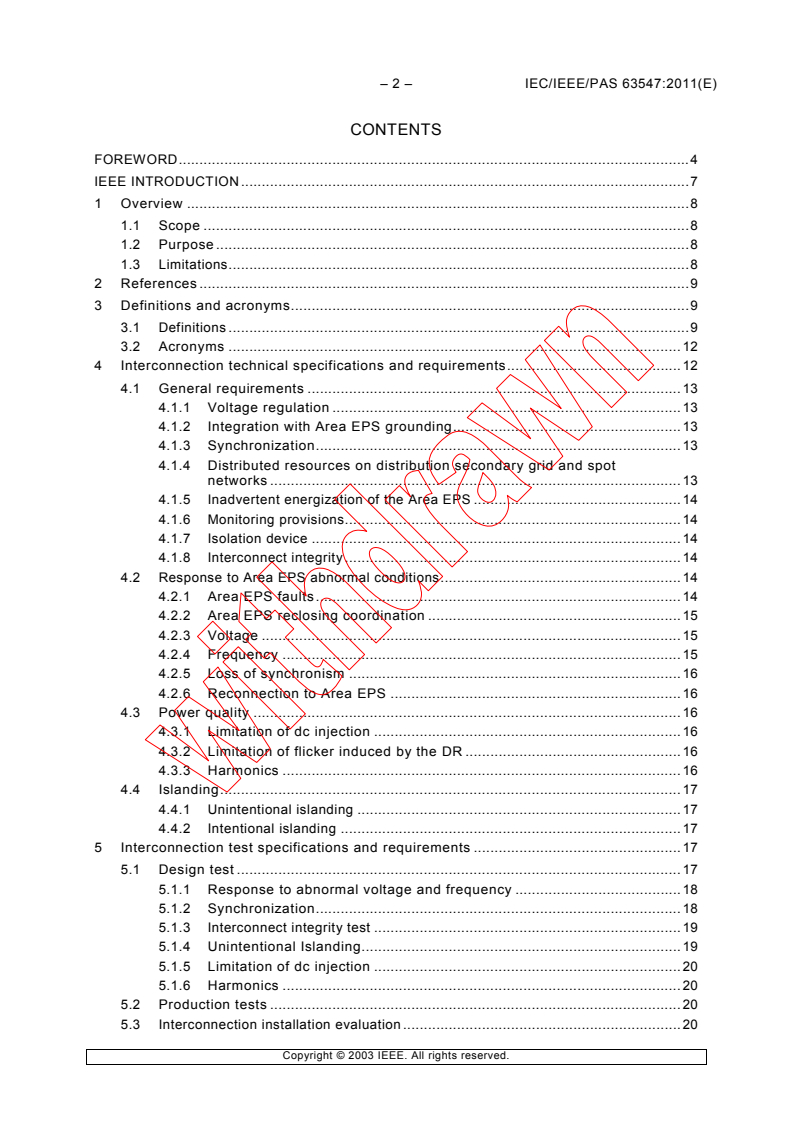
CONTENTS
FOREWORD . 4
IEEE INTRODUCTION . 7
1 Overview . 8
1.1 Scope . 8
1.2 Purpose . 8
1.3 Limitations . 8
2 References . 9
3 Definitions and acronyms . 9
3.1 Definitions . 9
3.2 Acronyms . 12
4 Interconnection technical specifications and requirements . 12
4.1 General requirements . 13
4.1.1 Voltage regulation . 13
4.1.2 Integration with Area EPS grounding . 13
4.1.3 Synchronization . 13
4.1.4 Distributed resources on distribution secondary grid and spot
networks . 13
4.1.5 Inadvertent energization of the Area EPS . 14
4.1.6 Monitoring provisions . 14
4.1.7 Isolation device . 14
4.1.8 Interconnect integrity . 14
4.2 Response to Area EPS abnormal conditions . 14
4.2.1 Area EPS faults . 14
4.2.2 Area EPS reclosing coordination . 15
4.2.3 Voltage . 15
4.2.4 Frequency . 15
4.2.5 Loss of synchronism . 16
4.2.6 Reconnection to Area EPS . 16
4.3 Power quality . 16
4.3.1 Limitation of dc injection . 16
4.3.2 Limitation of flicker induced by the DR . 16
4.3.3 Harmonics . 16
4.4 Islanding . 17
4.4.1 Unintentional islanding . 17
4.4.2 Intentional islanding . 17
5 Interconnection test specifications and requirements . 17
5.1 Design test . 17
5.1.1 Response to abnormal voltage and frequency . 18
5.1.2 Synchronization . 18
5.1.3 Interconnect integrity test . 19
5.1.4 Unintentional Islanding. 19
5.1.5 Limitation of dc injection . 20
5.1.6 Harmonics . 20
5.2 Production tests . 20
5.3 Interconnection installation evaluation . 20
IEC/IEEE/PAS 63547:2011(E) – 3 –
5.3.1 Grounding integration with Area EPS . 20
5.3.2 Isolation device . 21
5.3.3 Monitoring provisions . 21
5.3.4 Area EPS faults . 21
5.3.5 Area EPS reclosing coordination . 21
5.4 Commissioning tests . 21
5.4.1 Unintentional islanding functionality test . 22
5.4.2 Cease to energize functionality test. 22
5.5 Periodic interconnection tests. 22
Annex A (informative) Bibliography . 23
Annex B (informative) IEEE List of Participants . 24
Figure 1 – Relationship of interconnection terms . 10
Figure 2 – Schematic of interconnection . 11
Table 1 – Interconnection system response to abnormal voltages . 15
[IEC IN SOME COUNTRIES CLAUSE: Table 2 – Interconnection system response
to abnormal frequencies] . 16
[IEC IN SOME COUNTRIES CLAUSE: Table 3 – Maximum harmonic current
a
distortion in percent of current (I) ] . 17
Table 4 – Sequence for conducting design test . 18
Table 5 – Synchronization parameter limits for synchronous interconnection to an EPS,
or an energized local EPS to an energized Area EPS . 19
[IEC IN SOME COUNTRIES CLAUSE: Table 6 – Maximum harmonic voltage
distortion in percent of rated voltage for synchronous machines] . 20
– 4 – IEC/IEEE/PAS 63547:2011(E)
INTERNATIONAL ELECTROTECHNICAL COMMISSION
____________
INTERCONNECTING DISTRIBUTED RESOURCES
WITH ELECTRIC POWER SYSTEMS
FOREWORD
1) The International Electrotechnical Commission (IEC) is a worldwide organization for standardization comprising
all national electrotechnical committees (IEC National Committees). The object of IEC is to promote
international co-operation on all questions concerning standardization in the electrical and electronic fields. To
this end and in addition to other activities, IEC publishes International Standards, Technical Specifications,
Technical Reports, Publicly Available Specifications (PAS) and Guides (hereafter referred to as “IEC
Publication(s)”). Their preparation is entrusted to technical committees; any IEC National Committee interested
in the subject dealt with may participate in this preparatory work. International, governmental and non-
governmental organizations liaising with the IEC also participate in this preparation. IEC collaborates closely
with the International Organization for Standardization (ISO) in accordance with conditions determined by
agreement between the two organizations.
2) The formal decisions or agreements of IEC on technical matters express, as nearly as possible, an international
consensus of opinion on the relevant subjects since each technical committee has representation from all
interested IEC National Committees.
3) IEC Publications have the form of recommendations for international use and are accepted by IEC National
Committees in that sense. While all reasonable efforts are made to ensure that the technical content of IEC
Publications is accurate, IEC cannot be held responsible for the way in which they are used or for any
misinterpretation by any end user.
4) In order to promote international uniformity, IEC National Committees undertake to apply IEC Publications
transparently to the maximum extent possible in their national and regional publications. Any divergence
between any IEC Publication and the corresponding national or regional publication shall be clearly indicated in
the latter.
5) IEC itself does not provide any attestation of conformity. Independent certification bodies provide conformity
assessment services and, in some areas, access to IEC marks of conformity. IEC is not responsible for any
services carried out by independent certification bodies.
6) Attention is drawn to the possibility that some of the elements of this IEC Publication may be the subject of
patent rights. IEC shall not be held responsible for identifying any or all such patent rights.
A PAS is a technical specification not fulfilling the requirements for a standard, but made
available to the public.
IEC/IEEE-PAS 63547 was submitted by the IEEE (The Institute of Electrical and Electronics
Engineers) and has been processed by IEC technical committee 8: Systems aspects for
electrical energy supply.
TM
It is based on IEEE Std 1547 -2003. It is published as a double-logo PAS.
The text of this PAS is based on the This PAS was approved for
following document: publication by the P-members of the
committee concerned as indicated in
the following document:
Draft PAS Report on voting
8/1296/PAS 8/1299/RVD
Following publication of this PAS the technical committee or subcommittee concerned may
transform it into an International Standard.
This PAS shall remain valid for an initial maximum period of 3 years starting from the
publication date. The validity may be extended for a single period up to a maximum of
3 years, at the end of which it shall be published as another type of normative document, or
shall be withdrawn.
IEC/IEEE/PAS 63547:2011(E) – 5 –
TM
IEEE Std 1547 -2003
IEEE Standard for Interconnecting
Distributed Resources with Electric
Power Systems
Sponsor
Standards Coordinating Committee 21
(Fuel Cells, Photovoltaics, Dispersed Generation, and Energy Storage)
Approved 12 June 2003 IEEE-
SA Standards Board
– 6 – IEC/IEEE/PAS 63547 IEC:2011
Abstract: This standard is the first in the 1547 series of interconnection standards and is a
benchmark milestone demonstrating the open consensus process for standards development.
Traditionally, utility electric power systems (EPS--grid or utility grid) were not designed to
accommodate active generation and storage at the distribution level. As a result, there are major
issues and obstacles to an orderly transition to using and integrating distributed power
resources with the grid. The lack of uniform national interconnection standards and tests for
interconnection operation and certification, as well as the lack of uniform national building,
electrical, and safety codes, are understood. IEEE Std 1547 and its development demonstrate a
model for ongoing success in establishing additional interconnection agreements, rules, and standards,
on a national, regional, and state level. IEEE Std 1547 has the potential to be used in federal legislation
and rule making and state public utilities commission (PUC) deliberations, and by over 3000
utilities in formulating technical requirements for interconnection agreements for distributed
generators powering the electric grid.
This standard focuses on the technical specifications for, and testing of, the interconnection itself. It
provides requirements relevant to the performance, operation, testing, safety considerations, and
maintenance of the interconnection. It includes general requirements, response to abnormal
conditions, power quality, islanding, and test specifications and requirements for design,
production, installation evaluation, commissioning, and periodic tests. The stated requirements are
universally needed for interconnection of distributed resources (DR), including synchronous
machines, induction machines, or power inverters/converters and will be sufficient for most
installations. The criteria and requirements are applicable to all DR technologies, [IEC IN SOME
COUNTRIES CLAUSE: with aggregate capacity of 10 MVA or less at the point of common coupling],
interconnected to electric power systems at typical primary and/or secondary distribution voltages.
Installation of DR on radial primary and secondary distribution systems is the main emphasis of
this document, although installation of DR on primary and secondary network distribution systems
is considered. [IEC IN SOME COUNTRIES CLAUSE: This standard is written considering that the
DR is a 60 Hz source].
Keywords: certification; codes; commissioning, dc injection; design, field, installation, production tests;
communications; diesel generators; distributed generation, power; resources; electric distribution
systems; dispersed generation, storage; energy storage; faults; flicker; fuel cells; generators;
grid; harmonics; IEEE; induction machines; inverters; interconnection requirements and specifications;
islanding; microturbines; monitoring and control; paralleling; power converters, networks, quality;
photovoltaic power systems; point of common coupling; public utility commissions; reclosing
coordination; regulations; rule making, federal, national, regional, state; standards; synchronous
machines; testing; utilities; wind energy systems.
IEC/IEEE/PAS 63547:2011(E) – 7 –
IEEE INTRODUCTION
(This introduction is not part of IEEE Std 1547-2003, IEEE Standard for Interconnecting Distributed
Resources with Electric Power Systems.)
IEEE Std 1547-2003 is the first of a series of standards being developed by Standards
Coordinating Committee 21 on Fuel Cells, Photovoltaics, Dispersed Generation, and
Energy Storage (SCC21) concerning distributed resources interconnection. The titles of
the additional documents in that series follow.
TM
– IEEE P1547. 1 Draft Standard For Conformance Test Procedures for Equipment
Interconnecting Distributed Resources with Electric Power Systems
TM
– IEEE P1 547.2 Draft Application Guide for IEEE Std 1547-2003, IEEE Standard for
Interconnecting Distributed Resources with Electric Power Systems
TM
– IEEE P1 547.3 Draft Guide for Monitoring, Information Exchange, and Control of
Distributed Resources Interconnected with Electric Power Systems
This first publication of IEEE Std 1547-2003 is an outgrowth of the changes in the
environment for production and delivery of electricity and builds on prior IEEE
recommended practices and guidelines developed by SCC21 [IEC IN SOME COUNTRIES
TM
CLAUSE: e.g., IEEE Std 929 -2000, IEEE Recommended Practice for Utility Interface of
Photovoltaic (PV) Systems], and Standards Coordinating Committee 23 on Dispersed
TM
Storage and Generation (e.g., IEEE Std 1001 -1988, Guide for Interfacing Dispersed
Storage and Generation Facilities with Electric Utility Systems).
Traditionally, utility electric power systems (EPS) were not designed to accommodate
active generation and storage at the distribution level. The technologies and operational
concepts to properly integrate distributed resources (DR) into the existing EPS continue
to be further developed to fully realize benefits and to avoid negative impacts on system
reliability and safety.
There is a critical need to have a single document of consensus standard technical
requirements for DR interconnection rather than having to conform to numerous local
practices and guidelines. This standard addresses that critical need by providing uniform
criteria and requirements relevant to the performance, operation, testing, safety
considerations, and maintenance of the interconnection.
The intent of this standard is to define the technical requirements in a manner that can be
universally adopted. The universality relates not only to the technical aspects, but also to
the adoption of this standard as being pertinent across a number of industries and
institutions, e.g., hardware manufacturers, utilities, energy service companies, codes and
standards organizations, regulators and legislators, and other interested entities.
This standard focuses on the technical specifications for, and testing of, the
interconnection itself, and not on the types of the DR technologies. This standard aims to
be technology neutral, although cognizant that the technical attributes of DR and the
types of EPSs do have a bearing on the interconnection requirements. The addition of DR
to an EPS will change the system and its response in some manner. Although this
standard establishes criteria and requirements for interconnection, this standard is not a
design handbook nor is it an application guideline. This standard provides the minimum
functional technical requirements that are universally needed to help assure a technically
sound interconnection. Any additional local requirements should not be implemented to
the detriment of the functional technical requirements of this standard.
It is beyond the scope of this standard to address the methods used for performing EPS
impact studies, mitigating limitations of the Area EPS, or for addressing the business or
tariff issues associated with interconnection.
– 8 – IEC/IEEE/PAS 63547:2011(E)
INTERCONNECTING DISTRIBUTED RESOURCES
WITH ELECTRIC POWER SYSTEMS
1 Overview
This standard provides interconnection technical specifications and requirements, and test
specifications and requirements. Additionally, there is a bibliography included as Annex A
that lists citations referred to in this standard for informative purposes, but that are not
required to be used in conjunction with this standard.
1.1 Scope
This standard establishes criteria and requirements for interconnection of distributed
resources (DR) with electric power systems (EPS).
1.2 Purpose
This standard provides a uniform standard for interconnection of distributed resources
with electric power systems. It provides requirements relevant to the performance,
operation, testing, safety considerations, and maintenance of the interconnection.
The requirements shall be met at the point of common coupling (PCC), although the
devices used to meet these requirements can be located elsewhere. This standard
applies to interconnection based on the aggregate rating of all the DR units that are within
the Local EPS. The functions of the interconnection system hardware and software that
affect the Area EPS are required to meet this standard regardless of their location on the
EPS.
The stated specifications and requirements, both technical and testing, are universally
needed for interconnection of DR, including synchronous machines, induction machines,
or power inverters/converters, and will be sufficient for most installations.
1.3 Limitations
The criteria and requirements in this document are applicable to all distributed resource
technologies, [IEC IN SOME COUNTRIES CLAUSE: with aggregate capacity of 10 MVA
or less at the PCC], interconnected to EPSs at typical primary and/or secondary
distribution voltages. Installation of DR on radial primary and secondary distribution
systems is the main emphasis of this standard, although installation of DR on primary and
secondary network distribution systems is considered. [IEC IN SOME COUNTRIES
CLAUSE: This standard is written considering that the DR is a 60 Hz source].
– This standard does not define the maximum DR capacity for a particular installation
that may be interconnected to a single PCC or connected to a given feeder.
– This standard does not prescribe DR self-protection or all operating requirements for
DR units.
– This standard does not address planning, designing, operating, or maintaining the
Area EPS.
– This standard does not apply to automatic transfer schemes in which load is
transferred between the DR and the EPS in a momentary make-before-break
___________
Additional technical requirements and/or tests may be necessary for some limited situations.
IEC/IEEE/PAS 63547:2011(E) – 9 –
operation provided the duration of paralleling the sources is less than 100 ms, except
as noted in 4.1.4.
2 References
[IEC IN SOME COUNTRIES CLAUSE: The following standards shall be used in
conjunction with this standard. When the stated version of the following standards is
superseded by an approved revision, then that revision shall apply.
The applicability of the following standards is determined by the specific requirements
stated in this standard, such as requiring certain sections.
ANSI C84.1-1995, Electric Power Systems and Equipment –Voltage Ratings (60 Hz).
TM
IEEE Std C37.90.1 -2002, IEEE Standard Surge Withstand Capability (SWC) Tests for
,
3 4
Relays and Relay Systems Associated with Electric Power Apparatus
TM
IEEE Std C37.90.2 -1995, IEEE Standard Withstand Capability of Relay Systems to
Radiated Electromagnetic Interference from Transceivers
TM
-2002, IEEE Recommended Practice on Characterization of Surges
IEEE Std C62.41.2
in Low Voltage (1000 V and less) AC Power Circuits
TM
IEEE Std C62.45 -2002, IEEE Recommended Practice on Surge Testing for Equipment
Connected to Low-Voltage (1000 V and Less) AC Power Circuits
NEMA MG 1-1998, Motors and Generators, Revision 2. ]
3 Definitions and acronyms
For purposes of this standard, the following terms and definitions apply. [IEC IN SOME
TM
COUNTRIES CLAUSE: IEEE 1 00 , The Authoritative Dictionary of IEEE Standards
Terms, Seventh Edition [IEC IN SOME COUNTRIES CLAUSE: B4], should be referenced
for terms not defined in this clause].
3.1 Definitions
3.1.1
area electric power system operator (Area EPS Operator)
the entity responsible for designing, building, operating, and maintaining the Area EPS
3.1.2
cease to energize
cessation of energy outflow capability
___________
ANSI publications are available from the Sales Department, American National Standards Institute, 25
West 43rd Street, 4th Floor, New York, NY 10036, USA (http://www.ansi.org/).
The IEEE standards or products referred to in Clause 2 are trademarks owned by the Institute of
Electrical and Electronics Engineers, Incorporated.
IEEE publications are available from the Institute of Electrical and Electronics Engineers, 445 Hoes
Lane, P.O. Box 1331, Piscataway, NJ 08855-133 1, USA (http://standards.ieee.org/).
NEMA publications are available from Global Engineering Documents, 15 Inverness Way East,
Englewood, Colorado 80112, USA (http://global.ihs.com/).
The numbers in brackets correspond to those of the bibliography in Annex A.
– 10 – IEC/IEEE/PAS 63547:2011(E)
3.1.3
design test
test of one or more devices made to a certain design to show that the design meets
certain specifications
3.1.4
distributed generation (DG)
electric generation facilities connected to an Area EPS through a PCC; a subset of DR
3.1.5
distributed resources (DR)
sources of electric power that are not directly connected to a bulk power transmission
system. DR includes both generators and energy storage technologies
NOTE See Figure 1 and Figure 2.
Figure 1 – Relationship of interconnection terms
3.1.6
electric power system (EPS)
facilities that deliver electric power to a load
NOTE This may include generation units. See Figure 1.
3.1.6.1
electric power system, area (Area EPS)
an EPS that serves Local EPSs
NOTE Typically, an Area EPS has primary access to public rights-of-way, priority crossing of property
boundaries, etc., and is subject to regulatory oversight. See Figure 1.
3.1.6.2
electric power system, local (Local EPS)
an EPS contained entirely within a single premises or group of premises
IEC/IEEE/PAS 63547:2011(E) – 11 –
NOTE See Figure 1.
3.1.7
interconnection
the result of the process of adding a DR unit to an Area EPS
NOTE See Figure 2.
Figure 2 – Schematic of interconnection
3.1.8
interconnection equipment
Individual or multiple devices used in an interconnection system
3.1.9
interconnection system
the collection of all interconnection equipment and functions, taken as a group, used to
interconnect a DR unit(s) to an Area EPS
NOTE See Figure 2.
3.1.10
inverter
a machine, device, or system that changes direct-current power to alternating-current
power
3.1.11
island
a condition in which a portion of an Area EPS is energized solely by one or more Local
EPSs through the associated PCCs while that portion of the Area EPS is electrically
separated from the rest of the Area EPS
3.1.11.1
island, intentional
a planned island.
3.1.11.2
island, unintentional
an unplanned island.
3.1.12
non-islanding
intended to prevent the continued existence of an island
3.1.13
point of common coupling
PCC
the point where a Local EPS is connected to an Area EPS
NOTE See Figure 1.
– 12 – IEC/IEEE/PAS 63547:2011(E)
3.1.14
point of distributed resources connection (point of DR connection)
the point where a DR unit is electrically connected in an EPS
NOTE See Figure 1.
3.1.15
simulated utility
an assembly of variable frequency and variable voltage test equipment used to simulate a
normal utility source
3.1.16
total demand distortion
TDD
the total root-sum-square harmonic current distortion, in percent of the maximum demand
load current (15 or 30 minute demand)
3.1.17
total rated-current distortion
TRD
the total root-sum-square of the current harmonics created by the DR unit operating into a
linear balanced load divided by the greater of the test load current demand (IL) or the
rated current capacity of the DR unit (Irated)
3.2 Acronyms
Area EPS Area electric power system
DG distributed generation
DR distributed resources
EPS electric power system
I current
I load current
L
I short circuit current
SC
Local EPS Local electric power system
PCC point of common coupling
TDD total demand distortion
TRD total rated-current distortion
4 Interconnection technical specifications and requirements
The requirements in this clause shall be met at the PCC, although the devices used to
meet these requirements can be located elsewhere. The requirements apply to
interconnection of either a single DR unit based on that unit’s rating or multiple DR units
within a single Local EPS, based on the aggregate rating of all the DR units that are
within the Local EPS. The functions of the interconnection system hardware and software
that affect the Area EPS are required to meet this standard regardless of their location on
the EPS.
The requirements in this clause are functional and do not specify any particular
equipment or equipment type.
IEC/IEEE/PAS 63547:2011(E) – 13 –
The stated technical specifications and requirements are universally needed for
interconnection of DR, including synchronous machines, induction machines, or static
power inverters/converters, and will be sufficient for most installations.
4.1 General requirements
4.1.1 Voltage regulation
[IEC IN SOME COUNTRIES CLAUSE: The DR shall not actively regulate the voltage at
the PCC]. [IEC IN SOME COUNTRIES CLAUSE: The DR shall not cause the Area EPS
service voltage at other Local EPSs to go outside the requirements of ANSI C84.1-1995,
Range A.]
4.1.2 Integration with Area EPS grounding
The grounding scheme of the DR interconnection shall not cause overvoltages that
exceed the rating of the equipment connected to the Area EPS and shall not disrupt the
coordination of the ground fault protection on the Area EPS.
4.1.3 Synchronization
[IEC IN SOME COUNTRIES CLAUSE: The DR unit shall parallel with the Area EPS
without causing a voltage fluctuation at the PCC greater than ± 5 % of the prevailing
voltage level of the Area EPS at the PCC, and meet the flicker requirements of 4.3.2.]
4.1.4 Distributed resources on distribution secondary grid and spot networks
4.1.4.1 Distribution secondary grid networks
This topic is under consideration for future revisions of this standard.
4.1.4.2 Distribution secondary spot networks
Network protectors shall not be used to separate, switch, serve as breaker failure backup
or in any manner isolate a network or network primary feeder to which DR is connected
from the remainder of the Area EPS, unless the protectors are rated and tested per
applicable standards for such an application.
Any DR installation connected to a spot network shall not cause operation or prevent
reclosing of any network protectors installed on the spot network. This coordination shall
be accomplished without requiring any changes to prevailing network protector clearing
time practices of the Area EPS.
Connection of the DR to the Area EPS is only permitted if the Area EPS network bus is
already energized by more than 50 % of the installed network protectors.
The DR output shall not cause any cycling of network protectors.
The network equipment loading and fault interrupting capacity shall not be exceeded with
the addition of DR.
___________
Additional technical requirements may be necessary for some limited situations.
When required by the authority who has jurisdiction over the DR interconnection, a study may be
conducted to determine that all of the requirements of this subclause can be met when the aggregate
DR installed on a spot network exceeds 5 % of the spot network’s maximum load.
TM TM
IEEE C37.108 -2002 [IEC IN SOME COUNTRIES CLAUSE: B8] and IEEE C57.12.44 -2000 [IEC IN
SOME COUNTRIES CLAUSE: B9] provide guidance on the capabilities of network systems to accept
distributed resources.
– 14 – IEC/IEEE/PAS 63547:2011(E)
DR installations on a spot network, using an automatic transfer scheme in which load is
transferred between the DR and the EPS in a momentary make-before-break operation, shall
meet all the requirements of this clause regardless of the duration of paralleling.
4.1.5 Inadvertent energization of the Area EPS
The DR shall not energize the Area EPS when the Area EPS is de-energized.
4.1.6 Monitoring provisions
Each DR unit of 250 kVA or more or DR aggregate of 250 kVA or more at a single PCC shall
have provisions for monitoring its connection status, real power output, reactive power output,
and voltage at the point of DR connection.
4.1.7 Isolation device
When required by the Area EPS operating practices, a readily accessible, lockable, visible-
break isolation device shall be located between the Area EPS and the DR unit.
4.1.8 Interconnect integrity
4.1.8.1 Protection from electromagnetic interference
[IEC IN SOME COUNTRIES CLAUSE: The interconnection system shall have the capability
to withstand electromagnetic interference (EMI) environments in accordance with
IEEE Std C37.90.2-1995]. The influence of EMI shall not result in a change in state or
misoperation of the interconnection system.
4.1.8.2 Surge withstand performance
[IEC IN SOME COUNTRIES CLAUSE: The interconnection system shall have the capability
to withstand voltage and current surges in accordance with the environments defined in
IEEE Std C62.41. 2-2002 or IEEE Std C37.90. 1-2002 as applicable].
4.1.8.3 Paralleling device
The interconnection system paralleling-device shall be capable of withstanding 220 % of the
interconnection system rated voltage.
4.2 Response to Area EPS abnormal conditions
Abnormal conditions can arise on the Area EPS that require a response from the connected
DR. This response contributes to the safety of utility maintenance personnel and the general
public, as well as the avoidance of damage to connected equipment, including the DR. All
voltage and frequency parameters specified in these subclauses shall be met at the PCC,
unless otherwise stated.
Area EPS faults
4.2.1
The DR unit shall cease to energize the Area EPS for faults on the Area EPS circuit to
which it is connected.
___________
The isolation of a portion of the Area EPS, presenting the potential for an unintended DR island, is a
special concern and is addressed in 4.4.1.
Setting adjustments may only be made as approved by the authority who has jurisdiction over the DR
interconnection.
IEC/IEEE/PAS 63547:2011(E) – 15 –
4.2.2 Area EPS reclosing coordination
The DR shall cease to energize the Area EPS circuit to which it is connected prior to
reclosure by the Area EPS.
4.2.3 Voltage
The protection functions of the interconnection system shall detect the effective (rms) or
fundamental frequency value of each phase-to-phase voltage, except where the
transformer connecting the Local EPS to the Area EPS is a grounded wye-wye
configuration, or single-phase installation, the phase-to-neutral voltage shall be detected.
When any voltage is in a range given in Table 1, the DR shall cease to energize the Area
EPS within the clearing time as indicated. Clearing time is the time between the start of
the abnormal condition and the DR ceasing to energize the Area EPS. For DR less than
or equal to 30 kW in peak capacity, the voltage set points and clearing times shall be
either fixed or field adjustable. For DR greater than 30 kW, the voltage set points shall be
field adjustable.
The voltages shall be detected at either the PCC or the point of DR connection when any
of the following conditions exist:
a) The aggregate capacity of DR systems connected to a single PCC is less than or
equal to 30 kW,
b) The interconnection equipment is certified to pass a non-islanding test for the system
to which it is to be connected,
c) The aggregate DR capacity is less than 50 % of the total Local EPS minimum annual
integrated electrical demand for a 15 minute time period, and export of real or reactive
power by the DR to the Area EPS is not permitted.
Table 1 – Interconnection system response to abnormal voltages
Voltage range
b
Clearing time(s)
a
(% of base voltage )
V< 50 0.16
50 ≤V< 88 2.00
110 < V < 120 1.00
V ≥ 120 0.16
a
[IEC IN SOME COUNTRIES CLAUSE: Base voltages are the nominal system voltages stated in
ANSI C84.1-1995, Table 1].
b
DR ≤ 30 kW, maximum clearing times; DR > 30kW, default clearing times.
4.2.4 Frequency
When the system frequency is in a range given in Table 2, the DR shall cease to energize the
Area EPS within the clearing time as indicated. Clearing time is the time between the start of
the abnormal condition and the DR ceasing to energize the Area EPS. For DR less than or
equal to 30 kW in peak capacity, the frequency set points and clearing times shall be either
fixed or field adjustable. For DR greater than 30 kW, the frequency set points shall be field
adjustable.
Adjustable under-frequency trip settings shall be coordinated with Area EPS operations.
– 16 – IEC/IEEE/PAS 63547:2011(E)
[IEC IN SOME COUNTRIES CLAUSE:
Table 2 – Interconnection system response to abnormal frequencies]
a
DR size Frequency range (Hz) Clearing time(s)
> 60.5 0.16
≤ 30 kW
< 59.3 0.16
> 30 kW
> 60.5 0.16
< {59.8 – 57.0} Adjustable 0.16 to 300
(adjustable set point)
< 57.0 0.16
a
DR ≤ 30 kW, maximum clearing times; DR > 30 kW, default clearing times.
4.2.5 Loss of synchronism
Loss of synchronism protection is not required except as necessary to meet 4.3.2.
4.2.6 Reconnection to Area EPS
[IEC IN SOME COUNTRIES CLAUSE: After an Area EPS disturbance, no DR reconnection
shall take place until the Area EPS voltage is within Range B of ANSI C84.1-1995, Table 1],
[IEC IN SOME COUNTRIES CLAUSE: and frequency range of 59.3 Hz to 60.5 Hz].
The DR interconnection system shall include an adjustable delay (or a fixed delay of five
minutes) that may delay reconnection for up to five minutes after the Area EPS steady-state
voltage and frequency are restored to the ranges identified above.
4.3 Power quality
4.3.1 Limitation of dc injection
The DR and its interconnection system shall not inject dc current greater than 0.5% of the
full rated output current at the point of DR connection.
4.3.2 Limitation of flicker induced by the DR
The DR shall not create objectionable flicker for other customers on the Area EPS.
4.3.3 Harmonics
When the DR is serving balanced linear loads, harmonic current injection into the Area
EPS at the PCC shall not exceed the limits stated below in Table 3. The harmonic current
injections shall be exclusive of any harmonic currents due to harmonic voltage distortion present
in the Area EPS without the DR connected.
___________
Flicker is considered objectionable when it either causes a modulation of the light level of lamps
sufficient to be irritating to humans, or causes equipment misoperation. For guidance, refer to IEEE
TM TM
Std 519 -1992 [IEC IN SOME COUNTRIES CLAUSE: B5], IEEE P1453 [IEC IN SOME
COUNTRIES CLAUSE: B10], IEC/TR3 61000-3-7 [IEC IN SOME COUNTRIES CLAUSE: B1], IEC
61000-4-15 [IEC IN SOME COUNTRIES CLAUSE: B2], IEC 61400-21 [IEC IN SOME COUNTRIES
CLAUSE: B3].
IEC/IEEE/PAS 63547:2011(E) – 17 –
[IEC IN SOME COUNTRIES CLAUSE:
a
Table 3 – Maximum harmonic current distortion in percent of current (I) ]
Individual Total
harmonic order h demand
b
h < 11 11 ≤ h < 17 17 ≤ h < 23 23 ≤ h < 35 35 ≤ h
(odd harmonics) distortion
(TDD)
Percent (%) 4.0 2.0 1.5 0.6 0.3 5.0
a
I = the greater of the Local EPS maximum load current integrated demand (15 or 30 minutes) without the DR
unit, or the DR unit rated current capacity (transformed to the PCC when a transformer exists between the DR
unit and the PCC).
b
Even harmonics are limited to 25 % of the odd harmonic limits above.
4.4 Islanding
4.4.1 Unintentional islanding
For an unintentional island in which the DR energizes a portion of the Area EPS through
the PCC, the DR interconnection system shall detect the island and cease to energize the
Area EPS within two seconds of the formation of an island.
4.4.2 Intentional islanding
This topic is under consideration for future revisions of this standard.
5 Interconnection test specifications and requirements
This clause provides the test requirements to demonstrate that the interconnection
system meets the requirements of Clause 4. The applicable tests from this clause are
r
...