

IEC 61970-301:2013
(Main)Energy management system application program interface (EMS-API) - Part 301: Common information model (CIM) base
General Information
- Abstract
IEC 61970-301:2013 defines the Common Information Model (CIM), that is an abstract model representing all the major objects in an electric utility enterprise typically involved in utility operations. By providing a standard way of representing power system resources as object classes and attributes, along with their relationships, the CIM facilitates the integration of Energy Management System (EMS) applications developed independently by different vendors, between entire EMS systems developed independently, or between an EMS system and other systems concerned with different aspects of power system operations, such as generation or distribution management. SCADA is modeled to the extent necessary to support power system simulation and inter-control center communication. The CIM facilitates integration by defining a common language (i.e. semantics) based on the CIM to enable these applications or systems to access public data and exchange information independent of how such information is represented internally. Major changes from the fourth edition include the following:
- transformer models have been modified to be consistent for use by distribution and transmission purposes;
- a more general and clear naming approach was added and several ambiguous attributes related to naming were dropped;
- phase component wires models have been enhanced to describe internal phase specific attributes and connections;
- addition of diagram layout models to facilitate the exchange of diagram layout information.
- Status
- Published
- Publication Date
- 12-Dec-2013
- Technical Committee
- TC 57 - Power systems management and associated information exchange
- Drafting Committee
- WG 13 - TC 57/WG 13
- Current Stage
- DELPUB - Deleted Publication
- Start Date
- 16-Dec-2016
- Completion Date
- 28-Aug-2026
Overview
IEC 61970-301:2013 specifies the Common Information Model (CIM) base for Energy Management System Application Program Interfaces (EMS-API). It provides a standardized abstract model representing crucial objects within an electric utility enterprise involved in power system operations. This IEC standard lays the foundation for consistent representation of power system resources through object classes, attributes, and relationships to enable seamless integration across various EMS applications and systems.
By defining a common language and semantics for power system data, IEC 61970-301:2013 makes it possible to share data and exchange information regardless of how internal representations differ between vendors or systems. It also supports functions related to SCADA where necessary for power system simulation and inter-control center communication.
The fifth edition introduced important updates, refining transformer models for both transmission and distribution, improving naming conventions, enhancing phase component wire models, and adding diagram layout models for diagram exchanges.
Key Topics
Common Information Model (CIM):
- Abstract and object-oriented model representing equipment, measurements, and control devices in the utility domain.
- Structured with well-defined classes, associations, and inheritance hierarchies.
- Covers entities such as transformers, connectivity nodes, conducting equipment, and more.
Modeling Concepts:
- UML-based CIM modeling notation ensuring clarity and extensibility.
- Hierarchical containment and connectivity models reflecting real system topology.
- Specialized transformer and phase wire models supporting both transmission and distribution system needs.
Naming and Identification:
- Standardized and clearer naming approaches remove ambiguity.
- Root classes like IdentifiedObject and Name support unique identification of components.
Extensions and Enhancements:
- Diagram layout models to enable transfer of schematic views.
- Measurement and control classes facilitating operational data modeling.
- Regulating control models for describing automated device operations.
Practical Guidelines:
- Modeling rules for maintaining consistency and enabling future amendments.
- User conventions and best practices for implementation.
- Profiles for subsets of CIM tailored to different applications.
Applications
IEC 61970-301:2013 CIM base plays a pivotal role in modern electric utility systems, enabling:
EMS Integration:
- Facilitates interoperability between independent EMS applications from different vendors.
- Supports integration of entire EMS systems for coordinated control and monitoring.
Cross-Domain Data Exchange:
- Enables data sharing between EMS and other utility systems, such as generation and distribution management.
- Standardizes communication protocols to streamline inter-control center exchange.
SCADA and Simulation Support:
- Models SCADA data relevant for power system simulations and operational analysis.
- Enhances situational awareness and decision-making through consistent data views.
Utility Asset Modeling:
- Represents physical and logical assets in electrical networks for planning, operation, and maintenance.
- Assists in visualizing equipment configurations and system connectivity.
Automation and Control:
- Provides foundational structures for automated regulatory device description.
- Supports real-time data acquisition, control commands, and event handling.
Related Standards
IEC 61970 Series:
- Other parts address specific EMS API modules, interfaces, and profiles expanding on CIM usage.
- Complements IEC 61968 for distribution management system information exchanges.
IEC 61850:
- Focused on substation automation with complementary data models.
- Integration allows broader system interoperability from substation to enterprise.
IEC 61850-7-420:
- Defines CIM extensions for hydro power plants, harmonizing with IEC 61970 for seamless data exchange.
IEC 62325:
- Market communication standards leveraging CIM for energy markets and trading systems.
Keywords: IEC 61970-301, Common Information Model, CIM, Energy Management System, EMS-API, electric utility, power system modeling, EMS integration, SCADA, transformer models, power system data exchange, utility operations, interoperability, EMS applications, electrical network modeling, IEC standards.
Relations
- Effective Date
- 05-Sep-2023
- Effective Date
- 05-Sep-2023
Get Certified
Connect with accredited certification bodies for this standard

ANCE
Mexican certification and testing association.

Intertek Slovenia
Intertek testing, inspection, and certification services in Slovenia.

LNE (Laboratoire National de Métrologie et d'Essais)
French national laboratory for metrology and testing.
Sponsored listings
Frequently Asked Questions
IEC 61970-301:2013 is a standard published by the International Electrotechnical Commission (IEC). Its full title is "Energy management system application program interface (EMS-API) - Part 301: Common information model (CIM) base". This standard covers: IEC 61970-301:2013 defines the Common Information Model (CIM), that is an abstract model representing all the major objects in an electric utility enterprise typically involved in utility operations. By providing a standard way of representing power system resources as object classes and attributes, along with their relationships, the CIM facilitates the integration of Energy Management System (EMS) applications developed independently by different vendors, between entire EMS systems developed independently, or between an EMS system and other systems concerned with different aspects of power system operations, such as generation or distribution management. SCADA is modeled to the extent necessary to support power system simulation and inter-control center communication. The CIM facilitates integration by defining a common language (i.e. semantics) based on the CIM to enable these applications or systems to access public data and exchange information independent of how such information is represented internally. Major changes from the fourth edition include the following: - transformer models have been modified to be consistent for use by distribution and transmission purposes; - a more general and clear naming approach was added and several ambiguous attributes related to naming were dropped; - phase component wires models have been enhanced to describe internal phase specific attributes and connections; - addition of diagram layout models to facilitate the exchange of diagram layout information.
IEC 61970-301:2013 defines the Common Information Model (CIM), that is an abstract model representing all the major objects in an electric utility enterprise typically involved in utility operations. By providing a standard way of representing power system resources as object classes and attributes, along with their relationships, the CIM facilitates the integration of Energy Management System (EMS) applications developed independently by different vendors, between entire EMS systems developed independently, or between an EMS system and other systems concerned with different aspects of power system operations, such as generation or distribution management. SCADA is modeled to the extent necessary to support power system simulation and inter-control center communication. The CIM facilitates integration by defining a common language (i.e. semantics) based on the CIM to enable these applications or systems to access public data and exchange information independent of how such information is represented internally. Major changes from the fourth edition include the following: - transformer models have been modified to be consistent for use by distribution and transmission purposes; - a more general and clear naming approach was added and several ambiguous attributes related to naming were dropped; - phase component wires models have been enhanced to describe internal phase specific attributes and connections; - addition of diagram layout models to facilitate the exchange of diagram layout information.
IEC 61970-301:2013 is classified under the following ICS (International Classification for Standards) categories: 33.200 - Telecontrol. Telemetering. The ICS classification helps identify the subject area and facilitates finding related standards.
IEC 61970-301:2013 has the following relationships with other standards: It is inter standard links to IEC 61970-301:2016, IEC 61970-301:2013. Understanding these relationships helps ensure you are using the most current and applicable version of the standard.
IEC 61970-301:2013 is available in PDF format for immediate download after purchase. The document can be added to your cart and obtained through the secure checkout process. Digital delivery ensures instant access to the complete standard document.
Standards Content (Sample)
IEC 61970-301 ®
Edition 5.0 2013-12
INTERNATIONAL
STANDARD
NORME
INTERNATIONALE
colour
inside
Energy management system application program interface (EMS-API) –
Part 301: Common information model (CIM) base
Interface de programmation d'application pour système de gestion d'énergie
(EMS-API) –
Partie 301: Base de modèle d'information commun (CIM)
All rights reserved. Unless otherwise specified, no part of this publication may be reproduced or utilized in any form
or by any means, electronic or mechanical, including photocopying and microfilm, without permission in writing from
either IEC or IEC's member National Committee in the country of the requester.
If you have any questions about IEC copyright or have an enquiry about obtaining additional rights to this publication,
please contact the address below or your local IEC member National Committee for further information.
Droits de reproduction réservés. Sauf indication contraire, aucune partie de cette publication ne peut être reproduite ni
utilisée sous quelque forme que ce soit et par aucun procédé, électronique ou mécanique, y compris la photocopie et les
microfilms, sans l'accord écrit de la CEI ou du Comité national de la CEI du pays du demandeur.
Si vous avez des questions sur le copyright de la CEI ou si vous désirez obtenir des droits supplémentaires sur cette
publication, utilisez les coordonnées ci-après ou contactez le Comité national de la CEI de votre pays de résidence.
IEC Central Office Tel.: +41 22 919 02 11
3, rue de Varembé Fax: +41 22 919 03 00
CH-1211 Geneva 20 info@iec.ch
Switzerland www.iec.ch
About the IEC
The International Electrotechnical Commission (IEC) is the leading global organization that prepares and publishes
International Standards for all electrical, electronic and related technologies.
About IEC publications
The technical content of IEC publications is kept under constant review by the IEC. Please make sure that you have the
latest edition, a corrigenda or an amendment might have been published.
Useful links:
IEC publications search - www.iec.ch/searchpub Electropedia - www.electropedia.org
The advanced search enables you to find IEC publications The world's leading online dictionary of electronic and
by a variety of criteria (reference number, text, technical electrical terms containing more than 30 000 terms and
committee,…). definitions in English and French, with equivalent terms in
It also gives information on projects, replaced and additional languages. Also known as the International
withdrawn publications. Electrotechnical Vocabulary (IEV) on-line.
IEC Just Published - webstore.iec.ch/justpublished Customer Service Centre - webstore.iec.ch/csc
Stay up to date on all new IEC publications. Just Published If you wish to give us your feedback on this publication
details all new publications released. Available on-line and or need further assistance, please contact the
also once a month by email. Customer Service Centre: csc@iec.ch.
A propos de la CEI
La Commission Electrotechnique Internationale (CEI) est la première organisation mondiale qui élabore et publie des
Normes internationales pour tout ce qui a trait à l'électricité, à l'électronique et aux technologies apparentées.
A propos des publications CEI
Le contenu technique des publications de la CEI est constamment revu. Veuillez vous assurer que vous possédez
l’édition la plus récente, un corrigendum ou amendement peut avoir été publié.
Liens utiles:
Recherche de publications CEI - www.iec.ch/searchpub Electropedia - www.electropedia.org
La recherche avancée vous permet de trouver des Le premier dictionnaire en ligne au monde de termes
publications CEI en utilisant différents critères (numéro de électroniques et électriques. Il contient plus de 30 000
référence, texte, comité d’études,…). termes et définitions en anglais et en français, ainsi que
Elle donne aussi des informations sur les projets et les les termes équivalents dans les langues additionnelles.
publications remplacées ou retirées. Egalement appelé Vocabulaire Electrotechnique
International (VEI) en ligne.
Just Published CEI - webstore.iec.ch/justpublished
Service Clients - webstore.iec.ch/csc
Restez informé sur les nouvelles publications de la CEI.
Just Published détaille les nouvelles publications parues. Si vous désirez nous donner des commentaires sur
Disponible en ligne et aussi une fois par mois par email. cette publication ou si vous avez des questions
contactez-nous: csc@iec.ch.
IEC 61970-301 ®
Edition 5.0 2013-12
INTERNATIONAL
STANDARD
NORME
INTERNATIONALE
colour
inside
Energy management system application program interface (EMS-API) –
Part 301: Common information model (CIM) base
Interface de programmation d'application pour système de gestion d'énergie
(EMS-API) –
Partie 301: Base de modèle d'information commun (CIM)
INTERNATIONAL
ELECTROTECHNICAL
COMMISSION
COMMISSION
ELECTROTECHNIQUE
PRICE CODE
INTERNATIONALE
CODE PRIX XH
ICS 33.200 ISBN 978-2-8322-1291-2
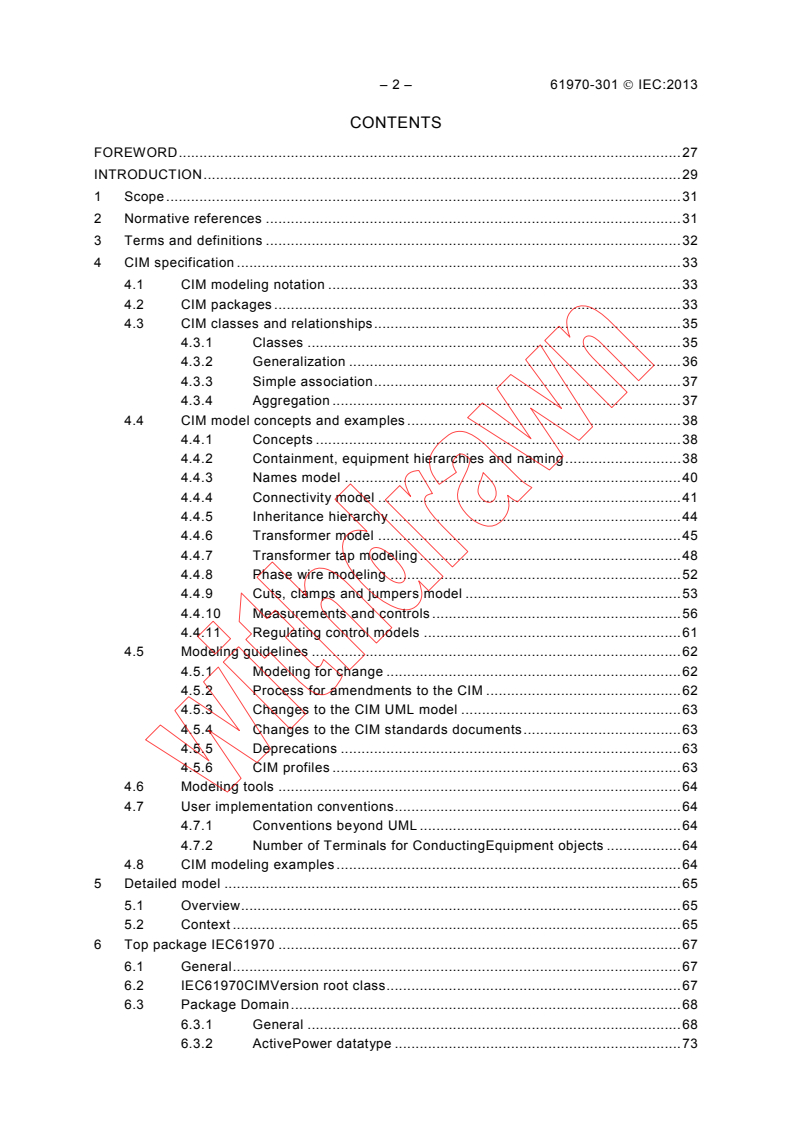
– 2 – 61970-301 IEC:2013
CONTENTS
FOREWORD . 27
INTRODUCTION . 29
1 Scope . 31
2 Normative references . 31
3 Terms and definitions . 32
4 CIM specification . 33
4.1 CIM modeling notation . 33
4.2 CIM packages . 33
4.3 CIM classes and relationships . 35
4.3.1 Classes . 35
4.3.2 Generalization . 36
4.3.3 Simple association . 37
4.3.4 Aggregation . 37
4.4 CIM model concepts and examples . 38
4.4.1 Concepts . 38
4.4.2 Containment, equipment hierarchies and naming . 38
4.4.3 Names model . 40
4.4.4 Connectivity model . 41
4.4.5 Inheritance hierarchy . 44
4.4.6 Transformer model . 45
4.4.7 Transformer tap modeling . 48
4.4.8 Phase wire modeling . 52
4.4.9 Cuts, clamps and jumpers model . 53
4.4.10 Measurements and controls . 56
4.4.11 Regulating control models . 61
4.5 Modeling guidelines . 62
4.5.1 Modeling for change . 62
4.5.2 Process for amendments to the CIM . 62
4.5.3 Changes to the CIM UML model . 63
4.5.4 Changes to the CIM standards documents . 63
4.5.5 Deprecations . 63
4.5.6 CIM profiles . 63
4.6 Modeling tools . 64
4.7 User implementation conventions . 64
4.7.1 Conventions beyond UML . 64
4.7.2 Number of Terminals for ConductingEquipment objects . 64
4.8 CIM modeling examples . 64
5 Detailed model . 65
5.1 Overview . 65
5.2 Context . 65
6 Top package IEC61970 . 67
6.1 General . 67
6.2 IEC61970CIMVersion root class . 67
6.3 Package Domain . 68
6.3.1 General . 68
6.3.2 ActivePower datatype . 73
61970-301 IEC:2013 – 3 –
6.3.3 ActivePowerChangeRate datatype . 73
6.3.4 Admittance datatype . 73
6.3.5 AngleDegrees datatype . 73
6.3.6 AngleRadians datatype . 74
6.3.7 ApparentPower datatype . 74
6.3.8 Boolean primitive . 74
6.3.9 Capacitance datatype . 74
6.3.10 Conductance datatype . 75
6.3.11 ConductancePerLength datatype . 75
6.3.12 CostPerEnergyUnit datatype . 75
6.3.13 CostPerVolume datatype . 75
6.3.14 CostRate datatype . 76
6.3.15 Currency enumeration . 76
6.3.16 CurrentFlow datatype . 77
6.3.17 Damping datatype . 77
6.3.18 Date primitive . 78
6.3.19 DateInterval compound . 78
6.3.20 DateTime primitive . 78
6.3.21 DateTimeInterval compound . 78
6.3.22 Decimal primitive . 78
6.3.23 Displacement datatype . 78
6.3.24 Duration primitive . 79
6.3.25 Float primitive . 79
6.3.26 FloatQuantity datatype . 79
6.3.27 Frequency datatype . 79
6.3.28 Hours datatype . 79
6.3.29 Impedance datatype . 80
6.3.30 Inductance datatype . 80
6.3.31 Integer primitive . 80
6.3.32 IntegerQuantity datatype . 80
6.3.33 KiloActivePower datatype . 80
6.3.34 Length datatype . 81
6.3.35 Minutes datatype . 81
6.3.36 Money datatype . 81
6.3.37 PU datatype . 81
6.3.38 PerCent datatype . 82
6.3.39 Pressure datatype . 82
6.3.40 Reactance datatype . 82
6.3.41 ReactancePerLength datatype . 83
6.3.42 ReactivePower datatype . 83
6.3.43 RealEnergy datatype . 83
6.3.44 Resistance datatype . 83
6.3.45 ResistancePerLength datatype . 84
6.3.46 RotationSpeed datatype . 84
6.3.47 Seconds datatype . 84
6.3.48 Speed datatype . 85
6.3.49 String primitive . 85
6.3.50 StringQuantity datatype . 85
6.3.51 Susceptance datatype . 85
– 4 – 61970-301 IEC:2013
6.3.52 SusceptancePerLength datatype . 86
6.3.53 Temperature datatype . 86
6.3.54 Time primitive . 86
6.3.55 TimeInterval compound . 86
6.3.56 UnitMultiplier enumeration . 87
6.3.57 UnitSymbol enumeration . 87
6.3.58 Voltage datatype . 88
6.3.59 VoltagePerReactivePower datatype . 88
6.3.60 Volume datatype . 89
6.3.61 VolumeFlowRate datatype . 89
6.3.62 WaterLevel datatype . 89
6.3.63 Weight datatype . 89
6.4 Package Core . 90
6.4.1 General . 90
6.4.2 BasePower . 94
6.4.3 BaseVoltage . 94
6.4.4 BasicIntervalSchedule . 95
6.4.5 Bay . 96
6.4.6 BreakerConfiguration enumeration . 97
6.4.7 BusbarConfiguration enumeration . 97
6.4.8 ConductingEquipment . 97
6.4.9 ConnectivityNode. 98
6.4.10 ConnectivityNodeContainer . 99
6.4.11 Curve . 99
6.4.12 CurveData root class . 100
6.4.13 CurveStyle enumeration . 101
6.4.14 Equipment . 101
6.4.15 EquipmentContainer . 102
6.4.16 GeographicalRegion . 103
6.4.17 IdentifiedObject root class . 103
6.4.18 IrregularIntervalSchedule . 104
6.4.19 IrregularTimePoint root class . 105
6.4.20 Name root class . 105
6.4.21 NameType root class . 106
6.4.22 NameTypeAuthority root class . 106
6.4.23 OperatingParticipant . 107
6.4.24 OperatingShare root class . 107
6.4.25 PhaseCode enumeration. 108
6.4.26 PowerSystemResource . 109
6.4.27 PsrList . 109
6.4.28 PSRType . 110
6.4.29 RegularIntervalSchedule . 110
6.4.30 RegularTimePoint root class . 111
6.4.31 ReportingGroup . 112
6.4.32 ReportingSuperGroup . 112
6.4.33 SubGeographicalRegion . 113
6.4.34 Substation . 113
6.4.35 Terminal . 114
6.4.36 VoltageLevel . 115
61970-301 IEC:2013 – 5 –
6.5 Package DiagramLayout . 116
6.5.1 General . 116
6.5.2 Diagram . 117
6.5.3 DiagramObject . 118
6.5.4 DiagramObjectGluePoint root class . 119
6.5.5 DiagramObjectPoint root class . 119
6.5.6 DiagramObjectStyle . 120
6.5.7 OrientationKind enumeration . 120
6.5.8 TextDiagramObject . 120
6.5.9 VisibilityLayer . 121
6.6 Package OperationalLimits . 122
6.6.1 General . 122
6.6.2 ActivePowerLimit . 123
6.6.3 ApparentPowerLimit. 124
6.6.4 BranchGroup . 125
6.6.5 BranchGroupTerminal root class . 125
6.6.6 CurrentLimit . 126
6.6.7 OperationalLimit . 126
6.6.8 OperationalLimitDirectionKind enumeration . 127
6.6.9 OperationalLimitSet . 127
6.6.10 OperationalLimitType . 128
6.6.11 VoltageLimit . 128
6.7 Package Topology . 129
6.7.1 General . 129
6.7.2 BusNameMarker . 133
6.7.3 TopologicalIsland . 134
6.7.4 TopologicalNode . 135
6.8 Package Wires . 136
6.8.1 General . 136
6.8.2 ACLineSegment . 149
6.8.3 ACLineSegmentPhase . 151
6.8.4 AsynchronousMachine . 152
6.8.5 Breaker . 154
6.8.6 BusbarSection . 155
6.8.7 Clamp . 156
6.8.8 CompositeSwitch . 157
6.8.9 CompositeSwitchType datatype . 158
6.8.10 Conductor . 158
6.8.11 Connector . 159
6.8.12 CoolantType enumeration . 160
6.8.13 Cut . 160
6.8.14 DCLineSegment . 162
6.8.15 Disconnector . 163
6.8.16 EnergyConsumer . 164
6.8.17 EnergyConsumerPhase . 166
6.8.18 EnergySource . 166
6.8.19 FrequencyConverter . 167
6.8.20 Fuse . 169
6.8.21 Ground . 170
– 6 – 61970-301 IEC:2013
6.8.22 GroundDisconnector . 171
6.8.23 Jumper . 172
6.8.24 Junction . 173
6.8.25 Line . 174
6.8.26 LoadBreakSwitch . 175
6.8.27 MutualCoupling . 176
6.8.28 OperatingMode datatype . 177
6.8.29 PerLengthImpedance . 177
6.8.30 PerLengthPhaseImpedance . 178
6.8.31 PerLengthSequenceImpedance . 179
6.8.32 PhaseImpedanceData root class . 179
6.8.33 PhaseShuntConnectionKind enumeration . 180
6.8.34 PhaseTapChanger . 180
6.8.35 PhaseTapChangerAsymetrical . 181
6.8.36 PhaseTapChangerLinear . 183
6.8.37 PhaseTapChangerNonLinear . 184
6.8.38 PhaseTapChangerSymetrical . 185
6.8.39 PhaseTapChangerTabular . 186
6.8.40 PhaseTapChangerTabularPoint root class . 186
6.8.41 Plant . 187
6.8.42 PowerTransformer . 188
6.8.43 PowerTransformerEnd . 190
6.8.44 ProtectedSwitch . 192
6.8.45 RatioTapChanger . 193
6.8.46 RatioTapChangerTabular . 194
6.8.47 RatioTapChangerTabularPoint root class . 195
6.8.48 ReactiveCapabilityCurve . 196
6.8.49 Recloser . 197
6.8.50 RectifierInverter . 198
6.8.51 RegulatingCondEq . 199
6.8.52 RegulatingControl . 200
6.8.53 RegulatingControlModeKind enumeration . 201
6.8.54 RegulationSchedule . 202
6.8.55 Resistor . 203
6.8.56 RotatingMachine . 203
6.8.57 Sectionaliser . 205
6.8.58 SeriesCompensator . 206
6.8.59 ShuntCompensator . 207
6.8.60 ShuntCompensatorPhase . 209
6.8.61 SinglePhaseKind enumeration . 210
6.8.62 StaticVarCompensator . 210
6.8.63 SVCControlMode enumeration . 211
6.8.64 Switch . 212
6.8.65 SwitchPhase . 213
6.8.66 SwitchSchedule . 214
6.8.67 SynchronousGeneratorType enumeration . 215
6.8.68 SynchronousMachine . 215
6.8.69 SynchronousMachineOperatingMode enumeration. 218
6.8.70 SynchronousMachineType enumeration . 219
61970-301 IEC:2013 – 7 –
6.8.71 TapChanger . 219
6.8.72 TapChangerControl . 220
6.8.73 TapChangerKind enumeration . 221
6.8.74 TapSchedule . 221
6.8.75 TransformerControlMode enumeration . 222
6.8.76 TransformerCoreAdmittance . 222
6.8.77 TransformerEnd . 223
6.8.78 TransformerMeshImpedance . 225
6.8.79 TransformerStarImpedance . 225
6.8.80 TransformerTank . 226
6.8.81 TransformerTankEnd . 227
6.8.82 VoltageControlZone . 228
6.8.83 WindingConnection enumeration . 229
6.9 Package Generation . 229
6.9.1 General . 229
6.9.2 Package GenerationDynamics . 230
6.9.3 Package Production . 246
6.10 Package LoadModel. 294
6.10.1 General . 294
6.10.2 ConformLoad . 295
6.10.3 ConformLoadGroup . 296
6.10.4 ConformLoadSchedule . 297
6.10.5 DayType . 298
6.10.6 EnergyArea . 298
6.10.7 LoadArea . 299
6.10.8 LoadGroup . 299
6.10.9 LoadResponseCharacteristic . 300
6.10.10 NonConformLoad . 301
6.10.11 NonConformLoadGroup . 302
6.10.12 NonConformLoadSchedule . 303
6.10.13 PowerCutZone . 304
6.10.14 Season root class . 304
6.10.15 SeasonDayTypeSchedule . 305
6.10.16 SeasonName enumeration . 305
6.10.17 StationSupply . 306
6.10.18 SubLoadArea . 307
6.11 Package Outage . 308
6.11.1 General . 308
6.11.2 ClearanceTag . 309
6.11.3 ClearanceTagType . 310
6.11.4 OutageSchedule . 311
6.11.5 SwitchingOperation . 311
6.11.6 SwitchState enumeration . 312
6.12 Package AuxiliaryEquipment . 312
6.12.1 General . 312
6.12.2 AuxiliaryEquipment . 313
6.12.3 CurrentTransformer . 314
6.12.4 FaultIndicator . 315
6.12.5 PostLineSensor . 316
– 8 – 61970-301 IEC:2013
6.12.6 PotentialTransformer . 317
6.12.7 Sensor . 318
6.12.8 SurgeProtector . 319
6.13 Package Protection . 320
6.13.1 General . 320
6.13.2 CurrentRelay . 321
6.13.3 ProtectionEquipment . 322
6.13.4 RecloseSequence . 323
6.13.5 SynchrocheckRelay . 324
6.14 Package Equivalents . 325
6.14.1 General . 325
6.14.2 EquivalentBranch . 325
6.14.3 EquivalentEquipment . 326
6.14.4 EquivalentInjection . 327
6.14.5 EquivalentNetwork . 328
6.14.6 EquivalentShunt . 329
6.15 Package Meas . 330
6.15.1 General . 330
6.15.2 Accumulator . 333
6.15.3 AccumulatorLimit . 334
6.15.4 AccumulatorLimitSet . 335
6.15.5 AccumulatorValue . 335
6.15.6 Analog . 336
6.15.7 AnalogLimit. 337
6.15.8 AnalogLimitSet . 337
6.15.9 AnalogValue . 338
6.15.10 Command . 339
6.15.11 Control . 340
6.15.12 ControlType . 341
6.15.13 Discrete . 341
6.15.14 DiscreteValue . 342
6.15.15 Limit . 343
6.15.16 LimitSet . 343
6.15.17 Measurement . 344
6.15.18 MeasurementValue . 345
6.15.19 MeasurementValueQuality . 346
6.15.20 MeasurementValueSource . 347
6.15.21 Quality61850 root class . 348
6.15.22 SetPoint. 348
6.15.23 StringMeasurement. 349
6.15.24 StringMeasurementValue . 350
6.15.25 Validity enumeration . 350
6.15.26 ValueAliasSet . 351
6.15.27 ValueToAlias . 352
6.16 Package SCADA . 352
6.16.1 General . 352
6.16.2 CommunicationLink . 353
6.16.3 RemoteControl . 354
6.16.4 RemotePoint . 354
61970-301 IEC:2013 – 9 –
6.16.5 RemoteSource . 355
6.16.6 RemoteUnit . 356
6.16.7 RemoteUnitType enumeration . 357
6.16.8 Source enumeration. 357
6.17 Package ControlArea . 357
6.17.1 General . 357
6.17.2 AltGeneratingUnitMeas root class . 359
6.17.3 AltTieMeas root class . 360
6.17.4 ControlArea . 360
6.17.5 ControlAreaGeneratingUnit root class . 361
6.17.6 ControlAreaTypeKind enumeration . 362
6.17.7 TieFlow root class. 362
6.18 Package Contingency . 363
6.18.1 General . 363
6.18.2 Contingency . 363
6.18.3 ContingencyElement . 364
6.18.4 ContingencyEquipment . 364
6.18.5 ContingencyEquipmentStatusKind enumeration . 365
6.19 Package StateVariables . 365
6.19.1 General . 365
6.19.2 StateVariable root class . 366
6.19.3 SvInjection . 366
6.19.4 SvPowerFlow . 367
6.19.5 SvShortCircuit . 367
6.19.6 SvShuntCompensatorSections . 368
6.19.7 SvStatus . 368
6.19.8 SvTapStep . 369
6.19.9 SvVoltage . 369
Bibliography . 371
Figure 1 – Example of working group package dependencies . 34
Figure 2 – CIM IEC 61970-301 package diagram .
...