


IEC TS 61850-1-2:2020
(Main)Communication networks and systems for power utility automation - Part 1-2: Guideline on extending IEC 61850
Communication networks and systems for power utility automation - Part 1-2: Guideline on extending IEC 61850
IEC TS 61850-1-2:2020, which is a technical specification, is intended for any users but primarily for standardization bodies that are considering using IEC 61850 as a base standard within the scope of their work and are willing to extend it as allowed by the IEC 61850 standards. This document identifies the required steps and high-level requirements in achieving such extensions of IEC 61850 and provides guidelines for the individual steps.
Within that scope, this document addresses the following cases:
• The management of product-level standards for products that have an interface based on IEC 61850
• The management of domain-level standards based on IEC 61850
• The management of transitional standards based on IEC 61850
• The management of private namespaces based on IEC 61850
• The development of standards offering the mapping of IEC 61850 data model at CDC level
• The development and management of IEC 61850 profiles for domains (underlying the role of IEC TR 62361-103 and IEC TR 61850-7-6)
This document includes both technical and process aspects:
On the technical side, this document:
• Reminds the main basic requirements (mostly referring to the appropriate parts of the series which host the requirements or recommendations)
• Lists all possible flexibilities offered by the standards
• Defines which flexibilities are allowed/possible per type of extension cases
On the process side, the document covers:
• The initial analysis of how the existing IEC 61850 object models and/or communication services may be applied and what allowed extensions may be required for utilizing them in new or specific domains (including private ones). The results of that step are expected to be documented
• The extension of the IEC 61850 object models for new domains. The typical associated work is to identify existing logical nodes which can be reused "as is", to determine if existing logical nodes can be extended, or to define new logical nodes
• The purpose and process to use transitional namespaces, which are expected to be merged eventually into an existing standard namespace
• The management of standard namespaces
• The development of private namespaces
General Information
- Status
- Published
- Publication Date
- 10-Jul-2022
- Technical Committee
- TC 57 - Power systems management and associated information exchange
- Drafting Committee
- WG 10 - TC 57/WG 10
- Current Stage
- PPUB - Publication issued
- Start Date
- 16-Jun-2020
- Completion Date
- 06-Jul-2020
Relations
- Effective Date
- 05-Sep-2023
Overview
IEC TS 61850-1-2:2020 - "Communication networks and systems for power utility automation - Part 1-2: Guideline on extending IEC 61850" is a Technical Specification from IEC that provides a structured approach for extending the IEC 61850 standard. It is intended primarily for standardization bodies but is useful to utilities, vendors and system integrators that plan to adapt or extend IEC 61850 for product, domain or private uses. The document defines required steps, high‑level requirements and guidance for safe, interoperable extensions of the IEC 61850 data model, services and XML namespaces.
Key Topics and Requirements
- Extension cases covered
- Product‑level standards with IEC 61850 interfaces
- Domain‑level standards based on IEC 61850
- Transitional standards and transitional namespaces
- Private namespaces built on IEC 61850
- Mapping IEC 61850 data model at CDC (Common Data Class) level
- Development and management of IEC 61850 domain profiles
- Technical aspects
- Reminders of basic requirements from the IEC 61850 series (object model, SCL, services)
- Identification and listing of allowed flexibilities in the standard
- Rules for XML namespace extensions and logical node reuse/extension
- Data model extension principles and semantic documentation requirements
- Cyber‑security considerations and conformance testing requirements
- Backward compatibility and versioning management
- Process aspects
- Initial gap analysis: how existing IEC 61850 object models and services apply
- Procedures to extend object models: reuse, extend, or define new logical nodes
- Management of transitional namespaces and merging into standard namespaces
- Governance: model manager nomination, review, publication and maintenance
Applications and Who Uses It
- Standardization bodies defining product or domain standards that build on IEC 61850
- Power utilities adapting IEC 61850 for specific operational domains (DER, distribution, grid automation)
- Equipment manufacturers and vendors creating IEC 61850‑based interfaces and device profiles
- System integrators and test laboratories implementing conformance testing, interoperability profiles and SCL tooling
- Practical benefits include improved interoperability, structured namespace governance, consistent data model mapping (CDC level), and clearer rules for private and transitional extensions.
Related Standards
- IEC 61850 series (base standard for communication networks and systems for power utility automation)
- IEC TR 62361‑103 and IEC TR 61850‑7‑6 (role in defining domain profiles and related guidance)
- Other IEC 61850 parts addressing SCL, services, security and conformance testing
Keywords: IEC TS 61850-1-2:2020, IEC 61850 extension, power utility automation, namespace, logical nodes, CDC mapping, domain profiles, conformance testing, cybersecurity.
IEC TS 61850-1-2:2020 - Communication networks and systems for power utility automation - Part 1-2: Guideline on extending IEC 61850
IEC TS 61850-1-2:2020+AMD1:2022 CSV - Communication networks and systems for power utility automation - Part 1-2: Guideline on extending IEC 61850 Released:7/11/2022
Frequently Asked Questions
IEC TS 61850-1-2:2020 is a technical specification published by the International Electrotechnical Commission (IEC). Its full title is "Communication networks and systems for power utility automation - Part 1-2: Guideline on extending IEC 61850". This standard covers: IEC TS 61850-1-2:2020, which is a technical specification, is intended for any users but primarily for standardization bodies that are considering using IEC 61850 as a base standard within the scope of their work and are willing to extend it as allowed by the IEC 61850 standards. This document identifies the required steps and high-level requirements in achieving such extensions of IEC 61850 and provides guidelines for the individual steps. Within that scope, this document addresses the following cases: • The management of product-level standards for products that have an interface based on IEC 61850 • The management of domain-level standards based on IEC 61850 • The management of transitional standards based on IEC 61850 • The management of private namespaces based on IEC 61850 • The development of standards offering the mapping of IEC 61850 data model at CDC level • The development and management of IEC 61850 profiles for domains (underlying the role of IEC TR 62361-103 and IEC TR 61850-7-6) This document includes both technical and process aspects: On the technical side, this document: • Reminds the main basic requirements (mostly referring to the appropriate parts of the series which host the requirements or recommendations) • Lists all possible flexibilities offered by the standards • Defines which flexibilities are allowed/possible per type of extension cases On the process side, the document covers: • The initial analysis of how the existing IEC 61850 object models and/or communication services may be applied and what allowed extensions may be required for utilizing them in new or specific domains (including private ones). The results of that step are expected to be documented • The extension of the IEC 61850 object models for new domains. The typical associated work is to identify existing logical nodes which can be reused "as is", to determine if existing logical nodes can be extended, or to define new logical nodes • The purpose and process to use transitional namespaces, which are expected to be merged eventually into an existing standard namespace • The management of standard namespaces • The development of private namespaces
IEC TS 61850-1-2:2020, which is a technical specification, is intended for any users but primarily for standardization bodies that are considering using IEC 61850 as a base standard within the scope of their work and are willing to extend it as allowed by the IEC 61850 standards. This document identifies the required steps and high-level requirements in achieving such extensions of IEC 61850 and provides guidelines for the individual steps. Within that scope, this document addresses the following cases: • The management of product-level standards for products that have an interface based on IEC 61850 • The management of domain-level standards based on IEC 61850 • The management of transitional standards based on IEC 61850 • The management of private namespaces based on IEC 61850 • The development of standards offering the mapping of IEC 61850 data model at CDC level • The development and management of IEC 61850 profiles for domains (underlying the role of IEC TR 62361-103 and IEC TR 61850-7-6) This document includes both technical and process aspects: On the technical side, this document: • Reminds the main basic requirements (mostly referring to the appropriate parts of the series which host the requirements or recommendations) • Lists all possible flexibilities offered by the standards • Defines which flexibilities are allowed/possible per type of extension cases On the process side, the document covers: • The initial analysis of how the existing IEC 61850 object models and/or communication services may be applied and what allowed extensions may be required for utilizing them in new or specific domains (including private ones). The results of that step are expected to be documented • The extension of the IEC 61850 object models for new domains. The typical associated work is to identify existing logical nodes which can be reused "as is", to determine if existing logical nodes can be extended, or to define new logical nodes • The purpose and process to use transitional namespaces, which are expected to be merged eventually into an existing standard namespace • The management of standard namespaces • The development of private namespaces
IEC TS 61850-1-2:2020 is classified under the following ICS (International Classification for Standards) categories: 33.200 - Telecontrol. Telemetering. The ICS classification helps identify the subject area and facilitates finding related standards.
IEC TS 61850-1-2:2020 has the following relationships with other standards: It is inter standard links to IEC TS 61850-1-2:2020/AMD1:2022. Understanding these relationships helps ensure you are using the most current and applicable version of the standard.
You can purchase IEC TS 61850-1-2:2020 directly from iTeh Standards. The document is available in PDF format and is delivered instantly after payment. Add the standard to your cart and complete the secure checkout process. iTeh Standards is an authorized distributor of IEC standards.
Standards Content (Sample)
IEC TS 61850-1-2 ®
Edition 1.0 2020-06
TECHNICAL
SPECIFICATION
colour
inside
Communication networks and systems for power utility automation –
Part 1-2: Guidelines on extending IEC 61850
All rights reserved. Unless otherwise specified, no part of this publication may be reproduced or utilized in any form
or by any means, electronic or mechanical, including photocopying and microfilm, without permission in writing from
either IEC or IEC's member National Committee in the country of the requester. If you have any questions about IEC
copyright or have an enquiry about obtaining additional rights to this publication, please contact the address below or
your local IEC member National Committee for further information.
IEC Central Office Tel.: +41 22 919 02 11
3, rue de Varembé info@iec.ch
CH-1211 Geneva 20 www.iec.ch
Switzerland
About the IEC
The International Electrotechnical Commission (IEC) is the leading global organization that prepares and publishes
International Standards for all electrical, electronic and related technologies.
About IEC publications
The technical content of IEC publications is kept under constant review by the IEC. Please make sure that you have the
latest edition, a corrigendum or an amendment might have been published.
IEC publications search - webstore.iec.ch/advsearchform Electropedia - www.electropedia.org
The advanced search enables to find IEC publications by a The world's leading online dictionary on electrotechnology,
variety of criteria (reference number, text, technical containing more than 22 000 terminological entries in English
committee,…). It also gives information on projects, replaced and French, with equivalent terms in 16 additional languages.
and withdrawn publications. Also known as the International Electrotechnical Vocabulary
(IEV) online.
IEC Just Published - webstore.iec.ch/justpublished
Stay up to date on all new IEC publications. Just Published IEC Glossary - std.iec.ch/glossary
details all new publications released. Available online and 67 000 electrotechnical terminology entries in English and
once a month by email. French extracted from the Terms and Definitions clause of
IEC publications issued since 2002. Some entries have been
IEC Customer Service Centre - webstore.iec.ch/csc collected from earlier publications of IEC TC 37, 77, 86 and
If you wish to give us your feedback on this publication or CISPR.
need further assistance, please contact the Customer Service
Centre: sales@iec.ch.
IEC TS 61850-1-2 ®
Edition 1.0 2020-06
TECHNICAL
SPECIFICATION
colour
inside
Communication networks and systems for power utility automation –
Part 1-2: Guidelines on extending IEC 61850
INTERNATIONAL
ELECTROTECHNICAL
COMMISSION
ICS 33.200 ISBN 978-2-8322-8471-1
– 2 – IEC TS 61850-1-2:2020 © IEC 2020
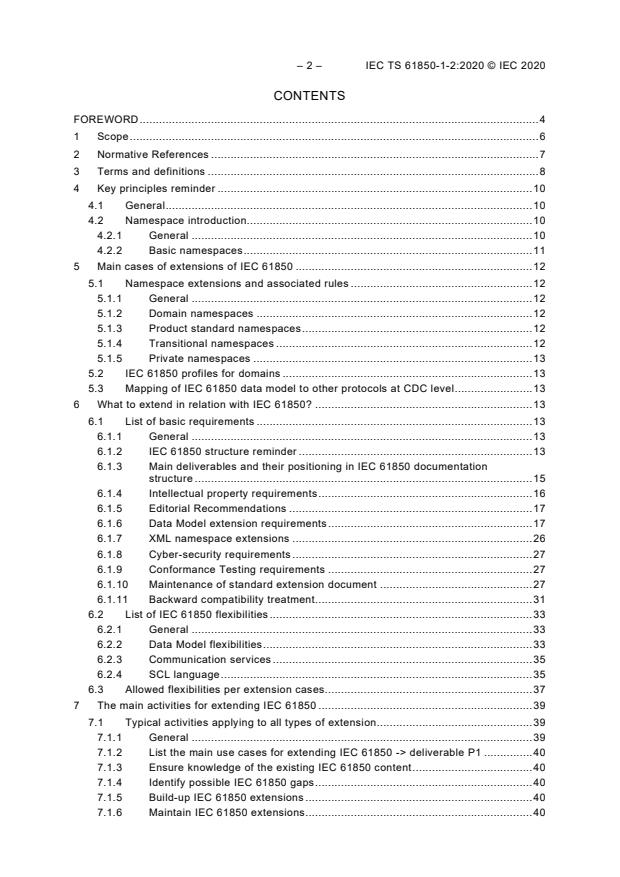
CONTENTS
FOREWORD . 4
1 Scope . 6
2 Normative References . 7
3 Terms and definitions . 8
4 Key principles reminder . 10
4.1 General . 10
4.2 Namespace introduction. 10
4.2.1 General . 10
4.2.2 Basic namespaces . 11
5 Main cases of extensions of IEC 61850 . 12
5.1 Namespace extensions and associated rules . 12
5.1.1 General . 12
5.1.2 Domain namespaces . 12
5.1.3 Product standard namespaces . 12
5.1.4 Transitional namespaces . 12
5.1.5 Private namespaces . 13
5.2 IEC 61850 profiles for domains . 13
5.3 Mapping of IEC 61850 data model to other protocols at CDC level . 13
6 What to extend in relation with IEC 61850? . 13
6.1 List of basic requirements . 13
6.1.1 General . 13
6.1.2 IEC 61850 structure reminder . 13
6.1.3 Main deliverables and their positioning in IEC 61850 documentation
structure . 15
6.1.4 Intellectual property requirements . 16
6.1.5 Editorial Recommendations . 17
6.1.6 Data Model extension requirements . 17
6.1.7 XML namespace extensions . 26
6.1.8 Cyber-security requirements . 27
6.1.9 Conformance Testing requirements . 27
6.1.10 Maintenance of standard extension document . 27
6.1.11 Backward compatibility treatment. 31
6.2 List of IEC 61850 flexibilities . 33
6.2.1 General . 33
6.2.2 Data Model flexibilities . 33
6.2.3 Communication services . 35
6.2.4 SCL language . 35
6.3 Allowed flexibilities per extension cases. 37
7 The main activities for extending IEC 61850 . 39
7.1 Typical activities applying to all types of extension. 39
7.1.1 General . 39
7.1.2 List the main use cases for extending IEC 61850 -> deliverable P1 . 40
7.1.3 Ensure knowledge of the existing IEC 61850 content . 40
7.1.4 Identify possible IEC 61850 gaps . 40
7.1.5 Build-up IEC 61850 extensions . 40
7.1.6 Maintain IEC 61850 extensions . 40
7.2 Define a standard namespace (product, domain or transitional) – if needed –
-> deliverable P2a or P2b . 40
7.2.1 General . 40
7.2.2 Get a model manager nominated . 41
7.2.3 Get the proposed model reviewed . 41
7.2.4 Publish a namespace extension . 41
7.3 Define "standard" profile(s) – if needed – deliverable P3 (and P4) . 42
7.3.1 General . 42
7.3.2 Define interoperability objectives . 42
7.3.3 Publish profile(s) -> deliverable P3 . 42
7.3.4 Publish profile(s) testing -> deliverable P4 . 42
Annex A (informative) IEC 61850 roadmap (example) . 43
Bibliography . 45
Figure 1 – IEC 61850 documentation structure . 14
Figure 2 – Extensions deliverables positioned in the IEC 61850 document structure . 15
Figure 3 – Handling versioning information for official IEC publication . 28
Figure 4 – Handling versioning information during the internal IEC writing process . 29
Figure 5 – Example of tissue fix sequence and its impact on versioning information . 30
Figure 6 – Activities related to IEC 61850 extensions . 39
Figure A.1 – Example of IEC 61850 roadmap . 44
Table 1 – Typical deliverables attached to IEC 61850 extensions . 16
Table 2 – Normative information related to a namespace (for example for
IEC61850‑7‑420:2009A release 5) . 19
Table 3 – Informative information related to a namespace (for example for
IEC61850‑7‑420:2009A release 5) . 19
Table 4 – Classification of Abbreviations in regards of their contribution to form a DO
Name (examples) . 23
Table 5 – Semantic description frame and requirements . 25
Table 6 – Typical compatibility assessment. 31
Table 7 – Typical compatibility assessment and associated compatibility rules –
detailed discussion . 31
Table 8 – Typical compatibility table . 32
Table 9 – Allowed flexibilities per extension cases . 37
– 4 – IEC TS 61850-1-2:2020 © IEC 2020
INTERNATIONAL ELECTROTECHNICAL COMMISSION
____________
COMMUNICATION NETWORKS AND SYSTEMS
FOR POWER UTILITY AUTOMATION –
Part 1-2: Guidelines on extending IEC 61850
FOREWORD
1) The International Electrotechnical Commission (IEC) is a worldwide organization for standardization comprising
all national electrotechnical committees (IEC National Committees). The object of IEC is to promote international
co-operation on all questions concerning standardization in the electrical and electronic fields. To this end and
in addition to other activities, IEC publishes International Standards, Technical Specifications, Technical Reports,
Publicly Available Specifications (PAS) and Guides (hereafter referred to as "IEC Publication(s)"). Their
preparation is entrusted to technical committees; any IEC National Committee interested in the subject dealt with
may participate in this preparatory work. International, governmental and non-governmental organizations liaising
with the IEC also participate in this preparation. IEC collaborates closely with the International Organization for
Standardization (ISO) in accordance with conditions determined by agreement between the two organizations.
2) The formal decisions or agreements of IEC on technical matters express, as nearly as possible, an international
consensus of opinion on the relevant subjects since each technical committee has representation from all
interested IEC National Committees.
3) IEC Publications have the form of recommendations for international use and are accepted by IEC National
Committees in that sense. While all reasonable efforts are made to ensure that the technical content of IEC
Publications is accurate, IEC cannot be held responsible for the way in which they are used or for any
misinterpretation by any end user.
4) In order to promote international uniformity, IEC National Committees undertake to apply IEC Publications
transparently to the maximum extent possible in their national and regional publications. Any divergence between
any IEC Publication and the corresponding national or regional publication shall be clearly indicated in the latter.
5) IEC itself does not provide any attestation of conformity. Independent certification bodies provide conformity
assessment services and, in some areas, access to IEC marks of conformity. IEC is not responsible for any
services carried out by independent certification bodies.
6) All users should ensure that they have the latest edition of this publication.
7) No liability shall attach to IEC or its directors, employees, servants or agents including individual experts and
members of its technical committees and IEC National Committees for any personal injury, property damage or
other damage of any nature whatsoever, whether direct or indirect, or for costs (including legal fees) and
expenses arising out of the publication, use of, or reliance upon, this IEC Publication or any other IEC
Publications.
8) Attention is drawn to the Normative references cited in this publication. Use of the referenced publications is
indispensable for the correct application of this publication.
9) Attention is drawn to the possibility that some of the elements of this IEC Publication may be the subject of patent
rights. IEC shall not be held responsible for identifying any or all such patent rights.
The main task of IEC technical committees is to prepare International Standards. In exceptional
circumstances, a technical committee may propose the publication of a Technical Specification
when
• the required support cannot be obtained for the publication of an International Standard,
despite repeated efforts, or
• the subject is still under technical development or where, for any other reason, there is the
future but no immediate possibility of an agreement on an International Standard.
Technical Specifications are subject to review within three years of publication to decide
whether they can be transformed into International Standards.
Technical specification IEC TS 61850-1-2 has been prepared by IEC technical committee
TC 57: Power systems management and associated information exchange.
The text of this technical specification is based on the following documents:
DTS Report on voting
57/2084/DTS 57/2145/RVDTS
Full information on the voting for the approval of this technical specification can be found in the
report on voting indicated in the above table.
This document has been drafted in accordance with the ISO/IEC Directives, Part 2.
A list of all parts in the IEC 61850 series, published under the general title Communication
networks and systems, can be found on the IEC website.
The committee has decided that the contents of this publication will remain unchanged until the
stability date indicated on the IEC web site under "http://webstore.iec.ch" in the data related to
the specific publication. At this date, the publication will be
• transformed into an International standard,
• reconfirmed,
• withdrawn,
• replaced by a revised edition, or
• amended.
A bilingual version of this publication may be issued at a later date.
IMPORTANT – The 'colour inside' logo on the cover page of this publication indicates
that it contains colours which are considered to be useful for the correct understanding
of its contents. Users should therefore print this document using a colour printer.
– 6 – IEC TS 61850-1-2:2020 © IEC 2020
COMMUNICATION NETWORKS AND SYSTEMS
FOR POWER UTILITY AUTOMATION –
Part 1-2: Guidelines on extending IEC 61850
1 Scope
This part of IEC 61850, which is a technical specification, is intended for any users but primarily
for standardization bodies that are considering using IEC 61850 as a base standard within the
scope of their work and are willing to extend it as allowed by the IEC 61850 standards. This
document identifies the required steps and high-level requirements in achieving such
extensions of IEC 61850 and provides guidelines for the individual steps.
Within that scope, this document addresses the following cases:
• The management of product-level standards for products that have an interface based on
IEC 61850
• The management of domain-level standards based on IEC 61850
• The management of transitional standards based on IEC 61850
• The management of private namespaces based on IEC 61850
• The development of standards offering the mapping of IEC 61850 data model at CDC level
• The development and management of IEC 61850 profiles for domains (underlying the role
of IEC TR 62361-103 and IEC TR 61850-7-6)
This document includes both technical and process aspects:
On the technical side, this document:
• Highlights the main basic requirements (mostly referring to the appropriate parts of the
series which host the requirements or recommendations)
• Lists all possible flexibilities offered by the standards
• Defines which flexibilities are allowed/possible per type of extension cases
On the process side, the document covers:
• The initial analysis of how the existing IEC 61850 object models and/or communication
services may be applied and what allowed extensions may be required for utilizing them in
new or specific domains (including private ones). The results of that step are expected to
be documented
• The extension of the IEC 61850 object models for new domains. The typical associated work
is to identify existing logical nodes which can be reused "as is", to determine if existing
logical nodes can be extended, or to define new logical nodes
• The purpose and process to use transitional namespaces, which are expected to be merged
eventually into an existing standard namespace
• The management of standard namespaces
• The development of private namespaces
2 Normative References
The following documents are referred to in the text in such a way that some or all of their content
constitutes requirements of this document. For dated references, only the edition cited applies.
For undated references, the latest edition of the referenced document (including any
amendments) applies.
IEC 61400‑25 (all parts), Wind energy generation systems – Part 25‑1: Communications for
monitoring and control of wind power plants – Overall description of principles and models
IEC 61850-8 (all parts), Communication networks and systems for power utility automation
IEC TR 61850‑1, Communication networks and systems for power utility automation – Part 1:
Introduction and overview
IEC TS 61850‑2, Communication networks and systems for power utility automation – Part 2:
Glossary
IEC 61850‑5, Communication networks and systems for power utility automation – Part 5:
Communication requirements for functions and device models
IEC 61850‑6, Communication networks and systems for power utility automation – Part 6:
Configuration description language for communication in electrical substations related to IEDs
IEC 61850‑7‑1, Communication networks and systems for power utility automation – Part 7‑1:
Basic communication structure – Principles and models
IEC 61850‑7‑2, Communication networks and systems for power utility automation – Part 7‑2:
Basic information and communication structure – Abstract communication service interface
(ACSI)
IEC 61850‑7‑3, Communication networks and systems for power utility automation – Part 7‑3:
Basic communication structure – Common data classes
IEC 61850‑7‑4:2010, Communication networks and systems for power utility automation –
Part 7‑4: Basic communication structure – Compatible logical node classes and data object
classes
IEC TR 61850‑7‑6, Communication networks and systems for power utility automation –
Part 7‑6: Guideline for definition of Basic Application Profiles (BAPs) using IEC 61850
IEC TS 61850‑7‑7, Communication networks and systems for power utility automation –
Part 7‑7: Machine‑processable format of IEC 61850‑related data models for tools
IEC 61850‑8‑1, Communication networks and systems for power utility automation – Part 8‑1:
Specific communication service mapping (SCSM) – Mappings to MMS (ISO 9506‑1 and ISO
9506‑2) and to ISO/IEC 8802‑3
IEC TS 61850‑80‑1, Communication networks and systems for power utility automation –
Part 80‑1: Guideline to exchanging information from a CDC‑based data model using
IEC 60870‑5‑101 or IEC 60870‑5‑104
IEC TS 61850‑80‑4, Communication networks and systems for power utility automation –
Part 80‑4: Translation from the COSEM object model (IEC 62056) to the IEC 61850 data model
IEC 61850-9 (all parts), Communication networks and systems for power utility automation
– 8 – IEC TS 61850-1-2:2020 © IEC 2020
IEC 62271‑3:2015, High‑voltage switchgear and controlgear – Part 3: Digital interfaces based
on IEC 61850
IEC 61869‑9, Instrument transformers – Part 9: Digital interface for instrument transformers
IEC TR 62361‑103, Power systems management and associated information exchange –
Interoperability in the long term – Part 103: Standard profiling
IEC 62351 (all parts), Power systems management and associated information exchange –
Data and communications security
IEEE 1815.1, Standard for Exchanging Information between networks Implementing IEC 61850
TM
and IEEE Std 1815 (Distributed Network Protocol – DNP3)
"Guidelines for code components" document accessible at:
http://www.iec.ch/tc57/supportdocuments
3 Terms and definitions
For the purposes of this document, the following terms and definitions apply.
ISO and IEC maintain terminological databases for use in standardization at the following
addresses:
• IEC Electropedia: available at http://www.electropedia.org/
• ISO Online browsing platform: available at http://www.iso.org/obp
3.1
code component
part of a standard document which has to be copied/modified from the IEC publication by any
potential users of the standards.
Note 1 to entry: Code Components are components included in IEC standards that are intended to be directly
processed by a computer and also includes any text found between the markers and
ENDS>, or otherwise clearly labelled in this standard as a Code Component.
3.2
namespace
domain in which any name and its related information is univocal
3.3
IEC 61850 basic namespace
data model namespace hosted in the IEC 61850 core standard (namely related to
IEC 61850-7-2, IEC 61850-7-3, IEC 61850-7-4 parts)
Note 1 to entry: Refer to IEC 61850-7-1, "Namespace".
Note 2 to entry: The 61850-7-4 namespace content may be revised in future in order to discriminate the elements
which are generic from the ones which are substation specific.
3.4
IEC 61850 domain namespace
data model namespace which extends IEC 61850 with the purpose of better supporting an
application domain
Note 1 to entry: Refer to IEC 61850-7-1, "Namespace".
3.5
IEC 61850 product namespace
data model namespace which extends IEC 61850 with the purpose of better supporting a
specific product (like switchgear) or function (like metering)
Note 1 to entry: Refer to IEC 61850-7-1, "Namespace".
3.6
IEC 61850 private namespace
private data model namespace which extends IEC 61850 with the purpose of better supporting
a private implementation or specification of IEC 61850
Note 1 to entry: Refer to IEC 61850-7-1, "Namespace".
3.7
IEC 61850 transitional namespace
data model namespace which has the goal to expose a proposed extension of the data model
to the market, before being formally embedded into a standard (product, domain or basic)
namespace
Note 1 to entry: Refer to IEC 61850-7-1, "Namespace".
Note 2 to entry: Transitional namespaces are supposed to have a limited time life, their future being to be integrated
into standard namespaces (or standard namespace extensions). At the time of the integration of transitional
namespace into the concerned standard parts, backward compatibility may be broken to take into account market
feedbacks.
3.8
IEC 61850 core standard
standard from the following list: IEC 61850-5, IEC 61850-6, IEC 61850-7-1, IEC 61850-7-2,
IEC 61850-7-3, IEC 61850-7-4, IEC 61850-8-x, IEC 61850-9-x
3.9
IEC 61850 flexibility
option or user-free area stated as such in the IEC 61850 standards
3.10
IEC 61850 extension
additional element or requirement, taking advantage of the IEC 61850 flexibilities, and which
therefore goes beyond the original definition/mandatory requirements of IEC 61850 as stated
in the IEC 61850 standards
Note 1 to entry: Typical extensions of IEC 61850 are new namespaces, including new LNs, and/or new data objects,
or more stringent requirements for presence of DOs/Attributes than required by the IEC 61850 core standards,
additional rules for naming LN prefixes, LDs, IEDs, etc.
3.11
model managers team
team within the IEC in charge of handling/maintaining the IEC 61850 model throughout the
different IEC publications and the different IEC entities, and in charge of preserving its
consistency, as well as its backward compatibility
3.12
profile
agreed-upon subset of requirements derived from a specification
Note 1 to entry: A common profile is required for achieving interoperability especially in those cases when a
specification could have more than one interpretation and there are probably many optional features. Refer to IEC TR
62361-103 and IEC TR 61850-7-6 for more in-depth content on profiles and profiling.
3.13
tissue
technical issue related to an IEC 61850 part
– 10 – IEC TS 61850-1-2:2020 © IEC 2020
4 Key principles reminder
4.1 General
This clause summarizes some main IEC 61850 principles needed for understanding of the rest
of the document.
4.2 Namespace introduction
4.2.1 General
Considering that namespaces can be handled by multiple entities, which can evolve over time
at different speeds, IEC 61850 introduced the following namespace concepts and requirements
from the beginning (Refer to IEC 61850-7-1, "Namespaces" (Clause 13 in Edition 2,
Amendment 1 ).):
• The concept of namespaces: namespaces are largely used and widespread in the IT world
to organize the names or identifiers of data types, data objects, functions, etc. into logical
sets in order to prevent name collisions that can occur when these are being defined in
parallel. In the specific case of IEC 61850, namespaces are a defined but structured
collection of logical nodes (LN), data objects and potentially common data classes (CDC)
and attributes. Each IEC publication which extends the IEC 61850 data models shall have
its own namespace. Each private extension of IEC 61850 shall also have its own
namespace. Each namespace has a unique "machine" name, i.e. a name which can be used
by a machine to uniquely refer to the semantic attached to a data.
• The concept of namespace owner: IEC TC 57 is the owner of the basic namespaces
contained in the IEC 61850 core data object model standards.
• The ability to clearly state and tag which namespace a data object is contained in, through
a specific attribute.
• Strict rules for managing/expanding namespaces: rules are provided to allow third parties
to make extensions to a data object model standard in a way that does not jeopardize
interoperability.
Namespaces are chained together, i.e. dependencies have been established between
namespaces.
Basically, there are 5 types of namespaces (as per current IEC 61850-7-1 "Namespaces" clause
content):
• Basic namespaces contain definitions of the basic classes from which are built all other
namespaces, namely IEC 61850-7-2; IEC 61850-7-3; IEC 61850-7-4.
• Domain namespaces include Parts 7-4xx of the IEC 61850 series, and possibly other
namespaces hosted in dedicated standards or technical specifications such as
IEC TS 61850-80-4 and the IEC 61400-25 series.
• Product standard namespaces typically contain the nameplate detailed information model
but can also be broader than specific products. IEC 62271-3:2015 for switchgears or
IEC 61869-9 for merging units are typical examples of product namespaces.
• Transitional namespaces are used in technical reports such as the 90-xx parts of the
IEC 61850 series. These technical reports may extend any of the basic namespaces
(IEC 61850-7-2, IEC 61850-7-3 and IEC 61850-7-4) as well as any domain namespaces.
They specify extensions that are expected to be included eventually as part of the basic or
domain namespaces in IEC 61850.
____________
Under preparation. Stage at the time of publication: IEC/TFDIS 61850-7-1/AMD1:2019.
• Private namespaces are developed to provide a private data model extension (i.e. a set of
non-standardized data object added to the standard one). They may be constructed to
include standard common data classes from the standard namespaces or from the standard
namespace extensions. They are expected to be managed by the entity (company) which
produced them.
NOTE Private namespaces are of great interest in the standardization process because they can often identify some
standardisation gaps that should be filled. Therefore, it is expected that some portions of private namespaces will be
proposed as "addendums" to the IEC process.
4.2.2 Basic namespaces
4.2.2.1 General
The basic namespaces of the IEC 61850 series, defined in Parts 7-2, 7-3 and 7-4, contain a
collection of standard logical nodes, data object classes, common data classes and attributes
defining at least:
• its wording (exact spelling)
• its semantic (meaning and possibly also the meaning of each of the states this data may
take)
• its type and structure
• its presence conditions
4.2.2.2 Logical nodes (LNs) and their objects classes included in the basic
namespace
Over 280 logical nodes (LNs) are defined in the IEC 61850 basic namespaces and cover the
most common applications of the domains covered by the IEC 61850 series. While original
focus has been on substation automation, the common applications also include many other
functions like monitoring, measurement, control, and power quality that are important for many
other domains. These logical nodes are defined in IEC 61850-7-4.
Most logical nodes provide information (data object and data attributes) that can be categorised
in six categories:
• Descriptions
• Common logical node information
• Status information
• Settings
• Measured values
• Controls
The data object and attribute names are standardized ones (i.e. they are built from standardized
acronyms) that have a specific semantic in the context of the IEC 61850 series.
Finally, the semantic of a logical node is represented by the data objects and data attributes it
contains.
4.2.2.3 Common data classes (CDCs)
The whole set of all the data attributes defined for a data object is based on predefined types
and structures called "Common Data Classes" (CDCs) which can be seen as defining the
"internal data structure template" of data objects.
IEC 61850-7-3 defines common data classes for a wide range of well-known applications. The
core common data classes are classified into the following groups:
– 12 – IEC TS 61850-1-2:2020 © IEC 2020
• status information,
• measurand information,
• controllable status information,
• description information
• controllable analogue information,
• status settings,
• analogue settings and
• description information settings
5 Main cases of extensions of IEC 61850
5.1 Namespace extensions and associated rules
5.1.1 General
This clause lists per type of namespaces the main high-level requirements attached to the
creation of such namespace.
5.1.2 Domain namespaces
Formally domain namespaces include the basic namespaces plus the needed extensions they
require to meet their domain application requirements. They are produced by International
Standardization Bodies. Standard namespaces have usually a status of IS or possibly TS. In
order to comply with IS (or TS) stability constraint, it is highly recommended to have any new
content initially exposed as transitional namespaces.
Refer to IEC 61850-7-1 "Specification of Name Spaces" (Subclause 13.5 in Edition 2,
Amendment 1).
5.1.3 Product standard namespaces
Product standard namespaces are designed as close as possible from the product knowledge,
i.e. within the product standardisation committee, with the ambition to provide through
extensions the most comprehensive product data model.
The nature of LN extensions shall only be the addition of new optional or mandatory data objects
and possibly LNs limited to:
• "Product characteristics" (typically including nameplate) related information. These
extensions may be located in the LPHD LN or in any product related LNs, i.e. any LN
containing the data object EEName. "Product characteristics" information should be
modelled in a way it allows machine processable treatment.
• Product specific LNs to depict product specific functions interface
The new data objects classes shall be assigned to any common data class defined in
IEC 61850-7-3.
5.1.4 Transitional namespaces
Some specific requirements are attached to transitional namespace, especially due to the fact
that potential incompatibilities may occur at the time of their (possible) integration into an IS
document.
Transitional namespaces usually have a status of TR or in some cases TS.
Refer to IEC 61850-7-1 "Specification of Name Spaces" (Subclause 13.5 in Edition 2,
Amendment 1).
By nature, conformance testing will not be applied to transitional namespaces.
5.1.5 Private namespaces
Private namespaces are namespace extensions defined by third parties, i.e. not refer to
IEC 61850-7-1 "Name Spaces" (Clause 13 in Edition 2, Amendment 1), as well as the clause
"Private extension" of the same part (Subclause 14.3 in Edition 2, Amendment 1).
5.2 IEC 61850 profiles for domains
An IEC 61850 profile is an agreed-upon selection of flexibilities, as defined in 6.2, where some
more stringent rules may apply, and which is built with the purpose of increasing the IEC 61850
interoperability in a dedicated context (refer to IEC TR 62361-103 for further elements on
profiling).
Such a profile may build from building blocks called "Basic Application profile" as defined in
IEC TR 61850-7-6.
Thus a profile shall define explicitly, the list of selected flexibilities, and the "additional" rules
associated with these one, typically:
• Consider an LN class presence as required, possibly attached with a (partially or totally)
predefined prefix name and/or predefined suffix number
• Consider a DO presence as required, where the standard only defines it as optional
• Consider a DA presence as required, where the standard only defines it as optional
• Etc.
A first example is the IEC TR 61850-90-17 related to the profile defined to characterise the use
of IEC 61850 in the specific context of IEC 61000-4-30 (power quality standard).
5.3 Mapping of IEC 61850 data model to other protocols at CDC level
These extensions provide additional rules to convey information, as modelled in IEC 61850 onto
different protocols, not supporting the communication services as defined in Part 7-2. Typical
examples are IEC TS 61850-80-1, IEC TS 61850-80-4 or IEEE 1815.1.
6 What to extend in relation with IEC 61850?
6.1 List of basic requirements
6.1.1 General
This clause tries to identify all requirements which have to be considered whatever the
considered case of extension.
6.1.2 IEC 61850 structure reminder
IEC 61850 is made of many parts which need to be clearly understood. These parts are
organized as presented in Figure 1 (Figure extracted from IEC 61850-1):
– 14 – IEC TS 61850-1-2:2020 © IEC 2020
Figure 1 – IEC 61850 documentation structure
These parts may have different states depending on their level of maturity:
• Standard and available as IS or TS: the core parts together with the domain namespaces.
• Transitional and available in TR: mostly grouped into the IEC 61850-90-xx series.
• Coming: a lot of activities are on-going, and it is important to consider all the on-going works
to ensure maximum consistency; a roadmap is published an internal INF document by IEC
on a regular basis of on-going activities and coming extensions related to IEC 61850. An
example is given in Annex A.
Already published parts may also be updated by tissues, and these fixes need also to be
considered (refer to IEC TR 61850-1 for more details on IEC 61850 maintenance process ).
____________
The description of the Tissue process should be part of a future IEC publication.
6.1.3 Main deliverables and their positioning in IEC 61850 documentation structure
Figure 2 – Extensions deliverables positioned in the IEC 61850 document structure
The diagram shown in Figure 2 highlights the possible "extensions" as introduced in Clause 5,
and their positions in the IEC 61850 documents structure.
Table 1 provides additional details for these deliverables:
– 16 – IEC TS 61850-1-2:2020 © IEC 2020
Table 1 – Typical deliverables attached to IEC 61850 extensions
Delivery Typical content Typical IEC type when Comments
type delivered by IEC
P1 Cases of use of the expected extensions TR, or informative annex Express use cases from
which to derive the
extensions requirements
P2a Domain or product specific LN and data IS or TS
object classes extensions (Domain or
product namespaces)
P2b Transitional Namespace TR
P2c Mapping at CDC level IS or TS May be even TR if still at
"feasibility stage"
P3 Profiles of usage IS, TS or TR The IEC type depends on
the maturity level of the
expected usage of the
standard
P4 Profile conformance testing IS, TS or TR depending The IEC type depends on
on the profile type the maturity level of the
expected usage of the
standard
P5 SCSM IS
6.1.4 Intellectual property requirements
6.1.4.1 General
Intellectual Property requirements are important to be considered as soon as a work intends to
start reusing IEC 61850 content totally or partially.
As is true for all IEC publications, the IEC 61850 series is copyright protected: "Unless
otherwise specified, no part of this publication may be reproduced or utilized in any form or by
any means, electronic or mechanical, including photocopying and microfilm, without permission
in writing from either IEC or IEC's member National Committee in the country of the requester."
6.1.4.2 Code component publication rules applying to IEC publications
Specific licensing conditions shall apply in the case where the IEC 61850 extension standard
document includes code components which provide the users with extra conditions for
duplicating, modifying and re-distributing these "code components". The IEC has developed
these specific licensing conditions to apply to IEC 61850-related publications.
In the case of IEC publications, at the earliest feasible stage in the development process
(typically at the CD or DC stage), the editor of the document should screen the contents and
identify all "code components" elements contained in the targeted standard document.
Then a specific process needs to be defined and specific rules need to apply to:
• Get the authorization by IEC to apply these specific licensing conditions
• Tag properly the code components
• Include the copyright and licensing conditions in all related deliverables
• Publish the code component, possibly through separated machine processable files,
possibly with free access or subscription-type access
These specific rules and processes are available within the latest version "Guidelines for code
components" document accessible at http://www.iec.ch/tc57/supportdocuments.
6.1.5 Editorial Recommendations
6.1.5.1 Document structure
In order to facilitate the potential ultimate merger of namespace extensions into the IEC 61850
series, it is highly recommended that the extension publications follow the IEC 61850 document
structure, i.e.:
• Clause 1 Scope
• Clause 2 Glossary
• Clause 3 General requirement
Potentially Business use cases
• Clause 4 Project and system management (aspects related to .)
• Clause 5 Communication requirements (detailed)
Potentially system use cases
• Clause 6 SCL language (impacts) (XML Namespace if any)
• Clause 7 Data models (Namespace if any)
• Clause 8 and 9 SCSM related specification (if any)
• Clause 10 Testing requirements (if any)
6.1.5.2 Document introduction
It is highly recommended to have namespace related information (see 6.1.6.2) included in
Clause 1 of any IEC concerned publication (part of the scope).
More specifically, Clause 1 of such document should be broken down as below:
• Clause 1: Scope
• Subclause 1.1: General
As usual …
• Subclause 1.2:
– Shall contain the namespace "nameplate", i.e. all information identifying the namespace
(see 6.1.6.2)
– Shall contain as well the correspondences between the IEC publications and the
namespace versions and revisions. And namespace name, version, and revision of this
new release. This clause should include a table listing all past publications of the
namespace, the IEC publication name (Ed. 2, Ed. 2/Amd. 1, etc.) and its associated
namespace name, version and revision. This shall also include namespace
dependencies formalization.
• S
...
IEC TS 61850-1-2 ®
Edition 1.1 2022-07
CONSOLIDATED VERSION
TECHNICAL
SPECIFICATION
colour
inside
Communication networks and systems for power utility automation –
Part 1-2: Guideline on extending IEC 61850
All rights reserved. Unless otherwise specified, no part of this publication may be reproduced or utilized in any form
or by any means, electronic or mechanical, including photocopying and microfilm, without permission in writing from
either IEC or IEC's member National Committee in the country of the requester. If you have any questions about IEC
copyright or have an enquiry about obtaining additional rights to this publication, please contact the address below or
your local IEC member National Committee for further information.
IEC Secretariat Tel.: +41 22 919 02 11
3, rue de Varembé info@iec.ch
CH-1211 Geneva 20 www.iec.ch
Switzerland
About the IEC
The International Electrotechnical Commission (IEC) is the leading global organization that prepares and publishes
International Standards for all electrical, electronic and related technologies.
About IEC publications
The technical content of IEC publications is kept under constant review by the IEC. Please make sure that you have the
latest edition, a corrigendum or an amendment might have been published.
IEC publications search - webstore.iec.ch/advsearchform IEC Products & Services Portal - products.iec.ch
The advanced search enables to find IEC publications by a Discover our powerful search engine and read freely all the
variety of criteria (reference number, text, technical publications previews. With a subscription you will always
committee, …). It also gives information on projects, replaced have access to up to date content tailored to your needs.
and withdrawn publications.
Electropedia - www.electropedia.org
IEC Just Published - webstore.iec.ch/justpublished
The world's leading online dictionary on electrotechnology,
Stay up to date on all new IEC publications. Just Published
containing more than 22 300 terminological entries in English
details all new publications released. Available online and
and French, with equivalent terms in 19 additional languages.
once a month by email.
Also known as the International Electrotechnical Vocabulary
(IEV) online.
IEC Customer Service Centre - webstore.iec.ch/csc
If you wish to give us your feedback on this publication or
need further assistance, please contact the Customer Service
Centre: sales@iec.ch.
IEC TS 61850-1-2 ®
Edition 1.1 2022-07
CONSOLIDATED VERSION
TECHNICAL
SPECIFICATION
colour
inside
Communication networks and systems for power utility automation –
Part 1-2: Guideline on extending IEC 61850
INTERNATIONAL
ELECTROTECHNICAL
COMMISSION
ICS 33.200 ISBN 978-2-8322-3984-1
– 2 – IEC TS 61850-1-2:2020+AMD1:2022 CSV
© IEC 2022
CONTENTS
FOREWORD . 4
1 Scope . 6
2 Normative References . 7
3 Terms and definitions . 8
4 Key principles reminder . 10
4.1 General . 10
4.2 Namespace introduction. 10
4.2.1 General . 10
4.2.2 Basic namespaces . 11
5 Main cases of extensions of IEC 61850 . 12
5.1 Namespace extensions and associated rules . 12
5.1.1 General . 12
5.1.2 Domain namespaces . 12
5.1.3 Product standard namespaces . 12
5.1.4 Transitional namespaces . 13
5.1.5 Private namespaces . 13
5.2 IEC 61850 profiles for domains . 13
5.3 Mapping of IEC 61850 data model to other protocols at CDC level . 13
6 What to extend in relation with IEC 61850? . 14
6.1 List of basic requirements . 14
6.1.1 General . 14
6.1.2 IEC 61850 structure reminder . 14
6.1.3 Main deliverables and their positioning in IEC 61850 documentation
structure . 15
6.1.4 Intellectual property requirements . 16
6.1.5 Editorial Recommendations . 17
6.1.6 Data Model extension requirements . 19
6.1.7 XML namespace extensions . 28
6.1.8 Cyber-security requirements . 29
6.1.9 Conformance Testing requirements . 29
6.1.10 Maintenance of standard extension document . 29
6.1.11 Backward compatibility treatment. 34
6.2 List of IEC 61850 flexibilities . 37
6.2.1 General . 37
6.2.2 Data Model flexibilities . 37
6.2.3 Communication services . 39
6.2.4 SCL language . 39
6.3 Allowed flexibilities per extension cases. 41
7 The main activities for extending IEC 61850 . 43
7.1 Typical activities applying to all types of extension. 43
7.1.1 General . 43
7.1.2 List the main use cases for extending IEC 61850 -> deliverable P1 . 44
7.1.3 Ensure knowledge of the existing IEC 61850 content . 44
7.1.4 Identify possible IEC 61850 gaps . 44
7.1.5 Build-up IEC 61850 extensions . 44
7.1.6 Maintain IEC 61850 extensions . 44
© IEC 2022
7.2 Define a standard namespace (product, domain or transitional) – if needed
-> deliverable P2a or P2b . 44
7.2.1 General . 44
7.2.2 Get a model manager nominated . 45
7.2.3 Get the proposed model reviewed . 45
7.2.4 Publish a namespace extension . 45
7.3 Define "standard" profile(s) – if needed –> deliverable P3 (and P4) . 46
7.3.1 General . 46
7.3.2 Define interoperability objectives . 46
7.3.3 Publish profile(s) -> deliverable P3 . 46
7.3.4 Publish profile(s) testing -> deliverable P4 . 46
Annex A (informative) IEC 61850 roadmap (example) . 47
Bibliography . 49
Figure 1 – IEC 61850 documentation structure . 14
Figure 2 – Extensions deliverables positioned in the IEC 61850 document structure . 15
Figure 3 – Handling versioning information for official IEC publication . 31
Figure 4 – Handling versioning information during the internal IEC writing process . 32
Figure 5 – Example of tissue fix sequence and its impact on versioning information . 33
Figure 6 – Activities related to IEC 61850 extensions . 43
Figure A.1 – Example of IEC 61850 roadmap . 48
Table 1 – Typical deliverables attached to IEC 61850 extensions . 16
Table 10 – Reference between published versions of the standard and related
namespace name . 17
Table 2 – Normative information related to a namespace (for example for IEC61850-7-
499:2009B release 5) . 20
Table 3 – Informative information related to a namespace (for example for
IEC61850‑7‑420:2009A release 5) . 21
Table 4 – Classification of Abbreviations in regards of their contribution to form a DO
Name (examples) . 25
Table 5 – Semantic description frame and requirements . 27
Table 11 – Attributes of an xsd namespace (example) . 29
Table 6 – Typical compatibility assessment. 34
Table 7 – Typical compatibility assessment and associated compatibility rules –
detailed discussion . 35
Table 8 – Typical compatibility table . 36
Table 9 – Allowed flexibilities per extension cases . 41
– 4 – IEC TS 61850-1-2:2020+AMD1:2022 CSV
© IEC 2022
INTERNATIONAL ELECTROTECHNICAL COMMISSION
____________
COMMUNICATION NETWORKS AND SYSTEMS
FOR POWER UTILITY AUTOMATION –
Part 1-2: Guidelines on extending IEC 61850
FOREWORD
1) The International Electrotechnical Commission (IEC) is a worldwide organization for standardization comprising
all national electrotechnical committees (IEC National Committees). The object of IEC is to promote international
co-operation on all questions concerning standardization in the electrical and electronic fields. To this end and
in addition to other activities, IEC publishes International Standards, Technical Specifications, Technical Reports,
Publicly Available Specifications (PAS) and Guides (hereafter referred to as "IEC Publication(s)"). Their
preparation is entrusted to technical committees; any IEC National Committee interested in the subject dealt with
may participate in this preparatory work. International, governmental and non-governmental organizations liaising
with the IEC also participate in this preparation. IEC collaborates closely with the International Organization for
Standardization (ISO) in accordance with conditions determined by agreement between the two organizations.
2) The formal decisions or agreements of IEC on technical matters express, as nearly as possible, an international
consensus of opinion on the relevant subjects since each technical committee has representation from all
interested IEC National Committees.
3) IEC Publications have the form of recommendations for international use and are accepted by IEC National
Committees in that sense. While all reasonable efforts are made to ensure that the technical content of IEC
Publications is accurate, IEC cannot be held responsible for the way in which they are used or for any
misinterpretation by any end user.
4) In order to promote international uniformity, IEC National Committees undertake to apply IEC Publications
transparently to the maximum extent possible in their national and regional publications. Any divergence between
any IEC Publication and the corresponding national or regional publication shall be clearly indicated in the latter.
5) IEC itself does not provide any attestation of conformity. Independent certification bodies provide conformity
assessment services and, in some areas, access to IEC marks of conformity. IEC is not responsible for any
services carried out by independent certification bodies.
6) All users should ensure that they have the latest edition of this publication.
7) No liability shall attach to IEC or its directors, employees, servants or agents including individual experts and
members of its technical committees and IEC National Committees for any personal injury, property damage or
other damage of any nature whatsoever, whether direct or indirect, or for costs (including legal fees) and
expenses arising out of the publication, use of, or reliance upon, this IEC Publication or any other IEC
Publications.
8) Attention is drawn to the Normative references cited in this publication. Use of the referenced publications is
indispensable for the correct application of this publication.
9) Attention is drawn to the possibility that some of the elements of this IEC Publication may be the subject of patent
rights. IEC shall not be held responsible for identifying any or all such patent rights.
This consolidated version of the official IEC Standard and its amendment has been
prepared for user convenience.
IEC TS 61850-1-2 edition 1.1 contains the first edition (2020-06) [documents 57/2084/DTS
and 57/2145/RVDTS] and its amendment 1 (2022-07) [documents 57/2370/DTS and
57/2408/RVDTS].
© IEC 2022
IEC TS 61850-1-2 has been prepared by IEC technical committee TC 57: Power systems
management and associated information exchange. It is a Technical Specification.
The language used for the development of this Technical Specification is English.
This document was drafted in accordance with ISO/IEC Directives, Part 2, and developed in
accordance with ISO/IEC Directives, Part 1 and ISO/IEC Directives, IEC Supplement, available
at www.iec.ch/members_experts/refdocs. The main document types developed by IEC are
described in greater detail at www.iec.ch/publications.
A list of all parts in the IEC 61850 series, published under the general title Communication
networks and systems, can be found on the IEC website.
The committee has decided that the contents of the base publication and its amendment will
remain unchanged until the stability date indicated on the IEC web site under webstore.iec.ch
in the data related to the specific publication. At this date, the publication will be
• reconfirmed,
• withdrawn,
• replaced by a revised edition, or
• amended.
IMPORTANT – The 'colour inside' logo on the cover page of this publication indicates
that it contains colours which are considered to be useful for the correct understanding
of its contents. Users should therefore print this document using a colour printer.
– 6 – IEC TS 61850-1-2:2020+AMD1:2022 CSV
© IEC 2022
COMMUNICATION NETWORKS AND SYSTEMS
FOR POWER UTILITY AUTOMATION –
Part 1-2: Guidelines on extending IEC 61850
1 Scope
This part of IEC 61850, which is a technical specification, is intended for any users but primarily
for standardization bodies that are considering using IEC 61850 as a base standard within the
scope of their work and are willing to extend it as allowed by the IEC 61850 standards. This
document identifies the required steps and high-level requirements in achieving such
extensions of IEC 61850 and provides guidelines for the individual steps.
Within that scope, this document addresses the following cases:
• The management of product-level standards for products that have an interface based on
IEC 61850
• The management of domain-level standards based on IEC 61850
• The management of transitional standards based on IEC 61850
• The management of private namespaces based on IEC 61850
• The development of standards offering the mapping of IEC 61850 data model at CDC level
• The development and management of IEC 61850 profiles for domains (underlying the role
of IEC TR 62361-103 and IEC TR 61850-7-6)
This document includes both technical and process aspects:
On the technical side, this document:
• Highlights the main basic requirements (mostly referring to the appropriate parts of the
series which host the requirements or recommendations)
• Lists all possible flexibilities offered by the standards
• Defines which flexibilities are allowed/possible per type of extension cases
On the process side, the document covers:
• The initial analysis of how the existing IEC 61850 object models and/or communication
services may be applied and what allowed extensions may be required for utilizing them in
new or specific domains (including private ones). The results of that step are expected to
be documented
• The extension of the IEC 61850 object models for new domains. The typical associated work
is to identify existing logical nodes which can be reused "as is", to determine if existing
logical nodes can be extended, or to define new logical nodes
• The purpose and process to use transitional namespaces, which are expected to be merged
eventually into an existing standard namespace
• The management of standard namespaces
• The development of private namespaces
© IEC 2022
2 Normative References
The following documents are referred to in the text in such a way that some or all of their content
constitutes requirements of this document. For dated references, only the edition cited applies.
For undated references, the latest edition of the referenced document (including any
amendments) applies.
IEC 61400‑25 (all parts), Wind energy generation systems – Part 25‑1: Communications for
monitoring and control of wind power plants – Overall description of principles and models
IEC 61850-8 (all parts), Communication networks and systems for power utility automation
IEC TR 61850‑1, Communication networks and systems for power utility automation – Part 1:
Introduction and overview
IEC TS 61850‑2, Communication networks and systems for power utility automation – Part 2:
Glossary
IEC 61850‑5, Communication networks and systems for power utility automation – Part 5:
Communication requirements for functions and device models
IEC 61850‑6, Communication networks and systems for power utility automation – Part 6:
Configuration description language for communication in electrical substations related to IEDs
IEC 61850‑7‑1, Communication networks and systems for power utility automation – Part 7‑1:
Basic communication structure – Principles and models
IEC 61850‑7‑2, Communication networks and systems for power utility automation – Part 7‑2:
Basic information and communication structure – Abstract communication service interface
(ACSI)
IEC 61850‑7‑3, Communication networks and systems for power utility automation – Part 7‑3:
Basic communication structure – Common data classes
IEC 61850‑7‑4:2010, Communication networks and systems for power utility automation –
Part 7‑4: Basic communication structure – Compatible logical node classes and data object
classes
IEC TR 61850‑7‑6, Communication networks and systems for power utility automation –
Part 7‑6: Guideline for definition of Basic Application Profiles (BAPs) using IEC 61850
IEC TS 61850‑7‑7, Communication networks and systems for power utility automation –
Part 7‑7: Machine‑processable format of IEC 61850‑related data models for tools
IEC 61850‑8‑1, Communication networks and systems for power utility automation – Part 8‑1:
Specific communication service mapping (SCSM) – Mappings to MMS (ISO 9506‑1 and
ISO 9506‑2) and to ISO/IEC 8802‑3
IEC TS 61850‑80‑1, Communication networks and systems for power utility automation –
Part 80‑1: Guideline to exchanging information from a CDC‑based data model using
IEC 60870‑5‑101 or IEC 60870‑5‑104
IEC TS 61850‑80‑4, Communication networks and systems for power utility automation –
Part 80‑4: Translation from the COSEM object model (IEC 62056) to the IEC 61850 data model
IEC 61850-9 (all parts), Communication networks and systems for power utility automation
– 8 – IEC TS 61850-1-2:2020+AMD1:2022 CSV
© IEC 2022
IEC 62271‑3:2015, High‑voltage switchgear and controlgear – Part 3: Digital interfaces based
on IEC 61850
IEC 61869‑9, Instrument transformers – Part 9: Digital interface for instrument transformers
IEC TR 62361‑103, Power systems management and associated information exchange –
Interoperability in the long term – Part 103: Standard profiling
IEC 62351 (all parts), Power systems management and associated information exchange –
Data and communications security
IEEE 1815.1, Standard for Exchanging Information between networks Implementing IEC 61850
TM
and IEEE Std 1815 (Distributed Network Protocol – DNP3)
"Guidelines for code components" document accessible at:
https://www.iec.ch/tc57/supportdocuments
3 Terms and definitions
For the purposes of this document, the following terms and definitions apply.
ISO and IEC maintain terminological databases for use in standardization at the following
addresses:
• IEC Electropedia: available at http://www.electropedia.org/
• ISO Online browsing platform: available at http://www.iso.org/obp
3.1
code component
part of a standard document which has to be copied/modified from the IEC publication by any
potential users of the standards.
Note 1 to entry: Code components are components included in IEC standards that are intended to be directly
processed by a computer and also includes any text found between the markers and
ENDS>, or otherwise clearly labelled in this standard as a code component.
3.2
namespace
domain in which any name and its related information is univocal
3.3
IEC 61850 basic namespace
data model namespace hosted in the IEC 61850 core standard (namely related to
IEC 61850-7-2, IEC 61850-7-3, IEC 61850-7-4 parts)
Note 1 to entry: Refer to IEC 61850-7-1, "Namespace".
Note 2 to entry: The 61850-7-4 namespace content may be revised in future in order to discriminate the elements
which are generic from the ones which are substation specific.
3.4
IEC 61850 domain namespace
data model namespace which extends IEC 61850 with the purpose of better supporting an
application domain
Note 1 to entry: Refer to IEC 61850-7-1, "Namespace".
© IEC 2022
3.5
IEC 61850 product namespace
data model namespace which extends IEC 61850 with the purpose of better supporting a
specific product (like switchgear) or function (like metering)
Note 1 to entry: Refer to IEC 61850-7-1, "Namespace".
3.6
IEC 61850 private namespace
private data model namespace which extends IEC 61850 with the purpose of better supporting
a private implementation or specification of IEC 61850
Note 1 to entry: Refer to IEC 61850-7-1, "Namespace".
3.7
IEC 61850 transitional namespace
data model namespace which has the goal to expose a proposed extension of the data model
to the market, before being formally embedded into a standard (product, domain or basic)
namespace
Note 1 to entry: Refer to IEC 61850-7-1, "Namespace".
Note 2 to entry: Transitional namespaces are supposed to have a limited time life, their future being to be integrated
into standard namespaces (or standard namespace extensions). At the time of the integration of transitional
namespace into the concerned standard parts, backward compatibility may be broken to take into account market
feedbacks.
3.8
IEC 61850 core standard
standard from the following list: IEC 61850-5, IEC 61850-6, IEC 61850-7-1, IEC 61850-7-2,
IEC 61850-7-3, IEC 61850-7-4, IEC 61850-8-x, IEC 61850-9-x
3.9
IEC 61850 flexibility
option or user-free area stated as such in the IEC 61850 standards
3.10
IEC 61850 extension
additional element or requirement, taking advantage of the IEC 61850 flexibilities, and which
therefore goes beyond the original definition/mandatory requirements of IEC 61850 as stated
in the IEC 61850 standards
Note 1 to entry: Typical extensions of IEC 61850 are new namespaces, including new LNs, and/or new data objects,
or more stringent requirements for presence of DOs/Attributes than required by the IEC 61850 core standards,
additional rules for naming LN prefixes, LDs, IEDs, etc.
3.11
model managers team
team within the IEC in charge of handling/maintaining the IEC 61850 model throughout the
different IEC publications and the different IEC entities, and in charge of preserving its
consistency, as well as its backward compatibility
3.12
profile
agreed-upon subset of requirements derived from a specification
Note 1 to entry: A common profile is required for achieving interoperability especially in those cases when a
specification could have more than one interpretation and there are probably many optional features. Refer to IEC TR
62361-103 and IEC TR 61850-7-6 for more in-depth content on profiles and profiling.
3.13
tissue
technical issue related to an IEC 61850 part
– 10 – IEC TS 61850-1-2:2020+AMD1:2022 CSV
© IEC 2022
3.14
deprecation (of an element of a given model)
action consisting in tagging this element specifically in order to discourage future usage of this
element
Note 1 to entry: The deprecation of an element implies the deprecation of all included sub-elements.
Note 2 to entry: A deprecation is often the latest stage before withdrawing a given element.
Note 3 to entry: Once deprecation has applied to an element, this element is tagged as "deprecated".
Note 4 to entry: Deprecation may apply to any types of element of the model, including (but not restricted to)
attribute, class, object, abbreviation, enumerated element, package, namespace.
4 Key principles reminder
4.1 General
This clause summarizes some main IEC 61850 principles needed for understanding of the rest
of the document.
4.2 Namespace introduction
4.2.1 General
Considering that namespaces can be handled by multiple entities, which can evolve over time
at different speeds, IEC 61850 introduced the following namespace concepts and requirements
from the beginning (Refer to IEC 61850-7-1, "Namespaces" (Clause 13 in Edition 2,
Amendment 1 ):
• The concept of namespaces: namespaces are largely used and widespread in the IT world
to organize the names or identifiers of data types, data objects, functions, etc. into logical
sets in order to prevent name collisions that can occur when these are being defined in
parallel. In the specific case of IEC 61850, namespaces are a defined but structured
collection of logical nodes (LN), data objects and potentially common data classes (CDC)
and attributes. Each IEC publication which extends the IEC 61850 data models shall have
its own namespace. Each private extension of IEC 61850 shall also have its own
namespace. Each namespace has a unique "machine" name, i.e. a name which can be used
by a machine to uniquely refer to the semantic attached to a data.
• The concept of namespace owner: IEC TC 57 is the owner of the basic namespaces
contained in the IEC 61850 core data object model standards.
• The ability to clearly state and tag which namespace a data object is contained in, through
a specific attribute.
• Strict rules for managing/expanding namespaces: rules are provided to allow third parties
to make extensions to a data object model standard in a way that does not jeopardize
interoperability.
Namespaces are chained together, i.e. dependencies have been established between
namespaces.
Basically, there are 5 types of namespaces (as per current IEC 61850-7-1 "Namespaces" clause
content):
• Basic namespaces contain definitions of the basic classes from which are built all other
namespaces, namely IEC 61850-7-2; IEC 61850-7-3; IEC 61850-7-4.
____________
Under preparation. Stage at the time of publication: IEC/TFDIS 61850-7-1/AMD1:2019.
© IEC 2022
• Domain namespaces include Parts 7-4xx of the IEC 61850 series, and possibly other
namespaces hosted in dedicated standards or technical specifications such as
IEC TS 61850-80-4 and the IEC 61400-25 series.
• Product standard namespaces typically contain the nameplate detailed information model
but can also be broader than specific products. IEC 62271-3:2015 for switchgears or
IEC 61869-9 for merging units are typical examples of product namespaces.
• Transitional namespaces are used in technical reports such as the 90-xx parts of the
IEC 61850 series. These technical reports may extend any of the basic namespaces
(IEC 61850-7-2, IEC 61850-7-3 and IEC 61850-7-4) as well as any domain namespaces.
They specify extensions that are expected to be included eventually as part of the basic or
domain namespaces in IEC 61850.
• Private namespaces are developed to provide a private data model extension (i.e. a set of
non-standardized data object added to the standard one). They may be constructed to
include standard common data classes from the standard namespaces or from the standard
namespace extensions. They are expected to be managed by the entity (company) which
produced them.
NOTE Private namespaces are of great interest in the standardization process because they can often identify some
standardisation gaps that should be filled. Therefore, it is expected that some portions of private namespaces will be
proposed as "addendums" to the IEC process.
4.2.2 Basic namespaces
4.2.2.1 General
The basic namespaces of the IEC 61850 series, defined in Parts 7-2, 7-3 and 7-4, contain a
collection of standard logical nodes, data object classes, common data classes and attributes
defining at least:
• its wording (exact spelling)
• its semantic (meaning and possibly also the meaning of each of the states this data may
take)
• its type and structure
• its presence conditions
4.2.2.2 Logical nodes (LNs) and their objects classes included in the basic
namespace
Over 280 logical nodes (LNs) are defined in the IEC 61850 basic namespaces and cover the
most common applications of the domains covered by the IEC 61850 series. While original
focus has been on substation automation, the common applications also include many other
functions like monitoring, measurement, control, and power quality that are important for many
other domains. These logical nodes are defined in IEC 61850-7-4.
Most logical nodes provide information (data object and data attributes) that can be categorised
in six categories:
• Descriptions
• Common logical node information
• Status information
• Settings
• Measured values
• Controls
The data object and attribute names are standardized ones (i.e. they are built from standardized
acronyms) that have a specific semantic in the context of the IEC 61850 series.
– 12 – IEC TS 61850-1-2:2020+AMD1:2022 CSV
© IEC 2022
Finally, the semantic of a logical node is represented by the data objects and data attributes it
contains.
4.2.2.3 Common data classes (CDCs)
The whole set of all the data attributes defined for a data object is based on predefined types
and structures called "Common Data Classes" (CDCs) which can be seen as defining the
"internal data structure template" of data objects.
IEC 61850-7-3 defines common data classes for a wide range of well-known applications. The
core common data classes are classified into the following groups:
• status information,
• measurand information,
• controllable status information,
• description information
• controllable analogue information,
• status settings,
• analogue settings and
• description information settings
5 Main cases of extensions of IEC 61850
5.1 Namespace extensions and associated rules
5.1.1 General
This clause lists per type of namespaces the main high-level requirements attached to the
creation of such namespace.
5.1.2 Domain namespaces
Formally domain namespaces include the basic namespaces plus the needed extensions they
require to meet their domain application requirements. They are produced by International
Standardization Bodies. Standard namespaces have usually a status of IS or possibly TS. In
order to comply with IS (or TS) stability constraint, it is highly recommended to have any new
content initially exposed as transitional namespaces.
Refer to IEC 61850-7-1 "Specification of Name Spaces" (Subclause 13.5 in Edition 2,
Amendment 1).
5.1.3 Product standard namespaces
Product standard namespaces are designed as close as possible from the product knowledge,
i.e. within the product standardisation committee, with the ambition to provide through
extensions the most comprehensive product data model.
The nature of LN extensions shall only be the addition of new optional or mandatory data objects
and possibly LNs limited to:
• "Product characteristics" (typically including nameplate) related information. These
extensions may be located in the LPHD LN or in any product related LNs, i.e. any LN
containing the data object EEName. "Product characteristics" information should be
modelled in a way it allows machine processable treatment.
• Product specific LNs to depict product specific functions interface
© IEC 2022
The new data objects classes shall be assigned to any common data class defined in
IEC 61850-7-3.
5.1.4 Transitional namespaces
Some specific requirements are attached to transitional namespace, especially due to the fact
that potential incompatibilities may occur at the time of their (possible) integration into an IS
document.
Transitional namespaces usually have a status of TR or in some cases TS.
Refer to IEC 61850-7-1 "Specification of Name Spaces" (Subclause 13.5 in Edition 2,
Amendment 1).
By nature, conformance testing will not be applied to transitional namespaces.
5.1.5 Private namespaces
Private namespaces are namespace extensions defined by third parties, i.e. not refer to
IEC 61850-7-1 "Name Spaces" (Clause 13 in Edition 2, Amendment 1), as well as the clause
"Private extension" of the same part (Subclause 14.3 in Edition 2, Amendment 1).
5.2 IEC 61850 profiles for domains
An IEC 61850 profile is an agreed-upon selection of flexibilities, as defined in 6.2, where some
more stringent rules may apply, and which is built with the purpose of increasing the IEC 61850
interoperability in a dedicated context (refer to IEC TR 62361-103 for further elements on
profiling).
Such a profile may build from building blocks called "Basic Application profile" as defined in
IEC TR 61850-7-6.
Thus a profile shall define explicitly, the list of selected flexibilities, and the "additional" rules
associated with these one, typically:
• Consider an LN class presence as required, possibly attached with a (partially or totally)
predefined prefix name and/or predefined suffix number
• Consider a DO presence as required, where the standard only defines it as optional
• Consider a DA presence as required, where the standard only defines it as optional
• Etc.
A first example is the IEC TR 61850-90-17 related to the profile defined to characterise the use
of IEC 61850 in the specific context of IEC 61000-4-30 (power quality standard).
5.3 Mapping of IEC 61850 data model to other protocols at CDC level
These extensions provide additional rules to convey information, as modelled in IEC 61850 onto
different protocols, not supporting the communication services as defined in Part 7-2. Typical
examples are IEC TS 61850-80-1, IEC TS 61850-80-4 or IEEE 1815.1.
– 14 – IEC TS 61850-1-2:2020+AMD1:2022 CSV
© IEC 2022
6 What to extend in relation with IEC 61850?
6.1 List of basic requirements
6.1.1 General
This clause tries to identify all requirements which have to be considered whatever the
considered case of extension.
6.1.2 IEC 61850 structure reminder
IEC 61850 is made of many parts which need to be clearly understood. These parts are
organized as presented in Figure 1 (Figure extracted from IEC 61850-1):
Figure 1 – IEC 61850 documentation structure
These parts may have different states depending on their level of maturity:
• Standard and available as IS or TS: the core parts together with the domain namespaces.
• Transitional and available in TR: mostly grouped into the IEC 61850-90-xx series.
• Coming: a lot of activities are on-going, and it is important to consider all the on-going works
to ensure maximum consistency; a roadmap is published an internal INF document by IEC
on a regular basis of on-going activities and coming extensions related to IEC 61850. An
example is given in Annex A.
© IEC 2022
Already published parts may also be updated by tissues, and these fixes need also to be
considered (refer to IEC TR 61850-1 for more details on IEC 61850 maintenance process ).
6.1.3 Main deliverables and their positioning in IEC 61850 documentation structure
Figure 2 – Extensions deliverables positioned in the IEC 61850 document structure
The diagram shown in Figure 2 highlights the possible "extensions" as introduced in Clause 5,
and their positions in the IEC 61850 documents structure.
Table 1 provides additional details for these deliverables:
____________
The description of the Tissue process should be part of a future IEC publication.
– 16 – IEC TS 61850-1-2:2020+AMD1:2022 CSV
© IEC 2022
Table 1 – Typical deliverables attached to IEC 61850 extensions
Delivery Typical content Typical IEC type when Comments
type delivered by IEC
P1 Cases of use of the expected extensions TR, or informative annex Express use cases from
which to derive the
extensions requirements
P2a Domain or product specific LN and data IS or TS
object classes extensions (Domain or
product namespaces)
P2b Transitional Namespace TR
P2c Mapping at CDC level IS or TS May be even TR if still at
"feasibility stage"
P3 Profiles of usage IS, TS or TR The IEC type depends on
the maturity level of the
expected usage of the
standard
P4 Profile conformance testing IS, TS or TR depending The IEC type depends on
on the profile type the maturity level of the
expected usage of the
standard
P5 SCSM IS
6.1.4 Intellectual property requirements
6.1.4.1 General
Intellectual Property requirements are important to be considered as soon as a work intends to
start reusing IEC 61850 content totally or partially.
As is true for all IEC publications, the IEC 61850 series is copyright protected: "Unless
otherwise specified, no part of this publication may be reproduced or utilized in any form or by
any means, electronic or mechanical, including photocopying and microfilm, without permission
in writing from either IEC or IEC's member National Committee in the country of the requester."
6.1.4.2 Code component publication rules applying to IEC publications
Specific licensing conditions shall apply in the case where the IEC 61850 extension standard
document includes code components which provide the users with extra conditions for
duplicating, modifying and re-distributing these "code components". The IEC has developed
these specific licensing conditions to apply to IEC 61850-related publications.
In the case of IEC publications, at the earliest feasible stage in the development process
(typically at the CD or DC stage), the editor of the document should screen the contents and
identify all "code components" elements contained in the targeted standard document.
Then a specific process needs to be defined and specific rules need to apply to:
• Get the authorization by IEC to apply these specific licensing conditions
• Tag properly the code components
• Include the copyright and licensing conditions in all related deliverables
• Publish the code component, possibly through separated machine processable files,
possibly with free access or subscription-type access
These specific rules and processes are available within the latest version "Guidelines for code
components" document accessible at https://www.iec.ch/tc57/supportdocuments.
© IEC 2022
6.1.5 Editorial Recommendations
6.1.5.1 Document structure
In order to facilitate the potential ultimate merger of namespace extensions into the IEC 61850
series, it is highly recommended that the extension publications follow the IEC 61850 document
structure, i.e.:
• Clause 1 Scope
• Clause 2 Glossary
• Clause 3 General requirement
Potentially Business use cases
• Clause 4 Project and system management (aspects related to .)
• Clause 5 Communication requirements (detailed)
Potentially system use cases
• Clause 6 SCL language (impacts) (XML Namespace if any)
• Clause 7 Data models (Namespace if any)
• Clause 8 and 9 SCSM related specification (if any)
• Clause 10 Testing requirements (if any)
6.1.5.2 Document introduction
As soon as code components are attached to the deliverables some “legal” specific information
need to be added to the foreword (refer to section
...
IEC TS 61850-1-2:2020은 전력 공용자동화를 위한 통신 네트워크 및 시스템에 대한 지침이다. 이 기술 사양은 모든 사용자를 대상으로 하지만, 주로 IEC 61850를 기본 표준으로 사용하고자 하는 표준화 기구를 대상으로 하며 IEC 61850 표준의 범위 내에서 확장하고자 하는 사람들을 위해 만들어졌다. 이 문서는 IEC 61850의 확장을 위한 필요한 단계와 고수준 요구사항을 식별하고 개별 단계에 대한 지침을 제공한다. 이 문서는 다음과 같은 사례를 다룬다: - IEC 61850 인터페이스를 기반으로 한 제품 수준의 표준 관리 - IEC 61850을 기반으로 한 도메인 수준의 표준 관리 - IEC 61850을 기반으로 한 이행 표준 관리 - IEC 61850을 기반으로 한 개인 네임스페이스 관리 - IEC 61850 데이터 모델의 CDC 수준에서 매핑을 제공하는 표준 개발 - 도메인을 위한 IEC 61850 프로파일의 개발 및 관리 (IEC TR 62361-103 및 IEC TR 61850-7-6의 역할을 기반으로 함) 이 문서에는 기술적인 측면과 프로세스 측면이 포함되어 있다. 기술적인 측면에서는 주로 요구사항 및 권고 사항을 포함한 기본 요구사항을 상기시키며, 표준에서 제공하는 가능한 유연성을 나열하고, 확장 사례 유형별로 허용되거나 가능한 유연성을 정의한다. 프로세스 측면에서는 기존 IEC 61850 객체 모델 및 통신 서비스가 새로운 도메인 (개인 도메인 포함)에서 적용될 수 있는 방법과 필요한 확장을 분석하는 초기 분석을 다루고, 새로운 도메인을 위한 IEC 61850 객체 모델의 확장을 다룬다. 일반적으로 연결할 수 있는 기존 논리 노드를 식별하고, 기존 논리 노드를 확장할 수 있는지 확인하거나 새로운 논리 노드를 정의하는 작업을 수행한다. 또한, 기존 표준 네임스페이스에 결국 병합될 것으로 예상되는 이행 네임스페이스의 목적과 과정을 사용하는 방법을 다루며, 표준 네임스페이스의 관리, 개인 네임스페이스의 개발을 다룬다.
IEC TS 61850-1-2:2020は、電力公益事業の自動化のための通信ネットワークとシステムに関するガイドラインであり、主にIEC 61850を基準として使用し、それを拡張したいと考えている標準化団体を対象としています。この文書では、IEC 61850の拡張に必要な手順と要件を特定し、個々の手順のためのガイドラインを提供しています。 この文書では、以下のケースについて取り上げています: - IEC 61850に基づくインターフェースを持つ製品レベルの標準の管理 - IEC 61850に基づくドメインレベルの標準の管理 - IEC 61850に基づく移行期間中の標準の管理 - IEC 61850に基づくプライベートな名前空間の管理 - IEC 61850データモデルのCDCレベルでのマッピングを提供する標準の開発 - ドメインのためのIEC 61850プロファイルの開発と管理(IEC TR 62361-103およびIEC TR 61850-7-6を基にしたもの) この文書には、技術的な側面とプロセスの側面の両方が含まれています。 技術的な側面では、主に要件や推奨事項を振り返り、標準で提供されている可能な柔軟性をリストアップし、拡張ケースごとに許容/可能な柔軟性を定義しています。 プロセスの側面では、既存のオブジェクトモデルや通信サービスをどのように適用し、新しいまたは特定のドメイン(プライベートドメインを含む)で利用するために必要な拡張を分析する初期分析について取り上げています。その結果は文書化されることが期待されています。新しいドメインのためのIEC 61850オブジェクトモデルの拡張に関しては、既存の論理ノードをそのまま再利用することが可能かどうかを特定し、既存の論理ノードを拡張することができるかどうかを判断し、新しい論理ノードを定義する作業が含まれます。また、将来的に既存の標準名前空間に統合されることが期待される移行期間中の名前空間の目的とプロセス、標準名前空間の管理、プライベート名前空間の開発についても取り上げています。
기사 제목: IEC TS 61850-1-2:2020 - 파워 유틸리티 자동화를 위한 통신 네트워크 및 시스템 - 부분 1-2: IEC 61850 확장에 대한 지침 기사 내용: IEC TS 61850-1-2:2020는 기술 명세서로서, IEC 61850을 기초 표준으로 사용하고 이를 IEC 61850 표준에서 허용하는 대로 확장하고자 하는 표준화 기관을 비롯한 모든 사용자를 위한 것입니다. 이 문서는 IEC 61850의 확장을 달성하기 위한 필요한 단계와 상위 수준 요구 사항을 식별하며 개별 단계에 대한 지침을 제공합니다. 이 문서는 다음과 같은 사례를 다룹니다: • IEC 61850을 기반으로 한 인터페이스를 가진 제품용 제품 수준 표준의 관리 • IEC 61850 기반의 도메인 수준 표준의 관리 • IEC 61850 기반의 임시 표준의 관리 • IEC 61850 기반의 개인 네임스페이스의 관리 • IEC 61850 데이터 모델의 CDC 수준에서의 매핑을 제공하는 표준의 개발 • 도메인용 IEC 61850 프로파일의 개발 및 관리 (IEC TR 62361-103 및 IEC TR 61850-7-6의 역할에 근거) 이 문서는 기술적 및 과정적 측면을 모두 포함하고 있습니다: 기술적인 측면에서, 이 문서는 다음을 수행합니다: • 주요 기본 요구 사항을 상기시킵니다 (대부분 해당 요구 사항이나 권장 사항이 포함된 시리즈의 적절한 부분을 언급함) • 표준이 제공하는 모든 유연성을 나열합니다 • 어떤 유연성이 확장 사례 유형별로 허용/가능한지를 정의합니다 과정적인 측면에서, 문서는 다음을 다룹니다: • 기존 IEC 61850 객체 모델 및/또는 통신 서비스가 새로운 또는 특정 도메인(개인 도메인을 포함하여)에서 어떻게 적용될 수 있고 어떤 확장이 필요한지에 대한 초기 분석 (그 결과는 문서화되어야 함) • 새로운 도메인을 위한 IEC 61850 객체 모델의 확장. 일반적으로 관련 작업은 기존의 논리 노드 중 재사용할 수 있는 것을 식별하고, 기존의 논리 노드를 확장할 수 있는지 판단하거나 새로운 논리 노드를 정의하는 것입니다. • 일시적인 네임스페이스 사용의 목적과 과정, 이들은 결국 기존 표준 네임스페이스에 병합될 것으로 예상됩니다. • 표준 네임스페이스의 관리 • 개인 네임스페이스의 개발
記事タイトル: IEC TS 61850-1-2:2020 - 電力公益事業の自動化のための通信ネットワークおよびシステム - 第1-2部:IEC 61850の拡張に関するガイドライン 記事内容:IEC TS 61850-1-2:2020は技術仕様であり、IEC 61850を基本規格として使用し、IEC 61850の範囲内で許容される範囲で拡張することを検討している標準化団体を含む一般のユーザーを対象としています。この文書では、IEC 61850の拡張を達成するための必要なステップとハイレベルの要件を特定し、各ステップのためのガイドラインを提供しています。 この文書では、以下のケースについて取り扱っています: ・IEC 61850を基にしたインターフェースを持つ製品の製品レベルの標準の管理 ・IEC 61850に基づいたドメインレベルの標準の管理 ・IEC 61850に基づいた移行期の標準の管理 ・IEC 61850に基づいたプライベートな名前空間の管理 ・IEC 61850データモデルのマッピングを提供する標準の開発 ・ドメインのためのIEC 61850プロファイルの開発と管理(IEC TR 62361-103およびIEC TR 61850-7-6の役割を基に) 本文書には技術的な側面とプロセスの側面が含まれています。 技術的な側面では、本文書は次のことを行います: ・主要な基本要件を思い出させます(主に要件または推奨事項が含まれるシリーズの適切な部分を参照) ・規格が提供するすべての柔軟性をリストアップします ・どの柔軟性がどの種類の拡張ケースで許容/可能かを定義します プロセスの側面では、文書は以下をカバーしています: ・既存のIEC 61850オブジェクトモデルや通信サービスをどのように適用し、新しいまたは特定のドメイン(プライベートドメインを含む)で利用するために必要な拡張が必要かの初期分析(その結果は文書化することが期待されています) ・新しいドメインのためのIEC 61850オブジェクトモデルの拡張。一般的には、既存の論理ノードをそのまま再利用できるか、既存の論理ノードを拡張することができるか、または新しい論理ノードを定義する作業になります ・結局は既存の標準名前空間に統合される予定の一時的な名前空間の目的とプロセスの利用 ・標準名前空間の管理 ・プライベートな名前空間の開発
The article discusses the technical specification IEC TS 61850-1-2:2020, which provides guidelines and requirements for extending the IEC 61850 standard. It is intended for users and standardization bodies who want to use IEC 61850 as a base standard and extend it. The document covers various cases, including managing product-level standards, domain-level standards, transitional standards, private namespaces, mapping data models, and developing profiles for domains. On the technical side, it reminds of basic requirements, lists flexibilities offered by the standards, and defines which flexibilities are allowed for different extension cases. On the process side, it covers the analysis of existing object models and communication services, extending object models for new domains, using transitional namespaces, managing standard namespaces, and developing private namespaces.
The article discusses the IEC TS 61850-1-2:2020 technical specification, which provides guidelines for extending the IEC 61850 standard for communication networks and systems in power utility automation. The document is aimed at users and standardization bodies who want to use IEC 61850 as a base standard and extend it within the limits of the IEC 61850 standards. It covers various cases such as managing product-level, domain-level, and transitional standards based on IEC 61850. It also addresses the development of standards for mapping the IEC 61850 data model and the management of IEC 61850 profiles for domains. The document includes both technical and process aspects, including reminding basic requirements, listing flexibilities offered by the standards, defining allowed flexibilities for different extension cases, analyzing existing object models and communication services, extending object models for new domains, managing namespaces, and developing private namespaces.
Questions, Comments and Discussion
Ask us and Technical Secretary will try to provide an answer. You can facilitate discussion about the standard in here.
Loading comments...