

IEC 60205:2006
(Main)Calculation of the effective parameters of magnetic piece parts
General Information
- Abstract
IEC 60205:2006 lays down uniform rules for the calculation of the effective parameters of closed circuits of ferromagnetic material.
- Status
- Published
- Publication Date
- 11-Aug-2009
- Technical Committee
- TC 51 - Magnetic components, ferrite and magnetic powder materials
- Drafting Committee
- MT 1 - TC 51/MT 1
- Current Stage
- DELPUB - Deleted Publication
- Start Date
- 18-Nov-2016
- Completion Date
- 28-Aug-2026
Buy Documents
IEC 60205:2006 - Calculation of the effective parameters of magnetic piece parts Released:4/26/2006
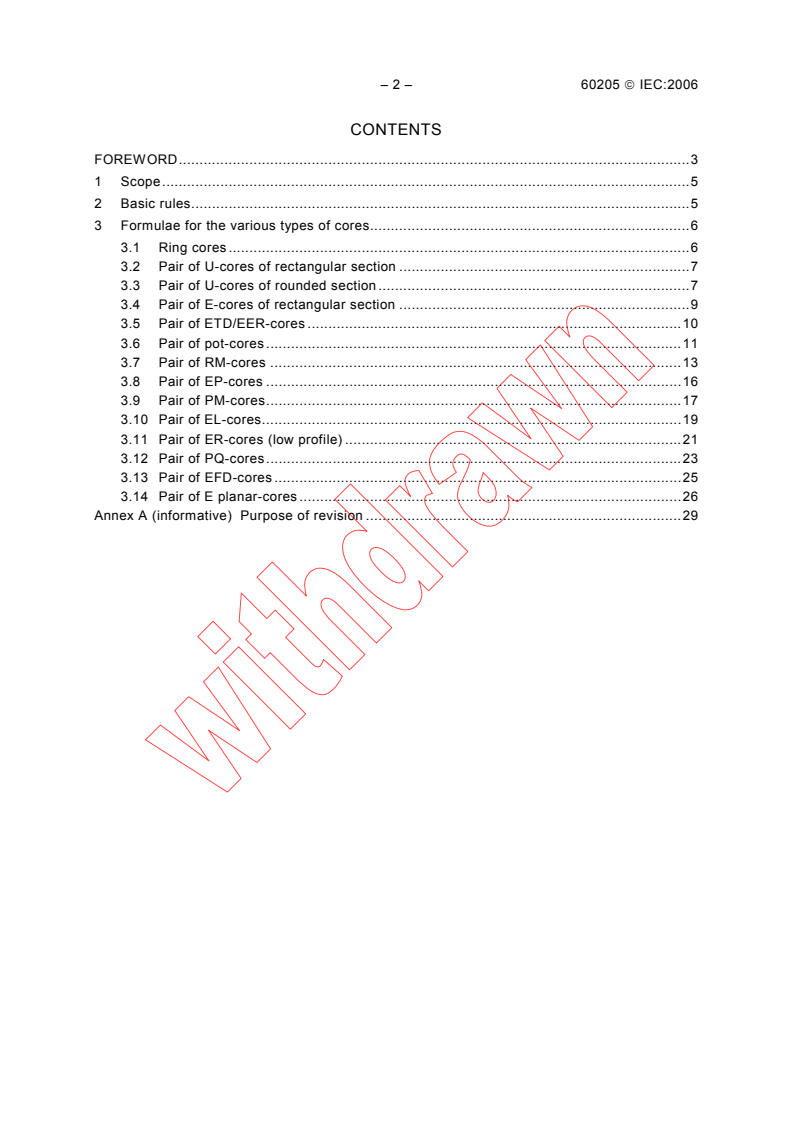
IEC 60205:2006 - Calculation of the effective parameters of magnetic piece parts Released:4/26/2006
IEC 60205:2006+AMD1:2009 CSV - Calculation of the effective parameters of magnetic piece parts Released:8/12/2009
Overview
IEC 60205:2006 - "Calculation of the effective parameters of magnetic piece parts" - establishes uniform rules for calculating the effective magnetic parameters of closed ferromagnetic circuits. The standard defines how to derive the effective magnetic length (le), effective cross-sectional area (Ae) and effective volume (Ve) from core geometry and provides core constants used in magnetic circuit calculations. Results are expressed in millimetres, angles in radians, and numerical accuracy requirements are specified to ensure reproducible values across organizations.
Key topics and technical requirements
- Scope and applicability: Rules apply to component parts of closed magnetic circuits (ferromagnetic cores).
- Units and accuracy: Dimensions in millimetres; results to three significant figures; intermediate core constants calculated to five significant figures. All angles in radians.
- Dimension input rules: Use mean values within drawing tolerances; ignore small manufacturing irregularities unless specified; treat sharp corners using mean circular flux-path lengths and averaged cross-sections.
- Definitions: Formal definitions and relationships for le, Ae, Ve and core constants C1, C2, C3 (used to compute effective parameters).
- Core-specific formulae: Detailed analytic formulae and procedures are provided for many common core types, including:
- Ring cores (rectangular, trapezoidal, rounded)
- U-cores and U-cores with plate (rectangular and rounded)
- E-cores and E + I (plate) cores
- ETD / EER, pot-cores, RM cores
- EP, PM, EL, ER, PQ, EFD and E planar cores (added or updated in this edition)
- Corner, rounding and slot handling: Methods to account for rounding radii, slotting, and corner flux-path lengths are specified to calculate mean lengths and associated areas.
Practical applications
- Calculating magnetic circuit parameters for transformers, inductors, chokes and power magnetics.
- Sizing and modelling ferrite and ferromagnetic cores in power electronics and EMI filter design.
- Producing core data sheets and performing analytical pre-checks before finite-element analysis (FEA).
- Standardizing core parameter reporting between manufacturers, designers and test laboratories.
Who uses IEC 60205
- Magnetic-component designers and electrical engineers
- Ferrite and metal-core manufacturers
- Power-electronics and transformer design teams
- Test laboratories and quality/standards engineers preparing component specifications
Related information
IEC technical committee 51 prepared this standard. For complete application, users typically consult additional IEC publications covering magnetic materials, ferrite specifications and component testing to complement geometric effective-parameter calculations.
Keywords: IEC 60205, effective magnetic parameters, magnetic piece parts, magnetic cores, le Ae Ve, ring cores, E-cores, RM cores, ferrite core calculation.
Relations
- Effective Date
- 05-Sep-2023
- Effective Date
- 05-Sep-2023
- Effective Date
- 05-Sep-2023
- Effective Date
- 05-Sep-2023
Buy Documents
IEC 60205:2006 - Calculation of the effective parameters of magnetic piece parts Released:4/26/2006
IEC 60205:2006 - Calculation of the effective parameters of magnetic piece parts Released:4/26/2006
IEC 60205:2006+AMD1:2009 CSV - Calculation of the effective parameters of magnetic piece parts Released:8/12/2009
Get Certified
Connect with accredited certification bodies for this standard

IMQ S.p.A. (Certification)
Italian electrical product certification.

SLG Prüf- und Zertifizierungs GmbH
German testing and certification body.

UL Solutions
Global safety science company with testing, inspection and certification.
Sponsored listings
Frequently Asked Questions
IEC 60205:2006 is a standard published by the International Electrotechnical Commission (IEC). Its full title is "Calculation of the effective parameters of magnetic piece parts". This standard covers: IEC 60205:2006 lays down uniform rules for the calculation of the effective parameters of closed circuits of ferromagnetic material.
IEC 60205:2006 lays down uniform rules for the calculation of the effective parameters of closed circuits of ferromagnetic material.
IEC 60205:2006 is classified under the following ICS (International Classification for Standards) categories: 29.100.10 - Magnetic components. The ICS classification helps identify the subject area and facilitates finding related standards.
IEC 60205:2006 has the following relationships with other standards: It is inter standard links to IEC 60205:2006/AMD1:2009, IEC 60205:2001/COR1:2002, IEC 60205:2001, IEC 60205:2016. Understanding these relationships helps ensure you are using the most current and applicable version of the standard.
IEC 60205:2006 is available in PDF format for immediate download after purchase. The document can be added to your cart and obtained through the secure checkout process. Digital delivery ensures instant access to the complete standard document.
Standards Content (Sample)
INTERNATIONAL IEC
STANDARD 60205
Third edition
2006-04
Calculation of the effective parameters
of magnetic piece parts
Reference number
Publication numbering
As from 1 January 1997 all IEC publications are issued with a designation in the
60000 series. For example, IEC 34-1 is now referred to as IEC 60034-1.
Consolidated editions
The IEC is now publishing consolidated versions of its publications. For example,
edition numbers 1.0, 1.1 and 1.2 refer, respectively, to the base publication, the
base publication incorporating amendment 1 and the base publication incorporating
amendments 1 and 2.
Further information on IEC publications
The technical content of IEC publications is kept under constant review by the IEC,
thus ensuring that the content reflects current technology. Information relating to
this publication, including its validity, is available in the IEC Catalogue of
publications (see below) in addition to new editions, amendments and corrigenda.
Information on the subjects under consideration and work in progress undertaken
by the technical committee which has prepared this publication, as well as the list
of publications issued, is also available from the following:
• IEC Web Site (www.iec.ch)
• Catalogue of IEC publications
The on-line catalogue on the IEC web site (www.iec.ch/searchpub) enables you to
search by a variety of criteria including text searches, technical committees
and date of publication. On-line information is also available on recently issued
publications, withdrawn and replaced publications, as well as corrigenda.
• IEC Just Published
This summary of recently issued publications (www.iec.ch/online_news/ justpub)
is also available by email. Please contact the Customer Service Centre (see
below) for further information.
• Customer Service Centre
If you have any questions regarding this publication or need further assistance,
please contact the Customer Service Centre:
Email: custserv@iec.ch
Tel: +41 22 919 02 11
Fax: +41 22 919 03 00
INTERNATIONAL IEC
STANDARD 60205
Third edition
2006-04
Calculation of the effective parameters
of magnetic piece parts
IEC 2006 Copyright - all rights reserved
No part of this publication may be reproduced or utilized in any form or by any means, electronic or
mechanical, including photocopying and microfilm, without permission in writing from the publisher.
International Electrotechnical Commission, 3, rue de Varembé, PO Box 131, CH-1211 Geneva 20, Switzerland
Telephone: +41 22 919 02 11 Telefax: +41 22 919 03 00 E-mail: inmail@iec.ch Web: www.iec.ch
PRICE CODE
Commission Electrotechnique Internationale U
International Electrotechnical Commission
МеждународнаяЭлектротехническаяКомиссия
For price, see current catalogue
– 2 – 60205 IEC:2006(E)
CONTENTS
FOREWORD.3
Scope.5
2 Basic rules.5
3 Formulae for the various types of cores.6
3.1 Ring cores .6
3.2 Pair of U-cores of rectangular section .7
3.3 Pair of U-cores of rounded section.7
3.4 Pair of E-cores of rectangular section .9
3.5 Pair of ETD/EER-cores .10
3.6 Pair of pot-cores .11
3.7 Pair of RM-cores .13
3.8 Pair of EP-cores .16
3.9 Pair of PM-cores.17
3.10 Pair of EL-cores.19
3.11 Pair of ER-cores (low profile) .21
3.12 Pair of PQ-cores.23
3.13 Pair of EFD-cores .25
3.14 Pair of E planar-cores .26
Annex A (informative) Purpose of revision .29
60205 IEC:2006(E) – 3 –
INTERNATIONAL ELECTROTECHNICAL COMMISSION
___________
CALCULATION OF THE EFFECTIVE PARAMETERS
OF MAGNETIC PIECE PARTS
FOREWORD
1) The International Electrotechnical Commission (IEC) is a worldwide organization for standardization comprising
all national electrotechnical committees (IEC National Committees). The object of the IEC is to promote
international co-operation on all questions concerning standardization in the electrical and electronic fields. To
this end and in addition to other activities, IEC publishes International Standards, Technical Specifications,
Technical Reports, Publicly Available Specifications (PAS) and Guides (hereafter referred to as “IEC
Publication(s)“). Their preparation is entrusted to technical committees; any IEC National Committee interested
in the subject dealt with may participate in this preparatory work. International, governmental and non-
governmental organizations liaising with the IEC also participate in this preparation. IEC collaborates closely
with the International Organization for Standardization (ISO) in accordance with conditions determined by
agreement between the two organizations.
2) The formal decisions or agreements of IEC on technical matters express, as nearly as possible, an international
consensus of opinion on the relevant subjects since each technical committee has representation from all
interested IEC National Committees.
3) IEC Publications have the form of recommendations for international use and are accepted by IEC National
Committees in that sense. While all reasonable efforts are made to ensure that the technical content of IEC
Publications is accurate, IEC cannot be held responsible for the way in which they are used or for any
misinterpretation by any end user.
4) In order to promote international uniformity, IEC National Committees undertake to apply IEC Publications
transparently to the maximum extent possible in their national and regional publications. Any divergence
between any IEC Publication and the corresponding national or regional publication shall be clearly indicated in
the latter.
5) IEC provides no marking procedure to indicate its approval and cannot be rendered responsible for any
equipment declared to be in conformity with an IEC Publication.
6) All users should ensure that they have the latest edition of this publication.
7) No liability shall attach to IEC or its directors, employees, servants or agents including individual experts and
members of its technical committees and IEC National Committees for any personal injury, property damage or
other damage of any nature whatsoever, whether direct or indirect, or for costs (including legal fees) and
expenses arising out of the publication, use of, or reliance upon, this IEC Publication or any other IEC
Publications.
8) Attention is drawn to the Normative references cited in this publication. Use of the referenced publications is
indispensable for the correct application of this publication.
9) Attention is drawn to the possibility that some of the elements of this IEC Publication may be the subject of
patent rights. IEC shall not be held responsible for identifying any or all such patent rights.
International Standard IEC 60205 has been prepared by IEC technical committee 51: Magnetic
components and ferrite materials.
This third edition cancels and replaces the second edition published in 2001, corrigendum 1
(2001). This edition constitutes a technical revision.
This edition includes the following significant technical changes with respect to the previous
edition:
a) unit of angles through the text are described by using “radian”;
b) new words are added in 2.1 “All angles are in radians”;
l ln d g / d ln d g / d
l
2 2 3 2 2 3
c) replacement, Clause 3.9, of the equation = by = ;
A Dπ()h − h A Dπ()h − h / 2
2 1 2 2 1 2
d) new cores “EL, ER, PQ, EFD and E planar” are added in this edition.
– 4 – 60205 IEC:2006(E)
The text of this standard is based on the following documents:
FDIS Report on voting
51/848/FDIS 51/857/RVD
Full information on the voting for the approval of this standard can be found in the report on
voting indicated in the above table.
This publication has been drafted in accordance with the ISO/IEC Directives, Part 2.
The committee has decided that the contents of this publication will remain unchanged until the
maintenance result date indicated on the IEC web site under "http://webstore.iec.ch" in the data
related to the specific publication. At this date, the publication will be
• reconfirmed;
• withdrawn;
• replaced by a revised edition, or
• amended.
A bilingual version of this publication may be issued at a later date.
60205 IEC:2006(E) – 5 –
CALCULATION OF THE EFFECTIVE PARAMETERS
OF MAGNETIC PIECE PARTS
1 Scope
This International Standard lays down uniform rules for the calculation of the effective
parameters of closed circuits of ferromagnetic material.
2 Basic rules
The following basic rules are applicable to this standard.
2.1 All results shall be expressed in units based on the millimetre, shall be accurate to three
significant figures, but to derive l , A , and V the values of C and C shall be calculated to
e e e 1 2
five significant figures. All angles are in radians.
NOTE The purpose of specifying this degree of accuracy is only to ensure that parameters calculated at different
establishments are identical and it is not intended to imply that the parameters are capable of being determined to
this accuracy.
2.2 A is the nominal value of the smallest cross-section. All the dimensions used to
min
calculate A shall be the mean values between the tolerance limits quoted on the appropriate
min
piece part drawing.
2.3 Calculations are only applicable to the component parts of a closed magnetic circuit.
2.4 All dimensions used for the purpose of calculations shall be the mean value within the
tolerance limits quoted on the appropriate piece part drawing.
2.5 All irregularities in the outline of the core, such as small cut-outs, notches, chamfers, etc.
shall be ignored unless otherwise described.
2.6 When the calculation involves the sharp corner of a piece part, then the mean length of
flux path for that corner shall be taken as the mean circular path joining the centres of area of
the two adjacent uniform sections, and the cross-sectional area associated with that length
shall be taken as the average area of the two adjacent uniform sections.
Calculation of effective parameters l , A and V .
e e e
The effective parameters can be defined as
2 3 2
l = C /C A = C / C V = l A = C / C
e 1 2 e 1 2 e e e 1 2
where
l is the effective magnetic length of the core (mm);
e
A is the effective cross-sectional area (mm );
e
V is the effective volume (mm );
e
–1
C is the core constant (mm );
–3
C is the core constant (mm ).
– 6 – 60205 IEC:2006(E)
3 Formulae for the various types of cores
3.1 Ring cores
X
α
β
r
r
4×
4×
r
ϕ
h h h
X
Section X-X
IEC 584/06
2π
C =
h ln()d / d
e 1 2
4π()1/ d −1/ d
2 1
C =
2 3
h ln()d / d
e 1 2
3.1.1 For ring cores of rectangular cross-section with sharp corners
h = h
e
3.1.2 For ring cores of rectangular cross-section with an appreciable average rounding
radius r
1,7168r
h = h()1− k k =
e 1 1
h()d − d
1 2
3.1.3 For ring cores of trapezoidal cross-section with sharp corners
h()tanα + tan β
h = h()1− k k =
e 2 2
d − d
1 2
3.1.4 For ring cores of trapezoidal cross-section with an appreciable average
rounding radius r
h =()1− k − k
e 1 2
3.1.5 For ring cores of cross-section with circular arc frontal sides
d − d ϕ sinϕ ϕ
1 2
h = h − 2sin − −
e 2
4sin()ϕ / 2 2 2 2
d /2
d /2
d /2
d /2
60205 IEC:2006(E) – 7 –
d − d
1 2
ϕ = 2arcsin .
4r
NOTE When the winding is uniformly distributed over a ring core, it may be expected that, at all points inside the
ring core, the flux lines will be parallel to its surface.
No leakage flux will therefore leave or enter the ring core. This justifies the use of a theoretically more correct
derivation of the effective parameters which does not make use of the assumption that the flux is uniformly
distributed over the cross-section.
3.2 Pair of U-cores of rectangular section
NOTE U + PLT (Plate)-cores use U core formulas
q
l
l″ l′
4 4
X
A
Area
h
Y Y
A
Area
A
Area
l″ l′
5 5
X
Section Y-Y
l
Section X-X
IEC 585/06
Length of flux path associated with area A :
l = l′ + l′′
2 2 2
Mean length of flux paths at corners:
π
′ ′′
l = l + l =()p + h
4 4 4
π
′ ′′
l = l + l = ()s + h
5 5 5
Mean areas associated with l and l :
4 5
A + A
1 2
A =
A + A
2 3
A =
5 5
l l
i i
C = C =
1 ∑ 2 ∑ 2
A
A
= =
i 1 i i 1
i
3.3 Pair of U-cores of rounded section
NOTE U + PLT (Plate)-cores use U core formulas.
q
l″
l′
s p
– 8 – 60205 IEC:2006(E)
l
p
l″ X
4 l′
A
Area
h
Y Y
A
Area
A
Area
l′
Section Y-Y
l″
5 X
s
l
Section X-X
IEC 586/06
In calculating A ignore any ridges introduced for the purpose of facilitating manufacture.
Length of flux path assoc
...
IEC 60205 ®
Edition 3.0 2006-04
INTERNATIONAL
STANDARD
NORME
INTERNATIONALE
Calculation of the effective parameters of magnetic piece parts
Calcul des paramètres effectifs des pièces magnétiques
All rights reserved. Unless otherwise specified, no part of this publication may be reproduced or utilized in any form or by
any means, electronic or mechanical, including photocopying and microfilm, without permission in writing from either IEC or
IEC's member National Committee in the country of the requester.
If you have any questions about IEC copyright or have an enquiry about obtaining additional rights to this publication,
please contact the address below or your local IEC member National Committee for further information.
Droits de reproduction réservés. Sauf indication contraire, aucune partie de cette publication ne peut être reproduite
ni utilisée sous quelque forme que ce soit et par aucun procédé, électronique ou mécanique, y compris la photocopie
et les microfilms, sans l'accord écrit de la CEI ou du Comité national de la CEI du pays du demandeur.
Si vous avez des questions sur le copyright de la CEI ou si vous désirez obtenir des droits supplémentaires sur cette
publication, utilisez les coordonnées ci-après ou contactez le Comité national de la CEI de votre pays de résidence.
IEC Central Office
3, rue de Varembé
CH-1211 Geneva 20
Switzerland
Email: 0Hinmail@iec.ch
Web: 1Hwww.iec.ch
About the IEC
The International Electrotechnical Commission (IEC) is the leading global organization that prepares and publishes
International Standards for all electrical, electronic and related technologies.
About IEC publications
The technical content of IEC publications is kept under constant review by the IEC. Please make sure that you have the
latest edition, a corrigenda or an amendment might have been published.
ƒ Catalogue of IEC publications: 2Hwww.iec.ch/searchpub
The IEC on-line Catalogue enables you to search by a variety of criteria (reference number, text, technical committee,…).
It also gives information on projects, withdrawn and replaced publications.
ƒ IEC Just Published: 3Hwww.iec.ch/online_news/justpub
Stay up to date on all new IEC publications. Just Published details twice a month all new publications released. Available
on-line and also by email.
ƒ Electropedia: 4Hwww.electropedia.org
The world's leading online dictionary of electronic and electrical terms containing more than 20 000 terms and definitions
in English and French, with equivalent terms in additional languages. Also known as the International Electrotechnical
Vocabulary online.
ƒ Customer Service Centre: 5Hwww.iec.ch/webstore/custserv
If you wish to give us your feedback on this publication or need further assistance, please visit the Customer Service
Centre FAQ or contact us:
Email: 6Hcsc@iec.ch
Tel.: +41 22 919 02 11
Fax: +41 22 919 03 00
A propos de la CEI
La Commission Electrotechnique Internationale (CEI) est la première organisation mondiale qui élabore et publie des
normes internationales pour tout ce qui a trait à l'électricité, à l'électronique et aux technologies apparentées.
A propos des publications CEI
Le contenu technique des publications de la CEI est constamment revu. Veuillez vous assurer que vous possédez
l’édition la plus récente, un corrigendum ou amendement peut avoir été publié.
ƒ Catalogue des publications de la CEI: 7Hwww.iec.ch/searchpub/cur_fut-f.htm
Le Catalogue en-ligne de la CEI vous permet d’effectuer des recherches en utilisant différents critères (numéro de référence,
texte, comité d’études,…). Il donne aussi des informations sur les projets et les publications retirées ou remplacées.
ƒ Just Published CEI: 8Hwww.iec.ch/online_news/justpub
Restez informé sur les nouvelles publications de la CEI. Just Published détaille deux fois par mois les nouvelles
publications parues. Disponible en-ligne et aussi par email.
ƒ Electropedia: 9Hwww.electropedia.org
Le premier dictionnaire en ligne au monde de termes électroniques et électriques. Il contient plus de 20 000 termes et
définitions en anglais et en français, ainsi que les termes équivalents dans les langues additionnelles. Egalement appelé
Vocabulaire Electrotechnique International en ligne.
ƒ Service Clients: 10Hwww.iec.ch/webstore/custserv/custserv_entry-f.htm
Si vous désirez nous donner des commentaires sur cette publication ou si vous avez des questions, visitez le FAQ du
Service clients ou contactez-nous:
Email: 11Hcsc@iec.ch
Tél.: +41 22 919 02 11
Fax: +41 22 919 03 00
IEC 60205 ®
Edition 3.0 2006-04
INTERNATIONAL
STANDARD
NORME
INTERNATIONALE
Calculation of the effective parameters of magnetic piece parts
Calcul des paramètres effectifs des pièces magnétiques
INTERNATIONAL
ELECTROTECHNICAL
COMMISSION
COMMISSION
ELECTROTECHNIQUE
PRICE CODE
INTERNATIONALE
U
CODE PRIX
ICS 29.100.10 ISBN 978-2-88910-071-2
– 2 – 60205 © IEC:2006
CONTENTS
FOREWORD.0H3
1 Scope.1H5
2 Basic rules.2H5
3 Formulae for the various types of cores.3H6
3.1 Ring cores .4H6
3.2 Pair of U-cores of rectangular section .5H7
3.3 Pair of U-cores of rounded section.6H7
3.4 Pair of E-cores of rectangular section .7H9
3.5 Pair of ETD/EER-cores .8H10
3.6 Pair of pot-cores .9H11
3.7 Pair of RM-cores .10H13
3.8 Pair of EP-cores .11H16
3.9 Pair of PM-cores.12H17
3.10 Pair of EL-cores.13H19
3.11 Pair of ER-cores (low profile) .14H21
3.12 Pair of PQ-cores.15H23
3.13 Pair of EFD-cores .16H25
3.14 Pair of E planar-cores .17H26
Annex A (informative) Purpose of revision .18H29
60205 © IEC:2006 – 3 –
INTERNATIONAL ELECTROTECHNICAL COMMISSION
___________
CALCULATION OF THE EFFECTIVE PARAMETERS
OF MAGNETIC PIECE PARTS
FOREWORD
1) The International Electrotechnical Commission (IEC) is a worldwide organization for standardization comprising
all national electrotechnical committees (IEC National Committees). The object of the IEC is to promote
international co-operation on all questions concerning standardization in the electrical and electronic fields. To
this end and in addition to other activities, IEC publishes International Standards, Technical Specifications,
Technical Reports, Publicly Available Specifications (PAS) and Guides (hereafter referred to as “IEC
Publication(s)“). Their preparation is entrusted to technical committees; any IEC National Committee interested
in the subject dealt with may participate in this preparatory work. International, governmental and non-
governmental organizations liaising with the IEC also participate in this preparation. IEC collaborates closely
with the International Organization for Standardization (ISO) in accordance with conditions determined by
agreement between the two organizations.
2) The formal decisions or agreements of IEC on technical matters express, as nearly as possible, an international
consensus of opinion on the relevant subjects since each technical committee has representation from all
interested IEC National Committees.
3) IEC Publications have the form of recommendations for international use and are accepted by IEC National
Committees in that sense. While all reasonable efforts are made to ensure that the technical content of IEC
Publications is accurate, IEC cannot be held responsible for the way in which they are used or for any
misinterpretation by any end user.
4) In order to promote international uniformity, IEC National Committees undertake to apply IEC Publications
transparently to the maximum extent possible in their national and regional publications. Any divergence
between any IEC Publication and the corresponding national or regional publication shall be clearly indicated in
the latter.
5) IEC provides no marking procedure to indicate its approval and cannot be rendered responsible for any
equipment declared to be in conformity with an IEC Publication.
6) All users should ensure that they have the latest edition of this publication.
7) No liability shall attach to IEC or its directors, employees, servants or agents including individual experts and
members of its technical committees and IEC National Committees for any personal injury, property damage or
other damage of any nature whatsoever, whether direct or indirect, or for costs (including legal fees) and
expenses arising out of the publication, use of, or reliance upon, this IEC Publication or any other IEC
Publications.
8) Attention is drawn to the Normative references cited in this publication. Use of the referenced publications is
indispensable for the correct application of this publication.
9) Attention is drawn to the possibility that some of the elements of this IEC Publication may be the subject of
patent rights. IEC shall not be held responsible for identifying any or all such patent rights.
International Standard IEC 60205 has been prepared by IEC technical committee 51: Magnetic
components and ferrite materials.
This third edition cancels and replaces the second edition published in 2001, corrigendum 1
(2001). This edition constitutes a technical revision.
This edition includes the following significant technical changes with respect to the previous
edition:
a) unit of angles through the text are described by using “radian”;
b) new words are added in 2.1 “All angles are in radians”;
l ln d g / d ln d g / d
l
2 2 3 2 2 3
c) replacement, Clause 3.9, of the equation = by = ;
A Dπ()h − h A Dπ()h − h / 2
2 1 2 2 1 2
d) new cores “EL, ER, PQ, EFD and E planar” are added in this edition.
– 4 – 60205 © IEC:2006
This bilingual version, published in 2009-01, corresponds to the English version.
The text of this standard is based on the following documents:
FDIS Report on voting
51/848/FDIS 51/857/RVD
Full information on the voting for the approval of this standard can be found in the report on
voting indicated in the above table.
The French version of this standard has not been voted upon.
This publication has been drafted in accordance with the ISO/IEC Directives, Part 2.
The committee has decided that the contents of this publication will remain unchanged until the
maintenance result date indicated on the IEC web site under "http://webstore.iec.ch" in the data
related to the specific publication. At this date, the publication will be
• reconfirmed;
• withdrawn;
• replaced by a revised edition, or
• amended.
60205 © IEC:2006 – 5 –
CALCULATION OF THE EFFECTIVE PARAMETERS
OF MAGNETIC PIECE PARTS
1 Scope
This International Standard lays down uniform rules for the calculation of the effective
parameters of closed circuits of ferromagnetic material.
2 Basic rules
The following basic rules are applicable to this standard.
2.1 All results shall be expressed in units based on the millimetre, shall be accurate to three
significant figures, but to derive l , A , and V the values of C and C shall be calculated to
e e e 1 2
five significant figures. All angles are in radians.
NOTE The purpose of specifying this degree of accuracy is only to ensure that parameters calculated at different
establishments are identical and it is not intended to imply that the parameters are capable of being determined to
this accuracy.
2.2 A is the nominal value of the smallest cross-section. All the dimensions used to
min
calculate A shall be the mean values between the tolerance limits quoted on the appropriate
min
piece part drawing.
2.3 Calculations are only applicable to the component parts of a closed magnetic circuit.
2.4 All dimensions used for the purpose of calculations shall be the mean value within the
tolerance limits quoted on the appropriate piece part drawing.
2.5 All irregularities in the outline of the core, such as small cut-outs, notches, chamfers, etc.
shall be ignored unless otherwise described.
2.6 When the calculation involves the sharp corner of a piece part, then the mean length of
flux path for that corner shall be taken as the mean circular path joining the centres of area of
the two adjacent uniform sections, and the cross-sectional area associated with that length
shall be taken as the average area of the two adjacent uniform sections.
Calculation of effective parameters l , A and V .
e e e
The effective parameters can be defined as
2 3 2
l = C /C A = C / C V = l A = C / C
e 1 2 e 1 2 e e e 1 2
where
l is the effective magnetic length of the core (mm);
e
A is the effective cross-sectional area (mm );
e
V is the effective volume (mm );
e
–1
C is the core constant (mm );
–3
C is the core constant (mm ).
– 6 – 60205 © IEC:2006
3 Formulae for the various types of cores
3.1 Ring cores
X
α
β
r
r
4×
4×
r
ϕ
h h h
X
Section X-X
IEC 584/06
2π
C =
h ln()d / d
e 1 2
4π()1/ d −1/ d
2 1
C =
2 3
h ln()d / d
e 1 2
3.1.1 For ring cores of rectangular cross-section with sharp corners
h = h
e
3.1.2 For ring cores of rectangular cross-section with an appreciable average
rounding radius r
1,7168r
h = h()1− k k =
e 1 1
h()d − d
1 2
3.1.3 For ring cores of trapezoidal cross-section with sharp corners
h()tanα + tan β
h = h()1− k k =
e 2 2
d − d
1 2
3.1.4 For ring cores of trapezoidal cross-section with an appreciable average
rounding radius r
h =()1− k − k
e 1 2
3.1.5 For ring cores of cross-section with circular arc frontal sides
d − d ϕ sinϕ ϕ
⎛ ⎞
1 2
h = h − 2sin − −
⎜ ⎟
e 2
4sin()ϕ / 2 2 2 2
⎝ ⎠
d /2
d /2
d /2
d /2
60205 © IEC:2006 – 7 –
d − d
1 2
ϕ = 2arcsin .
4r
NOTE When the winding is uniformly distributed over a ring core, it may be expected that, at all points inside the
ring core, the flux lines will be parallel to its surface.
No leakage flux will therefore leave or enter the ring core. This justifies the use of a theoretically more correct
derivation of the effective parameters which does not make use of the assumption that the flux is uniformly
distributed over the cross-section.
3.2 Pair of U-cores of rectangular section
NOTE U + PLT (Plate)-cores use U core formulas.
q
l
l″ l′
4 4
X
A
Area
h
Y Y
A
Area
A
Area
l″ l′
5 5
X
Section Y-Y
l
Section X-X
IEC 585/06
Length of flux path associated with area A :
l = l′ + l′′
2 2 2
Mean length of flux paths at corners:
π
′ ′′
l = l + l =()p + h
4 4 4
π
′ ′′
l = l + l = ()s + h
5 5 5
Mean areas associated with l and l :
4 5
A + A
1 2
A =
A + A
2 3
A =
5 5
l l
i i
C = C =
1 ∑ 2 ∑ 2
A
A
= =
i 1 i i 1
i
3.3 Pair of U-cores of rounded section
NOTE U + PLT (Plate)-cores use U core formulas.
q
l″
l′
s p
– 8 – 60205 © IEC:2006
l
p
l″ X
4 l′
A
Area
h
Y Y
A
Area
A
Area
l′
Section Y-Y
l″
5 X
s
l
Section X-X
IEC 586/06
In calculating A ignore any ridges introduced for the purpose of facilitating manufacture.
Length of flux path associated with area A :
l = l′ + l′′
2 2 2
Mean length of flux path at corners:
π
′ ′′
l = l + l =()p + h
4 4 4
π
′ ′′
l = l + l = ()s + h
5 5 5
Mean areas associated with l and l :
4 5
A + A
1 2
A =
A + A
2 3
A =
5 5
l l
i i
C = C =
1 ∑ 2 ∑ 2
A A
i=1 i=1
i i
s
l″
l′
60205 © IEC:2006 – 9 –
3.4 Pair of E-cores of rectangular section
NOTE E + I (Plate)-cores use E core formulas.
w
l
X
l
A
Area
Y Y
A
Area
l
h
A
l
Area
A
Area
A
Area
Section Y-Y
X
Section X-X
IEC 587/06
Area of half the centre limb: A
Mean length of flux paths at corners:
π
l =()p + h
π d
⎛ ⎞
l = ⎜ + h⎟
8 2
⎝ ⎠
Mean areas associated with l and l :
4 5
A + A
1 2
A =
A + A
2 3
A =
5 5
l l
i i
C = C =
∑ ∑
1 2 2
A 2A
i=1 i=1
i i
w
l
p
d /2
– 10 – 60205 © IEC:2006
3.5 Pair of ETD/EER-cores
b
X l
l
A
c
Area
Y Y
A′
Area
A″
l 3
Area
h
l
5 A
Area
A
Area
A
Area
Section Y-Y
X
Section X-X
IEC 588/06
⎛ ⎞
A1 is equal to the rectangle b a c A .
⎜ − ⎟ less the cap or segment
c
⎝ ⎠
⎛ ⎞
1 b 1
2 2
⎜ ⎟
A = d arcsin − b d − b
C 2 2
⎜ ⎟
4 d 4
⎝ 2⎠
⎛ ⎞
1 1 1 b
2 2
⎜ ⎟
A = ab − b d − b − d arcsin
1 2 2
⎜ ⎟
2 4 4 d
⎝ 2⎠
Mean length of flux path at back walls:
1 d
2 3
⎛ ⎞
l = ⎜d + d − b ⎟ −
2 2 2
⎝ ⎠
4 2
NOTE l is taken from the mean value of ()d − d and()c − d / 2 .
2 3 3
Area of half the centre limb:
A = A′ + A′′
3 3 3
The condition to obtain A′ = A′′ is
3 3
S = 0,2980d
1 3
Mean length of flux path at corners:
π
l =()p + h
a d
where p = − l −
2 2
b
l
a
d
c
d /2
S
1 p
60205 © IEC:2006 – 11 –
π
l =()2S + h
5 1
Mean areas associated with l and l :
4 5
A + A
1 2
A =
A + A
2 3
A =
5 5
l l
i i
C = C =
1 ∑ 2 ∑
A 2A
i=1 i=1
i i
3.6 Pair of pot-cores
l
h
a
l′
A″
X l″
Area
A′
Area
A
d /2
1 Area
l
d /2
A
4 6
Area
l″ l′
5 5
d /2
d /2
A″
Area
A′
Area
X
Section X-X
IEC 589/06
Area of outer ring:
′ ′′
A = A + A
1 1 1
′ ′′
The condition to obtain A = A is
1 1
d
2 2
S = − +()d + d
1 1 2
2 8
Area of centre limb:
′ ′′
A = A + A
3 3 3
′ ′′
The condition to obtain A = A is
3 3
d 1
2 2
S = −()d + d
2 3 4
2 8
b
θ
l″
l″
2 6
s
s 1
l′ l′
2 6
– 12 – 60205 © IEC:2006
Area of ring:
2 2
A =()π − nθ()d − d
1 1 2
2b
θ = arcsin
d + d
1 2
where
b is the slot width;
n is the number of slots.
Core factors associated with l :
l 1 a
= ln
A πh d
2 3
l a − d
2 3
=
2 2 2
A π ad h
2 3
Area of centre limb:
π
2 2
A =()d − d
3 3 4
Mean length of flux paths at corners:
π
l = l′ + l′′ =()2S + h
4 4 4 1
π
l = l′ + l′′ =()2S + h
5 5 5 2
Areas associated with l and l :
4 5
1 π
2 2
A =()π − nθ()d − d + d h
4 1 2 2
8 2
π 2 2
A =()d − d + 4d h
5 3 4 3
Core factors associated with l :
l 1 d
6 2
= ln
A()π − nθ h a
l d − a
6 2
=
A ad()π − nθ h
6 2
6 6
l l
i i
C = C =
∑ ∑
1 2
A
A
i=1 i=1
i
i
60205 © IEC:2006 – 13 –
3.7 Pair of RM-cores
NOTE 1 This calculation is also applicable to the core type without hole.
NOTE 2 RM + I (Plate)-cores use RM core formulas.
Type 1 – RM6–S, RM6–R
l′
A 4
8 l″
X
p
ϕ
l
min
l
A
A
β
d /2
l″
l′
d /2 5
l
max
d /2
e
X
l h
c
A /2
Section X-X
Type 2 – RM7
A
X
p ϕ
l
min
A
A
d /2
β
d /2
l
max
d /2
b
e
X
c
A /2
Type 3 – RM4, RM5, RM8, RM10, RM12, RM14
A
p ϕ
A
l A
min 3
l′
max
d /2
β 4
l″ d /2
max 3
d /2
e
c
A /2
l l′ l″
max = max + max
IEC 590/06
α
α
α
a
a
a
l″
l′
– 14 – 60205 © IEC:2006
Total area of the outer leg:
⎧ ⎫
1 ⎛ π⎞ β 2 1
2 2
A = a 1+ tan β − − d − p
⎜ ⎟
⎨ ⎬
1 2
2 4 2 2
⎝ ⎠
⎩ ⎭
e
where β = α − arcsin
d
Core factors associated with l :
d
ln f
l d
2 3
=
A Dπh
A
l min+ l max
where f = , D =
2l min
A
′ ′′
l = l + l
2 2 2
l()1 d −1 d f
2 3 2
=
2 2
π
A ()D h
Type 1:
1 1
2 2
l =()d + d − d d cos()α − β
max 2 3 2 3
4 2
Type 2:
1 1 b
⎛ ⎞
l = d + d − d d ()− −
⎜ ⎟ cos α β
max 2 2 3
4 2 ϕ
⎝ ⎠
2sin
Type 3:
ϕ
e 1⎛ ⎞
l = + 1− sin ()d − c
⎜ ⎟
max 2
2 2 2
⎝ ⎠
Type 1: RM 6-S:
1⎧ β 1 1 ϕ π ⎫
2 ⎛ ⎞ 2
2 2
A = d + e tan β − e tan α − − d
⎜ ⎟
⎨ ⎬
7 2 3
4 2 2 2 2 4
⎝ ⎠
⎩ ⎭
60205 © IEC:2006 – 15 –
Type 1: RM 6-R:
1⎧ β 1 1 ϕ π ⎫
2 2 2
A = d + d d sin()α − β +()c − d tan − d
⎨ ⎬
7 2 2 3 3 3
4 2 2 2 2 4
⎩ ⎭
Type 2:
1⎧ β π 1 ϕ 1 ⎫
2 2 ⎛ ⎞
2 2 2
A = d − d +()b − e tan α − + e tan β
⎜ ⎟
⎨ ⎬
7 2 3
4 2 4 2 2 2
⎝ ⎠
⎩ ⎭
Type 3:
1 β π 1
⎧ 2 2 ⎫
A = d − d + c tan()α − β
⎨ ⎬
7 2 3
4 2 4 2
⎩ ⎭
α
2 2
A =()d − d
8 2 3
Area of centre pole:
π
2 2
A =()d − d
3 3 4
Mean length of flux paths at corners and mean areas associated with these:
π 1 1
⎛ ⎞
l l′ l′′ h a d
= + = + −
⎜ ⎟
4 4 4 2
4 2 2
⎝ ⎠
A =()A + 2βd h
4 1 2
⎧ ⎫
π 1
2 2
l = l′ + l′′ = d + h −()d + d
⎨ ⎬
5 5 5 3 3 4
4 2
⎩ ⎭
1 π
⎧ 2 2 ⎫
A = ()d − d + 2αd h
⎨ ⎬
5 3 4 3
2 4
⎩ ⎭
5 5
l l
i i
C = C =
1 ∑ 2 ∑
A
A
i=1 i=1
i
i
NOTE This calculation ignores the effect of spring recesses and stud recesses. These may have some influence
on the outcome of the calculation, especially for smaller cores.
– 16 – 60205 © IEC:2006
3.8 Pair of EP-cores
l
b l″
l′ 1 4
X
A
l
d /2
α
d /2
l″
l′
5 5
A
h
c
h
X
Section X-X
IEC 591/06
As a pair:
l h
1 2
=
A
ab −πd / 8 − d d / 2
1 1 2
l h
1 2
=
2 2
A
()ab −πd / 8 − d d / 2
1 1 2
l 2 d
2 1
= ln
A ()π −α(h − h) d
2 1 2 2
l 4()d − d
2 1 2
=
2 2 2
A ()π −α(h − h) d d
2 1 2 1 2
4h
l h
3 2
= =
2 2
A
πd
d
3 ⎛ ⎞
π
⎜ ⎟
⎝ ⎠
16h
l h
3 2
= =
2 4 4
A
d π d
⎛ ⎞
3 2
2 2
π
⎜ ⎟
⎝ ⎠
Areas associated with l and l :
4 5
a
l′
l″
60205 © IEC:2006 – 17 –
π d h − h
⎛ ⎞
1 1 2
′ ′′
l = l + l = ⎜γ − + ⎟
4 4 4
2 2 4
⎝ ⎠
2 2
()π −α d + 2()ab −πd /8 − d d / 2
1 1 1 2
γ =
4()π −α
where γ is a hypothetical radius bisecting the cross-sectional area of the ring.
1⎧ π d d h h ⎫
⎛ ⎞
1 2 1 2
A = ab − d − +()π −α d −
⎜ ⎟
⎨ ⎬
4 1 1
2 8 2 2 2
⎝ ⎠
⎩ ⎭
π d h − h
⎛ ⎞
2 1 2
′ ′′
l = l + l = 0,29289 +
⎜ ⎟
5 5 5
2 2 4
⎝ ⎠
⎧ ⎫
π d d
2 2
A = + ()h − h
⎨ ⎬
5 1 2
2 4 2
⎩ ⎭
5 5
l l
i i
C = C =
1 ∑ 2 ∑
A
A
i=1 i=1
i
i
3.9 Pair of PM-cores
c
l″
l 4
l′
b 4 1
X
e
l
d
ϕ
l
max
l″
l′
β
d
A
A
α
h
X
h
Section X-X
IEC 592/06
Total area of the leg:
β
2 2
A =()d − d − 2bt
1 1 2
l
min
t
ƒ
l′
l″
d
d
d
– 18 – 60205 © IEC:2006
f
where β = α − arcsin
d
Core factors associated with l :
l = l′ + l′′
2 2 2
d
ln g
l d
2 3
=
A Dπ()h − h / 2
2 1 2
l min+ l max A
where g = , D =
2l min A
1 1
2 2
l =()d + d − d d cos()α − β
max 2 3 2 3
4 2
l ()1 d −1 d g
2 3 2
=
2 2
A{}Dπ()h − h 2
2 1 2
β 1 1 ϕ π
2 ⎛ ⎞ 2
2 2
A = d + f tan β − f tan α − − d
⎜ ⎟
7 2 3
8 2 16
8 8
⎝ ⎠
α
2 2
A =()d − d
8 2 3
Area of centre limb:
π
2 2
()
A = d − d
3 3 4
Mean length of flux paths at corners and mean areas associated with these:
π
′ ′′
l = l + l =()h − h + d − d
4 4 4 1 2 1 2
A ={}A + 2βd()h − h
4 1 2 1 2
⎧ ⎫
π 1
2 2
′ ′′
l = l + l = d + h − h −()d + d
⎨ ⎬
5 5 5 3 1 2 3 4
4 2
⎩ ⎭
π
2 2
A =()d − d +αd()h − h
5 3 4 3 1 2
60205 © IEC:2006 – 19 –
5 5
l l
i i
C = C =
∑ ∑
1 2
A
A
i=1 i=1
i
i
3.10 Pair of EL-cores
NOTE EL + PLT (Plate)-cores use EL core formulas.
C B
l
D
F
l
l
l
R
IEC 593/06
Area of outer leg:
1 1
⎛ ⎞
2 2
A =()A − E C − 4 R − πR
⎜ ⎟
2 4
⎝ ⎠
Mean length of flux path at outer leg:
l = D
Area of back wall:
A =()C +()F − F + πF /2(B − D)
2 2 1 1
Mean length of flux at back wall:
E F
⎛ ⎞
l = − ⎟
⎜
2 2
⎝ ⎠
Area of centre limb:
1⎧ 1 ⎫
A = πF +()F − F F
3 ⎨ 1 2 1 1⎬
2 4
⎩ ⎭
Mean length of flux path at centre limb:
l = D
F
H
E
A
l
– 20 – 60205 © IEC:2006
Area of outside corner:
A + A
1 21
A =
where A = (B – D)C
Mean length of flux path at outside corner:
π⎛ A E ⎞
⎛ ⎞
l = − +()B − D
⎜⎜ ⎟ ⎟
8 2 2
⎝ ⎠
⎝ ⎠
Area of inside corner:
A + A
23 3
A =
where A =()()F −F + πF /2(B − D)
23 2 1 1
Mean length of flux path at inside corner:
π⎛ A ⎞
⎜ ⎟
l = +()B − D
⎜ ⎟
8 F
⎝ 2 ⎠
5 5
l l
i i
C = C =
1 ∑ 2 ∑
A
2A
i= i=
1 i 1
i
2 3 2
l = C /C A = C /C V = C /C
e 1 2 e 1 2 e 1 2
60205 © IEC:2006 – 21 –
3.11 Pair of ER-cores (low profile)
NOTE ER + PLT (Plate)-cores use ER core formulas.
B
l
C
D
l
l
l
β A
A′
A″
α
A
IEC 594/06
Area of outer leg:
⎛ ⎞
1 αE EG
A = C()A −G −⎜ − sinα⎟
⎜ ⎟
2 4 4
⎝ ⎠
where α = arccos (G/E)
Mean length of flux path at outer leg:
l = D
Area of back wall:
= C(B – D)
A
Mean length of flux path at back wall:
2 2
l =()E + G + C − 2F
Area of centre limb:
G
F
E
A
S
l
– 22 – 60205 © IEC:2006
1 1
⎛ ⎞
A = πF
⎜ ⎟
2 4
⎝ ⎠
Mean length of flux path at centre limb:
l = D
Area of outside corner:
A + A
1 2
A =
Mean length of flux path at outside corner:
π
l =()p + h
where
A E
h = B − D p = −
2 2
Area of inside corner:
A + A
2 3
A =
Mean length of flux path at inside corner:
π
l =()2S + h
5 1
The condition to obtain A′ = A″ is
3 3
S = F()1− sinα = 0,2978F
5 5
l l
i i
C = C =
1 ∑ 2 ∑
A
2A
i=1 i=1
i
i
2 3 2
l = C /C A = C /C V = C /C
e 1 2 e 1 2 e 1 2
60205 © IEC:2006 – 23 –
3.12 Pair of PQ-cores
NOTE 1 This calculation ignores the effect of spring recesses.
NOTE 2 PQ + PLT (Plate)-cores use PQ core formulas.
l′
X 4
l″
A A
7 8
α
β
l
l
max
l′
l″ 5
A
A /2
X
D
l
1 h
C
B
Section X-X
IEC 595/06
Area of outer leg:
βE EG
A = C()A −G − + sin β
2 2
where β = arccos (G/E)
Mean length of flux path at outer leg:
l = 2D
Core factors associated with l :
l
ln()E/F
= f
A Kπ()B − D
l
1/F −1/E
= f
2 2
2 2
A
2K π()B − D
where
A A
7 7
K = =
π
A 2 2
()E − F
l + l
min max
f =
2l
min
NOTE 3 l may be determined by measurement.
max
A
l
min
G
F
E
l″
l′
– 24 – 60205 © IEC:2006
Area of centre limb:
A = πF
Mean length of flux path at centre limb:
l = 2D
Area of outside corner:
A ={}A + 2E()B − D β
4 1
Mean length of flux path at outside corner:
π 1 1
⎛ ⎞
l = l′ + l′′ = B − D + A − E
⎜ ⎟
4 4 4
4 2 2
⎝ ⎠
Area of inside corner:
π F
⎛ ⎞
A = + F()B − D α
⎜ ⎟
2 2
⎝ ⎠
NOTE 4 α in radian, may be determined by measurement.
Mean length off flux path at inside corner:
π ⎧ ⎛ 1 ⎞ ⎫
′ ′′
l = l + l = ()B − D +⎜1− ⎟F
5 5 5 ⎨ ⎬
⎜ ⎟
⎩ ⎝ ⎠ ⎭
l l
i i
C = C =
1 ∑ 2 ∑
A
A
i=1 i=1
i
i
2 3 2
l = C /C A = C /C V = C /C
e 1 2 e 1 2 e 1 2
60205 © IEC:2006 – 25 –
3.13 Pair of EFD-cores
C
B
K
l
F
D
l
l
l
IEC 596/06
Area of outer leg:
C()A − E
A =
Mean length of flux path at outer leg:
l = D
Area of back wall:
A = C()B − D
Mean length of flux at back wall:
E − F
l =
Area of centre limb:
F F − 2q
1 2
A =
where q: chamfer
Mean length of flux path at centre limb:
l = D
Area of out side corner:
F
E
A
q
l
– 26 – 60205 © IEC:2006
()A + A
1 2
A =
Mean length of flux path at outside corner:
π A − E
⎛ ⎞
l = +()B − D
⎜ ⎟
8 2
⎝ ⎠
Area of inside corner:
A + A
2 3
A =
Mean length of flux path at inside corner:
2 2
⎛ ⎞
π F C − F − 2K B − D
⎛ ⎞ ⎛ ⎞
⎜ 1 2 ⎟
l = + ⎟ +
⎜ ⎜ ⎟
⎜ ⎟
4 4 2 2
⎝ ⎠
⎝ ⎠
⎝ ⎠
5 5
l l
i i
C = C =
∑ ∑
1 2
A 2A
i=1 i=1
i i
2 3
C C C
1 1 1
l = A = V =
e e e 2
C C C
2 2 2
3.14 Pair of E planar-cores
NOTE E planar + PLT (Plate)-cores use E planar core formulas.
B
C
l
D
l
R
l
R
l
IEC 597/06
Area of outer leg:
F
E
A
l
60205 © IEC:2006 – 27 –
C()A − E π
⎛ ⎞
2 2
A = − 4 R − × R
⎜ ⎟
1 1 1
2 4
⎝ ⎠
Mean length of flux path at outer leg:
l = D
Area of back wall:
A = C()B − D
Mean length of flux at back wall:
E − F
l =
Area of centre limb:
π
⎛ ⎞
2 2
A = FC − 2 R − × R
⎜ ⎟
3 2 2
⎝ ⎠
Mean length of flux path at centre limb:
l = D
Area of outside corner:
A + A
1 2
A =
Mean length of flux path at outside corner:
...
IEC 60205 ®
Edition 3.1 2009-08
INTERNATIONAL
STANDARD
NORME
INTERNATIONALE
Calculation of the effective parameters of magnetic piece parts
Calcul des paramètres effectifs des pièces magnétiques
All rights reserved. Unless otherwise specified, no part of this publication may be reproduced or utilized in any form or by
any means, electronic or mechanical, including photocopying and microfilm, without permission in writing from either IEC or
IEC's member National Committee in the country of the requester.
If you have any questions about IEC copyright or have an enquiry about obtaining additional rights to this publication,
please contact the address below or your local IEC member National Committee for further information.
Droits de reproduction réservés. Sauf indication contraire, aucune partie de cette publication ne peut être reproduite
ni utilisée sous quelque forme que ce soit et par aucun procédé, électronique ou mécanique, y compris la photocopie
et les microfilms, sans l'accord écrit de la CEI ou du Comité national de la CEI du pays du demandeur.
Si vous avez des questions sur le copyright de la CEI ou si vous désirez obtenir des droits supplémentaires sur cette
publication, utilisez les coordonnées ci-après ou contactez le Comité national de la CEI de votre pays de résidence.
IEC Central Office
3, rue de Varembé
CH-1211 Geneva 20
Switzerland
Email: inmail@iec.ch
Web: www.iec.ch
About the IEC
The International Electrotechnical Commission (IEC) is the leading global organization that prepares and publishes
International Standards for all electrical, electronic and related technologies.
About IEC publications
The technical content of IEC publications is kept under constant review by the IEC. Please make sure that you have the
latest edition, a corrigenda or an amendment might have been published.
ƒ Catalogue of IEC publications: www.iec.ch/searchpub
The IEC on-line Catalogue enables you to search by a variety of criteria (reference number, text, technical committee,…).
It also gives information on projects, withdrawn and replaced publications.
ƒ IEC Just Published: www.iec.ch/online_news/justpub
Stay up to date on all new IEC publications. Just Published details twice a month all new publications released. Available
on-line and also by email.
ƒ Electropedia: www.electropedia.org
The world's leading online dictionary of electronic and electrical terms containing more than 20 000 terms and definitions
in English and French, with equivalent terms in additional languages. Also known as the International Electrotechnical
Vocabulary online.
ƒ Customer Service Centre: www.iec.ch/webstore/custserv
If you wish to give us your feedback on this publication or need further assistance, please visit the Customer Service
Centre FAQ or contact us:
Email: csc@iec.ch
Tel.: +41 22 919 02 11
Fax: +41 22 919 03 00
A propos de la CEI
La Commission Electrotechnique Internationale (CEI) est la première organisation mondiale qui élabore et publie des
normes internationales pour tout ce qui a trait à l'électricité, à l'électronique et aux technologies apparentées.
A propos des publications CEI
Le contenu technique des publications de la CEI est constamment revu. Veuillez vous assurer que vous possédez
l’édition la plus récente, un corrigendum ou amendement peut avoir été publié.
ƒ Catalogue des publications de la CEI: www.iec.ch/searchpub/cur_fut-f.htm
Le Catalogue en-ligne de la CEI vous permet d’effectuer des recherches en utilisant différents critères (numéro de référence,
texte, comité d’études,…). Il donne aussi des informations sur les projets et les publications retirées ou remplacées.
ƒ Just Published CEI: www.iec.ch/online_news/justpub
Restez informé sur les nouvelles publications de la CEI. Just Published détaille deux fois par mois les nouvelles
publications parues. Disponible en-ligne et aussi par email.
ƒ Electropedia: www.electropedia.org
Le premier dictionnaire en ligne au monde de termes électroniques et électriques. Il contient plus de 20 000 termes et
définitions en anglais et en français, ainsi que les termes équivalents dans les langues additionnelles. Egalement appelé
Vocabulaire Electrotechnique International en ligne.
ƒ Service Clients: www.iec.ch/webstore/custserv/custserv_entry-f.htm
Si vous désirez nous donner des commentaires sur cette publication ou si vous avez des questions, visitez le FAQ du
Service clients ou contactez-nous:
Email: csc@iec.ch
Tél.: +41 22 919 02 11
Fax: +41 22 919 03 00
IEC 60205 ®
Edition 3.1 2009-08
INTERNATIONAL
STANDARD
NORME
INTERNATIONALE
Calculation of the effective parameters of magnetic piece parts
Calcul des paramètres effectifs des pièces magnétiques
INTERNATIONAL
ELECTROTECHNICAL
COMMISSION
COMMISSION
ELECTROTECHNIQUE
PRICE CODE
INTERNATIONALE
CL
CODE PRIX
ICS 29.100.10 ISBN 978-2-88910-073-6
– 2 – 60205 © IEC:2006+A1:2009
CONTENTS
FOREWORD.3
1 Scope.5
2 Basic rules.5
3 Formulae for the various types of cores.6
3.1 Ring cores .6
3.2 Pair of U-cores of rectangular section .7
3.3 Pair of U-cores of rounded section.7
3.4 Pair of E-cores of rectangular section .9
3.5 Pair of ETD/EER-cores .10
3.6 Pair of pot-cores .11
3.7 Pair of RM-cores .13
3.8 Pair of EP-cores .16
3.9 Pair of PM-cores.17
3.10 Pair of EL-cores.19
3.11 Pair of ER-cores (low profile) .21
3.12 Pair of PQ-cores.23
3.13 Pair of EFD-cores .26
3.14 Pair of E planar-cores .27
Annex A (informative) Purpose of revision .30
60205 © IEC:2006+A1:2009 – 3 –
INTERNATIONAL ELECTROTECHNICAL COMMISSION
___________
CALCULATION OF THE EFFECTIVE PARAMETERS
OF MAGNETIC PIECE PARTS
FOREWORD
1) The International Electrotechnical Commission (IEC) is a worldwide organization for standardization comprising
all national electrotechnical committees (IEC National Committees). The object of the IEC is to promote
international co-operation on all questions concerning standardization in the electrical and electronic fields. To
this end and in addition to other activities, IEC publishes International Standards, Technical Specifications,
Technical Reports, Publicly Available Specifications (PAS) and Guides (hereafter referred to as “IEC
Publication(s)“). Their preparation is entrusted to technical committees; any IEC National Committee interested
in the subject dealt with may participate in this preparatory work. International, governmental and non-
governmental organizations liaising with the IEC also participate in this preparation. IEC collaborates closely
with the International Organization for Standardization (ISO) in accordance with conditions determined by
agreement between the two organizations.
2) The formal decisions or agreements of IEC on technical matters express, as nearly as possible, an international
consensus of opinion on the relevant subjects since each technical committee has representation from all
interested IEC National Committees.
3) IEC Publications have the form of recommendations for international use and are accepted by IEC National
Committees in that sense. While all reasonable efforts are made to ensure that the technical content of IEC
Publications is accurate, IEC cannot be held responsible for the way in which they are used or for any
misinterpretation by any end user.
4) In order to promote international uniformity, IEC National Committees undertake to apply IEC Publications
transparently to the maximum extent possible in their national and regional publications. Any divergence
between any IEC Publication and the corresponding national or regional publication shall be clearly indicated in
the latter.
5) IEC provides no marking procedure to indicate its approval and cannot be rendered responsible for any
equipment declared to be in conformity with an IEC Publication.
6) All users should ensure that they have the latest edition of this publication.
7) No liability shall attach to IEC or its directors, employees, servants or agents including individual experts and
members of its technical committees and IEC National Committees for any personal injury, property damage or
other damage of any nature whatsoever, whether direct or indirect, or for costs (including legal fees) and
expenses arising out of the publication, use of, or reliance upon, this IEC Publication or any other IEC
Publications.
8) Attention is drawn to the Normative references cited in this publication. Use of the referenced publications is
indispensable for the correct application of this publication.
9) Attention is drawn to the possibility that some of the elements of this IEC Publication may be the subject of
patent rights. IEC shall not be held responsible for identifying any or all such patent rights.
International Standard IEC 60205 has been prepared by IEC technical committee 51: Magnetic
components and ferrite materials.
This consolidated version of IEC 60205 consists of the third edition (2006) [documents
51/848/FDIS and 51/857/RVD] and its amendment 1 (2009) [documents 51/928A/CDV and
51/940/RVC].
The technical content is therefore identical to the base edition and its amendment and has
been prepared for user convenience.
It bears the edition number 3.1.
A vertical line in the margin shows where the base publication has been modified by
amendment 1.
The French version of this standard has not been voted upon.
– 4 – 60205 © IEC:2006+A1:2009
This edition includes the following significant technical changes with respect to the previous
edition:
a) unit of angles through the text are described by using “radian”;
b) new words are added in 2.1 “All angles are in radians”;
l ln d g / d ln d g / d
l
2 2 3 2 2 3
c) replacement, Clause 3.9, of the equation = by = ;
A Dπ()h − h A Dπ()h − h / 2
2 1 2 2 1 2
d) new cores “EL, ER, PQ, EFD and E planar” are added in this edition.
This publication has been drafted in accordance with the ISO/IEC Directives, Part 2.
The committee has decided that the contents of the base publication and its amendments will
remain unchanged until the maintenance result date indicated on the IEC web site under
"http://webstore.iec.ch" in the data related to the specific publication. At this date,
the publication will be
• reconfirmed,
• withdrawn,
• replaced by a revised edition, or
• amended.
60205 © IEC:2006+A1:2009 – 5 –
CALCULATION OF THE EFFECTIVE PARAMETERS
OF MAGNETIC PIECE PARTS
1 Scope
This International Standard lays down uniform rules for the calculation of the effective
parameters of closed circuits of ferromagnetic material.
2 Basic rules
The following basic rules are applicable to this standard.
2.1 All results shall be expressed in units based on the millimetre, shall be accurate to three
significant figures, but to derive l , A , and V the values of C and C shall be calculated to
e e e 1 2
five significant figures. All angles are in radians.
NOTE The purpose of specifying this degree of accuracy is only to ensure that parameters calculated at different
establishments are identical and it is not intended to imply that the parameters are capable of being determined to
this accuracy.
2.2 A is the nominal value of the smallest cross-section. All the dimensions used to
min
calculate A shall be the mean values between the tolerance limits quoted on the appropriate
min
piece part drawing.
2.3 Calculations are only applicable to the component parts of a closed magnetic circuit.
2.4 All dimensions used for the purpose of calculations shall be the mean value within the
tolerance limits quoted on the appropriate piece part drawing.
2.5 All irregularities in the outline of the core, such as small cut-outs, notches, chamfers, etc.
shall be ignored unless otherwise described.
2.6 When the calculation involves the sharp corner of a piece part, then the mean length of
flux path for that corner shall be taken as the mean circular path joining the centres of area of
the two adjacent uniform sections, and the cross-sectional area associated with that length
shall be taken as the average area of the two adjacent uniform sections.
Calculation of effective parameters l , A and V .
e e e
The effective parameters can be defined as
2 3 2
l = C /C A = C / C V = l A = C / C
e 1 2 e 1 2 e e e 1 2
where
l is the effective magnetic length of the core (mm);
e
A is the effective cross-sectional area (mm );
e
V is the effective volume (mm );
e
–1
C is the core constant (mm );
–3
C is the core constant (mm ).
– 6 – 60205 © IEC:2006+A1:2009
3 Formulae for the various types of cores
3.1 Ring cores
X
α
β
r
r
4×
4×
r
ϕ
h h h
X
Section X-X
IEC 584/06
2π
C =
h ln()d / d
e 1 2
4π()1/ d −1/ d
2 1
C =
2 3
h ln()d / d
e 1 2
3.1.1 For ring cores of rectangular cross-section with sharp corners
h = h
e
3.1.2 For ring cores of rectangular cross-section with an appreciable average
rounding radius r
1,7168r
h = h()1− k k =
e 1 1
h()d − d
1 2
3.1.3 For ring cores of trapezoidal cross-section with sharp corners
h()tanα + tan β
h = h()1− k k =
e 2 2
d − d
1 2
3.1.4 For ring cores of trapezoidal cross-section with an appreciable average
rounding radius r
h =()1− k − k
e 1 2
3.1.5 For ring cores of cross-section with circular arc frontal sides
d − d ϕ sinϕ ϕ
⎛ ⎞
1 2
h = h − 2sin − −
⎜ ⎟
e 2
4sin()ϕ / 2 2 2 2
⎝ ⎠
d /2
d /2
d /2
d /2
60205 © IEC:2006+A1:2009 – 7 –
d − d
1 2
ϕ = 2arcsin .
4r
NOTE When the winding is uniformly distributed over a ring core, it may be expected that, at all points inside the
ring core, the flux lines will be parallel to its surface.
No leakage flux will therefore leave or enter the ring core. This justifies the use of a theoretically more correct
derivation of the effective parameters which does not make use of the assumption that the flux is uniformly
distributed over the cross-section.
3.2 Pair of U-cores of rectangular section
NOTE U + PLT (Plate)-cores use U core formulas.
q
l
l″ l′
4 4
X
A
Area
h
Y Y
A
Area
A
Area
l″ l′
5 5
X
Section Y-Y
l
Section X-X
IEC 585/06
Length of flux path associated with area A :
l = l′ + l′′
2 2 2
Mean length of flux paths at corners:
π
′ ′′
l = l + l =()p + h
4 4 4
π
′ ′′
l = l + l = ()s + h
5 5 5
Mean areas associated with l and l :
4 5
A + A
1 2
A =
A + A
2 3
A =
5 5
l l
i i
C = C =
1 ∑ 2 ∑ 2
A
A
= =
i 1 i i 1
i
3.3 Pair of U-cores of rounded section
NOTE U + PLT (Plate)-cores use U core formulas.
q
l″
l′
s p
– 8 – 60205 © IEC:2006+A1:2009
l
p
l″ X
4 l′
A
Area
h
Y Y
A
Area
A
Area
l′
Section Y-Y
l″
5 X
s
l
Section X-X
IEC 586/06
In calculating A ignore any ridges introduced for the purpose of facilitating manufacture.
Length of flux path associated with area A :
l = l′ + l′′
2 2 2
Mean length of flux path at corners:
π
′ ′′
l = l + l =()p + h
4 4 4
π
′ ′′
l = l + l = ()s + h
5 5 5
Mean areas associated with l and l :
4 5
A + A
1 2
A =
A + A
2 3
A =
5 5
l l
i i
C = C =
1 ∑ 2 ∑ 2
A A
i=1 i=1
i i
s
l″
l′
60205 © IEC:2006+A1:2009 – 9 –
3.4 Pair of E-cores of rectangular section
NOTE E + I (Plate)-cores use E core formulas.
w
l
X
l
A
Area
Y Y
A
Area
l
h
A
l
Area
A
Area
A
Area
Section Y-Y
X
Section X-X
IEC 587/06
Area of half the centre limb: A
Mean length of flux paths at corners:
π
l =()p + h
π d
⎛ ⎞
l = ⎜ + h⎟
8 2
⎝ ⎠
Mean areas associated with l and l :
4 5
A + A
1 2
A =
A + A
2 3
A =
5 5
l l
i i
C = C =
∑ ∑
1 2 2
A 2A
i=1 i=1
i i
w
l
p
d /2
– 10 – 60205 © IEC:2006+A1:2009
3.5 Pair of ETD/EER-cores
b
X l
l
A
c
Area
Y Y
A′
Area
A″
l 3
Area
h
l
5 A
Area
A
Area
A
Area
Section Y-Y
X
Section X-X
IEC 588/06
⎛ ⎞
A1 is equal to the rectangle b a c A .
⎜ − ⎟ less the cap or segment
c
⎝ ⎠
⎛ ⎞
1 b 1
2 2
⎜ ⎟
A = d arcsin − b d − b
C 2 2
⎜ ⎟
4 d 4
⎝ 2 ⎠
⎛ ⎞
1 1 1 b
2 2
⎜ ⎟
A = ab − b d − b − d arcsin
1 2 2
⎜ ⎟
2 4 4 d
⎝ 2 ⎠
Mean length of flux path at back walls:
1 d
2 3
⎛ ⎞
l = ⎜d + d − b ⎟ −
2 2 2
⎝ ⎠
4 2
NOTE l is taken from the mean value of ()d − d and()c − d / 2 .
2 3 3
Area of half the centre limb:
A = A′ + A′′
3 3 3
The condition to obtain A′ = A′′ is
3 3
S = 0,2980d
1 3
Mean length of flux path at corners:
π
l =()p + h
a d
where p = − l −
2 2
b
l
a
d
c
d /2
S
1 p
60205 © IEC:2006+A1:2009 – 11 –
π
l =()2S + h
5 1
Mean areas associated with l and l :
4 5
A + A
1 2
A =
A + A
2 3
A =
5 5
l l
i i
C = C =
1 ∑ 2 ∑
A 2A
i=1 i=1
i i
3.6 Pair of pot-cores
l
h
a
l′
A″
X l″
Area
A′
Area
A
d /2
1 Area
l
d /2
A
4 6
Area
l″ l′
5 5
d /2
d /2
A″
Area
A′
Area
X
Section X-X
IEC 589/06
Area of outer ring:
′ ′′
A = A + A
1 1 1
′ ′′
The condition to obtain A = A is
1 1
d
2 2
S = − +()d + d
1 1 2
2 8
Area of centre limb:
′ ′′
A = A + A
3 3 3
′ ′′
The condition to obtain A = A is
3 3
d 1
2 2
S = −()d + d
2 3 4
2 8
b
θ
l″
l″
2 6
s
s 1
l′ l′
2 6
– 12 – 60205 © IEC:2006+A1:2009
Area of ring:
2 2
A =()π − nθ()d − d
1 1 2
2b
θ = arcsin
d + d
1 2
where
b is the slot width;
n is the number of slots.
Core factors associated with l :
l 1 a
= ln
A πh d
2 3
l a − d
2 3
=
2 2 2
A π ad h
2 3
Area of centre limb:
π
2 2
A =()d − d
3 3 4
Mean length of flux paths at corners:
π
l = l′ + l′′ =()2S + h
4 4 4 1
π
l = l′ + l′′ =()2S + h
5 5 5 2
Areas associated with l and l :
4 5
1 π
2 2
A =()π − nθ()d − d + d h
4 1 2 2
8 2
π 2 2
A =()d − d + 4d h
5 3 4 3
Core factors associated with l :
l 1 d
6 2
= ln
A()π − nθ h a
l d − a
6 2
=
A ad()π − nθ h
6 2
6 6
l l
i i
C = C =
∑ ∑
1 2
A
A
i=1 i=1
i
i
60205 © IEC:2006+A1:2009 – 13 –
3.7 Pair of RM-cores
NOTE 1 This calculation is also applicable to the core type without hole.
NOTE 2 RM + I (Plate)-cores use RM core formulas.
Type 1 – RM6–S, RM6–R
l′
A 4
8 l″
X
p
ϕ
l
min
l
A
A
β
d /2
l″
l′
d /2 5
l
max
d /2
e
X
l h
c
A /2
Section X-X
Type 2 – RM7
A
X
p ϕ
l
min
A
A
d /2
β
d /2
l
max
d /2
b
e
X
c
A /2
Type 3 – RM4, RM5, RM8, RM10, RM12, RM14
A
p ϕ
A
l A
min 3
l′
max
d /2
β 4
l″ d /2
max 3
d /2
e
c
A /2
l l′ l″
max = max + max
IEC 590/06
α
α
α
a
a
a
l″
l′
– 14 – 60205 © IEC:2006+A1:2009
Total area of the outer leg:
⎧ ⎫
1 ⎛ π ⎞ β 2 1
2 2
A = a 1+ tan β − − d − p
⎜ ⎟
⎨ ⎬
1 2
2 4 2 2
⎝ ⎠
⎩ ⎭
e
where β = α − arcsin
d
Core factors associated with l :
d
ln f
l d
2 3
=
A Dπh
A
l min+ l max
where f = , D =
2l min
A
′ ′′
l = l + l
2 2 2
l()1 d −1 d f
2 3 2
=
2 2
π
A ()D h
Type 1:
1 1
2 2
l =()d + d − d d cos()α − β
max 2 3 2 3
4 2
Type 2:
1 1 b
⎛ ⎞
l = d + d − d d ()− −
⎜ ⎟ cos α β
max 2 2 3
4 2 ϕ
⎝ ⎠
2sin
Type 3:
ϕ
e 1 ⎛ ⎞
l = + 1− sin ()d − c
⎜ ⎟
max 2
2 2 2
⎝ ⎠
Type 1: RM 6-S:
1 ⎧ β 1 1 ϕ π ⎫
2 ⎛ ⎞ 2
2 2
A = d + e tan β − e tan α − − d
⎜ ⎟
⎨ ⎬
7 2 3
4 2 2 2 2 4
⎝ ⎠
⎩ ⎭
60205 © IEC:2006+A1:2009 – 15 –
Type 1: RM 6-R:
1 ⎧ β 1 1 ϕ π ⎫
2 2 2
A = d + d d sin()α − β +()c − d tan − d
⎨ ⎬
7 2 2 3 3 3
4 2 2 2 2 4
⎩ ⎭
Type 2:
1 ⎧ β π 1 ϕ 1 ⎫
2 2 ⎛ ⎞
2 2 2
A = d − d +()b − e tan α − + e tan β
⎜ ⎟
⎨ ⎬
7 2 3
4 2 4 2 2 2
⎝ ⎠
⎩ ⎭
Type 3:
1 β π 1
⎧ 2 2 ⎫
A = d − d + c tan()α − β
⎨ ⎬
7 2 3
4 2 4 2
⎩ ⎭
α
2 2
A =()d − d
8 2 3
Area of centre pole:
π
2 2
A =()d − d
3 3 4
Mean length of flux paths at corners and mean areas associated with these:
π 1 1
⎛ ⎞
l l′ l′′ h a d
= + = + −
⎜ ⎟
4 4 4 2
4 2 2
⎝ ⎠
A =()A + 2βd h
4 1 2
⎧ ⎫
π 1
2 2
l = l′ + l′′ = d + h −()d + d
⎨ ⎬
5 5 5 3 3 4
4 2
⎩ ⎭
1 π
⎧ 2 2 ⎫
A = ()d − d + 2αd h
⎨ ⎬
5 3 4 3
2 4
⎩ ⎭
5 5
l l
i i
C = C =
1 ∑ 2 ∑
A
A
i=1 i=1
i
i
NOTE This calculation ignores the effect of spring recesses and stud recesses. These may have some influence
on the outcome of the calculation, especially for smaller cores.
– 16 – 60205 © IEC:2006+A1:2009
3.8 Pair of EP-cores
l
b l″
l′ 1 4
X
A
l
d /2
α
d /2
l″
l′
5 5
A
h
c
h
X
Section X-X
IEC 591/06
As a pair:
l h
1 2
=
A
ab −πd / 8 − d d / 2
1 1 2
l h
1 2
=
2 2
A
()ab −πd / 8 − d d / 2
1 1 2
l 2 d
2 1
= ln
A ()π −α(h − h) d
2 1 2 2
l 4()d − d
2 1 2
=
2 2 2
A ()π −α(h − h) d d
2 1 2 1 2
4h
l h
3 2
= =
2 2
A
πd
d
3 ⎛ ⎞
π
⎜ ⎟
⎝ ⎠
16h
l h
3 2
= =
2 4 4
A
d π d
⎛ ⎞
3 2
2 2
π
⎜ ⎟
⎝ ⎠
Areas associated with l and l :
4 5
a
l′
l″
60205 © IEC:2006+A1:2009 – 17 –
π d h − h
⎛ ⎞
1 1 2
′ ′′
l = l + l = ⎜γ − + ⎟
4 4 4
2 2 4
⎝ ⎠
2 2
()π −α d + 2()ab −πd /8 − d d / 2
1 1 1 2
γ =
4()π −α
where γ is a hypothetical radius bisecting the cross-sectional area of the ring.
1 ⎧ π d d h h ⎫
⎛ ⎞
1 2 1 2
A = ab − d − +()π −α d −
⎜ ⎟
⎨ ⎬
4 1 1
2 8 2 2 2
⎝ ⎠
⎩ ⎭
π d h − h
⎛ ⎞
2 1 2
′ ′′
l = l + l = 0,29289 +
⎜ ⎟
5 5 5
2 2 4
⎝ ⎠
⎧ ⎫
π d d
2 2
A = + ()h − h
⎨ ⎬
5 1 2
2 4 2
⎩ ⎭
5 5
l l
i i
C = C =
1 ∑ 2 ∑
A
A
i=1 i=1
i
i
3.9 Pair of PM-cores
c
l″
l 4
l′
b 4 1
X
e
l
d
ϕ
l
max
l″
l′
β
d
A
A
α
h
X
h
Section X-X
IEC 592/06
Total area of the leg:
β
2 2
A =()d − d − 2bt
1 1 2
l
min
t
ƒ
l′
l″
d
d
d
– 18 – 60205 © IEC:2006+A1:2009
f
where β = α − arcsin
d
Core factors associated with l :
l = l′ + l′′
2 2 2
d
ln g
l d
2 3
=
A Dπ()h − h / 2
2 1 2
l min+ l max A
where g = , D =
2l min A
1 1
2 2
l =()d + d − d d cos()α − β
max 2 3 2 3
4 2
l ()1 d −1 d g
2 3 2
=
2 2
A{}Dπ()h − h 2
2 1 2
β 1 1 ϕ π
2 ⎛ ⎞ 2
2 2
A = d + f tan β − f tan α − − d
⎜ ⎟
7 2 3
8 2 16
8 8
⎝ ⎠
α
2 2
A =()d − d
8 2 3
Area of centre limb:
π
2 2
()
A = d − d
3 3 4
Mean length of flux paths at corners and mean areas associated with these:
π
′ ′′
l = l + l =()h − h + d − d
4 4 4 1 2 1 2
A ={}A + 2βd()h − h
4 1 2 1 2
⎧ ⎫
π 1
2 2
′ ′′
l = l + l = d + h − h −()d + d
⎨ ⎬
5 5 5 3 1 2 3 4
4 2
⎩ ⎭
π
2 2
A =()d − d +αd()h − h
5 3 4 3 1 2
60205 © IEC:2006+A1:2009 – 19 –
5 5
l l
i i
C = C =
∑ ∑
1 2
A
A
i=1 i=1
i
i
3.10 Pair of EL-cores
NOTE EL + PLT (Plate)-cores use EL core formulas.
C B
l
D
F
l
l
l
R
IEC 593/06
Area of outer leg:
1 1
⎛ ⎞
2 2
A =()A − E C − 4 R − πR
⎜ ⎟
2 4
⎝ ⎠
Mean length of flux path at outer leg:
l = D
Area of back wall:
A =()C +()F − F + πF /2(B − D)
2 2 1 1
Mean length of flux at back wall:
E F
⎛ ⎞
l = − ⎟
⎜
2 2
⎝ ⎠
Area of centre limb:
1 ⎧ 1 ⎫
A = πF +()F − F F
3 ⎨ 1 2 1 1⎬
2 4
⎩ ⎭
Mean length of flux path at centre limb:
l = D
F
H
E
A
l
– 20 – 60205 © IEC:2006+A1:2009
Area of outside corner:
A + A
1 21
A =
where A = (B – D)C
Mean length of flux path at outside corner:
π ⎛ A E ⎞
⎛ ⎞
l = − +()B − D
⎜⎜ ⎟ ⎟
8 2 2
⎝ ⎠
⎝ ⎠
Area of inside corner:
A + A
23 3
A =
where A =()()F −F + πF /2(B − D)
23 2 1 1
Mean length of flux path at inside corner:
π ⎛ A ⎞
⎜ ⎟
l = +()B − D
⎜ ⎟
8 F
⎝ 2 ⎠
5 5
l l
i i
C = C =
1 ∑ 2 ∑
A
2A
i= i=
1 i 1
i
2 3 2
l = C /C A = C /C V = C /C
e 1 2 e 1 2 e 1 2
60205 © IEC:2006+A1:2009 – 21 –
3.11 Pair of ER-cores (low profile)
NOTE ER + PLT (Plate)-cores use ER core formulas.
B
l
C
D
l
l
l
β A
A′
A″
α
A
IEC 594/06
Area of outer leg:
⎛ ⎞
1 αE EG
A = C()A −G − ⎜ − sinα ⎟
⎜ ⎟
2 4 4
⎝ ⎠
where α = arccos (G/E)
Mean length of flux path at outer leg:
l = D
Area of back wall:
A = C(B – D)
Mean length of flux path at back wall:
2 2
l =()E + G + C − 2F
Area of centre limb:
G
F
E
A
S
l
– 22 – 60205 © IEC:2006+A1:2009
1 1
⎛ ⎞
A = πF
⎜ ⎟
2 4
⎝ ⎠
Mean length of flux path at centre limb:
l = D
Area of outside corner:
A + A
1 2
A =
Mean length of flux path at outside corner:
π
l =()p + h
where
A E
h = B − D p = −
2 2
Area of inside corner:
A + A
2 3
A =
Mean length of flux path at inside corner:
π
l =()2S + h
5 1
The condition to obtain A′ = A″ is
3 3
S = F()1− sinα = 0,2978F
5 5
l l
i i
C = C =
1 ∑ 2 ∑
A
2A
= i=1
i 1 i
i
2 3 2
l = C /C A = C /C V = C /C
e 1 2 e 1 2 e 1 2
60205 © IEC:2006+A1:2009 – 23 –
3.12 Pair of PQ-cores
NOTE 1 This calculation ignores the effect of spring recesses.
NOTE 2 PQ+PLT (Plate)-cores use PQ core formulas.
NOTE 3 The equations below are consistent with those given in IEC 62317-13.
′
″
l
A
8 l 4
A 4
α
β l
l
max
′
″
l
l
A
A /2
h
l
D 1
C
B
IEC 014/09
Area of outer leg:
βE 1
A = C(A − G) − + GI
2 2
where
G
⎛ ⎞
β = arccos
⎜ ⎟
E
⎝ ⎠
I = E sin β
Mean length of flux path at outer leg:
l = 2D
Core factors associated with l :
For l , A the elemental radius dr shown in the figure is elemental length of the flux path in the
2 2
integral below. The radius vector extends from F/2 to E/2 for the entire circle. The effective
length l for the section is multiplied by f. The area is the physical area multiplied by K.
2i
A
l
min
J
G
F
E
″
l
′
l
– 24 – 60205 © IEC:2006+A1:2009
r
dr
IEC 015/09
E
l f f ⎛ E ⎞
2i
= dr = ln
⎜ ⎟
∫F
A K2πr()B − D 2πK()B − D F
⎝ ⎠
1 1
⎛ ⎞
−
E ⎜ ⎟
l f F E
2i ⎝ ⎠
= dr = f
2 ∫F 2 2
A []2πK()B − D r 2[]πK()B − D
From this A is computed. The total magnetic length of this section is 2l for the top and
2i
bottom halves together.
B − D ⎛ E ⎞
A = πKEF ln
⎜ ⎟
E − F F
⎝ ⎠
⎛ ⎞
EF E
⎛ ⎞
l = 2l = f ⎜ln ⎟
⎜ ⎟
2 2i
⎜ ⎟
E − F F
⎝ ⎠
⎝ ⎠
where
A A
7 7
K = =
π
A
2 2
()E − F
2 2
A =()β ⋅ E − α ⋅ F + G ⋅ L − J ⋅ I
⎛ L ⎞
α = arctan⎜ ⎟
J
⎝ ⎠
l + l
min max
f =
2l
min
2 2
E + F − 2EF cos()α − β
l =
max
E
F
60205 © IEC:2006+A1:2009 – 25 –
Define the other two physical areas in the flux path at back wall.
A = 2α ⋅ F()B − D
A = 2β ⋅ E()B − D
The mathematical area A is given as A >A >A .
2 10 2 9
Area of centre limb:
A = πF
Mean length of flux path at centre limb:
l = 2D
Area of outside corner:
1 1
A =()A + A =[]A + 2E()B − D β
4 1 10 1
2 2
Mean length of flux path at outside corner:
π 1 1
⎛ ⎞
' "
()
l = l + l = ⎜ B − D + A − E ⎟
4 4 4
4 2 2
⎝ ⎠
Area of inside corner:
1 π ⎛ F ⎞
A =()A + A = ⎜ ⎟ + F()B − D α
5 3 9
2 2 2
⎝ ⎠
Mean length of flux path at inside corner:
⎛ ⎞
⎛ ⎞
π 1
' "
⎜ ⎟
l = l + l = ()B − D + ⎜1− ⎟F
5 5 5
⎜ ⎟
⎜ ⎟
⎝ ⎠
⎝ ⎠
5 5
l l
i i
C = C =
1 ∑ 2 ∑
A
A
i
i
i=1 i=1
The minimum physical cross-section area A is given as:
min
A = min (A , A , A , A , A )
min 1 3 4 5 9
2 3
C C C
1 1 1
l = A = V =
e e e
C C
C
2 2
– 26 – 60205 © IEC:2006+A1:2009
3.13 Pair of EFD-cores
C
B
K
l
F
D
l
l
l
IEC 596/06
Area of outer leg:
C()A − E
A =
Mean length of flux path at outer leg:
l = D
Area of back wall:
A = C()B − D
Mean length of flux at back wall:
E − F
l =
Area of centre limb:
F F − 2q
1 2
A =
where q: chamfer
Mean length of flux path at centre limb:
l = D
F
E
A
q
l
60205 © IEC:2006+A1:2009 – 27 –
Area of out side corner:
()A + A
1 2
A =
Mean length of flux path at outside corner:
π A − E
⎛ ⎞
l = +()B − D
⎜ ⎟
8 2
⎝ ⎠
Area of inside corner:
A + A
2 3
A =
Mean length of flux path at inside corner:
2 2
⎛ ⎞
F C − F − 2K
π ⎛ ⎞ B − D
⎛ ⎞
⎜ 1 2 ⎟
l = + +
⎜ ⎟ ⎜ ⎟
⎜ ⎟
4 4 2 2
⎝ ⎠ ⎝ ⎠
⎝ ⎠
5 5
l l
i i
C = C =
1 ∑ 2 ∑
A 2A
i=1 i i=1 i
2 3
C C C
1 1 1
l = A = V =
e e e
C C C
2 2 2
3.14 Pair of E planar-cores
NOTE E planar + PLT (Plate)-cores use E planar core formulas.
B
C
l
D
l
R
l
R
l
IEC 597/06
F
E
A
l
– 28 – 60205 © IEC:2006+A1:2009
Area of outer leg:
C()A − E π
⎛ ⎞
2 2
A = − 4 R − × R
⎜ ⎟
1 1 1
2 4
⎝ ⎠
Mean length of flux path at outer leg:
l = D
Area of back wall:
A = C()B − D
Mean length of flux at back wall:
E − F
l =
Area of centre limb:
π
⎛ ⎞
2 2
A = FC − 2 R − × R
⎜ ⎟
3 2 2
⎝ ⎠
Mean length of flux path at centre limb:
l = D
Area of outside corner:
A + A
1 2
A =
Mean length of flux path at outside corner:
π A − E
⎛ ⎞
()
l = + B − D
⎜ ⎟
8 2
⎝ ⎠
Area of inside corner:
()A + A
2 3
A =
...