

IEC TS 61400-26-4:2024
(Main)Wind energy generation systems - Part 26-4: Reliability for wind energy generation systems
General Information
- Abstract
IEC TS 61400-26-4:2024, which is a Technical Specification, specifies terms and information categories for identification and reporting of reliability metrics. The definitions are applicable to key components, any number of wind turbines, fleets of wind turbine types, a wind power station or a portfolio of wind power stations. The wind power station is made up of all WTGSs (Wind Turbine Generator Systems), functional services and balance of plant elements as seen from the point of common coupling.
This document provides guidelines regarding reliability methodologies with informative annexes regarding use.
It expands on the information model in IEC 61400-26-1, recognizing that availability and reliability are interrelated.
- Status
- Published
- Publication Date
- 07-Aug-2024
- Technical Committee
- TC 88 - Wind energy generation systems
- Drafting Committee
- WG 26 - TC 88/WG 26
- Current Stage
- PPUB - Publication issued
- Start Date
- 08-Aug-2024
- Completion Date
- 19-Jul-2024
Overview
IEC TS 61400-26-4:2024 is a Technical Specification from IEC TC 88 that defines standardized terms and information categories for identifying and reporting reliability metrics for wind energy generation systems (WEGS). Applicable across scales-from key components and individual WTGS (Wind Turbine Generator Systems) to fleets, wind power stations (as seen from the point of common coupling) and portfolios-this document expands the IEC 61400-26-1 information model and clarifies how reliability and availability interrelate. It provides guidelines for reliability methodologies and includes informative annexes with illustrative examples and engineering considerations.
Key Topics
- Standardized terminology and definitions for reliability (e.g., failure, fault detection time (FDT), downtime, MACMT, MAD, MLD).
- Information categories applied in reliability metrics to ensure consistent reporting across components, turbines and fleets.
- Derivation of reliability parameters from the IEC 61400-26-1 information model, including normative and optional levels for metric aggregation.
- Additional state information required to compute reliable metrics and aggregate counters (e.g., transitions between IN SERVICE, SCHEDULED MAINTENANCE, PLANNED CORRECTIVE ACTION).
- Reliability metrics and aggregated terms such as failure frequency, mean times (MFDT, MRT, MTD, MTBF, MDT) illustrated in informative annexes.
- Applicability guidance for WEGS, systems and component-level reporting.
- Informative annexes covering illustrative scenarios, reliability engineering considerations, component-level approaches and stakeholder reporting needs.
Applications
IEC TS 61400-26-4 is targeted at professionals and organizations who need consistent, comparable reliability data and reporting for wind energy assets:
- Wind farm operators and asset managers - standardize reliability tracking, downtime accounting and maintenance planning.
- OEMs and component suppliers - harmonize failure reporting and product reliability claims.
- Reliability and maintenance engineers - design RAM (reliability, availability, maintainability) analyses and maintenance strategies based on common definitions.
- Data analysts and performance auditors - aggregate metrics across turbines, fleets and portfolios for benchmarking and contractual reporting.
- Regulators and consultants - adopt consistent terminology for procurement, compliance and performance assessment.
Because the specification does not impose performance targets or prescribe data acquisition methods, it is especially useful as a neutral, harmonized framework for producing comparable reliability metrics across vendors and sites.
Related Standards
- IEC 61400-26-1 - Availability for wind energy generation systems (information model basis)
- IEC 60050-192 - International Electrotechnical Vocabulary (Dependability)
- IEC 61703 - Mathematical expressions for reliability, availability and maintainability
Keywords: IEC TS 61400-26-4:2024, wind energy reliability, reliability metrics, availability, WTGS, downtime, fault detection time, RAM, wind power station.
Get Certified
Connect with accredited certification bodies for this standard

DNV
DNV is an independent assurance and risk management provider.

Lloyd's Register
Lloyd's Register is a global professional services organisation specialising in engineering and technology.
DNV Energy Systems
Energy and renewable energy certification.
Sponsored listings
Frequently Asked Questions
IEC TS 61400-26-4:2024 is a technical specification published by the International Electrotechnical Commission (IEC). Its full title is "Wind energy generation systems - Part 26-4: Reliability for wind energy generation systems". This standard covers: IEC TS 61400-26-4:2024, which is a Technical Specification, specifies terms and information categories for identification and reporting of reliability metrics. The definitions are applicable to key components, any number of wind turbines, fleets of wind turbine types, a wind power station or a portfolio of wind power stations. The wind power station is made up of all WTGSs (Wind Turbine Generator Systems), functional services and balance of plant elements as seen from the point of common coupling. This document provides guidelines regarding reliability methodologies with informative annexes regarding use. It expands on the information model in IEC 61400-26-1, recognizing that availability and reliability are interrelated.
IEC TS 61400-26-4:2024, which is a Technical Specification, specifies terms and information categories for identification and reporting of reliability metrics. The definitions are applicable to key components, any number of wind turbines, fleets of wind turbine types, a wind power station or a portfolio of wind power stations. The wind power station is made up of all WTGSs (Wind Turbine Generator Systems), functional services and balance of plant elements as seen from the point of common coupling. This document provides guidelines regarding reliability methodologies with informative annexes regarding use. It expands on the information model in IEC 61400-26-1, recognizing that availability and reliability are interrelated.
IEC TS 61400-26-4:2024 is classified under the following ICS (International Classification for Standards) categories: 27.180 - Wind turbine energy systems. The ICS classification helps identify the subject area and facilitates finding related standards.
IEC TS 61400-26-4:2024 is available in PDF format for immediate download after purchase. The document can be added to your cart and obtained through the secure checkout process. Digital delivery ensures instant access to the complete standard document.
Standards Content (Sample)
IEC TS 61400-26-4 ®
Edition 1.0 2024-08
TECHNICAL
SPECIFICATION
Wind energy generation systems –
Part 26-4: Reliability for wind energy generation systems
All rights reserved. Unless otherwise specified, no part of this publication may be reproduced or utilized in any form
or by any means, electronic or mechanical, including photocopying and microfilm, without permission in writing from
either IEC or IEC's member National Committee in the country of the requester. If you have any questions about IEC
copyright or have an enquiry about obtaining additional rights to this publication, please contact the address below or
your local IEC member National Committee for further information.
IEC Secretariat Tel.: +41 22 919 02 11
3, rue de Varembé info@iec.ch
CH-1211 Geneva 20 www.iec.ch
Switzerland
About the IEC
The International Electrotechnical Commission (IEC) is the leading global organization that prepares and publishes
International Standards for all electrical, electronic and related technologies.
About IEC publications
The technical content of IEC publications is kept under constant review by the IEC. Please make sure that you have the
latest edition, a corrigendum or an amendment might have been published.
IEC publications search - webstore.iec.ch/advsearchform IEC Products & Services Portal - products.iec.ch
The advanced search enables to find IEC publications by a Discover our powerful search engine and read freely all the
variety of criteria (reference number, text, technical publications previews, graphical symbols and the glossary.
committee, …). It also gives information on projects, replaced With a subscription you will always have access to up to date
and withdrawn publications. content tailored to your needs.
IEC Just Published - webstore.iec.ch/justpublished
Electropedia - www.electropedia.org
Stay up to date on all new IEC publications. Just Published
The world's leading online dictionary on electrotechnology,
details all new publications released. Available online and once
containing more than 22 500 terminological entries in English
a month by email.
and French, with equivalent terms in 25 additional languages.
Also known as the International Electrotechnical Vocabulary
IEC Customer Service Centre - webstore.iec.ch/csc
(IEV) online.
If you wish to give us your feedback on this publication or need
further assistance, please contact the Customer Service
Centre: sales@iec.ch.
IEC TS 61400-26-4 ®
Edition 1.0 2024-08
TECHNICAL
SPECIFICATION
Wind energy generation systems –
Part 26-4: Reliability for wind energy generation systems
INTERNATIONAL
ELECTROTECHNICAL
COMMISSION
ICS 27.180 ISBN 978-2-8322-9458-1
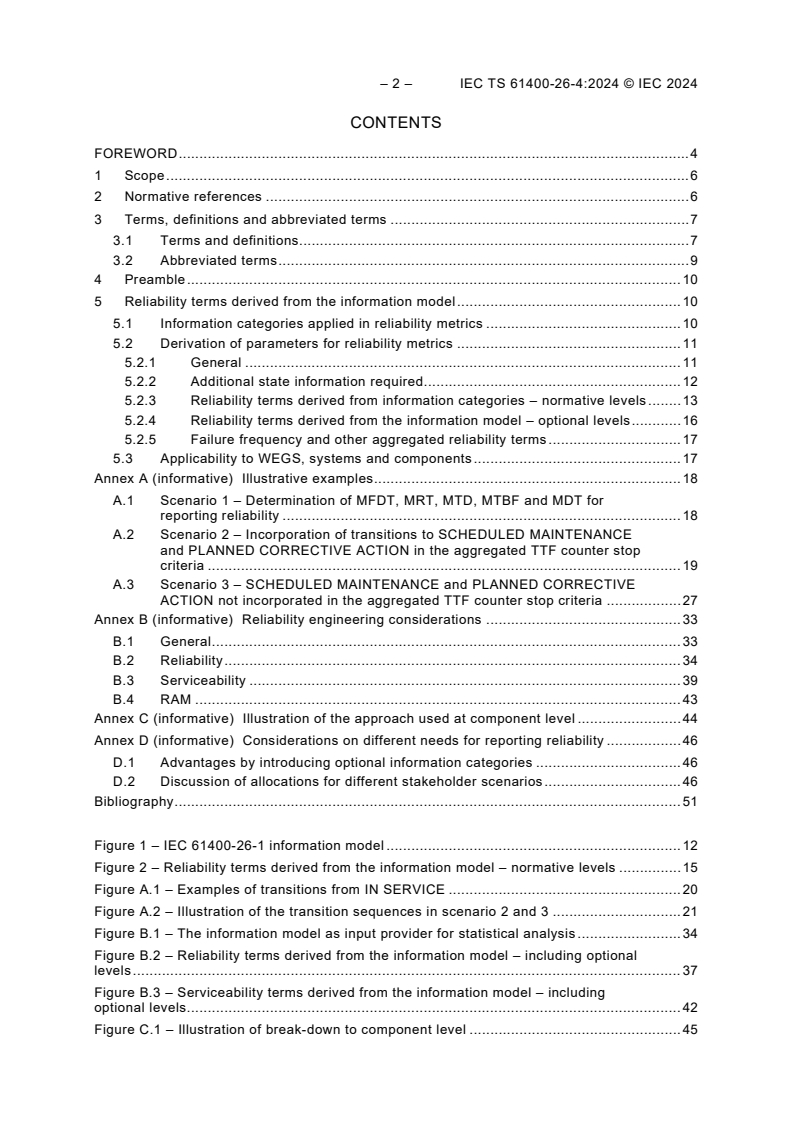
– 2 – IEC TS 61400-26-4:2024 © IEC 2024
CONTENTS
FOREWORD . 4
1 Scope . 6
2 Normative references . 6
3 Terms, definitions and abbreviated terms . 7
3.1 Terms and definitions. 7
3.2 Abbreviated terms . 9
4 Preamble . 10
5 Reliability terms derived from the information model . 10
5.1 Information categories applied in reliability metrics . 10
5.2 Derivation of parameters for reliability metrics . 11
5.2.1 General . 11
5.2.2 Additional state information required . 12
5.2.3 Reliability terms derived from information categories – normative levels . 13
5.2.4 Reliability terms derived from the information model – optional levels . 16
5.2.5 Failure frequency and other aggregated reliability terms . 17
5.3 Applicability to WEGS, systems and components . 17
Annex A (informative) Illustrative examples. 18
A.1 Scenario 1 – Determination of MFDT, MRT, MTD, MTBF and MDT for
reporting reliability . 18
A.2 Scenario 2 – Incorporation of transitions to SCHEDULED MAINTENANCE
and PLANNED CORRECTIVE ACTION in the aggregated TTF counter stop
criteria . 19
A.3 Scenario 3 – SCHEDULED MAINTENANCE and PLANNED CORRECTIVE
ACTION not incorporated in the aggregated TTF counter stop criteria . 27
Annex B (informative) Reliability engineering considerations . 33
B.1 General . 33
B.2 Reliability . 34
B.3 Serviceability . 39
B.4 RAM . 43
Annex C (informative) Illustration of the approach used at component level . 44
Annex D (informative) Considerations on different needs for reporting reliability . 46
D.1 Advantages by introducing optional information categories . 46
D.2 Discussion of allocations for different stakeholder scenarios . 46
Bibliography . 51
Figure 1 – IEC 61400-26-1 information model . 12
Figure 2 – Reliability terms derived from the information model – normative levels . 15
Figure A.1 – Examples of transitions from IN SERVICE . 20
Figure A.2 – Illustration of the transition sequences in scenario 2 and 3 . 21
Figure B.1 – The information model as input provider for statistical analysis . 34
Figure B.2 – Reliability terms derived from the information model – including optional
levels . 37
Figure B.3 – Serviceability terms derived from the information model – including
optional levels . 42
Figure C.1 – Illustration of break-down to component level . 45
Figure D.1 – Example of system approach only considering OPERATIVE (IAO), NON-
OPERATIVE (IANO) and FORCE MAJEURE (IAFM) . 46
Figure D.2 – Example of a system approach leaving a mandatory category (IAOSPP) in
ambiguity . 47
Figure D.3 – Example of system approach only considering FORCED OUTAGE
(IANOFO and SUSPENDED (IANOS) as downtime . 48
Figure D.4 – Example of system approach defining only active production situations to
be 'system up-time', apart from requested shutdowns – to avoid ambiguity with the
definitions for mandatory levels, introduction of level 5 is advised . 49
Figure D.5 – Example of system approach defining only FULL PERFORMANCE
situations to be 'system up-time' – to avoid ambiguity with the definitions for mandatory
levels, introduction of level 5 is advised . 49
Figure D.6 – Example of system approach defining only FORCED OUTAGE,
SUSPENDED and FORCE MAJEURE situations to be 'system down-time' . 50
Table A.1 – Registration of FDT, RT, TD, TBF and DT . 18
Table A.2 – Scenario 2 . 22
Table A.3 – Scenario 3 . 28
– 4 – IEC TS 61400-26-4:2024 © IEC 2024
INTERNATIONAL ELECTROTECHNICAL COMMISSION
____________
WIND ENERGY GENERATION SYSTEMS –
Part 26-4: Reliability for wind energy generation systems
FOREWORD
1) The International Electrotechnical Commission (IEC) is a worldwide organization for standardization comprising
all national electrotechnical committees (IEC National Committees). The object of IEC is to promote international
co-operation on all questions concerning standardization in the electrical and electronic fields. To this end and
in addition to other activities, IEC publishes International Standards, Technical Specifications, Technical Reports,
Publicly Available Specifications (PAS) and Guides (hereafter referred to as “IEC Publication(s)”). Their
preparation is entrusted to technical committees; any IEC National Committee interested in the subject dealt with
may participate in this preparatory work. International, governmental and non-governmental organizations liaising
with the IEC also participate in this preparation. IEC collaborates closely with the International Organization for
Standardization (ISO) in accordance with conditions determined by agreement between the two organizations.
2) The formal decisions or agreements of IEC on technical matters express, as nearly as possible, an international
consensus of opinion on the relevant subjects since each technical committee has representation from all
interested IEC National Committees.
3) IEC Publications have the form of recommendations for international use and are accepted by IEC National
Committees in that sense. While all reasonable efforts are made to ensure that the technical content of IEC
Publications is accurate, IEC cannot be held responsible for the way in which they are used or for any
misinterpretation by any end user.
4) In order to promote international uniformity, IEC National Committees undertake to apply IEC Publications
transparently to the maximum extent possible in their national and regional publications. Any divergence between
any IEC Publication and the corresponding national or regional publication shall be clearly indicated in the latter.
5) IEC itself does not provide any attestation of conformity. Independent certification bodies provide conformity
assessment services and, in some areas, access to IEC marks of conformity. IEC is not responsible for any
services carried out by independent certification bodies.
6) All users should ensure that they have the latest edition of this publication.
7) No liability shall attach to IEC or its directors, employees, servants or agents including individual experts and
members of its technical committees and IEC National Committees for any personal injury, property damage or
other damage of any nature whatsoever, whether direct or indirect, or for costs (including legal fees) and
expenses arising out of the publication, use of, or reliance upon, this IEC Publication or any other IEC
Publications.
8) Attention is drawn to the Normative references cited in this publication. Use of the referenced publications is
indispensable for the correct application of this publication.
9) IEC draws attention to the possibility that the implementation of this document may involve the use of (a)
patent(s). IEC takes no position concerning the evidence, validity or applicability of any claimed patent rights in
respect thereof. As of the date of publication of this document, IEC had not received notice of (a) patent(s), which
may be required to implement this document. However, implementers are cautioned that this may not represent
the latest information, which may be obtained from the patent database available at https://patents.iec.ch. IEC
shall not be held responsible for identifying any or all such patent rights.
IEC TS 61400-26-4 has been prepared by IEC technical committee 88: Wind energy generation
systems. It is a Technical Specification.
Throughout this document, mandatory information categories as defined in IEC 61400-26-1 are
written in capital letters (e.g. FULL PERFORMANCE, OUT OF ENVIRONMENTAL
SPECIFICATION).
The text of this Technical Specification is based on the following documents:
Draft Report on voting
88/954/DTS 88/1024/RVDTS
Full information on the voting for its approval can be found in the report on voting indicated in
the above table.
The language used for the development of this Technical Specification is English.
This document was drafted in accordance with ISO/IEC Directives, Part 2, and developed in
accordance with ISO/IEC Directives, Part 1 and ISO/IEC Directives, IEC Supplement, available
at www.iec.ch/members_experts/refdocs. The main document types developed by IEC are
described in greater detail at www.iec.ch/publications.
A list of all parts in the IEC 61400 series, published under the general title Wind energy
generation systems, can be found on the IEC website.
The committee has decided that the contents of this document will remain unchanged until the
stability date indicated on the IEC website under webstore.iec.ch in the data related to the
specific document. At this date, the document will be
• reconfirmed,
• withdrawn, or
• revised.
IMPORTANT – The "colour inside" logo on the cover page of this document indicates
that it contains colours which are considered to be useful for the correct understanding
of its contents. Users should therefore print this document using a colour printer.
– 6 – IEC TS 61400-26-4:2024 © IEC 2024
WIND ENERGY GENERATION SYSTEMS –
Part 26-4: Reliability for wind energy generation systems
1 Scope
This part of IEC 61400, which is a Technical Specification, specifies terms and information
categories for identification and reporting of reliability metrics. The definitions are applicable to
key components, any number of wind turbines, fleets of wind turbine types, a wind power station
or a portfolio of wind power stations. The wind power station is made up of all WTGSs (Wind
Turbine Generator Systems), functional services and balance of plant elements as seen from
the point of common coupling.
This document provides guidelines regarding reliability methodologies with informative annexes
regarding use.
It expands on the information model in IEC 61400-26-1, recognizing that availability and
reliability are interrelated.
It does not assign specific reliability specifications, constraints or targets but rather provides
standardized means of categorizing and prioritizing data and illustrates the use of the model
and metrics in informative annexes.
It does not specify the method of information acquisition or specific use. Beyond that, it is not
the intention of this document to specify exactly how to calculate other undefined or
performance-based reliability metrics.
2 Normative references
The following documents are referred to in the text in such a way that some or all of their content
constitutes requirements of this document. For dated references, only the edition cited applies.
For undated references, the latest edition of the referenced document (including any
amendments) applies.
IEC 61400-26-1, Wind energy generation systems – Part 26-1: Availability for wind energy
generation systems
IEC 60050-192, International Electrotechnical Vocabulary (IEV) – Part 192: Dependability
IEC 61703, Mathematical expressions for reliability, availability, maintainability and
maintenance support terms
3 Terms, definitions and abbreviated terms
3.1 Terms and definitions
For the purposes of this document, the terms and definitions given in IEC 60050-192,
IEC 61400-26-1 and the following apply.
ISO and IEC maintain terminology databases for use in standardization at the following
addresses:
• IEC Electropedia: available at https://www.electropedia.org/
• ISO Online browsing platform: available at https://www.iso.org/obp
3.1.1
failure
loss of ability to perform to specification
Note 1 to entry: EN 13306 defines failure as "termination of the ability of an item to perform a required function".
Note 2 to entry: After failure the item has a fault, which can be complete or partial.
Note 3 to entry: "failure" is an event, as distinguished from "fault", which is a state.
[SOURCE: IEC 60050-192:2015, 192-03-01, modified – Notes to entry have been changed.]
3.1.2
MACMT
mean active corrective maintenance time
expectation of the active corrective maintenance time
[SOURCE: IEC 60050-192:2015, 192-07-22]
3.1.3
MAD
mean administrative delay
expectation of the administrative delay
[SOURCE: IEC 60050-192:2015, 192-07-26]
3.1.4
downtime
expectation of the down time
[SOURCE: IEC 60050-192:2015, 192-08-10]
3.1.5
fault detection time
FDT
time interval between failure and detection of the resulting fault
[SOURCE: IEC 60050-192:2024, 192-07-11, modified – Notes and figures have been deleted]
3.1.6
MLD
mean logistic delay
expectation of the logistic delay
[SOURCE: IEC 60050-192:2015, 192-07-27]
– 8 – IEC TS 61400-26-4:2024 © IEC 2024
3.1.7
reliability
ability to perform to specification, without failure, for a given time interval, under given
conditions
Note 1 to entry: The time interval duration can be expressed in units appropriate to the item concerned, e.g., calendar
time, operating cycles, distance run, etc., and the units should always be clearly stated.
Note 2 to entry: Given conditions include aspects that affect reliability, such as: mode of operation, stress levels,
environmental conditions, and maintenance.
Note 3 to entry: Reliability can be quantified using appropriate measures, see IEC 60050-192, 192-05-05, Reliability
related concepts: measures.
Note 4 to entry: A general definition of reliability is provided in EN 13306: "ability of an item to perform a required
function under given conditions for a given time interval."
[SOURCE: IEC 60050-192:2015, 192-01-24, modified – Note 3 to entry has been changed and
Note 4 to entry has been added.]
3.1.8
repair
direct action taken to effect restoration
EXAMPLE 1: To restore equipment damaged, faulty or worn to a serviceable condition.
Note 1 to entry: IEC 60050-192 further defines several subsets of availability, e.g., "instantaneous availability"
(192-08-01), "inherent availability" (192-08-02) and "operational availability" (192-08-03).
Note 2 to entry: Repair also includes fault localization and function checkout.
[SOURCE: IEC 60050-192:2015, 192-06-14, modified – Note 1 to entry has been changed, an
example and Note 2 to entry have been added.]
3.1.9
mean repair time
MRT
expectation of the repair time
[SOURCE: IEC 60050-192:2015, 192-07-21]
3.1.10
technical delay
TD
delay incurred in performing auxiliary technical actions associated with, but not part of, the
maintenance action
EXAMPLE Rendering the equipment safe (such as immobilising, cooling, isolation and grounding).
[SOURCE: IEC 60050-192:2015, 192-07-15]
3.1.11
MTBF
mean operating time between failures
expectation of the duration of the operating time between failures
Note 1 to entry: Mean operating time between failures should only be applied to repairable items. For non-repairable
items, see mean operating time to failure (192-05-11).
[SOURCE: IEC 60050-192:2015, 192-05-13]
3.1.12
mean time to failure
MTTF
expectation of the operating time to failure
Note 1 to entry: In the case of non-repairable items with an exponential distribution of operating times to failure
(i.e. a constant failure rate) the MTTF is numerically equal to the reciprocal of the failure rate. This is also true for
repairable items if after restoration they can be considered to be "as-good-as-new".
Note 2 to entry: See also operating time to failure (192-05-01).
[SOURCE: IEC 60050-192:2015, 192-05-11]
3.1.13
mean time to restoration
MTTR
expectation of the time to restoration
Note 1 to entry: IEC 60050-191:1990 (now withdrawn; replaced by IEC 60050-192) defined the term ”mean time to
recovery” as a synonym, but restoration and recovery are not synonyms.
[SOURCE: IEC 60050-192:2015, 192-07-23]
3.1.14
MUT
mean up time
expectation of the up time
[SOURCE: IEC 60050-192:2015, 192-08-09]
3.2 Abbreviated terms
ACMT active corrective maintenance time
AD administrative delay
DT down time
FDT fault detection time
IA INFORMATION AVAILABLE
IANO NON-OPERATIVE
IAFM FORCE MAJEURE
IAO OPERATIVE
IANOFO FORCED OUTAGE
IANOPCA PLANNED CORRECTIVE ACTION
IANOS SUSPENDED
IANOSM SCHEDULED MAINTENANCE
IAOOS OUT OF SERVICE
IAOOSEN OUT OF ENVIRONMENTAL SPECIFICATION
IAOOSTS TECHNICAL STANDBY
IAOS IN SERVICE
IAOSFP FULL PERFORMANCE
IAOSPP PARTIAL PERFORMANCE
IAOSRS READY STANDBY
IAOOSEL OUT OF ELECTRICAL SPECIFICATION
– 10 – IEC TS 61400-26-4:2024 © IEC 2024
IAOOSRS REQUESTED SHUTDOWN
LD logistic delay
MACMT mean active corrective maintenance time
MAD mean administrative delay
MDT mean down time
MFDT mean fault detection time
MLD mean logistic delay
MRT mean repair time
MTBF mean operating time between failures
MTD mean technical delay
MTTF mean operating time to failure
MTTR mean time to restoration
MUT mean up time
RT repair time
TBF time between failures
TD technical delay
TTF time to failure
TTR time to restoration
UT up time
WEGS wind energy generation system
WTGS wind turbine generator system
4 Preamble
The key aspect of this document is that a reliability interpretation of the information model
specified in IEC 61400-26-1 is achieved by creating counters, one for each information category
at each mandatory level, optionally expanded with level 5 and level 6 categories.
These accumulated figures are in the present document used as the basis for data needed for
deriving reliability metrics for a WEGS.
The methodology illustrated is made only on the time-based modelling specified in
IEC 61400-26-1. A production-based approach is generally not implementable as standardised
reliability terms and definitions applicable to the production-based model are not developed.
5 Reliability terms derived from the information model
5.1 Information categories applied in reliability metrics
Each level of the information model defined in IEC 61400-26-1 (see Figure 1) represents
mutually exclusive and collectively exhaustive states for a WEGS. The information model can
be regarded as a collection of state-transition machines; for each column/level, there are
several operational states as each information category represents one state.
The WEGS can be only in one state at each level. At level 1, the WEGS can be only in IA or IU.
At level 2, the WEGS can be only in IAO, IANO, IAFM or IU. The same principle applies to level
3 and 4. The prioritization of the information categories defined in IEC 61400-26-1 shall apply
to the state machine approach too. The logic shall also apply to implementations with optional
levels (illustrated in Figure 1 with level 5 added).
EXAMPLE 1: A WEGS experiences a situation at PARTIAL PERFORMANCE and a transition to OUT OF
ENVIRONMENTAL SPECIFICATION is made. At level 3, the WEGS will transition from IN SERVICE to OUT OF
SERVICE, but at levels 1 and 2 no change takes place.
EXAMPLE 2: A WEGS experiences a situation at FULL PERFORMANCE where a technical fault is detected by the
turbine controller. At level 4, a transition to FORCED OUTAGE is made. At level 3, the WEGS will transition from IN
SERVICE to FORCED OUTAGE, and at level 2, a transition from OPERATIVE to NON-OPERATIVE is made, but at
level 1 no change takes place; IA remains.
5.2 Derivation of parameters for reliability metrics
5.2.1 General
IEC 61400-26-1 requires that the actual state of all mandatory levels is determined, meaning
that even though level 4 defines the more detailed information, the preceding (upper) levels
shall also be determined and documented. These upper states are used for the derivation of
parameters for reliability metrics.
– 12 – IEC TS 61400-26-4:2024 © IEC 2024
Figure 1 – IEC 61400-26-1 information model
5.2.2 Additional state information required
To derive reliability metrics, it is necessary to obtain a further granularity than that provided by
the counters defined in IEC 61400-26-1 giving only aggregated numbers for a full given period.
For each unbroken period, when the state at a given level has been constant, it is necessary to
know the duration, the preceding state, and the succeeding state. To provide a basis for more
complex analyses (e.g., dependency on time-of-day, day-of-week, etc,), information about the
duration of a period shall be completed with timestamps for the start and end of said period.
Data to be collected for each level in the information model consists of a set of data points that
each describe an uninterrupted period when the state did not change. The set of data points
shall include the following elements:
• information category level number,
• designation of state,
• timestamp for entry to state,
• designation of preceding state,
• timestamp for exit from state,
• designation of succeeding state,
• duration of state,
• number of events (within a specified period of time).
The set of data points shall make account for all time and all state changes for each level in the
period being analysed.
The specification of level is required because it cannot unambiguously be deducted from the
category names. For example, a transition from IANOFO to IANOS could be at either level 3 or
level 4.
5.2.3 Reliability terms derived from information categories – normative levels
Some of the time counters for the operational information categories defined by
IEC 61400-26-1 can directly be associated with commonly used reliability metrics.
Supplementing with event counters for each state, even more reliability metrics can be derived.
With the addition of the set of data points specified in this document, many of the commonly
used reliability metrics can be derived.
Using the terminology developed in IEC 61703 and IEC 60050-192, the parameters below can
be derived.
From the mandatory information categories (see Figure 1):
• DT and MDT, downtime, is derived directly from counting time and number of events in
NON-OPERATIVE (level 2).
• UT and MUT, uptime, is derived directly from counting time and number of events in
OPERATIVE (level 2).
• TBF and MTBF, time between failure, is derived from counting time between occurrences
and number of events in FORCED OUTAGE.
• TTR and MTTR, time to restoration, is derived directly as the combination of time spent and
number of events in FORCED OUTAGE + SUSPENDED (levels 3 and 4).
• TTF and MTTF, time to failure, is derived from a subset counter, and derived from time
spent in OPERATIVE, provided that the state transition is to FORCED OUTAGE.
NOTE DT is the individually measured/counted 'downtime' of the item. MDT is the mean value that can be calculated
based on additional data from the event counter.
UT is the individually measured/counted 'uptime' of the item. MUT is the mean value that can be calculated based
on additional data from the event counter. (MUT + MDT do not add-up to the total time as FORCE MAJEURE and
INFORMATION UNAVAILABLE are not included).
TBF is the individually measured/counted time elapsing between two consecutive failures (not necessarily the same
failures). MTBF is the mean value of TBFs.
TTR is the individually measured/counted total time 'spent' on restoring the item in case of an incident. MTTR is the
mean value. According to IEC 61703, MTTR can be considered the sum of MFDT + MAD + MLD + MACMT, but this
requires involvement of optional categories (see 5.2.4).
– 14 – IEC TS 61400-26-4:2024 © IEC 2024
TTF is the individually measured/counted time to fail. MTTF is the mean time to fail.
Users shall decide on how to incorporate transitions to SCHEDULED MAINTENANCE and
PLANNED CORRECTIVE ACTION. Users shall choose between adding one or both state
transitions to the counter stop criteria or leaving them out. Similarly, users shall decide on how
FORCE MAJEURE shall be used for reliability metrics. Some of these aspects are discussed in
Annex D.
Figure 2 illustrates from what information categories reliability terms can be derived directly.
The 'arrow' in each cell points to what reliability parameters can be derived when the data point
and the specified approach is applied. Not all information categories hold information that
directly associates with commonly used reliability terms (the white- and orange-colored cells).
It is however not ruled out, that these information categories can contribute to specific reliability
studies.
The cell marked green in Figure 2 indicates the 'uptime state'. The red colored cells indicate
the non-operative states providing the immediate downtime parameters associated with failures
and repair.
Key
white-coloured states not used in reliability terms
orange-coloured states not used in reliability terms
green-coloured states commonly used in reliability terms
red-coloured states commonly used in reliability terms
Figure 2 – Reliability terms derived from the information model – normative levels
– 16 – IEC TS 61400-26-4:2024 © IEC 2024
Annex A (informative) sets up three scenarios to illustrate the methodology introduced in this
document.
1) a simple scenario for illustration of an immediate derivation of some reliability parameters
based on the approach presented above,
2) an example on how to consider SCHEDULED MAINTENANCE and PLANNED
CORRECTIVE ACTION in the stop criteria, and
3) a scenario with an example on how to leave out SCHEDULED MAINTENANCE and
PLANNED CORRECTIVE ACTION stop criteria.
Annex B (informative) illustrates some aspects to consider when implementing counter data for
normative and optional information categories. Annex B also introduces commonly used
reliability engineering terms and a brief discussion on application of these terms. Annex C
illustrates the methodology for assessing reliability parameters at system and component level.
Annex D further addresses considerations when deciding on how to implement information
category data and to what level information will be needed for a proper implementation.
5.2.4 Reliability terms derived from the information model – optional levels
When one or more optional levels are introduced, further reliability metrics can be derived.
Again, introducing the terminology developed in IEC 61703 and IEC 60050-192, the parameters
listed below are examples of optional reliability parameters derived from the optional
information categories. For more information on these optional information categories, refer to
IEC 61400-26-1.
• AD and MAD, administrative delay, this is not defined in IEC 61400-26-1 but is a possible
level 5 or 6 category (not normative). AD could be considered as a component of response.
AD could also be considered a component of one or all three categories suspended
scheduled maintenance, suspended planned corrective action and suspended forced outage
(all non-normative), all representing break-down components of SUSPENDED.
• LD and MLD, logistic delay, correspond with the optional category logistic, a break-down
component of FORCED OUTAGE (not normative). LD could also be considered a
component of one or all three categories suspended scheduled maintenance, suspended
planned corrective action and suspended forced outage (all non-normative).
• RT and MRT, repair time, correspond with the optional category failure repair, a break-down
component of FORCED OUTAGE (non-normative).
• TD and MTD, technical delay, correspond with the optional category diagnostic, a break-
down component of FORCED OUTAGE (non-normative).
• ACMT and MACMT, active corrective maintenance time, this is not defined in
IEC 61400-26-1 but can be derived as the sum of MTD+MRT.
• FDT and MFDT, fault detection time, can be interpreted as a component of the optional
category response, a break-down component of FORCED OUTAGE (non-normative).
NOTE AD is an individually measured/counted administrative delay during the restoration time for a faulty item.
MAD is the mean value.
LD is an individually measured/counted logistic delay taking place before repairs during the individual incident. MLD
is the mean delay time.
RT is the individually measured/counted time spent performing repairs during the individual incident. MRT is the
(expected) mean repair time.
TD is an individually measured/counted technical (planning) delay taking place before repairs during the individual
incident. MTD is the mean delay time.
Users shall decide and agree on how to incorporate counters and/or timestamps based on the
optional information categories and for what reliability parameters – if at all. Users shall identify
the optional information categories that will form the basis of the respective reliability terms,
and the start and stop criteria that are to be applied.
IEC 60050-192 defines a wide range of parameters (not just the ones listed above) that users
can consider for implementation. Users shall keep in mind that counters for these parameters
always shall be implementable and that these counters also shall be defined as (new) optional
information categories items at level 5 or level 6.
5.2.5 Failure frequency and other aggregated reliability terms
When the data points introduced in 5.2.2 are implemented, frequencies of various parameters
can be calculated as required. The failure frequency, for example, can be calculated from
counting the number of times the item enters the FORCED OUTAGE state (based on the event
counter).
Other calculations such as minimum, maximum. variance, standard deviation, etc. (depending
on probability distribution) can be made. Requirement of methods is not within the scope of this
document.
NOTE In this context, frequency of failure or failure intensity is understood as the number of times that an item fails
during a specified period.
5.3 Applicability to WEGS, systems and components
In full compliance with IEC 61400-26-1, the above directions can be applied to a WEGS in the
sense that "…the document can be used for a single wind turbine (WTGS), as well as for any
number of WEGSs combined with additional components to represent a complete wind power
station (WPS)."
Moreover, the information model can be expanded to apply at either system or component
levels. If a WEGS is seen as consisting of several systems and components, individual 'sheets'
of the information model can be assigned to any number of systems and components. In this
case, the methodologies of IEC 61400-26-1 and this document shall also be applied. Annex C
(informative) illustrates an example of assessment principles for reliability parameters at system
and component level.
– 18 – IEC TS 61400-26-4:2024 © IEC 2024
Annex A
(informative)
Illustrative examples
A.1 Scenario 1 – Determination of MFDT, MRT, MTD, MTBF and MDT for
reporting reliability
This example illustrates registration of reliability parameters in an operational (fictitious)
sequence for a cluster of two wind turbines.
Case: failures of the pitch motors at two different wind turbines is experienced five times in
total. The report in Table A.1 is made in accordance with the approach set out in 5.2. The
example illustrates recording of MTBF and MTTR for the pitch motors and illustrates a
discarding of data in the process of determining MTBF when no data on this parameter is
recorded at these instances (first two incidents).
Table A.1 – Registration of FDT, RT, TD, TBF and DT
WTGS FORCED OUTAGE – Response / FORCED OUTAGE – Diagnostic Reliability analysis
Repair (level 5) (level 5)
#1 Response (FDT): Diagnostics (TD): Time since occurrence of the last
failure: n/a
Start: 20xx-01-10 02:15 Start: 20xx-01-10 09:00
FDT: 6h45
End: 20xx-01-10 09:00 (6h45) End: 20xx-01-10 11:45 (2h45)
RT: 03h30
Repair (RT):
TD: 2h45
Start: 20xx-01-10 11:45
TBF: n/a
End: 20xx-01-10 15:15 (3h30)
DT: 13h00
Total: 10h15
#1 Response (FDT): Diagnostics (TD): Time since occurrence of the last
failure: 722h30
Start: 20xx-02-08 04:45 Start: 20xx-02-08 10:15
FDT: 5h30
End: 20xx-02-08 10:15 (5h30) End: 20xx-02-08 11:00 (0h45)
RT: 03h45
Repair (RT):
TD: 0h45
Start: 20xx-02-08 11:00
TBF: 722h30
End: 20xx-02-08 14:45 (3h45)
DT: 10h00
Total: 9h15
#1 Response (FDT): Diagnostics (TD): Time since occurrence of the last
failure: 720h45
Start: 20xx-03-10 05:30 Start: 20xx-03-10 09:00
FDT: 3h30
End: 20xx-03-10 09:00 (3h30) End: 20xx-03-10 09:30 (0h30)
RT: 03h00
Repair (RT):
TD: 0h30
Start: 20xx-03-10 09:30
TBF: 720h45
End: 20xx-03-10 12:30 (03h00)
DT: 7h00
Total: 6h30
#1 Average (mean values) of MFDT: 5h15
parameters for the three events
MRT: 3h25
on WTGS #1
MTD: 1h20
MTBF: 721h38
MDT: 10h00
WTGS FORCED OUTAGE – Response / FORCED OUTAGE – Diagnostic Reliability analysis
Repair (level 5) (level 5)
#2 Response (FDT): Diagnostics (TD): Time since occurrence of the last
failure: n/a
Start: 20xx-01-10 02:45 Start: 20xx-01-10 09:00
FDT: 5h45
End: 20xx-01-10 09:00 (5h45) End: 20xx-01-11 08:00 (23h00)
RT: 03h15
Repair (RT):
TD: 23h00
Start: 20xx-01-11 08:00
TBF: n/a
End: 20xx-01-11 11:15 (3h15)
DT: 32h00
Total: 9h00
#2 Response (FDT): Diagnostics (TD): Time since occurrence of the last
failure: 792h45
Start: 20xx-02-08 03:30 Start: 20xx-02-08 10:15
FDT: 6h45
End: 20xx-02-08 10:15 (6h45) End: 20xx-02-08 11:00 (0h45)
RT: 3h45
Repair (RT):
TD: 0h45
Start: 20xx-02-08 11:00
TBF: 792h45
End: 20xx-02-08 14:45 (3h45)
DT: 11h15
Total: 10h30
#2 Average (mean values) of MFDT: 6h15
parameters for the two events on
MRT: 3h30
WTGS #2
MTD: 11h53
MTBF: 792h45
MDT: 21h38
A.2 Scenario 2 – Incorporation of transitions to SCHEDULED MAINTENANCE
and PLANNED CORRECTIVE ACTION in the aggregated TTF counter stop
criteria
When an operative WEGS (in OPERATIVE) moves to either a fault state (FORCED OUTAGE),
scheduled maintenance is being performed (SCHEDULED MAINTENANCE) or transitions to a
different state for some other reason (see Figure A.1), the cause is relevant for the reliability
assessment.
Scenarios 2 and 3 illustrate the importance of having predefined the implication of incorporating
SCHEDULED MAINTENANCE and PLANNED CORRECTIVE ACTION in the aggregated TTF
counter 'stop criteria'. Scenario 2 is an example on how counters can be used when
incorporating these two information categories in the stop criteria; scenario 3 illustrates an
example where the two information categories are NOT considered in the stop criteria.
The two scenarios are studied for the service "active energy" introduced in IEC 61400-26-1.
The assumption in scenario 2 is that scheduled maintenance and planned corrective actions
are assumed to be an "unreliable situation". For scenario 3, however, activities for scheduled
maintenance and for planned corrective actions do not constitute an "unreliable situation" for
the active production service (taking place in situations when no active production is possible
anyway). This is illustrated by the difference in the accounting of the FTT in the two scenarios.
Scenario 2: a WTGS transitions from an operational state (information category) in FULL
PERFORMANCE through PARTIAL PERFORMANCE, OUT OF ENVIRONMENTAL
SPECIFICATION to one of three situations (1a): SCHEDULED MAINTENANCE, (1b):
PLANNED CORRECTIVE ACTION or (1c): FORCED OUTAGE. For (1c), a further step into
SUSPENDED is experienced. All situations (1a), (1b) and (1c) end by the WTGS returning to
FULL PERFORMANCE, see Figure A.2.
– 20 – IEC TS 61400-26-4:2024 © IEC 2024
Figure A.1 – Examples of transitions from IN SERVICE
The operational sequences and relevant counters for all three situations, 1a, 1b and 1c, are
illustrated in Table A.2. The table also illustrates relevant reliability parameters derived in
accordance with the approach in Clause 5. For simplicity, timestamps at entry and exits of
states/categories are not illustrated but could just as well be used as basis for the recordings
illustrated.
Key
orange-coloured states non-operative states
green-coloured states 'uptime states'
red-coloured states non-operative states
yellow-marked state contributes with a counter to the example
Figure A.2 – Illustration of the transition sequences in scenario 2 and 3
Figure A.2 illustrates transition sequences in scenarios 2 and 3. The cells marked green
indicate the 'uptime states'. The red- and orange-colored cells indicate the non-operative states.
The yellow-marked cell contributes with a counter as illustrated in the scenario example.
– 22 – IEC TS 61400-26-4:2024 © IEC 2024
Table A.2 – Scenario 2
Event Transition Time 'Present DT UT TTR TTF RT (optional) TD (optional) FDT
category' (optional)
The WTGS FULL Day X, 09:00 Counter for Counter for Counter for Counters for The Counter for Counter for Counter for
has been PERFORMAN IAOSPP starts IANO is IAO is IANOFO and 'aggregated IANOFO IANOFO IANOFO
F D R
producing at CE to unaffected unaffected IANOS are counter for (failure repair) (diagnostic) is (response) is
full rating for (not counting) (keeps unaffected TTF' keeps
...