

IEC 60601-2-29:2008
(Main)Medical electrical equipment - Part 2-29: Particular requirements for the basic safety and essential performance of radiotherapy simulators
General Information
- Abstract
IEC 60601-2-29:2008 establishes requirements to be complied with by manufacturers in the design and construction of radiotherapy simulators; it does not attempt to define their optimum performance requirements. Its purpose is to identify those features of design that are regarded, at the present time, as essential for the safe operation of such medical electrical equipment. It places limits on the degradation of medical electrical equipment performance beyond which it can be presumed that a fault condition exists, for example a component failure, and where an interlock then operates to prevent continued operation of the medical electrical equipment. This third edition cancels and replaces the second edition published in 1999. This edition constitutes a technical revision, which brings this standard in line with the third edition of IEC 60601-1 and its collateral standards.
- Status
- Published
- Publication Date
- 10-Jun-2008
- Drafting Committee
- WG 1 - TC 62/SC 62C/WG 1
- Current Stage
- PPUB - Publication issued
- Start Date
- 11-Jun-2008
- Completion Date
- 31-Aug-2008
Overview
IEC 60601-2-29:2008 is an international standard published by the International Electrotechnical Commission (IEC) that specifies the particular requirements for the basic safety and essential performance of radiotherapy simulators. These medical electrical devices are used in clinical settings to simulate the geometry and radiation fields of actual radiotherapy equipment, supporting precise planning for patient treatments. This standard ensures that radiotherapy simulators are designed and constructed with critical safety features, establishing performance limits to prevent hazardous situations due to equipment faults or component failures.
Key Topics
- Basic Safety and Essential Performance: The standard outlines essential design features and performance requirements that must be maintained during operation. This includes safeguards against electrical and mechanical hazards, as well as unintended or excessive radiation exposure.
- Interlock Systems: IEC 60601-2-29 requires that interlocks automatically prevent unsafe operation if a fault is detected, such as performance degradation that might indicate a component failure.
- Marking and Documentation: The standard mandates clear identification, labeling, and technical documentation for all radiotherapy simulators, including specifics for moving parts, indicator light colors, and user instructions.
- Movement and Control Accuracy: Specific requirements govern the control and accuracy of equipment movements (such as gantry, patient support, and beam-limiting systems), speed of motion, and safe positioning to minimize patient risk.
- Instructions for Use & Maintenance: Manufacturers must provide comprehensive instructions covering the function and testing of safety devices and interlocks, recommended maintenance, and inspection schedules related to radiation exposure and environmental conditions.
- Electrical Protection: There are explicit requirements for protective earth conductors, earth leakage current limits, and continued safety in the event of power supply failures.
- Alignment with General and Collateral Standards: The document builds on IEC 60601-1 (general requirements for medical electrical equipment) and references relevant terminology and measurement conventions.
Applications
Radiotherapy simulators are critical in the healthcare sector, particularly in oncology and radiation therapy. Practical applications of IEC 60601-2-29:2008 include:
- Device Manufacturing: Ensuring that radiotherapy simulator designers and manufacturers meet international safety and performance benchmarks, thus supporting market access and regulatory compliance.
- Healthcare Facilities: Hospitals and radiotherapy clinics rely on compliance with this standard to safely prepare and plan treatment regimens, reducing the risk to patients and healthcare workers.
- Quality Assurance & Inspection: The standard provides the framework for performance testing, equipment verification, and maintenance protocols needed to uphold consistent, reliable operation.
- Procurement and Tendering: Purchasing departments use IEC 60601-2-29 compliance as a procurement requirement, ensuring that acquired equipment meets recognized safety and reliability standards.
Related Standards
- IEC 60601-1: Medical electrical equipment - Part 1: General requirements for basic safety and essential performance
- IEC TR 60788: Medical electrical equipment - Glossary of defined terms, providing harmonized terminology used within IEC standards
- IEC 61217: Radiotherapy equipment - Coordinates, movements, and scales, detailing the conventions for device measurement and movement
- Other 60601-2-x Parts: Covering particular safety requirements for various medical electrical equipment categories
By following IEC 60601-2-29:2008, manufacturers and healthcare providers can ensure the safe, accurate operation of radiotherapy simulators, support quality patient care, and meet international regulatory demands in medical device safety.
Relations
- Effective Date
- 05-Sep-2023
Get Certified
Connect with accredited certification bodies for this standard

BSI Group
BSI (British Standards Institution) is the business standards company that helps organizations make excellence a habit.

TÜV Rheinland
TÜV Rheinland is a leading international provider of technical services.

TÜV SÜD
TÜV SÜD is a trusted partner of choice for safety, security and sustainability solutions.
Sponsored listings
Frequently Asked Questions
IEC 60601-2-29:2008 is a standard published by the International Electrotechnical Commission (IEC). Its full title is "Medical electrical equipment - Part 2-29: Particular requirements for the basic safety and essential performance of radiotherapy simulators". This standard covers: IEC 60601-2-29:2008 establishes requirements to be complied with by manufacturers in the design and construction of radiotherapy simulators; it does not attempt to define their optimum performance requirements. Its purpose is to identify those features of design that are regarded, at the present time, as essential for the safe operation of such medical electrical equipment. It places limits on the degradation of medical electrical equipment performance beyond which it can be presumed that a fault condition exists, for example a component failure, and where an interlock then operates to prevent continued operation of the medical electrical equipment. This third edition cancels and replaces the second edition published in 1999. This edition constitutes a technical revision, which brings this standard in line with the third edition of IEC 60601-1 and its collateral standards.
IEC 60601-2-29:2008 establishes requirements to be complied with by manufacturers in the design and construction of radiotherapy simulators; it does not attempt to define their optimum performance requirements. Its purpose is to identify those features of design that are regarded, at the present time, as essential for the safe operation of such medical electrical equipment. It places limits on the degradation of medical electrical equipment performance beyond which it can be presumed that a fault condition exists, for example a component failure, and where an interlock then operates to prevent continued operation of the medical electrical equipment. This third edition cancels and replaces the second edition published in 1999. This edition constitutes a technical revision, which brings this standard in line with the third edition of IEC 60601-1 and its collateral standards.
IEC 60601-2-29:2008 is classified under the following ICS (International Classification for Standards) categories: 11.040.60 - Therapy equipment. The ICS classification helps identify the subject area and facilitates finding related standards.
IEC 60601-2-29:2008 has the following relationships with other standards: It is inter standard links to IEC 60601-2-29:1999. Understanding these relationships helps ensure you are using the most current and applicable version of the standard.
IEC 60601-2-29:2008 is available in PDF format for immediate download after purchase. The document can be added to your cart and obtained through the secure checkout process. Digital delivery ensures instant access to the complete standard document.
Standards Content (Sample)
IEC 60601-2-29
Edition 3.0 2008-06
INTERNATIONAL
STANDARD
NORME
INTERNATIONALE
Medical electrical equipment –
Part 2-29: Particular requirements for the basic safety and essential performance
of radiotherapy simulators
Appareils électromédicaux –
Partie 2-29: Exigences particulières pour la sécurité de base et les performances
essentielles des simulateurs de radiothérapie
All rights reserved. Unless otherwise specified, no part of this publication may be reproduced or utilized in any form or by
any means, electronic or mechanical, including photocopying and microfilm, without permission in writing from either IEC or
IEC's member National Committee in the country of the requester.
If you have any questions about IEC copyright or have an enquiry about obtaining additional rights to this publication,
please contact the address below or your local IEC member National Committee for further information.
Droits de reproduction réservés. Sauf indication contraire, aucune partie de cette publication ne peut être reproduite
ni utilisée sous quelque forme que ce soit et par aucun procédé, électronique ou mécanique, y compris la photocopie
et les microfilms, sans l'accord écrit de la CEI ou du Comité national de la CEI du pays du demandeur.
Si vous avez des questions sur le copyright de la CEI ou si vous désirez obtenir des droits supplémentaires sur cette
publication, utilisez les coordonnées ci-après ou contactez le Comité national de la CEI de votre pays de résidence.
IEC Central Office
3, rue de Varembé
CH-1211 Geneva 20
Switzerland
Email: inmail@iec.ch
Web: www.iec.ch
About the IEC
The International Electrotechnical Commission (IEC) is the leading global organization that prepares and publishes
International Standards for all electrical, electronic and related technologies.
About IEC publications
The technical content of IEC publications is kept under constant review by the IEC. Please make sure that you have the
latest edition, a corrigenda or an amendment might have been published.
ƒ Catalogue of IEC publications: www.iec.ch/searchpub
The IEC on-line Catalogue enables you to search by a variety of criteria (reference number, text, technical committee,…).
It also gives information on projects, withdrawn and replaced publications.
ƒ IEC Just Published: www.iec.ch/online_news/justpub
Stay up to date on all new IEC publications. Just Published details twice a month all new publications released. Available
on-line and also by email.
ƒ Electropedia: www.electropedia.org
The world's leading online dictionary of electronic and electrical terms containing more than 20 000 terms and definitions
in English and French, with equivalent terms in additional languages. Also known as the International Electrotechnical
Vocabulary online.
ƒ Customer Service Centre: www.iec.ch/webstore/custserv
If you wish to give us your feedback on this publication or need further assistance, please visit the Customer Service
Centre FAQ or contact us:
Email: csc@iec.ch
Tel.: +41 22 919 02 11
Fax: +41 22 919 03 00
A propos de la CEI
La Commission Electrotechnique Internationale (CEI) est la première organisation mondiale qui élabore et publie des
normes internationales pour tout ce qui a trait à l'électricité, à l'électronique et aux technologies apparentées.
A propos des publications CEI
Le contenu technique des publications de la CEI est constamment revu. Veuillez vous assurer que vous possédez
l’édition la plus récente, un corrigendum ou amendement peut avoir été publié.
ƒ Catalogue des publications de la CEI: www.iec.ch/searchpub/cur_fut-f.htm
Le Catalogue en-ligne de la CEI vous permet d’effectuer des recherches en utilisant différents critères (numéro de référence,
texte, comité d’études,…). Il donne aussi des informations sur les projets et les publications retirées ou remplacées.
ƒ Just Published CEI: www.iec.ch/online_news/justpub
Restez informé sur les nouvelles publications de la CEI. Just Published détaille deux fois par mois les nouvelles
publications parues. Disponible en-ligne et aussi par email.
ƒ Electropedia: www.electropedia.org
Le premier dictionnaire en ligne au monde de termes électroniques et électriques. Il contient plus de 20 000 termes et
définitions en anglais et en français, ainsi que les termes équivalents dans les langues additionnelles. Egalement appelé
Vocabulaire Electrotechnique International en ligne.
ƒ Service Clients: www.iec.ch/webstore/custserv/custserv_entry-f.htm
Si vous désirez nous donner des commentaires sur cette publication ou si vous avez des questions, visitez le FAQ du
Service clients ou contactez-nous:
Email: csc@iec.ch
Tél.: +41 22 919 02 11
Fax: +41 22 919 03 00
IEC 60601-2-29
Edition 3.0 2008-06
INTERNATIONAL
STANDARD
NORME
INTERNATIONALE
Medical electrical equipment –
Part 2-29: Particular requirements for the basic safety and essential performance
of radiotherapy simulators
Appareils électromédicaux –
Partie 2-29: Exigences particulières pour la sécurité de base et les performances
essentielles des simulateurs de radiothérapie
INTERNATIONAL
ELECTROTECHNICAL
COMMISSION
COMMISSION
ELECTROTECHNIQUE
PRICE CODE
INTERNATIONALE
T
CODE PRIX
ICS 11.040.60 ISBN 2-8318-9854-4
– 2 – 60601-2-29 © IEC:2008
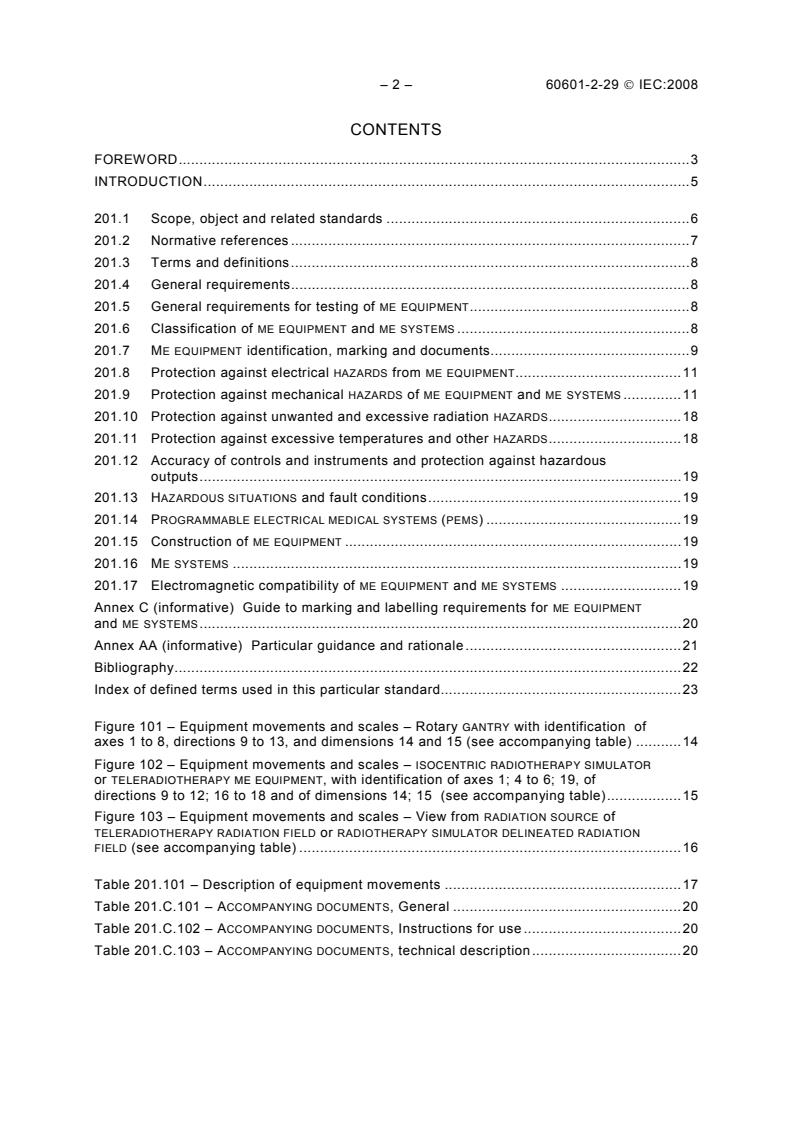
CONTENTS
FOREWORD.3
INTRODUCTION.5
201.1 Scope, object and related standards .6
201.2 Normative references.7
201.3 Terms and definitions.8
201.4 General requirements.8
201.5 General requirements for testing of ME EQUIPMENT.8
201.6 Classification of ME EQUIPMENT and ME SYSTEMS .8
201.7 ME EQUIPMENT identification, marking and documents.9
201.8 Protection against electrical HAZARDS from ME EQUIPMENT.11
201.9 Protection against mechanical HAZARDS of ME EQUIPMENT and ME SYSTEMS .11
201.10 Protection against unwanted and excessive radiation HAZARDS.18
201.11 Protection against excessive temperatures and other HAZARDS.18
201.12 Accuracy of controls and instruments and protection against hazardous
outputs.19
201.13 HAZARDOUS SITUATIONS and fault conditions.19
201.14 PROGRAMMABLE ELECTRICAL MEDICAL SYSTEMS (PEMS) .19
201.15 Construction of ME EQUIPMENT .19
201.16 ME SYSTEMS .19
201.17 Electromagnetic compatibility of ME EQUIPMENT and ME SYSTEMS .19
Annex C (informative) Guide to marking and labelling requirements for ME EQUIPMENT
and ME SYSTEMS.20
Annex AA (informative) Particular guidance and rationale.21
Bibliography.22
Index of defined terms used in this particular standard.23
Figure 101 – Equipment movements and scales – Rotary GANTRY with identification of
axes 1 to 8, directions 9 to 13, and dimensions 14 and 15 (see accompanying table) .14
Figure 102 – Equipment movements and scales – ISOCENTRIC RADIOTHERAPY SIMULATOR
or TELERADIOTHERAPY ME EQUIPMENT, with identification of axes 1; 4 to 6; 19, of
directions 9 to 12; 16 to 18 and of dimensions 14; 15 (see accompanying table).
Figure 103 – Equipment movements and scales – View from RADIATION SOURCE of
TELERADIOTHERAPY RADIATION FIELD or RADIOTHERAPY SIMULATOR DELINEATED RADIATION
FIELD (see accompanying table) .16
Table 201.101 – Description of equipment movements .17
Table 201.C.101 – ACCOMPANYING DOCUMENTS, General .20
Table 201.C.102 – ACCOMPANYING DOCUMENTS, Instructions for use .20
Table 201.C.103 – ACCOMPANYING DOCUMENTS, technical description.20
60601-2-29 © IEC:2008 – 3 –
INTERNATIONAL ELECTROTECHNICAL COMMISSION
____________
MEDICAL ELECTRICAL EQUIPMENT –
Part 2-29: Particular requirements for the basic safety and essential
performance of radiotherapy simulators
FOREWORD
1) The International Electrotechnical Commission (IEC) is a worldwide organization for standardization comprising
all national electrotechnical committees (IEC National Committees). The object of IEC is to promote
international co-operation on all questions concerning standardization in the electrical and electronic fields. To
this end and in addition to other activities, IEC publishes International Standards, Technical Specifications,
Technical Reports, Publicly Available Specifications (PAS) and Guides (hereafter referred to as “IEC
Publication(s)”). Their preparation is entrusted to technical committees; any IEC National Committee interested
in the subject dealt with may participate in this preparatory work. International, governmental and non-
governmental organizations liaising with the IEC also participate in this preparation. IEC collaborates closely
with the International Organization for Standardization (ISO) in accordance with conditions determined by
agreement between the two organizations.
2) The formal decisions or agreements of IEC on technical matters express, as nearly as possible, an international
consensus of opinion on the relevant subjects since each technical committee has representation from all
interested IEC National Committees.
3) IEC Publications have the form of recommendations for international use and are accepted by IEC National
Committees in that sense. While all reasonable efforts are made to ensure that the technical content of IEC
Publications is accurate, IEC cannot be held responsible for the way in which they are used or for any
misinterpretation by any end user.
4) In order to promote international uniformity, IEC National Committees undertake to apply IEC Publications
transparently to the maximum extent possible in their national and regional publications. Any divergence
between any IEC Publication and the corresponding national or regional publication shall be clearly indicated in
the latter.
5) IEC provides no marking procedure to indicate its approval and cannot be rendered responsible for any
equipment declared to be in conformity with an IEC Publication.
6) All users should ensure that they have the latest edition of this publication.
7) No liability shall attach to IEC or its directors, employees, servants or agents including individual experts and
members of its technical committees and IEC National Committees for any personal injury, property damage or
other damage of any nature whatsoever, whether direct or indirect, or for costs (including legal fees) and
expenses arising out of the publication, use of, or reliance upon, this IEC Publication or any other IEC
Publications.
8) Attention is drawn to the Normative references cited in this publication. Use of the referenced publications is
indispensable for the correct application of this publication.
9) Attention is drawn to the possibility that some of the elements of this IEC Publication may be the subject of
patent rights. IEC shall not be held responsible for identifying any or all such patent rights.
International standard IEC 60601-2-29 has been prepared by IEC subcommittee 62C:
Equipment for radiotherapy, nuclear medicine and radiation dosimetry, of IEC technical
committee 62: Electrical equipment in medical practice.
This third edition cancels and replaces the second edition published in 1999. This edition
constitutes a technical revision, which brings this standard in line with the third edition of
IEC 60601-1 and its collateral standards.
The text of this particular standard is based on the following documents:
CDV Report on voting
62C/423/CDV 62C/434/RVC
Full information on the voting for the approval of this particular standard can be found in the
report on voting indicated in the above table.
– 4 – 60601-2-29 © IEC:2008
This publication has been drafted in accordance with the ISO/IEC Directives, Part 2.
In this standard, the following print types are used:
– Requirements and definitions: roman type.
– Test specifications: italic type.
– Informative material appearing outside of tables, such as notes, examples and references: in smaller type.
Normative text of tables is also in a smaller type.
ERMS DEFINED IN CLAUSE 3 OF THE GENERAL STANDARD, IN THIS PARTICULAR STANDARD OR AS
– T
NOTED: SMALL CAPITALS.
In referring to the structure of this standard, the term
– “clause” means one of the seventeen numbered divisions within the table of contents,
inclusive of all subdivisions (e.g. Clause 7 includes subclauses 7.1, 7.2, etc.);
– “subclause” means a numbered subdivision of a clause (e.g. 7.1, 7.2 and 7.2.1 are all
subclauses of Clause 7).
References to clauses within this standard are preceded by the term “Clause” followed by the
clause number. References to subclauses within this particular standard are by number only.
In this standard, the conjunctive “or” is used as an “inclusive or” so a statement is true if any
combination of the conditions is true.
The verbal forms used in this standard conform to usage described in Annex H of the ISO/IEC
Directives, Part 2. For the purposes of this standard, the auxiliary verb:
– “shall” means that compliance with a requirement or a test is mandatory for compliance
with this standard;
– “should” means that compliance with a requirement or a test is recommended but is not
mandatory for compliance with this standard;
– “may” is used to describe a permissible way to achieve compliance with a requirement or
test.
An asterisk (*) as the first character of a title or at the beginning of a paragraph or table title
indicates that there is guidance or rationale related to that item in Annex A.
A list of all parts of the IEC 60601 series, published under the general title: Medical electrical
equipment, can be found on the IEC website.
The committee has decided that the contents of this publication will remain unchanged until
the maintenance result date indicated on the IEC web site under "http://webstore.iec.ch" in
the data related to the specific publication. At this date, the publication will be
• reconfirmed,
• withdrawn,
• replaced by a revised edition, or
• amended.
60601-2-29 © IEC:2008 – 5 –
INTRODUCTION
This particular standard establishes requirements to be complied with by MANUFACTURERS in
the design and construction of RADIOTHERAPY SIMULATORS; it does not attempt to define their
optimum performance requirements. Its purpose is to identify those features of design that are
regarded, at the present time, as essential for the safe operation of such ME EQUIPMENT. It
places limits on the degradation of ME EQUIPMENT performance beyond which it can be
presumed that a fault condition exists, for example a component failure, and where an
INTERLOCK then operates to prevent continued operation of the ME EQUIPMENT.
– 6 – 60601-2-29 © IEC:2008
MEDICAL ELECTRICAL EQUIPMENT –
Part 2-29: Particular requirements for the basic safety and essential
performance of radiotherapy simulators
201.1 Scope, object and related standards
1)
Clause 1 of the general standard applies, except as follows:
201.1.1 Scope
Replacement:
This International Standard applies to the BASIC SAFETY and ESSENTIAL PERFORMANCE of
RADIOTHERAPY SIMULATORS, hereafter referred to as ME EQUIPMENT.
If a clause or subclause is specifically intended to be applicable to ME EQUIPMENT only, or to
ME SYSTEMS only, the title and content of that clause or subclause will say so. If that is not the
case, the clause or subclause applies both to ME EQUIPMENT and to ME SYSTEMS, as relevant.
HAZARDS inherent in the intended physiological function of ME EQUIPMENT or ME SYSTEMS
within the scope of this standard are not covered by specific requirements in this standard
except in 7.2.13 and 8.4.1 of the general standard.
NOTE See also 4.2 of the general standard.
201.1.2 Object
Replacement:
The object of this particular standard is to establish particular BASIC SAFETY and ESSENTIAL
PERFORMANCE requirements for RADIOTHERAPY SIMULATORS [as defined in 201.3.204].
201.1.3 *Collateral standards
Addition:
This particular standard refers to those applicable collateral standards that are listed in
Clause 2 of the general standard and Clause 2 of this particular standard.
The following collateral standard does not apply:
– IEC 60601-1-10.
201.1.4 Particular standards
Replacement:
In the IEC 60601 series, particular standards may modify, replace or delete requirements
contained in the general standard and collateral standards as appropriate for the particular
—————————
1)
The general standard is IEC 60601-1:2005, Medical electrical equipment – Part 1: General requirements for
basic safety and essential performance
60601-2-29 © IEC:2008 – 7 –
ME EQUIPMENT under consideration, and may add other BASIC SAFETY and ESSENTIAL
PERFORMANCE requirements.
A requirement of a particular standard takes priority over the general standard.
For brevity, IEC 60601-1 is referred to in this particular standard as the general standard.
Collateral standards are referred to by their document number.
The numbering of sections, clauses and subclauses of this particular standard corresponds to
that of the general standard with the prefix “201” (e.g. 201.1 in this standard addresses the
content of Clause 1 of the general standard) or applicable collateral standard with the prefix
“20x” where x is the final digit(s) of the collateral standard document number (e.g. 202.4 in
this particular standard addresses the content of Clause 4 of the 60601-1-2 collateral
standard, 203.4 in this particular standard addresses the content of Clause 4 of the 60601-1-3
collateral standard, etc.). The changes to the text of the general standard are specified by the
use of the following words:
"Replacement" means that the clause or subclause of the general standard or applicable
collateral standard is replaced completely by the text of this particular standard.
"Addition" means that the text of this particular standard is additional to the requirements of
the general standard or applicable collateral standard.
"Amendment" means that the clause or subclause of the general standard or applicable
collateral standard is amended as indicated by the text of this particular standard.
Subclauses or figures which are additional to those of the general standard are numbered
starting from 201.101. However due to the fact that definitions in the general standard are
numbered 3.1 through 3.139, additional definitions in this standard are numbered beginning
from 201.3.201. Additional annexes are lettered AA, BB, etc., and additional items aa), bb),
etc.
Subclauses or figures which are additional to those of a collateral standard are numbered
starting from 20x, where “x” is the number of the collateral standard, e.g. 202 for IEC 60601-
1-2, 203 for IEC 60601-1-3, etc.
The term "this standard" is used to make reference to the general standard, any applicable
collateral standards and this particular standard taken together.
Where there is no corresponding section, clause or subclause in this particular standard, the
section, clause or subclause of the general standard or applicable collateral standard,
although possibly not relevant, applies without modification; where it is intended that any part
of the general standard or applicable collateral standard, although possibly relevant, is not to
be applied, a statement to that effect is given in this particular standard.
201.2 Normative references
Clause 2 of the general standard applies, except as follows:
Addition:
IEC TR 60788:2004, Medical electrical equipment – Glossary of defined terms
IEC 61217, Radiotherapy equipment – Coordinates, movements and scales
– 8 – 60601-2-29 © IEC:2008
201.3 Terms and definitions
For the purposes of this document, the terms and definitions given in IEC 60601-1:2005 and
IEC TR 60788:2004 apply, except as follows:
NOTE An index of defined terms is found beginning on page 23.
Addition:
201.3.201
DELINEATED RADIATION BEAM
that part of the RADIATION BEAM bordered by the shadow cast by the DELINEATORS
201.3.202
DELINEATED RADIATION FIELD
area of the DELINEATED RADIATION BEAM intercepted on a plane perpendicular to the REFERENCE
AXIS
201.3.203
DELINEATOR(S)
means for defining the border(s) of the simulated radiation field
201.3.204
RADIOTHERAPY SIMULATOR
SIMULATOR
ME EQUIPMENT that uses X-RAY EQUIPMENT to simulate geometrically the parameters of
movements and RADIATION FIELDS of RADIOTHERAPY ME EQUIPMENT to assist with the planning of
PATIENT treatments
NOTE This definition does not include:
− CT-simulation devices and MR-simulation devices;
− virtual simulation computer programs;
− imaging modalities that form a part of gamma beam therapy equipment or of electron accelerators.
201.4 General requirements
Clause 4 of the general standard applies, except as follows:
201.4.10.2 SUPPLY MAINS for ME EQUIPMENT and ME SYSTEMS
Addition:
– a sufficiently low internal impedance to prevent voltage fluctuations exceeding ±5 %
between the on-load and off-load steady states.
201.5 General requirements for testing of ME EQUIPMENT
Clause 5 of the general standard applies.
201.6 Classification of ME EQUIPMENT and ME SYSTEMS
Clause 6 of the general standard applies.
60601-2-29 © IEC:2008 – 9 –
201.7 ME EQUIPMENT identification, marking and documents
Clause 7 of the general standard applies, except as follows:
201.7.4 Marking of controls and instruments
Additional subclause:
201.7.4.101 Provision of scales and indications for moving parts
a) The following shall be provided:
– a numerical indication of the dimensions of the DELINEATED RADIATION FIELD at a
SPECIFIED distance;
– a visual indication of the RADIATION BEAM and the DELINEATED RADIATION FIELD;
– an indication of the position of the ISOCENTRE;
– means for indicating the FOCAL SPOT TO SKIN DISTANCE;
– an indication of the position of the REFERENCE AXIS on entry to the PATIENT or X-RAY
IMAGE RECEPTOR;
– an indication to the OPERATOR, associated with the angular position of the DELINEATED
RADIATION BEAM, of the possible WEDGE FILTER direction(s) for the RADIOTHERAPY ME
EQUIPMENT being simulated;
– a numerical indication of the distance from the FOCAL SPOT to the IMAGE RECEPTOR
PLANE;
– a numerical indication of the distance from the ISOCENTRE to the FOCAL SPOT when this
parameter is adjustable;
– scale readouts complying with the conventions of IEC 61217, for all available
movements of GANTRY, RADIATION HEAD and BLSs (BEAM LIMITING SYSTEMS),
DELINEATORS, X-RAY IMAGE RECEPTOR and PATIENT SUPPORT.
b) In order to reduce the possibility of error when transferring data between SIMULATORS and
RADIOTHERAPY ME EQUIPMENT having other scale conventions, SIMULATORS may incorporate
additional scale readouts supporting other scale conventions, in which case the scale
convention then being DISPLAYED by the SIMULATOR shall be unambiguous.
Compliance is checked by inspection.
201.7.8.1 Colours of indicator lights
Addition:
Where indicator lights are used on the TREATMENT CONTROL PANEL (TCP), or other CONTROL
PANELS, the colours of the lights shall be in accordance with the following:
– RADIATION BEAM “on” yellow;
– READY STATE green;
– urgent action required in response to an unintended state of
operation red;
– PREPARATORY STATE other colour.
NOTE In the SIMULATOR room, or in other locations, the states “RADIATION BEAM on” and “READY STATE” may need
urgent action or caution; different colours, in accordance with Table 2 of the general standard, may therefore be
used in such locations.
Light emitting diodes (LEDs) are not considered to be indicator lights when:
CONTROL PANEL, all indications for which no particular colour is required are given
– on any
by LEDs of the same colour; and
– 10 – 60601-2-29 © IEC:2008
– the indications for which particular colours are required are clearly distinguishable by
attributes other than the light colour.
201.7.9.1 General
Addition:
See also Table 201.C.101
201.7.9.2.1 General
Addition:
See also Table 201.C.102
The instructions for use shall contain:
– an explanation of the function of all INTERLOCKS and other RADIATION safety devices;
– instructions for checking their correct operation;
– a recommendation of the frequency with which such checks should be made;
– the recommended inspection or replacement intervals for parts having a safety
function that are subject to impairment caused, during NORMAL USE of the ME
EQUIPMENT, by the effects of IONIZING RADIATION on the dielectric and/or mechanical
properties of those parts;
201.7.9.2.15 Environmental protection
Addition:
– include data to assist the RESPONSIBLE ORGANIZATION’s RADIOLOGICAL PROTECTION adviser
regarding:
• the range of available DELINEATED RADIATION FIELD dimensions;
• the maximum available RADIATION FIELD dimensions and the distance from the FOCAL
SPOT at which this is SPECIFIED;
• the available directions of the RADIATION BEAM;
• the location of the FOCAL SPOT referred to an accessible point on the X-RAY SOURCE
ASSEMBLY/RADIATION HEAD;
• the maximum available X-RAY TUBE VOLTAGE.
201.7.9.3 Technical description
201.7.9.3.1 General
Addition:
See also Table 201.C.103.
The technical description shall provide full details of the environmental conditions and power
supply required for NORMAL USE.
Addition:
201.7.9.3.101 Installation
Where the requirements of this standard are wholly or partly met by measures taken during
the course of installation, compliance test methods shall be SPECIFIED in the technical
description.
60601-2-29 © IEC:2008 – 11 –
Compliance at installation should be checked by inspection of the technical description and
test.
201.8 Protection against electrical HAZARDS from ME EQUIPMENT
Clause 8 of the general standard applies, except as follows:
201.8.6.4 Impedance and current-carrying capability
Addition:
aa) The technical description shall contain advice that PROTECTIVE EARTH CONDUCTORS,
permanently fixed at installation to connect PROTECTIVE EARTH TERMINALS of ME
EQUIPMENT to an external protective system, should be adequately dimensioned
according to the requirements of national regulations, for each installation and for the
maximum fault current that may occur there.
Compliance is checked by inspection of the technical description
201.8.7.3 Allowable values
Replacement of item d):
The allowable values of the EARTH LEAKAGE CURRENT are 10 mA in NORMAL CONDITION and
20 mA in SINGLE FAULT CONDITION
201.9 Protection against mechanical HAZARDS of ME EQUIPMENT and
ME SYSTEMS
Clause 9 of the general standard applies, except as follows:
201.9.2.1 General
Addition:
For the PATIENT SUPPORT system, the requirements shall apply when it is unloaded and when it
is loaded with a uniformly distributed mass equal to the maximum specified patient load but
not less than 135 kg.
NOTE 1 The phrase "to set-up automatically” or “automatic set-up” is used to denote the moving of ME EQUIPMENT
parts automatically to the positions required for the start of a PATIENT treatment simulation.
NOTE 2 The term “pre-programmed movements” is used where movement of ME EQUIPMENT parts takes place
according to a previously planned programme, without intervention by the OPERATOR, during PATIENT treatment
simulation; this is referred to as “pre-programmed treatment simulation”.
201.9.2.2.4.4 Protective measures
Addition:
– where any part of the ME SYSTEM is provided with a device designed to reduce, in NORMAL
USE, the RISK of collision with the PATIENT, the operation and limitations of each device
shall be described in the instructions for use.
Compliance is checked by inspection of the instructions for use.
201.9.2.2.5 Continuous activation
Replacement of the existing text of the subclause:
– 12 – 60601-2-29 © IEC:2008
201.9.2.2.5.101 General
It shall not be possible to adjust motorized movements of ME EQUIPMENT parts which may
cause physical injury to the PATIENT without continuous simultaneous personal action by the
OPERATOR on two switches.
NOTE Linear or angular adjustments of BLSs or DELINEATORS are not considered to be likely causes of injury to
the PATIENT unless ACCESSORIES are fitted that do not have integral safety devices/touch guards or are otherwise
considered to present a HAZARD.
For ME EQUIPMENT intended to be set-up automatically, it shall not be possible to initiate or
maintain movements associated with this condition without continuous simultaneous personal
action by the OPERATOR on the automatic set-up switch and a switch common to all
movements.
All switches, when released, shall be capable of stopping movement within the limits given in
201.9.2.2.6. In each case, at least one of the required switches shall be HARD-WIRED.
Compliance is checked by inspection.
201.9.2.2.5.102 Operation of movements of ME EQUIPMENT parts from inside the
simulator room
The switches required by 201.9.2.2.5.101 shall be located close to the PATIENT SUPPORT
system, to allow the OPERATOR to observe the PATIENT during ME EQUIPMENT movement to
avoid injury to the PATIENT.
GANTRY angular speed may be increased to a maximum of 12°/s, for positioning under manual
control and, for ME EQUIPMENT that includes a computed tomography (CT) capability, during
the checking of a pre-programmed CT scan, provided that in both cases there is personal
action by the OPERATOR on a “fast speed” enabling switch, followed by continuous personal
action by the OPERATOR on the GANTRY rotation switch and the switch common to all
movements.
The instructions for use shall contain advice that when a remotely controlled movement from
the TCP or a CT scan is intended, a check should be made of all intended or planned
movements with the PATIENT finally positioned, before the OPERATOR leaves the SIMULATOR
room.
Compliance is checked by inspection of the instructions for use.
201.9.2.2.5.103 Operation of movements of ME EQUIPMENT parts from outside
the simulator room
For ME EQUIPMENT that includes a computed tomography (CT) capability, GANTRY angular
speed may be increased to a maximum of 12°/s, during pre-programmed CT scans, provided
that there is continuous simultaneous personal action by the OPERATOR on the CT enabling
switch and on the switch common to all movements.
The INSTRUCTIONS FOR USE shall include the recommendation that the OPERATOR shall have an
PATIENT before and during the treatment simulation.
unobstructed view of the
Compliance is checked by inspection of the instructions for use.
201.9.2.2.6 Speed of movement(s)
Replacement of the existing text of the subclause:
60601-2-29 © IEC:2008 – 13 –
201.9.2.2.6.101 General
For automatic set-up, speed shall be reduced at least 5° before any planned stop angle and at
least 25 mm before any planned stop position. The speed reduction shall be such that
overshoot does not exceed 2° for angular displacements and 5 mm for linear displacements.
Details of the speed reduction processes shall be included in the technical description.
Compliance is checked by measurement.
201.9.2.2.6.102 Angular movements
No speed shall exceed 7°/s, except for positioning under manual control or during the operation
of a pre-programmed CT facility (see subclauses 201.9.2.2.5.102 and 201.9.2.2.5.103).
NOTE This requirement above shall not apply to the BEAM LIMITING SYSTEM (BLS)
When rotating at the speed nearest to, but not exceeding, 1°/s, the angle between the
position of the moving part at the instant of operating any control to stop the movement and
its final position shall not exceed 0,5°, and it shall not exceed 3° for speeds in excess of
1°/s.
201.9.2.2.6.103 Linear movements
No speed shall exceed 100 mm/s.
When moving at speeds not exceeding 25 mm/s, the distance between the position of the
moving part at the instant of operating any control to stop the movement and its final position
shall not exceed 3 mm, and it shall not exceed 10 mm for speeds in excess of 25 mm/s.
Compliance is checked by measurement of the stopping distances. In order to eliminate the
effects of variable personal reaction times, measurement shall start at the instant the
personally actuated switch contacts open or close. In determining a stopping distance, the
measurement shall be repeated five times; on each occasion, the part in motion shall stop
within the allowable distance.
201.9.2.3 Other HAZARDS associated with moving parts
Addition:
201.9.2.3.101 Interruption or failure
Interruption or failure of
a) the power supply/ies for powered movements or
b) the SUPPLY MAINS to the ME EQUIPMENT
shall cause any parts in motion to be stopped within the limits given in 201.9.2.2.6.
Compliance is checked by interruption of the SUPPLY MAINS a) to powered movements, b) to
the ME EQUIPMENT, and measurement of stopping distances. In order to eliminate the effects of
variable personal reaction times, measurement shall start at the instant the personally
actuated the switch contacts that interrupt the SUPPLY MAINS. In determining a stopping
distance, the measurement shall be repeated five times; on each occasion, the part in motion
shall stop within the allowable distance.
201.9.2.3.102 Accuracy of positioning
To allow the accurate positioning of the moving parts of the simulator, the minimum speeds of
the movements shall comply with the following requirements:
– 14 – 60601-2-29 © IEC:2008
– the minimum speed available for each angular movement shall not exceed 1°/s;
– the minimum speed available for displacements 20, 21, 22 and 23 of the DELINEATED
RADIATION FIELD edges, 16, 17 and 18 of the X-RAY IMAGE RECEPTOR, and 9, 10 and 11 of
the PATIENT SUPPORT system shall not exceed 10 mm/s (see Figures 101, 102 and 103).
Compliance is checked by inspection.
RADIATION HEAD
1 8
Io
GANTRY
11 13
FY
FX
Y1 Y2
X1
X2
Eccentric support
Plane YZ
Turntable
Z Plane XZ
IEC 897/08
NOTE 1 The axes, directions and dimensions corresponding to the numbers on these figures are listed in the
accompanying table.
NOTE 2 The elliptical arrows show clockwise rotations looking towards GANTRY for axes 1 and 8, away from
GANTRY for axis 2, from right side of GANTRY for axes 3 and 7, up from ISOCENTRE, Io, for axis 4, up from ISOCENTRE
for axis 5, up from table top for axis 6.
NOTE 3 Symbols X1, X2, Y1 and Y2 designate the edges of RADIATION FIELD or DELINEATED RADIATION FIELD
according to 6.4.1 of IEC 61217.
NOTE 4 This figure is identical to Figure 13a in IEC 61217.
Figure 101 – Equipment movements and scales – Rotary GANTRY with identification
of axes 1 to 8, directions 9 to 13, and dimensions 14 and 15
(see accompanying table)
60601-2-29 © IEC:2008 – 15 –
Yg
Ie
Turntable
Top view
Xg
Zg
Zg
RADIATION
HEAD
GANTRY
Yr
Rotary GANTRY
WEDGE
19 Stand
FILTER
Xr
(if used)
BEAM LIMITING
DEVICE or
RADIOGRAPHIC 12
Stand
Ze
14 DELINEATOR
CASSETTE
FX
HOLDER
FY 1
6 Yg
Xg
Zr Top view
10 11
PATIENT
SUPPORT
X-RAY IMAGE
X-RAY IMAGE RECEPTOR
RECEPTOR
View toward the GANTRY
Turntable
End view
Side view
IEC 898/08
NOTE 1 RADIOGRAPHIC CASSETTE HOLDER and/or X-RAY IMAGE RECEPTOR motions:
Direction 17: motion along Y-axis, parallel to axis 1;
Direction 18: motion along Z-axis, parallel to axis 4;
Axis 19: rotation.
NOTE 2 Symbols Xr, Yr, Zr; Xg, Yg, Zg; and Ze are coordinates for X-RAY IMAGE RECEPTOR; GANTRY; and table top
eccentric rotation coordinate systems respectively. Ie is the origin of the eccentric coordinate system.
NOTE 3 This figure is identical to Figure 13b in IEC 61217.
Figure 102 – Equipment movements and scales – ISOCENTRIC RADIOTHERAPY SIMULATOR
or TELERADIOTHERAPY ME EQUIPMENT, with identification of axes 1; 4 to 6; 19,
of directions 9 to 12; 16 to 18 and of dimensions 14; 15
(see accompanying table)
– 16 – 60601-2-29 © IEC:2008
TELERADIOTHERAPY RADIATION
FY
FIELD or RADIOTHERAPY SIMULATOR
DELINEATED RADIATION FIELD
RADIOTHERAPY SIMULATOR
RADIATION FIELD
X1
Y1
Y2
Yb
FX
X2
Xb
IEC 899/08
NOTE 1 This figure is identical to Figure 13c in IEC 61217.
Figure 103 – Equipment movements and scales – View from RADIATION SOURCE of
TELERADIOTHERAPY RADIATION FIELD or RADIOTHERAPY SIMULATOR
DELINEATED RADIATION FIELD
(see accompanying table)
60601-2-29 © IEC:2008 – 17 –
Table 201.101 – Description of equipment movements
Axis 1 Rotation of GANTRY
Axis 2 Roll of the RADIATION HEAD
Axis 3 Pitch of the RADIATION HEAD
Axis 4 Rotation of the BEAM LIMITING SYSTEM or DELINEATOR
Axis 5 ISOCENTRIC rotation of the PATIENT SUPPORT
Axis 6 Rotation of the table top about the eccentric support
Axis 7 Pitch of the table top
Axis 8 Roll of the table top
Direction 9 Vertical displacement of the table top
Direction 10 Lateral displacement of the table top
Direction 11 Longitudinal displacement of the table top
Direction 12 Displacement of RADIATION SOURCE from axis 1
Direction 13 Displacement of RADIATION SOURCE from floor at GANTRY angular position zero
Dimension 14 Dimension FX of the RADIATION FIELD or DELINEATED RADIATION FIELD in the Xb direction indicated in
Figure 103 at a SPECIFIED distance from the RADIATION SOURCE (usually at the NORMAL TREATMENT
DISTANCE)
Dimension 15 Dimension FY of the RADIATION FIELD or DELINEATED RADIATION FIELD in the Yb direction indicated in
Figure 103 at a SPECIFIED distance from the RADIATION SOURCE (usually at the NORMAL TREATMENT
DISTANCE)
Direction 16 X-RAY IMAGE RECEPTOR or RADIOGRAPHIC CASSETTE HOLDER motion along X axis perpendicular to axis
1 and axis 4
Direction 17 X-RAY IMAGE RECEPTOR or RADIOGRAPHIC CASSETTE HOLDER motion along Y axis parallel to axis 1
Direction 18 X-RAY IMAGE RECEPTOR or RADIOGRAPHIC CASSETTE HOLDER motion along Z axis parallel to axis 4
Axis 19 Rotation of the X-RAY IMAGE RECEPTOR or RADIOGRAPHIC CASSETTE HOLDER
Direction 20 Displacement from RADIATION BEAM AXIS to RADIATION FIELD or DELINEATED RADIATION FIELD edge X1 at
a SPECIFIED distance from the RADIATION SOURCE (usually the NORMAL TREATMENT DISTANCE)
Direction 21 Displacement from RADIATION BEAM AXIS to RADIATION FIELD or DELINEATED RADIATION FIELD edge X2 at
a SPECIFIED distance from the RADIATION SOURCE (usually at the NORMAL TREATMENT DISTANCE)
Direction 22 Displacement from RADIATION BEAM AXIS to RADIATION FIELD or DELINEATED RADIATION FIELD edge Y1 at
a SPECIFIED distance from the RADIATION SOURCE (usually at the NORMAL TREATMENT DISTANCE)
Direction 23 Displacement from RADIATION BEAM AXIS to RADIATION FIELD or DELINEATED RADIATION FIELD edge Y2 at
a SPECIFIED distance from the RADIATION SOURCE (usually at the NORMAL TREATMENT DISTANCE)
201.9.2.4 Emergency stopping devices
Replacement of the first sentence:
Emergency stopping devices shall be provided that comply with the following requirements:
Addition:
aa) The emergency stopping devices shall be provided in HARD-WIRED circuits near to, or on,
the PATIENT SUPPORT system and the TCP, for emergency switching of all power to the
movement systems. When operated, any movement shall stop within the limits given in
201.9.2.2.6.
bb) The means provided near to, or on, the TCP shall also TERMINATE IRRADIATION. The time
to effect these disconnections shall not exceed 100 ms.
– 18 – 60601-2-29 © IEC:2008
cc) When any of the means are to be incorporated on site by the RESPONSIBLE
ORGANIZATION, the requirements and test procedures shall be SPECIFIED in the
ACCOMPANYING DOCUMENTS.
Replacement of test specifications:
Compliance is checked by inspection of the ACCOMPANYING DOCUMENTS, the MANUFACTURER’s
relevant information and by inspection and measurement of stopping distances and
disconnection time using suitable measuring instruments; in order to eliminate the effects of
variable personal reaction times, measurements shall start at the instant the personally
actuated switch contacts open or close.
201.9.2.5 Release of PATIENT
Addition at the end of the clause:
The means provided for the release of the PATIENT shall be described in the instructions for
use.
Compliance is checked by inspection of the instructions for use.
201.9.7.2 Pneumatic and hydraulic parts
Additional dash:
– If a HAZARD can arise from a change in the pressure of a system used to provide power for
movements, all movement shall stop from any speed within the limits specified in
201.9.2.2.6.
Compliance is checked by simulation of a fault condition, the operation of protective
devices and measurement of stopping distances.
201.9.8.1 General
Additional dashes:
– Where means are provided to permit the attachment of ACCESSORIES supplied by the
MANUFACTURER, in particular those for the shaping of the RADIATION BEAM, such means
shall be designed to retain those ACCESSORIES securely under all conditions of NORMAL
USE.
Compliance is checked by inspection, and by consideration of design data and applied
safety factors.
– The ACCOMPANYING DOCUMENTS shall contain maintenance requirements and define the
conditions and limits of use for the means of ACCESSORIES; they shall include guidance
regarding design limits for ACCESSORIES manufactured or commissioned by the
RESPONSIBLE ORGANIZATION.
Compliance is checked by inspection.
201.10 Protection against unwanted and excessive radiation HAZARDS
Clause 10 of the general standard applies.
201.11 Protection against excessive temperatures and other HAZARDS
Clause 11 of the general standard applies.
60601-2-29 © IEC:2008 – 19 –
201.12 Accuracy of controls and instruments and protection against
hazardous outputs
Clause 12 of the general standard applies.
201.13 HAZARDOUS SITUATIONS and fault conditions
Clause 13 of the general standard applies.
201.14 PROGRAMMABLE ELECTRICAL MEDICAL SYSTEMS (PEMS)
Clause 14
...