


IEC 61970-301:2009
(Main)Energy management system application program interface (EMS-API) - Part 301: Common information model (CIM) base
Energy management system application program interface (EMS-API) - Part 301: Common information model (CIM) base
IEC 61970-301:2009(E) defines the Common Information Model (CIM) base set of packages which provide a logical view of the physical aspects of an energy management system including SCADA (Supervisory Control and Data Acquisition). Whilst there are multiple IEC standards dealing with different parts of the CIM, there is a single, unified normalized information model comprising the CIM behind all these individual standards documents. This second edition contains the following main changes with respect to the previous edition:
- change of the naming hierarchy,
- replacement of several classes,
- addition of several new classes,
- many editorial corrections to resolve issues included in the first edition.
This publication is of core relevance for Smart Grid.
General Information
- Status
- Published
- Publication Date
- 06-Apr-2009
- Technical Committee
- TC 57 - Power systems management and associated information exchange
- Drafting Committee
- WG 13 - TC 57/WG 13
- Current Stage
- DELPUB - Deleted Publication
- Start Date
- 26-Aug-2011
- Completion Date
- 13-Feb-2026
Relations
- Effective Date
- 05-Sep-2023
- Effective Date
- 05-Sep-2023
Overview
IEC 61970-301:2009 (Edition 2.0) - part of the Energy Management System Application Program Interface (EMS‑API) series - specifies the Common Information Model (CIM) base. It defines the base set of packages, classes and modeling conventions that provide a logical view of the physical aspects of an energy management system, including SCADA. This second edition (2009) updates the CIM base with a revised naming hierarchy, replacement and addition of classes, and numerous editorial corrections. The standard is of core relevance to Smart Grid data interoperability.
Key topics
- CIM modeling notation and packages: core modeling constructs and package organization forming the normalized information model behind EMS‑API.
- Package set coverage: Core, Topology, Wires, Outage, Protection, Meas (measurements), LoadModel, Generation, SCADA and Domain packages define classes and relationships for power system representation.
- Class and relationship design: inheritance (generalization), associations, aggregation and containment rules to represent equipment hierarchies and connectivity.
- Model concepts and examples: containment, connectivity model, transformer and terminal modeling, measurements and controls.
- Normative detailed model and package architecture: formal definitions of classes, primitives and enumerations that form the CIM base.
- Modeling guidance: guidelines for amendments, CIM profiles, modeling tools and user implementation conventions.
- Practical artifacts: examples, schedules, units (BaseVoltage, BasePower), terminals and equipment containers to support real-world implementations.
Practical applications
- Enables data exchange and semantic interoperability between EMS, SCADA, network models and analytics in transmission and control centers.
- Forms the canonical information model used when integrating vendor systems, developing EMS‑API compliant applications, or implementing Smart Grid solutions that require consistent asset and measurement semantics.
- Supports modeling for network topology, outage management, protection coordination, measurement streaming and control commands.
Who uses this standard
- Utility system architects and control center engineers
- Software vendors and system integrators building EMS, SCADA, network modeling and analytics tools
- Smart Grid program managers and consultants needing a unified data model
- Standards implementers and testers who require the normative CIM base for interoperability
Related standards
- Part of the IEC 61970 EMS‑API family; the CIM base defined in IEC 61970‑301 underpins other IEC documents that address different CIM parts and profiles. This unified CIM is also commonly used alongside other IEC information‑model efforts for distribution and market interfaces in Smart Grid deployments.
Keywords: IEC 61970‑301, CIM, Common Information Model, EMS‑API, SCADA, energy management system, Smart Grid, interoperability.

Get Certified
Connect with accredited certification bodies for this standard

TL 9000 QuEST Forum
Telecommunications quality management system.

ANCE
Mexican certification and testing association.

Intertek Slovenia
Intertek testing, inspection, and certification services in Slovenia.
Sponsored listings
Frequently Asked Questions
IEC 61970-301:2009 is a standard published by the International Electrotechnical Commission (IEC). Its full title is "Energy management system application program interface (EMS-API) - Part 301: Common information model (CIM) base". This standard covers: IEC 61970-301:2009(E) defines the Common Information Model (CIM) base set of packages which provide a logical view of the physical aspects of an energy management system including SCADA (Supervisory Control and Data Acquisition). Whilst there are multiple IEC standards dealing with different parts of the CIM, there is a single, unified normalized information model comprising the CIM behind all these individual standards documents. This second edition contains the following main changes with respect to the previous edition: - change of the naming hierarchy, - replacement of several classes, - addition of several new classes, - many editorial corrections to resolve issues included in the first edition. This publication is of core relevance for Smart Grid.
IEC 61970-301:2009(E) defines the Common Information Model (CIM) base set of packages which provide a logical view of the physical aspects of an energy management system including SCADA (Supervisory Control and Data Acquisition). Whilst there are multiple IEC standards dealing with different parts of the CIM, there is a single, unified normalized information model comprising the CIM behind all these individual standards documents. This second edition contains the following main changes with respect to the previous edition: - change of the naming hierarchy, - replacement of several classes, - addition of several new classes, - many editorial corrections to resolve issues included in the first edition. This publication is of core relevance for Smart Grid.
IEC 61970-301:2009 is classified under the following ICS (International Classification for Standards) categories: 33.200 - Telecontrol. Telemetering. The ICS classification helps identify the subject area and facilitates finding related standards.
IEC 61970-301:2009 has the following relationships with other standards: It is inter standard links to IEC 61970-301:2011, IEC 61970-301:2003. Understanding these relationships helps ensure you are using the most current and applicable version of the standard.
IEC 61970-301:2009 is available in PDF format for immediate download after purchase. The document can be added to your cart and obtained through the secure checkout process. Digital delivery ensures instant access to the complete standard document.
Standards Content (Sample)
IEC 61970-301 ®
Edition 2.0 2009-04
INTERNATIONAL
STANDARD
Energy management system application program interface (EMS-API) –
Part 301: Common information model (CIM) base
All rights reserved. Unless otherwise specified, no part of this publication may be reproduced or utilized in any form
or by any means, electronic or mechanical, including photocopying and microfilm, without permission in writing from
either IEC or IEC's member National Committee in the country of the requester.
If you have any questions about IEC copyright or have an enquiry about obtaining additional rights to this publication,
please contact the address below or your local IEC member National Committee for further information.
IEC Central Office
3, rue de Varembé
CH-1211 Geneva 20
Switzerland
Email: inmail@iec.ch
Web: www.iec.ch
About the IEC
The International Electrotechnical Commission (IEC) is the leading global organization that prepares and publishes
International Standards for all electrical, electronic and related technologies.
About IEC publications
The technical content of IEC publications is kept under constant review by the IEC. Please make sure that you have the
latest edition, a corrigenda or an amendment might have been published.
ƒ Catalogue of IEC publications: www.iec.ch/searchpub
The IEC on-line Catalogue enables you to search by a variety of criteria (reference number, text, technical committee,…).
It also gives information on projects, withdrawn and replaced publications.
ƒ IEC Just Published: www.iec.ch/online_news/justpub
Stay up to date on all new IEC publications. Just Published details twice a month all new publications released. Available
on-line and also by email.
ƒ Electropedia: www.electropedia.org
The world's leading online dictionary of electronic and electrical terms containing more than 20 000 terms and definitions
in English and French, with equivalent terms in additional languages. Also known as the International Electrotechnical
Vocabulary online.
ƒ Customer Service Centre: www.iec.ch/webstore/custserv
If you wish to give us your feedback on this publication or need further assistance, please visit the Customer Service
Centre FAQ or contact us:
Email: csc@iec.ch
Tel.: +41 22 919 02 11
Fax: +41 22 919 03 00
IEC 61970-301 ®
Edition 2.0 2009-04
INTERNATIONAL
STANDARD
Energy management system application program interface (EMS-API) –
Part 301: Common information model (CIM) base
INTERNATIONAL
ELECTROTECHNICAL
COMMISSION
PRICE CODE
XH
ICS 33.200 ISBN 978-2-88910-593-9
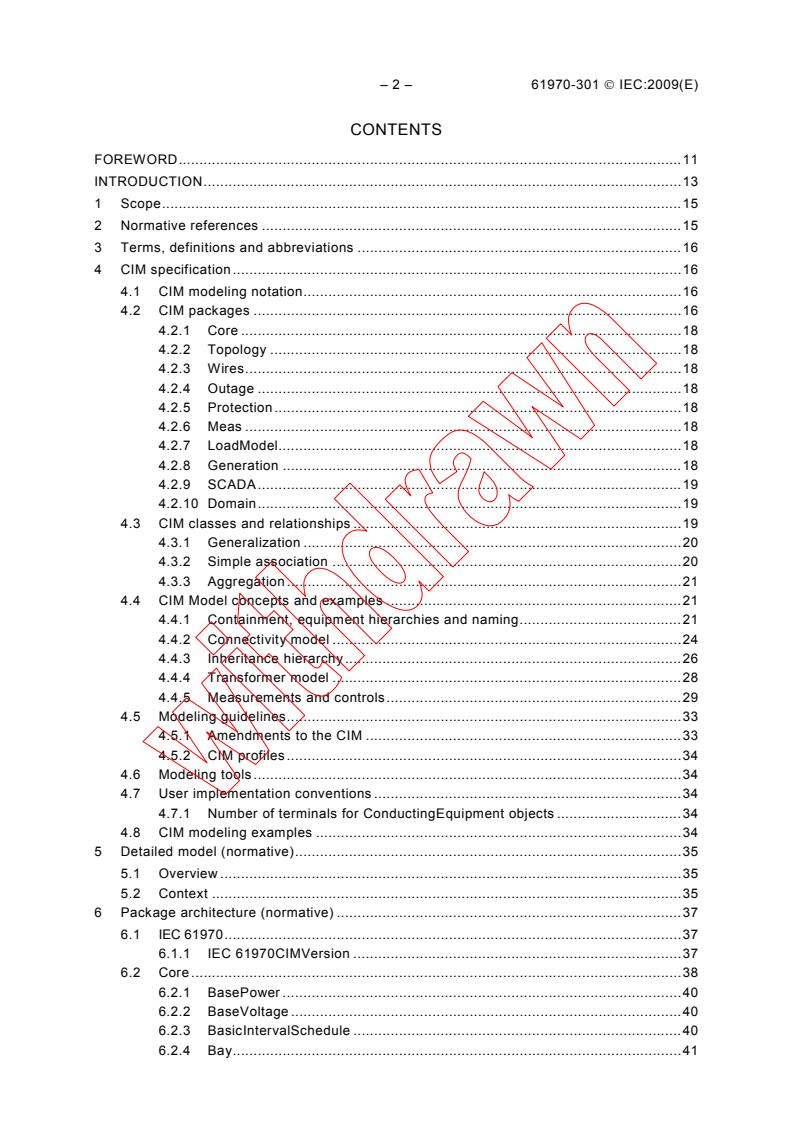
– 2 – 61970-301 © IEC:2009(E)
CONTENTS
FOREWORD.11
INTRODUCTION.13
1 Scope.15
2 Normative references .15
3 Terms, definitions and abbreviations .16
4 CIM specification.16
4.1 CIM modeling notation.16
4.2 CIM packages .16
4.2.1 Core .18
4.2.2 Topology .18
4.2.3 Wires.18
4.2.4 Outage .18
4.2.5 Protection.18
4.2.6 Meas .18
4.2.7 LoadModel.18
4.2.8 Generation .18
4.2.9 SCADA.19
4.2.10 Domain.19
4.3 CIM classes and relationships .19
4.3.1 Generalization .20
4.3.2 Simple association .20
4.3.3 Aggregation.21
4.4 CIM Model concepts and examples .21
4.4.1 Containment, equipment hierarchies and naming.21
4.4.2 Connectivity model .24
4.4.3 Inheritance hierarchy.26
4.4.4 Transformer model .28
4.4.5 Measurements and controls.29
4.5 Modeling guidelines.33
4.5.1 Amendments to the CIM .33
4.5.2 CIM profiles.34
4.6 Modeling tools .34
4.7 User implementation conventions .34
4.7.1 Number of terminals for ConductingEquipment objects .34
4.8 CIM modeling examples .34
5 Detailed model (normative).35
5.1 Overview .35
5.2 Context .35
6 Package architecture (normative) .37
6.1 IEC 61970.37
6.1.1 IEC 61970CIMVersion .37
6.2 Core.38
6.2.1 BasePower .40
6.2.2 BaseVoltage .40
6.2.3 BasicIntervalSchedule .40
6.2.4 Bay.41
61970-301 © IEC:2009(E) – 3 –
6.2.5 Company.41
6.2.6 ConductingEquipment.42
6.2.7 ControlHouseEquipment .43
6.2.8 CoreVersion .43
6.2.9 Curve .43
6.2.10 CurveData .44
6.2.11 Equipment .44
6.2.12 EquipmentContainer .44
6.2.13 GeographicalRegion .45
6.2.14 IdentifiedObject .45
6.2.15 IrregularIntervalSchedule.46
6.2.16 IrregularTimePoint .46
6.2.17 ModelingAuthority.47
6.2.18 ModelingAuthoritySet .47
6.2.19 PowerSystemResource.47
6.2.20 PSRType .48
6.2.21 RegularIntervalSchedule .48
6.2.22 RegularTimePoint.49
6.2.23 SubControlArea .49
6.2.24 SubGeographicalRegion .50
6.2.25 Substation .50
6.2.26 Terminal .51
6.2.27 Unit .51
6.2.28 VoltageLevel .52
6.3 Domain.52
6.3.1 AbsoluteDateTimePrimitive .57
6.3.2 ActivePowerPrimitive.57
6.3.3 AdmittancePrimitive .57
6.3.4 AngleDegreesPrimitive .57
6.3.5 AngleRadiansPrimitive .57
6.3.6 ApparentPowerPrimitive .57
6.3.7 AreaControlModeEnumeration.58
6.3.8 BoilerControlModeEnumeration .58
6.3.9 BooleanPrimitive .58
6.3.10 BreakerConfigurationEnumeration.58
6.3.11 BusbarConfigurationEnumeration .58
6.3.12 ClassificationPrimitive .58
6.3.13 ClearanceTagTypeEnumeration .59
6.3.14 CompanyTypeEnumeration .59
6.3.15 ComplexPrimitive .59
6.3.16 CompositeSwitchTypePrimitive .59
6.3.17 ConductancePrimitive.59
6.3.18 ControlHouseEquipmentTypeEnumeration .59
6.3.19 ControlModePrimitive .59
6.3.20 CoolantTypeEnumeration .60
6.3.21 CostPerEnergyUnitPrimitive .60
6.3.22 CostPerHeatUnitPrimitive.60
6.3.23 CostPerHourPrimitive.60
6.3.24 CounterPrimitive.60
– 4 – 61970-301 © IEC:2009(E)
6.3.25 CurrentFlowPrimitive .60
6.3.26 CurveStyleEnumeration.61
6.3.27 DampingPrimitive .61
6.3.28 DayTypeNameEnumeration .61
6.3.29 DomainVersion.61
6.3.30 EmissionPrimitive.61
6.3.31 EmissionTypeEnumeration .62
6.3.32 EmissionValueSourceEnumeration.62
6.3.33 EnergyAsMWhPrimitive .62
6.3.34 ExcitingCurrentPrimitive .62
6.3.35 ExponentPrimitive .62
6.3.36 FloatPrimitive .62
6.3.37 FractionPrimitive .63
6.3.38 FreqBiasFactorPrimitive .63
6.3.39 FrequencyPrimitive.63
6.3.40 FuelTypeEnumeration .63
6.3.41 GeneratorControlModeEnumeration .63
6.3.42 GeneratorControlSourceEnumeration .63
6.3.43 GeneratorOperatingModeEnumeration .64
6.3.44 HeatPerHourPrimitive.64
6.3.45 HoursPrimitive.64
6.3.46 HydroPlantTypeEnumeration.64
6.3.47 ImpedancePrimitive.64
6.3.48 InductancePrimitive.65
6.3.49 InertiaPrimitive .65
6.3.50 IntegerPrimitive .65
6.3.51 LoadPrimitive .65
6.3.52 LoadLossPrimitive.65
6.3.53 LongDoublePrimitive .65
6.3.54 LongLengthPrimitive.65
6.3.55 LongLongPrimitive.66
6.3.56 MoneyPrimitive.66
6.3.57 NoLoadLossPrimitive.66
6.3.58 NumericUnion .66
6.3.59 NumericTypeEnumeration .67
6.3.60 OctetPrimitive.67
6.3.61 OperatingModePrimitive .67
6.3.62 ParticipationFactorPrimitive.67
6.3.63 PenaltyFactorPrimitive .67
6.3.64 PenstockTypeEnumeration.67
6.3.65 PerCentPrimitive .67
6.3.66 PhaseCodePrimitive .68
6.3.67 PowerFactorPrimitive .68
6.3.68 PowerROCPerMinPrimitive.68
6.3.69 PowerROCPerSecPrimitive .68
6.3.70 PowerVersusFrequencyPrimitive .68
6.3.71 PowerVersusVoltagePrimitive.69
6.3.72 PressurePrimitive .69
6.3.73 PriorityPrimitive.69
61970-301 © IEC:2009(E) – 5 –
6.3.74 PUPrimitive .69
6.3.75 PUkVPerMVArPrimitive .69
6.3.76 QuantityEnumeration.70
6.3.77 RampMethodEnumeration .70
6.3.78 RampStartMethodEnumeration.70
6.3.79 RampUnitsEnumeration.70
6.3.80 RateOfChangePrimitive .70
6.3.81 RatioPrimitive.71
6.3.82 ReactancePrimitive .71
6.3.83 ReactivePowerPrimitive.71
6.3.84 ReferencePrimitive.71
6.3.85 RemoteUnitTypeEnumeration.71
6.3.86 ResistancePrimitive.71
6.3.87 SeasonNameEnumeration .72
6.3.88 SecondsPrimitive .72
6.3.89 ShortPrimitive.72
6.3.90 ShortLengthPrimitive .72
6.3.91 SourceEnumeration.72
6.3.92 SpillwayGateTypeEnumeration.72
6.3.93 StringPrimitive.72
6.3.94 SurgeTankCodeEnumeration.73
6.3.95 SusceptancePrimitive.73
6.3.96 SwitchStateEnumeration .73
6.3.97 SynchronousMachineOperatingModeEnumeration.73
6.3.98 SynchronousMachineTypeEnumeration .73
6.3.99 TapStepPrimitive.73
6.3.100 TemperaturePrimitive .73
6.3.101 TemperatureUnitsEnumeration .74
6.3.102 TerminalCountPrimitive .74
6.3.103 TerminalTypePrimitive.74
6.3.104 TimeStampPrimitive .74
6.3.105 TransformerControlModeEnumeration .74
6.3.106 TransformerCoolingTypeEnumeration .74
6.3.107 TransformerTypeEnumeration .74
6.3.108 TurbineTypeEnumeration .75
6.3.109 ULongPrimitive.75
6.3.110 ULongLongPrimitive .75
6.3.111 ValidityEnumeration .75
6.3.112 WaterLevelPrimitive .76
6.3.113 WindingConnectionEnumeration.76
6.3.114 WindingTypeEnumeration.76
6.3.115 VoltagePrimitive .76
6.3.116 VoltagePerReactivePowerPrimitive .76
6.3.117 VolumePrimitive .76
6.3.118 YAxisTypeEnumeration .77
6.4 LoadModel .77
6.4.1 AreaLoadCurve .78
6.4.2 AreaLossCurve.78
6.4.3 CustomerLoad .79
– 6 – 61970-301 © IEC:2009(E)
6.4.4 DayType.80
6.4.5 EquivalentLoad.80
6.4.6 InductionMotorLoad.82
6.4.7 LoadArea.83
6.4.8 LoadDemandModel.83
6.4.9 LoadModelVersion.84
6.4.10 NonConformLoadSchedule .84
6.4.11 PowerCutZone.85
6.4.12 Season.85
6.4.13 StationSupply .86
6.5 Meas .87
6.5.1 Accumulator .90
6.5.2 AccumulatorLimit .91
6.5.3 AccumulatorLimitSet.91
6.5.4 AccumulatorValue .92
6.5.5 Analog.92
6.5.6 AnalogLimit .93
6.5.7 AnalogLimitSet .93
6.5.8 AnalogValue .94
6.5.9 Command.94
6.5.10 Control .95
6.5.11 ControlType.95
6.5.12 Discrete.96
6.5.13 DiscreteValue .96
6.5.14 Limit .97
6.5.15 LimitSet .97
6.5.16 Measurement.97
6.5.17 MeasurementType .99
6.5.18 MeasurementValue.99
6.5.19 MeasurementValueQuality.100
6.5.20 MeasurementValueSource.100
6.5.21 MeasVersion .101
6.5.22 Quality61850 .101
6.5.23 SetPoint .102
6.5.24 StringMeasurement .103
6.5.25 StringMeasurementValue.103
6.5.26 ValueAliasSet .104
6.5.27 ValueToAlias .104
6.6 Outage .105
6.6.1 ClearanceTag.105
6.6.2 OutageSchedule.106
6.6.3 OutageVersion .107
6.6.4 SwitchingOperation .107
6.7 Topology .107
6.7.1 ConnectivityNode .108
6.7.2 TopologicalIsland .109
6.7.3 TopologicalNode.109
6.7.4 TopologyVersion.110
6.8 Wires .110
61970-301 © IEC:2009(E) – 7 –
6.8.1 ACLineSegment.118
6.8.2 Breaker .118
6.8.3 BusbarSection .119
6.8.4 CompositeSwitch.120
6.8.5 Conductor.121
6.8.6 ConductorType .122
6.8.7 Connector.123
6.8.8 DCLineSegment .123
6.8.9 Disconnector .125
6.8.10 EnergyConsumer.126
6.8.11 EquivalentSource .127
6.8.12 FrequencyConverter .128
6.8.13 Fuse.129
6.8.14 Ground .130
6.8.15 GroundDisconnector.131
6.8.16 HeatExchanger.132
6.8.17 Jumper .132
6.8.18 Junction.133
6.8.19 Line .134
6.8.20 LoadBreakSwitch.135
6.8.21 MVArCapabilityCurve .136
6.8.22 Plant.136
6.8.23 PowerTransformer .137
6.8.24 ProtectedSwitch .138
6.8.25 RectifierInverter.139
6.8.26 RegulatingCondEq.140
6.8.27 RegulationSchedule.141
6.8.28 SeriesCompensator .141
6.8.29 ShuntCompensator .142
6.8.30 StaticVarCompensator.144
6.8.31 Switch .145
6.8.32 SynchronousMachine .146
6.8.33 TapChanger .148
6.8.34 TransformerWinding .149
6.8.35 WindingTest .151
6.8.36 WireArrangement .152
6.8.37 WiresVersion .152
6.8.38 WireType.152
6.8.39 VoltageControlZone.153
6.9 Generation .154
6.9.1 GenerationVersion.154
6.10 Production.154
6.10.1 AccountBalance .157
6.10.2 AirCompressor .158
6.10.3 CAESPlant .158
6.10.4 CogenerationPlant.159
6.10.5 CombinedCyclePlant .160
6.10.6 EmissionAccount.160
6.10.7 EmissionCurve .161
– 8 – 61970-301 © IEC:2009(E)
6.10.8 FossilFuel .162
6.10.9 FuelAllocationSchedule .163
6.10.10 GeneratingUnit .164
6.10.11 GenUnitOpCostCurve.166
6.10.12 GenUnitOpSchedule.167
6.10.13 GrossToNetMWCurve.167
6.10.14 HeatInputCurve .168
6.10.15 HeatRateCurve .169
6.10.16 HydroGeneratingEfficiencyCurve.169
6.10.17 HydroGeneratingUnit.170
6.10.18 HydroPowerPlant .171
6.10.19 HydroPump .173
6.10.20 HydroPumpOpSchedule .173
6.10.21 IncrementalHeatRateCurve .174
6.10.22 InflowForecast.175
6.10.23 LevelVsVolumeCurve .175
6.10.24 PenstockLossCurve.176
6.10.25 Reservoir .176
6.10.26 ShutdownCurve.177
6.10.27 StartIgnFuelCurve .178
6.10.28 StartMainFuelCurve .179
6.10.29 StartRampCurve.179
6.10.30 StartupModel.180
6.10.31 SteamSendoutSchedule .181
6.10.32 TailbayLossCurve.181
6.10.33 TargetLevelSchedule.182
6.10.34 ThermalGeneratingUnit .182
6.11 GenerationDynamics .184
6.11.1 BWRSteamSupply.185
6.11.2 CombustionTurbine .186
6.11.3 CTTempMWCurve.187
6.11.4 DrumBoiler .188
6.11.5 FossilSteamSupply.189
6.11.6 HeatRecoveryBoiler .190
6.11.7 HydroTurbine .191
6.11.8 PrimeMover.192
6.11.9 PWRSteamSupply.192
6.11.10 SteamSupply.193
6.11.11 SteamTurbine.194
6.11.12 Subcritical .195
6.11.13 Supercritical .196
6.12 SCADA.197
6.12.1 CommunicationLink .197
6.12.2 RemoteControl .198
6.12.3 RemotePoint.198
6.12.4 RemoteSource.199
6.12.5 RemoteUnit .199
6.12.6 SCADAVersion .200
6.13 Protection.200
61970-301 © IEC:2009(E) – 9 –
6.13.1 CurrentRelay .201
6.13.2 ProtectionEquipment .202
6.13.3 ProtectionVersion .203
6.13.4 RecloseSequence.203
6.13.5 SynchrocheckRelay .204
Annex A (informative) Model of a circuit breaker in the CIM . 205
Bibliography.211
Figure 1 – CIM Part 301 package diagram .17
Figure 2 – Example of generalization .20
Figure 3 – Example of simple association .21
Figure 4 – Example of aggregation .21
Figure 5 – Equipment containers .23
Figure 6 – Connectivity model.24
Figure 7 – Simple network example .25
Figure 8 – Simple network connectivity modeled with CIM topology .26
Figure 9 – Equipment inheritance hierarchy .27
Figure 10 – Transformer model.28
Figure 11 – Navigating from PSR to MeasurementValue .30
Figure 12 – Measurement placement .32
Figure 13 – CIM Top level packages .35
Figure 14 – Main.37
Figure 15 – CurveSchedule.38
Figure 16 – Main.39
Figure 17 – Main.53
Figure 18 – Integer Datatypes.53
Figure 19 – Float Datatypes.
...
Questions, Comments and Discussion
Ask us and Technical Secretary will try to provide an answer. You can facilitate discussion about the standard in here.
Loading comments...