

IEC TS 63406:2025
(Main)Generic RMS simulation models of inverter-based generators for power system dynamic analysis
General Information
- Abstract
IEC TS 63406:2025 addresses the generic root-mean-square (RMS) simulation models of inverter-based generators for power system dynamic analysis. The scope of the document covers the grid-connected IBGs for photovoltaic power generation systems, wind turbine generation systems with full-scale converters (i.e. Type-4 wind turbine systems), wave energy generation systems, fuel cell energy generation systems, battery energy storage systems, supercapacitor energy storage systems, flywheel energy storage systems, AC- or DC-coupled hybrid energy generation or storage systems, etc.
This document is to specify generic dynamic models for various types of IBGs, which can be applied in power system stability studies.
This document addresses the generic root-mean-square (RMS) simulation models of inverter-based generators (IBGs) for power system dynamic analysis. The scope of the document covers the grid-connected IBGs for photovoltaic power generation systems, wind turbine generation systems with full-scale converters, wave energy generation systems, fuel cell energy generation systems, battery energy storage systems, supercapacitor energy storage systems, flywheel energy storage systems, AC- or DC-coupled hybrid energy generation or storage systems, etc. The models specified in this document can be primarily used for power system RMS dynamic simulation analysis in the electromechanical time scale.
- Status
- Published
- Publication Date
- 15-Oct-2025
- Technical Committee
- SC 8A - Grid Integration of Renewable Energy Generation
- Drafting Committee
- WG 8 - TC 8/SC 8A/WG 8
- Current Stage
- PPUB - Publication issued
- Start Date
- 16-Oct-2025
- Completion Date
- 10-Oct-2025
Overview
IEC TS 63406:2025 - "Generic RMS simulation models of inverter-based generators for power system dynamic analysis" - is an International Electrotechnical Commission (IEC) technical specification. This document defines generic root-mean-square (RMS) simulation models for inverter-based generators (IBGs) used in power system dynamic analysis. Covering grid-connected IBGs, it encompasses systems such as photovoltaic (PV) generation, full-scale converter wind turbines (Type-4), wave and fuel cell energy systems, as well as battery, supercapacitor, flywheel storage, and hybrid AC/DC-coupled systems.
The primary goal is to support power system stability and security assessments by providing generic, adaptable models for a range of inverter-interfaced generation assets. These RMS models are particularly suited for studies on the electromechanical time scale, helping system operators, manufacturers, and simulation software developers represent IBG behaviors consistently across a wide variety of scenarios.
Key Topics
- Generic RMS Models: Specification of standard RMS-based models representing essential dynamic behavior of IBGs, including positive and negative sequence response relevant to real grid conditions.
- Broad IBG Coverage: Models cater to various generator types-PV, wind (Type-4), wave, fuel cell, and diverse energy storage solutions-offering common compliance across technologies.
- Modular Architecture: The model structure is modular, partitioned into key functional blocks such as:
- Primary energy source-driven electric conversion
- Inverter system (current and voltage source interfaces)
- Measurement and monitoring
- Active and reactive power control (including fast frequency response and voltage regulation functionalities)
- Fault ride-through and protection mechanisms
- Communication interface to plant-level controllers
- Dynamic and Stability Analysis: Targeted at analyzing short-term phenomena (10–30 seconds post-disturbance), including rotor angle, frequency, and voltage stability, under large and small disturbances.
- Parameterization and Adaptation: Models are designed to be parameterized for specific IBG implementations, supporting both manufacturer-specific and generic applications.
- Compatibility and Limitations:
- Extends the coverage of IEC 61400-27-1 (wind models) to more RES technologies
- Focused on RMS-level (phasor-based) simulation; not suitable for harmonic, EMC, or detailed short-circuit studies; not intended for long-term or primary energy fluctuation analysis.
Applications
IEC TS 63406:2025 plays a critical role in the integration and assessment of renewable and storage-based generation in modern grids. Typical practical uses include:
- Grid Planning & Operations:
- System operators employ these models to assess grid stability with high IBG penetration, facilitating compliance with grid codes and enhancing operational security.
- Enables simulation of disturbances-short circuits, loss of generation, frequency excursions-and analysis of IBG response.
- Manufacturing and Project Development:
- Equipment manufacturers and project developers apply the standard to validate and share generic IBG models for project approvals and interconnection studies.
- Software Development:
- Developers of power system analysis tools implement these models as standardized libraries, ensuring consistency and interoperability for users worldwide.
- Certification & Validation:
- Certifying bodies use the specification for the independent validation of plant models, especially when manufacturer-specific data is confidential.
- Academic and Research:
- Provides a reference framework for research into renewable grid integration and comparative studies, open to customization and parameter-based tuning.
Related Standards
- IEC 61400-27-1: Specifies generic models for wind turbine generation systems (mainly Type-4). IEC TS 63406:2025 builds on and extends beyond this, ensuring backward compatibility and wider application.
- IEC 61400-27-2: Provides validation procedures for wind turbine models; its methodologies are referenced for model validation until a dedicated document for IBGs is published.
- IEC 62934: Defines terms related to grid integration and fault ride-through concepts, cross-referenced for terminology alignment.
- IEC 61000 Series: Pertains to EMC and harmonics, though not covered within IEC TS 63406:2025.
IEC TS 63406:2025 strengthens the foundation for accurate, reliable dynamic simulation studies of modern grid-connected inverter-based energy systems. By standardizing model structures and ensuring broad applicability, it supports grid modernization and the seamless integration of renewable and energy storage technologies.
Get Certified
Connect with accredited certification bodies for this standard

IMQ S.p.A. (Certification)
Italian electrical product certification.

SLG Prüf- und Zertifizierungs GmbH
German testing and certification body.

UL Solutions
Global safety science company with testing, inspection and certification.
Sponsored listings
Frequently Asked Questions
IEC TS 63406:2025 is a technical specification published by the International Electrotechnical Commission (IEC). Its full title is "Generic RMS simulation models of inverter-based generators for power system dynamic analysis". This standard covers: IEC TS 63406:2025 addresses the generic root-mean-square (RMS) simulation models of inverter-based generators for power system dynamic analysis. The scope of the document covers the grid-connected IBGs for photovoltaic power generation systems, wind turbine generation systems with full-scale converters (i.e. Type-4 wind turbine systems), wave energy generation systems, fuel cell energy generation systems, battery energy storage systems, supercapacitor energy storage systems, flywheel energy storage systems, AC- or DC-coupled hybrid energy generation or storage systems, etc. This document is to specify generic dynamic models for various types of IBGs, which can be applied in power system stability studies. This document addresses the generic root-mean-square (RMS) simulation models of inverter-based generators (IBGs) for power system dynamic analysis. The scope of the document covers the grid-connected IBGs for photovoltaic power generation systems, wind turbine generation systems with full-scale converters, wave energy generation systems, fuel cell energy generation systems, battery energy storage systems, supercapacitor energy storage systems, flywheel energy storage systems, AC- or DC-coupled hybrid energy generation or storage systems, etc. The models specified in this document can be primarily used for power system RMS dynamic simulation analysis in the electromechanical time scale.
IEC TS 63406:2025 addresses the generic root-mean-square (RMS) simulation models of inverter-based generators for power system dynamic analysis. The scope of the document covers the grid-connected IBGs for photovoltaic power generation systems, wind turbine generation systems with full-scale converters (i.e. Type-4 wind turbine systems), wave energy generation systems, fuel cell energy generation systems, battery energy storage systems, supercapacitor energy storage systems, flywheel energy storage systems, AC- or DC-coupled hybrid energy generation or storage systems, etc. This document is to specify generic dynamic models for various types of IBGs, which can be applied in power system stability studies. This document addresses the generic root-mean-square (RMS) simulation models of inverter-based generators (IBGs) for power system dynamic analysis. The scope of the document covers the grid-connected IBGs for photovoltaic power generation systems, wind turbine generation systems with full-scale converters, wave energy generation systems, fuel cell energy generation systems, battery energy storage systems, supercapacitor energy storage systems, flywheel energy storage systems, AC- or DC-coupled hybrid energy generation or storage systems, etc. The models specified in this document can be primarily used for power system RMS dynamic simulation analysis in the electromechanical time scale.
IEC TS 63406:2025 is classified under the following ICS (International Classification for Standards) categories: 29.020 - Electrical engineering in general. The ICS classification helps identify the subject area and facilitates finding related standards.
IEC TS 63406:2025 is available in PDF format for immediate download after purchase. The document can be added to your cart and obtained through the secure checkout process. Digital delivery ensures instant access to the complete standard document.
Standards Content (Sample)
IEC TS 63406 ®
Edition 1.0 2025-10
TECHNICAL
SPECIFICATION
Generic RMS simulation models of inverter-based generators for power system
dynamic analysis
ICS 29.020 ISBN 978-2-8327-0722-7
All rights reserved. Unless otherwise specified, no part of this publication may be reproduced or utilized in any form or
by any means, electronic or mechanical, including photocopying and microfilm, without permission in writing from either
IEC or IEC's member National Committee in the country of the requester. If you have any questions about IEC copyright
or have an enquiry about obtaining additional rights to this publication, please contact the address below or your local
IEC member National Committee for further information.
IEC Secretariat Tel.: +41 22 919 02 11
3, rue de Varembé info@iec.ch
CH-1211 Geneva 20 www.iec.ch
Switzerland
About the IEC
The International Electrotechnical Commission (IEC) is the leading global organization that prepares and publishes
International Standards for all electrical, electronic and related technologies.
About IEC publications
The technical content of IEC publications is kept under constant review by the IEC. Please make sure that you have the
latest edition, a corrigendum or an amendment might have been published.
IEC publications search - IEC Products & Services Portal - products.iec.ch
webstore.iec.ch/advsearchform Discover our powerful search engine and read freely all the
The advanced search enables to find IEC publications by a publications previews, graphical symbols and the glossary.
variety of criteria (reference number, text, technical With a subscription you will always have access to up to date
committee, …). It also gives information on projects, content tailored to your needs.
replaced and withdrawn publications.
Electropedia - www.electropedia.org
The world's leading online dictionary on electrotechnology,
IEC Just Published - webstore.iec.ch/justpublished
Stay up to date on all new IEC publications. Just Published containing more than 22 500 terminological entries in English
details all new publications released. Available online and and French, with equivalent terms in 25 additional languages.
once a month by email. Also known as the International Electrotechnical Vocabulary
(IEV) online.
IEC Customer Service Centre - webstore.iec.ch/csc
If you wish to give us your feedback on this publication or
need further assistance, please contact the Customer
Service Centre: sales@iec.ch.
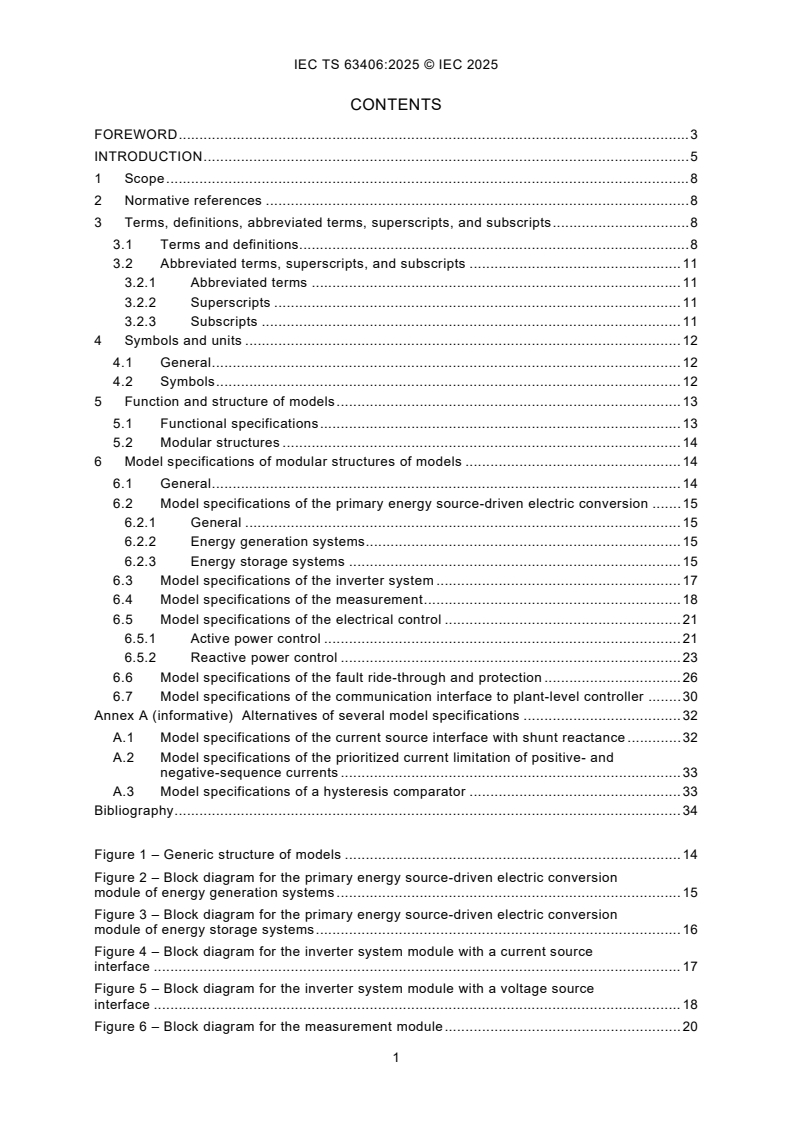
CONTENTS
FOREWORD . 3
INTRODUCTION . 5
1 Scope . 8
2 Normative references . 8
3 Terms, definitions, abbreviated terms, superscripts, and subscripts . 8
3.1 Terms and definitions. 8
3.2 Abbreviated terms, superscripts, and subscripts . 11
3.2.1 Abbreviated terms . 11
3.2.2 Superscripts . 11
3.2.3 Subscripts . 11
4 Symbols and units . 12
4.1 General . 12
4.2 Symbols . 12
5 Function and structure of models . 13
5.1 Functional specifications . 13
5.2 Modular structures . 14
6 Model specifications of modular structures of models . 14
6.1 General . 14
6.2 Model specifications of the primary energy source-driven electric conversion . 15
6.2.1 General . 15
6.2.2 Energy generation systems . 15
6.2.3 Energy storage systems . 15
6.3 Model specifications of the inverter system . 17
6.4 Model specifications of the measurement . 18
6.5 Model specifications of the electrical control . 21
6.5.1 Active power control . 21
6.5.2 Reactive power control . 23
6.6 Model specifications of the fault ride-through and protection . 26
6.7 Model specifications of the communication interface to plant-level controller . 30
Annex A (informative) Alternatives of several model specifications . 32
A.1 Model specifications of the current source interface with shunt reactance . 32
A.2 Model specifications of the prioritized current limitation of positive- and
negative-sequence currents . 33
A.3 Model specifications of a hysteresis comparator . 33
Bibliography . 34
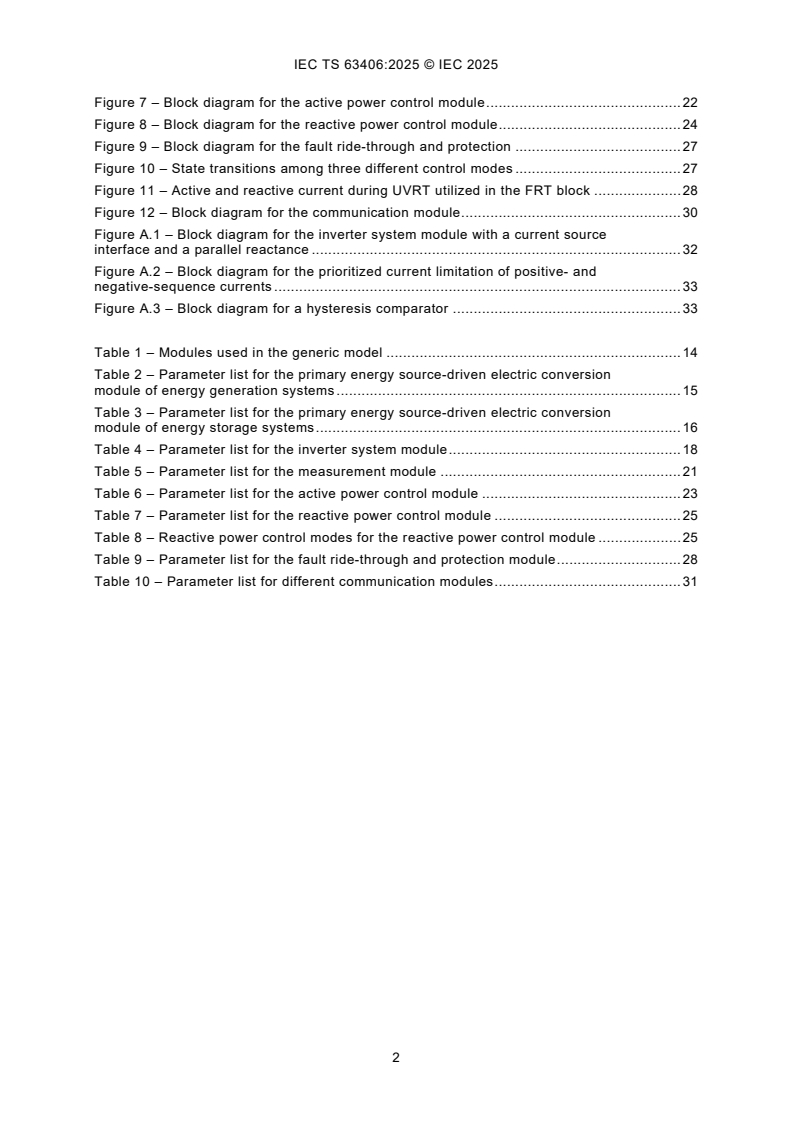
Figure 1 – Generic structure of models . 14
Figure 2 – Block diagram for the primary energy source-driven electric conversion
module of energy generation systems . 15
Figure 3 – Block diagram for the primary energy source-driven electric conversion
module of energy storage systems . 16
Figure 4 – Block diagram for the inverter system module with a current source
interface . 17
Figure 5 – Block diagram for the inverter system module with a voltage source
interface . 18
Figure 6 – Block diagram for the measurement module . 20
Figure 7 – Block diagram for the active power control module . 22
Figure 8 – Block diagram for the reactive power control module . 24
Figure 9 – Block diagram for the fault ride-through and protection . 27
Figure 10 – State transitions among three different control modes . 27
Figure 11 – Active and reactive current during UVRT utilized in the FRT block . 28
Figure 12 – Block diagram for the communication module . 30
Figure A.1 – Block diagram for the inverter system module with a current source
interface and a parallel reactance . 32
Figure A.2 – Block diagram for the prioritized current limitation of positive- and
negative-sequence currents . 33
Figure A.3 – Block diagram for a hysteresis comparator . 33
Table 1 – Modules used in the generic model . 14
Table 2 – Parameter list for the primary energy source-driven electric conversion
module of energy generation systems . 15
Table 3 – Parameter list for the primary energy source-driven electric conversion
module of energy storage systems . 16
Table 4 – Parameter list for the inverter system module . 18
Table 5 – Parameter list for the measurement module . 21
Table 6 – Parameter list for the active power control module . 23
Table 7 – Parameter list for the reactive power control module . 25
Table 8 – Reactive power control modes for the reactive power control module . 25
Table 9 – Parameter list for the fault ride-through and protection module . 28
Table 10 – Parameter list for different communication modules . 31
INTERNATIONAL ELECTROTECHNICAL COMMISSION
____________
Generic RMS simulation models of inverter-based generators
for power system dynamic analysis
FOREWORD
1) The International Electrotechnical Commission (IEC) is a worldwide organization for standardization comprising
all national electrotechnical committees (IEC National Committees). The object of IEC is to promote international
co-operation on all questions concerning standardization in the electrical and electronic fields. To this end and
in addition to other activities, IEC publishes International Standards, Technical Specifications, Technical Reports,
Publicly Available Specifications (PAS) and Guides (hereafter referred to as “IEC Publication(s)”). Their
preparation is entrusted to technical committees; any IEC National Committee interested in the subject dealt with
may participate in this preparatory work. International, governmental and non-governmental organizations liaising
with the IEC also participate in this preparation. IEC collaborates closely with the International Organization for
Standardization (ISO) in accordance with conditions determined by agreement between the two organizations.
2) The formal decisions or agreements of IEC on technical matters express, as nearly as possible, an international
consensus of opinion on the relevant subjects since each technical committee has representation from all
interested IEC National Committees.
3) IEC Publications have the form of recommendations for international use and are accepted by IEC National
Committees in that sense. While all reasonable efforts are made to ensure that the technical content of IEC
Publications is accurate, IEC cannot be held responsible for the way in which they are used or for any
misinterpretation by any end user.
4) In order to promote international uniformity, IEC National Committees undertake to apply IEC Publications
transparently to the maximum extent possible in their national and regional publications. Any divergence between
any IEC Publication and the corresponding national or regional publication shall be clearly indicated in the latter.
5) IEC itself does not provide any attestation of conformity. Independent certification bodies provide conformity
assessment services and, in some areas, access to IEC marks of conformity. IEC is not responsible for any
services carried out by independent certification bodies.
6) All users should ensure that they have the latest edition of this publication.
7) No liability shall attach to IEC or its directors, employees, servants or agents including individual experts and
members of its technical committees and IEC National Committees for any personal injury, property damage or
other damage of any nature whatsoever, whether direct or indirect, or for costs (including legal fees) and
expenses arising out of the publication, use of, or reliance upon, this IEC Publication or any other IEC
Publications.
8) Attention is drawn to the Normative references cited in this publication. Use of the referenced publications is
indispensable for the correct application of this publication.
9) IEC draws attention to the possibility that the implementation of this document may involve the use of (a)
patent(s). IEC takes no position concerning the evidence, validity or applicability of any claimed patent rights in
respect thereof. As of the date of publication of this document, IEC had not received notice of (a) patent(s), which
may be required to implement this document. However, implementers are cautioned that this may not represent
the latest information, which may be obtained from the patent database available at https://patents.iec.ch. IEC
shall not be held responsible for identifying any or all such patent rights.
IEC TS 63406 has been prepared by subcommittee 8A: Grid Integration of Renewable Energy
Generation, of IEC technical committee 8: System aspects of electrical energy supply. It is a
Technical Specification.
The text of this Technical Specification is based on the following documents:
Draft Report on voting
8A/188/DTS 8A/208/RVDTS
Full information on the voting for its approval can be found in the report on voting indicated in
the above table.
The language used for the development of this Technical Specification is English.
This document was drafted in accordance with ISO/IEC Directives, Part 2, and developed in
accordance with ISO/IEC Directives, Part 1 and ISO/IEC Directives, IEC Supplement, available
at www.iec.ch/members_experts/refdocs. The main document types developed by IEC are
described in greater detail at www.iec.ch/publications.
The committee has decided that the contents of this document will remain unchanged until the
stability date indicated on the IEC website under webstore.iec.ch in the data related to the
specific document. At this date, the document will be
– reconfirmed,
– withdrawn, or
– revised.
INTRODUCTION
This document addresses the generic root-mean-square (RMS) simulation models of inverter-
based generators (IBGs) for power system dynamic analysis. The scope of the document covers
the grid-connected IBGs for photovoltaic power generation systems, wind turbine generation
systems with full-scale converters, wave energy generation systems, fuel cell energy generation
systems, battery energy storage systems, supercapacitor energy storage systems, flywheel
energy storage systems, AC- or DC-coupled hybrid energy generation or storage systems, etc.
The models specified in this document can be primarily used for power system RMS dynamic
simulation analysis in the electromechanical time scale.
Renewable energy sources (RESs) including wind energy, photovoltaic energy, wave energy,
etc. have been increasingly integrated into modern power systems worldwide. A common
feature of renewable energy power generation is that it is typically interfaced with the grid
through power electronic inverters, and therefore it can also be called inverter-based generation.
Dynamic simulations play an important role in assessing the stability and security of power
systems. Such studies are typically performed by power system planners and operators using
models simulated in commercial software tools. To reduce the simulation loads, tailored
dynamic models, reserving all critical elements in a power system, are developed, with model
complexity adjusted to account for the key dynamic characteristics to be investigated.
In contrast to the models of synchronous generators, the development of publicly available
generic models for representing different types of IBGs is still inadequate. Wind turbine
generator models were specified by IEC 61400-27-1, but the models were prepared mainly for
the application scope of wind power generation. There is a lack of widely accepted generic
models of IBGs considering different types of RESs and different scenarios of distribution and
transmission networks for dynamic studies. Regardless of the types of RESs, the technical grid
compliance specifications stipulated by grid codes are similar, and therefore different types of
IBGs have similar dynamic characteristics as seen from the points of common connection or
coupling. In this respect, it is necessary to develop generic models for different types of IBGs.
The generic models should accommodate different RESs as classified by the types of their
primary energy source inputs, and also can be custom-parameterized and validated to capture
the dominant dynamic characteristics of IBGs for power system dynamic simulations.
The purpose of this document is to specify generic dynamic models for various types of IBGs,
which can be applied in power system stability studies. Referring to the stability categories
defined by the IEEE/CIGRE Joint Task Force in 2004, the models are developed to represent
IBGs in studies of large-disturbance short-term voltage stability phenomena. Similar to
IEC 61400-27-1 for wind turbine models, the developed models in this document are also
applicable to study other dynamic short-term phenomena such as rotor angle stability,
frequency stability, and small-disturbance voltage stability. Thus, the models are applicable for
dynamic simulations of power system events such as short circuits, loss of generation or loads,
and system separation of a synchronous system into more synchronous areas. Referring to the
stability categories extended by the IEEE in 2021 based on the version in 2004, two new
categories were added: resonance stability and converter-driven stability. The developed
models in this document can be potentially used to study the stability phenomena in these two
new categories, provided that the associated dynamic phenomena are in the electromechanical
time scale. This time scale limitation is due to the inherent capability of RMS-type models and
simulations.
The models are developed with the following general specifications:
– The models can represent a diversity of IBG types, including but not limited to photovoltaic
power generation systems, wind turbine generation systems with full-scale converters, wave
energy generation systems, fuel cell energy generation systems, battery energy storage
systems, supercapacitor energy storage systems, flywheel energy storage systems, and
AC- or DC-coupled hybrid energy generation or storage systems.
– The models can adapt to the dynamic studies in both transmission and distribution network
systems.
– The models can address short-term dynamic processes (10 s to 30 s following a
disturbance).
– The models are to be used primarily for power system dynamic analysis, including rotor
angle stability, short-term frequency stability, and short-term voltage stability.
– The models are specially targeted at large-disturbance stability studies, but can also
address small-disturbance stability studies such as low-frequency oscillations.
– The models can exhibit both positive-sequence and negative-sequence dynamic responses
under grid fault scenarios, and correspondingly the software platform should support the
simulation of negative-sequence responses.
– The models can provide the control functionalities of grid ancillary services such as fast
frequency response and voltage regulation, as required by system operators or grid codes.
– The models should work with integration time steps of about 1/20 cycle or larger, such that
certain electromagnetic transients such as the dynamics of the synchronization control loop
of IBGs (typically the phase-locked loop) can be retained.
– The models can be parameterized to represent any manufacturer-specific IBGs.
The models have the following limitations:
– The models are not intended for long-term stability analysis since the characteristics of the
primary energy source conversion (e.g. wind turbine aerodynamics, PC arrays) are not
sufficiently represented.
– The models are not intended for investigation of the impact of the fluctuations of the primary
energy source.
– The models can be used for both large-disturbance and small-disturbance simulations.
Although fast dynamics such as the phase-locked loop (PLL) dynamics are represented, the
models are probably still not sufficient for the investigation of sub-synchronous interaction
phenomena (e.g. oscillation in the frequency range above a typical PLL bandwidth of 10 Hz).
– The models are not necessarily able to represent oscillatory behaviours that typically occur
in an extremely weak grid connection (e.g. short-circuit ratio less than 2).
– The models do not cover phenomena such as harmonics, flicker, or any other EMC
emissions included in the IEC 61000 series.
– The models do not address the specifics of short-circuit calculations.
– The models are based on classical voltage vector-oriented grid-following controls and do
not address grid-forming controls. The models do not apply to studies where the inverter-
based generation systems are islanded without synchronous generation as well as studies
where there are not enough voltage sources such as synchronous machines.
The models in this document are to represent the dynamic behaviour of a single IBG. For a
power plant comprised of many IBGs, the appropriate number of IBG models should be
incorporated or aggregated by appropriate approaches. Moreover, the validation specification
for the models in this document will be developed exclusively in a new document. Before it is
released, the validation of the models can follow the same procedures, requirements, and
methodologies specified in IEC 61400-27-2.
Please note that IEC 61400-27-1 has released generic models for wind turbine systems earlier.
However, it normatively applies to wind turbine systems only. In contrast, the specifications
developed in this document are broad enough to encompass various types of renewable energy
systems, including but not limited to wind turbines. This is achieved by encompassing common
modules of different types of renewable energy systems in the generic models. Additionally, it
fills in the gaps left by IEC 61400-27-1 by identifying its limitations and developing new and
necessary modules. As a result, the specifications in this document are backward compatible
with the existing technical specifications by IEC 61400-27-1 and do not pose any technical
conflicts. Specifically, the major differences between this document and IEC 61400-27-1 as well
as the gaps filled lie in the following aspects:
– This document covers a diversity of IBGs, including but not limited to wind turbines.
Therefore, this document fills the gap that there are no IEC standards of generic simulation
models for photovoltaic generation, wave energy generation, fuel cell energy storage,
battery energy storage, supercapacitor storage systems, flywheel energy storage, and AC-
or DC-coupled hybrid energy generation or storage systems. More importantly, the models
are generic for as many types of RESs as possible, thus avoiding creating more and more
models for different RESs.
– The primary energy source model is simply presented to provide a unified model for a
diverse range of renewables.
– The models for grid ancillary services, e.g. fast frequency response, are provided.
– As many types of Var-Volt control modes as possible are provided, covering almost all
possible modes.
– Both positive- and negative-sequence dynamic responses under grid faults are provided.
– Two types of interface modules, namely current-source and voltage-source types, are
provided.
– Different detection techniques for the grid phase-angle are provided, including a phase-
locked loop.
The following stakeholders are potential users of the models specified in this document:
– System operators are end users of the models, performing power system stability studies
as part of the planning as well as the operation of the power systems.
– Renewable energy generation manufacturers will typically provide the models of the
generation technologies to the owner.
– Developers of modern software for power system simulation tools will use this document to
implement standard inverter-based generator models as part of the software library.
– Certification bodies in case of independent model validation.
– Consultants who use models on behalf of system operators or renewable energy generation
plant developers.
– Education and research communities who can also benefit from the generic models, as the
manufacturer-specific models are typically confidential.
1 Scope
This document addresses the generic root-mean-square (RMS) simulation models of inverter-
based generators for power system dynamic analysis. The scope of the document covers the
grid-connected IBGs for photovoltaic power generation systems, wind turbine generation
systems with full-scale converters (i.e. Type-4 wind turbine systems), wave energy generation
systems, fuel cell energy generation systems, battery energy storage systems, supercapacitor
energy storage systems, flywheel energy storage systems, AC- or DC-coupled hybrid energy
generation or storage systems, etc.
Given the technical commonalities of full inverter-based generation systems in dynamic
characteristics and grid specification requirements, this document is technically backward
compatible with the specification of IEC 61400-27-1 [1] (particularly compatible with the Type-
4A wind turbine model specification). Additionally, several feature-rich modules have been
added to provide fast frequency response, negative sequence control under unbalanced grid
conditions, voltage source interface to improve numerical stability under weak grid connection
conditions, etc. Generic model specifications for Type-3 wind turbine systems are out of scope
and can be found in IEC 61400-27-1 [1]. The aggregated model for a renewable energy power
plant and the plant-level control are also out of scope. The models specified in this document
can be primarily used for power system RMS dynamic simulation analysis in the
electromechanical time scale. The validation specification for the models in this document will
be developed exclusively in a new document, which will align with the procedures, requirements,
and methodologies already specified in IEC 61400-27-2 for wind turbine models [2].
2 Normative references
There are no normative references in this document.
3 Terms, definitions, abbreviated terms, superscripts, and subscripts
3.1 Terms and definitions
For the purposes of this document, the following terms and definitions apply.
ISO and IEC maintain terminology databases for use in standardization at the following
addresses:
– IEC Electropedia: available at https://www.electropedia.org/
– ISO Online browsing platform: available at https://www.iso.org/obp
3.1.1
base unit
unit of parameter values, which is the per-unit base value if the parameter is given in per-unit
or the physical unit if the value is given in a physical unit
[SOURCE: IEC 61400-27-1:2020, 3.1.3]
3.1.2
inverter-based generator
generator connected to the electric power network via an inverter, including but not limited to:
photovoltaic power generation systems, wind turbine generation systems with full-scale
converters, wave energy generation systems, fuel cell energy generation systems, battery
energy storage systems, supercapacitor energy storage systems, flywheel energy storage
systems, and AC- or DC-coupled hybrid energy generation or storage systems
___________
Numbers in square brackets refer to the Bibliography.
3.1.3
fault ride-through
ability of a generator or power plant to stay connected during specified faults in the electric
power system
[SOURCE: IEC 62934:2021, 3.2.25.1, modified – “generating unit” has been replaced by
“generator”.]
3.1.4
generic model
model that can be adapted to simulate different types of inverter-based generators by choosing
the model configurations and changing the model parameters
[SOURCE: IEC 61400-27-1:2020, 3.1.6, modified – “wind turbines or wind power plants” has
been replaced by “types of inverter-based generators”, and “choosing the model configurations”
has been added.]
3.1.5
high-voltage ride through
over-voltage ride through
ability of a generator or power plant to stay connected during a limited duration rise of grid
voltage
[SOURCE: IEC 62934:2021, 3.2.25.3, modified – “high-voltage ride through” has been included
in the term, and in the definition “generating unit” has been replaced by “generator”.]
3.1.6
integration time step
simulation time interval between two consecutive numerical solutions of the model’s differential
equations
[SOURCE: IEC 61400-27-1:2020, 3.1.9]
3.1.7
low-voltage ride through
under-voltage ride through
ability of a generator or power plant to stay connected during a voltage dip
[SOURCE: IEC 62934:2021, 3.2.25.2, modified – “low-voltage ride through” has been included
in the term, and in the definition “generating unit” has been replaced by “generator”.]
3.1.8
module
part of a model which has a modular structure
[SOURCE: IEC 61400-27-1:2020, 3.1.10]
3.1.9
negative (sequence) component (of a three-phase system)
one of the three symmetrical sequence components which exists only in an unsymmetrical
three-phase system of sinusoidal quantities and which is defined by the following complex-
valued (phasor) mathematical expression:
x= x++a x ax
2 ( L1 L2 L3)
where a is the 120 degree operator, and x , x , and x are the phasor expressions of the
L1 L2 L3
phase quantities concerned, and where x denotes the system current or voltage phasors
[SOURCE: IEC 60050-448:1995, 448-11-28, modified – complex has been replaced by
“complex-valued (phasor)” in the definition.]
3.1.10
phasor
complex root-mean-square (RMS) value
representation of a sinusoidal integral quantity by a complex quantity whose argument is equal
to the initial phase and whose modulus is equal to the RMS value
[SOURCE: IEC 60050-103:2017, 103-07-14, modified – the notes to entry have been omitted.]
3.1.11
positive (sequence) component (of a three-phase system)
one of the three symmetrical sequence components which exists in symmetrical and
unsymmetrical three-phase systems of sinusoidal quantities and which is defined by the
following complex-valued (phasor) mathematical expression
x= x+ ax + a x
( )
1 L1 L2 L3
where a is the 120 degree operator, and x , x , and x are the phasor expressions of the
L1 L2 L3
phase quantities concerned, and where x denotes the system current or voltage phasors
[SOURCE: IEC 60050-448:1995, 448-11-27, modified – complex has been replaced by
“complex-valued (phasor)” in the definition.]
3.1.12
root-mean-square simulation model
model where AC sinusoidal signals are represented by the phasor expressions of positive
sequence (and negative sequence) components
3.1.13
short-circuit ratio
ratio of the three-phase short-circuit power at the point of connection or point of generator
connection to the nominal active power of a renewable energy power plant or generator
[SOURCE: IEC 62934:2021, 3.2.7, modified – the notes to entry have been omitted.]
3.2 Abbreviated terms, superscripts, and subscripts
3.2.1 Abbreviated terms
The following abbreviated terms are used in this document:
FFR fast frequency response
FRT fault ride-through
IBG inverter-based generator
Im imaginary part
mag magnitude
OVRT over-voltage ride through
OR logical or operator
PI proportional-integral regulator
PLL phase-locked loop
p.u. per-unit
Re real part
Re & Im vector composed of real and imaginary parts
RMS root-mean-square
SOC state of charge
sqr square function
sqrt square root function
UVRT under-voltage ride through
WECC Western Electricity Coordinating Council
3.2.2 Superscripts
The following subscripts are used in this document:
* complex conjugate
' variables used in the FRT module
3.2.3 Subscripts
The following subscripts are used in this document:
1 positive-sequence component
2 negative-sequence component
avail available
conv primary energy conversion
cmd command
d d-axis component
dly delayed
dc DC quantity
droop droop control
eq equivalent value
ess energy storage system
f frequency
filt filtered variable
i current
I integral regulator gain
in input
init initial value
lag lag compensation
lead lead compensation
max maximum
meas measured value
min minimum
n nominal value
out output
p active power
P proportional regulator gain
pre-fault the pre-fault value
prim primary energy
pec primary energy conversion
q reactive power or q-axis component
r rotor speed
ref reference value
rocof rate of change of frequency
theta angle
u voltage
4 Symbols and units
4.1 General
The symbols used globally in this document are listed in 4.2. Additional symbols used in module
block diagram figures in Clause 6 represent module parameters which are described in tables
adjacent to the figures in the associated module clause. Those symbols are only used locally
within the associated module and therefore not duplicated in the list of symbols in 4.2. All the
variables are in per unit, except for phase angle variables and integer flag variables indicating
the switching states.
4.2 Symbols
θ positive- and negative-sequence phase angles outputted by phase-locked loops
pll1,2
FFlag Flag indicating the operating condition (see 6.6) as follows:
1 for grid fault conditions
0 for normal conditions
f measured frequency outputted by the phase-locked loop
meas
i positive- and negative-sequence current components (phasors)
1,2
i measured (and filtered) positive- and negative-sequence current components
meas1,2
i active current command
pcmd
i positive- and negative-sequence active current reference
pref1,2
i reactive current command
qcmd
i positive- and negative-sequence reactive current reference
qref1,2
p positive-sequence active power
p maximum input electrical power available to the active power control module
avail_in
p maximum output electrical power available to the active power control module
avail_out
p measured (and filtered) positive-sequence active power
meas
p active power reference provided by the plant controller
ref
q positive-sequence reactive power
q measured (and filtered) positive-sequence reactive power
meas
q reactive power reference provided by the plant controller
ref
u positive- and negative-sequence voltage components (phasors)
1,2
u measured (and filtered) positive- and negative-sequence voltage components
meas1,2
voltage reference provided by the plant controller
u
ref
5 Function and structure of models
5.1 Functional specifications
The models will be developed with the following general specifications in mind:
– The models can represent a diversity of IBG types, including but not limited to photovoltaic
power generation systems, wind turbine generation systems with full-scale converters, wave
energy generation systems, fuel cell energy generation systems, battery energy storage
systems, supercapacitor energy storage systems, flywheel energy storage systems, and
AC- or DC-coupled hybrid energy generation or storage systems.
– The models can adapt to the dynamic studies in both transmission and distribution network
systems.
– The models can address short-term dynamic processes (10 s to 30 s following a
disturbance).
– The models are to be used primarily for power system dynamic analysis, including rotor
angle stability, short-term frequency stability, and short-term voltage stability.
– The models are specially targeted at large-disturbance stability studies, but can also
address small-disturbance stability studies such as low-frequency oscillations.
– The models can exhibit both positive-sequence and negative-sequence dynamic responses
under grid fault scenarios.
– The models can provide the control functionalities of grid ancillary services such as fast
frequency response and voltage regulation, as required by system operators or grid codes.
– The models should work with integration time steps of about 1/20 cycle or larger [3], such
that certain electromagnetic transients such as the dynamics of the synchronization control
loop of IBGs (typically phase-locked loop) can be retained.
– The models can be parameterized to represent any manufacturer-specific IBGs.
___________
2 The reason for the time step of 1/20 cycle smaller than the time step of ¼ cycle in IEC 61400-27-1 is: the models
by this document additionally incorporate the dynamics with smaller time constants, including phase-locked loop
dynamics and the delay of the current control [3].
5.2 Modular structures
The generic IBG model comprises multiple modules, each representing the corresponding
physical component or control functionality. The generic structure of the model is shown in
Figure 1. The modules used in Figure 1 are briefly described in Table 1.
Figure 1 – Generic structure of models
Table 1 – Modules used in the generic model
Clause
Module Description
number
Primary energy source-driven electric
6.2 Simply representing the primary energy conversion
conversion
Inverter system 6.3 Interfacing the output with the grid
Measuring voltage, frequency, current, active and
Measurement 6.4
reactive power
Electrical control 6.5 Implementing active and reactive power control
Fault ride-through and protection 6.6 Addressing fault ride-through control and protection
Communication interface to plant-level
6.7 Communicating with the plant-level controller
controller
6 Model specifications of modular structures of models
6.1 General
The formal specification for each module is provided in Clause 6. By using block diagrams, the
module functions and the input and output signals of interconnecting the modules are defined.
The module parameters are listed, along with their descriptions. The values for the module
parameters are not specified in this document. The manufacturer shall provide those
parameters to complete the module specification.
6.2 Model specifications of the primary energy source-driven electric conversion
6.2.1 General
This module is specified according to energy generation and energy storage separately. The
distinction is because the power flow in energy generation systems is unidirectional, whereas
the power flow in energy storage systems is bidirectional (i.e. charging and discharging).
6.2.2 Energy generation systems
The representation of primary energy source-driven electric conversion is highly simplified to
allow the possibility of developing a generic model for a diversity of renewable energy sources.
If the primary energy conversion dynamics are of particular concern, users should refer to the
model specifications for specific types of renewable energy sources, e.g. wind turbine models
[1]. The block diagram of this module is given in Figure 2. The module parameters are described
in Table 2.
The input signal p represents the amount of the primary energy, which is specified by model
prim
users and can be time-varying to represent the variations of primary energy. The energy
conversion from primary energy to the input to the grid-connected inverter is represented by a
first-order lag element. The element mimics the delayed response of the primary energy
conversion, and it is also responsible for filtering out the rapidly-changing components in the
input specified by users. The input signal p can be pulled down during fault ride-through to
prim
represent the reduction of primary energy capture of actual IBGs. The output signal p is
avail_out
the maximum output electrical power available to the active power control module.
Figure 2 – Block diagram for the primary energy source-driven electric
conversion module of energy generation systems
Table 2 – Parameter list for the primary energy source-driven electric
conversion module of energy generation systems
Base
Symbol Description
unit
T
s Equivalent time constant of primary energy conversion
conv
p
p.u. Maximum power output capacity of the IBG
max
Input power from the primary energy, which should be specified by model users
p
p.u. and can be a constant or time-varying time series data to represent the
prim
variations of primary energy
6.2.3 Energy storage systems
The block diagram of this module is given in Figure 3. For battery energy storage systems, the
charge level is indicated by the state-of-charge (SOC) signal. For supercapacitor storage
systems, it is indicated by the DC voltage of capacitors. For flywheel storage systems, it is
indicated by the rotational speed of flywheels. The SOC changes with the charging or
discharging processes, as the following formula.
SOC + ptd , for battery storage systems
init meas
∫
T
ess
1 p
meas
SOC vv + dt, for supercapacitor storage systems
dc dc,init
∫
Tv
ess dc
1 p
meas
ωω+ dt, for flywheel storage systems
r r,init
∫
T ω
ess r
For battery storage systems, the DC voltage is considered constant during simulations, and
therefore, the SOC is decided by the output power. The SOCFlag is set to 0 for battery energy
storage systems. For supercapacitor or flywheel storage systems, the SOC is represented by
the capacitor voltage or the flywheel rotational speed, respectively. The SOCFlag is set to 1 to
consider the dynamics of the capacitor voltage or the flywheel speed. When the SOC reaches
the maximum or the minimum amount, the charging or the discharging should terminate. The
output signal p is the maximum output electrical power available to the active power
avail_out
control module, and the output signal p is the maximum input electrical power (i.e.
avail_in
minimum output power) available to the active power control module. The module parameters
are described in Table 3.
Figure 3 – B
...