


IEC 61970-457:2024
(Main)Energy management system application program interface (EMS-API) - Part 457: Dynamics profile
Energy management system application program interface (EMS-API) - Part 457: Dynamics profile
IEC 61970-457:2024 specifies a standard interface for exchanging dynamic model information needed to support the analysis of the steady state stability (small-signal stability) and/or transient stability of a power system or parts of it. The schema(s) for expressing the dynamic model information are derived directly from the CIM, more specifically from IEC 61970-302.
The scope of this document includes only the dynamic model information that needs to be exchanged as part of a dynamic study, namely the type, description and parameters of each control equipment associated with a piece of power system equipment included in the steady state solution of a complete power system network model. Therefore, this profile is dependent upon other standard profiles for the equipment as specified in IEC 61970-452: CIM static transmission network model profiles, the topology, the steady state hypothesis and the steady state solution (as specified in IEC 61970-456: Solved power system state profiles) of the power system, which bounds the scope of the exchange. The profile information described by this document needs to be exchanged in conjunction with IEC 61970-452 and IEC 61970-456 profiles’ information to support the data requirements of transient analysis tools. IEC 61970-456 provides a detailed description of how different profile standards can be combined to form various types of power system network model exchanges.
This document supports the exchange of the following types of dynamic models:
• standard models: a simplified approach to exchange, where models are contained in predefined libraries of classes interconnected in a standard manner that represent dynamic behaviour of elements of the power system. The exchange only indicates the name of the model along with the attributes needed to describe its behaviour.
• proprietary user-defined models: an exchange that would provide users the ability to exchange the parameters of a model representing a vendor or user proprietary device where an explicit description of the model is not described in this document. The connections between the proprietary models and standard models are the same as described for the standard models exchange. Recipient of the data exchange will need to contact the sender for the behavioural details of the model.
This document builds on IEC 61970-302, CIM for dynamics which defines the descriptions of the standard dynamic models, their function block diagrams, and how they are interconnected and associated with the static network model. This type of model information is assumed to be pre-stored by all software applications hence it is not necessary to be exchanged in real-time or as part of a dynamics model exchange.
This second edition cancels and replaces the first edition published in 2021. This edition constitutes a technical revision.
This edition includes the following significant technical changes with respect to the previous edition:
a) The majority of issues detected in IEC 61970-302:2018 and fixed in IEC 61970-302:2022 led to update of this document;
b) IEEE 421.5-2016 on Excitation systems is fully covered;
c) IEEE turbine report from 2013 was considered and as a result a number of gas, steam and hydro turbines/governors are added;
d) IEC 61400-27-1:2020 on wind turbines is fully incorporated;
e) WECC Inverter-Based Resource (IBR) models, Hybrid STATCOM models and storage models are added;
f) The user defined models approach was enhanced in IEC 61970-302:2022 adding a model which enables modelling of a detailed dynamic model. This results in the creation of two additional profiles in this document. These are the Detailed Model Configuration profile and Detailed Model Parameterisation profile;
g) A model to enable exchange of simulation results was added in IEC 61970-302:2022. This results in the creation of two additional profiles in this document. These are the Simulation Settings profile and Simulation Results profile;
h) The work on the
Interface de programmation d’application pour système de gestion d’énergie (EMS-API) - Partie 457: Profil de régimes dynamiques
IEC 61970-457:2024 spécifie une interface normalisée pour l’échange des informations de modèles dynamiques, nécessaires pour soutenir l’analyse de la stabilité en régime établi (stabilité en petits signaux) et/ou la stabilité transitoire d’un système électrique ou des parties de celui ci. Le ou les schémas d’expression des informations de modèles dynamiques sont déduits directement du CIM, plus spécifiquement de l’IEC 61970-302.
Le domaine d’application du présent document inclut uniquement les informations des modèles dynamiques qu’il est nécessaire d’échanger comme partie intégrante d’une étude des régimes dynamiques, à savoir le type, la description et les paramètres de chaque équipement de commande associé à un équipement de système électrique inclus dans la solution permanente d’un modèle exhaustif de réseau électrique. Par conséquent, ce profil dépend des autres profils normalisés pour les équipements comme cela est spécifié dans l’IEC 61970-452: Profils du modèle de réseau de transport statique CIM, la topologie, l’hypothèse en régime établi et la solution en régime établi (comme cela est spécifié dans l'IEC 61970-456: Profils d'état de réseaux électriques résolus) du système électrique, ce qui limite la portée de l’échange. Il est nécessaire d’échanger les informations de profils décrites par le présent document conjointement avec les informations de profils spécifiées dans l’IEC 61970-452 et l’IEC 61970-456 afin de venir à l’appui des exigences relatives aux données des outils d’analyse transitoire. L’IEC 61970-456 donne une description détaillée du mode selon lequel les différentes normes de profils peuvent être combinées afin de former différents types d’échanges de modèles de réseaux électriques.
Le présent document soutient l’échange des types suivants de modèles dynamiques:
• modèles normalisés: une approche simplifiée d’échange, avec laquelle les modèles sont contenus dans des bibliothèques prédéfinies de classes interconnectées de manière normalisée, qui représentent le comportement dynamique des éléments du système électrique. L’échange indique uniquement le nom du modèle, ainsi que les attributs nécessaires pour décrire son comportement.
• modèles propriétaires définis par l'utilisateur: échange qui offre la possibilité aux utilisateurs d’échanger les paramètres d’un modèle qui représente le dispositif propriétaire d’un fournisseur ou d’un utilisateur, lorsque le présent document ne donne pas de description explicite du modèle. Les connexions entre les modèles propriétaires et les modèles normalisés sont les mêmes que celles décrites pour l’échange de modèles normalisés. Il est nécessaire que le destinataire de l’échange de données contacte l’émetteur afin d’obtenir les informations détaillées du comportement du modèle.
La structure du présent document suit le CIM pour régimes dynamiques de l’IEC 61970-302, qui définit les descriptions des modèles dynamiques normalisés et de leurs diagrammes de blocs fonctionnels, ainsi que leur mode d'interconnexion et d’association avec le modèle de réseau statique. Par hypothèse, ce type d’information de modèle est réputé être pré mémorisé par toutes les applications logicielles et il n’est ainsi pas nécessaire de l'échanger en temps réel ou comme partie intégrante d’un échange de modèles de régimes dynamiques
Cette seconde édition annule et remplace la première édition parue en 2021. Cette édition constitue une révision technique.
Cette édition inclut les modifications techniques majeures suivantes par rapport à l’édition précédente:
a) La majorité des problèmes identifiés dans l’IEC 61970-302:2018 et réglés dans l’IEC 61970-302:2022 ont conduit à la mise à jour du présent document.
b) La norme IEEE 421.5-2016 sur les systèmes d’excitation est entièrement couverte.
c) La prise en considération du rapport IEEE de 2013 sur les turbines a contribué à l’ajout d’un certain nombre de turbines/régulateurs à gaz, à vapeur et hydrauliques.
d) L’IEC 61400-27-1:2020 conce
General Information
- Status
- Published
- Publication Date
- 08-Feb-2024
- Technical Committee
- TC 57 - Power systems management and associated information exchange
- Drafting Committee
- WG 13 - TC 57/WG 13
- Current Stage
- PPUB - Publication issued
- Start Date
- 09-Feb-2024
- Completion Date
- 19-Jan-2024
Relations
- Effective Date
- 05-Sep-2023
Overview
IEC 61970-457:2024 is an international standard developed by the International Electrotechnical Commission (IEC) that specifies a standardized interface for exchanging dynamic model information relevant to power system stability analysis. This edition updates and replaces the 2021 version, incorporating advances in dynamic modeling and expanding to cover new equipment types and models. It builds upon the Common Information Model (CIM) described in IEC 61970-302, focusing particularly on dynamics required for steady-state stability (small-signal) and transient stability analyses of power systems.
The standard defines the Dynamics Profile within the Energy Management System Application Program Interface (EMS-API) framework to enable consistent, interoperable data exchange among power system analysis tools, operators, and equipment vendors.
Key Topics
Scope of Dynamic Model Exchange
IEC 61970-457:2024 targets dynamic model information necessary for transient and steady-state stability studies, including types, descriptions, and parameters of control equipment linked to power system components. It complements static network models and steady-state solutions specified in IEC 61970-452 and IEC 61970-456.Model Types Supported
- Standard Models: Utilizes predefined dynamic model libraries with standardized class representations for power system components. Only model names and parameters are exchanged, assuming behavioral logic is pre-stored in software applications.
- Proprietary/User-Defined Models: Enables exchange of parameters for vendor-specific or user-defined models without explicit behavioral descriptions, requiring direct communication between sender and recipient for full interpretation.
Expanded Coverage of Dynamic Elements
The 2024 edition incorporates additional dynamic models reflecting modern power system components:- IEEE 421.5-2016 excitation systems
- Gas, steam, and hydro turbines/governors per IEEE 2013 turbine report
- IEC 61400-27-1:2020 compliant wind turbine models
- WECC inverter-based resource (IBR) models, hybrid STATCOMs, and storage systems
New Profiles Introduced
- Detailed Model Configuration and Parameterisation Profiles: For more detailed and complex dynamic model exchange.
- Simulation Settings and Results Profiles: Enhances capabilities for exchanging simulation scenarios and outcomes.
Integration with CIM Standards
The standard utilizes CIM classes and structures from IEC 61970-302 to define dynamic behavior and interconnections, ensuring consistency and compatibility with established power system modeling frameworks.
Applications
Power System Stability Analysis
Facilitates the exchange of dynamic data among utilities, transmission system operators, software vendors, and consulting engineers for small-signal and transient stability assessments. Enables enhanced coordination in contingency and disturbance studies.Interoperability of EMS and Simulation Tools
Supports seamless integration and data sharing between Energy Management Systems (EMS), dynamic simulation software, and control platforms, improving accuracy and efficiency in operational planning and real-time decision-making.Vendor Model Exchange and Validation
Allows utility and vendor collaboration in exchanging proprietary dynamic models while maintaining confidentiality of proprietary algorithm details, enabling validation and interoperability testing.Support for Renewable and Emerging Technologies
Incorporates dynamic models for wind power plants, inverter-based resources, hybrid compensation devices, and energy storage systems essential for modern grid stability analyses.
Related Standards
IEC 61970-302: CIM for Dynamics
Defines the Common Information Model entities and relationships specifically for dynamic models in power systems, serving as the basis for data representation in IEC 61970-457.IEC 61970-452: CIM Static Transmission Network Model Profiles
Specifies static transmission network models required for representing the network topology and equipment included in dynamic studies.IEC 61970-456: Solved Power System State Profiles
Details the steady-state solution and topology profiles needed to bound the dynamic model information exchange.IEEE Standards
- IEEE 421.5-2016: Excitation system models standard, fully integrated in this edition of IEC 61970-457.
- IEEE turbine reports guiding representation of turbine-governors and mechanical dynamics.
IEC 61400-27-1:2020
Defines wind turbine models incorporated into this standard’s dynamic profiles to address renewable integration.
Keywords: IEC 61970-457, EMS-API, Dynamics profile, power system stability, transient stability, small-signal stability, dynamic model exchange, Common Information Model CIM, dynamic simulation, renewable integration, inverter-based resources, excitation systems, turbine governors, wind turbine models, energy management systems, transient analysis tools.
Frequently Asked Questions
IEC 61970-457:2024 is a standard published by the International Electrotechnical Commission (IEC). Its full title is "Energy management system application program interface (EMS-API) - Part 457: Dynamics profile". This standard covers: IEC 61970-457:2024 specifies a standard interface for exchanging dynamic model information needed to support the analysis of the steady state stability (small-signal stability) and/or transient stability of a power system or parts of it. The schema(s) for expressing the dynamic model information are derived directly from the CIM, more specifically from IEC 61970-302. The scope of this document includes only the dynamic model information that needs to be exchanged as part of a dynamic study, namely the type, description and parameters of each control equipment associated with a piece of power system equipment included in the steady state solution of a complete power system network model. Therefore, this profile is dependent upon other standard profiles for the equipment as specified in IEC 61970-452: CIM static transmission network model profiles, the topology, the steady state hypothesis and the steady state solution (as specified in IEC 61970-456: Solved power system state profiles) of the power system, which bounds the scope of the exchange. The profile information described by this document needs to be exchanged in conjunction with IEC 61970-452 and IEC 61970-456 profiles’ information to support the data requirements of transient analysis tools. IEC 61970-456 provides a detailed description of how different profile standards can be combined to form various types of power system network model exchanges. This document supports the exchange of the following types of dynamic models: • standard models: a simplified approach to exchange, where models are contained in predefined libraries of classes interconnected in a standard manner that represent dynamic behaviour of elements of the power system. The exchange only indicates the name of the model along with the attributes needed to describe its behaviour. • proprietary user-defined models: an exchange that would provide users the ability to exchange the parameters of a model representing a vendor or user proprietary device where an explicit description of the model is not described in this document. The connections between the proprietary models and standard models are the same as described for the standard models exchange. Recipient of the data exchange will need to contact the sender for the behavioural details of the model. This document builds on IEC 61970-302, CIM for dynamics which defines the descriptions of the standard dynamic models, their function block diagrams, and how they are interconnected and associated with the static network model. This type of model information is assumed to be pre-stored by all software applications hence it is not necessary to be exchanged in real-time or as part of a dynamics model exchange. This second edition cancels and replaces the first edition published in 2021. This edition constitutes a technical revision. This edition includes the following significant technical changes with respect to the previous edition: a) The majority of issues detected in IEC 61970-302:2018 and fixed in IEC 61970-302:2022 led to update of this document; b) IEEE 421.5-2016 on Excitation systems is fully covered; c) IEEE turbine report from 2013 was considered and as a result a number of gas, steam and hydro turbines/governors are added; d) IEC 61400-27-1:2020 on wind turbines is fully incorporated; e) WECC Inverter-Based Resource (IBR) models, Hybrid STATCOM models and storage models are added; f) The user defined models approach was enhanced in IEC 61970-302:2022 adding a model which enables modelling of a detailed dynamic model. This results in the creation of two additional profiles in this document. These are the Detailed Model Configuration profile and Detailed Model Parameterisation profile; g) A model to enable exchange of simulation results was added in IEC 61970-302:2022. This results in the creation of two additional profiles in this document. These are the Simulation Settings profile and Simulation Results profile; h) The work on the
IEC 61970-457:2024 specifies a standard interface for exchanging dynamic model information needed to support the analysis of the steady state stability (small-signal stability) and/or transient stability of a power system or parts of it. The schema(s) for expressing the dynamic model information are derived directly from the CIM, more specifically from IEC 61970-302. The scope of this document includes only the dynamic model information that needs to be exchanged as part of a dynamic study, namely the type, description and parameters of each control equipment associated with a piece of power system equipment included in the steady state solution of a complete power system network model. Therefore, this profile is dependent upon other standard profiles for the equipment as specified in IEC 61970-452: CIM static transmission network model profiles, the topology, the steady state hypothesis and the steady state solution (as specified in IEC 61970-456: Solved power system state profiles) of the power system, which bounds the scope of the exchange. The profile information described by this document needs to be exchanged in conjunction with IEC 61970-452 and IEC 61970-456 profiles’ information to support the data requirements of transient analysis tools. IEC 61970-456 provides a detailed description of how different profile standards can be combined to form various types of power system network model exchanges. This document supports the exchange of the following types of dynamic models: • standard models: a simplified approach to exchange, where models are contained in predefined libraries of classes interconnected in a standard manner that represent dynamic behaviour of elements of the power system. The exchange only indicates the name of the model along with the attributes needed to describe its behaviour. • proprietary user-defined models: an exchange that would provide users the ability to exchange the parameters of a model representing a vendor or user proprietary device where an explicit description of the model is not described in this document. The connections between the proprietary models and standard models are the same as described for the standard models exchange. Recipient of the data exchange will need to contact the sender for the behavioural details of the model. This document builds on IEC 61970-302, CIM for dynamics which defines the descriptions of the standard dynamic models, their function block diagrams, and how they are interconnected and associated with the static network model. This type of model information is assumed to be pre-stored by all software applications hence it is not necessary to be exchanged in real-time or as part of a dynamics model exchange. This second edition cancels and replaces the first edition published in 2021. This edition constitutes a technical revision. This edition includes the following significant technical changes with respect to the previous edition: a) The majority of issues detected in IEC 61970-302:2018 and fixed in IEC 61970-302:2022 led to update of this document; b) IEEE 421.5-2016 on Excitation systems is fully covered; c) IEEE turbine report from 2013 was considered and as a result a number of gas, steam and hydro turbines/governors are added; d) IEC 61400-27-1:2020 on wind turbines is fully incorporated; e) WECC Inverter-Based Resource (IBR) models, Hybrid STATCOM models and storage models are added; f) The user defined models approach was enhanced in IEC 61970-302:2022 adding a model which enables modelling of a detailed dynamic model. This results in the creation of two additional profiles in this document. These are the Detailed Model Configuration profile and Detailed Model Parameterisation profile; g) A model to enable exchange of simulation results was added in IEC 61970-302:2022. This results in the creation of two additional profiles in this document. These are the Simulation Settings profile and Simulation Results profile; h) The work on the
IEC 61970-457:2024 is classified under the following ICS (International Classification for Standards) categories: 33.200 - Telecontrol. Telemetering. The ICS classification helps identify the subject area and facilitates finding related standards.
IEC 61970-457:2024 has the following relationships with other standards: It is inter standard links to IEC 61970-457:2021. Understanding these relationships helps ensure you are using the most current and applicable version of the standard.
You can purchase IEC 61970-457:2024 directly from iTeh Standards. The document is available in PDF format and is delivered instantly after payment. Add the standard to your cart and complete the secure checkout process. iTeh Standards is an authorized distributor of IEC standards.
Standards Content (Sample)
IEC 61970-457 ®
Edition 2.0 2024-02
INTERNATIONAL
STANDARD
NORME
INTERNATIONALE
colour
inside
Energy management system application program interface (EMS-API) –
Part 457: Dynamics profile
Interface de programmation d’application pour système de gestion d’énergie
(EMS-API) –
Partie 457: Profil de régimes dynamiques
All rights reserved. Unless otherwise specified, no part of this publication may be reproduced or utilized in any form
or by any means, electronic or mechanical, including photocopying and microfilm, without permission in writing from
either IEC or IEC's member National Committee in the country of the requester. If you have any questions about IEC
copyright or have an enquiry about obtaining additional rights to this publication, please contact the address below or
your local IEC member National Committee for further information.
Droits de reproduction réservés. Sauf indication contraire, aucune partie de cette publication ne peut être reproduite ni
utilisée sous quelque forme que ce soit et par aucun procédé, électronique ou mécanique, y compris la photocopie et
les microfilms, sans l'accord écrit de l'IEC ou du Comité national de l'IEC du pays du demandeur. Si vous avez des
questions sur le copyright de l'IEC ou si vous désirez obtenir des droits supplémentaires sur cette publication, utilisez
les coordonnées ci-après ou contactez le Comité national de l'IEC de votre pays de résidence.
IEC Secretariat Tel.: +41 22 919 02 11
3, rue de Varembé info@iec.ch
CH-1211 Geneva 20 www.iec.ch
Switzerland
About the IEC
The International Electrotechnical Commission (IEC) is the leading global organization that prepares and publishes
International Standards for all electrical, electronic and related technologies.
About IEC publications
The technical content of IEC publications is kept under constant review by the IEC. Please make sure that you have the
latest edition, a corrigendum or an amendment might have been published.
IEC publications search - webstore.iec.ch/advsearchform IEC Products & Services Portal - products.iec.ch
The advanced search enables to find IEC publications by a Discover our powerful search engine and read freely all the
variety of criteria (reference number, text, technical publications previews, graphical symbols and the glossary.
committee, …). It also gives information on projects, replaced With a subscription you will always have access to up to date
and withdrawn publications. content tailored to your needs.
IEC Just Published - webstore.iec.ch/justpublished
Electropedia - www.electropedia.org
Stay up to date on all new IEC publications. Just Published
The world's leading online dictionary on electrotechnology,
details all new publications released. Available online and once
containing more than 22 500 terminological entries in English
a month by email.
and French, with equivalent terms in 25 additional languages.
Also known as the International Electrotechnical Vocabulary
IEC Customer Service Centre - webstore.iec.ch/csc
(IEV) online.
If you wish to give us your feedback on this publication or need
further assistance, please contact the Customer Service
Centre: sales@iec.ch.
A propos de l'IEC
La Commission Electrotechnique Internationale (IEC) est la première organisation mondiale qui élabore et publie des
Normes internationales pour tout ce qui a trait à l'électricité, à l'électronique et aux technologies apparentées.
A propos des publications IEC
Le contenu technique des publications IEC est constamment revu. Veuillez vous assurer que vous possédez l’édition la
plus récente, un corrigendum ou amendement peut avoir été publié.
Recherche de publications IEC - IEC Products & Services Portal - products.iec.ch
webstore.iec.ch/advsearchform Découvrez notre puissant moteur de recherche et consultez
La recherche avancée permet de trouver des publications IEC gratuitement tous les aperçus des publications, symboles
en utilisant différents critères (numéro de référence, texte, graphiques et le glossaire. Avec un abonnement, vous aurez
comité d’études, …). Elle donne aussi des informations sur les toujours accès à un contenu à jour adapté à vos besoins.
projets et les publications remplacées ou retirées.
Electropedia - www.electropedia.org
IEC Just Published - webstore.iec.ch/justpublished
Le premier dictionnaire d'électrotechnologie en ligne au monde,
Restez informé sur les nouvelles publications IEC. Just
avec plus de 22 500 articles terminologiques en anglais et en
Published détaille les nouvelles publications parues.
français, ainsi que les termes équivalents dans 25 langues
Disponible en ligne et une fois par mois par email.
additionnelles. Egalement appelé Vocabulaire
Electrotechnique International (IEV) en ligne.
Service Clients - webstore.iec.ch/csc
Si vous désirez nous donner des commentaires sur cette
publication ou si vous avez des questions contactez-nous:
sales@iec.ch.
IEC 61970-457 ®
Edition 2.0 2024-02
INTERNATIONAL
STANDARD
NORME
INTERNATIONALE
colour
inside
Energy management system application program interface (EMS-API) –
Part 457: Dynamics profile
Interface de programmation d’application pour système de gestion d’énergie
(EMS-API) –
Partie 457: Profil de régimes dynamiques
INTERNATIONAL
ELECTROTECHNICAL
COMMISSION
COMMISSION
ELECTROTECHNIQUE
INTERNATIONALE
ICS 33.200 ISBN 978-2-8322-5588-9
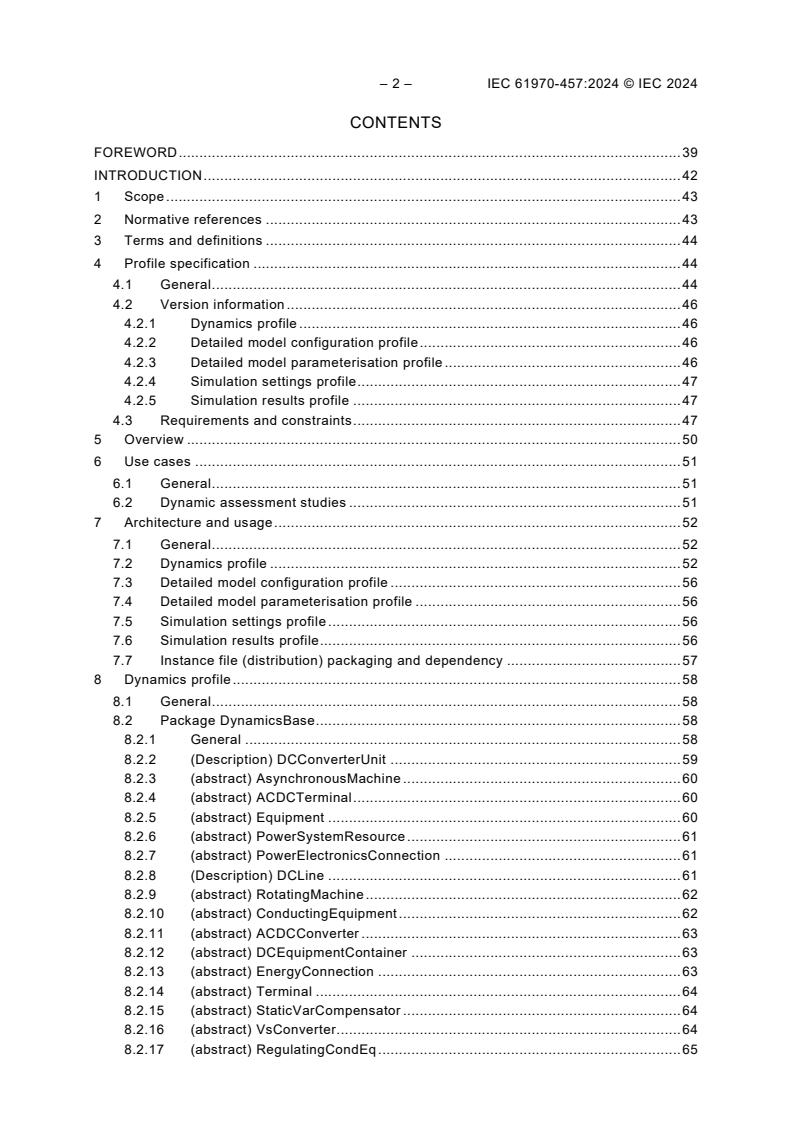
– 2 – IEC 61970-457:2024 © IEC 2024
CONTENTS
FOREWORD . 39
INTRODUCTION . 42
1 Scope . 43
2 Normative references . 43
3 Terms and definitions . 44
4 Profile specification . 44
4.1 General . 44
4.2 Version information . 46
4.2.1 Dynamics profile . 46
4.2.2 Detailed model configuration profile . 46
4.2.3 Detailed model parameterisation profile . 46
4.2.4 Simulation settings profile . 47
4.2.5 Simulation results profile . 47
4.3 Requirements and constraints . 47
5 Overview . 50
6 Use cases . 51
6.1 General . 51
6.2 Dynamic assessment studies . 51
7 Architecture and usage . 52
7.1 General . 52
7.2 Dynamics profile . 52
7.3 Detailed model configuration profile . 56
7.4 Detailed model parameterisation profile . 56
7.5 Simulation settings profile . 56
7.6 Simulation results profile . 56
7.7 Instance file (distribution) packaging and dependency . 57
8 Dynamics profile . 58
8.1 General . 58
8.2 Package DynamicsBase . 58
8.2.1 General . 58
8.2.2 (Description) DCConverterUnit . 59
8.2.3 (abstract) AsynchronousMachine . 60
8.2.4 (abstract) ACDCTerminal . 60
8.2.5 (abstract) Equipment . 60
8.2.6 (abstract) PowerSystemResource . 61
8.2.7 (abstract) PowerElectronicsConnection . 61
8.2.8 (Description) DCLine . 61
8.2.9 (abstract) RotatingMachine . 62
8.2.10 (abstract) ConductingEquipment . 62
8.2.11 (abstract) ACDCConverter . 63
8.2.12 (abstract) DCEquipmentContainer . 63
8.2.13 (abstract) EnergyConnection . 63
8.2.14 (abstract) Terminal . 64
8.2.15 (abstract) StaticVarCompensator . 64
8.2.16 (abstract) VsConverter . 64
8.2.17 (abstract) RegulatingCondEq . 65
8.2.18 (abstract) IdentifiedObject root class . 65
8.2.19 (abstract) ConnectivityNodeContainer . 66
8.2.20 (abstract) ProtectionEquipment . 66
8.2.21 (abstract) EquipmentContainer . 66
8.2.22 (abstract) ShuntCompensator . 67
8.2.23 (abstract) SynchronousMachine . 67
8.2.24 (abstract) CsConverter . 67
8.2.25 (Description) EnergyConsumer . 68
8.3 Package StandardInterconnections . 69
8.3.1 General . 69
8.3.2 RemoteInputSignal . 77
8.3.3 Package WindModels . 78
8.4 Package StandardModels . 85
8.4.1 General . 85
8.4.2 (abstract) DynamicsFunctionBlock . 86
8.4.3 (abstract) RotatingMachineDynamics . 86
8.4.4 Package SynchronousMachineDynamics . 87
8.4.5 Package AsynchronousMachineDynamics . 115
8.4.6 Package TurbineGovernorDynamics . 123
8.4.7 Package TurbineLoadControllerDynamics . 245
8.4.8 Package MechanicalLoadDynamics . 249
8.4.9 Package ExcitationSystemDynamics. 252
8.4.10 Package OverexcitationLimiterDynamics . 388
8.4.11 Package UnderexcitationLimiterDynamics . 402
8.4.12 Package PowerSystemStabilizerDynamics. 414
8.4.13 Package DiscontinuousExcitationControlDynamics . 458
8.4.14 Package PFVArControllerType1Dynamics . 463
8.4.15 Package PFVArControllerType2Dynamics . 467
8.4.16 Package VoltageAdjusterDynamics . 473
8.4.17 Package VoltageCompensatorDynamics . 476
8.4.18 Package WindDynamics . 481
8.4.19 Package WindDynamicsEd2 . 512
8.4.20 Package LoadDynamics. 547
8.4.21 Package HVDCDynamics . 565
8.4.22 Package RelayDynamics . 567
8.4.23 Package StaticVarCompensatorDynamics . 571
8.4.24 Package StatorCurrentLimiterDynamics . 584
8.4.25 Package ShuntCompensatorDynamics . 589
8.4.26 Package StatcomDynamics . 591
8.4.27 Package WECCDynamics . 594
8.4.28 Package IEEE1547Dynamics . 634
8.5 Package UserDefinedModels . 648
8.5.1 General . 648
8.5.2 CSCUserDefined . 649
8.5.3 SVCUserDefined . 650
8.5.4 StatcomUserDefined . 651
8.5.5 VSCUserDefined . 651
8.5.6 WindPlantUserDefined . 652
8.5.7 WindType1or2UserDefined . 653
– 4 – IEC 61970-457:2024 © IEC 2024
8.5.8 WindType3or4UserDefined . 653
8.5.9 SynchronousMachineUserDefined . 654
8.5.10 AsynchronousMachineUserDefined . 655
8.5.11 TurbineGovernorUserDefined . 656
8.5.12 TurbineLoadControllerUserDefined . 657
8.5.13 MechanicalLoadUserDefined . 658
8.5.14 ExcitationSystemUserDefined . 658
8.5.15 OverexcitationLimiterUserDefined . 659
8.5.16 UnderexcitationLimiterUserDefined . 660
8.5.17 PowerSystemStabilizerUserDefined . 660
8.5.18 DiscontinuousExcitationControlUserDefined . 661
8.5.19 PFVArControllerType1UserDefined . 662
8.5.20 VoltageAdjusterUserDefined . 662
8.5.21 PFVArControllerType2UserDefined . 663
8.5.22 VoltageCompensatorUserDefined . 664
8.5.23 StatorCurrentLimiterUserDefined . 664
8.5.24 ShuntCompensatorUserDefined . 665
8.5.25 LoadUserDefined . 666
8.5.26 HVDCInterconnectionUserDefined . 666
8.5.27 RelayUserDefined . 667
8.5.28 ProprietaryParameterDynamics root class . 667
8.6 Package DynamicsDatatypes . 669
8.6.1 General . 669
8.6.2 CurrentFlow datatype . 671
8.6.3 PerCent datatype . 672
8.6.4 ReactivePower datatype . 672
8.6.5 Susceptance datatype . 672
8.6.6 Voltage datatype. 672
8.6.7 ActivePower datatype . 673
8.6.8 AngleDegrees datatype . 673
8.6.9 ApparentPower datatype. 673
8.6.10 Area datatype . 674
8.6.11 Frequency datatype . 674
8.6.12 Length datatype . 674
8.6.13 PU datatype . 674
8.6.14 Seconds datatype . 675
8.6.15 Temperature datatype. 675
8.6.16 VolumeFlowRate datatype . 675
8.6.17 DateTime primitive . 676
8.6.18 Float primitive . 676
8.6.19 Boolean primitive . 676
8.6.20 Date primitive . 676
8.6.21 Integer primitive . 676
8.6.22 String primitive . 676
8.6.23 UnitSymbol enumeration . 676
8.6.24 UnitMultiplier enumeration . 681
8.6.25 SinglePhaseKind enumeration . 682
8.6.26 OverExcitationLimiterInputKind enumeration. 683
8.6.27 InputsST4CKind enumeration . 683
8.6.28 InputsST6CKind enumeration . 683
8.6.29 InputsST7CKind enumeration . 684
8.6.30 VoelInputKind enumeration . 684
8.6.31 VsclInputKind enumeration . 684
8.6.32 VsInputKind enumeration . 684
8.6.33 VuelInputKind enumeration . 685
8.6.34 DroopSignalFeedbackKind enumeration . 685
8.6.35 ExcIEEEST1AUELselectorKind enumeration. 685
8.6.36 ExcREXSFeedbackSignalKind enumeration . 686
8.6.37 ExcST6BOELselectorKind enumeration . 686
8.6.38 ExcST7BOELselectorKind enumeration . 686
8.6.39 ExcST7BUELselectorKind enumeration . 687
8.6.40 FrancisGovernorControlKind enumeration . 687
8.6.41 GenericNonLinearLoadModelKind enumeration . 688
8.6.42 GovHydro4ModelKind enumeration . 688
8.6.43 IfdBaseKind enumeration . 688
8.6.44 InputSignalKind enumeration . 688
8.6.45 RemoteSignalKind enumeration . 689
8.6.46 RotorKind enumeration . 690
8.6.47 StaticLoadModelKind enumeration . 690
8.6.48 SynchronousMachineModelKind enumeration . 690
8.6.49 WindLookupTableFunctionKind enumeration . 691
8.6.50 WindPlantQcontrolModeKind enumeration . 693
8.6.51 WindQcontrolModeKind enumeration . 693
8.6.52 WindUVRTQcontrolModeKind enumeration . 693
8.6.53 WindPlantQcontrolModeKind2 enumeration . 694
8.6.54 WindLookupTableFunctionKind2 enumeration . 694
8.6.55 WindFRTQcontrolModeKind enumeration . 695
8.6.56 WindQcontrolModeKind2 enumeration . 696
9 Detailed Model Configuration Profile . 696
9.1 General . 696
9.2 DetailedModelTypeDynamics . 697
9.3 (abstract) DetailedModelDescriptor . 698
9.4 DetailedModelDescriptorArtifact . 698
9.5 DetailedModelDocumentationArtifact. 699
9.6 (abstract) DynamicsFunctionBlock . 699
9.7 FunctionDescriptor . 700
9.8 (abstract) IdentifiedObject root class . 700
9.9 InputOutputDescriptor . 701
9.10 LimiterDescriptor. 701
9.11 OperatorDescriptor . 702
9.12 ParameterDescriptor . 703
9.13 SignalDescriptor . 703
9.14 LogicalKind enumeration . 704
9.15 EquationLanguageKind enumeration . 704
9.16 OperatorDescriptorKind enumeration . 705
9.17 ConstraintKind enumeration . 705
9.18 ParameterKind enumeration . 705
9.19 XSDDatatypeKind enumeration . 706
– 6 – IEC 61970-457:2024 © IEC 2024
9.20 Integer primitive . 706
9.21 Float primitive . 707
9.22 DateTime primitive . 707
9.23 Date primitive. 707
9.24 String primitive . 707
9.25 Boolean primitive . 707
10 Detailed Model Parameterisation Profile . 707
10.1 General . 707
10.2 Boolean primitive . 708
10.3 (abstract) DetailedModelTypeDynamics . 708
10.4 (abstract) DetailedModelDescriptor . 709
10.5 (abstract) ACDCTerminal root class . 709
10.6 (abstract) IdentifiedObject root class . 709
10.7 ParameterValue root class . 709
10.8 (abstract) PowerSystemResource . 710
10.9 String primitive . 710
10.10 (abstract) DynamicsFunctionBlock . 710
10.11 (abstract) Equipment . 711
10.12 (abstract) ParameterDescriptor . 711
10.13 (Description) SignalDescriptor root class . 711
10.14 DetailedModelDynamics . 712
11 Simulation Settings Profile . 712
11.1 General . 712
11.2 (abstract) ACLineSegment root class . 715
11.3 (abstract) Terminal . 716
11.4 (abstract) Equipment root class . 716
11.5 EquipmentFault . 716
11.6 (abstract) Fault . 717
11.7 FaultCauseType . 718
11.8 LineFault . 718
11.9 (abstract) ACDCTerminal . 719
11.10 ClearSimulationEvent. 719
11.11 (abstract) DetailedModelDescriptor . 719
11.12 (abstract) DynamicsFunctionBlock . 720
11.13 (abstract) IdentifiedObject root class . 720
11.14 ParameterEvent . 721
11.15 PowerFlowSettings . 722
11.16 SignalConfiguration . 724
11.17 (abstract) SignalDescriptor . 724
11.18 SignalRecorder . 724
11.19 SimulationEvents . 725
11.20 SimulationSettings . 725
11.21 FaultImpedance compound . 726
11.22 UnitSymbol enumeration . 727
11.23 UnitMultiplier enumeration . 732
11.24 PhaseCode enumeration . 733
11.25 PhaseConnectedFaultKind enumeration . 734
11.26 ParameterChangeKind enumeration . 734
11.27 PowerFlowAlgorithmKind enumeration . 735
11.28 PowerShiftKind enumeration . 735
11.29 SlackDistributionKind enumeration . 735
11.30 SignalKind enumeration . 736
11.31 Length datatype . 736
11.32 PU datatype . 736
11.33 Reactance datatype . 737
11.34 AngleDegrees datatype . 737
11.35 ActivePower datatype . 737
11.36 ReactivePower datatype . 738
11.37 Seconds datatype . 738
11.38 Resistance datatype . 738
11.39 Float primitive . 738
11.40 Boolean primitive . 738
11.41 DateTime primitive . 739
11.42 Date primitive. 739
11.43 Duration primitive . 739
11.44 Integer primitive . 739
11.45 String primitive . 739
12 Simulation Results Profile . 739
12.1 General . 739
12.2 (abstract) Curve . 740
12.3 CurveData root class . 741
12.4 (abstract) IdentifiedObject root class . 741
12.5 (abstract) SignalConfiguration . 742
12.6 (abstract) SignalRecorder . 742
12.7 (abstract) SimulationEvents . 742
12.8 SimulationResult . 742
12.9 SimulationResultCharacteristic . 743
12.10 (abstract) SimulationSettings . 744
12.11 CurveStyle enumeration . 744
12.12 UnitMultiplier enumeration . 744
12.13 UnitSymbol enumeration . 745
12.14 Float primitive . 751
12.15 String primitive . 751
12.16 IRI primitive . 751
Annex A (normative) Implementation clarifications related to the models inherited from
RotatingMachineDynamics class . 752
Annex B (informative) Examples using IEC 61970-552 serialisation (instance data,
i.e.,non executable code, not a code component) . 754
B.1 Overview. 754
B.2 Standard models . 754
B.3 User-defined models . 760
B.4 Detailed model configuration . 767
B.5 Detailed model parameterisation . 771
B.6 Simulation settings . 772
B.7 Simulation results . 775
Bibliography . 777
Figure 1 – Interconnection diagram for a synchronous machine . 53
– 8 – IEC 61970-457:2024 © IEC 2024
Figure 2 – Standard connections for a synchronous machine . 54
Figure 3 – SynchronousMachineDynamics association . 55
Figure 4 – Profile relationships . 55
Figure 5 – Instance file dependency . 57
Figure 6 – Class diagram DynamicsBase::DynamicsBase . 59
Figure 7 – StandardInterconnectionSynchronousMachine . 69
Figure 8 – StandardInterconnectionSynchronousGeneratorCrossCompound . 70
Figure 9 – StandardInterconnectionAsynchronousMachine . 71
Figure 10 – StandardInterconnectionSingleLoad . 72
Figure 11 – Class diagram StandardInterconnections::
StandardSynchronousMachineInterconnection . 73
Figure 12 – Class diagram StandardInterconnections::
StandardAsynchronousMachineInterconnection . 74
Figure 13 – Class diagram StandardInterconnections::StandardLoadInterconnection . 75
Figure 14 – Class diagram StandardInterconnections::StandardHVDCInterconnection . 76
Figure 15 – Class diagram StandardInterconnections::
StandardStaticVarCompensatorInterconnection . 76
Figure 16 – Class diagram StandardInterconnections::
StandardShuntCompensatorInterconnection . 77
Figure 17 – StandardInterconnectionWindTurbineType1Aand1B . 79
Figure 18 – StandardInterconnectionWindTurbineType2 . 80
Figure 19 – StandardInterconnectionWindTurbineType3 . 81
Figure 20 – StandardInterconnectionWindTurbineType4Aand4B . 82
Figure 21 – Class diagram WindModels::StandardWindType1and2Interconnection . 83
Figure 22 – Class diagram WindModels::StandardWindType3and4Interconnection . 84
Figure 23 – Class diagram SynchronousMachineDynamics::
SynchronousMachineDynamics . 88
Figure 24 – SynchronousGeneratorInterconnectionAndVariables . 89
Figure 25 – SynchronousMotorInterconnectionAndVariables . 90
Figure 26 – SynchronousMachineSaturationParameters . 91
Figure 27 – SynchronousGeneratorMechanicalEquation . 92
Figure 28 – SynchronousMotorMechanicalEquation . 93
Figure 29 – SynchronousGeneratorPhasor . 94
Figure 30 – SynchronousMotorPhasor . 95
Figure 31 – Simplified . 96
Figure 32 – SubtransientRoundRotor . 100
Figure 33 – SubtransientSalientPole . 101
Figure 34 – SubtransientTypeF . 102
Figure 35 – SubtransientTypeJ . 103
Figure 36 – SubtransientRoundRotorSimplified . 104
Figure 37 – SubtransientSalientPoleSimplified . 106
Figure 38 – SubtransientRoundRotorSimplifiedDirectAxis . 108
Figure 39 – SubtransientSal
...
The IEC 61970-457:2024 standard significantly enhances the framework for dynamic model information exchange necessary for power system analysis, focusing on both steady state stability and transient stability assessments. The explicit delineation of the types of models supported-standard models and proprietary user-defined models-enables versatile applications across various power system contexts. A key strength of the IEC 61970-457 standard is its alignment with the Common Information Model (CIM) framework, particularly drawing from IEC 61970-302. This ensures consistency in how dynamic model data is represented and exchanged, which is crucial given the complexity of modern power systems. The reliance on predefined libraries for standard models simplifies the exchange process, making it accessible and efficient for users, while the inclusion of proprietary user-defined models allows for flexibility in accommodating specific vendor requirements. Moreover, the integration of additional profiles like the Detailed Model Configuration profile, Detailed Model Parameterisation profile, Simulation Settings profile, and Simulation Results profile based on the technical advancements from IEC 61970-302:2022 presents a significant leap in the standard's capabilities. These additions cater to detailed modeling needs and improve the comprehensive understanding of system behavior under varied operational scenarios. The scope of IEC 61970-457:2024, therefore, is not only relevant but also imperative as it establishes a structured approach towards exchanging essential dynamic model information, aiding transient analysis tools and ensuring better-informed decision-making processes in energy management systems. The technical revisions from previous editions add further credibility and reliability to the standard, affirming its position as a pivotal resource in the evolving energy sector landscape.
La norme IEC 61970-457:2024 établit une interface standardisée pour l'échange d'informations de modèle dynamique, essentielle pour soutenir l'analyse de la stabilité du système électrique, que ce soit pour la stabilité en régime permanent ou la stabilité transitoire. Son intégration avec le CIM, en particulier à partir de l'IEC 61970-302, renforce son cadre technique et garantit une cohérence dans l'échange d'informations entre les différents modèles du système électrique. L'une des forces majeures de cette norme réside dans sa capacité à faciliter l'échange de modèles dynamiques, tant standards que personnalisés, tout en assurant que les utilisateurs disposent des informations nécessaires concernant le comportement des équipements sans avoir à décrire en temps réel ces modèles. Cela permet une harmonisation et une interopérabilité accrues entre les outils d'analyse dynamique, ce qui est d'une importance capitale dans un environnement énergétique en rapide évolution. Le document spécifie non seulement les types d'équipements de contrôle associés, mais il définit également comment ces modèles dynamiques doivent être reliés à d'autres profils standards tels que ceux de l'IEC 61970-452 et IEC 61970-456. Cette interconnexion nécessaire souligne sa pertinence dans la mise en œuvre pratique de l'analyse de la stabilité du système énergétique. Les changements techniques notables apportés par cette seconde édition, notamment la prise en charge complète des systèmes d'excitation (norme IEEE 421.5-2016) et l'incorporation de modèles de turbines éoliennes et de stockage, enrichissent davantage l'éventail de fonctionnalités de la norme. De plus, l'amélioration apportée à l'approche des modèles définis par les utilisateurs permettra une modélisation plus détaillée, ce qui est essentiel pour des analyses de stabilité robustes. En somme, la norme IEC 61970-457:2024 est cruciale pour améliorer la qualité des échanges d'informations dynamiques au sein des systèmes de gestion de l'énergie, tout en garantissant la fiabilité des analyses qui en découlent. Elle représente un pas en avant significatif vers une meilleure intégration des outils d'analyse au sein des infrastructures énergétiques modernes.
IEC 61970-457:2024は、エネルギー管理システムアプリケーションプログラムインターフェース(EMS-API)の一部であり、ダイナミクスプロファイルに関する標準的なインターフェースを規定しています。この標準は、電力システムの定常状態の安定性(小信号安定性)および/または過渡安定性を分析するために必要な動的モデル情報の交換をサポートするものであり、そのスコープは明確且つ重要です。 このドキュメントは、動的研究の一部として交換される必要がある動的モデル情報、具体的には各制御装置に関連する電力システム機器のタイプ、説明、およびパラメーターを含んでいます。IEC 61970-452およびIEC 61970-456に基づく他の標準プロファイルに依存しており、これにより電力システムのモデル交換の範囲が明確に示されています。特に、定常状態仮説や定常状態の解決方法についても詳細が示されており、これにより使用者は必要なデータ要求を適切に満たすことができます。 特筆すべきは、標準モデルとユーザー定義モデルの両方のインターフェースが提供されている点です。標準モデルでは、予め定義されたライブラリから動的挙動を示す要素が簡略化されており、ユーザーはモデルの名前とその挙動を記述するために必要な属性のみを交換します。一方、ユーザー定義モデルは、ベンダーやユーザーのプロプライエタリデバイスを表現するためのパラメーターの交換を可能にし、標準モデルとの接続も一貫しています。この柔軟性は、実際のアプリケーションにおいて多様なニーズに対応するための強みとなっています。 さらに、この文書はIEC 61970-302に基づき、標準動的モデルの説明やその機能ブロック図の互換性に関する詳細を定義しており、ソフトウェアアプリケーションが事前にモデル情報を保存していることを前提としています。そのため、リアルタイムでの交換が必ずしも必要ではないという設計理念も強調されています。 この第二版は、2021年に発行された初版をキャンセルおよび置き換えるものであり、多くの技術的変更が含まれています。特に、IEC 61970-302において発見された問題が修正されており、IEEE関連の文書にも対応が加えられています。これにより、新たにガス、蒸気、水力タービンなどのモデルが追加され、ユーザー定義モデルアプローチも拡張されています。また、シミュレーション結果の交換を可能にするモデルも追加されており、より包括的なデータ交換のフレームワークが提供されています。 全体として、IEC 61970-457:2024は、電力システムの動的解析を行う上で不可欠な標準であり、多様なモデル交換を円滑に行うための強力な基盤を提供しています。これにより、電力システムの運用と管理における効率を高め、技術の進展に対応した柔軟性を誇る標準となっています。
Die Norm IEC 61970-457:2024 stellt eine entscheidende Erweiterung im Bereich der Energiemanagementsysteme dar, indem sie eine standardisierte Schnittstelle für den Austausch dynamischer Modellinformationen definiert. Ihre Anwendbarkeit konzentriert sich auf die Unterstützung der Analyse der stationären Stabilität (kleine Signalstabilität) und/oder transienten Stabilität von Stromversorgungssystemen. Dies ist besonders relevant für Experten, die an der Optimierung und Sicherheit von Stromnetzen arbeiten. Zu den Stärken der IEC 61970-457:2024 gehört die klare Definition des Umfangs des Austauschs von dynamischen Modellen. Die Norm spezifiziert, dass ausschließlich die für dynamische Studien erforderlichen Modellinformationen übertragen werden, einschließlich der Typen, Beschreibungen und Parameter von Steuergeräten, die mit entsprechenden Komponenten des Stromsystems verknüpft sind. Dies sorgt für eine gezielte und bedarfsgerechte Datenkommunikation und minimiert den Aufwand, der bei der Verarbeitung nicht relevanter Daten entsteht. Die Norm integriert sich nahtlos in die bestehenden IEC 61970-452 und IEC 61970-456 Profile. Das bedeutet, dass sie nicht isoliert betrachtet werden kann, sondern dass ihr Zusammenwirken mit den statischen Übertragungsnetzmodellen und den zugehörigen stabilen Lösungen ausschlaggebend ist. Diese Interoperabilität erhöht die Relevanz der Norm erheblich, da sie den Anforderungen moderner transienter Analysesoftware gerecht wird. Ein weiterer positiver Aspekt ist die Möglichkeit, sowohl Standardmodelle als auch proprietäre benutzerdefinierte Modelle auszutauschen. Dadurch wird eine hohe Flexibilität gewährleistet, da Nutzer die Parametersätze ihrer spezifischen Geräte austauschen können, auch wenn diese nicht ausdrücklich in der Norm beschrieben sind. Diese Schnittstellenoption fördert die Innovation und Zusammenarbeit zwischen verschiedenen Anbietern und Anwendungen. Die überarbeitete zweite Auflage berücksichtigt auch zahlreiche technische Änderungen, die sich aus vorherigen Ausgaben ergeben haben. Dazu zählen bedeutende Anpassungen im Hinblick auf die Standards von IEEE und die Integration neuer Funktionsmodelle, wie Wind-, Gas- und Dampfturbinen. Diese Updates erhöhen die praktischen Anwendbarkeit der Norm und stellen sicher, dass sie mit den neuesten Entwicklungen in der Energiebranche Schritt hält. Insgesamt stärkt die IEC 61970-457:2024 die Analysefähigkeit und Stabilität von Netzbetriebsmodellen durch die Bereitstellung eines strukturierten und aktuellen Rahmens für den Austausch dynamischer Informationen. Diese Norm ist von hoher Relevanz für Fachleute im Energiebereich und bietet eine wertvolle Grundlage für die Weiterentwicklung von Energiemanagementsystemen.
IEC 61970-457:2024 표준은 에너지 관리 시스템 애플리케이션 프로그램 인터페이스(EMS-API) 중 다이내믹 프로파일에 대한 명확한 기준을 제시하고 있습니다. 이 문서의 범위는 전력 시스템 또는 그 일부의 정상 상태 안정성(소 신호 안정성) 및/또는 과도 안정성 분석에 필요한 다이내믹 모델 정보를 전송하기 위한 표준 인터페이스를 정의하는 것입니다. 보다 구체적으로, 이 다이내믹 모델 정보의 스키마는 CIM에서 직접 파생된 것으로, IEC 61970-302에 기반하고 있습니다. 이 표준의 주요 강점 중 하나는 전력 시스템 네트워크 모델의 정상 상태 솔루션에 포함된 각 제어 장비와 관련된 모델의 유형, 설명 및 매개변수를 포함한 정보의 통신을 지원한다는 것입니다. 따라서 IEC 61970-452 및 IEC 61970-456의 다른 표준 프로파일과의 의존성을 통해, 이 문서에서는 과도 분석 도구의 데이터 요구 사항을 충족하기 위한 효율적인 데이터 교환이 가능하게 됩니다. IEC 61970-457:2024 문서에서는 다음과 같은 유형의 다이내믹 모델 교환을 지원합니다. 첫째, 표준 모델은 전력 시스템의 요소들이 동적으로 동작하는 방식을 나타내는 간소화된 접근 방식입니다. 둘째, 사용자 정의 모델의 경우, 특정 공급업체의 장치에 대한 매개변수를 교환할 수 있는 기능을 제공합니다. 이 두 가지 모델 간의 연결은 표준 모델 교환에서 설명된 것과 동일합니다. 이 문서는 IEC 61970-302를 기반으로 하여 표준 다이내믹 모델의 설명, 기능 블록 다이어그램 및 정적 네트워크 모델과의 연결 방식을 정의하고 있습니다. 전반적으로, 이 표준의 출시는 다이내믹 모델 정보의 효율적인 교환을 촉진하며, 전력 시스템의 다양한 구성 요소와의 호환성을 보장하여 현대 에너지 관리 시스템의 발전에 기여합니다. IEC 61970-457:2024는 이전 판의 기술 개정을 포함하며, IEEE 및 기타 관련 표준에서 발생한 주요 기술적 변화를 반영합니다. 이로 인해, 이 표준은 다이내믹 모델 교환을 위한 강력한 기반을 제공하며, 실제 응용 프로그램에 대한 요구에 적합한 방식으로 발전해 나가고 있습니다.
Questions, Comments and Discussion
Ask us and Technical Secretary will try to provide an answer. You can facilitate discussion about the standard in here.
Loading comments...