

IEC 61307:2011
(Main)Industrial microwave heating installations - Test methods for the determination of power output
General Information
- Abstract
IEC 61307:2011 specifies test methods for the determination of the available microwave output power and the efficiency of frequency conversion from the electrical input in industrial microwave heating installations. This standard also specifies test methods for assessing the microwave power deposition in the microwave workload - the microwave workload power, in microwave-only installations. This standard is applicable to industrial microwave heating equipment and installations in the frequency range from 300 MHz to 300 GHz. This third edition cancels and replaces the second edition published in 2006. It constitutes a technical revision. This edition includes the following significant technical changes with respect to the previous edition:
a) it covers how to measure not only the microwave power output of all typical equipment designs, but also the system efficiency, including the standby and hibernation modes;
b) the handling of the former A and B types of equipment is replaced by measurements of the available microwave power output and microwave workload power, respectively.
- Status
- Published
- Publication Date
- 17-May-2011
- Technical Committee
- TC 27 - Industrial electroheating and electromagnetic processing
- Drafting Committee
- MT 23 - TC 27/MT 23

Overview
IEC 61307:2011 is the international standard that specifies test methods for determining the available microwave output power and the efficiency of frequency conversion from electrical input in industrial microwave heating installations. Applicable to microwave heating equipment and installations operating within the frequency range of 300 MHz to 300 GHz, it provides standardized approaches for measuring microwave power output and system efficiency, including standby and hibernation modes. The standard also details procedures for assessing microwave power deposition in the workload-a key factor for evaluating overall equipment performance.
This third edition of IEC 61307 replaces its 2006 predecessor, introducing significant updates, notably the measurement protocols for all typical equipment designs and the replacement of the former A and B equipment type designation with direct measurements of power output and workload power.
Key Topics
- Microwave Power Measurement Methods: The standard describes three principal approaches for quantifying microwave power output, tailored to different equipment configurations and operating frequencies.
- Available microwave power output: Measured at the output port of the microwave generator assembly.
- Microwave workload power: Determined via calorimetric methods, assessing the actual power deposited into the workload.
- Effective microwave power and efficiency: Evaluated using substitute liquid loads when direct measurement is impractical.
- Calorimetric Power Measurement: Applies to both direct water flow measurements and dummy load testing, ensuring consistent and accurate determination of power absorbed by the medium.
- Efficiency Determination: Stipulates clear guidelines on calculating electrical efficiency, by comparing the microwave output to total electric input, considering ancillary systems such as power supplies and control circuits.
- Standby and Hibernation Modes: The standard enforces the measurement of power consumption in non-operational states to promote energy-efficient operation and comprehensive performance assessment.
- Terminology and Definitions: IEC 61307 standardizes critical terminology related to industrial microwave heating, such as microwave applicator, workload, load, and generator assembly, fostering clarity across industries.
Applications
IEC 61307:2011 has practical applications in a broad range of industries utilizing industrial microwave heating technology, including:
- Materials Processing: Ensuring reliable operation and power output for processes such as drying, sintering, curing of composites, ceramics, and polymers.
- Food and Beverage Industry: Assuring consistent heating and processing by accurately measuring microwave power deposited in food products.
- Pharmaceutical Manufacturing: Verifying the effectiveness and repeatability of microwave sterilization and drying processes.
- Research and Development: Establishing reproducible test methods for the development and validation of new microwave heating equipment.
- Equipment Maintenance and Quality Control: Providing standard procedures for regular performance verification, ensuring compliance with industry safety and efficiency requirements.
Accurate power measurement and efficiency assessment, as described in this standard, help manufacturers, operators, and regulators ensure the optimal and safe use of industrial microwave heating systems.
Related Standards
For comprehensive compliance and safety, IEC 61307 should be used alongside related international standards, including:
- IEC 60519-6: Safety in electroheat installations – Specifications for safety in industrial microwave heating equipment
- IEC 60335-2-25: Particular requirements for household microwave ovens
- IEC 60335-2-90: Particular requirements for commercial microwave ovens
- IEC 60705: Methods for measuring performance of household microwave ovens
- IEC 61010-2-010: Safety requirements for laboratory heating equipment
Referencing these standards ensures holistic safety, performance, and interoperability in both industrial and commercial microwave heating applications.
Keywords: IEC 61307, industrial microwave heating, microwave power output, efficiency measurement, calorimetric methods, microwave workload power, frequency conversion, power consumption, industrial standards, test methods, IEC standards.
Relations
- Effective Date
- 31-Jan-2025
- Effective Date
- 05-Sep-2023
Get Certified
Connect with accredited certification bodies for this standard

DVS-ZERT GmbH
German welding certification society.
CARES (UK Certification Authority for Reinforcing Steels)
UK certification for reinforcing steels and construction.
EWF/IIW (European/International Welding Federation)
International welding personnel certification.
Sponsored listings
Frequently Asked Questions
IEC 61307:2011 is a standard published by the International Electrotechnical Commission (IEC). Its full title is "Industrial microwave heating installations - Test methods for the determination of power output". This standard covers: IEC 61307:2011 specifies test methods for the determination of the available microwave output power and the efficiency of frequency conversion from the electrical input in industrial microwave heating installations. This standard also specifies test methods for assessing the microwave power deposition in the microwave workload - the microwave workload power, in microwave-only installations. This standard is applicable to industrial microwave heating equipment and installations in the frequency range from 300 MHz to 300 GHz. This third edition cancels and replaces the second edition published in 2006. It constitutes a technical revision. This edition includes the following significant technical changes with respect to the previous edition: a) it covers how to measure not only the microwave power output of all typical equipment designs, but also the system efficiency, including the standby and hibernation modes; b) the handling of the former A and B types of equipment is replaced by measurements of the available microwave power output and microwave workload power, respectively.
IEC 61307:2011 specifies test methods for the determination of the available microwave output power and the efficiency of frequency conversion from the electrical input in industrial microwave heating installations. This standard also specifies test methods for assessing the microwave power deposition in the microwave workload - the microwave workload power, in microwave-only installations. This standard is applicable to industrial microwave heating equipment and installations in the frequency range from 300 MHz to 300 GHz. This third edition cancels and replaces the second edition published in 2006. It constitutes a technical revision. This edition includes the following significant technical changes with respect to the previous edition: a) it covers how to measure not only the microwave power output of all typical equipment designs, but also the system efficiency, including the standby and hibernation modes; b) the handling of the former A and B types of equipment is replaced by measurements of the available microwave power output and microwave workload power, respectively.
IEC 61307:2011 is classified under the following ICS (International Classification for Standards) categories: 25.180.10 - Electric furnaces. The ICS classification helps identify the subject area and facilitates finding related standards.
IEC 61307:2011 has the following relationships with other standards: It is inter standard links to IEC 61307:2026, IEC 61307:2006. Understanding these relationships helps ensure you are using the most current and applicable version of the standard.
IEC 61307:2011 is available in PDF format for immediate download after purchase. The document can be added to your cart and obtained through the secure checkout process. Digital delivery ensures instant access to the complete standard document.
Standards Content (Sample)
IEC 61307 ®
Edition 3.0 2011-05
INTERNATIONAL
STANDARD
NORME
INTERNATIONALE
Industrial microwave heating installations – Test methods for the determination
of power output
Installations industrielles de chauffage à hyperfréquence – Méthodes d'essai
pour la determination de la puissance de sortie
All rights reserved. Unless otherwise specified, no part of this publication may be reproduced or utilized in any form or by
any means, electronic or mechanical, including photocopying and microfilm, without permission in writing from either IEC or
IEC's member National Committee in the country of the requester.
If you have any questions about IEC copyright or have an enquiry about obtaining additional rights to this publication,
please contact the address below or your local IEC member National Committee for further information.
Droits de reproduction réservés. Sauf indication contraire, aucune partie de cette publication ne peut être reproduite
ni utilisée sous quelque forme que ce soit et par aucun procédé, électronique ou mécanique, y compris la photocopie
et les microfilms, sans l'accord écrit de la CEI ou du Comité national de la CEI du pays du demandeur.
Si vous avez des questions sur le copyright de la CEI ou si vous désirez obtenir des droits supplémentaires sur cette
publication, utilisez les coordonnées ci-après ou contactez le Comité national de la CEI de votre pays de résidence.
IEC Central Office
3, rue de Varembé
CH-1211 Geneva 20
Switzerland
Email: inmail@iec.ch
Web: www.iec.ch
About the IEC
The International Electrotechnical Commission (IEC) is the leading global organization that prepares and publishes
International Standards for all electrical, electronic and related technologies.
About IEC publications
The technical content of IEC publications is kept under constant review by the IEC. Please make sure that you have the
latest edition, a corrigenda or an amendment might have been published.
Catalogue of IEC publications: www.iec.ch/searchpub
The IEC on-line Catalogue enables you to search by a variety of criteria (reference number, text, technical committee,…).
It also gives information on projects, withdrawn and replaced publications.
IEC Just Published: www.iec.ch/online_news/justpub
Stay up to date on all new IEC publications. Just Published details twice a month all new publications released. Available
on-line and also by email.
Electropedia: www.electropedia.org
The world's leading online dictionary of electronic and electrical terms containing more than 20 000 terms and definitions
in English and French, with equivalent terms in additional languages. Also known as the International Electrotechnical
Vocabulary online.
Customer Service Centre: www.iec.ch/webstore/custserv
If you wish to give us your feedback on this publication or need further assistance, please visit the Customer Service
Centre FAQ or contact us:
Email: csc@iec.ch
Tel.: +41 22 919 02 11
Fax: +41 22 919 03 00
A propos de la CEI
La Commission Electrotechnique Internationale (CEI) est la première organisation mondiale qui élabore et publie des
normes internationales pour tout ce qui a trait à l'électricité, à l'électronique et aux technologies apparentées.
A propos des publications CEI
Le contenu technique des publications de la CEI est constamment revu. Veuillez vous assurer que vous possédez
l’édition la plus récente, un corrigendum ou amendement peut avoir été publié.
Catalogue des publications de la CEI: www.iec.ch/searchpub/cur_fut-f.htm
Le Catalogue en-ligne de la CEI vous permet d’effectuer des recherches en utilisant différents critères (numéro de référence,
texte, comité d’études,…). Il donne aussi des informations sur les projets et les publications retirées ou remplacées.
Just Published CEI: www.iec.ch/online_news/justpub
Restez informé sur les nouvelles publications de la CEI. Just Published détaille deux fois par mois les nouvelles
publications parues. Disponible en-ligne et aussi par email.
Electropedia: www.electropedia.org
Le premier dictionnaire en ligne au monde de termes électroniques et électriques. Il contient plus de 20 000 termes et
définitions en anglais et en français, ainsi que les termes équivalents dans les langues additionnelles. Egalement appelé
Vocabulaire Electrotechnique International en ligne.
Service Clients: www.iec.ch/webstore/custserv/custserv_entry-f.htm
Si vous désirez nous donner des commentaires sur cette publication ou si vous avez des questions, visitez le FAQ du
Service clients ou contactez-nous:
Email: csc@iec.ch
Tél.: +41 22 919 02 11
Fax: +41 22 919 03 00
IEC 61307 ®
Edition 3.0 2011-05
INTERNATIONAL
STANDARD
NORME
INTERNATIONALE
Industrial microwave heating installations – Test methods for the determination
of power output
Installations industrielles de chauffage à hyperfréquence – Méthodes d'essai
pour la determination de la puissance de sortie
INTERNATIONAL
ELECTROTECHNICAL
COMMISSION
COMMISSION
ELECTROTECHNIQUE
PRICE CODE
INTERNATIONALE
CODE PRIX N
ICS 25.180.10 ISBN 978-2-88912-499-2
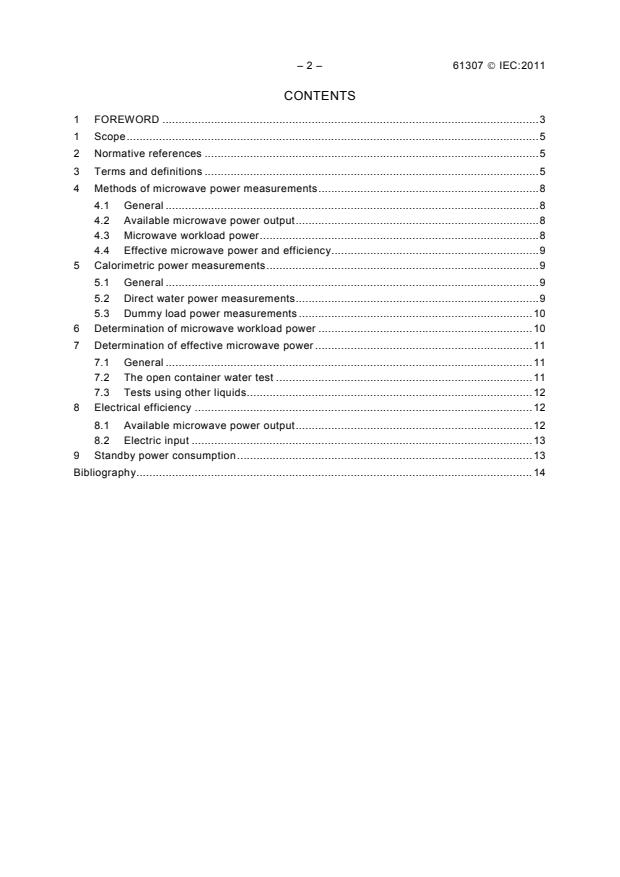
– 2 – 61307 IEC:2011
CONTENTS
1 FOREWORD . 3
1 Scope . 5
2 Normative references . 5
3 Terms and definitions . 5
4 Methods of microwave power measurements . 8
4.1 General . 8
4.2 Available microwave power output . 8
4.3 Microwave workload power . 8
4.4 Effective microwave power and efficiency . 9
5 Calorimetric power measurements . 9
5.1 General . 9
5.2 Direct water power measurements . 9
5.3 Dummy load power measurements . 10
6 Determination of microwave workload power . 10
7 Determination of effective microwave power . 11
7.1 General . 11
7.2 The open container water test . 11
7.3 Tests using other liquids . 12
Electrical efficiency . 12
8.1 Available microwave power output . 12
8.2 Electric input . 13
9 Standby power consumption . 13
Bibliography . 14
61307 IEC:2011 – 3 –
INTERNATIONAL ELECTROTECHNICAL COMMISSION
____________
INDUSTRIAL MICROWAVE HEATING INSTALLATIONS –
TEST METHODS FOR THE DETERMINATION
OF POWER OUTPUT
FOREWORD
1) The International Electrotechnical Commission (IEC) is a worldwide organization for standardization comprising
all national electrotechnical committees (IEC National Committees). The object of IEC is to promote
international co-operation on all questions concerning standardization in the electrical and electronic fields. To
this end and in addition to other activities, IEC publishes International Standards, Technical Specifications,
Technical Reports, Publicly Available Specifications (PAS) and Guides (hereafter referred to as “IEC
Publication(s)”). Their preparation is entrusted to technical committees; any IEC National Committee interested
in the subject dealt with may participate in this preparatory work. International, governmental and non-
governmental organizations liaising with the IEC also participate in this preparation. IEC collaborates closely
with the International Organization for Standardization (ISO) in accordance with conditions determined by
agreement between the two organizations.
2) The formal decisions or agreements of IEC on technical matters express, as nearly as possible, an international
consensus of opinion on the relevant subjects since each technical committee has representation from all
interested IEC National Committees.
3) IEC Publications have the form of recommendations for international use and are accepted by IEC National
Committees in that sense. While all reasonable efforts are made to ensure that the technical content of IEC
Publications is accurate, IEC cannot be held responsible for the way in which they are used or for any
misinterpretation by any end user.
4) In order to promote international uniformity, IEC National Committees undertake to apply IEC Publications
transparently to the maximum extent possible in their national and regional publications. Any divergence
between any IEC Publication and the corresponding national or regional publication shall be clearly indicated in
the latter.
5) IEC itself does not provide any attestation of conformity. Independent certification bodies provide conformity
assessment services and, in some areas, access to IEC marks of conformity. IEC is not responsible for any
services carried out by independent certification bodies.
6) All users should ensure that they have the latest edition of this publication.
7) No liability shall attach to IEC or its directors, employees, servants or agents including individual experts and
members of its technical committees and IEC National Committees for any personal injury, property damage or
other damage of any nature whatsoever, whether direct or indirect, or for costs (including legal fees) and
expenses arising out of the publication, use of, or reliance upon, this IEC Publication or any other IEC
Publications.
8) Attention is drawn to the Normative references cited in this publication. Use of the referenced publications is
indispensable for the correct application of this publication.
9) Attention is drawn to the possibility that some of the elements of this IEC Publication may be the subject of
patent rights. IEC shall not be held responsible for identifying any or all such patent rights.
International Standard IEC 61307 has been prepared by IEC technical committee 27:
Industrial electroheating.
This third edition cancels and replaces the second edition published in 2006. It constitutes a
technical revision .
This edition includes the following significant technical changes with respect to the previous
edition:-
a) it covers how to measure not only the microwave power output of all typical equipment
designs, but also the system efficiency, including the standby and hibernation modes;
b) the handling of the former A and B types of equipment is replaced by measurements of the
available microwave power output and microwave workload power, respectively.
– 4 – 61307 IEC:2011
The text of this standard is based on the following documents:
CDV Report on voting
27/761/CDV 27/782/RVC
Full information on the voting for the approval of this standard can be found in the report on
voting indicated in the above table.
This publication has been drafted in accordance with the ISO/IEC Directives, Part 2.
The committee has decided that the contents of this publication will remain unchanged until
the stability date indicated on the IEC web site under "http://webstore.iec.ch" in the data
related to the specific publication. At this date, the publication will be
• reconfirmed,
• withdrawn,
• replaced by a revised edition, or
• amended.
61307 IEC:2011 – 5 –
INDUSTRIAL MICROWAVE HEATING INSTALLATIONS –
TEST METHODS FOR THE DETERMINATION
OF POWER OUTPUT
1 Scope
This International Standard specifies test methods for the determination of the available
microwave output power and the efficiency of frequency conversion from the electrical input in
industrial microwave heating installations.
This standard also specifies test methods for assessing the microwave power deposition in
the microwave workload – the microwave workload power, in microwave-only installations.
This standard is applicable to industrial microwave heating equipment and installations in the
frequency range from 300 MHz to 300 GHz.
This standard relates to industrial microwave heating equipment operating under normal load.
This standard does not apply to appliances for household and similar use (covered by
IEC 60335-2-25), commercial use (covered by IEC 60335-2-90) or laboratory use (covered by
IEC 61010-2-010).
2 Normative references
The following referenced documents are indispensable for the application of this document.
For dated references, only the edition cited applies. For undated references, the latest edition
of the referenced document (including any amendments) applies.
IEC 60050-221:1990, International Electrotechnical Vocabulary – Chapter 221: Magnetic
materials and components
Amendment 1(1993)
Amendment 2 (1999)
Amendment 3 (2007)
IEC 60050-841:2004, International Electrotechnical Vocabulary – Part 841: Industrial
electroheat
IEC 60050-726:1982, International Electrotechnical Vocabulary – Chapter 726: Transmission
lines and waveguides
IEC 60519-6, Safety in electroheat installations – Part 6: Specifications for safety in industrial
microwave heating equipment
3 Terms and definitions
For the purposes of this document, the terms and definitions of IEC 60519-6 and
IEC 60050-841 as well as the following apply.
3.1
calorimetric power meter
calorimeter power meter
power meter which uses temperature rise in a medium as a means of measuring absorbed
power
– 6 – 61307 IEC:2011
NOTE The medium, typically water, is either the power-absorbing agent or has heat transferred to it from a
power-absorbing element.
[IEC 60050-726:1982, 726-21-10]
3.2
circulator
passive device having three or more ports in which the power entering any port is transmitted
to the next port according to a given order of sequence
NOTE The typical forms are junction circulators [IEC 60050-221:1990, 221-05-14] of the T junction
[IEC 60050-726:1982, 726-17-12] or Y junction [IEC 60050-726:1982, 726-17-13].
[IEC 60050-221:1990, 221-05-11, modified]
3.3
cross coupling (between generators)
appearance of undesired microwave energy in a microwave generator or the transmission line
output port of a microwave generator assembly caused by one or several other microwave
generators or microwave generator assemblies
3.4
electrical efficiency of microwave heating equipment
quotient between the available microwave power output and the electric input to the mains
frequency power supply or microwave generator assembly, at power settings for normal
operation
3.5
insertion loss
loss resulting from the insertion of a network into a transmission system, the ratio of the
power delivered to that part of the system following the network, before insertion of the
network, to the power delivered to that same part after insertion of the network
NOTE The insertion loss is generally expressed in decibels.
[IEC 60050-726:1982, 726-06-07]
3.6
isolation (of a three-port circulator)
reverse attenuation between the main output port and main input port, with all ports being
impedance matched
NOTE 1 The isolation should not be confused with the reverse loss occurring between adjacent ports.
NOTE 2 This is a special case of cross coupling of a circulator [IEC 60050-726:1982, 726-16-06].
3.7
means of access
all structural features of the microwave heating equipment which can be opened or removed
without the use of a tool to provide access to the interior of the microwave applicator or
microwave cavity
3.8
microwave applicator
structure which applies the microwave energy to the load
[IEC 60050-841:2004, 841-29-11]
3.9
microwave cavity
space enclosed by inner metal walls and a door or an access opening and in which the
microwave load is placed
61307 IEC:2011 – 7 –
[IEC 60050-841:2004, 841-29-19, modified]
3.10
microwave enclosure
structure which is intended to confine the microwave energy to a defined region
NOTE Examples are a cavity, door seals and waveguides.
[IEC 60050-841:2004, 841-29-20]
3.11
microwave generator
source used to produce electromagnetic energy in the frequency range from 300 MHz to
300 GHz
[IEC 60050-841:2004, 841-29-16]
NOTE In the context of this standard, the microwave generator is only the component where the frequency
conversion takes place. See 3.2.
3.12
microwave generator assembly
part of the microwave heating equipment comprising an apparatus producing microwave
energy and its associated transmission line output port
NOTE 1 The assembly includes the microwave generator, the power supply of the microwave generator and its ancillary
and control circuits. If a circulator is used, it is also included.
NOTE 2 Microwave heating equipment containing a microwave generator assembly was classified as Type A in
earlier editions of this standard; equipment where a transmission line output port is not available was classified as
Type B.
3.13
microwave heating equipment
assembly of electric and mechanical devices intended for the transfer of microwave energy to
the microwave load and comprising in general power supplies, microwave generators or
microwave generator assemblies with cooling arrangements and circulators if used,
microwave applicators or cavities with ventilation arrangements if used, interconnecting
cables and waveguides, control circuitry, and means for transporting the microwave load if
used
[IEC 60050-841:2004, 841-29-06, modified]
3.14
microwave load
objects introduced into the applicator or cavity, or put in the intended position near an open
applicator
[IEC 60050-841:2004, 841-29-12]
3.15
microwave transparency
property of a material having negligible absorption and reflection of microwaves
NOTE The relative permittivity of a microwave transparent material is usually less than 7 and the loss factor is
usually less than 0,015. However, if the microwave workload has a low loss factor, more stringent requirements
apply.
[IEC 60050-841:2004, 841-29-14, modified]
3.16
microwave workload
object to be treated by microwaves
– 8 – 61307 IEC:2011
[IEC 60050-841:2004, 841-29-13]
NOTE Workload containers are not a part of the microwave workload but of the microwave load.
3.17
normal load
nominal microwave load at full microwave output power as specified by the manufacturer's
documentation
3.18
normal operation
range of microwave output power with the normal loads in allowable working conditions of the
microwave heating equipment, as specified by the manufacturer's documentation
3.19
standby (mode of) operation
condition allowing immediate normal operation
NOTE 1 This mode typically occurs immediately before and after normal operation.
NOTE 2 If the treatment of the workload requires non-ambient conditions such as elevated temperature, this is
maintained.
NOTE 3 By "immediate" is meant a time period consistent with normal loading, unloading or replacement of the
workload.
NOTE 4 The magnetron cathode heater circuit may be switched on in this mode of operation.
4 Methods of microwave power measurements
4.1 General
Three different methods are described. Their applicability depends on the microwave
frequency and power level, and if the equipment comprises a microwave generator assembly.
NOTE 1 Since the wavelength of frequencies above about 20 GHz is very short, the power deposition may be of
the irradiation type with a short penetration depth. Water may not be useable with the calorimetric method, and
some of the methods of measuring microwave power deposition in this standard may not be applicable. In the low
end of the microwave band at 300 MHz, the microwave absorption capability of loads may be highly variable during
the heating process, large load masses may be needed, and representative artificial liquid loads for calorimetry
may be difficult to use.
NOTE 2 There are variabilities of the microwave absorption capability of microwave loads, and in particular the
unevenness of heating of these. Therefore, the microwave workload power data or the effective microwave power
data with a substitute liquid load obtained according to this standard should be treated with care. Power data is,
however, important and objective factors related to the overall energy utilisation efficiency are by that also a
performance factor.
NOTE 3 A method for measuring the microwave power output in household microwave ovens is specified in
IEC 60705. It uses a large water load, with compensation of heat capacity of the container and of heat exchange
with ambient. Technically, the method gives what is defined as the available microwave power output in this
standard.
4.2 Available microwave power output
Measurements at the microwave generator assembly output port give the available microwave
power output (see Clause 5).
4.3 Microwave workload power
Calorimetric measurements in a normal load, including the power losses in any containers for
the microwave workload, give the microwave workload power (see Clause 6).
61307 IEC:2011 – 9 –
This is the amount of power required to achieve an aimed enthalpy change in the microwave
workload within a fixed period of time. It depends on the type of microwave workload, the
change of its complex permittivity with temperature, as well as any workload containers or
supports, and the design of the microwave applicator or cavity.
The available microwave power output is always larger than the microwave workload power,
due to some or all of the following power loss mechanisms:
– impedance mismatching of the microwave generator;
– microwave enclosure metal surface losses;
– absorption by imperfect microwave transparency of containers for the workload and any
other ancillary objects in the microwave enclosure;
– microwave leakage out of the microwave enclosure;
– power losses due to cross coupling.
4.4 Effective microwave power and efficiency
Typically, actual microwave workloads are not well suited for calorimetric measurements.
Liquid substitutes are then used in calorimetric measurements, and give the effective
microwave power (see Clause 7 and Clause 8).
5 Calorimetric power measurements
5.1 General
Only the principles are outlined in this standard. The applied measurement instrumentation
and use shall conform to known engineering techniques. Water is the directly or indirectly
power-absorbing substance.
5.2 Direct water power measurements
It is important that any directly power-absorbing water has a microwave absorption capability
and load geometry which provides a good and essentially temperature independent
impedance matching over the actually used temperature interval. A sodium chloride solution
with specific conductivity between 200 μS/cm and 600 μS/cm shall be used for the direct
absorption at frequencies below 900 MHz.
The power meter typically consists of a waveguide section, equipped with a microwave
transparent tube through which the water can flow. The water shall be thoroughly mixed. The
recommended water flow rate is about 1 l/min for each kilowatt but not less than 0,5 l/min.
The difference between the outlet and inlet temperature shall be at least 10 K.
The inlet temperature of the water shall not exceed 35 °C, and the outlet temperature shall
not exceed 60 °C. However, for microwave power levels less than 3 kW, these temperatures
should be on both sides of the ambient temperature, to reduce heat loss errors.
Under operating conditions, the voltage standing wave ratio (VSWR) as measured by a
network analyser with a matched waveguide transition or an equivalent measurement device
replacing the microwave generator assembly and within the water temperature interval
specified above, shall not exceed 1,25.
If a circulator is used, its isolation shall be greater than 20 dB and the impedance matching of
the circulator with dissipative termination is to comply with this subclause.
The water flow shall be monitored, for instance by means of flow interlock switches, to avoid
the formation of steam which may lead to eruption.
– 10 – 61307 IEC:2011
The power dissipated in the water is measured directly or compared with a calibrated heated
water standard.
The measurement shall be carried out only when the flow rate is stable, and both the
microwave generator and load operate under stable conditions. It is necessary to use high-
accuracy thermometers and flowmeters to ensure that the inaccuracy of power output
measurement is less than 5 %.
The available microwave power output P is calculated from the following equation:
4187 ⋅ Q ⋅ ΔT
P =
(1)
where
P is the available microwave power output, in W;
Q is the water flow rate, in kg/min; the factor 4187 is its specific heat in J/(kg · K) and 60
is a factor resulting from units applied;
ΔT is the temperature difference in K between the water outlet and inlet temperature.
NOTE If the microwave generator assembly contains a circulator with a dissipative termination protecting the
microwave generator, this may be used as power meter by short-circuiting the load port. It is then to be noted that twice
the insertion loss applies for this measurement, but not in the evaluation for determination of the available microwave
power output.
5.3 Dummy load power measurements
The dummy load is a matched low-reactance resistor, cooled by natural air convection, by
forced air or by water. It is generally connected to the microwave generator or generator
assembly by a 50 W coaxial feeder, or by a TE10 waveguide. At low power levels, natural air
convection is applied and at higher power levels up to about 2 kW, forced air cooling can be
applied.
NOTE Applicable dummy loads in two-port design are commercially available, providing a calibrated insertion loss
at levels of -30 dB to -60 dB, suitable for the use of a commercially available power meter at its output port.
It is necessary to use high-accuracy components and instruments, to ensure that the
inaccuracy of power output measurement is less than 5 %.
6 Determination of microwave workload power
This test is applicable only if the normal load is well specified with regard to specific heat and
temperature rise in the process. Furthermore, it shall be possible to accurately measure the
average temperature rise after processing. If the set-up is suspected to provide an inaccuracy
of more than 5 % of the final result, the method described in Clause 5 or Clause 7 is instead
used.
NOTE Typically, accurate tests according to this clause can be made only in continuous processing of pumpable
workloads. These loads are representative only if their microwave properties are similar to those of the normal
load.
The input temperature T (°C) of the microwave workload is measured. During steady-state
in
processing, a suitable length of processed microwave workload exiting the microwave heating
equipment during a predetermined time t (s) is quickly taken out as sample and thermal
insulation is provided. Temperature equilibration is then accomplished by either forced
convection (stirring or kneading of the sample) or by internal heat conduction, after which the
output temperature T and the mass m of the sample are measured. Its specific heat c has
out
been pre-determined.
The microwave workload power P is then calculated from the following equation:
W
61307 IEC:2011 – 11 –
(T − T ) ⋅ c ⋅ m
out in
P = (2)
w
t
where
P is the microwave workload power, in W;
W
T
is the output temperature, in °C;
out
T is the input temperature, in °C;
in
c
is the specific heat of the workload, in J/(kg · K);
m is the mass of the sample in kg;
t
is the sampling time, in s, during which the mass m of the sample is taken out from the
microwave heating equipment.
7 Determination of effective microwave power
7.1 General
The tests in this clause are applicable in cases where the normal load cannot be well
specified with regard to specific heat, consists of individual items, or the process is for other
reasons not suitable for power determinations according to Clause 6. The normal load is
replaced by an artificial load, intended to have dielectric properties and geometries which
result in reasonably similar microwave absorption properties as in the normal load.
In the case of uncertainties with regard to the representativity of the chosen artificial load, a
network analyser is to be used to determine the impedance mismatches with the normal load
or a suitable substitute used as microwave workload and the artificial load, respectively. The
resulting calculated deviation in reflected power should not exceed 10 % of the transmitted
power, unless the microwave absorption capability of the normal load is very difficult to
characterise or varies significantly during processing. The estimated inaccuracy shall be
presented with the calculated effective microwave power.
Measuring devices including workload containers shall not be affected by electromagnetic
fields, unless explicitly specified or accepted by the manufacturer. The choice of
measurement method and the results shall be described in a document, with a reference to
this standard. An indication shall also be given that changes in the loading conditions during
the intended use typically have an influence on the efficiency of the microwave heating
equipment.
7.2 The open container water test
The water shall be placed in thin wall open containers, manufactured from a microwave
transparent material.
The amount of water shall be at least 0,5 l for each kilowatt of microwave generator power to
which it is exposed, and the height of the water column shall be at least 25 mm. Containers
should be distributed with a spacing such that at least 40 % of the available area within the
microwave enclosure is covered, unless specific patterns are specified by the manufacturer.
Due to possible effects of cross coupling between multiple microwave generators or
microwave generator assemblies, the test shall be made with a number of simultaneously
operating microwave generators or microwave generator assemblies and such large areas
covered by the containers that any such influence is included in the test result.
NOTE Batch equipment and equipment considered to be of multimode or irradiation character and intended for
processing of loads significantly higher than 50 mm, may be tested with single or multiple containers each taking
several litres.
– 12 – 61307 IEC:2011
As water temperature increases approximately 14 K per minute per litre of water for each
kilowatt of dissipated power in it, the processing time for the test is typically significantly
shorter than with the normal load. This is for avoiding heat losses to ambient, in particular by
evaporation. It shall be observed that stable conditions may not be obtained; any possibly
resulting errors by this are to be recorded.
The heat capacity of those parts of the containers which are heated by the water shall be
used for corrections in the calculations of effective microwave power, using the energy
deposited in both.
7.3 Tests using other liquids
If the microwave heating equipment is intended for processing normal loads with a low
moisture content such as wood, some types of ceramics, resins or paper, or normal loads
having a small or inhomogeneous particulate structure, the dielectric properties of water may
not be sufficiently representative.
NOTE 1 The real permittivity of water is very high and its loss factor may be too low at frequencies below or even
at the ISM frequency 2 450 MHz, to be representative for the power absorption characteristics of the normal load.
Adding sodium chloride may result in edge overheating and subsequent power losses by evaporation at
2 450 MHz. Additionally, the high real permittivity of water may result in a reduction of power absorption by
stronger wave reflections at the surface than for microwave workloads with lower real permittivity and a more
uneven top surface.
Particularly in microwave heating equipment with separated multiple microwave applicators each having one or
some few microwave generators or microwave generator assemblies delivering some few kilowatts of available
microwave power output, and intended for drying or similar treatment of small microwave workloads, it is
recommended to use liquids having a low real permittivity and good microwave absorption capability.
NOTE 2 Glycerol may be used. Technical glycerol contains about 15 % water and may be acceptable, but its
thermal data should then be checked.
Isopropanol has favourable microwave properties (low real permittivity, high microwave absorptivity) up to 50 °C for
all ISM frequencies from 434 MHz to 5 800 MHz. Its boiling temperature at atmospheric pressure is 82 °C and its
specific heat c is 2 560 J/(kg · K). It is to be used with care due to its low flashpoint.
Instead of open containers, reasonably flat, thin-walled and sealed plastic bags, each
containing a suitable amount of a lossy dielectric liquid, are used. The recommended average
height of the liquid is 15 mm to 30 mm and there is to be as little air as possible in the bag.
The liquid volume in each bag is to be at least about 200 ml at 2 450 MHz; less for the
generator frequency 5 800 MHz and more for frequencies below 1 000 MHz.
The bags shall be cooled to a temperature between 5 °C and 10 °C. Immediately before
placing them in the microwave enclosure, they are kneaded and the input temperature T is
in
measured by a small sensor covered by the folded bag.
The microwave heating is to a maximum temperature of about 40 °C; pre-testing is
recommended. Bags are then taken out of the microwave enclosure, kneaded again and the
output temperature T is measured as before.
out
The effective microwave power P is then calculated using the Equation (2) of Clause 6.
e
8 Electrical efficiency
8.1 Available microwave power output
If the microwave heating equipment has no transmission line output port from the microwave
generator, the generator shall be tested separately, according to Clause 5.
NOTE 1 The measurement result in Clause 5 will not include any significant microwave losses by impedance
mismatching of the generator and by wall losses in the applicator or cavity. Therefore, microwave workload power
(Clause 6) and in particular the effective microwave power (Clause 7) will be lower.
61307 IEC:2011 – 13 –
NOTE 2 There are some magnetron manufacturer procedures for magnetron testing and performance evaluation
purposes, using a particular standardised waveguide transition. However, the power supply specified in such
manufacturer procedures may not have the same output current curveform as the power supply of the actual
microwave heating equipment. This may result in a different magnetron efficiency.
8.2 Electric input
The following equipment circuits are to be included in the measurement of the electric input,
at specified available microwave power output(s):
– the main power circuit, with its particular curveform supplied to the microwave generator;
– the cathode filament heating circuit (the power may vary with output power setting);
– any other immediate circuits necessary for generator operation, such as electromagnets;
– all control circuits, including contactors;
– additional electric power consumption, e.g. illumination, water pumps, air cooling fans and
valves.
Other consumption is described separately and is not included in the efficiency value.
9 Standby power consumption
This clause applies to microwave heating equipment for:
– batch operation, where opening of the means of access stops the microwave generator(s)
or the microwave generator assembly and the microwave heating equipment enters
standby operation;
– continuous operation where load flow interruptions automatically stop the microwave
generator(s) or microwave generator assembly and the microwave heating equipment
enters standby operation.
Standby operation may be automatically followed by a secondary switch-off of additional
electric power and other consumption after a pre-programmed time period, then requiring
manual restart or causing a delayed restart of the microwave heating equipment. This
secondary mode is labelled hibernation mode.
The power consumption in the standby mode is measured. The measurements shall include
all items of Clause 8. In addition, the power consumption of conveyor motors and load pumps
are also included, if operating.
If the equipment automatically shuts off or enters a hibernation mode after a pre-determined
time, this is also recorded. The electric power in this mode is measured, as above.
– 14 – 61307 IEC:2011
Bibliography
[1] IEC 60335-2-25, Household and similar electrical appliances – Safety – Part 2-25:
Particular requirements for microwave ovens, including combination microwave ovens
[2] IEC 60335-2-90, Household and similar electrical appliances – Safety – Part 2-90:
Particular requirements for commercial microwave ovens
[3] IEC 60705, Household microwave ovens – Methods for measuring performance
[4] IEC 61010-2-010, Safety requirements for electrical equipment for measurement,
control and laboratory use – Part 2-010: Particular requirements for laboratory
equipment for the heating of materials
___________
– 16 – 61307 CEI:2011
SOMMAIRE
AVANT-PROPOS . 17
1 Domaine d’application . 19
2 Références normatives . 19
3 Termes et définitions . 19
4 Méthodes de mesure de la puissance hyperfréquence . 22
4.1 Généralités. 22
4.2 Puissance hyperfréquence de sortie disponible . 23
4.3 Puissance hyperfréquence de la charge de travail . 23
4.4 Puissance effective et rendement effectif en hyperfréquence . 23
5 Mesures de puissance calorimétrique . 23
5.1 Généralités. 23
5.2 Mesures de puissance directe dans l'eau . 23
5.3 Mesures de puissance de charge fictive . 24
6 Détermination de la puissance hyperfréquence de la charge de travail . 25
7 Détermination de la puissance hyperfréquence effective . 25
7.1 Généralités. 25
7.2 Essai à l'eau dans un récipient ouvert . 26
7.3 Essais utilisant d'autres liquides . 26
8 Rendement électrique. 27
8.1 Puissance hyperfréquence de sortie disponible . 27
8.2 Entrée électrique . 27
9 Consommation de puissance en veille . 28
Bibliographie . 29
61307 CEI:2011 – 17 –
COMMISSION ÉLECTROTECHNIQUE INTERNATIONALE
____________
INSTALLATIONS INDUSTRIELLES DE CHAUFFAGE
À HYPERFRÉQUENCE –
MÉTHODES D'ESSAI POUR LA DETERMINATION
DE LA PUISSANCE DE SORTIE
AVANT-PROPOS
1) La Commission Electrotechnique Internationale (CEI) est une organisation mondiale de normalisation
composée de l'ensemble des comités électrotechniques nationaux (Comités nationaux de la CEI). La CEI a
pour objet de favoriser la coopération internationale pour toutes les questions de normalisation dans les
domaines de l'électricité et de l'électronique. A cet effet, la CEI – entre autres activités – publie des Normes
internationales, des Spécifications techniques, des Rapports techniques, des Spécifications accessibles au
public (PAS) et des Guides (ci-après dénommés "Publication(s) de la CEI"). Leur élaboration est confiée à des
comités d'études, aux travaux desquels tout Comité national intéressé par le sujet traité peut participer. Les
organisations internationales, gouvernementales et non gouvernementales, en liaison avec la CEI, participent
également aux travaux. La CEI collabore étroitement avec l'Organisation Internationale de Normalisation (ISO),
selon des conditions fixées par accord entre les deux organisations.
2) Les décisions ou accords officiels de la CEI concernant les questions techniques représentent, dans la mesure
du possible, un accord international sur les sujets étudiés, étant donné que les Comités nationaux de la CEI
intéressés sont représentés dans chaque comité d’études.
3) Les Publications de la CEI se présentent sous la forme de recommandations internationales et sont agréées
comme telles par les Comités nationaux de la CEI. Tous les efforts raisonnables sont entrepris afin que la CEI
s'assure de l'exactitude du contenu technique de ses publications; la CEI ne peut pas être tenue responsable
de l'éventuelle mauvaise utilisation ou interprétation qui en est faite par un quelconque utilisateur final.
4) Dans le but d'encourager l'uniformité internationale, les Comités nationaux de la CEI s'engagent, dans toute la
mesure p
...