

IEC 61156-1:1994/AMD1:1999
(Amendment)Amendment 1 - Multicore and symmetrical pair/quad cables for digital communications - Part 1: Generic specification
General Information
- Abstract
- Status
- Published
- Publication Date
- 15-Sep-1999
- Technical Committee
- SC 46C - Wires and symmetric cables
- Drafting Committee
- WG 7 - TC 46/SC 46C/WG 7
- Current Stage
- DELPUB - Deleted Publication
- Start Date
- 20-Dec-2002
- Completion Date
- 28-Aug-2026
Overview
IEC 61156-1:1994/AMD1:1999 is an essential amendment to the international standard for multicore and symmetrical pair/quad cables used in digital communications. Published by the International Electrotechnical Commission (IEC), this amendment focuses on the generic specifications governing these cables designed for high-performance signal transmission in communication systems. The document updates key definitions and measurement methods for parameters such as crosstalk and attenuation, essential for ensuring signal integrity and minimizing interference in digital communication networks.
Key Topics
Multicore and Symmetrical Pair/Quad Cables
Defines the generic specifications for cables consisting of multiple conductors arranged in symmetrical pairs or quads. These configurations support balanced transmissions crucial for reducing electromagnetic interference.Near-End Crosstalk Loss (NEXT)
NEXT is a critical parameter measuring interference between conductors at the transmitting end. It quantifies the loss of signal power due to crosstalk using a logarithmic formula, emphasizing power ratio relationships between disturbing and disturbed pairs.Far-End Crosstalk Loss (FEXT)
FEXT measures crosstalk at the receiving end of the cable and is divided into Input/Output (IO FEXT) and Equal Level (EL FEXT) components. The standard defines mathematical expressions to calculate these losses and account for cable attenuation.Power Sum Crosstalk Loss (PS)
Introduces a method to compute the aggregated crosstalk effects from multiple pairs simultaneously. This summation considers near-end and far-end crosstalk losses to ensure a comprehensive evaluation of cable performance under load.Attenuation Measurement
Defines the procedures for determining signal attenuation at specified frequencies with a measurement accuracy target of ±5%. Emphasizes balanced testing conditions using baluns to ensure the precision and reproducibility of measurement results.Measurement Corrections
Provides correction formulas for temperature variations and cable length differences, standardizing results by normalizing to a 100-meter reference length and correcting for ambient temperature influences.
Applications
Digital Communication Systems
IEC 61156-1 amendment ensures cables meet stringent crosstalk and attenuation requirements, supporting reliable high-speed data transmission in telecommunication networks, broadband distribution, and data centers.Cable Manufacturing and Testing
Cable producers utilize the standard's measurement methods and performance criteria to verify product conformity, optimize cable design, and improve manufacturing consistency.Network Infrastructure Design
Engineers apply the specifications to select suitable cabling for installation projects, ensuring minimal signal degradation and interference for applications such as Ethernet, ISDN, and other digital signaling technologies.Quality Assurance and Compliance
Facilitates standardized testing protocols for compliance with international communication infrastructure requirements. This ensures interoperability and robustness across worldwide digital networks.
Related Standards
IEC 61156 (Series)
The broader series defines specifications for various types of cables used in digital communication, covering mechanical, electrical, and environmental properties.IEC Technical Committee 46 (Cables and Accessories)
Responsible for developing various cabling standards related to communication and signalling applications, focusing on reliable transmission media.ISO/IEC 11801
Provides generic cabling standards for information technology environments, complementing IEC 61156 in defining cabling structures for network installations.ITU-T Recommendations
International Telecommunication Union standards often work alongside IEC standards to define telecom cable performance and testing methodologies.
This amendment to IEC 61156-1 enriches the foundational cable specifications for digital communication by standardizing performance parameters like crosstalk and attenuation. It plays a vital role in guiding cable manufacturers, network designers, and testing labs towards ensuring high fidelity and low-interference digital signal transmission. Adherence to these standards supports the development of consistent, high-quality communication infrastructures globally.
Relations
- Effective Date
- 05-Sep-2023
- Effective Date
- 05-Sep-2023
Get Certified
Connect with accredited certification bodies for this standard

ANCE
Mexican certification and testing association.

Intertek Slovenia
Intertek testing, inspection, and certification services in Slovenia.

LNE (Laboratoire National de Métrologie et d'Essais)
French national laboratory for metrology and testing.
Sponsored listings
Frequently Asked Questions
IEC 61156-1:1994/AMD1:1999 is a standard published by the International Electrotechnical Commission (IEC). Its full title is "Amendment 1 - Multicore and symmetrical pair/quad cables for digital communications - Part 1: Generic specification". This standard covers: Amendment 1 - Multicore and symmetrical pair/quad cables for digital communications - Part 1: Generic specification
Amendment 1 - Multicore and symmetrical pair/quad cables for digital communications - Part 1: Generic specification
IEC 61156-1:1994/AMD1:1999 is classified under the following ICS (International Classification for Standards) categories: 33.120.20 - Wires and symmetrical cables. The ICS classification helps identify the subject area and facilitates finding related standards.
IEC 61156-1:1994/AMD1:1999 has the following relationships with other standards: It is inter standard links to IEC 61156-1:1994, IEC 61156-1:2002. Understanding these relationships helps ensure you are using the most current and applicable version of the standard.
IEC 61156-1:1994/AMD1:1999 is available in PDF format for immediate download after purchase. The document can be added to your cart and obtained through the secure checkout process. Digital delivery ensures instant access to the complete standard document.
Standards Content (Sample)
NORME CEI
INTERNATIONALE IEC
61156-1
INTERNATIONAL
STANDARD
AMENDEMENT 1
AMENDMENT 1
1999-09
Amendement 1
Câbles multiconducteurs à paires symétriques
et quartes pour transmissions numériques –
Partie 1: Spécification générique
Amendment 1
Multicore and symmetrical pair/quad cables
for digital communications –
Part 1: Generic specification
IEC 1999 Droits de reproduction réservés Copyright - all rights reserved
International Electrotechnical Commission 3, rue de Varembé Geneva, Switzerland
Telefax: +41 22 919 0300 e-mail: inmail@iec.ch IEC web site http://www.iec.ch
CODE PRIX
Commission Electrotechnique Internationale
E
PRICE CODE
International Electrotechnical Commission
Pour prix, voir catalogue en vigueur
For price, see current catalogue
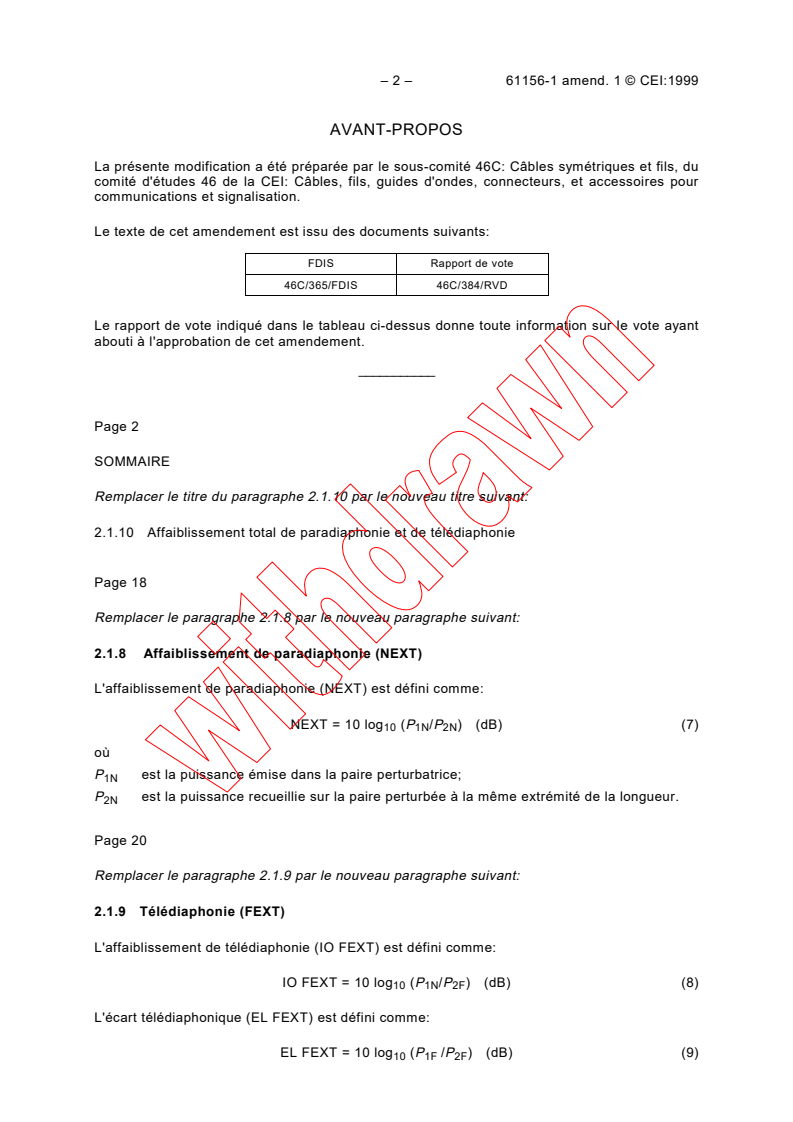
– 2 – 61156-1 amend. 1 © CEI:1999
AVANT-PROPOS
La présente modification a été préparée par le sous-comité 46C: Câbles symétriques et fils, du
comité d'études 46 de la CEI: Câbles, fils, guides d'ondes, connecteurs, et accessoires pour
communications et signalisation.
Le texte de cet amendement est issu des documents suivants:
FDIS Rapport de vote
46C/365/FDIS 46C/384/RVD
Le rapport de vote indiqué dans le tableau ci-dessus donne toute information sur le vote ayant
abouti à l'approbation de cet amendement.
___________
Page 2
SOMMAIRE
Remplacer le titre du paragraphe 2.1.10 par le nouveau titre suivant:
2.1.10 Affaiblissement total de paradiaphonie et de télédiaphonie
Page 18
Remplacer le paragraphe 2.1.8 par le nouveau paragraphe suivant:
2.1.8 Affaiblissement de paradiaphonie (NEXT)
L'affaiblissement de paradiaphonie (NEXT) est défini comme:
NEXT = 10 log (P /P ) (dB) (7)
10 1N 2N
où
P est la puissance émise dans la paire perturbatrice;
1N
P est la puissance recueillie sur la paire perturbée à la même extrémité de la longueur.
2N
Page 20
Remplacer le paragraphe 2.1.9 par le nouveau paragraphe suivant:
2.1.9 Télédiaphonie (FEXT)
L'affaiblissement de télédiaphonie (IO FEXT) est défini comme:
IO FEXT = 10 log (P /P ) (dB) (8)
10 1N 2F
L'écart télédiaphonique (EL FEXT) est défini comme:
EL FEXT = 10 log (P /P ) (dB) (9)
10 1F 2F
61156-1 Amend. 1 © IEC:1999 – 3 –
FOREWORD
This amendment has been prepared by subcommittee 46C: Wires and symmetric cables, of
IEC technical committee 46: Cables, wires, waveguides, r.f. connectors, and accessories for
communication and signalling.
The text of this amendment is based on the following documents:
FDIS Report on voting
46C/365/FDIS 46C/384/RVD
Full information on the voting for the approval of this amendment can be found in the report on
voting indicated in the above table.
___________
Page 3
CONTENTS
Replace the title of subclause 2.1.10 with the following new title:
2.1.10 Power sum (PS) of near-end and far-end crosstalk loss
Page 19
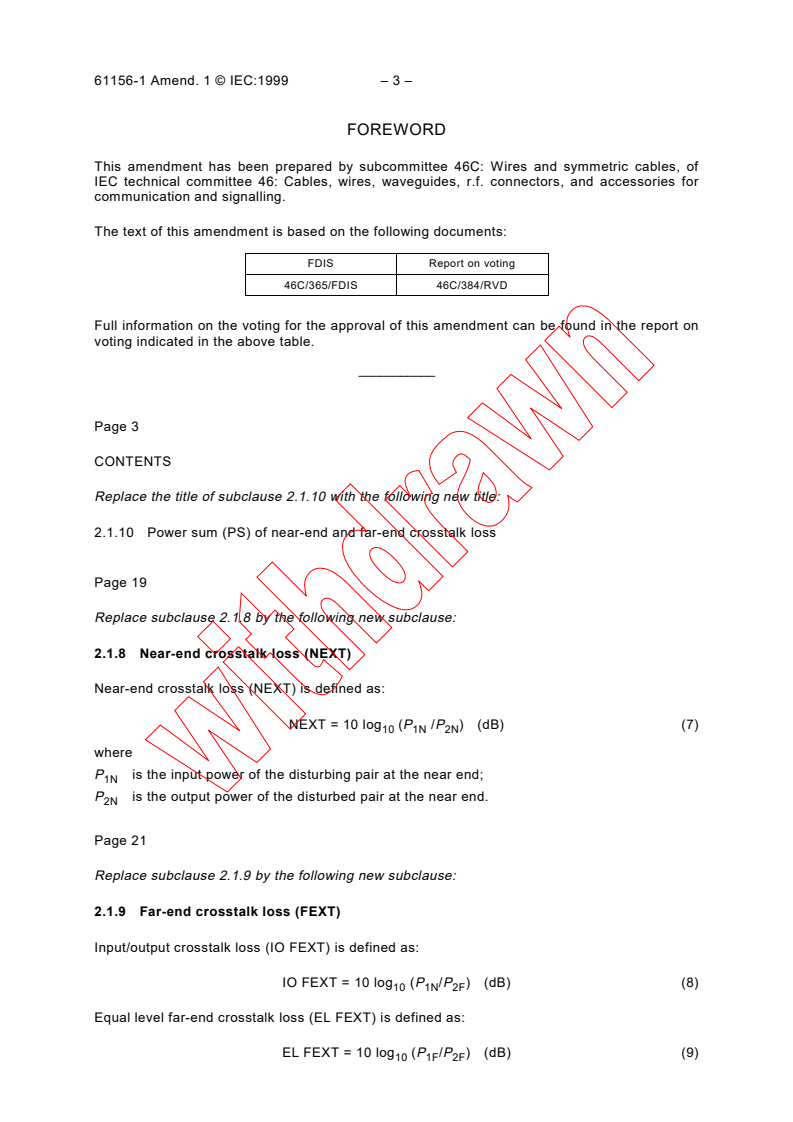
Replace subclause 2.1.8 by the following new subclause:
2.1.8 Near-end crosstalk loss (NEXT)
Near-end crosstalk loss (NEXT) is defined as:
NEXT = 10 log (P /P ) (dB) (7)
10 1N 2N
where
P is the input power of the disturbing pair at the near end;
1N
P is the output power of the disturbed pair at the near end.
2N
Page 21
Replace subclause 2.1.9 by the following new subclause:
2.1.9 Far-end crosstalk loss (FEXT)
Input/output crosstalk loss (IO FEXT) is defined as:
IO FEXT = 10 log (P /P ) (dB) (8)
10 1N 2F
Equal level far-end crosstalk loss (EL FEXT) is defined as:
EL FEXT = 10 log (P /P ) (dB) (9)
10 1F 2F
– 4 – 61156-1 amend. 1 © CEI:1999
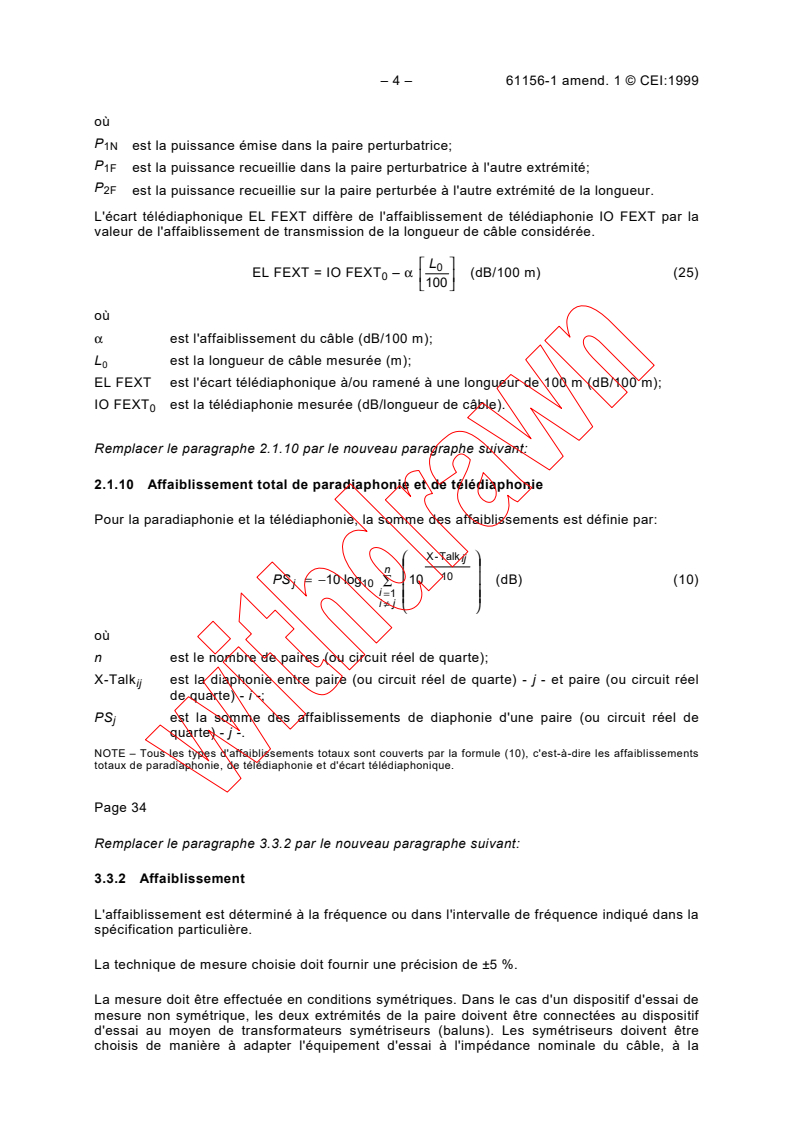
où
P
1N est la puissance émise dans la paire perturbatrice;
P
1F est la puissance recueillie dans la paire perturbatrice à l'autre extrémité;
P
2F est la puissance recueillie sur la paire perturbée à l'autre extrémité de la longueur.
L'écart télédiaphonique EL FEXT diffère de l'affaiblissement de télédiaphonie IO FEXT par la
valeur de l'affaiblissement de transmission de la longueur de câble considérée.
L
EL FEXT = IO FEXT – α (dB/100 m) (25)
où
α est l'affaiblissement du câble (dB/100 m);
L est la longueur de câble mesurée (m);
EL FEXT est l'écart télédiaphonique à/ou ramené à une longueur de 100 m (dB/100 m);
IO FEXT est la télédiaphonie mesurée (dB/longueur de câble).
Remplacer le paragraphe 2.1.10 par le nouveau paragraphe suivant:
2.1.10 Affaiblissement total de paradiaphonie et de télédiaphonie
Pour la paradiaphonie et la télédiaphonie, la somme des affaiblissements est définie par:
X-Talk
ij
n
PS = −10 log 10 (dB) (10)
∑
j 10
i =1
i ≠ j
où
n
est le nombre de paires (ou circuit réel de quarte);
X-Talk est la diaphonie entre paire (ou circuit réel de quarte) - j - et paire (ou circuit réel
ij
de quarte) - i -;
PS est la somme des affaiblissements de diaphonie d'une paire (ou circuit réel de
j
quarte) - j -.
NOTE – Tous les types d'affaiblissements totaux sont couverts par la formule (10), c'est-à-dire les affaiblissements
totaux de paradiaphonie, de télédiaphonie et d'écart télédiaphonique.
Page 34
Remplacer le paragraphe 3.3.2 par le nouveau paragraphe suivant:
3.3.2 Affaiblissement
L'affaiblissement est déterminé à la fréquence ou dans l'intervalle de fréquence indiqué dans la
spécification particulière.
La technique de mesure choisie doit fournir une précision de ±5 %.
La mesure doit être effectuée en conditions symétriques. Dans le cas d'un dispositif d'essai de
mesure non symétrique, les deux extrémités de la paire doivent être connectées au dispositif
d'essai au moyen de transformateurs symétriseurs (baluns). Les symétriseurs doivent être
choisis de manière à adapter l'équipement d'essai à l'impédance nominale du câble, à la
61156-1 Amend. 1 © IEC:1999 – 5 –
where
P is the input power of the disturbing pair at the near end;
1N
P is the output power of the disturbing pair at the far end;
1F
P is the output power of the disturbed pair under test at the far end.
2F
EL FEXT is related to the IO FEXT by the attenuation of the considered cable length:
L
EL FEXT = IO FEXT – α (dB/100 m) (25)
where:
α is the attenuation of the cable (dB/100 m);
L is the measured cable length (m);
EL FEXT is the equal level far-end crosstalk at or corrected to a length of 100 m (dB/100 m);
IO FEXT is the measured far-end crosstalk (dB/cable length).
Replace subclause 2.1.10 by the following new subclause:
2.1.10 Power sum (PS) of near-end and far-end crosstalk loss
For near-end and far-end crosstalk loss the power sum is defined as:
X-Talk
ij
n
PS = −10 log 10 (dB) (10)
∑
j 10
i =1
i ≠ j
where
n is the number of pairs (or one side of quads);
X-Talk is the crosstalk loss between pair (or one side of a quad) - j - and pair (or one side
ij
of the quad) - i -;
PS is the power sum of the pair (or one side of a quad) - j - .
j
NOTE – All types of power sum crosstalk losses are covered by formula (10), i.e. the power sums of near-end,
input/output far-end and equal level far-end crosstalk losses.
Page 35
Replace subclause 3.3.2 by the following new subclause:
3.3.2 Attenuation
The attenuation is determined at the frequency or in the frequency interval indicated in the
detail cable specification.
The measurement technique chosen shall provide an accuracy of ±5 %.
The measurement shall be carried out in a balanced condition. In the case of unbalanced
measuring test equipment, both ends of the pair shall be connected to the test equipment by
means of baluns. The baluns shall be selected to match the test equipment to the cable
– 6 – 61156-1 amend. 1 © CEI:1999
fréquence de mesure. Il est conseillé de compenser la désadaptation résiduelle des
symétriseurs en calibrant d'abord le système avec les symétriseurs connectés à une courte
longueur (≤1 m) du câble à mesurer.
Les mesures sont effectuées à la température ambiante et sont corrigées à 20 °C pour les
fréquences supérieures à 1 MHz, comme suit:
αα=+1 0,002− 20 (dB/100 m) (17)
T
()()
20 T
où
α est l'affaiblissement mesuré, en dB/100 m;
T
T est la température ambiante, en degrés Celsius;
α
est l'affaiblissement en dB/100 m, corrigé à 20 °C.
Les valeurs mesurées sont corrigées pour une longueur ramenée à 100 m, ou comme spécifié
dans la spécification particulière, en utilisant une variation directement proportionnelle à la
longueur.
NOTE – La correction ci-dessus est seulement valable pour des matériaux d'isolation ayant un diélectrique à faible
coefficient de température.
Page 36
Remplacer le paragraphe 3.3.4 par le nouveau paragraphe suivant:
3.3.4 Paradiaphonie
La paradiaphonie est mesurée à l'aide d'un générateur à balayage et d'un récepteur sélectif à
la fréquence ou dans les intervalles de fréquence indiqués dans la spécification particulière.
La mesure doit être effectuée en conditions symétriques, en connectant les deux
...