


IEC 62395-2:2013
(Main)Electrical resistance trace heating systems for industrial and commercial applications - Part 2: Application guide for system design, installation and maintenance
General Information
- Abstract
IEC 62395-2:2013 provides detailed recommendations for the system design, installation, maintenance and repair of electrical resistance trace heating systems in industrial and commercial applications. This standard does not include or provide for any applications in potentially explosive atmospheres. This standard cancels and replaces IEC/TS 62395-2:2008. This standard includes the following significant technical changes with respect to IEC/TS 62395-2:2008:
- This document has been changed from a Technical Specification to an International Standard.
- Design considerations for trace heating on sprinkler systems have been expanded and a figure has been added to illustrate how to avoid undue shadowing of spray patterns from insulated sprigs close to sprinkler heads;
- Specific details of design considerations for trace heating for emergency eyewash units and safety showers have been added.
- Status
- Replaced
- Publication Date
- 08-Sep-2013
- Technical Committee
- TC 27 - Industrial electroheating and electromagnetic processing
- Drafting Committee
- MT 17 - TC 27/MT 17
- Current Stage
- DELPUB - Deleted Publication
- Start Date
- 27-Jun-2024
- Completion Date
- 31-Mar-2020
Buy Documents

IEC 62395-2:2013 - Electrical resistance trace heating systems for industrial and commercial applications - Part 2: Application guide for system design, installation and maintenance Released:9/9/2013
Relations
- Effective Date
- 05-Sep-2023
- Effective Date
- 05-Sep-2023
Buy Documents
IEC 62395-2:2013 - Electrical resistance trace heating systems for industrial and commercial applications - Part 2: Application guide for system design, installation and maintenance Released:9/9/2013
Get Certified
Connect with accredited certification bodies for this standard

DVS-ZERT GmbH
German welding certification society.
CARES (UK Certification Authority for Reinforcing Steels)
UK certification for reinforcing steels and construction.
EWF/IIW (European/International Welding Federation)
International welding personnel certification.
Sponsored listings
Frequently Asked Questions
IEC 62395-2:2013 is a standard published by the International Electrotechnical Commission (IEC). Its full title is "Electrical resistance trace heating systems for industrial and commercial applications - Part 2: Application guide for system design, installation and maintenance". This standard covers: IEC 62395-2:2013 provides detailed recommendations for the system design, installation, maintenance and repair of electrical resistance trace heating systems in industrial and commercial applications. This standard does not include or provide for any applications in potentially explosive atmospheres. This standard cancels and replaces IEC/TS 62395-2:2008. This standard includes the following significant technical changes with respect to IEC/TS 62395-2:2008: - This document has been changed from a Technical Specification to an International Standard. - Design considerations for trace heating on sprinkler systems have been expanded and a figure has been added to illustrate how to avoid undue shadowing of spray patterns from insulated sprigs close to sprinkler heads; - Specific details of design considerations for trace heating for emergency eyewash units and safety showers have been added.
IEC 62395-2:2013 provides detailed recommendations for the system design, installation, maintenance and repair of electrical resistance trace heating systems in industrial and commercial applications. This standard does not include or provide for any applications in potentially explosive atmospheres. This standard cancels and replaces IEC/TS 62395-2:2008. This standard includes the following significant technical changes with respect to IEC/TS 62395-2:2008: - This document has been changed from a Technical Specification to an International Standard. - Design considerations for trace heating on sprinkler systems have been expanded and a figure has been added to illustrate how to avoid undue shadowing of spray patterns from insulated sprigs close to sprinkler heads; - Specific details of design considerations for trace heating for emergency eyewash units and safety showers have been added.
IEC 62395-2:2013 is classified under the following ICS (International Classification for Standards) categories: 25.180.10 - Electric furnaces. The ICS classification helps identify the subject area and facilitates finding related standards.
IEC 62395-2:2013 has the following relationships with other standards: It is inter standard links to IEC TS 62395-2:2008, IEC/IEEE 62395-2:2024. Understanding these relationships helps ensure you are using the most current and applicable version of the standard.
IEC 62395-2:2013 is available in PDF format for immediate download after purchase. The document can be added to your cart and obtained through the secure checkout process. Digital delivery ensures instant access to the complete standard document.
Standards Content (Sample)
IEC 62395-2 ®
Edition 1.0 2013-09
INTERNATIONAL
STANDARD
NORME
INTERNATIONALE
colour
inside
Electrical resistance trace heating systems for industrial and commercial
applications –
Part 2: Application guide for system design, installation and maintenance
Systèmes de traçage par résistance électrique pour applications industrielles et
commerciales –
Partie 2: Guide d’application pour la conception, l’installation et la maintenance
du système
All rights reserved. Unless otherwise specified, no part of this publication may be reproduced or utilized in any form
or by any means, electronic or mechanical, including photocopying and microfilm, without permission in writing from
either IEC or IEC's member National Committee in the country of the requester.
If you have any questions about IEC copyright or have an enquiry about obtaining additional rights to this publication,
please contact the address below or your local IEC member National Committee for further information.
Droits de reproduction réservés. Sauf indication contraire, aucune partie de cette publication ne peut être reproduite ni
utilisée sous quelque forme que ce soit et par aucun procédé, électronique ou mécanique, y compris la photocopie et les
microfilms, sans l'accord écrit de la CEI ou du Comité national de la CEI du pays du demandeur.
Si vous avez des questions sur le copyright de la CEI ou si vous désirez obtenir des droits supplémentaires sur cette
publication, utilisez les coordonnées ci-après ou contactez le Comité national de la CEI de votre pays de résidence.
IEC Central Office Tel.: +41 22 919 02 11
3, rue de Varembé Fax: +41 22 919 03 00
CH-1211 Geneva 20 info@iec.ch
Switzerland www.iec.ch
About the IEC
The International Electrotechnical Commission (IEC) is the leading global organization that prepares and publishes
International Standards for all electrical, electronic and related technologies.
About IEC publications
The technical content of IEC publications is kept under constant review by the IEC. Please make sure that you have the
latest edition, a corrigenda or an amendment might have been published.
Useful links:
IEC publications search - www.iec.ch/searchpub Electropedia - www.electropedia.org
The advanced search enables you to find IEC publications The world's leading online dictionary of electronic and
by a variety of criteria (reference number, text, technical electrical terms containing more than 30 000 terms and
committee,…). definitions in English and French, with equivalent terms in
It also gives information on projects, replaced and additional languages. Also known as the International
withdrawn publications. Electrotechnical Vocabulary (IEV) on-line.
IEC Just Published - webstore.iec.ch/justpublished Customer Service Centre - webstore.iec.ch/csc
Stay up to date on all new IEC publications. Just Published If you wish to give us your feedback on this publication
details all new publications released. Available on-line and or need further assistance, please contact the
also once a month by email. Customer Service Centre: csc@iec.ch.
A propos de la CEI
La Commission Electrotechnique Internationale (CEI) est la première organisation mondiale qui élabore et publie des
Normes internationales pour tout ce qui a trait à l'électricité, à l'électronique et aux technologies apparentées.
A propos des publications CEI
Le contenu technique des publications de la CEI est constamment revu. Veuillez vous assurer que vous possédez
l’édition la plus récente, un corrigendum ou amendement peut avoir été publié.
Liens utiles:
Recherche de publications CEI - www.iec.ch/searchpub Electropedia - www.electropedia.org
La recherche avancée vous permet de trouver des Le premier dictionnaire en ligne au monde de termes
publications CEI en utilisant différents critères (numéro de électroniques et électriques. Il contient plus de 30 000
référence, texte, comité d’études,…). termes et définitions en anglais et en français, ainsi que
Elle donne aussi des informations sur les projets et les les termes équivalents dans les langues additionnelles.
publications remplacées ou retirées. Egalement appelé Vocabulaire Electrotechnique
International (VEI) en ligne.
Just Published CEI - webstore.iec.ch/justpublished
Service Clients - webstore.iec.ch/csc
Restez informé sur les nouvelles publications de la CEI.
Just Published détaille les nouvelles publications parues. Si vous désirez nous donner des commentaires sur
Disponible en ligne et aussi une fois par mois par email. cette publication ou si vous avez des questions
contactez-nous: csc@iec.ch.
IEC 62395-2 ®
Edition 1.0 2013-09
INTERNATIONAL
STANDARD
NORME
INTERNATIONALE
colour
inside
Electrical resistance trace heating systems for industrial and commercial
applications –
Part 2: Application guide for system design, installation and maintenance
Systèmes de traçage par résistance électrique pour applications industrielles et
commerciales –
Partie 2: Guide d’application pour la conception, l’installation et la maintenance
du système
INTERNATIONAL
ELECTROTECHNICAL
COMMISSION
COMMISSION
ELECTROTECHNIQUE
PRICE CODE
INTERNATIONALE
CODE PRIX XC
ICS 25.180.10 ISBN 978-2-8322-1082-6
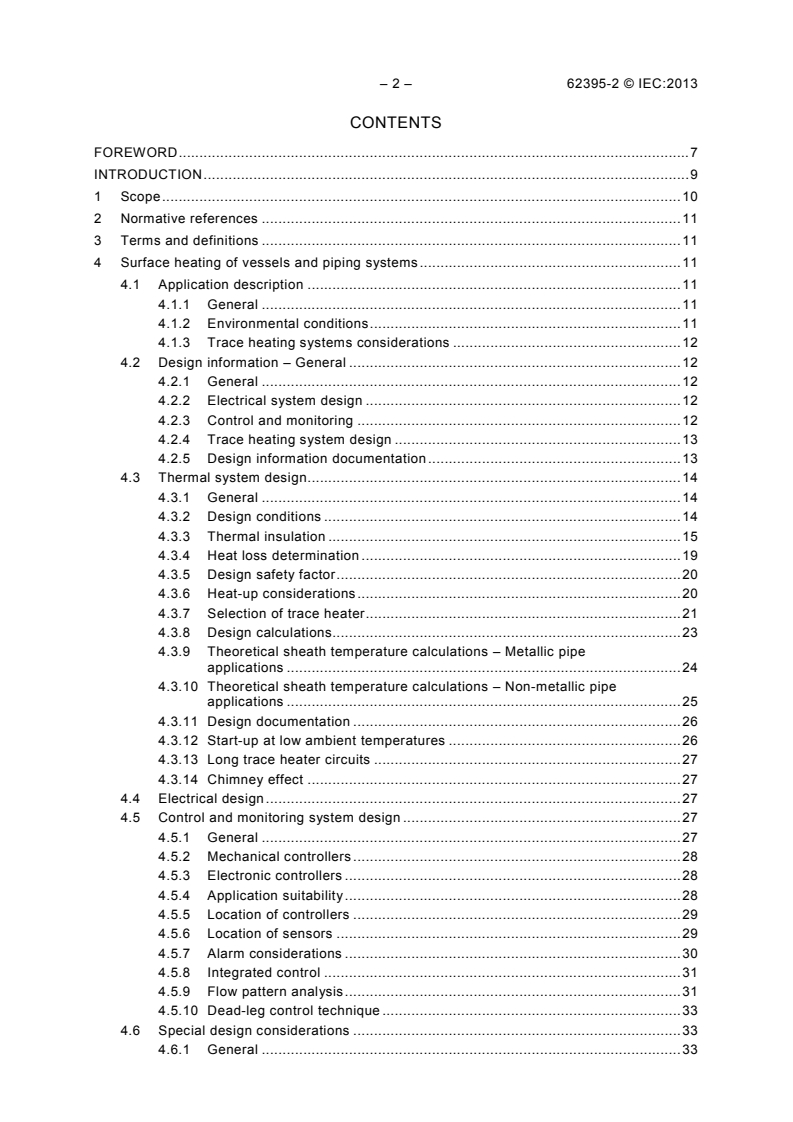
– 2 – 62395-2 © IEC:2013
CONTENTS
FOREWORD . 7
INTRODUCTION . 9
1 Scope . 10
2 Normative references . 11
3 Terms and definitions . 11
4 Surface heating of vessels and piping systems . 11
4.1 Application description . 11
4.1.1 General . 11
4.1.2 Environmental conditions . 11
4.1.3 Trace heating systems considerations . 12
4.2 Design information – General . 12
4.2.1 General . 12
4.2.2 Electrical system design . 12
4.2.3 Control and monitoring . 12
4.2.4 Trace heating system design . 13
4.2.5 Design information documentation . 13
4.3 Thermal system design . 14
4.3.1 General . 14
4.3.2 Design conditions . 14
4.3.3 Thermal insulation . 15
4.3.4 Heat loss determination . 19
4.3.5 Design safety factor . 20
4.3.6 Heat-up considerations . 20
4.3.7 Selection of trace heater . 21
4.3.8 Design calculations. 23
4.3.9 Theoretical sheath temperature calculations – Metallic pipe
applications . 24
4.3.10 Theoretical sheath temperature calculations – Non-metallic pipe
applications . 25
4.3.11 Design documentation . 26
4.3.12 Start-up at low ambient temperatures . 26
4.3.13 Long trace heater circuits . 27
4.3.14 Chimney effect . 27
4.4 Electrical design . 27
4.5 Control and monitoring system design . 27
4.5.1 General . 27
4.5.2 Mechanical controllers . 28
4.5.3 Electronic controllers . 28
4.5.4 Application suitability . 28
4.5.5 Location of controllers . 29
4.5.6 Location of sensors . 29
4.5.7 Alarm considerations . 30
4.5.8 Integrated control . 31
4.5.9 Flow pattern analysis . 31
4.5.10 Dead-leg control technique . 33
4.6 Special design considerations . 33
4.6.1 General . 33
62395-2 © IEC:2013 – 3 –
4.6.2 Freeze protection systems . 33
4.6.3 Sprinkler systems, fire suppression . 33
4.6.4 Hot water services/tempered water . 35
4.6.5 Safety shower design requirements . 36
4.6.6 Specialty lines . 36
4.7 Installation. 38
4.7.1 General . 38
4.7.2 Personnel aspects . 38
4.7.3 Preparatory work . 38
4.7.4 Preliminary installation of trace heating circuits . 39
4.7.5 Insulation resistance test . 39
4.7.6 Installation of trace heater systems . 39
4.7.7 Installation of control and monitoring equipment . 42
4.7.8 Necessary modifications . 43
4.7.9 Installation of the thermal insulation system. 43
4.7.10 Installation of electrical power . 44
4.7.11 Commissioning . 45
4.8 Maintenance . 46
4.8.1 General . 46
4.8.2 Training of maintenance personnel . 46
4.8.3 Frequency of inspection . 46
4.8.4 Maintenance program documentation . 46
4.8.5 Visual evaluation . 47
4.8.6 Electrical evaluation . 47
4.8.7 Review of the electrical protection system . 47
4.9 Repair . 48
4.9.1 General . 48
4.9.2 Fault location . 48
4.9.3 Practicability of repair to electric trace heaters . 48
4.9.4 Repair techniques for electrical trace heaters . 49
5 Roof and gutter de-icing . 49
5.1 Application description . 49
5.2 Design information – General . 50
5.3 Thermal design . 51
5.4 Electrical design . 51
5.5 Control and monitoring system design . 51
5.6 Special design considerations . 51
5.7 Installation. 51
5.7.1 General . 51
5.7.2 Trace heaters and component mounting . 52
5.8 Maintenance . 55
5.9 Repair . 55
6 Rail heating . 55
6.1 Application description . 55
6.1.1 General . 55
6.1.2 Switch point heating . 56
6.1.3 Contact/live rail heating . 56
6.1.4 Track heating . 56
6.1.5 Catenary/pantograph shoe heating . 56
– 4 – 62395-2 © IEC:2013
6.2 Design information . 57
6.2.1 General . 57
6.2.2 Weather data . 57
6.2.3 Rail system description . 57
6.2.4 System design . 57
6.3 Thermal design . 57
6.3.1 Heating load determination . 57
6.3.2 Typical heating load . 58
6.4 Electrical design . 58
6.5 Control and monitoring system design . 58
6.6 Special design considerations . 58
6.6.1 Electrical considerations . 58
6.6.2 Finite element analysis . 59
6.7 Installation. 59
6.7.1 General . 59
6.7.2 Point heating . 60
6.7.3 Swing nose crossing . 60
6.7.4 Clamp lock heating . 61
6.7.5 Contact/live rail heating and track heating . 61
6.7.6 Catenary/pantograph shoe heating . 62
6.8 Maintenance . 62
6.9 Repair . 62
7 Snow melting . 62
7.1 Application description . 62
7.2 Design information . 63
7.2.1 General . 63
7.2.2 Weather data . 63
7.2.3 Construction details of workpiece . 63
7.2.4 Electrical considerations . 63
7.2.5 System performance level . 63
7.2.6 Trace heater layout and component mounting. 64
7.3 Thermal design – Power output (heat load) determination . 68
7.4 Electrical design . 68
7.5 Control and monitoring system design . 68
7.6 Special design considerations . 68
7.7 Installation. 69
7.8 Maintenance . 69
7.9 Repair . 70
8 Floor warming. 70
8.1 Application description . 70
8.2 Design information . 70
8.2.1 General . 70
8.2.2 Environmental data . 70
8.2.3 Construction details of workpiece . 70
8.2.4 Electrical considerations . 70
8.2.5 Trace heater layout and component mounting. 71
8.3 Thermal design – Heat load determination . 72
8.4 Electrical design . 73
8.5 Control and monitoring system design . 73
62395-2 © IEC:2013 – 5 –
8.6 Special design consideration . 73
8.7 Installation. 74
8.8 Maintenance . 74
8.9 Repair . 74
9 Frost heave prevention . 74
9.1 Application description . 74
9.2 Design information . 75
9.2.1 General . 75
9.2.2 Construction details of the floor . 75
9.2.3 Electrical considerations . 75
9.3 Heat load determination . 75
9.3.1 General . 75
9.3.2 Trace heater layout and component mounting. 77
9.4 Electrical design . 77
9.5 Control and monitoring system design . 77
9.5.1 Control options . 77
9.5.2 Monitoring . 77
9.6 Special design considerations . 77
9.7 Installation. 78
9.8 Maintenance . 78
9.9 Repair . 78
10 Underground thermal energy storage systems . 78
10.1 Application description . 78
10.2 Design information . 79
10.2.1 General . 79
10.2.2 Environmental data . 79
10.2.3 Construction details of building . 79
10.2.4 Electrical considerations . 79
10.2.5 Trace heater layout and component mounting. 79
10.3 Thermal design – Heat-loss determination . 80
10.4 Electrical design . 80
10.5 Control and monitoring system design . 81
10.6 Special design considerations when trace heaters are located in sand layer. 81
10.7 Installation. 81
10.7.1 General . 81
10.7.2 Installation in sand . 81
10.7.3 Installation in concrete . 81
10.8 Maintenance . 82
10.9 Repair . 82
Annex A (informative) Pre-installation checks . 83
Annex B (informative) Trace heater commissioning record . 84
Annex C (informative) Maintenance schedule and log record . 85
Bibliography . 86
Figure 1 – Thermal insulation – Weather-barrier installation . 17
Figure 2 – Typical temperature profile . 18
Figure 3 – Equilibrium conditions for workpiece maintenance . 22
Figure 4 – Equilibrium conditions for upper limit evaluation . 23
– 6 – 62395-2 © IEC:2013
Figure 5 – Heated tank example . 32
Figure 6 – Bypass example . 32
Figure 7 – Fire sprinkler sprig: tapered thermal insulation . 35
Figure 8 – Double containment system . 37
Figure 9 – Gravity flow piping systems . 38
Figure 10 – Ice dam formation . 50
Figure 11 – Downspout to underground drain . 50
Figure 12 – Roof and gutter trace heater arrangement . 52
Figure 13 – Gutter detail . 53
Figure 14 – Typical roof mounting methods . 54
Figure 15 – Drain detail for flat roof . 55
Figure 16 – Typical positioning of point trace heater on stock rail and switch rail . 60
Figure 17 – Typical positioning of trace heater on swing nose crossing . 60
Figure 18 – Typical clamp lock trace heater . 61
Figure 19 – Typical positioning of trace heater on steel and aluminium clad contact
rails . 61
Figure 20 – Typical positioning of trace heater in pantograph shoe . 62
Figure 21 – Snow melting trace heater embedded in concrete . 65
Figure 22 – Snow melting trace heater located in conduit . 66
Figure 23 – Expansion joint detail . 67
Figure 24 – Snow melting junction box location . 67
Figure 25 – Typical floor warming trace heater mounting . 72
Figure 26 – Typical floor heating power requirements . 73
Figure 27 – Typical frost heave prevention substructure . 75
Figure 28 – Frost heave prevention power requirements . 76
Figure 29 – Typical underground thermal energy storage system installation . 80
Table 1 – Application types . 13
Table 2 – Recommendations for monitoring and control – Type II and III control . 29
Table 3 – Recommendations for hot water services and tempered water temperatures . 35
Table 4 – Typical snow melting heat loads . 64
62395-2 © IEC:2013 – 7 –
INTERNATIONAL ELECTROTECHNICAL COMMISSION
____________
ELECTRICAL RESISTANCE TRACE HEATING SYSTEMS
FOR INDUSTRIAL AND COMMERCIAL APPLICATIONS –
Part 2: Application guide for system design,
installation and maintenance
FOREWORD
1) The International Electrotechnical Commission (IEC) is a worldwide organization for standardization comprising
all national electrotechnical committees (IEC National Committees). The object of IEC is to promote
international co-operation on all questions concerning standardization in the electrical and electronic fields. To
this end and in addition to other activities, IEC publishes International Standards, Technical Specifications,
Technical Reports, Publicly Available Specifications (PAS) and Guides (hereafter referred to as “IEC
Publication(s)”). Their preparation is entrusted to technical committees; any IEC National Committee interested
in the subject dealt with may participate in this preparatory work. International, governmental and non-
governmental organizations liaising with the IEC also participate in this preparation. IEC collaborates closely
with the International Organization for Standardization (ISO) in accordance with conditions determined by
agreement between the two organizations.
2) The formal decisions or agreements of IEC on technical matters express, as nearly as possible, an international
consensus of opinion on the relevant subjects since each technical committee has representation from all
interested IEC National Committees.
3) IEC Publications have the form of recommendations for international use and are accepted by IEC National
Committees in that sense. While all reasonable efforts are made to ensure that the technical content of IEC
Publications is accurate, IEC cannot be held responsible for the way in which they are used or for any
misinterpretation by any end user.
4) In order to promote international uniformity, IEC National Committees undertake to apply IEC Publications
transparently to the maximum extent possible in their national and regional publications. Any divergence
between any IEC Publication and the corresponding national or regional publication shall be clearly indicated in
the latter.
5) IEC itself does not provide any attestation of conformity. Independent certification bodies provide conformity
assessment services and, in some areas, access to IEC marks of conformity. IEC is not responsible for any
services carried out by independent certification bodies.
6) All users should ensure that they have the latest edition of this publication.
7) No liability shall attach to IEC or its directors, employees, servants or agents including individual experts and
members of its technical committees and IEC National Committees for any personal injury, property damage or
other damage of any nature whatsoever, whether direct or indirect, or for costs (including legal fees) and
expenses arising out of the publication, use of, or reliance upon, this IEC Publication or any other IEC
Publications.
8) Attention is drawn to the Normative references cited in this publication. Use of the referenced publications is
indispensable for the correct application of this publication.
9) Attention is drawn to the possibility that some of the elements of this IEC Publication may be the subject of
patent rights. IEC shall not be held responsible for identifying any or all such patent rights.
International Standard IEC 62395-2 has been prepared by IEC technical committee 27:
Industrial electroheating and electromagnetic processing.
This standard cancels and replaces IEC/TS 62395-2:2008.
This standard includes the following significant technical changes with respect to
IEC/TS 62395-2:2008:
• This document has been changed from a Technical Specification to an International
Standard.
• Design considerations for trace heating on sprinkler systems have been expanded and a
figure has been added to illustrate how to avoid undue shadowing of spray patterns from
insulated sprigs close to sprinkler heads;
– 8 – 62395-2 © IEC:2013
• Specific details of design considerations for trace heating for emergency eyewash units
and safety showers have been added.
The text of this standard is based on the following documents:
FDIS Report on voting
27/927/FDIS 27/936/RVD
Full information on the voting for the approval of this standard can be found in the report on
voting indicated in the above table.
This publication has been drafted in accordance with the ISO/IEC Directives, Part 2.
A list of all parts in the IEC 62395 series, under the general title Electrical resistance trace
heating systems for industrial and commercial applications, can be found on the IEC website.
The committee has decided that the contents of this publication will remain unchanged until
the stability date indicated on the IEC web site under "http://webstore.iec.ch" in the data
related to the specific publication. At this date, the publication will be
• reconfirmed,
• withdrawn,
• replaced by a revised edition, or
• amended.
IMPORTANT – The 'colour inside' logo on the cover page of this publication indicates
that it contains colours which are considered to be useful for the correct
understanding of its contents. Users should therefore print this document using a
colour printer.
62395-2 © IEC:2013 – 9 –
INTRODUCTION
IEC 62395-1 provides the essential requirements and testing appropriate to electrical
resistance trace heating equipment used in industrial and commercial applications. While
some of this work already exists in national or international standards, this standard has
collated much of this existing work and added considerably to it.
IEC 62395-2 provides detailed recommendations for the system design, installation,
maintenance and repair of electrical resistance trace heating systems in industrial and
commercial applications which can include piping, vessels, roofs and concrete slab heating
applications.
It is the objective of IEC 62395 that, when in normal use, electrical trace heating systems
operate safely under their defined conditions of use, by
a) employing heaters of the appropriate construction so as to meet the test criteria and
requirements detailed in IEC 62395-1. The construction includes a metallic sheath, braid,
screen or equivalent electrically conductive covering;
b) operating at safe temperatures when designed, installed, and maintained in accordance
with IEC 62395-2;
c) having at least the minimum levels of overcurrent and earth-fault protection required in
IEC 62395-1 and IEC 62395-2.
– 10 – 62395-2 © IEC:2013
ELECTRICAL RESISTANCE TRACE HEATING SYSTEMS
FOR INDUSTRIAL AND COMMERCIAL APPLICATIONS —
Part 2: Application guide for system design,
installation and maintenance
1 Scope
This part of IEC 62395 provides detailed recommendations for the system design, installation,
maintenance and repair of electrical resistance trace heating systems in industrial and
commercial applications. This standard does not include or provide for any applications in
potentially explosive atmospheres.
This standard pertains to trace heating systems that may comprise either factory fabricated or
field-assembled (work-site) units, and which may be series or parallel trace heaters, or
surface heaters (heater pads or heater panels) that have been assembled and/or terminated
in accordance with the manufacturer’s instructions.
The products covered by this standard are intended to be installed by persons who are
suitably trained in the techniques required and that only trained personnel carry out especially
critical work, such as the installation of connections and terminations. Installations are
intended to be carried out under the supervision of a qualified person who has undergone
supplementary training in electric trace heating systems.
This standard does not cover induction, impedance or skin effect heating.
Trace heating systems can be grouped into different types of installations. These are
characterized by different requirements for testing and are usually certified for a specific type
of installation or application. Typical applications for the different types of installation are as
follows:
a) Installations of trace heating on pipes, vessels and associated equipment. Applications
include:
– freeze protection and temperature maintenance;
– hot water lines;
– oil and chemical lines;
– sprinkler systems.
b) Outdoor exposed area installations of trace heating. Applications include:
– roof de-icing;
– gutter and downspout de-icing;
– catch basins and drains;
– rail heating.
c) Installation with embedded trace heating. Applications include:
– snow melting;
– floor warming;
– frost heave prevention;
– underground thermal energy storage systems;
– door frames.
62395-2 © IEC:2013 – 11 –
d) Installations of trace heating internal to conduit or piping. Applications include:
– snow melting – in conduit;
– floor warming – in conduit;
– frost heave prevention – in conduit;
– underground thermal energy storage systems – in conduit;
– internal trace heating of potable water lines;
– enclosed drains and culverts.
2 Normative references
The following documents, in whole or in part, are normatively referenced in this document and
are indispensable for its application. For dated references, only the edition cited applies. For
undated references, the latest edition of the referenced document (including any
amendments) applies.
IEC 60519-1, Safety in electroheating installations – Part 1: General requirements
IEC 62395-1:2013, Electrical resistance trace heating systems for industrial and commercial
applications – Part 1: General and testing requirements
3 Terms and definitions
For the purposes of this document, the terms and definitions given in IEC 60519-1 and
IEC 62395-1:2013 apply.
NOTE General definitions are given in the International Electrotechnical Vocabulary, IEC 60050. Terms relating to
industrial electroheat are defined in IEC 60050-841.
4 Surface heating of vessels and piping systems
4.1 Application description
4.1.1 General
Piping and vessels often utilise surface-mounted trace heating systems to maintain water
above freezing-point and to maintain process fluids and gases at given temperature levels.
The trace heaters compensate for heat losses to the environment that are reduced but not
eliminated by thermal insulation.
4.1.2 Environmental conditions
Attention should be directed to the surrounding environmental conditions, especially for
systems that are exposed to sunlight (ultraviolet exposure), coastal atmospheres (corrosive
salt spray and high humidity), and chemical atmospheres such as oil refineries and chemical
plants.
Equipment subject to ultraviolet exposure may degrade due to surface oxidation, which can
possibly lead to surface embrittlement and cracking. Corrosive atmospheres can affect the
same exposed surfaces and can accelerate degradation of surfaces that are also susceptible
to ultraviolet exposure. Chemical exposure can affect all equipment, whether covered by
thermal insulation or not.
The trace heating equipment for piping and vessels is often protected from corrosion and
ultraviolet exposure to some degree by the thermal insulation. However, these systems can
have components that are exposed to the environment such as electrical connection
– 12 – 62395-2 © IEC:2013
components and weather barrier around the thermal insulation. The selection of trace heating
equipment shall include a review of the suitability of equipment to the expected environmental
conditions.
4.1.3 Trace heating systems considerations
Trace heating systems can range from simple pipe freeze protection in commercial buildings
to process temperature maintenance and heat-up applications in large complex piping/vessel
systems in industrial facilities. The details required for design can vary based on the
complexity of the application. Control systems and requirements for monitoring can also vary
depending on the control and design requirements.
Trace heating equipment should be chosen that is suitable for the application. For example
...