


IEC 62709:2024
(Main)Radiation protection instrumentation - Security screening of humans - Measuring the imaging performance of X-ray systems
Radiation protection instrumentation - Security screening of humans - Measuring the imaging performance of X-ray systems
IEC 62709:2024 applies to security screening systems that utilize X-ray radiation and are used to inspect people who are not inside vehicles, containers, or enclosures. Specifically, this document applies to systems used to detect objects carried on or within the body of the individual being inspected. The objective is to provide standard methods of measuring and reporting imaging quality characteristics that enable system manufacturers, potential system users and other interested parties to:
a) Establish a consistent indicator of the expected technical performance of screening systems used for the inspection of individuals. Such technical performance testing complements explicit detection testing and evaluation. In this document "detection" refers to items in an image.
b) Provide repeatable and verifiable imaging performance data that can be used to compare systems from different vendors.
c) Establish a baseline that can be used over time to calibrate the system or detect any performance degradation. (It is not intended that the entire test method be employed for daily quality assurance testing.)
d) Establish minimum acceptable performance requirements for the systems described above.
This second edition cancels and replaces the first edition published in 2014. This edition includes the following significant technical changes with respect to the previous edition:
a) Clarified the test procedures to maintain consistency with IEC 62463.
b) Changed the term "spatial resolution" to "pentalith resolution".
c) Modified some standard test conditions.
d) Modified some terms and definitions.
e) Changed the imaging requirements for transmission general-use systems.
Instrumentation pour la radioprotection - Contrôle de sécurité des individus - Mesure des performances de l'imagerie des systèmes radiographiques aux rayons X
IEC 62709:2024 est disponible sous forme de IEC 62709:2024 RLV qui contient la Norme internationale et sa version Redline, illustrant les modifications du contenu technique depuis l'édition précédente.
General Information
- Status
- Published
- Publication Date
- 12-Sep-2024
- Technical Committee
- SC 45B - Radiation protection instrumentation
- Drafting Committee
- WG 17 - TC 45/SC 45B/WG 17
- Current Stage
- PPUB - Publication issued
- Start Date
- 13-Sep-2024
- Completion Date
- 26-Jul-2024
Relations
- Effective Date
- 05-Sep-2023
Overview - IEC 62709:2024 (Radiation protection instrumentation)
IEC 62709:2024 is the International Electrotechnical Commission standard for measuring the imaging performance of X‑ray security screening systems used to inspect people (not inside vehicles, containers or enclosures). It defines repeatable, standard methods and test objects to characterize image quality for systems that detect objects carried on or within the body. The standard helps manufacturers, users and evaluators establish consistent technical performance indicators that complement detection testing.
Key objectives:
- Provide repeatable and verifiable imaging performance data for vendor comparison
- Establish baseline measurements for calibration and detection of performance degradation (note: not intended for daily QA)
- Define minimum acceptable imaging performance and environmental test conditions
This is the second edition (2024), replacing the 2014 edition. Notable updates include alignment with IEC 62463, renaming “spatial resolution” to pentalith resolution, modified test conditions and imaging requirements for transmission general‑use systems.
Key Topics and Technical Requirements
- Imaging performance evaluation procedures - standardized test locations, body phantom positioning and image-recording procedures.
- Body phantoms and test objects - mechanical drawings and standardized phantom configurations to simulate human tissue and concealed objects.
- Pentalith resolution test - new terminology and test object to quantify image resolution (see Annex C for pentalith measurement methodology).
- Wire detection test - procedures and wire size references to verify system capability to resolve thin metallic objects.
- Materials detection tests - separate procedures for detection on body and detection in air to assess material contrast and visibility.
- Penetration test - evaluates the system’s ability to image through varying thicknesses.
- Reporting and minimum performance - example reporting forms (Annex B) and tabulated minimum acceptable imaging performance at reference locations.
- Environmental requirements - standard test conditions and repeatability considerations.
Practical Applications
- Vendor comparison: provides objective, repeatable metrics to compare imaging performance across X‑ray security systems.
- Acceptance testing and baseline calibration: establishes initial baseline to monitor system degradation over time.
- Product development: manufacturers use test methods during R&D to validate imaging design choices (detectors, reconstruction, dose settings).
- Procurement and regulation: procurement teams, certification bodies and regulators can reference minimum performance requirements when specifying systems for airports, courts, prisons and other security checkpoints.
Who should use IEC 62709:2024
- X‑ray security system manufacturers and integrators
- Test laboratories and independent evaluators
- Security operators and facility procurement/specification teams
- Regulators and certification bodies concerned with radiation protection instrumentation
Related standards
- IEC 62463 - referenced for procedural consistency and harmonized test methods.
- Other radiation protection and detector performance standards (see normative references in IEC 62709:2024).
Keywords: IEC 62709:2024, radiation protection instrumentation, security screening, X‑ray systems, imaging performance, pentalith resolution, wire detection, body phantom, materials detection, penetration test, IEC 62463.

IEC 62709:2024 - Radiation protection instrumentation - Security screening of humans - Measuring the imaging performance of X-ray systems Released:13. 09. 2024 Isbn:9782832292433

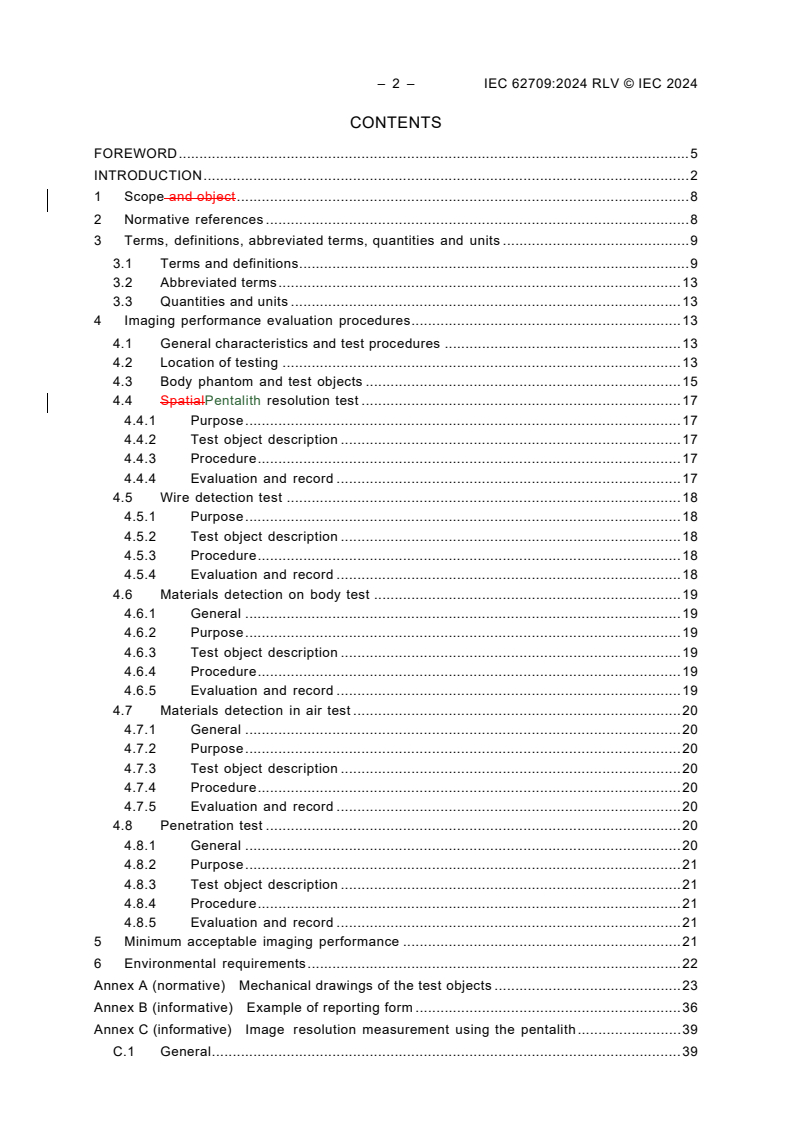
REDLINE IEC 62709:2024 - Radiation protection instrumentation - Security screening of humans - Measuring the imaging performance of X-ray systems Released:13. 09. 2024 Isbn:9782832297438
Get Certified
Connect with accredited certification bodies for this standard

NSF International
Global independent organization facilitating standards development and certification.

CIS Institut d.o.o.
Personal Protective Equipment (PPE) certification body. Notified Body NB-2890 for EU Regulation 2016/425 PPE.

Kiwa BDA Testing
Building and construction product certification.
Sponsored listings
Frequently Asked Questions
IEC 62709:2024 is a standard published by the International Electrotechnical Commission (IEC). Its full title is "Radiation protection instrumentation - Security screening of humans - Measuring the imaging performance of X-ray systems". This standard covers: IEC 62709:2024 applies to security screening systems that utilize X-ray radiation and are used to inspect people who are not inside vehicles, containers, or enclosures. Specifically, this document applies to systems used to detect objects carried on or within the body of the individual being inspected. The objective is to provide standard methods of measuring and reporting imaging quality characteristics that enable system manufacturers, potential system users and other interested parties to: a) Establish a consistent indicator of the expected technical performance of screening systems used for the inspection of individuals. Such technical performance testing complements explicit detection testing and evaluation. In this document "detection" refers to items in an image. b) Provide repeatable and verifiable imaging performance data that can be used to compare systems from different vendors. c) Establish a baseline that can be used over time to calibrate the system or detect any performance degradation. (It is not intended that the entire test method be employed for daily quality assurance testing.) d) Establish minimum acceptable performance requirements for the systems described above. This second edition cancels and replaces the first edition published in 2014. This edition includes the following significant technical changes with respect to the previous edition: a) Clarified the test procedures to maintain consistency with IEC 62463. b) Changed the term "spatial resolution" to "pentalith resolution". c) Modified some standard test conditions. d) Modified some terms and definitions. e) Changed the imaging requirements for transmission general-use systems.
IEC 62709:2024 applies to security screening systems that utilize X-ray radiation and are used to inspect people who are not inside vehicles, containers, or enclosures. Specifically, this document applies to systems used to detect objects carried on or within the body of the individual being inspected. The objective is to provide standard methods of measuring and reporting imaging quality characteristics that enable system manufacturers, potential system users and other interested parties to: a) Establish a consistent indicator of the expected technical performance of screening systems used for the inspection of individuals. Such technical performance testing complements explicit detection testing and evaluation. In this document "detection" refers to items in an image. b) Provide repeatable and verifiable imaging performance data that can be used to compare systems from different vendors. c) Establish a baseline that can be used over time to calibrate the system or detect any performance degradation. (It is not intended that the entire test method be employed for daily quality assurance testing.) d) Establish minimum acceptable performance requirements for the systems described above. This second edition cancels and replaces the first edition published in 2014. This edition includes the following significant technical changes with respect to the previous edition: a) Clarified the test procedures to maintain consistency with IEC 62463. b) Changed the term "spatial resolution" to "pentalith resolution". c) Modified some standard test conditions. d) Modified some terms and definitions. e) Changed the imaging requirements for transmission general-use systems.
IEC 62709:2024 is classified under the following ICS (International Classification for Standards) categories: 13.280 - Radiation protection. The ICS classification helps identify the subject area and facilitates finding related standards.
IEC 62709:2024 has the following relationships with other standards: It is inter standard links to IEC 62709:2014. Understanding these relationships helps ensure you are using the most current and applicable version of the standard.
IEC 62709:2024 is available in PDF format for immediate download after purchase. The document can be added to your cart and obtained through the secure checkout process. Digital delivery ensures instant access to the complete standard document.
Standards Content (Sample)
IEC 62709 ®
Edition 2.0 2024-09
INTERNATIONAL
STANDARD
Radiation protection instrumentation – Security screening of humans –
Measuring the imaging performance of X-ray systems
All rights reserved. Unless otherwise specified, no part of this publication may be reproduced or utilized in any form
or by any means, electronic or mechanical, including photocopying and microfilm, without permission in writing from
either IEC or IEC's member National Committee in the country of the requester. If you have any questions about IEC
copyright or have an enquiry about obtaining additional rights to this publication, please contact the address below or
your local IEC member National Committee for further information.
IEC Secretariat Tel.: +41 22 919 02 11
3, rue de Varembé info@iec.ch
CH-1211 Geneva 20 www.iec.ch
Switzerland
About the IEC
The International Electrotechnical Commission (IEC) is the leading global organization that prepares and publishes
International Standards for all electrical, electronic and related technologies.
About IEC publications
The technical content of IEC publications is kept under constant review by the IEC. Please make sure that you have the
latest edition, a corrigendum or an amendment might have been published.
IEC publications search - webstore.iec.ch/advsearchform IEC Products & Services Portal - products.iec.ch
The advanced search enables to find IEC publications by a Discover our powerful search engine and read freely all the
variety of criteria (reference number, text, technical publications previews, graphical symbols and the glossary.
committee, …). It also gives information on projects, replaced With a subscription you will always have access to up to date
and withdrawn publications. content tailored to your needs.
IEC Just Published - webstore.iec.ch/justpublished
Electropedia - www.electropedia.org
Stay up to date on all new IEC publications. Just Published
The world's leading online dictionary on electrotechnology,
details all new publications released. Available online and once
containing more than 22 500 terminological entries in English
a month by email.
and French, with equivalent terms in 25 additional languages.
Also known as the International Electrotechnical Vocabulary
IEC Customer Service Centre - webstore.iec.ch/csc
(IEV) online.
If you wish to give us your feedback on this publication or need
further assistance, please contact the Customer Service
Centre: sales@iec.ch.
IEC 62709 ®
Edition 2.0 2024-09
INTERNATIONAL
STANDARD
Radiation protection instrumentation – Security screening of humans –
Measuring the imaging performance of X-ray systems
INTERNATIONAL
ELECTROTECHNICAL
COMMISSION
ICS 13.280 ISBN 978-2-8322-9243-3
– 2 – IEC 62709:2024 © IEC 2024
CONTENTS
FOREWORD . 5
INTRODUCTION . 7
1 Scope . 8
2 Normative references . 8
3 Terms, definitions, abbreviated terms, quantities and units . 9
3.1 Terms and definitions . 9
3.2 Abbreviated terms . 12
3.3 Quantities and units . 12
4 Imaging performance evaluation procedures . 12
4.1 General characteristics and test procedures . 12
4.2 Location of testing . 13
4.3 Body phantom and test objects . 14
4.4 Pentalith resolution test . 15
4.4.1 Purpose . 15
4.4.2 Test object description . 16
4.4.3 Procedure . 16
4.4.4 Evaluation and record . 16
4.5 Wire detection test . 16
4.5.1 Purpose . 16
4.5.2 Test object description . 17
4.5.3 Procedure . 17
4.5.4 Evaluation and record . 17
4.6 Materials detection on body test . 18
4.6.1 General . 18
4.6.2 Purpose . 18
4.6.3 Test object description . 18
4.6.4 Procedure . 18
4.6.5 Evaluation and record . 18
4.7 Materials detection in air test . 18
4.7.1 General . 18
4.7.2 Purpose . 19
4.7.3 Test object description . 19
4.7.4 Procedure . 19
4.7.5 Evaluation and record . 19
4.8 Penetration test . 19
4.8.1 General . 19
4.8.2 Purpose . 19
4.8.3 Test object description . 20
4.8.4 Procedure . 20
4.8.5 Evaluation and record . 20
5 Minimum acceptable imaging performance . 20
6 Environmental requirements . 21
Annex A (normative) Mechanical drawings of the test objects . 22
Annex B (informative) Example of reporting form . 35
Annex C (informative) Image resolution measurement using the pentalith . 37
C.1 General . 37
C.2 Strategy . 37
C.3 Pentalith description . 37
C.4 Pass/fail criterion . 40
C.5 Repeatability . 41
Annex D (informative) Comparison of whole body imaging systems . 42
Bibliography . 43
Figure 1 – Generic illustration of the testing configuration showing a HDPE body
phantom with a test object on one end supported 1 m off the ground . 13
Figure 2 – Body phantom and test objects . 15
Figure A.1 – Components of the test phantom . 22
Figure A.2 – Material detection in air phantom . 23
Figure A.3 – Subassembly of the material detection in air phantom (Figure A.2), metal
comb, three teeth . 23
Figure A.4 – Subassembly of the material detection in air phantom (Figure A.2), metal
comb, two teeth . 24
Figure A.5 – Subassembly of the material detection in air phantom (Figure A.2), metal
comb, one tooth . 24
Figure A.6 – Subassembly of the material detection in air phantom (Figure A.2), plastic
comb . 25
Figure A.7 – Subassembly of the material detection in air phantom (Figure A.2),
mounting sheet . 25
Figure A.8 – Material detection on body 1 . 26
Figure A.9 – Material detection on body 2 . 26
Figure A.10 – Wire detection phantom . 27
Figure A.11 – Subassembly of the wire detection phantom (Figure A.10), mounting
base . 27
Figure A.12 – Subassembly of the wire detection phantom (Figure A.10), cover . 28
Figure A.13 – Pentalith resolution phantom . 29
Figure A.14 – Subassembly of the pentalith resolution phantom (Figure A.13),
mounting base . 30
Figure A.15 – Subassembly of the pentalith resolution phantom (Figure A.13); hole
placement in mounting base . 31
Figure A.16 – Subassembly of the pentalith resolution phantom (Figure A.13), cover . 32
Figure A.17 – Body phantom, 55 mm thick . 32
Figure A.18 – Body phantom, 75 mm thick . 33
Figure A.19 – Body phantom, 50 mm thick . 33
Figure A.20 – Storing space . 34
Figure C.1 – Dimensional design of the pentalith pattern . 38
Figure C.2 – Example of a pentalith overlying a pixel grid . 38
Figure C.3 – Example of a pentalith test phantom suitable for optical measurements . 39
Figure C.4 – Example of a pentalith test phantom suitable for X-ray imaging . 39
Figure C.5 – Example of using image thresholding as an objective pass/fail criterion . 41
Table 1 – Wire sizes for the wire detection test . 17
Table 2 – Minimum acceptable imaging performance at the reference location . 20
– 4 – IEC 62709:2024 © IEC 2024
Table 3 – Standard test conditions . 21
Table D.1 – Comparison of whole body imaging systems for security screening . 42
INTERNATIONAL ELECTROTECHNICAL COMMISSION
____________
RADIATION PROTECTION INSTRUMENTATION –
SECURITY SCREENING OF HUMANS –
MEASURING THE IMAGING PERFORMANCE OF X-RAY SYSTEMS
FOREWORD
1) The International Electrotechnical Commission (IEC) is a worldwide organization for standardization comprising
all national electrotechnical committees (IEC National Committees). The object of IEC is to promote international
co-operation on all questions concerning standardization in the electrical and electronic fields. To this end and
in addition to other activities, IEC publishes International Standards, Technical Specifications, Technical Reports,
Publicly Available Specifications (PAS) and Guides (hereafter referred to as “IEC Publication(s)”). Their
preparation is entrusted to technical committees; any IEC National Committee interested in the subject dealt with
may participate in this preparatory work. International, governmental and non-governmental organizations liaising
with the IEC also participate in this preparation. IEC collaborates closely with the International Organization for
Standardization (ISO) in accordance with conditions determined by agreement between the two organizations.
2) The formal decisions or agreements of IEC on technical matters express, as nearly as possible, an international
consensus of opinion on the relevant subjects since each technical committee has representation from all
interested IEC National Committees.
3) IEC Publications have the form of recommendations for international use and are accepted by IEC National
Committees in that sense. While all reasonable efforts are made to ensure that the technical content of IEC
Publications is accurate, IEC cannot be held responsible for the way in which they are used or for any
misinterpretation by any end user.
4) In order to promote international uniformity, IEC National Committees undertake to apply IEC Publications
transparently to the maximum extent possible in their national and regional publications. Any divergence between
any IEC Publication and the corresponding national or regional publication shall be clearly indicated in the latter.
5) IEC itself does not provide any attestation of conformity. Independent certification bodies provide conformity
assessment services and, in some areas, access to IEC marks of conformity. IEC is not responsible for any
services carried out by independent certification bodies.
6) All users should ensure that they have the latest edition of this publication.
7) No liability shall attach to IEC or its directors, employees, servants or agents including individual experts and
members of its technical committees and IEC National Committees for any personal injury, property damage or
other damage of any nature whatsoever, whether direct or indirect, or for costs (including legal fees) and
expenses arising out of the publication, use of, or reliance upon, this IEC Publication or any other IEC
Publications.
8) Attention is drawn to the Normative references cited in this publication. Use of the referenced publications is
indispensable for the correct application of this publication.
9) IEC draws attention to the possibility that the implementation of this document may involve the use of (a)
patent(s). IEC takes no position concerning the evidence, validity or applicability of any claimed patent rights in
respect thereof. As of the date of publication of this document, IEC had not received notice of (a) patent(s), which
may be required to implement this document. However, implementers are cautioned that this may not represent
the latest information, which may be obtained from the patent database available at https://patents.iec.ch. IEC
shall not be held responsible for identifying any or all such patent rights.
IEC 62709 has been prepared by subcommittee 45B: Radiation protection instrumentation, of
IEC technical committee 45: Nuclear instrumentation. It is an International Standard.
This second edition cancels and replaces the first edition published in 2014. This edition
constitutes a technical revision.
This edition includes the following significant technical changes with respect to the previous
edition:
a) Clarified the test procedures to maintain consistency with IEC 62463.
b) Changed the term "spatial resolution" to "pentalith resolution".
c) Modified some standard test conditions.
d) Modified some terms and definitions.
e) Changed the imaging requirements for transmission general-use systems.
– 6 – IEC 62709:2024 © IEC 2024
The text of this International Standard is based on the following documents:
Draft Report on voting
45B/1059/FDIS 45B/1069/RVD
Full information on the voting for its approval can be found in the report on voting indicated in
the above table.
The language used for the development of this International Standard is English.
This document was drafted in accordance with ISO/IEC Directives, Part 2, and developed in
accordance with ISO/IEC Directives, Part 1 and ISO/IEC Directives, IEC Supplement, available
at www.iec.ch/members_experts/refdocs. The main document types developed by IEC are
described in greater detail at www.iec.ch/publications.
The committee has decided that the contents of this document will remain unchanged until the
stability date indicated on the IEC website under webstore.iec.ch in the data related to the
specific document. At this date, the document will be
• reconfirmed,
• withdrawn, or
• revised.
IMPORTANT – The "colour inside" logo on the cover page of this document indicates
that it contains colours which are considered to be useful for the correct understanding
of its contents. Users should therefore print this document using a colour printer.
INTRODUCTION
This document establishes standard test methods and test objects for measuring the imaging
performance of X-ray systems for security screening of humans. For each image quality test,
this document also sets minimum acceptable levels of performance. These procedures and
minimum acceptable requirements should not be construed as an all-inclusive measure of
performance for any situation. Depending on the circumstances and detection needs, user
institutions will continue to generate their own requirements and are encouraged to do so.
Rather, it is hoped that this document will provide a starting point for evaluating systems,
provide a uniform set of readily available information to compare equipment, and offer a
standard procedure for periodic quality control testing.
Four annexes are included. Annex A (normative) provides mechanical drawings of the imaging
test objects. Sample test report forms are given in Annex B (informative). Annex C (informative)
provides a generic description of the pentalith resolution test object. Annex D (informative)
seeks to describe the different types of security systems presently being used for whole-body
imaging.
– 8 – IEC 62709:2024 © IEC 2024
RADIATION PROTECTION INSTRUMENTATION –
SECURITY SCREENING OF HUMANS –
MEASURING THE IMAGING PERFORMANCE OF X-RAY SYSTEMS
1 Scope
This document applies to security screening systems that utilize X-ray radiation and are used
to inspect people who are not inside vehicles, containers, or enclosures. Specifically, this
document applies to systems used to detect objects carried on or within the body of the
individual being inspected.
The following types of systems are included in the scope of this document:
– Systems designated as mobile or fixed.
– Systems employing detection of primary radiation, backscattered radiation, forward-
scattered radiation, (see Annex D) or some combination of these modalities to form two-
dimensional X-ray images.
– Systems that are primarily imaging but that also may have complementary features such as
material discrimination, automatic active or passive detection alerts. This document does
not address how to test these complementary features.
The objective is to provide standard methods of measuring and reporting imaging quality
characteristics that enable system manufacturers, potential system users and other interested
parties to:
a) Establish a consistent indicator of the expected technical performance of screening
systems used for the inspection of individuals. Such technical performance testing
complements explicit detection testing and evaluation. In this document "detection" refers
to items in an image.
b) Provide repeatable and verifiable imaging performance data that can be used to compare
systems from different vendors.
c) Establish a baseline that can be used over time to calibrate the system or detect any
performance degradation. (It is not intended that the entire test method be employed
for daily quality assurance testing.)
d) Establish minimum acceptable performance requirements for the systems described above.
2 Normative references
The following documents are referred to in the text in such a way that some or all of their content
constitutes requirements of this document. For dated references, only the edition cited applies.
For undated references, the latest edition of the referenced document (including any
amendments) applies.
IEC 60050-395:2014, International Electrotechnical Vocabulary (IEV) – Part 395: Nuclear
instrumentation – Physical phenomena, basic concepts, instruments, systems, equipment and
detectors
IEC 60050-395:2014/AMD1:2016
IEC 60050-395:2014/AMD2:2020
IEC 60050-881:1983, International Electrotechnical Vocabulary (IEV) – Part 881: Radiology and
radiological physics
IEC 60050-881:1983/AMD1:2014
IEC 60050-881:1983/AMD2:2019
IEC 60050-881:1983/AMD3:2020
IEC 62463:2024, Radiation protection instrumentation – X-ray systems for the security
screening of persons
ISO 683-17:2023, Heat-treatable steels, alloy steels and free-cutting steels – Part 17: Ball and
roller bearing steels
3 Terms, definitions, abbreviated terms, quantities and units
For the purposes of this document, the following terms and definitions apply.
ISO and IEC maintain terminology databases for use in standardization at the following
addresses:
• IEC Electropedia: available at https://www.electropedia.org/
• ISO Online browsing platform: available at https://www.iso.org/obp
3.1 Terms and definitions
For the purposes of this document, the following terms and definitions apply. The general
terminology concerning X-ray systems and radiological physics is given in IEC 60050-395:2014
and IEC 60050-881:1983.
3.1.1
backscattered radiation
backscatter
scattering of photons by material through angles greater than 90°with respect to their initial
direction
3.1.2
backscatter system
security screening system that makes use of backscattered radiation to form an image
3.1.3
body phantom
object whose absorption and scattering effects on ionizing radiation are equivalent to a human
3.1.4
contrast sensitivity
ability to distinguish a small difference of intensity in an area of an X-ray image from a
surrounding uniform background
[SOURCE: IEC 62523:2010, 3.11]
3.1.5
edge detection
ability to discern edges of objects or anomalies even when the bulk of the objects or anomalies
may appear with the same brightness as the background
3.1.6
effective dose
dose quantity intended to reflect the stochastic health risk to the whole body due to radiation
exposure. It is calculated based on the sum of the equivalent doses in various organs multiplied
by the appropriate tissue weighting factors
– 10 – IEC 62709:2024 © IEC 2024
3.1.7
forward-scattered radiation
forward-scatter
scattering of photons by material through angles less than 90°with respect to their initial
direction
3.1.8
forward-scatter system
security screening system that makes use of forward-scattered radiation to form an image
3.1.9
floor of the scanner
surface that individuals stand on when scanned
3.1.10
general-use system
X-ray screening system that is configured to deliver an effective dose of less than 0,25 µSv per
screening (using the dose estimation methods defined in IEC 62463) and operating using the
administrative controls specified in IEC 62463. Given proper justification and certain
restrictions, general-use systems may be operated without specific controls that would limit the
number of individuals scanned or the number of scans per individual in a year
Note 1 to entry: This definition was reproduced, with the permission of the Health Physics Society (HPS), from
ANSI/HPS N43.17-2009 (R2018)
[SOURCE: IEC 62463:2024, 3.4]
3.1.11
influence quantity
quantity that is not the measurand but that affects the result of the measurement
3.1.12
limited-use system
personnel screening system that is configured to deliver an effective dose that does not exceed
10 μSv per screening (using the dose estimation methods defined in IEC 62463) which does not
meet the definition of a general-use system. Limited-use systems require additional controls
and documentation to ensure that annual individual dose limits are not exceeded.
Note 1 to entry: This definition was reproduced, with the permission of the Health Physics Society (HPS), from
ANSI/HPS N43.17.
[SOURCE: IEC 62463:2024, 3.7]
3.1.13
materials detection
test of the ability to detect materials on or off the body phantom
3.1.14
operator
person that controls one or more aspects of the screening procedure. An operator is authorized
to perform their duties, appropriately trained, and performs their duties according to the
standard operating procedure
[SOURCE: IEC 62463:2024, 3.9]
3.1.15
partial body field of view
field of view of systems designed to scan parts of the body, such as cast and prostheses
scanners or shoe scanners
3.1.16
penetration test
test of pentalith resolution and wire detection as a function of body phantom thickness
3.1.17
pentalith
resolution test object consisting of five equal spheres placed at the vertices of a regular
pentagon. The vertices are separated by twice the diameter of the spheres
Note 1 to entry: See Annex C for a complete description.
3.1.18
pentalith resolution
minimum separation between two spherical objects at which they can be resolved as separate
entities, as measured using the pentalith test
3.1.19
primary radiation
ionizing radiation emitted by a radiation source which has not undergone scattering
3.1.20
radiation source
equipment or matter emitting or capable of emitting ionizing radiation
3.1.21
reference location
required location where test objects are placed for assessing imaging performance according
to this document
Note 1 to entry: The reference location is specified in 4.2.
Note 2 to entry: Other testing locations may be used for additional information.
3.1.22
Screening procedure
Procedure, described in the SOP, that is followed to completely inspect something using the X-
ray system
Note 1 to entry: Depending on the concept of operation of the system, this could involve taking multiple scans.
[SOURCE: IEC 62463:2024, 3.17]
3.1.23
scan area
field of view of a screening system at a given distance from the source of radiation
3.1.24
scanning speed
speed of the inspected object moving relative to the inspection system, or vice versa
[SOURCE: IEC 62523:2010, 3.15]
3.1.25
scattered radiation
scatter
radiation which, during passage through a material, has been deviated from its original
direction or changed in energy by scattering
Note 1 to entry: Backscatter and forward-scatter systems use scatter to form backscatter and/or forward-scatter
images.
– 12 – IEC 62709:2024 © IEC 2024
[SOURCE: IEC 60050-881:1983,881-03-19]
3.1.26
security screening
inspection of personnel, goods, cargo, vehicles and other objects to detect prohibited,
controlled or dangerous items
Note 1 to entry: In the case of this document, the objects inspected are carried on or within the body of a person.
3.1.27
system
scanning system
equipment used to produce a scanned image, including the X-ray generator, collimator,
detector assembly, computer and display console
3.1.28
transmission system
system using the conventional means of projection radiographic imaging in which X rays pass
through a target (e.g., person or container) and create shadowgrams of enclosed objects (e.g.,
contraband) based on their radiation attenuating properties
3.1.29
whole body field of view
field of view of systems designed to completely scan and image a person in one image
3.1.30
wide field of view
field of view of systems for which one scan covers an area that may contain more than
one person
3.1.31
wire detection
minimum diameter of a wire in mm, that can be detected and distinguished from the background
[SOURCE: IEC 62523:2010, 3.10]
3.2 Abbreviated terms
HDPE high-density polyethylene
3.3 Quantities and units
In this document, the units are the multiples and sub-multiples of units of the International
System of Units(SI) . The definitions of radiation quantities are given in IEC 60050-395.
4 Imaging performance evaluation procedures
4.1 General characteristics and test procedures
The procedures of this document shall be used to measure the following four characteristics of
imaging performance or image quality:
a) Pentalith resolution.
b) Wire detection.
c) Materials detection (may be by means of contrast sensitivity or edge detection).
___________
International Bureau of Weights and Measures: The International System of Units, 8th edition, 2006.
d) Penetration.
The test procedures provide for the measurement of systems that use the following imaging
modes: detection of primary radiation, backscattered radiation, forward-scattered radiation, or
some combination of these modalities (see Annex D).
For each test, the test object shall be scanned as in normal use; this is defined to mean standard
operating procedure, software, and hardware settings of lateral and/or vertical scan speed,
power supply,source voltage and current, and filtration, and which are the same as the machine
settings for radiation safety testing (measuring the effective dose). Since effective dose and
image quality are interrelated, the system shall comply with the effective dose requirements in
IEC 62463. General-use systems shall deliver an effective dose of less than 0,25 μSv per
screening. Limited-use systems shall deliver a dose of less than 10 μSv per screening. See
IEC 62463 for more details on the system classes and effective dose estimation methods.
These machine settings and the effective dose shall be included in the test report (for an
example, see Annex B) to facilitate the evaluation of overall system performance. If
image-enhancement software features are available to the operator in normal use, these may
be used to achieve the best possible image. Examples are zoom, edge enhancement, expanded
density, black-and-white reverse, and pseudo-color. The use of these software features shall
be recorded in test documentation.
Each test should be repeated 3 times.
4.2 Location of testing
At a minimum, all the image quality tests shall be performed at the reference location. The
reference location is defined as follows:
a) the surface of the body phantom and test object combination closest to the radiation source
shall be perpendicular with the floor and at the optimum operating distance as specified by
the manufacturer and,
b) the centre of the body phantom shall be in the lateral centre of the scan area and, for full-
body systems, at a height 1 m from the floor of the scanner. For partial body systems the
reference location should be centred about the subject imaging location. A generic
illustration of this testing configuration is given in Figure 1.
Figure 1 – Generic illustration of the testing configuration showing a HDPE body
phantom with a test object on one end supported 1 m off the ground
– 14 – IEC 62709:2024 © IEC 2024
Additionally, off-centre tests may be performed at specified locations. Prospective users may
request test results for specific locations in the scan area (e.g., head, feet, sides, edge of scan
area). For off-centre tests, a 300 mm × 300 mm × 100 mm block of high-density polyethylene
(HDPE) may be placed in the centre of the field of view if needed for proper functioning of the
auto gain control.
4.3 Body phantom and test objects
The test objects for each of the image quality tests shall be mounted on a body phantom. The
body phantom shall be made of HDPE. The body phantom and all the other HDPE parts of test
−3 −3
objects described in this document shall have a density of 0,95 g cm ± 0,05 g cm .
The body phantom shall have dimensions of 300 mm wide × 300 mm high × 280 mm deep. The
body phantom shall have a means of supporting each of the test object assemblies described
in 4.4 through 4.7 so that the overall HDPE depth of the body phantom and test object assembly
(excluding the 1,5 mm overlay) shall be 300 mm. That is, an HDPE cube, 300 mm on each side,
is used to simulate the human body.
For general-use transmission systems, it is acceptable to use a reduced body phantom with
dimensions of 300 mm wide × 300 mm high × 230 mm deep, so that the overall HDPE depth of
the body phantom and test object assembly shall be 250 mm.
For the penetration test for limited-use systems, the overall depth shall be expandable from
300 mm to 400 mm by attaching additional 50 mm thick HDPE slabs.
For the penetration test of general-use systems, the overall depth shall be expandable from
250 mm to 300 mm by attaching additional 25 mm thick HDPE slabs.
A diagram of the body phantom and test objects is shown in Figure 2. Complete mechanical
drawings of the body phantom and test objects are provided in normative Annex A.
All the dimensions of the body phantom and test objects shall be within ±2 % or 0,2 mm,
whichever is greater, unless otherwise specified.
Key
1 materials detection in air
2 and 3 materials detection on body
4 wire detection
5 spatial resolution
6 and 7 body phantom, four pieces
8 additional phantom, two pieces
9 storage spacer
NOTE For each test the respective test object, (1) through (5), is placed over the four body phantom pieces, (6)
and (7). The body phantom extensions, (8), are used for the penetration test. The last piece, (9), is only a spacer
used for storing and stacking pieces (2) and (3) with the other blocks. The combs of piece (1) swivel inward for
storage.
Figure 2 – Body phantom and test objects
4.4 Pentalith resolution test
4.4.1 Purpose
The purpose of this test is to measure the ability to distinguish as separate, objects that are
themselves separated by a space equal to the object width.
– 16 – IEC 62709:2024 © IEC 2024
4.4.2 Test object description
The pentalith resolution test object consists of fourteen sets of five equal spheres, forming
fourteen regular pentagons, called pentaliths (see also informative Annex C). The spheres are
made of bearing steel, ISO 683-17:2023, grade designation 100Cr6 or equivalent (e.g.
AISI/SAE 52100 in ASTM A295/A295M-14:2020, 1.3505 in EN 10027-2; SUJ2 in JIS G4805)
and are imbedded in a block of HDPE, 300 mm × 300 mm × 25 mm, so that the front surface of
each sphere is flush with the surface of the block. The five spheres are placed at the vertices
of a regular pentagon. The space between adjacent spheres is equal to the sphere diameter.
Each pentagon is aligned such that no side is perfectly vertical or horizontal. There is a
pentagon for each of the following sphere diameters: 1 mm, 1,2 mm, 1,5 mm, 2 mm, 2,5 mm,
3 mm, 4 mm, 5 mm, 6 mm, 7 mm, 8 mm, 10 mm, 12 mm, and 14 mm. The tolerance for each
sphere diameter and the hole containing each sphere shall be no greater than ±0,1 mm. A
1,5 mm thick sheet of HDPE is placed over the spheres to simulate a layer of thick clothing and
to hold the spheres in place.
The pentalith assembly is attached to the body phantom to form a solid HDPE block that is
300 mm on a side. Mechanical drawings of the pentalith resolution test object are given in
Figure A.1, Figure A.13, Figure A.14, Figure A.15 and Figure A.16.
4.4.3 Procedure
A test object meeting the description in 4.4.2 and a body phantom as described in 4.3 shall be
used for this test.
The test object shall be mounted on the body phantom and positioned at the reference location
(see 4.2) as follows. For backscatter and/or forward-scatter systems, the surface of the body
phantom containing the test object shall be the surface closest to the radiation source. For
transmission systems, either the surface containing the test object or the opposite surface shall
face the radiation source (the orientation of the body phantom shall be recorded in the test
report).
The test object shall be scanned as in normal use as defined in 4.1.
The procedure may be repeated at other desired testing locations.
4.4.4 Evaluation and record
Find the smallest pentagon for which all five spheres are visible as completely separate objects.
Software image adjustments available to the operator may be used to obtain optimum contrast
and brightness. The settings for any adjustments shall be recorded in the test report. For
example, if contrast and brightness adjustments are available to the operator, the following is
an acceptable procedure for testing separation and for achieving reproducible measurements:
turn the contrast all the way up, adjust the brightness to see if five separate islands can be
formed. See Annex C for further information related to objectively scoring this test.
Record the smallest sphere diameter meeting the above analysis.
The reported results shall be the sphere diameter of the smallest pentalith that was detected in
at least two thirds of the images.
4.5 Wire detection test
4.5.1 Purpose
The purpose of this test is to determine the minimum diameter of copper wire that can be
detected.
4.5.2 Test object description
The wire detection test object consists of nine copper wires, each forming a circle with a nominal
diameter of 50 mm. The wires are attached on the surface of a HDPE block having dimensions
of 300 mm × 300 mm × 25 mm. (Alternatively, the wires may be mounted on a 6,4 mm thick
sheet using an additional 19 mm HDPE spacer). A 1,5 mm thick sheet of HDPE is placed over
the wires to simulate a layer of thick clothing.
The following wire sizes are included on the test object (see Table 1).
Table 1 – Wire sizes for the wire detection test
Nominal diameter
mm
0,812
0,644
0,511
0,405
0,321
0,255
0,202
0,160
0,127
Mechanical drawings of the wire detection test object are given in Figure A.1, Figure A.7,
Figure A.11 and Figure A.9.
4.5.3 Procedure
A test object meeting the description in 4.5.2 and body phantom as described in 4.3 shall be
used for this test.
The test object shall be mounted on the body phantom so that the surface on which the wires
are placed faces away from the HDPE cube. The body phantom and test object shall be
positioned at the reference location (see 4.2) as follows. For backscatter and/or forward
systems the surface of the body phantom containing the test object shall be the surface closest
to the radiation source. For transmission systems, either the surface containing the test object
or the opposite surface shall face the radiation source (the orientation of the body phantom
shall be recorded in the test report).
The procedure may be repeated at other desired testing locations.
4.5.4 Evaluation and record
Identify and record the smallest wire gauge for which a contiguous length of at least half the
circle circumference is visible. Image adjustments available to the operator may be used to
obtain optimum contrast and brightness. The settings for any adjustments shall be recorded in
the test report.
The reported results shall be the diameter of the smallest wire gauge that was detected in at
least two thirds of the images.
– 18 – IEC 62709:2024 © IEC 2024
4.6 Materials detection on body test
4.6.1 General
This test is intended to measure the ability to detect objects on the body that are of a density
similar to that of the body. Depending on the properties of the scanning system, this test may
serve as either a contrast sensitivity test or edge detection test.
4.6.2 Purpose
The purpose of this test is to measure the ability to observe step changes in thickness of flat
organic material superimposed on the flat body phantom.
4.6.3 Test object description
The test object consists of HDPE discs placed over the body phantom. The discs are 60 mm in
diameter and have thicknesses of 1,5 mm, 3 mm, 5 mm, 7 mm, 10 mm, 14 mm, and 20 mm.
The discs are attached on the surface of a 300 mm × 300 mm × 25 mm HDPE sheet and are
spaced at least 60 mm apart. (Alternatively, the discs may be mounted on a 6,4 mm thick sheet
using an additional 19 mm HDPE spacer). In order to adequately space the discs, the seven
thicknesses are distributed on two HDPE sheets. The 7 mm thickness is repeated on each set
for reference. Mechanical drawings of the materials detection on body test object are given in
Figure A.1, Figure A.8 and Figure A.9.
4.6.4 Procedure
A test object meeting the description in 4.6.3 and body phantom as described in 4.3 shall be
used for this test.
The test object shall be mounted on the body phantom and posi
...
IEC 62709 ®
Edition 2.0 2024-09
REDLINE VERSION
INTERNATIONAL
STANDARD
colour
inside
Radiation protection instrumentation – Security screening of humans –
Measuring the imaging performance of X-ray systems
All rights reserved. Unless otherwise specified, no part of this publication may be reproduced or utilized in any form
or by any means, electronic or mechanical, including photocopying and microfilm, without permission in writing from
either IEC or IEC's member National Committee in the country of the requester. If you have any questions about IEC
copyright or have an enquiry about obtaining additional rights to this publication, please contact the address below or
your local IEC member National Committee for further information.
IEC Secretariat Tel.: +41 22 919 02 11
3, rue de Varembé info@iec.ch
CH-1211 Geneva 20 www.iec.ch
Switzerland
About the IEC
The International Electrotechnical Commission (IEC) is the leading global organization that prepares and publishes
International Standards for all electrical, electronic and related technologies.
About IEC publications
The technical content of IEC publications is kept under constant review by the IEC. Please make sure that you have the
latest edition, a corrigendum or an amendment might have been published.
IEC publications search - webstore.iec.ch/advsearchform IEC Products & Services Portal - products.iec.ch
The advanced search enables to find IEC publications by a Discover our powerful search engine and read freely all the
variety of criteria (reference number, text, technical publications previews, graphical symbols and the glossary.
committee, …). It also gives information on projects, replaced With a subscription you will always have access to up to date
and withdrawn publications. content tailored to your needs.
IEC Just Published - webstore.iec.ch/justpublished
Electropedia - www.electropedia.org
Stay up to date on all new IEC publications. Just Published
The world's leading online dictionary on electrotechnology,
details all new publications released. Available online and once
containing more than 22 500 terminological entries in English
a month by email.
and French, with equivalent terms in 25 additional languages.
Also known as the International Electrotechnical Vocabulary
IEC Customer Service Centre - webstore.iec.ch/csc
(IEV) online.
If you wish to give us your feedback on this publication or need
further assistance, please contact the Customer Service
Centre: sales@iec.ch.
IEC 62709 ®
Edition 2.0 2024-09
REDLINE VERSION
INTERNATIONAL
STANDARD
colour
inside
Radiation protection instrumentation – Security screening of humans –
Measuring the imaging performance of X-ray systems
INTERNATIONAL
ELECTROTECHNICAL
COMMISSION
ICS 13.280 ISBN 978-2-8322-9743-8
– 2 – IEC 62709:2024 RLV © IEC 2024
CONTENTS
FOREWORD . 5
INTRODUCTION . 2
1 Scope and object . 8
2 Normative references . 8
3 Terms, definitions, abbreviated terms, quantities and units . 9
3.1 Terms and definitions . 9
3.2 Abbreviated terms . 13
3.3 Quantities and units . 13
4 Imaging performance evaluation procedures . 13
4.1 General characteristics and test procedures . 13
4.2 Location of testing . 13
4.3 Body phantom and test objects . 15
4.4 SpatialPentalith resolution test . 17
4.4.1 Purpose . 17
4.4.2 Test object description . 17
4.4.3 Procedure . 17
4.4.4 Evaluation and record . 17
4.5 Wire detection test . 18
4.5.1 Purpose . 18
4.5.2 Test object description . 18
4.5.3 Procedure . 18
4.5.4 Evaluation and record . 18
4.6 Materials detection on body test . 19
4.6.1 General . 19
4.6.2 Purpose . 19
4.6.3 Test object description . 19
4.6.4 Procedure . 19
4.6.5 Evaluation and record . 19
4.7 Materials detection in air test . 20
4.7.1 General . 20
4.7.2 Purpose . 20
4.7.3 Test object description . 20
4.7.4 Procedure . 20
4.7.5 Evaluation and record . 20
4.8 Penetration test . 20
4.8.1 General . 20
4.8.2 Purpose . 21
4.8.3 Test object description . 21
4.8.4 Procedure . 21
4.8.5 Evaluation and record . 21
5 Minimum acceptable imaging performance . 21
6 Environmental requirements . 22
Annex A (normative) Mechanical drawings of the test objects . 23
Annex B (informative) Example of reporting form . 36
Annex C (informative) Image resolution measurement using the pentalith . 39
C.1 General . 39
C.2 Strategy . 39
C.3 Pentalith description . 39
C.4 Pass/fail criterion . 42
C.5 Repeatability . 43
Annex D (informative) Comparison of whole body imaging systems . 45
Bibliography . 46
Figure 1 – Generic illustration of the testing configuration showing a HDPE body
phantom with a test object on one end supported 1 m off the ground . 15
Figure 2 – Body phantom and test objects . 16
Figure A.1 – Components of the test phantom . 23
Figure A.2 – Material detection in air phantom . 24
Figure A.3 – Subassembly of the material detection in air phantom (Figure A.2), metal
comb, three teeth . 24
Figure A.4 – Subassembly of the material detection in air phantom (Figure A.2), metal
comb, two teeth . 25
Figure A.5 – Subassembly of the material detection in air phantom (Figure A.2), metal
comb, one tooth . 25
Figure A.6 – Subassembly of the material detection in air phantom (Figure A.2), plastic
comb . 26
Figure A.7 – Subassembly of the material detection in air phantom (Figure A.2),
mounting sheet . 26
Figure A.8 – Material detection on body 1 . 27
Figure A.9 – Material detection on body 2 . 27
Figure A.10 – Wire detection phantom . 28
Figure A.11 – Subassembly of the wire detection phantom (Figure A.10), mounting
base . 28
Figure A.12 – Subassembly of the wire detection phantom (Figure A.10), cover . 29
Figure A.13 – Pentalith resolution phantom . 30
Figure A.14 – Subassembly of the spatial pentalith resolution phantom (Figure A.13),
mounting base . 31
Figure A.15 – Subassembly of the spatial pentalith resolution phantom (Figure A.13);
hole placement in mounting base . 32
Figure A.16 – Subassembly of the spatial pentalith resolution phantom (Figure A.13),
cover . 33
Figure A.17 – Body phantom, 55 mm thick . 33
Figure A.18 – Body phantom, 75 mm thick . 34
Figure A.19 – Body phantom, 50 mm thick . 34
Figure A.20 – Storing space . 35
Figure C.1 – Dimensional design of the pentalith pattern . 40
Figure C.2 – Example of a pentalith overlying a pixel grid . 41
Figure C.3 – Example of a pentalith test phantom suitable for optical measurements . 41
Figure C.4 – Example of a pentalith test phantom suitable for X-ray imaging . 42
Figure C.5 – Example of using image thresholding as an objective pass/fail criterion . 43
Table 1 – Wire sizes for the wire detection test . 18
Table 2 – Minimum acceptable imaging performance at the reference location . 21
– 4 – IEC 62709:2024 RLV © IEC 2024
Table 3 – Standard test conditions . 22
Table D.1 – Comparison of whole body imaging systems for security screening . 45
INTERNATIONAL ELECTROTECHNICAL COMMISSION
____________
RADIATION PROTECTION INSTRUMENTATION –
SECURITY SCREENING OF HUMANS –
MEASURING THE IMAGING PERFORMANCE OF X-RAY SYSTEMS
FOREWORD
1) The International Electrotechnical Commission (IEC) is a worldwide organization for standardization comprising
all national electrotechnical committees (IEC National Committees). The object of IEC is to promote international
co-operation on all questions concerning standardization in the electrical and electronic fields. To this end and
in addition to other activities, IEC publishes International Standards, Technical Specifications, Technical Reports,
Publicly Available Specifications (PAS) and Guides (hereafter referred to as “IEC Publication(s)”). Their
preparation is entrusted to technical committees; any IEC National Committee interested in the subject dealt with
may participate in this preparatory work. International, governmental and non-governmental organizations liaising
with the IEC also participate in this preparation. IEC collaborates closely with the International Organization for
Standardization (ISO) in accordance with conditions determined by agreement between the two organizations.
2) The formal decisions or agreements of IEC on technical matters express, as nearly as possible, an international
consensus of opinion on the relevant subjects since each technical committee has representation from all
interested IEC National Committees.
3) IEC Publications have the form of recommendations for international use and are accepted by IEC National
Committees in that sense. While all reasonable efforts are made to ensure that the technical content of IEC
Publications is accurate, IEC cannot be held responsible for the way in which they are used or for any
misinterpretation by any end user.
4) In order to promote international uniformity, IEC National Committees undertake to apply IEC Publications
transparently to the maximum extent possible in their national and regional publications. Any divergence between
any IEC Publication and the corresponding national or regional publication shall be clearly indicated in the latter.
5) IEC itself does not provide any attestation of conformity. Independent certification bodies provide conformity
assessment services and, in some areas, access to IEC marks of conformity. IEC is not responsible for any
services carried out by independent certification bodies.
6) All users should ensure that they have the latest edition of this publication.
7) No liability shall attach to IEC or its directors, employees, servants or agents including individual experts and
members of its technical committees and IEC National Committees for any personal injury, property damage or
other damage of any nature whatsoever, whether direct or indirect, or for costs (including legal fees) and
expenses arising out of the publication, use of, or reliance upon, this IEC Publication or any other IEC
Publications.
8) Attention is drawn to the Normative references cited in this publication. Use of the referenced publications is
indispensable for the correct application of this publication.
9) IEC draws attention to the possibility that the implementation of this document may involve the use of (a)
patent(s). IEC takes no position concerning the evidence, validity or applicability of any claimed patent rights in
respect thereof. As of the date of publication of this document, IEC had not received notice of (a) patent(s), which
may be required to implement this document. However, implementers are cautioned that this may not represent
the latest information, which may be obtained from the patent database available at https://patents.iec.ch. IEC
shall not be held responsible for identifying any or all such patent rights.
This redline version of the official IEC Standard allows the user to identify the changes
made to the previous edition IEC 62709:2014. A vertical bar appears in the margin
wherever a change has been made. Additions are in green text, deletions are in
strikethrough red text.
– 6 – IEC 62709:2024 RLV © IEC 2024
IEC 62709 has been prepared by subcommittee 45B: Radiation protection instrumentation, of
IEC technical committee 45: Nuclear instrumentation. It is an International Standard.
This second edition cancels and replaces the first edition published in 2014. This edition
constitutes a technical revision.
This edition includes the following significant technical changes with respect to the previous
edition:
a) Clarified the test procedures to maintain consistency with IEC 62463.
b) Changed the term "spatial resolution" to "pentalith resolution".
c) Modified some standard test conditions.
d) Modified some terms and definitions.
e) Changed the imaging requirements for transmission general-use systems.
The text of this International Standard is based on the following documents:
Draft Report on voting
45B/1059/FDIS 45B/1069/RVD
Full information on the voting for its approval can be found in the report on voting indicated in
the above table.
The language used for the development of this International Standard is English.
This document was drafted in accordance with ISO/IEC Directives, Part 2, and developed in
accordance with ISO/IEC Directives, Part 1 and ISO/IEC Directives, IEC Supplement, available
at www.iec.ch/members_experts/refdocs. The main document types developed by IEC are
described in greater detail at www.iec.ch/publications.
The committee has decided that the contents of this document will remain unchanged until the
stability date indicated on the IEC website under webstore.iec.ch in the data related to the
specific document. At this date, the document will be
• reconfirmed,
• withdrawn, or
• revised.
IMPORTANT – The "colour inside" logo on the cover page of this document indicates
that it contains colours which are considered to be useful for the correct understanding
of its contents. Users should therefore print this document using a colour printer.
INTRODUCTION
This document establishes standard test methods and test objects for measuring the imaging
performance of X-ray systems for security screening of humans. For each image quality test,
this document also sets minimum acceptable levels of performance. These procedures and
minimum acceptable requirements should not be construed as an all-inclusive measure of
performance for any situation. Depending on the circumstances and detection needs, user
institutions will continue to generate their own requirements and are encouraged to do so.
Rather, it is hoped that this document will provide a starting point for evaluating systems,
provide a uniform set of readily available information to compare equipment, and offer a
standard procedure for periodic quality control testing.
Four annexes are included. Annex A (normative) provides mechanical drawings of the imaging
test objects. Sample test report forms are given in Annex B (informative). Annex C (informative)
provides a generic description of the pentalith, the spatial resolution test object. Annex D
(informative) seeks to describe the different types of security systems presently being used for
whole-body imaging.
– 8 – IEC 62709:2024 RLV © IEC 2024
RADIATION PROTECTION INSTRUMENTATION –
SECURITY SCREENING OF HUMANS –
MEASURING THE IMAGING PERFORMANCE OF X-RAY SYSTEMS
1 Scope and object
This document applies to security screening systems that utilize X-ray radiation and are used
to inspect people who are not inside vehicles, containers, or enclosures. Specifically, this
document applies to systems used to detect objects carried on or within the body of the
individual being inspected. This standard does not include requirements related to
electromagnetic compatibility, radiological, electrical and mechanical safety. These
requirements are covered in IEC 62463:2010.
The following types of systems are included in the scope of this document:
– Systems designated as fixed, portal, transportable, mobile or gantry fixed.
– Systems employing detection of primary radiation, backscattered radiation, forward-
scattered radiation, (see Annex D) or some combination of these modalities to form two-
dimensional X-ray images.
– Systems that are primarily imaging but that also may have complementary features such as
material discrimination, automatic active or passive detection alerts. This document does
not address how to test these complementary features.
The objective is to provide standard methods of measuring and reporting imaging quality
characteristics that enable system manufacturers, potential system users and other interested
parties to:
a) Establish a consistent indicator of the expected technical performance of screening
systems used for the inspection of individuals. Such technical performance testing
complements explicit detection testing and evaluation. In this document "detection" refers
to items in an image.
b) Provide repeatable and verifiable imaging performance data that can be used to compare
systems from different vendors.
c) Establish a baseline that can be used over time to calibrate the system or detect any
performance degradation. (It is not intended that the entire test method be employed
for daily quality assurance testing.)
d) Establish minimum acceptable performance requirements for the systems described above.
2 Normative references
The following documents are referred to in the text in such a way that some or all of their content
constitutes requirements of this document. For dated references, only the edition cited applies.
For undated references, the latest edition of the referenced document (including any
amendments) applies.
NOTE Users of this standard should note that standards referenced herein may not fulfil the legal requirements and
practices in all countries, or jurisdictions. Care should be taken to ensure regulatory compliance.
IEC 60050-393:2003, International Electrotechnical Vocabulary (IEV) – Part 393: Nuclear
instrumentation – Physical phenomena and basic concepts
IEC 60050-394:2007, International Electrotechnical Vocabulary (IEV) – Part 394: Nuclear
instrumentation – instruments, systems, equipment and detectors
IEC 60050-395:2014, International Electrotechnical Vocabulary (IEV) – Part 395: Nuclear
instrumentation – Physical phenomena, basic concepts, instruments, systems, equipment and
detectors
IEC 60050-395:2014/AMD1:2016
IEC 60050-395:2014/AMD2:2020
IEC 60050-881:1983, International Electrotechnical Vocabulary (IEV) – Part 881: Radiology and
radiological physics
IEC 60050-881:1983/AMD1:2014
IEC 60050-881:1983/AMD2:2019
IEC 60050-881:1983/AMD3:2020
IEC 62463:20102024, Radiation protection instrumentation – X-ray systems for the security
screening of persons for security and the carrying of illicit items
ISO 683-17:19992023, Heat-treatedtreatable steels, alloy steels and free-cutting steels – Part
17: Ball and roller bearing steels
3 Terms, definitions, abbreviated terms, quantities and units
For the purposes of this document, the following terms and definitions apply.
ISO and IEC maintain terminology databases for use in standardization at the following
addresses:
• IEC Electropedia: available at https://www.electropedia.org/
• ISO Online browsing platform: available at https://www.iso.org/obp
3.1 Terms and definitions
For the purposes of this document, the following terms and definitions apply. The general
terminology concerning X-ray systems and radiological physics is given in IEC 60050-393:2003,
IEC 60050-394:2007 IEC 60050-395:2014 and IEC 60050-881:1983.
3.1.1
backscattered radiation
backscatter
scattering of photons by material through angles greater than 90°with respect to their initial
direction
[SOURCE: IEC 60050-393:2003, 393-13-14]
3.1.2
backscatter system
security screening system that makes use of backscattered radiation to form an image
3.1.3
body phantom
object whose absorption and scattering effects on ionizing radiation are equivalent to a human
3.1.4
contrast sensitivity
ability to distinguish a small difference of intensity in an area of an X-ray image from a
surrounding uniform background
[SOURCE: IEC 62523:2010, 3.11]
– 10 – IEC 62709:2024 RLV © IEC 2024
3.1.5
edge detection
ability to discern edges of objects or anomalies even when the bulk of the objects or anomalies
may appear with the same brightness as the background
3.1.6
effective dose
dose quantity intended to reflect the stochastic health risk to the whole body due to radiation
exposure. It is calculated based on the sum of the equivalent doses in various organs multiplied
by the appropriate tissue weighting factors
3.1.7
forward-scattered radiation
forward-scatter
scattering of photons by material through angles less than 90°with respect to their initial
direction
3.1.8
forward-scatter system
security screening system that makes use of forward-scattered radiation to form an image
3.1.9
floor of the scanner
surface that individuals stand on when scanned
3.1.10
general-use system
X-ray screening system that is configured to deliver an effective dose of less than 0,25 µSv per
screening (using the dose estimation methods defined in IEC 62463) and operating using the
administrative controls specified in IEC 62463. Given proper justification and certain
restrictions, general-use systems may be operated without specific controls that would limit the
number of individuals scanned or the number of scans per individual in a year
Note 1 to entry: This definition was reproduced, with the permission of the Health Physics Society (HPS), from
ANSI/HPS N43.17-2009 (R2018)
[SOURCE: IEC 62463:2024, 3.4]
3.1.11
influence quantity
quantity that is not the measurand but that affects the result of the measurement
[SOURCE: IEC 60050-394:2007, 394-40-27]
3.1.12
limited-use system
personnel screening system that is configured to deliver an effective dose that does not exceed
10 μSv per screening (using the dose estimation methods defined in IEC 62463) which does not
meet the definition of a general-use system. Limited-use systems require additional controls
and documentation to ensure that annual individual dose limits are not exceeded.
Note 1 to entry: This definition was reproduced, with the permission of the Health Physics Society (HPS), from
ANSI/HPS N43.17.
[SOURCE: IEC 62463:2024, 3.7]
3.1.13
materials detection
test of the ability to detect materials on or off the body phantom
mobile system
system that is mounted on a vehicle which moves while scanning
3.1.14
operator
person authorised and fully trained to operate the system
person that controls one or more aspects of the screening procedure. An operator is authorized
to perform their duties, appropriately trained, and performs their duties according to the
standard operating procedure
[SOURCE: IEC 62463:20102024,3.9]
3.1.15
partial body field of view
field of view of systems designed to scan parts of the body, such as cast and prostheses
scanners or shoe scanners
3.1.16
penetration test
test of spatial pentalith resolution and wire detection as a function of body phantom thickness
3.1.17
pentalith
spatial resolution test object consisting of five equal spheres placed at the vertices of a regular
pentagon. The vertices are separated by twice the diameter of the spheres
Note 1 to entry: See Annex C for a complete description.
3.1.18
spatial pentalith resolution
minimum separation between two spherical objects at which they can be resolved as separate
entities, as measured using the pentalith test
3.1.19
primary radiation
ionizing radiation emitted directly by a radiation source which has not undergone scattering
[SOURCE: IEC 60050-393:2003, 393-12-19]
3.1.20
radiation source
equipment or matter emitting or capable of emitting ionizing radiation
[SOURCE: IEC 60050-393:2003, 393-12-23]
3.1.21
reference location
required location where test objects are placed for assessing imaging performance according
to this document
Note 1 to entry: The reference location is specified in 4.2.
Note 2 to entry: Other testing locations may be used for additional information.
– 12 – IEC 62709:2024 RLV © IEC 2024
3.1.22
Screening procedure
Procedure, described in the SOP, that is followed to completely inspect something using the X-
ray system
Note 1 to entry: Depending on the concept of operation of the system, this could involve taking multiple scans.
[SOURCE: IEC 62463:2024, 3.17]
3.1.23
scan area
field of view of a screening system at a given distance from the source of radiation
3.1.24
scanning speed
speed of the inspected object moving relative to the inspection system, or vice versa
[SOURCE: IEC 62523:2010, 3.15]
3.1.25
scattered radiation
scatter
radiation which, during passage through a material, has been deviated from its original direction
or changed in energy by scattering
Note 1 to entry: Backscatter and forward-scatter systems use scatter to form backscatter and/or forward-scatter
images.
[SOURCE: IEC 60050-881:1983, 881-03-19]
3.1.26
security screening
inspection of personnel, goods, cargo, vehicles and other objects to detect prohibited,
controlled or dangerous items. In the case pertaining to this standard the objects inspected are
carried on or within the body of a person
Note 1 to entry: In the case of this document, the objects inspected are carried on or within the body of a person.
3.1.27
system
scanning system
whole equipment used to produce a scanned image, including the X-ray generator, collimator,
detector assembly, computer and display console
3.1.28
transmission system
system using the conventional means of projection radiographic imaging in which X rays pass
through a target (e.g., person or container) and create shadowgrams of enclosed objects (e.g.,
contraband) based on their radiation attenuating properties
transportable system
system that is designed to be easily redeployed and transported
3.1.29
whole body field of view
field of view of systems designed to completely scan and image one a person at a time in one
image
3.1.30
wide field of view
field of view of systems for which one scan covers an area that may contain more than one
person
3.1.31
wire detection
minimum diameter of a wire in mm, that can be detected and distinguished from the background
[SOURCE: IEC 62523:2010, 3.10]
3.2 Abbreviated terms
HDPE high-density polyethylene
MTF
modulation transfer function
3.3 Quantities and units
In this document, the units are the multiples and sub-multiples of units of the International
System of Units(SI) . The definitions of radiation quantities are given in IEC 60050-393 and
IEC 60050-394 IEC 60050-395.
4 Imaging performance evaluation procedures
4.1 General characteristics and test procedures
The procedures of this document shall be used to measure the following four characteristics of
imaging performance or image quality:
a) SpatialPentalith resolution.
b) Wire detection.
c) Materials detection (may be by means of contrast sensitivity or edge detection).
d) Penetration.
The test procedures provide for the measurement of systems that use the following imaging
modes: detection of primary radiation, backscattered radiation, forward-scattered radiation, or
some combination of these modalities (see Annex D).
For each test, the test object shall be scanned as in normal use; this is defined to mean standard
operating procedure, software, and hardware settings of lateral and/or vertical scan speed,
source voltage and current, and filtration. Since dose to scanned individuals and image quality
are interrelated, these machine settings shall be included in the test report (for an example, see
Annex B). If the dose to scanned persons is also being measured (e.g., IEC 62463:2010) for
this system, the same machine settings should be used for both the image quality and radiation
safety testing to facilitate the assessment of overall system performance. If image-enhancement
software features are available to the operator in normal use, these may be used to achieve the
best possible image. Examples are zoom, edge enhancement, expanded density, black-and-
white reverse, and pseudo-color. The use of these software features shall be recorded in test
documentation in addition to the hardware settings listed above.
___________
International Bureau of Weights and Measures: The International System of Units, 8th edition, 2006.
– 14 – IEC 62709:2024 RLV © IEC 2024
The score for each test shall be repeatable at least two thirds of the time.
For each test, the test object shall be scanned as in normal use; this is defined to mean standard
operating procedure, software, and hardware settings of lateral and/or vertical scan speed,
power supply,source voltage and current, and filtration, and which are the same as the machine
settings for radiation safety testing (measuring the effective dose). Since effective dose and
image quality are interrelated, the system shall comply with the effective dose requirements in
IEC 62463. General-use systems shall deliver an effective dose of less than 0,25 μSv per
screening. Limited-use systems shall deliver a dose of less than 10 μSv per screening. See
IEC 62463 for more details on the system classes and effective dose estimation methods.
These machine settings and the effective dose shall be included in the test report (for an
example, see Annex B) to facilitate the evaluation of overall system performance. If
image-enhancement software features are available to the operator in normal use, these may
be used to achieve the best possible image. Examples are zoom, edge enhancement, expanded
density, black-and-white reverse, and pseudo-color. The use of these software features shall
be recorded in test documentation.
Each test should be repeated 3 times.
4.2 Location of testing
At a minimum, all the image quality tests shall be performed at the reference location. The
reference location is defined as follows:
a) the surface of the body phantom and test object combination closest to the radiation source
shall be perpendicular with the floor and at the optimum operating distance as specified by
the manufacturer, and,
b) the centre of the body phantom shall be in the lateral centre of the scan area and, for full-
body systems, at a height 1 m from the ground floor of the scanner. For partial body systems
the reference location should be centred about the subject imaging location. A generic
illustration of this testing configuration is given in Figure 1.
Test phantoms
Support
IEC 0586/14
Figure 1 – Generic illustration of the testing configuration showing a HDPE body
phantom with a test object on one end supported 1 m off the ground
Additionally, off-centre tests should may be performed at specified locations. Prospective users
may request test results for specific locations in the scan area (e.g., head, feet, sides, edge of
scan area). For off-centre tests, a 300 mm × 300 mm × 100 mm block of high-density
polyethylene (HDPE) may be placed in the centre of the field of view if needed for proper
functioning of the auto gain control.
4.3 Body phantom and test objects
The test objects for each of the image quality tests shall be mounted on a body phantom. The
body phantom shall be made of HDPE. The body phantom and all the other HDPE parts of test
−3 −3
objects described in this document shall have a density of 0,95 g cm ± 0,05 g cm .
The body phantom shall have dimensions of 300 mm wide × 300 mm high × 280 mm deep. The
body phantom shall have a means of supporting each of the test object assemblies described
in 4.4 through 4.7 so that the overall HDPE depth of the body phantom and test object assembly
– 16 – IEC 62709:2024 RLV © IEC 2024
(excluding the 1,5 mm overlay) shall be 300 mm. That is, an HDPE cube, 300 mm on each side,
is used to simulate the human body.
For general-use transmission systems, it is acceptable to use a reduced body phantom with
dimensions of 300 mm wide × 300 mm high × 230 mm deep, so that the overall HDPE depth of
the body phantom and test object assembly shall be 250 mm.
For the penetration test for limited-use systems, the overall depth shall be expandable from
300 mm to 400 mm by attaching two additional 50 mm thick HDPE slabs of HDPE.
For the penetration test of general-use systems, the overall depth shall be expandable from
250 mm to 300 mm by attaching additional 25 mm thick HDPE slabs.
A diagram of the body phantom and test objects is shown in Figure 2. Complete mechanical
drawings of the body phantom and test objects are provided in normative Annex A.
All the dimensions of the body phantom and test objects shall be within ±2 % or 0,2 mm,
whichever is greater, unless otherwise specified.
Key
1 materials detection in air
2 and 3 materials detection on body
4 wire detection
5 spatial resolution
6 and 7 body phantom, four pieces
8 penetration testadditional phantom, two pieces
9 storage spacer
NOTE For each test the respective test object, (1) through (5), is placed over the four body phantom pieces, (6)
and (7). The body phantom extensions, (8), are used for the penetration test. The last piece, (9), is only a spacer
used for storing and stacking pieces (2) and (3) with the other blocks. The combs of piece (1) swivel inward for
storage.
Figure 2 – Body phantom and test objects
4.4 SpatialPentalith resolution test
4.4.1 Purpose
The purpose of this test is to measure the ability to distinguish as separate, objects that are
themselves separated by a space equal to the object width.
4.4.2 Test object description
The spatial pentalith resolution test object consists of fourteen sets of five equal spheres,
forming fourteen regular pentagons, called pentaliths (see also informative Annex C). The
spheres are made of bearing steel, ISO 683-17:19992023, grade designation 100Cr6 or
equivalent (e.g. AISI/SAE 52100 in ASTM A295/A295M-14:2020, 1.3505 in EN 10027-2 1.3505;
SUJ2 in JIS G4805) and are imbedded in a block of HDPE, 300 mm × 300 mm × 25 mm, so that
the front surface of each sphere is flush with the surface of the block. The five spheres are
placed at the vertices of a regular pentagon. The space between adjacent spheres is equal to
the sphere diameter. Each pentagon is aligned such that no side is perfectly vertical or
horizontal. There is a pentagon for each of the following sphere diameters: 1 mm, 1,2 mm,
1,5 mm, 2 mm, 2,5 mm, 3 mm, 4 mm, 5 mm, 6 mm, 7 mm, 8 mm, 10 mm, 12 mm, and 14 mm.
The tolerance for each sphere diameter and the hole containing each sphere shall be no greater
than ±0,1 mm. A 1,5 mm thick sheet of HDPE is placed over the spheres to simulate a layer of
thick clothing and to hold the spheres in place.
The pentalith assembly is attached to the body phantom to form a solid HDPE block that is
300 mm on a side. Mechanical drawings of the spatial pentalith resolution test object are given
in Figure A.1, Figure A.13, Figure A.14, Figure A.15 and Figure A.16.
4.4.3 Procedure
A test object meeting the description in 4.4.2 and a body phantom as described in 4.3 shall be
used for this test.
The test object shall be mounted on the body phantom and positioned at the reference location
(see 4.2) as follows. For backscatter and/or forward-scatter systems, the surface of the body
phantom containing the test object shall be the surface closest to the radiation source. For
transmission systems, either the surface containing the test object or the opposite surface shall
face the radiation source (the orientation of the body phantom shall be recorded in the test
report).
The test object shall be scanned as in normal use as defined in 4.1.
The procedure may be repeated at other desired testing locations.
4.4.4 Evaluation and record
Find the smallest pentagon for which all five spheres are visible as completely separate objects.
Software image adjustments available to the operator may be used to obtain optimum contrast
and brightness. The settings for any adjustments shall be recorded in the test report. For
example, if contrast and brightness adjustments are available to the operator, the following is
an acceptable procedure for testing separation and for achieving reproducible measurements:
turn the contrast all the way up, adjust the brightness to see if five separate islands can be
formed. See Annex C for further information related to objectively scoring this test.
Record the smallest sphere diameter meeting the above analysis.
The reported results shall be the sphere diameter of the smallest pentalith that was detected in
at least two thirds of the images.
– 18 – IEC 62709:2024 RLV © IEC 2024
4.5 Wire detection test
4.5.1 Purpose
The purpose of this test is to determine the minimum diameter of copper wire that can be
detected.
4.5.2 Test object description
The wire detection test object consists of nine copper wires, each forming a circle with a nominal
diameter of 50 mm. The wires are attached on the surface of a HDPE block having dimensions
of 300 mm × 300 mm × 25 mm. (Alternatively, the wires may be mounted
...
Questions, Comments and Discussion
Ask us and Technical Secretary will try to provide an answer. You can facilitate discussion about the standard in here.
Loading comments...