

IEC 61850-9-2:2011
(Main)Communication networks and systems for power utility automation - Part 9-2: Specific communication service mapping (SCSM) - Sampled values over ISO/IEC 8802-3
General Information
- Abstract
IEC 61850-9-2:2011 defines the specific communication service mapping for the transmission of sampled values according to the abstract specification in IEC 61850-7-2. The mapping is that of the abstract model on a mixed stack using direct access to an ISO/IEC 8802-3 link for the transmission of the samples in combination with IEC 61850-8-1. Main changes with respect to the first edition are:
- addition of an optional link redundancy layer;
- redefinition of "reserved" fields in link layer;
- evolution of USVCB and MSVCB components;
- evolution of encoding for the transmission of the sampled value buffer.
- Status
- Published
- Publication Date
- 11-Feb-2020
- Technical Committee
- TC 57 - Power systems management and associated information exchange
- Drafting Committee
- WG 10 - TC 57/WG 10
- Current Stage
- PPUB - Publication issued
- Start Date
- 22-Sep-2011
- Completion Date
- 15-Sep-2011
Buy Documents
IEC 61850-9-2:2011+AMD1:2020 CSV - Communication networks and systems for power utility automation - Part 9-2: Specific communication service mapping (SCSM) - Sampled values over ISO/IEC 8802-3 Released:2/12/2020
IEC 61850-9-2:2011 - Communication networks and systems for power utility automation - Part 9-2: Specific communication service mapping (SCSM) - Sampled values over ISO/IEC 8802-3 Released:9/22/2011
Overview
IEC 61850-9-2:2011 (with Amendment 1, 2020) defines the Specific Communication Service Mapping (SCSM) for the transmission of sampled values over ISO/IEC 8802-3 (Ethernet). It maps the abstract sampled-value model from IEC 61850-7-2 onto a mixed protocol stack that uses direct access to the Ethernet link for high-rate sample streams, combined with selected IEC 61850-8-1 services (MMS) for control and configuration. The edition update adds synchronization references, link redundancy options and clarifications for backward/forward compatibility.
Key topics and requirements
- Sampled values mapping: Defines how the IEC 61850-7-2 sampled-value model (SV) is encoded and carried on Ethernet frames for process-bus implementations.
- Mixed stack approach: Uses direct ISO/IEC 8802-3 link access for SV streams while referencing IEC 61850-8-1 for access to SV control blocks and configuration where required.
- Control blocks evolution: Updates to MSVCB (multicast sampled value control block) and deprecation/changes regarding USVCB (unicast sampled value control block) in the amendment.
- Link redundancy: Adds an optional link redundancy layer (e.g., PRP/HSR style topologies) to improve availability of sampled-value streams.
- Encoding and presentation: Evolutions to the encoding of the sampled value buffer and ASN.1/BER presentation rules are described (Annex A includes frame format and BER guidance).
- Synchronization: Clause added in the amendment referencing IEC 61588 (PTP) and IEC/IEEE 61850-9-3 for SV synchronization requirements.
- Conformance and SCL: Requirements for conformance statements and Substation Configuration Language (SCL) elements for SV are included to enable interoperability.
- Compatibility guidance: Annex C discusses backward/forward compatibility issues between revisions.
Practical applications - who uses this standard
- Utility engineers and substation designers implementing a digital process bus to replace hard-wired CT/VT outputs.
- Manufacturers of merging units, digital sensors, protection relays, bay controllers and meters needing interoperability for sampled-value streams.
- System integrators and test labs performing interoperability testing and conformance verification for IEC 61850-based substations.
- Network architects planning redundant Ethernet topologies and time-synchronization strategies for protection and measurement applications.
Related standards
- IEC 61850-7-2 (sampled-value abstract model)
- IEC 61850-8-1 (MMS services and configuration)
- ISO/IEC 8802-3 (Ethernet link)
- IEC 61588 (Precision Time Protocol / PTP)
- IEC/IEEE 61850-9-3 (SV synchronization profile)
- Substation Configuration Language (SCL) concepts within IEC 61850-6
IEC 61850-9-2 is essential for anyone designing, implementing or certifying high-speed sampled-value communications on Ethernet for modern digital substations and process-bus architectures.
Relations
- Effective Date
- 05-Sep-2023
- Effective Date
- 05-Sep-2023
- Effective Date
- 05-Sep-2023
Buy Documents
IEC 61850-9-2:2011+AMD1:2020 CSV - Communication networks and systems for power utility automation - Part 9-2: Specific communication service mapping (SCSM) - Sampled values over ISO/IEC 8802-3 Released:2/12/2020
IEC 61850-9-2:2011 - Communication networks and systems for power utility automation - Part 9-2: Specific communication service mapping (SCSM) - Sampled values over ISO/IEC 8802-3 Released:9/22/2011
Get Certified
Connect with accredited certification bodies for this standard

ANCE
Mexican certification and testing association.

Intertek Slovenia
Intertek testing, inspection, and certification services in Slovenia.

LNE (Laboratoire National de Métrologie et d'Essais)
French national laboratory for metrology and testing.
Sponsored listings
Frequently Asked Questions
IEC 61850-9-2:2011 is a standard published by the International Electrotechnical Commission (IEC). Its full title is "Communication networks and systems for power utility automation - Part 9-2: Specific communication service mapping (SCSM) - Sampled values over ISO/IEC 8802-3". This standard covers: IEC 61850-9-2:2011 defines the specific communication service mapping for the transmission of sampled values according to the abstract specification in IEC 61850-7-2. The mapping is that of the abstract model on a mixed stack using direct access to an ISO/IEC 8802-3 link for the transmission of the samples in combination with IEC 61850-8-1. Main changes with respect to the first edition are: - addition of an optional link redundancy layer; - redefinition of "reserved" fields in link layer; - evolution of USVCB and MSVCB components; - evolution of encoding for the transmission of the sampled value buffer.
IEC 61850-9-2:2011 defines the specific communication service mapping for the transmission of sampled values according to the abstract specification in IEC 61850-7-2. The mapping is that of the abstract model on a mixed stack using direct access to an ISO/IEC 8802-3 link for the transmission of the samples in combination with IEC 61850-8-1. Main changes with respect to the first edition are: - addition of an optional link redundancy layer; - redefinition of "reserved" fields in link layer; - evolution of USVCB and MSVCB components; - evolution of encoding for the transmission of the sampled value buffer.
IEC 61850-9-2:2011 is classified under the following ICS (International Classification for Standards) categories: 33.200 - Telecontrol. Telemetering. The ICS classification helps identify the subject area and facilitates finding related standards.
IEC 61850-9-2:2011 has the following relationships with other standards: It is inter standard links to IEC 61850-9-1:2003, IEC 61850-9-2:2011/AMD1:2020, IEC 61850-9-2:2004. Understanding these relationships helps ensure you are using the most current and applicable version of the standard.
IEC 61850-9-2:2011 is available in PDF format for immediate download after purchase. The document can be added to your cart and obtained through the secure checkout process. Digital delivery ensures instant access to the complete standard document.
Standards Content (Sample)
IEC 61850-9-2 ®
Edition 2.1 2020-02
CONSOLIDATED VERSION
INTERNATIONAL
STANDARD
Communication networks and systems for power utility automation –
Part 9-2: Specific communication service mapping (SCSM) – Sampled values
over ISO/IEC 8802-3
All rights reserved. Unless otherwise specified, no part of this publication may be reproduced or utilized in any form
or by any means, electronic or mechanical, including photocopying and microfilm, without permission in writing from
either IEC or IEC's member National Committee in the country of the requester. If you have any questions about IEC
copyright or have an enquiry about obtaining additional rights to this publication, please contact the address below or
your local IEC member National Committee for further information.
IEC Central Office Tel.: +41 22 919 02 11
3, rue de Varembé info@iec.ch
CH-1211 Geneva 20 www.iec.ch
Switzerland
About the IEC
The International Electrotechnical Commission (IEC) is the leading global organization that prepares and publishes
International Standards for all electrical, electronic and related technologies.
About IEC publications
The technical content of IEC publications is kept under constant review by the IEC. Please make sure that you have the
latest edition, a corrigendum or an amendment might have been published.
IEC publications search - webstore.iec.ch/advsearchform Electropedia - www.electropedia.org
The advanced search enables to find IEC publications by a The world's leading online dictionary on electrotechnology,
variety of criteria (reference number, text, technical containing more than 22 000 terminological entries in English
committee,…). It also gives information on projects, replaced and French, with equivalent terms in 16 additional languages.
and withdrawn publications. Also known as the International Electrotechnical Vocabulary
(IEV) online.
IEC Just Published - webstore.iec.ch/justpublished
Stay up to date on all new IEC publications. Just Published IEC Glossary - std.iec.ch/glossary
details all new publications released. Available online and 67 000 electrotechnical terminology entries in English and
once a month by email. French extracted from the Terms and definitions clause of
IEC publications issued between 2002 and 2015. Some
IEC Customer Service Centre - webstore.iec.ch/csc entries have been collected from earlier publications of IEC
If you wish to give us your feedback on this publication or TC 37, 77, 86 and CISPR.
need further assistance, please contact the Customer Service
Centre: sales@iec.ch.
IEC 61850-9-2 ®
Edition 2.1 2020-02
CONSOLIDATED VERSION
INTERNATIONAL
STANDARD
Communication networks and systems for power utility automation –
Part 9-2: Specific communication service mapping (SCSM) – Sampled values
over ISO/IEC 8802-3
INTERNATIONAL
ELECTROTECHNICAL
COMMISSION
ICS 33.200 ISBN 978-2-8322-7886-4
– 2 – IEC 61850-9-2:2011+AMD1:2020 CSV
© IEC 2020
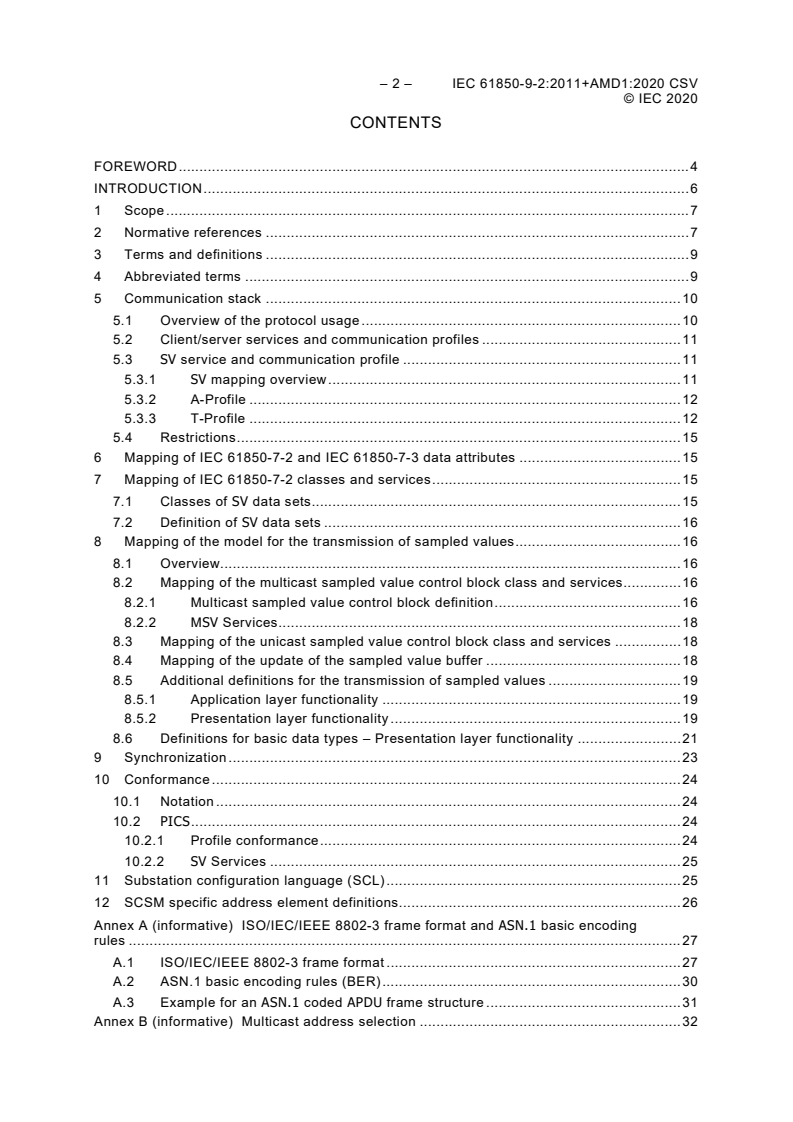
CONTENTS
FOREWORD . 4
INTRODUCTION . 6
1 Scope . 7
2 Normative references . 7
3 Terms and definitions . 9
4 Abbreviated terms . 9
5 Communication stack . 10
5.1 Overview of the protocol usage . 10
5.2 Client/server services and communication profiles . 11
5.3 SV service and communication profile . 11
5.3.1 SV mapping overview . 11
5.3.2 A-Profile . 12
5.3.3 T-Profile . 12
5.4 Restrictions . 15
6 Mapping of IEC 61850-7-2 and IEC 61850-7-3 data attributes . 15
7 Mapping of IEC 61850-7-2 classes and services . 15
7.1 Classes of SV data sets. 15
7.2 Definition of SV data sets . 16
8 Mapping of the model for the transmission of sampled values . 16
8.1 Overview. 16
8.2 Mapping of the multicast sampled value control block class and services. 16
8.2.1 Multicast sampled value control block definition . 16
8.2.2 MSV Services . 18
8.3 Mapping of the unicast sampled value control block class and services . 18
8.4 Mapping of the update of the sampled value buffer . 18
8.5 Additional definitions for the transmission of sampled values . 19
8.5.1 Application layer functionality . 19
8.5.2 Presentation layer functionality . 19
8.6 Definitions for basic data types – Presentation layer functionality . 21
9 Synchronization . 23
10 Conformance . 24
10.1 Notation . 24
10.2 PICS . 24
10.2.1 Profile conformance . 24
10.2.2 SV Services . 25
11 Substation configuration language (SCL) . 25
12 SCSM specific address element definitions. 26
Annex A (informative) ISO/IEC/IEEE 8802-3 frame format and ASN.1 basic encoding
rules . 27
A.1 ISO/IEC/IEEE 8802-3 frame format . 27
A.2 ASN.1 basic encoding rules (BER) . 30
A.3 Example for an ASN.1 coded APDU frame structure . 31
Annex B (informative) Multicast address selection . 32
© IEC 2020
Annex C (normative) Compatibility of the different revisions of this standard . 33
C.1 General . 33
C.2 Compatibility rules for IEC 61850-9-2 . 33
C.3 Other modifications to consider for backward / forward compatibility . 33
C.3.1 Deferral of Physical Layer specification . 33
C.3.2 Adding new optional fields in frame . 33
C.3.3 Adding time synchronization specifications . 33
C.3.4 Removal of field values . 33
C.3.5 Changing attribute values . 34
Figure 1 – OSI reference model and profiles . 11
Figure 2 – Structure of the tag header. 13
Figure 3 – Reserved 1 . 15
Figure 4 – Concatenation of several ASDU's into one frame . 19
Figure A.1 – ISO/IEC/IEEE 8802-3 frame format – No link redundancy . 27
Figure A.2 – ISO/IEC/IEEE 8802-3 frame format – Link redundancy: HSR . 28
Figure A.3 – ISO/IEC/IEEE 8802-3 frame format – Link redundancy: PRP . 29
Figure A.4 – Basic encoding rules format . 30
Figure A.5 – Format of the tag octets . 30
Figure A.6 – Example for an ASN.1 coded APDU frame structure . 31
Table 4 – Service requiring SV communication profile . 11
Table 5 – Service and protocols for SV communication A-Profile . 12
Table 6 – SV T-Profile . 12
Table 7 – Default Virtual LAN IDs and priorities . 13
Table 8 – Assigned Ethertype values . 14
Table 9 – MMS TypeDescription definition for MSVCB MMS structure . 16
Table 10 – PhyComAddr structure . 18
Table 20 – Mapping of OptFlds within Bitstring . 18
Table 11 – Mapping of multicast sampled value services . 18
Table 14 – Encoding for the transmission of the sampled value buffer . 20
Table 15 – Encoding for the basic data types . 22
Table 21 – Mapping for IEC 61850-7-2 quality . 23
Table 16 – PICS for A-Profile support . 25
Table 17 – PICS for T-Profile support . 25
Table 18 – SV conformance statement . 25
Table 19 – Definitions for SV SCL . 26
Table B.1 – Recommended multicast addressing example . 32
– 4 – IEC 61850-9-2:2011+AMD1:2020 CSV
© IEC 2020
INTERNATIONAL ELECTROTECHNICAL COMMISSION
____________
COMMUNICATION NETWORKS AND SYSTEMS
FOR POWER UTILITY AUTOMATION –
Part 9-2: Specific communication service mapping (SCSM) –
Sampled values over ISO/IEC 8802-3
FOREWORD
1) The International Electrotechnical Commission (IEC) is a worldwide organization for standardization comprising
all national electrotechnical committees (IEC National Committees). The object of IEC is to promote
international co-operation on all questions concerning standardization in the electrical and electronic fields. To
this end and in addition to other activities, IEC publishes International Standards, Technical Specifications,
Technical Reports, Publicly Available Specifications (PAS) and Guides (hereafter referred to as “IEC
Publication(s)”). Their preparation is entrusted to technical committees; any IEC National Committee interested
in the subject dealt with may participate in this preparatory work. International, governmental and non-
governmental organizations liaising with the IEC also participate in this preparation. IEC collaborates closely
with the International Organization for Standardization (ISO) in accordance with conditions determined by
agreement between the two organizations.
2) The formal decisions or agreements of IEC on technical matters express, as nearly as possible, an international
consensus of opinion on the relevant subjects since each technical committee has representation from all
interested IEC National Committees.
3) IEC Publications have the form of recommendations for international use and are accepted by IEC National
Committees in that sense. While all reasonable efforts are made to ensure that the technical content of IEC
Publications is accurate, IEC cannot be held responsible for the way in which they are used or for any
misinterpretation by any end user.
4) In order to promote international uniformity, IEC National Committees undertake to apply IEC Publications
transparently to the maximum extent possible in their national and regional publications. Any divergence
between any IEC Publication and the corresponding national or regional publication shall be clearly indicated in
the latter.
5) IEC itself does not provide any attestation of conformity. Independent certification bodies provide conformity
assessment services and, in some areas, access to IEC marks of conformity. IEC is not responsible for any
services carried out by independent certification bodies.
6) All users should ensure that they have the latest edition of this publication.
7) No liability shall attach to IEC or its directors, employees, servants or agents including individual experts and
members of its technical committees and IEC National Committees for any personal injury, property damage or
other damage of any nature whatsoever, whether direct or indirect, or for costs (including legal fees) and
expenses arising out of the publication, use of, or reliance upon, this IEC Publication or any other IEC
Publications.
8) Attention is drawn to the Normative references cited in this publication. Use of the referenced publications is
indispensable for the correct application of this publication.
9) Attention is drawn to the possibility that some of the elements of this IEC Publication may be the subject of
patent rights. IEC shall not be held responsible for identifying any or all such patent rights.
This consolidated version of the official IEC Standard and its amendment has been
prepared for user convenience.
IEC 61850-9-2 edition 2.1 contains the second edition (2011-09) [documents 57/1133/
FDIS and 57/1161/RVD] and its amendment 1 (2020-02) [documents 57/2112/FDIS and
57/2135/RVD].
© IEC 2020
International Standard IEC 61850-9-2 has been prepared by IEC technical committee 57:
Power systems management and associated information exchange.
Compared to the second edition, this first revision of the second edition:
a) updates the normative references
b) adds a synchronization clause (Clause 9); adds references to IEC 61588:2009 and
IEC/IEEE 61850-9-3 for SV synchronization;
c) modifies physical layer specification in T-Profile;
d) modifies MSVCB components (Table 9 and Table 10);
e) deprecates usage of USVCB;
f) modifies encoding for the transmission of the sampled value buffer (Table 14);
g) adds Table 20;
h) adds Table 21;
i) adds Annex C related to possible backward compatibility issues between revisions of this
standard;
j) provides clarifications and corrections to the second edition of IEC 61850-9-2, based on
the tissues = { 1349, 1272, 1055, 944, 863 }.
This publication has been drafted in accordance with the ISO/IEC Directives, Part 2.
A list of all parts of the IEC 61850 series, under the general title: Communication networks
and systems for power utility automation, can be found on the IEC website.
The committee has decided that the contents of the base publication and its amendment will
remain unchanged until the stability date indicated on the IEC website under
"http://webstore.iec.ch" in the data related to the specific publication. At this date, the
publication will be
• reconfirmed,
• withdrawn,
• replaced by a revised edition, or
• amended.
– 6 – IEC 61850-9-2:2011+AMD1:2020 CSV
© IEC 2020
INTRODUCTION
This part of IEC 61850 defines the SCSM for sampled values over ISO/IEC 8802-3. The intent
of this SCSM definition is to include the complete mapping of the sampled value model.
This part of IEC 61850 applies to all electronic sensors related to process measurements of
the T logical node group having a digital sampled value output stream such as current and
voltage transformers, merging units, or devices acting as T group publishers as well as
subscribing intelligent electronic devices, for example protection units, bay controllers and
meters.
Process bus communication structures can be arranged in different ways as described in IEC
TR 61850-1. In addition to the transmission of sampled value data sets, which are directly
connected to ISO/IEC 8802-3, a selection of IEC 61850-8-1 services is necessary to support
the access to the SV control block. References to the relevant IEC 61850-8-1 services are
provided in this SCSM. For less complex devices (for example merging units), the sampled
value control block can be pre-configured, in which case there is no need to implement
IEC 61850-8-1 services based on the MMS-Stack.
This document defines the mapping of sampled value class model (IEC 61850-7-2) to
ISO/IEC 8802-3. This SCSM, in combination with IEC 61850-7 and IEC 61850-6, allows
interoperability between devices from different manufacturers.
This standard does not specify individual implementations or products, nor does it constrain
the implementation of entities and interfaces within a computer system. This standard
specifies the externally visible functionality of implementations together with conformance
requirements for such functionalities.
Reading guide:
• This document is an extended mapping specification of IEC 61850-8-1 to cover sampled
value transmission over ISO/IEC 8802-3.
• This document can best be understood if the reader is thoroughly familiar with
IEC 61850-7-1, IEC 61850-7-2, IEC 61850-7-3 and IEC 61850-7-4.
• The ACSI services defined in IEC 61850-7-2 are not explained in this part of IEC 61850.
© IEC 2020
COMMUNICATION NETWORKS AND SYSTEMS
FOR POWER UTILITY AUTOMATION –
Part 9-2: Specific communication service mapping (SCSM) –
Sampled values over ISO/IEC 8802-3
1 Scope
This part of IEC 61850 defines the specific communication service mapping (SCSM) for the
transmission of sampled values according to the abstract specification in IEC 61850-7-2. The
mapping is that of the abstract model on a mixed stack using direct access to an
ISO/IEC 8802-3 link for the transmission of the samples in combination with IEC 61850-8-1.
Each SCSM consists of three parts:
– a specification of the communication stack being used,
– the mapping of the abstract specifications of IEC 61850-7 series on the real elements of
the stack being used, and
– the implementation specification of functionality, which is not covered by the stack being
used.
2 Normative references
The following documents are referred to in the text in such a way that some or all of their
content constitutes requirements of this document. For dated references, only the edition
cited applies. For undated references, the latest edition of the referenced document (including
any amendments) applies.
IEC 61588:2009, Precision clock synchronization protocol for networked measurement and
control systems
IEC TS 61850-2, Communication networks and systems in substations – Part 2: Glossary
IEC 61850-6, Communication networks and systems for power utility automation – Part 6:
Configuration description language for communication in electrical substations related to IEDs
IEC 61850-7-2, Communication networks and systems for power utility automation – Part 7-2:
Basic information and communication structure – Abstract communication service interface
(ACSI)
IEC 61850-7-3, Communication networks and systems for power utility automation – Part 7-3:
Basic communication structure – Common data classes
IEC 61850-8-1, Communication networks and systems for power utility automation – Part 8-1:
Specific communication service mapping (SCSM) – Mappings to MMS (ISO 9506-1 and
ISO 9506-2) and to ISO/IEC 8802-3
IEC/IEEE 61850-9-3, Communication networks and systems for power utility automation –
Part 9-3: Precision Time Protocol profile for power utility automation
– 8 – IEC 61850-9-2:2011+AMD1:2020 CSV
© IEC 2020
IEC TR 61850-90-4, Communication networks and systems for power utility automation –
Part 90-4: Network engineering guidelines
IEC 62351-6 , Power systems management and associated information exchange – Data and
communications security – Part 6: Security for IEC 61850
IEC 62439-3:2016, Industrial communication networks – High availability automation networks
– Part 3: Parallel Redundancy Protocol (PRP) and High-availability Seamless Redundancy
(HSR)
ISO/IEC 8326:1996, Information technology – Open Systems Interconnection – Session
service definition
ISO/IEC 8327-1:1996, Information technology – Open Systems Interconnection – Connection-
oriented session protocols: Protocol specification
ISO/IEC 8649:1996, Information technology – Open Systems Interconnection – Service
definition for the Associated Control Service Element
ISO/IEC 8650-1:1996, Information technology – Open Systems Interconnection – Connection-
oriented protocol for the Association Control Service Element: Protocol specification
ISO/IEC/IEEE 8802-3, Standard for Ethernet
ISO/IEC 8822:1994, Information technology – Open Systems Interconnection – Presentation
service definition
ISO/IEC 8823-1:1994, Information technology – Open Systems Interconnection – Connection-
oriented presentation protocol: Protocol specification
ISO/IEC 8824-1:2008, Information technology – Abstract Syntax Notation One (ASN. 1):
Specification of basic notation
ISO/IEC 8825-1, Information technology – ASN.1 encoding rules: Specification of Basic
Encoding Rules (BER), Canonical Encoding Rules (CER) and Distinguished Encoding Rules
(DER)
ISO 4217:2015, Code for the representation of currencies
ISO 9506-1:2003, Industrial automation systems – Manufacturing Message Specification –
Part 1: Service definition
ISO 9506-2:2003, Industrial automation systems – Manufacturing Message Specification –
Part 2: Protocol specification
IEEE 754:1985, IEEE Standard for Binary Floating-Point Arithmetic
IEEE 802.1Q:1998, IEEE Standards for Local and Metropolitan Area Networks: Virtual
Bridged Local Area Networks
__________
Under preparation. Stage at the time of publication: IEC/PRVC 62351-6:2020.
© IEC 2020
RFC 791, Internet Protocol; IETF, available at http://www.ietf.orgRFC 792, Internet Control
Message Protocol; IETF, available at http://www.ietf.org
RFC 793, Transmission Control Procedure; IETF, available at http://www.ietf.org
RFC 826, Ethernet Address Resolution Protocol or Converting Network Protocol Addresses to
48.bit Ethernet Address for Transmission on Ethernet Hardware; IETF, available at
http://www.ietf.org
RFC 894, A Standard for the Transmission of IP Datagrams over Ethernet Networks; IETF,
available at http://www.ietf.org
RFC 919, Broadcasting Internet Datagrams; IETF, available at http://www.ietf.org
RFC 1006, ISO transport services on top of TCP: Version 3; IETF, available at
http://www.ietf.org
RFC 1112, Host Extensions for IP multicasting; IETF, available at http://www.ietf.org
RFC 2460, Internet Protocol, Version 6 (IPv6) Specification, IETF, available at
http://www.ietf.org
3 Terms and definitions
For the purposes of this document, the terms and definitions given in IEC/TS 61850-2 apply.
ISO and IEC maintain terminological databases for use in standardization at the following
addresses:
• IEC Electropedia: available at http://www.electropedia.org/
• ISO Online browsing platform: available at http://www.iso.org/obp
4 Abbreviated terms
abstract communication service interface
ACSI
application service data unit
ASDU
abstract syntax notation number one
ASN.1
application protocol control information
APCI
application protocol data unit
APDU
application identifier
APPID
AUI attachment unit interface
BER ASN.1 basic encoding rules
BS bitstring
c Conditional support. The item shall be implemented if the stated condition exists.
canonical format identifier
CFI
data frame
DF
data object
DO
functional standard
F/S
– 10 – IEC 61850-9-2:2011+AMD1:2020 CSV
© IEC 2020
generic object oriented substation event
GOOSE
Out-of-scope: The implementation of the item is not within the scope of this
i
standard.
IED configuration description
ICD
intelligent electronic device
IED
link layer service data unit
LSDU
Mandatory support. The item shall be implemented.
m
media access control
MAC
manufacturing message specification (ISO 9506)
MMS
MSVCB multicast sampled value control block
MU merging unit
o Optional support. The implementor may decide to implement the item.
PDU protocol data unit
protocol implementation conformance statement
PICS
Precision Time Protocol, referring to IEC 61588:2009
PTP
specific communication services mapping
SCSM
readable
r
sampled value
SV
tag control information
TCI
tag protocol identifier
TPID
unicast sampled value control block
USVCB
VLAN identifier
VID
virtual local area network
VLAN
VMD virtual manufacturing device
w writeable
Excluded. The implementor shall not implement this item.
x
extensible markup language
XML
5 Communication stack
5.1 Overview of the protocol usage
The OSI reference model (ISO/IEC 7498-1) defines a model based upon the concept of
layering of communication functions. The model includes 7 layers and specifies the functional
requirements for each layer to achieve a robust communication system. The model does not
specify the protocols to be used to achieve the functionality, nor does it restrict the solution to
a single set of protocols.
© IEC 2020
Application
Presentation A-Profile
Session
Transport
Network
T-Profile
DataLink
Physical
Figure 1 – OSI reference model and profiles
The use of ISO application (A-Profile) and transport (T-Profile) profiles (see Figure 1)
describes the various stack profiles. An ISO A-Profile is the set of specifications and
agreements relating to the upper three (3) layers of the ISO OSI reference model (for
example, the application, presentation, and session layers). An ISO T-Profile is the set of
specifications and agreements relating to the lower four (4) layers of the ISO OSI reference
model (for example, the transport, network, data link and physical layers).
Two combinations of A-Profiles and T-Profiles are defined in order to support the transmission
of sampled values, including access to the associated SV control block, as specified in
IEC 61850-7-2. The two different combinations are used for:
• client/server services based on MMS in accordance with IEC 61850-8-1;
• SV services based on data link layer.
5.2 Client/server services and communication profiles
Content removed; see IEC 61850-8-1.
5.3 SV service and communication profile
5.3.1 SV mapping overview
This SV communication profile shall be used for any implementation claiming conformance to
this standard and declaring support for one of the following IEC 61850-7-2 services in
Table 4.
Table 4 – Service requiring SV communication profile
Model IEC 61850-7-2 service
Multicast sampled value class model Multicast SV message
Unicast sampled value class model Unicast SV message (deprecated)
– 12 – IEC 61850-9-2:2011+AMD1:2020 CSV
© IEC 2020
5.3.2 A-Profile
Table 5 shows services and protocols of the A-Profile SV.
Table 5 – Service and protocols for SV communication A-Profile
OSI model Specification m/o
layer
Name Service specification Protocol specification
Application SendMSVMessage service See clause 8.5 m
Security IEC 62351-6 o
Presentation Abstract syntax ISO/IEC 8824-1:2008 ISO/IEC 8825-1 m
Session
Presentation layer: see additional definitions in 8.5.
5.3.3 T-Profile
5.3.3.1 General
The T-Profile for SV services is shown in Table 6.
Table 6 – SV T-Profile
Specification
OSI model
m/o
Name Service specification Protocol
layer
specification
Transport
Network
Link Parallel redundancy protocol and IEC 62439-3:2016 o
Redundancy high availability seamless ring
DataLink Priority tagging/VLAN IEEE 802.1Q m
Standard for Ethernet ISO/IEC/IEEE 8802-3 m
Physical Interface IEC TR 61850-90-4 c
c If the product standard profiling this standard is not specifying another physical interface, IEC/TR 61850-90-4
applies
NOTE This standard only considers layer 2 sampled values transmission. Routable sampled values mechanisms
are defined in IEC 61850-8-1.
5.3.3.2 Link layer: Ethernet addresses
The destination ISO/IEC/IEEE 8802-3 multicast address has to be configured for the
transmission of sampled values. A unique ISO/IEC/IEEE 8802-3 source address shall be
used. Recommendations of multicast address range assignments are given in Annex B.
5.3.3.3 Link layer: Priority tagging/virtual LAN
IEEE 802.1Q field shall be present in the egress frames from a SV publisher.
Priority tagging according to IEEE 802.1Q is used to separate time-critical and high-priority
bus traffic for protection-relevant applications from low priority bus loads.
© IEC 2020
Subscribers conformant to this document shall be prepared that the Virtual LAN tag might
have been removed or modified by the network on the path from the publisher to the subscriber.
See Figure 2 for the structure of the tag header.
Octets 8 7 6 5 4 3 2 1
TPID
0 × 8100 (as per 802.1Q)
2 User priority CFI VID
TCI
3 VID
Figure 2 – Structure of the tag header
TPID (tag protocol identifier) field: indicates the Ethernet type assigned for 802.1Q Ethernet
encoded frames. This value shall be 0x8100.
TCI (tag control information) fields: user priority: BS3; user priority value shall be set by
configuration to separate sampled values from low priority bus load. If the priority is not
configured, then the default values of Table 7 shall be used.
CFI (canonical format indicator): BS1 [0]; a single bit flag value. For this standard, the CFI bit
value shall be reset (value = 0).
NOTE If set (value = 1), an embedded resource identification field (E-RIF) follows the Length/Type field in the
ISO/IEC/IEEE 8802-3 tagged frame.
VID: for backward compatibility reasons, the value of the VLAN Identifier shall be zero (0) if
the SMV P-Type VLAN-ID is missing in the configuration.
As IEEE 802.1Q allows implementation with a restricted set of priorities, the higher priority
frames should have a priority of 4 to 7 and the lower priority should have a priority of 1 to 3.
The value 1 is the priority of untagged frames; thus 0 should be avoided as it may cause
unpredictable delay due to normal traffic.
Additionally, since sampled values potentially need to have their own bandwidth allocation,
their configured VID will be different from GOOSE.
The default values for priority and VID shall be as defined in Table 7.
Table 7 – Default Virtual LAN IDs and priorities
Service Default VID Default priority
Sampled Values 0 4
The general ISO/IEC 8802-3 frame structure for sampled values can be found in Annex A.
All implementations that send Sampled Values and claim conformance to this clause of this
standard, shall be capable of configuration of the VID and priority attributes.
All implementations that receive Sampled Values shall be capable of receiving any VID and
priority (e.g. these attributes shall not be used for Source address matching). Additionally,
– 14 – IEC 61850-9-2:2011+AMD1:2020 CSV
© IEC 2020
such implementations shall be capable of processing incoming messages that do not contain
IEEE 802.1Q information.
5.3.3.4 Link layer: Ethertype and other header information
5.3.3.4.1 Ethertype
Ethertypes based on ISO/IEC/IEEE 8802-3 MAC-sublayer are registered by the IEEE authority
registration. GSE management, GOOSE and sampled values shall be directly mapped to the
reserved Ethertype(s) and the Ethertype PDU. The assigned values are found in Table 8.
Table 8 – Assigned Ethertype values
Use Ethertype value APPID type
(hexadecimal)
IEC 61850-8-1 GOOSE Type 1 88-B8 0 0
IEC 61850-8-1 88-B9 0 0
GSE Management and
SV Management
IEC 61850-9-2 Sampled Values 88-BA 0 1
IEC 61850-8-1 GOOSE Type 1A 88-B8 1 0
The Ethertype PDU and APDU octets shall be as defined in Annex A.
5.3.3.4.2 APPID
Application identifier. The APPID is used to select ISO/IEC/IEEE 8802-3 frames containing
sampled value messages and to distinguish the application association.
The value of APPID is the combination of the APPID type, defined as the two most significant
bits of the value (as defined in Table 8), and the actual ID.
The reserved value range for sampled values is 0x4000 to 0x7FFF. If no APPID is configured,
the default value shall be 0x4000. The default value is reserved to indicate lack of
configuration. It is strongly recommended to have unique, source orientated SV APPID within a
system, in order to enable a filter on link layer. The configuration of APPID should be
enforced by the configuration system.
5.3.3.4.3 Length
Number of octets including the Ethertype PDU header starting at APPID, and the length of the
APDU (Application Protocol Data Unit). Therefore, the value of length shall be 8 + m, where m
is the length of the APDU and m is less than 1 493. Frames with inconsistent or invalid length
field shall be discarded.
5.3.3.4.4 Reserved 1
The structure of Reserved 1 is defined in Figure 3.
Octets 8 7 6 5 4 3 2 1
0 S R Reserved Security
1 Reserved Security
© IEC 2020
Figure 3 – Reserved 1
S: Simulate. When this flag is set, the sampled value telegram has been issued by a publisher
located in a test device and not by the publisher as specified in the configuration file of the
device.
R: Reserved. The three bits are reserved for future standardized application and shall be set
to 0 as default.
Reserved security: See Reserved 2 below.
5.3.3.4.5 Reserved 2
The Reserved 2 field and the “reserved security” of Reserved 1 field form a 28-bit word
defined by the security standard IEC 62351-6. It shall be used as defined when SampledValue
telegram with security is transmitted, otherwise it shall be set to 0. Subscribers that do not
support IEC 62351-6 shall ignore the value of the fields when it is not 0.
5.4 Restrictions
This mapping is restricted to the mapping of the ACSI model for the transmission of sampled
values. The model applies to data sets. To get the full benefit of IEC 61850, additional ACSI
models need to be supported in accordance with IEC 61850-8-1. As an example, to enable
the transmission of a sampled value buffer, the associated control block attribute “SvEna”
shall be written. However, if the client will read a list of available data sets or the contents of
the data set, further models (for example logical device, logical node or data set) need to be
supported.
Data sets for sampled values shall be specified by using the XML language on engineering
level in accordance with IEC 61850-6 to ensure interoperability.
For the transmission of sampled value data sets, the ASN.1 basic encoding rules (BER) shall
be used in combination with tags notation harmonised with the MMS grammar used in
IEC 61850-8-1.
Only FCDA of Basic Types are allowed to be members of data sets for sampled values.
6 Mapping of IEC 61850-7-2 and IEC 61850-7-3 data attributes
The mapping of attributes and common data attributes to MMS are specified in IEC 61850-8-1.
For the transmission of sampled values, the ASN.1, the basic encoding rules (BER), and the
common data classes defined in IEC 61850-7-3 apply.
7 Mapping of IEC 61850-7-2 classes and services
7.1 Classes of SV data sets
If a client/server association based on MMS is used in addition to the transmission of SV data
sets, the definitions of IEC 61850-8-1 apply for the following classes:
– server class model;
– association model;
– logical device model;
– 16 – IEC 61850-9-2:2011+AMD1:2020 CSV
© IEC 2020
– logical node model;
– data class model;
– data set class model.
7.2 Definition of SV data sets
For the transmission of sampled values, the data sets are defined in logical node "LLN0". All
sampled value data set specifications are part of the IED configuration description (ICD).
NOTE It is assumed that the data sets used for the transmission of sampled values can include data objects from
more than one logical node and are therefore allocated in LLN0.
8 Mapping of the model for the transmission of sampled values
8.1 Overview
To ensure interoperability, the data sets for sampled values are specified in XML according to
the definition in IEC 61850-6.
The sampled value class model provides reporting of sampled value data sets in an organised
and time controlled way, so that transfer is very fast and time of transfer is kept constant.
Sampled value control block defines the transmission characteristics of the data set they refer
to. A detailed description is given in IEC 61850-7-2.
8.2 Mapping of the multicast sampled value control block class and services
8.2.1 Multicast sampled value control block definition
The sampled value control block, as defined in IEC 61850-7-2, shall be pre-defined by
configuration and shall be mapped to an MMS Multicast sampled value control block (MSVCB)
as defined in Table 9. All MSVCB components shall be of the functional constraint “MS”.
Table 9 – MMS TypeDescription definition for MSVCB MMS structure
Condi-
MMS component MMS
r/w m/o Comments
name TypeDescription tion
MMS Identifier of the structure of the
MsvCBNam Identifier r m
MsvCBName within the MMS object named:
LLN0$MS e.g. LLN0$MS$
MsvCBRef Visible-string r m The value of this component shall contain
the IEC Reference of the MsvCB.
e.g.
/LLN0$MS$
SvEna Boolean r/w m TRUE = transmission of sampled value
buffer is activated.
FALSE = transmission of sampled value
buffer is deactivated.
MsvID Visible-string r m System-wide unique identification.
It is strongly recommended to use a four-
byte hexadecimal representation of APPID
value as system-wide unique identification
DatSet Visible-string r m The value of this component shall contain
the IEC reference of the DataSet conveyed
by the MsvCB. This ObjectReference shall
be limited to VMD or Domain scoped
NamedVariableLists.
Only FCDA of Basic Types are allowed to be
members of the DataSet.
© IEC 2020
MMS component MMS Condi-
r/w m/o Comments
name TypeDescription tion
ConfRev Unsigned integer r m Count of configuration changes regard to
MSVCB.
SmpRate Unsigned integer r m Amount of samples (default per nominal
period, see SmpMod).
OptFlds Bitstring See Table 20
refresh-time Boolean r m TRUE = SV buffer contains the attribute
“RefrTm”.
FALSE = attribute “RefrTm” is not available
in the SV buffer.
sample- Boolean r m Value will be ignored. Kept to ensure
synchronised backward compatibility with IEC 61850-9-
2:2004
sample-rate Boolean r m TRUE = SV buffer contains the attribute
“SmpRate”.
FALSE = attribute “SmpRate” is not available
in the SV buffer.
data-set-name Boolean r m TRUE = SV buffer contains the attribute
“DatSet”.
FALSE = attribute “DatSet” is not available
in the SV buffer.
security Boolean r m Mapping specific attribute.
TRUE = SV buffer contains the attribute
“Security”.
FALSE = attribute “Security” is not available
in the SV buffer.
sample-mode Boolean r m TRUE = SV buffer contains the attribute
“SmpMod”.
FALSE = attribute “SmpMod” is not available
in the SV buffer.
synch-source- Boolean r m TRUE = SV buffer contains the attribute
identity “GmIdentity”.
FALSE = attribute “GmIdentity” is not
available in the SV buffer.
SmpMod Enumerated r m smpMod specifies
0 = samples per nominal period (DEFAULT)
1 = samples per second
2 = seconds per sample
If not available (backward compatibility) the
default value is 0.
DstAddress PhyComAddr m Mapping specific attribute. See Table 10
noASDU Unsigned integer r m Mapping specific attribute.
Number of ASDU concatenated into one
APDU.
– 18 – IEC 61850-9-2:2011+AMD1:2020 CSV
© IEC 2020
Table 10 – PhyComAddr structure
Condi-
MMS component MMS
r/w m/o Comments
name TypeDescription tion
Length is 6 octets and contains the value of
Addr OCTET-STRING r m
the destination media access control (MAC)
address to which the SV message is to be
sent.
The DstAddress shall be an Ethernet
address that has the multicast bit set to
TRUE. In order to facilitate the network
traffic filtering, it is recommended to use
different Ethernet addresses for each
DstAddress.
See Annex B for multicast addressing
recommendations
PRIORITY Unsigned8 r m Range of values shall be limited from 0 to 7.
VID Unsigned16 r/w m Range of values shall be limited from 0 to
4 095.
APPID Unsigned16 r m As defined in 5.3.3.
Table 20 – Mapping of OptFlds within Bitstring
MMS component name Bitstring bit position
refresh-time 0
sample-synchronised 1
sample-rate 2
data-set-name 3
security 4
sample-mode 5
synch-source-identity 6
8.2.2 MSV Services
See Table 11.
Table 11 – Mapping of multicast sampled v
...
IEC 61850-9-2 ®
Edition 2.0 2011-09
INTERNATIONAL
STANDARD
NORME
INTERNATIONALE
Communication networks and systems for power utility automation –
Part 9-2: Specific communication service mapping (SCSM) – Sampled values
over ISO/IEC 8802-3
Réseaux et systèmes de communication pour l'automatisation des systèmes
électriques –
Partie 9-2: Mise en correspondance des services de communication spécifiques
(SCSM) – Valeurs échantillonnées sur ISO/CEI 8802-3
All rights reserved. Unless otherwise specified, no part of this publication may be reproduced or utilized in any form or by
any means, electronic or mechanical, including photocopying and microfilm, without permission in writing from either IEC or
IEC's member National Committee in the country of the requester.
If you have any questions about IEC copyright or have an enquiry about obtaining additional rights to this publication,
please contact the address below or your local IEC member National Committee for further information.
Droits de reproduction réservés. Sauf indication contraire, aucune partie de cette publication ne peut être reproduite
ni utilisée sous quelque forme que ce soit et par aucun procédé, électronique ou mécanique, y compris la photocopie
et les microfilms, sans l'accord écrit de la CEI ou du Comité national de la CEI du pays du demandeur.
Si vous avez des questions sur le copyright de la CEI ou si vous désirez obtenir des droits supplémentaires sur cette
publication, utilisez les coordonnées ci-après ou contactez le Comité national de la CEI de votre pays de résidence.
IEC Central Office
3, rue de Varembé
CH-1211 Geneva 20
Switzerland
Email: inmail@iec.ch
Web: www.iec.ch
About the IEC
The International Electrotechnical Commission (IEC) is the leading global organization that prepares and publishes
International Standards for all electrical, electronic and related technologies.
About IEC publications
The technical content of IEC publications is kept under constant review by the IEC. Please make sure that you have the
latest edition, a corrigenda or an amendment might have been published.
Catalogue of IEC publications: www.iec.ch/searchpub
The IEC on-line Catalogue enables you to search by a variety of criteria (reference number, text, technical committee,…).
It also gives information on projects, withdrawn and replaced publications.
IEC Just Published: www.iec.ch/online_news/justpub
Stay up to date on all new IEC publications. Just Published details twice a month all new publications released. Available
on-line and also by email.
Electropedia: www.electropedia.org
The world's leading online dictionary of electronic and electrical terms containing more than 20 000 terms and definitions
in English and French, with equivalent terms in additional languages. Also known as the International Electrotechnical
Vocabulary online.
Customer Service Centre: www.iec.ch/webstore/custserv
If you wish to give us your feedback on this publication or need further assistance, please visit the Customer Service
Centre FAQ or contact us:
Email: csc@iec.ch
Tel.: +41 22 919 02 11
Fax: +41 22 919 03 00
A propos de la CEI
La Commission Electrotechnique Internationale (CEI) est la première organisation mondiale qui élabore et publie des
normes internationales pour tout ce qui a trait à l'électricité, à l'électronique et aux technologies apparentées.
A propos des publications CEI
Le contenu technique des publications de la CEI est constamment revu. Veuillez vous assurer que vous possédez
l’édition la plus récente, un corrigendum ou amendement peut avoir été publié.
Catalogue des publications de la CEI: www.iec.ch/searchpub/cur_fut-f.htm
Le Catalogue en-ligne de la CEI vous permet d’effectuer des recherches en utilisant différents critères (numéro de référence,
texte, comité d’études,…). Il donne aussi des informations sur les projets et les publications retirées ou remplacées.
Just Published CEI: www.iec.ch/online_news/justpub
Restez informé sur les nouvelles publications de la CEI. Just Published détaille deux fois par mois les nouvelles
publications parues. Disponible en-ligne et aussi par email.
Electropedia: www.electropedia.org
Le premier dictionnaire en ligne au monde de termes électroniques et électriques. Il contient plus de 20 000 termes et
définitions en anglais et en français, ainsi que les termes équivalents dans les langues additionnelles. Egalement appelé
Vocabulaire Electrotechnique International en ligne.
Service Clients: www.iec.ch/webstore/custserv/custserv_entry-f.htm
Si vous désirez nous donner des commentaires sur cette publication ou si vous avez des questions, visitez le FAQ du
Service clients ou contactez-nous:
Email: csc@iec.ch
Tél.: +41 22 919 02 11
Fax: +41 22 919 03 00
IEC 61850-9-2 ®
Edition 2.0 2011-09
INTERNATIONAL
STANDARD
NORME
INTERNATIONALE
Communication networks and systems for power utility automation –
Part 9-2: Specific communication service mapping (SCSM) – Sampled values
over ISO/IEC 8802-3
Réseaux et systèmes de communication pour l'automatisation des systèmes
électriques –
Partie 9-2: Mise en correspondance des services de communication spécifiques
(SCSM) – Valeurs échantillonnées sur ISO/CEI 8802-3
INTERNATIONAL
ELECTROTECHNICAL
COMMISSION
COMMISSION
ELECTROTECHNIQUE
PRICE CODE
INTERNATIONALE
CODE PRIX V
ICS 33.200 ISBN 978-2-88912-631-6
– 2 – 61850-9-2 © IEC:2011
CONTENTS
FOREWORD . 4
INTRODUCTION . 6
1 Scope . 7
2 Normative references. 7
3 Terms and definitions . 9
4 Abbreviations . 9
5 Communication stack . 10
5.1 Overview of the protocol usage . 10
5.2 Client/server services and communication profiles . 11
5.2.1 Client/server services . 11
5.2.2 A-Profile . 12
5.2.3 TCP/IP T-Profile . 13
5.3 SV service and communication profile . 13
5.3.1 SV mapping overview . 13
5.3.2 A-Profile . 14
5.3.3 T-Profile . 14
5.4 Restrictions . 17
6 Mapping of IEC 61850-7-2 and IEC 61850-7-3 data attributes . 17
7 Mapping of IEC 61850-7-2 classes and services . 17
7.1 Classes of SV data sets . 17
7.2 Definition of SV data sets . 17
8 Mapping of the model for the transmission of sampled values . 18
8.1 Overview . 18
8.2 Mapping of the multicast sampled value control block class and services . 18
8.2.1 Multicast sampled value control block definition . 18
8.2.2 MSV Services . 19
8.3 Mapping of the unicast sampled value control block class and services . 20
8.3.1 Unicast sampled value control block definition . 20
8.3.2 USV Services . 21
8.4 Mapping of the update of the sampled value buffer. 21
8.5 Additional definitions for the transmission of sampled values . 21
8.5.1 Application layer functionality . 21
8.5.2 Presentation layer functionality . 22
8.6 Definitions for basic data types – Presentation layer functionality . 24
9 Conformance . 24
9.1 Notation . 24
9.2 PICS . 24
9.2.1 Profile conformance . 24
9.2.2 SV Services . 25
10 Substation configuration language (SCL) . 25
11 SCSM specific address element definitions . 26
Annex A (informative) ISO/IEC 8802-3 frame format and ASN.1 basic encoding rules . 27
Annex B (informative) Multicast address selection . 32
61850-9-2 © IEC:2011 – 3 –
Figure 1 – OSI reference model and profiles . 11
Figure 2 – Structure of the tag header . 15
Figure 3 – Reserved 1 . 16
Figure 4 – Concatenation of several ASDU's into one frame . 22
Figure A.1 – ISO/IEC 8802-3 frame format – No link redundancy . 27
Figure A.2 – ISO/IEC 8802-3 frame format – Link redundancy: HSR . 28
Figure A.3 – ISO/IEC 8802-3 frame format – Link redundancy: PRP . 29
Figure A.4 – Basic encoding rules format . 30
Figure A.5 – Format of the tag octets . 30
Figure A.6 – Example for an ASN.1 coded APDU frame structure . 31
Table 1 – Service requiring client/server communication profile . 12
Table 2 – Service and protocols for client/server communication A-Profile . 12
Table 3 – Service and protocols for peer TCP/IP T-Profile . 13
Table 4 – Service requiring SV communication profile . 13
Table 5 – Service and protocols for SV communication A-Profile . 14
Table 6 – SV T-Profile . 14
Table 7 – Default Virtual LAN IDs and priorities . 15
Table 8 – Assigned Ethertype values . 16
Table 9 – MMS TypeDescription definition for MSVCB MMS structure . 18
Table 10 – DstAddress structure . 19
Table 11 – Mapping of multicast sampled value services . 19
Table 12 – MMS TypeDescription definition for USVCB MMS structure . 20
Table 13 – Mapping of unicast sampled value services . 21
Table 14 – Encoding for the transmission of the sampled value buffer . 22
Table 15 – Encoding for the basic data types . 24
Table 16 – PICS for A-Profile support . 25
Table 17 – PICS for T-Profile support . 25
Table 18 – SV conformance statement . 25
Table 19 – Definitions for SV SCL . 26
Table B.1 – Recommended multicast addressing example . 32
– 4 – 61850-9-2 © IEC:2011
INTERNATIONAL ELECTROTECHNICAL COMMISSION
____________
COMMUNICATION NETWORKS AND SYSTEMS
FOR POWER UTILITY AUTOMATION –
Part 9-2: Specific communication service mapping (SCSM) –
Sampled values over ISO/IEC 8802-3
FOREWORD
1) The International Electrotechnical Commission (IEC) is a worldwide organization for standardization comprising
all national electrotechnical committees (IEC National Committees). The object of IEC is to promote
international co-operation on all questions concerning standardization in the electrical and electronic fields. To
this end and in addition to other activities, IEC publishes International Standards, Technical Specifications,
Technical Reports, Publicly Available Specifications (PAS) and Guides (hereafter referred to as “IEC
Publication(s)”). Their preparation is entrusted to technical committees; any IEC National Committee interested
in the subject dealt with may participate in this preparatory work. International, governmental and non-
governmental organizations liaising with the IEC also participate in this preparation. IEC collaborates closely
with the International Organization for Standardization (ISO) in accordance with conditions determined by
agreement between the two organizations.
2) The formal decisions or agreements of IEC on technical matters express, as nearly as possible, an international
consensus of opinion on the relevant subjects since each technical committee has representation from all
interested IEC National Committees.
3) IEC Publications have the form of recommendations for international use and are accepted by IEC National
Committees in that sense. While all reasonable efforts are made to ensure that the technical content of IEC
Publications is accurate, IEC cannot be held responsible for the way in which they are used or for any
misinterpretation by any end user.
4) In order to promote international uniformity, IEC National Committees undertake to apply IEC Publications
transparently to the maximum extent possible in their national and regional publications. Any divergence
between any IEC Publication and the corresponding national or regional publication shall be clearly indicated in
the latter.
5) IEC itself does not provide any attestation of conformity. Independent certification bodies provide conformity
assessment services and, in some areas, access to IEC marks of conformity. IEC is not responsible for any
services carried out by independent certification bodies.
6) All users should ensure that they have the latest edition of this publication.
7) No liability shall attach to IEC or its directors, employees, servants or agents including individual experts and
members of its technical committees and IEC National Committees for any personal injury, property damage or
other damage of any nature whatsoever, whether direct or indirect, or for costs (including legal fees) and
expenses arising out of the publication, use of, or reliance upon, this IEC Publication or any other IEC
Publications.
8) Attention is drawn to the Normative references cited in this publication. Use of the referenced publications is
indispensable for the correct application of this publication.
9) Attention is drawn to the possibility that some of the elements of this IEC Publication may be the subject of
patent rights. IEC shall not be held responsible for identifying any or all such patent rights.
International Standard IEC 61850-9-2 has been prepared by IEC technical committee 57:
Power systems management and associated information exchange.
The text of this standard is based on the following documents:
FDIS Report on voting
57/1133/FDIS 57/1161/RVD
Full information on the voting for the approval of this standard can be found in the report on
voting indicated in the above table.
61850-9-2 © IEC:2011 – 5 –
This second edition cancels and replaces the first edition published in 2004 and constitutes a
technical revision.
Main changes with respect to the first edition are:
• addition of an optional Link redundancy layer (Tables 3 to 6);
• redefinition of “reserved” fields in link layer (5.3.3.4);
• evolution of USVCB and MSVCB components (Tables 9, 10, 12);
• evolution of encoding for the transmission of the sampled value buffer (Table 14).
This publication has been drafted in accordance with the ISO/IEC Directives, Part 2.
A list of all parts of the IEC 61850 series, under the general title: Communication networks and
systems for power utility automation, can be found on the IEC website.
The committee has decided that the contents of this publication will remain unchanged until the
stability date indicated on the IEC web site under "http://webstore.iec.ch" in the data related to
the specific publication. At this date, the publication will be
• reconfirmed,
• withdrawn,
• replaced by a revised edition, or
• amended.
– 6 – 61850-9-2 © IEC:2011
INTRODUCTION
This part of IEC 61850 defines the SCSM for sampled values over ISO/IEC 8802-3. The intent
of this SCSM definition is to include the complete mapping of the sampled value model.
This part of IEC 61850 applies to electronic current and voltage transformers (ECT and EVT
having a digital output), merging units, and intelligent electronic devices, for example protection
units, bay controllers and meters, or sensors.
Process bus communication structures can be arranged in different ways as described in
IEC/TR 61850-1. In addition to the transmission of sampled value data sets, which are directly
connected to ISO/IEC 8802-3, a selection of IEC 61850-8-1 services is necessary to support
the access to the SV control block. References to the relevant IEC 61850-8-1 services are
provided in this SCSM. For less complex devices (for example merging units), the sampled
value control block can be pre-configured, in which case there is no need to implement
IEC 61850-8-1 services based on the MMS-Stack.
This document defines the mapping of sampled value class model (IEC 61850-7-2) to
ISO/IEC 8802-3. This SCSM, in combination with IEC 61850-7 and IEC 61850-6, allows
interoperability between devices from different manufacturers.
This standard does not specify individual implementations or products, nor does it constrain the
implementation of entities and interfaces within a computer system. This standard specifies the
externally visible functionality of implementations together with conformance requirements for
such functionalities.
Reading guide:
• This document is an extended mapping specification of IEC 61850-8-1 to cover sampled
value transmission over ISO/IEC 8802-3.
• This document can best be understood if the reader is thoroughly familiar with
IEC 61850-7-1, IEC 61850-7-2, IEC 61850-7-3 and IEC 61850-7-4.
• The ACSI services defined in IEC 61850-7-2 are not explained in this part of IEC 61850.
61850-9-2 © IEC:2011 – 7 –
COMMUNICATION NETWORKS AND SYSTEMS
FOR POWER UTILITY AUTOMATION –
Part 9-2: Specific communication service mapping (SCSM) –
Sampled values over ISO/IEC 8802-3
1 Scope
This part of IEC 61850 defines the specific communication service mapping (SCSM) for the
transmission of sampled values according to the abstract specification in IEC 61850-7-2. The
mapping is that of the abstract model on a mixed stack using direct access to an
ISO/IEC 8802-3 link for the transmission of the samples in combination with IEC 61850-8-1.
Each SCSM consists of three parts:
– a specification of the communication stack being used,
– the mapping of the abstract specifications of IEC 61850-7 series on the real elements of the
stack being used, and
– the implementation specification of functionality, which is not covered by the stack being
used.
2 Normative references
The following referenced documents are indispensable for the application of this document. For
dated references, only the edition cited applies. For undated references, the latest edition of
the referenced document (including any amendments) applies.
IEC 60874-10-1, Connectors for optical fibres and cables – Part 10-1: Detail specification for
fibre optic connector type BFOC/2,5 terminated to multimode fibre type A1 (withdrawn)
IEC 60874-10-2, Connectors for optical fibres and cables – Part 10-2: Detail specification for
fibre optic connector type BFOC/2,5 terminated to single-mode fibre type B1 (withdrawn)
IEC 60874-10-3, Connectors for optical fibres and cables – Part 10-3: Detail specification for
fibre optic adaptor type BFOC/2,5 for single and multimode fibre (withdrawn)
IEC/TR 61850-1, Communication networks and systems for power utility automation – Part 1:
Introduction and overview
IEC/TS 61850-2, Communication networks and systems for power utility automation – Part 2:
Glossary
IEC 61850-6, Communication networks and systems for power utility automation – Part 6:
Configuration description language for communication in electrical substations related to IEDs
IEC 61850-7-1, Communication networks and systems for power utility automation – Part 7-1:
Basic communication structure – Part 7-1: Principles and models
IEC 61850-7-2, Communication networks and systems for power utility automation – Part 7-2:
Basic information and communication structure – Abstract communication service interface
(ACSI)
– 8 – 61850-9-2 © IEC:2011
IEC 61850-7-3, Communication networks and systems for power utility automation – Part 7-3:
Basic communication structure – Common data classes
IEC 61850-7-4, Communication networks and systems for power utility automation – Part 7-4:
Basic communication structure – Compatible logical node classes and data object classes
IEC 61850-8-1, Communication networks and systems for power utility automation – Part 8-1:
Specific Communication Service Mapping (SCSM) – Mappings to MMS (ISO 9506-1 and
ISO 9506-2) and to ISO/IEC 8802-3
IEC/TS 62351-6, Power systems management and associated information exchange – Data
and communications security – Part 6: Security for IEC 61850
IEC 62439-3:2010, Industrial communication networks – High availability automation networks –
Part 3: Parallel Redundancy Protocol (PRP) and High-availability Seamless Redundancy (HSR)
Amendment 1
ISO/IEC 7498-1:1994, Information technology – Open Systems Interconnection – Basic
Reference Model: The Basic Model
ISO/IEC 8326:1996, Information technology – Open Systems Interconnection – Session service
definition
ISO/IEC 8327-1:1996, Information technology – Open Systems Interconnection – Connection-
oriented session protocols: Protocol specification
ISO/IEC 8649:1996, Information technology – Open Systems Interconnection – Service
definition for the Associated Control Service Element
ISO/IEC 8650-1:1996, Information technology – Open Systems Interconnection – Connection-
oriented protocol for the Association Control Service Element: Protocol specification
ISO/IEC 8802-3:2000, Information technology – Telecommunications and information exchange
between systems – Local and metropolitan area networks – Specific requirements – Part 3:
Carrier sense multiple access with collision detection (CSMA/CD) access method and physical
layer specifications
ISO/IEC 8822:1994, Information technology – Open Systems Interconnection – Presentation
service definition
ISO/IEC 8823-1:1994, Information technology – Open Systems Interconnection – Connection-
oriented presentation protocol: Protocol specification
ISO/IEC 8824-1:2008, Information technology – Abstract Syntax Notation One (ASN. 1):
Specification of basic notation
ISO/IEC 8825-1, Information technology – ASN.1 encoding rules: Specification of Basic
Encoding Rules (BER), Canonical Encoding Rules (CER) and Distinguished Encoding Rules
(DER)
ISO 9506-1:2003, Industrial automation systems – Manufacturing Message Specification –
Part 1: Service definition
———————
To be published.
61850-9-2 © IEC:2011 – 9 –
ISO 9506-2:2003, Industrial automation systems – Manufacturing Message Specification –
Part 2: Protocol specification
IEEE 754:1985, IEEE Standard for Binary Floating-Point Arithmetic
IEEE 802.1Q:1998, IEEE Standards for Local and Metropolitan Area Networks: Virtual Bridged
Local Area Networks
RFC 791, Internet Protocol; IETF, available at http://www.ietf.org [cited on 2011-03-18]
RFC 792, Internet Control Message Protocol; IETF, available at http://www.ietf.org [cited on
2011-03-18]
RFC 793, Transmission Control Procedure; IETF, available at http://www.ietf.org [cited on
2011-03-18]
RFC 826, Ethernet Address Resolution Protocol or Converting Network Protocol Addresses to
48.bit Ethernet Address for Transmission on Ethernet Hardware; IETF, available at
http://www.ietf.org [cited on 2011-03-18]
RFC 894, A Standard for the Transmission of IP Datagrams over Ethernet Networks; IETF,
available at http://www.ietf.org [cited on 2011-03-18]
RFC 919, Broadcasting Internet Datagrams; IETF, available at http://www.ietf.org [cited on
2011-03-18]
RFC 1006 ISO transport services on top of TCP: Version 3; IETF, available at
http://www.ietf.org [cited on 2011-03-18]
RFC 1112, Host Extensions for IP multicasting; IETF, available at http://www.ietf.org [cited on
2011-03-18]
3 Terms and definitions
For the purposes of this document, the terms and definitions given in IEC/TS 61850-2 apply.
4 Abbreviations
Abstract communication service interface
ACSI
Application service data unit
ASDU
Abstract syntax notation number one
ASN.1
Application protocol control information
APCI
Application protocol data unit
APDU
Application identifier
APPID
Attachment unit interface
AUI
BER ASN.1 basic encoding rules
Bitstring
BS
c Conditional support. The item shall be implemented if the stated condition exists
CFI Canonical format identifier
– 10 – 61850-9-2 © IEC:2011
Carrier sense multiple access/collision detection
CSMA/CD
Data frame
DF
Data object
DO
Electronic current transformer
ECT
Electronic voltage transformer
EVT
Functional standard
F/S
Generic object oriented substation event
GOOSE
Generic substation status event
GSSE
i Out-of-scope: The implementation of the item is not within the scope of this
standard
ICD IED configuration description
Intelligent electronic device
IED
Link layer service data unit
LSDU
m Mandatory support. The item shall be implemented
Media access control
MAC
Medium attachment unit
MAU
Manufacturing message specification (ISO 9506)
MMS
Multicast sampled value control block
MSVCB
Merging unit
MU
o Optional support. The implementor may decide to implement the item
Protocol data unit
PDU
Protocol implementation conformance statement
PICS
Specific communication services mapping
SCSM
r readable
Sampled value
SV
Tag control information
TCI
Tag protocol identifier
TPID
Unicast sampled value control block
USVCB
VID VLAN identifier
VLAN Virtual local area network
VMD Virtual manufacturing device
w Writeable
Excluded: The implementor shall not implement this item
x
XML Extensible markup language
5 Communication stack
5.1 Overview of the protocol usage
The OSI reference model (ISO/IEC 7498-1) defines a model based upon the concept of
layering of communication functions. The model includes 7 layers and specifies the functional
requirements for each layer to achieve a robust communication system. The model does not
61850-9-2 © IEC:2011 – 11 –
specify the protocols to be used to achieve the functionality, nor does it restrict the solution to a
single set of protocols.
Application
Presentation A-Profile
Session
Transport
Network
T-Profile
DataLink
Physical
IEC 1786/11
Figure 1 – OSI reference model and profiles
The use of ISO application (A-Profile) and transport (T-Profile) profiles (see Figure 1)
describes the various stack profiles. An ISO A-Profile is the set of specifications and
agreements relating to the upper three (3) layers of the ISO OSI reference model (for example
the application, presentation, and session layers). An ISO T-Profile is the set of specifications
and agreements relating to the lower four (4) layers of the ISO OSI reference model (for
example the transport, network, datalink and physical layers).
Two combinations of A-Profiles and T-Profiles are defined in order to support the transmission
of sampled values including the access to the associated SV control block, as specified in
IEC 61850-7-2. The two different combinations are used for:
• client/server services based on MMS in accordance to IEC 61850-8-1;
• SV services based on datalink layer.
5.2 Client/server services and communication profiles
5.2.1 Client/server services
This client/server communication profile shall be used in addition to the SV communication
profile according to 5.3 if an access to the sampled value control block via client is required.
This profile shall be used for any implementation claiming conformance to this standard and
declaring support for one of the following IEC 61850-7-2 services in Table 1.
– 12 – 61850-9-2 © IEC:2011
Table 1 – Service requiring client/server communication profile
IEC 61850-7-2 model IEC 61850-7-2 service
Server GetServerDirectory
Association Associate
Abort
Release
Logical device GetLogicalDeviceDirectory
Logical node GetLogicalNodeDirectory
GetAllDataValues
Data GetDataValues
SetDataValues
GetDataDirectory
GetDataDefinition
Data set GetDataSetValues
SetDataSetValues
CreateDataSet
DeleteDataSet
GetDataSetDirectory
SV class model GetMSVCBValues
SetMSVCBValues
GetUSVCBValues
SetUSVCBValues
5.2.2 A-Profile
Table 2 shows services and protocols of the A-Profile client/server.
Table 2 – Service and protocols for client/server communication A-Profile
Specification
OSI model layer m/o
Protocol
Name Service specification
specification
Application Manufacturing ISO 9506-1:2000 ISO 9506-2:2000 m
message
specification
Association control ISO/IEC 8649:1996 ISO/IEC 8650-1:1996 m
service element
Presentation Connection oriented ISO/IEC 8822:1994 ISO/IEC 8823-1:1994 m
presentation
Abstract syntax ISO/IEC 8824-1:2008 ISO/IEC 8825-1 m
Session Connection oriented ISO/IEC 8326:1996 ISO/IEC 8327-1:1996 m
session
There is only one T-Profile (TCP/IP) that may be used by the client/server A-Profile.
61850-9-2 © IEC:2011 – 13 –
5.2.3 TCP/IP T-Profile
Table 3 shows services and protocols of the TCP/IP T-Profile client/server.
Table 3 – Service and protocols for peer TCP/IP T-Profile
Specification
OSI model
m/o
Service Protocol
layer
Name
specification specification
Transport ISO transport on top of TCP RFC 1006 m
Internet control message protocol (ICMP) RFC 792 m
Transmission control protocol (TCP) RFC 793 m
Network Internet protocol RFC 791
Converting network protocol address RFC 826 (Address resolution m
protocol: ARP)
Broadcasting internet datagrams RFC 919 m
Host extensions for IP multicasting RFC 1112 m
Link Parallel redundancy protocol and high IEC 62439-3, Amendment 1 o
Redundancy availability seamless ring
DataLink Standard for the transmission of IP datagrams RFC 894 m
over Ethernet networks
Carrier sense multiple access with collision ISO/IEC 8802-3:2000 m
detection (CSMA/CD)
Physical Fibre optic transmission system 100Base-FX ISO/IEC 8802-3:2000 c1
Basic optical fibre connector IEC 60874-10-1, IEC 60874-10-2 c1
and IEC 60874-10-3
NOTE This is the specification for the ST
connector.
c1 – Recommended, but future technology could be used.
5.3 SV service and communication profile
5.3.1 SV mapping overview
This SV communication profile shall be used for any implementation claiming conformance to
this standard and declaring support for one of the following IEC 61850-7-2 services in Table 4.
Table 4 – Service requiring SV communication profile
Model IEC 61850-7-2 service
Multicast sampled value class model Multicast SV message
Unicast sampled value class model Unicast SV message
– 14 – 61850-9-2 © IEC:2011
5.3.2 A-Profile
Table 5 shows services and protocols of the A-Profile SV.
Table 5 – Service and protocols for SV communication A-Profile
OSI model Specification m/o
layer
Name Service specification Protocol specification
Application m
SV service
Presentation Abstract syntax ISO/IEC 8824-1:2008 ISO/IEC 8825-1 m
Session
Presentation layer: see additional definitions in 8.5.
Application layer: see additional definitions in 8.5.
5.3.3 T-Profile
The T-Profile for SV services is shown in Table 6.
Table 6 – SV T-Profile
Specification
OSI model
m/o
Name Service specification Protocol
layer
specification
Transport
Network
Link Parallel redundancy protocol and IEC 62439-3, Amendment 1 o
Redundancy high availability seamless ring
DataLink IEEE 802.1Q m
Priority tagging/VLAN
Carrier sense multiple access ISO/IEC 8802-3:2000 m
with collision detection
(CSMA/CD)
Physical Fibre optic transmission system ISO/IEC 8802-3:2000 c1
100Base-FX
Basic optical fibre connector IEC 60874-10-1, IEC 60874-10-2 and c1
IEC 60874-10-3
NOTE This is the specification
for the ST connector.
c1 – Recommended, but future technology could be used.
5.3.3.1 Physical layer: Specifications for the medium attachment unit (MAU)
The optical fibre transmission system 100Base-FX according to ISO/IEC 8802-3 is
recommended as indicated above because of requirements relating to the electromagnetic
environment.
5.3.3.2 Link layer: Ethernet addresses
The destination ISO/IEC 8802-3 multicast/unicast address has to be configured for the
transmission of sampled values. A unique ISO/IEC 8802-3 source address shall be used.
Recommendations of multicast address range assignments are given in Annex B.
61850-9-2 © IEC:2011 – 15 –
5.3.3.3 Link layer: Priority tagging/virtual LAN
Priority tagging according to IEEE 802.1Q is used to separate time critical and high priority bus
traffic for protection-relevant applications from low priority busload.
See Figure 2 for the structure of the tag header.
Octets 8 7 6 5 4 3 2 1
TPID
0 × 8100 (as per 802.1Q)
2 User priority CFI VID
TCI
3 VID
IEC 1787/11
Figure 2 – Structure of the tag header
TPID (tag protocol identifier) field: Indicates the Ethernet type assigned for 802.1Q Ethernet
encoded frames. This value shall be 0x8100.
TCI (tag control information) fields: User priority: BS3; User priority value shall be set by
configuration to separate sampled values from low priority busload. If the priority is not
configured, then the default values of Table 7 shall be used.
CFI (canonical format indicator): BS1 [0]; A single bit flag value. For this standard, the CFI bit
value shall be reset (value = 0).
NOTE 1 If set (value = 1), an embedded resource identification field (E-RIF) follows the Length/Type field in the
ISO/IEC 8802-3 tagged frame.
VID: Virtual LAN support is optional. If this mechanism will be used, the VLAN identifier (VID)
shall be set by configuration, if it is not used, it shall be set to zero (0).
NOTE 2 As IEEE 802.1Q allows implementation with a restricted set of priorities, the higher priority frames should
have a priority of 4 to 7 and the lower priority should have a priority of 1 to 3. The value 1 is the priority of untagged
frames thus 0 should be avoided as it may cause unpredictable delay due to normal traffic.
Additionally, since sampled values need to have potentially its own bandwidth allocation, their configured VID will
be different from GOOSE and GSSE.
The default values for priority and VID shall be as defined in Table 7.
Table 7 – Default Virtual LAN IDs and priorities
Service Default priority
Default VID
Sampled Values 0 4
The general ISO/IEC 8802-3 frame structure for sampled values can be found in Annex A.
5.3.3.4 Link layer: Ethertype and other header information
5.3.3.4.1 Ethertype
Ethertypes based on ISO/IEC 8802-3 MAC-sublayer are registered by the IEEE authority
registration. GSE management, GOOSE and samples values shall be directly mapped to the
reserved Ethertype(s) and the Ethertype PDU. The assigned values are found in Table 8.
– 16 – 61850-9-2 © IEC:2011
Table 8 – Assigned Ethertype values
Ethertype value
Use
APPID type
(hexadecimal)
88-B8 0 0
IEC 61850-8-1 GOOSE
88-B9 0 0
IEC 61850-8-1 GSE Management
IEC 61850-9-2 Sampled Values 88-BA 0 1
The Ethertype PDU and APDU octets shall be as defined in Annex A.
5.3.3.4.2 APPID
Application identifier. The APPID is used to select ISO/IEC 8802-3 frames containing sampled
value messages and to distinguish the application association.
The value of APPID is the combination of the APPID type, defined as the two most significant
bits of the value (as defined in Table 8), and the actual ID.
The reserved value range for sampled values is 0x4000 to 0x7FFF. If no APPID is configured,
the default value shall be 0x4000. The default value is reserved to indicate lack of
configuration. It is strongly recommended to have unique, source orientated SV APPID within a
system, in order to enable a filter on link layer. The configuration of APPID should be enforced
by the configuration system.
5.3.3.4.3 Length
Number of octets including the Ethertype PDU header starting at APPID, and the length of the
APDU (Application Protocol Data Unit). Therefore, the value of Length shall be 8 + m, where m
is the length of the APDU and m is less than 1493. Frames with inconsistent or invalid length
field shall be discarded.
5.3.3.4.4 Reserved 1
The structure of the Reserved 1 is defined in Figure 3.
Octets 8 7 6 5 4 3 2 1
0 S R Reserved Security
1 Reserved Security
IEC 1788/11
Figure 3 – Reserved 1
S: Simulate. When this flag is set, the SampledValue telegram has been issued by a publisher
located in a test device and not by the publisher as specified in the configuration file of the
device.
R: Reserved. The three bits are reserved for future standardized application and shall be set to
0 as default.
Reserved security: See reserved 2 below.
61850-9-2 © IEC:2011 – 17 –
5.3.3.4.5 Reserved 2
The Reserved 2 field and the “reserved security” of Reserved 1 field form a 28 bits word
defined by the security standard IEC/TS 62351-6. It shall be used as defined when
SampledValue telegram with security is transmitted, otherwise it shall be set to 0.
5.4 Restrictions
This mapping is restricted to the mapping of the ACSI model for the transmission of sampled
values. The model applies to data sets. To get full benefit of IEC 61850, additional ACSI
models need to be supported in accordance to IEC 61850-8-1. As an example, to enable the
transmission of sampled value buffer, the associated control block attribute “SvEna” shall be
written. However, if the client will read a list of available data sets or the contents of the data
set, further models (for example logical device, logical node or data set) need to be supported.
Data sets for sampled values will be specified by using the XML language on engineering level
in accordance with IEC 61850-6 to ensure interoperability.
For the transmission of sampled value data sets, the ASN.1 basic encoding rules (BER) will
be used in combination with tags notation harmonised with the MMS grammar used in
IEC 61850-8-1.
6 Mapping of IEC 61850-7-2 and IEC 61850-7-3 data attributes
The mapping of attributes and common data attributes to MMS are specified in IEC 61850-8-1.
For the transmission of sampled values the ASN.1, the basic encoding rules (BER) and the
common data classes defined in IEC 61850-7-3 apply.
7 Mapping of IEC 61850-7-2 classes and services
7.1 Classes of SV data sets
If a client/server association based on MMS is used in addition to the transmission of SV data
sets, the definitions of IEC 61850-8-1 apply for the following classes:
– server class model;
– association model;
– logical device model;
– logical node model;
– data class model;
– data set class model.
7.2 Definition of SV data sets
For the transmission of sampled values, the data sets are defined in logical node "LLN0". All
sampled value data sets specification are part of the IED configuration description (ICD).
NOTE It is assumed that the data sets used for the transmission of sampled values may include data objects from
more than one logical node and are therefore allocated in LLN0.
– 18 – 61850-9-2 © IEC:2011
8 Mapping of the model for the transmission of sampled values
8.1 Overview
To ensure interoperability, the data sets for sampled values are specified in XML according to
the definition in IEC 61850-6.
The sampled value class model provides reporting of sampled value data sets in an organised
and time controlled way, so that transfer is very fast and time of transfer is kept constant.
Sampled value control block for unicast and multicast defines the transmission characteristics
of the data set they refer to. A detailed description is given in IEC 61850-7-2.
8.2 Mapping of the multicast sampled value control block class and services
8.2.1 Multicast sampled value control block definition
The sampled value control block, as defined in IEC 61850-7-2, shall be pre-defined by
configuration or shall be mapped to an MMS Multicast sampled value control block (MSVCB) as
defined in Table 9. All MSVCB components shall be of the functional
...