


IEC 61970-302:2024
(Main)Energy management system application program interface (EMS-API) - Part 302: Common information model (CIM) dynamics
Energy management system application program interface (EMS-API) - Part 302: Common information model (CIM) dynamics
IEC 61970-302:2024 specifies a Dynamics package which contains part of the CIM to support the exchange of models between software applications that perform analysis of the steady-state stability (small-signal stability) or transient stability of a power system as defined by IEEE / CIGRE, Definition and classification of power system stability IEEE/CIGRE joint task force on stability terms and definitions.
The model descriptions in this document provide specifications for each type of dynamic model as well as the information that needs to be included in dynamic case exchanges between planning/study applications.
The scope of the CIM Dynamics package specified in this document includes:
• standard models: a simplified approach to describing dynamic models, where models representing dynamic behaviour of elements of the power system are contained in predefined libraries of classes which are interconnected in a standard manner. Only the names of the selected elements of the models along with their attributes are needed to describe dynamic behaviour.
• proprietary user-defined models: an approach providing users the ability to define the parameters of a dynamic behaviour model representing a vendor or user proprietary device where an explicit description of the model is not provided by this document. The same libraries and standard interconnections are used for both proprietary user-defined models and standard models. The behavioural details of the model are not documented in this document, only the model parameters.
• A model to enable exchange of models’ descriptions. This approach can be used to describe user defined and standard models.
• A model to enable exchange of simulation results.
This second edition cancels and replaces the first edition published in 2018. This edition constitutes a technical revision.
This edition includes the following significant technical changes with respect to the previous edition:
a) The majority of issues detected in IEC 61970-302:2018 are addressed;
b) IEEE 421.5-2016 on Excitation systems is fully covered;
c) The IEEE turbine report from 2013 was considered and as a result a number of gas, steam and hydro turbines/governors are added;
d) IEC 61400-27-1:2020 on wind turbines is fully incorporated;
e) WECC Inverter-Based Resource (IBR) models, Hybrid STATCOM models and storage models are added;
f) The user defined models are enhanced with a model which enables modelling of detailed dynamic model;
g) A model to enable exchange of simulation results is added;
h) The work on the HVDC models is not complete. The HVDC dynamics models are a complex domain in which there are no models that are approved or widely recognised on international level, i.e. there are only project-based models. At this stage IEC 61970-302:2022 only specifies some general classes. However, it is recognised that better coverage of HVDC will require a further edition of this document;
i) Models from IEEE 1547-2018 "IEEE Standard for Interconnection and Interoperability of Distributed Energy Resources with Associated Electric Power Systems Interfaces" are added.
j) Statements have been added to certain figures, tables, schemas, and enumerations throughout the document that indicate that they are reproduced with the permission of the UCA International User Group (UCAIug). These items are derived from the CIM.
Interface de programmation d'application pour système de gestion d'énergie (EMS-API) - Partie 302: Régimes dynamiques de modèle d'information commun (CIM)
IEC 61970-302:2024 spécifie un paquetage dynamique (Dynamics) contenant des extensions du modèle d'information commun (CIM). Il s'agit d'assurer l'échange des modèles entre les applications logicielles qui procèdent à l'analyse de la stabilité en régime établi (stabilité en petits signaux) ou de la stabilité transitoire d'un système de puissance comme cela est défini dans le document Definition and classification of power system stability (Définition et classification de la stabilité des systèmes de puissance) du groupe de travail commun IEEE/CIGRE sur les termes et définitions relatifs à la stabilité.
Les descriptions de modèles indiquées dans le présent document donnent des spécifications pour chaque type de modèle dynamique, ainsi que des informations qui doivent être incluses dans les échanges de cas dynamiques entre les applications de planification/d'étude.
Le domaine d'application du paquetage CIM Dynamics spécifié dans le présent document inclut:
• des modèles normalisés: une approche simplifiée qui vise à décrire des modèles dynamiques, les modèles représentant le comportement dynamique des éléments du système de puissance qui sont contenus dans des bibliothèques prédéfinies de classes interconnectées de manière normalisée. Seuls les noms des éléments sélectionnés des modèles, accompagnés de leurs attributs, sont nécessaires à la description du comportement dynamique;
• des modèles propriétaires définis par l'utilisateur: approche qui donne à l'utilisateur la possibilité de définir les paramètres d'un modèle de comportement dynamique représentant le dispositif propriétaire d'un fournisseur ou d'un utilisateur lorsque le présent document ne donne pas de description explicite du modèle. Les mêmes bibliothèques et interconnexions normalisées sont utilisées tant pour les modèles propriétaires définis par l'utilisateur que pour les modèles normalisés. Les détails comportementaux du modèle ne sont pas documentés dans le présent document, seuls les paramètres du modèle le sont;
• un modèle d'échange des descriptions des modèles. Cette approche peut être utilisée pour décrire les modèles définis par l'utilisateur et les modèles normalisés;
• un modèle d'échange des résultats de simulation.
Cette deuxième édition annule et remplace la première édition parue en 2018. Cette édition constitue une révision technique.
Cette édition inclut les modifications techniques majeures suivantes par rapport à l'édition précédente:
a) la majeure partie des problèmes détectés dans l'IEC 61970-302:2018 ont été résolus;
b) l’IEEE 421.5-2016 relative aux systèmes d'excitation est intégralement couverte;
c) le rapport IEEE sur les turbines publié en 2013 a été pris en considération et, à ce titre, un certain nombre de turbines/régulateurs à vapeur, à gaz et hydrauliques ont été ajoutés;
d) l’IEC 61400-27-1:2020 relative aux éoliennes est totalement intégrée;
e) des modèles de ressources fondées sur les onduleurs (IBR - Inverter based Resource), des modèles STATCOM hybrides et des modèles de stockage WECC ont été ajoutés;
f) les modèles définis par l'utilisateur ont été améliorés avec un modèle de modélisation de modèle dynamique détaillé;
g) un modèle d'échange des résultats de simulation a été ajouté;
h) le travail réalisé sur les modèles CCHT n'est pas terminé. Les modèles de régimes dynamiques CCHT sont un domaine complexe dans lequel aucun modèle n'est approuvé ou ne fait l'objet d'un consensus au niveau mondial, c'est-à-dire qu'il ne s'agit que de modèles à l'état de projet. À ce stade, l'IEC 61970-302:2022 ne spécifie que certaines classes générales. Toutefois, il est reconnu qu'une meilleure couverture de CCHT implique une prochaine édition du présent document;
i) les modèles de l'IEEE 1547-2018 "IEEE Standard for Interconnection and Interoperability of Distributed Energy Resources with Associated Electric Power Systems Interfaces" sont ajoutés;
j) Les experts de l’IEC et les experts techniques procèdent actuellement à la
General Information
- Status
- Published
- Publication Date
- 30-Jan-2024
- Technical Committee
- TC 57 - Power systems management and associated information exchange
- Drafting Committee
- WG 13 - TC 57/WG 13
- Current Stage
- PPUB - Publication issued
- Start Date
- 31-Jan-2024
- Completion Date
- 19-Jan-2024
Relations
- Effective Date
- 05-Sep-2023
Overview
IEC 61970-302:2024 is an international standard published by the International Electrotechnical Commission (IEC) that specifies the Dynamics package within the Common Information Model (CIM). It is part 302 of the Energy Management System Application Program Interface (EMS-API) series. This edition defines models used for exchanging dynamic power system data between software applications that analyze steady-state and transient stability of power systems. It supports interoperability and standardization in the representation and exchange of dynamic models in energy management and planning tools.
This 2024 revision updates the previous 2018 edition by incorporating recent IEEE and IEC standards, adding new dynamic models, and enhancing modeling capabilities for emerging power system components such as inverter-based resources and wind turbines. The standard addresses dynamic modeling of devices like turbines, governors, excitation systems, and loads, ensuring compatibility in simulation data exchange while allowing for proprietary user-defined model extensions.
Key Topics
- CIM Dynamics Package: Core component specifying standardized dynamic models and their interconnections, enabling consistent representation of power system dynamic behavior for simulation and analysis.
- Standard Models: Library-based simplified dynamic models with pre-defined classes, supporting common power system elements and enabling ease of interoperability.
- Proprietary User-Defined Models: Framework allowing vendors and users to define custom dynamic models beyond standardized libraries, while maintaining compatibility with the CIM structure.
- Dynamic Model Descriptions: Specification of metadata and detailed model documentation to support exchange of complex dynamic model information.
- Simulation Results Exchange: Models that define how simulation output data, such as transient stability results, can be standardized and shared across applications.
- Coverage of Key Technologies:
- IEEE 421.5-2016 excitation systems,
- IEEE 1547-2018 for distributed energy resources,
- IEC 61400-27-1:2020 wind turbines,
- WECC inverter-based resources, hybrid STATCOMs, and storage devices,
- Gas, steam, and hydro turbines, governors, and load controllers.
- HVDC Dynamics: Initial classes provided, recognizing the need for further development given the complexity and project-specific nature of HVDC dynamic models.
- Enhancements & Corrections: Addressing issues from the previous edition and extending standardization to cover latest technologies and modeling practices.
Applications
IEC 61970-302:2024 is essential for software developers, system planners, and researchers working in electric power system dynamics and stability analysis. Its applications include:
- Power System Simulation Software: Ensures consistent exchange and interpretation of dynamic model data among transient stability and small signal stability simulation tools.
- Energy Management Systems (EMS): Facilitates integration of dynamic modeling into EMS APIs, enabling advanced real-time analysis and control based on dynamic system behavior.
- Interoperability Platforms: Supports cross-vendor and cross-application data sharing, simplifying integration of planning studies with operational tools.
- Smart Grid and DER Integration: Assists with the accurate modeling and analysis of distributed energy resources and their impact on system dynamics.
- Research and Development: Provides a validated framework for developing and testing new dynamic models or enhancements to existing classes.
- Vendor Product Integration: Enables standardized representation of proprietary dynamic models, ensuring compatibility while preserving intellectual property.
Related Standards
- IEC 61970 (EMS-API series): The broader series of standards defining interfaces for energy management systems, including network model exchange and operational data.
- IEEE 421.5-2016: Standard for excitation system models, fully covered within IEC 61970-302:2024’s dynamic model libraries.
- IEEE 1547-2018: Standard for interconnection and interoperability of distributed energy resources, incorporated for dynamic modeling of DERs.
- IEC 61400-27-1:2020: Wind turbine generator models integrated into the dynamics package.
- CIGRE and IEEE Power System Stability Definitions: Foundational definitions for stability terms and classifications that guide the modeling approaches.
- WECC Dynamic Model Specifications: Used as references and incorporated to support inverter-based resources and advanced dynamic devices.
- IEC 61970-301: Works as a complementary standard detailing common information models for power system networks.
By implementing IEC 61970-302:2024, utilities and software providers enhance compatibility, reproducibility, and rigor in power system dynamic stability studies, supporting the reliable and efficient operation of modern electric power grids. This standard is critical for modern EMS APIs, dynamic simulations, and facilitating integration of renewable and distributed energy resources into the power system.
Frequently Asked Questions
IEC 61970-302:2024 is a standard published by the International Electrotechnical Commission (IEC). Its full title is "Energy management system application program interface (EMS-API) - Part 302: Common information model (CIM) dynamics". This standard covers: IEC 61970-302:2024 specifies a Dynamics package which contains part of the CIM to support the exchange of models between software applications that perform analysis of the steady-state stability (small-signal stability) or transient stability of a power system as defined by IEEE / CIGRE, Definition and classification of power system stability IEEE/CIGRE joint task force on stability terms and definitions. The model descriptions in this document provide specifications for each type of dynamic model as well as the information that needs to be included in dynamic case exchanges between planning/study applications. The scope of the CIM Dynamics package specified in this document includes: • standard models: a simplified approach to describing dynamic models, where models representing dynamic behaviour of elements of the power system are contained in predefined libraries of classes which are interconnected in a standard manner. Only the names of the selected elements of the models along with their attributes are needed to describe dynamic behaviour. • proprietary user-defined models: an approach providing users the ability to define the parameters of a dynamic behaviour model representing a vendor or user proprietary device where an explicit description of the model is not provided by this document. The same libraries and standard interconnections are used for both proprietary user-defined models and standard models. The behavioural details of the model are not documented in this document, only the model parameters. • A model to enable exchange of models’ descriptions. This approach can be used to describe user defined and standard models. • A model to enable exchange of simulation results. This second edition cancels and replaces the first edition published in 2018. This edition constitutes a technical revision. This edition includes the following significant technical changes with respect to the previous edition: a) The majority of issues detected in IEC 61970-302:2018 are addressed; b) IEEE 421.5-2016 on Excitation systems is fully covered; c) The IEEE turbine report from 2013 was considered and as a result a number of gas, steam and hydro turbines/governors are added; d) IEC 61400-27-1:2020 on wind turbines is fully incorporated; e) WECC Inverter-Based Resource (IBR) models, Hybrid STATCOM models and storage models are added; f) The user defined models are enhanced with a model which enables modelling of detailed dynamic model; g) A model to enable exchange of simulation results is added; h) The work on the HVDC models is not complete. The HVDC dynamics models are a complex domain in which there are no models that are approved or widely recognised on international level, i.e. there are only project-based models. At this stage IEC 61970-302:2022 only specifies some general classes. However, it is recognised that better coverage of HVDC will require a further edition of this document; i) Models from IEEE 1547-2018 "IEEE Standard for Interconnection and Interoperability of Distributed Energy Resources with Associated Electric Power Systems Interfaces" are added. j) Statements have been added to certain figures, tables, schemas, and enumerations throughout the document that indicate that they are reproduced with the permission of the UCA International User Group (UCAIug). These items are derived from the CIM.
IEC 61970-302:2024 specifies a Dynamics package which contains part of the CIM to support the exchange of models between software applications that perform analysis of the steady-state stability (small-signal stability) or transient stability of a power system as defined by IEEE / CIGRE, Definition and classification of power system stability IEEE/CIGRE joint task force on stability terms and definitions. The model descriptions in this document provide specifications for each type of dynamic model as well as the information that needs to be included in dynamic case exchanges between planning/study applications. The scope of the CIM Dynamics package specified in this document includes: • standard models: a simplified approach to describing dynamic models, where models representing dynamic behaviour of elements of the power system are contained in predefined libraries of classes which are interconnected in a standard manner. Only the names of the selected elements of the models along with their attributes are needed to describe dynamic behaviour. • proprietary user-defined models: an approach providing users the ability to define the parameters of a dynamic behaviour model representing a vendor or user proprietary device where an explicit description of the model is not provided by this document. The same libraries and standard interconnections are used for both proprietary user-defined models and standard models. The behavioural details of the model are not documented in this document, only the model parameters. • A model to enable exchange of models’ descriptions. This approach can be used to describe user defined and standard models. • A model to enable exchange of simulation results. This second edition cancels and replaces the first edition published in 2018. This edition constitutes a technical revision. This edition includes the following significant technical changes with respect to the previous edition: a) The majority of issues detected in IEC 61970-302:2018 are addressed; b) IEEE 421.5-2016 on Excitation systems is fully covered; c) The IEEE turbine report from 2013 was considered and as a result a number of gas, steam and hydro turbines/governors are added; d) IEC 61400-27-1:2020 on wind turbines is fully incorporated; e) WECC Inverter-Based Resource (IBR) models, Hybrid STATCOM models and storage models are added; f) The user defined models are enhanced with a model which enables modelling of detailed dynamic model; g) A model to enable exchange of simulation results is added; h) The work on the HVDC models is not complete. The HVDC dynamics models are a complex domain in which there are no models that are approved or widely recognised on international level, i.e. there are only project-based models. At this stage IEC 61970-302:2022 only specifies some general classes. However, it is recognised that better coverage of HVDC will require a further edition of this document; i) Models from IEEE 1547-2018 "IEEE Standard for Interconnection and Interoperability of Distributed Energy Resources with Associated Electric Power Systems Interfaces" are added. j) Statements have been added to certain figures, tables, schemas, and enumerations throughout the document that indicate that they are reproduced with the permission of the UCA International User Group (UCAIug). These items are derived from the CIM.
IEC 61970-302:2024 is classified under the following ICS (International Classification for Standards) categories: 33.200 - Telecontrol. Telemetering. The ICS classification helps identify the subject area and facilitates finding related standards.
IEC 61970-302:2024 has the following relationships with other standards: It is inter standard links to IEC 61970-302:2018. Understanding these relationships helps ensure you are using the most current and applicable version of the standard.
You can purchase IEC 61970-302:2024 directly from iTeh Standards. The document is available in PDF format and is delivered instantly after payment. Add the standard to your cart and complete the secure checkout process. iTeh Standards is an authorized distributor of IEC standards.
Standards Content (Sample)
IEC 61970-302 ®
Edition 2.0 2024-01
INTERNATIONAL
STANDARD
NORME
INTERNATIONALE
colour
inside
Energy management system application program interface (EMS-API) –
Part 302: Common information model (CIM) dynamics
Interface de programmation d'application pour système de gestion d'énergie
(EMS-API) –
Partie 302: Régimes dynamiques de modèle d'information commun (CIM)
All rights reserved. Unless otherwise specified, no part of this publication may be reproduced or utilized in any form
or by any means, electronic or mechanical, including photocopying and microfilm, without permission in writing from
either IEC or IEC's member National Committee in the country of the requester. If you have any questions about IEC
copyright or have an enquiry about obtaining additional rights to this publication, please contact the address below or
your local IEC member National Committee for further information.
Droits de reproduction réservés. Sauf indication contraire, aucune partie de cette publication ne peut être reproduite ni
utilisée sous quelque forme que ce soit et par aucun procédé, électronique ou mécanique, y compris la photocopie et
les microfilms, sans l'accord écrit de l'IEC ou du Comité national de l'IEC du pays du demandeur. Si vous avez des
questions sur le copyright de l'IEC ou si vous désirez obtenir des droits supplémentaires sur cette publication, utilisez
les coordonnées ci-après ou contactez le Comité national de l'IEC de votre pays de résidence.
IEC Secretariat Tel.: +41 22 919 02 11
3, rue de Varembé info@iec.ch
CH-1211 Geneva 20 www.iec.ch
Switzerland
About the IEC
The International Electrotechnical Commission (IEC) is the leading global organization that prepares and publishes
International Standards for all electrical, electronic and related technologies.
About IEC publications
The technical content of IEC publications is kept under constant review by the IEC. Please make sure that you have the
latest edition, a corrigendum or an amendment might have been published.
IEC publications search - webstore.iec.ch/advsearchform IEC Products & Services Portal - products.iec.ch
The advanced search enables to find IEC publications by a Discover our powerful search engine and read freely all the
variety of criteria (reference number, text, technical publications previews, graphical symbols and the glossary.
committee, …). It also gives information on projects, replaced With a subscription you will always have access to up to date
and withdrawn publications. content tailored to your needs.
IEC Just Published - webstore.iec.ch/justpublished
Electropedia - www.electropedia.org
Stay up to date on all new IEC publications. Just Published
The world's leading online dictionary on electrotechnology,
details all new publications released. Available online and once
containing more than 22 500 terminological entries in English
a month by email.
and French, with equivalent terms in 25 additional languages.
Also known as the International Electrotechnical Vocabulary
IEC Customer Service Centre - webstore.iec.ch/csc
(IEV) online.
If you wish to give us your feedback on this publication or need
further assistance, please contact the Customer Service
Centre: sales@iec.ch.
A propos de l'IEC
La Commission Electrotechnique Internationale (IEC) est la première organisation mondiale qui élabore et publie des
Normes internationales pour tout ce qui a trait à l'électricité, à l'électronique et aux technologies apparentées.
A propos des publications IEC
Le contenu technique des publications IEC est constamment revu. Veuillez vous assurer que vous possédez l’édition la
plus récente, un corrigendum ou amendement peut avoir été publié.
Recherche de publications IEC - IEC Products & Services Portal - products.iec.ch
webstore.iec.ch/advsearchform Découvrez notre puissant moteur de recherche et consultez
La recherche avancée permet de trouver des publications IEC gratuitement tous les aperçus des publications, symboles
en utilisant différents critères (numéro de référence, texte, graphiques et le glossaire. Avec un abonnement, vous aurez
comité d’études, …). Elle donne aussi des informations sur les toujours accès à un contenu à jour adapté à vos besoins.
projets et les publications remplacées ou retirées.
Electropedia - www.electropedia.org
IEC Just Published - webstore.iec.ch/justpublished
Le premier dictionnaire d'électrotechnologie en ligne au monde,
Restez informé sur les nouvelles publications IEC. Just
avec plus de 22 500 articles terminologiques en anglais et en
Published détaille les nouvelles publications parues.
français, ainsi que les termes équivalents dans 25 langues
Disponible en ligne et une fois par mois par email.
additionnelles. Egalement appelé Vocabulaire
Electrotechnique International (IEV) en ligne.
Service Clients - webstore.iec.ch/csc
Si vous désirez nous donner des commentaires sur cette
publication ou si vous avez des questions contactez-nous:
sales@iec.ch.
IEC 61970-302 ®
Edition 2.0 2024-01
INTERNATIONAL
STANDARD
NORME
INTERNATIONALE
colour
inside
Energy management system application program interface (EMS-API) –
Part 302: Common information model (CIM) dynamics
Interface de programmation d'application pour système de gestion d'énergie
(EMS-API) –
Partie 302: Régimes dynamiques de modèle d'information commun (CIM)
INTERNATIONAL
ELECTROTECHNICAL
COMMISSION
COMMISSION
ELECTROTECHNIQUE
INTERNATIONALE
ICS 33.200 ISBN 978-2-8322-4270-4
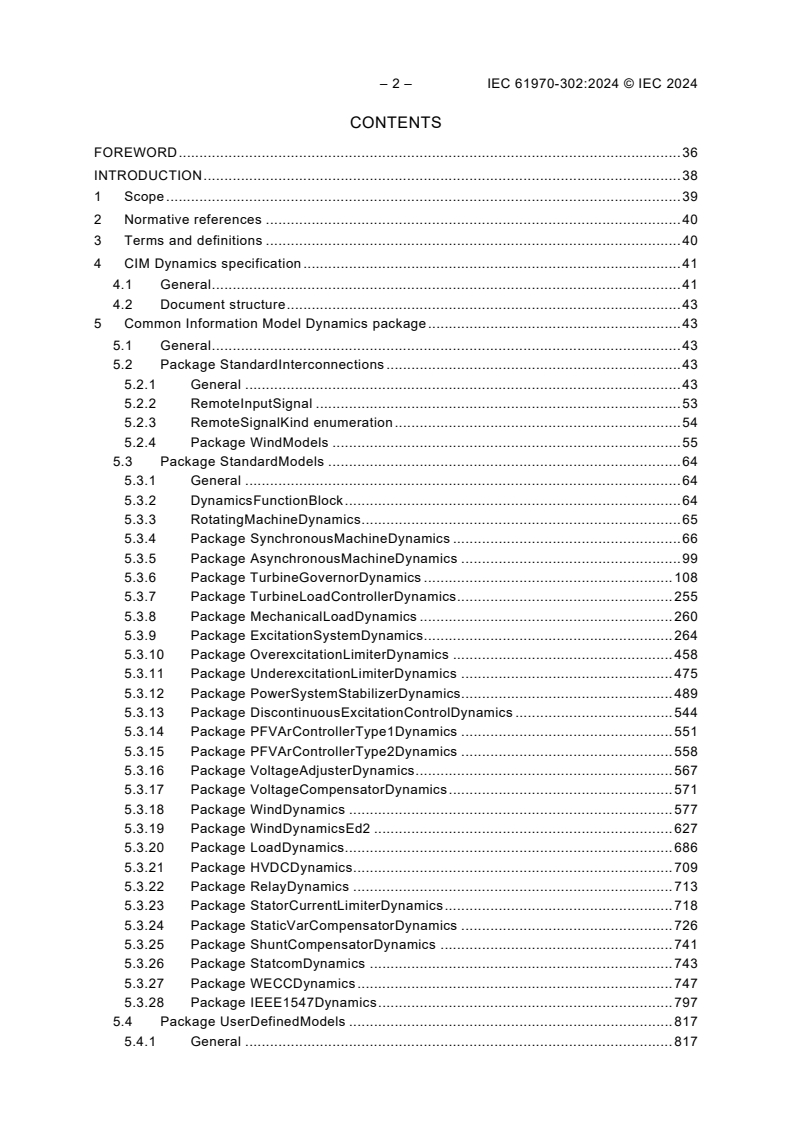
– 2 – IEC 61970-302:2024 © IEC 2024
CONTENTS
FOREWORD . 36
INTRODUCTION . 38
1 Scope . 39
2 Normative references . 40
3 Terms and definitions . 40
4 CIM Dynamics specification . 41
4.1 General . 41
4.2 Document structure . 43
5 Common Information Model Dynamics package . 43
5.1 General . 43
5.2 Package StandardInterconnections . 43
5.2.1 General . 43
5.2.2 RemoteInputSignal . 53
5.2.3 RemoteSignalKind enumeration . 54
5.2.4 Package WindModels . 55
5.3 Package StandardModels . 64
5.3.1 General . 64
5.3.2 DynamicsFunctionBlock . 64
5.3.3 RotatingMachineDynamics . 65
5.3.4 Package SynchronousMachineDynamics . 66
5.3.5 Package AsynchronousMachineDynamics . 99
5.3.6 Package TurbineGovernorDynamics . 108
5.3.7 Package TurbineLoadControllerDynamics . 255
5.3.8 Package MechanicalLoadDynamics . 260
5.3.9 Package ExcitationSystemDynamics. 264
5.3.10 Package OverexcitationLimiterDynamics . 458
5.3.11 Package UnderexcitationLimiterDynamics . 475
5.3.12 Package PowerSystemStabilizerDynamics. 489
5.3.13 Package DiscontinuousExcitationControlDynamics . 544
5.3.14 Package PFVArControllerType1Dynamics . 551
5.3.15 Package PFVArControllerType2Dynamics . 558
5.3.16 Package VoltageAdjusterDynamics . 567
5.3.17 Package VoltageCompensatorDynamics . 571
5.3.18 Package WindDynamics . 577
5.3.19 Package WindDynamicsEd2 . 627
5.3.20 Package LoadDynamics. 686
5.3.21 Package HVDCDynamics . 709
5.3.22 Package RelayDynamics . 713
5.3.23 Package StatorCurrentLimiterDynamics . 718
5.3.24 Package StaticVarCompensatorDynamics . 726
5.3.25 Package ShuntCompensatorDynamics . 741
5.3.26 Package StatcomDynamics . 743
5.3.27 Package WECCDynamics . 747
5.3.28 Package IEEE1547Dynamics . 797
5.4 Package UserDefinedModels . 817
5.4.1 General . 817
5.4.2 SynchronousMachineUserDefined . 818
5.4.3 AsynchronousMachineUserDefined . 820
5.4.4 TurbineGovernorUserDefined . 821
5.4.5 TurbineLoadControllerUserDefined . 822
5.4.6 MechanicalLoadUserDefined . 823
5.4.7 ExcitationSystemUserDefined . 825
5.4.8 OverexcitationLimiterUserDefined . 826
5.4.9 UnderexcitationLimiterUserDefined . 827
5.4.10 PowerSystemStabilizerUserDefined . 828
5.4.11 DiscontinuousExcitationControlUserDefined . 829
5.4.12 PFVArControllerType1UserDefined . 831
5.4.13 VoltageAdjusterUserDefined . 832
5.4.14 PFVArControllerType2UserDefined . 833
5.4.15 VoltageCompensatorUserDefined . 834
5.4.16 LoadUserDefined . 835
5.4.17 WindType1or2UserDefined . 836
5.4.18 WindType3or4UserDefined . 837
5.4.19 WindPlantUserDefined . 838
5.4.20 CSCUserDefined . 840
5.4.21 VSCUserDefined . 841
5.4.22 SVCUserDefined . 842
5.4.23 StatorCurrentLimiterUserDefined . 843
5.4.24 ShuntCompensatorUserDefined . 844
5.4.25 ProprietaryParameterDynamics root class . 845
5.4.26 StatcomUserDefined . 846
5.4.27 HVDCInterconnectionUserDefined . 847
5.4.28 RelayUserDefined . 849
5.5 Package DetailedModelDescription . 850
5.5.1 General . 850
5.5.2 DetailedModelTypeDynamics . 851
5.5.3 DetailedModelDescriptorArtifact . 851
5.5.4 DetailedModelDocumentationArtifact . 852
5.5.5 FunctionDescriptor . 853
5.5.6 InputOutputDescriptor . 854
5.5.7 LimiterDescriptor . 855
5.5.8 OperatorDescriptor . 856
5.5.9 ParameterDescriptor . 857
5.5.10 ParameterValue root class . 859
5.5.11 SignalDescriptor . 859
5.5.12 DetailedModelDescriptor . 860
5.5.13 DetailedModelDynamics . 861
5.5.14 ConstraintKind enumeration . 862
5.5.15 LogicalKind enumeration . 862
5.5.16 EquationLanguageKind enumeration. 863
5.5.17 OperatorDescriptorKind enumeration . 863
5.5.18 ParameterKind enumeration . 864
5.5.19 XSDDatatypeKind enumeration . 864
5.5.20 IRI primitive . 865
5.6 Package SimulationResult . 865
– 4 – IEC 61970-302:2024 © IEC 2024
5.6.1 General . 865
5.6.2 ParameterChangeKind enumeration . 866
5.6.3 ClearSimulationEvent . 866
5.6.4 ParameterEvent . 867
5.6.5 PowerFlowSettings . 868
5.6.6 PowerFlowAlgorithmKind enumeration . 871
5.6.7 PowerShiftKind enumeration . 871
5.6.8 SimulationResultCharacteristic . 871
5.6.9 SignalRecorder . 872
5.6.10 SignalConfiguration . 873
5.6.11 SimulationEvents . 874
5.6.12 SlackDistributionKind enumeration . 875
5.6.13 SimulationResult. 875
5.6.14 SimulationSettings . 876
5.6.15 SignalKind enumeration . 878
5.7 Package Examples . 878
Annex A (informative) Dynamics package symbol representation conventions . 882
Annex B (informative) Use of per unit. 884
Annex C (informative) Updates to CIM dynamics standard models . 886
Bibliography . 891
Figure 1 – StandardInterconnectionSynchronousMachine . 44
Figure 2 – StandardInterconnectionSynchronousGeneratorCrossCompound . 45
Figure 3 – StandardInterconnectionAsynchronousMachine . 46
Figure 4 – StandardInterconnectionSingleLoad . 47
Figure 5 – Class diagram StandardInterconnections::
StandardSynchronousMachineInterconnection . 48
Figure 6 – Class diagram StandardInterconnections::
StandardAsynchronousMachineInterconnection . 49
Figure 7 – Class diagram StandardInterconnections::StandardLoadInterconnection . 50
Figure 8 – Class diagram StandardInterconnections::StandardHVDCInterconnection . 51
Figure 9 – Class diagram StandardInterconnections::
StandardStaticVarCompensatorInterconnection . 52
Figure 10 – Class diagram StandardInterconnections::
StandardShuntCompensatorInterconnection . 53
Figure 11 – StandardInterconnectionWindTurbineType1Aand1B . 56
Figure 12 – StandardInterconnectionWindTurbineType2 . 57
Figure 13 – StandardInterconnectionWindTurbineType3 . 58
Figure 14 – StandardInterconnectionWindTurbineType4Aand4B . 59
Figure 15 – Class diagram WindModels::StandardWindType1and2Interconnection . 61
Figure 16 – Class diagram WindModels::StandardWindType3and4Interconnection . 63
Figure 17 – SynchronousGeneratorInterconnectionAndVariables . 67
Figure 18 – SynchronousMotorInterconnectionAndVariables . 68
Figure 19 – Class diagram SynchronousMachineDynamics::
SynchronousMachineDynamics . 69
Figure 20 – SynchronousMachineSaturationParameters . 70
Figure 21 – SynchronousGeneratorMechanicalEquation . 71
Figure 22 – SynchronousMotorMechanicalEquation . 72
Figure 23 – SynchronousGeneratorPhasor . 73
Figure 24 – SynchronousMotorPhasor . 74
Figure 25 – Simplified . 76
Figure 26 – SubtransientRoundRotor . 81
Figure 27 – SubtransientSalientPole . 82
Figure 28 – SubtransientTypeF . 83
Figure 29 – SubtransientTypeJ . 84
Figure 30 – SubtransientRoundRotorSimplified . 85
Figure 31 – SubtransientSalientPoleSimplified . 87
Figure 32 – SubtransientRoundRotorSimplifiedDirectAxis . 89
Figure 33 – SubtransientSalientPoleSimplifiedDirectAxis . 91
Figure 34 – SynchronousEquivalentCircuit . 95
Figure 35 – AsynchronousGeneratorInterconnectionAndVariables . 99
Figure 36 – AsynchronousMotorInterconnectionAndVariables . 100
Figure 37 – Class diagram AsynchronousMachineDynamics::
AsynchronousMachineDynamics . 101
Figure 38 – AsynchronousGeneratorMechanicalEquation . 102
Figure 39 – AsynchronousMotorMechanicalEquation . 102
Figure 40 – AsynchronousEquivalentCircuit . 107
Figure 41 – TurbineGovernorInterconnectionAndVariables . 109
Figure 42 – Class diagram TurbineGovernorDynamics::GasTurbineGovernorDynamics . 110
Figure 43 – Class diagram
TurbineGovernorDynamics::HydroTurbineGovernorDynamics . 110
Figure 44 – Class diagram
TurbineGovernorDynamics::SteamTurbineGovernorDynamics . 111
Figure 45 – GovHydroIEEE0 . 149
Figure 46 – GovHydroIEEE2 . 151
Figure 47 – GovSteamIEEE1 . 154
Figure 48 – GovCT1 . 157
Figure 49 – GovCT2 . 161
Figure 50 – GovGAST . 166
Figure 51 – GovGAST1 . 168
Figure 52 – GovGAST2 . 171
Figure 53 – GovGAST3 . 174
Figure 54 – GovGAST3ExhaustTemperature . 174
Figure 55 – GovGAST4 . 177
Figure 56 – GovGASTWD . 179
Figure 57 – GovHydro1 . 182
Figure 58 – GovHydro2 . 184
Figure 59 – GovHydro3 . 188
Figure 60 – GovHydro4 . 191
Figure 61 – GovHydro4SimpleHydroTurbine . 192
Figure 62 – GovHydro4FrancisPeltonTurbine . 193
– 6 – IEC 61970-302:2024 © IEC 2024
Figure 63 – GovHydro4KaplanTurbine . 194
Figure 64 – GovHydroDD . 198
Figure 65 – GovHydroFrancis . 201
Figure 66 – GovHydroFrancisNonLinearGainAndEfficiency . 202
Figure 67 – DetailedHydroModelHydraulicSystem . 203
Figure 68 – GovHydroPelton . 206
Figure 69 – GovHydroPeltonNonLinearGainAndEfficiency . 207
Figure 70 – GovHydroPID . 210
Figure 71 – GovHydroPID2 . 213
Figure 72 – GovHydroR . 216
Figure 73 – GovHydroWEH . 220
Figure 74 – GovHydroWPID . 225
Figure 75 – GovSteam0 . 227
Figure 76 – GovSteam1 . 229
Figure 77 – GovSteam1BacklashHysteresis . 230
Figure 78 – GovSteam1InputSpeedDeadband . 231
Figure 79 – GovSteam2 . 234
Figure 80 – GovSteamBB . 236
Figure 81 – GovSteamCC . 238
Figure 82 – GovSteamEU . 241
Figure 83 – GovSteamFV2 . 244
Figure 84 – GovSteamFV3 . 246
Figure 85 – GovSteamFV4 . 249
Figure 86 – GovSteamSGO. 253
Figure 87 – Class diagram TurbineLoadControllerDynamics::
TurbineLoadControllerDynamics . 256
Figure 88 – TurbLCFB1 . 258
Figure 89 – MechanicalLoadInterconnectionAndVariables . 261
Figure 90 – MechanicalLoadEquations . 261
Figure 91 – Class diagram MechanicalLoadDynamics::MechanicalLoadDynamics . 262
Figure 92 – ExcitationSystemInterconnectionAndVariables . 265
Figure 93 – Class diagram ExcitationSystemDynamics::ExcitationSystemDynamics . 266
Figure 94 – ExcAC1A . 268
Figure 95 – ExcAC2A . 271
Figure 96 – ExcAC3A . 274
Figure 97 – ExcAC4A . 277
Figure 98 – ExcAC5A . 279
Figure 99 – ExcAC6A . 281
Figure 100 – ExcAC8B . 284
Figure 101 – ExcANS . 287
Figure 102 – ExcAVR1 . 290
Figure 103 – ExcAVR2 . 292
Figure 104 – ExcAVR3 . 294
Figure 105 – ExcAVR4 . 296
Figure 106 – ExcAVR5 . 298
Figure 107 – ExcAVR7 . 300
Figure 108 – ExcBBC . 302
Figure 109 – ExcCZ . 305
Figure 110 – ExcDC1A . 307
Figure 111 – ExcDC2A . 310
Figure 112 – ExcDC3A . 313
Figure 113 – ExcDC3A1 . 315
Figure 114 – ExcELIN1 . 318
Figure 115 – ExcELIN2 . 320
Figure 116 – ExcHU . 323
Figure 117 – ExcNI . 325
Figure 118 – ExcOEX3T . 327
Figure 119 – ExcPIC . 329
Figure 120 – ExcREXS . 332
Figure 121 – ExcRQB . 336
Figure 122 – ExcSCRX . 338
Figure 123 – ExcSEXS . 340
Figure 124 – ExcSK . 342
Figure 125 – ExcST1A . 345
Figure 126 – ExcST2A . 348
Figure 127 – ExcST3A . 350
Figure 128 – ExcST4B . 353
Figure 129 – ExcST6B . 355
Figure 130 – ExcST7B . 358
Figure 131 – Class diagram IEEE4215from2016::IEEE4215from2016 . 362
Figure 132 – Class diagram IEEE4215from2005::IEEE4215from2005 . 418
Figure 133 – Class diagram
OverexcitationLimiterDynamics::OverexcitationLimiterDynamics . 458
Figure 134 – OverexcLim2 . 468
Figure 135 – OverexcLimX1 . 470
Figure 136 – OverexcLimX1TimeCharacteristic . 470
Figure 137 – OverexcLimX2 . 472
Figure 138 – OverexcLimX2TimeCharacteristic . 473
Figure 139 – Class diagram UnderexcitationLimiterDynamics::
UnderexcitationLimiterDynamics . 475
Figure 140 – UnderexcLim2Simplified . 484
Figure 141 – UnderexcLimX1 . 486
Figure 142 – UnderexcLimX2 . 488
Figure 143 – PowerSystemStabilizerInterconnectionAndVariables . 490
Figure 144 – Class diagram PowerSystemStabilizerDynamics::
PowerSystemStabilizerDynamics . 491
Figure 145 – Pss1 . 516
– 8 – IEC 61970-302:2024 © IEC 2024
Figure 146 – Pss1A . 518
Figure 147 – Pss2B . 520
Figure 148 – Pss2ST . 522
Figure 149 – Pss5 . 524
Figure 150 – PssELIN2 . 527
Figure 151 – PssPTIST1 . 528
Figure 152 – PssPTIST3 . 530
Figure 153 – PssRQB . 533
Figure 154 – PssSB4 . 535
Figure 155 – PssSH . 536
Figure 156 – PssSK . 538
Figure 157 – PssSTAB2A . 540
Figure 158 – PssWECC . 542
Figure 159 – DiscontinuousExcitationControlInterconnectionAndVariables . 545
Figure 160 – Class diagram DiscontinuousExcitationControlDynamics::
DiscontinuousExcitationControlDynamics . 546
Figure 161 – Class diagram
PFVArControllerType1Dynamics::PFVArControllerType1Dynamics . 552
Figure 162 – Class diagram PFVArControllerType2Dynamics::
PFVArControllerType2Dynamics . 559
Figure 163 – PFVArType2Common1 . 560
Figure 164 – Class diagram VoltageAdjusterDynamics::VoltageAdjusterDynamics . 567
Figure 165 – VoltageCompensatorInterconnectionAndVariables . 572
Figure 166 – Class diagram
VoltageCompensatorDynamics::VoltageCompensatorDynamics . 573
Figure 167 – Class diagram WindDynamics::WindDynamicsType1or2 . 578
Figure 168 – Class diagram WindDynamics::WindDynamicsType3 . 579
Figure 169 – Class diagram WindDynamics::WindDynamicsType4 . 580
Figure 170 – Class diagram WindDynamics::WindDynamicsPlant . 581
Figure 171 – Class diagram WindDynamicsEd2::WindDynamicsType1or2 . 629
Figure 172 – Class diagram WindDynamicsEd2::WindDynamicsType3 . 630
Figure 173 – Class diagram WindDynamicsEd2::WindDynamicsType4 . 631
Figure 174 – Class diagram WindDynamicsEd2::WindDynamicsPlant . 632
Figure 175 – LoadInterconnectionAndVariables . 687
Figure 176 – Class diagram LoadDynamics::LoadDynamics . 688
Figure 177 – LoadCompositeEquations . 689
Figure 178 – LoadGenericNonLinearTypeEquations. 691
Figure 179 – LoadStaticTypeEquations . 695
Figure 180 – LoadMotor . 698
Figure 181 – Class diagram LoadCompositeWECC::LoadCompositeWECC . 701
Figure 182 – Class diagram HVDCDynamics::HVDCDynamics . 709
Figure 183 – Class diagram RelayDynamics::RelayDynamics . 714
Figure 184 – Class diagram StatorCurrentLimiterDynamics::
StatorCurrentLimiterDynamics . 719
Figure 185 – Class diagram StaticVarCompensatorDynamics::
StaticVarCompensatorDynamics . 726
Figure 186 – Class diagram
ShuntCompensatorDynamics::ShuntCompensatorDynamics . 741
Figure 187 – Class diagram StatcomDynamics::StatcomIEC . 743
Figure 188 – Class diagram StatcomDynamics::StatcomDynamics . 744
Figure 189 – Class diagram WECCDynamics::WeccDynamics . 747
Figure 190 – Class diagram WECCDynamics::WeccBESS . 748
Figure 191 – Class diagram IEEE1547Dynamics::IEEE1547Dynamics . 797
Figure 192 – Class diagram UserDefinedModels::ProprietaryUserDefinedModels . 818
Figure 193 – Class diagram DetailedModelDescription::DetailedModelDescription . 850
Figure 194 – Class diagram SimulationResult::SimulationResult . 865
Figure 195 – Object diagram Examples::ExampleStandardModel . 879
Figure 196 – Object diagram Examples::ExampleFunctionBlockProprietaryModel . 880
Figure 197 – Object diagram Examples::ExampleCompleteProprietaryModel . 881
Table 1 – Attributes of StandardInterconnections::RemoteInputSignal . 53
Table 2 – Association ends of StandardInterconnections:: RemoteInputSignal with
other classes . 54
Table 3 – Literals of StandardInterconnections::RemoteSignalKind . 55
Table 4 – Attributes of StandardMode
...
IEC 61970-302:2024 presents a comprehensive Dynamics package within the Common Information Model (CIM) aimed at enhancing the interoperability and exchange of models for power system analysis. This standard focuses on steady-state stability, small-signal stability, and transient stability of power systems, aligning with definitions established by IEEE and CIGRE. The strengths of IEC 61970-302:2024 lie in its structured approach to dynamic modeling. It introduces standard models that facilitate a simplified and consistent method of representing dynamic behavior through predefined libraries, ensuring that users can easily identify and utilize relevant elements and attributes. This standardization significantly reduces the complexity typically associated with dynamic modeling in power systems, making it accessible to a broader range of applications and users. Additionally, the standard allows for proprietary user-defined models, providing flexibility for vendors or users who may require specific customizations not covered by standard models. This dual approach-standard and proprietary-encourages innovation while maintaining a degree of compatibility through the use of shared libraries and interconnections. Another crucial aspect of IEC 61970-302:2024 is its emphasis on information exchange, which is vital for advancing simulation capabilities within the context of power systems. The ability to share not only model descriptions but also simulation results ensures that various stakeholders can collaborate effectively, thus enhancing overall system reliability and performance. The recent revision brings significant technical advancements, such as addressing previously identified issues, fully incorporating standards relevant to excitation systems and wind turbines, and expanding the coverage to inverter-based resources and hybrid models. The inclusion of detailed dynamic modeling for user-defined models demonstrates an ongoing commitment to enhancing the richness and applicability of the standard. Noteworthy is the acknowledgment of the complexities surrounding High Voltage Direct Current (HVDC) models, which are still under development. This transparency sets realistic expectations while highlighting the need for future enhancements, making the standard a living document responsive to the industry's evolving needs. Overall, IEC 61970-302:2024 is a key reference point for professionals in the energy management and power systems domains, providing both a robust framework for dynamic modeling and a strategic foundation for ongoing development and collaboration in energy system analysis. Its relevance is underscored by the increasing complexity of power systems and the necessity for effective communication and interoperability among diverse applications.
La norme IEC 61970-302:2024, relative à l'interface d'application des systèmes de gestion de l'énergie (EMS-API) - Partie 302 : dynamique du modèle d'information commun (CIM), constitue un document essentiel pour le secteur de la gestion énergétique. Son champ d'application est centré sur la spécification d'un paquet dynamique qui intègre des éléments du CIM pour faciliter l'échange de modèles entre les applications logicielles chargées d'analyser la stabilité des systèmes électriques. Les forces de cette norme résident dans son approche standardisée des modèles dynamiques, qui simplifie la description des comportements dynamiques des éléments d'un système électrique. L'inclusion de bibliothèques prédéfinies de classes interconnectées permet de ne nécessiter que les noms des éléments sélectionnés et leurs attributs pour décrire le comportement dynamique, ce qui réduit considérablement la complexité du processus d'analyse. La norme offre également un cadre pour les modèles définis par l'utilisateur, permettant aux utilisateurs de spécifier les paramètres de leurs propres modèles tout en maintenant un standard de connexion. Cela favorise l'innovation tout en garantissant une certaine cohérence dans l'échange d'informations, grâce à l'utilisation des mêmes bibliothèques et interconnexions standards pour les modèles standard et propriétaires. Un autre aspect remarquable est la capacité de la norme à faciliter l'échange de résultats de simulation, ce qui est crucial dans le cadre de la planification et de l'étude des systèmes énergétiques. Ces résultats permettent aux ingénieurs et chercheurs de valider les performances des modèles en application réelle. La révision technique de cette édition, qui annule et remplace la première édition publiée en 2018, tient compte des préoccupations soulevées dans la version précédente en abordant divers problèmes techniques. Parmi les ajouts significatifs figurent la couverture complète des systèmes d'excitation selon la norme IEEE 421.5-2016 et l'incorporation de nouveaux modèles de turbines à gaz, à vapeur et hydroélectriques, ainsi qu'une meilleure conception des modèles définis par l'utilisateur. En somme, la norme IEC 61970-302:2024 représente une avancée significative dans la normalisation des interfaces pour les modèles dynamiques dans le secteur énergétique. Avec des améliorations telles que l'intégration de modèles supplémentaires et une approche claire pour l'échange d'informations, elle s'avère être un outil essentiel pour les professionnels du secteur. Son actualisation témoigne de l'engagement constant de faire évoluer les pratiques dans un domaine en changement rapide.
Die Norm IEC 61970-302:2024 behandelt das Thema der dynamischen Modelle innerhalb der Anwendungsschnittstelle für Energiemanagementsysteme (EMS-API) und stellt einen bedeutenden Fortschritt in der Standardisierung dar. Der Umfang dieser Norm umfasst ein Dynamics-Paket, das Teil des Common Information Model (CIM) ist und die Modellwechsel zwischen Softwareanwendungen unterstützt, die Analysen zur stabilen und transiente Stabilität von Stromversorgungssystemen durchführen. Ein herausragendes Merkmal der IEC 61970-302:2024 ist die Verwendung von standardisierten Modellen. Diese vereinfachte Herangehensweise zur Beschreibung dynamischer Modelle reduziert die Komplexität, indem sie grundlegende Verhaltensweisen von Systemelementen in vordefinierten Klassenbibliotheken darstellt. Diese Interkonnektivität der Modelle ist entscheidend für die Konsistenz und Interoperabilität zwischen verschiedenen Analysesoftwarepaketen. Ein weiterer wesentlicher Aspekt dieser Norm ist die Möglichkeit, benutzerspezifische, proprietäre Modelle zu definieren. Dies ist insbesondere für Hersteller oder Benutzer von Bedeutung, die individuelle Geräte und deren dynamisches Verhalten darstellen möchten, ohne eine umfassende Dokumentation des Modells einzureichen. Diese Flexibilität fördert die individuelle Anpassung und Innovation innerhalb des Rahmens standardisierter Praktiken. Die Richtlinie ermöglicht zudem den Austausch von Modellerklärungen und Simulationsergebnissen, was die Effizienz und Transparenz in der Datenanalyse und Entscheidungsfindung innerhalb der Energiebranche erhöht. Diese Funktionalität ist von großer Relevanz, da sie den Benutzern helfen kann, fundierte Entscheidungen auf der Grundlage präziser, dynamischer Simulationsergebnisse zu treffen. Die technisch revidierte zweite Auflage bringt zahlreiche signifikante Veränderungen mit sich, die die vorherige Ausgabe ansprechen und dabei die Berücksichtigung aktueller Standards wie IEEE 421.5-2016 und IEC 61400-27-1:2020 beinhalten. Die Einbeziehung neuer Modelle, wie z.B. von Hybrid STATCOM und speicherbasierten Modellen, zeigt die dynamische Natur dieser Norm und ihre Anpassungsfähigkeit an sich verändernde Technologien im Energiebereich. Insgesamt stellt die IEC 61970-302:2024 einen essentiellen Bestandteil der internationalen Standardisierung für Energiemanagementsysteme dar, indem sie eine strukturierte, flexible und zukunftssichere Grundlage für die Analyse und den Austausch von Modellen in der Energiebranche bietet. Die relevanten technischen Modifikationen verbessern nicht nur die Benutzerfreundlichkeit, sondern tragen auch zur Erhöhung der Zuverlässigkeit und Genauigkeit in der Analyse von Systemstabilität bei.
IEC 61970-302:2024の標準は、エネルギー管理システムアプリケーションプログラムインターフェース(EMS-API)の一部であり、共通情報モデル(CIM)の動的要素に関する非常に重要なガイドラインを提供しています。この標準は、IEEE/CIGREによって定義された電力システムの定常状態安定性または過渡安定性の解析を行うソフトウェアアプリケーション間でモデルを交換するための基盤を形成します。 このドキュメントには、動的モデルの各種に関する仕様が含まれており、計画や研究アプリケーション間での動的ケース交換に必要な情報も網羅されています。具体的には、標準モデルとユーザー定義のモデルを統一された方法で扱うことができる強力な枠組みを提供しています。 標準モデルは、予め定義されたクラスライブラリ内で電力システム要素の動的挙動を簡易的に表現するアプローチを採用しており、これによりユーザーはモデルの要素名と属性のみを指定することで、動的挙動を定義できます。一方で、プロプライエタリユーザー定義モデルでは、ユーザーが独自のデバイスに関するパラメータを定義できる柔軟性を持ちつつも、標準の相互接続を使用する利点を享受できます。 また、この改訂版では、IEC 61970-302:2018で特定された問題の大部分に対処されており、IEEE 421.5-2016やIEC 61400-27-1:2020に基づく新たなモデルが追加されています。これにより、より多様な電力システムの挙動を効果的に表現でき、現代の電力網における要求に応じた仕様が整いました。 標準の中では、ユーザー定義モデルの強化やシミュレーション結果の交換を可能にするモデルの追加も行われており、技術的な進展が明確に反映されています。特に、HVDCモデルに関する注釈も含まれており、複雑なドメインであることが認識されていますが、今後の発展の可能性が示唆されています。 このIEC 61970-302:2024は、電力システムの安定性解析に関わる専門家にとって欠かせない文書であり、正確で一貫した情報交換を促進するための強固な基盤を提供しています。これにより、より効率的で安全な電力管理が実現できることが期待されます。
IEC 61970-302:2024 표준은 에너지 관리 시스템 응용 프로그램 인터페이스(EMS-API)의 일환으로, 일반 정보 모델(CIM) 다이나믹스에 관한 구체적인 지침을 포함하고 있습니다. 본 문서는 전력 시스템의 소규모 신뢰성(steady-state stability) 및 과도 안정성(transient stability)을 분석하는 소프트웨어 애플리케이션 간 모델 교환을 지원하기 위해 CIM의 일부를 포함하는 다이나믹 패키지를 규정하고 있습니다. 이 표준의 주요 강점 중 하나는 동적 모델을 설명하기 위한 표준화된 모델을 제공한다는 점입니다. 표준 모델은 전력 시스템의 동적 행동을 설명하기 위해 미리 정의된 클래스 라이브러리에 포함된 요소들로 구성되어 있으며, 이러한 모델은 규격화된 방식으로 상호 연결됩니다. 이로 인해 사용자는 동적 행동을 설명하기 위해 모든 모델의 이름과 속성만으로도 충분합니다. 또한, IEC 61970-302:2024는 사용자 정의 모델을 통해 특정 벤더나 사용자 고유 장치의 동적 행동을 정의할 수 있는 유연성을 제공합니다. 사용자 정의 모델은 표준 모델과 동일한 라이브러리 및 표준 상호 연결을 사용하는데, 이는 다양한 적용 가능성을 열어줍니다. 문서에는 동적 모델의 행동 세부정보는 포함되지 않지만, 필수적인 모델 파라미터를 제공하여 다양한 사용자 요구를 충족시킵니다. 이 문서는 시뮬레이션 결과의 교환을 가능하게 하는 모델을 포함함으로써 사용자의 요구에 더욱 세심하게 대응합니다. 특히, 기존의 문제를 해결하고 IEEE 및 IEC의 다양한 최신 기준을 완벽히 반영한 점은 이 표준의 신뢰성과 적합성을 더욱 높이고 있습니다. IEC 61970-302:2024의 업데이트사항 역시 주목할 만합니다. 이전 버전에서 발견된 다수의 문제를 해결했으며, 예를 들어, IEEE 421.5-2016의 자극 시스템을 완전히 다루고, 최신의 발전소 모델과 시스템 요구를 반영한 점이 두드러집니다. HVDC 모델의 발전이 진행 중인 점은 다소 도전적인 요소로 남아있지만, 이는 향후 버전에서 더 나은 coverage를 기대할 수 있는 기반이 될 것입니다. 결과적으로 IEC 61970-302:2024는 전력 시스템 분석에 필요한 표준화된 동적 모델을 제공하며, 소프트웨어 애플리케이션 간 효율적인 모델 교환을 지원하는 데 매우 중요합니다. 이는 전력 시스템의 안정성 평가 및 관리를 위한 필수적인 자료로, 현대의 복잡한 에너지 관리 체계에서 불가결한 역할을 합니다.
Questions, Comments and Discussion
Ask us and Technical Secretary will try to provide an answer. You can facilitate discussion about the standard in here.
Loading comments...