

IEC 61850-7-1:2003
(Main)Communication networks and systems in substations - Part 7-1: Basic communication structure for substation and feeder equipment - Principles and models
General Information
- Abstract
Provides an overview of the architecture for communication and interactions between substation devices such as protection devices, breakers, transformers, substation hosts, etc. Uses simple examples of functions to describe the concepts and methods applied in the IEC 61850 series. Also describes the relationships between other parts of the IEC 61850 series and defines how inter-operability is reached.
This publication is of core relevance for Smart Grid.
- Status
- Published
- Publication Date
- 22-Jul-2003
- Technical Committee
- TC 57 - Power systems management and associated information exchange
- Drafting Committee
- WG 10 - TC 57/WG 10
- Current Stage
- DELPUB - Deleted Publication
- Start Date
- 15-Jul-2011
- Completion Date
- 28-Aug-2026
Buy Documents


iec61850-7-1{ed1.0}en - IEC 61850-7-1:2003 - Communication networks and systems in substations - Part 7-1: Basic communication structure for substation and feeder equipment - Principles and models Released:7/23/2003

iec61850-7-Browsable-Models - IEC 61850-7-1:2003 - Communication networks and systems in substations - Part 7-1: Basic communication structure for substation and feeder equipment - Principles and models Released:7/23/2003
Overview
IEC 61850-7-1:2003 is part of the IEC 61850 family for communication networks and systems in substations. It provides a high-level overview of the basic communication structure, principles and object models used to describe interactions between substation devices (protection relays, circuit-breakers, transformers, substation hosts, etc.). As a core Smart Grid publication, IEC 61850-7-1 explains how interoperability is achieved across the series by linking device and service models to engineering files and mappings.
Key topics
- Object-oriented information models: introduces the conceptual classes SERVER, LOGICAL-DEVICE (LD), LOGICAL-NODE (LN) and DATA used to model device behavior and information.
- Logical Nodes (LN): defines the purpose of LNs as standard functional building blocks (for example XCBR for circuit‑breaker, MMXU for measurements) that group typed data and services.
- Abstract Communication Service Interface (ACSI): describes the basic ACSI concepts (data-sets, report/log control blocks, substitution, setting-group control) and the relationship between models and services.
- Service and control models: outlines services such as read, report (buffered/unbuffered), logging, GOOSE/GSSE (generic substation events), sampled values (SV), control operations, file transfer and time synchronization.
- Naming and addressing: specifies unique ObjectName and ObjectReference syntax (LDName/LNName[.Name...]) to identify instances within the hierarchy.
- Engineering support: explains links to the substation configuration language (SCL / IEC 61850-6) and the use of XML model files for presentation (non‑normative).
Applications and who uses it
IEC 61850-7-1 is targeted at:
- Protection & control engineers designing substation automation systems
- IED manufacturers implementing interoperable device models
- System integrators and utility architects specifying substation communications
- Test laboratories and commissioning teams validating interoperability
Practical value:
- Enables standardized device models (Logical Nodes) for consistent data exchange
- Reduces engineering effort by using common data classes and SCL configuration
- Supports high-speed peer-to-peer signaling (GOOSE), sampled values for instrument transformers, and robust reporting/logging for SCADA and protection applications
- A foundation for Smart Grid interoperability and multi-vendor integration
Related standards
- IEC 61850-7-2 (ACSI/service definitions)
- IEC 61850-7-3 (Common DATA classes)
- IEC 61850-7-4 (Compatible Logical Node classes)
- IEC 61850-6 (Configuration language, SCL / XML)
- IEC 61850-8-1 / 9-x (Specific communication service mappings to MMS and sampled values)
Keywords: IEC 61850-7-1, IEC 61850, substation communication, logical node, ACSI, Smart Grid, interoperability, substation automation, SCL, GOOSE, sampled values.
Relations
- Effective Date
- 05-Sep-2023
Buy Documents
iec61850-7-1{ed1.0}en - IEC 61850-7-1:2003 - Communication networks and systems in substations - Part 7-1: Basic communication structure for substation and feeder equipment - Principles and models Released:7/23/2003
iec61850-7-Browsable-Models - IEC 61850-7-1:2003 - Communication networks and systems in substations - Part 7-1: Basic communication structure for substation and feeder equipment - Principles and models Released:7/23/2003
Get Certified
Connect with accredited certification bodies for this standard

ANCE
Mexican certification and testing association.

Intertek Slovenia
Intertek testing, inspection, and certification services in Slovenia.

LNE (Laboratoire National de Métrologie et d'Essais)
French national laboratory for metrology and testing.
Sponsored listings
Frequently Asked Questions
IEC 61850-7-1:2003 is a standard published by the International Electrotechnical Commission (IEC). Its full title is "Communication networks and systems in substations - Part 7-1: Basic communication structure for substation and feeder equipment - Principles and models". This standard covers: Provides an overview of the architecture for communication and interactions between substation devices such as protection devices, breakers, transformers, substation hosts, etc. Uses simple examples of functions to describe the concepts and methods applied in the IEC 61850 series. Also describes the relationships between other parts of the IEC 61850 series and defines how inter-operability is reached. This publication is of core relevance for Smart Grid.
Provides an overview of the architecture for communication and interactions between substation devices such as protection devices, breakers, transformers, substation hosts, etc. Uses simple examples of functions to describe the concepts and methods applied in the IEC 61850 series. Also describes the relationships between other parts of the IEC 61850 series and defines how inter-operability is reached. This publication is of core relevance for Smart Grid.
IEC 61850-7-1:2003 is classified under the following ICS (International Classification for Standards) categories: 33.200 - Telecontrol. Telemetering. The ICS classification helps identify the subject area and facilitates finding related standards.
IEC 61850-7-1:2003 has the following relationships with other standards: It is inter standard links to IEC 61850-7-1:2011. Understanding these relationships helps ensure you are using the most current and applicable version of the standard.
IEC 61850-7-1:2003 is available in PDF format for immediate download after purchase. The document can be added to your cart and obtained through the secure checkout process. Digital delivery ensures instant access to the complete standard document.
Standards Content (Sample)
INTERNATIONAL IEC
STANDARD
61850-7-1
First edition
2003-07
Communication networks and systems
in substations –
Part 7-1:
Basic communication structure
for substation and feeder equipment –
Principles and models
Reference number
Publication numbering
As from 1 January 1997 all IEC publications are issued with a designation in the
60000 series. For example, IEC 34-1 is now referred to as IEC 60034-1.
Consolidated editions
The IEC is now publishing consolidated versions of its publications. For example,
edition numbers 1.0, 1.1 and 1.2 refer, respectively, to the base publication, the
base publication incorporating amendment 1 and the base publication incorporating
amendments 1 and 2.
Further information on IEC publications
The technical content of IEC publications is kept under constant review by the IEC,
thus ensuring that the content reflects current technology. Information relating to
this publication, including its validity, is available in the IEC Catalogue of
publications (see below) in addition to new editions, amendments and corrigenda.
Information on the subjects under consideration and work in progress undertaken
by the technical committee which has prepared this publication, as well as the list
of publications issued, is also available from the following:
• IEC Web Site (www.iec.ch)
• Catalogue of IEC publications
The on-line catalogue on the IEC web site (www.iec.ch/searchpub) enables you to
search by a variety of criteria including text searches, technical committees
and date of publication. On-line information is also available on recently issued
publications, withdrawn and replaced publications, as well as corrigenda.
• IEC Just Published
This summary of recently issued publications (www.iec.ch/online_news/ justpub)
is also available by email. Please contact the Customer Service Centre (see
below) for further information.
• Customer Service Centre
If you have any questions regarding this publication or need further assistance,
please contact the Customer Service Centre:
Email: custserv@iec.ch
Tel: +41 22 919 02 11
Fax: +41 22 919 03 00
INTERNATIONAL IEC
STANDARD
61850-7-1
First edition
2003-07
Communication networks and systems
in substations –
Part 7-1:
Basic communication structure
for substation and feeder equipment –
Principles and models
IEC 2003 Copyright - all rights reserved
No part of this publication may be reproduced or utilized in any form or by any means, electronic or
mechanical, including photocopying and microfilm, without permission in writing from the publisher.
International Electrotechnical Commission, 3, rue de Varembé, PO Box 131, CH-1211 Geneva 20, Switzerland
Telephone: +41 22 919 02 11 Telefax: +41 22 919 03 00 E-mail: inmail@iec.ch Web: www.iec.ch
PRICE CODE
Commission Electrotechnique Internationale
XE
International Electrotechnical Commission
Международная Электротехническая Комиссия
For price, see current catalogue
– 2 – 61850-7-1 IEC:2003(E)
CONTENTS
FOREWORD . 7
INTRODUCTION .9
1 Scope .11
2 Normative references.12
3 Terms and definitions .12
4 Abbreviated terms.13
5 Overview of concepts the IEC 61850 series .13
5.1 Objective .13
5.2 Topology and communication functions of substation automation systems.14
5.3 The information models of substation automation systems.15
5.4 Applications modelled by logical nodes defined in IEC 61850-7-4 .16
5.5 The semantic is attached to data .19
5.6 The services to exchange information.21
5.7 Services mapped to concrete communication protocols .22
5.8 The configuration of a substation .23
5.9 Summary .23
6 Modelling approach of the IEC 61850 series .24
6.1 Decomposition of application functions and information .24
6.2 Creating information models by stepwise composition .26
6.3 Example of an IED composition .29
6.4 Information exchange models .29
7 Application view.42
7.1 Introduction .42
7.2 First modelling step – Logical nodes and data .44
8 Device view .47
8.1 Introduction .47
8.2 Second modelling step – logical device model .47
9 Communication view.49
9.1 The service models of the IEC 61850 series .49
9.2 The virtualisation .52
9.3 Basic information exchange mechanisms.53
9.4 The client-server building blocks.54
9.5 Interfaces inside and between devices.57
10 Where physical devices, application models and communication meet.58
11 Relationships between IEC 61850-7-2, IEC 61850-7-3 and IEC 61850-7-4.59
11.1 Refinements of class definitions .59
11.2 Example 1 – Logical node and data class .60
11.3 Example 2 – Relationship of IEC 61850-7-2, IEC 61850-7-3, and
IEC 61850-7-4 .62
12 Mapping the ACSI to real communication systems .64
12.1 Introduction .64
12.2 Mapping example (IEC 61850-8-1).66
61850-7-1 IEC:2003(E) – 3 –
13 Formal specification method .71
13.1 Notation of ACSI classes .71
13.2 Class modelling .72
13.3 Service tables.77
13.4 Referencing instances .78
14 Name spaces.80
14.1 General .80
14.2 Name spaces defined in IEC 61850-7-x .82
14.3 Specification of name spaces .85
14.4 Attributes for references to name spaces.87
14.5 Common rules for extensions of name spaces .89
15 Approaches for the definition of a new semantic .91
15.1 General .91
15.2 Semantic for new definition.92
15.3 Approach 1 (fixed semantic) .92
15.4 Approach 2 (flexible semantic).92
15.5 Approach 3 (reusable flexible semantic) .93
Annex A (informative) Overview of IEC 61850-7-x, IEC 61850-8-x, and IEC 61850-9-x .94
Annex B (informative) Allocation of data to logical nodes .97
Annex C (informative) Use of the substation configuration language (SCL) .100
Annex D (informative) Applying the LN concept to options for future extensions.102
Annex E (informative) Relation between logical nodes and PICOMs.107 ®
Annex F (informative) Relation between IEC 61850-7-x (IEC 61850-8-x) and UCA 2.0 .108
Bibliography.109
Index.111
Figure 1 – Sample substation automation topology.14
Figure 2 – Modelling approach (conceptual) .15
Figure 3 – Logical node information categories .18
Figure 4 – Build up of devices (principle).18
Figure 5 – Position information depicted as a tree (conceptual).19
Figure 6 – Service excerpt .21
Figure 7 – Example of communication mapping.22
Figure 8 – Summary.24
Figure 9 – Decomposition and composition process (conceptual).25
Figure 10 – XCBR1 information depicted as a tree .28
Figure 11 – Example of IED composition.29
Figure 12 – Output and Input model (principle).30
Figure 13 – Output model (step 1) (conceptual).31
Figure 14 – Output model (step 2) (conceptual).31
Figure 15 – GSE output model (conceptual) .32
Figure 16 – Setting data (conceptual).33
– 4 – 61850-7-1 IEC:2003(E)
Figure 17 – Input model for analogue values (step 1) (conceptual).34
Figure 18 – Deadbanded value (conceptual) .35
Figure 19 – Input model for analogue values (step 2) (conceptual).35
Figure 20 – Range values .36
Figure 21 – Reporting and logging model (conceptual).36
Figure 22 – Data set members and reporting.37
Figure 23 – Buffered report control block (conceptual) .38
Figure 24 – Buffer time.39
Figure 25 – Data set members and inclusion-bitstring .40
Figure 26 – Log control block - conceptual .40
Figure 27 – Peer-to-peer data value publishing model (conceptual).41
Figure 28 – Real world devices .43
Figure 29 – Logical nodes and data (IEC 61850-7-2).44
Figure 30 – Simple example of modelling .45
Figure 31 – Basic building blocks .45
Figure 32 – Logical nodes and PICOM .46
Figure 33 – Logical nodes connected (outside view in IEC 61850-7-x) .46
Figure 34 – Logical device building block .47
Figure 35 – Logical devices and LLN0/LPHD.48
Figure 36 – Logical devices in proxies or gateways .49
Figure 37 – ACSI communication methods .50
Figure 38 – Virtualisation .52
Figure 39 – Virtualisation and usage .52
Figure 40 – Information flow and modelling .53
Figure 41 – Application of the GSE model .53
Figure 42 – Server building blocks .54
Figure 43 – Interaction between application process and application layer
(client/server).55
Figure 44 – Example for a service .55
Figure 45 – Client/server and logical nodes.56
Figure 46 – Client and server role .56
Figure 47 – Logical nodes communicate with logical nodes .57
Figure 48 – Interfaces inside and between devices .57
Figure 49 – Component hierarchy of different views (excerpt) .58
Figure 50 – Refinement of the DATA class .59
Figure 51 – Instances of a DATA class (conceptual).62
Figure 52 – Relation between parts of the IEC 61850 series .63
Figure 53 – ACSI mapping to an application layer .64
Figure 54 – ACSI mappings (conceptual) .65
Figure 55 – ACSI mapping to communication stacks/profiles.66
Figure 56 – Mapping to MMS (conceptual) .66
Figure 57 – Mapping approach.67
Figure 58 – Mapping detail of mapping to a MMS named variable .68
61850-7-1 IEC:2003(E) – 5 –
Figure 59 – Example of MMS named variable (process values) .68
Figure 60 – Use of MMS named variables and named variable list .69
Figure 61 – MMS Information Report message.70
Figure 62 – Mapping example .71
Figure 63 – Abstract data model example for IEC 61850-7 .73
Figure 64 – Relation of TrgOp and Reporting .76
Figure 65 – Sequence diagram .78
Figure 66 – References.78
Figure 67 – Use of FCD and FCDA .79
Figure 68 – Object names and object reference .80
Figure 69 – Definition of names and semantics .81
Figure 70 – One name with two meanings .81
Figure 71 – Name space as class repository .82
Figure 72 – All instances derived from classes in a single name space .83
Figure 73 – Instances derived from multiple name spaces.84
Figure 74 – Inherited name spaces .84
Figure 75 – Example of logical node and data name spaces .86
Figure 76 – Example common data class name spaces.87
Figure 77 – Extensions of name spaces (conceptual) .90
Figure 78 – Use of extended name space (conceptual) .91
Figure A.1 – Overall communication system architecture.94
Figure B.1 – Example for control and protection LNs combined in one physical device.97
Figure B.2 – Merging unit and sampled value exchange (topology) .98
Figure B.3 – Merging unit and sampled value exchange (data).98
Figure C.1 – Application of SCL for LNs (conceptual).100
Figure C.2 – Application of SCL for data (conceptual) .101
Figure D.1 – Seamless communication (simplified).102
Figure D.2 – Example for new logical nodes.103
Figure D.3 – Example for control center view and mapping to substation view.105
Figure E.1 – Exchanged data between subfunctions (logical nodes).107
Figure E.2 – Relationship between PICOMS and client/server model .107
Figure F.1 – Relation between the IEC 61850 series and UCA .108
Table 1 – Guide for the reader .10
Table 2 – LN groups.16
Table 3 – Logical node class XCBR (conceptual) .27
Table 4 – Excerpt of integer status setting .33
Table 5 – Comparison of the data access methods .37
Table 6 – ACSI models and services .50
Table 7 – Logical node circuit breaker.60
Table 8 – Controllable double point (DPC) .61
Table 9 – ACSI class definition.72
Table 10 – Single point status common data class (SPS) .74
– 6 – 61850-7-1 IEC:2003(E)
Table 11 – Quality components attribute definition .74
Table 12 – Basic status information template (excerpt) .75
Table 13 – Trigger option .75
Table 14 – Logical node class (LN) definition .76
Table 15 – Excerpt of logical node name plate common data class (LPL).87
Table 16 – Excerpt of common data class .88
Table A.1 – Excerpt of data classes for measurands .95
Table A.2 – List of common data classes .96
61850-7-1 IEC:2003(E) – 7 –
INTERNATIONAL ELECTROTECHNICAL COMMISSION
____________
COMMUNICATION NETWORKS AND SYSTEMS IN SUBSTATIONS –
Part 7-1: Basic communication structure for substation
and feeder equipment – Principles and models
FOREWORD
1) The International Electrotechnical Commission (IEC) is a worldwide organization for standardization comprising
all national electrotechnical committees (IEC National Committees). The object of IEC is to promote
international co-operation on all questions concerning standardization in the electrical and electronic fields. To
this end and in addition to other activities, IEC publishes International Standards, Technical Specifications,
Technical Reports, and Guides (hereafter referred to as “IEC Publication(s)”). Their preparation is entrusted to
technical committees; any IEC National Committee interested in the subject dealt with may participate in this
preparatory work. International, governmental and non-governmental organizations liaising with the IEC also
participate in this preparation. IEC collaborates closely with the International Organization for Standardization
(ISO) in accordance with conditions determined by agreement between the two organizations.
2) The formal decisions or agreements of IEC on technical matters express, as nearly as possible, an international
consensus of opinion on the relevant subjects since each technical committee has representation from all
interested IEC National Committees.
3) IEC Publications have the form of recommendations for international use and are accepted by IEC National
Committees in that sense. While all reasonable efforts are made to ensure that the technical content of IEC
Publications is accurate, IEC cannot be held responsible for the way in which they are used or for any
misinterpretation by any end user.
4) In order to promote international uniformity, IEC National Committees undertake to apply IEC Publications
transparently to the maximum extent possible in their national and regional publications. Any divergence
between any IEC Publication and the corresponding national or regional publication shall be clearly indicated in
the latter.
5) IEC provides no marking procedure to indicate its approval and cannot be rendered responsible for any
equipment declared to be in conformity with an IEC Publication.
6) All users should ensure that they have the latest edition of this publication.
7) No liability shall attach to IEC or its directors, employees, servants or agents including individual experts and
members of its technical committees and IEC National Committees for any personal injury, property damage or
other damage of any nature whatsoever, whether direct or indirect, or for costs (including legal fees) and
expenses arising out of the publication, use of, or reliance upon, this IEC Publication or any other IEC
Publications.
8) Attention is drawn to the Normative references cited in this publication. Use of the referenced publications is
indispensable for the correct application of this publication.
9) Attention is drawn to the possibility that some of the elements of this IEC Publication may be the subject of
patent rights. IEC shall not be held responsible for identifying any or all such patent rights.
International Standard IEC 61850-7-1 has been prepared by IEC technical committee 57:
Power system control and associated communications.
The text of this standard is based on the following documents:
FDIS Report on voting
57/637/FDIS 57/646/RVD
Full information on the voting for the approval of this standard can be found in the report on
voting indicated in the above table.
This publication has been drafted in accordance with the ISO/IEC Directives, Part 2.
– 8 – 61850-7-1 IEC:2003(E)
IEC 61850 consists of the following parts, under the general title Communication networks
and systems in substations.
Part 1: Introduction and overview
Part 2: Glossary
Part 3: General requirements
Part 4: System and project management
Part 5: Communication requirements for functions and device models
Part 6: Configuration description language for communication in electrical substations
related to IEDs
Part 7-1: Basic communication structure for substation and feeder equipment – Principles
and models
Part 7-2: Basic communication structure for substation and feeder equipment – Abstract
communication service interface (ACSI)
Part 7-3: Basic communication structure for substation and feeder equipment – Common
data classes
Part 7-4: Basic communication structure for substation and feeder equipment – Compatible
logical node classes and data classes
Part 8-1: Specific communication service mapping (SCSM) – Mappings to MMS (ISO/IEC
9506-1 and ISO/IEC 9506-2) and to ISO/IEC 8802-3
Part 9-1: Specific communication service mapping (SCSM) – Sampled values over serial
unidirectional multidrop point to point link
Part 9-2: Specific communication service mapping (SCSM) – Sampled values over
ISO/IEC 8802-3
Part 10: Conformance testing
The content of this part is based on existing or emerging standards and applications.
The committee has decided that the contents of this publication will remain unchanged until 2005.
At this date, the publication will be
• reconfirmed;
• withdrawn;
• replaced by a revised edition, or
• amended.
A bilingual version of this standard may be issued at a later date.
———————
To be published.
Under consideration.
61850-7-1 IEC:2003(E) – 9 –
INTRODUCTION
This part of the IEC 61850 series provides an overview of the architecture for communication
and interactions between substation devices such as protection devices, breakers,
transformers, substation hosts etc.
This document is part of a set of specifications which details a layered substation communi-
cation architecture. This architecture has been chosen to provide abstract definitions of classes
(representing hierarchical information models) and services such that the specifications are
independent of specific protocol stacks, implementations, and operating systems.
The goal of the IEC 61850 series is to provide interoperability between the IEDs from different
suppliers or, more precisely, between functions to be performed in a substation but residing in
equipment (physical devices) from different suppliers. Interoperable functions may be those
functions that represent interfaces to the process (for example, circuit breaker) or substation
automation functions such as protection functions. This part of the IEC 61850 series uses
simple examples of functions to describe the concepts and methods applied in the IEC 61850
series.
This part of the IEC 61850 series describes the relationships between other parts of the
IEC 61850 series. Finally this part defines how inter-operability is reached.
NOTE Interchangeability, i.e. the ability to replace a device from the same vendor, or from different vendors,
utilising the same communication interface and as a minimum, providing the same functionality, and with no impact
on the rest of the system. If differences in functionality are accepted, the exchange may require some changes
somewhere in the system also. Interchangeability implies a standardisation of functions and, in a strong sense, of
devices which are both outside the scope of this standard. Interchangeability is outside the scope, but it will be
supported following this standard for interoperability.
– 10 – 61850-7-1 IEC:2003(E)
Table 1 – Guide for the reader
IEC
User IEC IEC IEC IEC IEC IEC IEC 61850-8-x
a
61850-1 61850-5 61850-7-1 61850-7-4 61850-7-3 61850-7-2 IEC
61850-6
61850-9-x
a
(Introduc- (Require- (Principles) (Logical (Common (Inform-
(Configur-
(Concrete
tion and ments) nodes and data ation
ation
communi-
overview) data classes) exchange)
language)
cation
classes)
stack)
Manager x – Clause 5 – – – – –
In
Engineer x x x x x x –
extracts
Application In In
x x x x x x
extracts extracts
engineer
Communi-
x x x – – x – x
cation
engineer
Product In In In
x x x x –
manager extracts extracts extracts
In In In In
Marketing x x Clause 5 –
extracts extracts extracts extracts
Application
x x x x x – x –
engineer
Communi-
cation x – x – – x x x
engineer
All others x x x– –– ––
The “x” means that this part of the IEC 61850 series should be read.
The “in extracts” means that extracts of this part of the IEC 61850 series should be read to understand the
conceptual approach used.
The “–” means that this part of the IEC 61850 series may be read.
a
These documents are under consideration.
This part of the IEC 61850 series is intended for all stakeholders of standardised
communication and standardised systems in the utility industry. It provides an overview of and
an introduction to IEC 61850-7-4, IEC 61850-7-3, IEC 61850-7-2, IEC 61850-6, and IEC
61850-8-1.
Table 1 provides a simplified guide as to which parts of the IEC 61850 series should be read
by various stakeholders. Four groups are shown: utility, vendor, various consultants, and
others.
Consultant Vendor Utility
61850-7-1 IEC:2003(E) – 11 –
COMMUNICATION NETWORKS AND SYSTEMS IN SUBSTATIONS –
Part 7-1: Basic communication structure for substation
and feeder equipment – Principles and models
1 Scope
This part of the IEC 61850 series introduces the modelling methods, communication
principles, and information models that are used in the parts of IEC 61850-7-x. The purpose
of this part of the IEC 61850 series is to provide – from a conceptual point of view –
assistance to understand the basic modelling concepts and description methods for:
– substation-specific information models for substation automation systems,
– device functions used for substation automation purposes, and
– communication systems to provide interoperability within substations.
Furthermore, this part of the IEC 61850 series provides explanations and provides detailed
requirements relating to the relation between IEC 61850-7-4, IEC 61850-7-3, IEC 61850-7-2
and IEC 61850-5. This part explains how the abstract services and models of IEC 61850-7-x
are mapped to concrete communication protocols as defined in IEC 61850-8-1.
The concepts and models provided in this part of the IEC 61850 series may also be applied to
describe information models and functions for:
– substation to substation information exchange,
– substation to control centre information exchange,
– information exchange for distributed automation,
– information exchange for metering,
– condition monitoring and diagnosis, and
– information exchange with engineering systems for device configuration.
NOTE 1 This part of IEC 61850 uses examples and excerpts from other parts of the IEC 61850 series. These
excerpts are used to explain concepts and methods. These examples and excerpts are informative in this part of
IEC 61850.
NOTE 2 Examples in this part use names of classes (e.g. XCBR for a class of a logical node) defined in IEC
61850-7-4, IEC 61850-7-3, and service names defined in IEC 61850-7-2. The normative names are defined in IEC
61850-7-4, IEC 61850-7-3, and IEC 61850-7-2 only.
NOTE 3 This part of IEC 61850 does not provide a comprehensive tutorial. It is recommended that this part be
read first – in conjunction with IEC 61850-7-4, IEC 61850-7-3, and IEC 61850-7-2. In addition, it is recommended
that IEC 61850-1 and IEC 61850-5 also be read.
NOTE 4 This part of IEC 61850 does not discuss implementation issues.
– 12 – 61850-7-1 IEC:2003(E)
2 Normative references
The following referenced documents are indispensable for the application of this document.
For dated references, only the edition cited applies. For undated references, the latest edition
of the referenced document (including any amendments) applies.
IEC 61850-2, Communication networks and systems in substations – Part 2: Glossary
IEC 61850-5, Communication networks and systems in substations – Part 5: Communication
requirements for functions and devices models
IEC 61850-7-2, Communication networks and systems in substations – Part 7-2: Basic
communication structure for substation and feeder equipment – Abstract communication
service interface (ACSI)
IEC 61850-7-3, Communication networks and systems in substations – Part 7-3: Basic
communication structure for substation and feeder equipment – Common data classes
IEC 61850-7-4, Communication networks and systems in substations – Part 7-4: Basic
communication structure for substation and feeder equipment – Compatible logical node
classes and data classes
ISO/IEC 8802-3:2000, Information technology – Telecommunications and information ex-
change between systems – Local and metropolitan area networks – Specific requirements –
Part 3: Carrier sense multiple access with collision detection (CSMA/CD) access method and
physical layer specifications
ISO/IEC 8825 (all parts), Information technology – ASN.1 encoding rules
ISO 9506-1:2003, Industrial automation systems – Manufacturing Message Specification –
Part 1: Service definition
ISO 9506-2:2003, Industrial automation systems – Manufacturing Message Specification –
Part 2: Protocol specification
3 Terms and definitions
For the purposes of this International Standard, the terms and definitions given in IEC 61850-
2 as well as the following, apply.
3.1
information
knowledge concerning objects, such as facts, events, things, processes, or ideas, including
concepts, that within a certain context has a particular meaning
(IEV 101-12-01)
3.2
information model
represents the knowledge concerning substation functions and devices in which the functions
are implemented. This knowledge is made visible and accessible through the means of the
IEC 61850 series. The model describes in an abstract way a communication oriented
representation of a real function or device.
———————
To be published.
61850-7-1 IEC:2003(E) – 13 –
3.3
model
a representation of some aspect of reality. The purpose of creating a model is to help
understand, describe, or predict how things work in the real world by exploring a simplified
representation of a particular entity or phenomenon. The focus of the model defined in
IEC 61850-7-x is on the communication features of the data and functions modelled.
4 Abbreviated terms
ACSI Abstract Communication Service Interface
ASN.1 Abstract Syntax Notation One
API Application Program Interface
CDC Common Data Class
CT Current Transformer
IED Intelligent Electronic Device
LD Logical Device
LN Logical Node
LLN0 Logical Node Zero
LPHD Logical Node Physical Device
MMS Manufacturing Message Specification
PHD Physical Device
PICOM Piece Of Communication
SCSM Specific Communication Service Mapping
SoE Sequence Of Events
UML Unified Modelling Language
VMD Virtual Manufacturing Device
VT Voltage Transformer
XML eXtended Markup Language
5 Overview of concepts the IEC 61850 series
5.1 Objective
IEC 61850-7-4, IEC 61850-7-3, IEC 61850-7-2, IEC 61850-6, and IEC 61850-8-1 are closely
related. This Subclause provides an overview of these parts and it describes how these parts
are interwoven.
Each part defines a specific aspect of a substation IED:
– IEC 61850-7-4 defines specific information models for substation automation functions (for
example, breaker with status of breaker position, settings for a protection function, etc.) –
what is modelled and could be exchanged,
– IEC 61850-7-3 has a list of commonly used information (for example, for double point
control, 3-phase measurand value, etc.) – what the common basic information is,
– IEC 61850-7-2 provides the services to exchange information for the different kinds of
functions (for example, control, report, get and set, etc.) – how to exchange information,
– 14 – 61850-7-1 IEC:2003(E)
– IEC 61850-6 offers the formal configuration description of a substation IED including the
description of the relations with other IEDs and with the power process (single line
diagram) – how to describe the configuration, and
– IEC 61850-8-1 defines the concrete means to communicate the information between IEDs
(for example, the application layer, the encoding, etc.) – how to serialise the information
during the exchange.
5.2 Topology and communication functions of substation automation systems
As shown by the topology in Figure 1, one focus of the IEC 61850 series is the support of
substation automation functions by the communication of (numbers in brackets refer to the
figure):
– sampled value exchange for CTs and VTs (1),
– fast exchange of I/O data for protection and control (2),
– control and trip signals (3),
– engineering and configuration (4),
– monitoring and supervision (5),
– control-center communication (6),
– time-synchronisation,
–etc.
Support for other functions such as metering, condition monitoring, and asset management is
provided as well.
Many functions are implemented in intelligent electronic devices (IED); various IEDs are
shown in Figure 1. Several functions may be implemented in a single IED or one function may
be implemented in one IED and another function may be hosted by another IED. IEDs (i.e.,
the functions residing in IEDs) communicate with functions in other IEDs by the information
exchange mechanisms of this standard. Therefore, functions distributed over more than one
IED may be also implemented.
Control
Engineering
HMI
Center
6 3
5 5 4
Router
other
other
devics
Station Bus other
devics
devices
Ethernet
Switch
Bay Relay Relay Bay Relay Relay
Controller A B Controller A B
Process
Bus
Modern Modern Modern Modern
Switchgear CT / VT Switchgear CT / VT
IEC 923/03
Figure 1 – Sample substation automation topology
61850-7-1 IEC:2003(E) – 15 –
5.3 The information models of substation automation systems
The information exchange mechanisms rely primarily on well defined information models.
These information models and the modelling methods are at the core of the IEC 61850 series.
The IEC 61850 series uses the approach to model the common information found in real
devices as depicted in Figure 2. All information made available to be exchanged with other
devices is defined in the standard. The model provides for the substation automation system
an image of the analogue world (power system process, switchgear).
NOTE 1 “The common information” in the context of the IEC 61850 series means that the stakeholders of
substation automation systems (users and vendors) have agreed that the information defined in the IEC 61850
series is widely accepted and required for the open exchange of information between any kind of substation IEDs.
logical device (Bay)
(Virtual World)
IEC 61850-7-2 virtualisation
Services
LN
TCP/IP
LNLN
MMS
LN
Network
XCBR1
Position
SCSM
Mode
IEC 61850-8-1
...
Real devices
in any
substation
IEC 61850-7-4 logical
IEC 61850-7-4
node (circuit breaker)
data (Position)
IEC 61850-6
configuration file
IEC 924/03
Figure 2 – Modelling approach (conceptual)
The IEC 61850 series defines the information and information exchange in a way that it is
independent of a concrete implementation (i.e., it uses abstract models). The standard also
uses the concept of virtualisation. Virtualisation provides a view of those aspects of a real
device that are of interest for the information exchange with other devices. Only those details
that are required to provide interoperability of devices are defined in the IEC 61850 series.
As described in IEC 61850-5, the approach of the standard is to decompose the application
functions into the smallest entities, which are used to exchange information. The granularity is
given by a reasonable distributed allocation of these entities to dedicated devices (IED).
These entities are called logical nodes (for example, a virtual representation of a circuit
breaker class, with the standardised class name XCBR). The logical nodes are modelled and
defined from the conceptual application point of view in IEC 61850-5. Several logical nodes
build a logical device (for example, a representation of a Bay unit). A logical device is always
implemented in one IED; therefore logical devices are not distributed.
Real devices on the right hand side of Figure 2 are modelled as a virtual model in the middle
of the figure. The logical nodes defined in the logical device (for example, bay) correspond to
well known functions in the real devices. In this example the logical node XCBR represents a
specific circuit breaker of the bay to the right.
NOTE 2 The logical nodes of this example may be implemented in one or several IEDs as appropriate. If the
logical nodes
...
This PDF file has been prepared by TC 57 experts and is made
available to assist the users of the IEC 61850-7 series.
Please note:
ƒ There was no IEC vote on these files, and IEC Central Office does
therefore not take any responsibility as to their contents.
ƒ Adobe Acrobat 6.0 is required to navigate through this file.
Any comments on these files are to be communicated to the following
address:
Karlheinz Schwarz
(schwarz@scc-online.de)
IEC 61850 - Communication networks and systems in substations
Informative tutorial on the object models
NOTE 1 These pdf files (html pages) are intended to provide a hypertext version of an excerpt of the main
concepts and definitions of Parts IEC 61850-7-4, IEC 61850-7-3, and IEC 61850-7-2.
NOTE 2 The content of these files is informative only. They do in no way replace the normative definitions
contained in the above referenced documents.
There are the following pages to browse and study the object models:
1. Modeling approach of logical nodes (one page - pdf)
2. IEC 61850-7-2 Overview of ACSI models
3. Logical nodes of 61850-7-4
4. Common data classes in a single window
The xml files containg the models are (not available in the pdf format):
- Logical Nodes from IEC 61850-7-4:2003 LN.xml
- DATA Semantics from IEC 61850-7-4:2003 Data-Sematic.xml
- DATA-Attributes from IEC 61850-7-3:2003 CDC.xml
- DATA-Attribute Semantics from IEC 61850-7-3:2003 DA-Semantic.xml
- Common Data Attributes from IEC 61850-7-3:2003 CDA.xml
These xml files can be used to produce any other presentation. They should not be used as normative
xml documents.
Parts of the standard
� IEC 61850-1, Part 1: Introduction and overview
� IEC 61850-2, Part 2: Glossary
� IEC 61850-3, Part 3: General requirements
� IEC 61850-4, Part 4: System and project management
� IEC 61850-5, Part 5: Communication requirements for functions and devices models
� IEC 61850-6, Part 6: Configuration description language for communication in electrical
substations related to IEDs
� IEC 61850-7-1, Part 7-1: Basic communication structure for substation and feeder equipment -
Principles and models
� IEC 61850-7-2, Part 7-2: Basic communication structure for substation and feeder equipment -
Abstract communication service interface (ACSI)
� IEC 61850-7-3, Part 7-3: Basic communication structure for substation and feeder equipment -
Common data classes
� IEC 61850-7-4, Part 7-4: Basic communication structure for substation and feeder equipment -
Compatible logical node classes and data classes
� IEC 61850-8-1, Part 8-1: Specific communication service mapping (SCSM) - Mappings to MMS
(ISO/IEC 9506-1 and ISO/IEC 9506-2) and to ISO/IEC 8802-3
� IEC 61850-9-1, Part 9-1: Specific communication service mapping (SCSM) - Sampled values
over serial unidirectional multidrop point to point link
� IEC 61850-9-2, Part 9-2: Specific communication service mapping (SCSM) - Sampled values
over ISO/IEC 8802-3
� IEC 61850-10, Part 10: Conformance testing
The web pages and the corresponding xml files have been created by
Karlheinz Schwarz, SCC. (schwarz@scc-online.de)
SCC does not take any responsibility as to the content of the files contained in the ZIP file
"IEC61850_HTML.zip" (html, xml and jpg) or the "browsable" pdf file and linked on this page
respectively.
Karlheinz Schwarz, based in Karlsruhe, Germany, is a consultant for the power systems control
industry. He is involved in several Working Groups within IEC TC 57, TC 65, and TC 88. He is a well-
known authority on the standardization and application of advanced information and communication
technologies.
© IEC 2004
Version 1.1 2004-03-22
SV
SV
SV
SV
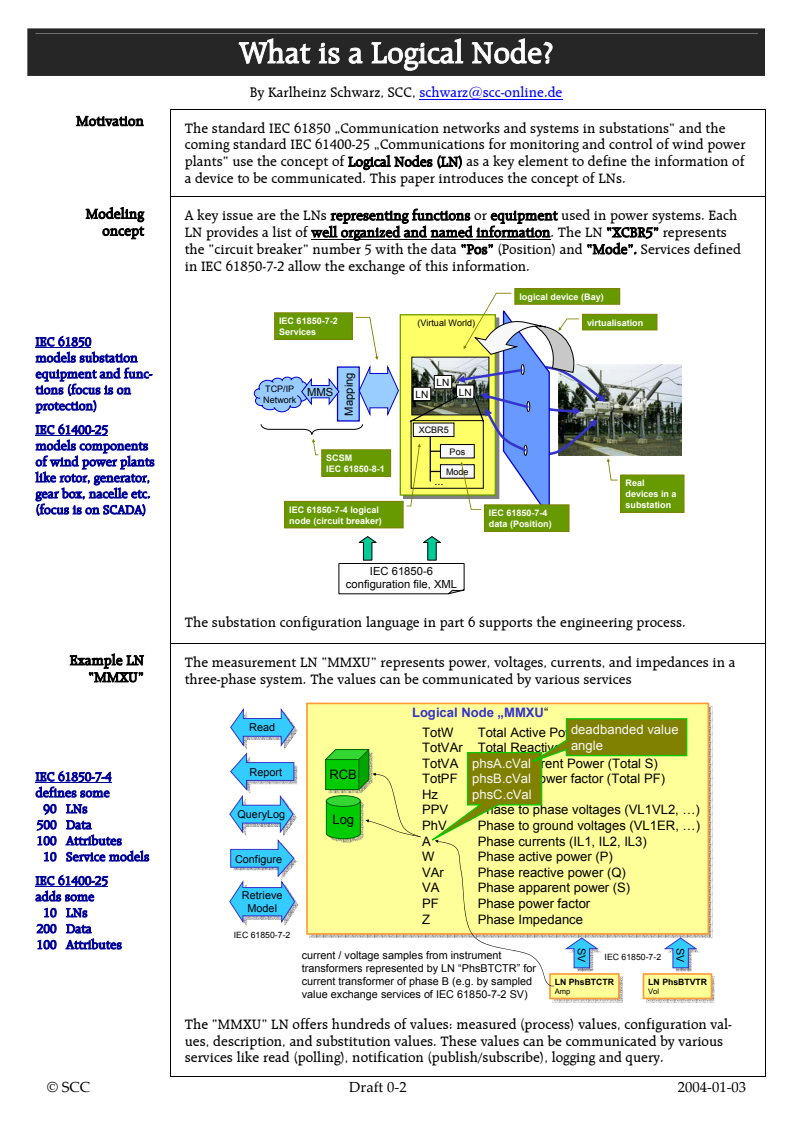
What is a Logical Node?
By Karlheinz Schwarz, SCC, schwarz@scc-online.de
Motivation
The standard IEC 61850 „Communication networks and systems in substations“ and the
coming standard IEC 61400-25 „Communications for monitoring and control of wind power
plants“ use the concept of Logical Nodes (LN) as a key element to define the information of
a device to be communicated. This paper introduces the concept of LNs.
Modeling
A key issue are the LNs representing functions or equipment used in power systems. Each
oncept
LN provides a list of well organized and named information. The LN “XCBR5” represents
the “circuit breaker” number 5 with the data “Pos” (Position) and “Mode”. Services defined
in IEC 61850-7-2 allow the exchange of this information.
logical device (Bay)
IEC 61850-7-2
(Virtual World) virtualisation
Services
IEC 61850
models substation
equipment and func-
LN
TCP/IP
tions (focus is on
LNLN
MMS
LN
Network
protection)
IEC 61400-25 XCBR5
models components
Pos
SCSM
of wind power plants
IEC 61850-8-1
Mode
like rotor, generator,
...
Real
gear box, nacelle etc. devices in a
substation
IEC 61850-7-4 logical
(focus is on SCADA)
IEC 61850-7-4
node (circuit breaker)
data (Position)
IEC 61850-6
configuration file, XML
The substation configuration language in part 6 supports the engineering process.
Example LN
The measurement LN “MMXU” represents power, voltages, currents, and impedances in a
“MMXU”
three-phase system. The values can be communicated by various services
Logical Node „MMXU“
Read
deadbanded value
Read
TotW Total Active Power (Total P)
angle
TotVAr Total Reactive Power (Total Q)
TotVA phsA.cVTotal Appareal nt Power (Total S)
Report
Report RCB
IEC 61850-7-4 RCB
TotPF phsB.cVAverage alPower factor (Total PF)
defines some
Hz phsCFrequency.cVal
90 LNs
PPV Phase to phase voltages (VL1VL2, …)
QueryLog
QueryLog
Log
Log
500 Data PhV Phase to ground voltages (VL1ER, …)
100 Attributes A Phase currents (IL1, IL2, IL3)
10 Service models W Phase active power (P)
Configure
Configure
VAr Phase reactive power (Q)
IEC 61400-25
VA Phase apparent power (S)
Retrieve
adds some
Retrieve
PF Phase power factor
Model
Model
10 LNs
Z Phase Impedance
200 Data
IEC 61850-7-2
100 Attributes
current / voltage samples from instrument
IEC 61850-7-2
transformers represented by LN “PhsBTCTR” for
current transformer of phase B (e.g. by sampled LN PhsBTCTR LN PhsBTVTR
LN PhsBTCTR LN PhsBTVTR
Amp Vol
value exchange services of IEC 61850-7-2 SV) Amp Vol
The “MMXU” LN offers hundreds of values: measured (process) values, configuration val-
ues, description, and substitution values. These values can be communicated by various
services like read (polling), notification (publish/subscribe), logging and query.
© SCC Draft 0-2 2004-01-03
Mapping
ACSI overview and basic concepts
General
The models of the ACSI provide
� the specification of a basic model for the definition of the substation-specific information models contained
in IEC 61850-7-3 (common DATA classes) and IEC 61850-7-4 (compatible LOGICAL-NODE classes and
compatible DATA classes) and
� the specification of information exchange service models.
The information models and information exchange services are interwoven. From a descriptive point of view, the
two aspects are separated to some degree (see the excerpt shown in Figure 1). The common models (for
example, LOGICAL-NODE and DATA classes including their services) are applied in IEC 61850-7-3 and IEC
61850-7-4 to define many specialized information models - the substation automation models.
Figure 1 - Excerpt of conceptual model
Other service models required for substation automation systems (for example, DATA-SET and reporting provide
specific information exchange services) are also defined in this part of the standard; these models are linked to
LOGICAL-NODEs and DATA. The information exchange services are completely defined in the ACSI. The
information models defined in IEC 61850-7-4 reference the services defined in the various models of the ACSI.
Overview of basic information models
The conceptual models to build the domain-specific information models are:
� SERVER - represents the external visible behaviour of a device. All other ACSI models are part of the
server.
NOTE 1 A server has two roles: to communicate with a client (most service models in IEC 61850 provide
communication with client devices) and to send information to peer devices (for example, for sampled
values).
� LOGICAL-DEVICE (LD) - contains the information produced and consumed by a group of domain-specific
application functions; functions are defined as LOGICAL-NODEs.
� LOGICAL-NODE (LN) - contains the information produced and consumed by a domain-specific application
function, for example, overvoltage protection or circuit-breaker.
� DATA - provide means to specify typed information, for example, position of a switch with quality
information and timestamp, contained in LOGICAL-NODEs.
Each of these information models is defined as a class. The classes comprise attributes and services. The
conceptual class diagram of the ACSI is depicted in Figure 2.
NOTE 2 The classes are major building blocks that provide the framework for substation automation device
models. Additional details on the modelling and relations between IEC 61850-7-4, IEC 61850-7-3, and this part of
IEC 61850 can be found in IEC 61850-7-1.
Click on boxes to get the definitions!
Figure 2 - Basic conceptual class model of the ACSI
Click on boxes to get the definitions!
NOTE 3 The numbers in the circles indicate the respective clauses in this part of IEC 61850.
The Name class is inherited by the classes LOGICAL-DEVICE, LOGICAL-NODE, DATA, and DataAttribute.
EXAMPLE In an implementation the logical device, logical node, data, and data attribute have each an object
name (instance name) which is a unique name among classes of the same container to which they belong. In
addition, each of the four has an ObjectReference (path name) which is a concatenation of all object names from
each container. The four object names (one per column) can be concatenated.
Logical device Logical node Data Data attribute
Object name "Atlanta_HV5" "XCBR1" "Pos" "stVal"
Description
High-voltage station 5 Circuit-breaker 1 Position Status value
Overview of the other service models
In addition to the models listed above, the ACSI comprises the following models that provide services operating
on data, data attributes, and data sets.
� DATA-SET - permits the grouping of data and data attributes. Used for direct access and for reporting and
logging.
� Substitution - supports replacement of a process value by another value.
� SETTING-GROUP-CONTROL-BLOCK - defines how to switch from one set of setting values to another
one and how to edit setting groups.
� REPORT-CONTROL-BLOCK and LOG-CONTROL-BLOCK - describe the conditions for generating
reports and logs based on parameters set by the client. Reports may be triggered by changes of process
data values (for example, state change or dead band) or by quality changes. Logs can be queried for later
retrieval. Reports may be sent immediately or deferred. Reports provide change-of-state and sequence-of-
events information exchange.
� control blocks for generic substation event (GSE) - supports a fast and reliable system-wide distribution of
input and output data values; peer-to-peer exchange of IED binary status information, for example, a trip
signal.
� control blocks for transmission of sampled values - fast and cyclic transfer of samples, for example, of
instrument transformers.
� control - describes the services to control, for example, devices.
� time and time synchronization - provides the time base for the device and system.
� file transfer - defines the exchange of large data blocks such as programs.
An overview of the conceptual service model of the ACSI is shown in Figure 3.
Click on boxes to get the definitions!
Figure 3 - Conceptual service model of the ACSI
Click on boxes to get the definitions!
NOTE 1 The numbers in the circles indicate the respective clauses in this part of IEC 61850.
NOTE 2 The class diagrams are conceptual. Details are defined in the respective clauses. Comprehensive
diagrams are contained in IEC 61850-7-1. The DATA class may be defined recursively. The operations for
substitution and control are restricted to the lowest level in the DATA class. The DataAttributes may be defined
recursively as well.
The logical node is one of the major building blocks that has associations to most of the other information
exchange models, for example, report control, log control, and setting control.
Any other information exchange service model, for example, report control, log control, and setting control shall
inherit the ObjectName and ObjectReference as depicted in Figure 2.
NOTE 3 The class models and services are defined using an object-oriented approach allowing for the mapping
of class models and services to different application layer and middle ware solutions.
Overview of ACSI services
The complete list of ACSI classes and their services is shown in Table 1.
Table 1 - ACSI classes
SERVER model (Clause 6) LOG-CONTROL-BLOCK model:
GetServerDirectory GetLCBValues
SetLCBValues
QueryLogByTime
ASSOCIATION model (Clause 7)
QueryLogAfter
Associate
GetLogStatusValues
Abort
Release
Generic substation event model —
GSE (Clause 15)
LOGICAL-DEVICE model (Clause 8)
GOOSE
GetLogicalDeviceDirectory
SendGOOSEMessage
GetGoReference
LOGICAL-NODE model (Clause 9)
GetGOOSEElementNumber
GetLogicalNodeDirectory
GetGoCBValues
GetAllDataValues
SetGoCBValues
GSSE
DATA model (Clause 10)
SendGSSEMessage
GetDataValues
GetGsReference
SetDataValues
GetGSSEDataOffset
GetDataDirectory
GetGsCBValues
GetDataDefinition
SetGsCBValues
DATA-SET model (Clause 11)
Transmission of sampled values model
GetDataSetValues
(Clause 16)
SetDataSetValues
MULTICAST-SAMPLE-VALUE-CONTROL-BLOCK:
CreateDataSet
SendMSVMessage
DeleteDataSet
GetMSVCBValues
GetDataSetDirectory
SetMSVCBValues
UNICAST-SAMPLE-VALUE-CONTROL-BLOCK:
Substitution model (Clause 12)
SetDataValues SendUSVMessage
GetUSVCBValues
GetDataValues
SetUSVCBValues
SETTING-GROUP-CONTROL-BLOCK model
Control model (Clause 17)
(Clause 13)
Select
SelectActiveSG
SelectWithValue
SelectEditSG
Cancel
SetSGValues
Operate
ConfirmEditSGValues
CommandTermination
GetSGValues
TimeActivatedOperate
GetSGCBValues
Time and time synchronization (Clause 18)
TimeSynchronization
REPORT-CONTROL-BLOCK and LOG-
CONTROL-BLOCK model (Clause 14) FILE transfer model (Clause 20)
BUFFERED-REPORT-CONTROL-BLOCK: GetFile
SetFile
Report
DeleteFile
GetBRCBValues
GetFileAttributeValues
SetBRCBValues
UNBUFFERED-REPORT-CONTROL-BLOCK:
Report
GetURCBValues
SetURCBValues
5 ObjectName
The ObjectName shall specify a unique instance name among instances of a class owned by the same parent
class with a type as specified in Table 3 - ObjectName type
ObjectName type
Attribute name Attribute type Value/value range/explanation Used by
ObjectName VISIBLE STRING32 Name of an instance of a class of a IEC 61850-7-4
single hierarchy level IEC 61850-7-3
IEC 61850-7-2
NOTE Clause 19 specifies constraints on the use of the type ObjectName.
5 ObjectReference
Instances of classes in the hierarchical information model (ACSI class hierarchy of logical device, logical node,
data, data attributes) shall be constructed by the concatenation of all instance names comprising the whole
path-name of an instance of a class that identifies the instance uniquely. The type of the ObjectReference shall
be as specified in Table 4.
Table 4 - ObjectReference type
ObjectReference type
Attribute name Attribute type Value/value range/explanation Used by
ObjectReference VISIBLE STRING255 ObjectReference comprises the IEC 61850-7-2
whole path-name of an instance of a
class that identifies the instance
uniquely
The ObjectReference syntax shall be:
LDName/LNName[.Name[. .]]
The "/" shall separate the instance name of a logical device (LDName) from the name of an instance of a
logical node (LNName). The "." shall separate the further names in the hierarchy. The "[ ]" shall indicate an
option. The inner square bracket "[. .]" shall indicate further names of recursively nested definitions.
NOTE 1 In any case where the context of the text provides sufficient information that an instance of a class is
meant, the term "instance of" is not used.
NOTE 2 Clause 19 specifies constraints on the use of the type ObjectReference.
6 Server
The class SERVER shall represent the externally visible behaviour of a device. The SERVER shall be a
composition as defined in Table 11.
NOTE 1 For simple devices the server may comprise just one logical device with the GOOSE control model
with no other service.
Table 11 - SERVER class definition
SERVER class
Attribute name Attribute type Value/value range/explanation
ServiceAccessPoint [1.n] (*) (*) Type is SCSM specific
LogicalDevice [1.n] LOGICAL-DEVICE
File [0.n] FILE
TPAppAssociation [0.n] TWO-PARTY-APPLICATION-
ASSOCIATION
MCAppAssociation [0.n] MULTICAST-APPLICATION-
ASSOCIATION
Services
GetServerDirectory
NOTE 2 The server's relationship to the underlying communication system and the concrete implementation
depend on the SCSM (specific communication service mapping, see IEC 61850-8-x and IEC 61850-9-x) used.
Network management (as part of an SCSM), device management, and system management are outside the
scope of IEC 61850-7-2.
8 Logical Device
The LOGICAL-DEVICE (LD) shall be a composition of LOGICAL-NODE as defined in Table 14.
NOTE- A LOGICAL-DEVICE can be used simply as a container of a group of LOGICAL-NODEs or as a device
that functions as a gateway or proxy. Details on the use of LOGICAL-DEVICE can be found in IEC 61850-7-1.
Table 14 - LOGICAL-DEVICE (LD) class definition
LOGICAL-DEVICE class
Attribute name Attribute type Value/value range/explanation
LDName ObjectName Instance name of an instance of LOGICAL-
DEVICE
LDRef ObjectReference Path-name of an instance of LOGICAL-
DEVICE
LogicalNode [3.n] LOGICAL-NODE IEC 61850-7-4 specifies specialized classes
of LOGICAL-NODE
Services
GetLogicalDeviceDirectory
9 LOGICAL NODE
The LOGICAL-NODE shall be a composition of DATA, DATA-SET, BRCB, URCB, LCB, LOG, SGCB, GoCB,
GsCB, MSVCB, and USVCB as defined in Table 15.
Table 15 - LOGICAL-NODE (LN) class definition
LOGICAL-NODE class
Attribute name Attribute type Explanation
LNName ObjectName Instance name of an instance of
LOGICAL-NODE
LNRef ObjectReference Path-name of an instance of
LOGICAL-NODE
Data [1.n] DATA
DataSet [0.n] DATA-SET
BufferedReportControlBlock [0.n] BRCB
UnbufferedReportControlBlock [0.n] URCB
LogControlBlock [0.n] LCB
IF compatible LN class defined in IEC 61850-7-4 equals LLN0
SettingGroupControlBlock [0.1] SGCB
Log [0.1] LOG
GOOSEControlBlock [0.n] GoCB
GSSEControlBlock [0.n] GsCB
MulticastSampledValueControlBlock [0.n] MSVCB
UnicastSampledValueControlBlock [0.n] USVCB
Services
GetLogicalNodeDirectory
GetAllDataValues
NOTE 1 IEC 61850-7-4 defines specialized logical node classes - the compatible logical node classes, for
example, XCBR representing circuit-breakers.
The definition of LOGICAL-NODEs for the substation-application domain is refined by the definition of specific
DATAin IEC 61850-7-4. The definitions in IEC 61850-7-4 (and IEC 61850-7-3 for the common DATA classes)
shall be taken into account to get the comprehensive definition of substation-domain-specific LOGICAL-
NODEs.
NOTE 2 IEC 61850-7-4 defines further attributes for LOGICAL-NODEs; for example,, the mode (behaviour:
ON, BLOCKED, TEST, etc.) of the substation-specific LOGICAL-NODE is defined in IEC 61850-7-4. The state
model of a LOGICAL-NODE is modelled as a specific DATA (named Mod).
10 Data
The DATA shall have the structure defined in Table 16.
Table 16 - DATA class definition
DATA class
Attribute name Attribute type Value/value range/explanation
DataName ObjectName Instance name of an instance of DATA,
for example, PhV (1st level), phsA (2nd
level)
DataRef ObjectReference Path-name of an instance of DATA,
for example, MMXU1.PhV or
for example, MMXU1.PhV.PhsA
Presence BOOLEAN Indicates mandatory/optional
DataAttribute [0.n] DAType For example, Vector class of IEC 61850-7-
DataAttributeTypeFunctionalConstraint FC 3
TrgOp [0.n] TriggerConditions for example, MX
for example, dchg
Specializations of DATA
CompositeCDC [0.n] DATA For example, WYE class of IEC 61850-7-3
SimpleCDC [0.n] COMMON-DATA For example, CMV class of IEC 61850-7-3
Services
GetDataValues
SetDataValues
GetDataDirectory
GetDataDefinition
An instance of a DATA class may contain zero or more instances of a CompositeCDC, SimpleCDC or a
DataAttribute. However, they cannot all be absent, so at least one of these elements shall be present.
NOTE 5 The structure of a DATA class is recursive since a CompositeCDC is also of type DATA class. The
level of recursion may be restricted by a SCSM, so the number of levels of recursion of CompositeCDCs is
normally no greater than 1.
NOTE 6 DATA or part of a DATA may be referenced in a DATA-SET. The persistent existence of DATA is
expected as long as they are referenced as members of a DATA-SET. A system has to take special measures
to ensure their existence.
10 Data Attribute Type
The DAType shall be as defined in Table 17.
Table 17 - DAType definition
DAType
Attribute name Attribute type Value/value range/explanation
DATName ObjectName Instance name of an instance of DAType,
for example, cVal (1stlevel), mag (2nd level), f
(3rd level)
DATRef ObjectReference Path-name of an instance of DAType
for example, MMXU1.PhV.phsA.cVal
for example, MMXU1.PhV.phsA.cVal.mag or
for example, MMXU1.PhV.phsA.cVal.mag.f
Presence BOOLEAN Indicates mandatory/optional
Specializations of DAType
CompositeComponent [0.n] DAType For example, mag in Vector class of IEC 61850-
7-3
for example, f in AnalogueValue of IEC 61850-7-
PrimitiveComponent [0.1] BasicType For example, FLOAT32 class of IEC 61850-7-3
for f
NOTE 1 An instance of a DAType may contain 0 or more instances of a CompositeComponent or a
PrimitveDAT. However, they cannot both be absent, so at least one of these elements must be present.
NOTE 2 The structure of a DAType is recursive since a CompositeComponent is also of type DAType. The
level of recursion may be restricted by a SCSM, so the number of levels of recursion of
CompositeComponents is normally no greater than 2.
11 DATA-SET class syntax
The DATA-SET shall have the structure as defined in Table 21.
Table 21 - DATA-SET (DS) class definition
DATA-SET class
Attribute name Attribute type Value/value range/explanation
DSName ObjectName Instance name of an instance of DATA-SET
DSRef ObjectReference Path-name of an instance of DATA-SET
DSMemberRef [1.n] (*) (*) Functionally constrained data (FCD) or
functionally constrained data attribute (FCDA)
Services
GetDataSetValues
SetDataSetValues
CreateDataSet
DeleteDataSet
GetDataSetDirectory
13 SETTING-GROUP-CONTROL-BLOCK class model
The SGCB shall have the structure defined in Table 22.
Clients should use the existence of a SGCB to determine if the LOGICAL-DEVICE contains SGs.
Table 22 - SGCB class definition
SGCB class
Attribute name Attribute type FC TrgOp Value/value range/explanation
SGCBName ObjectName - - Instance name of an instance of SGCB
SGCBRef ObjectReference - - Path-name of an instance of SGCB
NumOfSG INT8U SP - n = NumOfSG
ActSG INT8U SP dchg Allowable range: 1 . n
EditSG INT8U SP dchg Allowable range: 0 . n
CnfEdit BOOLEAN SP dchg
LActTm TimeStamp SP dchg
Services
SelectActiveSG
SelectEditSG
SetSGValues
ConfirmEditSGValues
GetSGValues
GetSGCB Values
Values of the attributes of the instances of SGCB shall be configured.
14 BUFFERED-REPORT-CONTROL-BLOCK (BRCB)
The BRCB class shall have the structure defined in Table 23.
Table 23 - BRCB class definition
BRCB class
Attribute name Attribute type FC TrgOp Value/value range/explanation
BRCBName ObjectName - - Instance name of an instance of BRCB
BRCBRef ObjectReference - - Path-name of an instance of BRCB
Specific to report handler
RptID VISIBLE STRING65 BR -
RptEna BOOLEAN BR dchg
DatSet ObjectReference BR dchg
ConfRev INT32U BR dchg
OptFlds PACKED LIST BR dchg
sequence-number BOOLEAN
report-time-stamp BOOLEAN
reason-for-inclusion BOOLEAN
data-set-name BOOLEAN
data-reference BOOLEAN
buffer-overflow BOOLEAN
entryID BOOLEAN
conf-revision BOOLEAN
BufTm INT32U BR dchg
SqNum INT16U BR -
TrgOp TriggerConditions BR dchg
IntgPd INT32U BR dchg 0. MAX; 0 implies no integrity report.
GI BOOLEAN BR -
PurgeBuf BOOLEAN BR -
EntryID EntryID BR -
TimeOfEntry EntryTime BR -
Services
Report
GetBRCBValues
SetBRCBValues
These attributes determine the service procedures of the Report service. The impact of the various values
shall be as defined in the following attribute definitions.
14 UNBUFFERED-REPORT-CONTROL-BLOCK (BRCB)
The URCB class shall have the structure defined in Table 25.
Table 25 - URCB class definition
URCB class
Attribute name Attribute type FC TrgOp Value/value range/explanation
URCBName ObjectName - - Instance name of an instance of URCB
URCBRef ObjectReference - - Path-name of an instance of URCB
Specific to report handler
RptID VISIBLE STRING65 RP -
RptEna BOOLEAN RP dchg
Resv BOOLEAN RP -
DatSet ObjectReference RP dchg
ConfRev INT32U RP dchg
OptFlds PACKED LIST RP dchg
reserved BOOLEAN
sequence-number BOOLEAN
report-time-stamp BOOLEAN
reason-for-inclusion BOOLEAN
data-set-name BOOLEAN
data-reference BOOLEAN
reserved BOOLEAN Used for buffer-overflow in BRCB
reserved BOOLEAN Used for entryID in BRCB
conf-revision BOOLEAN
BufTm INT32U RP dchg 0 . MAX
SqNum INT8U RP -
TrgOp TriggerConditions RP dchg
IntgPd INT32U RP dchg 0. MAX
GI BOOLEAN BR -
Services
Report
GetURCBValues
SetURCBValues
Except URCBName, URCBRef, RptEna, and Resv all other attributes shall be as defined for the BRCB in
14.2.2.
14 LOG-CONTROL-BLOCK class model
The LCB shall control the procedures that are required for storing values of DataAttribute (the log entry) into a
LOG. Each enabled LCB shall associate DATA-SET with a LOG. Changes in a value of a member of a DATA-
SET shall be stored as LOG entry. Multiple LCBs allow multiple DATA-SETs to feed a LOG.
It shall be the responsibility of access control, to prevent unauthorized clients to modify an LCB.
NOTE The internal notification, local storage mechanism, internal formats, etc. for log entries are all local
issues and outside the scope of this part of IEC 61850.
The LCB shall have the structure specified in Table 26.
Table 26 - LCB class definition
LCB class
Attribute name Attribute type FC TrgOp Value/value range/explanation
LCBName ObjectName - - Instance name of an instance of LCB
LCBRef ObjectReference - - Path-name of an instance of LCB
Specific to log handler
LogEna BOOLEAN LG dchg
DatSet ObjectReference LG dchg
OptFlds PACKED LIST LG dchg
reason-for-inclusion BOOLEAN
TrgOp TriggerConditions LG dchg Valid values for TrgOp of type
TriggerConditions shall be dchg, qchg,
dupd, and integrity.
IntgPd INT32U LG dchg 1.MAX; 0 implies no integrity logging.
Specific to building the log
LogRef ObjectReference LG
Services
GetLCBValues
SetLCBValues
14 LOG
The LOG shall be filled on a first-in first-out basis. When the list of log entries reaches a point where the stored
data reaches the maximal size of the log, the oldest log entry shall be overwritten. This action shall have no
impact to the further incrementing of the EntryID of the added log entries.
The LOG shall have the structure defined in Table 27.
Table 27 - LOG class definition
LOG class
Attribute name Attribute type FC Value/value range/explanation
LogName ObjectName Instance name of an instance of LOG
LogRef ObjectReference Path-name of an instance of LOG
OldEntrTm TimeStamp LG
NewEntrTm TimeStamp LG
OldEntr INT32U LG
NewEntr INT32U LG
Entry [1.n]
TimeOfEntry EntryTime
EntryID EntryID
EntryData [1.n]
DataRef ObjectReference
Value (*) (*) type(s) depend on the definition of common data
classes in IEC 61850-7-3
ReasonCode TriggerConditions If reason-for-inclusion (="TRUE)" in optFlds.
ReasonCode general-interrogation shall never
occur as TRUE.
Services
QueryLogByTime
QueryLogAfter
GetLogStatusValues
15 GOOSE-CONTROL-BLOCK (GoCB) class
The GoCB shall be as defined in Table 28.
Table 28 - GOOSE control block class definition
GoCB class
Attribute name Attribute type FC TrgOp Value/value range/explanation
GoCBName ObjectName GO - Instance name of an instance of GoCB
GoCBRef ObjectReference GO - Path-name of an instance of GoCB
GoEna BOOLEAN GO dchg Enabled (TRUE) | disabled (FALSE)
AppID VISIBLE STRING65 GO Attribute that allows a user to assign a
system unique identification for the
application that is issuing the GOOSE.
DEFAULT GoCBRef
DatSet ObjectReference GO dchg
ConfRev INT32U GO dchg
NdsCom BOOLEAN GO dchg
Services
SendGOOSEMessage
GetGoReference
GetGOOSEElementNumber
GetGoCBValues
SetGoCBValues
15 Generic substation state event (GSSE) control block (GsCB)
The GsCB shall be as defined in Table 30.
Table 30 - GSSE control block class definition
GsCB class
Attribute name Attribute type FC Value/value range/explanation
GsCBName ObjectName Instance name of an instance of GsCB
GsCBRef ObjectReference Path-name of an instance of GsCB
GsEna BOOLEAN GS Enabled (TRUE) | disabled (FALSE)
AppID VISIBLE STRING65 GS
DataLabel [1.n] VISIBLE STRING65 GS
LSentData [1.n] GSSEData GS Derived from GSSE message
Services
SendGSSEMessage
GetGsReference
GetGSSEDataOffset
GetGsCBValues
SetGsCBValues
16 Transmission of sampled values using multicast (MSVCB)
The transmission of sampled values using multicast (MULTICAST-SAMPLE-VALUE-CONTROL-BLOCK -
MSVCB) shall be based on configured configuration in the producer device. The data exchange shall be based
on the multicast application association. To support self-descriptive capabilities, any client may read the
attributes of the sampled value control instance. Authorized clients may modify attributes of the sampled value
control.
The MSVCB shall be as defined in Table 32.
Table 32 - MSVCB class definition
MSVCB class
Attribute Attribute type FC TrgOp Value/value range/explanation
name
MsvCBNam ObjectName - - Instance name of an instance of MSVCB
MsvCBRef ObjectReference - - Path-name of an instance of MSVCB
SvEna BOOLEAN MS dchg Enabled (TRUE) | disabled (FALSE), DEFAULT
FALSE
MsvID VISIBLE STRING65 MS -
DatSet ObjectReference MS dchg
ConfRev INT32U MS dchg
SmpRate INT16U MS - (0.MAX)
OptFlds PACKED LIST MS dchg
refresh-time BOOLEAN
sample-synchronized BOOLEAN
sample-rate BOOLEAN
Services
SendMSVMessage
GetMSVCBValues
SetMSVCBValues
16 Transmission of sampled values using unicast (USVCB)
The transmission of sampled values using unicast (UNICAST-SAMPLE-VALUE-CONTROL-BLOCK - USVCB)
shall be based on two-party application associations. The subscriber shall establish the association with the
producer. The subscriber may then configure the class and enable the transmission of the sampled values with
the attribute SvEna. When the association is released, the transmission of the sampled values shall stop and
the instance of the control class shall be released.
The samples shall be sent using the two-party application association.
The USVCB shall be as defined in Table 33.
Table 33 - USVCB class definition
USVCB class
Attribute name Attribute FC TrgOp Value/value range/explanation
UsvCBNam ObjectName - - Instance name of an instance of UNICAST-
SVC
UsvCBRef ObjectReference - - Path-name of an instance of UNIICAST-
SVC
SvEna BOOLEAN US dchg Enabled (TRUE) | disabled (FALSE),
DEFAULT FALSE
Resv BOOLEAN US -
UsvID VISIBLE STRING65 US -
DatSet ObjectReference US dchg
ConfRev INT32U US dchg
SmpRate INT16U US dchg (0.MAX)
OptFlds PACKED LIST US dchg
refresh-time BOOLEAN
sample-synchronized BOOLEAN
sample-rate BOOLEAN
Services
SendUSVMessage
GetUSVCBValues
SetUSVCBValues
All LN classes defined in IEC 61850-7-4
� The first column (Summary) provides all logical nodes with data
names and explanation only.
� The second column (IEC) provides almost all information of all
logical nodes as in IEC 61850-7-4
How to view?
If you want to see one of the following logical nodes (available in HTML Format only!!)
together with the Common Data Classes (CDC) AND the Semantic of all names,
with the following three frames:
� Upper frame: logical node (LN),
� Middle frame: the common data class (CDC), and
� Bottom frame: the semantic of the names).
Then navigate through the LNs below (on this page).
Summary IEC
LPHD Summary LPHD IEC Table
CLN Summary CLN IEC Table
LLN0 Summary LLN0 IEC Table
PDIF Summary PDIF IEC Table
PDIR Summary PDIR IEC Table
PDIS Summary PDIS IEC Table
PDOP Summary PDOP IEC Table
PDUP Summary PDUP IEC Table
PFRC Summary PFRC IEC Table
PHAR Summary PHAR IEC Table
PHIZ Summary PHIZ IEC Table
PIOC Summary PIOC IEC Table
PMRI Summary PMRI IEC Table
PMSS Summary PMSS IEC Table
POPF Summary POPF IEC Table
PPAM Summary PPAM IEC Table
PSCH Summary PSCH IEC Table
PSDE Summary PSDE IEC Table
PTEF Summary PTEF IEC Table
PTOC Summary PTOC IEC Table
PTOF Summary PTOF IEC Table
PTOV Summary PTOV IEC Table
PTRC Summary PTRC IEC Table
PTTR Summary PTTR IEC Table
PTUC Summary PTUC IEC Table
PTUV Summary PTUV IEC Table
PUPF Summary PUPF IEC Table
PTUF Summary PTUF IEC Table
PVOC Summary PVOC IEC Table
PVPH Summary PVPH IEC Table
PZSU Summary PZSU IEC Table
RDRE Summary RDRE IEC Table
RADR Summary RADR IEC Table
RBDR Summary RBDR IEC Table
RDRS Summary RDRS IEC Table
RBRF Summary RBRF IEC Table
RDIR Summary RDIR IEC Table
RFLO Summary RFLO IEC Table
RPSB Summary RPSB IEC Table
RREC Summary RREC IEC Table
RSYN Summary RSYN IEC Table
CALH Summary CALH IEC Table
CCGR Summary CCGR IEC Table
CILO Summary CILO IEC Table
CPOW Summary CPOW IEC Table
CSWI Summary CSWI IEC Table
GAPC Summary GAPC IEC Table
GGIO Summary GGIO IEC Table
GSAL Summary GSAL IEC Table
IARC Summary IARC IEC Table
IHMI Summary IHMI IEC Table
ITCI Summary ITCI IEC Table
ITMI Summary ITMI IEC Table
ANCR Summary ANCR IEC Table
ARCO Summary ARCO IEC Table
ATCC Summary ATCC IEC Table
AVCO Summary AVCO IEC Table
MDIF Summary MDIF IEC Table
MHAI Summary MHAI IEC Table
MHAN Summary MHAN IEC Table
MMTR Summary MMTR IEC Table
MMXN Summary MMXN IEC Table
MMXU Summary MMXU IEC Table
MSQI Summary MSQI IEC Table
MSTA Summary MSTA IEC Table
SARC Summary SARC IEC Table
SIMG Summary SIMG IEC Table
SIML Summary SIML IEC Table
SPDC Summary SPDC IEC Table
XCBR Summary XCBR IEC Table
XSWI Summary XSWI IEC Table
TCTR Summary TCTR IEC Table
TVTR Summary TVTR IEC Table
YEFN Summary YEFN IEC Table
YLTC Summary YLTC IEC Table
YPSH Summary YPSH IEC Table
YPTR Summary YPTR IEC Table
ZAXN Summary ZAXN IEC Table
ZBAT Summary ZBAT IEC Table
ZBSH Summary ZBSH IEC Table
ZCAB Summary ZCAB IEC Table
ZCAP Summary ZCAP IEC Table
ZCON Summary ZCON IEC Table
ZGEN Summary ZGEN IEC Table
ZGIL Summary ZGIL IEC Table
ZLIN Summary ZLIN IEC Table
ZMOT Summary ZMOT IEC Table
ZREA Summary ZREA IEC Table
ZRRC Summary ZRRC IEC Table
ZSAR Summary ZSAR IEC Table
ZTCF Summary ZTCF IEC Table
ZTCR Summary ZTCR IEC Table
Logical node classes (LN) of IEC 61850-7-4
Version 2004-03-22
This web page (pdf file) is intended to provide a hypertext version of an excerpt of the main
concepts and definitions of Parts IEC 61850-7-4
NOTE The content of this web page (pdf file) is informative only. The page does in no way
replace the normative definitions contained in IEC 61850-7-4.
Copyright of transformation (c) 2004 by Karlheinz Schwarz, SCC
Send comment to Karlheinz
2004-03-22
Brief tables of LN classes defined in IEC 61850-7-4
(Tables provide just DATA Class Names and Explanation)
LPHD - Physical device information
This LN is introduced in this part to model common issues for physical devices.
LPHD class
DATA Class Explanation
PhyNam
Physical device name plate
PhyHealth
Physical device health
OutOv
Output communications buffer overflow
Proxy
Indicates if this LN is a proxy
InOv
Input communications buffer overflow
NumPwrUp
Number of Power ups
WrmStr
Number of Warm Starts
WacTrg
Number of watchdog device resets detected
PwrUp
Power Up detected
PwrDn
Power Down detected
PwrSupAlm
External power supply alarm
RsStat
Reset device statistics
CLN - Common Logical Node
The compatible logical node classes defined in this document are specilisations of this
Common Logical Node Class.
CLN class
DATA Class Explanation
Mandatory Logical Node Information (Shall be inherited by ALL LN but LPHD)
Mod
Mode
Beh
Behaviour
Health
Health
NamPlt
Name plate
Optional Logical Node Information
Loc
Local operation
EEHealth
External equipment health
EEName
External equipment name plate
OpCntRs
Operation counter resetable
OpCnt
Operation counter
OpTmh
Operation time
Data Sets (see IEC 61850-7-2)
LLN0 - Logical node zero
This logical node shall be used to address common issues for logical devices.
LLN0 class
DATA Class Explanation
Common Logical Node Information
LN shall inherit all Mandatory Data from Common Logical Node Class
Loc
Local operation for complete logical device
OpTmh
Operation time
Controls
Diag
Run Diagnostics
LEDRs
LED reset
PDIF - Differential
See IEC 61850-5 (LNs PLDF, PNDF, PTDF, PBDF, PMDF, and PPDF). This LN shall be
used for all kind of current differential protection. Proper current samples for the dedicated
application shall be subscribed.
PDIF class
DATA Class Explanation
Common Logical Node Information
LN shall inherit all Mandatory Data from Common Logical Node Class
OpCntRs
Resetable operation counter
Status Information
Str
Start
Op
Operate
TmASt
Active curve characteristic
Measured Values
DifAClc
Differential Current
RstA
Restraint Current
Settings
LinCapac
Line capacitance (for load currents)
LoSet
Low operate value, percentage of the nominal current
HiSet
High operate value, percentage of the nominal current
MinOpTmms
Minimum Operate Time
MaxOpTmms
Maximum Operate Time
RstMod
Restraint Mode
RsDlTmms
Reset Delay Time
TmACrv
Operating Curve Type
PDIR - Direction comparison
For a description of this LN, see IEC 61850-5. The operate decision is based on an
agreement of the fault direction signals from all directional fault sensors (for example
directional relays) surrounding the fault. The directional comparison for lines is made with
PSCH.
PDIR class
DATA Class Explanation
Common Logical Node Information
LN shall inherit all Mandatory Data from Common Logical Node Class
OpCntRs
Resetable operation counter
Status Information
Str
Start (appearance of the first related fault direction)
Op
Operate (decision from all sensors that the surrounded object is faulted)
Settings
RsDlTmms
Reset Delay Time
PDIS - Distance
For a description of this LN, see IEC 61850-5. The phase start value and ground start value
are minimum thresholds to release the impedance measurements depending on the distance
function characteristic given by the algorithm and defined by the settings. The settings
replace the data curve as used for the characteristic on some other protection LNs.
PDIS class
DATA Class Explanation
Common Logical Node Information
LN shall inherit all Mandatory Data from Common Logical Node Class
OpCntRs
Resetable operation counter
Status Information
Str
Start
Op
Operate
Settings
PoRch
Polar Reach is the diameter of the Mho diagram
PhStr
Phase Start Value
GndStr
Ground Start Value
DirMod
Directional Mode
PctRch
Percent Reach
Ofs
Offset
PctOfs
Percent Offset
RisLod
Resistive reach for load area
AngLod
Angle for load area
TmDlMod
Operate Time Delay Mode
OpDlTmms
Operate Time Delay
PhDlMod
Operate Time Delay Multiphase Mode
PhDlTmms
Operate Time Delay for Multiphase Faults
GndDlMod
Operate Time Delay for Single Phase Ground Mode
GndDlTmms
Operate Time Delay for single phase ground faults
X1
Positive sequence line (reach) reactance
LinAng
Line Angle
RisGndRch
Resistive Ground Reach
RisPhRch
Resistive Phase Reach
K0Fact
Residual Compensation Factor K0
K0FactAng
Residual Compensation Factor Angle
RsDlTmms
Reset Time Delay
PDOP - Directional overpower
For a description of this LN, see IEC 61850-5 (LN PDPR). This LN shall be used for the
overpower part of PDPR. Additionally, PDOP is used to model a reverse overpower function
(IEEE device function number 32R, from IEEE 32R.2,1996) when the DirMod is set to
reverse.
PDOP class
DATA Class Explanation
Common Logical Node Information
LN shall inherit all Mandatory Data from Common Logical Node Class
OpCntRs
Resetable operation counter
Status Information
Str
Start
Op
Operate
Settings
DirMod
Directional Mode
StrVal
Start Value
OpDlTmms
Operate Delay Time
RsDlTmms
Reset Delay Time
PDUP - Directional underpower
For a description of this LN, see IEC 61850-5 (LN PDPR). This LN shall be used for the
underpower part of PDPR.
PDUP class
DATA Class Explanation
Common Logical Node Information
LN shall inherit all Mandatory Data from Common Logical Node Class
OpCntRs
Resetable operation counter
Status Information
Str
Start
Op
Operate
Settings
StrVal
Start Value
OpDlTmms
Operate Delay Time
RsDlTmms
Reset Delay Time
DirMod
Directional Mode
PFRC - Rate of change of frequency
For a description of this LN, see IEC 61850-5 (LN PFRQ). This LN shall be used to model the
rate of frequency change of PFRQ. One instance shall be used per stage.
PFRC class
DATA Class Explanation
Common Logical Node Information
LN shall inherit all Mandatory Data from Common Logical Node Class
OpCntRs
Resetable operation counter
Status Information
Str
Start
Op
Operate
BlkV
Blocked because of voltage
Settings
StrVal
Start Value df/dt
BlkVal
Voltage Block Value
OpDlTmms
Operate Delay Time
RsDlTmms
Reset Delay Time
PHAR - Harmonic restraint
This LN shall be used to represent the harmonic restraint data of the transformer differential
protection (see PDIF) in a dedicated node. There may be multiple instantiations of this LN
with different settings, especially with different data HaRst.
PHAR class
DATA Class Explanation
Common Logical Node Information
LN shall inherit all Mandatory Data from Common Logical Node Class
OpCntRs
Resetable operation counter
Status Information
Str
Start (active when restraint is needed)
Settings
HaRst
Number of harmonic restrained
PhStr
Start Value
PhStop
Stop Value
OpDlTmms
Operate Delay Time
RsDlTmms
Reset Delay Time
PHIZ - Ground detector
For a description of this LN, see IEC 61850-5. This LN shall be used for high-impedance
isolation faults only.
PHIZ class
DATA Class Explanation
Common Logical Node Information
LN shall inherit all Mandatory Data from Common Logical Node Class
OpCntRs
Resetable operation counter
Status Information
Str
Start
Op
Operate
Settings
AStr
Current Start Value
VStr
Voltage Start Value
HVStr
Third Harmonic Voltage Start Value
OpDlTmms
Operate Delay Time
RsDlTmms
Reset Delay Time
...