


IEC 60703:2008
(Main)Test methods for electroheating installations with electron guns
General Information
- Abstract
IEC 60703:2008 lays down the test methods to determine the essential parameters, technical data and characteristics of electroheating installations comprising one or more electron guns. The significant changes with respect to the previous edition are as follows: the latest edition of IEC 60519-7 has been taken into account; test requirements have been completed.
- Status
- Published
- Publication Date
- 07-Oct-2008
- Technical Committee
- TC 27 - Industrial electroheating and electromagnetic processing
- Drafting Committee
- MT 26 - TC 27/MT 26
- Current Stage
- PPUB - Publication issued
- Start Date
- 08-Oct-2008
- Completion Date
- 31-Jan-2009
Overview
IEC 60703:2008 is an international standard developed by the International Electrotechnical Commission (IEC) that specifies test methods for electroheating installations using electron guns. This standard is essential for ensuring the reliable operation, safety, and performance of electroheating systems incorporating one or more electron guns as the heat source. The 2008 edition updates and expands previous requirements, including alignment with the latest IEC 60519-7 standard on safety in electroheat installations with electron guns.
This document provides standardized test methods meant to assess critical parameters, technical data, and operational characteristics of electroheating installations. It serves as a guideline rather than a mandatory set of tests, allowing flexibility for users and manufacturers to select applicable tests while maintaining conformity with international best practices.
Key Topics
Scope and Test Objectives
IEC 60703 defines test methods to evaluate the essential parameters and technical characteristics of electron gun-based electroheating equipment. It focuses on installations with vacuum chambers, high-voltage power supplies, electron beam systems, and auxiliary facilities.Essential Components Covered
- Electron beam and electron gun systems
- High-voltage power supplies and electrical safety components
- Beam deflection, focusing, and bending systems
- Auxiliary systems such as cooling, vacuum chambers, electrical interlocks, and safety alarms
Test Requirements and Procedures
- Electrical tests including insulation resistance, continuity, and safety interlocks
- High-voltage equipment and connector verification
- Electron beam parameters such as beam power, diameter, deflection limits, and frequency response
- Vacuum integrity and cooling system performance
- Stability under hot-run conditions and production run tests
- X-ray emission testing and electromagnetic compatibility assessment
Related Definitions & Terminology
The standard references terms defined in IEC 60050-841 and IEC 60519-7, clarifying concepts such as electron beam, beam accelerating voltage, electron gun components (anode, cathode), beam deflection system, and more.
Applications
IEC 60703:2008 finds practical use in industries and environments where electron beam electroheating is employed, such as:
Industrial Electroheating Installations
Facilities that utilize electron guns for materials processing, surface treatment, welding, or melting applications.Manufacturing Quality Control
Standardized testing of electron gun systems during production to ensure component integrity and consistent performance.Safety Compliance and Certification
Verifying compliance with international electrical safety standards, reducing risks from high-voltage equipment and radiation hazards.Research and Development
Guiding experimental setups and evaluation methods for new electroheating technologies involving electron beam sources.Maintenance and Operational Testing
Regular verification of auxiliary systems, electron beam parameters, and safety interlocks to assure long-term reliability and safe operation.
Related Standards
IEC 60703 references and harmonizes with related IEC standards to ensure comprehensive coverage and consistency:
IEC 60519-7:2008 – Safety in electroheat installations with electron guns; sets safety requirements that complement IEC 60703 testing methods.
IEC 60398:1999 – General test methods for industrial electroheating installations.
IEC 60204-1:2005 – Safety requirements for electrical equipment of machinery, focusing on general electrical safety.
IEC 60204-11:2000 – Requirements for high-voltage equipment used in machinery, relevant for electron gun high-voltage supplies.
IEC 60050-841:2004 – International Electrotechnical Vocabulary covering industrial electroheat, essential for consistent terminology.
Comprehensive application of IEC 60703 alongside these standards enables manufacturers, users, and safety inspectors to establish rigorous testing protocols, maintain high product quality, and ensure regulatory compliance in electron gun electroheating systems.
Keywords: IEC 60703, electroheating installations, electron guns, test methods, high-voltage power supply, electron beam, electroheat safety, vacuum chamber, beam deflection, industrial electroheating, IEC standards, electroheating testing, electron beam parameters.
Get Certified
Connect with accredited certification bodies for this standard

National Aerospace and Defense Contractors Accreditation Program (NADCAP)
Global cooperative program for special process quality in aerospace.
CARES (UK Certification Authority for Reinforcing Steels)
UK certification for reinforcing steels and construction.
DVS-ZERT GmbH
German welding certification society.
Sponsored listings
Frequently Asked Questions
IEC 60703:2008 is a standard published by the International Electrotechnical Commission (IEC). Its full title is "Test methods for electroheating installations with electron guns". This standard covers: IEC 60703:2008 lays down the test methods to determine the essential parameters, technical data and characteristics of electroheating installations comprising one or more electron guns. The significant changes with respect to the previous edition are as follows: the latest edition of IEC 60519-7 has been taken into account; test requirements have been completed.
IEC 60703:2008 lays down the test methods to determine the essential parameters, technical data and characteristics of electroheating installations comprising one or more electron guns. The significant changes with respect to the previous edition are as follows: the latest edition of IEC 60519-7 has been taken into account; test requirements have been completed.
IEC 60703:2008 is classified under the following ICS (International Classification for Standards) categories: 25.180.10 - Electric furnaces. The ICS classification helps identify the subject area and facilitates finding related standards.
IEC 60703:2008 is available in PDF format for immediate download after purchase. The document can be added to your cart and obtained through the secure checkout process. Digital delivery ensures instant access to the complete standard document.
Standards Content (Sample)
IEC 60703
Edition 2.0 2008-10
INTERNATIONAL
STANDARD
NORME
INTERNATIONALE
Test methods for electroheating installations with electron guns
Méthodes d'essai des installations électrothermiques comportant des canons à
électrons
All rights reserved. Unless otherwise specified, no part of this publication may be reproduced or utilized in any form or by
any means, electronic or mechanical, including photocopying and microfilm, without permission in writing from either IEC or
IEC's member National Committee in the country of the requester.
If you have any questions about IEC copyright or have an enquiry about obtaining additional rights to this publication,
please contact the address below or your local IEC member National Committee for further information.
Droits de reproduction réservés. Sauf indication contraire, aucune partie de cette publication ne peut être reproduite
ni utilisée sous quelque forme que ce soit et par aucun procédé, électronique ou mécanique, y compris la photocopie
et les microfilms, sans l'accord écrit de la CEI ou du Comité national de la CEI du pays du demandeur.
Si vous avez des questions sur le copyright de la CEI ou si vous désirez obtenir des droits supplémentaires sur cette
publication, utilisez les coordonnées ci-après ou contactez le Comité national de la CEI de votre pays de résidence.
IEC Central Office
3, rue de Varembé
CH-1211 Geneva 20
Switzerland
Email: 0Hinmail@iec.ch
Web: 1Hwww.iec.ch
About the IEC
The International Electrotechnical Commission (IEC) is the leading global organization that prepares and publishes
International Standards for all electrical, electronic and related technologies.
About IEC publications
The technical content of IEC publications is kept under constant review by the IEC. Please make sure that you have the
latest edition, a corrigenda or an amendment might have been published.
ƒ Catalogue of IEC publications: 2Hwww.iec.ch/searchpub
The IEC on-line Catalogue enables you to search by a variety of criteria (reference number, text, technical committee,…).
It also gives information on projects, withdrawn and replaced publications.
ƒ IEC Just Published: 3Hwww.iec.ch/online_news/justpub
Stay up to date on all new IEC publications. Just Published details twice a month all new publications released. Available
on-line and also by email.
ƒ Electropedia: 4Hwww.electropedia.org
The world's leading online dictionary of electronic and electrical terms containing more than 20 000 terms and definitions
in English and French, with equivalent terms in additional languages. Also known as the International Electrotechnical
Vocabulary online.
ƒ Customer Service Centre: 5Hwww.iec.ch/webstore/custserv
If you wish to give us your feedback on this publication or need further assistance, please visit the Customer Service
Centre FAQ or contact us:
Email: 6Hcsc@iec.ch
Tel.: +41 22 919 02 11
Fax: +41 22 919 03 00
A propos de la CEI
La Commission Electrotechnique Internationale (CEI) est la première organisation mondiale qui élabore et publie des
normes internationales pour tout ce qui a trait à l'électricité, à l'électronique et aux technologies apparentées.
A propos des publications CEI
Le contenu technique des publications de la CEI est constamment revu. Veuillez vous assurer que vous possédez
l’édition la plus récente, un corrigendum ou amendement peut avoir été publié.
ƒ Catalogue des publications de la CEI: 7Hwww.iec.ch/searchpub/cur_fut-f.htm
Le Catalogue en-ligne de la CEI vous permet d’effectuer des recherches en utilisant différents critères (numéro de référence,
texte, comité d’études,…). Il donne aussi des informations sur les projets et les publications retirées ou remplacées.
ƒ Just Published CEI: 8Hwww.iec.ch/online_news/justpub
Restez informé sur les nouvelles publications de la CEI. Just Published détaille deux fois par mois les nouvelles
publications parues. Disponible en-ligne et aussi par email.
ƒ Electropedia: 9Hwww.electropedia.org
Le premier dictionnaire en ligne au monde de termes électroniques et électriques. Il contient plus de 20 000 termes et
définitions en anglais et en français, ainsi que les termes équivalents dans les langues additionnelles. Egalement appelé
Vocabulaire Electrotechnique International en ligne.
ƒ Service Clients: 10Hwww.iec.ch/webstore/custserv/custserv_entry-f.htm
Si vous désirez nous donner des commentaires sur cette publication ou si vous avez des questions, visitez le FAQ du
Service clients ou contactez-nous:
Email: 11Hcsc@iec.ch
Tél.: +41 22 919 02 11
Fax: +41 22 919 03 00
IEC 60703
Edition 2.0 2008-10
INTERNATIONAL
STANDARD
NORME
INTERNATIONALE
Test methods for electroheating installations with electron guns
Méthodes d'essai des installations électrothermiques comportant des canons à
électrons
INTERNATIONAL
ELECTROTECHNICAL
COMMISSION
COMMISSION
ELECTROTECHNIQUE
PRICE CODE
INTERNATIONALE
N
CODE PRIX
ICS 25.180.10 ISBN 978-2-88910-254-9
– 2 – 60703 © IEC:2008
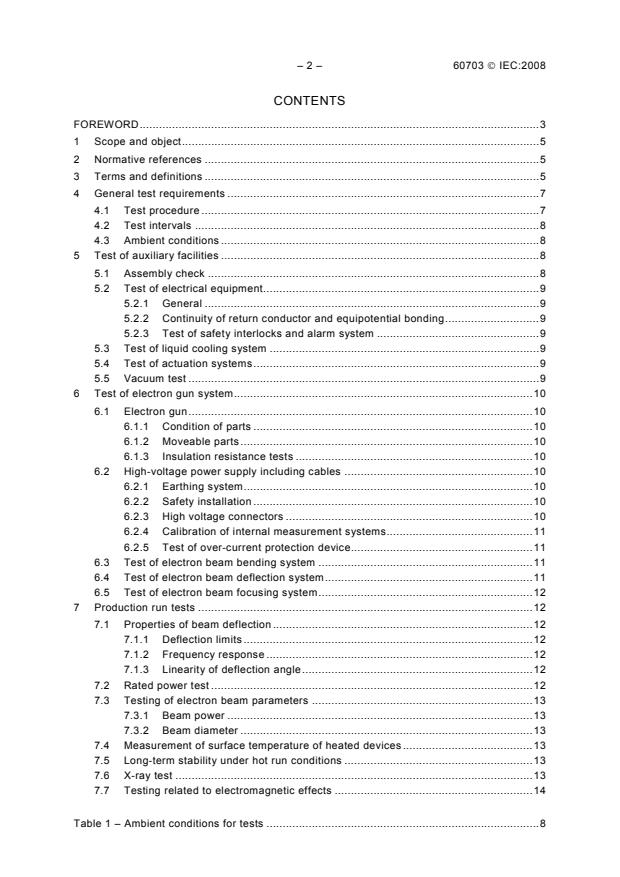
CONTENTS
FOREWORD.0H3
1 Scope and object.1H5
2 Normative references .2H5
3 Terms and definitions .3H5
4 General test requirements .4H7
4.1 Test procedure .5H7
4.2 Test intervals .6H8
4.3 Ambient conditions .7H8
5 Test of auxiliary facilities .8H8
5.1 Assembly check .9H8
5.2 Test of electrical equipment.10H9
5.2.1 General .11H9
5.2.2 Continuity of return conductor and equipotential bonding.12H9
5.2.3 Test of safety interlocks and alarm system .13H9
5.3 Test of liquid cooling system .14H9
5.4 Test of actuation systems.15H9
5.5 Vacuum test .16H9
6 Test of electron gun system.17H10
6.1 Electron gun.18H10
6.1.1 Condition of parts .19H10
6.1.2 Moveable parts.20H10
6.1.3 Insulation resistance tests .21H10
6.2 High-voltage power supply including cables .22H10
6.2.1 Earthing system.23H10
6.2.2 Safety installation .24H10
6.2.3 High voltage connectors .25H10
6.2.4 Calibration of internal measurement systems.26H11
6.2.5 Test of over-current protection device.27H11
6.3 Test of electron beam bending system .28H11
6.4 Test of electron beam deflection system.29H11
6.5 Test of electron beam focusing system.30H12
7 Production run tests .31H12
7.1 Properties of beam deflection .32H12
7.1.1 Deflection limits .33H12
7.1.2 Frequency response .34H12
7.1.3 Linearity of deflection angle.35H12
7.2 Rated power test .36H12
7.3 Testing of electron beam parameters .37H13
7.3.1 Beam power .38H13
7.3.2 Beam diameter .39H13
7.4 Measurement of surface temperature of heated devices .40H13
7.5 Long-term stability under hot run conditions .41H13
7.6 X-ray test .42H13
7.7 Testing related to electromagnetic effects .43H14
Table 1 – Ambient conditions for tests .44H8
60703 © IEC:2008 – 3 –
INTERNATIONAL ELECTROTECHNICAL COMMISSION
____________
TEST METHODS FOR ELECTROHEATING
INSTALLATIONS WITH ELECTRON GUNS
FOREWORD
1) The International Electrotechnical Commission (IEC) is a worldwide organization for standardization comprising
all national electrotechnical committees (IEC National Committees). The object of IEC is to promote
international co-operation on all questions concerning standardization in the electrical and electronic fields. To
this end and in addition to other activities, IEC publishes International Standards, Technical Specifications,
Technical Reports, Publicly Available Specifications (PAS) and Guides (hereafter referred to as “IEC
Publication(s)”). Their preparation is entrusted to technical committees; any IEC National Committee interested
in the subject dealt with may participate in this preparatory work. International, governmental and non-
governmental organizations liaising with the IEC also participate in this preparation. IEC collaborates closely
with the International Organization for Standardization (ISO) in accordance with conditions determined by
agreement between the two organizations.
2) The formal decisions or agreements of IEC on technical matters express, as nearly as possible, an international
consensus of opinion on the relevant subjects since each technical committee has representation from all
interested IEC National Committees.
3) IEC Publications have the form of recommendations for international use and are accepted by IEC National
Committees in that sense. While all reasonable efforts are made to ensure that the technical content of IEC
Publications is accurate, IEC cannot be held responsible for the way in which they are used or for any
misinterpretation by any end user.
4) In order to promote international uniformity, IEC National Committees undertake to apply IEC Publications
transparently to the maximum extent possible in their national and regional publications. Any divergence
between any IEC Publication and the corresponding national or regional publication shall be clearly indicated in
the latter.
5) IEC provides no marking procedure to indicate its approval and cannot be rendered responsible for any
equipment declared to be in conformity with an IEC Publication.
6) All users should ensure that they have the latest edition of this publication.
7) No liability shall attach to IEC or its directors, employees, servants or agents including individual experts and
members of its technical committees and IEC National Committees for any personal injury, property damage or
other damage of any nature whatsoever, whether direct or indirect, or for costs (including legal fees) and
expenses arising out of the publication, use of, or reliance upon, this IEC Publication or any other IEC
Publications.
8) Attention is drawn to the Normative references cited in this publication. Use of the referenced publications is
indispensable for the correct application of this publication.
9) Attention is drawn to the possibility that some of the elements of this IEC Publication may be the subject of
patent rights. IEC shall not be held responsible for identifying any or all such patent rights.
International Standard IEC 60703 has been prepared by IEC technical committee 27:
Industrial electroheating equipment.
This second edition cancels and replaces the first edition published in 1981 and constitutes a
technical revision.
The significant changes with respect to the previous edition are as follows:
– the latest edition of IEC 60519-7 has been taken into account;
– test requirements have been completed with new items important for testing and
acceptance of installations.
– 4 – 60703 © IEC:2008
The text of this standard is based on the following documents:
CDV Report on voting
27/628/CDV 27/648/RVC
Full information on the voting for the approval of this standard can be found in the report on
voting indicated in the above table.
This publication has been drafted in accordance with the ISO/IEC Directives, Part 2.
The committee has decided that the contents of this publication will remain unchanged until
the maintenance result date indicated on the IEC web site under "http://webstore.iec.ch" in
the data related to the specific publication. At this date, the publication will be
• reconfirmed,
• withdrawn,
• replaced by a revised edition, or
• amended.
60703 © IEC:2008 – 5 –
TEST METHODS FOR ELECTROHEATING
INSTALLATIONS WITH ELECTRON GUNS
1 Scope and object
This International Standard applies to electroheating installations comprising one or more
electron guns as heating source.
The object of this standard is the standardization of test methods to determine the essential
parameters, technical data and characteristics of electroheating installations comprising one
or more electron guns.
The standard does not contain a mandatory list of tests and is not restrictive. Tests may be
selected from the proposed list. The specification established by agreement between the user
and the manufacturer of electroheating installations can supplement these recommendations
but should not be in contradiction with them.
2 Normative references
The following referenced documents are indispensable for the application of this document.
For dated references, only the edition cited applies. For undated references, the latest edition
of the referenced document (including any amendments) applies.
IEC 60050-841:2004, International Electrotechnical Vocabulary (IEV) – Part 841: Industrial
electroheat
IEC 60204-1:2005, Safety of machinery – Electrical equipment of machines – Part 1: General
requirements
IEC 60204-11:2000, Safety of machinery – Electrical equipment of machines – Part 11:
Requirements for HV equipment for voltages above 1 000 V a.c. or 1 500 V d.c. and not
exceeding 36 kV
IEC 60398:1999, Industrial electroheating installations – General test methods
IEC 60519-1:2004, Safety in electroheat installations – Part 1: General requirements
0F, Safety in electroheat installations – Part 7: Particular requirements for
IEC 60519-7:2008
installations with electron guns
3 Terms and definitions
For the purposes of this document, the terms and definitions given in IEC 60050-841,
IEC 60519-7 (some of which are repeated here) and the following apply.
3.1
electron beam
electron flux emitted from one source (cathode or plasma) and moving along the exactly
determined tracks at very great velocities
[IEV 841-30-01, modified]
– 6 – 60703 © IEC:2008
3.2
electron (beam) gun
system of generating, forming and accelerating one or more electron beams
[IEV 841-30-08, modified]
3.3
anode (of an electron gun)
electrode capable of educing and accelerating electrons from the medium of lower
conductivity
[IEV 841-22-31, modified]
3.4
cathode (of an electron gun)
electrode capable of emitting electrons from the medium of low conductivity and also of
receiving positive carriers, if necessary
[IEV 841-22-32, modified]
3.5
beam accelerating voltage
potential difference between the cathode and the anode, to generate an electric field for
acceleration of the electrons
[IEV 841-30-29]
3.6
high-voltage power supply
source of the acceleration voltage and of the emission current for electron guns
3.7
return conductor
electrical interconnection between the high-voltage power supply (positive pole) and anodic
part of the electron gun system including the vacuum chamber around the workpiece
3.8
interlock
device that prevents activation of a piece of equipment when any form of hazard or danger
exists
3.9
vacuum chamber
enclosed space of a vacuum plant constructed in such a way that it can withstand a rarefied
atmosphere inside, in which the workpiece to be treated is placed
3.10
electron gun chamber
vacuum chamber in which the electron gun is located
NOTE This chamber may be separated from the workpiece by an aperture, so that between the electron gun and
the workpiece a pressure difference can be established.
3.11
electron beam deflection system
electromagnetic coil or deflecting electrodes system, applied to place the beam to different
working positions or move the beam over the charge heating surface
[IEV 841-30-25, modified]
60703 © IEC:2008 – 7 –
3.12
electron beam bending system
electromagnetic coil or permanent magnet for changing the direction of the electron beam
outside the electron gun
3.13
electron beam focusing system
electromagnetic coil, system of coils or capacitor plates for focusing the electron beam over
the charge heating surface
[IEV 841-30-27, modified]
3.14
beam pattern
image created by a cyclic time function of electron beam positions or a superposition of such
cycles
3.15
maximum deflection angle
angle between electron beam attitude without any deflection and at maximum activation in
one direction
3.16
deflection limits
limits of a defined area that may proceed with the electron beam without danger for the
equipment at reasonable power distribution
3.17
maximum deflection frequency
frequency, at which the amplitude of the deflected beam is reduced to one half in relation to a
static deflection caused by the dynamic performance of the complete deflection system
3.18
beam power
product of electron beam current and acceleration voltage
3.19
cathode current
electron current flowing from cathode
NOTE 1 The electron beam current arriving at the workpiece may either be lower than the cathode current, or up
to several orders of magnitude larger than the emission current if ion bombardment is also present.
NOTE 2 There is a difference between the possible emission current and the circulated current; cathode current is
limited by the space charge.
3.20
rated power (of an electron gun)
product of acceleration voltage and cathode current
4 General test requirements
4.1 Test procedure
The test procedure includes tests and measurements, which can be grouped as follows:
a) Tests of auxiliary facilities (Clause 5);
b) Tests of electron gun system (Clause 6);
c) Production run tests (Clause 7).
– 8 – 60703 © IEC:2008
The tests of group a) shall be finished before proceeding to the group b) tests. The test
procedure shall include all relevant tests of groups a) and b). Production run tests of group c)
are only recommendations, their necessity depends on the beam properties requested by the
application.
4.2 Test intervals
The test procedure shall be carried out immediately
• after the erection of the electron beam gun installation,
• after general repair work,
• after an accident caused by the electron beam gun installation,
• after substantial modifications of the installation.
The test procedure shall be repeated at least once a year. A shorter period may be
determined by the manufacturer or by the user of the installation.
After a repair of a single component the relevant test(s) is also required and may be limited to
functionalities directly influenced by this component.
4.3 Ambient conditions
The tests shall be carried out in the ambient conditions stated in Table 1, unless other
conditions are specified by the manufacturer.
Table 1 – Ambient conditions for tests
Normal 20
Minimum 15
Ambient temperature °C
Maximum 40
Relative humidity % Maximum 85
Altitude above sea level m Maximum 1 000
NOTE When the ambient conditions are beyond the values listed in this
table, the measured values shall be corrected in accordance with the relevant
rules.
The ambient temperature is considered as an average value. All quantities dependent on the
temperature shall refer to the ambient temperature of 20 °C, the so-called reference ambient
temperature.
5 Test of auxiliary facilities
5.1 Assembly check
Completeness and integrity of equipment of the electron gun installation shall be verified.
Particular attention shall be given to:
• safety appliances and danger signs,
• lock-out devices,
• X-ray shields including lead glass view ports.
60703 © IEC:2008 – 9 –
5.2 Test of electrical equipment
5.2.1 General
Basically, the test of electrical equipment including control system shall be carried out in
accordance with IEC 60204-1, IEC 60398 and IEC 60204-11. Special test procedures for the
electrical equipment for electroheat installations with electron guns are stated in the following
subclauses. Special tests for electron guns and the high-voltage supply are given in Clause 6.
5.2.2 Continuity of return conductor and equipotential bonding
The return conductor and equipotential bonding shall be visually inspected for compliance
with IEC 60519-1 and IEC 60519-7 and a check for tightness of the connections shall be
made.
The continuity of the protective bonding and the return conductor shall be verified by injecting
current of at least 10 A at 50 Hz or 60 Hz derived from an electrically separated extra low
voltage source for a period of at least 10 s. Deviating from IEC 60204-1, the measured
voltage drop shall not exceed 1,0 V in the case of return conductor and equipotential bonding
between process chamber, electron gun and the high-voltage supply.
5.2.3 Test of safety interlocks and alarm system
The test shall be performed in accordance with IEC 60398.
Special care should be given to the interlocks for the acceleration voltage and, if it exists, to
the automatic earthing system (see 45H6.2.1 and 46H6.2.2).
When testing interlocks, only the control circuits shall be live. The power circuits should be
only switched on for tests of monitoring circuits, which need these voltages.
5.3 Test of liquid cooling system
The test shall be carried out in accordance with IEC 60398. If some parts and electrical
devices cannot withstand 1,5 times the maximum pressure, for example double wall vacuum
chambers, turbo molecular pumps and heat exchangers in electrical cabinets, they shall be
bypassed or disconnected and individually tested according to manufacturer's instructions.
5.4 Test of actuation systems
The electron beam installation may be equipped with different actuation systems like
compressed air, hydraulics and electric motion systems. These systems shall be tested
according to the relevant standards and manufacturer's instructions. Particular attention shall
be given to:
• protective devices against overload and mechanical malfunction,
• means to safeguard personnel against dangerous movements.
5.5 Vacuum test
Measurement shall be carried out using an ionization vacuum gauge when the installation is
clean.
–2
A pressure of 10 Pa or lower shall be attained in the electron gun chamber, when the
cathode is cold. For this measurement, the vacuum chamber shall be separated from the gun
chamber, or if not possible, the vacuum chamber shall be cleaned and no workpiece shall be
placed inside the chamber.
– 10 – 60703 © IEC:2008
–2
After heating up, the cathode shall be degassed for 30 min, then a pressure of 5 × 10 Pa or
lower shall be attained.
The required pressure for the vacuum chamber depends on the process and the kind of
separation between a gun chamber and vacuum chamber. In any case, the pressure inside
–2
the gun chamber shall be below the level of 5 × 10 Pa also in the case of maximum
specified process pressure inside the vacuum chamber.
6 Test of electron gun system
6.1 Electron gun
6.1.1 Condition of parts
The individual parts of the electron gun shall be checked regarding cleanness, tightness and
adjustment according to the manufacturer's maintenance instruction. Particular care should be
given to the cathode system.
6.1.2 Moveable parts
If the electron gun has any moveable parts, like for example a vario cathode or vario anode,
the movement shall be checked regarding smooth running, limits and accuracy of positioning.
6.1.3 Insulation resistance tests
The insulation resistance between high voltage conductors and ground shall be measured
according to Clause 19 of IEC 60204-11 (2000).
6.2 High-voltage power supply including cables
6.2.1 Earthing system
6.2.1.1 Test of earthing stick
All parts of the earthing stick, the earthing cable as well as the connections to ground and to
the hooks shall be carefully inspected. Damaged parts shall be replaced, immediately.
6.2.1.2 Test of automatic earthing systems
Connection wires, contacts and control devices shall be checked visually.
Beside the test of reliable operation of each earthing device, it is also necessary to check the
monitoring circuits for earth connection. For this purpose, a piece of paper is put between the
contacts. The simulation of this failure may only be done as long as power circuits are
switched off in a safe way.
6.2.2 Safety installation
Beside the test of reliable operation of each safety device and the right assignment, it is also
necessary to check whether the monitoring circuits for redundant elements can detect a single
failure. The simulation of such a failure may only be done as long as power circuits are
switched off in a safe way.
6.2.3 High voltage connectors
The insulation resistance between high voltage conductors and ground shall be measured
according to Clause 19 of IEC 60204-11 (2000). Connections to ground or other potentials
shall be temporarily disconnected for the measurement.
60703 © IEC:2008 – 11 –
The cleanness of connectors and the right assignment of the high voltage cables to the
connectors at high voltage supply and electron gun shall be carefully checked.
6.2.4 Calibration of internal measurement systems
The measurement of acceleration voltage and return current shall be calibrated periodically.
The reference measuring instruments shall have an accuracy of at least class 0,5. The same
accuracy is necessary for voltage divider and shunts, if they are used for the calibration.
In the case that the power is calculated by means of an analogue multiplier, this device shall
be calibrated, too.
NOTE In most cases, it is not possible for the high voltage supply to measure the real beam current. The return
current may be used as an equivalent.
6.2.5 Test of over-current protection device
6.2.5.1 Testing with a short circuit
The current drawn from the high-voltage power supply shall be increased to a level higher
than its rated value, and the over-current control device shall operate at the specified current.
The preferred method of performing this test is to apply a short circuit to the output terminals
of the high-voltage supply taking suitable precautions to avoid damage to equipment and
hazard to personnel.
6.2.5.2 Test of the normal functioning of the over-current protection device
Before rated power tests may be carried out, the normal functioning of the over-current
protection device shall be first tested by increasing the emission current above its rated value,
in accordance with the manufacturer’s specification.
6.3 Test of electron beam bending system
The performance of a bending system may be checked with the help of a reference beam
pattern. This pattern is created during the first installation corresponding to fix points inside
the chamber, at the crucible or the work piece support, respectively. The stored reference
beam pattern shall be applied on a regular basis under similar conditions (acceleration
voltage, beam power, bending current) to check the stability of the bending system.
Alternatively, the magnetic field can be measured at several defined points (for example at a
virtual grid in the plane of the bended gun axis). If the magnetic field is generated by an
electromagnetic coil, the magnetic field shall be recorded as well as the corresponding current
through the coil.
6.4 Test of electron beam deflection system
Before using the electron gun in production, the following properties of the deflection system
shall be checked:
• the condition of cables, connectors and amplifiers (visual check),
• coil resistance or inductance and insulation resistance (see 47H6.5),
• the right assignment of deflection directions,
• the correlation between deflection angle and coil current,
• the functioning of the amplifiers and
• the functioning of electron beam interlock in case of deflection system faults.
The parameters of the beam deflection shall be tested under hot run conditions (see 48H7.1).
– 12 – 60703 © IEC:2008
6.5 Test of electron beam focusing system
The test of the focusing system includes:
• a visual check of cables, connectors and amplifiers,
• the measurement of coil resistance or coil inductance,
• the insulation resistance measurement from coils to ground and to the coils of the
deflection system and
• checking the functioning of the amplifiers.
The insulation resistance shall have a value higher than 100 kΩ. It shall be measured at
extra-low voltage only.
7 Production run tests
7.1 Properties of beam deflection
7.1.1 Deflection limits
The deflection system should have the possibility to define limits, which restrict a processing
area for the beam. Before the electron beam is made visible with an adequate pattern at a
sample, preliminary limits are set to start the test with a small processing area. After checking
the effectiveness of the limits for the beam deflection, the processing area may be enlarged
step by step.
7.1.2 Frequency response
For detection of the maximum deflection frequency, the beam pattern is made visible by
bombarding a sample with the electron beam. In the case of deflection in two directions, a
circle should be the preferred pattern. Starting with a low deflection value (lower than one
tenth of the expected maximum), the frequency is being increased till the pattern is reduced to
half of its size. The test pattern size shall be 10 % of the maximum deflection angle, unless
other conditions are specified by the manufacturer.
7.1.3 Linearity of deflection angle
A beam pattern is made visible by bombarding a sample with the electron beam. In the case
of deflection in two directions, a circle should be the preferred pattern. The pattern is drawn
with a frequency much lower than the maximum deflection frequency. The amplitude is
increased in 5 to 10 equal steps from 10 % to 100 % of the maximum deflection angle.
In case that the equipment does not allow to operate the gun with its maximum deflection
angle, the test is determined by the deflection limits.
7.2 Rated power test
The rated power is defined as the product of the cathode current and the acceleration voltage.
The cathode current is measured as return current at the cold end of the acceleration voltage
supply.
To reduce risks for service personnel, the internal measurement devices of high-voltage
supply can be used for identification of rated power, after calibration according to 49H6.2.4.
60703 © IEC:2008 – 13 –
7.3 Testing of electron beam parameters
7.3.1 Beam power
A workpiece or collector is installed, electrically insulated inside the vacuum chamber and
connected via a shunt with low resistance to the return conductor. The beam current is given
by the resistance of the shunt and the measured voltage drop over the shunt. The beam
power is the product of this current and the acceleration voltage.
NOTE A damaged shunt can cause dangerous voltages at the measurement connection to the workpiece.
7.3.2 Beam diameter
7.3.2.1 Collector with slit
The beam is scanned via a collector with a slit. The period is measured, when the current
flowing via the collector is less than 10 % of the beam current. Drawing a circle on a collector
with radial arranged slits allows the measurement of the beam dimension in several directions.
7.3.2.2 Drilling test
A hole is drilled by the beam into a sample located next to the workpiece. It shall be ensured
that heat from the workpiece does not influence the size of the hole.
The shape of the spot should be visually inspected in order to detect the focusing symmetry.
NOTE The beam diameter is also influenced by the beam current and vacuum conditions.
7.4 Measurement of surface temperature of heated devices
The temperature measurement shall be done by a thermocouple, resistance thermometer or
pyrometer according to IEC 60398.
7.5 Long-term stability under hot run conditions
The installation with electron gun is operated under nominal conditions.
Voltages and currents for supply of the cathode system and the gun shall attain stable values
according to the specifications after at the latest 30 min.
After 8 h run, it shall be checked whether heat or radiation cause changes or destructions at
components of the installation. Special care shall be given to:
• the condition of cathode system,
• the mobility of moveable parts,
• vacuum and water seals,
• the condition of crucibles, supports, shielding and similar equipment.
7.6 X-ray test
The test shall be carried out in accordance with national requirements.
The X-ray emission test shall be carried out after any replacement of X-ray shielding of
relevant parts of the gun chamber and vacuum chamber.
– 14 – 60703 © IEC:2008
7.7 Testing related to electromagnetic effects
The measurements connected with EMC issues and influence of electromagnetic fields on
people according to 6.4 of IEC 60519-1 (2003) apply.
___________
– 16 – 60703 © CEI:2008
SOMMAIRE
AVANT-PROPOS.1H17
1 Domaine d'application et objet.2H19
2 Références normatives.3H19
3 Termes et définitions .4H19
4 Exigences générales pour les essais .5H22
4.1 Méthode d'essai .6H22
4.2 Périodicité des essais.7H22
4.3 Conditions ambiantes .8H22
5 Essai des appareils auxiliaires.9H23
5.1 Vérification d'ensemble .10H23
5.2 Essai de l’équipement électrique .11H23
5.2.1 Généralités.12H23
5.2.2 Continuité du conducteur de retour et liaison équipotentielle .13H23
5.2.3 Essai des verrouillages de sécurité et du système d'alarme.14H23
5.3 Essai du système de refroidissement par liquide .15H23
5.4 Essai des systèmes de manœuvre .16H23
5.5 Essai sous vide .17H24
6 Essai du système à canon à électrons.18H24
6.1 Canon à électrons .19H24
6.1.1 Parties individuelles .20H24
6.1.2 Parties mobiles.21H24
6.1.3 Essais de résistance d'isolement .22H24
6.2 Alimentation à haute tension y compris les câbles.23H24
6.2.1 Système de mise à la terre .24H24
6.2.2 Installation de sécurité.25H25
6.2.3 Connecteurs à haute tension .26H25
6.2.4 Calibration des systèmes de mesures internes .27H25
6.2.5 Essai du dispositif de protection contre les surintensités .28H25
6.3 Essai du système de cintrage du faisceau électronique .29H25
6.4 Essai du système de déflexion du faisceau électronique .30H26
6.5 Essai du système de mise au point du faisceau électronique.31H26
7 Essais de campagne de production .32H26
7.1 Propriétés de déflexion du faisceau.33H26
7.1.1 limites de déflexion.34H26
7.1.2 Réponse en fréquence.35H26
7.1.3 Linéarité de l'angle de déflexion .36H27
7.2 Essai à la puissance assignée.37H27
7.3 Essai des paramètres du faisceau électronique .38H27
7.3.1 Puissance du faisceau.39H27
7.3.2 Diamètre du faisceau.40H27
7.4 Mesure de la température de surface des dispositifs chauffés .41H27
7.5 Stabilité à long terme en conditions de campagne de production.42H28
7.6 Essai aux rayons X.43H28
7.7 Essai relatif aux effets électromagnétiques.44H28
Tableau 1 – Conditions ambiantes pour les essais.45H22
60703 © CEI:2008 – 17 –
COMMISSION ÉLECTROTECHNIQUE INTERNATIONALE
____________
MÉTHODES D'ESSAI DES INSTALLATIONS ÉLECTROTHERMIQUES
COMPORTANT DES CANONS À ÉLECTRONS
AVANT-PROPOS
1) La Commission Electrotechnique Internationale (CEI) est une organisation mondiale de normalisation
composée de l'ensemble des comités électrotechniques nationaux (Comités nationaux de la CEI). La CEI a
pour objet de favoriser la coopération internationale pour toutes les questions de normalisation dans les
domaines de l'électricité et de l'électronique. A cet effet, la CEI – entre autres activités – publie des Normes
internationales, des Spécifications techniques, des Rapports techniques, des Spécifications accessibles au
public (PAS) et des Guides (ci-après dénommés "Publication(s) de la CEI"). Leur élaboration est confiée à des
comités d'études, aux travaux desquels tout Comité national intéressé par le sujet traité peut participer. Les
organisations internationales, gouvernementales et non gouvernementales, en liaison avec la CEI, participent
également aux travaux. La CEI collabore étroitement avec l'Organisation Internationale de Normalisation (ISO),
selon des conditions fixées par accord entre les deux organisations.
2) Les décisions ou accords officiels de la CEI concernant les questions techniques représentent, dans la mesure
du possible, un accord international sur les sujets étudiés, étant donné que les Comités nationaux de la CEI
intéressés sont représentés dans chaque comité d’études.
3) Les Publications de la CEI se présentent sous la forme de recommandations internationales et sont agréées
comme telles par les Comités nationaux de la CEI. Tous les efforts raisonnables sont entrepris afin que la CEI
s'assure de l'exactitude du contenu technique de ses publications; la CEI ne peut pas être tenue responsable
de l'éventuelle mauvaise utilisation ou interprétation qui en est faite par un quelconque utilisateur final.
4) Dans le but d'encourager l'uniformité internationale, les Comités nationaux de la CEI s'engagent, dans toute la
mesure possible, à appliquer de façon transparente les Publications de la CEI dans leurs publications
nationales et régionales. Toutes divergences entre toutes Publications de la CEI et toutes publications
nationales ou régionales correspondantes doivent être indiquées en termes clairs dans ces dernières.
5) La CEI n’a prévu aucune procédure de marquage valant indication d’approbation et n'engage pas sa
responsabilité pour les équipements déclarés conformes à une de ses Publications.
6) Tous les utilisateurs doivent s'assurer qu'ils sont en possession de la dernière édition de cet
...