

IEC 61195:1999
(Main)Double-capped fluorescent lamps - Safety specifications
General Information
- Abstract
Specifies the safety requirements for double-capped fluorescent lamps for general lighting purposes of all groups having Fa6, Fa8, G5, G13 and R17d caps. Also specifies the method a manufacturer should use to show compliance with the requirements of this standard. The contents of the corrigendum of August 2000 have been included in this copy.
- Status
- Published
- Publication Date
- 18-Sep-2014
- Technical Committee
- SC 34A - Electric light sources
- Drafting Committee
- WG 6 - TC 34/SC 34A/WG 6
- Current Stage
- PPUB - Publication issued
- Start Date
- 29-Oct-1999
- Completion Date
- 15-Dec-1999
Buy Documents
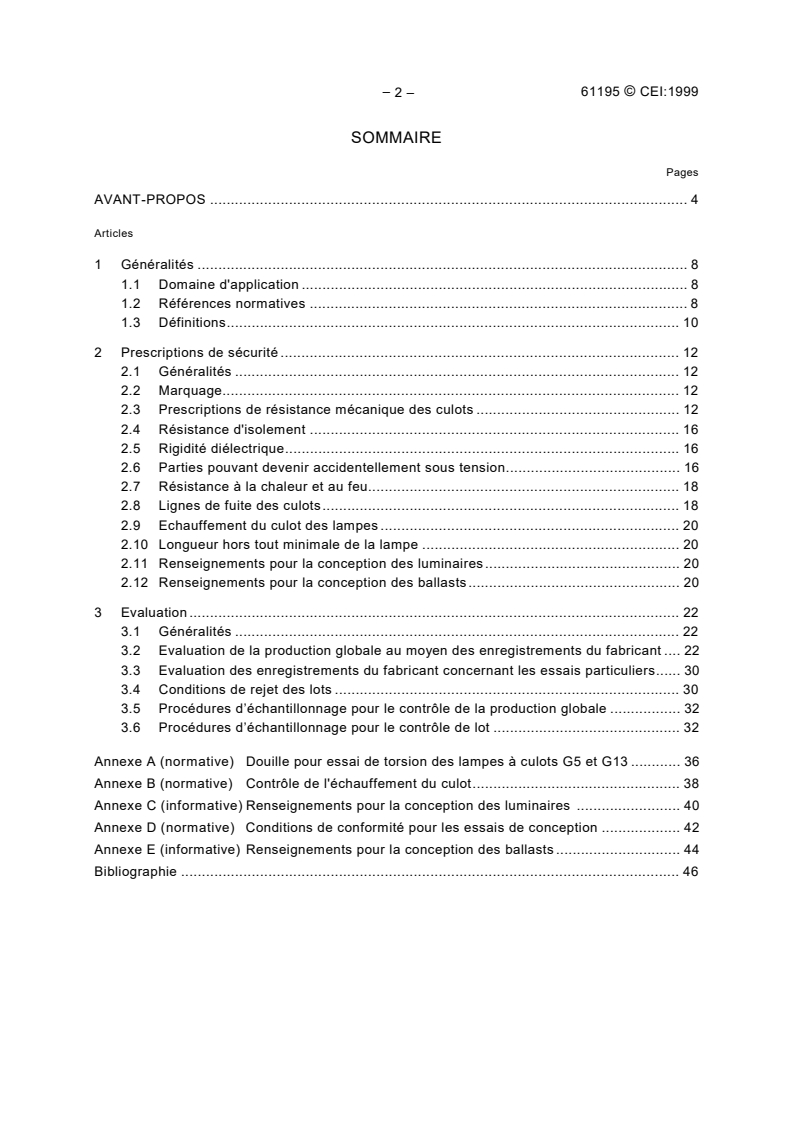
IEC 61195:1999 - Double-capped fluorescent lamps - Safety specifications Released:10/29/1999

IEC 61195:1999+AMD1:2012+AMD2:2014 CSV - Double-capped fluorescent lamps - Safety specifications Released:9/19/2014
IEC 61195:1999+AMD1:2012 CSV - Double-capped fluorescent lamps - Safety specifications Released:10/14/2012
Overview
IEC 61195:1999 – Double-capped Fluorescent Lamps – Safety Specifications sets forth essential safety requirements for double-capped fluorescent lamps intended for general lighting applications. Published by the International Electrotechnical Commission (IEC), this standard applies to all groups of fluorescent lamps with Fa6, Fa8, G5, G13, and R17d caps. It also details the manufacturer's obligations for demonstrating compliance, including production appraisal methods and assessment procedures for both whole production and batch testing. The 2014 consolidated edition integrates all amendments and corrigenda, ensuring international uniformity and robust safety criteria for double-capped fluorescent lamps.
Key Topics
- Scope of Application: Covers double-capped, low-pressure mercury discharge lamps with specified cap types, focusing on their safety in general lighting environments.
- Safety Requirements: Includes mechanical strength, marking durability, insulation resistance, electric strength, resistance to heat and fire, creepage distances, and limits on UV radiation emission.
- Testing and Compliance: Describes methods for compliance assessment through manufacturer’s records, periodic and design testing, and detailed batch testing procedures.
- Marking and Traceability: Requires clear, durable marking of either the lamp wattage or an equivalent identifier and the manufacturer’s origin to ensure product traceability.
- Ultraviolet and Photobiological Safety: Aligns with IEC 62471, factoring in blue light and infrared risk assessment, and stipulates maximum permissible UV emission for safe human exposure.
- Document Structure: The standard includes annexes with specific test methods and guidance for luminaire and ballast design, supporting compliance and interoperability.
Applications
IEC 61195 is vital for:
- Manufacturers: Ensuring that double-capped fluorescent lamps meet global safety benchmarks. The standard guides production line checks, quality control, and conformity declarations, supporting access to international markets.
- Certification Bodies: Reference for conformity assessment, quality audits, and product certification, enhancing product trust and regulatory acceptance.
- Lighting Engineers & Designers: Providing reliable specifications for lamp integration into luminaires and lighting systems, ensuring compatibility and minimizing safety risks.
- Test Laboratories: Outlining standardized test protocols for mechanical, electrical, and thermal lamp properties, enabling consistent verification and benchmarking.
- Regulatory Compliance: Serving as a foundation for safety regulations concerning the use, handling, and installation of fluorescent lamps in public and private spaces.
Related Standards
For comprehensive lamp safety and performance, IEC 61195 is frequently used alongside:
- IEC 60081: Double-capped fluorescent lamps – Performance specifications; for characteristics like luminous flux, color, and operation.
- IEC 62471: Photobiological safety of lamps and lamp systems; for assessing hazards related to UV and blue light exposure.
- IEC 60061 Series: Lamp caps and holders’ standards; ensures proper fitting, interchangeability, and safety of lamp caps and holders.
- IEC 60695-2-1/0: Glow-wire test methods; for evaluating fire resistance of lamp components.
- IEC 60921: Ballasts for tubular fluorescent lamps – Performance requirements; important for compatible operation with luminaires.
- IEC 60410: Sampling plans and procedures; referenced for quality assurance and inspection by attributes.
IEC 61195:1999 is a cornerstone safety standard supporting the global lighting industry in delivering reliable, safe, and compliant double-capped fluorescent lamps. Adhering to its requirements helps manufacturers, regulators, and users ensure safer lighting environments in homes, workplaces, and public areas worldwide.
Relations
- Amended By
IEC 61195:1999/AMD2:2014 - Amendment 2 - Double-capped fluorescent lamps - Safety specifications - Effective Date
- 05-Sep-2023
- Amended By
IEC 61195:1999/AMD1:2012 - Amendment 1 - Double-capped fluorescent lamps - Safety specifications - Effective Date
- 05-Sep-2023
- Corrected By
IEC 61195:1999/COR1:2000 - Corrigendum 1 - Double-capped fluorescent lamps - Safety specifications - Effective Date
- 05-Sep-2023
- Effective Date
- 05-Sep-2023
- Revises
IEC 61195:1993/AMD1:1998 - Amendment 1 - Double-capped fluorescent lamps - Safety specifications - Effective Date
- 05-Sep-2023
Buy Documents
IEC 61195:1999 - Double-capped fluorescent lamps - Safety specifications Released:10/29/1999
IEC 61195:1999+AMD1:2012+AMD2:2014 CSV - Double-capped fluorescent lamps - Safety specifications Released:9/19/2014
IEC 61195:1999+AMD1:2012 CSV - Double-capped fluorescent lamps - Safety specifications Released:10/14/2012
Get Certified
Connect with accredited certification bodies for this standard

IMQ S.p.A. (Certification)
Italian electrical product certification.

SLG Prüf- und Zertifizierungs GmbH
German testing and certification body.

UL Solutions
Global safety science company with testing, inspection and certification.
Sponsored listings
Frequently Asked Questions
IEC 61195:1999 is a standard published by the International Electrotechnical Commission (IEC). Its full title is "Double-capped fluorescent lamps - Safety specifications". This standard covers: Specifies the safety requirements for double-capped fluorescent lamps for general lighting purposes of all groups having Fa6, Fa8, G5, G13 and R17d caps. Also specifies the method a manufacturer should use to show compliance with the requirements of this standard. The contents of the corrigendum of August 2000 have been included in this copy.
Specifies the safety requirements for double-capped fluorescent lamps for general lighting purposes of all groups having Fa6, Fa8, G5, G13 and R17d caps. Also specifies the method a manufacturer should use to show compliance with the requirements of this standard. The contents of the corrigendum of August 2000 have been included in this copy.
IEC 61195:1999 is classified under the following ICS (International Classification for Standards) categories: 29.140.30 - Fluorescent lamps. Discharge lamps. The ICS classification helps identify the subject area and facilitates finding related standards.
IEC 61195:1999 has the following relationships with other standards: It is inter standard links to IEC 61195:1999/AMD2:2014, IEC 61195:1999/AMD1:2012, IEC 61195:1999/COR1:2000, IEC 61195:1993, IEC 61195:1993/AMD1:1998. Understanding these relationships helps ensure you are using the most current and applicable version of the standard.
IEC 61195:1999 is available in PDF format for immediate download after purchase. The document can be added to your cart and obtained through the secure checkout process. Digital delivery ensures instant access to the complete standard document.
Standards Content (Sample)
NORME CEI
INTERNATIONALE IEC
INTERNATIONAL
Deuxième édition
STANDARD
Second edition
1999-10
Lampes à fluorescence à deux culots –
Prescriptions de sécurité
Double-capped fluorescent lamps –
Safety specifications
Numéro de référence
Reference number
CEI/IEC 61195:1999
Numéros des publications Numbering
Depuis le 1er janvier 1997, les publications de la CEI As from 1 January 1997 all IEC publications are
sont numérotées à partir de 60000. issued with a designation in the 60000 series.
Publications consolidées Consolidated publications
Les versions consolidées de certaines publications de Consolidated versions of some IEC publications
la CEI incorporant les amendements sont disponibles. including amendments are available. For example,
Par exemple, les numéros d’édition 1.0, 1.1 et 1.2 edition numbers 1.0, 1.1 and 1.2 refer, respectively, to
indiquent respectivement la publication de base, la the base publication, the base publication incor-
publication de base incorporant l’amendement 1, et la porating amendment 1 and the base publication
publication de base incorporant les amendements 1 incorporating amendments 1 and 2.
et 2.
Validité de la présente publication Validity of this publication
Le contenu technique des publications de la CEI est The technical content of IEC publications is kept
constamment revu par la CEI afin qu'il reflète l'état under constant review by the IEC, thus ensuring that
actuel de la technique. the content reflects current technology.
Des renseignements relatifs à la date de reconfir- Information relating to the date of the reconfirmation
mation de la publication sont disponibles dans le of the publication is available in the IEC catalogue.
Catalogue de la CEI.
Les renseignements relatifs à des questions à l’étude et Information on the subjects under consideration and
des travaux en cours entrepris par le comité technique work in progress undertaken by the technical
qui a établi cette publication, ainsi que la liste des committee which has prepared this publication, as well
publications établies, se trouvent dans les documents ci- as the list of publications issued, is to be found at the
dessous: following IEC sources:
• «Site web» de la CEI* • IEC web site*
• Catalogue des publications de la CEI • Catalogue of IEC publications
Publié annuellement et mis à jour Published yearly with regular updates
régulièrement (On-line catalogue)*
(Catalogue en ligne)*
• IEC Bulletin
• Bulletin de la CEI Available both at the IEC web site* and
Disponible à la fois au «site web» de la CEI* as a printed periodical
et comme périodique imprimé
Terminology, graphical and letter
Terminologie, symboles graphiques
symbols
et littéraux
For general terminology, readers are referred to
En ce qui concerne la terminologie générale, le lecteur IEC 60050: International Electrotechnical Vocabulary
se reportera à la CEI 60050: Vocabulaire Electro- (IEV).
technique International (VEI).
For graphical symbols, and letter symbols and signs
Pour les symboles graphiques, les symboles littéraux approved by the IEC for general use, readers are
et les signes d'usage général approuvés par la CEI, le referred to publications IEC 60027: Letter symbols to
lecteur consultera la CEI 60027: Symboles littéraux à be used in electrical technology, IEC 60417: Graphical
utiliser en électrotechnique, la CEI 60417: Symboles symbols for use on equipment. Index, survey and
graphiques utilisables sur le matériel. Index, relevé et compilation of the single sheets and IEC 60617:
compilation des feuilles individuelles, et la CEI 60617: Graphical symbols for diagrams.
Symboles graphiques pour schémas.
* See web site address on title page.
* Voir adresse «site web» sur la page de titre.
NORME CEI
INTERNATIONALE IEC
INTERNATIONAL
Deuxième édition
STANDARD
Second edition
1999-10
Lampes à fluorescence à deux culots –
Prescriptions de sécurité
Double-capped fluorescent lamps –
Safety specifications
IEC 1999 Droits de reproduction réservés Copyright - all rights reserved
Aucune partie de cette publication ne peut être reproduite ni No part of this publication may be reproduced or utilized in
utilisée sous quelque forme que ce soit et par aucun procédé, any form or by any means, electronic or mechanical,
électronique ou mécanique, y compris la photo-copie et les including photocopying and microfilm, without permission in
microfilms, sans l'accord écrit de l'éditeur. writing from the publisher.
International Electrotechnical Commission 3, rue de Varembé Geneva, Switzerland
Telefax: +41 22 919 0300 e-mail: inmail@iec.ch IEC web site http://www.iec.ch
CODE PRIX
Commission Electrotechnique Internationale
T
PRICE CODE
International Electrotechnical Commission
Pour prix, voir catalogue en vigueur
For price, see current catalogue
– 2 – 61195 © CEI:1999
SOMMAIRE
Pages
AVANT-PROPOS . 4
Articles
1 Généralités . 8
1.1 Domaine d'application . 8
1.2 Références normatives . 8
1.3 Définitions. 10
2 Prescriptions de sécurité . 12
2.1 Généralités . 12
2.2 Marquage. 12
2.3 Prescriptions de résistance mécanique des culots . 12
2.4 Résistance d'isolement . 16
2.5 Rigidité diélectrique. 16
2.6 Parties pouvant devenir accidentellement sous tension. 16
2.7 Résistance à la chaleur et au feu. 18
2.8 Lignes de fuite des culots. 18
2.9 Echauffement du culot des lampes . 20
2.10 Longueur hors tout minimale de la lampe . 20
2.11 Renseignements pour la conception des luminaires. 20
2.12 Renseignements pour la conception des ballasts. 20
3 Evaluation . 22
3.1 Généralités . 22
3.2 Evaluation de la production globale au moyen des enregistrements du fabricant . 22
3.3 Evaluation des enregistrements du fabricant concernant les essais particuliers. 30
3.4 Conditions de rejet des lots . 30
3.5 Procédures d’échantillonnage pour le contrôle de la production globale . 32
3.6 Procédures d’échantillonnage pour le contrôle de lot . 32
Annexe A (normative) Douille pour essai de torsion des lampes à culots G5 et G13 . 36
Annexe B (normative) Contrôle de l'échauffement du culot. 38
Annexe C (informative) Renseignements pour la conception des luminaires . 40
Annexe D (normative) Conditions de conformité pour les essais de conception . 42
Annexe E (informative) Renseignements pour la conception des ballasts . 44
Bibliographie . 46
61195 © IEC:1999 – 3 –
CONTENTS
Page
FOREWORD . 5
Clause
1 General. 9
1.1 Scope . 9
1.2 Normative references. 9
1.3 Definitions. 11
2 Safety requirements . 13
2.1 General. 13
2.2 Marking. 13
2.3 Mechanical requirements for caps . 13
2.4 Insulation resistance . 17
2.5 Electric strength . 17
2.6 Parts which can become accidentally live . 17
2.7 Resistance to heat and fire. 19
2.8 Creepage distance for caps. 19
2.9 Lamp cap temperature rise. 21
2.10 Lamp minimum overall length. 21
2.11 Information for luminaire design . 21
2.12 Information for ballast design . 21
3 Assessment . 23
3.1 General. 23
3.2 Whole production assessment by means of the manufacturer’s records . 23
3.3 Assessment of the manufacturer’s records of particular tests. 31
3.4 Rejection conditions of batches . 31
3.5 Sampling procedures for whole production testing . 33
3.6 Sampling procedures for batch testing. 33
Annex A (normative) Test holder for torsion test for G5 and G13 capped lamps. 37
Annex B (normative) Test for lamp cap temperature rise . 39
Annex C (informative) Information for luminaire design. 41
Annex D (normative) Conditions of compliance for design tests . 43
Annex E (informative) Information for ballast design. 45
Bibliography . 47
– 4 – 61195 © CEI:1999
COMMISSION ÉLECTROTECHNIQUE INTERNATIONALE
____________
LAMPES À FLUORESCENCE À DEUX CULOTS –
PRESCRIPTIONS DE SÉCURITÉ
AVANT-PROPOS
1) La CEI (Commission Électrotechnique Internationale) est une organisation mondiale de normalisation composée
de l'ensemble des comités électrotechniques nationaux (Comités nationaux de la CEI). La CEI a pour objet de
favoriser la coopération internationale pour toutes les questions de normalisation dans les domaines de
l'électricité et de l'électronique. A cet effet, la CEI, entre autres activités, publie des Normes internationales.
Leur élaboration est confiée à des comités d'études, aux travaux desquels tout Comité national intéressé par le
sujet traité peut participer. Les organisations internationales, gouvernementales et non gouvernementales, en
liaison avec la CEI, participent également aux travaux. La CEI collabore étroitement avec l'Organisation
Internationale de Normalisation (ISO), selon des conditions fixées par accord entre les deux organisations.
2) Les décisions ou accords officiels de la CEI concernant les questions techniques représentent, dans la mesure
du possible, un accord international sur les sujets étudiés, étant donné que les Comités nationaux intéressés
sont représentés dans chaque comité d’études.
3) Les documents produits se présentent sous la forme de recommandations internationales. Ils sont publiés
comme normes, spécifications techniques, rapports techniques ou guides et agréés comme tels par les Comités
nationaux.
4) Dans le but d'encourager l'unification internationale, les Comités nationaux de la CEI s'engagent à appliquer de
façon transparente, dans toute la mesure possible, les Normes internationales de la CEI dans leurs normes
nationales et régionales. Toute divergence entre la norme de la CEI et la norme nationale ou régionale
correspondante doit être indiquée en termes clairs dans cette dernière.
5) La CEI n’a fixé aucune procédure concernant le marquage comme indication d’approbation et sa responsabilité
n’est pas engagée quand un matériel est déclaré conforme à l’une de ses normes.
6) L’attention est attirée sur le fait que certains des éléments de la présente Norme internationale peuvent faire
l’objet de droits de propriété intellectuelle ou de droits analogues. La CEI ne saurait être tenue pour
responsable de ne pas avoir identifié de tels droits de propriété et de ne pas avoir signalé leur existence.
La Norme internationale CEI 61195 a été établie par le sous-comité 34A: Lampes, du comité
d'études 34 de la CEI: Lampes et équipements associés.
Cette deuxième édition annule et remplace la première édition, parue en 1993, et son
amendement 1 (1998) dont elle constitue une révision technique.
Le texte de cette norme est issu des documents suivants:
FDIS Rapport de vote
34A/886/FDIS 34A/900/RVD
Le rapport de vote indiqué dans le tableau ci-dessus donne toute information sur le vote ayant
abouti à l'approbation de cette norme.
Cette publication a été rédigée selon les Directives ISO/CEI, Partie 3.
Les annexes A, B et D font partie intégrante de cette norme.
Les annexes C et E sont données uniquement à titre d'information.
Le contenu du corrigendum d'août 2000 a été pris en considération dans cet exemplaire.
61195 © IEC:1999 – 5 –
INTERNATIONAL ELECTROTECHNICAL COMMISSION
____________
DOUBLE-CAPPED FLUORESCENT LAMPS –
SAFETY SPECIFICATIONS
FOREWORD
1) The IEC (International Electrotechnical Commission) is a worldwide organization for standardization comprising
all national electrotechnical committees (IEC National Committees). The object of the IEC is to promote
international co-operation on all questions concerning standardization in the electrical and electronic fields. To
this end and in addition to other activities, the IEC publishes International Standards. Their preparation is
entrusted to technical committees; any IEC National Committee interested in the subject dealt with may
participate in this preparatory work. International, governmental and non-governmental organizations liaising
with the IEC also participate in this preparation. The IEC collaborates closely with the International Organization
for Standardization (ISO) in accordance with conditions determined by agreement between the two
organizations.
2) The formal decisions or agreements of the IEC on technical matters express, as nearly as possible, an
international consensus of opinion on the relevant subjects since each technical committee has representation
from all interested National Committees.
3) The documents produced have the form of recommendations for international use and are published in the form
of standards, technical specifications, technical reports or guides and they are accepted by the National
Committees in that sense.
4) In order to promote international unification, IEC National Committees undertake to apply IEC International
Standards transparently to the maximum extent possible in their national and regional standards. Any
divergence between the IEC Standard and the corresponding national or regional standard shall be clearly
indicated in the latter.
5) The IEC provides no marking procedure to indicate its approval and cannot be rendered responsible for any
equipment declared to be in conformity with one of its standards.
6) Attention is drawn to the possibility that some of the elements of this International Standard may be the subject
of patent rights. The IEC shall not be held responsible for identifying any or all such patent rights.
International Standard IEC 61195 has been prepared by sub-committee 34A: Lamps, of IEC
technical committee 34: Lamps and related equipment.
This second edition cancels and replaces the first edition published in 1993 and its
amendment 1 (1998). It constitutes a technical revision.
The text of this standard is based on the following documents:
FDIS Report on voting
34A/886/FDIS 34A/900/RVD
Full information on the voting for the approval of this standard can be found in the report on
voting indicated in the above table.
This publication has been drafted in accordance with the ISO/IEC Directives, Part 3.
Annexes A, B and D form an integral part of this standard.
Annexes C and E are for information only.
The contents of the corrigendum of August 2000 have been included in this copy.
– 6 – 61195 © CEI:1999
Le comité à décidé que cette publication reste valable jusqu’en 2003-09.
A cette date, selon décision préalable du comité, la publication sera
• reconduite;
•
supprimée;
•
remplacée par une édition révisée, ou
• amendée.
61195 © IEC:1999 – 7 –
The committee has decided that this publication remains valid until 2003-09.
At this date, in accordance with the committee’s decision, the publication will be
• reconfirmed;
•
withdrawn;
•
replaced by a revised edition, or
• amended.
– 8 – 61195 © CEI:1999
LAMPES À FLUORESCENCE À DEUX CULOTS –
PRESCRIPTIONS DE SÉCURITÉ
1 Généralités
1.1 Domaine d'application
La présente Norme internationale spécifie les prescriptions de sécurité auxquelles doivent
répondre les lampes à fluorescence à deux culots destinées à l’éclairage général, de tous les
groupes à culots Fa6, Fa8, G5, G13, 2G13, R17d et W4.3×8.5d.
Elle spécifie aussi la méthode qu'il convient que le fabricant utilise pour démontrer la
conformité de ses produits aux prescriptions de la présente norme, méthode basée sur
l'évaluation de la qualité de la production globale, associée aux résultats d'essais enregistrés
sur les produits finis. Cette méthode peut aussi être appliquée à des fins de certification. Des
précisions sont également données dans la présente norme sur la procédure de contrôle par
lots qui peut être utilisée pour l'appréciation limitée de la qualité des lots.
NOTE – La conformité à la présente norme ne concerne que les critères de sécurité; la performance des lampes à
fluorescence à deux culots pour éclairage général n'est pas prise en compte pour tout ce qui concerne le flux
lumineux, la couleur et les caractéristiques d'amorçage et de fonctionnement. Pour toutes ces données, le lecteur
est renvoyé à la CEI 60081.
1.2 Références normatives
Les documents normatifs suivants contiennent des dispositions qui, par suite de la référence
qui y est faite, constituent des dispositions valables pour la présente Norme internationale.
Pour les références datées, les amendements ultérieurs ou les révisions de ces publications
ne s’appliquent pas. Toutefois, les parties prenantes aux accords fondés sur la présente
Norme internationale sont invitées à rechercher la possibilité d'appliquer les éditions les plus
récentes des documents normatifs indiqués ci-après. Pour les références non datées, la
dernière édition du document normatif en référence s’applique. Les membres de la CEI et de
l'ISO possèdent le registre des Normes internationales en vigueur.
CEI 60061-1, Culots de lampes et douilles ainsi que calibres pour le contrôle de
l'interchangeabilité et de la sécurité – Première partie: Culots de lampes
CEI 60061-2, Culots de lampes et douilles ainsi que calibres pour le contrôle de
l'interchangeabilité et de la sécurité – Deuxième partie: Douilles
CEI 60061-3, Culots de lampes et douilles ainsi que calibres pour le contrôle de
l'interchangeabilité et de la sécurité – Troisième partie: Calibres
CEI 60081, Lampes à fluorescence à deux culots – Prescriptions de performances
CEI 60410, Plans et règles d'échantillonnage pour les contrôles par attributs
CEI 60695-2-1/0, Essais relatifs aux risques du feu – Partie 2: Méthodes d'essai –
Section 1/feuille 0: Méthode d'essai au fil incandescent – Généralités
CEI 60921, Ballasts pour lampes tubulaires à fluorescence. Prescriptions de performances
61195 © IEC:1999 – 9 –
DOUBLE-CAPPED FLUORESCENT LAMPS –
SAFETY SPECIFICATIONS
1 General
1.1 Scope
This International Standard specifies the safety requirements for double-capped fluorescent
lamps for general lighting purposes of all groups having Fa6, Fa8, G5, G13, 2G13, R17d and
W4.3×8.5d caps.
It also specifies the method a manufacturer should use to show compliance with the
requirements of this standard on the basis of whole production appraisal in association with his
test records on finished products. This method can also be applied for certification purposes.
Details of a batch test procedure which can be used to make limited assessment of batches
are also given in this standard.
NOTE – Compliance with this standard concerns only safety criteria and does not take into account the
performance of double-capped fluorescent lamps for general lighting purposes with respect to luminous flux, colour,
starting and operational characteristics. Readers are referred to IEC 60081 for such characteristics.
1.2 Normative references
The following normative documents contain provisions which, through reference in this text,
constitute provisions of this International Standard. For dated references, subsequent
amendments to, or revisions of, any of these publications do not apply. However, parties to
agreements based on this International Standard are encouraged to investigate the possibility
of applying the most recent editions of the normative documents indicated below. For undated
references, the latest edition of the normative document referred to applies. Members of IEC
and ISO maintain registers of currently valid International Standards.
IEC 60061-1, Lamp caps and holders together with gauges for the control of
interchangeability and safety – Part 1: Lamp caps
IEC 60061-2, Lamp caps and holders together with gauges for the control of interchangeability
and safety – Part 2: Lampholders
IEC 60061-3, Lamp caps and holders together with gauges for the control of
interchangeability and safety – Part 3: Gauges
IEC 60081, Double-capped fluorescent lamps – Performance specifications
Sampling plans and procedures for inspection by attributes
IEC 60410,
IEC 60695-2-1/0, Fire hazard testing – Part 2: Test methods – Section 1/sheet 0: Glow-wire
test methods – General
IEC 60921, Ballasts for tubular fluorescent lamps – Performance requirements
– 10 – 61195 © CEI:1999
1.3 Définitions
Pour les besoins de la présente Norme internationale, les définitions suivantes s'appliquent.
1.3.1
lampe à fluorescence à deux culots
lampe tubulaire à décharge à vapeur de mercure à basse pression, avec deux culots, et dans
laquelle la plus grande partie de la lumière est émise par une couche de substances
fluorescentes excitées par le rayonnement ultraviolet de la décharge
1.3.2
groupe
lampes ayant les mêmes caractéristiques électriques et de cathodes, les mêmes cotes
géométriques et la même méthode d'amorçage
1.3.3
type
lampes du même groupe ayant les mêmes caractéristiques de flux lumineux et de couleur
apparente
1.3.4
famille
groupe de lampes qui se distinguent par des traits communs touchant aux matériaux utilisés,
aux composants, au diamètre de lampe et/ou à la méthode de fabrication
1.3.5
puissance nominale
puissance utilisée pour désigner la lampe
1.3.6
essai de conception
essai effectué sur un échantillon dans le but de vérifier la conformité de la conception d'une
famille, d'un groupe ou d'un certain nombre de groupes aux prescriptions de l'article corres-
pondant
1.3.7
essai périodique
essai ou série d'essais exécutés à intervalles afin de vérifier que le produit ne dévie pas, à
certains égards, du modèle correspondant à la conception
1.3.8
essai courant
essai répété à intervalles courts en vue de réunir les données destinées à l'évaluation
1.3.9
lot
toutes les lampes d'une famille, ou d'un groupe, identifiées comme telles, et présentées en
même temps pour subir ensemble le contrôle de la conformité
1.3.10
production globale
ensemble de tous les types de lampes produits au cours d'une période de douze mois dans le
cadre de la présente norme et entrant dans une liste dressée par le fabricant en vue d'être
incluse dans le certificat de conformité
61195 © IEC:1999 – 11 –
1.3 Definitions
For the purposes of this International Standard, the following definitions apply.
1.3.1
double-capped fluorescent lamp
double-capped low-pressure mercury discharge lamp of tubular form in which most of the light
is emitted by a layer of fluorescent material excited by the ultra-violet radiation from the
discharge
1.3.2
group
lamps having the same electrical and cathode characteristics, the same physical dimensions
and the same starting method
1.3.3
type
lamps of the same group having the same photometric and colour characteristics
1.3.4
family
lamp groups which are distinguished by common features of materials, components, lamp
diameter and/or method of processing
1.3.5
nominal wattage
wattage used to designate the lamp
1.3.6
design test
test made on a sample for the purpose of checking compliance of the design of a family, group
or a number of groups with the requirements of the relevant clause
1.3.7
periodic test
test, or series of tests, repeated at intervals in order to check that the product does not deviate
in certain respects from the given design
1.3.8
running test
test repeated at frequent intervals to provide data for assessment
1.3.9
batch
all the lamps of one family and/or group identified as such and put forward at one time for
testing to check compliance
1.3.10
whole production
production during a period of twelve months of all types of lamps within the scope of this
standard and nominated in a list of the manufacturer for inclusion in the certificate
– 12 – 61195 © CEI:1999
2 Prescriptions de sécurité
2.1 Généralités
Les lampes doivent être conçues et construites de telle sorte qu'elles ne présentent en
utilisation normale aucun danger pour l'usager ou l'environnement.
D'une manière générale, la conformité est vérifiée en exécutant tous les contrôles spécifiés.
NOTE – Lorsque le contrôle peut sans nécessité devenir difficile en raison de la longueur des lampes, le fournisseur et
l'autorité de certification peuvent s'entendre pour appliquer des méthodes permettant d'atténuer la difficulté.
2.2 Marquage
2.2.1 Les renseignements suivants doivent être marqués sur les lampes de manière durable
et lisible:
a) marque d'origine (elle peut prendre la forme d'une marque commerciale, du nom du
fabricant ou de celui du vendeur responsable);
b) puissance nominale (marquée «W» ou «watts») ou toute autre indication identifiant la
lampe.
NOTE – Dans certains pays, la longueur de la lampe est marquée au lieu de la puissance.
2.2.2 La conformité est contrôlée comme suit:
a) présence et lisibilité de la marque par inspection visuelle;
b) durabilité du marquage en appliquant l'essai suivant à des lampes neuves.
La zone du marquage des lampes doit être frottée à la main au moyen d'un chiffon doux imbibé
d'eau pendant une période de 15 s.
Après l'exécution de cet essai, le marquage doit être encore lisible.
2.3 Prescriptions de résistance mécanique des culots
2.3.1 Construction et assemblage
Les culots doivent être construits et assemblés aux ampoules de manière qu'ils demeurent liés
à celles-ci durant et après le fonctionnement des lampes.
La conformité est vérifiée au moyen des essais suivants:
2.3.1.1 Pour les types de lampes utilisant les culots G5, G13 et R17d:
a) pour des lampes neuves, la conformité est vérifiée en appliquant l'essai de torsion des
broches comme suit:
– le culot de la lampe doit rester fermement fixé à l'ampoule et aucun déplacement
angulaire supérieur à 6° ne doit se produire entre les parties composant le culot,
lorsque sont appliqués les couples dont les niveaux figurent au tableau 1.
61195 © IEC:1999 – 13 –
2 Safety requirements
2.1 General
Lamps shall be so designed and constructed that in normal use they present no danger to the
user or surroundings.
In general, compliance is checked by carrying out all the tests specified.
NOTE – Where testing can become unnecessarily difficult due to the lamp length, methods to alleviate the problem
may be agreed between the supplier and the certification authority.
2.2 Marking
2.2.1 The following information shall be legibly and durably marked on the lamps:
a) mark of origin (this may take the form of a trade mark, the manufacturer's name or the
name of the responsible vendor);
b) the nominal wattage (marked "W" or "watts") or any other indication which identifies the
lamp.
NOTE – In some countries, the length of the lamp is marked in place of the wattage.
2.2.2
Compliance is checked by the following:
a) presence and legibility of the marking by visual inspection;
b) durability of marking by applying the following test on unused lamps.
The area of the marking on the lamp shall be rubbed by hand with a smooth cloth dampened
with water for a period of 15 s.
After this test, the marking shall still be legible.
2.3 Mechanical requirements for caps
2.3.1 Construction and assembly
Caps shall be so constructed and assembled to the bulbs that they remain attached during and
after operation.
Compliance is checked by the following tests:
2.3.1.1
For lamp types using caps G5, G13 and R17d:
a) for unused lamps compliance is checked by applying a torque test to the pins, as follows:
– the lamp cap shall remain firmly attached to the bulb and there shall be no rotational
movement between component parts of the cap exceeding an angular displacement
of 6° when subjected to the torque levels listed in table 1.
– 14 – 61195 © CEI:1999
Tableau 1 – Valeurs des couples pour les lampes neuves
Type de culot Valeur du couple
Nm
G5 0,5
G13 1,0
R17d 1,0
Le couple ne doit pas être appliqué brusquement mais doit être augmenté progressivement
de zéro à la valeur spécifiée dans le tableau 1.
Les douilles d'essai destinées à l'application du couple de torsion sont décrites à
l'annexe A. La douille d'essai correspondant au culot R17d est à l'étude;
b) après avoir subi un traitement de chauffage pendant une période de 2 000 h ± 50 h à la
température de 120 °C ± 5 °C, le culot doit rester fermement lié à l'ampoule et aucun
déplacement angulaire excédant 6° ne doit se produire entre les parties composant le culot
lorsque celui-ci est soumis aux couples des niveaux spécifiés au tableau 2.
Pour les lampes munies de culots G13 et de puissance nominale supérieure à 40 W, le
traitement thermique doit être effectué à la température de 140 °C ± 5 °C.
Tableau 2 – Valeurs des couples à appliquer après traitement de chauffage
Type de culot Valeur du couple
Nm
G5 0,3
G13 0,6
R17d 0,6
2.3.1.2
Pour les types de lampes utilisant des culots Fa6 et Fa8, la conformité est vérifiée par
l'inspection de lampes neuves.
2.3.1.3 Pour les types de lampes utilisant des culots 2G13:
a) pour des lampes neuves, le culot de la lampe doit rester fermement fixé à l’ampoule lorsque
sont appliqués une traction axiale de 40 N ou un moment de flexion de 3 Nm. Le moment de
flexion doit être appliqué en maintenant de façon uniforme la partie des tubes de verre la plus
proche du culot, le centre de rotation étant situé dans le plan de référence du culot (plan au
contact de la douille). La force de traction et le moment de flexion ne doivent pas être appliqués
brusquement mais doivent être augmentés progressivement de zéro à la valeur spécifiée;
±
b) après avoir subi un traitement de chauffage pendant une période de 2 000 h 50 h à la
±
température de 120 °C 5 °C, le culot doit rester fermement fixé à l’ampoule lorsque sont
appliqués des forces de traction et des moments de flexion qui sont à l’étude.
2.3.2 Prescriptions dimensionnelles pour les culots
2.3.2.1 Les lampes doivent être équipées de culots normalisés conformes aux prescriptions
de la CEI 60061-1.
61195 © IEC:1999 – 15 –
Table 1 – Torque values for unused lamps
Cap type Torque value
Nm
G5 0,5
G13 1,0
R17d 1,0
The torque shall not be applied suddenly but shall be increased progressively from zero to
the value specified in table 1.
The test holders for the application of the torque are shown in annex A. The test holder for
the R17d cap is under consideration;
b) following a heating treatment for a period of 2 000 h ± 50 h at a temperature of 120 °C ± 5 °C,
the cap shall remain firmly attached to the bulb and there shall be no rotational movement
between component parts of the cap exceeding an angular displacement of 6° when
subjected to the torque levels specified in table 2.
For G13 capped lamps with a nominal wattage greater than 40 W, the heating shall be
performed at a temperature of 140 °C ± 5 °C.
Table 2 – Torque values after heating treatment
Cap type Torque value
Nm
G5 0,3
G13 0,6
R17d 0,6
2.3.1.2
For lamp types using caps Fa6 and Fa8, compliance is checked by inspection on
unused lamps.
2.3.1.3 For lamp types using cap 2G13:
a) for unused lamps the cap shall remain firmly attached to the bulb when subjected to an axial pull
of 40 N or a bending moment of 3 Nm. The bending moment shall be applied by holding in a
uniform manner that part of the glass tubes closest to the cap, the pivot point lying at the cap
reference plane (mating plane with the lampholder). The pulling force and bending moment shall
not be applied suddenly but shall be increased gradually from zero to the specified value;
b) following a heating treatment for a period of 2 000 h ± 50 h at a temperature of 120 °C ± 5 °C, the
cap shall remain firmly attached to the bulb when subjected to the pulling forces and
bending moments which are under consideration.
2.3.2 Dimensional requirements for caps
2.3.2.1 Lamps shall use standardized caps in accordance with the requirements of
IEC 60061-1.
– 16 – 61195 © CEI:1999
2.3.2.2 La conformité est vérifiée en utilisant les calibres indiqués au tableau 3.
Tableau 3 – Feuilles de référence des feuilles de la CEI 60061
Numéros des feuilles
Type de culot
CEI 60061-1 CEI 60061-3
Culot de lampe Calibre
G13 7004-51 7006-45
G5 7004-52 7006-46A
Fa6 7004-55 7006-41
R17d 7004-56 7006-57
Fa8 7004-57 7006-40/7006-40A
2G13 7004-33 7006-33
2.4 Résistance d'isolement
2.4.1 La résistance d'isolement entre la chemise métallique du culot et la ou les broches ou
les contacts ne doit pas être inférieure à 2 MΩ.
2.4.2 La conformité est vérifiée par des mesures et au moyen d'un équipement d'essai
convenable utilisant une tension continue de 500 V.
2.5 Rigidité diélectrique
2.5.1 Ce contrôle ne doit pas être appliqué aux lampes munies de culots à résistance interne.
2.5.2 L'isolement entre la chemise du culot et la ou les broches ou les contacts doit résister à
la tension d'essai. Aucun contournement ou claquage ne doit se produire durant l'essai.
2.5.3
La conformité est vérifiée avec une tension alternative de 1 500 V de forme réellement
sinusoïdale, d'une fréquence de 50 Hz ou 60 Hz à appliquer pendant 1 min. La tension
initialement appliquée ne doit pas dépasser la moitié de la valeur prescrite; elle doit ensuite
être augmentée rapidement jusqu'à la valeur prescrite.
Les décharges en régime de lueur, sans chute de tension, sont négligées.
2.6 Parties pouvant devenir accidentellement sous tension
2.6.1 Les parties métalliques destinées à être isolées des parties sous tension ne doivent pas
être ni devenir sous tension.
2.6.2 Exception faite des broches du culot, aucune partie sous tension ne doit faire saillie
d'aucune partie du culot.
2.6.3
La conformité est vérifiée au moyen d’un système de mesure convenable qui peut
inclure, si applicable, un contrôle visuel. En outre, des contrôles réguliers journaliers des
équipements ou une vérification de l’efficacité du contrôle doivent être effectués. Voir 3.5.4.
61195 © IEC:1999 – 17 –
2.3.2.2 Compliance is checked by using the gauges shown in table 3.
Table 3 – Sheet references of IEC 60061
Sheet numbers
Cap type
IEC 60061-1 IEC 60061-3
Lamp caps Gauges
G13 7004-51 7006-45
G5 7004-52 7006-46A
Fa6 7004-55 7006-41
R17d 7004-56 7006-57
Fa8 7004-57 7006-40/7006-40A
2G13 7004-33 7006-33
2.4 Insulation resistance
2.4.1 The insulation resistance between the metal shell of the cap and the pin(s) or contacts
shall not be less than 2 MΩ.
2.4.2 Compliance is checked by measurement with suitable test equipment using a d.c.
voltage of 500 V.
2.5 Electric strength
2.5.1 This test shall not apply to lamps having caps with internal resistors.
2.5.2 The insulation between the shell of the cap and the pin(s) or contacts shall withstand
the test voltage. No flash-over or breakdown shall occur during the test.
2.5.3
Compliance is checked with a 1 500 V a.c. voltage of substantially sine-wave form,
with a frequency of 50 Hz or 60 Hz and applied for 1 min. Initially, not more than half the
prescribed voltage shall be applied; it shall then be raised rapidly to the full value.
Glow discharges without a drop in voltage are neglected.
2.6 Parts which can become accidentally live
2.6.1
Metal parts intended to be insulated from live parts shall not be or become live.
2.6.2
With the exception of cap pins no live part shall project from any part of the cap.
2.6.3 Compliance is checked by a suitable measuring system which may include visual
inspection where appropriate. In addition, there shall be regular daily checks of the equipment
or a verification of the effectiveness of the inspection. See 3.5.4.
– 18 – 61195 © CEI:1999
2.7 Résistance à la chaleur et au feu
2.7.1 Le matériau isolant des culots doit être résistant à la chaleur.
2.7.2 La conformité est vérifiée au moyen de l'essai suivant.
Les échantillons sont testés dans une étuve à la température de 125 °C ± 5 °C pendant une
période de 168 h.
Les échantillons de culots G13 de lampes ayant une puissance nominale supérieure à 40 W,
sont essayés à la température de 140 °C ± 5 °C.
A la fin de l'essai, les échantillons ne doivent avoir subi aucun changement mettant en cause la
fonction de sécurité qu'ils doivent assurer, surtout en ce qui concerne les points suivants:
– réduction de la protection contre les chocs électriques selon les exigences de 2.4 et 2.5;
– jeu dans les broches des culots, fêlures, gonflement et rétrécissement, à constater par
inspection visuelle.
A la fin de l'essai, les dimensions doivent être conformes aux prescriptions de 2.3.2.
2.7.3 Les parties externes du matériau isolant doivent résister à une chaleur anormale et au feu.
2.7.4 La conformité est vérifiée au moyen de l'essai suivant.
Les parties sont soumises à un essai au fil de nickel-chrome incandescent, chauffé à 650 °C.
L'appareil d'essai doit être celui décrit dans la CEI 60695-2-1/0.
L'échantillon à tester est monté verticalement sur le chariot et pressé contre l'extrémité du fil
incandescent avec une force de 1 N, de préférence à 15 mm ou plus du bord supérieur de
l'échantillon. La pénétration du fil incandescent dans l'échantillon est limitée mécaniquement à
7 mm. Le contact entre l'échantillon et l'extrémité du fil incandescent est interrompu après 30 s.
Toute flamme ou incandescence de l'échantillon doit s'éteindre dans les 30 s qui suivent le
retrait du fil incandescent, et les gouttes de matière fondue ou enflammée ne doivent pas
communiquer le feu à un ensemble de cinq couches de papier de soie dépliées horizontale-
ment à 200 mm ± 5 mm sous l'échantillon.
La température du fil incandescent et le courant de chauffage doivent demeurer constants
pendant la minute qui précède le début de l'essai. On doit prendre soin à ce que la chaleur
radiée n'influence pas le comportement de l'échantillon pendant cette période. La température
de l'extrémité du fil incandescent est mesurée au moyen d'un couple thermoélectrique à fil fin
gainé, construit et étalonné comme indiqué dans la CEI 60695-2-1/0.
NOTE – Il convient de prendre des précautions pour préserver la santé du personnel chargé de l'essai, contre les risques
– d'explosion ou de feu;
– d'inhalation de fumée et/ou de produits toxiques;
– de résidus toxiques.
2.8 Lignes de fuite des culots
2.8.1 La longueur minimale des lignes de fuite entre la ou les broches ou contacts et la
chemise du culot doit être conforme aux prescriptions de la CEI 60061-1. Les numéros des
feuilles de norme des culots correspondants sont donnés au tableau 3.
2.8.2
La conformité est vérifiée par une mesure, dans la position la plus défavorable.
61195 © IEC:1999 – 19 –
2.7 Resistance to heat and fire
2.7.1 Insulating material of caps shall be resistant to heat.
2.7.2 Compliance is checked by the following test.
Samples are tested in a heating cabinet at a temperature of 125 °C ± 5 °C for a period of 168 h.
For G13 caps to be used on lamps with a nominal wattage greater than 40 W, the samples
shall be tested at a temperature of 140 °C ± 5 °C.
At the end of the test, the samples shall not have undergone any change impairing their further
safety, especially in the following respects:
– reduction in the protection against electric shock as required in 2.4 and 2.5;
– loosening of cap pins, cracks, swelling and shrinking as determined by visual inspection.
At the end of the test, the dimensions shall comply with the requirements of 2.3.2.
2.7.3 External parts of insulating material shall be resistant to abnormal heat and to fire.
2.7.4 Compliance is checked by the following test.
Parts are subjected to a test using a nickel-chromium glow-wire heated to 650 °C. The test
apparatus shall be that described in IEC 60695-2-1/0.
The sample to be tested is mounted vertically on the carriage and pressed against the glow-
wire tip with a force of 1 N, preferably 15 mm or more from the upper edge of the sample. The
penetration of the glow-wire into the sample is mechanically limited to 7 mm. After 30 s the
sample is withdrawn from contact with the glow-wire tip.
Any flame or glowing of the sample shall extinguish within 30 s of withdrawing the glow-wire
and any burning or molten drop shall not ignite a piece of tissue paper consisting of five layers
spread out horizontally 200 mm ± 5 mm belo
...
IEC 61195 ®
Edition 2.2 2014-09
CONSOLIDATED VERSION
INTERNATIONAL
STANDARD
NORME
INTERNATIONALE
colour
inside
Double-capped fluorescent lamps – Safety specifications
Lampes à fluorescence à deux culots – Prescriptions de sécurité
All rights reserved. Unless otherwise specified, no part of this publication may be reproduced or utilized in any form
or by any means, electronic or mechanical, including photocopying and microfilm, without permission in writing from
either IEC or IEC's member National Committee in the country of the requester. If you have any questions about IEC
copyright or have an enquiry about obtaining additional rights to this publication, please contact the address below or
your local IEC member National Committee for further information.
Droits de reproduction réservés. Sauf indication contraire, aucune partie de cette publication ne peut être reproduite
ni utilisée sous quelque forme que ce soit et par aucun procédé, électronique ou mécanique, y compris la photocopie
et les microfilms, sans l'accord écrit de l'IEC ou du Comité national de l'IEC du pays du demandeur. Si vous avez des
questions sur le copyright de l'IEC ou si vous désirez obtenir des droits supplémentaires sur cette publication, utilisez
les coordonnées ci-après ou contactez le Comité national de l'IEC de votre pays de résidence.
IEC Central Office Tel.: +41 22 919 02 11
3, rue de Varembé Fax: +41 22 919 03 00
CH-1211 Geneva 20 info@iec.ch
Switzerland www.iec.ch
About the IEC
The International Electrotechnical Commission (IEC) is the leading global organization that prepares and publishes
International Standards for all electrical, electronic and related technologies.
About IEC publications
The technical content of IEC publications is kept under constant review by the IEC. Please make sure that you have the
latest edition, a corrigenda or an amendment might have been published.
IEC Catalogue - webstore.iec.ch/catalogue Electropedia - www.electropedia.org
The stand-alone application for consulting the entire The world's leading online dictionary of electronic and
bibliographical information on IEC International Standards, electrical terms containing more than 30 000 terms and
Technical Specifications, Technical Reports and other definitions in English and French, with equivalent terms in 14
documents. Available for PC, Mac OS, Android Tablets and additional languages. Also known as the International
iPad. Electrotechnical Vocabulary (IEV) online.
IEC publications search - www.iec.ch/searchpub IEC Glossary - std.iec.ch/glossary
The advanced search enables to find IEC publications by a More than 55 000 electrotechnical terminology entries in
variety of criteria (reference number, text, technical English and French extracted from the Terms and Definitions
committee,…). It also gives information on projects, replaced clause of IEC publications issued since 2002. Some entries
and withdrawn publications. have been collected from earlier publications of IEC TC 37,
77, 86 and CISPR.
IEC Just Published - webstore.iec.ch/justpublished
Stay up to date on all new IEC publications. Just Published IEC Customer Service Centre - webstore.iec.ch/csc
details all new publications released. Available online and If you wish to give us your feedback on this publication or
also once a month by email. need further assistance, please contact the Customer Service
Centre: csc@iec.ch.
A propos de l'IEC
La Commission Electrotechnique Internationale (IEC) est la première organisation mondiale qui élabore et publie des
Normes internationales pour tout ce qui a trait à l'électricité, à l'électronique et aux technologies apparentées.
A propos des publications IEC
Le contenu technique des publications IEC est constamment revu. Veuillez vous assurer que vous possédez l’édition la
plus récente, un corrigendum ou amendement peut avoir été publié.
Catalogue IEC - webstore.iec.ch/catalogue Electropedia - www.electropedia.org
Application autonome pour consulter tous les renseignements
Le premier dictionnaire en ligne de termes électroniques et
bibliographiques sur les Normes internationales,
électriques. Il contient plus de 30 000 termes et définitions en
Spécifications techniques, Rapports techniques et autres
anglais et en français, ainsi que les termes équivalents dans
documents de l'IEC. Disponible pour PC, Mac OS, tablettes
14 langues additionnelles. Egalement appelé Vocabulaire
Android et iPad.
Electrotechnique International (IEV) en ligne.
Recherche de publications IEC - www.iec.ch/searchpub
Glossaire IEC - std.iec.ch/glossary
La recherche avancée permet de trouver des publications IEC Plus de 55 000 entrées terminologiques électrotechniques, en
en utilisant différents critères (numéro de référence, texte, anglais et en français, extraites des articles Termes et
comité d’études,…). Elle donne aussi des informations sur les Définitions des publications IEC parues depuis 2002. Plus
projets et les publications remplacées ou retirées. certaines entrées antérieures extraites des publications des
CE 37, 77, 86 et CISPR de l'IEC.
IEC Just Published - webstore.iec.ch/justpublished
Service Clients - webstore.iec.ch/csc
Restez informé sur les nouvelles publications IEC. Just
Published détaille les nouvelles publications parues. Si vous désirez nous donner des commentaires sur cette
Disponible en ligne et aussi une fois par mois par email. publication ou si vous avez des questions contactez-nous:
csc@iec.ch.
IEC 61195 ®
Edition 2.2 2014-09
CONSOLIDATED VERSION
INTERNATIONAL
STANDARD
NORME
INTERNATIONALE
colour
inside
Double-capped fluorescent lamps – Safety specifications
Lampes à fluorescence à deux culots – Prescriptions de sécurité
INTERNATIONAL
ELECTROTECHNICAL
COMMISSION
COMMISSION
ELECTROTECHNIQUE
INTERNATIONALE
ICS 29.140.30 ISBN 978-2-8322-1859-4
IEC 61195 ®
Edition 2.2 2014-09
CONSOLIDATED VERSION
REDLINE VERSION
VERSION REDLINE
colour
inside
Double-capped fluorescent lamps – Safety specifications
Lampes à fluorescence à deux culots – Prescriptions de sécurité
– 2 – IEC 61195:1999
+AMD1:2012+AMD2:2014 CSV © IEC 2014
CONTENTS
FOREWORD . 3
INTRODUCTION . 5
1 General . 6
1.1 Scope . 6
1.2 Normative references . 6
1.3 Definitions . 7
2 Safety requirements . 8
2.1 General . 8
2.2 Marking . 8
2.3 Mechanical requirements for caps . 8
2.4 Insulation resistance . 10
2.5 Electric strength . 10
2.6 Parts which can become accidentally live . 10
2.7 Resistance to heat and fire . 10
2.8 Creepage distance for caps . 11
2.9 Lamp cap temperature rise . 11
2.10 Lamp minimum overall length . 12
2.11 Information for luminaire design . 12
2.12 Information for ballast design . 12
2.13 UV radiation . 12
3 Assessment . 13
3.1 General . 13
3.2 Whole production assessment by means of the manufacturer’s records . 13
3.3 Assessment of the manufacturer’s records of particular tests . 17
3.4 Rejection conditions of batches . 17
3.5 Sampling procedures for whole production testing . 18
3.6 Sampling procedures for batch testing . 18
Annex A (normative) Test holder for torsion test for G5 and G13 capped lamps . 20
Annex B (normative) Test for lamp cap temperature rise . 21
Annex C (informative) Information for luminaire design . 22
Annex D (normative) Conditions of compliance for design tests . 23
Annex E (informative) Information for ballast design . 24
Bibliography . 25
+AMD1:2012+AMD2:2014 CSV © IEC 2014
INTERNATIONAL ELECTROTECHNICAL COMMISSION
____________
DOUBLE-CAPPED FLUORESCENT LAMPS –
SAFETY SPECIFICATIONS
FOREWORD
1) The International Electrotechnical Commission (IEC) is a worldwide organization for standardization comprising
all national electrotechnical committees (IEC National Committees). The object of IEC is to promote
international co-operation on all questions concerning standardization in the electrical and electronic fields. To
this end and in addition to other activities, IEC publishes International Standards, Technical Specifications,
Technical Reports, Publicly Available Specifications (PAS) and Guides (hereafter referred to as “IEC
Publication(s)”). Their preparation is entrusted to technical committees; any IEC National Committee interested
in the subject dealt with may participate in this preparatory work. International, governmental and non-
governmental organizations liaising with the IEC also participate in this preparation. IEC collaborates closely
with the International Organization for Standardization (ISO) in accordance with conditions determined by
agreement between the two organizations.
2) The formal decisions or agreements of IEC on technical matters express, as nearly as possible, an international
consensus of opinion on the relevant subjects since each technical committee has representation from all
interested IEC National Committees.
3) IEC Publications have the form of recommendations for international use and are accepted by IEC National
Committees in that sense. While all reasonable efforts are made to ensure that the technical content of IEC
Publications is accurate, IEC cannot be held responsible for the way in which they are used or for any
misinterpretation by any end user.
4) In order to promote international uniformity, IEC National Committees undertake to apply IEC Publications
transparently to the maximum extent possible in their national and regional publications. Any divergence
between any IEC Publication and the corresponding national or regional publication shall be clearly indicated in
the latter.
5) IEC itself does not provide any attestation of conformity. Independent certification bodies provide conformity
assessment services and, in some areas, access to IEC marks of conformity. IEC is not responsible for any
services carried out by independent certification bodies.
6) All users should ensure that they have the latest edition of this publication.
7) No liability shall attach to IEC or its directors, employees, servants or agents including individual experts and
members of its technical committees and IEC National Committees for any personal injury, property damage or
other damage of any nature whatsoever, whether direct or indirect, or for costs (including legal fees) and
expenses arising out of the publication, use of, or reliance upon, this IEC Publication or any other IEC
Publications.
8) Attention is drawn to the Normative references cited in this publication. Use of the referenced publications is
indispensable for the correct application of this publication.
9) Attention is drawn to the possibility that some of the elements of this IEC Publication may be the subject of
patent rights. IEC shall not be held responsible for identifying any or all such patent rights.
This consolidated version of the official IEC Standard and its amendments has been
prepared for user convenience.
IEC 61195 edition 2.2 contains the second edition (1999-10) [documents 34A/886/FDIS
and 34A/900/RVD], its amendment 1 (2012-10) [documents 34A/1536/CDV and 34A/1577/
RVC] and its amendment 2 (2014-09) [documents 34A/1739/CDV and 34A/1778/RVC].
In this Redline version, a vertical line in the margin shows where the technical content
is modified by amendments 1 and 2. Additions and deletions are displayed in red, with
deletions being struck through. A separate Final version with all changes accepted is
available in this publication.
– 4 – IEC 61195:1999
+AMD1:2012+AMD2:2014 CSV © IEC 2014
International Standard IEC 61195 has been prepared by sub-committee 34A: Lamps, of IEC
technical committee 34: Lamps and related equipment.
This publication has been drafted in accordance with the ISO/IEC Directives, Part 3.
Annexes A, B and D form an integral part of this standard.
Annexes C and E are for information only.
The committee has decided that the contents of the base publication and its amendments will
remain unchanged until the stability date indicated on the IEC web site under
"http://webstore.iec.ch" in the data related to the specific publication. At this date, the
publication will be
• reconfirmed,
• withdrawn,
• replaced by a revised edition, or
• amended.
The contents of the corrigendum of August 2000 have been included in this copy.
IMPORTANT – The “colour inside” logo on the cover page of this publication indicates
that it contains colours which are considered to be useful for the correct understanding
of its contents. Users should therefore print this publication using a colour printer.
+AMD1:2012+AMD2:2014 CSV © IEC 2014
INTRODUCTION
The standards IEC 62471 and IEC/TR 62471-2 contain horizontal requirements available that
need to be introduced into product standards, e.g. to IEC 61195.
The horizontal requirements are transformed into requirements for double-capped fluorescent
lamps.
The lamps within the scope of this standard are general lighting service (GLS) lamps according
to the definition 3.11 of IEC 62471:2006,".lamps intended for lighting spaces that are typically
occupied or viewed by people."
According to Clause 6 of IEC 62471:2006, radiation of GLS lamps is measured at a distance
equivalent to 500 lx.
Measured at the 500 lx distance, GLS lamps will not exceed risk group 1 for blue light hazard
and risk group 0 for IR radiation. This combination of risk group and hazard does not require
marking (Table 1 of IEC/TR 62471-2:2009).
Hazards from UV radiation of GLS lamps are now covered in 2.13 of IEC 61195.
Hence, IEC 62471 does not require any additional marking for GLS lamps.
– 6 – IEC 61195:1999
+AMD1:2012+AMD2:2014 CSV © IEC 2014
DOUBLE-CAPPED FLUORESCENT LAMPS –
SAFETY SPECIFICATIONS
1 General
1.1 Scope
This International Standard specifies the safety requirements for double-capped fluorescent
lamps for general lighting purposes of all groups having Fa6, Fa8, G5, G13, 2G13, R17d and
W4.3×8.5d caps.
It also specifies the method a manufacturer should use to show compliance with the
requirements of this standard on the basis of whole production appraisal in association with his
test records on finished products. This method can also be applied for certification purposes.
Details of a batch test procedure which can be used to make limited assessment of batches
are also given in this standard.
This part of the standard covers photobiological safety according to IEC 62471 and
IEC/TR 62471-2.
Blue light and infrared hazards are below the level which requires marking.
NOTE – Compliance with this standard concerns only safety criteria and does not take into account the
performance of double-capped fluorescent lamps for general lighting purposes with respect to luminous flux, colour,
starting and operational characteristics. Readers are referred to IEC 60081 for such characteristics.
1.2 Normative references
The following normative documents contain provisions which, through reference in this text,
constitute provisions of this International Standard. For dated references, subsequent
amendments to, or revisions of, any of these publications do not apply. However, parties to
agreements based on this International Standard are encouraged to investigate the possibility
of applying the most recent editions of the normative documents indicated below. For undated
references, the latest edition of the normative document referred to applies. Members of IEC
and ISO maintain registers of currently valid International Standards.
IEC 60061-1, Lamp caps and holders together with gauges for the control of
interchangeability and safety – Part 1: Lamp caps
IEC 60061-2, Lamp caps and holders together with gauges for the control of interchangeability
and safety – Part 2: Lampholders
IEC 60061-3, Lamp caps and holders together with gauges for the control of
interchangeability and safety – Part 3: Gauges
IEC 60081, Double-capped fluorescent lamps – Performance specifications
IEC 60410, Sampling plans and procedures for inspection by attributes
IEC 60695-2-1/0, Fire hazard testing – Part 2: Test methods – Section 1/sheet 0: Glow-wire
test methods – General
IEC 60921, Ballasts for tubular fluorescent lamps – Performance requirements
+AMD1:2012+AMD2:2014 CSV © IEC 2014
1.3 Definitions
For the purposes of this International Standard, the following definitions apply.
1.3.1
double-capped fluorescent lamp
double-capped low-pressure mercury discharge lamp of tubular form in which most of the light
is emitted by a layer of fluorescent material excited by the ultra-violet radiation from the
discharge
1.3.2
group
lamps having the same electrical and cathode characteristics, the same physical dimensions
and the same starting method
1.3.3
type
lamps of the same group having the same photometric and colour characteristics
1.3.4
family
lamp groups which are distinguished by common features of materials, components, lamp
diameter and/or method of processing
1.3.5
nominal wattage
wattage used to designate the lamp
1.3.6
design test
test made on a sample for the purpose of checking compliance of the design of a family, group
or a number of groups with the requirements of the relevant clause
1.3.7
periodic test
test, or series of tests, repeated at intervals in order to check that the product does not deviate
in certain respects from the given design
1.3.8
running test
test repeated at frequent intervals to provide data for assessment
1.3.9
batch
all the lamps of one family and/or group identified as such and put forward at one time for
testing to check compliance
1.3.10
whole production
production during a period of twelve months of all types of lamps within the scope of this
standard and nominated in a list of the manufacturer for inclusion in the certificate
1.3.11
specific effective radiant UV power
effective power of the UV radiation of a lamp related to its luminous flux
– 8 – IEC 61195:1999
+AMD1:2012+AMD2:2014 CSV © IEC 2014
NOTE 1 Specific effective radiant UV power is expressed in mW/klm.
NOTE 2 The effective power of the UV radiation is obtained by weighting the spectral power distribution of the lamp
with the UV hazard function S (λ). Information about the relevant UV hazard function is given in IEC 62471. It only
UV
relates to possible hazards regarding UV exposure of human beings. It does not deal with the possible influence of
optical radiation on materials, like mechanical damage or discoloration.
2 Safety requirements
2.1 General
Lamps shall be so designed and constructed that in normal use they present no danger to the
user or surroundings.
In general, compliance is checked by carrying out all the tests specified.
NOTE – Where testing can become unnecessarily difficult due to the lamp length, methods to alleviate the problem
may be agreed between the supplier and the certification authority.
2.2 Marking
2.2.1 The following information shall be legibly and durably marked on the lamps:
a) mark of origin (this may take the form of a trade mark, the manufacturer's name or the
name of the responsible vendor);
b) the nominal wattage (marked "W" or "watts") or any other indication which identifies the
lamp.
NOTE – In some countries, the length of the lamp is marked in place of the wattage.
2.2.2 Compliance is checked by the following:
a) presence and legibility of the marking by visual inspection;
b) durability of marking by applying the following test on unused lamps.
The area of the marking on the lamp shall be rubbed by hand with a smooth cloth dampened
with water for a period of 15 s.
After this test, the marking shall still be legible.
2.3 Mechanical requirements for caps
2.3.1 Construction and assembly
Caps shall be so constructed and assembled to the bulbs that they remain attached during and
after operation.
Compliance is checked by the following tests:
2.3.1.1 For lamp types using caps G5, G13 and R17d:
a) for unused lamps compliance is checked by applying a torque test to the pins, as follows:
– the lamp cap shall remain firmly attached to the bulb and there shall be no rotational
movement between component parts of the cap exceeding an angular displacement
of 6° when subjected to the torque levels listed in table 1.
+AMD1:2012+AMD2:2014 CSV © IEC 2014
Table 1 – Torque values for unused lamps
Cap type Torque value
Nm
G5 0,5
G13 1,0
R17d 1,0
The torque shall not be applied suddenly but shall be increased progressively from zero to
the value specified in table 1.
The test holders for the application of the torque are shown in annex A. The test holder for
the R17d cap is under consideration;
b) following a heating treatment for a period of 2 000 h ± 50 h at a temperature of 120 °C ± 5 °C,
the cap shall remain firmly attached to the bulb and there shall be no rotational movement
between component parts of the cap exceeding an angular displacement of 6° when
subjected to the torque levels specified in table 2.
For G13 capped lamps with a nominal wattage greater than 40 W, the heating shall be
performed at a temperature of 140 °C ± 5 °C.
Table 2 – Torque values after heating treatment
Cap type Torque value
Nm
G5 0,3
G13 0,6
R17d 0,6
2.3.1.2 For lamp types using caps Fa6 and Fa8, compliance is checked by inspection on
unused lamps.
2.3.1.3 For lamp types using cap 2G13:
a) for unused lamps the cap shall remain firmly attached to the bulb when subjected to an axial pull
of 40 N or a bending moment of 3 Nm. The bending moment shall be applied by holding in a
uniform manner that part of the glass tubes closest to the cap, the pivot point lying at the cap
reference plane (mating plane with the lampholder). The pulling force and bending moment shall
not be applied suddenly but shall be increased gradually from zero to the specified value;
b) following a heating treatment for a period of 2 000 h ± 50 h at a temperature of 120 °C ± 5 °C, the
cap shall remain firmly attached to the bulb when subjected to the pulling forces and
bending moments which are under consideration.
2.3.2 Dimensional requirements for caps
2.3.2.1 Lamps shall use standardized caps in accordance with the requirements of
IEC 60061-1.
2.3.2.2 Compliance is checked by using the gauges shown in table 3.
2.3.3 System requirements
Where a cap sheet as specified in IEC 60061-1 includes information on system requirements,
lamps shall not exceed the limits specified.
Compliance is checked by measurement.
– 10 – IEC 61195:1999
+AMD1:2012+AMD2:2014 CSV © IEC 2014
Table 3 – Sheet references of IEC 60061
Sheet numbers
Cap type
IEC 60061-1 IEC 60061-3
Lamp caps Gauges
G13 7004-51 7006-45
G5 7004-52 7006-46A
Fa6 7004-55 7006-41
R17d 7004-56 7006-57
Fa8 7004-57 7006-40/7006-40A
2G13 7004-33 7006-33
2.4 Insulation resistance
2.4.1 The insulation resistance between the metal shell of the cap and the pin(s) or contacts
shall not be less than 2 MΩ.
2.4.2 Compliance is checked by measurement with suitable test equipment using a d.c.
voltage of 500 V.
2.5 Electric strength
2.5.1 This test shall not apply to lamps having caps with internal resistors.
2.5.2 The insulation between the shell of the cap and the pin(s) or contacts shall withstand
the test voltage. No flash-over or breakdown shall occur during the test.
2.5.3 Compliance is checked with a 1 500 V a.c. voltage of substantially sine-wave form,
with a frequency of 50 Hz or 60 Hz and applied for 1 min. Initially, not more than half the
prescribed voltage shall be applied; it shall then be raised rapidly to the full value.
Glow discharges without a drop in voltage are neglected.
2.6 Parts which can become accidentally live
2.6.1 Metal parts intended to be insulated from live parts shall not be or become live.
2.6.2 With the exception of cap pins no live part shall project from any part of the cap.
2.6.3 Compliance is checked by a suitable measuring system which may include visual
inspection where appropriate. In addition, there shall be regular daily checks of the equipment
or a verification of the effectiveness of the inspection. See 3.5.4.
2.7 Resistance to heat and fire
2.7.1 Insulating material of caps shall be resistant to heat.
2.7.2 Compliance is checked by the following test.
Samples are tested in a heating cabinet at a temperature of 125 °C ± 5 °C for a period of 168 h.
+AMD1:2012+AMD2:2014 CSV © IEC 2014
For G13 caps to be used on lamps with a nominal wattage greater than 40 W, the samples
shall be tested at a temperature of 140 °C ± 5 °C.
At the end of the test, the samples shall not have undergone any change impairing their further
safety, especially in the following respects:
– reduction in the protection against electric shock as required in 2.4 and 2.5;
– loosening of cap pins, cracks, swelling and shrinking as determined by visual inspection.
At the end of the test, the dimensions shall comply with the requirements of 2.3.2.
2.7.3 External parts of insulating material shall be resistant to abnormal heat and to fire.
2.7.4 Compliance is checked by the following test.
Parts are subjected to a test using a nickel-chromium glow-wire heated to 650 °C. The test
apparatus shall be that described in IEC 60695-2-1/0.
The sample to be tested is mounted vertically on the carriage and pressed against the glow-
wire tip with a force of 1 N, preferably 15 mm or more from the upper edge of the sample. The
penetration of the glow-wire into the sample is mechanically limited to 7 mm. After 30 s the
sample is withdrawn from contact with the glow-wire tip.
Any flame or glowing of the sample shall extinguish within 30 s of withdrawing the glow-wire
and any burning or molten drop shall not ignite a piece of tissue paper consisting of five layers
spread out horizontally 200 mm ± 5 mm below the sample.
The glow-wire temperature and heating current shall be constant for 1 min prior to commencing
the test. Care shall be taken to ensure that heat radiation does not influence the sample during
this period. The glow-wire tip temperature is measured by means of a sheathed fine-wire
thermocouple constructed and calibrated as described in IEC 60695-2-1/0.
NOTE – Precautions should be taken to safeguard the health of personnel conducting tests against risk of
– explosion or fire;
– inhalation of smoke and/or toxic products;
– toxic residues.
2.8 Creepage distance for caps
2.8.1 The minimum creepage distance between contact pin(s) or contacts and the metal
shell of the cap shall be in accordance with the requirements in IEC 60061-1. Relevant cap
standard sheet numbers are given in table 3.
2.8.2 Compliance is checked by measurement in the most onerous position.
2.9 Lamp cap temperature rise
2.9.1 For lamps using caps G5, G13 and 2G13, and designed for operation with the use of a
starter, the lamp cap temperature rise above ambient temperature shall not exceed 95 K. For
lamps with W4.3×8.5d caps, the lamp cap temperature rise at the measuring point shall not
exceed 55 K (see figure 1).
– 12 – IEC 61195:1999
+AMD1:2012+AMD2:2014 CSV © IEC 2014
Temperature measuring point
16,5 mm
Reference plane
IEC 1528/99
Figure 1 – Temperature measuring point
2.9.2 Compliance is checked by the procedure specified in annex B. Conditions of compliance
are given in D.4.
2.9.3 Where it can be shown that one lamp group produces the highest cap temperature rise
for a given lamp family, e.g. a lamp with a 26 mm nominal bulb diameter, only tests on this one
lamp group are necessary to show compliance for all identically capped lamps.
2.10 Lamp minimum overall length
2.10.1 To ensure retention in luminaires, lamps shall comply with a minimum overall length
specified as follows:
– for lamps with G5 and G13 caps: B – 0,2 mm (under consideration);
min
– for lamps with Fa8 caps: B ;
min
– for lamps with R17d and Fa6 caps: C .
min
B and C are specified on the relevant data sheets of IEC 60081.
min min
For lamps not specified in IEC 60081, reference should be made to the manufacturer's data.
2.10.2 Compliance is checked by measurement.
2.11 Information for luminaire design
Refer to annex C.
2.12 Information for ballast design
Refer to annex E.
2.13 UV radiation
The specific effective radiant UV power emitted by the lamp shall not exceed the value of
2 mW/klm. For reflector lamps it shall not exceed the value of 2 mW/(m ⋅ klx).
NOTE In IEC 62471 exposure limits are given as effective irradiance values (unit W/m ) and for risk group
classification the values for general lighting lamps are reported at an illuminance level of 500 lx. The borderline for
risk group exempt is 0,001 W/m at an illuminance level of 500 lx. This means the specific value, related to the
2 2 2
illuminance, is 0,001 divided by 500 in W/(m ⋅lx), which is 2 mW/(m ⋅klx). Since lx = lm/m , this equals 2 mW/klm
specific UV power.
+AMD1:2012+AMD2:2014 CSV © IEC 2014
Compliance is checked by spectroradiometric measurement, under the same conditions as for
the lamp’s electrical and photometric characteristics as given in IEC 60081.
2.14 Water contact protection of lamp glass bulb
The lamp bulb is suitable for water contact and need not be tested for this property.
3 Assessment
3.1 General
This clause specifies the method a manufacturer should use to show that his product conforms
to this standard on the basis of whole production assessment in association with his test
records on finished products. This method can also be applied for certification purposes.
Subclauses 3.2, 3.3 and 3.5 give details of assessment by means of the manufacturer’s
records.
Details of a batch test procedure which can be used to make limited assessment of batches
are given in 3.4 and 3.6. Requirements for batch testing are included in order to enable the
assessment of batches presumed to contain unsafe lamps. As some safety requirements
cannot be checked by batch testing and as there may be no previous knowledge of the
manufacturer’s quality, batch testing cannot be used for certification purposes nor in any way
for an approval of the batch. Where a batch is found to be acceptable, a testing agency may
only conclude that there is no reason to reject the batch on safety grounds.
3.2 Whole production assessment by means of the manufacturer’s records
3.2.1 The manufacturer shall show evidence that his products comply with the particular
requirements of 3.3. To this end, the manufacturer shall make available all the results of his
product testing pertinent to the requirements of this standard.
3.2.2 The test results may be drawn from working records and as such may not be
immediately available in collated form.
3.2.3 The assessment shall be based in general on individual factories, each meeting the
acceptance criteria of 3.3. However, a number of factories may be grouped together, providing
they are under the same quality management. For certification purposes, one certificate may
be issued to cover a nominated group of factories but the certification authority shall have the
right to visit each plant to examine the relevant local records and quality control procedures.
3.2.4 For certification purposes, the manufacturer shall declare a list of marks of origin and
corresponding lamp families, groups and/or types which are within the scope of this standard
and manufactured in a nominated group of factories. The certificate shall be taken to include
all lamps so listed made by the manufacturer. Notification of additions or deletions may be
made at any time.
3.2.5 In presenting the test results, the manufacturer may combine results of different lamp
families, groups and/or types according to column 4 of table 4.
The whole production assessment requires that the quality control procedures of a manu-
facturer shall satisfy recognized quality system requirements for final inspection. Within the
framework of a quality system based also on in-process inspection and testing the
manufacturer may show compliance with some of the requirements of this standard by means
of in-process inspection instead of finished product testing.
– 14 – IEC 61195:1999
+AMD1:2012+AMD2:2014 CSV © IEC 2014
Table 4 – Grouping of test records –
Sampling and acceptable quality levels
1 2 3 4 5 6
Clause Test Type Permitted accumulation Minimum annual sample per a)
AQL
or of test of test records between accumulation
subclause lamp groups
For lamps For lamps %
made most made
of the year infrequently
2.2.2 a) Marking – legibility Running All families with the same 200 – 2,5
method of marking
2.2.2 b) Marking – durability Periodic All families with the same 50 – 2,5
method of marking
2.3.1.1 a) Construction and Periodic All families using the
assembly of caps of same cement, the same
2.3.1.3 a) 125 80 0,65
unused lamps (except cap and with the same
Fa6 and Fa8 caps) nominal lamp diameter
2.3.1.1 b) Construction and Design All families using the See D.1
assembly of caps after same cement, the same
2.3.1.3 b)
heating test (except cap and with the same
Fa6 and Fa8 caps) nominal lamp diameter
2.3.1.2 Construction and Periodic All families using the
assembly of caps of same cement and the
0,65
125 80
unused lamps (Fa6 and same cap
Fa8 caps)
2.3.2.2 Dimensional Periodic All families using the 32 2,5
requirements for caps same cap
2.4.2 Insulation resistance Design All families using the See D.2
same cap and with the
same nominal lamp
diameter
2.5.3 Electric strength Design All families using the See D.2
same cap and with the
same nominal lamp
diameter
2.6.3 Accidentally live part 100 % By group and type __
inspection
2.7.2 Resistance to heat Design All families using the See D.3
same cap and with the
same nominal lamp
diameter
2.7.4 Resistance to fire Design All families using the See D.3
same cap and with the
same nominal lamp
diameter
2.8.2 Cap creepage distance Design All families using the See D.3
same cap and with the
same nominal lamp
diameter
2.9.2 Cap temperature rise Design Lamps selected See D.4
according to 2.9.3
2.10.2 Minimum overall length Running All groups 200 b) b)
80 0,65
2.13 UV radiation Design By family, group, type 4 4 -
NOTE – Except for design tests (see annex D), where tests can be applied to both ends of the lamps, both ends shall be
tested. The lamp shall be a non-conformity if either one or both ends fail the requirement.
a)
For the use of this term, see IEC 60410.
b)
Under consideration.
+AMD1:2012+AMD2:2014 CSV © IEC 2014
3.2.6 The manufacturer shall provide sufficient test records with respect to each clause as
indicated in column 5 of table 4.
3.2.7 The number of non-conformities in the manufacturer’s records shall not exceed the
limits shown in table 5 or 6 relevant to the Acceptable Quality Level (AQL) values shown in
column 6 of table 4.
Table 5 – Acceptance numbers AQL = 0,65 %
Part 1 Part 2
Number of lamps in Acceptance Number of lamps in Qualifying limit
manufacturer’s number manufacturer’s for acceptance as
records records percentage of lamps
in records
80 1 2 001 1,03
81 to 125 2 2 100 1,02
126 to 200 3 2 400 1,00
201 to 260 4 2 750 0,98
261 to 315 5 3 150 0,96
316 to 400 6 3 550 0,94
401 to 500 7 4 100 0,92
501 to 600 8 4 800 0,90
601 to 700 9 5 700 0,88
701 to 800 10 6 800 0,86
801 to 920 11 8 200 0,84
921 to 1 040 12 10 000 0,82
1 041 to 1 140 13 13 000 0,80
1 141 to 1 250 14 17 500 0,78
1 251 to 1 360 15 24 500 0,76
1 361 to 1 460 16 39 000 0,74
1 461 to 1 570 17 69 000 0,72
1 571 to 1 680 18 145 000 0,70
1 681 to 1 780 19 305 000 0,68
1 781 to 1 890 20 1 000 000 0,67
1 891 to 2 000 21
– 16 – IEC 61195:1999
+AMD1:2012+AMD2:2014 CSV © IEC 2014
Table 6 – Acceptance numbers AQL = 2,5 %
Part 1 Part 2
Number of lamps in Acceptance Number of lamps in Qualifying limit for
manufacturer’s number manufacturer’s acceptance as
records records percentage of lamps
in records
32 2 1 001 3,65
33 to 50 3 1 075 3,60
51 to 65 4 1 150 3,55
66 to 80 5 1 250 3,50
81 to 100 6 1 350 3,45
101 to 125 7 1 525 3,40
126 to 145 8 1 700 3,35
146 to 170 9 1 925 3,30
171 to 200 10 2 200 3,25
201 to 225 11 2 525 3,20
226 to 255 12 2 950 3,15
256 to 285 13 3 600 3,10
286 to 315 14 4 250 3,05
316 to 335 15 5 250 3,00
336 to 360 16 6 400 2,95
361 to 390 17 8 200 2,90
391 to 420 18 11 000 2,85
421 to 445 19 15 500 2,80
446 to 475 20 22 000 2,75
476 to 500 21 34 000 2,70
501 to 535 22 60 000 2,65
536 to 560 23 110 000 2,60
561 to 590 24 500 000 2,55
591 to 620 25 1 000 000 2,54
621 to 650 26
651 to 680 27
681 to 710 28
711 to 745 29
746 to 775 30
776 to 805 31
806 to 845 32
846 to 880 33
881 to 915 34
916 to 955 35
956 to 1 000 36
+AMD1:2012+AMD2:2014 CSV © IEC 2014
3.2.8 The period of review for assessment purposes need not be limited to a predetermined
year, but may consist of 12 consecutive calendar months immediately preceding the date of
review.
3.2.9 A manufacturer who has met, but no longer meets, the specified criteria shall not be
disqualified from claiming compliance with this standard providing he can show that:
a) action has been taken to remedy the situation as soon as the trend was reasonably
confirmed from his test records;
b) the specified acceptance level was re-established within a period of
1) six months for 2.3.1 and 2.9;
2) one month for other clauses.
When compliance is assessed after corrective action has been taken in accordance with
items a) and b), the test records of these lamp families, groups and/or types which do not
comply shall be excluded from the 12-month summation for their period of non-compliance.
The test results relating to the period of corrective action shall be retained in the records.
3.2.10 A manufacturer who has failed to meet the requirements of a clause where grouping of
the test results is permitted under 3.2.5 shall not be disqualified for the whole of the lamp
families, groups and/or types so grouped, if he can show by additional testing that the problem
is present only in certain families, groups and/or types so grouped. In this case, either these
families, groups and/or types are dealt with in accordance with 3.2.9 or they are deleted from
the list of families, groups and/or types which the manufacturer may claim are in conformity
with the standard.
3.2.11 In the case of a family, group and/or type which has been deleted under 3.2.10 from
the list (see 3.2.4), it may be reinstated if satisfactory results are obtained from tests on a
number of lamps equivalent to the minimum annual sample specified in table 4 required by the
clause where non-compliance occurred. This sample may be collected over a short period of
time.
3.2.12 In the case of new products, there may be features which are common to existing lamp
families, groups and/or types, and these can be taken as being in compliance if the new
product is taken into the sampling scheme as soon as manufacture is started. Any feature not
so covered shall be tested before production starts.
3.3 Assessment of the manufacturer’s records of particular tests
Table 4 specifies the type of test and other information which applies to the method of
assessing compliance to the requirements of various clauses.
A design test need only be repeated when a substantial change is made in the physical or
mechanical construction, materials, or manufacturing process used to manufacture the relevant
product. Tests are required for only those properties affected by the change.
3.4 Rejection conditions of batches
Rejection is established if any rejection number in table 7 with due regard to annex D is
reached irrespective of the quantity tested. A batch shall be rejected as soon as the rejection
number for a particular test is reached.
– 18 – IEC 61195:1999
+AMD1:2012+AMD2:2014 CSV © IEC 2014
Table 7 – Batch sample size and rejection numbe
...
IEC 61195 ®
Edition 2.1 2012-10
INTERNATIONAL
STANDARD
NORME
INTERNATIONALE
colour
inside
Double-capped fluorescent lamps – Safety specifications
Lampes à fluorescence à deux culots – Prescriptions de sécurité
All rights reserved. Unless otherwise specified, no part of this publication may be reproduced or utilized in any form
or by any means, electronic or mechanical, including photocopying and microfilm, without permission in writing from
either IEC or IEC's member National Committee in the country of the requester.
If you have any questions about IEC copyright or have an enquiry about obtaining additional rights to this publication,
please contact the address below or your local IEC member National Committee for further information.
Droits de reproduction réservés. Sauf indication contraire, aucune partie de cette publication ne peut être reproduite ni
utilisée sous quelque forme que ce soit et par aucun procédé, électronique ou mécanique, y compris la photocopie et les
microfilms, sans l'accord écrit de la CEI ou du Comité national de la CEI du pays du demandeur.
Si vous avez des questions sur le copyright de la CEI ou si vous désirez obtenir des droits supplémentaires sur cette
publication, utilisez les coordonnées ci-après ou contactez le Comité national de la CEI de votre pays de résidence.
IEC Central Office Tel.: +41 22 919 02 11
3, rue de Varembé Fax: +41 22 919 03 00
CH-1211 Geneva 20 info@iec.ch
Switzerland www.iec.ch
About the IEC
The International Electrotechnical Commission (IEC) is the leading global organization that prepares and publishes
International Standards for all electrical, electronic and related technologies.
About IEC publications
The technical content of IEC publications is kept under constant review by the IEC. Please make sure that you have the
latest edition, a corrigenda or an amendment might have been published.
Useful links:
IEC publications search - www.iec.ch/searchpub Electropedia - www.electropedia.org
The advanced search enables you to find IEC publications The world's leading online dictionary of electronic and
by a variety of criteria (reference number, text, technical electrical terms containing more than 30 000 terms and
committee,…). definitions in English and French, with equivalent terms in
It also gives information on projects, replaced and additional languages. Also known as the International
withdrawn publications. Electrotechnical Vocabulary (IEV) on-line.
IEC Just Published - webstore.iec.ch/justpublished Customer Service Centre - webstore.iec.ch/csc
Stay up to date on all new IEC publications. Just Published If you wish to give us your feedback on this publication
details all new publications released. Available on-line and or need further assistance, please contact the
also once a month by email. Customer Service Centre: csc@iec.ch.
A propos de la CEI
La Commission Electrotechnique Internationale (CEI) est la première organisation mondiale qui élabore et publie des
Normes internationales pour tout ce qui a trait à l'électricité, à l'électronique et aux technologies apparentées.
A propos des publications CEI
Le contenu technique des publications de la CEI est constamment revu. Veuillez vous assurer que vous possédez
l’édition la plus récente, un corrigendum ou amendement peut avoir été publié.
Liens utiles:
Recherche de publications CEI - www.iec.ch/searchpub Electropedia - www.electropedia.org
La recherche avancée vous permet de trouver des Le premier dictionnaire en ligne au monde de termes
publications CEI en utilisant différents critères (numéro de électroniques et électriques. Il contient plus de 30 000
référence, texte, comité d’études,…). termes et définitions en anglais et en français, ainsi que
Elle donne aussi des informations sur les projets et les les termes équivalents dans les langues additionnelles.
publications remplacées ou retirées. Egalement appelé Vocabulaire Electrotechnique
International (VEI) en ligne.
Just Published CEI - webstore.iec.ch/justpublished
Service Clients - webstore.iec.ch/csc
Restez informé sur les nouvelles publications de la CEI.
Just Published détaille les nouvelles publications parues. Si vous désirez nous donner des commentaires sur
Disponible en ligne et aussi une fois par mois par email. cette publication ou si vous avez des questions
contactez-nous: csc@iec.ch.
IEC 61195 ®
Edition 2.1 2012-10
INTERNATIONAL
STANDARD
NORME
INTERNATIONALE
colour
inside
Double-capped fluorescent lamps – Safety specifications
Lampes à fluorescence à deux culots – Prescriptions de sécurité
INTERNATIONAL
ELECTROTECHNICAL
COMMISSION
COMMISSION
ELECTROTECHNIQUE
PRICE CODE
INTERNATIONALE
CODE PRIX CJ
ICS 29.140.30 ISBN 978-2-8322-0415-3
– 2 – 61195 © IEC:1999+A1:2012
CONTENTS
FOREWORD . 4
INTRODUCTION . 6
1 General . 7
1.1 Scope . 7
1.2 Normative references . 7
1.3 Definitions . 8
2 Safety requirements . 9
2.1 General . 9
2.2 Marking . 9
2.3 Mechanical requirements for caps . 9
2.4 Insulation resistance . 11
2.5 Electric strength . 11
2.6 Parts which can become accidentally live . 11
2.7 Resistance to heat and fire . 11
2.8 Creepage distance for caps . 12
2.9 Lamp cap temperature rise . 12
2.10 Lamp minimum overall length . 13
2.11 Information for luminaire design . 13
2.12 Information for ballast design . 13
2.13 UV radiation . 13
3 Assessment . 14
3.1 General . 14
3.2 Whole production assessment by means of the manufacturer’s records . 14
3.3 Assessment of the manufacturer’s records of particular tests . 18
3.4 Rejection conditions of batches . 18
3.5 Sampling procedures for whole production testing . 19
3.6 Sampling procedures for batch testing . 19
Annex A (normative) Test holder for torsion test for G5 and G13 capped lamps . 21
Annex B (normative) Test for lamp cap temperature rise . 22
Annex C (informative) Information for luminaire design . 23
Annex D (normative) Conditions of compliance for design tests . 24
Annex E (informative) Information for ballast design . 25
Bibliography . 26
Figure 1 – Temperature measuring point . 13
Figure A.1 – Holder for torsion tests on lamps with bi-pin caps . 21
Table 1 – Torque values for unused lamps . 10
Table 2 – Torque values after heating treatment . 10
Table 3 – Sheet references of IEC 60061 . 11
Table 4 – Grouping of test records – Sampling and acceptable quality levels . 15
61195 © IEC:1999+A1:2012 – 3 –
Table 5 – Acceptance numbers AQL = 0,65 % . 16
Table 6 – Acceptance numbers AQL = 2,5 % . 17
Table 7 – Batch sample size and rejection number . 19
– 4 – 61195 © IEC:1999+A1:2012
INTERNATIONAL ELECTROTECHNICAL COMMISSION
____________
DOUBLE-CAPPED FLUORESCENT LAMPS –
SAFETY SPECIFICATIONS
FOREWORD
1) The International Electrotechnical Commission (IEC) is a worldwide organization for standardization comprising
all national electrotechnical committees (IEC National Committees). The object of IEC is to promote
international co-operation on all questions concerning standardization in the electrical and electronic fields. To
this end and in addition to other activities, IEC publishes International Standards, Technical Specifications,
Technical Reports, Publicly Available Specifications (PAS) and Guides (hereafter referred to as “IEC
Publication(s)”). Their preparation is entrusted to technical committees; any IEC National Committee interested
in the subject dealt with may participate in this preparatory work. International, governmental and non-
governmental organizations liaising with the IEC also participate in this preparation. IEC collaborates closely
with the International Organization for Standardization (ISO) in accordance with conditions determined by
agreement between the two organizations.
2) The formal decisions or agreements of IEC on technical matters express, as nearly as possible, an international
consensus of opinion on the relevant subjects since each technical committee has representation from all
interested IEC National Committees.
3) IEC Publications have the form of recommendations for international use and are accepted by IEC National
Committees in that sense. While all reasonable efforts are made to ensure that the technical content of IEC
Publications is accurate, IEC cannot be held responsible for the way in which they are used or for any
misinterpretation by any end user.
4) In order to promote international uniformity, IEC National Committees undertake to apply IEC Publications
transparently to the maximum extent possible in their national and regional publications. Any divergence
between any IEC Publication and the corresponding national or regional publication shall be clearly indicated in
the latter.
5) IEC itself does not provide any attestation of conformity. Independent certification bodies provide conformity
assessment services and, in some areas, access to IEC marks of conformity. IEC is not responsible for any
services carried out by independent certification bodies.
6) All users should ensure that they have the latest edition of this publication.
7) No liability shall attach to IEC or its directors, employees, servants or agents including individual experts and
members of its technical committees and IEC National Committees for any personal injury, property damage or
other damage of any nature whatsoever, whether direct or indirect, or for costs (including legal fees) and
expenses arising out of the publication, use of, or reliance upon, this IEC Publication or any other IEC
Publications.
8) Attention is drawn to the Normative references cited in this publication. Use of the referenced publications is
indispensable for the correct application of this publication.
9) Attention is drawn to the possibility that some of the elements of this IEC Publication may be the subject of
patent rights. IEC shall not be held responsible for identifying any or all such patent rights.
This consolidated version of IEC 61195 consists of the second edition (1999)
[documents 34A/886/FDIS and 34A/900/RVD], its amendment 1 (2012) [documents
34A/1536/CDV and 34A/1577/RVC] and its corrigendum of August 2000. It bears the
edition number 2.1.
The technical content is therefore identical to the base edition and its amendment and
has been prepared for user convenience. A vertical line in the margin shows where the
base publication has been modified by amendment 1. Additions and deletions are
displayed in red, with deletions being struck through.
61195 © IEC:1999+A1:2012 – 5 –
International Standard IEC 61195 has been prepared by sub-committee 34A: Lamps, of IEC
technical committee 34: Lamps and related equipment.
Annexes A, B and D form an integral part of this standard.
Annexes C and E are for information only.
The committee has decided that the contents of the base publication and its amendments will
remain unchanged until the stability date indicated on the IEC web site under
"http://webstore.iec.ch" in the data related to the specific publication. At this date, the
publication will be
• reconfirmed,
• withdrawn,
• replaced by a revised edition, or
• amended.
IMPORTANT – The “colour inside” logo on the cover page of this publication indicates
that it contains colours which are considered to be useful for the correct understanding
of its contents. Users should therefore print this publication using a colour printer.
– 6 – 61195 © IEC:1999+A1:2012
INTRODUCTION
The standards IEC 62471 and IEC/TR 62471-2 contain horizontal requirements available that
need to be introduced into product standards, e.g. to IEC 61195.
The horizontal requirements are transformed into requirements for double-capped fluorescent
lamps.
The lamps within the scope of this standard are general lighting service (GLS) lamps according
to the definition 3.11 of IEC 62471:2006,".lamps intended for lighting spaces that are typically
occupied or viewed by people."
According to Clause 6 of IEC 62471:2006, radiation of GLS lamps is measured at a distance
equivalent to 500 lx.
Measured at the 500 lx distance, GLS lamps will not exceed risk group 1 for blue light hazard
and risk group 0 for IR radiation. This combination of risk group and hazard does not require
marking (Table 1 of IEC/TR 62471-2:2009).
Hazards from UV radiation of GLS lamps are now covered in 2.13 of IEC 61195.
Hence, IEC 62471 does not require any additional marking for GLS lamps.
61195 © IEC:1999+A1:2012 – 7 –
DOUBLE-CAPPED FLUORESCENT LAMPS –
SAFETY SPECIFICATIONS
1 General
1.1 Scope
This International Standard specifies the safety requirements for double-capped fluorescent
lamps for general lighting purposes of all groups having Fa6, Fa8, G5, G13, 2G13, R17d and
W4.3×8.5d caps.
It also specifies the method a manufacturer should use to show compliance with the
requirements of this standard on the basis of whole production appraisal in association with his
test records on finished products. This method can also be applied for certification purposes.
Details of a batch test procedure which can be used to make limited assessment of batches
are also given in this standard.
This part of the standard covers photobiological safety according to IEC 62471 and
IEC/TR 62471-2.
Blue light and infrared hazards are below the level which requires marking.
NOTE Compliance with this standard concerns only safety criteria and does not take into account the performance
of double-capped fluorescent lamps for general lighting purposes with respect to luminous flux, colour, starting and
operational characteristics. Readers are referred to IEC 60081 for such characteristics.
1.2 Normative references
The following referenced documents are indispensable for the application of this document. For
dated references, only the edition cited applies. For undated references, the latest edition of
the referenced document (including any amendments) applies.
IEC 60061-1, Lamp caps and holders together with gauges for the control of
interchangeability and safety – Part 1: Lamp caps
IEC 60061-2, Lamp caps and holders together with gauges for the control of interchangeability
and safety – Part 2: Lampholders
IEC 60061-3, Lamp caps and holders together with gauges for the control of
interchangeability and safety – Part 3: Gauges
IEC 60081, Double-capped fluorescent lamps – Performance specifications
IEC 60410, Sampling plans and procedures for inspection by attributes
IEC 60695-2-1/0, Fire hazard testing – Part 2: Test methods – Section 1/sheet 0: Glow-wire
test methods – General
IEC 60921, Ballasts for tubular fluorescent lamps – Performance requirements
– 8 – 61195 © IEC:1999+A1:2012
1.3 Definitions
For the purposes of this International Standard, the following definitions apply.
1.3.1
double-capped fluorescent lamp
double-capped low-pressure mercury discharge lamp of tubular form in which most of the light
is emitted by a layer of fluorescent material excited by the ultra-violet radiation from the
discharge
1.3.2
group
lamps having the same electrical and cathode characteristics, the same physical dimensions
and the same starting method
1.3.3
type
lamps of the same group having the same photometric and colour characteristics
1.3.4
family
lamp groups which are distinguished by common features of materials, components, lamp
diameter and/or method of processing
1.3.5
nominal wattage
wattage used to designate the lamp
1.3.6
design test
test made on a sample for the purpose of checking compliance of the design of a family, group
or a number of groups with the requirements of the relevant clause
1.3.7
periodic test
test, or series of tests, repeated at intervals in order to check that the product does not deviate
in certain respects from the given design
1.3.8
running test
test repeated at frequent intervals to provide data for assessment
1.3.9
batch
all the lamps of one family and/or group identified as such and put forward at one time for
testing to check compliance
1.3.10
whole production
production during a period of twelve months of all types of lamps within the scope of this
standard and nominated in a list of the manufacturer for inclusion in the certificate
1.3.11
specific effective radiant UV power
effective power of the UV radiation of a lamp related to its luminous flux
NOTE 1 Specific effective radiant UV power is expressed in mW/klm.
61195 © IEC:1999+A1:2012 – 9 –
NOTE 2 The effective power of the UV radiation is obtained by weighting the spectral power distribution of the lamp
with the UV hazard function S (λ). Information about the relevant UV hazard function is given in IEC 62471. It only
UV
relates to possible hazards regarding UV exposure of human beings. It does not deal with the possible influence of
optical radiation on materials, like mechanical damage or discoloration.
2 Safety requirements
2.1 General
Lamps shall be so designed and constructed that in normal use they present no danger to the
user or surroundings.
In general, compliance is checked by carrying out all the tests specified.
NOTE Where testing can become unnecessarily difficult due to the lamp length, methods to alleviate the problem
may be agreed between the supplier and the certification authority.
2.2 Marking
2.2.1 The following information shall be legibly and durably marked on the lamps:
a) mark of origin (this may take the form of a trade mark, the manufacturer's name or the
name of the responsible vendor);
b) the nominal wattage (marked "W" or "watts") or any other indication which identifies the
lamp.
NOTE In some countries, the length of the lamp is marked in place of the wattage.
2.2.2 Compliance is checked by the following:
a) presence and legibility of the marking by visual inspection;
b) durability of marking by applying the following test on unused lamps.
The area of the marking on the lamp shall be rubbed by hand with a smooth cloth dampened
with water for a period of 15 s.
After this test, the marking shall still be legible.
2.3 Mechanical requirements for caps
2.3.1 Construction and assembly
Caps shall be so constructed and assembled to the bulbs that they remain attached during and
after operation.
Compliance is checked by the following tests:
2.3.1.1 For lamp types using caps G5, G13 and R17d:
a) for unused lamps compliance is checked by applying a torque test to the pins, as follows:
– the lamp cap shall remain firmly attached to the bulb and there shall be no rotational
movement between component parts of the cap exceeding an angular displacement
of 6° when subjected to the torque levels listed in table 1.
– 10 – 61195 © IEC:1999+A1:2012
Table 1 – Torque values for unused lamps
Cap type Torque value
Nm
G5 0,5
G13 1,0
R17d 1,0
The torque shall not be applied suddenly but shall be increased progressively from zero to the
value specified in table 1.
The test holders for the application of the torque are shown in annex A. The test holder for
the R17d cap is under consideration;
b) following a heating treatment for a period of 2 000 h ± 50 h at a temperature of 120 °C ± 5 °C,
the cap shall remain firmly attached to the bulb and there shall be no rotational movement
between component parts of the cap exceeding an angular displacement of 6° when
subjected to the torque levels specified in table 2.
For G13 capped lamps with a nominal wattage greater than 40 W, the heating shall be
performed at a temperature of 140 °C ± 5 °C.
Table 2 – Torque values after heating treatment
Cap type Torque value
Nm
G5 0,3
G13 0,6
R17d 0,6
2.3.1.2 For lamp types using caps Fa6 and Fa8, compliance is checked by inspection on
unused lamps.
2.3.1.3 For lamp types using cap 2G13:
a) for unused lamps the cap shall remain firmly attached to the bulb when subjected to an axial pull
of 40 N or a bending moment of 3 Nm. The bending moment shall be applied by holding in a
uniform manner that part of the glass tubes closest to the cap, the pivot point lying at the cap
reference plane (mating plane with the lampholder). The pulling force and bending moment shall
not be applied suddenly but shall be increased gradually from zero to the specified value;
b) following a heating treatment for a period of 2 000 h ± 50 h at a temperature of 120 °C ± 5 °C, the
cap shall remain firmly attached to the bulb when subjected to the pulling forces and
bending moments which are under consideration.
2.3.2 Dimensional requirements for caps
2.3.2.1 Lamps shall use standardized caps in accordance with the requirements of
IEC 60061-1.
61195 © IEC:1999+A1:2012 – 11 –
2.3.2.2 Compliance is checked by using the gauges shown in table 3.
Table 3 – Sheet references of IEC 60061
Sheet numbers
Cap type
IEC 60061-1 IEC 60061-3
Lamp caps Gauges
G13 7004-51 7006-45
G5 7004-52 7006-46A
Fa6 7004-55 7006-41
R17d 7004-56 7006-57
Fa8 7004-57 7006-40/7006-40A
2G13 7004-33 7006-33
2.4 Insulation resistance
2.4.1 The insulation resistance between the metal shell of the cap and the pin(s) or contacts
shall not be less than 2 MΩ.
2.4.2 Compliance is checked by measurement with suitable test equipment using a d.c.
voltage of 500 V.
2.5 Electric strength
2.5.1 This test shall not apply to lamps having caps with internal resistors.
2.5.2 The insulation between the shell of the cap and the pin(s) or contacts shall withstand
the test voltage. No flash-over or breakdown shall occur during the test.
2.5.3 Compliance is checked with a 1 500 V a.c. voltage of substantially sine-wave form,
with a frequency of 50 Hz or 60 Hz and applied for 1 min. Initially, not more than half the
prescribed voltage shall be applied; it shall then be raised rapidly to the full value.
Glow discharges without a drop in voltage are neglected.
2.6 Parts which can become accidentally live
2.6.1 Metal parts intended to be insulated from live parts shall not be or become live.
2.6.2 With the exception of cap pins no live part shall project from any part of the cap.
2.6.3 Compliance is checked by a suitable measuring system which may include visual
inspection where appropriate. In addition, there shall be regular daily checks of the equipment
or a verification of the effectiveness of the inspection. See 3.5.4.
2.7 Resistance to heat and fire
2.7.1 Insulating material of caps shall be resistant to heat.
2.7.2 Compliance is checked by the following test.
Samples are tested in a heating cabinet at a temperature of 125 °C ± 5 °C for a period of 168 h.
– 12 – 61195 © IEC:1999+A1:2012
For G13 caps to be used on lamps with a nominal wattage greater than 40 W, the samples
shall be tested at a temperature of 140 °C ± 5 °C.
At the end of the test, the samples shall not have undergone any change impairing their further
safety, especially in the following respects:
– reduction in the protection against electric shock as required in 2.4 and 2.5;
– loosening of cap pins, cracks, swelling and shrinking as determined by visual inspection.
At the end of the test, the dimensions shall comply with the requirements of 2.3.2.
2.7.3 External parts of insulating material shall be resistant to abnormal heat and to fire.
2.7.4 Compliance is checked by the following test.
Parts are subjected to a test using a nickel-chromium glow-wire heated to 650 °C. The test
apparatus shall be that described in IEC 60695-2-1/0.
The sample to be tested is mounted vertically on the carriage and pressed against the glow-
wire tip with a force of 1 N, preferably 15 mm or more from the upper edge of the sample. The
penetration of the glow-wire into the sample is mechanically limited to 7 mm. After 30 s the
sample is withdrawn from contact with the glow-wire tip.
Any flame or glowing of the sample shall extinguish within 30 s of withdrawing the glow-wire
and any burning or molten drop shall not ignite a piece of tissue paper consisting of five layers
spread out horizontally 200 mm ± 5 mm below the sample.
The glow-wire temperature and heating current shall be constant for 1 min prior to commencing
the test. Care shall be taken to ensure that heat radiation does not influence the sample during
this period. The glow-wire tip temperature is measured by means of a sheathed fine-wire
thermocouple constructed and calibrated as described in IEC 60695-2-1/0.
NOTE Precautions should be taken to safeguard the health of personnel conducting tests against risk of
– explosion or fire;
– inhalation of smoke and/or toxic products;
– toxic residues.
2.8 Creepage distance for caps
2.8.1 The minimum creepage distance between contact pin(s) or contacts and the metal
shell of the cap shall be in accordance with the requirements in IEC 60061-1. Relevant cap
standard sheet numbers are given in table 3.
2.8.2 Compliance is checked by measurement in the most onerous position.
2.9 Lamp cap temperature rise
2.9.1 For lamps using caps G5, G13 and 2G13, and designed for operation with the use of a
starter, the lamp cap temperature rise above ambient temperature shall not exceed 95 K. For
lamps with W4.3×8.5d caps, the lamp cap temperature rise at the measuring point shall not
exceed 55 K (see figure 1).
61195 © IEC:1999+A1:2012 – 13 –
Temperature measuring point
16,5 mm
Reference plane
IEC 1528/99
Figure 1 – Temperature measuring point
2.9.2 Compliance is checked by the procedure specified in annex B. Conditions of compliance
are given in D.4.
2.9.3 Where it can be shown that one lamp group produces the highest cap temperature rise
for a given lamp family, e.g. a lamp with a 26 mm nominal bulb diameter, only tests on this one
lamp group are necessary to show compliance for all identically capped lamps.
2.10 Lamp minimum overall length
2.10.1 To ensure retention in luminaires, lamps shall comply with a minimum overall length
specified as follows:
– for lamps with G5 and G13 caps: B – 0,2 mm (under consideration);
min
– for lamps with Fa8 caps: B ;
min
– for lamps with R17d and Fa6 caps: C .
min
B and C are specified on the relevant data sheets of IEC 60081.
min min
For lamps not specified in IEC 60081, reference should be made to the manufacturer's data.
2.10.2 Compliance is checked by measurement.
2.11 Information for luminaire design
Refer to annex C.
2.12 Information for ballast design
Refer to annex E.
2.13 UV radiation
The specific effective radiant UV power emitted by the lamp shall not exceed the value of
2 mW/klm. For reflector lamps it shall not exceed the value of 2 mW/(m ⋅ klx).
NOTE In IEC 62471 exposure limits are given as effective irradiance values (unit W/m ) and for risk group
classification the values for general lighting lamps are reported at an illuminance level of 500 lx. The borderline for
risk group exempt is 0,001 W/m at an illuminance level of 500 lx. This means the specific value, related to the
2 2 2
illuminance, is 0,001 divided by 500 in W/(m ⋅lx), which is 2 mW/(m ⋅klx). Since lx = lm/m , this equals 2 mW/klm
specific UV power.
– 14 – 61195 © IEC:1999+A1:2012
Compliance is checked by spectroradiometric measurement, under the same conditions as for
the lamp’s electrical and photometric characteristics as given in IEC 60081.
3 Assessment
3.1 General
This clause specifies the method a manufacturer should use to show that his product conforms
to this standard on the basis of whole production assessment in association with his test
records on finished products. This method can also be applied for certification purposes.
Subclauses 3.2, 3.3 and 3.5 give details of assessment by means of the manufacturer’s
records.
Details of a batch test procedure which can be used to make limited assessment of batches
are given in 3.4 and 3.6. Requirements for batch testing are included in order to enable the
assessment of batches presumed to contain unsafe lamps. As some safety requirements
cannot be checked by batch testing and as there may be no previous knowledge of the
manufacturer’s quality, batch testing cannot be used for certification purposes nor in any way
for an approval of the batch. Where a batch is found to be acceptable, a testing agency may
only conclude that there is no reason to reject the batch on safety grounds.
3.2 Whole production assessment by means of the manufacturer’s records
3.2.1 The manufacturer shall show evidence that his products comply with the particular
requirements of 3.3. To this end, the manufacturer shall make available all the results of his
product testing pertinent to the requirements of this standard.
3.2.2 The test results may be drawn from working records and as such may not be
immediately available in collated form.
3.2.3 The assessment shall be based in general on individual factories, each meeting the
acceptance criteria of 3.3. However, a number of factories may be grouped together, providing
they are under the same quality management. For certification purposes, one certificate may
be issued to cover a nominated group of factories but the certification authority shall have the
right to visit each plant to examine the relevant local records and quality control procedures.
3.2.4 For certification purposes, the manufacturer shall declare a list of marks of origin and
corresponding lamp families, groups and/or types which are within the scope of this standard
and manufactured in a nominated group of factories. The certificate shall be taken to include
all lamps so listed made by the manufacturer. Notification of additions or deletions may be
made at any time.
3.2.5 In presenting the test results, the manufacturer may combine results of different lamp
families, groups and/or types according to column 4 of table 4.
The whole production assessment requires that the quality control procedures of a manu-
facturer shall satisfy recognized quality system requirements for final inspection. Within the
framework of a quality system based also on in-process inspection and testing the
manufacturer may show compliance with some of the requirements of this standard by means
of in-process inspection instead of finished product testing.
61195 © IEC:1999+A1:2012 – 15 –
Table 4 – Grouping of test records –
Sampling and acceptable quality levels
1 2 3 4 5 6
Clause Test Type Permitted accumulation Minimum annual sample per a)
AQL
or of test of test records between accumulation
subclause lamp groups
For lamps For lamps %
made most made
of the year infrequently
2.2.2 a) Marking – legibility Running All families with the same 200 – 2,5
method of marking
2.2.2 b) Marking – durability Periodic All families with the same 50 – 2,5
method of marking
2.3.1.1 a) Construction and Periodic All families using the
assembly of caps of same cement, the same
2.3.1.3 a) 0,65
125 80
unused lamps (except cap and with the same
Fa6 and Fa8 caps) nominal lamp diameter
2.3.1.1 b) Construction and Design All families using the See D.1
assembly of caps after same cement, the same
2.3.1.3 b)
heating test (except cap and with the same
Fa6 and Fa8 caps) nominal lamp diameter
2.3.1.2 Construction and Periodic All families using the
assembly of caps of same cement and the
125 80 0,65
unused lamps (Fa6 and same cap
Fa8 caps)
2.3.2.2 Dimensional Periodic All families using the 32 2,5
requirements for caps same cap
2.4.2 Insulation resistance Design All families using the See D.2
same cap and with the
same nominal lamp
diameter
2.5.3 Electric strength Design All families using the See D.2
same cap and with the
same nominal lamp
diameter
2.6.3 Accidentally live part 100 % By group and type __
inspection
2.7.2 Resistance to heat Design All families using the See D.3
same cap and with the
same nominal lamp
diameter
2.7.4 Resistance to fire Design All families using the
See D.3
same cap and with the
same nominal lamp
diameter
2.8.2 Cap creepage distance Design All families using the See D.3
same cap and with the
same nominal lamp
diameter
2.9.2 Cap temperature rise Design Lamps selected See D.4
according to 2.9.3
2.10.2 Minimum overall length Running All groups 200 b) b)
80 0,65
2.13 UV radiation Design By family, group, type 4 4 –
NOTE Except for design tests (see annex D), where tests can be applied to both ends of the lamps, both ends shall be
tested. The lamp shall be a non-conformity if either one or both ends fail the requirement.
a)
For the use of this term, see IEC 60410.
b)
Under consideration.
– 16 – 61195 © IEC:1999+A1:2012
3.2.6 The manufacturer shall provide sufficient test records with respect to each clause as
indicated in column 5 of table 4.
3.2.7 The number of non-conformities in the manufacturer’s records shall not exceed the
limits shown in table 5 or 6 relevant to the Acceptable Quality Level (AQL) values shown in
column 6 of table 4.
Table 5 – Acceptance numbers AQL = 0,65 %
Part 1 Part 2
Number of lamps in Acceptance Number of lamps in Qualifying limit
manufacturer’s number manufacturer’s for acceptance as
records records percentage of lamps
in records
80 1 2 001 1,03
81 to 125 2 2 100 1,02
126 to 200 3 2 400 1,00
201 to 260 4 2 750 0,98
261 to 315 5 3 150 0,96
316 to 400 6 3 550 0,94
401 to 500 7 4 100 0,92
501 to 600 8 4 800 0,90
601 to 700 9 5 700 0,88
701 to 800 10 6 800 0,86
801 to 920 11 8 200 0,84
921 to 1 040 12 10 000 0,82
1 041 to 1 140 13 13 000 0,80
1 141 to 1 250 14 17 500 0,78
1 251 to 1 360 15 24 500 0,76
1 361 to 1 460 16 39 000 0,74
1 461 to 1 570 17 69 000 0,72
1 571 to 1 680 18 145 000 0,70
1 681 to 1 780 19 305 000 0,68
1 781 to 1 890 20 1 000 000 0,67
1 891 to 2 000 21
61195 © IEC:1999+A1:2012 – 17 –
Table 6 – Acceptance numbers AQL = 2,5 %
Part 1 Part 2
Number of lamps in Acceptance Number of lamps in Qualifying limit for
manufacturer’s number manufacturer’s acceptance as
records records percentage of lamps
in records
32 2 1 001 3,65
33 to 50 3 1 075 3,60
51 to 65 4 1 150 3,55
66 to 80 5 1 250 3,50
81 to 100 6 1 350 3,45
101 to 125 7 1 525 3,40
126 to 145 8 1 700 3,35
146 to 170 9 1 925 3,30
171 to 200 10 2 200 3,25
201 to 225 11 2 525 3,20
226 to 255 12 2 950 3,15
256 to 285 13 3 600 3,10
286 to 315 14 4 250 3,05
316 to 335 15 5 250 3,00
336 to 360 16 6 400 2,95
361 to 390 17 8 200 2,90
391 to 420 18 11 000 2,85
421 to 445 19 15 500 2,80
446 to 475 20 22 000 2,75
476 to 500 21 34 000 2,70
501 to 535 22 60 000 2,65
536 to 560 23 110 000 2,60
561 to 590 24 500 000 2,55
591 to 620 25 1 000 000 2,54
621 to 650 26
651 to 680 27
681 to 710 28
711 to 745 29
746 to 775 30
776 to 805 31
806 to 845 32
846 to 880 33
881 to 915 34
916 to 955 35
956 to 1 000 36
– 18 – 61195 © IEC:1999+A1:2012
3.2.8 The period of review for assessment purposes need not be limited to a predetermined
year, but may consist of 12 consecutive calendar months immediately preceding the date of
review.
3.2.9 A manufacturer who has met, but no longer meets, the specified criteria shall not be
disqualified from claiming compliance with this standard providing he can show that:
a) action has been taken to remedy the situation as soon as the trend was reasonably
confirmed from his test records;
b) the specified acceptance level was re-established within a period of
1) six months for 2.3.1 and 2.9;
2) one month for other clauses.
When compliance is assessed after corrective action has been taken in accordance with
items a) and b), the test records of these lamp families, groups and/or types which do not
comply shall be excluded from the 12-month summation for their period of non-compliance.
The test results relating to the period of corrective action shall be retained in the records.
3.2.10 A manufacturer who has failed to meet the requirements of a clause where grouping of
the test results is permitted under 3.2.5 shall not be disqualified for the whole of the lamp
families, groups and/or types so grouped, if he can show by additional testing that the problem
is present only in certain families, groups and/or types so grouped. In this case, either these
families, groups and/or types are dealt with in accordance with 3.2.9 or they are deleted from
the list of families, groups and/or types which the manufacturer may claim are in conformity
with the standard.
3.2.11 In the case of a family, group and/or type which has been deleted under 3.2.10 from
the list (see 3.2.4), it may be reinstated if satisfactory results are obtained from tests on a
number of lamps equivalent to the minimum annual sample specified in table 4 required by the
clause where non-compliance occurred. This sample may be collected over a short period of
time.
3.2.12 In the case of new products, there may be features which are common to existing lamp
families, groups and/or types, and these can be taken as being in compliance if the new
product is taken into the sampling scheme as soon as manufacture is started. Any feature not
so covered shall be tested before production starts.
3.3 Assessment of the manufacturer’s records of particular tests
Table 4 specifies the type of test and other information which applies to the method of
assessing compliance to the requirements of various clauses.
A design test need only be repeated when a substantial change is made in the physical or
mechanical construction, materials, or manufacturing process used to manufacture the relevant
product. Tests are required for only those properties affected by the change.
3.4 Rejection conditions of batches
Rejection is established if any rejection number in table 7 with due regard to annex D is
reached irrespective of the quantity tested. A batch shall be rejected as soon as the rejection
number for a particular test is reached.
61195 © IEC:1999+A1:2012 – 19 –
Table 7 – Batch sample size and rejection number
Subclause Test Number of lamps tested Rejection number
number
2.2.2 a) Marking – legibility 200 11
2.2.2 b) Marking – durability 50 4
a)
2.10.2 Minimum overall length 200
2.4.2 Insulation resistance Apply D.2
2.3.2.2 Requirements for caps 32 3
2.6.3 Accidentally live parts 500 1
2.3.1.1 a) Construction and assembly of caps 125 3
2.3.1.3 a) (unused lamps)
2.5.3 Electric strength Apply D.2
2.3.1.1 b) Construction and assembly of caps Apply D.1
2.3.1.3 b) (after heating)
2.7.2 Resistance to heat Apply D.3
2.7.4 Resistance to fire Apply D.3
2.8.2 Cap creepage distance Apply D.3
2.9.2 Cap temperature rise Test not applicable
a)
Under consideration
3.5 Sampling procedures for whole production testing
3.5.1 The conditions of table 4 apply.
3.5.2 The whole production running tests shall be applied at least once per production day.
They may also be based on in-process inspection and testing.
The frequency of application of the various tests may be different, providing the conditions of
table 4 are met.
3.5.3 Whole production tests shall be made on samples randomly selected at a rate not less
than that indicated in column 5 of table 4. Lamps selected for one test need not be used for
other tests.
3.5.4 For whole production testing of the requirements for accidentally live parts (see 2.6), the
manufacturer shall demonstrate that there is a continuous 100 % inspection.
3.6 Sampling procedures for batch testing
3.6.1 The lamps for testing shall be selected in accordance with a mutually agreed method so
as to ensure proper representation. Selection shall be randomly made as nearly as possible
from one-third of the total number of containers in the batch, with a minimum of 10 containers.
3.6.2 In order to cover the risk of
...