

IEC 61869-15:2018
(Main)Instrument transformers - Part 15: Additional requirements for voltage transformers for DC applications
General Information
- Abstract
IEC 61869-15:2018 provides all requirements specific to voltage transformers to be used in DC applications (DCVTs), whatever the technology used. The output signal can be analogue or digital.
It is applicable to newly manufactured voltage transformers used for measuring, protection and/or control applications in DC power systems with a rated voltage above 1,5 kV.
This document covers passive voltage dividers as well as active voltage transformers, used for measurement, control and protection.
The general configuration of a single-pole low-power instrument transformer is described in Figure 601 of IEC 61869-6:2016.
IEC 61869-15:2018 applies to voltage transformers (VT) intended to be used in DC applications with the following functions:
• measure DC voltage (with significant harmonics);
• withstand DC voltage.
Two main technologies of DC converters exist today: LCC and VSC
• Line-commutated converters (LCC) are based on thyristor converters. They are characterized by a single direction of current flow, and a voltage polarity reversal possibility. Significant voltage and current harmonics exist up to frequencies of about 3 kHz to 4 kHz.
• Voltage source converters (VSC) are based on transistor converters. They are characterized by a bi-directional current flow and a single voltage polarity. Voltage and current harmonics exist up to frequencies of about 20 kHz.
- Status
- Published
- Publication Date
- 16-Jul-2018
- Technical Committee
- TC 38 - Instrument Transformers
- Drafting Committee
- WG 37 - TC 38/WG 37
- Current Stage
- PPUB - Publication issued
- Start Date
- 17-Jul-2018
- Completion Date
- 06-Jul-2018
Overview
IEC 61869-15:2018 is an international standard specifying additional requirements for voltage transformers used in direct current (DC) applications, commonly referred to as DC voltage transformers (DCVTs). This part of the IEC 61869 series addresses the unique needs of voltage transformers operating in DC power systems with rated voltages above 1.5 kV. The standard applies regardless of the technology used, encompassing both passive voltage dividers and active voltage transformers with analogue or digital output signals.
Designed to support measuring, protection, and control functions in DC networks, IEC 61869-15:2018 details the configuration, performance, and testing criteria specific to voltage transformers for DC environments. It supplements and modifies requirements established in IEC 61869-1 (General Requirements) and IEC 61869-6 (Additional Requirements for Low-Power Instrument Transformers), thereby integrating the complex challenges posed by DC systems into the broader instrument transformer framework.
Key Topics
Scope and Applicability
The standard covers voltage transformers with rated voltages exceeding 1.5 kV that are used primarily for measurement, control, and protection purposes in DC power systems. It defines requirements applicable to output signals that may be analogue or digital, facilitating integration into modern monitoring and control setups.Technology Considerations
Presently, DCVTs commonly utilize resistive voltage dividers, optionally supplemented by capacitive elements. The standard incorporates additional requirements relevant to these technologies but remains technology-neutral to accommodate emerging solutions such as optical voltage sensors.DC Converter Technologies
IEC 61869-15 classifies DC power systems by the type of converter technology employed:- Line-Commutated Converters (LCC): Based on thyristor technology, characterized by unidirectional current flow and voltage polarity reversals. These systems generate significant voltage and current harmonics up to 3-4 kHz.
- Voltage Source Converters (VSC): Employing transistor switches, these allow bi-directional current flow with a single voltage polarity. Harmonic frequencies can reach up to approximately 20 kHz.
Functional Requirements
The standard emphasizes two main functional criteria for DCVTs:- Accurate measurement of DC voltage, including harmonic components.
- Robust electrical insulation and ability to withstand steady-state and transient DC voltages.
Performance Standards
IEC 61869-15 outlines accuracy classes ranging from 0.1 to 3 for ratio errors, defining strict limits to maintain measurement precision in challenging DC environments. It also mandates rigorous testing regimes, including partial discharge, voltage withstand, polarity reversal, and step response time assessments to ensure reliability and safety.
Applications
IEC 61869-15:2018 is critical for industries relying on high-voltage DC systems that require precise and dependable voltage measurement and monitoring. Typical applications include:
HVDC Transmission
Ensures accurate voltage measurements in high-voltage direct current transmission lines, enhancing system protection and control.Power Conversion Systems
Supports equipment employing both LCC and VSC technologies by providing harmonics-safe voltage measurement solutions.Renewable Energy Integration
Facilitates measurement and control in DC power plants and energy storage systems where DC voltage transformers are integral to monitoring and protection.Industrial and Utility Control Systems
Offers reliable voltage sensing for operations in electrochemical processes, rail transport electrification, and other industrial DC applications.
Related Standards
IEC 61869-15:2018 is part of the IEC 61869 instrument transformer series and should be used alongside the following relevant documents for comprehensive compliance:
- IEC 61869-1: General Requirements for Instrument Transformers
- IEC 61869-6: Additional General Requirements for Low-Power Instrument Transformers
- IEC 61869-14: Additional Requirements for Current Transformers for DC Applications
- IEC 61869-3: Additional Requirements for Inductive Voltage Transformers
- IEC 61869-9: Digital Interface for Instrument Transformers
These complementary standards collectively cover various types of instrument transformers, providing a complete regulatory framework for both AC and DC systems.
Keywords: IEC 61869-15, voltage transformers, DC voltage transformers, DCVT, instrument transformers, voltage measurement, high-voltage DC systems, line-commutated converters, voltage source converters, power system protection, electrical standards, measurement accuracy.
Get Certified
Connect with accredited certification bodies for this standard

BSMI (Bureau of Standards, Metrology and Inspection)
Taiwan's standards and inspection authority.
Sponsored listings
Frequently Asked Questions
IEC 61869-15:2018 is a standard published by the International Electrotechnical Commission (IEC). Its full title is "Instrument transformers - Part 15: Additional requirements for voltage transformers for DC applications". This standard covers: IEC 61869-15:2018 provides all requirements specific to voltage transformers to be used in DC applications (DCVTs), whatever the technology used. The output signal can be analogue or digital. It is applicable to newly manufactured voltage transformers used for measuring, protection and/or control applications in DC power systems with a rated voltage above 1,5 kV. This document covers passive voltage dividers as well as active voltage transformers, used for measurement, control and protection. The general configuration of a single-pole low-power instrument transformer is described in Figure 601 of IEC 61869-6:2016. IEC 61869-15:2018 applies to voltage transformers (VT) intended to be used in DC applications with the following functions: • measure DC voltage (with significant harmonics); • withstand DC voltage. Two main technologies of DC converters exist today: LCC and VSC • Line-commutated converters (LCC) are based on thyristor converters. They are characterized by a single direction of current flow, and a voltage polarity reversal possibility. Significant voltage and current harmonics exist up to frequencies of about 3 kHz to 4 kHz. • Voltage source converters (VSC) are based on transistor converters. They are characterized by a bi-directional current flow and a single voltage polarity. Voltage and current harmonics exist up to frequencies of about 20 kHz.
IEC 61869-15:2018 provides all requirements specific to voltage transformers to be used in DC applications (DCVTs), whatever the technology used. The output signal can be analogue or digital. It is applicable to newly manufactured voltage transformers used for measuring, protection and/or control applications in DC power systems with a rated voltage above 1,5 kV. This document covers passive voltage dividers as well as active voltage transformers, used for measurement, control and protection. The general configuration of a single-pole low-power instrument transformer is described in Figure 601 of IEC 61869-6:2016. IEC 61869-15:2018 applies to voltage transformers (VT) intended to be used in DC applications with the following functions: • measure DC voltage (with significant harmonics); • withstand DC voltage. Two main technologies of DC converters exist today: LCC and VSC • Line-commutated converters (LCC) are based on thyristor converters. They are characterized by a single direction of current flow, and a voltage polarity reversal possibility. Significant voltage and current harmonics exist up to frequencies of about 3 kHz to 4 kHz. • Voltage source converters (VSC) are based on transistor converters. They are characterized by a bi-directional current flow and a single voltage polarity. Voltage and current harmonics exist up to frequencies of about 20 kHz.
IEC 61869-15:2018 is classified under the following ICS (International Classification for Standards) categories: 17.220.20 - Measurement of electrical and magnetic quantities. The ICS classification helps identify the subject area and facilitates finding related standards.
IEC 61869-15:2018 is available in PDF format for immediate download after purchase. The document can be added to your cart and obtained through the secure checkout process. Digital delivery ensures instant access to the complete standard document.
Standards Content (Sample)
IEC 61869-15 ®
Edition 1.0 2018-07
INTERNATIONAL
STANDARD
NORME
INTERNATIONALE
colour
inside
Instrument transformers –
Part 15: Additional requirements for voltage transformers for DC applications
Transformateurs de mesure –
Partie 15: Exigences supplémentaires concernant les transformateurs de
tension pour application en courant continu
All rights reserved. Unless otherwise specified, no part of this publication may be reproduced or utilized in any form
or by any means, electronic or mechanical, including photocopying and microfilm, without permission in writing from
either IEC or IEC's member National Committee in the country of the requester. If you have any questions about IEC
copyright or have an enquiry about obtaining additional rights to this publication, please contact the address below or
your local IEC member National Committee for further information.
Droits de reproduction réservés. Sauf indication contraire, aucune partie de cette publication ne peut être reproduite
ni utilisée sous quelque forme que ce soit et par aucun procédé, électronique ou mécanique, y compris la photocopie
et les microfilms, sans l'accord écrit de l'IEC ou du Comité national de l'IEC du pays du demandeur. Si vous avez des
questions sur le copyright de l'IEC ou si vous désirez obtenir des droits supplémentaires sur cette publication, utilisez
les coordonnées ci-après ou contactez le Comité national de l'IEC de votre pays de résidence.
IEC Central Office Tel.: +41 22 919 02 11
3, rue de Varembé info@iec.ch
CH-1211 Geneva 20 www.iec.ch
Switzerland
About the IEC
The International Electrotechnical Commission (IEC) is the leading global organization that prepares and publishes
International Standards for all electrical, electronic and related technologies.
About IEC publications
The technical content of IEC publications is kept under constant review by the IEC. Please make sure that you have the
latest edition, a corrigenda or an amendment might have been published.
IEC Catalogue - webstore.iec.ch/catalogue Electropedia - www.electropedia.org
The stand-alone application for consulting the entire The world's leading online dictionary of electronic and
bibliographical information on IEC International Standards, electrical terms containing 21 000 terms and definitions in
Technical Specifications, Technical Reports and other English and French, with equivalent terms in 16 additional
documents. Available for PC, Mac OS, Android Tablets and languages. Also known as the International Electrotechnical
iPad. Vocabulary (IEV) online.
IEC publications search - webstore.iec.ch/advsearchform IEC Glossary - std.iec.ch/glossary
The advanced search enables to find IEC publications by a 67 000 electrotechnical terminology entries in English and
variety of criteria (reference number, text, technical French extracted from the Terms and Definitions clause of
committee,…). It also gives information on projects, replaced IEC publications issued since 2002. Some entries have been
and withdrawn publications. collected from earlier publications of IEC TC 37, 77, 86 and
CISPR.
IEC Just Published - webstore.iec.ch/justpublished
Stay up to date on all new IEC publications. Just Published IEC Customer Service Centre - webstore.iec.ch/csc
details all new publications released. Available online and If you wish to give us your feedback on this publication or
also once a month by email. need further assistance, please contact the Customer Service
Centre: sales@iec.ch.
A propos de l'IEC
La Commission Electrotechnique Internationale (IEC) est la première organisation mondiale qui élabore et publie des
Normes internationales pour tout ce qui a trait à l'électricité, à l'électronique et aux technologies apparentées.
A propos des publications IEC
Le contenu technique des publications IEC est constamment revu. Veuillez vous assurer que vous possédez l’édition la
plus récente, un corrigendum ou amendement peut avoir été publié.
Catalogue IEC - webstore.iec.ch/catalogue Electropedia - www.electropedia.org
Application autonome pour consulter tous les renseignements
Le premier dictionnaire en ligne de termes électroniques et
bibliographiques sur les Normes internationales,
électriques. Il contient 21 000 termes et définitions en anglais
Spécifications techniques, Rapports techniques et autres
et en français, ainsi que les termes équivalents dans 16
documents de l'IEC. Disponible pour PC, Mac OS, tablettes
langues additionnelles. Egalement appelé Vocabulaire
Android et iPad.
Electrotechnique International (IEV) en ligne.
Recherche de publications IEC -
Glossaire IEC - std.iec.ch/glossary
webstore.iec.ch/advsearchform
67 000 entrées terminologiques électrotechniques, en anglais
La recherche avancée permet de trouver des publications IEC et en français, extraites des articles Termes et Définitions des
en utilisant différents critères (numéro de référence, texte, publications IEC parues depuis 2002. Plus certaines entrées
comité d’études,…). Elle donne aussi des informations sur les antérieures extraites des publications des CE 37, 77, 86 et
projets et les publications remplacées ou retirées. CISPR de l'IEC.
IEC Just Published - webstore.iec.ch/justpublished Service Clients - webstore.iec.ch/csc
Restez informé sur les nouvelles publications IEC. Just Si vous désirez nous donner des commentaires sur cette
Published détaille les nouvelles publications parues. publication ou si vous avez des questions contactez-nous:
Disponible en ligne et aussi une fois par mois par email. sales@iec.ch.
IEC 61869-15 ®
Edition 1.0 2018-07
INTERNATIONAL
STANDARD
NORME
INTERNATIONALE
colour
inside
Instrument transformers –
Part 15: Additional requirements for voltage transformers for DC applications
Transformateurs de mesure –
Partie 15: Exigences supplémentaires concernant les transformateurs de
tension pour application en courant continu
INTERNATIONAL
ELECTROTECHNICAL
COMMISSION
COMMISSION
ELECTROTECHNIQUE
INTERNATIONALE
ICS 17.220.20 ISBN 978-2-8322-5804-0
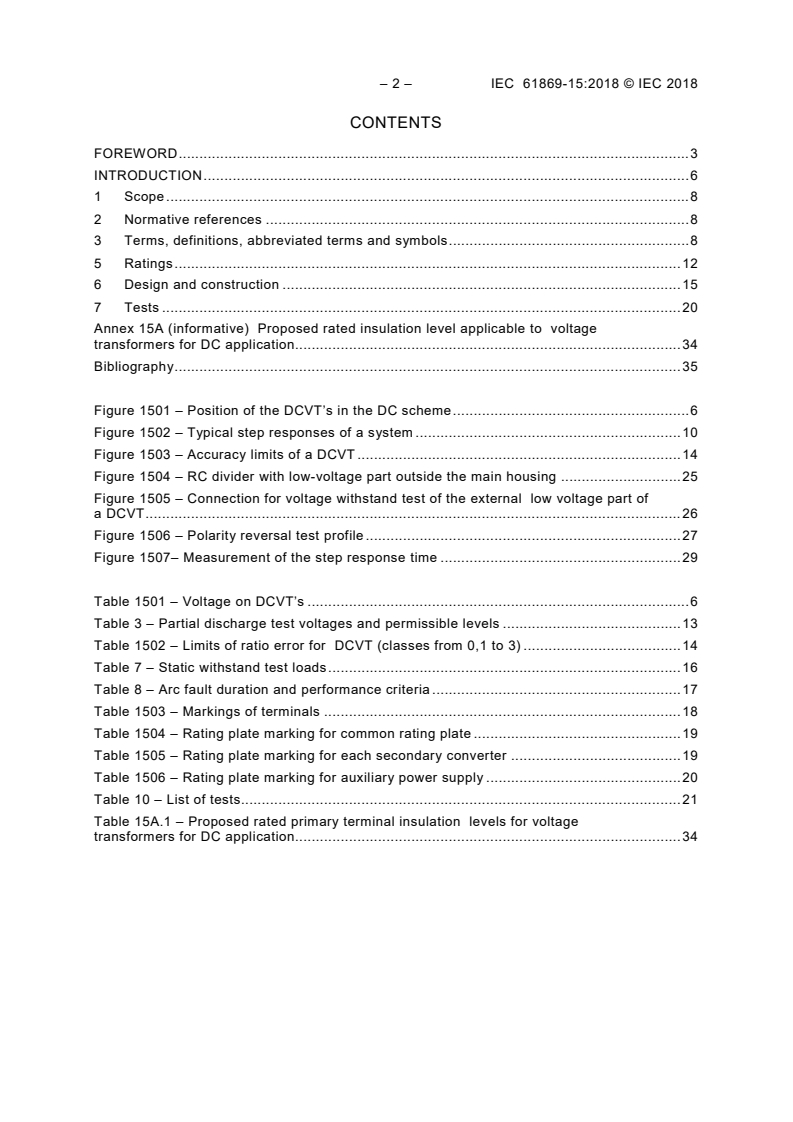
– 2 – IEC 61869-15:2018 © IEC 2018
CONTENTS
FOREWORD . 3
INTRODUCTION . 6
1 Scope . 8
2 Normative references . 8
3 Terms, definitions, abbreviated terms and symbols . 8
5 Ratings . 12
6 Design and construction . 15
7 Tests . 20
Annex 15A (informative) Proposed rated insulation level applicable to voltage
transformers for DC application. 34
Bibliography . 35
Figure 1501 – Position of the DCVT’s in the DC scheme . 6
Figure 1502 – Typical step responses of a system . 10
Figure 1503 – Accuracy limits of a DCVT . 14
Figure 1504 – RC divider with low-voltage part outside the main housing . 25
Figure 1505 – Connection for voltage withstand test of the external low voltage part of
a DCVT . 26
Figure 1506 – Polarity reversal test profile . 27
Figure 1507– Measurement of the step response time . 29
Table 1501 – Voltage on DCVT’s . 6
Table 3 – Partial discharge test voltages and permissible levels . 13
Table 1502 – Limits of ratio error for DCVT (classes from 0,1 to 3) . 14
Table 7 – Static withstand test loads . 16
Table 8 – Arc fault duration and performance criteria . 17
Table 1503 – Markings of terminals . 18
Table 1504 – Rating plate marking for common rating plate . 19
Table 1505 – Rating plate marking for each secondary converter . 19
Table 1506 – Rating plate marking for auxiliary power supply . 20
Table 10 – List of tests. 21
Table 15A.1 – Proposed rated primary terminal insulation levels for voltage
transformers for DC application. 34
INTERNATIONAL ELECTROTECHNICAL COMMISSION
____________
INSTRUMENT TRANSFORMERS –
Part 15: Additional requirements for
voltage transformers for DC applications
FOREWORD
1) The International Electrotechnical Commission (IEC) is a worldwide organization for standardization comprising
all national electrotechnical committees (IEC National Committees). The object of IEC is to promote
international co-operation on all questions concerning standardization in the electrical and electronic fields. To
this end and in addition to other activities, IEC publishes International Standards, Technical Specifications,
Technical Reports, Publicly Available Specifications (PAS) and Guides (hereafter referred to as "IEC
Publication(s)"). Their preparation is entrusted to technical committees; any IEC National Committee interested
in the subject dealt with may participate in this preparatory work. International, governmental and non-
governmental organizations liaising with the IEC also participate in this preparation. IEC collaborates closely
with the International Organization for Standardization (ISO) in accordance with conditions determined by
agreement between the two organizations.
2) The formal decisions or agreements of IEC on technical matters express, as nearly as possible, an international
consensus of opinion on the relevant subjects since each technical committee has representation from all
interested IEC National Committees.
3) IEC Publications have the form of recommendations for international use and are accepted by IEC National
Committees in that sense. While all reasonable efforts are made to ensure that the technical content of IEC
Publications is accurate, IEC cannot be held responsible for the way in which they are used or for any
misinterpretation by any end user.
4) In order to promote international uniformity, IEC National Committees undertake to apply IEC Publications
transparently to the maximum extent possible in their national and regional publications. Any divergence
between any IEC Publication and the corresponding national or regional publication shall be clearly indicated in
the latter.
5) IEC itself does not provide any attestation of conformity. Independent certification bodies provide conformity
assessment services and, in some areas, access to IEC marks of conformity. IEC is not responsible for any
services carried out by independent certification bodies.
6) All users should ensure that they have the latest edition of this publication.
7) No liability shall attach to IEC or its directors, employees, servants or agents including individual experts and
members of its technical committees and IEC National Committees for any personal injury, property damage or
other damage of any nature whatsoever, whether direct or indirect, or for costs (including legal fees) and
expenses arising out of the publication, use of, or reliance upon, this IEC Publication or any other IEC
Publications.
8) Attention is drawn to the Normative references cited in this publication. Use of the referenced publications is
indispensable for the correct application of this publication.
9) Attention is drawn to the possibility that some of the elements of this IEC Publication may be the subject of
patent rights. IEC shall not be held responsible for identifying any or all such patent rights.
International Standard IEC 61869-15 has been prepared by IEC technical committee 38:
Instrument transformers.
The text of this standard is based on the following documents:
FDIS Report on voting
38/561/FDIS 38/566/RVD
Full information on the voting for the approval of this International Standard can be found in
the report on voting indicated in the above table.
This document has been drafted in accordance with the ISO/IEC Directives, Part 2.
– 4 – IEC 61869-15:2018 © IEC 2018
A list of all parts in the IEC 61869 series, published under the general title Instrument
transformers, can be found on the IEC website.
This Part 15 is to be used in conjunction with IEC 61869-1:2007, General Requirements, and
IEC 61869-6:2016, Additional general requirements for low-power instrument transformers –
however, the reader is encouraged to use the most recent edition.
This Part 15 follows the structure of IEC 61869-1:2007 and IEC 61869-6:2016 and
supplements or modifies their corresponding clauses.
When a subclause of Part 1 or Part 6 is not mentioned in this Part 15, that subclause applies.
When this standard states "addition", "modification" or "replacement", the relevant text in
Part 1 or Part 6 is to be adapted accordingly.
For additional clauses, subclauses, figures, tables, annexes or notes, the following numbering
system is used:
• clauses, subclauses, tables, figures and notes that are numbered starting from 1501 are
additional to those in Part 1 and Part 6;
• additional annexes are lettered 15A, 15B, etc.
An overview of the planned set of standards at the date of publication of this document is
given below. The updated list of standards issued by IEC TC 38 is available at the website:
www.iec.ch.
PRODUCT FAMILY STANDARDS PRODUCT PRODUCTS OLD
STANDARD STANDARD
61869-1 61869-2 ADDITIONAL REQUIREMENTS FOR 60044-1
CURRENT TRANSFORMERS 60044-6
GENERAL
REQUIREMENTS
61869-3 ADDITIONAL REQUIREMENTS FOR 60044-2
INDUCTIVE VOLTAGE TRANSFORMERS
61869-4 ADDITIONAL REQUIREMENTS FOR 60044-3
COMBINED TRANSFORMERS
61869-5 ADDITIONAL REQUIREMENTS FOR 60044-5
CAPACITIVE VOLTAGE TRANSFORMERS
ADDITIONAL REQUIREMENTS FOR
61869-6 61869-7 60044-7
ELECTRONIC VOLTAGE
ADDITIONAL
TRANSFORMERS
GENERAL
REQUIREMENTS ADDITIONAL REQUIREMENTS FOR
61869-8 60044-8
FOR LOW-POWER
ELECTRONIC CURRENT
INSTRUMENT
TRANSFORMERS
TRANSFORMERS
61869-9 DIGITAL INTERFACE FOR INSTRUMENT
TRANSFORMERS
61869-10 ADDITIONAL REQUIREMENTS FOR LOW-
POWER PASSIVE CURRENT
TRANSFORMERS
61869-11 ADDITIONAL REQUIREMENTS FOR LOW- 60044-7
POWER PASSIVE VOLTAGE
TRANSFORMERS
61869-12 ADDITIONAL REQUIREMENTS FOR
COMBINED ELECTRONIC INSTRUMENT
TRANSFORMER OR COMBINED LOW-
POWER PASSIVE TRANSFORMERS
61869-13 STAND ALONE MERGING UNIT
61869-14 ADDITIONAL REQUIREMENTS FOR
CURRENT TRANSFORMERS FOR DC
APPLICATIONS
61869-15 ADDITIONAL REQUIREMENTS FOR
VOLTAGE TRANSFORMERS FOR DC
APPLICATIONS
The committee has decided that the contents of this document will remain unchanged until the
stability date indicated on the IEC website under "http://webstore.iec.ch" in the data related to
the specific document. At this date, the document will be
• reconfirmed,
• withdrawn,
• replaced by a revised edition, or
• amended.
IMPORTANT – The 'colour inside' logo on the cover page of this publication indicates
that it contains colours which are considered to be useful for the correct
understanding of its contents. Users should therefore print this document using a
colour printer.
– 6 – IEC 61869-15:2018 © IEC 2018
INTRODUCTION
This document applies to voltage transformers (VT) intended to be used in DC applications
with the following functions:
• measure DC voltage (with significant harmonics);
• withstand DC voltage.
Two main technologies of DC converters exist today: LCC and VSC
• Line-commutated converters (LCC) are based on thyristor converters. They are
characterized by a single direction of current flow, and a voltage polarity reversal
possibility. Significant voltage and current harmonics exist up to frequencies of about
3 kHz to 4 kHz.
• Voltage source converters (VSC) are based on transistor converters. They are
characterized by a bi-directional current flow and a single voltage polarity. Voltage and
current harmonics exist up to frequencies of about 20 kHz.
The position of the DCVTs on the DC system is illustrated in Figure 1501.
Figure 1501 – Position of the DCVT’s in the DC scheme
Table 1501 gives an overview of the voltage waveshape as well as the main characteristics of
the VT.
Table 1501 – Voltage on DCVT’s
Voltage Characteristics
Pure DC application
High-accuracy measurement
Harmonics measurement
Metering, control and protection purpose
The actual technology used for DCVT’s are resistive voltage dividers (with or without
additional capacitance). However, other technologies could be used in the future (for
example, optical voltage sensors).
This document includes some specific requirements applicable to resistive voltage dividers,
but can be applied to any technology.
– 8 – IEC 61869-15:2018 © IEC 2018
INSTRUMENT TRANSFORMERS –
Part 15: Additional requirements for
voltage transformers for DC applications
1 Scope
This part of IEC 61869 provides all requirements specific to voltage transformers to be used
in DC applications (DCVTs), whatever the technology used. The output signal can be
analogue or digital.
It is applicable to newly manufactured voltage transformers used for measuring, protection
and/or control applications in DC power systems with a rated voltage above 1,5 kV.
This document covers passive voltage dividers as well as active voltage transformers, used
for measurement, control and protection.
The general configuration of a single-pole low-power instrument transformer is described in
Figure 601 of IEC 61869-6:2016.
2 Normative references
The following documents are referred to in the text in such a way that some or all of their
content constitutes requirements of this document. For dated references, only the edition
cited applies. For undated references, the latest edition of the referenced document (including
any amendments) applies.
Clause 2 of IEC 61869-6:2016 is applicable, with the following additions:
IEC TS 60815-4:2016, Selection and dimensioning of high-voltage insulators intended for use
in polluted conditions – Part 4: Insulators for DC systems
IEC TS 61245, Artificial pollution tests on high-voltage ceramic and glass insulators to be
used on DC systems
IEC 61869-1:2007, Instrument transformers – Part 1: General requirements
IEC 61869-6:2016, Instrument transformers – Part 6: Additional general requirements for low-
power instrument transformers
IEC 61869-9:2016, Instrument transformers – Part 9: Digital interface for instrument
transformers
3 Terms, definitions, abbreviated terms and symbols
For the purposes of this document, the terms and definitions given in Clause 3 of IEC 61869-
1:2007, of IEC 61869-6:2016 and of IEC 61869-9:2016 are applicable with the following
additions and modifications.
ISO and IEC maintain terminological databases for use in standardization at the following
addresses:
• IEC Electropedia: available at http://www.electropedia.org/
• ISO Online browsing platform: available at http://www.iso.org/obp
3.1 General definitions
3.1.1501
instrument transformer for DC application
instrument transformer intended to be used in DC applications with at least one of the
following functions:
• measure DC current or DC voltage (with significant harmonics);
• withstand DC voltage.
3.1.1502
voltage transformer for DC application
DCVT
instrument transformer for DC application in which the secondary signal, under normal
conditions of use, is substantially proportional to the primary voltage
3.2 Definitions related to dielectric ratings
3.2.2
highest voltage for equipment
U
m
Definition 3.2.2 of IEC 61869-1:2007 is replaced by the following one:
highest value of DC voltage for which the equipment is designed to operate continuously, in
respect of its insulation as well as other characteristics that relate to this voltage
3.3 Definitions related to current ratings
3.3.1501
maximum peak fault current
I
sc
maximum peak value of current occurring during a fault condition of the DC power system
3.4 Definitions related to accuracy
3.4.1501
absolute error
ε
V
error (expressed in V) that a voltage transformer introduces into the measurement and which
arises from the fact that the actual transformation ratio is not equal to the rated transformation
ratio
Note 1 to entry: The absolute error is defined by the following formula:
ε = K ⋅ U – U
V r s p
where
K is the rated transformation ratio;
r
U is the DC value of the actual primary voltage in steady state;
p
U is the DC value of the output voltage.
s
3.5 Definitions related to other ratings
3.5.1501
step response
duration between the instant when the measurand (or quantity supplied) is subjected to a
specified abrupt change and the instant when the indication (or quantity supplied) reaches,
and remains within specified limits of, its final steady-state value
– 10 – IEC 61869-15:2018 © IEC 2018
Note 1 to entry: See graphical explanation in Figure 1502.
a
For periodic behaviour
b
For aperiodic behaviour
u Input variable
U Initial value of the input variable
o
U Step height of the input variable
s
v Output variable
V , V Steady-state values before and after application of the step
0 ∞
v Overshoot
m
Specified tolerance limit
2 ∆v
s
T Step response time
sr
T Settling time
s
T Dead time
t
Figure 1502 – Typical step responses of a system
Note 2 to entry: The dead time includes the delay time.
[SOURCE: IEC 60050-311:2001, 311-06-04 and IEC 60050-351:2013, 351-45-27, modified –
Notes to entry of the sources have been deleted and a new Note 1 to entry has been added.]
3.5.1502
step response time
T
sr
for a step response, the duration of the time interval between the instant of the step change of
an input variable and the instant when the output variable reaches for the first time a specified
percentage of the difference between the final and the initial steady-state values
Note 1 to entry: The step response time includes the delay time of the voltage transformer.
[SOURCE: IEC 60050-351:2013, 351-45-36 modified – Note 1 to entry of the source has been
deleted and a new Note 1 to entry has been added, and the symbol has been added.]
3.5.1503
settling time
T
s
for a step response, the duration of the time interval between the instant of the step change of
an input variable and the instant when the difference between the step response and their
steady-state value remains smaller than the transient value tolerance
Note 1 to entry: The settling time includes the delay time of the voltage transformer.
[SOURCE: IEC 60050-351:2013, 351-45-37 modified – Note 1 to entry of the source has been
deleted and a new Note 1 to entry has been added, and the symbol has been added.]
3.5.1504
overshoot
v
m
for a step response of a transfer element, the maximum transient deviation from the final
steady-state value of the output variable, usually expressed in percent of the difference
between the final and the initial steady-state values and for reference-variable step response
or disturbance-variable step response of a control system the maximum transient deviation
from the desired value
[SOURCE: IEC 60050-351:2013, 351-45-38, modified – Note 1 to entry has been deleted and
the symbol has been replaced.]
3.7 Index of abbreviated terms and symbols
The table in 3.7 of IEC 61869-6:2016 is replaced by the following one:
DCVT voltage transformer for DC application
F mechanical load
I maximum supply current
amax
I rated supply current
ar
I maximum peak fault current
sc
IT instrument transformer
K actual transformation ratio
K rated transformation ratio
r
R rated burden
br
t delay time
d
t rated delay time
dr
T settling time
s
T step response time
sr
T dead time
t
U auxiliary power supply voltage
ar
– 12 – IEC 61869-15:2018 © IEC 2018
U highest voltage for equipment
m
U rated primary voltage
pr
U rated secondary voltage
sr
v overshoot
m
ratio error
ε
ε absolute error
V
5 Ratings
5.1 General
Subclause 5.1 of IEC 61869-1:2007 is replaced by the following one:
If applicable, the ratings of voltage transformers, including their auxiliary equipment, shall be
selected from the following ones:
);
• highest voltage for equipment (U
m
• rated primary voltage (U );
pr
• rated delay time (t );
dr
• rated secondary voltage (U );
sr
• insulation level;
• rated burden (R );
br
• rated accuracy class;
• rated step response time (T ).
sr
The rating applies at the standardized reference atmosphere (temperature 20 °C, pressure
101,3 kPa, and humidity 11 g/m ) as specified in IEC 60071-1.
NOTE The ratings are specified by the purchaser depending on the characteristics of the whole DC system
application.
5.2 Highest voltage for equipment
There are no standard values for highest voltage for equipment.
However, a tentative list of standard values is given in Annex 15A.
5.3 Rated insulation levels
5.3.1 General
Subclause 5.3.1 from IEC 61869-1:2007 is replaced by the following one:
The standard values of insulation level of IEC 60071-1 are not applicable to DC systems.
Methods of calculation for applied dielectric test voltages are given in the relevant clauses of
this document.
Additionally, indication for impulse withstand voltage values are given in Annex 15A.
5.3.3 Other requirements for insulation of primary terminals
5.3.3.1 Partial discharges
Subclause 5.3.3.1 of IEC 61869-1:2007 is replaced by the following one:
The partial discharge level measured during the power-frequency voltage withstand test, shall
not exceed the limits specified in Table 3.
Table 3 – Partial discharge test voltages and permissible levels
Maximum permissible PD level
PD test voltage
pC
(r.m.s.)
Type of insulation
kV
immersed in liquid or gas solid
1,5 U /√2 10 50
m
1,2 U /√2 5 20
m
5.4 Rated frequency
Subclause 5.4 of IEC 61869-1:2007 is replaced by the following one:
The rated frequency is equal to 0 (which means DC).
5.5 Rated output
5.5.602 Standard values for the rated delay time (t )
dr
Subclause 5.5.602 of IEC 61869-6:2016 is replaced by the following one:
The standard values for rated delay time are:
5 µs – 25 µs – 100 µs
In the case of a pure passive DCVT, the rated delay time is 0.
5.5.1501 Standard values of rated secondary voltage
The standard values of rated secondary DC voltage are:
5 V – 10V – 50 V
5.6 Rated accuracy class
5.6.1501 Accuracy class designation
The accuracy class is designated by the highest permissible percentage of voltage error at
rated primary voltage and with the rated burden.
5.6.1502 Standard accuracy classes
The standard accuracy classes are:
0,1 – 0,2 – 0,5 – 1 – 3
– 14 – IEC 61869-15:2018 © IEC 2018
5.6.1503 Limits of ratio error
The ratio error for the DC component, measured at the secondary terminals, shall not exceed
the values given in Table 1502, expressed as a percentage of the measured voltage. A
graphical representation of error limits is shown in Figure 1503.
The accuracy shall be guaranteed for the whole range of temperature, both for the outdoor
and the indoor part of the voltage transformer and for both polarities.
Table 1502 – Limits of ratio error for
DCVT (classes from 0,1 to 3)
Accuracy Ratio error
class
± %
at % of rated voltage
5 20 40 70 100 125
0,1 1 0,2 0,1 0,1 0,1 0,1
0,2 2 0,4 0,2 0,2 0,2 0,2
0,5 3,5 1 0,5 0,5 0,5 0,5
1 5 2 1 1 1 1
3 10 5 3 3 3 3
For voltage lower than 5 % of the rated voltage, the absolute error ε shall not increase above
V
the value at 5 % of the rated voltage.
NOTE The purpose of this requirement is to consider a minimum value of error due to offset voltage and noise.
Figure 1503 – Accuracy limits of a DCVT
5.6.1504 Accuracy requirements for harmonic measurement
This subclause is applicable for the measurement of the ripple of the DC voltage.
When required, Subclause 6A.4.3 of IEC 61869-6:2016 is applicable.
5.1501 Rated step response time
The standard values for the rated step response time are:
25 µs – 100 µs – 500 µs
6 Design and construction
6.6 Requirements for the external insulation
6.6.1 Pollution
Subclause 6.6.1 of IEC 61869-1:2007 is replaced by the following one:
This subclause is applicable to voltage transformers having U equal to or above 20 kV.
m
The purchaser shall specify the minimum creepage distance or the minimum USCD
(see IEC TS 60815-4:2016) or, alternatively, the DC site pollution severity.
The necessary creepage distance shall be determined from the USCD by:
USCD × U
m
where USCD is the minimum nominal unified specific creepage distance (mm/kV), see
IEC 60050-471:2007, 471-01-16.
For indoor voltage transformers, the minimum USCD value shall be 14 mm/kV.
For outdoor voltage transformers, if artificial pollution tests are required, they shall be
performed in accordance with 7.4.1501.
NOTE Values for USCD for outdoor voltage transformers are considered in IEC TS 60815-4:2016. These values
are strongly dependent on the insulator material. Additional factors relating to the insulator profile and insulator
material are also specified.
6.7 Mechanical requirements
Subclause 6.7 of IEC 61869-1:2007 is replaced by the following one:
The required static load that voltage transformers shall be able to withstand is given in
Table 7. The figures include loads due to wind and ice.
The specified test loads are intended to be applied in any direction at the level of the primary
terminals.
– 16 – IEC 61869-15:2018 © IEC 2018
Table 7 – Static withstand test loads
Static withstand test load, F
Highest voltage for
equipment, U
N
m
kV
Voltage transformers
Up to 100 500
> 100 up to 300 1 000
> 300 up to 500 1 250
> 500 1 500
The sum of the loads acting in routinely operating conditions should not exceed 50 % of the specified withstand
test load.
In some applications, voltage transformers with through current terminals should withstand rarely occurring
extreme dynamic loads (e.g. short circuits) not exceeding 1,4 times the static test load.
For some applications, it may be necessary to establish the resistance to rotation of the primary terminals. The
moment to be applied during the test is agreed between the manufacturer and the purchaser.
6.8 Multiple chopped impulse on primary terminals
Subclause 6.8 of IEC 61869-1:2007 is replaced by the following one:
If additionally specified, the primary terminals of oil-immersed voltage transformers having U
m
equal to or above100 kV shall withstand multiple chopped impulses in accordance with 7.4.2
of IEC 61869-1:2007.
NOTE Requirements and tests relate to the behaviour of the internal shields and connections carrying high-
frequency transient currents. The test can also be applied to ratings below this level.
6.9 Internal arc fault protection requirements
Subclause 6.9 of IEC 61869-1:2007 is replaced by the following one:
These requirements apply to oil-immersed and gas-insulated voltage transformers having U
m
equal to or above 100 kV, for which an internal arc fault protection class is additionally
specified.
If additionally specified, the instrument transformer shall be able to withstand an internal arc
of the specified current and duration.
The applied current is a symmetrical sinusoidal current. The r.m.s. current value is
I /√2
sc
The arc fault duration shall be defined in accordance with Table 8.
It shall be considered that compliance with these requirements is achieved if the instrument
transformer passes the test described in 7.4.6. of IEC 61869-1:2007.
Table 8 – Arc fault duration and performance criteria
Protection Arc fault Internal arc fault protection Internal arc fault protection
stage duration class I class II
s
Fracture of the housing and fire No external effect other than the
1 0,2 permitted, but all projected parts to be operation of suitable pressure relief
confined within the containment area device
No fragmentation (burn-through or fire
2 0,5
acceptable)
6.11 Electromagnetic compatibility (EMC)
6.11.1 Requirement for radio interference voltage (RIV)
Subclause 6.11.2 of IEC 61869-1:2007 is replaced by the following one:
The RIV requirement applies to voltage transformers having U equal to or above 100 kV to
m
be installed in air-insulated substations.
During test with power-frequency voltage, the radio interference voltage shall not exceed
2 500 µV at 1,1 × U / √2.
m
NOTE This requirement is included to meet certain electromagnetic compatibility regulations.
6.13 Markings
6.13.1501 Terminal markings
The markings shall identify:
a) the primary and the secondary terminals;
b) the relative polarity of terminals.
6.13.1502 Method of marking
The primary terminals shall be marked clearly and indelibly, either on their surface or in their
immediate vicinity. If possible, the secondary terminals shall be identified clearly and
indelibly, either on the surface of the DCVT or in the immediate vicinity of the terminals.
6.13.1503 Terminal markings
Terminal markings shall be in accordance with Table 1503.
– 18 – IEC 61869-15:2018 © IEC 2018
Table 1503 – Markings of terminals
Line primary terminal
Secondary terminals
Ground primary terminal
DCVT with one secondary output
Line primary terminal
Secondary terminals
Ground primary terminal
DCVT with two secondary outputs
6.13.1504 Rating plate markings
Subclause 6.13 of IEC 61869-1:2007 and IEC 61869-6:2016 is replaced by the following one:
All voltage transformers shall carry at least the following markings:
a) manufacturer’s name or other mark by which the manufacturer can be readily identified;
b) year of manufacture and a serial number or a type designation, preferably both;
c) highest voltage for equipment (U );
m
d) insulation level;
e) rated primary voltage (U );
pr
f) accuracy class;
When the instrument transformer is intended for both DC and AC measurements, the
accuracy for both applications shall be marked separately.
g) temperature category;
h) mass in kg (when ≥ 25 kg);
i) thermal class of insulation if different from Class A.
If several classes of insulating material are used, the one which limits the temperature rise
should be indicated.
In addition, the following information should be marked (if applicable):
j) maximum static mechanical load;
k) type of insulating fluid;
l) rated filling pressure;
m) minimum functional pressure;
n) insulating fluid volume (or mass) contained in the voltage transformer;
o) on transformers with secondary converters, the use of each one and its corresponding
terminals.
For analogue secondary output, the following information shall be marked:
p) rated secondary output voltage;
);
q) rated burden (R
br
r) rated delay time (t ), if different from 0;
dr
s) on voltage transformers with two or more secondary terminals, the ratings of each one
(e.g. transformation ratio, accuracy class).
The rating plate of all DCVTs, where practicable, shall be readable from ground level and
carry the markings given in Tables 1504 to 1506.
Table 1504 – Rating plate marking for common rating plate
Rating Symbol Analogue output Digital output
Type designation x x
Manufacturer’s name or mark x x
Highest voltage for equipment U x x
m
Insulation level x x
Rated primary voltage U x x
pr
Temperature category x x
Mass in kg x x
Thermal class of insulation x x
Maximum static mechanical load x x
Type of insulating fluid x x
Rated filling pressure x x
Minimum functional pressure
Insulating fluid volume (or mass) x x
Table 1505 – Rating plate marking for each secondary converter
Rating Symbol Analogue output Digital output
Accuracy class
x x
Rated transformation ratio K
x
r
Rated secondary output voltage U
x
sr
Rated burden R
x
br
Rated delay time t
x
dr
Maximum delay time
x
– 20 – IEC 61869-15:2018 © IEC 2018
Table 1506 – Rating plate marking for auxiliary power supply
Rating Symbol Analogue output Digital output
Auxiliary power supply voltage U x x
ar
Auxiliary power supply frequency x x
Supply current (nominal conditions) I x x
ar
Maximum supply current (overload conditions) I x x
amax
All information shall be marked in an indelible manner on a rating plate securely attached to
the transformer (at least the common rating plate) or to the secondary auxiliary cabinet for the
secondary converter and auxiliary power supply, if present.
6.602 Requirements for electrical transmitting system and electrical wires for output
link
6.602.1 Connectors
Subclause 6.602.1 of IEC 61869-6:2016 is replaced by the following one:
Screw terminals are the standard interface.
For applications requesting a high bandwidth, it is preferable to use a coaxial connector. In
this case, the centre pin shall correspond to the "a" terminal.
6.1501 Digital interface
Refer to the different clauses and annexes of IEC 61869-9:2016.
NOTE Digital interfaces for DC applications are still under development, and the full adequacy of IEC 61869-9
has still to be improved.
6.1502 Design requirements for DC voltage dividers
The capacitors shall comply with Subclause 6.1 of IEC 60815-1, regarding their individual
insulation level.
7 Tests
7.1 General
7.1.2 List of tests
Table 10 of IEC 61869-1:2007 is replaced by the following table.
Table 10 – List of tests
Tests Subclause
Type tests 7.2
Temperature rise test 7.2.2
Impulse voltage withstand test on primary terminals 7.2.3
Wet test for outdoor type transformers 7.2.4
Polarity reversal test with partial discharge measurement 7.2.1501
Electromagnetic compatibility tests 7.2.5
Test for accuracy 7.2.6
Test for accuracy versus harmonics 7.2.1502
Verification of the degree of protection by enclosures 7.2.7
Enclosure tightness test at ambient temperature 7.2.8
Pressure test for the enclosure 7.2.9
Low-voltage component voltage withstand test 7.2.601
Measurement of the step response time 7.2.1503
Routine tests 7.3
Power-frequency voltage withstand test on primary terminals 7.3.1
Partial discharge measurement 7.3.2
Power-frequency voltage withstand test between sections 7.3.3
DC applied voltage withstand test with partial discharge measurement 7.3.1501
Power-frequency voltage withstand test on secondary terminals 7.3.4
Test for accuracy 7.3.5
Verification of markings 7.3.6
Enclosure tightness test at ambient temperature 7.3.7
Pressure test for the enclosure 7.3.8
Power-frequency voltage withstand test for low-voltage components 7.3.601
Measurement of capacitance 7.3.1502
Measurement of resistance 7.3.1503
Special tests 7.4
Chopped impulse voltage withstand test on primary terminals 7.4.1
Multiple chopped impulse test on primary terminals 7.4.2
Transmitted overvoltage test 7.4.4
Mechanical tests 7.4.5
Internal arc fault test 7.4.6
Enclosure tightness test at low and high temperatures 7.4.7
Gas dew point test 7.4.8
Corrosion test 7.4.9
Fire hazard test 7.4.10
Pollution tests 7.4.1501
Vibration tests 7.2.602
Test for accuracy on the composite signal 7.4.1502
Ageing test for R and C components 7.4.1503
– 22 – IEC 61869-15:2018 © IEC 2018
7.1.3 Sequence of tests
Subclause 7.1.3 of IEC 61869-1:2007 is replaced by 7.1.3.1501 and 7.1.3.1502 .
7.1.3.1501 Sequence of type tests
The sequence of tests is not specified and may be agreed between the purchaser and the
supplier.
Before starting the type test sequence, the following routine tests shall be performed:
• power-frequency voltage withstand tests on primary terminals;
• partial discharge measurement.
NOTE The partial discharge measurement is generally performed together with the power-frequency voltage
withstand test.
After the type test sequence, the voltage transformer shall be subjected to all routine tests
detailed in 7.3.
The DC applied voltage test may be performed before the polarity reversal test. In this case, it
does not need to be repeated after the type test sequence.
7.1.3.1502 Sequence of routine tests
The sequence of tests is not specified, but the accuracy tests shall be performed after the
dielectric tests.
7.2 Type tests
7.2.1 General
Subclause 7.2.1 of IEC 61869-6:2016 is applicable with the following addition:
Type tests on DCVTs are considered as valid if they have been performed on a device of
comparable design, with similar specific design stresses. Evidence shall to be provided by the
manufacturer.
7.2.2 Temperature rise test
Subclause 7.2.2 of IEC 61869-6:2016 is applicable with the following modifications:
The second and third paragraphs are replaced by the following ones:
For the temperature rise test, the following test methods may be used for temperature
measurement:
• for gas-insulated equipment: infrared camera and gas pressure variation measurements;
• for oil-insulated equipment: infrared camera measurement.
The voltage to be applied is the highest voltage for the equipment (U ). The test shall be
m
continued until the temperature of the transformer has reached the steady
...