


IEC 61952:2002
(Main)Insulators for overhead lines - Composite line post insulators for a.c. with a nominal voltage greater than 1000 V
Insulators for overhead lines - Composite line post insulators for a.c. with a nominal voltage greater than 1000 V
Applies to composite line post insulators consisting of a load-bearing, cylindrical, insulating solid core made up of fibres - usually glass - in a resin-based matrix, a housing (outside the insulating core) made of elastomer material (e.g. silicone or ethylene-propylene) and end fittings permanently attached to the insulating core. The object of this standard is to - define the terms used, - prescribe test methods, - prescribe acceptance or failure criteria This standard does not include requirements dealing with the choice of insulators for specific operating conditions.
Isolateurs composites rigides à socle destinés aux lignes aériennes à courant alternatif de tension nominale supérieure à 1000 V - Définitions, méthodes d'essai et critères d'acceptation
est applicable aux isolateurs composites rigides à socle constitués d'un noyau isolant cylindrique supportant la charge, composé de fibres - habituel-lement en verre - dans une matrice à base de résine, d'un revêtement (extérieur au noyau isolant) en matériau élastomère (par exemple silicone ou éthylène-propylène) et d'armatures d'extrémité reliées de façon permanente au noyau isolant. La présente norme a pour objet: - de définir les termes employés, - de fixer les méthodes d'essai, - de fixer les critères d'acceptation ou de rejet d'une fourniture. Cette norme n'inclut pas d'exigences relatives au choix des isolateurs pour des conditions de service spécifiques.
General Information
- Status
- Published
- Publication Date
- 29-Jul-2002
- Technical Committee
- TC 36 - Insulators
- Drafting Committee
- MT 10 - TC 2/MT 10
- Current Stage
- DELPUB - Deleted Publication
- Start Date
- 27-May-2008
- Completion Date
- 14-Feb-2026
Relations
- Effective Date
- 05-Sep-2023
Overview
IEC 61952:2002, developed by the International Electrotechnical Commission (IEC), establishes requirements and test methods for composite line post insulators used in overhead a.c. power lines with a nominal voltage greater than 1,000 V. These insulators typically consist of a solid cylindrical insulating core-usually glass fibers in a resin matrix-an elastomer housing (such as silicone or ethylene-propylene), and metallic end fittings permanently attached to the core.
This standard aims to:
- Define relevant terms.
- Prescribe standardized test methods.
- Set forth acceptance or failure criteria for composite line post insulators.
IEC 61952:2002 is designed to ensure product consistency and reliability but does not specify criteria for insulator selection based on environmental or operating conditions.
Key Topics
Key areas covered under IEC 61952:2002 include:
Scope and Definitions
Clear definitions of composite line post insulator components and functions.Component Structure
Specification of insulator construction, including material types for the core, housing, and end fittings.Classification of Tests
- Design Tests: Performed once per design to validate suitability for high-voltage applications.
- Type Tests: Verifying mechanical and electrical performance.
- Sample Tests: Ensuring ongoing production quality.
- Routine Tests: Quality control for every manufactured unit.
Test Procedures
- Mechanical (tensile, cantilever, compression)
- Electrical (as referenced to applicable IEC standards)
- Material performance (tracking, erosion, and aging)
Criteria for Acceptance or Failure Clearly articulated criteria for passing or failing each defined test.
Notes on Application The standard does not cover pollution tests, specific power arc tests, or insulator selection for unusually severe environmental conditions. Guidelines for future advancements in aging and tracking tests are noted.
Applications
IEC 61952:2002 is vital for manufacturers, engineers, and utilities engaged in the design, procurement, and maintenance of high-voltage a.c. overhead transmission and distribution lines. Principal applications include:
- Ensuring the mechanical and electrical reliability of composite line post insulators in utility environments with voltages exceeding 1,000 V.
- Supporting line conductors under various mechanical loads (cantilever, tensile, and compression), primarily in transmission line structures.
- Standardizing the qualification and testing process, allowing utilities to compare insulators from different manufacturers on an equal basis.
- Supporting quality control during ongoing production through routine and sample testing, reducing the risk of in-service failures.
Using insulators conforming to IEC 61952:2002 can minimize outages, improve asset longevity, and ensure safety in power transmission.
Related Standards
Professionals implementing IEC 61952:2002 should be familiar with several supporting and related standards:
- IEC 60060-1: High-voltage test techniques - General definitions and test requirements.
- IEC 60383-1/2: Insulators for overhead lines above 1,000 V - Definitions, test methods, and acceptance criteria.
- IEC 60695-11-10: Fire hazard testing for materials used in insulator construction.
- IEC 61109: Composite insulators for a.c. overhead lines with a nominal voltage greater than 1,000 V.
- IEC 61467: Testing procedures for a.c. power arc of insulator sets.
- IEC 61462: Complete tests for composite hollow core insulators, with guidance applicable to certain configurations.
- ISO 868, ISO 3274, ISO 4287, ISO 4892: Mechanical and material testing standards for plastics used in insulators.
Referencing these standards alongside IEC 61952:2002 helps ensure comprehensive product evaluation and compliance in the context of international quality and safety in electrical infrastructures.
Get Certified
Connect with accredited certification bodies for this standard

IMQ S.p.A. (Certification)
Italian electrical product certification.

SLG Prüf- und Zertifizierungs GmbH
German testing and certification body.

UL Solutions
Global safety science company with testing, inspection and certification.
Sponsored listings
Frequently Asked Questions
IEC 61952:2002 is a standard published by the International Electrotechnical Commission (IEC). Its full title is "Insulators for overhead lines - Composite line post insulators for a.c. with a nominal voltage greater than 1000 V". This standard covers: Applies to composite line post insulators consisting of a load-bearing, cylindrical, insulating solid core made up of fibres - usually glass - in a resin-based matrix, a housing (outside the insulating core) made of elastomer material (e.g. silicone or ethylene-propylene) and end fittings permanently attached to the insulating core. The object of this standard is to - define the terms used, - prescribe test methods, - prescribe acceptance or failure criteria This standard does not include requirements dealing with the choice of insulators for specific operating conditions.
Applies to composite line post insulators consisting of a load-bearing, cylindrical, insulating solid core made up of fibres - usually glass - in a resin-based matrix, a housing (outside the insulating core) made of elastomer material (e.g. silicone or ethylene-propylene) and end fittings permanently attached to the insulating core. The object of this standard is to - define the terms used, - prescribe test methods, - prescribe acceptance or failure criteria This standard does not include requirements dealing with the choice of insulators for specific operating conditions.
IEC 61952:2002 is classified under the following ICS (International Classification for Standards) categories: 29.080.10 - Insulators; 29.240.20 - Power transmission and distribution lines. The ICS classification helps identify the subject area and facilitates finding related standards.
IEC 61952:2002 has the following relationships with other standards: It is inter standard links to IEC 61952:2008. Understanding these relationships helps ensure you are using the most current and applicable version of the standard.
IEC 61952:2002 is available in PDF format for immediate download after purchase. The document can be added to your cart and obtained through the secure checkout process. Digital delivery ensures instant access to the complete standard document.
Standards Content (Sample)
NORME CEI
INTERNATIONALE IEC
INTERNATIONAL
Première édition
STANDARD
First edition
2002-07
Isolateurs pour lignes aériennes –
Isolateurs composites rigides
à socle pour courant alternatif
de tension nominale >1 000 V
Insulators for overhead lines –
Composite line post insulators
for alternative current
with a nominal voltage >1 000 V
Numéro de référence
Reference number
CEI/IEC 61952:2002
Numérotation des publications Publication numbering
Depuis le 1er janvier 1997, les publications de la CEI As from 1 January 1997 all IEC publications are
sont numérotées à partir de 60000. Ainsi, la CEI 34-1 issued with a designation in the 60000 series. For
devient la CEI 60034-1. example, IEC 34-1 is now referred to as IEC 60034-1.
Editions consolidées Consolidated editions
Les versions consolidées de certaines publications de la The IEC is now publishing consolidated versions of its
CEI incorporant les amendements sont disponibles. Par publications. For example, edition numbers 1.0, 1.1
exemple, les numéros d’édition 1.0, 1.1 et 1.2 indiquent and 1.2 refer, respectively, to the base publication,
respectivement la publication de base, la publication de the base publication incorporating amendment 1 and
base incorporant l’amendement 1, et la publication de the base publication incorporating amendments 1
base incorporant les amendements 1 et 2. and 2.
Informations supplémentaires Further information on IEC publications
sur les publications de la CEI
Le contenu technique des publications de la CEI est The technical content of IEC publications is kept
constamment revu par la CEI afin qu'il reflète l'état under constant review by the IEC, thus ensuring that
actuel de la technique. Des renseignements relatifs à the content reflects current technology. Information
cette publication, y compris sa validité, sont dispo- relating to this publication, including its validity, is
nibles dans le Catalogue des publications de la CEI available in the IEC Catalogue of publications
(voir ci-dessous) en plus des nouvelles éditions, (see below) in addition to new editions, amendments
amendements et corrigenda. Des informations sur les and corrigenda. Information on the subjects under
sujets à l’étude et l’avancement des travaux entrepris consideration and work in progress undertaken by the
par le comité d’études qui a élaboré cette publication, technical committee which has prepared this
ainsi que la liste des publications parues, sont publication, as well as the list of publications issued,
également disponibles par l’intermédiaire de: is also available from the following:
• Site web de la CEI (www.iec.ch) • IEC Web Site (www.iec.ch)
• Catalogue des publications de la CEI • Catalogue of IEC publications
Le catalogue en ligne sur le site web de la CEI The on-line catalogue on the IEC web site
(www.iec.ch/catlg-f.htm) vous permet de faire des (www.iec.ch/catlg-e.htm) enables you to search
recherches en utilisant de nombreux critères, by a variety of criteria including text searches,
comprenant des recherches textuelles, par comité technical committees and date of publication. On-
d’études ou date de publication. Des informations line information is also available on recently
en ligne sont également disponibles sur les issued publications, withdrawn and replaced
nouvelles publications, les publications rempla- publications, as well as corrigenda.
cées ou retirées, ainsi que sur les corrigenda.
• IEC Just Published
• IEC Just Published
Ce résumé des dernières publications parues
This summary of recently issued publications
(www.iec.ch/JP.htm) est aussi disponible par
(www.iec.ch/JP.htm) is also available by email.
courrier électronique. Veuillez prendre contact
Please contact the Customer Service Centre (see
avec le Service client (voir ci-dessous) pour plus
below) for further information.
d’informations.
• Service clients
• Customer Service Centre
Si vous avez des questions au sujet de cette
If you have any questions regarding this
publication ou avez besoin de renseignements
publication or need further assistance, please
supplémentaires, prenez contact avec le Service
contact the Customer Service Centre:
clients:
Email: custserv@iec.ch
Email: custserv@iec.ch
Tél: +41 22 919 02 11
Tel: +41 22 919 02 11
Fax: +41 22 919 03 00
Fax: +41 22 919 03 00
.
NORME CEI
INTERNATIONALE IEC
INTERNATIONAL
Première édition
STANDARD
First edition
2002-07
Isolateurs pour lignes aériennes –
Isolateurs composites rigides
à socle pour courant alternatif
de tension nominale >1 000 V
Insulators for overhead lines –
Composite line post insulators
for alternative current
with a nominal voltage >1 000 V
IEC 2002 Droits de reproduction réservés Copyright - all rights reserved
Aucune partie de cette publication ne peut être reproduite ni No part of this publication may be reproduced or utilized in any
utilisée sous quelque forme que ce soit et par aucun procédé, form or by any means, electronic or mechanical, including
électronique ou mécanique, y compris la photocopie et les photocopying and microfilm, without permission in writing from
microfilms, sans l'accord écrit de l'éditeur. the publisher.
International Electrotechnical Commission, 3, rue de Varembé, PO Box 131, CH-1211 Geneva 20, Switzerland
Telephone: +41 22 919 02 11 Telefax: +41 22 919 03 00 E-mail: inmail@iec.ch Web: www.iec.ch
CODE PRIX
V
Commission Electrotechnique Internationale PRICE CODE
International Electrotechnical Commission
Международная Электротехническая Комиссия
Pour prix, voir catalogue en vigueur
For price, see current catalogue
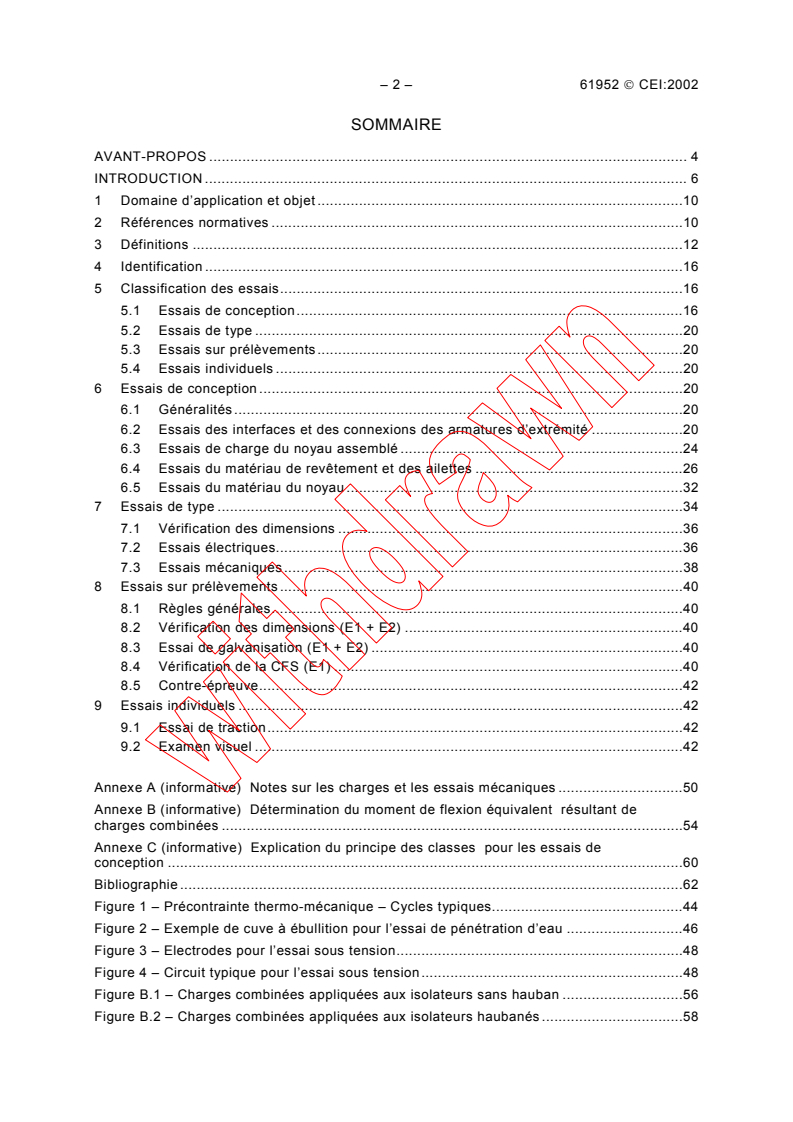
– 2 – 61952 CEI:2002
SOMMAIRE
AVANT-PROPOS . 4
INTRODUCTION .6
1 Domaine d’application et objet .10
2 Références normatives .10
3 Définitions .12
4 Identification .16
5 Classification des essais.16
5.1 Essais de conception.16
5.2 Essais de type .20
5.3 Essais sur prélèvements.20
5.4 Essais individuels .20
6 Essais de conception .20
6.1 Généralités.20
6.2 Essais des interfaces et des connexions des armatures d’extrémité .20
6.3 Essais de charge du noyau assemblé .24
6.4 Essais du matériau de revêtement et des ailettes .26
6.5 Essais du matériau du noyau .32
7 Essais de type .34
7.1 Vérification des dimensions .36
7.2 Essais électriques.36
7.3 Essais mécaniques.38
8 Essais sur prélèvements .40
8.1 Règles générales.40
8.2 Vérification des dimensions (E1 + E2) .40
8.3 Essai de galvanisation (E1 + E2) .40
8.4 Vérification de la CFS (E1) .40
8.5 Contre-épreuve.42
9 Essais individuels .42
9.1 Essai de traction.42
9.2 Examen visuel .42
Annexe A (informative) Notes sur les charges et les essais mécaniques .50
Annexe B (informative) Détermination du moment de flexion équivalent résultant de
charges combinées .54
Annexe C (informative) Explication du principe des classes pour les essais de
conception .60
Bibliographie .62
Figure 1 – Précontrainte thermo-mécanique – Cycles typiques.44
Figure 2 – Exemple de cuve à ébullition pour l’essai de pénétration d’eau .46
Figure 3 – Electrodes pour l’essai sous tension.48
Figure 4 – Circuit typique pour l’essai sous tension.48
Figure B.1 – Charges combinées appliquées aux isolateurs sans hauban .56
Figure B.2 – Charges combinées appliquées aux isolateurs haubanés .58
61952 IEC:2002 – 3 –
CONTENTS
FOREWORD . 5
INTRODUCTION .7
1 Scope and object .11
2 Normative references.11
3 Definitions .13
4 Identification .17
5 Classification of tests.17
5.1 Design tests .17
5.2 Type tests.21
5.3 Sample tests.21
5.4 Routine tests .21
6 Design tests.21
6.1 General .21
6.2 Tests on interfaces and connections of end fittings.21
6.3 Assembled core load tests.25
6.4 Tests of shed and housing material .27
6.5 Tests for the core material .33
7 Type tests.35
7.1 Verification of dimensions.37
7.2 Electrical tests .37
7.3 Mechanical tests.39
8 Sample tests.41
8.1 General rules.41
8.2 Verification of dimensions (E1 + E2) .41
8.3 Galvanizing test (E1 + E2) .41
8.4 Verification of the SCL (E1) .41
8.5 Re-testing procedure .43
9 Routine tests .43
9.1 Tensile load test .43
9.2 Visual examination .43
Annex A (informative) Notes on the mechanical loads and tests.51
Annex B (informative) Determination of the equivalent bending moment
caused by combined loads.55
Annex C (informative) Explanation of the concept of classes for the design tests .61
Bibliography.63
Figure 1 – Thermal-mechanical pre-stressing test –Typical cycles .45
Figure 2 – Example of a boiling container for the water diffusion test .47
Figure 3 – Electrodes for the voltage test .49
Figure 4 – Typical circuit for the voltage test .49
Figure B.1 – Combined loads applied to unbraced insulators.57
Figure B.2 – Combined loads applied to braced insulators .59
– 4 – 61952 CEI:2002
COMMISSION ÉLECTROTECHNIQUE INTERNATIONALE
____________
ISOLATEURS POUR LIGNES AÉRIENNES –
ISOLATEURS COMPOSITES RIGIDES À SOCLE POUR COURANT
ALTERNATIF DE TENSION NOMINALE >>1000 V
>>
AVANT-PROPOS
1) La CEI (Commission Électrotechnique Internationale) est une organisation mondiale de normalisation
composée de l'ensemble des comités électrotechniques nationaux (Comités nationaux de la CEI). La CEI a
pour objet de favoriser la coopération internationale pour toutes les questions de normalisation dans les
domaines de l'électricité et de l'électronique. A cet effet, la CEI, entre autres activités, publie des Normes
internationales. Leur élaboration est confiée à des comités d'études, aux travaux desquels tout Comité national
intéressé par le sujet traité peut participer. Les organisations internationales, gouvernementales et non
gouvernementales, en liaison avec la CEI, participent également aux travaux. La CEI collabore étroitement
avec l'Organisation Internationale de Normalisation (ISO), selon des conditions fixées par accord entre les
deux organisations.
2) Les décisions ou accords officiels de la CEI concernant les questions techniques représentent, dans la mesure
du possible, un accord international sur les sujets étudiés, étant donné que les Comités nationaux intéressés
sont représentés dans chaque comité d’études.
3) Les documents produits se présentent sous la forme de recommandations internationales. Ils sont publiés
comme normes, spécifications techniques, rapports techniques ou guides et agréés comme tels par les
Comités nationaux.
4) Dans le but d'encourager l'unification internationale, les Comités nationaux de la CEI s'engagent à appliquer de
façon transparente, dans toute la mesure possible, les Normes internationales de la CEI dans leurs normes
nationales et régionales. Toute divergence entre la norme de la CEI et la norme nationale ou régionale
correspondante doit être indiquée en termes clairs dans cette dernière.
5) La CEI n’a fixé aucune procédure concernant le marquage comme indication d’approbation et sa responsabilité
n’est pas engagée quand un matériel est déclaré conforme à l’une de ses normes.
6) L’attention est attirée sur le fait que certains des éléments de la présente Norme internationale peuvent faire
l’objet de droits de propriété intellectuelle ou de droits analogues. La CEI ne saurait être tenue pour
responsable de ne pas avoir identifié de tels droits de propriété et de ne pas avoir signalé leur existence.
La Norme internationale CEI 61952 a été établie par le sous-comité 36B: Isolateurs pour
lignes aériennes, du comité d'études 36 de la CEI: Isolateurs.
Le texte de cette norme est issu des documents suivants:
FDIS Rapport de vote
36B/208/FDIS 36B/209/RVD
Le rapport de vote indiqué dans le tableau ci-dessus donne toute information sur le vote ayant
abouti à l'approbation de cette norme.
Cette publication a été rédigée selon les Directives ISO/CEI, Partie 3.
Les annexes A, B et C sont données uniquement à titre d'information.
Le comité a décidé que le contenu de cette publication ne sera pas modifié avant 2004.
A cette date, la publication sera
• reconduite;
• supprimée;
• remplacée par une édition révisée, ou
• amendée.
61952 IEC:2002 – 5 –
INTERNATIONAL ELECTROTECHNICAL COMMISSION
____________
INSULATORS FOR OVERHEAD LINES –
COMPOSITE LINE POST INSULATORS FOR ALTERNATIVE CURRENT
WITH A NOMINAL VOLTAGE >>1 000 V
>>
FOREWORD
1) The IEC (International Electrotechnical Commission) is a worldwide organization for standardization comprising
all national electrotechnical committees (IEC National Committees). The object of the IEC is to promote
international co-operation on all questions concerning standardization in the electrical and electronic fields. To
this end and in addition to other activities, the IEC publishes International Standards. Their preparation is
entrusted to technical committees; any IEC National Committee interested in the subject dealt with may
participate in this preparatory work. International, governmental and non-governmental organizations liaising
with the IEC also participate in this preparation. The IEC collaborates closely with the International
Organization for Standardization (ISO) in accordance with conditions determined by agreement between the
two organizations.
2) The formal decisions or agreements of the IEC on technical matters express, as nearly as possible, an
international consensus of opinion on the relevant subjects since each technical committee has representation
from all interested National Committees.
3) The documents produced have the form of recommendations for international use and are published in the form
of standards, technical specifications, technical reports or guides and they are accepted by the National
Committees in that sense.
4) In order to promote international unification, IEC National Committees undertake to apply IEC International
Standards transparently to the maximum extent possible in their national and regional standards. Any
divergence between the IEC Standard and the corresponding national or regional standard shall be clearly
indicated in the latter.
5) The IEC provides no marking procedure to indicate its approval and cannot be rendered responsible for any
equipment declared to be in conformity with one of its standards.
6) Attention is drawn to the possibility that some of the elements of this International Standard may be the subject
of patent rights. The IEC shall not be held responsible for identifying any or all such patent rights.
International Standard IEC 61952 has been prepared by subcommittee 36B: Insulators for
overhead lines, of IEC technical committee 36: Insulators.
The text of this standard is based on the following documents:
FDIS Report on voting
36B/208/FDIS 36B/209/RVD
Full information on the voting for the approval of this standard can be found in the report on
voting indicated in the above table.
This publication has been drafted in accordance with the ISO/IEC Directives, Part 3.
Annexes A, B, and C are for information only.
The committee has decided that the contents of this publication will remain unchanged until
2004. At this date, the publication will be
• reconfirmed;
• withdrawn;
• replaced by a revised edition, or
• amended.
– 6 – 61952 CEI:2002
INTRODUCTION
Les isolateurs composites rigides à socle pour lignes aériennes sont constitués d’un noyau
isolant cylindrique plein supportant la charge mécanique, protégé par un revêtement en
élastomère, les charges étant transmises au noyau par des armatures métalliques. Malgré
ces caractéristiques communes, les matériaux et les méthodes de construction utilisés par
différents fabricants peuvent varier.
Certains essais ont été regroupés sous le terme d’«essais de conception», à n’effectuer
qu’une seule fois pour les isolateurs de même conception. Les essais de conception sont
réalisés pour éliminer les modèles et les matériaux non appropriés pour les applications à
haute tension. L’influence du temps sur les propriétés électriques et mécaniques de l’isolateur
composite rigide à socle et de ses composants (matériau du noyau, matériau du revêtement,
interfaces, etc.) a été prise en considération dans la spécification des essais de conception,
de façon à assurer une durée de vie satisfaisante dans des conditions de service normales.
Pour les essais mécaniques sous charges de flexion, l’approche utilisée dans cette norme est
basée sur les travaux de la CIGRE. Cette approche utilise le concept de limite d’endom-
magement, qui est la contrainte maximale susceptible de se développer dans l’isolateur avant
que des dommages ne se manifestent. L’annexe A fournit quelques indications sur les
charges et les essais mécaniques utilisés dans cette norme.
Les isolateurs composites rigides à socle sont souvent utilisés dans des structures à hauban
dont la géométrie varie d’une ligne à l’autre. Un essai de charge combiné visant à reproduire
les cas de charges complexes dans ces structures ne rentre pas dans le cadre de cette
norme et il serait très difficile de spécifier un essai général couvrant la majorité des cas de
géométrie et de répartition des charges. Pour donner quelques indications, l’annexe B
explique comment calculer le moment résultant de charges combinées dans les isolateurs. Ce
moment peut alors être assimilé à une charge ou à une contrainte de flexion équivalente à
des fins de conception.
Les essais mécaniques de compression ne sont pas spécifiés dans cette norme. Les efforts
mécaniques produits par les contraintes de service sur les isolateurs rigides à socle sont
principalement des efforts combinés. Ces efforts provoqueront un fléchissement des isola-
teurs. L'application de charges de compression sur des isolateurs pré-fléchis conduira à des
résultats dépendant en très grande partie de la pré-flexion. Par conséquent, un essai de
compression pure est peu significatif puisque le fléchissement avant compression ne peut
être spécifié.
Les essais sous pollution, tels que spécifiés dans la CEI 60507, ne sont pas inclus dans cette
norme, leur applicabilité aux isolateurs composites rigides à socle n’ayant pas été prouvée.
Ces essais sous pollution effectués sur des isolateurs en matériaux non céramiques ne sont
pas corrélés avec l’expérience en service. Des essais de pollution spécifiques pour les
isolateurs non céramiques sont à l’étude.
L’essai de cheminement et d’érosion décrit dans cette norme est basé sur l’essai spécifié
dans la CEI 61109. Toutefois, lors de la rédaction de la présente norme, il a été décidé
d’étudier la possibilité de préparer une norme générale sur les essais de cheminement,
d’érosion et de vieillissement pour tous les types d’isolateurs composites. Les prescriptions
relatives aux essais de 1 000 h et aux essais alternatifs pour les environnements sévères
sont donc fournies à titre provisoire, jusqu'à publication de la norme générale par la CEI.
61952 IEC:2002 – 7 –
INTRODUCTION
Composite line post insulators consist of a cylindrical solid insulating core, bearing the
mechanical load, protected by an elastomer housing, the loads being transmitted to the core
by metal fittings. Despite these common features, the materials used and the construction
details employed by different manufacturers may be different.
Some tests have been grouped together as "design tests" to be performed only once for
insulators of the same design. Design tests are performed in order to eliminate designs and
materials not suitable for high-voltage applications. The influence of time on the electrical and
mechanical properties of the complete composite line post insulator and its components (core
material, housing material, interfaces, etc.) has been considered in specifying the design tests
in order to ensure a satisfactory lifetime under normal service conditions.
The approach for mechanical testing under bending loads used in this standard is based on
the work of CIGRE. This approach uses the concept of a damage limit which is the maximum
stress which can be developed in the insulator before damage begins to occur. Annex A gives
some notes on the mechanical loads and tests used in this standard.
Line post insulators are often used in braced structures whose geometry varies from line to
line. A combined loading test to reproduce the complex loading cases in such structures is
outside the scope of this standard and it would be very difficult to specify a general test which
covers the majority of geometry and loading cases. In order to give some guidance, annex B
explains how to calculate the moment in the insulators resulting from combined loads. This
moment can then be equated to an equivalent bending load or stress for design purposes.
Compression load tests are not specified in this standard. The mechanical loads expected
from service stress acting on line post insulators are mostly combined loads, These loads will
cause some deflection on the insulator. Compression loads applied on pre-deflected
insulators will lead to results largely dependent on the pre-deflection. Therefore a pure
compression test has little meaning since the deflection prior to the cantilever load test cannot
be specified.
Pollution tests, as specified in IEC 60507, are not included in this standard, their applicability
to composite line post insulators not having been proven. Such pollution tests performed on
insulators made of non-ceramic materials do not correlate with experience obtained from
service. Specific pollution tests for non-ceramic insulators are under consideration.
The tracking and erosion test given in this standard is based on the test specified in
IEC 61109. However, when this standard was drafted, it had been decided to study the
possibility of preparing a general standard on tracking, erosion and ageing tests for all types
of composite insulators. The prescriptions concerning the 1 000 h and alternative tests for
severe environmental conditions are therefore given as a temporary measure until such time
as the general standard is issued by the IEC.
– 8 – 61952 CEI:2002
Dans le cas d’isolateurs destinés à une utilisation dans des conditions d’environnement
sévères, un essai de vieillissement multi-contraintes supplémentaire peut être envisagé (tel
que l’essai de vieillissement de 5 000 h présenté à l'annexe C de la CEI 61109. Toutefois, la
CIGRÉ et la CEI étudient actuellement la représentativité, la répétabilité et la reproductibilité
des essais de vieillissement et émettront des recommandations dans l'avenir. Entre-temps, il
est recommandé de prêter une attention particulière lorsque l’on spécifie le type et les
paramètres de tels essais.
Il n’a pas été jugé utile de spécifier un essai d’arc de puissance parmi les essais obligatoires.
Les paramètres de l’essai sont nombreux et peuvent avoir des valeurs très différentes selon
les configurations du réseau et les supports et selon la conception des dispositifs de
protection contre les arcs. L’effet de la chaleur des arcs de puissance doit être pris en
considération dans la conception des armatures métalliques. Les dommages critiques subis
par les armatures métalliques et dus à l’amplitude et à la durée du courant de court-circuit,
peuvent être évités en concevant des dispositifs de protection appropriés contre les arcs.
Cette norme n’exclut cependant pas la possibilité d’un essai d’arc de puissance, après accord
entre l’utilisateur et le fabricant. La CEI 61467 fournit des détails sur les essais d’arc de
puissance en courant alternatif des chaînes d’isolateurs équipées.
Les essais de perturbations radioélectriques et d’effet couronne ne sont pas spécifiés dans
cette norme car les performances en perturbations radioélectriques et effet couronne ne sont
pas des caractéristiques de l’isolateur seul.
Les isolateurs composites creux à socle destinés aux lignes aériennes ne sont actuellement
pas traités dans cette norme. La CEI 61462 fournit des indications d’essais sur les isolateurs
composites creux, dont beaucoup sont applicables à de tels isolateurs de ligne.
Les charges de torsion ne sont pas abordées dans cette norme car elles sont généralement
négligeables dans la configuration où sont habituellement utilisés les isolateurs rigides à
socle. Les applications spécifiques, où des charges de torsion élevées peuvent être
appliquées, sont en dehors du domaine d’application de cette norme.
61952 IEC:2002 – 9 –
For insulators intended for use in severe environmental conditions, a supplementary multi-
stress ageing test may be considered (such as the 5 000 h ageing test in annex C of
IEC 61109). However CIGRE and IEC are currently studying the representativity, repeatability
and reproducibility of ageing tests and will issue guidance in the future. In the meantime, it is
recommended that particular care be taken when specifying the type and parameters of such
tests.
It has not been considered useful to specify a power arc test as a mandatory test. The test
parameters are manifold and can have very different values depending on the configurations
of the network and the supports and on the design of arc-protection devices. The heating
effect of power arcs should be considered in the design of metal fittings. Critical damage to
the metal fittings, resulting from the magnitude and duration of the short-circuit current can be
avoided by properly designed arc-protection devices. This standard, however, does not
exclude the possibility of a power arc test if agreed between the user and manufacturer.
IEC 61467 gives details of a.c. power arc testing of insulator sets.
Radio interference and corona tests are not specified in this standard since the RIV and
corona performance are not characteristics of the insulator alone.
Composite, hollow core, line post insulators are currently not dealt with in this standard.
IEC 61462 gives details of tests on hollow core, composite insulators, many of which can be
applied to such line post insulators.
Torsion loads are not dealt with in this standard since they are usually negligible in the
configuration in which line post insulators are generally used. Specific applications where high
torsion loads can occur are outside the scope of this standard.
– 10 – 61952 CEI:2002
ISOLATEURS POUR LIGNES AÉRIENNES –
ISOLATEURS COMPOSITES RIGIDES À SOCLE POUR COURANT
ALTERNATIF DE TENSION NOMINALE >>>>1000 V
1 Domaine d’application et objet
La présente Norme internationale est applicable aux isolateurs composites rigides à socle
constitués d’un noyau isolant cylindrique supportant la charge, composé de fibres – habituel-
lement en verre – dans une matrice à base de résine, d’un revêtement (extérieur au noyau
isolant) en matériau élastomère (par exemple silicone ou éthylène-propylène) et d’armatures
d’extrémité reliées de façon permanente au noyau isolant.
Lorsqu’ils supportent les conducteurs de ligne, les isolateurs composites rigides à socle couverts
par cette norme sont soumis à des charges de flexion, de traction et de compression.
Ils sont prévus pour être utilisés sur des lignes aériennes à courant alternatif de tension
nominale supérieure à 1 000 V et de fréquence ne dépassant pas 100 Hz.
La présente norme a pour objet:
– de définir les termes employés,
– de fixer les méthodes d'essai,
– de fixer les critères d’acceptation ou de rejet d’une fourniture.
Cette norme n’inclut pas d’exigences relatives au choix des isolateurs pour des conditions de
service spécifiques.
2 Références normatives
Les documents de référence suivants sont indispensables pour l'application du présent
document. Pour les références datées, seule l'édition citée s'applique. Pour les références
non datées, la dernière édition du document de référence s'applique (y compris les éventuels
amendements).
CEI 60060-1:1989, Techniques des essais à haute tension – Première partie: Définitions et
prescriptions générales relatives aux essais
CEI 60383-1:1993, Isolateurs pour lignes aériennes de tension nominale supérieure à 1 000 V –
Partie 1: Eléments d’isolateurs en matière céramique ou en verre pour systèmes à courant
alternatif – Définitions, méthodes d’essai et critères d’acceptation
CEI 60383-2:1993, Isolateurs pour lignes aériennes de tension nominale supérieure à 1 000 V –
Partie 2: Chaînes d’isolateurs et chaînes d’isolateurs équipées pour systèmes à courant
alternatif – Définitions, méthodes d’essai et critères d’acceptation
CEI 60695-11-10:1999, Essais relatifs aux risques du feu – Partie 11-10: Flammes d'essai –
Méthodes d'essai horizontale et verticale à la flamme de 50 W
ISO 868:1985, Plastiques et ébonite – Détermination de la dureté par pénétration au moyen
d’un duromètre (dureté Shore)
61952 IEC:2002 – 11 –
INSULATORS FOR OVERHEAD LINES –
COMPOSITE LINE POST INSULATORS FOR ALTERNATIVE CURRENT
WITH A NOMINAL VOLTAGE >>>>1000 V
1 Scope and object
This International Standard applies to composite line post insulators consisting of a load-
bearing, cylindrical, insulating solid core made up of fibres – usually glass – in a resin-based
matrix, a housing (outside the insulating core) made of elastomer material (e.g. silicone or
ethylene-propylene) and end fittings permanently attached to the insulating core.
Composite line post insulators covered by this standard are subjected to cantilever, tensile
and compressive loads, when supporting the line conductors.
They are intended for use on a.c. overhead lines with a rated voltage greater than 1 000 V
and a frequency not greater than 100 Hz.
The object of this standard is to
– define the terms used,
– prescribe test methods,
– prescribe acceptance or failure criteria.
This standard does not include requirements dealing with the choice of insulators for specific
operating conditions.
2 Normative references
The following referenced documents are indispensable for the application of this document.
For dated references, only the edition cited applies. For undated references, the latest edition
of the referenced document (including any amendments) applies.
IEC 60060-1:1989, High-voltage test techniques – Part 1: General definitions and test
requirements
IEC 60383-1:1993, Insulators for overhead lines with a nominal voltage above 1 000 V –
Part 1: Ceramic or glass insulator units for a.c. systems – Definitions, test methods and
acceptance criteria
IEC 60383-2:1993, Insulators for overhead lines with a nominal voltage above 1 000 V –
Part 2: Insulator strings and insulator sets for a.c. systems – Definitions, test methods and
acceptance criteria
IEC 60695-11-10:1999, Fire hazard testing – Part 11-10: Test flames – 50 W horizontal and
vertical flame test methods
ISO 868:1985, Plastics and ebonite – Determination of indentation hardness by means of
a durometer (Shore hardness)
– 12 – 61952 CEI:2002
ISO 3274:1996, Spécification géométrique des produits (GPS) – Etat de surface: Méthode
du profil – Caractéristiques nominales des appareils à contact (palpeur)
ISO 3274:1996/Cor. 1:1998
ISO 3452 (toute les parties), Essais non destructifs – Contrôle par ressuage
ISO 4287:1997, Spécification géométrique des produits (GPS) – Etat de surface: Méthode du
profil – Termes, définitions et paramètres d’état de surface
ISO 4287:1997/Cor. 1:1998
ISO 4892-1:1999, Plastiques – Méthodes d’exposition à des sources lumineuses de labo-
ratoire – Partie 1: Guide général
ISO 4892-2:1994, Plastiques – Méthodes d’exposition à des sources lumineuses de
laboratoire – Partie 2: Source à arc au xénon
ISO 4892-3:1994, Plastiques – Méthodes d’exposition à des sources lumineuses de labo-
ratoire – Partie 3: Lampes fluorescentes UV
3 Définitions
Pour les besoins de la présente Norme internationale, les définitions suivantes s'appliquent.
3.1
isolateur composite rigide à socle
isolateur constitué d’un noyau solide isolant cylindrique supportant la charge, d’un revêtement
et d’armatures d’extrémité reliées au noyau isolant. Il est destiné à être soumis à des charges
en flexion, traction et compression
3.2
noyau
partie isolante interne d’un isolateur composite, conçue pour assurer les caractéristiques
mécaniques. Le noyau est généralement constitué de fibres de verre disposées dans une
matrice à base de résine
3.3
revêtement
partie isolante externe d’un isolateur composite, qui assure la ligne de fuite nécessaire et
protège le noyau de l’environnement. Une gaine intermédiaire en matériau isolant peut faire
partie du revêtement
3.4
profil du revêtement
forme et dimensions du revêtement qui comprend les éléments suivants:
– profondeur(s) de l’ailette
– épaisseur de l’ailette à sa base et à son sommet
– pas de(s) ailette(s)
– répétition des ailettes
– inclinaison(s) des ailettes
61952 IEC:2002 – 13 –
ISO 3274:1996, Geometrical Product Specifications (GPS) – Surface texture: Profile method –
Nominal characteristics of contact (stylus) instruments
ISO 3274:1996/Cor. 1:1998
ISO 3452 (all parts), Non-destructive testing – Penetrant inspection
ISO 4287:1997, Geometrical Product Specifications (GPS) – Surface texture: Profile method –
Terms, definitions and surface texture parameters
ISO 4287:1997/Cor. 1:1998
ISO 4892-1:1999, Plastics – Methods of exposure to laboratory light sources – Part 1:
General guidance
ISO 4892-2:1994, Plastics – Methods of exposure to laboratory light sources – Part 2: Xenon-
arc sources
ISO 4892-3:1994, Plastics – Methods of exposure to laboratory light sources – Part 3:
Fluorescent UV lamps
3 Definitions
For the purposes of this International Standard, the following definitions apply.
3.1
composite line post insulator
insulator consisting of a load-bearing cylindrical insulating solid core, a housing and end
fittings attached to the insulating core. It is intended to be subjected to cantilever, tensile
and compressive loads
3.2
core
internal insulating part of a composite line post insulator designed to ensure the mechanical
characteristics. The core usually consists of glass-fibres in a resin-based matrix
3.3
housing
external insulating part of composite line post insulator providing necessary creepage
distance and protecting core from environment. An intermediate sheath made of insulating
material may be part of the housing
3.4
housing profile
shape and dimensions of the housing which include the following:
– shed overhang(s)
– shed thickness at the base and at the tip
– shed spacing
– shed repetition
– shed inclination(s).
– 14 – 61952 CEI:2002
3.5
ailette
partie en saillie du revêtement destinée à augmenter la ligne de fuite
3.6
interface
surface de contact entre les différents matériaux. La plupart des isolateurs composites rigides
à socle présentent plusieurs interfaces, à savoir
– entre fibres de verre et résine d’imprégnation,
– entre noyau et revêtement,
– entre les diverses parties du revêtement, par exemple entre les ailettes ou entre les
ailettes et la gaine,
– entre le revêtement, le noyau et les armatures d’extrémité
3.7
armatures d’extrémité d’un isolateur composite rigide à socle
dispositifs faisant partie intégrale et permanente de l'isolateur et destinés à le relier à une
structure de support ou à un accessoire du conducteur. Le socle de l'isolateur composite
rigide à socle est l’armature située à la base de l’isolateur, sur laquelle la contrainte maximale
de flexion est susceptible de se produire. L'armature, côté ligne, est celle où s'applique
généralement l'effort de flexion
3.8
zone de connexion
zone où la charge mécanique est transmise entre le noyau et l’armature d’extrémité
3.9
zone de couplage
partie de l’armature d’extrémité qui transmet la charge aux accessoires externes à l’isolateur
composite rigide à socle
3.10
cheminement
dégradation irréversible consistant en la formation de sillons conducteurs qui apparaissent et
se développent à la surface d’un matériau isolant. Ces sillons sont conducteurs même à sec.
Le cheminement peut se produire sur des surfaces au contact de l’air et aussi aux interfaces
entre les différents matériaux isolants
3.11
érosion
dégradation irréversible et non conductrice qui peut se produire à la surface de l’isolateur, par
perte de matière. Elle peut être uniforme, localisée ou arborescente
NOTE Après un amorçage partiel, de légères traces superficielles, généralement arborescentes, peuvent
apparaître sur les isolateurs composites rigides à socle, comme sur les isolateurs en porcelaine. Tant qu’elles ne
sont pas conductrices, ces traces ne sont pas préjudiciables. Lorsqu’elles sont conductrices, elles sont classées
comme cheminement.
3.12
délaminage du noyau
perte d’adhérence irréversible entre les fibres laminées visible à l'œil nu
3.13
craquelure
toute fracture interne ou superficielle d’une profondeur supérieure à 0,1 mm
61952 IEC:2002 – 15 –
3.5
shed
projecting part of the housing intended to increase the creepage distance
3.6
interface
surface between different materials. Various interfaces occur in most composite line post
insulators, e.g.
– between glass fibres and impregnating resin,
– between core and housing,
– between various parts of the hou
...
Questions, Comments and Discussion
Ask us and Technical Secretary will try to provide an answer. You can facilitate discussion about the standard in here.
Loading comments...