


IEC 60255-26:2013
(Main)Measuring relays and protection equipment - Part 26: Electromagnetic compatibility requirements
General Information
- Abstract
IEC 60255-26:2013 is applicable to measuring relays and protection equipment, taking into account combinations of devices to form schemes for power system protection including the control, monitoring, communication and process interface equipment used with those systems. This standard specifies the requirements for electromagnetic compatibility for measuring relays and protection equipment. The requirements specified in this standard are applicable to measuring relays and protection equipment in a new condition and all tests specified are type tests only. This new edition includes the following significant technical changes with respect to the previous edition:
- definition of test specifications, test procedures and acceptance criteria per phenomena and port under test in one document;
- extension of radiated emission measurement for frequencies above 1 GHz;
- limitation of radiated emission measurement at 3 m distance for small equipment only;
- addition of zone A and zone B test level on surge test;
- extension of tests on the auxiliary power supply port by a.c. and d.c. voltage dips, a.c. component in d.c. (ripple) and gradual shut-down/start-up;
- harmonization of acceptance criteria for immunity tests.
- Status
- Published
- Publication Date
- 23-May-2013
- Technical Committee
- TC 95 - Measuring relays and protection equipment
- Drafting Committee
- MT 2 - TC 95/MT 2
- Current Stage
- DELPUB - Deleted Publication
- Start Date
- 24-Jan-2023
- Completion Date
- 30-Nov-2017
Overview
IEC 60255-26:2013 is an international standard developed by the International Electrotechnical Commission (IEC) that specifies the electromagnetic compatibility (EMC) requirements for measuring relays and protection equipment. This standard applies to devices used in power system protection schemes, including control, monitoring, communication, and process interface equipment. The third edition introduces significant technical updates to ensure enhanced performance and reliability of protection apparatus in electromagnetic environments.
The primary focus of IEC 60255-26:2013 is to define test specifications, procedures, and acceptance criteria for emissions and immunity of measuring relays and protection equipment. It addresses both new installations and type tests, with a detailed emphasis on various electromagnetic phenomena and ports under test. This ensures that protection devices function correctly without electromagnetic interference affecting their performance or causing system disruptions.
Key Topics
EMC Requirements: Detailed specifications targeting the electromagnetic emission limits and immunity levels required for measuring relays and protection equipment to operate reliably within electrical power environments.
Test Methods: Comprehensive test procedures for:
- Radiated and conducted emissions, including measurements extended above 1 GHz.
- Immunity to electrostatic discharge, radiated interference, electrical fast transients, surge, power frequency magnetic fields, voltage dips, voltage ripple, and gradual shutdown/start-up.
Ports Under Test: Specific requirements for emission and immunity testing on multiple equipment ports including:
- Enclosure port
- Auxiliary power supply port
- Communication port
- Input/output ports
- Functional earth port
Environmental Zones: Definition of test levels for Zone A (severe electrical environment) and Zone B (typical electrical environment), particularly in surge testing, to simulate real-world operating conditions.
Harmonization: Unified acceptance criteria for immunity tests ensuring consistent evaluation across testing scenarios.
Control of Emission: Measures and limits aligned with modern standards to restrict electromagnetic emissions beyond 3 meters in distance for small equipment, minimizing interference risks.
Applications
IEC 60255-26:2013 is essential for manufacturers, testing laboratories, utilities, and engineers involved in the design, verification, and deployment of measuring relays and protection equipment in electrical power systems. Applications include:
Power System Protection: Ensuring reliable and interference-free operation of protection relays, crucial for fault detection and isolation in power grids.
Equipment Certification: Serves as a benchmark for conformity testing and certification related to electromagnetic compatibility, aiding regulatory compliance and market access.
System Reliability: Helps utilities maintain power system integrity by guaranteeing that protection devices are resilient to typical and severe electromagnetic disturbances.
Product Development: Assists manufacturers in designing robust protection devices that meet enhanced EMC requirements, reducing field failures due to electromagnetic interference.
Installation Guidelines: Provides engineers with standardized criteria and test methods to select and install compliant protection equipment for both new projects and upgrades.
Related Standards
The IEC 60255-26:2013 edition replaces and consolidates several previous standards to streamline EMC requirements into a single comprehensive publication. Related documents include:
IEC 60255 Series: A multipart standard covering various aspects of measuring relays and protection equipment, including their performance, testing, and safety.
IEC 60255-22 Tests: Earlier standards addressing specific EMC immunity and emission tests that have now been integrated into the 60255-26 standard.
ISO/IEC Directives: Guidelines governing the drafting and publication procedures of international standards, ensuring uniformity and technical accuracy.
National EMC Standards: Countries may have complementary standards aligned with IEC 60255-26 for certification and compliance purposes.
By adhering to IEC 60255-26:2013, stakeholders can ensure better electromagnetic compatibility and operational integrity of measuring relays and protection equipment, thus supporting the reliable functioning of modern electrical power systems worldwide.
Relations
- Effective Date
- 05-Sep-2023
- Effective Date
- 05-Sep-2023
- Effective Date
- 05-Sep-2023
- Effective Date
- 05-Sep-2023
- Effective Date
- 05-Sep-2023
- Effective Date
- 05-Sep-2023
- Effective Date
- 05-Sep-2023
- Effective Date
- 05-Sep-2023
- Effective Date
- 05-Sep-2023
- Effective Date
- 05-Sep-2023
- Effective Date
- 05-Sep-2023
Get Certified
Connect with accredited certification bodies for this standard

IMQ S.p.A. (Certification)
Italian electrical product certification.

SLG Prüf- und Zertifizierungs GmbH
German testing and certification body.

UL Solutions
Global safety science company with testing, inspection and certification.
Sponsored listings
Frequently Asked Questions
IEC 60255-26:2013 is a standard published by the International Electrotechnical Commission (IEC). Its full title is "Measuring relays and protection equipment - Part 26: Electromagnetic compatibility requirements". This standard covers: IEC 60255-26:2013 is applicable to measuring relays and protection equipment, taking into account combinations of devices to form schemes for power system protection including the control, monitoring, communication and process interface equipment used with those systems. This standard specifies the requirements for electromagnetic compatibility for measuring relays and protection equipment. The requirements specified in this standard are applicable to measuring relays and protection equipment in a new condition and all tests specified are type tests only. This new edition includes the following significant technical changes with respect to the previous edition: - definition of test specifications, test procedures and acceptance criteria per phenomena and port under test in one document; - extension of radiated emission measurement for frequencies above 1 GHz; - limitation of radiated emission measurement at 3 m distance for small equipment only; - addition of zone A and zone B test level on surge test; - extension of tests on the auxiliary power supply port by a.c. and d.c. voltage dips, a.c. component in d.c. (ripple) and gradual shut-down/start-up; - harmonization of acceptance criteria for immunity tests.
IEC 60255-26:2013 is applicable to measuring relays and protection equipment, taking into account combinations of devices to form schemes for power system protection including the control, monitoring, communication and process interface equipment used with those systems. This standard specifies the requirements for electromagnetic compatibility for measuring relays and protection equipment. The requirements specified in this standard are applicable to measuring relays and protection equipment in a new condition and all tests specified are type tests only. This new edition includes the following significant technical changes with respect to the previous edition: - definition of test specifications, test procedures and acceptance criteria per phenomena and port under test in one document; - extension of radiated emission measurement for frequencies above 1 GHz; - limitation of radiated emission measurement at 3 m distance for small equipment only; - addition of zone A and zone B test level on surge test; - extension of tests on the auxiliary power supply port by a.c. and d.c. voltage dips, a.c. component in d.c. (ripple) and gradual shut-down/start-up; - harmonization of acceptance criteria for immunity tests.
IEC 60255-26:2013 is classified under the following ICS (International Classification for Standards) categories: 29.120.70 - Relays. The ICS classification helps identify the subject area and facilitates finding related standards.
IEC 60255-26:2013 has the following relationships with other standards: It is inter standard links to IEC 60255-22-1:2007, IEC 60255-22-7:2003, IEC 60255-22-3:2007, IEC 60255-11:2008, IEC 60255-22-2:2008, IEC 60255-22-4:2008, IEC 60255-22-5:2008, IEC 60255-22-6:2001, IEC 60255-25:2000, IEC 60255-26:2008, IEC 60255-26:2023. Understanding these relationships helps ensure you are using the most current and applicable version of the standard.
IEC 60255-26:2013 is available in PDF format for immediate download after purchase. The document can be added to your cart and obtained through the secure checkout process. Digital delivery ensures instant access to the complete standard document.
Standards Content (Sample)
IEC 60255-26 ®
Edition 3.0 2013-05
INTERNATIONAL
STANDARD
NORME
INTERNATIONALE
Measuring relays and protection equipment –
Part 26: Electromagnetic compatibility requirements
Relais de mesure et dispositifs de protection –
Partie 26: Exigences de compatibilité électromagnétique
All rights reserved. Unless otherwise specified, no part of this publication may be reproduced or utilized in any form
or by any means, electronic or mechanical, including photocopying and microfilm, without permission in writing from
either IEC or IEC's member National Committee in the country of the requester.
If you have any questions about IEC copyright or have an enquiry about obtaining additional rights to this publication,
please contact the address below or your local IEC member National Committee for further information.
Droits de reproduction réservés. Sauf indication contraire, aucune partie de cette publication ne peut être reproduite ni
utilisée sous quelque forme que ce soit et par aucun procédé, électronique ou mécanique, y compris la photocopie et les
microfilms, sans l'accord écrit de la CEI ou du Comité national de la CEI du pays du demandeur.
Si vous avez des questions sur le copyright de la CEI ou si vous désirez obtenir des droits supplémentaires sur cette
publication, utilisez les coordonnées ci-après ou contactez le Comité national de la CEI de votre pays de résidence.
IEC Central Office Tel.: +41 22 919 02 11
3, rue de Varembé Fax: +41 22 919 03 00
CH-1211 Geneva 20 info@iec.ch
Switzerland www.iec.ch
About the IEC
The International Electrotechnical Commission (IEC) is the leading global organization that prepares and publishes
International Standards for all electrical, electronic and related technologies.
About IEC publications
The technical content of IEC publications is kept under constant review by the IEC. Please make sure that you have the
latest edition, a corrigenda or an amendment might have been published.
Useful links:
IEC publications search - www.iec.ch/searchpub Electropedia - www.electropedia.org
The advanced search enables you to find IEC publications The world's leading online dictionary of electronic and
by a variety of criteria (reference number, text, technical electrical terms containing more than 30 000 terms and
committee,…). definitions in English and French, with equivalent terms in
It also gives information on projects, replaced and additional languages. Also known as the International
withdrawn publications. Electrotechnical Vocabulary (IEV) on-line.
IEC Just Published - webstore.iec.ch/justpublished Customer Service Centre - webstore.iec.ch/csc
Stay up to date on all new IEC publications. Just Published If you wish to give us your feedback on this publication
details all new publications released. Available on-line and or need further assistance, please contact the
also once a month by email. Customer Service Centre: csc@iec.ch.
A propos de la CEI
La Commission Electrotechnique Internationale (CEI) est la première organisation mondiale qui élabore et publie des
Normes internationales pour tout ce qui a trait à l'électricité, à l'électronique et aux technologies apparentées.
A propos des publications CEI
Le contenu technique des publications de la CEI est constamment revu. Veuillez vous assurer que vous possédez
l’édition la plus récente, un corrigendum ou amendement peut avoir été publié.
Liens utiles:
Recherche de publications CEI - www.iec.ch/searchpub Electropedia - www.electropedia.org
La recherche avancée vous permet de trouver des Le premier dictionnaire en ligne au monde de termes
publications CEI en utilisant différents critères (numéro de électroniques et électriques. Il contient plus de 30 000
référence, texte, comité d’études,…). termes et définitions en anglais et en français, ainsi que
Elle donne aussi des informations sur les projets et les les termes équivalents dans les langues additionnelles.
publications remplacées ou retirées. Egalement appelé Vocabulaire Electrotechnique
International (VEI) en ligne.
Just Published CEI - webstore.iec.ch/justpublished
Service Clients - webstore.iec.ch/csc
Restez informé sur les nouvelles publications de la CEI.
Just Published détaille les nouvelles publications parues. Si vous désirez nous donner des commentaires sur
Disponible en ligne et aussi une fois par mois par email. cette publication ou si vous avez des questions
contactez-nous: csc@iec.ch.
IEC 60255-26 ®
Edition 3.0 2013-05
INTERNATIONAL
STANDARD
NORME
INTERNATIONALE
Measuring relays and protection equipment –
Part 26: Electromagnetic compatibility requirements
Relais de mesure et dispositifs de protection –
Partie 26: Exigences de compatibilité électromagnétique
INTERNATIONAL
ELECTROTECHNICAL
COMMISSION
COMMISSION
ELECTROTECHNIQUE
PRICE CODE
INTERNATIONALE
CODE PRIX X
ICS 29.120.70 ISBN 978-2-83220-816-8
– 2 – 60255-26 © IEC:2013
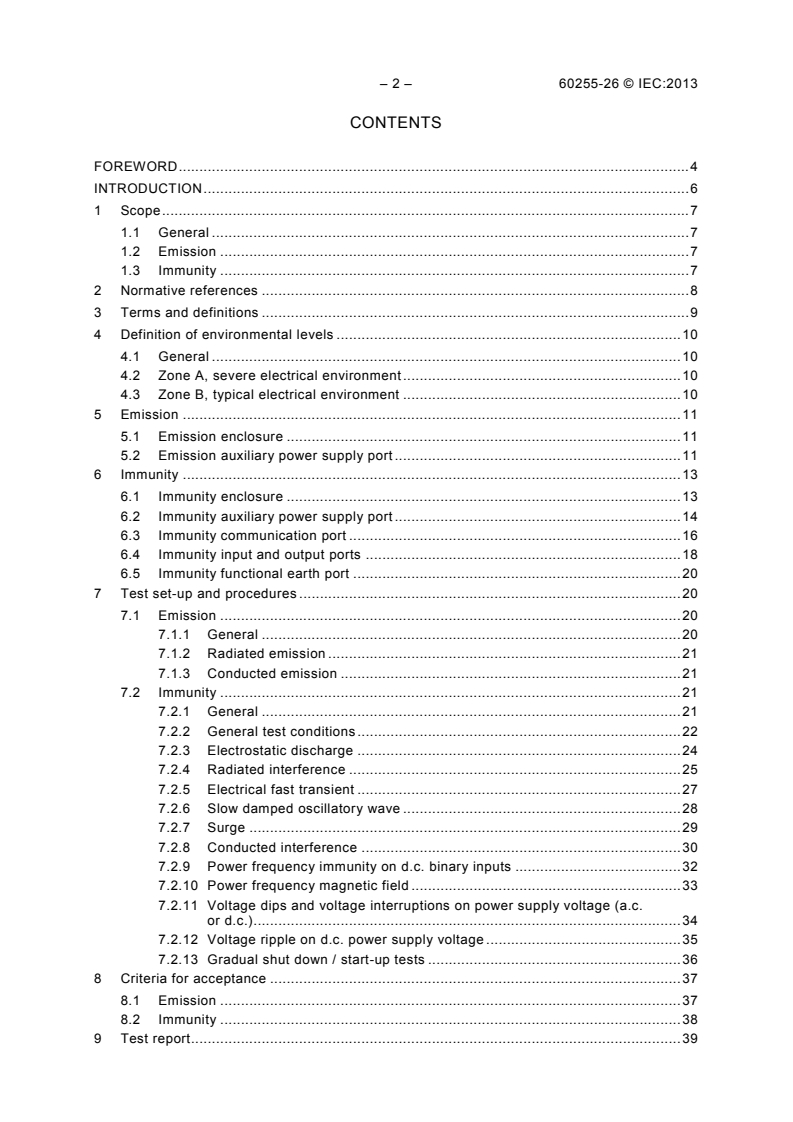
CONTENTS
FOREWORD . 4
INTRODUCTION . 6
1 Scope . 7
1.1 General . 7
1.2 Emission . 7
1.3 Immunity . 7
2 Normative references . 8
3 Terms and definitions . 9
4 Definition of environmental levels . 10
4.1 General . 10
4.2 Zone A, severe electrical environment . 10
4.3 Zone B, typical electrical environment . 10
5 Emission . 11
5.1 Emission enclosure . 11
5.2 Emission auxiliary power supply port . 11
6 Immunity . 13
6.1 Immunity enclosure . 13
6.2 Immunity auxiliary power supply port . 14
6.3 Immunity communication port . 16
6.4 Immunity input and output ports . 18
6.5 Immunity functional earth port . 20
7 Test set-up and procedures . 20
7.1 Emission . 20
7.1.1 General . 20
7.1.2 Radiated emission . 21
7.1.3 Conducted emission . 21
7.2 Immunity . 21
7.2.1 General . 21
7.2.2 General test conditions . 22
7.2.3 Electrostatic discharge . 24
7.2.4 Radiated interference . 25
7.2.5 Electrical fast transient . 27
7.2.6 Slow damped oscillatory wave . 28
7.2.7 Surge . 29
7.2.8 Conducted interference . 30
7.2.9 Power frequency immunity on d.c. binary inputs . 32
7.2.10 Power frequency magnetic field . 33
7.2.11 Voltage dips and voltage interruptions on power supply voltage (a.c.
or d.c.) . 34
7.2.12 Voltage ripple on d.c. power supply voltage . 35
7.2.13 Gradual shut down / start-up tests . 36
8 Criteria for acceptance . 37
8.1 Emission . 37
8.2 Immunity . 38
9 Test report . 39
60255-26 © IEC:2013 – 3 –
Annex A (normative) Power frequency immunity tests on binary inputs . 40
Annex B (informative) Background information for power frequency tests . 44
Annex C (normative) Application of discharges for electrostatic discharge test . 45
Bibliography . 46
Figure 1 – Ports for measuring relays and protection equipment . 9
Figure 2 – Gradual shut down/start-up test . 36
Figure A.1 – Example of Class A differential mode tests . 42
Figure A.2 – Example of Class B differential mode tests . 42
Figure A.3 – Example of common mode tests . 43
Table 1 – Emission tests – Enclosure port . 11
Table 2 – Emission tests – Auxiliary power supply port . 12
Table 3 – Immunity tests – Enclosure port . 13
Table 4 – Immunity tests – Auxiliary power supply port . 14
Table 5 – Immunity tests – Communication port . 16
Table 6 – Immunity tests – Input and output ports . 18
Table 7 – Immunity tests – Functional earth port . 20
Table 8 – Radiated emission test . 21
Table 9 – Conducted emission test . 21
Table 10 – Electrostatic discharge immunity test . 24
Table 11 – Radiated interference immunity test (frequency sweep) . 25
Table 12 – Radiated interference immunity test (spot frequencies). 26
Table 13 – Electrical fast transient immunity test . 27
Table 14 – Slow damped oscillatory wave immunity test . 28
Table 15 – Surge immunity test . 29
Table 16 – Conducted interference immunity test (frequency sweep) . 30
Table 17 – Conducted interference immunity test (spot frequencies) . 31
Table 18 – Power frequency immunity test . 32
Table 19 – Power frequency magnetic field immunity test . 33
Table 20 – Voltage dips and voltage interruptions test . 34
Table 21 – Voltage ripple test . 35
Table 22 – Gradual shutdown and start-up test . 36
Table 23 – Acceptance criteria for immunity tests . 38
– 4 – 60255-26 © IEC:2013
INTERNATIONAL ELECTROTECHNICAL COMMISSION
____________
MEASURING RELAYS AND PROTECTION EQUIPMENT –
Part 26: Electromagnetic compatibility requirements
FOREWORD
1) The International Electrotechnical Commission (IEC) is a worldwide organization for standardization comprising
all national electrotechnical committees (IEC National Committees). The object of IEC is to promote
international co-operation on all questions concerning standardization in the electrical and electronic fields. To
this end and in addition to other activities, IEC publishes International Standards, Technical Specifications,
Technical Reports, Publicly Available Specifications (PAS) and Guides (hereafter referred to as “IEC
Publication(s)”). Their preparation is entrusted to technical committees; any IEC National Committee interested
in the subject dealt with may participate in this preparatory work. International, governmental and non-
governmental organizations liaising with the IEC also participate in this preparation. IEC collaborates closely
with the International Organization for Standardization (ISO) in accordance with conditions determined by
agreement between the two organizations.
2) The formal decisions or agreements of IEC on technical matters express, as nearly as possible, an international
consensus of opinion on the relevant subjects since each technical committee has representation from all
interested IEC National Committees.
3) IEC Publications have the form of recommendations for international use and are accepted by IEC National
Committees in that sense. While all reasonable efforts are made to ensure that the technical content of IEC
Publications is accurate, IEC cannot be held responsible for the way in which they are used or for any
misinterpretation by any end user.
4) In order to promote international uniformity, IEC National Committees undertake to apply IEC Publications
transparently to the maximum extent possible in their national and regional publications. Any divergence
between any IEC Publication and the corresponding national or regional publication shall be clearly indicated in
the latter.
5) IEC provides no marking procedure to indicate its approval and cannot be rendered responsible for any
equipment declared to be in conformity with an IEC Publication.
6) All users should ensure that they have the latest edition of this publication.
7) No liability shall attach to IEC or its directors, employees, servants or agents including individual experts and
members of its technical committees and IEC National Committees for any personal injury, property damage or
other damage of any nature whatsoever, whether direct or indirect, or for costs (including legal fees) and
expenses arising out of the publication, use of, or reliance upon, this IEC Publication or any other IEC
Publications.
8) Attention is drawn to the Normative references cited in this publication. Use of the referenced publications is
indispensable for the correct application of this publication.
9) Attention is drawn to the possibility that some of the elements of this IEC Publication may be the subject of
patent rights. IEC shall not be held responsible for identifying any or all such patent rights.
International Standard IEC 60255-26 has been prepared by IEC technical committee 95:
Measuring relays and protection equipment.
This third edition cancels and replaces the second edition published in 2008. This third edition
also cancels and replaces the following standards: IEC 60255-22-1:2007,
IEC 60255-22-2:2008; IEC 60255-22-3:2007, IEC 60255-22-4:2008, IEC 60255-22-5:2008,
IEC 60255-22-6:2001 and IEC 60255-22-7:2003, IEC 60255-11:2008, IEC 60255-25:2000 and
IEC 60255-26:2008. This edition constitutes a technical revision.
This edition includes the following significant technical changes with respect to the previous
edition:
a) definition of test specifications, test procedures and acceptance criteria per phenomena
and port under test in one document;
b) extension of radiated emission measurement for frequencies above 1 GHz;
c) limitation of radiated emission measurement at 3 m distance for small equipment only;
d) addition of zone A and zone B test level on surge test;
60255-26 © IEC:2013 – 5 –
e) extension of tests on the auxiliary power supply port by a.c. and d.c. voltage dips, a.c.
component in d.c. (ripple) and gradual shut-down / start-up;
f) harmonization of acceptance criteria for immunity tests.
The text of this standard is based on the following documents:
FDIS Report on voting
95/309/FDIS 95/312/RVD
Full information on the voting for the approval of this standard can be found in the report on
voting indicated in the above table.
This publication has been drafted in accordance with the ISO/IEC Directives, Part 2.
A list of all the parts in the IEC 60255 series, published under the general title Measuring
relays and protection equipment, can be found on the IEC website.
The committee has decided that the contents of this publication will remain unchanged until
the maintenance result date indicated on the IEC web site under "http://webstore.iec.ch" in
the data related to the specific publication. At this date, the publication will be
• reconfirmed;
• withdrawn;
• replaced by a revised edition, or
• amended.
– 6 – 60255-26 © IEC:2013
INTRODUCTION
This part of the IEC 60255 series specifies all of the requirements for electromagnetic
compatibility in a single document.
As such, it is considered as an overview document for measuring relays and protection
equipment. The detailed test procedures are given in other referenced standards.
This part of IEC 60255 does not include the reversal of d.c. power supply polarity test which
had been provided in IEC 60255-11, because this is a safety test. This test will be covered by
future IEC 60255-27.
60255-26 © IEC:2013 – 7 –
MEASURING RELAYS AND PROTECTION EQUIPMENT –
Part 26: Electromagnetic compatibility requirements
1 Scope
1.1 General
This part of the IEC 60255 series is applicable to measuring relays and protection equipment,
taking into account combinations of devices to form schemes for power system protection
including the control, monitoring, communication and process interface equipment used with
those systems.
This standard specifies the requirements for electromagnetic compatibility for measuring
relays and protection equipment.
Tests specified in this standard are not required for equipment not incorporating electronic
circuits, for example electromechanical relays.
The requirements specified in this standard are applicable to measuring relays and protection
equipment in a new condition and all tests specified are type tests only.
1.2 Emission
The object of this standard is to specify limits and test methods, for measuring relays and
protection equipment in relation to electromagnetic emissions which may cause interference
in other equipment.
These emission limits represent electromagnetic compatibility requirements and have been
selected to ensure that the disturbances generated by measuring relays and protection
equipment, operated normally in substations and power plants, do not exceed a specified
level which could prevent other equipment from operating as intended.
Test requirements are specified for the enclosure and auxiliary power supply ports.
1.3 Immunity
This standard is to specify the immunity test requirements for measuring relays and protection
equipment in relation to continuous and transient, conducted and radiated disturbances,
including electrostatic discharges.
These test requirements represent the electromagnetic compatibility immunity requirements
and have been selected so as to ensure an adequate level of immunity for measuring relays
and protection equipment, operated normally in substations and power plants.
NOTE 1 Safety considerations are not covered in this standard.
NOTE 2 In special cases, situations will arise where the levels of disturbance could exceed the levels specified in
this standard, for example where a hand-held transmitter or a mobile telephone is used in close proximity to
measuring relays and protection equipment. In these instances, special precautions and procedures could have to
be employed.
– 8 – 60255-26 © IEC:2013
2 Normative references
The following documents, in whole or in part, are normatively referenced in this document and
are indispensable for its application. For dated references, only the edition cited applies. For
undated references, the latest edition of the referenced document (including any
amendments) applies.
IEC 60255-1:2009, Measuring relays and protection equipment – Part 1: Common
requirements
IEC 61000-4-2:2008, Electromagnetic compatibility (EMC) – Part 4-2: Testing and
measurement techniques – Electrostatic discharge immunity test
IEC 61000-4-3:2006, Electromagnetic compatibility (EMC) – Part 4-3: Testing and
measurement techniques – Radiated, radio-frequency, electromagnetic field immunity test
Amendment 1:2007
Amendment 2:2010
IEC 61000-4-4:2012, Electromagnetic compatibility (EMC) – Part 4-4: Testing and
measurement techniques – Electrical fast transient/burst immunity test
IEC 61000-4-5:2005, Electromagnetic compatibility (EMC) – Part 4-5: Testing and
measurement techniques – Surge immunity test
IEC 61000-4-6:2008, Electromagnetic compatibility (EMC) – Part 4-6: Testing and
measurement techniques – Immunity to conducted disturbances, induced by radio-frequency
fields
IEC 61000-4-8:2009, Electromagnetic compatibility (EMC) – Part 4-8: Testing and
measurement techniques – Power frequency magnetic field immunity test
IEC 61000-4-11:2004, Electromagnetic compatibility (EMC) – Part 4-11: Testing and
measurement techniques – Voltage dips, short interruptions and voltage variations immunity
tests
IEC 61000-4-16:1998, Electromagnetic compatibility (EMC) – Part 4-16: Testing and
measurement techniques – Test for immunity to conducted, common mode disturbances in
the frequency range 0 Hz to 150 kHz
Amendment 2:2009
IEC 61000-4-17:1999, Electromagnetic compatibility (EMC) – Part 4-17: Testing and
measurement techniques – Ripple on d.c. input power port immunity test
Amendment 1:2001
Amendment 2:2008
IEC 61000-4-18:2006, Electromagnetic compatibility (EMC) – Part 4-18: Testing and
measurement techniques – Damped oscillatory wave immunity test
Amendment 1:2010
IEC 61000-4-29:2000, Electromagnetic compatibility (EMC) – Part 4-29: Testing and
measurement techniques – Voltage dips, short interruptions and voltage variations on d.c.
input power port immunity tests
CISPR 11:2009, Industrial, scientific and medical equipment – Radio-frequency disturbance
characteristics – Limits and methods of measurement
Amendment 1:2010
60255-26 © IEC:2013 – 9 –
CISPR 22:2008, Information technology equipment – Radio disturbance characteristics –
Limits and methods of measurement
3 Terms and definitions
For the purposes of this document, the following terms and definitions apply.
3.1
EUT
Equipment Under Test
equipment which may be either a measuring relay or protection equipment
3.2
small equipment
equipment, either positioned on a table top or standing on the floor which, including its cables
fits in a cylindrical test volume of 1,2 m in diameter and 1,5 m above the ground plane.
3.3
port
particular interface of the specified EUT with the external electromagnetic environment
SEE: Figure 1
Enclosure port
Auxiliary power supply port Functional earth port
Output port
EUT
Input port Communication port
IEC 1203/13
Figure 1 – Ports for measuring relays and protection equipment
3.4
auxiliary power supply port
a.c. or d.c. auxiliary energizing input of the EUT
3.5
communication port
interface with a communication and/or control system permanently connected to the EUT
3.6
enclosure port
physical boundary of the EUT through which electromagnetic fields may radiate or impinge
3.7
functional earth port
port on the EUT which is connected to earth for purposes other than electrical safety
3.8
input port
port through which the EUT is energized or controlled in order to perform its function(s)
EXAMPLE Current and voltage transformer, binary input, etc.
– 10 – 60255-26 © IEC:2013
3.9
output port
port through which the EUT produces predetermined changes
EXAMPLE Contacts, optocouplers, analogue output, etc.
3.10
coupling/decoupling network
CDN
electrical circuit for the purpose of transferring energy from one circuit to another/
electrical circuit for the purpose of preventing test voltages applied to the EUT from affecting
other devices, equipment, or systems which are not under test
3.11
common mode
CM
mode between each active conductor and a specified reference, usually earth or ground
reference plane
3.12
differential mode
DM
mode between any two of a specified set of active conductors
4 Definition of environmental levels
4.1 General
The environmental levels shall be selected in accordance with the most realistic installation
and environmental conditions in which the EUT is expected to operate.
Based on common installation practices, the recommended selection of test levels is the
following:
4.2 Zone A, severe electrical environment
The installation is characterized by the following attributes:
• no suppression of electrical fast transients/bursts in the power supply and control and
power circuits which are switched by relays and contactors;
• no separation of the industrial circuits from other circuits associated with environments of
higher severity levels;
• no separation between power supply, control, signal and communication cables;
• use of common multi-core cables for control and signal lines.
The outdoor area of industrial process equipment, where no specific installation practice has
been adopted, of power stations, open-air HV substation switchyards and gas insulated
switchgear may be representative of this environment.
4.3 Zone B, typical electrical environment
The installation is characterized by the following attributes:
• no suppression of electrical fast transients/bursts in the power supply and control circuits
which are switched by relays (no contactors);
• poor separation of the industrial circuits from other circuits associated with environments
of higher severity levels;
60255-26 © IEC:2013 – 11 –
• dedicated cables for power supply, control, signal and communication lines;
• poor separation between power supply, control, signal and communication cables;
• availability of earthing system represented by conductive pipes, ground conductors in the
cable trays (connected to the protective earth system) and by a ground mesh.
The area of industrial process equipment, the power plants and the relay room of open-air HV
substations may be representative of this environment.
5 Emission
5.1 Emission enclosure
Table 1 – Emission tests – Enclosure port
Environmental Basic Test
Item Frequency range Limits
phenomena standard procedure
40 dB(µV/m) quasi peak
at 10 m
30 MHz to 230 MHz
50 dB(µV/m) quasi peak
at 3 m
Radiated emission
1.1 CISPR 11 See 7.1.2
ab
(below 1 GHz)
47 dB(µV/m) quasi peak
at 10 m
230 MHz to 1 000 MHz
57 dB(µV/m) quasi peak
at 3 m
56 dB(µV/m) average
1 GHz to 3 GHz
76 dB(µV/m) peak
at 3 m
Radiated emission
1.2 CISPR 22 See 7.1.2
(above 1 GHz)
60 dB(µV/m) average
3 GHz to 6 GHz
80 dB(µV/m) peak
at 3 m
a
Measuring relays and protection equipment are apparatus which satisfy the class A limits. Limits can be
measured at a nominal distance of 3 m, 10 m or 30 m. A measuring distance less than 10 m is allowed only for
equipment which complies with the definition given in 3.2. In case of measurements at a separation distance of
30 m an inverse proportionality factor of 20 dB per decade shall be used to normalize the measured data to
the specified distance for determining compliance.
b
The limits specified for the 3 m separation distance apply only to small equipment meeting the size criterion
defined in 3.2.
Conditional testing procedure
• The highest internal source of an EUT is defined as the highest frequency generated or
used within the EUT or on which the EUT operates or tunes.
• If the highest frequency of the internal sources of the EUT is less than 108 MHz, the
measurement shall only be made up to 1 GHz.
• If the highest frequency of the internal sources of the EUT is between 108 MHz and
500 MHz, the measurement shall only be made up to 2 GHz.
• If the highest frequency of the internal sources of the EUT is between 500 MHz and
1 GHz, the measurement shall only be made up to 5 GHz.
• If the highest frequency of the internal sources of the EUT is above 1 GHz, the
measurement shall be made up to 5 times the highest frequency or 6 GHz, whichever is
less.
5.2 Emission auxiliary power supply port
See Table 2.
– 12 – 60255-26 © IEC:2013
Table 2 – Emission tests – Auxiliary power supply port
Environmental Basic Test
Item Frequency range Limits
phenomena standard procedure
2.1 Conducted
79 dB(µV) quasi peak
0,15 MHz to 0,50 MHz
emission
66 dB(µV) average
CISPR 22 See 7.1.3
73 dB(µV) quasi peak
0,5 MHz to 30 MHz
60 dB(µV) average
60255-26 © IEC:2013 – 13 –
6 Immunity
6.1 Immunity enclosure
Table 3 – Immunity tests – Enclosure port
Basic Test Acceptance
Environmental Test
Item Units standard procedure criteria
phenomena specification
(see 8.2)
3.1 Radiated
radiofrequency
electromagnetic
field
Frequency sweep
Test frequency 80 to 1 000 MHz
range
1 400 to 2 700 MHz
Test field strength 10 V/m (r.m.s.)
(prior to
modulation)
Amplitude 80 % AM (1 kHz)
modulated
Sweep rate ≤ 1 % (of preceding
frequency value)
Spot frequencies
IEC
7.2.4 A
61000-4-3
Test spot MHz
80 ± 0,5 %
frequencies
MHz
160 ± 0,5 %
380 ± 0,5 %
MHz
450 ± 0,5 %
MHz
900 ± 5
MHz
1 850 ± 5
MHz
2 150 ± 5 MHz
Test field strength 10 V/m (r.m.s.)
(prior to
modulation)
Amplitude 80 % AM (1 kHz)
modulated
Duty cycle 100 %
3.2 Electrostatic
discharge
IEC
See 7.2.3 B
Contact 2 4 6 kV (charge voltage) 61000-4-2
Air 2 4 8 kV (charge voltage)
3.3 Power frequency
magnetic field
IEC
See 7.2.10
Continuous 30 A/m 61000-4-8
A
1 s to 3 s 300 A/m B
– 14 – 60255-26 © IEC:2013
6.2 Immunity auxiliary power supply port
Table 4 – Immunity tests – Auxiliary power supply port
Item Environmental Test Units Basic Test Acceptance
phenomena specification standard procedure criteria
(see 8.2)
Conducted
4.1
disturbance induced
by radio-frequency
fields
Frequency sweep
Test frequency 0,15 to 80 MHz
range
Test level (prior to 10 V (r.m.s.)
modulation)
Source impedance 150
Ω
Amplitude 80 % AM (1 kHz)
modulated
IEC
See 7.2.8 A
61000-4-6
Sweep rate % (of preceding
≤ 1
frequency value)
Spot frequencies
Test spot 27 ± 0,5 % MHz
frequencies
MHz
68 ± 0,5 %
Test level (prior to 10 V (r.m.s.)
modulation)
Source impedance 150 Ω
Amplitude 80 % AM (1 kHz)
modulated
Duty cycle 100 %
4.2 Fast transients
Rise time t / 5 / 50 ns
r
duration time t
d
IEC
Test level
See 7.2.5 B
61000-4-4
Zone A 4 kV peak voltage
Zone B 2 kV peak voltage
Repetition frequency 5 kHz
4.3 Slow damped
oscillatory wave
Voltage oscillation 1 MHz
frequency
Test level
IEC
Differential mode 1 kV peak voltage See 7.2.6 B
61000-4-18
Common mode 2,5 kV peak voltage
Voltage rise time 75 ns
Repetition frequency 400 Hz
Output impedance 200
Ω
60255-26 © IEC:2013 – 15 –
Item Environmental Test Units Basic Test Acceptance
phenomena specification standard procedure criteria
(see 8.2)
Surge
4.4
Front time / 1,2 / 50 (8 / 20)
µs voltage (current)
time to half value
Source impedance 2
Ω
Test level
Line-to-line
Zone A 0,5 1 2 kV
Zone B 0,5 1 kV IEC
See 7.2.7 B
61000-4-5
Coupling resistor 0
Ω
Coupling capacitor 18
µF
Line-to-earth
Zone A 0,5 1 2 4 kV
Zone B 0,5 1 2 kV
Coupling resistor 10
Ω
Coupling capacitor 9 µF
4.5 A.C. and d.c. voltage
dips
Test level 0 % residual voltage
IEC
Duration time 61000-4-11
See 7.2.11 A
a
a.c. 0,5 to 25 cycles IEC
61000-4-29
b
d.c. 10 to 1 000 ms
Test level 40 % residual voltage
IEC
Duration time 61000-4-11
See 7.2.11 C
d
a.c. 10/12 cycles IEC
61000-4-29
d.c. 200 ms
Test level 70 % residual voltage
IEC
Duration time 61000-4-11
See 7.2.11 C
d
a.c. 25/30 cycles IEC
61000-4-29
d.c. 500 ms
4.6 A.C. and d.c. voltage
interruptions
Test level 0 % residual voltage
IEC
Duration time 61000-4-11
See 7.2.11 C
a.c. 250/300 cycles IEC
61000-4-29
d.c. 5 s
4.7 A.C. component in
d.c. (ripple)
Test level 15 % of rated V
d.c. value
IEC
See 7.2.12 A
c 61000-4-17
Test frequency 100/120 Hz, sinusoidal
waveform.
– 16 – 60255-26 © IEC:2013
Item Environmental Test Units Basic Test Acceptance
phenomena specification standard procedure criteria
(see 8.2)
Gradual shut-
4.8
down/start-up (for
d.c. power supply)
Shut-down ramp 60 s
Power off 5 min --- See 7.2.13 C
Start-up ramp 60 s
a
Manufacturer shall declare the duration among the following values: 0,5 cycle, 1 cycle, 2,5 cycles, 5 cycles,
10 cycles or 25 cycles.
b
Manufacturer shall declare the duration among the following values: 10 ms, 20 ms, 30 ms, 50 ms, 100 ms,
200 ms, 300 ms, 500 ms or 1 000 ms.
c
Test shall be done at a frequency of twice the specified power system frequency(s).
d
“10/12 cycles” means “10 cycles for 50 Hz test” and “12 cycles for 60 Hz test”.
6.3 Immunity communication port
Table 5 – Immunity tests – Communication port
Item Environmental Test Units Basic Test Acceptance
phenomena specification standard procedure criteria
(see 8.2)
5.1 Conducted
disturbance induced
by radio-frequency
fields
Frequency sweep
Test frequency range 0,15 to 80 MHz
Test level (prior to 10 V (r.m.s.)
modulation)
Source impedance 150
Ω
Amplitude 80 % AM (1 kHz)
modulated
IEC
See 7.2.8 A
Sweep rate % (of preceding
≤ 1
61000-4-6
frequency value)
Spot frequencies
Test spot frequencies 27 ± 0,5 % MHz
MHz
68 ± 0,5 %
Test level (prior to 10 V (r.m.s.)
modulation)
Source impedance 150 Ω
Amplitude 80 % AM (1 kHz)
modulated
Duty cycle 100 %
Fast transients
5.2
Rise time t / 5 / 50 ns
r
Duration time t
d
IEC
Test level
See 7.2.5 B
61000-4-4
Zone A 2 kV peak voltage
Zone B 1 kV peak voltage
Repetition frequency 5 kHz
60255-26 © IEC:2013 – 17 –
Item Environmental Test Units Basic Test Acceptance
phenomena specification standard procedure criteria
(see 8.2)
Slow damped
5.3
oscillatory wave
Voltage oscillation 1 MHz
frequency
Test level
IEC
See 7.2.6 B
Differential mode 0 kV peak voltage
61000-4-18
Common mode 1 kV peak voltage
Voltage rise time 75 ns
Repetition frequency 400 Hz
Output impedance 200
Ω
5.4 Surge
Front time / 1,2 / 50 (8 /
µs voltage
time to half value 20)
(current)
Source impedance 2 Ω
Test level
IEC
See 7.2.7 B
Line-to-earth 61000-4-5
Zone A 0,5 1 2 4 kV
Zone B 0,5 1 2 kV
a
Coupling resistor 0
Ω
a
Coupling capacitor 0 µF
a
These coupling values are for screened communication ports. For unscreened communication ports use
coupling values given in Table 6, item 6.4.
– 18 – 60255-26 © IEC:2013
6.4 Immunity input and output ports
Table 6 – Immunity tests – Input and output ports
Item Environmental Test Units Basic Test Acceptance
phenomena specification standard procedure criteria
(see 8.2)
Conducted
6.1
disturbance induced
by radio-frequency
fields
Frequency sweep
Test frequency range 0,15 to 80 MHz
Test level (prior to 10 V (r.m.s.)
modulation)
Source impedance 150
Ω
Amplitude 80 % AM (1 kHz)
modulated
IEC
See 7.2.8 A
Sweep rate ≤ 1 % (of preceding
61000-4-6
frequency value)
Spot frequencies
Test spot frequencies MHz
27 ± 0,5 %
MHz
68 ± 0,5 %
Test level (prior to 10 V (r.m.s.)
modulation)
Source impedance 150
Ω
Amplitude 80 % AM (1 kHz)
modulated
Duty cycle 100 %
6.2 Fast transients
Rise time t / 5 / 50 ns
r
duration time t
d
IEC
Test level
See 7.2.5 B
61000-4-4
Zone A 4 kV peak voltage
Zone B 2 kV peak voltage
Repetition frequency 5 kHz
Slow damped
6.3
oscillatory wave
Voltage oscillation 1 MHz
frequency
Test level
IEC
c
See 7.2.6 B
Differential mode 1 kV peak voltage
61000-4-18
Common mode 2,5 kV peak voltage
Voltage rise time 75 ns
Repetition frequency 400 Hz
Output impedance 200
Ω
60255-26 © IEC:2013 – 19 –
Item Environmental Test Units Basic Test Acceptance
phenomena specification standard procedure criteria
(see 8.2)
Surge
6.4
Front time / 1,2/50 (8/20)
µs voltage (current)
time to half value
Source impedance 2
Ω
Test level
Line-to-line
Zone A 0,5 1 2 kV
Zone B 0,5 1 kV IEC
See 7.2.7 B
61000-4-5
Coupling resistor 40
Ω
Coupling capacitor 0,5 µF
Line-to-earth
Zone A 0,5 1 2 4 kV
Zone B 0,5 1 2 kV
b
Coupling resistor 40
Ω
b
Coupling capacitor 0,5 µF
a
6.5 Power frequency
Zone A
Test voltage 150 V r.m.s.
differential mode
Coupling resistor 100
Ω
Coupling capacitor 0,1 µF
Test voltage 300 V r.m.s.
common mode
Coupling resistor 220
Ω
IEC
Coupling capacitor 0,47
µF
See 7.2.9 A
61000-4-16
Zone B
Test voltage 100 V r.m.s.
differential mode
Coupling resistor 100
Ω
Coupling capacitor 0,047 µF
Test voltage 300 V r.m.s.
common mode
Coupling resistor 220
Ω
Coupling capacitor 0,47
µF
a
The power frequency test is only applicable to binary input ports.
b
For screened input/output, e.g. transducer input/output use coupling as per Table 5, item 5.4.
c
In more severe environments a differential test voltage of 2,5 kV may be required for current and voltage
transformer inputs.
– 20 – 60255-26 © IEC:2013
6.5 Immunity functional earth port
Table 7 – Immunity tests – Functional earth port
Item Environmental Test Units Basic Test Acceptance
phenomena specification standard procedure criteria
(see 8.2)
Conducted
7.1
disturbance induced
by radio-frequency
fields
Frequency sweep
Test frequency range 0,15 to 80 MHz
Test level (prior to 10 V (r.m.s.)
modulation)
Source impedance 150
Ω
Amplitude 80 % AM (1 kHz)
modulated
IEC
See 7.2.8 A
61000-4-6
Sweep rate ≤ 1 % (of frequency)
Spot frequencies
Test spot frequencies 27 ± 0,5 % MHz
MHz
68 ± 0,5 %
Test level (prior to 10 V (r.m.s.)
modulation)
Source impedance 150 Ω
Amplitude 80 % AM (1 kHz)
modulated
Duty cycle 100 %
7.2 Fast transients
Rise time t / 5 / 50 ns
r
duration time t
d
IEC
Test level
See 7.2.5 B
61000-4-4
Zone A 4 kV peak voltage
Zone B 2 kV peak voltage
Repetition frequency 5 kHz
7 Test set-up and procedures
7.1 Emission
7.1.1 General
The tests shall be carried out with the equipment under reference conditions as stated in
IEC 60255-1, CISPR 11 and CISPR 22.
The tests shall be carried out with the rated values of auxiliary energizing and input
energizing quantities applied to the appropriate circuits of the EUT. The applied values shall
be representative of normal in-service quiescent conditions and the EUT shall neither be in a
transient operational state nor in an operated state. Half of the binary inputs and half of the
output relays shall be energized. Communication modules, if any, shall be activated.
For relays with a wide operating power supply range or rating, the radiated emissions shall be
performed on the lowest and the highest nominal voltage of the relay power supply.
60255-26 © IEC:2013 – 21 –
The conducted emission shall be performed on all nominal voltages of the relay power supply.
For most of their operational life, measuring relays and protection equipment are in a
quiescent state, and the instances when they may be operating or operated are extremely
short; in these instances, the emissions from the EUT are not considered to be of
significance.
7.1.2 Radiated emission
See Table 8.
Table 8 – Radiated emission test
Test set-up Test procedure
In accordance with CISPR 11 for radiated emission
Test configuration below 1 GHz and in accordance with CISPR 22 for
radiated emission above 1 GHz
Distance and method See Table 1
Details of mounting Installed according to manufacturer’s specification
Frequency range See Table 1
Acceptance criteria Class A limits See Table 1
7.1.3 Conducted emission
See
...