

IEC 61995-1:2005
(Main)Devices for the connection of luminaires for household and similar purposes - Part 1: General requirements
General Information
- Abstract
IEC 61995-1:2005 applies to devices for the connection of luminaires (DCL) intended for household and similar purposes, for the electrical connection of fixed luminaires to final circuits rated at not more than 16 A without providing mechanical support for the luminaire. DCLs are intended for use according to their IP rating per IEC 60529.
- Status
- Published
- Publication Date
- 25-May-2016
- Technical Committee
- SC 23B - Plugs, socket-outlets and switches
- Drafting Committee
- MT 13 - TC 23/SC 23B/MT 13
Buy Documents

IEC 61995-1:2005+AMD1:2016 CSV - Devices for the connection of luminaires for household and similarpurposes - Part 1: General requirements Released:5/26/2016
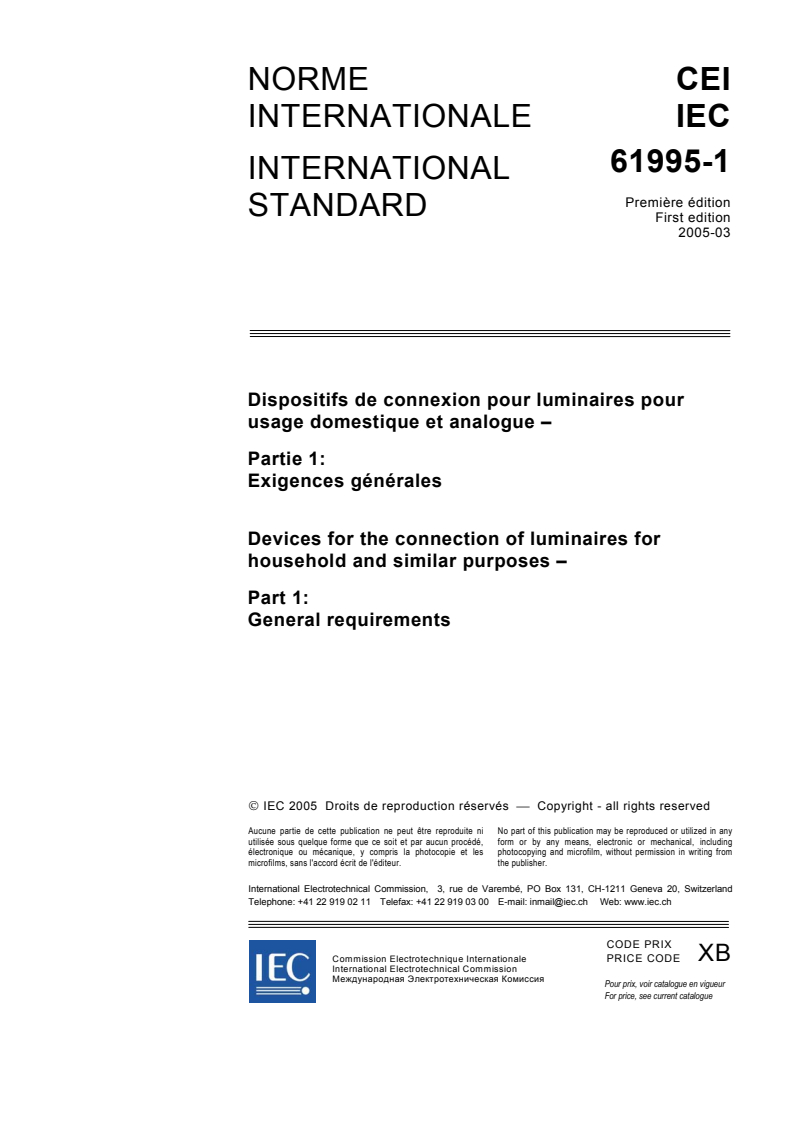
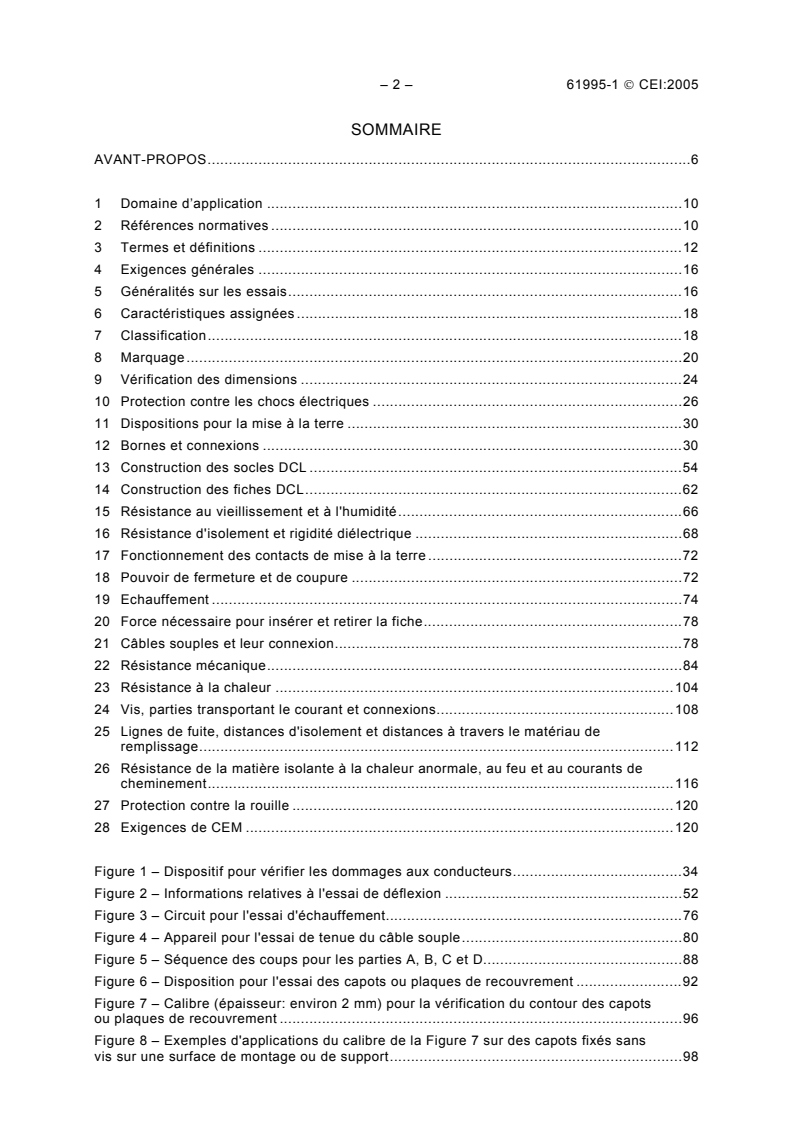
IEC 61995-1:2005 - Devices for the connection of luminaires for household and similar purposes - Part 1: General requirements Released:3/2/2005
Overview
IEC 61995-1:2005 is an international standard published by the International Electrotechnical Commission (IEC) that specifies the general requirements for devices intended for the connection of luminaires (devices for connecting lights) in household and similar environments. Commonly known as DCLs (Device for the Connection of Luminaires), these accessories are designed solely for the electrical connection of fixed luminaires to final electrical circuits, with a maximum current rating of 16 A. The standard ensures safe, reliable, and uniform connection practices for luminaires, without providing mechanical support to the fixtures themselves.
This standard is intended for use in conjunction with relevant IP (Ingress Protection) ratings as stipulated in IEC 60529, guiding the suitability of DCL devices for different environmental conditions.
Key Topics
Scope and Application
- Covers DCL outlets and plugs for connecting fixed luminaires of class I and class II.
- Applies to devices for use in household and similar premises, with final circuit ratings not exceeding 16 A.
- Specifies rated voltages of 125 V or 250 V at 50/60 Hz.
Classification and Marking
- DCLs are classified by method of application, terminal type, and mounting method.
- Outlets include earthing contacts and may have screw or screwless terminals.
- DCL plugs are available in rewirable and non-rewirable forms, suitable for flexible cables.
- Mandatory markings: current/voltage ratings, manufacturer details, terminal identification, and symbols for luminaire-only use.
Safety and Reliability
- Outlines protection against electric shock, mechanical strength, insulation resistance, and ageing.
- Specifies requirements for earthing provisions, dimension verification, and resistance to heat and humidity.
- DCL devices are subject to rigorous type tests to verify safety and conformity.
Testing Requirements
- Describes standard test conditions and procedures for durability of markings, temperature rise, insertion/withdrawal force, and EMC (Electromagnetic Compatibility).
Applications
IEC 61995-1-compliant DCLs are crucial for safety and efficiency in luminaires' installation in residential, commercial, and similar premises. Typical uses include:
Lighting Installations
- Ensures standardized electrical connections between the building wiring and fixed luminaires, enhancing installation speed and electrical safety.
Renovation and Upgrades
- Facilitates quick and safe replacement of luminaires, reducing installation time and minimizing wiring errors.
Compliance and Inspection
- Assists manufacturers, installers, and inspectors in verifying that connection devices meet international safety and performance requirements.
By adhering to these requirements, manufacturers and installers can ensure that lighting connections are robust, standardized, and reduce the risk of accidental electric shock or malfunction.
Related Standards
Several other IEC standards are referenced or closely related to IEC 61995-1:
- IEC 60529 - Degrees of protection provided by enclosures (IP Code), which specifies the suitability of DCL devices for various environments based on ingress protection.
- IEC 60068-2-32/75 - Environmental testing standards for free fall and hammer tests.
- IEC 60112 - Testing of solid insulating materials for electrical tracking.
- IEC 60695-2-11 - Fire hazard testing with glow-wire methods.
- IEC 60227-5 - Standards for polyvinyl chloride insulated flexible cables.
- IEC 61032 - Requirements for protection of persons and equipment by enclosures, including test probe dimensions.
- IEC 61140 - Protection against electric shock, relevant for classification and safety aspects of equipment.
- IEC 61995-2 (when available) - Standard sheets that specify interface dimensions and other detailed requirements for DCLs.
Practical Value
Implementing IEC 61995-1 supports standardized, safe, and interchangeable connection of luminaires in residential and similar settings. This reduces installation errors, ensures compatibility between products, and protects both users and installers from electrical hazards. The alignment with other IEC standards further enhances safety, reliability, and global interoperability of lighting installation devices.
Relations
- Effective Date
- 05-Sep-2023
- Effective Date
- 05-Sep-2023
Buy Documents
IEC 61995-1:2005+AMD1:2016 CSV - Devices for the connection of luminaires for household and similarpurposes - Part 1: General requirements Released:5/26/2016
IEC 61995-1:2005 - Devices for the connection of luminaires for household and similar purposes - Part 1: General requirements Released:3/2/2005
Get Certified
Connect with accredited certification bodies for this standard

IMQ S.p.A. (Certification)
Italian electrical product certification.

SLG Prüf- und Zertifizierungs GmbH
German testing and certification body.

UL Solutions
Global safety science company with testing, inspection and certification.
Sponsored listings
Frequently Asked Questions
IEC 61995-1:2005 is a standard published by the International Electrotechnical Commission (IEC). Its full title is "Devices for the connection of luminaires for household and similar purposes - Part 1: General requirements". This standard covers: IEC 61995-1:2005 applies to devices for the connection of luminaires (DCL) intended for household and similar purposes, for the electrical connection of fixed luminaires to final circuits rated at not more than 16 A without providing mechanical support for the luminaire. DCLs are intended for use according to their IP rating per IEC 60529.
IEC 61995-1:2005 applies to devices for the connection of luminaires (DCL) intended for household and similar purposes, for the electrical connection of fixed luminaires to final circuits rated at not more than 16 A without providing mechanical support for the luminaire. DCLs are intended for use according to their IP rating per IEC 60529.
IEC 61995-1:2005 is classified under the following ICS (International Classification for Standards) categories: 29.120.20 - Connecting devices; 29.140.40 - Luminaires. The ICS classification helps identify the subject area and facilitates finding related standards.
IEC 61995-1:2005 has the following relationships with other standards: It is inter standard links to IEC 61995-1:2005/AMD1:2016, IEC 61995-1:2025. Understanding these relationships helps ensure you are using the most current and applicable version of the standard.
IEC 61995-1:2005 is available in PDF format for immediate download after purchase. The document can be added to your cart and obtained through the secure checkout process. Digital delivery ensures instant access to the complete standard document.
Standards Content (Sample)
IEC 61995-1 ®
Edition 1.1 2016-05
CONSOLIDATED VERSION
INTERNATIONAL
STANDARD
NORME
INTERNATIONALE
colour
inside
Devices for the connection of luminaires for household and similar purposes –
Part 1: General requirements
Dispositifs de connexion pour luminaires pour usage domestique et analogue –
Partie 1: Exigences générales
All rights reserved. Unless otherwise specified, no part of this publication may be reproduced or utilized in any form
or by any means, electronic or mechanical, including photocopying and microfilm, without permission in writing from
either IEC or IEC's member National Committee in the country of the requester. If you have any questions about IEC
copyright or have an enquiry about obtaining additional rights to this publication, please contact the address below or
your local IEC member National Committee for further information.
Droits de reproduction réservés. Sauf indication contraire, aucune partie de cette publication ne peut être reproduite
ni utilisée sous quelque forme que ce soit et par aucun procédé, électronique ou mécanique, y compris la photocopie
et les microfilms, sans l'accord écrit de l'IEC ou du Comité national de l'IEC du pays du demandeur. Si vous avez des
questions sur le copyright de l'IEC ou si vous désirez obtenir des droits supplémentaires sur cette publication, utilisez
les coordonnées ci-après ou contactez le Comité national de l'IEC de votre pays de résidence.
IEC Central Office Tel.: +41 22 919 02 11
3, rue de Varembé Fax: +41 22 919 03 00
CH-1211 Geneva 20 info@iec.ch
Switzerland www.iec.ch
About the IEC
The International Electrotechnical Commission (IEC) is the leading global organization that prepares and publishes
International Standards for all electrical, electronic and related technologies.
About IEC publications
The technical content of IEC publications is kept under constant review by the IEC. Please make sure that you have the
latest edition, a corrigenda or an amendment might have been published.
IEC Catalogue - webstore.iec.ch/catalogue Electropedia - www.electropedia.org
The stand-alone application for consulting the entire The world's leading online dictionary of electronic and
bibliographical information on IEC International Standards, electrical terms containing 20 000 terms and definitions in
Technical Specifications, Technical Reports and other English and French, with equivalent terms in 15 additional
documents. Available for PC, Mac OS, Android Tablets and languages. Also known as the International Electrotechnical
iPad. Vocabulary (IEV) online.
IEC publications search - www.iec.ch/searchpub IEC Glossary - std.iec.ch/glossary
The advanced search enables to find IEC publications by a 65 000 electrotechnical terminology entries in English and
variety of criteria (reference number, text, technical French extracted from the Terms and Definitions clause of
committee,…). It also gives information on projects, replaced IEC publications issued since 2002. Some entries have been
and withdrawn publications. collected from earlier publications of IEC TC 37, 77, 86 and
CISPR.
IEC Just Published - webstore.iec.ch/justpublished
Stay up to date on all new IEC publications. Just Published IEC Customer Service Centre - webstore.iec.ch/csc
details all new publications released. Available online and If you wish to give us your feedback on this publication or
also once a month by email. need further assistance, please contact the Customer Service
Centre: csc@iec.ch.
A propos de l'IEC
La Commission Electrotechnique Internationale (IEC) est la première organisation mondiale qui élabore et publie des
Normes internationales pour tout ce qui a trait à l'électricité, à l'électronique et aux technologies apparentées.
A propos des publications IEC
Le contenu technique des publications IEC est constamment revu. Veuillez vous assurer que vous possédez l’édition la
plus récente, un corrigendum ou amendement peut avoir été publié.
Catalogue IEC - webstore.iec.ch/catalogue Electropedia - www.electropedia.org
Application autonome pour consulter tous les renseignements
Le premier dictionnaire en ligne de termes électroniques et
bibliographiques sur les Normes internationales,
électriques. Il contient 20 000 termes et définitions en anglais
Spécifications techniques, Rapports techniques et autres
et en français, ainsi que les termes équivalents dans 15
documents de l'IEC. Disponible pour PC, Mac OS, tablettes
langues additionnelles. Egalement appelé Vocabulaire
Android et iPad.
Electrotechnique International (IEV) en ligne.
Recherche de publications IEC - www.iec.ch/searchpub
Glossaire IEC - std.iec.ch/glossary
La recherche avancée permet de trouver des publications IEC
65 000 entrées terminologiques électrotechniques, en anglais
en utilisant différents critères (numéro de référence, texte,
et en français, extraites des articles Termes et Définitions des
comité d’études,…). Elle donne aussi des informations sur les
publications IEC parues depuis 2002. Plus certaines entrées
projets et les publications remplacées ou retirées.
antérieures extraites des publications des CE 37, 77, 86 et
CISPR de l'IEC.
IEC Just Published - webstore.iec.ch/justpublished
Restez informé sur les nouvelles publications IEC. Just Service Clients - webstore.iec.ch/csc
Published détaille les nouvelles publications parues. Si vous désirez nous donner des commentaires sur cette
Disponible en ligne et aussi une fois par mois par email. publication ou si vous avez des questions contactez-nous:
csc@iec.ch.
IEC 61995-1 ®
Edition 1.1 2016-05
CONSOLIDATED VERSION
INTERNATIONAL
STANDARD
NORME
INTERNATIONALE
colour
inside
Devices for the connection of luminaires for household and similar purposes –
Part 1: General requirements
Dispositifs de connexion pour luminaires pour usage domestique et analogue –
Partie 1: Exigences générales
INTERNATIONAL
ELECTROTECHNICAL
COMMISSION
COMMISSION
ELECTROTECHNIQUE
INTERNATIONALE
ICS 29.120.20, 29.140.40 ISBN 978-2-8322-3441-9
IEC 61995-1 ®
Edition 1.1 2016-05
CONSOLIDATED VERSION
REDLINE VERSION
VERSION REDLINE
colour
inside
Devices for the connection of luminaires for household and similar purposes –
Part 1: General requirements
Dispositifs de connexion pour luminaires pour usage domestique et analogue –
Partie 1: Exigences générales
– 2 – IEC 61995-1:2005+AMD1:2016 CSV
IEC 2016
CONTENTS
FOREWORD. 4
1 Scope . 6
2 Normative references . 6
3 Terms and definitions . 7
4 General requirements . 9
5 General notes on tests . 9
6 Ratings . 10
7 Classification . 10
8 Marking . 11
9 Checking of dimensions . 13
10 Protection against electric shock . 13
11 Provision for earthing. 15
12 Terminals and terminations . 16
13 Construction of DCL outlets . 27
14 Construction of DCL Plugs . 30
15 Resistance to ageing and to humidity . 33
16 Insulation resistance and electric strength . 34
17 Operation of earthing contacts . 35
18 Making and breaking capacity . 35
19 Temperature rise . 36
20 Force necessary to insert and withdraw the plug . 38
21 Flexible cables and their connection . 38
22 Mechanical strength . 40
23 Resistance to heat . 51
24 Screws, current-carrying parts and connections. 52
25 Creepage distances, clearances and distances through sealing compound . 54
26 Resistance of insulating material to abnormal heat, to fire and to tracking . 56
27 Resistance to rusting . 57
28 EMC Requirements . 58
Bibliography . 59
Figure 1 – Arrangement for checking damage to conductors . 18
Figure 2 – Information for deflection test . 26
Figure 3 – Circuit diagram for temperature rise test . 37
Figure 4 – Apparatus for testing the flexible cable retention . 39
Figure 5 – Sequence of blows for parts A, B, C and D . 43
Figure 6 – Arrangement for test on covers or cover-plates . 45
Figure 7 – Gauge (thickness: about 2 mm) for the verification of the outline of covers
or cover-plates . 47
Figure 8 – Examples of application of the gauge of Figure 7 on covers fixed without
screws on a mounting surface or supporting surface . 48
IEC 2016
Figure 9 – Examples of application of the gauge of Figure 7 in accordance with the
requirements of 22.6 . 49
Figure 10 – Gauge for verification of grooves, holes and reverse tapers . 50
Figure 11 – Sketch showing the direction of application of the gauge of Figure 10 . 50
Figure 12– Ball pressure test apparatus . 52
Table 1 – Connection of copper conductors . 17
Table 2– Values for checking damage to conductors . 19
Table 3 – Values for pull forces . 19
Table 4 – Core composition of conductors . 20
Table 5 – Screw torque values . 21
Table 6 – Test current for checking screwless terminals . 24
Table 7 – Conductors for deflection test . 27
Table 8 – Force for deflection test . 27
Table 9– Forces to be applied to covers, cover-plates whose fixing is not dependent on
screws . 29
Table 10 – Test sequence for temperature rise test . 37
Table 11 – Cable dimensions for the flexible cable retention test . 39
Table 12 – Schedule of mechanical strength test . 41
Table 13 – Height of fall for impact test . 42
Table 14 – Creepage distances and clearances . 55
– 4 – IEC 61995-1:2005+AMD1:2016 CSV
IEC 2016
INTERNATIONAL ELECTROTECHNICAL COMMISSION
____________
DEVICES FOR THE CONNECTION OF LUMINAIRES
FOR HOUSEHOLD AND SIMILAR PURPOSES –
Part 1: General requirements
FOREWORD
1) The International Electrotechnical Commission (IEC) is a worldwide organization for standardization comprising
all national electrotechnical committees (IEC National Committees). The object of IEC is to promote
international co-operation on all questions concerning standardization in the electrical and electronic fields. To
this end and in addition to other activities, IEC publishes International Standards, Technical Specifications,
Technical Reports, Publicly Available Specifications (PAS) and Guides (hereafter referred to as “IEC
Publication(s)”). Their preparation is entrusted to technical committees; any IEC National Committee interested
in the subject dealt with may participate in this preparatory work. International, governmental and non-
governmental organizations liaising with the IEC also participate in this preparation. IEC collaborates closely
with the International Organization for Standardization (ISO) in accordance with conditions determined by
agreement between the two organizations.
2) The formal decisions or agreements of IEC on technical matters express, as nearly as possible, an international
consensus of opinion on the relevant subjects since each technical committee has representation from all
interested IEC National Committees.
3) IEC Publications have the form of recommendations for international use and are accepted by IEC National
Committees in that sense. While all reasonable efforts are made to ensure that the technical content of IEC
Publications is accurate, IEC cannot be held responsible for the way in which they are used or for any
misinterpretation by any end user.
4) In order to promote international uniformity, IEC National Committees undertake to apply IEC Publications
transparently to the maximum extent possible in their national and regional publications. Any divergence
between any IEC Publication and the corresponding national or regional publication shall be clearly indicated in
the latter.
5) IEC itself does not provide any attestation of conformity. Independent certification bodies provide conformity
assessment services and, in some areas, access to IEC marks of conformity. IEC is not responsible for any
services carried out by independent certification bodies.
6) All users should ensure that they have the latest edition of this publication.
7) No liability shall attach to IEC or its directors, employees, servants or agents including individual experts and
members of its technical committees and IEC National Committees for any personal injury, property damage or
other damage of any nature whatsoever, whether direct or indirect, or for costs (including legal fees) and
expenses arising out of the publication, use of, or reliance upon, this IEC Publication or any other IEC
Publications.
8) Attention is drawn to the Normative references cited in this publication. Use of the referenced publications is
indispensable for the correct application of this publication.
9) Attention is drawn to the possibility that some of the elements of this IEC Publication may be the subject of
patent rights. IEC shall not be held responsible for identifying any or all such patent rights.
This consolidated version of the official IEC Standard and its amendment has been prepared
for user convenience.
IEC 61995-1 edition 1.1 contains the first edition (2005-03) [documents 23B/776/FDIS and
23B/782/RVD] and its amendment 1 (2016-05) [documents 23B/1208/FDIS and 23B/1212/RVD].
In this Redline version, a vertical line in the margin shows where the technical
content is modified by amendment 1. Additions are in green text, deletions are in
strikethrough red text. A separate Final version with all changes accepted is
available in this publication.
IEC 2016
International Standard IEC 61995-1 has been prepared by subcommittee 23B: Plugs, socket-
outlets and switches, of IEC technical committee 23: Electrical accessories.
This publication has been drafted in accordance with the ISO/IEC Directives, Part 2.
IEC 61995 consists of the following parts, under the general title Devices for the connection of
luminaires for household and similar purposes:
Part 1: General requirements
Part 2: Standard sheets
The committee has decided that the contents of the base publication and its amendment will
remain unchanged until the stability date indicated on the IEC web site under
"http://webstore.iec.ch" in the data related to the specific publication. At this date, the
publication will be
• reconfirmed,
• withdrawn,
• replaced by a revised edition, or
• amended.
IMPORTANT – The 'colour inside' logo on the cover page of this publication indicates
that it contains colours which are considered to be useful for the correct
understanding of its contents. Users should therefore print this document using a
colour printer.
– 6 – IEC 61995-1:2005+AMD1:2016 CSV
IEC 2016
DEVICES FOR THE CONNECTION OF LUMINAIRES
FOR HOUSEHOLD AND SIMILAR PURPOSES –
Part 1: General requirements
1 Scope
This part of IEC 61995-1 applies to devices for the connection of luminaires (DCL) intended
for household and similar purposes, for the electrical connection of fixed luminaires of class I
or class II to final circuits rated at not more than 16 A without providing a mechanical support
for the luminaire. DCLs are intended for use according to their IP rating per as specified in
IEC 60529.
Outlets have an earthing contact and a rated current of 6 A. Plugs are have a rated current at
of 6 A, unless otherwise specified in the relevant part 2.
The rated voltage is 125 V or 250 V at 50/60 Hz.
NOTE 1 This standard does not cover integrated DCL-plugs (under consideration).
This standard can also be applied to types other than those with standardised interface.
NOTE 2 In the following countries only types with a standardised interface according to IEC 61995-2 (under
consideration) are allowed: IT.
DCL plugs and DCL outlets complying with this standard are suitable for use under the
following conditions:
– an ambient temperature not normally exceeding 25 °C, but occasionally reaching 35 °C;
NOTE 3 The effect of the heat generated by the luminaire may affect the ambient temperature local to the
DCL.
– a temperature not exceeding 70 °C at the terminals of the DCL outlet including the effect
of heat generated by the luminaire and the passage of current.
NOTE 4 The requirements and tests of this standard may also be used as a guide when testing DCL's which
have different interface configurations or ratings.
2 Normative references
The following referenced documents are indispensable for the application of this document.
For dated references, only the edition cited applies. For undated references, the latest edition
of the referenced document (including any amendments) applies.
IEC 60068-2-32:1975, Environmental testing – Part 2: Tests – Test Ed: Free fall
IEC 60068-2-75:1997, Environmental testing – Part 2: Tests – Test Eh: Hammer test
IEC 60112, Method for the determination of the proof and the comparative tracking indices of
solid insulating materials
IEC 60227-5, Polyvinyl chloride insulated cables of rated voltages up to and including
450/750V – Part 5: Flexible cables (cords)
IEC 2016
1)
IEC 60417-DB: , Graphical symbols for use on equipment
IEC 60529, Degrees of protection provided by enclosures
IEC 60695-2-11, Fire hazard testing – Part 2-11: Glowing/hot-wire based test methods –
Glow-wire flammability test method for end-products
IEC 61032:1997, Protection of persons and equipment by enclosures – Probes for verification
3 Terms and definitions
For the purposes of this document, the following terms and definitions apply.
Where the terms voltage and current are used, they imply r.m.s. values, unless otherwise
specified.
Throughout this standard the word "earthing" is used for "protective earthing".
3.1
device for connecting a luminaire
DCL
system comprising a DCL outlet and a DCL plug providing a fixed luminaire with electrical
connection to and disconnection from a fixed installation
NOTE The designations DCL, DCL outlet or DCL plug, are used when it is necessary to specify particular
requirements and test specifications.
3.2
DCL outlet
device for connecting a luminaire having socket-contacts designed to engage with the pins of
a DCL plug and having terminals for the connection of cable
3.3
DCL plug
device for connecting a luminaire having pins designed to engage with the contacts of a DCL
outlet, also incorporating means for the electrical connection and mechanical retention of
flexible cable
3.4
rewirable DCL plug
DCL plug so constructed that the flexible cable can be replaced
3.5
non-rewirable DCL plug
DCL plug so constructed that it forms a complete unit with the flexible cable after connection
and assembly by the manufacturer of the plug (see also 14.1)
3.6
moulded-on DCL plug
non-rewirable DCL plug, the manufacture of which is completed by insulating material
moulded around pre-assembled component parts and the terminations of the flexible cable
———————
1)
“DB” refers to the IEC on-line database.
– 8 – IEC 61995-1:2005+AMD1:2016 CSV
IEC 2016
3.20
DCL temporary lampholder
independent lampholder designed in order to be temporarily connected to a DCL outlet, in
compliance with the corresponding standards, and provided with a DCL rewirable plug
(2P + E) for future connection of a luminaire
3.7
rated voltage
voltage assigned to the DCL plug or DCL outlet by the manufacturer
3.8
rated current
current assigned to the DCL plug or DCL outlet by the manufacturer
3.9
mounting box
box in or on a wall or ceiling, etc., for flush or surface application, intended to house a DCL
outlet
3.10
terminal
insulated or non-insulated connecting device intended for reusable electrical connection of the
external conductors
3.11
termination
insulated or non-insulated connecting device intended for non-reusable electrical connection
of the external conductors
3.12
clamping unit
part or parts of a terminal necessary for the mechanical clamping and the electrical
connection of the conductor(s)
3.13
screw-type terminal
terminal for the connection and subsequent disconnection of a conductor or the
interconnection of two or more conductors capable of being dismantled, the connection being
made, directly or indirectly, by means of screws or nuts of any kind
3.14
pillar terminal
terminal with screw clamping in which the conductor is inserted into a hole or cavity, where it
is clamped under the shank of the screw or screws. The clamping pressure may be applied
directly by the shank of the screw or through an intermediate member to which pressure is
applied by the shank of the screw
NOTE Examples of pillar terminals are shown in IEC 60999-1.
3.15
screw terminal
terminal with screw clamping in which the conductor is clamped under the head of the screw.
The clamping pressure may be applied directly by the head of the screw or through an
intermediate part, such as a washer, clamping plate or anti-spread device
NOTE Examples of screw terminals are shown in IEC 60999-1.
IEC 2016
3.16
stud terminal
terminal with screw clamping in which the conductor is clamped under a nut. The clamping
pressure may be applied directly by a suitably shaped nut or through an intermediate part,
such as a washer, clamping plate or anti-spread device
NOTE Examples of stud terminals are shown in IEC 60999-1.
3.17
mantle terminal
terminal with screw clamping in which the conductor is clamped against the base of a slot in a
threaded stud by means of a nut. The conductor is clamped against the base of the slot by a
suitably shaped washer under the nut, by a central peg if the nut is a cap nut, or by equally
effective means for transmitting the pressure from the nut to the conductor within the slot
NOTE Examples of mantle terminals are shown in IEC 60999-1.
3.18
screwless terminal
connecting device for the connection and subsequent disconnection of a rigid (solid or
stranded) or flexible conductor or the interconnection of two or more conductors capable of
being dismantled, the connection being made, directly or indirectly, by means of springs, parts
of angled, eccentric or conical form, etc., without special preparation of the conductor
concerned, other than removal of insulation
3.19
loop terminal
supply terminal intended for the interconnection of live conductors
4 General requirements
DCL systems shall be so designed and constructed that in normal use their performance is
reliable and without danger to the user or surroundings.
Compliance is checked by carrying out all the relevant tests specified.
5 General notes on tests
5.1 Tests according to this standard are type tests.
5.2 Unless otherwise specified, the specimens are tested as delivered and under normal
conditions of use.
Non-rewirable DCL plugs are tested with the type and size of flexible cable as delivered.
5.3 Unless otherwise specified, the tests are carried out in the order of the clauses, at an
ambient temperature between 15 °C and 35 °C. In case of doubt the tests are made at an
ambient temperature of (20 ± 5) °C.
Plugs and outlets are tested separately, unless otherwise specified.
The neutral is treated as a pole.
5.4 Unless otherwise specified, three specimens are subjected to all the relevant tests.
For the purpose of the test of 12.3.11 three new specimens are required.
– 10 – IEC 61995-1:2005+AMD1:2016 CSV
IEC 2016
For the purpose of the test of Clause 20 one additional specimen is required.
5.5 The specimens are submitted to all the relevant tests and the requirements are satisfied
if all these tests are met.
If one specimen does not satisfy a test due to an assembly or manufacturing fault, that test
and any preceding one which may have influenced the results of the test shall be repeated
and also the tests which follow shall be made in the required sequence on another full set of
specimens, all of which shall comply with the requirements.
NOTE The applicant may submit, together with the number of specimens specified in 5.4, an additional set of
specimens which may be required, should one specimen fail. The testing station will then, without further request,
test the additional specimens and will only reject them if a further failure occurs. If the additional set of specimens
is not submitted at the same time, the failure of one specimen will entail rejection.
6 Ratings
DCL plugs and DCL outlets shall have a rated voltage of 125 V a.c. or 250 V a.c. and a rated
current of 6 A.
Compliance is checked by inspection of the marking and by the tests described in this
standard.
7 Classification
7.1 DCLs are classified according to their interface design:
a) complying with the relevant part 2 of this standard;
b) other types (not complying with any relevant part 2 of this standard).
7.2 DCL outlets shall have an earthing contact and are classified:
7.2.1 according to the method of application:
– fixed type;
– floating type;
7.2.2 according to the type of terminals:
– DCL outlets with screw-type terminals;
– DCL outlets with screwless terminals for rigid conductors only;
– DCL outlets with screwless terminals for rigid and flexible conductors;
7.2.3 according to the provision of a loop terminal:
– DCL outlets with a loop terminal;
– DCL outlets without a loop terminal;
NOTE The loop terminal may be needed for the continuity of the live conductor.
7.2.4 according to the method of mounting as a consequence of design:
– design A – DCL outlets where the cover or cover-plate or parts of them can be removed
without displacement of the conductors;
– design B – DCL outlets where the cover or cover-plate or parts of them cannot be
removed without displacement of the conductors.
IEC 2016
NOTE If a DCL outlet has a base (main part) which cannot be separated from the cover or cover-plate and
requires a supplementary plate which can be removed for redecorating the wall or ceiling without displacement of
the conductors, it is considered to be of design A, provided the supplementary plate meets the requirements
specified for covers and cover-plates.
7.3 DCL plugs are classified:
7.3.1 according to the method of connecting the cable:
– rewirable DCL plugs;
– non-rewirable DCL plugs;
7.3.1.1 rewirable DCL plugs are classified according to the type of terminal:
– DCL plug with screw-type terminals,
– DCL plug with screwless terminals for rigid and flexible conductors.
Note: Only DCL plugs for connection of flexible cables are allowed in DK.
7.3.2 according to the class of luminaire to which they are intended to be connected:
– DCL plugs for fixed luminaires of Class I;
– DCL plugs for fixed luminaires of Class II;
NOTE For the description of the classes of equipment, see IEC 61140 (Protection against Electric Shock –
Common aspects for installation and equipment).
7.4 according to the degree of protection per IEC 60529;
7.5 according to the provision of signal contacts:
7.5.1 with provision;
7.5.2 without provision.
8 Marking
8.1 DCL outlets shall be marked with the following information:
– rated current;
– rated voltage;
– symbol for alternating current;
– name or trademark of the manufacturer or responsible vendor;
– terminal identification (see 8.5);
– symbol indicating that the outlet is only to be used with luminaires.
In addition DCL outlets with screwless terminals shall be marked with:
– an appropriate marking indicating the length of insulation to be removed before the
insertion of the conductor in the screwless terminal;
– an indication of the suitability to accept rigid conductors only (“r“) for those DCL outlets
having this restriction. (see also 12.3.1).
NOTE 1 The additional markings may shall be put on the DCL outlet,. In addition, they can be
given on the packaging unit and/or given in an instruction sheet which accompanies the DCL
outlet.
– 12 – IEC 61995-1:2005+AMD1:2016 CSV
IEC 2016
NOTE 2 The manufacturer should explain the marking “r” in the instruction sheet (r - use rigid conductors only).
The symbol indicating “luminaires only” shall be visible after installation but not necessarily
after insertion of the DCL plug.
8.2 DCL plugs shall be marked with the following information:
– rated current;
– rated voltage;
– symbol for alternating current;
– name or trademark of the manufacturer or responsible vendor;
– terminal identification (see 8.5);
– symbol indicating the plug is only for use with luminaires.
The symbol indicating “luminaires only” shall be visible after fitting the flexible cable but not
necessarily after insertion into the DCL outlet.
In addition DCL plugs with screwless terminals shall be marked with:
– an appropriate marking indicating the length of insulation to be removed before the
insertion of the conductor in the screwless terminal
NOTE The additional markings may shall be put either on the DCL plug, or on the packaging
unit, and/or given in an instruction sheet which accompanies the DCL plug.
8.3 DCL outlets and DCL plugs shall be provided with information warning the user that
these products are intended only for the connection of fixed luminaires.
Where it is necessary for safe operation that the user be aware of any particular
characteristics of the DCL plug or DCL outlet, the necessary information shall be given.
The instructions and information referred to in this subclause shall be given by marking the DCL
plug or DCL outlet itself, or where this is not practicable, in a notice which accompanies it.
8.4 Where symbols are used they shall be as follows:
– amperes A
– volts V
– nature of supply (symbol IEC 60417- 5032) ~
– line L
– neutral N
– protective earth (symbol IEC60417- 5019)
– symbol for use with luminaires only (symbol IEC60417-5974)
For the marking of rated current and rated voltage, figures may be used alone. These figures
shall be placed on one line separated by an oblique line. Alternatively the figure for rated
current shall be placed above the figure for rated voltage, separated by a horizontal line. The
marking for the nature of supply if any shall be next to the marking for voltage and current.
NOTE 1 Lines formed by the construction of the tool are not considered as part of the marking.
NOTE 2 Details of construction of symbols are given in IEC 60470.
NOTE 3 The marking for current, voltage and nature of supply may be, for example, as follows:
IEC 2016
6 A 250 V~ or 6/250~ or ~
8.5 Terminals intended exclusively for the neutral conductor shall be indicated by the letter N.
Earthing terminals shall be indicated by the symbol for protective earth.
These markings shall not be placed on screws, or any other easily removable parts.
NOTE "Easily removable parts" are those parts which can be removed during the normal installation of the DCL
outlet or the assembly of the DCL plug.
Terminations of non-rewirable DCL plugs need not be marked.
8.6 Markings shall be durable and easily legible.
Compliance is checked by inspection and by the following test:
The marking is rubbed by hand for 15 s with a piece of cloth soaked with water and again for
15 s with a piece of cloth soaked with petroleum spirit.
Marking made by impression, moulding, pressing or engraving is not subjected to this test.
NOTE It is recommended that the petroleum spirit used consist of a solvent hexane with an aromatic content of
maximum 0,1 volume percentage, a kauributanol value of 29, an initial boiling point of approximately 65 °C, a dry
point of approximately 69 °C and a specific density of approximately 0,68 g/cm³.
9 Checking of dimensions
9.1 DCL types classified according to 7.1 a) shall comply with the standard sheets of the
relevant part 2.
Compliance is checked by measurement and/or by means of gauges.
9.2 DCL types classified according to 7.1 b) as other types shall comply with the relevant
specification and shall not be interchangeable with or create a hazardous situation with DCL
types complying with the standard sheets of part 2.
Compliance is checked by measurement and/or by means of gauges.
10 Protection against electric shock
10.1 DCL outlets shall be so designed that, when they are wired and mounted as for normal
use, live parts are not accessible, even after removal of parts which can be removed without
the use of a tool.
Live parts of DCL plugs shall not be accessible when the DCL plug is in partial or complete
engagement with a DCL outlet.
Compliance is checked by inspection and, if necessary, by the following test:
The specimen is mounted as for normal use and fitted with conductors of the smallest cross-
sectional areas and the test is then repeated using conductors of the largest cross-sectional
areas, as specified in Table 1.
For DCL outlets, the test finger specified in IEC 61032 test probe B is applied in every
possible position.
– 14 – IEC 61995-1:2005+AMD1:2016 CSV
IEC 2016
For DCL plugs, the test finger is applied in every possible position when the plug is in partial
or complete engagement with a DCL outlet.
An electrical indicator with a voltage of (45 ± 5) V, is used to show contact with the relevant
part.
For DCL systems where the use of elastomeric or thermoplastic material is likely to influence
the requirement, the test is repeated but at an ambient temperature of (35 ± 2) °C, the DCLs
being at this temperature.
During this additional test the DCLs are subjected for 1 min to a force of 75 N, applied
through the tip of a straight unjointed test finger of the same dimensions as the standard test
finger. This finger, with an electrical indicator as described above, is applied to all places
where yielding of the insulating material could impair the safety of the accessory, and it is
applied to thin walled knock-outs with a force of 10 N.
During this test, the DCL, with its associated mounting means, shall not deform to such an
extent that those dimensions shown in the relevant standard sheets which ensure safety are
unduly altered and no live part shall be accessible.
10.2 Parts which are accessible when the DCL is wired and mounted as for normal use,
with exception of small screws and the like, isolated from live parts, for fixing bases and
covers or cover plates of DCL outlets, shall be made of insulating material; however the
covers or cover-plates of fixed DCL outlets may be made of metal if the requirements given in
10.2.1 or 10.2.2 are fulfilled.
10.2.1 The covers or cover-plates of metal shall be protected by supplementary insulation
made by insulating linings or insulating barriers fixed to covers or cover-plates or to the body
of the DCL, in such a way that the insulating linings or insulating barriers:
– either cannot be removed without being permanently damaged,
– or are so designed that:
– they cannot be replaced in an incorrect position;
– if they are omitted, the DCLs are rendered inoperable or manifestly incomplete;
– there is no risk of accidental contact between live parts and metal covers or cover-
plates, for example through their fixing screws, even if a conductor should come away
from its terminal;
– precautions are taken in order to prevent creepage distances or clearances becoming
less than the values specified in Clause 25.
Compliance is checked by inspection.
The above linings or barriers shall comply with the tests of Clauses 16 and 25.
NOTE Insulating coating sprayed on the inside or on the outside of the metal covers or cover plates is not
deemed to be an insulating lining or barrier for the purpose of this requirement.
10.2.2 The metal covers or cover-plates shall be securely connected, through a low
resistance connection, to the earth during fixing of the cover or the cover-plate itself.
NOTE 1 Fixing screws of metal covers, cover-plates or other means are allowed.
The creepage distances and the clearances between the live pins of a DCL plug when fully
inserted and the earthed metal cover of a DCL outlet shall comply with items 2 and 7 of Table
14 respectively.
Compliance is checked by inspection and by the test of 11.4.
IEC 2016
NOTE 2 Due to the lack of an earthing conductor in many existing old buildings, accessories requiring earth
connection cannot normally be used in the following countries: DK.
10.3 It shall not be possible to make connection between a pin of a DCL plug and a live
contact of a DCL outlet while any other pin is accessible.
Compliance is checked by manual test using a DCL outlet with corresponding DCL plug and
test finger specified in IEC 61032 test probe B in a manner most likely to make contact with
live parts. In applying the test a supply of (45 ± 5) V, in series with a suitable indicating lamp,
shall be connected between the test finger and the relevant conducting parts of the DCL plug
and/or DCL outlet.
For DCLs with enclosures or bodies of thermoplastic material, the test is made at an ambient
temperature of (35 ± 2) °C, both the DCL and the gauge being at this temperature.
For DCL outlets provided with metal covers or cover plates, a clearance, between a pin and a
socket-contact, of at least 2 mm is required, when another pin, or pins, is (are) in contact with
the metal covers or cover-plates.
10.4 External parts of DCL plugs, with the exception of assembly screws and the like,
current-carrying and earthing pins, earthing straps and metal rings around pins, shall be of
insulating material. Covers of DCL plugs may be of metal provided they comply with the
requirements of 10.2.1 or 10.2.2.
Compliance is checked by inspection.
NOTE Lacquer, enamel or sprayed insulating coating is not deemed to be insulating material for the purpose of
10.1 to 10.4.
11 Provision for earthing
11.1 DCLs with earthing contact shall be so constructed that, when inserting the DCL plug,
the earth connection is made before the current-carrying contacts of the DCL plug become
live.
When withdrawing the DCL plug, the current-carrying pins shall not remain live after the earth
connection is broken.
Compliance is checked by inspection and by measurement.
11.2 Earthing terminals of rewirable DCLs shall allow the proper connection of copper
conductors in accordance with Clause 12.
11.3 Accessible metal parts of DCL outlets, which may become live in the event of an
insulation fault, shall be permanently and reliably connected to the earthing terminal.
NOTE 1 This requirement does not apply to the metal cover or cover-plates complying with 10.2.1.
NOTE 2 For the purpose of this requirement, small screws and the like, isolated from live parts, for fixing bases,
covers or cover-plates, are not considered as accessible parts which may become live in the event of an insulation
fault.
Compliance with the requirements of 11.2 to 11.3 is checked by inspection and by the tests of
...
NORME CEI
INTERNATIONALE IEC
61995-1
INTERNATIONAL
Première édition
STANDARD
First edition
2005-03
Dispositifs de connexion pour luminaires pour
usage domestique et analogue –
Partie 1:
Exigences générales
Devices for the connection of luminaires for
household and similar purposes –
Part 1:
General requirements
Numéro de référence
Reference number
CEI/IEC 61995-1:2005
Numérotation des publications Publication numbering
Depuis le 1er janvier 1997, les publications de la CEI As from 1 January 1997 all IEC publications are
sont numérotées à partir de 60000. Ainsi, la CEI 34-1 issued with a designation in the 60000 series. For
devient la CEI 60034-1. example, IEC 34-1 is now referred to as IEC 60034-1.
Editions consolidées Consolidated editions
Les versions consolidées de certaines publications de la The IEC is now publishing consolidated versions of its
CEI incorporant les amendements sont disponibles. Par publications. For example, edition numbers 1.0, 1.1
exemple, les numéros d’édition 1.0, 1.1 et 1.2 indiquent and 1.2 refer, respectively, to the base publication,
respectivement la publication de base, la publication de the base publication incorporating amendment 1 and
base incorporant l’amendement 1, et la publication de the base publication incorporating amendments 1
base incorporant les amendements 1 et 2. and 2.
Informations supplémentaires Further information on IEC publications
sur les publications de la CEI
Le contenu technique des publications de la CEI est The technical content of IEC publications is kept
constamment revu par la CEI afin qu'il reflète l'état under constant review by the IEC, thus ensuring that
actuel de la technique. Des renseignements relatifs à the content reflects current technology. Information
cette publication, y compris sa validité, sont dispo- relating to this publication, including its validity, is
nibles dans le Catalogue des publications de la CEI available in the IEC Catalogue of publications
(voir ci-dessous) en plus des nouvelles éditions, (see below) in addition to new editions, amendments
amendements et corrigenda. Des informations sur les and corrigenda. Information on the subjects under
sujets à l’étude et l’avancement des travaux entrepris consideration and work in progress undertaken by the
par le comité d’études qui a élaboré cette publication, technical committee which has prepared this
ainsi que la liste des publications parues, sont publication, as well as the list of publications issued,
également disponibles par l’intermédiaire de: is also available from the following:
• Site web de la CEI (www.iec.ch) • IEC Web Site (www.iec.ch)
• Catalogue des publications de la CEI • Catalogue of IEC publications
Le catalogue en ligne sur le site web de la CEI The on-line catalogue on the IEC web site
(www.iec.ch/searchpub) vous permet de faire des (www.iec.ch/searchpub) enables you to search by a
recherches en utilisant de nombreux critères, variety of criteria including text searches,
comprenant des recherches textuelles, par comité technical committees and date of publication. On-
d’études ou date de publication. Des informations en line information is also available on recently
ligne sont également disponibles sur les nouvelles issued publications, withdrawn and replaced
publications, les publications remplacées ou retirées, publications, as well as corrigenda.
ainsi que sur les corrigenda.
• IEC Just Published • IEC Just Published
Ce résumé des dernières publications parues This summary of recently issued publications
(www.iec.ch/online_news/justpub) est aussi dispo- (www.iec.ch/online_news/justpub) is also available
nible par courrier électronique. Veuillez prendre by email. Please contact the Customer Service
contact avec le Service client (voir ci-dessous) Centre (see below) for further information.
pour plus d’informations.
• Service clients • Customer Service Centre
Si vous avez des questions au sujet de cette If you have any questions regarding this
publication ou avez besoin de renseignements publication or need further assistance, please
supplémentaires, prenez contact avec le Service contact the Customer Service Centre:
clients:
Email: custserv@iec.ch Email: custserv@iec.ch
Tél: +41 22 919 02 11 Tel: +41 22 919 02 11
Fax: +41 22 919 03 00 Fax: +41 22 919 03 00
.
NORME CEI
INTERNATIONALE IEC
61995-1
INTERNATIONAL
Première édition
STANDARD
First edition
2005-03
Dispositifs de connexion pour luminaires pour
usage domestique et analogue –
Partie 1:
Exigences générales
Devices for the connection of luminaires for
household and similar purposes –
Part 1:
General requirements
IEC 2005 Droits de reproduction réservés Copyright - all rights reserved
Aucune partie de cette publication ne peut être reproduite ni No part of this publication may be reproduced or utilized in any
utilisée sous quelque forme que ce soit et par aucun procédé, form or by any means, electronic or mechanical, including
électronique ou mécanique, y compris la photocopie et les photocopying and microfilm, without permission in writing from
microfilms, sans l'accord écrit de l'éditeur. the publisher.
International Electrotechnical Commission, 3, rue de Varembé, PO Box 131, CH-1211 Geneva 20, Switzerland
Telephone: +41 22 919 02 11 Telefax: +41 22 919 03 00 E-mail: inmail@iec.ch Web: www.iec.ch
CODE PRIX
Commission Electrotechnique Internationale PRICE CODE XB
International Electrotechnical Commission
Международная Электротехническая Комиссия
Pour prix, voir catalogue en vigueur
For price, see current catalogue
– 2 – 61995-1 CEI:2005
SOMMAIRE
AVANT-PROPOS.6
1 Domaine d’application .10
2 Références normatives .10
3 Termes et définitions .12
4 Exigences générales .16
5 Généralités sur les essais.16
6 Caractéristiques assignées .18
7 Classification.18
8 Marquage.20
9 Vérification des dimensions .24
10 Protection contre les chocs électriques .26
11 Dispositions pour la mise à la terre .30
12 Bornes et connexions .30
13 Construction des socles DCL .54
14 Construction des fiches DCL.62
15 Résistance au vieillissement et à l'humidité.66
16 Résistance d'isolement et rigidité diélectrique .68
17 Fonctionnement des contacts de mise à la terre .72
18 Pouvoir de fermeture et de coupure .72
19 Echauffement .74
20 Force nécessaire pour insérer et retirer la fiche.78
21 Câbles souples et leur connexion.78
22 Résistance mécanique.84
23 Résistance à la chaleur .104
24 Vis, parties transportant le courant et connexions.108
25 Lignes de fuite, distances d'isolement et distances à travers le matériau de
remplissage.112
26 Résistance de la matière isolante à la chaleur anormale, au feu et au courants de
cheminement.116
27 Protection contre la rouille .120
28 Exigences de CEM .120
Figure 1 – Dispositif pour vérifier les dommages aux conducteurs.34
Figure 2 – Informations relatives à l'essai de déflexion .52
Figure 3 – Circuit pour l'essai d'échauffement.76
Figure 4 – Appareil pour l'essai de tenue du câble souple.80
Figure 5 – Séquence des coups pour les parties A, B, C et D.88
Figure 6 – Disposition pour l'essai des capots ou plaques de recouvrement .92
Figure 7 – Calibre (épaisseur: environ 2 mm) pour la vérification du contour des capots
ou plaques de recouvrement .96
Figure 8 – Exemples d'applications du calibre de la Figure 7 sur des capots fixés sans
vis sur une surface de montage ou de support.98
61995-1 IEC:2005 – 3 –
CONTENTS
FOREWORD.7
1 Scope .11
2 Normative references .11
3 Terms and definitions .13
4 General requirements .17
5 General notes on tests.17
6 Ratings .19
7 Classification.19
8 Marking .21
9 Checking of dimensions.25
10 Protection against electric shock.27
11 Provision for earthing.31
12 Terminals and terminations.31
13 Construction of DCL outlets .55
14 Construction of DCL Plugs.63
15 Resistance to ageing and to humidity .67
16 Insulation resistance and electric strength.69
17 Operation of earthing contacts .73
18 Making and breaking capacity.73
19 Temperature rise .75
20 Force necessary to insert and withdraw the plug .79
21 Flexible cables and their connection .79
22 Mechanical strength .85
23 Resistance to heat.105
24 Screws, current-carrying parts and connections.109
25 Creepage distances, clearances and distances through sealing compound .113
26 Resistance of insulating material to abnormal heat, to fire and to tracking.117
27 Resistance to rusting .121
28 EMC Requirements.121
Figure 1 – Arrangement for checking damage to conductors .35
Figure 2 – Information for deflection test .53
Figure 3 – Circuit diagram for temperature rise test .77
Figure 4 – Apparatus for testing the flexible cable retention .81
Figure 5 – Sequence of blows for parts A, B, C and D.89
Figure 6 – Arrangement for test on covers or cover-plates .93
Figure 7 – Gauge (thickness: about 2 mm) for the verification of the outline of covers
or cover-plates.97
Figure 8 – Examples of application of the gauge of Figure 7 on covers fixed without
screws on a mounting surface or supporting surface.99
– 4 – 61995-1 CEI:2005
Figure 9 – Exemples d'application du calibre de la Figure 7 selon les exigences de
22.6.100
Figure 10 – Calibre pour la vérification des rainures, trous et dépouilles inverses.102
Figure 11 – Illustration montrant la direction d'application du calibre de la Figure 10 .102
Figure 12 – Appareil pour l'essai de pression à la bille.106
Tableau 1 – Raccordement des conducteurs en cuivre .32
Tableau 2 – Valeurs pour vérifier les dommages aux conducteurs.36
Tableau 3 – Valeurs des forces de traction.38
Tableau 4 – Composition de l'âme des conducteurs.38
Tableau 5 – Valeurs des couples de serrage .40
Tableau 6 – Courant d'essai pour vérification des bornes sans vis .46
Tableau 7 – Conducteurs pour l’essai de déflexion .54
Tableau 8 – Forces pour l’essai de déflexion .54
Tableau 9 – Forces à appliquer aux capots, plaques de recouvrement dont la fixation
ne dépend pas de vis.58
Tableau 10 – Séquence d'essai pour l'essai d'échauffement .78
Tableau 11 – Dimensions des câbles pour l'essai de tenue du câble.82
Tableau 12 – Plan d'essai de résistance mécanique .84
Tableau 13 – Hauteur de chute pour l'essai de choc .86
Tableau 14 – Lignes de fuite et distances d'isolement dans l'air.114
61995-1 IEC:2005 – 5 –
Figure 9 – Examples of application of the gauge of Figure 7 in accordance with the
requirements of 22.6.101
Figure 10 – Gauge for verification of grooves, holes and reverse tapers.103
Figure 11 – Sketch showing the direction of application of the gauge of Figure 10.103
Figure 12– Ball pressure test apparatus .107
Table 1 – Connection of copper conductors .33
Table 2– Values for checking damage to conductors .37
Table 3 – Values for pull forces.39
Table 4 – Core composition of conductors .39
Table 5 – Screw torque values .41
Table 6 – Test current for checking screwless terminals .47
Table 7 – Conductors for deflection test .55
Table 8 – Force for deflection test .55
Table 9– Forces to be applied to covers, cover-plates whose fixing is not dependent on
screws.59
Table 10 – Test sequence for temperature rise test .79
Table 11 – Cable dimensions for the flexible cable retention test .83
Table 12 – Schedule of mechanical strength test .85
Table 13 – Height of fall for impact test .87
Table 14 – Creepage distances and clearances.115
– 6 – 61995-1 CEI:2005
COMMISSION ÉLECTROTECHNIQUE INTERNATIONALE
____________
DISPOSITIFS DE CONNEXION POUR LUMINAIRES
POUR USAGE DOMESTIQUE ET ANALOGUE –
Partie 1: Exigences générales
AVANT-PROPOS
1) La Commission Electrotechnique Internationale (CEI) est une organisation mondiale de normalisation
composée de l'ensemble des comités électrotechniques nationaux (Comités nationaux de la CEI). La CEI a
pour objet de favoriser la coopération internationale pour toutes les questions de normalisation dans les
domaines de l'électricité et de l'électronique. A cet effet, la CEI – entre autres activités – publie des Normes
internationales, des Spécifications techniques, des Rapports techniques, des Spécifications accessibles au
public (PAS) et des Guides (ci-après dénommés «Publication(s) de la CEI»). Leur élaboration est confiée à des
comités d'études, aux travaux desquels tout Comité national intéressé par le sujet traité peut participer. Les
organisations internationales, gouvernementales et non gouvernementales, en liaison avec la CEI, participent
également aux travaux. La CEI collabore étroitement avec l'Organisation Internationale de Normalisation (ISO),
selon des conditions fixées par accord entre les deux organisations.
2) Les décisions ou accords officiels de la CEI concernant les questions techniques représentent, dans la mesure
du possible, un accord international sur les sujets étudiés, étant donné que les Comités nationaux de la CEI
intéressés sont représentés dans chaque comité d’études.
3) Les Publications de la CEI se présentent sous la forme de recommandations internationales et sont agréées
comme telles par les Comités nationaux de la CEI. Tous les efforts raisonnables sont entrepris afin que la CEI
s'assure de l'exactitude du contenu technique de ses publications; la CEI ne peut pas être tenue responsable
de l'éventuelle mauvaise utilisation ou interprétation qui en est faite par un quelconque utilisateur final.
4) Dans le but d'encourager l'uniformité internationale, les Comités nationaux de la CEI s'engagent, dans toute la
mesure possible, à appliquer de façon transparente les Publications de la CEI dans leurs publications
nationales et régionales. Toutes divergences entre toutes Publications de la CEI et toutes publications
nationales ou régionales correspondantes doivent être indiquées en termes clairs dans ces dernières.
5) La CEI n’a prévu aucune procédure de marquage valant indication d’approbation et n'engage pas sa
responsabilité pour les équipements déclarés conformes à une de ses Publications.
6) Tous les utilisateurs doivent s'assurer qu'ils sont en possession de la dernière édition de cette publication.
7) Aucune responsabilité ne doit être imputée à la CEI, à ses administrateurs, employés, auxiliaires ou
mandataires, y compris ses experts particuliers et les membres de ses comités d'études et des Comités
nationaux de la CEI, pour tout préjudice causé en cas de dommages corporels et matériels, ou de tout autre
dommage de quelque nature que ce soit, directe ou indirecte, ou pour supporter les coûts (y compris les frais
de justice) et les dépenses découlant de la publication ou de l'utilisation de cette Publication de la CEI ou de
toute autre Publication de la CEI, ou au crédit qui lui est accordé.
8) L'attention est attirée sur les références normatives citées dans cette publication. L'utilisation de publications
référencées est obligatoire pour une application correcte de la présente publication.
9) L’attention est attirée sur le fait que certains des éléments de la présente Publication de la CEI peuvent faire
l’objet de droits de propriété intellectuelle ou de droits analogues. La CEI ne saurait être tenue pour
responsable de ne pas avoir identifié de tels droits de propriété et de ne pas avoir signalé leur existence.
La Norme internationale CEI 61995-1 a été établie par le sous-comité 23B: Prises de courant
et interrupteurs, du comité d'études 23 de la CEI: Petit appareillage.
Le texte de la présente norme est issu des documents suivants:
FDIS Rapport de vote
23B/776/FDIS 23B/782/RVD
Le rapport de vote indiqué dans le tableau ci-dessus donne toute information sur le vote ayant
abouti à l'approbation de cette norme.
Cette publication a été rédigée selon les Directives ISO/CEI, Partie 2.
61995-1 IEC:2005 – 7 –
INTERNATIONAL ELECTROTECHNICAL COMMISSION
____________
DEVICES FOR THE CONNECTION OF LUMINAIRES
FOR HOUSEHOLD AND SIMILAR PURPOSES –
Part 1: General requirements
FOREWORD
1) The International Electrotechnical Commission (IEC) is a worldwide organization for standardization comprising
all national electrotechnical committees (IEC National Committees). The object of IEC is to promote
international co-operation on all questions concerning standardization in the electrical and electronic fields. To
this end and in addition to other activities, IEC publishes International Standards, Technical Specifications,
Technical Reports, Publicly Available Specifications (PAS) and Guides (hereafter referred to as “IEC
Publication(s)”). Their preparation is entrusted to technical committees; any IEC National Committee interested
in the subject dealt with may participate in this preparatory work. International, governmental and non-
governmental organizations liaising with the IEC also participate in this preparation. IEC collaborates closely
with the International Organization for Standardization (ISO) in accordance with conditions determined by
agreement between the two organizations.
2) The formal decisions or agreements of IEC on technical matters express, as nearly as possible, an international
consensus of opinion on the relevant subjects since each technical committee has representation from all
interested IEC National Committees.
3) IEC Publications have the form of recommendations for international use and are accepted by IEC National
Committees in that sense. While all reasonable efforts are made to ensure that the technical content of IEC
Publications is accurate, IEC cannot be held responsible for the way in which they are used or for any
misinterpretation by any end user.
4) In order to promote international uniformity, IEC National Committees undertake to apply IEC Publications
transparently to the maximum extent possible in their national and regional publications. Any divergence
between any IEC Publication and the corresponding national or regional publication shall be clearly indicated in
the latter.
5) IEC provides no marking procedure to indicate its approval and cannot be rendered responsible for any
equipment declared to be in conformity with an IEC Publication.
6) All users should ensure that they have the latest edition of this publication.
7) No liability shall attach to IEC or its directors, employees, servants or agents including individual experts and
members of its technical committees and IEC National Committees for any personal injury, property damage or
other damage of any nature whatsoever, whether direct or indirect, or for costs (including legal fees) and
expenses arising out of the publication, use of, or reliance upon, this IEC Publication or any other IEC
Publications.
8) Attention is drawn to the Normative references cited in this publication. Use of the referenced publications is
indispensable for the correct application of this publication.
9) Attention is drawn to the possibility that some of the elements of this IEC Publication may be the subject of
patent rights. IEC shall not be held responsible for identifying any or all such patent rights.
International Standard IEC 61995-1 has been prepared by subcommittee 23B: Plugs, socket-
outlets and switches, of IEC technical committee 23: Electrical accessories.
The text of this standard is based on the following documents:
FDIS Report on voting
23B/776/FDIS 23B/782/RVD
Full information on the voting for the approval of this standard can be found in the report on
voting indicated in the above table.
This publication has been drafted in accordance with the ISO/IEC Directives, Part 2.
– 8 – 61995-1 CEI:2005
La CEI 61995-1 comprend les parties suivantes, présentées sous le titre général Dispositifs
de connexion pour luminaires pour usage domestique et analogue:
Partie 1: Exigences générales
Partie 2: Feuilles de norme
Le comité a décidé que le contenu de cette publication ne sera pas modifié avant la date de
maintenance indiquée sur le site web de la CEI sous «http://webstore.iec.ch» dans les
données relatives à la publication recherchée. A cette date, la publication sera
• reconduite;
• supprimée;
• remplacée par une édition révisée, ou
• amendée.
61995-1 IEC:2005 – 9 –
IEC 61995 consists of the following parts, under the general title Devices for the connection of
luminaires for household and similar purposes:
Part 1: General requirements
Part 2: Standard sheets
The committee has decided that the contents of this publication will remain unchanged until
the maintenance result date indicated on the IEC web site under "http://webstore.iec.ch" in
the data related to the specific publication. At this date, the publication will be
• reconfirmed;
• withdrawn;
• replaced by a revised edition, or
• amended.
– 10 – 61995-1 CEI:2005
DISPOSITIFS DE CONNEXION POUR LUMINAIRES
POUR USAGE DOMESTIQUE ET ANALOGUE –
Partie 1: Exigences générales
1 Domaine d’application
La présente partie de la CEI 61995 s'applique aux dispositifs de connexion pour luminaires
(DCL) prévus pour un usage domestique et analogue, destinés au raccordement de
luminaires fixes à des circuits finaux de courant assigné inférieur ou égal à 16 A mais ne
comportant pas de support mécanique au luminaire. Les DCL sont destinés à un usage tenant
compte de leur degré de protection IP selon la CEI 60529.
Les socles ont un contact de mise à la terre et un courant assigné de 6 A; les fiches ont un
courant assigné de 6 A, sauf spécification contraire dans la partie 2 appropriée.
La tension assignée est de 125 V ou 250 V à 50/60 Hz.
NOTE 1 La présente norme ne couvre pas les fiches DCL intégrées (à l’étude).
La présente norme peut aussi être appliquée à des types autres que ceux disposant d'une
interface normalisée.
NOTE 2 Dans les pays suivants, seuls les types disposant d'une interface normalisée selon la CEI 61995-2 (à
l'étude) sont admis: IT.
Les fiches et les socles DCL conformes à la présente norme conviennent pour une utilisation
dans les conditions suivantes:
– une température ambiante ne dépassant normalement pas 25 °C, mais pouvant
occasionnellement atteindre 35 °C;
NOTE 3 Il est possible que la chaleur produite par le luminaire affecte la température ambiante au voisinage
du DCL.
– une température ne dépassant pas 70 °C aux bornes du socle DCL, y compris l'effet de la
chaleur produite par le luminaire et le passage du courant.
NOTE 4 Il est également possible d'utiliser les exigences et les essais spécifiés dans la présente norme
comme lignes directrices pour effectuer les essais sur des DCL présentant des configurations d'interface ou
des caractéristiques différentes.
2 Références normatives
Les documents de référence suivants sont indispensables pour l'application du présent
document. Pour les références datées, seule l'édition citée s'applique. Pour les références
non datées, la dernière édition du document de référence s'applique (y compris les éventuels
amendements).
CEI 60068-2-32:1975, Essais fondamentaux climatiques et de robustesse mécanique —
Partie 2: Essais. Essai Ed: Chute libre
CEI 60068-2-75:1997, Essais d'environnement — Partie 2: Essais. Essai Eh: Essais aux
marteaux
CEI 60112, Méthode de détermination des indices de résistance et de tenue au cheminement
des matériaux isolants solides
61995-1 IEC:2005 – 11 –
DEVICES FOR THE CONNECTION OF LUMINAIRES
FOR HOUSEHOLD AND SIMILAR PURPOSES –
Part 1: General requirements
1 Scope
This part of IEC 61995-1 applies to devices for the connection of luminaires (DCL) intended
for household and similar purposes, for the electrical connection of fixed luminaires to final
circuits rated at not more than 16 A without providing mechanical support for the luminaire.
DCLs are intended for use according to their IP rating per IEC 60529.
Outlets have an earthing contact and a rated current of 6 A, plugs are rated at 6 A, unless
otherwise specified in the relevant part 2.
The rated voltage is 125 V or 250 V at 50/60 Hz.
NOTE 1 This standard does not cover integrated DCL-plugs (under consideration).
This standard can also be applied to types other than those with standardised interface.
NOTE 2 In the following countries only types with a standardised interface according to IEC 61995-2 (under
consideration) are allowed: IT.
DCL plugs and DCL outlets complying with this standard are suitable for use under the
following conditions:
– an ambient temperature not normally exceeding 25 °C, but occasionally reaching 35 °C;
NOTE 3 The effect of the heat generated by the luminaire may affect the ambient temperature local to the
DCL.
– a temperature not exceeding 70 °C at the terminals of the DCL outlet including the effect
of heat generated by the luminaire and the passage of current.
NOTE 4 The requirements and tests of this standard may also be used as a guide when testing DCL's which
have different interface configurations or ratings.
2 Normative references
The following referenced documents are indispensable for the application of this document.
For dated references, only the edition cited applies. For undated references, the latest edition
of the referenced document (including any amendments) applies.
IEC 60068-2-32:1975, Environmental testing – Part 2: Tests – Test Ed: Free fall
IEC 60068-2-75:1997, Environmental testing – Part 2: Tests – Test Eh: Hammer test
IEC 60112, Method for the determination of the proof and the comparative tracking indices of
solid insulating materials
– 12 – 61995-1 CEI:2005
CEI 60227-5, Conducteurs et câbles isolés au polychlorure de vinyle, de tension assignée au
plus égale à 450/750 V – Partie 5: Câbles souples
1)
CEI 60417-DB: , Symboles graphiques
CEI 60529, Degrés de protection procurés par les enveloppes (Code IP)
CEI 60695-2-11, Essais relatifs aux risques du feu – Partie 2-11 : Essais au fil incandescent/
chauffant – Méthode d'essai d'inflammabilité pour produits finis
CEI 61032:1997, Protection des personnes et des matériels par les enveloppes – Calibres
d'essai pour la vérification
3 Termes et définitions
Pour les besoins de la présente norme, les définitions suivantes s'appliquent.
Lorsque les termes tension et courant sont utilisés, ils impliquent les valeurs efficaces, sauf
spécification contraire.
Dans la présente norme, le terme «mise à la terre» est utilisé pour indiquer «mise à la terre
de protection».
3.1
dispositif de connexion pour luminaire
DCL
dispositif comprenant un socle DCL et une fiche DCL équipant un luminaire fixe et permettant
de raccorder électriquement et de débrancher ce luminaire d'une installation fixe
NOTE Les désignations DCL, socle DCL ou fiche DCL sont utilisées lorsqu'il est nécessaire de spécifier des
exigences particulières et des spécifications d'essais.
3.2
socle DCL
dispositif destiné au raccordement d'un luminaire équipé d'alvéoles conçues pour recevoir les
broches d'une fiche DCL et de bornes pour le raccordement du câble
3.3
fiche DCL
dispositif destiné au raccordement d'un luminaire, équipé de broches conçues pour s'engager
avec les alvéoles d'un socle DCL et incorporant aussi les moyens de raccordement électrique
et de retenue mécanique du câble souple
3.4
fiche DCL démontable
fiche DCL construite de manière à permettre le remplacement du câble souple
3.5
fiche DCL non démontable
fiche DCL construite de manière à constituer un ensemble complet avec le câble souple après
le raccordement et l'assemblage par le fabricant de la fiche (voir également 14.1)
———————
1)
« DB » se réfère à la base de données « on-line » de la CEI.
61995-1 IEC:2005 – 13 –
IEC 60227-5, Polyvinyl chloride insulated cables of rated voltages up to and including
450/750V – Part 5: Flexible cables (cords)
1)
IEC 60417-DB: , Graphical symbols for use on equipment
IEC 60529, Degrees of protection provided by enclosures
IEC 60695-2-11, Fire hazard testing – Part 2-11: Glowing/hot-wire based test methods –
Glow-wire flammability test method for end-products
IEC 61032:1997, Protection of persons and equipment by enclosures – Probes for verification
3 Terms and definitions
For the purposes of this document, the following terms and definitions apply.
Where the terms voltage and current are used, they imply r.m.s. values, unless otherwise
specified.
Throughout this standard the word "earthing" is used for "protective earthing".
3.1
device for connecting a luminaire
DCL
system comprising a DCL outlet and a DCL plug providing a fixed luminaire with electrical
connection to and disconnection from a fixed installation
NOTE The designations DCL, DCL outlet or DCL plug, are used when it is necessary to specify particular
requirements and test specifications.
3.2
DCL outlet
device for connecting a luminaire having socket-contacts designed to engage with the pins of
a DCL plug and having terminals for the connection of cable
3.3
DCL plug
device for connecting a luminaire having pins designed to engage with the contacts of a DCL
outlet, also incorporating means for the electrical connection and mechanical retention of
flexible cable
3.4
rewirable DCL plug
DCL plug so constructed that the flexible cable can be replaced
3.5
non-rewirable DCL plug
DCL plug so constructed that it forms a complete unit with the flexible cable after connection
and assembly by the manufacturer of the plug (see also 14.1)
———————
1)
“DB” refers to the IEC on-line database.
– 14 – 61995-1 CEI:2005
3.6
fiche DCL surmoulée
fiche DCL non démontable dont la fabrication se termine par le moulage d'un matériau isolant
autour des éléments pré-assemblés et des terminaisons du câble souple
3.7
tension assignée
tension attribuée à la fiche DCL ou au socle DCL par le fabricant
3.8
courant assigné
courant attribué à la fiche DCL ou au socle DCL par le fabricant
3.9
boîte de montage
boîte prévue pour un montage encastré ou en saillie dans ou sur un mur, ou un plafond, etc.,
destinée à recevoir un socle DCL
3.10
borne
dispositif de connexion, isolé ou non, servant au raccordement électrique réutilisable de
conducteurs extérieurs
3.11
terminaison
dispositif de connexion, isolé ou non, servant au raccordement électrique non réutilisable de
conducteurs extérieurs
3.12
organe de serrage
pièce(s) d'une borne nécessaire(s) au serrage mécanique et au raccordement électrique
du(des) conducteur(s)
3.13
borne à vis
borne permettant la connexion et la déconnexion ultérieure d'un conducteur ou l'inter-
connexion démontable de deux ou plusieurs conducteurs, le raccordement étant réalisé
directement ou indirectement au moyen de vis ou d'écrous de toute sorte
3.14
borne à trou
borne à serrage à vis dans laquelle le conducteur est introduit dans un trou ou une cavité, où
il est serré sous le corps de la vis ou des vis. La pression de serrage peut être appliquée
directement par le corps de la vis ou au moyen d'un organe de serrage intermédiaire auquel
la pression est appliquée par le corps de la vis
NOTE Des exemples de bornes à trou sont représentés dans la CEI 60999-1.
3.15
borne à serrage sous tête de vis
borne à serrage à vis dans laquelle le conducteur est serré sous la tête de la vis. La pression
de serrage peut être appliquée directement par la tête de la vis ou au moyen d'un organe
intermédiaire, tel qu'une rondelle, une plaquette ou un dispositif empêchant le conducteur ou
ses brins de s'échapper
NOTE Des exemples de bornes à serrage sous tête de vis sont représentés dans la CEI 60999-1.
61995-1 IEC:2005 – 15 –
3.6
moulded-on DCL plug
non-rewirable DCL plug, the manufacture of which is completed by insulating material
moulded around pre-assembled component parts and the terminations of the flexible cable
3.7
rated voltage
voltage assigned to the DCL plug or DCL outlet by the manufacturer
3.8
rated current
current assigned to the DCL plug or DCL outlet by the manufacturer
3.9
mounting box
box in or on a wall or ceiling, etc., for flush or surface application, intended to house a DCL
outlet
3.10
terminal
insulated or non-insulated connecting device intended for reusable electrical connection of the
external conductors
3.11
termination
insulated or non-insulated connecting device intended for non-reusable electrical connection
of the external conductors
3.12
clamping unit
part or parts of a terminal necessary for the mechanical clamping and the electrical
connection of the conductor(s)
3.13
screw-type terminal
terminal for the connection and subsequent disconnection of a conductor or the
interconnection of two or more conductors capable of being dismantled, the connection being
made, directly or indirectly, by means of screws or nuts of any kind
3.14
pillar terminal
terminal with screw clamping in which the conductor is inserted into a hole or cavity, where it
is clamped under the shank of the screw or screws. The clamping pressure may be applied
directly by the shank of the screw or through an intermediate member to which pressure is
applied by the shank of the screw
NOTE Examples of pillar terminals are shown in IEC 60999-1.
3.15
screw terminal
terminal with screw clamping in which the conductor is clamped under the head of the screw.
The clamping pressure may be applied directly by the head of the screw or through an
intermediate part, such as a washer, clamping plate or anti-spread device
NOTE Examples of screw terminals are shown in IEC 60999-1.
– 16 – 61995-1 CEI:2005
3.16
borne à goujon fileté
borne à serrage à vis dans laquelle le conducteur est serré sous un écrou. La pression de
serrage peut être appliquée directement par un écrou de forme appropriée ou au moyen d'un
organe intermédiaire, tel qu'une rondelle, une plaquette ou un dispositif empêchant le
conducteur ou ses brins de s'échapper
NOTE Des exemples de bornes à goujon fileté sont représentés dans la CEI 60999-1.
3.17
borne à capot taraudé
borne à serrage à vis dans laquelle le conducteur est serré au moyen d'un écrou contre le
fond d'une fente pratiquée dans un goujon fileté. Le conducteur est serré contre le fond de la
fente par une rondelle de forme appropriée placée sous l'écrou, par un téton central si l'écrou
est un écrou à chape, ou par un autre moyen aussi efficace pour transmettre la pression de
l'écrou au conducteur à l'intérieur de la fente
NOTE Des exemples de bornes à capot taraudé sont représentés dans la CEI 60999-1.
3.18
borne sans vis
borne de connexion permettant la connexion et la déconnexion ultérieure d'un conducteur
rigide (massif ou câblé), d'un conducteur souple ou l'interconnexion démontable de deux ou
plusieurs conducteurs, le raccordement étant réalisé directement ou indirectement au moyen
de ressorts, pièces formant coin, excentriques, coniques, etc., sans autre préparation
spéciale du conducteur concerné que l'enlèvement de l'isolant
3.19
borne de repiquage
borne d'alimentation destinée à l'interconnexion de conducteurs sous tension
4 Exigences générales
Les DCL doivent être conçus et construits de telle sorte qu'en usage normal, leur
fonctionnement soit sûr et sans danger pour l'utilisateur ou son entourage.
La conformité est vérifiée en effectuant tous les essais applicables spécifiés.
5 Généralités sur les essais
5.1 Les essais selon la présente norme sont des essais de type.
5.2 Sauf spécification contraire, les échantillons sont essayés en l'état de livraison et dans
des conditions no
...