

IEC 61995-1:2025
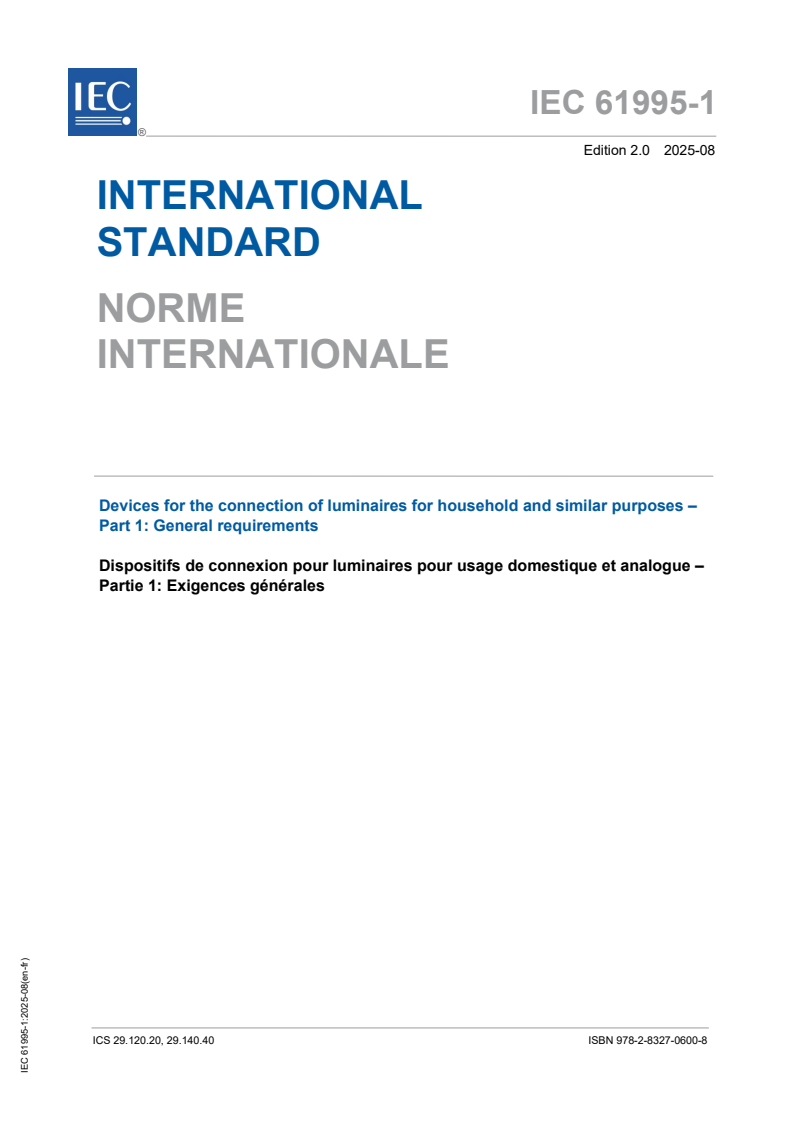
(Main)Devices for the connection of luminaires for household and similar purposes - Part 1: General requirements
General Information
- Abstract
IEC 61995-1:2025 applies to devices for the connection of luminaires (DCL) intended for household and similar purposes, for the electrical connection of fixed luminaires of class I or class II to final circuits rated at not more than 16 A without mechanical support for the luminaires incorporated in the plug/outlet interface. The DCL retention mechanisms are not intended to support the weight of the luminaires.
This second edition cancels and replaces the first edition published in 2005 and Amendment 1:2016. This edition constitutes a technical revision.
This edition includes the following significant technical changes with respect to the previous edition:
a) additional requirements and tests for additional suspension means;
b) additional requirements and tests for additional functions;
c) additional requirements and tests for floating type DCLs;
d) introduction of insulation piercing terminals (IPT);
e) additional classification according to the connection capacities of the DCL outlet terminals;
f) modification of maximum withdrawal force for plugs with enabled locking means;
g) improvements of temperature rise tests.
- Status
- Published
- Publication Date
- 04-Aug-2025
- Technical Committee
- SC 23B - Plugs, socket-outlets and switches
- Drafting Committee
- MT 13 - TC 23/SC 23B/MT 13
- Current Stage
- PPUB - Publication issued
- Start Date
- 05-Aug-2025
- Completion Date
- 15-Aug-2025
Buy Documents
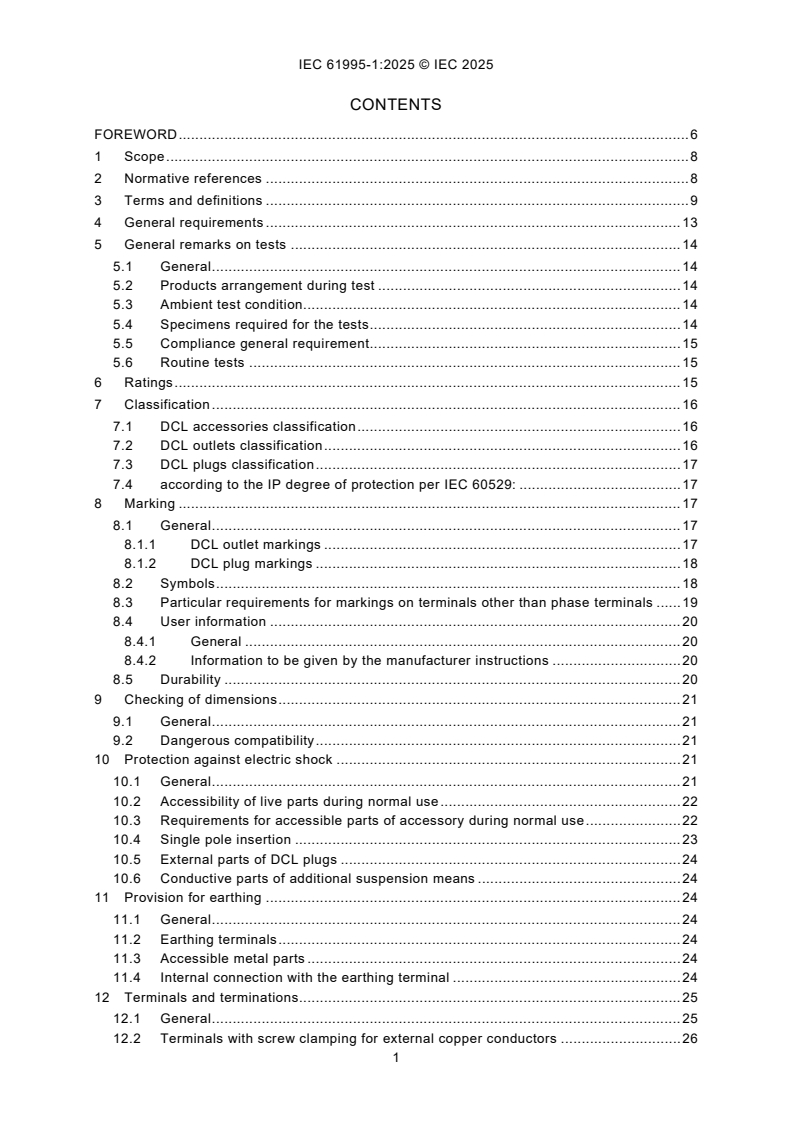
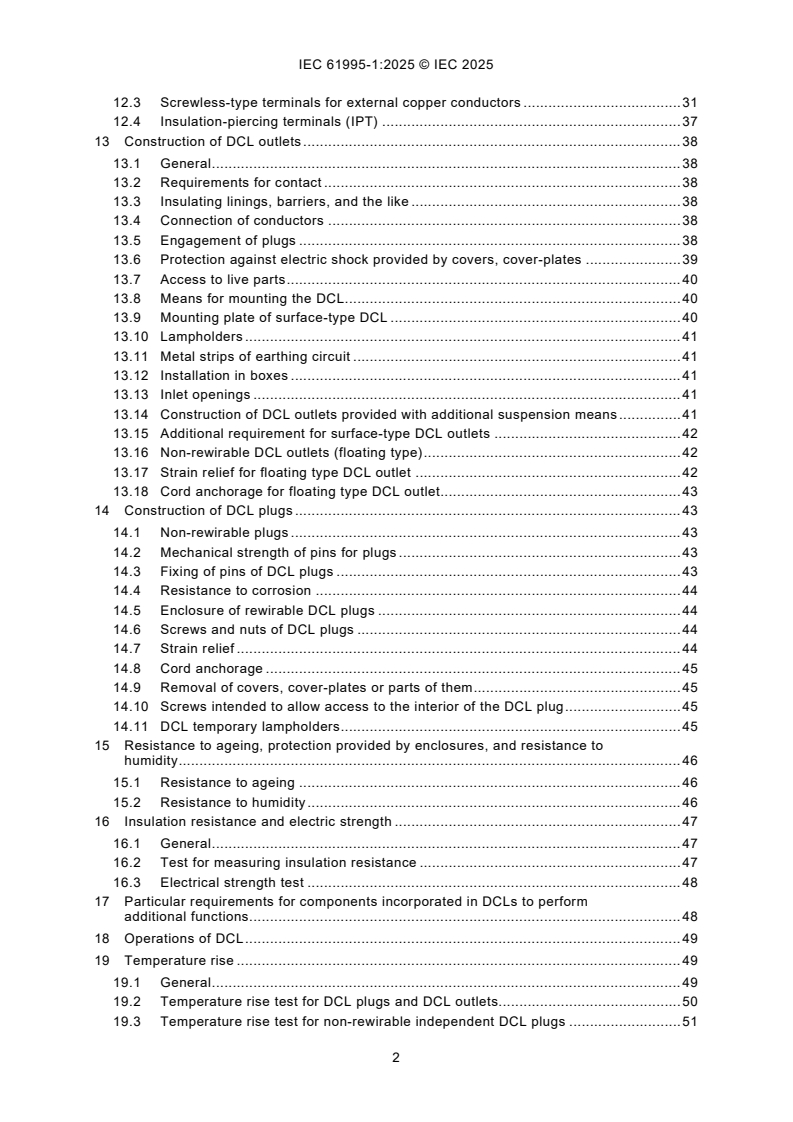
IEC 61995-1:2025 - Devices for the connection of luminaires for household and similar purposes - Part 1: General requirements Released:8/5/2025
IEC 61995-1:2025 - Dispositifs de connexion pour luminaires pour usage domestique et analogue - Partie 1: Exigences générales Released:8/5/2025
IEC 61995-1:2025 - Devices for the connection of luminaires for household and similar purposes - Part 1: General requirements Released:8/5/2025
Overview
IEC 61995-1:2025 - Devices for the connection of luminaires for household and similar purposes, Part 1: General requirements - specifies safety, performance and testing requirements for devices for the connection of luminaires (DCL) intended for household and similar applications. It applies to DCLs used to connect fixed luminaires of Class I or II to final circuits rated up to 16 A, where the plug/outlet interface is not intended to provide mechanical support for the luminaire. Edition 2.0 (2025) replaces the 2005 edition and its 2016 amendment and introduces a technical revision reflecting new functional, mechanical and electrical requirements.
Key Topics
- Scope & ratings: DCLs for household and similar purposes; final circuits ≤ 16 A; Class I and II luminaires.
- Classification & markings: new outlet/plug classification by connection capacity, IP degree (per IEC 60529), and clear marking/user information requirements.
- Terminals & connections: updated requirements for screw, screwless and newly introduced insulation piercing terminals (IPT).
- Mechanical and safety tests: improved temperature rise tests, modified maximum withdrawal force for plugs with locking means, impact, mechanical strength, and routine test regimes.
- Floating type DCLs: added requirements and tests for non-rewirable (floating) DCL outlets and associated strain relief/cord anchorage.
- Additional features: requirements and testing for additional suspension means and for components providing additional functions (e.g., switching, dimming or smart modules).
- Protection against electric shock & earthing: accessibility, earthing terminal requirements, and clearances/creepage distances.
- EMC and EMF: immunity and emission considerations plus electromagnetic field requirements.
Applications
- Manufacturer product design and quality control for DCL plugs and outlets intended for household fixed luminaires.
- Test laboratories and certification bodies performing compliance testing (temperature rise, mechanical strength, IPT performance).
- Electrical safety engineers, specifiers and procurement professionals selecting compliant DCL components for residential and similar installations.
- Installers and maintenance teams who rely on standardised markings, terminal performance and user information to ensure safe luminaire connections.
Related Standards
- IEC 60529 (degrees of protection - IP codes) - referenced for enclosure protection classification.
- Manufacturers and testing bodies should also consider applicable national wiring regulations and related IEC standards for luminaires and installations.
Keywords: IEC 61995-1:2025, devices for the connection of luminaires, DCL, insulation piercing terminals, floating type DCL, DCL outlets, temperature rise tests, suspension means.
Relations
- Effective Date
- 05-Sep-2023
- Effective Date
- 05-Sep-2023
Buy Documents
IEC 61995-1:2025 - Devices for the connection of luminaires for household and similar purposes - Part 1: General requirements Released:8/5/2025
IEC 61995-1:2025 - Dispositifs de connexion pour luminaires pour usage domestique et analogue - Partie 1: Exigences générales Released:8/5/2025
IEC 61995-1:2025 - Devices for the connection of luminaires for household and similar purposes - Part 1: General requirements Released:8/5/2025
Get Certified
Connect with accredited certification bodies for this standard

IMQ S.p.A. (Certification)
Italian electrical product certification.

SLG Prüf- und Zertifizierungs GmbH
German testing and certification body.

UL Solutions
Global safety science company with testing, inspection and certification.
Sponsored listings
Frequently Asked Questions
IEC 61995-1:2025 is a standard published by the International Electrotechnical Commission (IEC). Its full title is "Devices for the connection of luminaires for household and similar purposes - Part 1: General requirements". This standard covers: IEC 61995-1:2025 applies to devices for the connection of luminaires (DCL) intended for household and similar purposes, for the electrical connection of fixed luminaires of class I or class II to final circuits rated at not more than 16 A without mechanical support for the luminaires incorporated in the plug/outlet interface. The DCL retention mechanisms are not intended to support the weight of the luminaires. This second edition cancels and replaces the first edition published in 2005 and Amendment 1:2016. This edition constitutes a technical revision. This edition includes the following significant technical changes with respect to the previous edition: a) additional requirements and tests for additional suspension means; b) additional requirements and tests for additional functions; c) additional requirements and tests for floating type DCLs; d) introduction of insulation piercing terminals (IPT); e) additional classification according to the connection capacities of the DCL outlet terminals; f) modification of maximum withdrawal force for plugs with enabled locking means; g) improvements of temperature rise tests.
IEC 61995-1:2025 applies to devices for the connection of luminaires (DCL) intended for household and similar purposes, for the electrical connection of fixed luminaires of class I or class II to final circuits rated at not more than 16 A without mechanical support for the luminaires incorporated in the plug/outlet interface. The DCL retention mechanisms are not intended to support the weight of the luminaires. This second edition cancels and replaces the first edition published in 2005 and Amendment 1:2016. This edition constitutes a technical revision. This edition includes the following significant technical changes with respect to the previous edition: a) additional requirements and tests for additional suspension means; b) additional requirements and tests for additional functions; c) additional requirements and tests for floating type DCLs; d) introduction of insulation piercing terminals (IPT); e) additional classification according to the connection capacities of the DCL outlet terminals; f) modification of maximum withdrawal force for plugs with enabled locking means; g) improvements of temperature rise tests.
IEC 61995-1:2025 is classified under the following ICS (International Classification for Standards) categories: 29.120.20 - Connecting devices; 29.140.40 - Luminaires. The ICS classification helps identify the subject area and facilitates finding related standards.
IEC 61995-1:2025 has the following relationships with other standards: It is inter standard links to IEC 61995-1:2005, IEC 61995-1:2005/AMD1:2016. Understanding these relationships helps ensure you are using the most current and applicable version of the standard.
IEC 61995-1:2025 is available in PDF format for immediate download after purchase. The document can be added to your cart and obtained through the secure checkout process. Digital delivery ensures instant access to the complete standard document.
Standards Content (Sample)
IEC 61995-1 ®
Edition 2.0 2025-08
INTERNATIONAL
STANDARD
Devices for the connection of luminaires for household and similar purposes –
Part 1: General requirements
ICS 29.120.20; 29.140.40 ISBN 978-2-8327-0600-8
All rights reserved. Unless otherwise specified, no part of this publication may be reproduced or utilized in any form or
by any means, electronic or mechanical, including photocopying and microfilm, without permission in writing from either
IEC or IEC's member National Committee in the country of the requester. If you have any questions about IEC copyright
or have an enquiry about obtaining additional rights to this publication, please contact the address below or your local
IEC member National Committee for further information.
IEC Secretariat Tel.: +41 22 919 02 11
3, rue de Varembé info@iec.ch
CH-1211 Geneva 20 www.iec.ch
Switzerland
About the IEC
The International Electrotechnical Commission (IEC) is the leading global organization that prepares and publishes
International Standards for all electrical, electronic and related technologies.
About IEC publications
The technical content of IEC publications is kept under constant review by the IEC. Please make sure that you have the
latest edition, a corrigendum or an amendment might have been published.
IEC publications search - IEC Products & Services Portal - products.iec.ch
webstore.iec.ch/advsearchform Discover our powerful search engine and read freely all the
The advanced search enables to find IEC publications by a publications previews, graphical symbols and the glossary.
variety of criteria (reference number, text, technical With a subscription you will always have access to up to date
committee, …). It also gives information on projects, content tailored to your needs.
replaced and withdrawn publications.
Electropedia - www.electropedia.org
The world's leading online dictionary on electrotechnology,
IEC Just Published - webstore.iec.ch/justpublished
Stay up to date on all new IEC publications. Just Published containing more than 22 500 terminological entries in English
details all new publications released. Available online and and French, with equivalent terms in 25 additional languages.
once a month by email. Also known as the International Electrotechnical Vocabulary
(IEV) online.
IEC Customer Service Centre - webstore.iec.ch/csc
If you wish to give us your feedback on this publication or
need further assistance, please contact the Customer
Service Centre: sales@iec.ch.
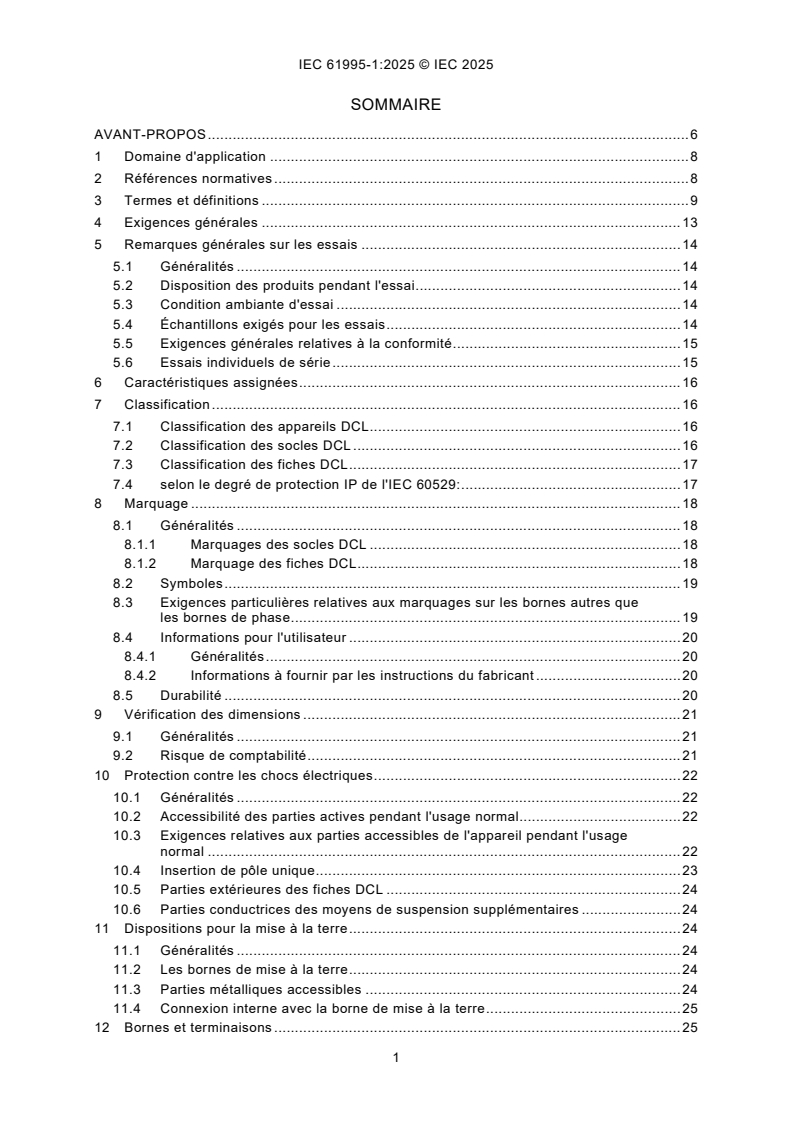
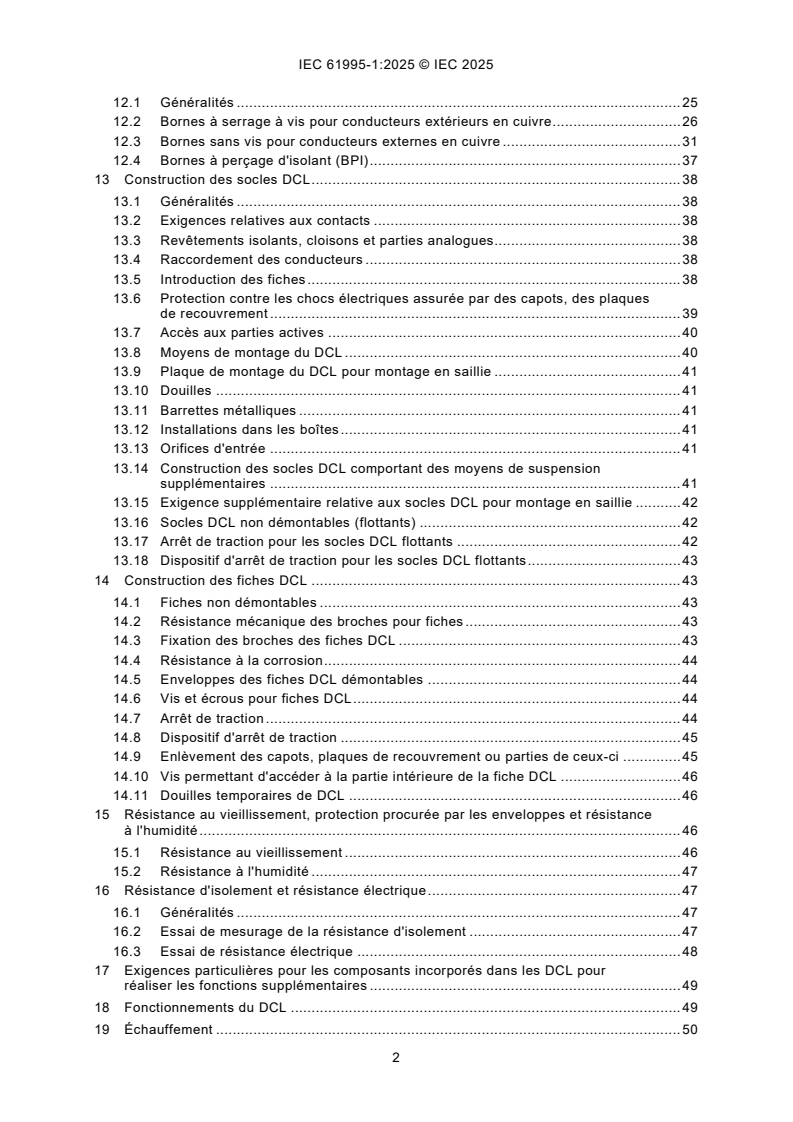
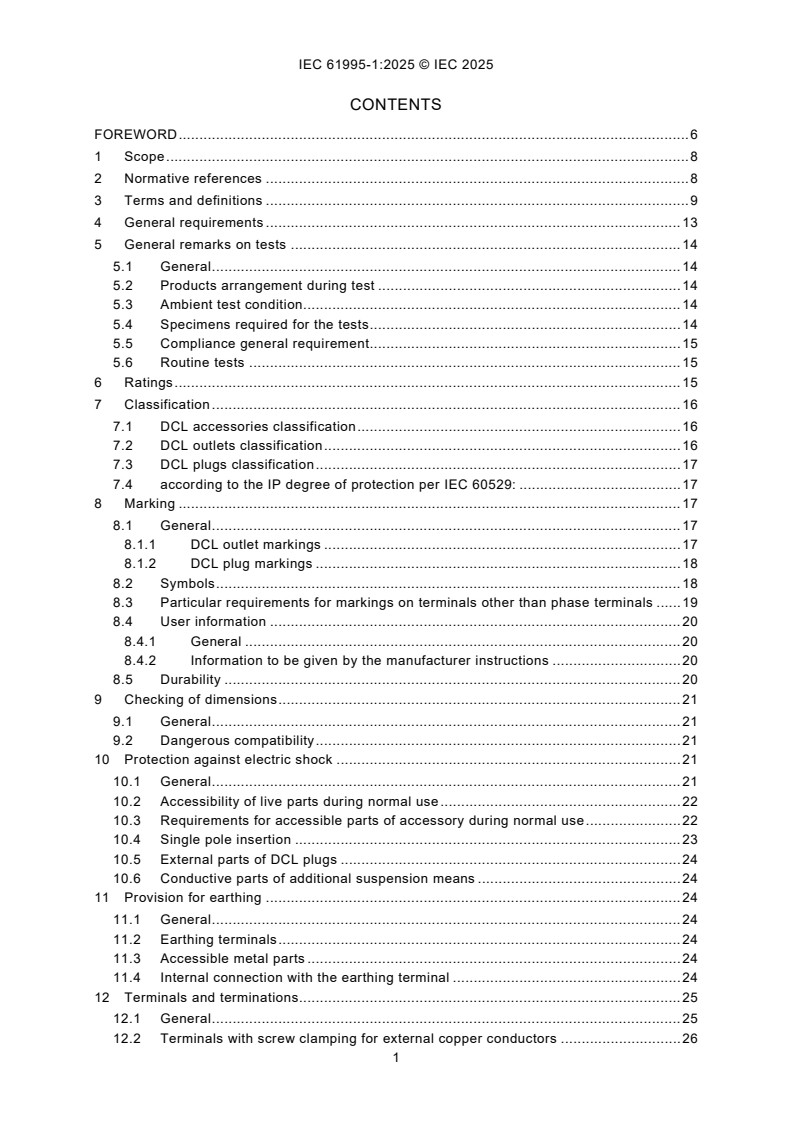
CONTENTS
FOREWORD . 6
1 Scope . 8
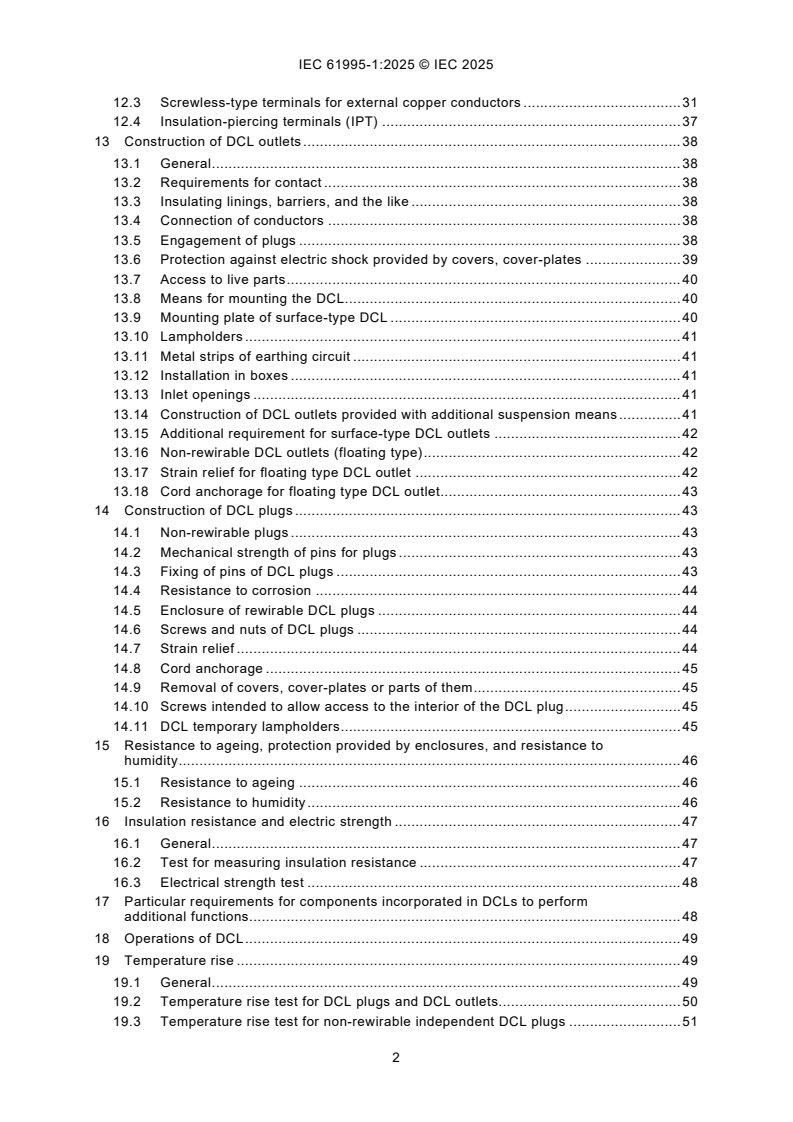
2 Normative references . 8
3 Terms and definitions . 9
4 General requirements . 13
5 General remarks on tests . 14
5.1 General . 14
5.2 Products arrangement during test . 14
5.3 Ambient test condition. 14
5.4 Specimens required for the tests . 14
5.5 Compliance general requirement. 15
5.6 Routine tests . 15
6 Ratings . 15
7 Classification . 16
7.1 DCL accessories classification . 16
7.2 DCL outlets classification . 16
7.3 DCL plugs classification . 17
7.4 according to the IP degree of protection per IEC 60529: . 17
8 Marking . 17
8.1 General . 17
8.1.1 DCL outlet markings . 17
8.1.2 DCL plug markings . 18
8.2 Symbols . 18
8.3 Particular requirements for markings on terminals other than phase terminals . 19
8.4 User information . 20
8.4.1 General . 20
8.4.2 Information to be given by the manufacturer instructions . 20
8.5 Durability . 20
9 Checking of dimensions . 21
9.1 General . 21
9.2 Dangerous compatibility . 21
10 Protection against electric shock . 21
10.1 General . 21
10.2 Accessibility of live parts during normal use . 22
10.3 Requirements for accessible parts of accessory during normal use . 22
10.4 Single pole insertion . 23
10.5 External parts of DCL plugs . 24
10.6 Conductive parts of additional suspension means . 24
11 Provision for earthing . 24
11.1 General . 24
11.2 Earthing terminals . 24
11.3 Accessible metal parts . 24
11.4 Internal connection with the earthing terminal . 24
12 Terminals and terminations. 25
12.1 General . 25
12.2 Terminals with screw clamping for external copper conductors . 26
12.3 Screwless-type terminals for external copper conductors . 31
12.4 Insulation-piercing terminals (IPT) . 37
13 Construction of DCL outlets . 38
13.1 General . 38
13.2 Requirements for contact . 38
13.3 Insulating linings, barriers, and the like . 38
13.4 Connection of conductors . 38
13.5 Engagement of plugs . 38
13.6 Protection against electric shock provided by covers, cover-plates . 39
13.7 Access to live parts . 40
13.8 Means for mounting the DCL . 40
13.9 Mounting plate of surface-type DCL . 40
13.10 Lampholders . 41
13.11 Metal strips of earthing circuit . 41
13.12 Installation in boxes . 41
13.13 Inlet openings . 41
13.14 Construction of DCL outlets provided with additional suspension means . 41
13.15 Additional requirement for surface-type DCL outlets . 42
13.16 Non-rewirable DCL outlets (floating type) . 42
13.17 Strain relief for floating type DCL outlet . 42
13.18 Cord anchorage for floating type DCL outlet. 43
14 Construction of DCL plugs . 43
14.1 Non-rewirable plugs . 43
14.2 Mechanical strength of pins for plugs . 43
14.3 Fixing of pins of DCL plugs . 43
14.4 Resistance to corrosion . 44
14.5 Enclosure of rewirable DCL plugs . 44
14.6 Screws and nuts of DCL plugs . 44
14.7 Strain relief . 44
14.8 Cord anchorage . 45
14.9 Removal of covers, cover-plates or parts of them . 45
14.10 Screws intended to allow access to the interior of the DCL plug . 45
14.11 DCL temporary lampholders . 45
15 Resistance to ageing, protection provided by enclosures, and resistance to
humidity . 46
15.1 Resistance to ageing . 46
15.2 Resistance to humidity . 46
16 Insulation resistance and electric strength . 47
16.1 General . 47
16.2 Test for measuring insulation resistance . 47
16.3 Electrical strength test . 48
17 Particular requirements for components incorporated in DCLs to perform
additional functions. 48
18 Operations of DCL . 49
19 Temperature rise . 49
19.1 General . 49
19.2 Temperature rise test for DCL plugs and DCL outlets. 50
19.3 Temperature rise test for non-rewirable independent DCL plugs . 51
19.4 Particular test requirements for DCL incorporating components to perform
additional functions . 52
20 Force necessary to insert and withdraw the plug . 54
21 Flexible cables and their connection . 55
21.1 Flexible cables in DCL plugs . 55
21.2 Cord anchorage . 55
21.3 Flexible cable of non-rewireable plugs . 57
22 Mechanical strength . 57
22.1 General . 57
22.2 Impact test with pendulum hammer . 57
22.3 Test for surface-type DCL outlets intended to be mounted directly on a
surface . 60
22.4 Test on covers and cover-plates or parts of them according to 13.6.3 a) . 60
22.4.1 General . 60
22.4.2 Verification of the non-removal of covers or cover-plates . 60
22.4.3 Verification of the removal of covers or cover-plates . 61
22.5 Test on cover and cover-plates or parts of them according to 13.6.3 b) . 62
22.6 Test on cover and cover-plates or parts of them according to 13.6.3 c) . 62
22.7 Verification of the outline of covers fixed without screws on a mounting
surface or supporting surface . 62
22.8 Verification of grooves, holes and revers tapers . 66
22.9 Tumble barrel test . 67
22.10 Test for additional suspension means . 67
23 Resistance to heat . 68
23.1 General . 68
23.2 Basic heat test . 68
23.3 Ball pressure test at 125 °C . 68
23.4 Ball pressure test at 70 °C or higher . 69
24 Screws, current-carrying parts and connections . 69
24.1 General . 69
24.2 Correct insertion of screws . 70
24.3 Contact pressure of electrical connections . 70
24.4 Screws and rivets used both as electrical and mechanical connections . 70
24.5 Material of current carrying parts . 71
24.6 Contacts subjected to sliding actions . 71
24.7 Thread-forming and thread-cutting screws . 71
25 Creepage distances, clearances and distances through sealing compound . 71
25.1 General . 71
25.2 Insulating sealing compound . 73
26 Resistance of insulating material to abnormal heat, to fire and to tracking . 73
26.1 Resistance to abnormal heat and to fire . 73
26.2 Resistance to tracking. 75
27 Resistance to rusting . 75
28 EMC Requirements. 76
28.1 Immunity . 76
28.2 Emission . 76
29 Electromagnetic fields (EMF) requirements. 76
Annex A (normative) Safety-related routine tests for factory-wired accessories
(protection against electric shock and correct polarity) . 77
A.1 General remarks . 77
A.2 Polarized systems, phase (L) and neutral (N) – correct connection . 77
A.3 Earth continuity . 78
A.4 Short-circuit/wrong connection and reduction of creepage distance and
clearances between phase (L) or neutral (N) to earth ( ) . 78
Annex B (normative) Additional requirements for DCL provided with insulation-piercing
terminals . 79
Bibliography . 86
Figure 1 – Example of fixed DCL outlet and plug. 10
Figure 2 – Example of thread-forming screw . 11
Figure 3 – Example of thread-cutting screw . 11
Figure 4 – Example of additional suspension means . 12
Figure 5 – Example of floating type DCL outlet . 13
Figure 6 – Test piston dimensions . 21
Figure 7 – Arrangement for checking damage to conductors . 27
Figure 8 – Information for deflection test . 36
Figure 9 – Circuit diagram for temperature rise test . 51
Figure 10 – Circuit diagram for temperature rise test according to 19.4 b). 52
Figure 11 – Circuit diagram for temperature rise test according to c) . 52
Figure 12 – Apparatus for testing the cord retention . 55
Figure 13 – Sequence of blows for parts A, B, C and D . 59
Figure 14 – Arrangement for test on covers or cover-plates . 61
Figure 15 – Gauge (thickness: about 2 mm) for the verification of the outline of covers
or cover-plates . 63
Figure 16 – Examples of application of the gauge of Figure 15 on covers fixed without
screws on a mounting surface or supporting surface . 64
Figure 17 – Examples of application of the gauge of Figure 18 in accordance with the
requirements of 22.6 . 65
Figure 18 – Gauge for verification of grooves, holes and reverse tapers . 66
Figure 19 – Sketch showing the direction of application of the gauge of Figure 18 . 66
Figure 20 – Ball pressure test apparatus . 69
Figure 21 – Diagrammatic representation of 26.1 . 74
Figure B.1 – Example of IPTs . 85
Figure B.2 – Example of test-points . 85
Figure B.3 – Example of test results . 85
Table 1 – Number of specimens required for the tests . 14
Table 2 – Symbols . 19
Table 3 – Connection of copper conductors . 26
Table 4 – Values for checking damage to conductors . 28
Table 5 – Values for pull forces . 29
Table 6 – Core composition of conductors . 29
Table 7 – Screw torque values . 30
Table 8 – Test current for checking screwless-type terminals . 33
Table 9 – Conductors for deflection test . 37
Table 10 – Force for deflection test . 37
Table 11 – Forces to be applied to covers, cover-plates whose fixing is not dependent
on screws . 40
Table 12 – Test currents for temperature rise test . 51
Table 13 – Permissible temperature rise values . 53
Table 14 – Cable dimensions for the cord anchorage test . 56
Table 15 – Height of fall for impact test . 58
Table 16 – Creepage distances and clearances . 72
Table B.1 – Maximum dimensions of copper conductors for IPT . 80
INTERNATIONAL ELECTROTECHNICAL COMMISSION
____________
Devices for the connection of luminaires
for household and similar purposes -
Part 1: General requirements
FOREWORD
1) The International Electrotechnical Commission (IEC) is a worldwide organization for standardization comprising
all national electrotechnical committees (IEC National Committees). The object of IEC is to promote international
co-operation on all questions concerning standardization in the electrical and electronic fields. To this end and
in addition to other activities, IEC publishes International Standards, Technical Specifications, Technical Reports,
Publicly Available Specifications (PAS) and Guides (hereafter referred to as “IEC Publication(s)”). Their
preparation is entrusted to technical committees; any IEC National Committee interested in the subject dealt with
may participate in this preparatory work. International, governmental and non-governmental organizations liaising
with the IEC also participate in this preparation. IEC collaborates closely with the International Organization for
Standardization (ISO) in accordance with conditions determined by agreement between the two organizations.
2) The formal decisions or agreements of IEC on technical matters express, as nearly as possible, an international
consensus of opinion on the relevant subjects since each technical committee has representation from all
interested IEC National Committees.
3) IEC Publications have the form of recommendations for international use and are accepted by IEC National
Committees in that sense. While all reasonable efforts are made to ensure that the technical content of IEC
Publications is accurate, IEC cannot be held responsible for the way in which they are used or for any
misinterpretation by any end user.
4) In order to promote international uniformity, IEC National Committees undertake to apply IEC Publications
transparently to the maximum extent possible in their national and regional publications. Any divergence between
any IEC Publication and the corresponding national or regional publication shall be clearly indicated in the latter.
5) IEC itself does not provide any attestation of conformity. Independent certification bodies provide conformity
assessment services and, in some areas, access to IEC marks of conformity. IEC is not responsible for any
services carried out by independent certification bodies.
6) All users should ensure that they have the latest edition of this publication.
7) No liability shall attach to IEC or its directors, employees, servants or agents including individual experts and
members of its technical committees and IEC National Committees for any personal injury, property damage or
other damage of any nature whatsoever, whether direct or indirect, or for costs (including legal fees) and
expenses arising out of the publication, use of, or reliance upon, this IEC Publication or any other IEC
Publications.
8) Attention is drawn to the Normative references cited in this publication. Use of the referenced publications is
indispensable for the correct application of this publication.
9) IEC draws attention to the possibility that the implementation of this document may involve the use of (a)
patent(s). IEC takes no position concerning the evidence, validity or applicability of any claimed patent rights in
respect thereof. As of the date of publication of this document, IEC had not received notice of (a) patent(s), which
may be required to implement this document. However, implementers are cautioned that this may not represent
the latest information, which may be obtained from the patent database available at https://patents.iec.ch. IEC
shall not be held responsible for identifying any or all such patent rights.
IEC 61995-1 has been prepared by subcommittee 23B: Plugs, socket-outlets and switches, of
IEC technical committee 23: Electrical accessories. It is an International Standard.
This second edition cancels and replaces the first edition published in 2005 and
Amendment 1:2016. This edition constitutes a technical revision.
This edition includes the following significant technical changes with respect to the previous
edition:
a) additional requirements and tests for additional suspension means;
b) additional requirements and tests for additional functions;
c) additional requirements and tests for floating type DCLs;
d) introduction of insulation piercing terminals (IPT);
e) additional classification according to the connection capacities of the DCL outlet terminals;
f) modification of maximum withdrawal force for plugs with enabled locking means;
g) improvements of temperature rise tests.
The text of this International Standard is based on the following documents:
Draft Report on voting
23B/1573/FDIS 23B/1581/RVD
Full information on the voting for its approval can be found in the report on voting indicated in
the above table.
The language used for the development of this International Standard is English.
A list of all the parts in the IEC 61995 series, published under the general title Devices for the
connection of luminaires for household and similar purposes, can be found on the IEC website.
In this document, the following print types are used:
• compliance statements: in italic type.
This document was drafted in accordance with ISO/IEC Directives, Part 2, and developed in
accordance with ISO/IEC Directives, Part 1 and ISO/IEC Directives, IEC Supplement, available
at www.iec.ch/members_experts/refdocs. The main document types developed by IEC are
described in greater detail at www.iec.ch/publications.
The committee has decided that the contents of this document will remain unchanged until the
stability date indicated on the IEC website under webstore.iec.ch in the data related to the
specific document. At this date, the document will be
• reconfirmed,
• withdrawn, or
• revised.
1 Scope
This document applies to devices for the connection of luminaires (DCL) intended for household
and similar purposes, for the electrical connection of fixed luminaires of class I or class II to
final circuits rated at not more than 16 A without mechanical support for the luminaires
incorporated in the plug/outlet interface. The DCL retention mechanisms are not intended to
support the weight of the luminaires.
• DCL plugs and outlets have a rated current of 6 A.
• DCL outlets have an earthing contact.
The rated voltage is 125 V or 250 V at 50/60 Hz.
• DCLs with additional suspension means are limited to a maximum mass of 5 kg.
• DCL plugs and DCL outlets complying with this document are suitable for use at ambient
temperatures not normally exceeding +40 °C, but their average over a period of 24 h does
not exceed + 35 °C, with a lower limit of the ambient air temperature of −5 °C.
• DCLs are intended for use according to their IP rating as specified in IEC 60529.
This document gives additional requirements for DCL accessories provided with
insulation-piercing terminals, see Annex B (normative).
2 Normative references
The following documents are referred to in the text in such a way that some or all of their content
constitutes requirements of this document. For dated references, only the edition cited applies.
For undated references, the latest edition of the referenced document (including any
amendments) applies.
IEC 60068-2-31:2008, Environmental testing - Part 2-31: Tests - Test Ec: Rough handling
shocks, primarily for equipment-type specimens
IEC 60068-2-75:2014, Environmental testing - Part 2-75: Tests - Test Eh: Hammer tests
IEC 60112:2020, Method for the determination of the proof and the comparative tracking indices
of solid insulating materials
IEC 60227-5:2024, Polyvinyl chloride insulated cables of rated voltages up to and including
450/750V - Part 5: Flexible cables (cords)
IEC 60417, Graphical symbols for use on equipment, available at http://www.graphical-
symbols.info/equipment
IEC 60529:1989, Degrees of protection provided by enclosures (IP Code)
IEC 60529:1989/AMD1:1999
IEC 60529:1989/AMD2:2013
IEC 60695-2-11:2021, Fire hazard testing - Part 2-11: Glowing/hot-wire based test methods -
Glow-wire flammability test method for end-products (GWEPT)
IEC 61032:1997, Protection of persons and equipment by enclosures - Probes for verification
IEC 61995-2:2025, Devices for the connection of luminaires for household and similar purposes
- Part 2: Standard sheets
ISO/IEC Guide 51:2014, Safety aspects - Guidelines for their inclusion in standards
3 Terms and definitions
For the purposes of this document, the following terms and definitions apply.
ISO and IEC maintain terminology databases for use in standardization at the following
addresses:
• IEC Electropedia: available at https://www.electropedia.org/
• ISO Online browsing platform: available at https://www.iso.org/obp
NOTE 1 Where the terms voltage and current are used, they imply RMS values, unless otherwise specified in this
document.
NOTE 2 Throughout this document the word "earthing" is used for "protective earthing".
NOTE 3 The term "accessory" is used as a general term covering DCL plugs and DCL outlets.
3.1
device for connecting a luminaire
DCL
system comprising a DCL outlet and a DCL plug providing a fixed luminaire with electrical
connection to and disconnection from a fixed installation
Note 1 to entry: The designations DCL, DCL outlet or DCL plug, are used when it is necessary to specify particular
requirements and test specifications.
3.2
DCL outlet
device for connecting a luminaire having socket-contacts designed to engage with the pins of a
DCL plug and having terminals for the connection of cable
3.3
DCL plug
device for connecting a luminaire having pins designed to engage with the contacts of a DCL
outlet
3.4
rewirable DCL plug
DCL plug so constructed that the flexible cable can be replaced
3.5
non-rewirable DCL plug
DCL plug so constructed that it forms a complete unit with the flexible cable after connection
and assembly by the manufacturer of the plug (see also 14.1)
3.6
moulded-on DCL plug
non-rewirable DCL plug, the manufacture of which is completed by insulating material moulded
around pre-assembled component parts and the terminations of the flexible cable
3.7
rated voltage
voltage assigned by the manufacturer for a specified operating condition of an accessory
[SOURCE: IEC 60050-442:1998, 442-01-03, modified – the specific use "(for accessories)" has
been omitted.]
3.8
rated current
current assigned by the manufacturer for specified operating condition of an accessory
[SOURCE: IEC 60050-442:1998, 442-01-02, modified – the specific use "(for accessories)" has
been omitted.]
3.9
fixed DCL outlet
DCL outlet intended to be installed at a fixed location and be connected to fixed wiring
Note 1 to entry: An example of a fixed DCL outlet and plug is shown in Figure 1.
Figure 1 – Example of fixed DCL outlet and plug
3.10
mounting box
box in or on a wall or ceiling, etc., for flush or surface application, intended to house a DCL
outlet
3.11
terminal
insulated or non-insulated connecting device intended for reusable electrical connection of the
external conductors
3.12
termination
insulated or non-insulated connecting device intended for non-reusable electrical connection of
the external conductors
3.13
clamping unit
part(s) of the terminal necessary for the mechanical clamping and the electrical connection of
the conductor(s), including the parts which are necessary to ensure correct contact pressure
[SOURCE: IEC 60050-442:1998, 442-06-12]
3.14
screw-type terminal
terminal for the connection and subsequent disconnection of one conductor or the
interconnection and subsequent disconnection of two or more conductors, the connection being
made, directly or indirectly, by means of screws or nuts of any kind
Note 1 to entry: The terms of definitions 3.14 to 3.17 are examples of screw-type terminals.
3.15
pillar terminal
screw-type terminal in which the conductor is inserted into a hole or cavity, where it is clamped
under the end of the screw or screws
Note 1 to entry: The clamping pressure may be applied directly by the end of the screw or through an intermediate
clamping member to which pressure is applied by the end of the screw.
3.16
screwless-type terminal
connecting device for the connection and subsequent disconnection of a rigid (solid or stranded)
or flexible conductor or the interconnection of two or more conductors capable of being
dismantled, the connection being made, directly or indirectly, by means of springs, parts of
angled, eccentric or conical form, etc., without special preparation of the conductor concerned,
other than removal of insulation
3.17
thread-forming screw
screw having an uninterrupted thread, which by screwing in, forms a thread by displacing
material
Note 1 to entry: An example of a thread-forming screw is shown in Figure 2.
Figure 2 – Example of thread-forming screw
3.18
thread-cutting screw
screw having an uninterrupted thread, which by screwing in, forms a thread by removing
material
Note 1 to entry: An example of a thread-cutting screw is shown in Figure 3.
Figure 3 – Example of thread-cutting screw
3.19
loop terminal
supply terminal intended for the interconnection of live conductors
3.20
DCL temporary lampholder
independent lampholder integral with a DCL plug, designed in order to be temporarily connected
to a DCL outlet
3.21
additional suspension means
means comprising any necessary component (hooks, brackets, etc) which is a part of the DCL,
used to fix the luminaire
Note 1 to entry: An example of additional suspension means is shown in Figure 4.
Key
1 Mounting box (flush-type or surface-type)
2 Fixed DCL outlet
3 Additional suspension means
4 Cover-plate
Figure 4 – Example of additional suspension means
3.22
base
part of the DCL outlet supporting the outlet contacts
3.23
live part
conductor or conductive part intended to be energized in normal use, including a neutral
conductor, but by convention, not a PEN conductor
3.24
cord anchorage
part of an accessory which has the ability to limit the displacement of a fitted flexible cable
against pull, push and turning forces
3.25
main part
assembly consisting of the base and other parts
Note 1 to entry: This assembly is not intended to be dismantled at any time after manufacture
3.26
protective earthing
protective grounding, US
earthing a point or points in a system or in an installation or in equipment, for purposes of
electrical safety
3.27
type test
test of one or more devices made to a certain design to show that the design meets certain
specifications
3.28
floating type DCL outlet
DCL outlet not intended to be fixed to a mounting box
Note 1 to entry: An example of a floating type DCL outlet is shown in Figure 5.
Figure 5 – Example of floating type DCL outlet
3.29
stroke
insertion or withdrawal of the DCL plug
3.30
insulation-piercing terminal
IPT
connecting device for the connection and possible disconnection of one or more conductors,
the connection being made by piercing, boring through, cutting through, displacing, or making
ineffective in some other manner the insulation of the conductor(s) without previous stripping
Note 1 to entry: The removal of the sheath of the cable, if necessary, is not considered as a previous stripping.
Note 2 to entry: Examples of IPTs are given in Figure B.1.
4 General requirements
DCL systems shall be so designed and constructed that in normal use their performance is
reliable, and safety is achieved by reducing risk to a tolerable level, as defined in
ISO/IEC Guide 51.
Compliance is checked by meeting all the relevant requirements and tests specified.
5 General remarks on tests
5.1 General
Tests shall be made to prove compliance with the requirements laid down in this document,
where applicable.
Tests according to this document are type tests.
5.2 Products arrangement during test
Unless otherwise specified in this document, the specimens are tested as delivered and under
normal conditions of use.
Non-rewirable DCL plugs and non-rewireable DCL outlets are tested with the type and size of
flexible cable as delivered.
DCL plugs and DCL outlets are tested separately, unless otherwise specified in this document.
The neutral is treated as a pole.
Flush and semi-flush type DCL outlets shall be tested, if appropriate, when installed in a box
complying with the applicable standard sheet(s), if any. If the DCL outlet is designed for a
specific box, the tests shall be conducted when the DCL outlet is installed in the corresponding
box as specified by the manufacturer.
5.3 Ambient test condition
Unless otherwise specified in this document, the tests are carried out in the order of the clauses,
at an ambient temperature between 15 °C and 35 °C.
It is recommended that the tests are made at an ambient temperature of (20 ± 5) °C.
5.4 Specimens required for the tests
Unless otherwise specified in this document, three specimens are subjected to all the relevant
tests.
The number of specimens (identified by e.g. ABC) required for the tests shall be as specified in
Table 1.
Table 1 – Number of specimens required for the tests
Number of specimens
Clauses and subclauses
DCL outlet DCL plug
6 Ratings A A
7 Classification A A
8 Marking A A
9 Checking of dimensions ABC ABC
10 Protection against electric shock ABC ABC
11 Provision for earthing ABC ABC
a, b a
12 Terminals and terminations
ABC ABC
13 Construction of DCL outlets ABC ABC
14 Constructio
...
IEC 61995-1 ®
Edition 2.0 2025-08
NORME
INTERNATIONALE
Dispositifs de connexion pour luminaires pour usage domestique et analogue –
Partie 1: Exigences générales
ICS 29.120.20; 29.140.40 ISBN 978-2-8327-0600-8
Droits de reproduction réservés. Sauf indication contraire, aucune partie de cette publication ne peut être reproduite ni
utilisée sous quelque forme que ce soit et par aucun procédé, électronique ou mécanique, y compris la photocopie et
les microfilms, sans l'accord écrit de l'IEC ou du Comité national de l'IEC du pays du demandeur. Si vous avez des
questions sur le copyright de l'IEC ou si vous désirez obtenir des droits supplémentaires sur cette publication, utilisez
les coordonnées ci-après ou contactez le Comité national de l'IEC de votre pays de résidence.
IEC Secretariat Tel.: +41 22 919 02 11
3, rue de Varembé info@iec.ch
CH-1211 Geneva 20 www.iec.ch
Switzerland
A propos de l'IEC
La Commission Electrotechnique Internationale (IEC) est la première organisation mondiale qui élabore et publie des
Normes internationales pour tout ce qui a trait à l'électricité, à l'électronique et aux technologies apparentées.
A propos des publications IEC
Le contenu technique des publications IEC est constamment revu. Veuillez vous assurer que vous possédez l’édition la
plus récente, un corrigendum ou amendement peut avoir été publié.
Recherche de publications IEC - IEC Products & Services Portal - products.iec.ch
webstore.iec.ch/advsearchform Découvrez notre puissant moteur de recherche et consultez
La recherche avancée permet de trouver des publications gratuitement tous les aperçus des publications, symboles
IEC en utilisant différents critères (numéro de référence, graphiques et le glossaire. Avec un abonnement, vous aurez
texte, comité d’études, …). Elle donne aussi des toujours accès à un contenu à jour adapté à vos besoins.
informations sur les projets et les publications remplacées
ou retirées. Electropedia - www.electropedia.org
Le premier dictionnaire d'électrotechnologie en ligne au
IEC Just Published - webstore.iec.ch/justpublished monde, avec plus de 22 500 articles terminologiques en
Restez informé sur les nouvelles publications IEC. Just anglais et en français, ainsi que les termes équivalents
dans 25 langues additionnelles. Egalement appelé
Published détaille les nouvelles publications parues.
Disponible en ligne et une fois par mois par email. Vocabulaire Electrotechnique International (IEV) en ligne.
Service Clients - webstore.iec.ch/csc
Si vous désirez nous donner des commentaires sur cette
publication ou si vous avez des questions contactez-
nous: sales@iec.ch.
SOMMAIRE
AVANT-PROPOS . 6
1 Domaine d'application . 8
2 Références normatives . 8
3 Termes et définitions . 9
4 Exigences générales . 13
5 Remarques générales sur les essais . 14
5.1 Généralités . 14
5.2 Disposition des produits pendant l'essai . 14
5.3 Condition ambiante d'essai . 14
5.4 Échantillons exigés pour les essais . 14
5.5 Exigences générales relatives à la conformité . 15
5.6 Essais individuels de série . 15
6 Caractéristiques assignées . 16
7 Classification . 16
7.1 Classification des appareils DCL . 16
7.2 Classification des socles DCL . 16
7.3 Classification des fiches DCL . 17
7.4 selon le degré de protection IP de l'IEC 60529: . 17
8 Marquage . 18
8.1 Généralités . 18
8.1.1 Marquages des socles DCL . 18
8.1.2 Marquage des fiches DCL . 18
8.2 Symboles . 19
8.3 Exigences particulières relatives aux marquages sur les bornes autres que
les bornes de phase . 19
8.4 Informations pour l'utilisateur . 20
8.4.1 Généralités . 20
8.4.2 Informations à fournir par les instructions du fabricant . 20
8.5 Durabilité . 20
9 Vérification des dimensions . 21
9.1 Généralités . 21
9.2 Risque de comptabilité . 21
10 Protection contre les chocs électriques . 22
10.1 Généralités . 22
10.2 Accessibilité des parties actives pendant l'usage normal. 22
10.3 Exigences relatives aux parties accessibles de l'appareil pendant l'usage
normal . 22
10.4 Insertion de pôle unique . 23
10.5 Parties extérieures des fiches DCL . 24
10.6 Parties conductrices des moyens de suspension supplémentaires . 24
11 Dispositions pour la mise à la terre . 24
11.1 Généralités . 24
11.2 Les bornes de mise à la terre . 24
11.3 Parties métalliques accessibles . 24
11.4 Connexion interne avec la borne de mise à la terre . 25
12 Bornes et terminaisons . 25
12.1 Généralités . 25
12.2 Bornes à serrage à vis pour conducteurs extérieurs en cuivre . 26
12.3 Bornes sans vis pour conducteurs externes en cuivre . 31
12.4 Bornes à perçage d'isolant (BPI) . 37
13 Construction des socles DCL . 38
13.1 Généralités . 38
13.2 Exigences relatives aux contacts . 38
13.3 Revêtements isolants, cloisons et parties analogues . 38
13.4 Raccordement des conducteurs . 38
13.5 Introduction des fiches . 38
13.6 Protection contre les chocs électriques assurée par des capots, des plaques
de recouvrement . 39
13.7 Accès aux parties actives . 40
13.8 Moyens de montage du DCL . 40
13.9 Plaque de montage du DCL pour montage en saillie . 41
13.10 Douilles . 41
13.11 Barrettes métalliques . 41
13.12 Installations dans les boîtes . 41
13.13 Orifices d'entrée . 41
13.14 Construction des socles DCL comportant des moyens de suspension
supplémentaires . 41
13.15 Exigence supplémentaire relative aux socles DCL pour montage en saillie . 42
13.16 Socles DCL non démontables (flottants) . 42
13.17 Arrêt de traction pour les socles DCL flottants . 42
13.18 Dispositif d'arrêt de traction pour les socles DCL flottants . 43
14 Construction des fiches DCL . 43
14.1 Fiches non démontables . 43
14.2 Résistance mécanique des broches pour fiches . 43
14.3 Fixation des broches des fiches DCL . 43
14.4 Résistance à la corrosion . 44
14.5 Enveloppes des fiches DCL démontables . 44
14.6 Vis et écrous pour fiches DCL . 44
14.7 Arrêt de traction . 44
14.8 Dispositif d'arrêt de traction . 45
14.9 Enlèvement des capots, plaques de recouvrement ou parties de ceux-ci . 45
14.10 Vis permettant d'accéder à la partie intérieure de la fiche DCL . 46
14.11 Douilles temporaires de DCL . 46
15 Résistance au vieillissement, protection procurée par les enveloppes et résistance
à l'humidité . 46
15.1 Résistance au vieillissement . 46
15.2 Résistance à l'humidité . 47
16 Résistance d'isolement et résistance électrique . 47
16.1 Généralités . 47
16.2 Essai de mesurage de la résistance d'isolement . 47
16.3 Essai de résistance électrique . 48
17 Exigences particulières pour les composants incorporés dans les DCL pour
réaliser les fonctions supplémentaires . 49
18 Fonctionnements du DCL . 49
19 Échauffement . 50
19.1 Généralités . 50
19.2 Essai d'échauffement pour les fiches DCL et les socles DCL . 51
19.3 Essai d'échauffement pour les fiches DCL indépendantes non démontables . 52
19.4 Exigences d'essai particulières pour les composants incorporés dans les
DCL pour réaliser les fonctions supplémentaires . 52
20 Force nécessaire pour insérer et retirer la fiche . 55
21 Câbles souples et leur connexion . 56
21.1 Câbles souples dans les fiches DCL . 56
21.2 Dispositif d'arrêt de traction . 56
21.3 Câbles souples des fiches non démontables . 58
22 Résistance mécanique. 58
22.1 Généralités . 58
22.2 Essai de choc avec marteau pendulaire . 58
22.3 Essai pour les socles DCL pour montage en saillie destinés à être montés
directement sur une surface . 61
22.4 Essais des capots et plaques de recouvrement ou parties de ceux-ci selon le
13.6.3 a) . 61
22.4.1 Généralités . 61
22.4.2 Vérification du non-enlèvement des capots ou plaques de recouvrement . 62
22.4.3 Vérification de l'enlèvement des capots ou plaques de recouvrement . 63
22.5 Essai des capots et plaques de recouvrement ou parties de ceux-ci selon le
13.6.3 b) . 63
22.6 Essai des capots et plaques de recouvrement ou parties de ceux-ci selon le
13.6.3 c) . 63
22.7 Vérification du contour des capots fixés sans vis sur une surface de
montage ou de support . 63
22.8 Vérification des rainures, trous et dépouilles inverses . 67
22.9 Essai au tambour tournant . 68
22.10 Essai pour les moyens de suspension supplémentaires . 68
23 Résistance à la chaleur . 69
23.1 Généralités . 69
23.2 Essai de chaleur de base . 69
23.3 Essai de pression à la bille à 125 ºC . 70
23.4 Essai de pression à la bille à 70 ºC ou plus. 70
24 Vis, parties transportant le courant et connexions . 71
24.1 Généralités . 71
24.2 Insertion correcte des vis . 71
24.3 Pression de contact des connexions électriques . 72
24.4 Vis et rivets utilisés comme connexions électriques et mécaniques . 72
24.5 Matériau des parties transportant le courant . 72
24.6 Contacts soumis aux frottements . 73
24.7 Vis autotaraudeuse par déformation et vis autotaraudeuse à découpe . 73
25 Lignes de fuite, distances d'isolement dans l'air et distances à travers le matériau
d'étanchéité . 73
25.1 Généralités . 73
25.2 Matériau isolant d'étanchéité . 75
26 Résistance du matériau isolant à la chaleur anormale, au feu et au courant de
cheminement . 75
26.1 Résistance à la chaleur anormale et au feu . 75
26.2 Résistance au cheminement . 77
27 Protection contre la rouille . 77
28 Exigences de CEM . 78
28.1 Immunité . 78
28.2 Émission . 78
29 Exigences relatives aux champs électromagnétiques (EMF) . 78
Annexe A (normative) Essais individuels de série relatifs à la sécurité pour les
appareils raccordés en usine (protection contre les chocs électriques et polarité
correcte) . 79
A.1 Remarques générales . 79
A.2 Systèmes polarisés, phase (L) et neutre (N) – connexion correcte . 79
A.3 Continuité de terre . 80
A.4 Court-circuit/mauvaise connexion et réduction de la ligne de fuite et des
distances d'isolement dans l'air entre la phase (L) ou le neutre (N) et la terre
( ) . 80
Annexe B (normative) Exigences supplémentaires relatives aux DCL équipés de
bornes à perçage d'isolant . 81
Bibliographie . 89
Figure 1 – Exemple de socle DCL fixe et de fiche DCL fixe . 10
Figure 2 – Exemple de vis autotaraudeuse par déformation . 11
Figure 3 – Exemple de vis autotaraudeuse à découpe . 11
Figure 4 – Exemple de moyen de suspension supplémentaire . 12
Figure 5 – Exemple de socle DCL flottant . 13
Figure 6 – Dimensions du piston d'essai . 21
Figure 7 – Dispositif pour vérifier les dommages aux conducteurs . 27
Figure 8 – Informations relatives à l'essai de déflexion . 36
Figure 9 – Circuit pour l'essai d'échauffement . 51
Figure 10 – Circuit pour l'essai d'échauffement selon le 19.4 b) . 53
Figure 11 – Circuit pour l'essai d'échauffement selon le 19.4 c) . 53
Figure 12 – Appareillage pour l'essai de tenue du câble . 56
Figure 13 – Séquence des coups pour les parties A, B, C et D . 60
Figure 14 – Disposition pour l'essai des capots ou plaques de recouvrement . 62
Figure 15 – Calibre (épaisseur: environ 2 mm) pour la vérification du contour des
capots ou plaques de recouvrement . 64
Figure 16 – Exemples d'applications du calibre de la Figure 15 sur des capots fixés
sans vis sur une surface de montage ou de support . 65
Figure 17 – Exemples d'applications du calibre de la Figure 18 conformément aux
exigences du 22.6 . 66
Figure 18 – Calibre pour la vérification des rainures, trous et contre-dépouilles . 67
Figure 19 – Représentation graphique de la direction d'application du calibre de la
Figure 18 . 67
Figure 20 – Appareillage pour l'essai de pression à la bille . 70
Figure 21 – Représentation schématique du 26.1 . 76
Figure B.1 – Exemple de BPI . 87
Figure B.2 – Exemples de points d'essai . 87
Figure B.3 – Exemples de résultats d'essai . 88
Tableau 1 – Nombre d'échantillons exigé pour les essais . 14
Tableau 2 – Symboles . 19
Tableau 3 – Raccordement des conducteurs en cuivre . 26
Tableau 4 – Valeurs pour vérifier les dommages aux conducteurs . 28
Tableau 5 – Valeurs des forces de traction . 29
Tableau 6 – Composition de l'âme des conducteurs . 29
Tableau 7 – Valeurs des couples de serrage . 30
Tableau 8 – Courant d'essai pour vérification des bornes sans vis . 34
Tableau 9 – Conducteurs pour l'essai de déflexion . 37
Tableau 10 – Forces pour l'essai de déflexion . 37
Tableau 11 – Forces à appliquer aux capots, plaques de recouvrement dont la fixation
ne dépend pas de vis . 40
Tableau 12 – Courants d'essai pour l'essai d'échauffement . 52
Tableau 13 – Valeurs admissibles de l'échauffement . 54
Tableau 14 – Dimensions des câbles pour l'essai du dispositif d'arrêt de traction . 57
Tableau 15 – Hauteur de chute pour l'essai de choc . 59
Tableau 16 – Lignes de fuite et distances d'isolement dans l'air. 73
Tableau B.1 – Dimensions maximales des conducteurs en cuivre pour les BPI . 82
COMMISSION ÉLECTROTECHNIQUE INTERNATIONALE
____________
Dispositifs de connexion pour luminaires
pour usage domestique et analogue -
Partie 1: Exigences générales
AVANT-PROPOS
1) La Commission Électrotechnique Internationale (IEC) est une organisation mondiale de normalisation composée
de l'ensemble des comités électrotechniques nationaux (Comités nationaux de l'IEC). L'IEC a pour objet de
favoriser la coopération internationale pour toutes les questions de normalisation dans les domaines de
l'électricité et de l'électronique. À cet effet, l'IEC – entre autres activités – publie des Normes internationales,
des Spécifications techniques, des Rapports techniques, des Spécifications accessibles au public (PAS) et des
Guides (ci-après dénommés "Publication(s) de l'IEC"). Leur élaboration est confiée à des comités d'études, aux
travaux desquels tout Comité national intéressé par le sujet traité peut participer. Les organisations
internationales, gouvernementales et non gouvernementales, en liaison avec l'IEC, participent également aux
travaux. L'IEC collabore étroitement avec l'Organisation Internationale de Normalisation (ISO), selon des
conditions fixées par accord entre les deux organisations.
2) Les décisions ou accords officiels de l'IEC concernant les questions techniques représentent, dans la mesure du
possible, un accord international sur les sujets étudiés, étant donné que les Comités nationaux de l'IEC intéressés
sont représentés dans chaque comité d'études.
3) Les Publications de l'IEC se présentent sous la forme de recommandations internationales et sont agréées
comme telles par les Comités nationaux de l'IEC. Tous les efforts raisonnables sont entrepris afin que l'IEC
s'assure de l'exactitude du contenu technique de ses publications; l'IEC ne peut pas être tenue responsable de
l'éventuelle mauvaise utilisation ou interprétation qui en est faite par un quelconque utilisateur final.
4) Dans le but d'encourager l'uniformité internationale, les Comités nationaux de l'IEC s'engagent, dans toute la
mesure possible, à appliquer de façon transparente les Publications de l'IEC dans leurs publications nationales
et régionales. Toutes divergences entre toutes Publications de l'IEC et toutes publications nationales ou
régionales correspondantes doivent être indiquées en termes clairs dans ces dernières.
5) L'IEC elle-même ne fournit aucune attestation de conformité. Des organismes de certification indépendants
fournissent des services d'évaluation de conformité et, dans certains secteurs, accèdent aux marques de
conformité de l'IEC. L'IEC n'est responsable d'aucun des services effectués par les organismes de certification
indépendants.
6) Tous les utilisateurs doivent s'assurer qu'ils sont en possession de la dernière édition de cette publication.
7) Aucune responsabilité ne doit être imputée à l'IEC, à ses administrateurs, employés, auxiliaires ou mandataires,
y compris ses experts particuliers et les membres de ses comités d'études et des Comités nationaux de l'IEC,
pour tout préjudice causé en cas de dommages corporels et matériels, ou de tout autre dommage de quelque
nature que ce soit, directe ou indirecte, ou pour supporter les coûts (y compris les frais de justice) et les dépenses
découlant de la publication ou de l'utilisation de cette Publication de l'IEC ou de toute autre Publication de l'IEC,
ou au crédit qui lui est accordé.
8) L'attention est attirée sur les références normatives citées dans cette publication. L'utilisation de publications
référencées est obligatoire pour une application correcte de la présente publication.
9) L'attention est attirée sur le fait que certains des éléments de la présente Publication de l'IEC peuvent faire l'objet
de droits de brevet. L'IEC ne saurait être tenue pour responsable de ne pas avoir identifié de tels droits de
brevets. À la date de publication du présent document, l'IEC n'avait pas reçu notification qu'un ou plusieurs
brevets pouvaient être nécessaires à sa mise en application. Toutefois, il y a lieu d'avertir les responsables de
la mise en application du présent document que des informations plus récentes sont susceptibles de figurer dans
la base de données de brevets, disponible à l'adresse https://patents.iec.ch. L'IEC ne saurait être tenue pour
responsable de ne pas avoir identifié de tels droits de brevets.
L'IEC 61995-1 a été établie par le sous-comité 23B: Prises de courant et interrupteurs, du
comité d'études 23 de l'IEC: Petit appareillage. Il s'agit d'une Norme internationale.
Cette deuxième édition annule et remplace la première édition parue en 2005 et son
Amendement 1:2016. Cette édition constitue une révision technique.
Cette édition inclut les modifications techniques majeures suivantes par rapport à l'édition
précédente:
a) exigences et essais complémentaires pour les moyens de suspension supplémentaires;
b) exigences et essais complémentaires pour les fonctions supplémentaires;
c) exigences et essais complémentaires pour les DCL flottants non démontables;
d) introduction des bornes à perçage d'isolant (BPI);
e) classification supplémentaire selon les capacités de connexion des bornes de socles DCL;
f) modification de la force de retrait maximale pour les fiches avec dispositif de verrouillage
activé;
g) amélioration des essais d'échauffement.
Le texte de cette Norme internationale est issu des documents suivants:
Projet Rapport de vote
23B/1573/FDIS 23B/1581/RVD
Le rapport de vote indiqué dans le tableau ci-dessus donne toute information sur le vote ayant
abouti à son approbation.
La langue employée pour l'élaboration de cette Norme internationale est l'anglais.
Une liste de toutes les parties de la série IEC 61995, publiées sous le titre général Dispositifs
de connexion pour luminaires pour usage domestique et analogue, se trouve sur le site web de
l'IEC.
Dans le présent document, les caractères d'imprimerie suivants sont utilisés:
• déclarations de conformité: caractères italiques.
Ce document a été rédigé selon les Directives ISO/IEC, Partie 2, il a été développé selon les
Directives ISO/IEC, Partie 1 et les Directives ISO/IEC, Supplément IEC, disponibles sous
www.iec.ch/members_experts/refdocs. Les principaux types de documents développés par
l'IEC sont décrits plus en détail sous www.iec.ch/publications
Le comité a décidé que le contenu de ce document ne sera pas modifié avant la date de stabilité
indiquée sur le site web de l'IEC sous webstore.iec.ch dans les données relatives au document
recherché. À cette date, le document sera
• reconduit,
• supprimé, ou
• révisé.
1 Domaine d'application
Le présent document s'applique aux dispositifs de connexion pour luminaires (DCL) prévus
pour un usage domestique et analogue, destinés au raccordement de luminaires fixes de
classe I ou de classe II à des circuits finaux de courant assigné inférieur ou égal à 16 A sans
support mécanique aux luminaires incorporés dans l'interface de la fiche/du socle. Les
mécanismes de retenue de DCL ne sont pas destinés à supporter le poids des luminaires.
• Les fiches DCL et les socles DCL ont un courant assigné de 6 A.
• Les socles DCL ont un contact de mise à la terre.
La tension assignée est de 125 V ou 250 V à 50/60 Hz.
• Les DCL avec des moyens de suspension supplémentaires sont limités à une masse
maximale de 5 kg.
• Les fiches DCL et les socles DCL conformes au présent document conviennent pour une
utilisation à des températures ambiantes ne dépassant normalement pas +40 °C, mais leur
moyenne ne dépasse pas +35 °C sur une période de 24 h, avec une limite inférieure de
température d'air ambiant de −5 °C.
• Les DCL sont destinés à un usage selon leur degré de protection IP comme cela est spécifié
dans l'IEC 60529.
Le présent document fournit des exigences supplémentaires relatives aux appareils DCL
comportant des bornes à perçage d'isolant, voir l'Annexe B (normative).
2 Références normatives
Les documents suivants sont cités dans le texte de sorte qu'ils constituent, pour tout ou partie
de leur contenu, des exigences du présent document. Pour les références datées, seule
l'édition citée s'applique. Pour les références non datées, la dernière édition du document de
référence s'applique (y compris les éventuels amendements).
IEC 60068-2-31:2008, Essais d'environnement - Partie 2-31: Essais - Essai Ec: Choc lié à des
manutentions brutales, essai destiné en premier lieu aux matériels
IEC 60068-2-75:2014, Essais d'environnement - Partie 2-75: Essais - Test Eh: Essais au
marteau
IEC 60112:2020, Méthode de détermination des indices de résistance et de tenue au
cheminement des matériaux isolants solides
IEC 60227-5:2024, Polyvinyl chloride insulated cables of rated voltages up to and including
450/750V - Part 5: Flexible cables (cords) (disponible en anglais seulement)
IEC 60417, Symboles graphiques utilisables sur le matériel, disponible à l'adresse
http://www.graphical-symbols.info/equipment
IEC 60529:1989, Degrés de protection procurés par les enveloppes (Code IP)
IEC 60529:1989/AMD1:1999
IEC 60529:1989/AMD2:2013
IEC 60695-2-11:2021, Essais relatifs aux risques du feu - Partie 2-11: Essais au fil
incandescent/chauffant - Méthode d'essai d'inflammabilité pour produits finis (GWEPT)
IEC 61032:1997, Protection des personnes et des matériels par les enveloppes - Calibres
d'essai pour la vérification
IEC 61995-2:2025, Dispositifs de connexion pour luminaires pour usage domestique et
analogue - Partie 2: Feuilles de norme
Guide 51:2014 de l'ISO/IEC, Aspects liés à la sécurité - Principes directeurs pour les inclure
dans les normes
3 Termes et définitions
Pour les besoins du présent document, les termes et définitions suivants s'appliquent.
L'ISO et l'IEC tiennent à jour des bases de données terminologiques destinées à être utilisées
en normalisation, consultables aux adresses suivantes:
• IEC Electropedia: disponible à l'adresse https://www.electropedia.org/
• ISO Online browsing platform: disponible à l'adresse https://www.iso.org/obp
NOTE 1 Lorsque les termes "tension" et "courant" sont utilisés, sauf spécification contraire dans le présent
document, il s'agit de leur valeur efficace.
NOTE 2 Dans le présent document, le terme "mise à la terre" est utilisé pour indiquer "mise à la terre de protection".
NOTE 3 Le terme "appareil" est utilisé comme un terme général qui couvre les fiches DCL et les socles DCL.
3.1
dispositif de connexion pour luminaire
DCL
dispositif comprenant un socle DCL et une fiche DCL équipant un luminaire fixe et permettant
de raccorder électriquement et de débrancher ce luminaire d'une installation fixe
Note 1 à l'article: Les désignations DCL, socle DCL ou fiche DCL sont utilisées lorsqu'il est nécessaire de spécifier
des exigences particulières et des spécifications d'essais.
Note 2 à l'article: L'abréviation "DCL" est dérivée du terme anglais développé correspondant "device for connecting
a luminaire".
3.2
socle DCL
dispositif destiné au raccordement d'un luminaire équipé d'alvéoles conçues pour recevoir les
broches d'une fiche DCL et de bornes pour le raccordement du câble
3.3
fiche DCL
dispositif destiné au raccordement d'un luminaire, équipé de broches conçues pour s'engager
avec les alvéoles d'un socle DCL
3.4
fiche DCL démontable
fiche DCL construite de manière à permettre le remplacement du câble souple
3.5
fiche DCL non démontable
fiche DCL construite de manière à constituer un ensemble complet avec le câble souple après
le raccordement et l'assemblage par le fabricant de la fiche (voir également 14.1)
3.6
fiche DCL surmoulée
fiche DCL non démontable dont la fabrication se termine par le moulage d'un matériau isolant
autour des éléments préassemblés et des terminaisons du câble souple
3.7
tension assignée
tension fixée par le constructeur pour le fonctionnement spécifié d'un appareil
[SOURCE: IEC 60050-442:1998, 442-01-03, modifié – L'usage spécifique "(pour le petit
appareillage)" a été supprimée.]
3.8
courant assigné
courant fixé par le constructeur pour le fonctionnement spécifié d'un appareil
[SOURCE: IEC 60050-442:1998, 442-01-02, modifié – L'usage spécifique "(pour le petit
appareillage)" a été supprimée.]
3.9
socle DCL fixe
socle DCL destiné à être utilisé à un emplacement fixe ou à être raccordé à un câble fixe
Note 1 à l'article: La Figure 1 représente un exemple de socle DCL fixe et de fiche DCL fixe.
Figure 1 – Exemple de socle DCL fixe et de fiche DCL fixe
3.10
boîte de montage
boîte prévue pour un montage encastré ou en saillie dans ou sur un mur, ou un plafond, etc.,
destinée à recevoir un socle DCL
3.11
borne
dispositif de connexion, isolé ou non, servant au raccordement électrique réutilisable de
conducteurs extérieurs
3.12
terminaison
dispositif de connexion, isolé ou non, servant au raccordement électrique non réutilisable de
conducteurs extérieurs
3.13
organe de serrage
partie d'une borne nécessaire pour le serrage mécanique et la connexion électrique du (des)
conducteur(s), y compris les parties qui sont nécessaires pour assurer une pression de contact
correcte
[SOURCE: IEC 60050-442:1998, 442-06-12]
3.14
borne à vis
borne permettant la connexion et la déconnexion ultérieure d'un conducteur ou l'interconnexion
et la déconnexion ultérieure de deux ou plusieurs conducteurs, le raccordement étant réalisé
directement ou indirectement au moyen de vis ou d'écrous de toute sorte
Note 1 à l'article: Les termes des définitions 3.14 à 3.17 constituent des exemples de bornes à vis.
3.15
borne à trou
borne de type à vis dans laquelle le conducteur est introduit dans un trou ou une cavité et y est
serré par l'extrémité de la vis ou des vis
Note 1 à l'article: La pression de serrage peut être appliquée directement par l'extrémité de la vis ou au moyen d'un
organe de serrage intermédiaire auquel la pression est appliquée par l'extrémité de la vis.
3.16
borne sans vis
borne de connexion permettant la connexion et la déconnexion ultérieure d'un conducteur rigide
(massif ou câblé), d'un conducteur souple ou l'interconnexion démontable de deux ou plusieurs
conducteurs, le raccordement étant réalisé directement ou indirectement au moyen de ressorts,
pièces formant coin, excentriques, coniques, etc., sans autre préparation spéciale du
conducteur concerné que l'enlèvement de l'isolant
3.17
vis autotaraudeuse par déformation
vis autotaraudeuse ayant un filet ininterrompu qui, par vissage, forme le filetage par déformation
du matériau
Note 1 à l'article: La Figure 2 représente un exemple de vis autotaraudeuse par déformation.
Figure 2 – Exemple de vis autotaraudeuse par déformation
3.18
vis autotaraudeuse à découpe
vis autotaraudeuse ayant un filet ininterrompu qui, par vissage, forme le filetage en enlevant
du matériau
Note 1 à l'article: La Figure 3 représente un exemple de vis autotaraudeuse à découpe.
Figure 3 – Exemple de vis autotaraudeuse à découpe
3.19
borne de repiquage
borne d'alimentation destinée à l'interconnexion de conducteurs sous tension
3.20
douille temporaire de DCL
douille indépendante intégrée avec une fiche DCL, conçue afin d'être connectée
temporairement à un socle DCL
3.21
moyen de suspension supplémentaire
moyen comprenant tout élément nécessaire (crochet, supports, etc.) qui fait partie du DCL
utilisé pour fixer le luminaire
Note 1 à l'article: La Figure 4 représente un exemple de moyen de suspension supplémentaire.
Légende
1 boîte de montage (montage encastré ou montage en saillie)
2 socle DCL fixe
3 moyen de suspension supplémentaire
4 plaque de recouvrement
Figure 4 – Exemple de moyen de suspension supplémentaire
3.22
base
partie d'un socle DCL qui porte les alvéoles
3.23
partie active
partie sous tension
conducteur ou partie conductrice destiné à être sous tension en service normal, ainsi que le
conducteur de neutre, à l'exception toutefois, par convention, du conducteur PEN
3.24
dispositif d'arrêt de traction
partie d'un appareil capable de limiter le déplacement d'un câble souple monté contre les forces
de traction, de poussée et de rotation
3.25
partie principale
assemblage comprenant une base et d'autres parties
Note 1 à l'article: Il est prévu que cet assemblage ne soit démonté à aucun moment après la fabrication.
3.26
mise à la terre de protection
mise à la terre d'un ou de plusieurs points d'un réseau, d'une installation ou d'un matériel pour
des raisons de sécurité électrique
3.27
essai de type
essai effectué sur un ou plusieurs dispositifs réalisés selon une conception donnée pour
démontrer que cette conception satisfait à certaines spécifications
3.28
socle DCL flottant
socle DCL qui n'est pas destiné à être fixé à une boîte de montage
Note 1 à l'article: La Figure 5 représente un exemple de socle DCL flottant.
Figure 5 – Exemple de socle DCL flottant
3.29
changement de position
insertion ou retrait de la fich
...
IEC 61995-1 ®
Edition 2.0 2025-08
INTERNATIONAL
STANDARD
NORME
INTERNATIONALE
Devices for the connection of luminaires for household and similar purposes –
Part 1: General requirements
Dispositifs de connexion pour luminaires pour usage domestique et analogue –
Partie 1: Exigences générales
ICS 29.120.20, 29.140.40 ISBN 978-2-8327-0600-8
All rights reserved. Unless otherwise specified, no part of this publication may be reproduced or utilized in any form or
by any means, electronic or mechanical, including photocopying and microfilm, without permission in writing from either
IEC or IEC's member National Committee in the country of the requester. If you have any questions about IEC copyright
or have an enquiry about obtaining additional rights to this publication, please contact the address below or your local
IEC member National Committee for further information.
Droits de reproduction réservés. Sauf indication contraire, aucune partie de cette publication ne peut être reproduite ni
utilisée sous quelque forme que ce soit et par aucun procédé, électronique ou mécanique, y compris la photocopie et
les microfilms, sans l'accord écrit de l'IEC ou du Comité national de l'IEC du pays du demandeur. Si vous avez des
questions sur le copyright de l'IEC ou si vous désirez obtenir des droits supplémentaires sur cette publication, utilisez
les coordonnées ci-après ou contactez le Comité national de l'IEC de votre pays de résidence.
IEC Secretariat Tel.: +41 22 919 02 11
3, rue de Varembé info@iec.ch
CH-1211 Geneva 20 www.iec.ch
Switzerland
About the IEC
The International Electrotechnical Commission (IEC) is the leading global organization that prepares and publishes
International Standards for all electrical, electronic and related technologies.
About IEC publications
The technical content of IEC publications is kept under constant review by the IEC. Please make sure that you have the
latest edition, a corrigendum or an amendment might have been published.
IEC publications search - IEC Products & Services Portal - products.iec.ch
webstore.iec.ch/advsearchform Discover our powerful search engine and read freely all the
The advanced search enables to find IEC publications by a publications previews, graphical symbols and the glossary.
variety of criteria (reference number, text, technical With a subscription you will always have access to up to date
committee, …). It also gives information on projects, content tailored to your needs.
replaced and withdrawn publications.
Electropedia - www.electropedia.org
IEC Just Published - webstore.iec.ch/justpublished The world's leading online dictionary on electrotechnology,
Stay up to date on all new IEC publications. Just Published containing more than 22 500 terminological entries in English
details all new publications released. Available online and and French, with equivalent terms in 25 additional languages.
once a month by email. Also known as the International Electrotechnical Vocabulary
(IEV) online.
IEC Customer Service Centre - webstore.iec.ch/csc
If you wish to give us your feedback on this publication or
need further assistance, please contact the Customer
Service Centre: sales@iec.ch.
A propos de l'IEC
La Commission Electrotechnique Internationale (IEC) est la première organisation mondiale qui élabore et publie des
Normes internationales pour tout ce qui a trait à l'électricité, à l'électronique et aux technologies apparentées.
A propos des publications IEC
Le contenu technique des publications IEC est constamment revu. Veuillez vous assurer que vous possédez l’édition la
plus récente, un corrigendum ou amendement peut avoir été publié.
Recherche de publications IEC - IEC Products & Services Portal - products.iec.ch
webstore.iec.ch/advsearchform Découvrez notre puissant moteur de recherche et consultez
La recherche avancée permet de trouver des publications gratuitement tous les aperçus des publications, symboles
IEC en utilisant différents critères (numéro de référence, graphiques et le glossaire. Avec un abonnement, vous aurez
texte, comité d’études, …). Elle donne aussi des toujours accès à un contenu à jour adapté à vos besoins.
informations sur les projets et les publications remplacées
ou retirées. Electropedia - www.electropedia.org
Le premier dictionnaire d'électrotechnologie en ligne au
IEC Just Published - webstore.iec.ch/justpublished monde, avec plus de 22 500 articles terminologiques en
Restez informé sur les nouvelles publications IEC. Just anglais et en français, ainsi que les termes équivalents
Published détaille les nouvelles publications parues. dans 25 langues additionnelles. Egalement appelé
Disponible en ligne et une fois par mois par email. Vocabulaire Electrotechnique International (IEV) en ligne.
Service Clients - webstore.iec.ch/csc
Si vous désirez nous donner des commentaires sur cette
publication ou si vous avez des questions contactez-
nous: sales@iec.ch.
CONTENTS
FOREWORD . 6
1 Scope . 8
2 Normative references . 8
3 Terms and definitions . 9
4 General requirements . 13
5 General remarks on tests . 14
5.1 General . 14
5.2 Products arrangement during test . 14
5.3 Ambient test condition. 14
5.4 Specimens required for the tests . 14
5.5 Compliance general requirement. 15
5.6 Routine tests . 15
6 Ratings . 15
7 Classification . 16
7.1 DCL accessories classification . 16
7.2 DCL outlets classification . 16
7.3 DCL plugs classification . 17
7.4 according to the IP degree of protection per IEC 60529: . 17
8 Marking . 17
8.1 General . 17
8.1.1 DCL outlet markings . 17
8.1.2 DCL plug markings . 18
8.2 Symbols . 18
8.3 Particular requirements for markings on terminals other than phase terminals . 19
8.4 User information . 20
8.4.1 General . 20
8.4.2 Information to be given by the manufacturer instructions . 20
8.5 Durability . 20
9 Checking of dimensions . 21
9.1 General . 21
9.2 Dangerous compatibility . 21
10 Protection against electric shock . 21
10.1 General . 21
10.2 Accessibility of live parts during normal use . 22
10.3 Requirements for accessible parts of accessory during normal use . 22
10.4 Single pole insertion . 23
10.5 External parts of DCL plugs . 24
10.6 Conductive parts of additional suspension means . 24
11 Provision for earthing . 24
11.1 General . 24
11.2 Earthing terminals . 24
11.3 Accessible metal parts . 24
11.4 Internal connection with the earthing terminal . 24
12 Terminals and terminations. 25
12.1 General . 25
12.2 Terminals with screw clamping for external copper conductors . 26
12.3 Screwless-type terminals for external copper conductors . 31
12.4 Insulation-piercing terminals (IPT) . 37
13 Construction of DCL outlets . 38
13.1 General . 38
13.2 Requirements for contact . 38
13.3 Insulating linings, barriers, and the like . 38
13.4 Connection of conductors . 38
13.5 Engagement of plugs . 38
13.6 Protection against electric shock provided by covers, cover-plates . 39
13.7 Access to live parts . 40
13.8 Means for mounting the DCL . 40
13.9 Mounting plate of surface-type DCL . 40
13.10 Lampholders . 41
13.11 Metal strips of earthing circuit . 41
13.12 Installation in boxes . 41
13.13 Inlet openings . 41
13.14 Construction of DCL outlets provided with additional suspension means . 41
13.15 Additional requirement for surface-type DCL outlets . 42
13.16 Non-rewirable DCL outlets (floating type) . 42
13.17 Strain relief for floating type DCL outlet . 42
13.18 Cord anchorage for floating type DCL outlet. 43
14 Construction of DCL plugs . 43
14.1 Non-rewirable plugs . 43
14.2 Mechanical strength of pins for plugs . 43
14.3 Fixing of pins of DCL plugs . 43
14.4 Resistance to corrosion . 44
14.5 Enclosure of rewirable DCL plugs . 44
14.6 Screws and nuts of DCL plugs . 44
14.7 Strain relief . 44
14.8 Cord anchorage . 45
14.9 Removal of covers, cover-plates or parts of them . 45
14.10 Screws intended to allow access to the interior of the DCL plug . 45
14.11 DCL temporary lampholders . 45
15 Resistance to ageing, protection provided by enclosures, and resistance to
humidity . 46
15.1 Resistance to ageing . 46
15.2 Resistance to humidity . 46
16 Insulation resistance and electric strength . 47
16.1 General . 47
16.2 Test for measuring insulation resistance . 47
16.3 Electrical strength test . 48
17 Particular requirements for components incorporated in DCLs to perform
additional functions. 48
18 Operations of DCL . 49
19 Temperature rise . 49
19.1 General . 49
19.2 Temperature rise test for DCL plugs and DCL outlets. 50
19.3 Temperature rise test for non-rewirable independent DCL plugs . 51
19.4 Particular test requirements for DCL incorporating components to perform
additional functions . 52
20 Force necessary to insert and withdraw the plug . 54
21 Flexible cables and their connection . 55
21.1 Flexible cables in DCL plugs . 55
21.2 Cord anchorage . 55
21.3 Flexible cable of non-rewireable plugs . 57
22 Mechanical strength . 57
22.1 General . 57
22.2 Impact test with pendulum hammer . 57
22.3 Test for surface-type DCL outlets intended to be mounted directly on a
surface . 60
22.4 Test on covers and cover-plates or parts of them according to 13.6.3 a) . 60
22.4.1 General . 60
22.4.2 Verification of the non-removal of covers or cover-plates . 60
22.4.3 Verification of the removal of covers or cover-plates . 61
22.5 Test on cover and cover-plates or parts of them according to 13.6.3 b) . 62
22.6 Test on cover and cover-plates or parts of them according to 13.6.3 c) . 62
22.7 Verification of the outline of covers fixed without screws on a mounting
surface or supporting surface . 62
22.8 Verification of grooves, holes and revers tapers . 66
22.9 Tumble barrel test . 67
22.10 Test for additional suspension means . 67
23 Resistance to heat . 68
23.1 General . 68
23.2 Basic heat test . 68
23.3 Ball pressure test at 125 °C . 68
23.4 Ball pressure test at 70 °C or higher . 69
24 Screws, current-carrying parts and connections . 69
24.1 General . 69
24.2 Correct insertion of screws . 70
24.3 Contact pressure of electrical connections . 70
24.4 Screws and rivets used both as electrical and mechanical connections . 70
24.5 Material of current carrying parts . 71
24.6 Contacts subjected to sliding actions . 71
24.7 Thread-forming and thread-cutting screws . 71
25 Creepage distances, clearances and distances through sealing compound . 71
25.1 General . 71
25.2 Insulating sealing compound . 73
26 Resistance of insulating material to abnormal heat, to fire and to tracking . 73
26.1 Resistance to abnormal heat and to fire . 73
26.2 Resistance to tracking. 75
27 Resistance to rusting . 75
28 EMC Requirements. 76
28.1 Immunity . 76
28.2 Emission . 76
29 Electromagnetic fields (EMF) requirements. 76
Annex A (normative) Safety-related routine tests for factory-wired accessories
(protection against electric shock and correct polarity) . 77
A.1 General remarks . 77
A.2 Polarized systems, phase (L) and neutral (N) – correct connection . 77
A.3 Earth continuity . 78
A.4 Short-circuit/wrong connection and reduction of creepage distance and
clearances between phase (L) or neutral (N) to earth ( ) . 78
Annex B (normative) Additional requirements for DCL provided with insulation-piercing
terminals . 79
Bibliography . 86
Figure 1 – Example of fixed DCL outlet and plug. 10
Figure 2 – Example of thread-forming screw . 11
Figure 3 – Example of thread-cutting screw . 11
Figure 4 – Example of additional suspension means . 12
Figure 5 – Example of floating type DCL outlet . 13
Figure 6 – Test piston dimensions . 21
Figure 7 – Arrangement for checking damage to conductors . 27
Figure 8 – Information for deflection test . 36
Figure 9 – Circuit diagram for temperature rise test . 51
Figure 10 – Circuit diagram for temperature rise test according to 19.4 b). 52
Figure 11 – Circuit diagram for temperature rise test according to c) . 52
Figure 12 – Apparatus for testing the cord retention . 55
Figure 13 – Sequence of blows for parts A, B, C and D . 59
Figure 14 – Arrangement for test on covers or cover-plates . 61
Figure 15 – Gauge (thickness: about 2 mm) for the verification of the outline of covers
or cover-plates . 63
Figure 16 – Examples of application of the gauge of Figure 15 on covers fixed without
screws on a mounting surface or supporting surface . 64
Figure 17 – Examples of application of the gauge of Figure 18 in accordance with the
requirements of 22.6 . 65
Figure 18 – Gauge for verification of grooves, holes and reverse tapers . 66
Figure 19 – Sketch showing the direction of application of the gauge of Figure 18 . 66
Figure 20 – Ball pressure test apparatus . 69
Figure 21 – Diagrammatic representation of 26.1 . 74
Figure B.1 – Example of IPTs . 85
Figure B.2 – Example of test-points . 85
Figure B.3 – Example of test results . 85
Table 1 – Number of specimens required for the tests . 14
Table 2 – Symbols . 19
Table 3 – Connection of copper conductors . 26
Table 4 – Values for checking damage to conductors . 28
Table 5 – Values for pull forces . 29
Table 6 – Core composition of conductors . 29
Table 7 – Screw torque values . 30
Table 8 – Test current for checking screwless-type terminals . 33
Table 9 – Conductors for deflection test . 37
Table 10 – Force for deflection test . 37
Table 11 – Forces to be applied to covers, cover-plates whose fixing is not dependent
on screws . 40
Table 12 – Test currents for temperature rise test . 51
Table 13 – Permissible temperature rise values . 53
Table 14 – Cable dimensions for the cord anchorage test . 56
Table 15 – Height of fall for impact test . 58
Table 16 – Creepage distances and clearances . 72
Table B.1 – Maximum dimensions of copper conductors for IPT . 80
INTERNATIONAL ELECTROTECHNICAL COMMISSION
____________
Devices for the connection of luminaires
for household and similar purposes -
Part 1: General requirements
FOREWORD
1) The International Electrotechnical Commission (IEC) is a worldwide organization for standardization comprising
all national electrotechnical committees (IEC National Committees). The object of IEC is to promote international
co-operation on all questions concerning standardization in the electrical and electronic fields. To this end and
in addition to other activities, IEC publishes International Standards, Technical Specifications, Technical Reports,
Publicly Available Specifications (PAS) and Guides (hereafter referred to as “IEC Publication(s)”). Their
preparation is entrusted to technical committees; any IEC National Committee interested in the subject dealt with
may participate in this preparatory work. International, governmental and non-governmental organizations liaising
with the IEC also participate in this preparation. IEC collaborates closely with the International Organization for
Standardization (ISO) in accordance with conditions determined by agreement between the two organizations.
2) The formal decisions or agreements of IEC on technical matters express, as nearly as possible, an international
consensus of opinion on the relevant subjects since each technical committee has representation from all
interested IEC National Committees.
3) IEC Publications have the form of recommendations for international use and are accepted by IEC National
Committees in that sense. While all reasonable efforts are made to ensure that the technical content of IEC
Publications is accurate, IEC cannot be held responsible for the way in which they are used or for any
misinterpretation by any end user.
4) In order to promote international uniformity, IEC National Committees undertake to apply IEC Publications
transparently to the maximum extent possible in their national and regional publications. Any divergence between
any IEC Publication and the corresponding national or regional publication shall be clearly indicated in the latter.
5) IEC itself does not provide any attestation of conformity. Independent certification bodies provide conformity
assessment services and, in some areas, access to IEC marks of conformity. IEC is not responsible for any
services carried out by independent certification bodies.
6) All users should ensure that they have the latest edition of this publication.
7) No liability shall attach to IEC or its directors, employees, servants or agents including individual experts and
members of its technical committees and IEC National Committees for any personal injury, property damage or
other damage of any nature whatsoever, whether direct or indirect, or for costs (including legal fees) and
expenses arising out of the publication, use of, or reliance upon, this IEC Publication or any other IEC
Publications.
8) Attention is drawn to the Normative references cited in this publication. Use of the referenced publications is
indispensable for the correct application of this publication.
9) IEC draws attention to the possibility that the implementation of this document may involve the use of (a)
patent(s). IEC takes no position concerning the evidence, validity or applicability of any claimed patent rights in
respect thereof. As of the date of publication of this document, IEC had not received notice of (a) patent(s), which
may be required to implement this document. However, implementers are cautioned that this may not represent
the latest information, which may be obtained from the patent database available at https://patents.iec.ch. IEC
shall not be held responsible for identifying any or all such patent rights.
IEC 61995-1 has been prepared by subcommittee 23B: Plugs, socket-outlets and switches, of
IEC technical committee 23: Electrical accessories. It is an International Standard.
This second edition cancels and replaces the first edition published in 2005 and
Amendment 1:2016. This edition constitutes a technical revision.
This edition includes the following significant technical changes with respect to the previous
edition:
a) additional requirements and tests for additional suspension means;
b) additional requirements and tests for additional functions;
c) additional requirements and tests for floating type DCLs;
d) introduction of insulation piercing terminals (IPT);
e) additional classification according to the connection capacities of the DCL outlet terminals;
f) modification of maximum withdrawal force for plugs with enabled locking means;
g) improvements of temperature rise tests.
The text of this International Standard is based on the following documents:
Draft Report on voting
23B/1573/FDIS 23B/1581/RVD
Full information on the voting for its approval can be found in the report on voting indicated in
the above table.
The language used for the development of this International Standard is English.
A list of all the parts in the IEC 61995 series, published under the general title Devices for the
connection of luminaires for household and similar purposes, can be found on the IEC website.
In this document, the following print types are used:
• compliance statements: in italic type.
This document was drafted in accordance with ISO/IEC Directives, Part 2, and developed in
accordance with ISO/IEC Directives, Part 1 and ISO/IEC Directives, IEC Supplement, available
at www.iec.ch/members_experts/refdocs. The main document types developed by IEC are
described in greater detail at www.iec.ch/publications.
The committee has decided that the contents of this document will remain unchanged until the
stability date indicated on the IEC website under webstore.iec.ch in the data related to the
specific document. At this date, the document will be
• reconfirmed,
• withdrawn, or
• revised.
1 Scope
This document applies to devices for the connection of luminaires (DCL) intended for household
and similar purposes, for the electrical connection of fixed luminaires of class I or class II to
final circuits rated at not more than 16 A without mechanical support for the luminaires
incorporated in the plug/outlet interface. The DCL retention mechanisms are not intended to
support the weight of the luminaires.
• DCL plugs and outlets have a rated current of 6 A.
• DCL outlets have an earthing contact.
The rated voltage is 125 V or 250 V at 50/60 Hz.
• DCLs with additional suspension means are limited to a maximum mass of 5 kg.
• DCL plugs and DCL outlets complying with this document are suitable for use at ambient
temperatures not normally exceeding +40 °C, but their average over a period of 24 h does
not exceed + 35 °C, with a lower limit of the ambient air temperature of −5 °C.
• DCLs are intended for use according to their IP rating as specified in IEC 60529.
This document gives additional requirements for DCL accessories provided with
insulation-piercing terminals, see Annex B (normative).
2 Normative references
The following documents are referred to in the text in such a way that some or all of their content
constitutes requirements of this document. For dated references, only the edition cited applies.
For undated references, the latest edition of the referenced document (including any
amendments) applies.
IEC 60068-2-31:2008, Environmental testing - Part 2-31: Tests - Test Ec: Rough handling
shocks, primarily for equipment-type specimens
IEC 60068-2-75:2014, Environmental testing - Part 2-75: Tests - Test Eh: Hammer tests
IEC 60112:2020, Method for the determination of the proof and the comparative tracking indices
of solid insulating materials
IEC 60227-5:2024, Polyvinyl chloride insulated cables of rated voltages up to and including
450/750V - Part 5: Flexible cables (cords)
IEC 60417, Graphical symbols for use on equipment, available at http://www.graphical-
symbols.info/equipment
IEC 60529:1989, Degrees of protection provided by enclosures (IP Code)
IEC 60529:1989/AMD1:1999
IEC 60529:1989/AMD2:2013
IEC 60695-2-11:2021, Fire hazard testing - Part 2-11: Glowing/hot-wire based test methods -
Glow-wire flammability test method for end-products (GWEPT)
IEC 61032:1997, Protection of persons and equipment by enclosures - Probes for verification
IEC 61995-2:2025, Devices for the connection of luminaires for household and similar purposes
- Part 2: Standard sheets
ISO/IEC Guide 51:2014, Safety aspects - Guidelines for their inclusion in standards
3 Terms and definitions
For the purposes of this document, the following terms and definitions apply.
ISO and IEC maintain terminology databases for use in standardization at the following
addresses:
• IEC Electropedia: available at https://www.electropedia.org/
• ISO Online browsing platform: available at https://www.iso.org/obp
NOTE 1 Where the terms voltage and current are used, they imply RMS values, unless otherwise specified in this
document.
NOTE 2 Throughout this document the word "earthing" is used for "protective earthing".
NOTE 3 The term "accessory" is used as a general term covering DCL plugs and DCL outlets.
3.1
device for connecting a luminaire
DCL
system comprising a DCL outlet and a DCL plug providing a fixed luminaire with electrical
connection to and disconnection from a fixed installation
Note 1 to entry: The designations DCL, DCL outlet or DCL plug, are used when it is necessary to specify particular
requirements and test specifications.
3.2
DCL outlet
device for connecting a luminaire having socket-contacts designed to engage with the pins of a
DCL plug and having terminals for the connection of cable
3.3
DCL plug
device for connecting a luminaire having pins designed to engage with the contacts of a DCL
outlet
3.4
rewirable DCL plug
DCL plug so constructed that the flexible cable can be replaced
3.5
non-rewirable DCL plug
DCL plug so constructed that it forms a complete unit with the flexible cable after connection
and assembly by the manufacturer of the plug (see also 14.1)
3.6
moulded-on DCL plug
non-rewirable DCL plug, the manufacture of which is completed by insulating material moulded
around pre-assembled component parts and the terminations of the flexible cable
3.7
rated voltage
voltage assigned by the manufacturer for a specified operating condition of an accessory
[SOURCE: IEC 60050-442:1998, 442-01-03, modified – the specific use "(for accessories)" has
been omitted.]
3.8
rated current
current assigned by the manufacturer for specified operating condition of an accessory
[SOURCE: IEC 60050-442:1998, 442-01-02, modified – the specific use "(for accessories)" has
been omitted.]
3.9
fixed DCL outlet
DCL outlet intended to be installed at a fixed location and be connected to fixed wiring
Note 1 to entry: An example of a fixed DCL outlet and plug is shown in Figure 1.
Figure 1 – Example of fixed DCL outlet and plug
3.10
mounting box
box in or on a wall or ceiling, etc., for flush or surface application, intended to house a DCL
outlet
3.11
terminal
insulated or non-insulated connecting device intended for reusable electrical connection of the
external conductors
3.12
termination
insulated or non-insulated connecting device intended for non-reusable electrical connection of
the external conductors
3.13
clamping unit
part(s) of the terminal necessary for the mechanical clamping and the electrical connection of
the conductor(s), including the parts which are necessary to ensure correct contact pressure
[SOURCE: IEC 60050-442:1998, 442-06-12]
3.14
screw-type terminal
terminal for the connection and subsequent disconnection of one conductor or the
interconnection and subsequent disconnection of two or more conductors, the connection being
made, directly or indirectly, by means of screws or nuts of any kind
Note 1 to entry: The terms of definitions 3.14 to 3.17 are examples of screw-type terminals.
3.15
pillar terminal
screw-type terminal in which the conductor is inserted into a hole or cavity, where it is clamped
under the end of the screw or screws
Note 1 to entry: The clamping pressure may be applied directly by the end of the screw or through an intermediate
clamping member to which pressure is applied by the end of the screw.
3.16
screwless-type terminal
connecting device for the connection and subsequent disconnection of a rigid (solid or stranded)
or flexible conductor or the interconnection of two or more conductors capable of being
dismantled, the connection being made, directly or indirectly, by means of springs, parts of
angled, eccentric or conical form, etc., without special preparation of the conductor concerned,
other than removal of insulation
3.17
thread-forming screw
screw having an uninterrupted thread, which by screwing in, forms a thread by displacing
material
Note 1 to entry: An example of a thread-forming screw is shown in Figure 2.
Figure 2 – Example of thread-forming screw
3.18
thread-cutting screw
screw having an uninterrupted thread, which by screwing in, forms a thread by removing
material
Note 1 to entry: An example of a thread-cutting screw is shown in Figure 3.
Figure 3 – Example of thread-cutting screw
3.19
loop terminal
supply terminal intended for the interconnection of live conductors
3.20
DCL temporary lampholder
independent lampholder integral with a DCL plug, designed in order to be temporarily connected
to a DCL outlet
3.21
additional suspension means
means comprising any necessary component (hooks, brackets, etc) which is a part of the DCL,
used to fix the luminaire
Note 1 to entry: An example of additional suspension means is shown in Figure 4.
Key
1 Mounting box (flush-type or surface-type)
2 Fixed DCL outlet
3 Additional suspension means
4 Cover-plate
Figure 4 – Example of additional suspension means
3.22
base
part of the DCL outlet supporting the outlet contacts
3.23
live part
conductor or conductive part intended to be energized in normal use, including a neutral
conductor, but by convention, not a PEN conductor
3.24
cord anchorage
part of an accessory which has the ability to limit the displacement of a fitted flexible cable
against pull, push and turning forces
3.25
main part
assembly consisting of the base and other parts
Note 1 to entry: This assembly is not intended to be dismantled at any time after manufacture
3.26
protective earthing
protective grounding, US
earthing a point or points in a system or in an installation or in equipment, for purposes of
electrical safety
3.27
type test
test of one or more devices made to a certain design to show that the design meets certain
specifications
3.28
floating type DCL outlet
DCL outlet not intended to be fixed to a mounting box
Note 1 to entry: An example of a floating type DCL outlet is shown in Figure 5.
Figure 5 – Example of floating type DCL outlet
3.29
stroke
insertion or withdrawal of the DCL plug
3.30
insulation-piercing terminal
IPT
connecting device for the connection and possible disconnection of one or more conductors,
the connection being made by p
...