

IEC TR 61292-6:2010
(Main)Optical amplifiers - Part 6: Distributed Raman amplification
General Information
- Abstract
IEC/TR 61292-6:2010(E) deals with distributed Raman amplification (DRA). The main purpose of the report is to provide background material for future standards (specifications, test methods and operating procedures) relating to DRA.
- Status
- Published
- Publication Date
- 23-Feb-2010
- Technical Committee
- SC 86C - Fibre optic systems, sensing and active devices
- Drafting Committee
- WG 3 - TC 86/SC 86C/WG 3
- Current Stage
- DELPUB - Deleted Publication
- Start Date
- 11-Jan-2023
- Completion Date
- 17-Dec-2021
Buy Documents


IEC TR 61292-6:2010 - Optical amplifiers - Part 6: Distributed Raman amplification
IEC TR 61292-6:2010 - Optical amplifiers - Part 6: Distributed Raman amplification Released:2/24/2010
Overview
IEC TR 61292-6:2010 - "Optical amplifiers - Part 6: Distributed Raman amplification" is a technical report from IEC that provides foundational background for future standards, specifications, test methods and operating procedures relating to Distributed Raman Amplification (DRA). Rather than prescribing a single product specification, the report explains the physical principles, deployment considerations and measurement approaches needed when Raman pump power is introduced into the transmission fibre to provide in-line amplification.
Key outcomes:
- Explains how DRA differs from discrete amplifiers (e.g., EDFAs) and why many performance parameters are system-dependent.
- Provides background material to support development of normative standards for DRA test methods and specifications.
Key Topics and Technical Requirements
The report covers technical topics relevant to design, test and operation of DRA systems, including:
- Raman amplification process and Raman gain spectrum for silica fibres (stimulated Raman scattering).
- Distributed vs. lumped amplification - implications for system modelling and testing.
- Tailoring the Raman gain spectrum using multiple pump wavelengths to achieve broadband, flat gain.
- Pump configurations: forward (co-propagating) and backward (counter‑propagating) pumping and their impact on performance.
- Pump module characteristics and test considerations:
- Pump wavelengths and output power
- Degree-of-polarization (DOP)
- Pump relative intensity noise (RIN)
- Insertion loss and other passive attributes of pump modules
- System-level performance metrics and measurement methods:
- On‑off signal gain
- Gain flatness and polarization dependent gain (PDG)
- Equivalent noise figure (NF) and optical signal-to-noise ratio (OSNR)
- Multi-path interference (MPI)
- Operational issues: sensitivity to transmission fibre type and line quality, eye-safety and high pump power risks (laser safety and potential fibre damage).
(Note: the report includes illustrative examples - e.g., simulation and measurement plots and sample pump wavelengths - to guide practical testing and modelling.)
Practical Applications
IEC TR 61292-6 is intended to inform standards and practice for:
- All‑Raman transmission systems where Raman amplification is the primary gain mechanism.
- Hybrid EDFA‑Raman systems, used for long repeaterless links, long-span masking in multi-span links, and high-capacity long-haul / ultra-long-haul networks.
- Design optimization to improve OSNR, extend reach, and broaden usable transmission bands.
Who should use this standard
- Optical system designers and network engineers planning Raman-amplified links
- Equipment manufacturers (pump modules, amplifiers, transceivers)
- Test laboratories and standards developers creating DRA specifications and test procedures
- Network operators and integrators evaluating long‑haul and high-capacity deployments
Related standards
Relevant references cited in the report include:
- IEC 60825-2 (laser safety for optical fibre systems)
- IEC 61290 series (optical amplifier test methods, noise figure)
- IEC 61291-1 (optical amplifiers - generic specification)
- ITU‑T G.664 / G.665 (Raman amplifier characteristics and safety guidance)
Keywords: IEC TR 61292-6:2010, Distributed Raman amplification, DRA, Raman pump module, optical amplifiers, Raman gain, on-off gain, noise figure, OSNR, forward/backward pumping.
Relations
- Effective Date
- 05-Sep-2023
Buy Documents
IEC TR 61292-6:2010 - Optical amplifiers - Part 6: Distributed Raman amplification
IEC TR 61292-6:2010 - Optical amplifiers - Part 6: Distributed Raman amplification Released:2/24/2010
Get Certified
Connect with accredited certification bodies for this standard

ANCE
Mexican certification and testing association.

Intertek Slovenia
Intertek testing, inspection, and certification services in Slovenia.

LNE (Laboratoire National de Métrologie et d'Essais)
French national laboratory for metrology and testing.
Sponsored listings
Frequently Asked Questions
IEC TR 61292-6:2010 is a technical report published by the International Electrotechnical Commission (IEC). Its full title is "Optical amplifiers - Part 6: Distributed Raman amplification". This standard covers: IEC/TR 61292-6:2010(E) deals with distributed Raman amplification (DRA). The main purpose of the report is to provide background material for future standards (specifications, test methods and operating procedures) relating to DRA.
IEC/TR 61292-6:2010(E) deals with distributed Raman amplification (DRA). The main purpose of the report is to provide background material for future standards (specifications, test methods and operating procedures) relating to DRA.
IEC TR 61292-6:2010 is classified under the following ICS (International Classification for Standards) categories: 33.160.10 - Amplifiers; 33.180.30 - Optic amplifiers. The ICS classification helps identify the subject area and facilitates finding related standards.
IEC TR 61292-6:2010 has the following relationships with other standards: It is inter standard links to IEC TR 61292-6:2023. Understanding these relationships helps ensure you are using the most current and applicable version of the standard.
IEC TR 61292-6:2010 is available in PDF format for immediate download after purchase. The document can be added to your cart and obtained through the secure checkout process. Digital delivery ensures instant access to the complete standard document.
Standards Content (Sample)
IEC/TR 61292-6 ®
Edition 1.0 2010-02
TECHNICAL
REPORT
Optical amplifiers –
Part 6: Distributed Raman amplification
IEC/TR 61292-6:2010(E)
All rights reserved. Unless otherwise specified, no part of this publication may be reproduced or utilized in any form or by
any means, electronic or mechanical, including photocopying and microfilm, without permission in writing from either IEC or
IEC's member National Committee in the country of the requester.
If you have any questions about IEC copyright or have an enquiry about obtaining additional rights to this publication,
please contact the address below or your local IEC member National Committee for further information.
Droits de reproduction réservés. Sauf indication contraire, aucune partie de cette publication ne peut être reproduite
ni utilisée sous quelque forme que ce soit et par aucun procédé, électronique ou mécanique, y compris la photocopie
et les microfilms, sans l'accord écrit de la CEI ou du Comité national de la CEI du pays du demandeur.
Si vous avez des questions sur le copyright de la CEI ou si vous désirez obtenir des droits supplémentaires sur cette
publication, utilisez les coordonnées ci-après ou contactez le Comité national de la CEI de votre pays de résidence.
IEC Central Office
3, rue de Varembé
CH-1211 Geneva 20
Switzerland
Email: inmail@iec.ch
Web: www.iec.ch
About IEC publications
The technical content of IEC publications is kept under constant review by the IEC. Please make sure that you have the
latest edition, a corrigenda or an amendment might have been published.
ƒ Catalogue of IEC publications: www.iec.ch/searchpub
The IEC on-line Catalogue enables you to search by a variety of criteria (reference number, text, technical committee,…).
It also gives information on projects, withdrawn and replaced publications.
ƒ IEC Just Published: www.iec.ch/online_news/justpub
Stay up to date on all new IEC publications. Just Published details twice a month all new publications released. Available
on-line and also by email.
ƒ Electropedia: www.electropedia.org
The world's leading online dictionary of electronic and electrical terms containing more than 20 000 terms and definitions
in English and French, with equivalent terms in additional languages. Also known as the International Electrotechnical
Vocabulary online.
ƒ Customer Service Centre: www.iec.ch/webstore/custserv
If you wish to give us your feedback on this publication or need further assistance, please visit the Customer Service
Centre FAQ or contact us:
Email: csc@iec.ch
Tel.: +41 22 919 02 11
Fax: +41 22 919 03 00
IEC/TR 61292-6 ®
Edition 1.0 2010-02
TECHNICAL
REPORT
Optical amplifiers –
Part 6: Distributed Raman amplification
INTERNATIONAL
ELECTROTECHNICAL
COMMISSION
PRICE CODE
T
ICS 33.160.10; 33.180.30 ISBN 978-2-88910-482-6
– 2 – TR 61292-6 © IEC:2010(E)
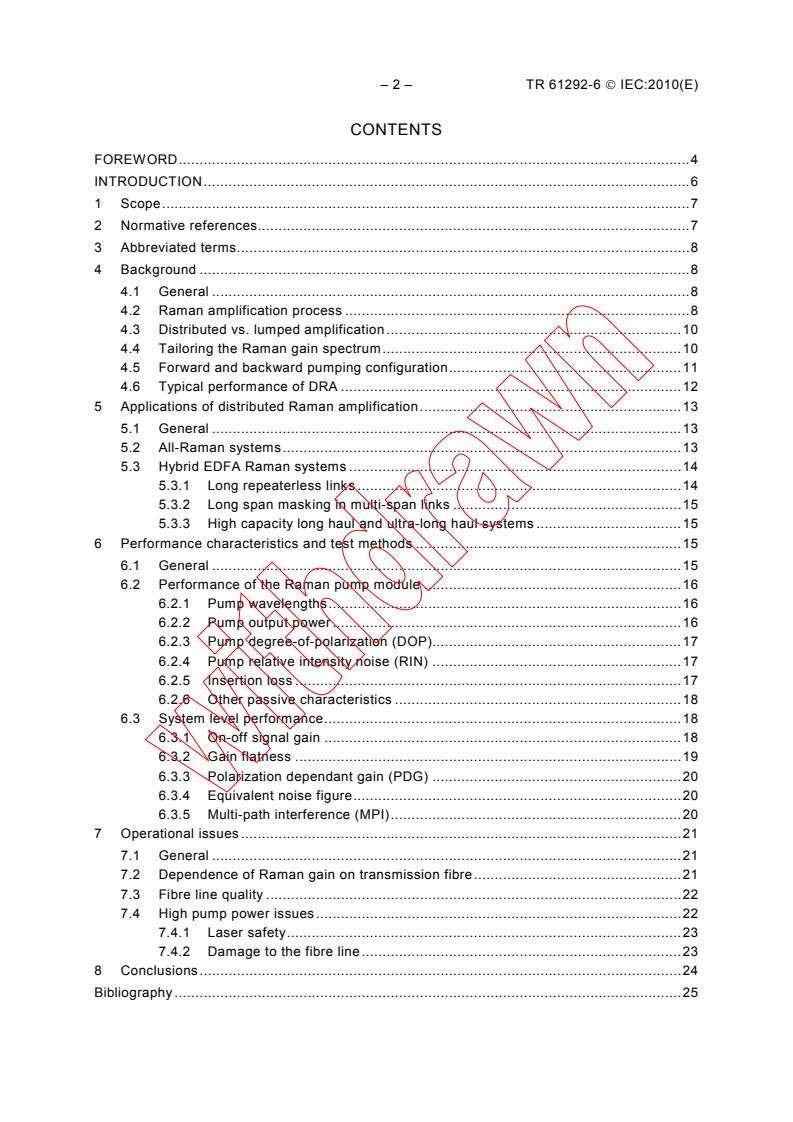
CONTENTS
FOREWORD.4
INTRODUCTION.6
1 Scope.7
2 Normative references.7
3 Abbreviated terms.8
4 Background .8
4.1 General .8
4.2 Raman amplification process .8
4.3 Distributed vs. lumped amplification .10
4.4 Tailoring the Raman gain spectrum.10
4.5 Forward and backward pumping configuration.11
4.6 Typical performance of DRA .12
5 Applications of distributed Raman amplification.13
5.1 General .13
5.2 All-Raman systems.13
5.3 Hybrid EDFA Raman systems .14
5.3.1 Long repeaterless links .14
5.3.2 Long span masking in multi-span links .15
5.3.3 High capacity long haul and ultra-long haul systems .15
6 Performance characteristics and test methods .15
6.1 General .15
6.2 Performance of the Raman pump module .16
6.2.1 Pump wavelengths.16
6.2.2 Pump output power .16
6.2.3 Pump degree-of-polarization (DOP).17
6.2.4 Pump relative intensity noise (RIN) .17
6.2.5 Insertion loss .17
6.2.6 Other passive characteristics .18
6.3 System level performance.18
6.3.1 On-off signal gain .18
6.3.2 Gain flatness .19
6.3.3 Polarization dependant gain (PDG) .20
6.3.4 Equivalent noise figure.20
6.3.5 Multi-path interference (MPI).20
7 Operational issues .21
7.1 General .21
7.2 Dependence of Raman gain on transmission fibre.21
7.3 Fibre line quality .22
7.4 High pump power issues.22
7.4.1 Laser safety.23
7.4.2 Damage to the fibre line.23
8 Conclusions.24
Bibliography .25
TR 61292-6 © IEC:2010(E) – 3 –
Figure 1 – Stimulated Raman scattering process (left) and Raman gain spectrum for
silica fibres (right) .9
Figure 2 – Distributed vs. lumped amplification.10
Figure 3 – The use of multiple pump wavelengths to achieve flat broadband gain.11
Figure 4 – Simulation results showing pump and signal propagation along an SMF span
in forward (right plot) and backward (left plot) pumping configurations .11
Figure 5 – On-off gain and equivalent NF for SMF using a dual pump backward DRA
with pumps at 1 424 nm and 1 452 nm .13
Figure 6 – Typical configuration of an amplification site in an all-Raman system .14
Figure 7 – Typical configuration of a Raman pump module used for counter-propagating
DRA.16
Figure 8 – Model for signal insertion loss (IL) of a Raman pump module used for
counter-propagating DRA .18
Figure 9 – Typical configuration used to measure on of gain (a) for co-propagating DRA
and (b) for counter-propagating DRA .19
Figure 10 – Variations of Raman on-off gain for different transmission fibres .22
– 4 – TR 61292-6 © IEC:2010(E)
INTERNATIONAL ELECTROTECHNICAL COMMISSION
____________
OPTICAL AMPLIFIERS –
Part 6: Distributed Raman amplification
FOREWORD
1) The International Electrotechnical Commission (IEC) is a worldwide organization for standardization comprising
all national electrotechnical committees (IEC National Committees). The object of IEC is to promote
international co-operation on all questions concerning standardization in the electrical and electronic fields. To
this end and in addition to other activities, IEC publishes International Standards, Technical Specifications,
Technical Reports, Publicly Available Specifications (PAS) and Guides (hereafter referred to as “IEC
Publication(s)”). Their preparation is entrusted to technical committees; any IEC National Committee interested
in the subject dealt with may participate in this preparatory work. International, governmental and non-
governmental organizations liaising with the IEC also participate in this preparation. IEC collaborates closely
with the International Organization for Standardization (ISO) in accordance with conditions determined by
agreement between the two organizations.
2) The formal decisions or agreements of IEC on technical matters express, as nearly as possible, an international
consensus of opinion on the relevant subjects since each technical committee has representation from all
interested IEC National Committees.
3) IEC Publications have the form of recommendations for international use and are accepted by IEC National
Committees in that sense. While all reasonable efforts are made to ensure that the technical content of IEC
Publications is accurate, IEC cannot be held responsible for the way in which they are used or for any
misinterpretation by any end user.
4) In order to promote international uniformity, IEC National Committees undertake to apply IEC Publications
transparently to the maximum extent possible in their national and regional publications. Any divergence
between any IEC Publication and the corresponding national or regional publication shall be clearly indicated in
the latter.
5) IEC itself does not provide any attestation of conformity. Independent certification bodies provide conformity
assessment services and, in some areas, access to IEC marks of conformity. IEC is not responsible for any
services carried out by independent certification bodies.
6) All users should ensure that they have the latest edition of this publication.
7) No liability shall attach to IEC or its directors, employees, servants or agents including individual experts and
members of its technical committees and IEC National Committees for any personal injury, property damage or
other damage of any nature whatsoever, whether direct or indirect, or for costs (including legal fees) and
expenses arising out of the publication, use of, or reliance upon, this IEC Publication or any other IEC
Publications.
8) Attention is drawn to the Normative references cited in this publication. Use of the referenced publications is
indispensable for the correct application of this publication.
9) Attention is drawn to the possibility that some of the elements of this IEC Publication may be the subject of
patent rights. IEC shall not be held responsible for identifying any or all such patent rights.
The main task of IEC technical committees is to prepare International Standards. However, a
technical committee may propose the publication of a technical report when it has collected
data of a different kind from that which is normally published as an International Standard, for
example "state of the art".
IEC 61292-6, which is a technical report, has been prepared by subcommittee 86C: Fibre optic
systems and active devices, of IEC technical committee 86: Fibre optics.
The text of this technical report is based on the following documents:
Enquiry draft Report on voting
86C/910/DTR 86C/936/RVC
Full information on the voting for the approval of this technical report can be found in the report
on voting indicated in the above table.
TR 61292-6 © IEC:2010(E) – 5 –
This publication has been drafted in accordance with the ISO/IEC Directives, Part 2.
A list of all parts of the IEC 61292 series, published under the general title Optical amplifiers,
can be found on the IEC website.
The committee has decided that the contents of this amendment and the base publication will
remain unchanged until the stability date indicated on the IEC web site under
"http://webstore.iec.ch" in the data related to the specific publication. At this date, the
publication will be
• reconfirmed,
• withdrawn,
• replaced by a revised edition, or
• amended.
A bilingual version of this publication may be issued at a later date.
IMPORTANT – The 'colour inside' logo on the cover page of this publication indicates
that it contains colours which are considered to be useful for the correct understanding
of its contents. Users should therefore print this document using a colour printer.
– 6 – TR 61292-6 © IEC:2010(E)
INTRODUCTION
Distributed Raman amplification (DRA) describes the process whereby Raman pump power is
introduced into the transmission fibre, leading to signal amplification within the transmission
fibre though stimulated Raman scattering. This technology has become increasingly
widespread in recent years due to the many advantage that it offers optical system designers,
including improved system optical signal-to-noise ratio (OSNR), and the ability to tailor the gain
spectrum to cover any or several transmission bands.
A fundamental difference between distributed Raman amplification and amplification using
discrete amplifiers, such as erbium-doped fibre amplifiers (EDFAs), is that the latter can be
described using a black box approach, while the former is an inherent part of the system in
which it is deployed. Thus, a discrete amplifier is a unique and separate element with a well
defined input and output ports, allowing rigorous specifications of the amplifiers performance
characteristics and the methods used to test these characteristics. On the other hand, a
distributed Raman amplifier is basically a pump module, with the actual amplification process
taking place along the transmission fibre. This means that many of the performance
characteristics of distributed Raman amplification are inherently coupled to the system in which
it is deployed.
This technical report provides an overview of DRA and its applications. It also provides a
detailed discussion of the various performance characteristics related to DRA, some of the
methods that can be used to test these characteristics, and some of the operational issues
related to the distributed nature of the amplification process, such as the sensitivity to
transmission line quality and eye-safety.
The material provided is intended to provide a basis for future development of specifications
and test method standards related to DRA.
TR 61292-6 © IEC:2010(E) – 7 –
OPTICAL AMPLIFIERS –
Part 6: Distributed Raman amplification
1 Scope
This part of IEC 61292, which is a technical report, deals with distributed Raman amplification
(DRA). The main purpose of the report is to provide background material for future standards
(specifications, test methods and operating procedures) relating to DRA. The report covers the
following aspects:
– general overview of Raman amplification;
– applications of DRA;
– performance characteristics and test methods related to DRA;
– operational issues relating to the deployment of DRA.
As DRA is a relatively young technology, and still rapidly evolving, some of the material in this
report may become obsolete or irrelevant in a relatively short period. This technical report will
be frequently updated in order to minimize this possibility.
2 Normative references
The following referenced documents are indispensable for the application of this document. For
dated references, only the edition cited applies. For undated references, the latest edition of
the referenced document (including any amendments) applies.
IEC 60825-2, Safety of laser products – Part 2: Safety of optical fibre communication systems
(OFCS)
IEC 61290-3, Optical amplifiers – Test methods – Part 3: Noise figure parameters
IEC 61290-3-1, Optical amplifiers – Test methods – Part 3-1: Noise figure parameters – Optical
spectrum analyzer method
IEC 61290-3-2, Optical amplifiers – Test methods – Part 3-2: Noise figure parameters –
Electrical spectrum analyzer method
IEC 61290-7-1, Optical amplifiers – Test methods – Part 7-1: Out-of-band insertion losses –
Filtered optical power meter method
IEC 61291-1, Optical amplifiers – Part 1: Generic specification
IEC/TR 61292-3, Optical amplifiers – Part 3: Classification, characteristics and applications
IEC/TR 61292-4, Optical amplifiers – Part 4: Maximum permissible optical power for the
damage-free and safe use of optical amplifiers, including Raman amplifiers
ITU-T G.664, Optical safety procedures and requirements for optical transport systems
ITU-T G.665, Generic characteristics of Raman amplifiers and Raman amplified subsystems
– 8 – TR 61292-6 © IEC:2010(E)
NOTE A list of informative references is given in the Bibliography.
3 Abbreviated terms
For the purposes of this document, the following abbreviated terms apply.
APR automatic power reduction
DCF dispersion compensating fibre
DOP degree of polarization
DRA distributed Raman amplification
DRB double Rayleigh backscattering
DWDM dense wavelength division multiplexing
EDFA erbium-doped fibre amplifier
ESA electrical spectrum analyzer
FBG fibre Bragg grating
FWHM full width half maximum
GFF gain flattening filter
LRFA lumped Raman fibre amplifier
MPI multi-path interference
NZDSF non-zero dispersion shifted fibre
OA optical amplifier
OFA optical fibre amplifier
OSA optical spectrum analyzer
OSC optical supervisory channel
OSNR optical signal-to-noise ratio
PDG polarization dependent gain
PMD polarization mode dispersion
RIN relative intensity noise
ROADM reconfigurable optical add drop multiplexer
SMF single mode fibre
4 Background
4.1 General
This clause provides a brief introduction to the main concepts of Raman amplification. Further
information can be found IEC/TR 61292-3, ITU-T G.665, as well as in the bibliography.
4.2 Raman amplification process
Raman scattering, first discovered by Sir Chandrasekhara Raman in 1928, describes an
inelastic scattering process whereby light is scattered from matter molecules to a higher
wavelength (lower energy). In this interaction between light and matter, a light photon excites
the matter molecules to a high (virtual) energy state, which then relaxes back to the ground
state by emitting another photon as well as vibration (i.e. acoustic) energy. Due to the vibration
energy, the emitted photon has less energy than the incident photon, and therefore a higher
wavelength.
Stimulated Raman scattering describes a similar process whereby the presence of a higher
wavelength photon stimulates the scattering process, i.e. the absorption of the initial lower
TR 61292-6 © IEC:2010(E) – 9 –
wavelength photon, resulting in the emission of a second higher wavelength photon, thus
providing amplification. This process is shown in Figure 1 for silica fibres, where a ~1 550 nm
signal is amplified through absorption of pump energy at ~1 450 nm. Unlike doped OFAs, such
as EDFAs, where the gain spectrum is constant and determined by the dopants, with Raman
amplification the gain spectrum depends on the pump wavelength, with maximum gain
occurring at a frequency of about 13 THz (for Silica fibres) below that of the pump. This is
shown on the right side of Figure 1.
Raman coefficient in silica fibers
Virtual state
100 nm100 nm
∼1 450 nm pump
∼1 550 nm amplification
Photon relaxation 4
Vibrational states
Ground state
0 100 200 300 400 500 600
Pump - Signal wavelength difference (1/cm)
IEC 418/10 IEC 419/10
Figure 1 – Stimulated Raman scattering process (left)
and Raman gain spectrum for silica fibres (right)
In its most basic form, a Raman amplifier consists of a Raman pump laser, a fibre amplification
medium, and a means of coupling the Raman pump and input signal into the fibre. The main
performance parameter characterizing the Raman amplifier is the on-off gain, which is defined
as the ratio of the output signal (i.e. the signal at the fibre output) when the Raman pumps are
on to the output signal when the Raman pumps are off (the on-off gain will be further discussed
in 6.2.1), Neglecting pump power depletion (i.e. small input signal regime), the on-off gain of a
Raman amplifier can be approximated by
G = 4,34C PL
R eff
where G is the on-off gain (in dB), C the Raman efficiency between pump and signal, P the
R
coupled pump power, and L the effective length of the fibre with respect to the Raman
eff
process, defined as
−α L
p
1− e
L ≡
eff
α
p
where α is the fibre attenuation coefficient at the pump WL.
p
The Raman efficiency C depends on the separation between the pump and signal
R
wavelengths, as well as their relative polarization. If the pump and signal polarizations are
orthogonal, then C = 0 , whereas if they have the same polarization, C is maximum. In many
R
R
cases, the pump is depolarized, and then C is approximately half the maximum value. In
R
other cases, the pump and signal relative polarization changes continuously as they propagate
along the fibre amplification medium, so that C has the same average value as for the
R
depolarized pump case. However, in this case, C may have some residual dependence on
R
signal polarization, resulting in PDG.
Raman coefficient
X1e-14 (m/W)
– 10 – TR 61292-6 © IEC:2010(E)
Taking as an example conventional single mode fibre (SMF) and a depolarized pump with
wavelength of 1 450 nm, then C for a signal located at 1 550 nm is approximately
R
−1
–1 –1
0,4 W km . In the limit of a long fibre, where L ≈ α ≈ 17km, a 500 mW pump provides
eff p
approximately 15 dB of on-off gain, illustrating the relatively low gain efficiency of the Raman
process. The gain efficiency can be increase using highly non-linear fibre (such as DCF),
however, a relatively long length of fibre (approximately 10 km) is still required to achieve
reasonable gain.
4.3 Distributed vs. lumped amplification
Typically OFAs are deployed as lumped (or discrete) amplifiers, meaning that the amplification
occurs within a closed amplifier module. These modules are placed at various points along the
optical link (discrete amplification sites at the end of each fibre span), so that the transmission
signal which is attenuated along the fibre span is amplified back to the required power level at
the discrete site at the end of each span. This is shown graphically by the green curve in
Figure 2. Raman amplifiers may also be used as discrete amplifiers, however, as shown in 4.2,
this requires special highly non-linear fibre. Even then the application of such amplifiers is
limited due to multi-path interference (to be discussed in 6.3.5, and other issues, and in most
cases other lumped amplifiers, such as EDFA’s, are preferable.
While most OFAs require a special doped fibre (such as Erbium doped fibre for EDFA’s) to
provide amplification, Raman amplification can occur in any fibre, and in particular within the
transmission fibre itself. This enable distributed Raman amplification (DRA), i.e. the process
whereby the transmission fibre itself is pumped in order to provide amplification for the signal
as it travels along the fibre. The blue curve in Figure 2 shows signal evolution for distributed
Raman amplification in counter-propagating (“backward”) configuration, where the Raman
pump power is introduced at the end of each span, and propagates counter to the signal. Since
gain occurs along the transmission fibre, DRA prevents the signal from being attenuated to
very low powers where noise is significant, thus improving the optical signal-to-noise ratio
(OSNR) of the transmitted signal. The fact that the net attenuation of the signal along the span
is reduced can also be utilized to launch the signal into the transmission fibre with less power,
which can be important in applications where signal non-linear effects are an issue. DRA can
also be used in co-propagating (“forward”) configuration, where the Raman pump power is
introduced at input to the span and propagates with the signal. The distinction between the two
configurations will be discussed in more detail in 4.5.
EDFAs High nonlinearities
Distance (km)
Raman amplification
High noise
EDFA amplification
IEC 420/10
Figure 2 – Distributed vs. lumped amplification
4.4 Tailoring the Raman gain spectrum
As mentioned earlier, the shape of the Raman gain spectrum depends on the pump
wavelength, with the maximum gain occurring at a wavelength approximately 100 nm higher
than the pump wavelength. This unique feature of Raman amplification enables amplification in
any wavelength band, just by using the appropriate pump wavelengths. Furthermore, multiple
Signal power (dB)
TR 61292-6 © IEC:2010(E) – 11 –
pumps with different wavelengths can be used in order to achieve flat broadband gain over a
large spectral region, as illustrated in Figure 3.
Besides achieving flat broadband gain, multiple pump wavelengths also help to reduce the
polarization dependent gain (PDG) which can be significant when a single pump is used (this
will be discussed in more detail in 6.2.3 and 6.3.3. The PDG can be further reduced by using
two pumps with the same wavelength but orthogonal polarization.
Resulting gain profile
P1 P3
P2 P4
Wavelength (nm)
IEC 421/10
Figure 3 – The use of multiple pump wavelengths to achieve flat broadband gain
4.5 Forward and backward pumping configuration
DRA can be deployed in either forward (co-propagating) configuration, where the pump is
introduced together with the signal at the input to the span, or backward (counter-propagating)
configuration, where the pump is introduced at the end of the span and propagates counter to
the signal. These two pumping configurations are illustrated in Figure 4. Assuming a small
input signal and the same pumps, the on-off gain in both configurations is the same, with the
difference being the position along the span where the amplification takes place.
Fibre span Fibre span
Signal Signal
Pump Pump
Pump Pump
unit unit
IEC 422/10 IEC 423/10
NOTE Two pumps at different wavelength provide a total of 500 mW, resulting in 10 dB on-off gain across the
C-band.
Figure 4 – Simulation results showing pump and signal propagation along an SMF span
in forward (right plot) and backward (left plot) pumping configurations
Gain (dB)
– 12 – TR 61292-6 © IEC:2010(E)
The main advantage of the forward pumping configuration is that each dB of Raman gain is
equivalent to effectively increasing the signal launch power by one dB, thus achieving a dB of
OSNR system improvement. However, there are a number of issues that reduce the overall
effectiveness of the forward pumping configuration:
• Signal non-linear effects: Since the Raman gain occurs a few tens of km within the fibre,
the maximum signal power within the span is less than what would occur if a lumped
amplifier with equivalent gain were to be placed at the beginning of the span. While this
reduces signal non-linear effects, these can still become an issue when the effective launch
power per channel increases, thus placing a practical limit on the amount of forward Raman
gain that can be used.
• Pump relative intensity noise (RIN): Typical commercial semi-conductor Raman pump
lasers have RIN values of the order of -115 dB/Hz. In forward pumping configuration there
is a long walk-off length between signal and pump, which results in significant transference
of the pump RIN to the signal, thus resulting in a system penalty which can accumulate
along many spans. This is discussed in more detail in 6.2.4.
• Pump depletion: As the composite signal input power increases pump depletion occurs,
resulting in reduction of the Raman gain. For example, 650 mW of pump power configured
to provide 15 dB flat gain across the C-Band for SMF fibre in the small signal regime, will
only provide about 8,5 dB of gain when the composite input signal is 20 dBm. Pump
depletion can also lead to large transient effects when the input signal changes abruptly
(e.g. due to channel add/drop). Unlike EDFA’s where transient effect can be suppressed
using electronic feed-back and feed-forward mechanisms, such effects cannot be fully
suppressed in forward DRA due to the fast response time of the Raman effect and the
distributed nature of the amplification.
While the backward pumping configuration does not suffer from the above disadvantages, the
OSNR improvement is typically more modest since the amplification occurs in the last few tens
of km of the fibre span. For example, 10 dB of Raman gain in the backward configuration will
typically result in about 5 dB OSNR improvement (relative to a lumped amplifier providing the
same gain at the end of the span), while increasing the Raman gain further will only result in an
additional 1 dB to 2 dB OSNR improvement. Further OSNR improvement (typically another 1 to
2 dB) can be achieved using complex multi-order Raman pumping schemes, which involve
boosting the Raman pump energy in the transmission fibre with additional pumps at even
shorter wavelengths. Thus the Raman gain occurs deeper within the span, leading to improved
OSNR.
Overall, the backward pumping configuration usually provides better system performance for
the same amount of Raman pump power, and is simpler to implement. Thus, in most systems
backward pumped DRA is usually deployed first, and then forward pumped DRA only for those
spans where backward pump DRA alone cannot supply sufficient OSNR improvement.
4.6 Typical performance of DRA
As we shall see in Clause 5, DRA is most often used to provide moderate (10 dB to 15 dB) flat
on-off gain in the C-Band, most often in the backward configuration, and less often in the
forward configuration.
Figure 5 shows the gain for SMF in the C-Band provided by a triple pump backward DRA with
pump wavelengths of 1 424 nm (two pumps) and 1 452 nm (one pump). For 10 dB gain about
450 mW of composite pump power is required, whereas for 14 dB gain 650 mW pump power is
required. The figure also shows the equivalent NF figure of the backward DRA for different
gains, which is defined as the NF of an equivalent lumped amplifier (generating the same gain
and same amount of ASE) placed at the end of the span (see 6.3.4 for further detail). In a
hybrid EDFA/Raman system (see 5.3) backward DRA is used as a pre-amplifier for a
conventional EDFA which provides the remaining gain required to compensate the span loss.
Since the DRA has a very low effective NF, and since it acts as a pre-amplifier, it mainly
determines the NF of the combined EDFA Raman amplifier. Thus, assuming a typical EDFA NF
of about 5 dB, the combined EDFA/Raman amplifier can be shown to have a composite NF of
TR 61292-6 © IEC:2010(E) – 13 –
about 0 dB in the case of 10 dB on-off Raman gain, which results in a 5 dB OSNR improvement
compared to an equivalent EDFA case.
Raman gain and NF Vs. wavelegth
G4
G6
G8
G10
G12
G14
–1
–2
1 530 1 535 1 540 1 545 1 550 1 555 1 560
Wavelength (nm)
IEC 424/10
NOTE The various curves correspond to different composite pump powers.
Figure 5 – On-off gain and equivalent NF for SMF using a dual pump
backward DRA with pumps at 1 424 nm and 1 452 nm
5 Applications of distributed Raman amplification
5.1 General
DRA offers two unique advantages compared to conventional amplifiers such as EDFAs:
Improved system OSNR; and the ability to provide flat gain for any and multiple transmission
bands. These advantages are offset by the high cost of DRA, due to the high pump power
required, as well as operational issues which will be further discussed in Clause 7. For this
reason, DRA is usually only utilized in those applications where it offers a significant
advantage, or there are no other viable alternatives. These applications will be discussed in
this clause.
5.2 All-Raman systems
All-Raman systems are systems which utilize only Raman amplification, both DRA and lumped
Raman amplifiers. By using only Raman amplification, such systems benefit from the inherent
OSNR improvement provided by DRA, and can be operated in wavelength ranges for which it is
impossible or impractical to provide amplification with more common technologies such as
EDFA’s. In particular, all Raman systems can operate in the L-Band, for which EDFA
technology is much less efficient compared to the C-Band. Since L-Band systems allow for
longer system reach compared to C-Band systems when using Non-zero dispersion shifted
transmission fibre (NZDSF), all Raman L-Band systems are particularly well suited to ultra-long
haul (>1500 km) optical links.
A typical configuration of an all-Raman amplification site is shown in Figure 6. The
configuration comprises three Raman pump modules, one for backward DRA, one for forward
DRA and one for providing lumped Raman amplification within the DCF fibre. In a typical
system such an amplification site is placed every 80 km, and thus is required to provide
approximately 20 dB of net gain. This is achieved by providing about 20 dB gain using forward
and backward DRA, and by pumping the DCF so that its net gain is zero (i.e. the on-off Raman
gain exactly compensates the DCF insertion loss, typically about 10 dB). Since DCF has a
NF (dB) Gain (dB)
– 14 – TR 61292-6 © IEC:2010(E)
relatively high Raman efficiency (due to its small effective area), a relatively small amount of
pump power is required to pump the DCF.
Besides the relatively high cost of all-Raman systems, it is also difficult to upgrade them to
support reconfigurable optical add drop multiplexers (ROADM’s), which are an integral part of
more modern optical networks. The reason for this is two-fold:
• Firstly, additional lumped amplification needs to be provided to compensate for the added
insertion loss of the ROADM modules. One option for providing the additional Raman gain
is to pump the DCF with higher pump power. However, this may lead to increased MPI due
to double Rayleigh backscattering (see 6.3.5). Another option is to use a separate lumped
Raman amplifier, which further adds to the overall cost of the system.
• Secondly, the transients resulting from system reconfiguration are difficult to suppress,
especially in the case of forward DRA.
For these reasons, the application of all-Raman systems is mainly limited to ultra-long haul
point to point (i.e. non-reconfigurable) optical links.
Transmission Transmission
DCF
fibre fibre
Mux
Mux Mux
Forward
Backward DCF
DRA Raman Raman DRA Raman
pump pump pump
IEC 425/10
Figure 6 – Typical configuration of an amplification site in an all-Raman system
5.3 Hybrid EDFA Raman systems
EDFA based system are by far the most common optical communication system in deployment
today. EDFA technology is mature and well developed, and can provide a cost effective and
efficient solution for most common applications. However, there are some more challenging
applications for which EDFA technology may not be sufficient, in which case DRA, and
particularly backward DRA, is required to improve system OSNR.
The cost of adding DRA to EDFA based systems may be reduced by tightly integrating the
Raman pump module with the EDFA, and optimizing the overall design. This is particularly
useful for LH and ULH applications (see 5.3.3), where DRA is used in every span of the link.
Integration and optimizing of the design may include, for example, mounting the Raman and
EDFA pumps in the same physical package, thus reducing package costs and footprint.
Additionally, a combined gain flattening filter (GFF) can be designed to take into account the
Raman gain spectral shape as well as the EDFA gain spectral shape, thus reducing gain
flattening requirements for both the EDFA and the Raman (and possibly reducing the number
of separate Raman pumps). Due to the pre-amplifier function of the Raman, the GFF can be
placed before the EDFA without significantly increasing the composite NF of the Hybrid
module, thus reducing the required EDFA pump power.
In the following subclauses, applications for hybrid EDFA Raman systems are discussed.
5.3.1 Long repeaterless links
Long (>150 km) repeaterless links have many applications, such as connecting islands or oil
rigs, traversing hostile or inaccessible terrain, and links where repeater sites may pose a
security or logistic challenge.
TR 61292-6 © IEC:2010(E) – 15 –
By utilizing backward DRA, the system OSNR can typically be improved by 5 dB to 7 dB,
depending on the pump power. For example, using a 700 mW Raman pump module configured
to provide approximately 15 dB of on-off Raman gain across the C-Band, an OSNR
improvement of approximately 6 dB may be achieved depending on the transmission fibre type,
thus allowing the link reach to be extended by approximately 30 km.
For even longer links, it is possible to use forward DRA as well as backward DRA. For
example, assuming a system with a 20 dBm EDFA booster, adding a 700 mW forward DRA
pump module will provide ~8,5 dB Raman on-off gain, corresponding to about 7 dB OSNR
improvement (taking into account the insertion loss of the Raman pump module).
Thus, using forward and backward DRA with moderate pump power (e.g. up to 700 mW), the
system reach for repeaterless links can be increased by up to 13 dB compared to
corresponding EDFA only systems.
5.3.2 Long span masking in multi-span links
Most multi-span links are typically constructed such that in-line EDFA repeaters are placed
after every 80 km to 100 km span. However, geographical limitation may require individual
spans to be longer, or practical considerations may provide an incentive to reduce the number
of spans and thus increase the length of one or more span. In both cases, DRA can provide the
extra OSNR margins required to support the longer spans. In addition, many systems are
designed such that the in-line EDFA can support a limited gain range while still maintaining flat
gain. In this case, besides providing improved OSNR, DRA allows longer spans to be
supported while still using the standard EDFA used by the system, thus increasing system
flexibility and utility.
While the repeaterless links discussed in the previous clause tend to be static (i.e. non-
reconfigurable) point-to-point links, multi-span links are most often dynamic, and thus required
to provide ROADM functionality. Therefore, by nature such system may generate transient
events, which are problematic to suppress when forward DRA is used. This is one reason why
forward DRA is not often used in such applications, and backward DRA is much more common.
5.3.3 High capacity long haul and ultra-long haul systems
In high capacity (high bit rate and/or dense channel spacing) systems OSNR quickly becomes
a critical issue as the number of spans increases. By utilizing backward DRA in every span in
the system, the OSNR can be increased significantly, thus allowing the system to support more
spans and/or higher capacity. For example, by providing 10 dB of backward DRA in each span
(approximately 500 mW pump power), the system OSNR can be improved by about 5 dB
compared to an equivalent EDFA only system, allowing a 3-fold increase in the reach of the
system.
6 Performance characteristics and test methods
6.1 General
This clause describes important performance parameters relevant to DRA, and considers tests
methods for these parameters. As discussed previously, a fundamental difference between
DRA and lumped amplifiers is that the performance of DRA depends on the transmission fibre,
so that a full characterization of the amplifier performance can only be performed on a system
level, rather than on a device level. However, there are some performance parameters that are
specific to the Raman pump module, which can be specified and measured independently of
the system in which the module is installed. Furthermore, those parameters which are system
dependent can be characterized on average for various types of transmission fibre, so that the
expected performance is a system can be predicted. In what follows, we first discuss these
device level characteristics, and then proceed to system level performance.
– 16 – TR 61292-6 © IEC:2010(E)
6.2 Performance of the Raman pump module
A Raman pump module typically consists of a number of Raman pump lasers together with
passive components designed to multiplex the output of these lasers with the signal. The
module may also contain detectors for monitoring pump power and signal power, as well
circuits and software for controlling the amplifier. A possible construction of a Raman pump
module used for counter-propagating DRA is shown in Figure 7. In this example, the pump
module contains three pumps laser diodes, two polarization multiplexed diodes at wavelength
λ1, and one laser diode at wavelength λ2.
Raman pump module
Fibre span
Pump/Signal
WDM
Tap
Signal out
Signal in
Pump out
Pump
power
Tap
detector
Input
signal
Pump WDM
detector
λ1 λ2
Polarization
beam
combiner
Pump Pump Pump
λ1 λ1 λ2
IEC 426/10
Figure 7 – Typical configuration of a Raman pump module used
for counter-propagating DRA
6.2.1 Pump wavelengths
The spectrum of the pump
...
IEC/TR 61292-6 ®
Edition 1.0 2010-02
TECHNICAL
REPORT
Optical amplifiers –
Part 6: Distributed Raman amplification
IEC/TR 61292-6:2010(E)
All rights reserved. Unless otherwise specified, no part of this publication may be reproduced or utilized in any form or by
any means, electronic or mechanical, including photocopying and microfilm, without permission in writing from either IEC or
IEC's member National Committee in the country of the requester.
If you have any questions about IEC copyright or have an enquiry about obtaining additional rights to this publication,
please contact the address below or your local IEC member National Committee for further information.
Droits de reproduction réservés. Sauf indication contraire, aucune partie de cette publication ne peut être reproduite
ni utilisée sous quelque forme que ce soit et par aucun procédé, électronique ou mécanique, y compris la photocopie
et les microfilms, sans l'accord écrit de la CEI ou du Comité national de la CEI du pays du demandeur.
Si vous avez des questions sur le copyright de la CEI ou si vous désirez obtenir des droits supplémentaires sur cette
publication, utilisez les coordonnées ci-après ou contactez le Comité national de la CEI de votre pays de résidence.
IEC Central Office
3, rue de Varembé
CH-1211 Geneva 20
Switzerland
Email: inmail@iec.ch
Web: www.iec.ch
About IEC publications
The technical content of IEC publications is kept under constant review by the IEC. Please make sure that you have the
latest edition, a corrigenda or an amendment might have been published.
ƒ Catalogue of IEC publications: www.iec.ch/searchpub
The IEC on-line Catalogue enables you to search by a variety of criteria (reference number, text, technical committee,…).
It also gives information on projects, withdrawn and replaced publications.
ƒ IEC Just Published: www.iec.ch/online_news/justpub
Stay up to date on all new IEC publications. Just Published details twice a month all new publications released. Available
on-line and also by email.
ƒ Electropedia: www.electropedia.org
The world's leading online dictionary of electronic and electrical terms containing more than 20 000 terms and definitions
in English and French, with equivalent terms in additional languages. Also known as the International Electrotechnical
Vocabulary online.
ƒ Customer Service Centre: www.iec.ch/webstore/custserv
If you wish to give us your feedback on this publication or need further assistance, please visit the Customer Service
Centre FAQ or contact us:
Email: csc@iec.ch
Tel.: +41 22 919 02 11
Fax: +41 22 919 03 00
IEC/TR 61292-6 ®
Edition 1.0 2010-02
TECHNICAL
REPORT
Optical amplifiers –
Part 6: Distributed Raman amplification
INTERNATIONAL
ELECTROTECHNICAL
COMMISSION
PRICE CODE
T
ICS 33.160.10; 33.180.30 ISBN 978-2-88910-482-6
– 2 – TR 61292-6 © IEC:2010(E)
CONTENTS
FOREWORD.4
INTRODUCTION.6
1 Scope.7
2 Normative references.7
3 Abbreviated terms.8
4 Background .8
4.1 General .8
4.2 Raman amplification process .8
4.3 Distributed vs. lumped amplification .10
4.4 Tailoring the Raman gain spectrum.10
4.5 Forward and backward pumping configuration.11
4.6 Typical performance of DRA .12
5 Applications of distributed Raman amplification.13
5.1 General .13
5.2 All-Raman systems.13
5.3 Hybrid EDFA Raman systems .14
5.3.1 Long repeaterless links .14
5.3.2 Long span masking in multi-span links .15
5.3.3 High capacity long haul and ultra-long haul systems .15
6 Performance characteristics and test methods .15
6.1 General .15
6.2 Performance of the Raman pump module .16
6.2.1 Pump wavelengths.16
6.2.2 Pump output power .16
6.2.3 Pump degree-of-polarization (DOP).17
6.2.4 Pump relative intensity noise (RIN) .17
6.2.5 Insertion loss .17
6.2.6 Other passive characteristics .18
6.3 System level performance.18
6.3.1 On-off signal gain .18
6.3.2 Gain flatness .19
6.3.3 Polarization dependant gain (PDG) .20
6.3.4 Equivalent noise figure.20
6.3.5 Multi-path interference (MPI).20
7 Operational issues .21
7.1 General .21
7.2 Dependence of Raman gain on transmission fibre.21
7.3 Fibre line quality .22
7.4 High pump power issues.22
7.4.1 Laser safety.23
7.4.2 Damage to the fibre line.23
8 Conclusions.24
Bibliography .25
TR 61292-6 © IEC:2010(E) – 3 –
Figure 1 – Stimulated Raman scattering process (left) and Raman gain spectrum for
silica fibres (right) .9
Figure 2 – Distributed vs. lumped amplification.10
Figure 3 – The use of multiple pump wavelengths to achieve flat broadband gain.11
Figure 4 – Simulation results showing pump and signal propagation along an SMF span
in forward (right plot) and backward (left plot) pumping configurations .11
Figure 5 – On-off gain and equivalent NF for SMF using a dual pump backward DRA
with pumps at 1 424 nm and 1 452 nm .13
Figure 6 – Typical configuration of an amplification site in an all-Raman system .14
Figure 7 – Typical configuration of a Raman pump module used for counter-propagating
DRA.16
Figure 8 – Model for signal insertion loss (IL) of a Raman pump module used for
counter-propagating DRA .18
Figure 9 – Typical configuration used to measure on of gain (a) for co-propagating DRA
and (b) for counter-propagating DRA .19
Figure 10 – Variations of Raman on-off gain for different transmission fibres .22
– 4 – TR 61292-6 © IEC:2010(E)
INTERNATIONAL ELECTROTECHNICAL COMMISSION
____________
OPTICAL AMPLIFIERS –
Part 6: Distributed Raman amplification
FOREWORD
1) The International Electrotechnical Commission (IEC) is a worldwide organization for standardization comprising
all national electrotechnical committees (IEC National Committees). The object of IEC is to promote
international co-operation on all questions concerning standardization in the electrical and electronic fields. To
this end and in addition to other activities, IEC publishes International Standards, Technical Specifications,
Technical Reports, Publicly Available Specifications (PAS) and Guides (hereafter referred to as “IEC
Publication(s)”). Their preparation is entrusted to technical committees; any IEC National Committee interested
in the subject dealt with may participate in this preparatory work. International, governmental and non-
governmental organizations liaising with the IEC also participate in this preparation. IEC collaborates closely
with the International Organization for Standardization (ISO) in accordance with conditions determined by
agreement between the two organizations.
2) The formal decisions or agreements of IEC on technical matters express, as nearly as possible, an international
consensus of opinion on the relevant subjects since each technical committee has representation from all
interested IEC National Committees.
3) IEC Publications have the form of recommendations for international use and are accepted by IEC National
Committees in that sense. While all reasonable efforts are made to ensure that the technical content of IEC
Publications is accurate, IEC cannot be held responsible for the way in which they are used or for any
misinterpretation by any end user.
4) In order to promote international uniformity, IEC National Committees undertake to apply IEC Publications
transparently to the maximum extent possible in their national and regional publications. Any divergence
between any IEC Publication and the corresponding national or regional publication shall be clearly indicated in
the latter.
5) IEC itself does not provide any attestation of conformity. Independent certification bodies provide conformity
assessment services and, in some areas, access to IEC marks of conformity. IEC is not responsible for any
services carried out by independent certification bodies.
6) All users should ensure that they have the latest edition of this publication.
7) No liability shall attach to IEC or its directors, employees, servants or agents including individual experts and
members of its technical committees and IEC National Committees for any personal injury, property damage or
other damage of any nature whatsoever, whether direct or indirect, or for costs (including legal fees) and
expenses arising out of the publication, use of, or reliance upon, this IEC Publication or any other IEC
Publications.
8) Attention is drawn to the Normative references cited in this publication. Use of the referenced publications is
indispensable for the correct application of this publication.
9) Attention is drawn to the possibility that some of the elements of this IEC Publication may be the subject of
patent rights. IEC shall not be held responsible for identifying any or all such patent rights.
The main task of IEC technical committees is to prepare International Standards. However, a
technical committee may propose the publication of a technical report when it has collected
data of a different kind from that which is normally published as an International Standard, for
example "state of the art".
IEC 61292-6, which is a technical report, has been prepared by subcommittee 86C: Fibre optic
systems and active devices, of IEC technical committee 86: Fibre optics.
The text of this technical report is based on the following documents:
Enquiry draft Report on voting
86C/910/DTR 86C/936/RVC
Full information on the voting for the approval of this technical report can be found in the report
on voting indicated in the above table.
TR 61292-6 © IEC:2010(E) – 5 –
This publication has been drafted in accordance with the ISO/IEC Directives, Part 2.
A list of all parts of the IEC 61292 series, published under the general title Optical amplifiers,
can be found on the IEC website.
The committee has decided that the contents of this amendment and the base publication will
remain unchanged until the stability date indicated on the IEC web site under
"http://webstore.iec.ch" in the data related to the specific publication. At this date, the
publication will be
• reconfirmed,
• withdrawn,
• replaced by a revised edition, or
• amended.
A bilingual version of this publication may be issued at a later date.
IMPORTANT – The 'colour inside' logo on the cover page of this publication indicates
that it contains colours which are considered to be useful for the correct understanding
of its contents. Users should therefore print this document using a colour printer.
– 6 – TR 61292-6 © IEC:2010(E)
INTRODUCTION
Distributed Raman amplification (DRA) describes the process whereby Raman pump power is
introduced into the transmission fibre, leading to signal amplification within the transmission
fibre though stimulated Raman scattering. This technology has become increasingly
widespread in recent years due to the many advantage that it offers optical system designers,
including improved system optical signal-to-noise ratio (OSNR), and the ability to tailor the gain
spectrum to cover any or several transmission bands.
A fundamental difference between distributed Raman amplification and amplification using
discrete amplifiers, such as erbium-doped fibre amplifiers (EDFAs), is that the latter can be
described using a black box approach, while the former is an inherent part of the system in
which it is deployed. Thus, a discrete amplifier is a unique and separate element with a well
defined input and output ports, allowing rigorous specifications of the amplifiers performance
characteristics and the methods used to test these characteristics. On the other hand, a
distributed Raman amplifier is basically a pump module, with the actual amplification process
taking place along the transmission fibre. This means that many of the performance
characteristics of distributed Raman amplification are inherently coupled to the system in which
it is deployed.
This technical report provides an overview of DRA and its applications. It also provides a
detailed discussion of the various performance characteristics related to DRA, some of the
methods that can be used to test these characteristics, and some of the operational issues
related to the distributed nature of the amplification process, such as the sensitivity to
transmission line quality and eye-safety.
The material provided is intended to provide a basis for future development of specifications
and test method standards related to DRA.
TR 61292-6 © IEC:2010(E) – 7 –
OPTICAL AMPLIFIERS –
Part 6: Distributed Raman amplification
1 Scope
This part of IEC 61292, which is a technical report, deals with distributed Raman amplification
(DRA). The main purpose of the report is to provide background material for future standards
(specifications, test methods and operating procedures) relating to DRA. The report covers the
following aspects:
– general overview of Raman amplification;
– applications of DRA;
– performance characteristics and test methods related to DRA;
– operational issues relating to the deployment of DRA.
As DRA is a relatively young technology, and still rapidly evolving, some of the material in this
report may become obsolete or irrelevant in a relatively short period. This technical report will
be frequently updated in order to minimize this possibility.
2 Normative references
The following referenced documents are indispensable for the application of this document. For
dated references, only the edition cited applies. For undated references, the latest edition of
the referenced document (including any amendments) applies.
IEC 60825-2, Safety of laser products – Part 2: Safety of optical fibre communication systems
(OFCS)
IEC 61290-3, Optical amplifiers – Test methods – Part 3: Noise figure parameters
IEC 61290-3-1, Optical amplifiers – Test methods – Part 3-1: Noise figure parameters – Optical
spectrum analyzer method
IEC 61290-3-2, Optical amplifiers – Test methods – Part 3-2: Noise figure parameters –
Electrical spectrum analyzer method
IEC 61290-7-1, Optical amplifiers – Test methods – Part 7-1: Out-of-band insertion losses –
Filtered optical power meter method
IEC 61291-1, Optical amplifiers – Part 1: Generic specification
IEC/TR 61292-3, Optical amplifiers – Part 3: Classification, characteristics and applications
IEC/TR 61292-4, Optical amplifiers – Part 4: Maximum permissible optical power for the
damage-free and safe use of optical amplifiers, including Raman amplifiers
ITU-T G.664, Optical safety procedures and requirements for optical transport systems
ITU-T G.665, Generic characteristics of Raman amplifiers and Raman amplified subsystems
– 8 – TR 61292-6 © IEC:2010(E)
NOTE A list of informative references is given in the Bibliography.
3 Abbreviated terms
For the purposes of this document, the following abbreviated terms apply.
APR automatic power reduction
DCF dispersion compensating fibre
DOP degree of polarization
DRA distributed Raman amplification
DRB double Rayleigh backscattering
DWDM dense wavelength division multiplexing
EDFA erbium-doped fibre amplifier
ESA electrical spectrum analyzer
FBG fibre Bragg grating
FWHM full width half maximum
GFF gain flattening filter
LRFA lumped Raman fibre amplifier
MPI multi-path interference
NZDSF non-zero dispersion shifted fibre
OA optical amplifier
OFA optical fibre amplifier
OSA optical spectrum analyzer
OSC optical supervisory channel
OSNR optical signal-to-noise ratio
PDG polarization dependent gain
PMD polarization mode dispersion
RIN relative intensity noise
ROADM reconfigurable optical add drop multiplexer
SMF single mode fibre
4 Background
4.1 General
This clause provides a brief introduction to the main concepts of Raman amplification. Further
information can be found IEC/TR 61292-3, ITU-T G.665, as well as in the bibliography.
4.2 Raman amplification process
Raman scattering, first discovered by Sir Chandrasekhara Raman in 1928, describes an
inelastic scattering process whereby light is scattered from matter molecules to a higher
wavelength (lower energy). In this interaction between light and matter, a light photon excites
the matter molecules to a high (virtual) energy state, which then relaxes back to the ground
state by emitting another photon as well as vibration (i.e. acoustic) energy. Due to the vibration
energy, the emitted photon has less energy than the incident photon, and therefore a higher
wavelength.
Stimulated Raman scattering describes a similar process whereby the presence of a higher
wavelength photon stimulates the scattering process, i.e. the absorption of the initial lower
TR 61292-6 © IEC:2010(E) – 9 –
wavelength photon, resulting in the emission of a second higher wavelength photon, thus
providing amplification. This process is shown in Figure 1 for silica fibres, where a ~1 550 nm
signal is amplified through absorption of pump energy at ~1 450 nm. Unlike doped OFAs, such
as EDFAs, where the gain spectrum is constant and determined by the dopants, with Raman
amplification the gain spectrum depends on the pump wavelength, with maximum gain
occurring at a frequency of about 13 THz (for Silica fibres) below that of the pump. This is
shown on the right side of Figure 1.
Raman coefficient in silica fibers
Virtual state
100 nm100 nm
∼1 450 nm pump
∼1 550 nm amplification
Photon relaxation 4
Vibrational states
Ground state
0 100 200 300 400 500 600
Pump - Signal wavelength difference (1/cm)
IEC 418/10 IEC 419/10
Figure 1 – Stimulated Raman scattering process (left)
and Raman gain spectrum for silica fibres (right)
In its most basic form, a Raman amplifier consists of a Raman pump laser, a fibre amplification
medium, and a means of coupling the Raman pump and input signal into the fibre. The main
performance parameter characterizing the Raman amplifier is the on-off gain, which is defined
as the ratio of the output signal (i.e. the signal at the fibre output) when the Raman pumps are
on to the output signal when the Raman pumps are off (the on-off gain will be further discussed
in 6.2.1), Neglecting pump power depletion (i.e. small input signal regime), the on-off gain of a
Raman amplifier can be approximated by
G = 4,34C PL
R eff
where G is the on-off gain (in dB), C the Raman efficiency between pump and signal, P the
R
coupled pump power, and L the effective length of the fibre with respect to the Raman
eff
process, defined as
−α L
p
1− e
L ≡
eff
α
p
where α is the fibre attenuation coefficient at the pump WL.
p
The Raman efficiency C depends on the separation between the pump and signal
R
wavelengths, as well as their relative polarization. If the pump and signal polarizations are
orthogonal, then C = 0 , whereas if they have the same polarization, C is maximum. In many
R
R
cases, the pump is depolarized, and then C is approximately half the maximum value. In
R
other cases, the pump and signal relative polarization changes continuously as they propagate
along the fibre amplification medium, so that C has the same average value as for the
R
depolarized pump case. However, in this case, C may have some residual dependence on
R
signal polarization, resulting in PDG.
Raman coefficient
X1e-14 (m/W)
– 10 – TR 61292-6 © IEC:2010(E)
Taking as an example conventional single mode fibre (SMF) and a depolarized pump with
wavelength of 1 450 nm, then C for a signal located at 1 550 nm is approximately
R
−1
–1 –1
0,4 W km . In the limit of a long fibre, where L ≈ α ≈ 17km, a 500 mW pump provides
eff p
approximately 15 dB of on-off gain, illustrating the relatively low gain efficiency of the Raman
process. The gain efficiency can be increase using highly non-linear fibre (such as DCF),
however, a relatively long length of fibre (approximately 10 km) is still required to achieve
reasonable gain.
4.3 Distributed vs. lumped amplification
Typically OFAs are deployed as lumped (or discrete) amplifiers, meaning that the amplification
occurs within a closed amplifier module. These modules are placed at various points along the
optical link (discrete amplification sites at the end of each fibre span), so that the transmission
signal which is attenuated along the fibre span is amplified back to the required power level at
the discrete site at the end of each span. This is shown graphically by the green curve in
Figure 2. Raman amplifiers may also be used as discrete amplifiers, however, as shown in 4.2,
this requires special highly non-linear fibre. Even then the application of such amplifiers is
limited due to multi-path interference (to be discussed in 6.3.5, and other issues, and in most
cases other lumped amplifiers, such as EDFA’s, are preferable.
While most OFAs require a special doped fibre (such as Erbium doped fibre for EDFA’s) to
provide amplification, Raman amplification can occur in any fibre, and in particular within the
transmission fibre itself. This enable distributed Raman amplification (DRA), i.e. the process
whereby the transmission fibre itself is pumped in order to provide amplification for the signal
as it travels along the fibre. The blue curve in Figure 2 shows signal evolution for distributed
Raman amplification in counter-propagating (“backward”) configuration, where the Raman
pump power is introduced at the end of each span, and propagates counter to the signal. Since
gain occurs along the transmission fibre, DRA prevents the signal from being attenuated to
very low powers where noise is significant, thus improving the optical signal-to-noise ratio
(OSNR) of the transmitted signal. The fact that the net attenuation of the signal along the span
is reduced can also be utilized to launch the signal into the transmission fibre with less power,
which can be important in applications where signal non-linear effects are an issue. DRA can
also be used in co-propagating (“forward”) configuration, where the Raman pump power is
introduced at input to the span and propagates with the signal. The distinction between the two
configurations will be discussed in more detail in 4.5.
EDFAs High nonlinearities
Distance (km)
Raman amplification
High noise
EDFA amplification
IEC 420/10
Figure 2 – Distributed vs. lumped amplification
4.4 Tailoring the Raman gain spectrum
As mentioned earlier, the shape of the Raman gain spectrum depends on the pump
wavelength, with the maximum gain occurring at a wavelength approximately 100 nm higher
than the pump wavelength. This unique feature of Raman amplification enables amplification in
any wavelength band, just by using the appropriate pump wavelengths. Furthermore, multiple
Signal power (dB)
TR 61292-6 © IEC:2010(E) – 11 –
pumps with different wavelengths can be used in order to achieve flat broadband gain over a
large spectral region, as illustrated in Figure 3.
Besides achieving flat broadband gain, multiple pump wavelengths also help to reduce the
polarization dependent gain (PDG) which can be significant when a single pump is used (this
will be discussed in more detail in 6.2.3 and 6.3.3. The PDG can be further reduced by using
two pumps with the same wavelength but orthogonal polarization.
Resulting gain profile
P1 P3
P2 P4
Wavelength (nm)
IEC 421/10
Figure 3 – The use of multiple pump wavelengths to achieve flat broadband gain
4.5 Forward and backward pumping configuration
DRA can be deployed in either forward (co-propagating) configuration, where the pump is
introduced together with the signal at the input to the span, or backward (counter-propagating)
configuration, where the pump is introduced at the end of the span and propagates counter to
the signal. These two pumping configurations are illustrated in Figure 4. Assuming a small
input signal and the same pumps, the on-off gain in both configurations is the same, with the
difference being the position along the span where the amplification takes place.
Fibre span Fibre span
Signal Signal
Pump Pump
Pump Pump
unit unit
IEC 422/10 IEC 423/10
NOTE Two pumps at different wavelength provide a total of 500 mW, resulting in 10 dB on-off gain across the
C-band.
Figure 4 – Simulation results showing pump and signal propagation along an SMF span
in forward (right plot) and backward (left plot) pumping configurations
Gain (dB)
– 12 – TR 61292-6 © IEC:2010(E)
The main advantage of the forward pumping configuration is that each dB of Raman gain is
equivalent to effectively increasing the signal launch power by one dB, thus achieving a dB of
OSNR system improvement. However, there are a number of issues that reduce the overall
effectiveness of the forward pumping configuration:
• Signal non-linear effects: Since the Raman gain occurs a few tens of km within the fibre,
the maximum signal power within the span is less than what would occur if a lumped
amplifier with equivalent gain were to be placed at the beginning of the span. While this
reduces signal non-linear effects, these can still become an issue when the effective launch
power per channel increases, thus placing a practical limit on the amount of forward Raman
gain that can be used.
• Pump relative intensity noise (RIN): Typical commercial semi-conductor Raman pump
lasers have RIN values of the order of -115 dB/Hz. In forward pumping configuration there
is a long walk-off length between signal and pump, which results in significant transference
of the pump RIN to the signal, thus resulting in a system penalty which can accumulate
along many spans. This is discussed in more detail in 6.2.4.
• Pump depletion: As the composite signal input power increases pump depletion occurs,
resulting in reduction of the Raman gain. For example, 650 mW of pump power configured
to provide 15 dB flat gain across the C-Band for SMF fibre in the small signal regime, will
only provide about 8,5 dB of gain when the composite input signal is 20 dBm. Pump
depletion can also lead to large transient effects when the input signal changes abruptly
(e.g. due to channel add/drop). Unlike EDFA’s where transient effect can be suppressed
using electronic feed-back and feed-forward mechanisms, such effects cannot be fully
suppressed in forward DRA due to the fast response time of the Raman effect and the
distributed nature of the amplification.
While the backward pumping configuration does not suffer from the above disadvantages, the
OSNR improvement is typically more modest since the amplification occurs in the last few tens
of km of the fibre span. For example, 10 dB of Raman gain in the backward configuration will
typically result in about 5 dB OSNR improvement (relative to a lumped amplifier providing the
same gain at the end of the span), while increasing the Raman gain further will only result in an
additional 1 dB to 2 dB OSNR improvement. Further OSNR improvement (typically another 1 to
2 dB) can be achieved using complex multi-order Raman pumping schemes, which involve
boosting the Raman pump energy in the transmission fibre with additional pumps at even
shorter wavelengths. Thus the Raman gain occurs deeper within the span, leading to improved
OSNR.
Overall, the backward pumping configuration usually provides better system performance for
the same amount of Raman pump power, and is simpler to implement. Thus, in most systems
backward pumped DRA is usually deployed first, and then forward pumped DRA only for those
spans where backward pump DRA alone cannot supply sufficient OSNR improvement.
4.6 Typical performance of DRA
As we shall see in Clause 5, DRA is most often used to provide moderate (10 dB to 15 dB) flat
on-off gain in the C-Band, most often in the backward configuration, and less often in the
forward configuration.
Figure 5 shows the gain for SMF in the C-Band provided by a triple pump backward DRA with
pump wavelengths of 1 424 nm (two pumps) and 1 452 nm (one pump). For 10 dB gain about
450 mW of composite pump power is required, whereas for 14 dB gain 650 mW pump power is
required. The figure also shows the equivalent NF figure of the backward DRA for different
gains, which is defined as the NF of an equivalent lumped amplifier (generating the same gain
and same amount of ASE) placed at the end of the span (see 6.3.4 for further detail). In a
hybrid EDFA/Raman system (see 5.3) backward DRA is used as a pre-amplifier for a
conventional EDFA which provides the remaining gain required to compensate the span loss.
Since the DRA has a very low effective NF, and since it acts as a pre-amplifier, it mainly
determines the NF of the combined EDFA Raman amplifier. Thus, assuming a typical EDFA NF
of about 5 dB, the combined EDFA/Raman amplifier can be shown to have a composite NF of
TR 61292-6 © IEC:2010(E) – 13 –
about 0 dB in the case of 10 dB on-off Raman gain, which results in a 5 dB OSNR improvement
compared to an equivalent EDFA case.
Raman gain and NF Vs. wavelegth
G4
G6
G8
G10
G12
G14
–1
–2
1 530 1 535 1 540 1 545 1 550 1 555 1 560
Wavelength (nm)
IEC 424/10
NOTE The various curves correspond to different composite pump powers.
Figure 5 – On-off gain and equivalent NF for SMF using a dual pump
backward DRA with pumps at 1 424 nm and 1 452 nm
5 Applications of distributed Raman amplification
5.1 General
DRA offers two unique advantages compared to conventional amplifiers such as EDFAs:
Improved system OSNR; and the ability to provide flat gain for any and multiple transmission
bands. These advantages are offset by the high cost of DRA, due to the high pump power
required, as well as operational issues which will be further discussed in Clause 7. For this
reason, DRA is usually only utilized in those applications where it offers a significant
advantage, or there are no other viable alternatives. These applications will be discussed in
this clause.
5.2 All-Raman systems
All-Raman systems are systems which utilize only Raman amplification, both DRA and lumped
Raman amplifiers. By using only Raman amplification, such systems benefit from the inherent
OSNR improvement provided by DRA, and can be operated in wavelength ranges for which it is
impossible or impractical to provide amplification with more common technologies such as
EDFA’s. In particular, all Raman systems can operate in the L-Band, for which EDFA
technology is much less efficient compared to the C-Band. Since L-Band systems allow for
longer system reach compared to C-Band systems when using Non-zero dispersion shifted
transmission fibre (NZDSF), all Raman L-Band systems are particularly well suited to ultra-long
haul (>1500 km) optical links.
A typical configuration of an all-Raman amplification site is shown in Figure 6. The
configuration comprises three Raman pump modules, one for backward DRA, one for forward
DRA and one for providing lumped Raman amplification within the DCF fibre. In a typical
system such an amplification site is placed every 80 km, and thus is required to provide
approximately 20 dB of net gain. This is achieved by providing about 20 dB gain using forward
and backward DRA, and by pumping the DCF so that its net gain is zero (i.e. the on-off Raman
gain exactly compensates the DCF insertion loss, typically about 10 dB). Since DCF has a
NF (dB) Gain (dB)
– 14 – TR 61292-6 © IEC:2010(E)
relatively high Raman efficiency (due to its small effective area), a relatively small amount of
pump power is required to pump the DCF.
Besides the relatively high cost of all-Raman systems, it is also difficult to upgrade them to
support reconfigurable optical add drop multiplexers (ROADM’s), which are an integral part of
more modern optical networks. The reason for this is two-fold:
• Firstly, additional lumped amplification needs to be provided to compensate for the added
insertion loss of the ROADM modules. One option for providing the additional Raman gain
is to pump the DCF with higher pump power. However, this may lead to increased MPI due
to double Rayleigh backscattering (see 6.3.5). Another option is to use a separate lumped
Raman amplifier, which further adds to the overall cost of the system.
• Secondly, the transients resulting from system reconfiguration are difficult to suppress,
especially in the case of forward DRA.
For these reasons, the application of all-Raman systems is mainly limited to ultra-long haul
point to point (i.e. non-reconfigurable) optical links.
Transmission Transmission
DCF
fibre fibre
Mux
Mux Mux
Forward
Backward DCF
DRA Raman Raman DRA Raman
pump pump pump
IEC 425/10
Figure 6 – Typical configuration of an amplification site in an all-Raman system
5.3 Hybrid EDFA Raman systems
EDFA based system are by far the most common optical communication system in deployment
today. EDFA technology is mature and well developed, and can provide a cost effective and
efficient solution for most common applications. However, there are some more challenging
applications for which EDFA technology may not be sufficient, in which case DRA, and
particularly backward DRA, is required to improve system OSNR.
The cost of adding DRA to EDFA based systems may be reduced by tightly integrating the
Raman pump module with the EDFA, and optimizing the overall design. This is particularly
useful for LH and ULH applications (see 5.3.3), where DRA is used in every span of the link.
Integration and optimizing of the design may include, for example, mounting the Raman and
EDFA pumps in the same physical package, thus reducing package costs and footprint.
Additionally, a combined gain flattening filter (GFF) can be designed to take into account the
Raman gain spectral shape as well as the EDFA gain spectral shape, thus reducing gain
flattening requirements for both the EDFA and the Raman (and possibly reducing the number
of separate Raman pumps). Due to the pre-amplifier function of the Raman, the GFF can be
placed before the EDFA without significantly increasing the composite NF of the Hybrid
module, thus reducing the required EDFA pump power.
In the following subclauses, applications for hybrid EDFA Raman systems are discussed.
5.3.1 Long repeaterless links
Long (>150 km) repeaterless links have many applications, such as connecting islands or oil
rigs, traversing hostile or inaccessible terrain, and links where repeater sites may pose a
security or logistic challenge.
TR 61292-6 © IEC:2010(E) – 15 –
By utilizing backward DRA, the system OSNR can typically be improved by 5 dB to 7 dB,
depending on the pump power. For example, using a 700 mW Raman pump module configured
to provide approximately 15 dB of on-off Raman gain across the C-Band, an OSNR
improvement of approximately 6 dB may be achieved depending on the transmission fibre type,
thus allowing the link reach to be extended by approximately 30 km.
For even longer links, it is possible to use forward DRA as well as backward DRA. For
example, assuming a system with a 20 dBm EDFA booster, adding a 700 mW forward DRA
pump module will provide ~8,5 dB Raman on-off gain, corresponding to about 7 dB OSNR
improvement (taking into account the insertion loss of the Raman pump module).
Thus, using forward and backward DRA with moderate pump power (e.g. up to 700 mW), the
system reach for repeaterless links can be increased by up to 13 dB compared to
corresponding EDFA only systems.
5.3.2 Long span masking in multi-span links
Most multi-span links are typically constructed such that in-line EDFA repeaters are placed
after every 80 km to 100 km span. However, geographical limitation may require individual
spans to be longer, or practical considerations may provide an incentive to reduce the number
of spans and thus increase the length of one or more span. In both cases, DRA can provide the
extra OSNR margins required to support the longer spans. In addition, many systems are
designed such that the in-line EDFA can support a limited gain range while still maintaining flat
gain. In this case, besides providing improved OSNR, DRA allows longer spans to be
supported while still using the standard EDFA used by the system, thus increasing system
flexibility and utility.
While the repeaterless links discussed in the previous clause tend to be static (i.e. non-
reconfigurable) point-to-point links, multi-span links are most often dynamic, and thus required
to provide ROADM functionality. Therefore, by nature such system may generate transient
events, which are problematic to suppress when forward DRA is used. This is one reason why
forward DRA is not often used in such applications, and backward DRA is much more common.
5.3.3 High capacity long haul and ultra-long haul systems
In high capacity (high bit rate and/or dense channel spacing) systems OSNR quickly becomes
a critical issue as the number of spans increases. By utilizing backward DRA in every span in
the system, the OSNR can be increased significantly, thus allowing the system to support more
spans and/or higher capacity. For example, by providing 10 dB of backward DRA in each span
(approximately 500 mW pump power), the system OSNR can be improved by about 5 dB
compared to an equivalent EDFA only system, allowing a 3-fold increase in the reach of the
system.
6 Performance characteristics and test methods
6.1 General
This clause describes important performance parameters relevant to DRA, and considers tests
methods for these parameters. As discussed previously, a fundamental difference between
DRA and lumped amplifiers is that the performance of DRA depends on the transmission fibre,
so that a full characterization of the amplifier performance can only be performed on a system
level, rather than on a device level. However, there are some performance parameters that are
specific to the Raman pump module, which can be specified and measured independently of
the system in which the module is installed. Furthermore, those parameters which are system
dependent can be characterized on average for various types of transmission fibre, so that the
expected performance is a system can be predicted. In what follows, we first discuss these
device level characteristics, and then proceed to system level performance.
– 16 – TR 61292-6 © IEC:2010(E)
6.2 Performance of the Raman pump module
A Raman pump module typically consists of a number of Raman pump lasers together with
passive components designed to multiplex the output of these lasers with the signal. The
module may also contain detectors for monitoring pump power and signal power, as well
circuits and software for controlling the amplifier. A possible construction of a Raman pump
module used for counter-propagating DRA is shown in Figure 7. In this example, the pump
module contains three pumps laser diodes, two polarization multiple
...