

IEC 60034-7:2020
(Main)Rotating electrical machines - Part 7: Classification of types of construction, mounting arrangements and terminal box position (IM Code)
General Information
- Abstract
IEC 60034-7:2020 specifies the IM Code, a classification of types of construction, mounting arrangements and the terminal box position of rotating electrical machines. Two systems of classification are provided as follows:
- Code I: An alpha-numeric designation applicable to machines with end-shield bearing(s) and only one shaft extension
- Code II: An all-numeric designation applicable to a wider range of types of machines including types covered by Code I.
This third edition cancels and replaces the second edition, published in 1992, and its Amendment 1:2000. The main technical changes with regard to the previous edition are as follows:
- note on twin motors added
- reference to 4.3 instead of duplication of text
- new subclause on marking of shaft inclination or declination.
The contents of the corrigendum of March 2023 have been included in this copy.
- Status
- Published
- Publication Date
- 06-Oct-2020
- Technical Committee
- TC 2 - Rotating machinery
- Drafting Committee
- WG 12 - TC 2/WG 12
- Current Stage
- PPUB - Publication issued
- Start Date
- 07-Oct-2020
- Completion Date
- 09-Oct-2020
Overview
IEC 60034-7:2020 is an international standard published by the International Electrotechnical Commission (IEC) that specifies the classification system known as the IM Code. This standard categorizes rotating electrical machines based on their construction type, mounting arrangements, and terminal box position. The IM Code facilitates clear communication, design standardization, and easy identification across the industry of electric motors, generators, and similar rotating machines.
The 2020 edition is the third release of this standard, replacing the 1992 version and its 2000 amendment. Notable technical updates include additional notes on twin motors, improved referencing within the document, and new guidance regarding shaft inclination or declination markings. The corrigendum from March 2023 is also incorporated.
Key Topics
IM Code Classification Systems
IEC 60034-7 defines two classification codes:- Code I: An alpha-numeric system designed for machines with end-shield bearings and a single shaft extension. It is ideal for typical horizontal or vertical shaft machines.
- Code II: An all-numeric system broader in scope, covering a wider range of machine types including those classified under Code I.
Types of Construction
The standard clarifies arrangements of machine components such as frame, bearings, shaft extensions, and auxiliaries relative to one another. This “type of construction” forms a basis for classification.Mounting Arrangements
It specifies where and how the machine is to be mounted on site, including orientation of the shaft (horizontal or vertical) and the positioning of fixings to ensure standardized installation practices.Terminal Box Positioning
The IM Code identifies various permissible positions of the terminal box on the machine frame, which is critical for wiring access and operational safety.Shaft Inclination and Declination Marking
New to this edition is a subclause that prescribes the marking of shaft inclination or declination angles for machines installed at non-standard orientations, facilitating proper installation and maintenance.Relationship Between Codes
Annex A provides a cross-reference between Code I and Code II, allowing users to translate between the alpha-numeric and numeric designations effortlessly.
Applications
The IEC 60034-7:2020 standard is essential for manufacturers, designers, and end-users of rotating electrical machines to:
Standardize Design and Manufacture
Improves interoperability by ensuring consistent designation of machine build and mounting features across global markets.Optimize Installation
Clear mounting arrangement definitions support efficient and safe machine installation aligned with international best practices.Facilitate Maintenance and Replacement
Terminal box location classifications help service personnel identify wiring configurations easily, reducing downtime.Enhance Regulatory Compliance
Adherence to this IEC standard can assist organizations in meeting regional or national safety and performance regulations.Support Custom Configurations
With defined codes for a variety of mounting options and construction types, engineers can accurately specify machines tailored to complex operational environments.
Related Standards
For comprehensive understanding and additional context in the domain of rotating electrical machines, the following IEC standards are relevant:
IEC 60034 Series
The broad series addressing general specifications, testing, performance, and safety of rotating electrical machinery.IEC 60034-8
Covers dimensions and characteristics of different types of shaft extensions and their mounting.IEC 60050-411
Electrotechnical vocabulary standards that define terms related to rotating electrical machines, ensuring precise communication.ISO/IEC Directives, Part 2
Provides rules for the preparation of IEC International Standards including terminology and presentation.
Utilizing the IM Code from IEC 60034-7:2020 enables engineers and industry professionals to implement consistent technical documentation, simplify machine selection, and support operational safety across electrical machinery sectors globally.
Keywords: IEC 60034-7, IM Code, rotating electrical machines, mounting arrangements, terminal box position, machine construction types, electrical motor standards, shaft inclination, electrical machine classification, IEC standards rotating machines.
Relations
- Effective Date
- 05-Sep-2023
- Effective Date
- 05-Sep-2023
- Effective Date
- 05-Sep-2023
Get Certified
Connect with accredited certification bodies for this standard

IMQ S.p.A. (Certification)
Italian electrical product certification.

SLG Prüf- und Zertifizierungs GmbH
German testing and certification body.

UL Solutions
Global safety science company with testing, inspection and certification.
Sponsored listings
Frequently Asked Questions
IEC 60034-7:2020 is a standard published by the International Electrotechnical Commission (IEC). Its full title is "Rotating electrical machines - Part 7: Classification of types of construction, mounting arrangements and terminal box position (IM Code)". This standard covers: IEC 60034-7:2020 specifies the IM Code, a classification of types of construction, mounting arrangements and the terminal box position of rotating electrical machines. Two systems of classification are provided as follows: - Code I: An alpha-numeric designation applicable to machines with end-shield bearing(s) and only one shaft extension - Code II: An all-numeric designation applicable to a wider range of types of machines including types covered by Code I. This third edition cancels and replaces the second edition, published in 1992, and its Amendment 1:2000. The main technical changes with regard to the previous edition are as follows: - note on twin motors added - reference to 4.3 instead of duplication of text - new subclause on marking of shaft inclination or declination. The contents of the corrigendum of March 2023 have been included in this copy.
IEC 60034-7:2020 specifies the IM Code, a classification of types of construction, mounting arrangements and the terminal box position of rotating electrical machines. Two systems of classification are provided as follows: - Code I: An alpha-numeric designation applicable to machines with end-shield bearing(s) and only one shaft extension - Code II: An all-numeric designation applicable to a wider range of types of machines including types covered by Code I. This third edition cancels and replaces the second edition, published in 1992, and its Amendment 1:2000. The main technical changes with regard to the previous edition are as follows: - note on twin motors added - reference to 4.3 instead of duplication of text - new subclause on marking of shaft inclination or declination. The contents of the corrigendum of March 2023 have been included in this copy.
IEC 60034-7:2020 is classified under the following ICS (International Classification for Standards) categories: 29.160.01 - Rotating machinery in general. The ICS classification helps identify the subject area and facilitates finding related standards.
IEC 60034-7:2020 has the following relationships with other standards: It is inter standard links to IEC 60034-7:2020/COR1:2023, IEC 60034-7:1992/AMD1:2000, IEC 60034-7:1992. Understanding these relationships helps ensure you are using the most current and applicable version of the standard.
IEC 60034-7:2020 is available in PDF format for immediate download after purchase. The document can be added to your cart and obtained through the secure checkout process. Digital delivery ensures instant access to the complete standard document.
Standards Content (Sample)
IEC 60034-7 ®
Edition 3.0 2020-10
INTERNATIONAL
STANDARD
NORME
INTERNATIONALE
Rotating electrical machines –
Part 7: Classification of types of construction, mounting arrangements
and terminal box position (IM Code)
Machines électriques tournantes –
Partie 7: Classification des modes de construction, des dispositions
de montage et position de la boîte à bornes (Code IM)
All rights reserved. Unless otherwise specified, no part of this publication may be reproduced or utilized in any form
or by any means, electronic or mechanical, including photocopying and microfilm, without permission in writing from
either IEC or IEC's member National Committee in the country of the requester. If you have any questions about IEC
copyright or have an enquiry about obtaining additional rights to this publication, please contact the address below or
your local IEC member National Committee for further information.
Droits de reproduction réservés. Sauf indication contraire, aucune partie de cette publication ne peut être reproduite
ni utilisée sous quelque forme que ce soit et par aucun procédé, électronique ou mécanique, y compris la photocopie
et les microfilms, sans l'accord écrit de l'IEC ou du Comité national de l'IEC du pays du demandeur. Si vous avez des
questions sur le copyright de l'IEC ou si vous désirez obtenir des droits supplémentaires sur cette publication, utilisez
les coordonnées ci-après ou contactez le Comité national de l'IEC de votre pays de résidence.
IEC Central Office Tel.: +41 22 919 02 11
3, rue de Varembé info@iec.ch
CH-1211 Geneva 20 www.iec.ch
Switzerland
About the IEC
The International Electrotechnical Commission (IEC) is the leading global organization that prepares and publishes
International Standards for all electrical, electronic and related technologies.
About IEC publications
The technical content of IEC publications is kept under constant review by the IEC. Please make sure that you have the
latest edition, a corrigendum or an amendment might have been published.
IEC publications search - webstore.iec.ch/advsearchform Electropedia - www.electropedia.org
The advanced search enables to find IEC publications by a The world's leading online dictionary on electrotechnology,
variety of criteria (reference number, text, technical containing more than 22 000 terminological entries in English
committee,…). It also gives information on projects, replaced and French, with equivalent terms in 16 additional languages.
and withdrawn publications. Also known as the International Electrotechnical Vocabulary
(IEV) online.
IEC Just Published - webstore.iec.ch/justpublished
Stay up to date on all new IEC publications. Just Published IEC Glossary - std.iec.ch/glossary
details all new publications released. Available online and 67 000 electrotechnical terminology entries in English and
once a month by email. French extracted from the Terms and Definitions clause of
IEC publications issued since 2002. Some entries have been
IEC Customer Service Centre - webstore.iec.ch/csc collected from earlier publications of IEC TC 37, 77, 86 and
If you wish to give us your feedback on this publication or CISPR.
need further assistance, please contact the Customer Service
Centre: sales@iec.ch.
A propos de l'IEC
La Commission Electrotechnique Internationale (IEC) est la première organisation mondiale qui élabore et publie des
Normes internationales pour tout ce qui a trait à l'électricité, à l'électronique et aux technologies apparentées.
A propos des publications IEC
Le contenu technique des publications IEC est constamment revu. Veuillez vous assurer que vous possédez l’édition la
plus récente, un corrigendum ou amendement peut avoir été publié.
Recherche de publications IEC - Electropedia - www.electropedia.org
webstore.iec.ch/advsearchform Le premier dictionnaire d'électrotechnologie en ligne au
La recherche avancée permet de trouver des publications IEC monde, avec plus de 22 000 articles terminologiques en
en utilisant différents critères (numéro de référence, texte, anglais et en français, ainsi que les termes équivalents dans
comité d’études,…). Elle donne aussi des informations sur les 16 langues additionnelles. Egalement appelé Vocabulaire
projets et les publications remplacées ou retirées. Electrotechnique International (IEV) en ligne.
IEC Just Published - webstore.iec.ch/justpublished Glossaire IEC - std.iec.ch/glossary
Restez informé sur les nouvelles publications IEC. Just 67 000 entrées terminologiques électrotechniques, en anglais
Published détaille les nouvelles publications parues. et en français, extraites des articles Termes et Définitions des
Disponible en ligne et une fois par mois par email. publications IEC parues depuis 2002. Plus certaines entrées
antérieures extraites des publications des CE 37, 77, 86 et
Service Clients - webstore.iec.ch/csc CISPR de l'IEC.
Si vous désirez nous donner des commentaires sur cette
publication ou si vous avez des questions contactez-nous:
sales@iec.ch.
IEC 60034-7 ®
Edition 3.0 2020-10
INTERNATIONAL
STANDARD
NORME
INTERNATIONALE
Rotating electrical machines –
Part 7: Classification of types of construction, mounting arrangements
and terminal box position (IM Code)
Machines électriques tournantes –
Partie 7: Classification des modes de construction, des dispositions
de montage et position de la boîte à bornes (Code IM)
INTERNATIONAL
ELECTROTECHNICAL
COMMISSION
COMMISSION
ELECTROTECHNIQUE
INTERNATIONALE
ICS 29.160.01 ISBN 978-2-8322-8845-0
– 2 – IEC 60034-7:2020 © IEC 2020
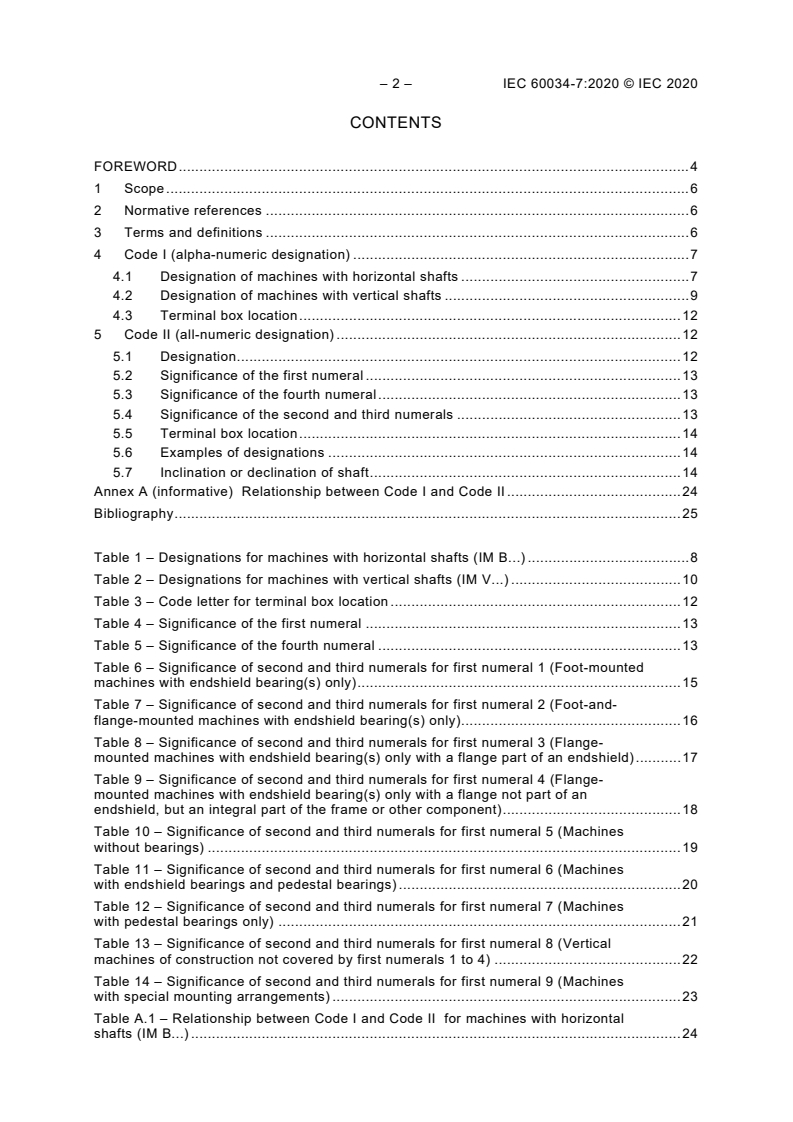
CONTENTS
FOREWORD . 4
1 Scope . 6
2 Normative references . 6
3 Terms and definitions . 6
4 Code I (alpha-numeric designation) . 7
4.1 Designation of machines with horizontal shafts . 7
4.2 Designation of machines with vertical shafts . 9
4.3 Terminal box location . 12
5 Code II (all-numeric designation) . 12
5.1 Designation . 12
5.2 Significance of the first numeral . 13
5.3 Significance of the fourth numeral . 13
5.4 Significance of the second and third numerals . 13
5.5 Terminal box location . 14
5.6 Examples of designations . 14
5.7 Inclination or declination of shaft . 14
Annex A (informative) Relationship between Code I and Code II . 24
Bibliography . 25
Table 1 – Designations for machines with horizontal shafts (IM B.) . 8
Table 2 – Designations for machines with vertical shafts (IM V.) . 10
Table 3 – Code letter for terminal box location . 12
Table 4 – Significance of the first numeral . 13
Table 5 – Significance of the fourth numeral . 13
Table 6 – Significance of second and third numerals for first numeral 1 (Foot-mounted
machines with endshield bearing(s) only) . 15
Table 7 – Significance of second and third numerals for first numeral 2 (Foot-and-
flange-mounted machines with endshield bearing(s) only). 16
Table 8 – Significance of second and third numerals for first numeral 3 (Flange-
mounted machines with endshield bearing(s) only with a flange part of an endshield) . 17
Table 9 – Significance of second and third numerals for first numeral 4 (Flange-
mounted machines with endshield bearing(s) only with a flange not part of an
endshield, but an integral part of the frame or other component) . 18
Table 10 – Significance of second and third numerals for first numeral 5 (Machines
without bearings) . 19
Table 11 – Significance of second and third numerals for first numeral 6 (Machines
with endshield bearings and pedestal bearings) . 20
Table 12 – Significance of second and third numerals for first numeral 7 (Machines
with pedestal bearings only) . 21
Table 13 – Significance of second and third numerals for first numeral 8 (Vertical
machines of construction not covered by first numerals 1 to 4) . 22
Table 14 – Significance of second and third numerals for first numeral 9 (Machines
with special mounting arrangements) . 23
Table A.1 – Relationship between Code I and Code II for machines with horizontal
shafts (IM B.) . 24
Table A.2 – Relationship between Code I and Code II for machines with vertical shafts
(IM V.) . 24
– 4 – IEC 60034-7:2020 © IEC 2020
INTERNATIONAL ELECTROTECHNICAL COMMISSION
____________
ROTATING ELECTRICAL MACHINES –
Part 7: Classification of types of construction,
mounting arrangements and terminal box position (IM Code)
FOREWORD
1) The International Electrotechnical Commission (IEC) is a worldwide organization for standardization comprising
all national electrotechnical committees (IEC National Committees). The object of IEC is to promote international
co-operation on all questions concerning standardization in the electrical and electronic fields. To this end and
in addition to other activities, IEC publishes International Standards, Technical Specifications, Technical Reports,
Publicly Available Specifications (PAS) and Guides (hereafter referred to as “IEC Publication(s)”). Their
preparation is entrusted to technical committees; any IEC National Committee interested in the subject dealt with
may participate in this preparatory work. International, governmental and non-governmental organizations liaising
with the IEC also participate in this preparation. IEC collaborates closely with the International Organization for
Standardization (ISO) in accordance with conditions determined by agreement between the two organizations.
2) The formal decisions or agreements of IEC on technical matters express, as nearly as possible, an international
consensus of opinion on the relevant subjects since each technical committee has representation from all
interested IEC National Committees.
3) IEC Publications have the form of recommendations for international use and are accepted by IEC National
Committees in that sense. While all reasonable efforts are made to ensure that the technical content of IEC
Publications is accurate, IEC cannot be held responsible for the way in which they are used or for any
misinterpretation by any end user.
4) In order to promote international uniformity, IEC National Committees undertake to apply IEC Publications
transparently to the maximum extent possible in their national and regional publications. Any divergence between
any IEC Publication and the corresponding national or regional publication shall be clearly indicated in the latter.
5) IEC itself does not provide any attestation of conformity. Independent certification bodies provide conformity
assessment services and, in some areas, access to IEC marks of conformity. IEC is not responsible for any
services carried out by independent certification bodies.
6) All users should ensure that they have the latest edition of this publication.
7) No liability shall attach to IEC or its directors, employees, servants or agents including individual experts and
members of its technical committees and IEC National Committees for any personal injury, property damage or
other damage of any nature whatsoever, whether direct or indirect, or for costs (including legal fees) and
expenses arising out of the publication, use of, or reliance upon, this IEC Publication or any other IEC
Publications.
8) Attention is drawn to the Normative references cited in this publication. Use of the referenced publications is
indispensable for the correct application of this publication.
9) Attention is drawn to the possibility that some of the elements of this IEC Publication may be the subject of patent
rights. IEC shall not be held responsible for identifying any or all such patent rights.
International Standard IEC 60034-7 has been prepared by IEC technical committee 2: Rotating
machinery.
This third edition cancels and replaces the second edition, published in 1992, and its
Amendment 1:2000. It constitutes a technical revision.
The main technical changes with regard to the previous edition are as follows:
5.4 Note on twin motors added.
5.5 Reference to 4.3 instead of duplication of text.
5.7 New subclause on marking of shaft inclination or declination.
The text of this International Standard is based on the following documents:
FDIS Report on voting
2/2010/FDIS 2/2018/RVD
Full information on the voting for the approval of this International Standard can be found in the
report on voting indicated in the above table.
This document has been drafted in accordance with the ISO/IEC Directives, Part 2.
A list of all parts in the IEC 60034 series, published under the general title Rotating electrical
machines, can be found on the IEC website.
The committee has decided that the contents of this document will remain unchanged until the
stability date indicated on the IEC website under "http://webstore.iec.ch" in the data related to
the specific document. At this date, the document will be
• reconfirmed,
• withdrawn,
• replaced by a revised edition, or
• amended.
– 6 – IEC 60034-7:2020 © IEC 2020
ROTATING ELECTRICAL MACHINES –
Part 7: Classification of types of construction,
mounting arrangements and terminal box position (IM Code)
1 Scope
This part of IEC 60034 specifies the IM Code, a classification of types of construction, mounting
arrangements and the terminal box position of rotating electrical machines.
Two systems of classification are provided as follows:
– Code I (see Clause 4): An alpha-numeric designation applicable to machines with end-
shield bearing(s) and only one shaft extension.
– Code II (see Clause 5): An all-numeric designation applicable to a wider range of types
of machines including types covered by Code I.
The type of machine not covered by Code II is fully described in words.
The relationship between Code I and Code II is given in Annex A.
2 Normative references
There are no normative references in this document.
3 Terms and definitions
For the purposes of this document, the following terms and definitions apply.
ISO and IEC maintain terminological databases for use in standardization at the following
addresses:
• IEC Electropedia: available at http://www.electropedia.org/
• ISO Online browsing platform: available at http://www.iso.org/obp
3.1
type of construction
arrangement of machine components with regard to fixings, bearing arrangement and shaft
extension
[SOURCE: IEC 60050-411:1996, 411-43-34]
3.2
mounting arrangement
orientation on site of the machine as the whole with regard to shaft alignment and position of
fixings
[SOURCE: IEC 60050-411:1996, 411-43-35]
3.3
shaft extension
portion of a shaft extending beyond an extreme bearing
Note 1 to entry: The bearing may be on the machine itself or be part of an assembly comprising a machine and (an)
additional bearing(s).
[SOURCE: IEC 60050-411:1996, 411-43-07]
3.4
drive-end of a machine
D-end
that end of the machine which accommodates the shaft end
Note 1 to entry: This is normally the driving end of a motor or the driven end of a generator.
Where for some machines the above definition is inadequate, the D-end is defined as follows:
a) Machine with two shaft extensions of different diameter: the end with the larger shaft diameter;
b) Machine with a cylindrical shaft extension and a conical shaft extension of the same diameter: the end with
cylindrical shaft extension;
c) Machine with other arrangements: according to IEC 60034-8 if applicable; otherwise by agreement.
Note 2 to entry: The outer diameter of a forged-on flange is taken to be the diameter of the shaft extension.
[SOURCE: IEC 60050-411:1996, 411-43-36]
3.5
non-drive end of the machine
N-end
that end of the machine opposite to the drive end
[SOURCE: IEC 60050-411:1996, 411-43-37]
4 Code I (alpha-numeric designation)
4.1 Designation of machines with horizontal shafts
In Code I, a machine with a horizontal shaft is designated by the code letters IM (International
Mounting), followed by a space, the letter B, one or two numerals as shown in Table 1 and an
optional letter as shown in 4.3.
– 8 – IEC 60034-7:2020 © IEC 2020
Table 1 – Designations for machines with horizontal shafts (IM B.)
Type of construction
Mounting
Number
Desig-
Sketch arrangement
of end-
nation
Feet Flange Other details
(Horizontal shaft)
shields
bearings
With Mounted by feet,
IM B3 2 – –
feet feet down
Endshield flange at
With Mounted on D-end
IM B5 2 – D-end with access
flange side of flange
to back
Mounted by feet,
With
IM B6 2 – – feet left
feet
(viewed from D-end)
Mounted by feet,
With
feet right
IM B7 2 – –
feet
(viewed from D-end)
With Mounted by feet,
IM B8 2 – –
feet feet up
Mounted on end
No endshield or
IM B9 1 – – face
bearing at D-end
of frame at D-end
With Special flange Mounted on D-end
IM B10 2 –
flange at D-end side of flange
Endshield spigot.
With Mounted on D-end
IM B14 2 – No access to back
flange side of flange
Flange at D-end
Type of construction
Mounting
Number
Desig-
Sketch arrangement
of end-
nation
Feet Flange Other details
(Horizontal shaft)
shields
bearings
No endshield or Mounted by feet,
bearing at D-end. feet down, with
With
IM B15 1 – Additional mounting addi-tional mounting
feet
provisions on D-end on
of frame end face of frame
With
Mounted by feet,
IM B20 2 raised – –
feet down
feet
Mounted by feet,
With Endshield flange
With feet down, with
IM B25 2 raised at D-end with access
flange addi-tional mounting
feet to back
on flange
3 or 4 pads on
IM B30 2 – – Pad mounted
endshield(s) or frame
Mounted by feet,
Endshield spigot feet down, with
With With
IM B34 2 No access to back addi-tional mounting
feet flange
Flange at D-end on
D-end side of flange
Mounted by feet,
Endshield flange at feet down, with
With With
IM B35 2 D-end with access addi-tional mounting
feet flange
to back on
D-end side of flange
4.2 Designation of machines with vertical shafts
In Code I, a machine with a vertical shaft is designated by the code letters IM (International
mounting), followed by a space, the letter V, one or two numerals as shown in Table 2 and an
optional letter as shown in 4.3.
– 10 – IEC 60034-7:2020 © IEC 2020
Table 2 – Designations for machines with vertical shafts (IM V.)
Type of construction
Mounting
Number
Desig-
Sketch arrangement
of end-
nation
Feet Flange Other details
(Vertical shaft)
shields
bearings
Endshield flange at Mounted on D-end
With
IM V1 2 – D-end with access side of flange,
flange
to back D-end down
Endshield flange at Mounted on N-end
With
IM V2 2 – N-end with access side of flange,
flange
to back D-end up
Endshield flange at Mounted on D-end
With
IM V3 2 – D-end with access side of flange,
flange
to back D-end up
Endshield flange at Mounted on N-end
With
IM V4 2 – N-end with access side of flange,
flange
to back D-end down
With Mounted by feet,
IM V5 2 – –
feet D-end down
With Mounted by feet,
IM V6 2 – –
feet D-end up
Mounted on end face
No endshield or
IM V8 1 – – of frame at D-end,
bearing at D-end
D-end down
Mounted on end face
No endshield or
IM V9 1 – – of frame at D-end,
bearing at D-end
D-end up
Type of construction
Mounting
Number
Desig-
Sketch arrangement
of end-
nation
Feet Flange Other details
(Vertical shaft)
shields
bearings
Mounted on D-end
With Special flange
IM V10 2 – side of flange,
flange at D-end
D-end down
Mounted on D-end
With Special flange
IM V14 2 – side of flange,
flange at D-end
D-end up
Endshield flange Mounted by feet, with
With With at D-end with additional mounting on
IM V15 2
feet flange access D-end side of flange,
to back D-end down
Mounted on N-end
With Special flange
IM V16 2 – side of flange,
flange at D-end
D-end up
Mounted by feet, with
Endshield spigot
With With additional mounting on
IM V17 2 no access to back
feet flange D-end side of flange,
Flange at D-end
D-end down
Endshield spigot Mounted on D-end
With
IM V18 2 – no access to back side of flange,
flange
Flange at D-end D-end down
Endshield spigot Mounted on D-end
With
IM V19 2 – No access to back side of flange,
flange
Flange at D-end D-end up
3 or 4 pads on
Pad-mounted
IM V30 2 – – endshield(s) or
D-end down
frame
– 12 – IEC 60034-7:2020 © IEC 2020
Type of construction
Mounting
Number
Desig-
Sketch arrangement
of end-
nation
Feet Flange Other details
(Vertical shaft)
shields
bearings
3 or 4 pads on
Pad-mounted,
endshield(s) or
IM V31 2
D-end up
frame
Endshield flange Mounted by feet, with
With With at D-end with additional mounting
IM V35 2
feet flange access on D-end side of flange,
to back D-end up
Mounted by feet, with
Endshield spigot
With With additional mounting
IM V37 2 no access to back
feet flange on D-end side of flange,
Flange at D-end
D-end up
4.3 Terminal box location
When designated, the terminal box position shall be coded with a final letter in accordance with
the following rules:
a) machines with feet shall be viewed from the D-end with the feet at 6 o’clock;
b) machines with flange only and with drains shall be viewed from the D-end and with the
drains at 6 o’clock;
c) other configurations shall not have a coding.
The coding shall conform to Table 3.
Table 3 – Code letter for terminal box location
Letter designation Terminal box location
R Right 3 o’clock
B Bottom 6 o’clock
L Left 9 o’clock
T Top 12 o’clock
None Unspecified
5 Code II (all-numeric designation)
5.1 Designation
In Code II, a machine is designated by the Code letters IM (International Mounting) followed by
a space and four numerals.
The first, second and third numerals designate aspects of construction (see 5.2 and 5.4).
The fourth numeral designates the type of shaft extension (see 5.3).
When used, a letter following the four numerals shall designate the terminal box position,
see 5.5.
5.2 Significance of the first numeral
The significance of the first numeral is given in Table 4.
Table 4 – Significance of the first numeral
Table relevant
First
Significance to the second
numeral
and third numerals
0 Not allocated –
1 Foot-mounted machines with endshield bearing(s) only 5
2 Foot-and-flange-mounted machines with endshield bearing(s) only 6
3 Flange-mounted machines with endshield bearing(s) only, 7
with a flange part of an endshield
4 Flange-mounted machines with endshield bearing(s) only, 8
with a flange not part of an endshield but an integral part
of the frame or other component
5 Machines without bearings 9
6 Machines with endshield bearing(s) and pedestal bearing(s) 10
7 Machines with pedestal bearing(s) only 11
8 Vertical machines of construction not covered by 12
first numeral 1 to 4
9 Machines with special mounting arrangements 13
5.3 Significance of the fourth numeral
The significance of the fourth numeral is given in Table 5.
Table 5 – Significance of the fourth numeral
Fourth
Significance
numeral
0 No shaft extension
1 One cylindrical shaft extension
2 Two cylindrical shaft extensions
3 One conical shaft extension
4 Two conical shaft extensions
5 One flanged shaft extension
6 Two flanged shaft extensions
7 Flanged shaft extension (D-end)
and cylindrical shaft extension (N-end)
8 (Not allocated)
9 Other arrangement
5.4 Significance of the second and third numerals
The significance of the second and third numerals is specified in Table 6 to Table 14 depending
on the first numeral with which they are associated (see Table 4).
– 14 – IEC 60034-7:2020 © IEC 2020
NOTE Rolling mill main motors can be used in a twin arrangement, where one of the upper/lower twin motors or the
side-by-side twin motors drives the upper roll for the rolling mill, while the other drives the lower roll for the mill, so
that the completely same speed control response for both twin motors can be obtained.
5.5 Terminal box location
See the information of 4.3.
5.6 Examples of designations
In Table 6 through Table 14, common types of construction and mounting arrangements are
illustrated by sketches, and their designations are given using a particular fourth numeral. Other
fourth numerals could be applicable (see Table 5). The absence of a sketch does not imply that
a designation is not available.
Numerals to which a significance has been allocated in the appropriate tables may be combined
to form a valid designation. Some of these designations may be impracticable.
5.7 Inclination or declination of shaft
Machines whose shaft orientation is other than horizontal (0°) or vertical (±90°) shall have their
IM code followed by the appropriate angle designation referenced to the drive end, such as:
• IM1001 +7,5° (positive degrees always means DE-shaft up, i. e. inclination of shaft)
• IM7311 −7,5° (negative degrees always means DE-shaft down, i. e. declination of shaft).
NOTE An inclination or declination may require special bearing design as the bearings carry an additional thrust
load caused by the gravity force of the machine’s rotor.
Table 6 – Significance of second and third numerals for first numeral 1
(Foot-mounted machines with endshield bearing(s) only)
Machine
Designation and sketch (see 3.5)
construction
Third numeral
Numbe
0 1 2 3 4 5 6 7 8 9
r
Feet
of (Shaft (Shaft
(gearbox)
(D-end (D-end left, (D-end
bearing horizontal, (D-end up) horizontal,
down) feet at right,
s feet down) feet up
back) feet at
back)
IM 1001 IM 1011 IM 1031 IM 1051 IM 1061 IM 1071
Normal feet
2 0
(no gearbox)
IM 1101
Raised feet
2 1 –
(no gearbox)
IM 1201 IM 1211 IM 1231 IM 1251 IM 1261 IM 1271
Normal feet
1 2
(no gearbox)
IM 1301
Raised feet
1 3
(no gearbox)
(Not allocated) 4 – – – – – –
(Not allocated) 5 – – – – – –
IM 1601 IM 1611 IM 1631 IM 1651 IM 1661 IM 1671
Normal feet,
integral
gearbox
2 with output 6
shaft
parallel to
input shaft
Normal feet, IM 1701 IM 1711 IM 1731 IM 1751 IM 1761 IM 1771
integral
gearbox
2 with output 7
shaft
at right angles
to input shaft
(Not allocated) 8 – – – – – –
(Non allocated) 9 – – – – – –
Second numeral
Suitable for operation in accordance with third numerals 0 and 1
Suitable for operation in accordance with third numerals 0, 1 and 3
Suitable for operation in accordance with third numerals 0, 1, 3, 5, 6 and 7
Not covered by third numerals 0 to 8 – inclination of shaft not specified
– 16 – IEC 60034-7:2020 © IEC 2020
Table 7 – Significance of second and third numerals for first numeral 2
(Foot-and-flange-mounted machines with endshield bearing(s) only)
Machine
Designation and sketch (see 3.5)
construction
Third numeral
Number
0 1 2 3 4 5 6 7 8 9
of
flanges
(Shaft (Shaft
Feet
(D-end (D-end (D-end
and
horizontal (D-end horizontal
down) left, right,
access
, up) ,
feet at feet at
thereto
feet feet up)
back) back)
down)
IM 2001 IM 2011 IM 2031 IM 2051 IM 2061 IM 2071
1 flange,
Normal
access 0
feet
to back
IM 2101 IM 2111 IM 2131 IM 2151 IM 2161 IM 2171
1 flange,
Normal no
feet access
to back
IM 2202 IM 2212 IM 2232 IM 2252 IM 2262 IM 2272
Normal flanges,
feet access
to back
IM 2302 IM 2312 IM 2332 IM 2352 IM 2362 IM 2372
flanges,
Normal
no 3
feet
access
to back
IM 2401
1 flange,
Raised
access 4
feet
to back
(Not allocated) 5 – – – – – –
(Not allocated) 6 – – – – – –
Second numeral
Suitable for operation in accordance with third numerals 0 and 1
Suitable for operation in accordance with third numerals 0, 1 and 3
Suitable for operation in accordance with third numerals 0, 1, 3, 5, 6 and 7
Not covered by third numerals 0 to 8 – inclination of shaft not specified
Table 8 – Significance of second and third numerals for first numeral 3
(Flange-mounted machines with endshield bearing(s) only
with a flange part of an endshield)
Machine construction Designation and sketch (see 3.5)
Third numeral
Face
Number Access
of
of Flange to back 0 1 2 3 4 5 to 8 9
flange
bearing position of
faces
s flange
(Shaft (Not
towards
(D-end down) (D-end up)
horizontal) allocated)
IM 3001 IM 3011 IM 3031
2 D-end Yes D-end 0
IM 3101 IM 3111 IM 3131
2 D-end Yes N-end 1
IM 3201 IM 3211 IM 3231
2 N-end Yes N-end 2
IM 3301 IM 3311 IM 3331
2 N-end Yes D-end 3
IM 3401 IM 3411 IM 3431
1 N-end Yes N-end 4
IM 3501 IM 3511 IM 3531
1 N-end Yes D-end 5
IM 3601 IM 3611 IM 3631
2 D-end No D-end 6
IM 3701 IM 3711 IM 3731
2 N-end No N-end 7
IM 3811
D-end
skirt
part of
2 Yes D-end 8
end-
1)
shield
1)
Second numeral 8 is the same as second numeral 0 except for the skirt.
Second numeral
Suitable for operation in accordance with third numerals 0 and 1
Suitable for operation in accordance with third numerals 0, 1 and 3
Not covered by third numerals 0 to 4 – inclination of shaft not specified
– 18 – IEC 60034-7:2020 © IEC 2020
Table 9 – Significance of second and third numerals for first numeral 4
(Flange-mounted machines with endshield bearing(s) only with a flange not part
of an endshield, but an integral part of the frame or other component)
Machine construction Designation and sketch (see 3.5)
Third numeral
Face
Access
Number of
Flange to back 0 1 2 3 4 5 to 8 9
of flange
position of
bearings faces
flange
(Shaft (Not
towards
(D-end down) (D-end up)
horizontal) allocated)
IM 4001 IM 4011 IM 4031
2 D-end Yes D-end 0
IM 4101 IM 4111 IM 4131
2 D-end Yes N-end 1
IM 4201 IM 4211 IM 4231
2 N-end Yes D-end 2
IM 4301 IM 4311 IM 4331
2 N-end Yes N-end 3
IM 4401 IM 4411 IM 4431
1 D-end Yes D-end 4
IM 4501 IM 4511 IM 4531
1 D-end Yes N-end 5
IM 4601 IM 4611 IM 4631
1 N-end Yes D-end 6
IM 4701 IM 4711 IM 4731
1 N-end Yes N-end 7
(Not allocated) 8 – – –
Second numeral
Suitable for operation in accordance with third numerals 0 and 1
Suitable for operation in accordance with third numerals 0, 1 and 3
Not covered by third numerals 0 to 4 – inclination of shaft not specified
Table 10 – Significance of second and third numerals for first numeral 5
(Machines without bearings)
Machine construction Designation and sketch (see 3.5)
Third numeral
0 1 2
Mounting
Frame
arrangement
(With rotor,
(With rotor, with (Stator only)
without shaft)
shaft)
IM 5002 IM 5010 IM 5020
Without
Not specified 0
frame
IM 5102 IM 5110 IM 5120
With With cylindrical
frame support
IM 5202 IM 5210 IM 5220
With On end-face of frame
frame at D-end
(Not allocated) 3 – – –
IM 5402 IM 5410 IM 5420
With
By normal feet 4
frame
IM 5502 IM 5510 IM 5520
With
By raised feet 5
frame
IM 5602 IM 5610 IM 5620
With By normal feet
frame and sole-plates
IM 5702 IM 5710 IM 5720
With By raised feet
frame and sole-plates
Second numeral
– 20 – IEC 60034-7:2020 © IEC 2020
Table 11 – Significance of second and third numerals for first numeral 6
(Machines with endshield bearings and pedestal bearings)
Machine construction Designation and sketch (see 3.5)
Third numeral
Number Number
Feet of endshield of pedestal 0 1
bearings bearings
(Without bedplate) (With bedplate)
IM 6000 IM 6010
Normal 1
2 0
feet (D-end)
IM 6100 IM 6110
Raised
2 1
feet (D-end)
IM 6201 IM 6211
Normal 1 1
feet (D-end) (N-end)
IM 6301 IM 6311
Raised 1 1
feet (D-end) (N-end)
(Not allocated) 4 – –
(Not allocated) 5 – –
IM 6600 IM 6610
Normal 1
2 6
feet (D-end)
IM 6700 IM 6710
Raised 1
2 7
feet (D-end)
IM 6811
Without
2 2 8 –
feet
Second numeral
Table 12 – Significance of second and third numerals for first numeral 7
(Machines with pedestal bearings only)
Machine construction Designation and sketch (see 3.5)
Third numeral
Number 0 1 2 3
of
Feet
pedestal (Without (With bedplate
(With bedplate) (With sole-plate)
bedplate with sole-plate)
bearings
without sole-
plates
IM 7001 IM 7011 IM 7021
Normal
1 0
feet
IM 7101 IM 7111 IM 7121
Raised
1 1
feet
IM 7201 IM 7211 IM 7221
Normal
2 2
feet
IM 7301 IM 7311 IM 7321
Raised
2 3
feet
IM 7400 IM 7410 IM 7420 IM 7430
Normal
3 4
feet
IM 7500 IM 7510 IM 7520 IM 7530
Raised
3 5
feet
Second numeral
– 22 – IEC 60034-7:2020 © IEC 2020
Table 13 – Significance of second and third numerals for first numeral 8
(Vertical machines of construction not covered by first numerals 1 to 4)
Machine construction Designation and sketch (see 3.5)
Third numeral
0 1 2 3 4
Thrust
Fly- (One guide (One guide (Two guide (Two guide (No guide
bearing Shaft
wheel bearing bearing bearings, bearings bearing)
position
below rotor) above rotor) one above below rotor)
and
one below
rotor)
IM 8001 IM 8011 IM 8021 IM 8031 IM 8041
Without
With Without
thrust 0
shaft flywheel
bearing
IM 8100 IM 8110 IM 8120 IM 8140
Without
Without Without
thrust 1
shaft flywheel
bearing
IM 8201 IM 8211 IM 8221 IM 8231
Below With Without
rotor shaft flywheel
IM 8300 IM 8310 IM 8320
Below Without Without
rotor shaft flywheel
IM 8411 IM 8421
Above With Without
rotor shaft flywheel
IM 8510
Above Without Without
rotor shaft flywheel
IM 8621
Above With With
rotor shaft flywheel
IM 8721
Above With With
rotor shaft flywheel
IM 8820
Above Without With
rotor shaft flywheel
Second numeral
Table 14 – Significance of second and third numerals for first numeral 9
(Machines with special mounting arrangements)
Machine construction Designation and sketch (see 3.5)
Third numeral
Number
of Mounting
0 1 2 3 4 5 to 8 9
endshield arrangement
bearings (Not
(Shaft horizontal) (D-end down) (D-end up)
allocated)
IM 9001 IM 9011 IM 9031
With
cylindrical
frame
2 0 –
for building-
in
IM 9101 IM 9111 IM 9131
For
mounting
1 on end face 1 –
of frame at
D-end
IM 9201 IM 9211 IM 9231
2 By pads 2 –
IM 9301
2 By trunnions 3 –
IM 9401
By axle
2 4 –
suspension
IM 9501
By pendulum
2 5 –
suspension
Second numeral
Suitable for operation in accordance with third numerals 0 and 1
Suitable for operation in accordance with third numerals 0, 1 and 3
Not covered by third numerals 0 to 4 – inclination of shaft not specified
– 24 – IEC 60034-7:2020 © IEC 2020
Annex A
(informative)
Relationship between Code I and Code II
The relationship between Code I and Code II is given in Table A.1 and Table A.2.
Table A.1 – Relationship between Code I and Code II
for machines with horizontal shafts (IM B.)
Code I Code II
IM B3 IM 1001
IM B5 IM 3001
IM B6 IM 1051
IM B7 IM 1061
IM B8 IM 1071
IM B9 IM 9101
IM B10 IM 4001
IM B14 IM 3601
IM B15 IM 1201
IM B20 IM 1101
IM B25 IM 2401
IM B30 IM 9201
IM B34 IM 2101
IM B35 IM 2001
Table A.2 – Relationship between Code I and Code II
for machines with vertical shafts (IM V.)
Code I Code II
IM V1 IM 3011
IM V2 IM 3231
IM V3 IM 3031
IM V4 IM 3211
IM V5 IM 1011
IM V6 IM 1031
IM V8 IM 9111
IM V9 IM 9131
IM V10 IM 4011
IM V14 IM 4031
IM V15 IM 2011
IM V16 IM 4131
IM V17 IM 2111
IM V18 IM 3611
IM V19 IM 3631
IM V30 IM 9211
IM V31 IM 9231
IM V35 IM 2031
IM V37 IM 2131
Bibliography
IEC 60050-411:1996, International Electrotechnical Vocabulary (IEV) – Part 411: Rotating
machinery
IEC 60050-411:1996/AMD1:2007
___________
– 26 – IEC 60034-7:2020 © IEC 2020
SOMMAIRE
AVANT-PROPOS . 28
1 Domaine d'application . 30
2 Références normatives . 30
3 Termes et définitions . 30
4 Code I (désignation alphanumérique) . 31
4.1 Désignation des machines à arbre horizontal . 31
4.2 Désignation des machines à arbre vertical . 33
4.3 Emplacement de la boîte à bornes . 36
5 Code II (désignation numérique) . 36
5.1 Désignation . 36
5.2 Signification du premier chiffre . 37
5.3 Signification du quatrième chiffre . 37
5.4 Signification des deuxième et troisième chiffres . 38
5.5 Emplacement de la boîte à bornes . 38
5.6 Exemples de désignations . 38
5.7 Inclinaison ou déclinaison de l’arbre . 38
Annexe A (informative) Relation entre le Code I et le Code II . 48
Bibliographie . 49
Tableau 1 – Désignations des machines à arbre horizontal (IM B.) . 32
Tableau 2 – Désignations des machines à arbre vertical (IM V.) . 34
Tableau 3 – Lettres de code pour l’emplacement de la boîte à bornes . 36
Tableau 4 – Signification du premier chiffre . 37
Tableau 5 – Signification du quatrième chiffre . 37
Tableau 6 – Signification des deuxième et troisième chiffres pour le premier chiffre 1
(Machines à pattes avec flasque(s) palier(s) seulement) . 39
Tableau 7 – Signification des deuxième et troisième chiffres pour le premier chiffre 2
(Machines à pattes et bride avec flasque(s) palier(s) seulement) . 40
Tableau 8 – Signification des deuxième et troisième chiffres pour le premier chiffre 3
(Machines à bride avec flasque(s) palier(s) seulement avec une bride faisant partie
d'un flasque) . 41
Tableau 9 – Signification des deuxième et troisième chiffres pour le premier chiffre 4
(Machines à bride avec flasque(s) palier(s) seulement, avec une bride ne faisant pas
partie d'un flasque, mais faisant partie intégrante de la carcasse ou d'un autre
composant) . 42
Tableau 10 – Signification des deuxième et troisième chiffres pour le premier chiffre 5
(Machines sans palier) .
...