


IEC 62560:2011
(Main)Self-ballasted LED-lamps for general lighting services by voltage > 50 V - Safety specifications
Self-ballasted LED-lamps for general lighting services by voltage > 50 V - Safety specifications
IEC 62560:2011 specifies the safety and interchangeability requirements, together with the test methods and conditions required to show compliance of LED-lamps with integrated means for stable operation (self-ballasted LED-lamps), intended for domestic and similar general lighting purposes, having:
- a rated wattage up to 60 W;
- a rated voltage of > 50 V up to 250 V;
- caps according to Table 1. The contents of the corrigendum 1 of January 2012 and of the corrigendum 2 of July 2015 have been included in this copy.
Lampes à DEL autoballastées pour l'éclairage général fonctionnant à des tensions > 50 V - Spécifications de sécurité
La CEI 62560:2011 spécifie les exigences de sécurité et d'interchangeabilité, ainsi que les méthodes et les conditions d'essai prescrites pour démontrer la conformité des lampes à DEL à dispositif intégré pour assurer un fonctionnement stable (lampes à DEL autoballastées), destinées à l'éclairage général domestique et analogue, ayant:
- une puissance assignée inférieure ou égale à 60 W;
- une tension assignée > 50 V inférieure ou égale à 250 V;
- des culots conformes au Tableau 1. Le contenu du corrigendum 1 de janvier 2012 et du corrigendum 2 de juillet 2015 a été pris en considération dans cet exemplaire.
General Information
- Status
- Published
- Publication Date
- 09-Feb-2011
- Technical Committee
- SC 34A - Electric light sources
- Current Stage
- PPUB - Publication issued
- Start Date
- 10-Feb-2011
- Completion Date
- 15-Feb-2011
Relations
- Effective Date
- 05-Sep-2023
- Effective Date
- 05-Sep-2023
- Effective Date
- 05-Sep-2023
Overview
IEC 62560:2011 is an international standard published by the International Electrotechnical Commission (IEC) that defines safety specifications for self-ballasted LED lamps used in general lighting services. This standard applies to LED lamps designed for domestic and similar environments, operating at voltages greater than 50 V and up to 250 V, with a rated wattage up to 60 W. It covers lamps with integrated electronic components providing stable operation (self-ballasted), which are intended as direct replacements for traditional incandescent or compact fluorescent lamps.
By establishing safety and interchangeability requirements, IEC 62560 ensures that LED lamps are safe for consumers, compatible with existing fixtures, and reliable through standardized testing protocols. The 2011 edition incorporates amendments made up to April 2015, representing a consolidated version for end-users and manufacturers.
Key Topics
Scope & Applicability: Covers self-ballasted LED lamps for general lighting with rated wattage ≤ 60 W and voltage > 50 V to 250 V, intended mainly for household use.
Safety Requirements: Addresses protection against electric shock, insulation resistance, mechanical strength, temperature limits, flame resistance, fault conditions, and ingress protection (dust and moisture).
Interchangeability Criteria: Specifies caps and dimensions ensuring the LED lamps fit existing light holders and sockets without modification. Includes tests on cap interchangeability, bending moment, axial pull, and lamp mass as applied to the holder.
Testing Procedures: Defines test methods for insulation resistance, electric strength after humidity treatment, mechanical torque and axial strength, heat resistance, flame resistance, abnormal operation, and photobiological safety including UV radiation and blue light hazard.
Marking & Information: Details necessary markings for the lamps, including wattage, voltage ratings, dimmability information, and warnings about operational limitations to inform users and manufacturers.
Photobiological Safety: Addresses LED emission concerns such as ultraviolet (UV) radiation safety and blue light hazard assessment to minimize health risks associated with prolonged exposure.
Fault and Abnormal Operation Tests: Simulates possible failure modes to ensure lamp safety even under extreme electrical conditions, including non-dimmable and dimmable lamp testing.
Applications
IEC 62560:2011 is critical for:
Manufacturers designing and producing self-ballasted LED lamps to ensure compliance with international safety and interoperability requirements.
Consumers and Installers seeking safe LED lighting solutions that fit standard fixtures without modification, assuring product safety and reliability.
Certification Bodies and Regulators implementing testing protocols to certify LED lamp products for the global market.
Luminaire Designers who must consider electrical and mechanical data from compliant lamps for safe luminaire integration.
The standard enhances market confidence in LED lamp products by promoting universal safety and performance expectations for domestic and similar lighting applications.
Related Standards
IEC 62560 works alongside other key IEC standards such as:
IEC 60432 – Testing of tungsten filament lamps, providing test equipment references used for mechanical testing of lamp caps.
IEC 60529 – Degrees of protection provided by enclosures (IP Code), referenced for ingress protection testing.
IEC 62471 – Photobiological safety of lamps and lamp systems, related to the assessment of UV and blue light hazard in LED lamps.
IEC 62031 – LED modules for general lighting – safety specifications, complementing IEC 62560 for LED modules without integrated ballasts.
ISO/IEC Directives – General rules for standard preparation, ensuring international alignment.
By adhering to IEC 62560, manufacturers contribute to harmonizing LED lamp safety worldwide, facilitating easier compliance with national regulations and user safety expectations.
Keywords: IEC 62560, self-ballasted LED lamps, LED lamp safety, general lighting services, LED lamp standards, electrical safety, interchangeability, photobiological safety, LED cap dimensions, ingress protection, LED lighting compliance, domestic lighting LED standards.
Buy Documents
IEC 62560:2011 - Self-ballasted LED-lamps for general lighting services by voltage > 50 V - Safety specifications

IEC 62560:2011+AMD1:2015 CSV - Self-ballasted LED-lamps for general lighting services by voltage >50 V - Safety specifications Released:4/17/2015 Isbn:9782832226209
Get Certified
Connect with accredited certification bodies for this standard

Intertek Testing Services NA Inc.
Intertek certification services in North America.

UL Solutions
Global safety science company with testing, inspection and certification.

ANCE
Mexican certification and testing association.
Sponsored listings
Frequently Asked Questions
IEC 62560:2011 is a standard published by the International Electrotechnical Commission (IEC). Its full title is "Self-ballasted LED-lamps for general lighting services by voltage > 50 V - Safety specifications". This standard covers: IEC 62560:2011 specifies the safety and interchangeability requirements, together with the test methods and conditions required to show compliance of LED-lamps with integrated means for stable operation (self-ballasted LED-lamps), intended for domestic and similar general lighting purposes, having: - a rated wattage up to 60 W; - a rated voltage of > 50 V up to 250 V; - caps according to Table 1. The contents of the corrigendum 1 of January 2012 and of the corrigendum 2 of July 2015 have been included in this copy.
IEC 62560:2011 specifies the safety and interchangeability requirements, together with the test methods and conditions required to show compliance of LED-lamps with integrated means for stable operation (self-ballasted LED-lamps), intended for domestic and similar general lighting purposes, having: - a rated wattage up to 60 W; - a rated voltage of > 50 V up to 250 V; - caps according to Table 1. The contents of the corrigendum 1 of January 2012 and of the corrigendum 2 of July 2015 have been included in this copy.
IEC 62560:2011 is classified under the following ICS (International Classification for Standards) categories: 29.140.30 - Fluorescent lamps. Discharge lamps. The ICS classification helps identify the subject area and facilitates finding related standards.
IEC 62560:2011 has the following relationships with other standards: It is inter standard links to IEC 62560:2011/AMD1:2015, IEC 62560:2011/COR2:2015, IEC 62560:2011/COR1:2012. Understanding these relationships helps ensure you are using the most current and applicable version of the standard.
IEC 62560:2011 is available in PDF format for immediate download after purchase. The document can be added to your cart and obtained through the secure checkout process. Digital delivery ensures instant access to the complete standard document.
Standards Content (Sample)
IEC 62560 ®
Edition 1.0 2011-02
INTERNATIONAL
STANDARD
NORME
INTERNATIONALE
Self-ballasted LED-lamps for general lighting services by voltage > 50 V – Safety
specifications
Lampes à DEL autoballastées pour l’éclairage général fonctionnant à des
tensions > 50 V – Spécifications de sécurité
All rights reserved. Unless otherwise specified, no part of this publication may be reproduced or utilized in any form or by
any means, electronic or mechanical, including photocopying and microfilm, without permission in writing from either IEC or
IEC's member National Committee in the country of the requester.
If you have any questions about IEC copyright or have an enquiry about obtaining additional rights to this publication,
please contact the address below or your local IEC member National Committee for further information.
Droits de reproduction réservés. Sauf indication contraire, aucune partie de cette publication ne peut être reproduite
ni utilisée sous quelque forme que ce soit et par aucun procédé, électronique ou mécanique, y compris la photocopie
et les microfilms, sans l'accord écrit de la CEI ou du Comité national de la CEI du pays du demandeur.
Si vous avez des questions sur le copyright de la CEI ou si vous désirez obtenir des droits supplémentaires sur cette
publication, utilisez les coordonnées ci-après ou contactez le Comité national de la CEI de votre pays de résidence.
IEC Central Office
3, rue de Varembé
CH-1211 Geneva 20
Switzerland
Email: inmail@iec.ch
Web: www.iec.ch
About the IEC
The International Electrotechnical Commission (IEC) is the leading global organization that prepares and publishes
International Standards for all electrical, electronic and related technologies.
About IEC publications
The technical content of IEC publications is kept under constant review by the IEC. Please make sure that you have the
latest edition, a corrigenda or an amendment might have been published.
Catalogue of IEC publications: www.iec.ch/searchpub
The IEC on-line Catalogue enables you to search by a variety of criteria (reference number, text, technical committee,…).
It also gives information on projects, withdrawn and replaced publications.
IEC Just Published: www.iec.ch/online_news/justpub
Stay up to date on all new IEC publications. Just Published details twice a month all new publications released. Available
on-line and also by email.
Electropedia: www.electropedia.org
The world's leading online dictionary of electronic and electrical terms containing more than 20 000 terms and definitions
in English and French, with equivalent terms in additional languages. Also known as the International Electrotechnical
Vocabulary online.
Customer Service Centre: www.iec.ch/webstore/custserv
If you wish to give us your feedback on this publication or need further assistance, please visit the Customer Service
Centre FAQ or contact us:
Email: csc@iec.ch
Tel.: +41 22 919 02 11
Fax: +41 22 919 03 00
A propos de la CEI
La Commission Electrotechnique Internationale (CEI) est la première organisation mondiale qui élabore et publie des
normes internationales pour tout ce qui a trait à l'électricité, à l'électronique et aux technologies apparentées.
A propos des publications CEI
Le contenu technique des publications de la CEI est constamment revu. Veuillez vous assurer que vous possédez
l’édition la plus récente, un corrigendum ou amendement peut avoir été publié.
Catalogue des publications de la CEI: www.iec.ch/searchpub/cur_fut-f.htm
Le Catalogue en-ligne de la CEI vous permet d’effectuer des recherches en utilisant différents critères (numéro de référence,
texte, comité d’études,…). Il donne aussi des informations sur les projets et les publications retirées ou remplacées.
Just Published CEI: www.iec.ch/online_news/justpub
Restez informé sur les nouvelles publications de la CEI. Just Published détaille deux fois par mois les nouvelles
publications parues. Disponible en-ligne et aussi par email.
Electropedia: www.electropedia.org
Le premier dictionnaire en ligne au monde de termes électroniques et électriques. Il contient plus de 20 000 termes et
définitions en anglais et en français, ainsi que les termes équivalents dans les langues additionnelles. Egalement appelé
Vocabulaire Electrotechnique International en ligne.
Service Clients: www.iec.ch/webstore/custserv/custserv_entry-f.htm
Si vous désirez nous donner des commentaires sur cette publication ou si vous avez des questions, visitez le FAQ du
Service clients ou contactez-nous:
Email: csc@iec.ch
Tél.: +41 22 919 02 11
Fax: +41 22 919 03 00
IEC 62560 ®
Edition 1.0 2011-02
INTERNATIONAL
STANDARD
NORME
INTERNATIONALE
Self-ballasted LED-lamps for general lighting services by voltage > 50 V – Safety
specifications
Lampes à DEL autoballastées pour l’éclairage général fonctionnant à des
tensions > 50 V – Spécifications de sécurité
INTERNATIONAL
ELECTROTECHNICAL
COMMISSION
COMMISSION
ELECTROTECHNIQUE
PRICE CODE
INTERNATIONALE
CODE PRIX T
ICS 29.140.30 ISBN 978-2-88912-355-1
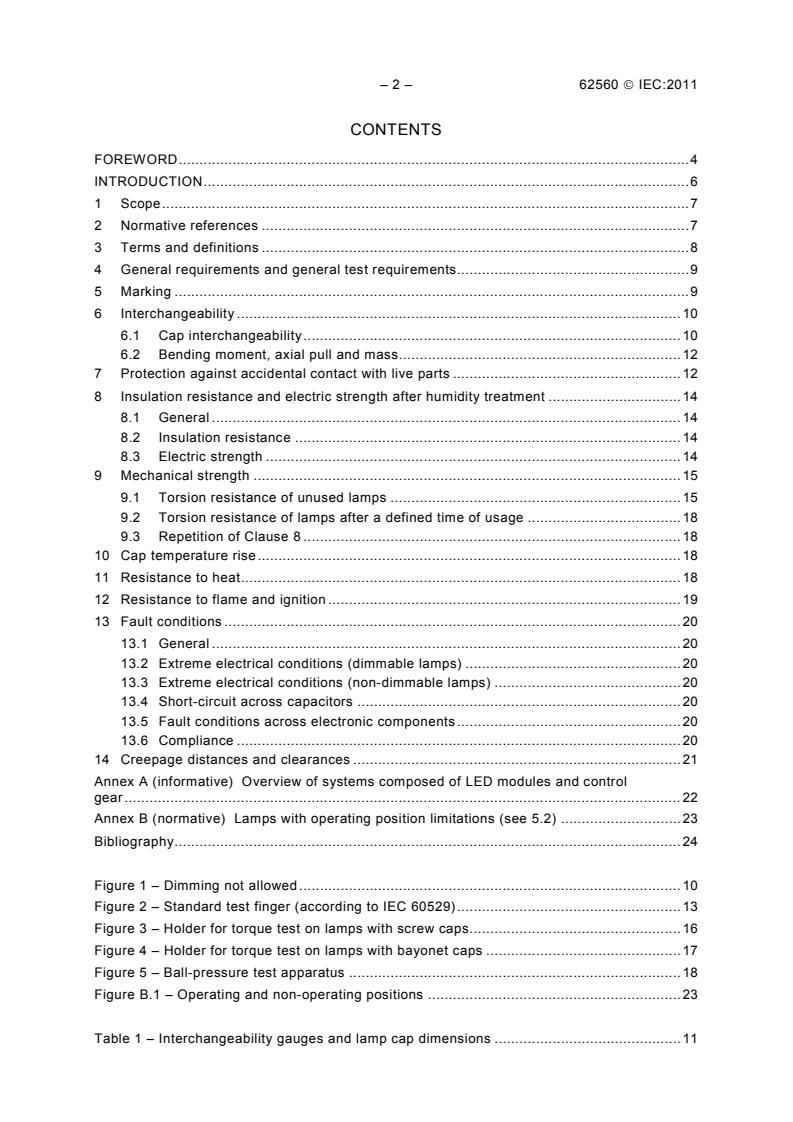
– 2 – 62560 IEC:2011
CONTENTS
FOREWORD . 4
INTRODUCTION . 6
1 Scope . 7
2 Normative references . 7
3 Terms and definitions . 8
4 General requirements and general test requirements . 9
5 Marking . 9
6 Interchangeability . 10
6.1 Cap interchangeability . 10
6.2 Bending moment, axial pull and mass . 12
7 Protection against accidental contact with live parts . 12
8 Insulation resistance and electric strength after humidity treatment . 14
8.1 General . 14
8.2 Insulation resistance . 14
8.3 Electric strength . 14
9 Mechanical strength . 15
9.1 Torsion resistance of unused lamps . 15
9.2 Torsion resistance of lamps after a defined time of usage . 18
9.3 Repetition of Clause 8 . 18
10 Cap temperature rise . 18
11 Resistance to heat . 18
12 Resistance to flame and ignition . 19
13 Fault conditions . 20
13.1 General . 20
13.2 Extreme electrical conditions (dimmable lamps) . 20
13.3 Extreme electrical conditions (non-dimmable lamps) . 20
13.4 Short-circuit across capacitors . 20
13.5 Fault conditions across electronic components . 20
13.6 Compliance . 20
14 Creepage distances and clearances . 21
Annex A (informative) Overview of systems composed of LED modules and control
gear . 22
Annex B (normative) Lamps with operating position limitations (see 5.2) . 23
Bibliography . 24
Figure 1 – Dimming not allowed . 10
Figure 2 – Standard test finger (according to IEC 60529) . 13
Figure 3 – Holder for torque test on lamps with screw caps. 16
Figure 4 – Holder for torque test on lamps with bayonet caps . 17
Figure 5 – Ball-pressure test apparatus . 18
Figure B.1 – Operating and non-operating positions . 23
Table 1 – Interchangeability gauges and lamp cap dimensions . 11
62560 IEC:2011 – 3 –
Table 2 – Bending moments and masses . 12
Table 3 – Torque test values for unused lamps . 17
– 4 – 62560 IEC:2011
INTERNATIONAL ELECTROTECHNICAL COMMISSION
____________
SELF-BALLASTED LED-LAMPS FOR GENERAL
LIGHTING SERVICES BY VOLTAGE > 50 V –
SAFETY SPECIFICATIONS
FOREWORD
1) The International Electrotechnical Commission (IEC) is a worldwide organization for standardization comprising
all national electrotechnical committees (IEC National Committees). The object of IEC is to promote
international co-operation on all questions concerning standardization in the electrical and electronic fields. To
this end and in addition to other activities, IEC publishes International Standards, Technical Specifications,
Technical Reports, Publicly Available Specifications (PAS) and Guides (hereafter referred to as “IEC
Publication(s)”). Their preparation is entrusted to technical committees; any IEC National Committee interested
in the subject dealt with may participate in this preparatory work. International, governmental and non-
governmental organizations liaising with the IEC also participate in this preparation. IEC collaborates closely
with the International Organization for Standardization (ISO) in accordance with conditions determined by
agreement between the two organizations.
2) The formal decisions or agreements of IEC on technical matters express, as nearly as possible, an international
consensus of opinion on the relevant subjects since each technical committee has representation from all
interested IEC National Committees.
3) IEC Publications have the form of recommendations for international use and are accepted by IEC National
Committees in that sense. While all reasonable efforts are made to ensure that the technical content of IEC
Publications is accurate, IEC cannot be held responsible for the way in which they are used or for any
misinterpretation by any end user.
4) In order to promote international uniformity, IEC National Committees undertake to apply IEC Publications
transparently to the maximum extent possible in their national and regional publications. Any divergence
between any IEC Publication and the corresponding national or regional publication shall be clearly indicated in
the latter.
5) IEC itself does not provide any attestation of conformity. Independent certification bodies provide conformity
assessment services and, in some areas, access to IEC marks of conformity. IEC is not responsible for any
services carried out by independent certification bodies.
6) All users should ensure that they have the latest edition of this publication.
7) No liability shall attach to IEC or its directors, employees, servants or agents including individual experts and
members of its technical committees and IEC National Committees for any personal injury, property damage or
other damage of any nature whatsoever, whether direct or indirect, or for costs (including legal fees) and
expenses arising out of the publication, use of, or reliance upon, this IEC Publication or any other IEC
Publications.
8) Attention is drawn to the Normative references cited in this publication. Use of the referenced publications is
indispensable for the correct application of this publication.
9) Attention is drawn to the possibility that some of the elements of this IEC Publication may be the subject of
patent rights. IEC shall not be held responsible for identifying any or all such patent rights.
International Standard IEC 62560 has been prepared by subcommittee 34A: Lamps, of IEC
technical committee 34: Lamps and related equipment.
The text of this standard is based on the following documents:
FDIS Report on voting
34A/1425/FDIS 34A/1447/RVD
Full information on the voting for the approval of this standard can be found in the report on
voting indicated in the above table.
This publication has been drafted in accordance with the ISO/IEC Directives, Part 2.
62560 IEC:2011 – 5 –
In this standard, the following print types are used:
– requirements proper: in roman type.
– test specifications: in italic type.
The committee has decided that the contents of this publication will remain unchanged until
the stability date indicated on the IEC web site under "http://webstore.iec.ch" in the data
related to the specific publication. At this date, the publication will be
• reconfirmed,
• withdrawn,
• replaced by a revised edition, or
• amended.
The contents of the corrigenda 1 (January 2012) and 2 (July 2015) have been included in
this copy.
– 6 – 62560 IEC:2011
INTRODUCTION
There will be and are already LED products in the market which substitute existing lamps,
either as retrofit mains voltage incandescent or self-ballasted fluorescent lamps or as
replacement for tungsten halogen lamps below 50 V.
The present document takes up the supply voltage range from > 50 V up to 250 V. A proposal
for a safety standard for LED lamps with voltages ≤ 50 V may follow in due time.
Future work will also consequently comprise performance standards for all kind of LED lamps,
including minimum photometric requirements for type testing.
Due to the urgent need of establishing this standard, it will be a stand-alone standard for the
time being, not excluding a future relocation as a part of IEC 60968, self-ballasted lamps.
62560 IEC:2011 – 7 –
SELF-BALLASTED LED-LAMPS FOR GENERAL
LIGHTING SERVICES BY VOLTAGE > 50 V –
SAFETY SPECIFICATIONS
1 Scope
This International Standard specifies the safety and interchangeability requirements, together
with the test methods and conditions required to show compliance of LED-lamps with
integrated means for stable operation (self-ballasted LED-lamps), intended for domestic and
similar general lighting purposes, having:
– a rated wattage up to 60 W;
– a rated voltage of > 50 V up to 250 V;
– caps according to Table 1.
The requirements of this standard relate only to type testing.
Recommendations for whole product testing or batch testing are identical to those given in
Annex C of IEC 62031.
NOTE Where in this standard the term “lamp(s)” is used, it is understood to stand for “self-ballasted LED-
lamp(s)”, except where it is obviously assigned to other types of lamps.
2 Normative references
The following reference documents are indispensable for the application of this document. For
dated references, only the edition cited applies. For undated references, the latest edition of
the reference document (including any amendments) applies.
IEC 60061-1, Lamp caps and holders together with gauges for the control of
interchangeability and safety – Part 1 : Lamp caps
IEC 60061-3, Lamp caps and holders together with gauges for the control of
interchangeability and safety – Part 3 : Gauges
IEC 60360, Standard method of measurement of lamp cap temperature rise
IEC 60432-1, Incandescent lamps – Safety specifications – Part 1: Tungsten filament lamps
for domestic and similar general lighting purposes
IEC 60529:1989, Degrees of protection provided by enclosures (IP Code)
IEC 60598-1:2008, Luminaires – Part 1: General requirements and tests
IEC 60695-2-10:2000, Fire hazard testing – Part 2-10: Glowing/hot-wire based test methods;
Glow-wire apparatus and common test procedure
IEC 60695-2-11:2000, Fire hazard testing – Part 2-11: Glowing/hot-wire based test methods –
Glow-wire flammability test method for end products
IEC 60695-2-12:2000, Fire hazard testing – Part 2-12: Glowing/hot-wire based test methods;
Glow-wire flammability test method for materials
– 8 – 62560 IEC:2011
IEC 60695-2-13:2000, Fire hazard testing – Part 2-13: Glowing/hot-wire based test methods;
Glow-wire ignitability test method for materials
IEC 61199:1999, Single-capped fluorescent lamps – Safety specifications
IEC 61347-1:2007, Lamp controlgear – Part 1: General and safety requirements
IEC 62031:2008, LED modules for general lighting – Safety requirements
IEC/TR 62471-2, Photobiological safety of lamps and lamp systems – Part 2: Guidance on
manufacturing requirements relating to non-laser optical radiation safety
IEC/TS 62504, Terms and definitions of LEDs and LED modules in general lighting
ISO 4046-4:2002, Paper, board, pulp and related terms – Vocabulary – Part 4: Paper and
board grades and converted products
3 Terms and definitions
For the purposes of this document, the terms and definitions of IEC/TS 62504 (in
preparation), IEC 62031 and the following apply.
3.1
self-ballasted LED-lamp
unit which cannot be dismantled without being permanently damaged, provided with a lamp
cap and incorporating a LED light source and any additional elements necessary for stable
operation of the light source
NOTE Lamp caps are given in IEC 60061-1.
3.2
rated voltage
voltage or voltage range marked on the lamp
3.3
rated wattage
wattage marked on the lamp
3.4
rated frequency
frequency marked on the lamp
3.5
cap temperature rise
Δt
s
surface temperature rise (above ambient) of a standard test lampholder fitted to the lamp,
when measured in accordance with the standard method, in case of an Edison screw cap or a
bayonet cap
NOTE The standard method for Edison screw cap or bayonet cap is that given in IEC 60360.
3.6
live part
conductive part which may cause an electric shock in normal use
___________
To be published.
62560 IEC:2011 – 9 –
3.7
type
lamps that have an identical electrical rating and a similar cap
3.8
type test
test or series of tests made on a type test sample for the purpose of checking compliance of
the design of a given product with the requirements of the relevant standard
3.9
type test sample
sample consisting of one or more similar units submitted by the manufacturer or responsible
vendor for the purpose of the type test
4 General requirements and general test requirements
4.1 The lamps shall be so designed and constructed that in normal use they function reliably
and cause no danger to the user or surroundings.
In general, compliance is checked by carrying out all the tests specified.
4.2 Self-ballasted LED-lamps are non-repairable, factory-sealed units. They shall normally
not be opened for any tests. In the case of doubt based on the inspection of the lamp and the
examination of the circuit diagram, and in agreement with the manufacturer or responsible
vendor, either the output terminals shall be short-circuited or, in agreement with the
manufacturer, lamps specially prepared so that a fault condition can be simulated shall be
submitted for testing (see Clause 13).
4.3 In general, all tests are carried out on each type of lamp or, where a range of similar
lamps is involved, for each wattage in the range or on a representative selection from the
range, as agreed with the manufacturer.
4.4 When the lamp fails safely during one of the tests, it is replaced, provided that no fire,
smoke or flammable gas is produced. Further requirements on failing safe are given in Clause
12.
5 Marking
5.1 Lamps shall be clearly and durably marked with the following mandatory markings:
a) mark of origin (this may take the form of a trademark, the manufacturer’s name or the
name of the responsible vendor);
b) rated voltage or voltage range (marked “V” or “volts”);
c) rated wattage (marked “W” or “watts”);
d) rated frequency (marked in “Hz”).
5.2 In addition, the following information shall be given by the lamp manufacturer on the
lamp or immediate lamp wrapping or container or in installation instructions.
a) Burning position, if restricted, shall be marked with the appropriate symbol. Symbol
examples are shown in Annex B.
b) rated current (marked “A” or “ampere”);
c) “For lamps with a weight significantly higher than that of the lamps for which they are a
replacement, attention should be drawn to the fact that the increased weight may reduce
the mechanical stability of certain luminaires and lampholders and may impair contact
making and lamp retention.”
– 10 – 62560 IEC:2011
d) Special conditions or restrictions which shall be observed for lamp operation, for example
operation in dimming circuits. Where lamps are not suitable for dimming, the following
symbol in Figure 1 may be used:
IEC 928/99
Figure 1 – Dimming not allowed
e) For eye protection, see requirements of IEC/TR 62471-2
5.3 Compliance is checked by the following:
Presence and legibility of the marking required in 5.1 – by visual inspection.
The durability of the marking is checked by trying to remove it by rubbing lightly for 15 s with
a piece of cloth soaked with water and, after drying, for a further 15 s with a piece of cloth
soaked with hexane. The marking shall be legible after the test.
Availability of information required in 5.2 – by visual inspection.
6 Interchangeability
6.1 Cap interchangeability
Interchangeability shall be ensured by the use of caps in accordance with IEC 60061-1 and
gauges in accordance with IEC 60061-3, see Table 1.
Compliance is checked by the use of the relevant gauges.
62560 IEC:2011 – 11 –
Table 1 – Interchangeability gauges and lamp cap dimensions
Cap sheet
no.
Cap dimensions to be checked by Gauge sheet no.
Lamp cap from
the gauge from IEC 60061-3
IEC 60061-
7006-10
B15d 7004-11 A max. and A min.
D1 max. and
N min. 7006-11
B22d 7004-10
Diametrical position of the pins
Insertion in lampholder 7006-4A
Retention in lampholder 7006-4B
E11 7004-6 “Go” 7006-6
E12 7004-28 “Go” 7006-27H
Additional “Go” 7006-27J
“Not Go” 7006-28C
Contact-making 7006-32
E14 7004-23 Max. dimensions of the screw thread 7006-27F
Min. major diameter of the screw 7006-28B
thread
Dimension S1 7006-27G
Contact making 7006-54
Max. dimensions of the screw thread 7006-27K
Min. major diameter of the screw
E17 7004-26 7006-28F
thread
Contact making 7006-26D
E26 7004-21A Max. dimensions of the screw thread 7006-27D
Min. major diameter of the screw 7006-27E
thread
E27 7004-21 Max. dimensions of the screw thread 7006-27B
Min. major diameter of the screw 7006-28A
thread
Dimension S1 7006-27C
Contact making 7006-50
GU10 7004-121 “Go” and “Not Go” 7006-121
GZ10 7004-120 “Go” and “Not Go” 7006-120
GX53 7004-142 “Go” and “Not Go” 7006-142
“Not Go” 7006-142D
“Go” and “Not Go” for checking 7006-142E
keyways
“Not Go” for checking keyways 7006-142F
– 12 – 62560 IEC:2011
6.2 Bending moment, axial pull and mass
The value of the bending moment, imparted by the lamp at the lampholder shall not exceed
the value given in Table 2.
The bending moment shall be determined by measuring the weight of the lamp (e. g. by
means of a balance) at the tip of the bulb of the horizontally held lamp and multiplying this
force by the distance between the tip of the bulb and the pivot line. The pivot line shall lie at
the bottom end of the cylindrical part (for Edison and bayonet caps) or at the end of the
contact pins (for pin caps). It shall be supported by an upright held thin metal sheet or a
similar means.
The lamp construction shall withstand externally applied axial pull and bending moment.
For the measurement method, see A.2.1 of IEC 61199.
The mass as given in Table 2 shall not be exceeded.
Table 2 – Bending moments and masses
Cap Bending moment Mass
(Nm) (kg)
B15d 1 *
B22d 2 1
E11 0,5 *
E12 0,5 *
E14 1 *
E17 1 *
E26 2 *
E27 2 1
GU10 0,1 *
GZ10 0,1 *
GX53 0,3 *
* Under consideration.
NOTE 1 For lamps with caps different to those in Table 2, the effect of the bending moment should be regarded
and limited. A measurement method for these lamps with these caps is under consideration.
NOTE 2 It should be taken care that the luminaire surface where the lampholder is fixed to can withstand the
bending moment. For the calculation of this bending moment, the length of the lampholder needs to be taken into
account when measuring the overall length. This should be made sure for the elevated temperature during
operation in order to check the possible softening of the surface material.
7 Protection against accidental contact with live parts
The lamps shall be so constructed that, without any additional enclosure in the form of a
luminaire, no internal metal parts, basic insulated external metal parts or live metal parts of
the lamp cap or of the lamp itself are accessible when the lamp is installed in a lampholder
according to the relevant IEC lampholder data sheet.
Compliance is checked by means of the test finger specified in Figure 2, if necessary, with a
force of 10 N.
62560 IEC:2011 – 13 –
Ø 50
Section A-A
Ø 75
20±0,2
Section B-B
Handle
5±0,5
Guard
Insulating material
Joints
Stop face
Ø12
Chamfer all
edges
14° A A
B B
37°
R=4±0,05 R=2±0,05
Spherical Cylindrical
IEC 1069/08
Linear dimensions in millimetres
Material: metal, except where otherwise specified
Tolerances on dimensions without specific tolerance:
+0
– on angles:
−10′
– on linear dimensions:
+0
• up to 25 mm:
−0,05
• over 25 mm: ± 0,2 mm
Both joints shall permit movement in the same plane and the same direction through an angle of 90° with a 0° to
+10° tolerance.
Figure 2 – Standard test finger (according to IEC 60529)
(from IEC 60400, Figure 41)
– 14 – 62560 IEC:2011
Lamps with Edison screw caps shall be so designed that they comply with the requirements
for inaccessibility of live parts for general lighting service (GLS) lamps.
Compliance is checked with the aid of a gauge in accordance with the current edition of
IEC 60061-3, sheet 7006-51A for E27 caps and sheet 7006-55 for E14 caps.
Requirements for lamps with E26 caps are under consideration.
Lamps with B22, B15, GU10 or GZ10 caps are subject to the same requirements as normal
incandescent lamps with this cap.
Requirements for lamps with GX53 caps are under consideration.
External metal parts other than current-carrying metal parts of the cap shall not be or become
live. For testing, any movable conductive material shall be placed in the most onerous
position without using a tool.
Compliance is checked by means of the insulation resistance and electric strength test (see
Clause 8).
8 Insulation resistance and electric strength after humidity treatment
8.1 General
Insulation resistance and electric strength shall be adequate between live parts of the lamp
and accessible parts of the lamp.
8.2 Insulation resistance
The lamp shall be conditioned for 48 h in a cabinet containing air with a relative humidity
between 91 % and 95 %. The temperature of the air is maintained within 1 °C of any
convenient value between 20 °C and 30 °C.
Insulation resistance shall be measured in the humidity cabinet with a DC voltage of
approximately 500 V, 1 min after application of the voltage.
The insulation resistance between live parts of the cap and accessible parts of the lamp
(accessible parts of insulating material are covered with metal foil) shall be not less than
4 MΩ. The requirements of IEC 61347-1, Annex A, shall be complied with.
NOTE The insulation resistance of bayonet caps between shell and contacts is under consideration.
8.3 Electric strength
Immediately after the insulation resistance test, the same parts as specified above shall
withstand a voltage test for 1 min with an AC voltage as follows.
During the test, the supply contacts of the cap are short-circuited. Accessible parts of
insulating material of the cap are covered with metal foil. Initially, no more than half the
voltage prescribed in IEC 60598-1, Table 10.2 for Class II luminaires is applied between the
contacts and the metal foil. It is then gradually raised to the full value.
No flashover or breakdown shall occur during the test. Measurements shall be carried out in
the humidity cabinet.
NOTE The distance between the foil and the live parts is under consideration.
62560 IEC:2011 – 15 –
9 Mechanical strength
9.1 Torsion resistance of unused lamps
The torsion resistance of unused lamps is tested as follows.
The cap shall remain firmly attached to the bulb or that part of the lamp which is used for
screwing the lamp in or out when subjected to the torque levels listed in Table 3 below.
Tests are made according to the description of the relevant lamp standard per lamp type in
IEC 60432-1 and by means of the test holders shown in Figures 3 and 4.
– 16 – 62560 IEC:2011
O
C
K S
Detail of thread
r
r
d
d
P
IEC 993/99
Surface finish of screw thread R = 0,4 µm minimum (see note).
a
NOTE A smoother surface might result in mechanical overloading of the cap - see also IEC 60432-1, Annex C,
Subclause C.1.2.
Dimensions in millimetres
Dimension E12 E14 E17 E26 and E26d E27 Tolerance
C 15,27 20,0 20,0 32,0 32,0 Min.
0,0
K 9,0 11,5 10,0 11,0 13,5
−0,3
+0,1
O 9,5 12,0 14,0 23,0 23,0
−0,1
S 4,0 7,0 8,0 12,0 12,0 Min.
+0,1
d 11,89 13,89 16,64 26,492 26,45
0,0
+0,1
d 10,62 12,29 15,27 24,816 24,26
0,0
P 2,540 2,822 2,822 3,629 3,629 –
r 0,792 0,822 0,897 1,191 1,025 –
NOTE The drawing illustrates the essential dimensions of the holder which need only be checked if doubt arises
from the application of the test.
Figure 3 – Holder for torque test on lamps with screw caps
(from IEC 60432-1, Figure C.2)
62560 IEC:2011 – 17 –
K
D
These slots to be
X
symmetrical on
centre line
A E
C
R
H
X
B
G
Section X-X
IEC 992/99
B15 B22 Tolerance
Dimension
mm mm mm
A 15,27 22,27 +0,03
B 19,0 19,0 Min.
C 21,0 28,0 Min.
D 9,5 9,5 Min.
E 3,0 3,0 +0,17
G 18,3 24,6
±0,3
H 9,0 12,15 Min.
K 12,7 12,7
±0,3
R 1,5 1,5 Approximate
NOTE The drawing illustrates the essential dimensions of the holder
which need only be checked if doubt arises from the application of
the test.
Figure 4 – Holder for torque test on lamps with bayonet caps
(from IEC 60432-1, Figure C.1)
Table 3 – Torque test values for unused lamps
Cap Torsion moment
Nm
B15d 1,15
B22d 3
E11 0,8
E12 0,8
E14 1,15
E17 1,5
E26 and E27 3
GX53 3 u.c.
u.c.: under consideration
– 18 – 62560 IEC:2011
The torque shall not be applied suddenly, but shall be increased continuously from zero to the
specified value.
In the case of un-cemented caps, relative movement between cap and bulb is permitted
provided it does not exceed 10°.
9.2 Torsion resistance of lamps after a defined time of usage
The torsion resistance of used lamps is under consideration.
9.3 Repetition of Clause 8
After the mechanical strength test, the sample shall comply with the requirements of
accessibility (see Clause 8).
10 Cap temperature rise
The surface temperature rise (above ambient) of a lampholder fitted to the lamp shall not be
higher than that of the lamp type which is being replaced by the lamp.
The cap temperature rise Δt of the complete lamp shall not exceed 120 K. The value of
s
Δt corresponds to a 60 W max. incandescent lamp. The operating position and ambient
s
temperature are detailed in IEC 60360.
Measurement shall be carried out at rated voltage. If the lamp is marked with a voltage range,
it shall be measured at the maximum voltage of that range.
11 Resistance to heat
The lamp shall be sufficiently resistant to heat. External parts of insulating material providing
protection against electric shock, and parts of insulating material retaining live parts in
position shall be sufficiently resistant to heat.
Compliance is checked by subjecting the parts to a ball-pressure test by means of the
apparatus shown in Figure 5.
Sample
R 2,5
Spherical
IEC 494/08
Dimensions in millimetres
Figure 5 – Ball-pressure test apparatus
(from IEC 60598-1, Figure 10)
The test is made in a heating cabinet at a temperature of (25 ± 5) °C in excess of the
operating temperature of the relevant part according to Clause 10, with a minimum of
125 °C for parts retaining live parts in position and 80 °C (value 80 °C under consideration)
62560 IEC:2011 – 19 –
for other parts. The surface of the part to be tested is placed in the horizontal position and a
steel ball of 5 mm diameter pressed against this surface with a force of 20 N.
The test load and the supporting means are placed within the heating cabinet for a sufficient
time to ensure that they have attained the stabilized testing temperature before the test
commences.
The part to be tested is placed in the heating cabinet, for a period of 10 min, before the test
load is applied.
The surface where the ball presses should not bend, if necessary the surface shall be
supported. For this purpose, if the test cannot be made on the complete specimen, a suitable
part may be cut from it.
The specimen shall be at least 2,5 mm thick, but if such a thickness is not available on the
specimen, then two or more pieces are placed together.
After 1 h, the ball is removed from the specimen, which is then immersed for 10 s in cold
water for cooling down to approximately room temperature. The diameter of the impression is
measured, and shall not exceed 2 mm.
In the event of curved surfaces, the shorter axis is measured if the indent is elliptical.
In case of doubt, the depth of the impression is measured and the diameter calculated using
the formula
Φ= 2 p(5− p)
in which p is the depth of impression.
The test is not made on parts of ceramic material.
12 Resistance to flame and ignition
Parts of insulating material retaining live parts in position and external parts of insulating
material providing protection against electric shock are subjected to the glow-wire test in
accordance with IEC 60695-2-10, IEC 60695-2-11, IEC 60695-2-12 and IEC 60695-2-13,
subject to the following details.
– The test specimen is a complete lamp. It may be necessary to take away parts of the lamp
to perform the test, but care is taken to ensure that the test conditions are not significantly
different from those occurring in normal use.
– The test specimen is mounted on the carriage and pressed against the glow-wire tip with a
force of 1 N, preferably 15 mm, or more, from the upper edge, into the centre of the
surface to be tested. The penetration of the glow-wire into the specimen is mechanically
limited to 7 mm.
If it is not possible to make the test on a specimen as described above because the specimen
is too small, the above test is made on a separate specimen of the same material, 30 mm
square and with a thickness equal to the smallest thickness of the specimen.
– The temperature of the tip of the glow-wire is 650 °C. After 30 s, the specimen is
withdrawn from contact with the glow-wire tip.
The glow-wire temperature and heating current are constant for 1 min prior to commencing
the test. Care is taken to ensure that heat radiation does not influence the specimen during
this period. The glow-wire tip temperature is measured by means of a sheathed fine-wire
thermocouple constructed and calibrated as described in IEC 60695-2-10.
– 20 – 62560 IEC:2011
– Any flame or glowing of the specimen shall extinguish within 30 s of withdrawing the glow-
wire, and any flaming drop shall not ignite a piece of the tissue paper, spread out
horizontally 200 ± 5 mm below the specimen. The tissue paper is specified in 4.187 of
ISO 4046-4.
The test is not made on parts of ceramic material.
13 Fault conditions
13.1 General
Lamps shall not impair safety when operated under fault conditions which may occur during
the intended use. Each of the following fault conditions is applied in turn, as well as any other
associated fault condition that may arise from them as logical consequence.
13.2 Extreme electrical conditions (dimmable lamps)
If lamps are marked with a voltage range, rated voltage is taken as the maximum of the
voltage range marked unless the manufacturer declares another voltage as the most critical
one. The lamp is switched on at ambient temperature (definition as in IEC/TS 62504 and
conditions as in Clause H.1 of IEC 61347-1) and adjusted to the most critical electrical
conditions as indicated by the manufacturer or the power is increased until 150 % of the rated
power is reached. The test is continued until the lamp is thermally stabilised. A stable
condition is reached, if the lamp cap temperature does not change by more than 1 K in 1 h
(test as described in IEC 60360). The lamp shall withstand the extreme electrical conditions
for at least 15 min, after stabilization is reached.
A lamp which fails safe and has withstood the extreme electrical conditions for 15 min, has
passed the test, provided the compliance (see 4.1 and 13.6) is fulfilled.
If the lamp contains an automatic protective device or circuit which limits the power, it is
subjected to a 15 min operation at this limit. If the device or circuit effectively limits the power
over this period, the lamp has passed the test, provided the compliance (see 4.1 and 13.6) is
fulfilled.
13.3 Extreme electrical conditions (non-dimmable lamps)
Lamps, which according to the marking, are not suitable for dimming, shall be tested as far as
possible according to Subclause 13.2 under the most adverse electrical conditions as
indicated by the manufacturer. If lamps are marked with a voltage range, rated voltage is
taken as the maximum of the voltage range marked unless the manufacturer declares another
voltage as the most critical one.
13.4 Short-circuit across capacitors
Only one component at a time is subjected to a fault condition.
13.5 Fault conditions across electronic components
Open or bridge points in the circuit where the diagram indicates that such a fault condition
may impair safety.
Only one component at a time is subjected to a fault condition.
13.6 Compliance
During the tests 13.2 to 13.5 the lamp shall not catch fire, or produce flammable gases or
smoke and live parts shall not become accessible.
62560 IEC:2011 – 21 –
To check if gases liberated from component parts are flammable or not, a test with a high-
frequency spark generator is made.
To check if accessible parts have become live, a test in accordance with Clause 7 is made.
After testing in 13.2 to 13.5, the lamp shall meet the insulation resistance requirements of 8.1
except the applied voltage shall be a DC voltage of approximately 1 000 V.
14 Creepage distances and clearances
The requirements of IEC 61347-1 apply except that for conductive accessible parts IEC
60598-1 is applicable.
– 22 – 62560 IEC:2011
Annex A
(informative)
Overview of systems composed of LED modules and control gear
62560 IEC:2011 – 23 –
Annex B
(normative)
Lamps with operating position limitations (see 5.2)
These symbols are to indicate that only cap-down to horizontal operation is permitted because
of possible overheating.
There shall be text in the vicinity of the symbol in order to avoid it being read upside down.
The symbols for candle and round bulb lamps shown in Figure B.1 are given as examples.
Candle lamps
IEC 990/99
Round bulb lamps
IEC 991/99
Figure B.1 – Operating and non-operating positions
(from IEC 60432-1. Annex B)
– 24 – 62560 IEC:2011
Bibliography
IEC 60400, Lampholders for tubular fluorescent lamps and starterholders
IEC 60968, Self-ballasted lamps for general lighting – Safety requirements
___________
– 26 – 62560 CEI:2011
SOMMAIRE
AVANT-PROPOS . 28
INTRODUCTION . 30
1 Domaine d’application . 31
2 Références normatives . 31
3 Termes et définitions . 32
4 Exigences générales exigences générales d’essai. 33
5 Marquage . 33
6 Interchangeabilité . 34
6.1 Interchangeabilité de culot . 34
6.2 Moment de flexion, traction axiale et masse . 35
7 Protection contre le contact accidentel avec des parties actives . 36
8 Résistance d’isolement et rigidité diélectrique après traitement humide .
...
IEC 62560 ®
Edition 1.1 2015-04
CONSOLIDATED VERSION
INTERNATIONAL
STANDARD
NORME
INTERNATIONALE
colour
inside
Self-ballasted LED-lamps for general lighting services by voltage > 50 V – Safety
specifications
Lampes à LED autoballastées pour l’éclairage général fonctionnant à des
tensions > 50 V – Spécifications de sécurité
All rights reserved. Unless otherwise specified, no part of this publication may be reproduced or utilized in any form
or by any means, electronic or mechanical, including photocopying and microfilm, without permission in writing from
either IEC or IEC's member National Committee in the country of the requester. If you have any questions about IEC
copyright or have an enquiry about obtaining additional rights to this publication, please contact the address below or
your local IEC member National Committee for further information.
Droits de reproduction réservés. Sauf indication contraire, aucune partie de cette publication ne peut être reproduite
ni utilisée sous quelque forme que ce soit et par aucun procédé, électronique ou mécanique, y compris la photocopie
et les microfilms, sans l'accord écrit de l'IEC ou du Comité national de l'IEC du pays du demandeur. Si vous avez des
questions sur le copyright de l'IEC ou si vous désirez obtenir des droits supplémentaires sur cette publication, utilisez
les coordonnées ci-après ou contactez le Comité national de l'IEC de votre pays de résidence.
IEC Central Office Tel.: +41 22 919 02 11
3, rue de Varembé Fax: +41 22 919 03 00
CH-1211 Geneva 20 info@iec.ch
Switzerland www.iec.ch
About the IEC
The International Electrotechnical Commission (IEC) is the leading global organization that prepares and publishes
International Standards for all electrical, electronic and related technologies.
About IEC publications
The technical content of IEC publications is kept under constant review by the IEC. Please make sure that you have the
latest edition, a corrigenda or an amendment might have been published.
IEC Catalogue - webstore.iec.ch/catalogue Electropedia - www.electropedia.org
The stand-alone application for consulting the entire The world's leading online dictionary of electronic and
bibliographical information on IEC International Standards, electrical terms containing more than 30 000 terms and
Technical Specifications, Technical Reports and other definitions in English and French, with equivalent terms in 15
documents. Available for PC, Mac OS, Android Tablets and additional languages. Also known as the International
iPad. Electrotechnical Vocabulary (IEV) online.
IEC publications search - www.iec.ch/searchpub IEC Glossary - std.iec.ch/glossary
The advanced search enables to find IEC publications by a More than 60 000 electrotechnical terminology entries in
variety of criteria (reference number, text, technical English and French extracted from the Terms and Definitions
committee,…). It also gives information on projects, replaced clause of IEC publications issued since 2002. Some entries
and withdrawn publications. have been collected from earlier publications of IEC TC 37,
77, 86 and CISPR.
IEC Just Published - webstore.iec.ch/justpublished
Stay up to date on all new IEC publications. Just Published IEC Customer Service Centre - webstore.iec.ch/csc
details all new publications released. Available online and If you wish to give us your feedback on this publication or
also once a month by email. need further assistance, please contact the Customer Service
Centre: csc@iec.ch.
A propos de l'IEC
La Commission Electrotechnique Internationale (IEC) est la première organisation mondiale qui élabore et publie des
Normes internationales pour tout ce qui a trait à l'électricité, à l'électronique et aux technologies apparentées.
A propos des publications IEC
Le contenu technique des publications IEC est constamment revu. Veuillez vous assurer que vous possédez l’édition la
plus récente, un corrigendum ou amendement peut avoir été publié.
Catalogue IEC - webstore.iec.ch/catalogue Electropedia - www.electropedia.org
Application autonome pour consulter tous les renseignements
Le premier dictionnaire en ligne de termes électroniques et
bibliographiques sur les Normes internationales,
électriques. Il contient plus de 30 000 termes et définitions en
Spécifications techniques, Rapports techniques et autres
anglais et en français, ainsi que les termes équivalents dans
documents de l'IEC. Disponible pour PC, Mac OS, tablettes
15 langues additionnelles. Egalement appelé Vocabulaire
Android et iPad.
Electrotechnique International (IEV) en ligne.
Recherche de publications IEC - www.iec.ch/searchpub
Glossaire IEC - std.iec.ch/glossary
La recherche avancée permet de trouver des publications IEC Plus de 60 000 entrées terminologiques électrotechniques, en
en utilisant différents critères (numéro de référence, texte, anglais et en français, extraites des articles Termes et
comité d’études,…). Elle donne aussi des informations sur les Définitions des publications IEC parues depuis 2002. Plus
projets et les publications remplacées ou retirées. certaines entrées antérieures extraites des publications des
CE 37, 77, 86 et CISPR de l'IEC.
IEC Just Published - webstore.iec.ch/justpublished
Service Clients - webstore.iec.ch/csc
Restez informé sur les nouvelles publications IEC. Just
Published détaille les nouvelles publications parues. Si vous désirez nous donner des commentaires sur cette
Disponible en ligne et aussi une fois par mois par email. publication ou si vous avez des questions contactez-nous:
csc@iec.ch.
IEC 62560 ®
Edition 1.1 2015-04
CONSOLIDATED VERSION
INTERNATIONAL
STANDARD
NORME
INTERNATIONALE
colour
inside
Self-ballasted LED-lamps for general lighting services by voltage > 50 V – Safety
specifications
Lampes à LED autoballastées pour l’éclairage général fonctionnant à des
tensions > 50 V – Spécifications de sécurité
INTERNATIONAL
ELECTROTECHNICAL
COMMISSION
COMMISSION
ELECTROTECHNIQUE
INTERNATIONALE
ICS 29.140.30 ISBN 978-2-8322-2620-9
IEC 62560 ®
Edition 1.1 2015-04
CONSOLIDATED VERSION
REDLINE VERSION
VERSION REDLINE
colour
inside
Self-ballasted LED-lamps for general lighting services by voltage > 50 V – Safety
specifications
Lampes à LED autoballastées pour l’éclairage général fonctionnant à des
tensions > 50 V – Spécifications de sécurité
– 2 – IEC 62560:2011
+AMD1:2015 CSV IEC 2015
CONTENTS
FOREWORD . 4
INTRODUCTION . 6
1 Scope . 7
2 Normative references . 7
3 Terms and definitions . 8
4 General requirements and general test requirements . 9
5 Marking . 10
6 Interchangeability . 11
6.1 Cap interchangeability . 11
6.2 Bending moment, axial pull and mass imparted by the lamp at the lamp
holder . 13
7 Protection against accidental contact with live parts . 14
8 Insulation resistance and electric strength after humidity treatment . 16
8.1 General . 16
8.2 Insulation resistance . 16
8.3 Electric strength . 16
9 Mechanical strength . 17
9.1 Torsion resistance of unused lamps Requirements . 17
9.2 Torsion resistance of lamps after a defined time of usage Tests . 17
9.3 Repetition of Clause 8 Compliance criteria . 21
9.4 Axial strength of Edison caps . 21
10 Cap temperature rise . 22
11 Resistance to heat . 22
12 Resistance to flame and ignition . 24
13 Fault conditions . 24
13.1 General requirements . 24
13.2 Extreme electrical conditions (dimmable lamps) Tests conditions . 25
13.3 Extreme electrical conditions (non-dimmable lamps) Compliance . 26
13.4 Short-circuit across capacitors .
13.5 Fault conditions across electronic components .
13.6 Compliance .
14 Creepage distances and clearances . 26
15 Abnormal operation . 26
16 Test conditions for dimmable lamps . 27
17 Photobiological safety . 28
17.1 UV radiation . 28
17.2 Blue light hazard . 28
18 Ingress protection . 28
18.1 Requirements . 28
18.2 Tests . 28
19 Information for luminaire design . 28
+AMD1:2015 CSV IEC 2015
Annex A (informative) Overview of systems composed of LED modules and control
gear Information for luminaire design . 29
Annex B (normative) Lamps with operating position limitations (see 5.2) .
Bibliography . 32
Figure 1 – Dimming not allowed . 10
Figure 2 – Standard test finger (according to IEC 60529) . 15
Figure 3 – Holder for torque test on lamps with screw caps (from IEC 60432-1, Figure
C.2) . 18
Figure 4 – Holder for torque test on lamps with bayonet caps (from IEC 60432-1,
Figure C.1) . 20
Figure 5 – Ball-pressure test apparatus . 23
Figure 6 – Lamp not suitable for use under dust and moisture . 10
Figure 7 – Test equipment for applying an axial force . 22
Figure 8 – Test circuit for testing a non-dimmable lamp at a dimmer or electronic
switch . 27
Figure B.1 – Operating and non-operating positions .
Table 1 – Interchangeability gauges and lamp cap dimensions . 12
Table 2 – Bending moments and masses . 13
Table 3 – Torque test values for unused lamps . 20
Table 4 – Values for axial force. 22
– 4 – IEC 62560:2011
+AMD1:2015 CSV IEC 2015
INTERNATIONAL ELECTROTECHNICAL COMMISSION
____________
SELF-BALLASTED LED-LAMPS FOR GENERAL
LIGHTING SERVICES BY VOLTAGE > 50 V –
SAFETY SPECIFICATIONS
FOREWORD
1) The International Electrotechnical Commission (IEC) is a worldwide organization for standardization comprising
all national electrotechnical committees (IEC National Committees). The object of IEC is to promote
international co-operation on all questions concerning standardization in the electrical and electronic fields. To
this end and in addition to other activities, IEC publishes International Standards, Technical Specifications,
Technical Reports, Publicly Available Specifications (PAS) and Guides (hereafter referred to as “IEC
Publication(s)”). Their preparation is entrusted to technical committees; any IEC National Committee interested
in the subject dealt with may participate in this preparatory work. International, governmental and non-
governmental organizations liaising with the IEC also participate in this preparation. IEC collaborates closely
with the International Organization for Standardization (ISO) in accordance with conditions determined by
agreement between the two organizations.
2) The formal decisions or agreements of IEC on technical matters express, as nearly as possible, an international
consensus of opinion on the relevant subjects since each technical committee has representation from all
interested IEC National Committees.
3) IEC Publications have the form of recommendations for international use and are accepted by IEC National
Committees in that sense. While all reasonable efforts are made to ensure that the technical content of IEC
Publications is accurate, IEC cannot be held responsible for the way in which they are used or for any
misinterpretation by any end user.
4) In order to promote international uniformity, IEC National Committees undertake to apply IEC Publications
transparently to the maximum extent possible in their national and regional publications. Any divergence
between any IEC Publication and the corresponding national or regional publication shall be clearly indicated in
the latter.
5) IEC itself does not provide any attestation of conformity. Independent certification bodies provide conformity
assessment services and, in some areas, access to IEC marks of conformity. IEC is not responsible for any
services carried out by independent certification bodies.
6) All users should ensure that they have the latest edition of this publication.
7) No liability shall attach to IEC or its directors, employees, servants or agents including individual experts and
members of its technical committees and IEC National Committees for any personal injury, property damage or
other damage of any nature whatsoever, whether direct or indirect, or for costs (including legal fees) and
expenses arising out of the publication, use of, or reliance upon, this IEC Publication or any other IEC
Publications.
8) Attention is drawn to the Normative references cited in this publication. Use of the referenced publications is
indispensable for the correct application of this publication.
9) Attention is drawn to the possibility that some of the elements of this IEC Publication may be the subject of
patent rights. IEC shall not be held responsible for identifying any or all such patent rights.
This consolidated version of the official IEC Standard and its amendment has been prepared
for user convenience.
IEC 62560 edition 1.1 contains the first edition (2011-02) [documents 34A/1425/FDIS and
34A/1447/RVD] and its amendment 1 (2015-04) [documents 34A/1836/FDIS and 34A/1845/RVD].
In this Redline version, a vertical line in the margin shows where the technical content
is modified by amendment 1. Additions and deletions are displayed in red, with
deletions being struck through. A separate Final version with all changes accepted is
available in this publication.
+AMD1:2015 CSV IEC 2015
International Standard IEC 62560 has been prepared by subcommittee 34A: Lamps, of IEC
technical committee 34: Lamps and related equipment.
This publication has been drafted in accordance with the ISO/IEC Directives, Part 2.
In this standard, the following print types are used:
– requirements proper: in roman type.
– test specifications: in italic type.
The committee has decided that the contents of the base publication and its amendment will
remain unchanged until the stability date indicated on the IEC web site under
"http://webstore.iec.ch" in the data related to the specific publication. At this date, the
publication will be
• reconfirmed,
• withdrawn,
• replaced by a revised edition, or
• amended.
The contents of the corrigendum of January 2012 and the corrigendum of Amendment 1 of
June 2015 have been included in this copy.
IMPORTANT – The 'colour inside' logo on the cover page of this publication indicates
that it contains colours which are considered to be useful for the correct
understanding of its contents. Users should therefore print this document using a
colour printer.
– 6 – IEC 62560:2011
+AMD1:2015 CSV IEC 2015
INTRODUCTION
There will be and are already LED products in the market which substitute existing lamps,
either as retrofit mains voltage incandescent or self-ballasted fluorescent lamps or as
replacement for tungsten halogen lamps below 50 V.
The present document takes up the supply voltage range from > 50 V up to 250 V. A proposal
for a safety standard for LED lamps with voltages ≤ 50 V may follow in due time.
Future work will also consequently comprise performance standards for all kind of LED lamps,
including minimum photometric requirements for type testing.
Due to the urgent need of establishing this standard, it will be a stand-alone standard for the
time being, not excluding a future relocation as a part of IEC 60968, self-ballasted lamps.
+AMD1:2015 CSV IEC 2015
SELF-BALLASTED LED-LAMPS FOR GENERAL
LIGHTING SERVICES BY VOLTAGE > 50 V –
SAFETY SPECIFICATIONS
1 Scope
This International Standard specifies the safety and interchangeability requirements, together
with the test methods and conditions required to show compliance of LED-lamps with
integrated means for stable operation (self-ballasted LED-lamps), intended for domestic and
similar general lighting purposes, having:
– a rated wattage up to 60 W;
– a rated voltage of > 50 V up to 250 V;
– caps according to Table 1.
The requirements of this standard relate only to type testing.
Recommendations for whole product testing or batch testing are identical to those given in
Annex C of IEC 62031.
NOTE 1 Where in this standard the term “lamp(s)” is used, it is understood to stand for “self-ballasted LED-
lamp(s)”, except where it is obviously assigned to other types of lamps.
NOTE 2 This standard includes photobiological safety.
2 Normative references
The following reference documents are indispensable for the application of this document. For
dated references, only the edition cited applies. For undated references, the latest edition of
the reference document (including any amendments) applies.
IEC 60061-1, Lamp caps and holders together with gauges for the control of
interchangeability and safety – Part 1 : Lamp caps
IEC 60061-3, Lamp caps and holders together with gauges for the control of
interchangeability and safety – Part 3 : Gauges
IEC 60360, Standard method of measurement of lamp cap temperature rise
IEC 60432-1, Incandescent lamps – Safety specifications – Part 1: Tungsten filament lamps
for domestic and similar general lighting purposes
IEC 60529:1989, Degrees of protection provided by enclosures (IP Code)
IEC 60598-1:2008, Luminaires – Part 1: General requirements and tests
IEC 60695-2-10:2000, Fire hazard testing – Part 2-10: Glowing/hot-wire based test methods;
Glow-wire apparatus and common test procedure
IEC 60695-2-11:2000, Fire hazard testing – Part 2-11: Glowing/hot-wire based test methods –
Glow-wire flammability test method for end products
– 8 – IEC 62560:2011
+AMD1:2015 CSV IEC 2015
IEC 60695-2-12:2000, Fire hazard testing – Part 2-12: Glowing/hot-wire based test methods;
Glow-wire flammability test method for materials
IEC 60695-2-13:2000, Fire hazard testing – Part 2-13: Glowing/hot-wire based test methods;
Glow-wire ignitability test method for materials
IEC 61199:1999, Single-capped fluorescent lamps – Safety specifications
IEC 61347-1:2007 —, Lamp controlgear – Part 1: General and safety requirements
IEC 62031:2008, LED modules for general lighting – Safety requirements
IEC/TR 62471-2, Photobiological safety of lamps and lamp systems – Part 2: Guidance on
manufacturing requirements relating to non-laser optical radiation safety
IEC/TS 62504, Terms and definitions of LEDs and LED modules in general lighting
IEC TR 62778: 2014, Application of IEC 62471 for the assessment of blue light hazard to light
sources and luminaires
ISO 4046-4:2002, Paper, board, pulp and related terms – Vocabulary – Part 4: Paper and
board grades and converted products
3 Terms and definitions
For the purposes of this document, the terms and definitions of IEC/TS 62504 (in
preparation), IEC 62031 and the following apply.
3.1
self-ballasted LED-lamp
unit which cannot be dismantled without being permanently damaged, provided with a lamp
cap and incorporating a LED light source and any additional elements necessary for stable
operation of the light source
NOTE Lamp caps are given in IEC 60061-1.
3.2
rated voltage
voltage or voltage range marked on the lamp
3.3
rated wattage
wattage marked on the lamp
3.4
rated frequency
frequency marked on the lamp
___________
To be published.
+AMD1:2015 CSV IEC 2015
3.5
cap temperature rise
Δt
s
surface temperature rise (above ambient) of a standard test lampholder fitted to the lamp,
when measured in accordance with the standard method, in case of an Edison screw cap or a
bayonet cap
NOTE The standard method for Edison screw cap or bayonet cap is that given in IEC 60360.
3.6
live part
conductive part which may cause an electric shock in normal use
3.7
type
lamps that have an identical electrical rating and a similar cap
3.8
type test
test or series of tests made on a type test sample for the purpose of checking compliance of
the design of a given product with the requirements of the relevant standard
3.9
type test sample
sample consisting of one or more similar units submitted by the manufacturer or responsible
vendor for the purpose of the type test
3.10
ultraviolet hazard efficacy of luminous radiation
K
,
S v
quotient of an ultraviolet hazard quantity to the corresponding photometric quantity
NOTE 1 Ultraviolet hazard efficacy of luminous radiation is expressed in mW/klm.
NOTE 2 The ultraviolet hazard efficacy of luminous radiation is obtained by weighting the spectral power
distribution of the lamp with the UV hazard function S (λ). Information about the relevant UV hazard function is
UV
given in IEC 62471. It only relates to possible hazards regarding UV exposure of human beings. It does not deal
with the possible influence of optical radiation on materials, such as mechanical damage or discoloration.
4 General requirements and general test requirements
4.1 The lamps shall be so designed and constructed that in normal use they function reliably
and cause no danger to the user or surroundings.
In general, compliance is checked by carrying out all the tests specified.
4.2 Self-ballasted LED-lamps are non-repairable, factory-sealed units. They shall normally
not be opened for any tests. In the case of doubt based on the inspection of the lamp and the
examination of the circuit diagram, and in agreement with the manufacturer or responsible
vendor, either the output terminals shall be short-circuited or, in agreement with the
manufacturer, lamps specially prepared so that a fault condition can be simulated shall be
submitted for testing (see Clause 13).
4.3 In general, all tests are carried out on each type of lamp or, where a range of similar
lamps is involved, for each wattage in the range or on a representative selection from the
range, as agreed with the manufacturer.
– 10 – IEC 62560:2011
+AMD1:2015 CSV IEC 2015
4.4 When the lamp fails safely during one of the tests, it is replaced, provided that no fire,
smoke or flammable gas is produced. Further requirements on failing safe are given in Clause
12.
5 Marking
5.1 Lamps shall be clearly and durably marked with the following mandatory markings:
a) mark of origin (this may take the form of a trademark, the manufacturer’s name or the
name of the responsible vendor);
b) rated voltage or voltage range (marked “V” or “volts”);
c) rated wattage (marked “W” or “watts”);
d) rated frequency (marked in “Hz”).
5.2 In addition, the following information shall be given by the lamp manufacturer on the
lamp or immediate lamp wrapping or container or in installation instructions.
a) Burning position, if restricted, shall be marked with the appropriate symbol. Symbol
examples are shown in Annex B.
b) rated current (marked “A” or “ampere”);
c) “For lamps with a weight significantly higher than that of the lamps for which they are a
replacement, attention should be drawn to the fact that the increased weight may reduce
the mechanical stability of certain luminaires and lampholders and may impair contact
making and lamp retention.”
d) Special conditions or restrictions which shall be observed for lamp operation, for example
operation in dimming circuits. Where lamps are not suitable for dimming, the following
symbol in Figure 1 may be used:
IEC 928/99
Figure 1 – Dimming not allowed
e) For eye protection, see requirements of IEC/TR 62471-2
Lamps with bulbs not suitable for water contact shall be marked with the symbol according
to Figure 6. The marking shall be provided on the packaging or accompanying information.
The height of the graphical symbol shall be at least 5 mm. The symbol is not needed if a
written cautionary notice is provided such as ‘Use in Dry Locations only’.
[SOURCE: IEC 60417-6179-1 (2014-10)]
Figure 6 – Lamp not suitable for use under moisture
5.3 Compliance is checked by the following:
Presence and legibility of the marking required in 5.1 – by visual inspection.
+AMD1:2015 CSV IEC 2015
The durability of the marking is checked by trying to remove it by rubbing lightly for 15 s with
a piece of cloth soaked with water and, after drying, for a further 15 s with a piece of cloth
soaked with hexane. The marking shall be legible after the test.
Availability of information required in 5.2 – by visual inspection.
6 Interchangeability
6.1 Cap interchangeability
Interchangeability shall be ensured by the use of caps in accordance with IEC 60061-1 and
gauges in accordance with IEC 60061-3, see Table 1.
Compliance is checked by the use of the relevant gauges.
– 12 – IEC 62560:2011
+AMD1:2015 CSV IEC 2015
Table 1 – Interchangeability gauges and lamp cap dimensions
Cap sheet
no.
Cap dimensions to be checked by Gauge sheet no.
Lamp cap from
the gauge from IEC 60061-3
IEC 60061-
7006-10
B15d 7004-11 A max. and A min.
D1 max. and
N min. 7006-11
B22d 7004-10
Diametrical position of the pins
Insertion in lampholder 7006-4A
Retention in lampholder 7006-4B
E11 7004-6 “Go” 7006-6
E12 7004-28 “Go” 7006-27H
Additional “Go” 7006-27J
“Not Go” 7006-28C
Contact-making 7006-32
E14 7004-23 Max. dimensions of the screw thread 7006-27F
Min. major diameter of the screw 7006-28B
thread
Dimension S1 7006-27G
Contact making 7006-54
Max. dimensions of the screw thread 7006-27K
Min. major diameter of the screw
E17 7004-26 7006-28F
thread
Contact making 7006-26D
E26 7004-21A Max. dimensions of the screw thread 7006-27D
Min. major diameter of the screw 7006-27E
thread
E27 7004-21 Max. dimensions of the screw thread 7006-27B
Min. major diameter of the screw 7006-28A
thread
Dimension S1 7006-27C
Contact making 7006-50
GU10 7004-121 “Go” and “Not Go” 7006-121
GZ10 7004-120 “Go” and “Not Go” 7006-120
GX53 7004-142 “Go” and “Not Go” 7006-142
“Not Go” 7006-142D
“Go” and “Not Go” for checking 7006-142E
keyways
“Not Go” for checking keyways 7006-142F
+AMD1:2015 CSV IEC 2015
6.2 Bending moment, axial pull and mass imparted by the lamp at the lamp holder
The value of the bending moment and mass, imparted by the lamp at the lampholder shall not
exceed the value given in Table 2 or, where not given, the value in the system information on
cap sheets specified in IEC 60061-1.
The bending moment shall be determined by measuring the weight of the lamp (e. g. by
means of a balance) at the tip of the bulb of the horizontally held lamp and multiplying this
force by the distance between the tip of the bulb and the pivot line. The pivot line shall lie at
the bottom end of the cylindrical part (for Edison and bayonet caps) or at the end of the
contact pins (for pin caps). It shall be supported by an upright held thin metal sheet or a
similar means.
The lamp construction shall withstand externally applied axial pull and bending moment.
For the measurement method, see A.2.1 of IEC 61199.
The mass as given in Table 2 shall not be exceeded.
Table 2 – Bending moments and masses
Cap Bending moment Mass
(Nm) (kg)
B15d 1 * u.c.
B22d 2 1
E11 0,5 * u.c.
E12 0,5 * u.c.
E14 1 * u.c.
E17 1 * u.c.
E26 2 * u.c.
E27 2 1
E39 1 (u.c.) u.c.
E40 1 (u.c.) u.c.
GU10 0,1 * u.c.
GZ10 0,1 * u.c.
GX53 0,3 * u.c.
u.c.: under consideration
* Under consideration.
NOTE 1 For lamps with caps different to those in Table 2, the effect of the bending moment should be regarded
and limited. A measurement method for these lamps with these caps is under consideration.
NOTE 2 It should be taken care that the luminaire surface where the lampholder is fixed to can withstand the
bending moment. For the calculation of this bending moment, the length of the lampholder needs to be taken into
account when measuring the overall length. This should be made sure for the elevated temperature during
operation in order to check the possible softening of the surface material.
NOTE 3 Requirements for lamps with additional mechanical fixation e.g. rim mounted lamps, is under
consideration.
– 14 – IEC 62560:2011
+AMD1:2015 CSV IEC 2015
7 Protection against accidental contact with live parts
The lamps shall be so constructed that, without any additional enclosure in the form of a
luminaire, no internal metal parts, basic insulated external metal parts or live metal parts of
the lamp cap or of the lamp itself are accessible when the lamp is installed in a lampholder
according to the relevant IEC lampholder data sheet.
Compliance is checked by means of the test finger specified in Figure 2, if necessary, with a
force of 10 N.
+AMD1:2015 CSV IEC 2015
Ø 50
Section A-A
Ø 75
20±0,2
Section B-B
Handle
5±0,5
Guard
Insulating material
Joints
Stop face
Ø12
Chamfer all
edges
14° A A
B B
37°
R=4±0,05 R=2±0,05
IEC 1069/08
Spherical Cylindrical
Linear dimensions in millimetres
Material: metal, except where otherwise specified
Tolerances on dimensions without specific tolerance:
+0
– on angles:
−10′
– on linear dimensions:
+0
• up to 25 mm:
−0,05
• over 25 mm: ± 0,2 mm
Both joints shall permit movement in the same plane and the same direction through an angle of 90° with a 0° to
+10° tolerance.
Figure 2 – Standard test finger (according to IEC 60529)
(from IEC 60400, Figure 41)
– 16 – IEC 62560:2011
+AMD1:2015 CSV IEC 2015
Lamps with Edison screw caps shall be so designed that they comply with the requirements
for inaccessibility of live parts for general lighting service (GLS) lamps.
Compliance is checked with the aid of a gauge in accordance with the current edition of
IEC 60061-3, sheet 7006-51A for E27 caps and sheet 7006-55 for E14 caps.
Requirements for lamps with E26 caps are under consideration.
Lamps with B22, B15, GU10 or GZ10 caps are subject to the same requirements as normal
incandescent lamps with this cap.
Requirements for lamps with GX53 caps are under consideration.
External metal parts other than current-carrying metal parts of the cap shall not be or become
live. For testing, any movable conductive material shall be placed in the most onerous
position without using a tool.
Compliance is checked by means of the insulation resistance and electric strength test (see
Clause 8).
8 Insulation resistance and electric strength after humidity treatment
8.1 General
Insulation resistance and electric strength shall be adequate between live parts of the lamp
and accessible parts of the lamp.
8.2 Insulation resistance
The lamp shall be conditioned for 48 h in a cabinet containing air with a relative humidity
between 91 % and 95 %. The temperature of the air is maintained within 1 °C of any
convenient value between 20 °C and 30 °C.
Insulation resistance shall be measured in the humidity cabinet with a DC voltage of
approximately 500 V, 1 min after application of the voltage.
The insulation resistance between live parts of the cap and accessible parts of the lamp
(accessible parts of insulating material are covered with metal foil) shall be not less than
4 MΩ. The requirements of IEC 61347-1, Annex A, shall be complied with.
NOTE The insulation resistance of bayonet caps between shell and contacts is under consideration.
8.3 Electric strength
Immediately after the insulation resistance test, the same parts as specified above shall
withstand a voltage test for 1 min with an a.c. voltage or a d.c. voltage equal to the peak
voltage of the prescribed a.c. voltage as follows.
NOTE The use of either a.c. or d.c. voltage is advised by the manufacturer.
During the test, the supply contacts of the cap are short-circuited. Accessible parts of
insulating material of the cap lamp are covered with metal foil. Initially, no more than half the
voltage prescribed in IEC 60598-1, Table 10.2 for Class II luminaires, reference d) for double
and reinforced insulation is applied between the contacts and the metal foil. It is then
gradually raised to the full value. Care shall be taken that the metal foil is so placed that no
flashover occurs at the edges of the insulation.
+AMD1:2015 CSV IEC 2015
No flashover or breakdown shall occur during the test. Measurements shall be carried out in
the humidity cabinet.
NOTE The distance between the foil and the live parts is under consideration.
9 Mechanical strength
9.1 Requirements
Lamps shall be able to withstand the relevant mechanical strength tests as given in 9.2.
9.2 Tests
9.1 9.2.1 Torsion resistance of unused lamps
The torsion resistance of unused lamps is tested as follows.
The cap shall remain firmly attached to the bulb or that part of the lamp which is used for
screwing the lamp in or out when subjected to the torque levels listed in Table 3 below.
Tests are made according to the description of the relevant lamp standard per lamp type in
IEC 60432-1 and by means of the test holders shown in Figures 3 and 4.
In order to test the connection of the cap to the lamp shell the torsion resistance of unused
lamps is tested as follows.
O
C
K S
Detail of thread
r
r
d
d
P
IEC 993/99
– 18 – IEC 62560:2011
+AMD1:2015 CSV IEC 2015
K S
Detail of thread
r
r
P
IEC
Surface finish of screw thread R = 0,4 µm minimum (see note).
a
NOTE A smoother surface might result in mechanical overloading of the cap - see also C.1.2 of IEC 60432-1,
Annex C, Subclause C.1.2.
Dimensions in millimetres
Dimension E12 E14 E17 E26 and E26d E27 Tolerance
C 15,27 20,0 20,0 32,0 32,0 Min.
0,0
K 9,0 11,5 10,0 11,0 13,5
−0,3
+0,1
O 9,5 12,0 14,0 23,0 23,0
−0,1
S 4,0 7,0 8,0 12,0 12,0 Min.
+0,1
d 11,89 13,89 16,64 26,492 26,45
0,0
+0,1
d 10,62 12,29 15,27 24,816 24,26
0,0
P 2,540 2,822 2,822 3,629 3,629 –
r 0,792 0,822 0,897 1,191 1,025 –
NOTE The drawing illustrates the essential dimensions of the holder which need only be checked if doubt arises
from the application of the test.
Figure 3 – Holder for torque test on lamps with screw caps
(from IEC 60432-1, Figure C.2)
O
C
d
d
+AMD1:2015 CSV IEC 2015
K
D
These slots to be
X
symmetrical on
centre line
A E
C
R
H
X
B
G
Section X-X
IEC 992/99
K
These slots to be
D
symmetrical on
X
centre line
R
H
X
B
G
Section X-X
IEC
C
A
E
– 20 – IEC 62560:2011
+AMD1:2015 CSV IEC 2015
B15 B22 Tolerance
Dimension
mm mm mm
A 15,27 22,27 +0,03
B 19,0 19,0 Min.
C 21,0 28,0 Min.
D 9,5 9,5 Min.
E 3,0 3,0 +0,17
G 18,3 24,6
±0,3
H 9,0 12,15 Min.
K 12,7 12,7
±0,3
R 1,5 1,5 Approximate
NOTE The drawing illustrates the essential dimensions of the holder
which need only be checked if doubt arises from the application of
the test.
Figure 4 – Holder for torque test on lamps with bayonet caps
(from IEC 60432-1, Figure C.1)
Table 3 – Torque test values for unused lamps
Cap Torsion moment
Nm
B15d 1,15
B22d 3
E11 0,8
E12 0,8
E14 1,15
E17 1,5
E26 and E27 3
E26d 3
E27 3
E39 5
E40 5
GU10 u.c.
GZ10 u.c.
GX53 3 u.c.
u.c.: under consideration
The torque shall not be applied suddenly, but shall be increased continuously from zero to the
specified value.
Before each use, the test holder for screw caps shall be checked to ensure that it is clean and
completely free of lubricants and grease.
The cap of the test lamp shall be placed in the appropriate holder shown in Figures 3 and 4.
Either the cap or the part of the lamp which is used for inserting or removing the lamp may be
mechanically clamped.
+AMD1:2015 CSV IEC 2015
Torque shall be applied steadily to the appropriate lamp component, so that no jerk occurs.
The application of the torque may follow either of the following schemes.
a) The required torque shall be applied, according to the limits given in Table 3.
b) Higher torque values than the relevant limit shall be applied so that the value of torque for
failure is obtained. In this case, the equipment is to be provided with suitable means for
measuring torque over a wide range of failure levels.
Compliance:
The cap shall remain firmly attached to the bulb or that part of the lamp which is used for
inserting or removing the lamp when subjected to the torque levels listed in Table 3 above.
Some lamps are made with parts designed to be moved after insertion (for example a light
sensor or decorative ring). Movement of these parts does not constitute non-compliance.
In the case of un-cemented caps, relative movement between cap and bulb is permitted
provided it does not exceed 10°.
9.2 9.2.2 Torsion resistance of lamps after a defined time of usage
The torsion resistance of used lamps is under consideration.
9.2.3 Externally applied axial pull and bending moment
The lamp construction shall withstand externally applied axial pull and bending moment.
The bending shall be applied by holding in a uniform manner that part of the material closest
to the cap. The pivot point lies at the cap reference plane (mating plane with the lamp holder).
The pulling force and bending moment shall not be applied suddenly but shall be increased
gradually from zero to the specified value.
Values are under consideration.
9.3 Repetition of Clause 8 Compliance criteria
After the mechanical strength test of 9.2, the sample shall comply with the requirements of
accessibility (see Clause 8).
9.4 Axial strength of Edison caps
The lamps shall be screwed into gauge of Table 4. After full insertion an axial force of Table 4
is applied to the central contact. See Figure 7.
In case axial strength of the cap does not decrease when the unmounted cap was assembled
to the finished lamp, test results on the unmounted cap can be applied.
NOTE The gauges are used to hold the lamp. Calibration is not required.
Compliance:
After this test the insulation around the central contact shall remain intact. The application of
the torque test in 9.2.1 shall not lead to impressing the bottom part of the cap into the shell.
– 22 – IEC 62560:2011
+AMD1:2015 CSV IEC 2015
Table 4 – Values for axial force
Cap Gauge sheet no. Axial Additional information
from IEC 60061-3 force
N
E11 7006-6-1 u.c.
E12 7006-27H-1 u.c. The portion for contact making check is not needed; Full
threaded gauge with T1 height; C and H dimension are
irrelevant
E14 7006-27F-1 80
E26 7006-27B-1 120
E26d 7006-27B-1 120
E27 7006-27B-1 120
E39 7006-24B-1 u.c.
E40 7006-27-7 u.c.
u.c.: under consideratio
...
Questions, Comments and Discussion
Ask us and Technical Secretary will try to provide an answer. You can facilitate discussion about the standard in here.
Loading comments...