


IEC 61970-456:2021
(Main)Energy management system application program interface (EMS-API) - Part 456: Solved power system state profiles
Energy management system application program interface (EMS-API) - Part 456: Solved power system state profiles
IEC 61970-456:2021 belongs to the IEC 61970-450 to IEC 61970-499 series that, taken as a whole, defines at an abstract level the content and exchange mechanisms used for data transmitted between power system analyses applications, control centres and/or control centre components.
The purpose of this document is to rigorously define the subset of classes, class attributes, and roles from the CIM necessary to describe the result of state estimation, power flow and other similar applications that produce a steady-state solution of a power network, under a set of use cases which are included informatively in this document.
This document is intended for two distinct audiences, data producers and data recipients, and can be read from those two perspectives. From the standpoint of model export software used by a data producer, the document defines how a producer may describe an instance of a network case in order to make it available to some other program. From the standpoint of a consumer, the document defines what that importing software must be able to interpret in order to consume power flow cases.
There are many different use cases for which use of this document is expected and they differ in the way that the document will be applied in each case. Implementers are expected to consider what use cases they wish to cover in order to know the extent of different options they must cover. As an example, the profiles defined in this document will be used in some cases to exchange starting conditions rather than solved conditions, so if this is an important use case, it means that a consumer application needs to be able to handle an unsolved state as well as one which has met some solution criteria.
This third edition cancels and replaces the second edition published in 2018. This edition constitutes a technical revision. It is based on the IEC 61970 UML version ‘IEC61970CIM17v40’, dated 2020-08-24.
This edition includes the following significant technical changes with respect to the previous edition:
a) Updated to support CIM17 (IEC 61970-301:2020+AMD1) and align with IEC 61970‑452:ED4.
b) The classes PowerElectronicsConnection, PowerElectronicsUnit and PowerElectronicsWindUnit are added to the Steady State Hypothesis (SSH) profile to match the changes done for Edition 4 of IEC 61970-452 , Core Equipment profile.
c) Added relevant terms used in this document.
d) Clarified use of Equipment.inService and Equipment.normallyInService.
Interface de programmation d'application pour système de gestion d'énergie (EMS-API) - Partie 456: Profils d'état de réseaux électriques résolus
IEC 61970-456:2021 appartient aux séries IEC 61970-450 à IEC 61970-499 qui, considérées dans leur ensemble, définissent à un niveau abstrait le contenu et les mécanismes d'échange utilisés pour les données transmises entre des applications d’analyses de réseaux électriques, des centres de conduite et/ou des composants de centre de conduite.
Le présent document a pour objet de définir de façon rigoureuse le sous-ensemble de classes, les attributs de classe et les rôles du CIM, nécessaires pour décrire le résultat de l'estimation d'état, du calcul de répartition et d'autres applications analogues qui produisent une solution en régime établi d'un réseau électrique dans un ensemble de cas d'utilisation inclus à titre informatif dans le présent document.
Le présent document s'adresse à deux destinataires distincts, les producteurs de données et les destinataires de données. Il peut être interprété selon ces deux points de vue. Du point de vue du logiciel d'exportation des modèles utilisé par un producteur de données, le présent document présente la façon dont un producteur peut décrire une instance d'un cas de réseau pour le rendre accessible à un autre programme. Du point de vue du client, le document définit ce que ce logiciel d'importation doit être capable d'interpréter afin de pouvoir absorber les cas de calcul de répartition.
Il existe un grand nombre de cas d'utilisation pour lesquels l'utilisation du présent document est prévue et ils diffèrent dans la manière dont le document est appliqué dans chaque cas. Il est prévu que les personnes chargées de la mise en œuvre envisagent les cas d'utilisation qu'ils souhaitent traiter afin de connaître l'étendue des différentes options qu'ils doivent traiter. Par exemple, le profil définit dans le présent document est utilisé dans certains cas pour échanger des conditions initiales plutôt que des conditions résolues, de sorte que s'il s'agit d'un cas d'utilisation important, cela signifie qu’il est nécessaire qu’une application du client soit capable de traiter un état non résolu ainsi qu'un état qui a satisfait à certains critères de solution.
Cette troisième édition annule et remplace la deuxième édition parue en 2018. Cette édition constitue une révision technique. Elle est fondée sur la version UML de l’IEC 61970 ʺIEC61970CIM17v40ʺ datée du 2020-08-24.
Cette édition inclut les modifications techniques majeures suivantes par rapport à l'édition précédente:
a) mise à jour pour prendre en charge le CIM17 (IEC 61970-301:2020+AMD1) et s'aligner sur l'IEC 61970-452:ED4;
b) les classes PowerElectronicsConnection, PowerElectronicsUnit et PowerElectronicsWindUnit sont ajoutées au profil SSH (Steady State Hypothesis) pour correspondre aux modifications apportées au profil CoreEquipment de l’édition 4 de l’IEC 61970-452 ;
c) ajout des termes pertinents utilisés dans le présent document;
d) clarification de l'utilisation de Equipment.inService et de Equipment.normallyInService.
General Information
- Status
- Published
- Publication Date
- 14-Dec-2021
- Technical Committee
- TC 57 - Power systems management and associated information exchange
- Drafting Committee
- WG 13 - TC 57/WG 13
- Current Stage
- PPUB - Publication issued
- Start Date
- 15-Dec-2021
- Completion Date
- 03-Dec-2021
Relations
- Effective Date
- 05-Sep-2023
Overview
IEC 61970-456:2021 is a key international standard developed by the International Electrotechnical Commission (IEC) focused on defining the Energy Management System Application Program Interface (EMS-API) for solved power system state profiles. This document is part of the IEC 61970 series, specifically falling within the 450 to 499 range, which collectively standardize the abstract content and exchange methods used for data transmission between power system analysis applications, control centers, and related components.
The primary goal of IEC 61970-456:2021 is to rigorously specify the subset of the Common Information Model (CIM) classes, their attributes, and roles essential to describing results from state estimation, power flow, and other steady-state power system analysis applications. By defining these profiles, the standard facilitates seamless data exchange between producers and consumers of power system state solutions.
This third edition, which supersedes the 2018 second edition, aligns with the updated CIM17 version and includes significant technical enhancements to support evolving power system components such as power electronics and wind units. It targets two main audiences: data producers who export the network cases and data consumers who import and utilize solved power flow cases.
Key Topics
Steady-State Solution Representation
Defines how steady-state solutions from state estimation and power flow applications are modeled and exchanged, including solved and unsolved network states.CIM Profile Subset
Specifies the required CIM classes, attributes, and roles necessary for representing power system states, focusing on interoperability.Data Producer and Consumer Perspectives
Details model export considerations for data producers and necessary interpretation capabilities for data consumers.Updated Support for CIM17 and Power Electronics
Inclusion of new classes such as PowerElectronicsConnection, PowerElectronicsUnit, and PowerElectronicsWindUnit for more accurate modeling of modern grids.Use Case Flexibility
Supports a range of use cases including EMS network analysis integration, power flow-based network analysis, model partitioning, and boundary modeling.Topology and Connectivity Modeling
Includes specifications for bus-branch, node-breaker models, and connectivity profiles to accurately represent network architecture.Data Modeling Examples
Provides CIMXML examples to illustrate topology processing and state profile exchanges.
Applications
IEC 61970-456:2021 serves crucial roles in the energy management industry by enabling:
Interoperability Between Power System Analysis Tools
Ensuring consistent data exchange of solved power system states across diverse software platforms used by utilities and system operators.Improved EMS Integration
Allowing Energy Management Systems (EMS) to incorporate accurate steady-state network profiles from multiple sources, improving situational awareness.Facilitation of Model Partitioning
Supports dividing large network models into manageable partitions with defined boundaries, enhancing analysis and planning activities.Enhanced Grid Modernization Efforts
By integrating power electronics and renewable generation modeling, the standard helps accommodate the evolving dynamics of modern smart grids.Data Exchange for Power Flow and State Estimation
Streamlines the sharing of solutions that inform operational decisions, contingency analysis, and grid reliability assessments.
Related Standards
IEC 61970-301:2020 (CIM Core Model)
Provides the foundational Common Information Model structure upon which the EMS-API profiles build.IEC 61970-450 to IEC 61970-499 Series
Covers the broader suite of EMS-API standards, encompassing various data exchange and interface aspects for power system applications.IEC 61970-452 (Core Equipment Profile)
Closely related for equipment modeling, recently updated to support power electronics components aligning with IEC 61970-456 revisions.IEC 61970-455 (Topology Profiles)
Complements IEC 61970-456 by detailing topology modeling essential for accurate network state solutions.
IEC 61970-456:2021 is essential for utilities, system operators, software vendors, and engineers engaging in power system state estimation and analysis. Its clear framework for exchanging solved power system state profiles promotes interoperability, reliability, and efficiency across modern electric grid management systems.
Get Certified
Connect with accredited certification bodies for this standard

TL 9000 QuEST Forum
Telecommunications quality management system.

ANCE
Mexican certification and testing association.

Intertek Slovenia
Intertek testing, inspection, and certification services in Slovenia.
Sponsored listings
Frequently Asked Questions
IEC 61970-456:2021 is a standard published by the International Electrotechnical Commission (IEC). Its full title is "Energy management system application program interface (EMS-API) - Part 456: Solved power system state profiles". This standard covers: IEC 61970-456:2021 belongs to the IEC 61970-450 to IEC 61970-499 series that, taken as a whole, defines at an abstract level the content and exchange mechanisms used for data transmitted between power system analyses applications, control centres and/or control centre components. The purpose of this document is to rigorously define the subset of classes, class attributes, and roles from the CIM necessary to describe the result of state estimation, power flow and other similar applications that produce a steady-state solution of a power network, under a set of use cases which are included informatively in this document. This document is intended for two distinct audiences, data producers and data recipients, and can be read from those two perspectives. From the standpoint of model export software used by a data producer, the document defines how a producer may describe an instance of a network case in order to make it available to some other program. From the standpoint of a consumer, the document defines what that importing software must be able to interpret in order to consume power flow cases. There are many different use cases for which use of this document is expected and they differ in the way that the document will be applied in each case. Implementers are expected to consider what use cases they wish to cover in order to know the extent of different options they must cover. As an example, the profiles defined in this document will be used in some cases to exchange starting conditions rather than solved conditions, so if this is an important use case, it means that a consumer application needs to be able to handle an unsolved state as well as one which has met some solution criteria. This third edition cancels and replaces the second edition published in 2018. This edition constitutes a technical revision. It is based on the IEC 61970 UML version ‘IEC61970CIM17v40’, dated 2020-08-24. This edition includes the following significant technical changes with respect to the previous edition: a) Updated to support CIM17 (IEC 61970-301:2020+AMD1) and align with IEC 61970‑452:ED4. b) The classes PowerElectronicsConnection, PowerElectronicsUnit and PowerElectronicsWindUnit are added to the Steady State Hypothesis (SSH) profile to match the changes done for Edition 4 of IEC 61970-452 , Core Equipment profile. c) Added relevant terms used in this document. d) Clarified use of Equipment.inService and Equipment.normallyInService.
IEC 61970-456:2021 belongs to the IEC 61970-450 to IEC 61970-499 series that, taken as a whole, defines at an abstract level the content and exchange mechanisms used for data transmitted between power system analyses applications, control centres and/or control centre components. The purpose of this document is to rigorously define the subset of classes, class attributes, and roles from the CIM necessary to describe the result of state estimation, power flow and other similar applications that produce a steady-state solution of a power network, under a set of use cases which are included informatively in this document. This document is intended for two distinct audiences, data producers and data recipients, and can be read from those two perspectives. From the standpoint of model export software used by a data producer, the document defines how a producer may describe an instance of a network case in order to make it available to some other program. From the standpoint of a consumer, the document defines what that importing software must be able to interpret in order to consume power flow cases. There are many different use cases for which use of this document is expected and they differ in the way that the document will be applied in each case. Implementers are expected to consider what use cases they wish to cover in order to know the extent of different options they must cover. As an example, the profiles defined in this document will be used in some cases to exchange starting conditions rather than solved conditions, so if this is an important use case, it means that a consumer application needs to be able to handle an unsolved state as well as one which has met some solution criteria. This third edition cancels and replaces the second edition published in 2018. This edition constitutes a technical revision. It is based on the IEC 61970 UML version ‘IEC61970CIM17v40’, dated 2020-08-24. This edition includes the following significant technical changes with respect to the previous edition: a) Updated to support CIM17 (IEC 61970-301:2020+AMD1) and align with IEC 61970‑452:ED4. b) The classes PowerElectronicsConnection, PowerElectronicsUnit and PowerElectronicsWindUnit are added to the Steady State Hypothesis (SSH) profile to match the changes done for Edition 4 of IEC 61970-452 , Core Equipment profile. c) Added relevant terms used in this document. d) Clarified use of Equipment.inService and Equipment.normallyInService.
IEC 61970-456:2021 is classified under the following ICS (International Classification for Standards) categories: 33.200 - Telecontrol. Telemetering. The ICS classification helps identify the subject area and facilitates finding related standards.
IEC 61970-456:2021 has the following relationships with other standards: It is inter standard links to IEC 61970-456:2018. Understanding these relationships helps ensure you are using the most current and applicable version of the standard.
IEC 61970-456:2021 is available in PDF format for immediate download after purchase. The document can be added to your cart and obtained through the secure checkout process. Digital delivery ensures instant access to the complete standard document.
Standards Content (Sample)
IEC 61970-456 ®
Edition 3.0 2021-12
INTERNATIONAL
STANDARD
NORME
INTERNATIONALE
colour
inside
Energy management system application program interface (EMS-API) –
Part 456: Solved power system state profiles
Interface de programmation d'application pour système de gestion d'énergie
(EMS-API) –
Partie 456: Profils d'état de réseaux électriques résolus
All rights reserved. Unless otherwise specified, no part of this publication may be reproduced or utilized in any form
or by any means, electronic or mechanical, including photocopying and microfilm, without permission in writing from
either IEC or IEC's member National Committee in the country of the requester. If you have any questions about IEC
copyright or have an enquiry about obtaining additional rights to this publication, please contact the address below or
your local IEC member National Committee for further information.
Droits de reproduction réservés. Sauf indication contraire, aucune partie de cette publication ne peut être reproduite
ni utilisée sous quelque forme que ce soit et par aucun procédé, électronique ou mécanique, y compris la photocopie
et les microfilms, sans l'accord écrit de l'IEC ou du Comité national de l'IEC du pays du demandeur. Si vous avez des
questions sur le copyright de l'IEC ou si vous désirez obtenir des droits supplémentaires sur cette publication, utilisez
les coordonnées ci-après ou contactez le Comité national de l'IEC de votre pays de résidence.
IEC Central Office Tel.: +41 22 919 02 11
3, rue de Varembé info@iec.ch
CH-1211 Geneva 20 www.iec.ch
Switzerland
About the IEC
The International Electrotechnical Commission (IEC) is the leading global organization that prepares and publishes
International Standards for all electrical, electronic and related technologies.
About IEC publications
The technical content of IEC publications is kept under constant review by the IEC. Please make sure that you have the
latest edition, a corrigendum or an amendment might have been published.
IEC publications search - webstore.iec.ch/advsearchform IEC online collection - oc.iec.ch
The advanced search enables to find IEC publications by a Discover our powerful search engine and read freely all the
variety of criteria (reference number, text, technical publications previews. With a subscription you will always
committee, …). It also gives information on projects, replaced have access to up to date content tailored to your needs.
and withdrawn publications.
Electropedia - www.electropedia.org
IEC Just Published - webstore.iec.ch/justpublished
The world's leading online dictionary on electrotechnology,
Stay up to date on all new IEC publications. Just Published
containing more than 22 000 terminological entries in English
details all new publications released. Available online and
and French, with equivalent terms in 18 additional languages.
once a month by email.
Also known as the International Electrotechnical Vocabulary
(IEV) online.
IEC Customer Service Centre - webstore.iec.ch/csc
If you wish to give us your feedback on this publication or
need further assistance, please contact the Customer Service
Centre: sales@iec.ch.
A propos de l'IEC
La Commission Electrotechnique Internationale (IEC) est la première organisation mondiale qui élabore et publie des
Normes internationales pour tout ce qui a trait à l'électricité, à l'électronique et aux technologies apparentées.
A propos des publications IEC
Le contenu technique des publications IEC est constamment revu. Veuillez vous assurer que vous possédez l’édition la
plus récente, un corrigendum ou amendement peut avoir été publié.
Recherche de publications IEC - IEC online collection - oc.iec.ch
webstore.iec.ch/advsearchform Découvrez notre puissant moteur de recherche et consultez
La recherche avancée permet de trouver des publications IEC gratuitement tous les aperçus des publications. Avec un
en utilisant différents critères (numéro de référence, texte, abonnement, vous aurez toujours accès à un contenu à jour
comité d’études, …). Elle donne aussi des informations sur adapté à vos besoins.
les projets et les publications remplacées ou retirées.
Electropedia - www.electropedia.org
IEC Just Published - webstore.iec.ch/justpublished
Le premier dictionnaire d'électrotechnologie en ligne au
Restez informé sur les nouvelles publications IEC. Just
monde, avec plus de 22 000 articles terminologiques en
Published détaille les nouvelles publications parues.
anglais et en français, ainsi que les termes équivalents dans
Disponible en ligne et une fois par mois par email.
16 langues additionnelles. Egalement appelé Vocabulaire
Electrotechnique International (IEV) en ligne.
Service Clients - webstore.iec.ch/csc
Si vous désirez nous donner des commentaires sur cette
publication ou si vous avez des questions contactez-nous:
sales@iec.ch.
IEC 61970-456 ®
Edition 3.0 2021-12
INTERNATIONAL
STANDARD
NORME
INTERNATIONALE
colour
inside
Energy management system application program interface (EMS-API) –
Part 456: Solved power system state profiles
Interface de programmation d'application pour système de gestion d'énergie
(EMS-API) –
Partie 456: Profils d'état de réseaux électriques résolus
INTERNATIONAL
ELECTROTECHNICAL
COMMISSION
COMMISSION
ELECTROTECHNIQUE
INTERNATIONALE
ICS 33.200 ISBN 978-2-8322-1046-1
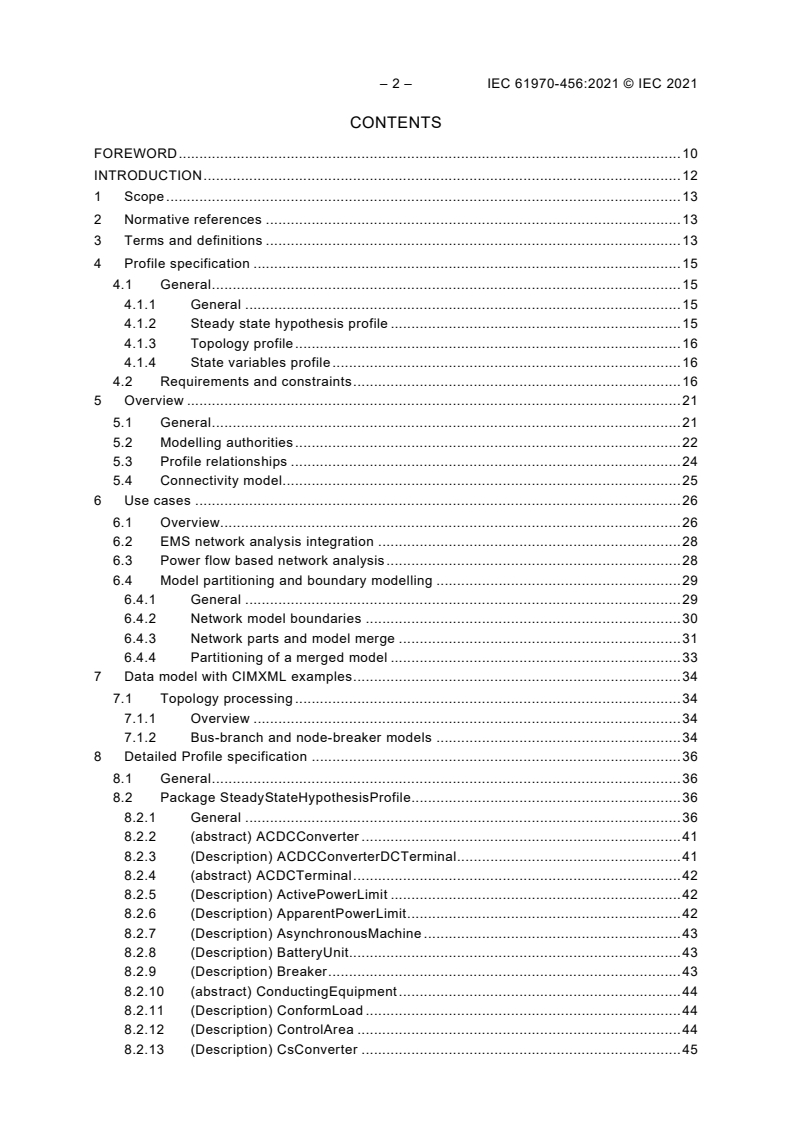
– 2 – IEC 61970-456:2021 © IEC 2021
CONTENTS
FOREWORD . 10
INTRODUCTION . 12
1 Scope . 13
2 Normative references . 13
3 Terms and definitions . 13
4 Profile specification . 15
4.1 General . 15
4.1.1 General . 15
4.1.2 Steady state hypothesis profile . 15
4.1.3 Topology profile . 16
4.1.4 State variables profile . 16
4.2 Requirements and constraints . 16
5 Overview . 21
5.1 General . 21
5.2 Modelling authorities . 22
5.3 Profile relationships . 24
5.4 Connectivity model. 25
6 Use cases . 26
6.1 Overview. 26
6.2 EMS network analysis integration . 28
6.3 Power flow based network analysis . 28
6.4 Model partitioning and boundary modelling . 29
6.4.1 General . 29
6.4.2 Network model boundaries . 30
6.4.3 Network parts and model merge . 31
6.4.4 Partitioning of a merged model . 33
7 Data model with CIMXML examples . 34
7.1 Topology processing . 34
7.1.1 Overview . 34
7.1.2 Bus-branch and node-breaker models . 34
8 Detailed Profile specification . 36
8.1 General . 36
8.2 Package SteadyStateHypothesisProfile. 36
8.2.1 General . 36
8.2.2 (abstract) ACDCConverter . 41
8.2.3 (Description) ACDCConverterDCTerminal . 41
8.2.4 (abstract) ACDCTerminal . 42
8.2.5 (Description) ActivePowerLimit . 42
8.2.6 (Description) ApparentPowerLimit . 42
8.2.7 (Description) AsynchronousMachine . 43
8.2.8 (Description) BatteryUnit. 43
8.2.9 (Description) Breaker . 43
8.2.10 (abstract) ConductingEquipment . 44
8.2.11 (Description) ConformLoad . 44
8.2.12 (Description) ControlArea . 44
8.2.13 (Description) CsConverter . 45
8.2.14 (Description) CurrentLimit . 46
8.2.15 (abstract) DCBaseTerminal . 47
8.2.16 (Description) DCTerminal . 47
8.2.17 (Description) Disconnector. 47
8.2.18 (Description) DisconnectingCircuitBreaker . 48
8.2.19 (abstract) EnergyConnection . 48
8.2.20 (Description) EnergyConsumer . 48
8.2.21 (Description) EnergySource . 49
8.2.22 Equipment . 50
8.2.23 (abstract) EquivalentEquipment . 50
8.2.24 (Description) EquivalentInjection . 50
8.2.25 (Description) ExternalNetworkInjection . 51
8.2.26 (Description) Fuse . 51
8.2.27 (Description) GeneratingUnit . 52
8.2.28 (Description) GroundDisconnector . 52
8.2.29 (Description) HydroGeneratingUnit . 53
8.2.30 (abstract) IdentifiedObject root class . 53
8.2.31 (Description) Jumper . 53
8.2.32 (Description) LinearShuntCompensator . 54
8.2.33 (Description) LoadBreakSwitch . 54
8.2.34 (Description) NonConformLoad . 54
8.2.35 (Description) NonlinearShuntCompensator . 55
8.2.36 (Description) NuclearGeneratingUnit . 55
8.2.37 (abstract) OperationalLimit . 55
8.2.38 (abstract) PhaseTapChanger . 56
8.2.39 (Description) PhaseTapChangerAsymmetrical . 56
8.2.40 (Description) PhaseTapChangerLinear . 57
8.2.41 (abstract) PhaseTapChangerNonLinear . 57
8.2.42 (Description) PhaseTapChangerSymmetrical . 57
8.2.43 (Description) PhaseTapChangerTabular . 58
8.2.44 (Description) PowerElectronicsConnection . 58
8.2.45 (abstract) PowerElectronicsUnit . 59
8.2.46 (abstract) PowerSystemResource . 59
8.2.47 (abstract) ProtectedSwitch . 59
8.2.48 (Description) RatioTapChanger . 60
8.2.49 (abstract,Description) RegulatingCondEq . 60
8.2.50 (Description) RegulatingControl . 60
8.2.51 (abstract) RotatingMachine . 61
8.2.52 (abstract) ShuntCompensator . 62
8.2.53 (Description) SolarGeneratingUnit . 63
8.2.54 (Description) StaticVarCompensator . 63
8.2.55 (Description) StationSupply . 63
8.2.56 (Description) Switch . 64
8.2.57 (Description) SynchronousMachine . 64
8.2.58 (abstract) TapChanger . 65
8.2.59 (Description) TapChangerControl . 65
8.2.60 (Description) Terminal . 66
8.2.61 (Description) ThermalGeneratingUnit . 66
8.2.62 (Description) VoltageLimit . 66
– 4 – IEC 61970-456:2021 © IEC 2021
8.2.63 (Description) VsConverter . 67
8.2.64 (Description) WindGeneratingUnit . 68
8.2.65 AsynchronousMachineKind enumeration . 68
8.2.66 BatteryStateKind enumeration . 68
8.2.67 CsOperatingModeKind enumeration. 68
8.2.68 CsPpccControlKind enumeration . 69
8.2.69 SynchronousMachineOperatingMode enumeration . 69
8.2.70 UnitMultiplier enumeration . 69
8.2.71 UnitSymbol enumeration . 70
8.2.72 VsPpccControlKind enumeration . 76
8.2.73 VsQpccControlKind enumeration . 76
8.2.74 ActivePower datatype . 77
8.2.75 AngleDegrees datatype . 77
8.2.76 AngleRadians datatype . 77
8.2.77 ApparentPower datatype. 78
8.2.78 CurrentFlow datatype . 78
8.2.79 PerCent datatype . 78
8.2.80 PU datatype . 79
8.2.81 ReactivePower datatype . 79
8.2.82 RealEnergy datatype . 79
8.2.83 Resistance datatype . 79
8.2.84 Voltage datatype. 80
8.2.85 Boolean primitive . 80
8.2.86 Date primitive . 80
8.2.87 Float primitive . 80
8.2.88 Integer primitive . 80
8.2.89 String primitive . 80
8.3 Package TopologyProfile . 80
8.3.1 General . 80
8.3.2 (Description) ACDCConverterDCTerminal . 82
8.3.3 (abstract) ACDCTerminal . 82
8.3.4 (abstract) BaseVoltage root class . 82
8.3.5 (Description) ConnectivityNode root class . 82
8.3.6 (abstract) ConnectivityNodeContainer root class . 83
8.3.7 (abstract) DCBaseTerminal . 83
8.3.8 (abstract) DCEquipmentContainer root class . 83
8.3.9 (Description) DCNode . 83
8.3.10 (Description) DCTerminal . 84
8.3.11 DCTopologicalNode . 84
8.3.12 (abstract) IdentifiedObject root class . 85
8.3.13 (Description) Terminal . 85
8.3.14 TopologicalNode . 86
8.3.15 Date primitive . 87
8.3.16 (abstract) ReportingGroup . 87
8.3.17 String primitive . 87
8.4 Package StateVariablesProfile . 87
8.4.1 General . 87
8.4.2 (abstract) ACDCConverter . 90
8.4.3 (abstract) ACDCTerminal . 90
8.4.4 (Description) CsConverter . 90
8.4.5 (abstract) ConductingEquipment root class . 91
8.4.6 DCTopologicalIsland . 91
8.4.7 (abstract) DCTopologicalNode . 92
8.4.8 (abstract) IdentifiedObject root class . 92
8.4.9 (abstract) ShuntCompensator root class . 93
8.4.10 SvInjection root class. 93
8.4.11 SvPowerFlow root class . 93
8.4.12 SvShuntCompensatorSections root class . 94
8.4.13 SvStatus root class . 94
8.4.14 SvSwitch root class . 95
8.4.15 SvTapStep root class . 95
8.4.16 SvVoltage root class . 96
8.4.17 (abstract) Switch . 96
8.4.18 (abstract) TapChanger root class . 96
8.4.19 (abstract) Terminal . 97
8.4.20 TopologicalIsland. 97
8.4.21 (abstract) TopologicalNode root class . 98
8.4.22 (Description) VsConverter . 98
8.4.23 UnitMultiplier enumeration . 98
8.4.24 UnitSymbol enumeration . 99
8.4.25 ActivePower datatype . 105
8.4.26 AngleDegrees datatype . 105
8.4.27 CurrentFlow datatype . 105
8.4.28 ReactivePower datatype . 105
8.4.29 Voltage datatype. 106
8.4.30 Boolean primitive . 106
8.4.31 Date primitive . 106
8.4.32 Float primitive . 106
8.4.33 String primitive . 106
Bibliography . 107
Figure 1 – Relations between MAS, profile and dataset . 23
Figure 2 – Profile relationships . 24
Figure 3 – Connectivity and solution model . 25
Figure 4 – The European power system with regions . 27
Figure 5 – Information exchange in power flow and sharing of results . 27
Figure 6 – EMS datasets to an external client . 28
Figure 7 – Node-breaker power flow integration architecture . 29
Figure 8 – Bus-branch power flow integration architecture . 29
Figure 9 – Line boundary dataset example . 30
Figure 10 – Substation boundary dataset example . 30
Figure 11 – Merged model . 31
Figure 12 – Alternate boundary modelling . 32
Figure 13 – Merged model alternatives . 32
Figure 14 – Partitioning of a merged model . 33
Figure 15 – Relation between ConnectivityNode and TopologicalNode . 35
– 6 – IEC 61970-456:2021 © IEC 2021
Figure 16 – Bus-branch modelling of bus coupler and line transfer . 36
Figure 17 – Class diagram
SteadyStateHypothesisProfile::SteadyStateHypothesisProfile . 37
Figure 18 – Class diagram SteadyStateHypothesisProfile::Core. 38
Figure 19 – Class diagram SteadyStateHypothesisProfile::DC . 39
Figure 20 – Class diagram SteadyStateHypothesisProfile::OperationalLimits . 39
Figure 21 – Class diagram SteadyStateHypothesisProfile::Datatypes . 40
Figure 22 – Class diagram TopologyProfile::TopologyProfile . 81
Figure 23 – Class diagram TopologyProfile::Datatypes . 81
Figure 24 – Class diagram StateVariablesProfile::StateVariablesProfile . 88
Figure 25 – Class diagram StateVariablesProfile::Datatypes . 89
Table 1 – Attributels of SteadyStateHypothesisProfile::ACDCConverter . 41
Table 2 – Attributes of SteadyStateHypothesisProfile::ACDCConverterDCTerminal . 42
Table 3 – Attributes of SteadyStateHypothesisProfile::ACDCTerminal . 42
Table 4 – Attributes of SteadyStateHypothesisProfile::ActivePowerLimit . 42
Table 5 – Attributes of SteadyStateHypothesisProfile::ApparentPowerLimit . 43
Table 6 – Attributes of SteadyStateHypothesisProfile::AsynchronousMachine . 43
Table 7 – Attributes of SteadyStateHypothesisProfile::BatteryUnit . 43
Table 8 – Attributes of SteadyStateHypothesisProfile::Breaker . 44
Table 9 – Attributes of SteadyStateHypothesisProfile::ConductingEquipment. 44
Table 10 – Attributes of SteadyStateHypothesisProfile::ConformLoad . 44
Table 11 – Attributes of SteadyStateHypothesisProfile::ControlArea . 45
Table 12 – Attributes of SteadyStateHypothesisProfile::CsConverter . 46
Table 13 – Attributes of SteadyStateHypothesisProfile::CurrentLimit . 46
Table 14 – Attributes of SteadyStateHypothesisProfile::DCBaseTerminal . 47
Table 15 – Attributes of SteadyStateHypothesisProfile::DCTerminal . 47
Table 16 – Attributes of SteadyStateHypothesisProfile::Disconnector . 47
Table 17 – Attributes of SteadyStateHypothesisProfile::DisconnectingCircuitBreaker . 48
Table 18 – Attributes of SteadyStateHypothesisProfile::EnergyConnection . 48
Table 19 – Attributes of SteadyStateHypothesisProfile::EnergyConsumer . 49
Table 20 – Attributes of SteadyStateHypothesisProfile::EnergySource . 49
Table 21 – Attributes of SteadyStateHypothesisProfile::Equipment . 50
Table 22 – Attributes of SteadyStateHypothesisProfile::EquivalentEquipment . 50
Table 23 – Attributes of SteadyStateHypothesisProfile::EquivalentInjection . 51
Table 24 – Attributes of SteadyStateHypothesisProfile::ExternalNetworkInjection . 51
Table 25 – Attributes of SteadyStateHypothesisProfile::Fuse . 52
Table 26 – Attributes of SteadyStateHypothesisProfile::GeneratingUnit . 52
Table 27 – Attributes of SteadyStateHypothesisProfile::GroundDisconnector . 52
Table 28 – Attributes of SteadyStateHypothesisProfile::HydroGeneratingUnit . 53
Table 29 – Attributes of SteadyStateHypothesisProfile::IdentifiedObject . 53
Table 30 – Attributes of SteadyStateHypothesisProfile::Jumper . 53
Table 31 – Attributes of SteadyStateHypothesisProfile::LinearShuntCompensator . 54
Table 32 – Attributes of SteadyStateHypothesisProfile::LoadBreakSwitch . 54
Table 33 – Attributes of SteadyStateHypothesisProfile::NonConformLoad . 55
Table 34 – Attributes of SteadyStateHypothesisProfile::NonlinearShuntCompensator . 55
Table 35 – Attributes of SteadyStateHypothesisProfile::NuclearGeneratingUnit . 55
Table 36 – Attributes of SteadyStateHypothesisProfile::OperationalLimit . 56
Table 37 – Attributes of SteadyStateHypothesisProfile::PhaseTapChanger . 56
Table 38 – Attributes of
SteadyStateHypothesisProfile::PhaseTapChangerAsymmetrical . 56
Table 39 – Attributes of SteadyStateHypothesisProfile::PhaseTapChangerLinear . 57
Table 40 – Attributes of SteadyStateHypothesisProfile::PhaseTapChangerNonLinear . 57
Table 41 – Attributes of SteadyStateHypothesisProfile::PhaseTapChangerSymmetrical . 58
Table 42 – Attributes of SteadyStateHypothesisProfile::PhaseTapChangerTabular . 58
Table 43 – Attributes of SteadyStateHypothesisProfile::PowerElectronicsConnection . 58
Table 44 – Attributes of SteadyStateHypothesisProfile::PowerElectronicsUnit . 59
Table 45 – Attributes of SteadyStateHypothesisProfile::PowerSystemResource . 59
Table 46 – Attributes of SteadyStateHypothesisProfile::ProtectedSwitch . 59
Table 47 – Attributes of SteadyStateHypothesisProfile::RatioTapChanger . 60
Table 48 – Attributes of SteadyStateHypothesisProfile::RegulatingCondEq . 60
Table 49 – Attributes of SteadyStateHypothesisProfile::RegulatingControl . 61
Table 50 – Attributes of SteadyStateHypothesisProfile::RotatingMachine . 62
Table 51 – Attributes of SteadyStateHypothesisProfile::ShuntCompensator . 62
Table 52 – Attributes of SteadyStateHypothesisProfile::SolarGeneratingUnit . 63
Table 53 – Attributes of SteadyStateHypothesisProfile::StaticVarCompensator . 63
Table 54 – Attributes of SteadyStateHypothesisProfile::StationSupply . 64
Table 55 – Attributes of SteadyStateHypothesisProfile::Switch . 64
Table 56 – Attributes of SteadyStateHypothesisProfile::SynchronousMachine . 65
Table 57 – Attributes of SteadyStateHypothesisProfile::TapChanger . 65
Table 58 – Attributes of SteadyStateHypothesisProfile::TapChangerControl . 66
Table 59 – Attributes of SteadyStateHypothesisProfile::Terminal . 66
Table 60 – Attributes of SteadyStateHypothesisProfile::ThermalGeneratingUnit . 66
Table 61 – Attributes of SteadyStateHypothesisProfile::VoltageLimit . 67
Table 62 – Attributes of SteadyStateHypothesisProfile::VsConverter . 67
Table 63 – Attributes of SteadyStateHypothesisProfile::WindGeneratingUnit . 68
Table 64 – Literals of SteadyStateHypothesisProfile::AsynchronousMachineKind . 68
Table 65 – Literals of SteadyStateHypothesisProfile::BatteryStateKind . 68
Table 66 – Literals of SteadyStateHypothesisProfile::CsOperatingModeKind . 69
Table 67 – Literals of SteadyStateHypothesisProfile::CsPpccControlKind . 69
Table 68 – Literals of
SteadyStateHypothesisProfile::SynchronousMachineOperatingMode . 69
Table 69 – Literals of SteadyStateHypothesisProfile::UnitMultiplier . 70
Table 70 – Literals of SteadyStateHypothesisProfile::UnitSymbol . 71
Table 71 – Literals of SteadyStateHypothesisProfile::VsPpccControlKind . 76
Table 72 – Literals of SteadyStateHypothesisProfile::VsQpccControlKind . 77
Table 73 – Attributes of SteadyStateHypothesisProfile::ActivePower . 77
– 8 – IEC 61970-456:2021 © IEC 2021
Table 74 – Attributes of SteadyStateHypothesisProfile::AngleDegrees . 77
Table 75 – Attributes of SteadyStateHypothesisProfile::AngleRadians . 78
Table 76 – Attributes of SteadyStateHypothesisProfile::ApparentPower . 78
Table 77 – Attributes of SteadyStateHypothesisProfile::CurrentFlow . 78
Table 78 – Attributes of SteadyStateHypothesisProfile::PerCent . 78
Table 79 – Attributes of SteadyStateHypothesisProfile::PU . 79
Table 80 – Attributes of SteadyStateHypothesisProfile::ReactivePower . 79
Table 81 – Attributes of SteadyStateHypothesisProfile::RealEnergy . 79
Table 82 – Attributes of SteadyStateHypothesisProfile::Resistance . 80
Table 83 – Attributes of SteadyStateHypothesisProfile::Voltage . 80
Table 84 – Attributes of TopologyProfile::ACDCConverterDCTerminal . 82
Table 85 – Association ends of TopologyProfile::ACDCConverterDCTerminal with other
classes . 82
Table 86 – Attributes of TopologyProfile::ACDCTerminal . 82
Table 87 – Association ends of TopologyProfile::ConnectivityNode with other classes . 83
Table 88 – Attributes of TopologyProfile::DCBaseTerminal . 83
Table 89 – Association ends of TopologyProfile::DCBaseTerminal with other classes . 83
Table 90 – Attributes of TopologyProfile::DCNode . 84
Table 91 – Association ends of TopologyProfile::DCNode with other classes . 84
Table 92 – Attributes of TopologyProfile::DCTerminal . 84
Table 93 – Association ends of TopologyProfile::DCTerminal with other classes . 84
Table 94 – Attributes of TopologyProfile::DCTopologicalNode. 85
Table 95 – Association ends of TopologyProfile::DCTopologicalNode with other
classes . 85
Table 96 – Attributes of TopologyProfile::IdentifiedObject . 85
Table 97 – Attributes of TopologyProfile::Terminal . 86
Table 98 – Association ends of TopologyProfile::Terminal with other classes . 86
Table 99 – Attributes of TopologyProfile::TopologicalNode . 86
Table 100 – Association ends of TopologyProfile::TopologicalNode with other classes . 87
Table 101 – Attributes of TopologyProfile::ReportingGroup . 87
Table 102 – Attributes of StateVariablesProfile::ACDCConverter . 90
Table 103 – Attributes of StateVariablesProfile::ACDCTerminal . 90
Table 104 – Attributes of StateVariablesProfile::CsConverter . 91
Table 105 – Attributes of StateVariablesProfile::DCTopologicalIsland . 92
Table 106 – Association ends of StateVariablesProfile::DCTopologicalIsland with other
classes . 92
Table 107 – Attributes of StateVariablesProfile::DCTopologicalNode . 92
Table 108 – Attributes of StateVariablesProfile::IdentifiedObject . 93
Table 109 – Attributes of StateVariablesProfile::SvInjection . 93
Table 110 – Association ends of StateVariablesProfile::SvInjection with other classes . 93
Table 111 – Attributes of StateVariablesProfile::SvPowerFlow . 94
Table 112 – Association ends of StateVariablesProfile::SvPowerFlow with other
classes . 94
Table 113 – Attributes of StateVariablesProfile::SvShuntCompensatorSections . 94
Table 114 – Association ends of StateVariablesProfile::SvShuntCompensatorSections
with other classes . 94
Table 115 – Attributes of StateVariablesProfile::SvStatus . 95
Table 116 – Association ends of StateVariablesProfile::SvStatus with other classes . 95
Table 117 – Attributes of StateVariablesProfile::SvSwitch . 95
Table 118 – Association ends of StateVariablesProfile::SvSwitch with other classes. 95
Table 119 – Attributes of StateVariablesProfile::SvTapStep . 96
Table 120 – Association ends of StateVariablesProfile::SvTapStep with other classes . 96
Table 121 – Attributes of StateVariablesProfile::SvVoltage . 96
Table 122 – Association ends of StateVariablesProfile::SvVoltage with other classes . 96
Table 123 – Attributes of StateVariablesProfile::Terminal. 97
Table 124 – Attributes of StateVariablesProfile::TopologicalIsland . 97
Table 125 – Association ends of StateVariablesProfile::TopologicalIsland with other
classes . 97
Table 126 – Attributes of StateVariablesProfile::VsConverter . 98
Table 127 – Literals of StateVariablesProfile::UnitMultiplier . 99
Table 128 – Literals of StateVariablesProfile::UnitSymbol . 100
Table 129 – Attributes of StateVariablesProfile::ActivePower . 105
Table 130 – Attributes of StateVariablesProfile::AngleDegrees . 105
Table 131 – Attributes of StateVariablesProfile::CurrentFlow . 105
Table 132 – Attributes of StateVariablesProfile::ReactivePower . 106
Table 133 – Attributes of StateVariablesProfile::Voltage .
...
Questions, Comments and Discussion
Ask us and Technical Secretary will try to provide an answer. You can facilitate discussion about the standard in here.
Loading comments...