


IEC TR 61400-24:2002
(Main)Wind turbine generator systems - Part 24: Lightning protection
General Information
- Abstract
Identifies the generic problems involved in lightning protection of wind turbines; describes appropriate methods for evaluating the risk of lightning damage to wind turbines; describes and outlines suitable methods for lightning protection of wind turbine components.
- Status
- Replaced
- Publication Date
- 10-Jul-2002
- Technical Committee
- TC 88 - Wind energy generation systems
- Current Stage
- DELPUB - Deleted Publication
- Start Date
- 16-Jun-2010
- Completion Date
- 28-Aug-2026

Relations
- Effective Date
- 28-Jun-2024
- Effective Date
- 10-Feb-2026
- Effective Date
- 05-Sep-2023
Get Certified
Connect with accredited certification bodies for this standard

DNV
DNV is an independent assurance and risk management provider.

Lloyd's Register
Lloyd's Register is a global professional services organisation specialising in engineering and technology.
DNV Energy Systems
Energy and renewable energy certification.
Sponsored listings
Frequently Asked Questions
IEC TR 61400-24:2002 is a technical report published by the International Electrotechnical Commission (IEC). Its full title is "Wind turbine generator systems - Part 24: Lightning protection". This standard covers: Identifies the generic problems involved in lightning protection of wind turbines; describes appropriate methods for evaluating the risk of lightning damage to wind turbines; describes and outlines suitable methods for lightning protection of wind turbine components.
Identifies the generic problems involved in lightning protection of wind turbines; describes appropriate methods for evaluating the risk of lightning damage to wind turbines; describes and outlines suitable methods for lightning protection of wind turbine components.
IEC TR 61400-24:2002 is classified under the following ICS (International Classification for Standards) categories: 27.180 - Wind turbine energy systems. The ICS classification helps identify the subject area and facilitates finding related standards.
IEC TR 61400-24:2002 has the following relationships with other standards: It is inter standard links to IEC 61400-24:2010, EN 61400-1:2005, IEC 61400-24:2019. Understanding these relationships helps ensure you are using the most current and applicable version of the standard.
IEC TR 61400-24:2002 is available in PDF format for immediate download after purchase. The document can be added to your cart and obtained through the secure checkout process. Digital delivery ensures instant access to the complete standard document.
Standards Content (Sample)
TECHNICAL IEC
REPORT
TR 61400-24
First edition
2002-07
Wind turbine generator systems –
Part 24:
Lightning protection
Reference number
IEC/TR 61400-24:2002(E)
Publication numbering
As from 1 January 1997 all IEC publications are issued with a designation in the
60000 series. For example, IEC 34-1 is now referred to as IEC 60034-1.
Consolidated editions
The IEC is now publishing consolidated versions of its publications. For example,
edition numbers 1.0, 1.1 and 1.2 refer, respectively, to the base publication, the
base publication incorporating amendment 1 and the base publication incorporating
amendments 1 and 2.
Further information on IEC publications
The technical content of IEC publications is kept under constant review by the IEC,
thus ensuring that the content reflects current technology. Information relating to
this publication, including its validity, is available in the IEC Catalogue of
publications (see below) in addition to new editions, amendments and corrigenda.
Information on the subjects under consideration and work in progress undertaken
by the technical committee which has prepared this publication, as well as the list
of publications issued, is also available from the following:
• IEC Web Site (www.iec.ch)
• Catalogue of IEC publications
The on-line catalogue on the IEC web site (www.iec.ch/catlg-e.htm) enables
you to search by a variety of criteria including text searches, technical
committees and date of publication. On-line information is also available on
recently issued publications, withdrawn and replaced publications, as well as
corrigenda.
• IEC Just Published
This summary of recently issued publications (www.iec.ch/JP.htm) is also
available by email. Please contact the Customer Service Centre (see below) for
further information.
• Customer Service Centre
If you have any questions regarding this publication or need further assistance,
please contact the Customer Service Centre:
Email: custserv@iec.ch
Tel: +41 22 919 02 11
Fax: +41 22 919 03 00
TECHNICAL IEC
REPORT
TR 61400-24
First edition
2002-07
Wind turbine generator systems –
Part 24:
Lightning protection
IEC 2002 Copyright - all rights reserved
No part of this publication may be reproduced or utilized in any form or by any means, electronic or
mechanical, including photocopying and microfilm, without permission in writing from the publisher.
International Electrotechnical Commission, 3, rue de Varembé, PO Box 131, CH-1211 Geneva 20, Switzerland
Telephone: +41 22 919 02 11 Telefax: +41 22 919 03 00 E-mail: inmail@iec.ch Web: www.iec.ch
PRICE CODE
Commission Electrotechnique Internationale
XB
International Electrotechnical Commission
Международная Электротехническая Комиссия
For price, see current catalogue
– 2 – TR 61400-24 IEC:2002(E)
CONTENTS
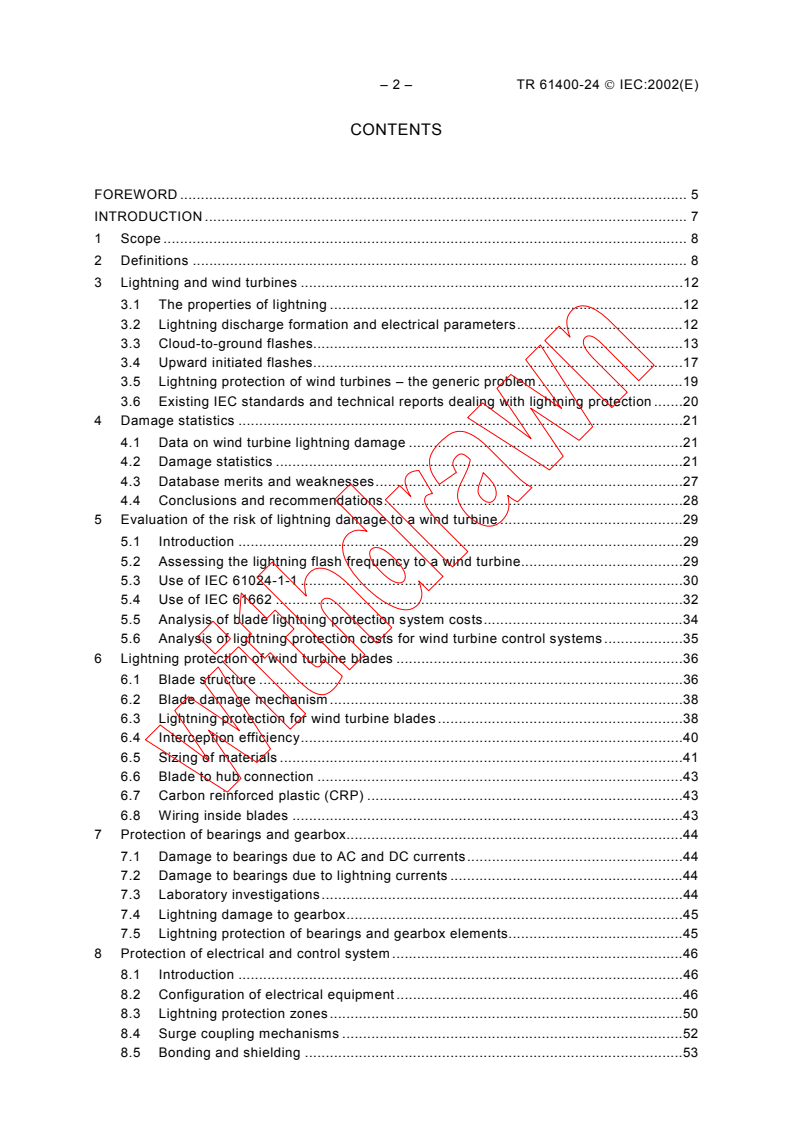
FOREWORD . 5
INTRODUCTION .7
1 Scope . 8
2 Definitions . 8
3 Lightning and wind turbines .12
3.1 The properties of lightning .12
3.2 Lightning discharge formation and electrical parameters.12
3.3 Cloud-to-ground flashes.13
3.4 Upward initiated flashes.17
3.5 Lightning protection of wind turbines – the generic problem .19
3.6 Existing IEC standards and technical reports dealing with lightning protection .20
4 Damage statistics .21
4.1 Data on wind turbine lightning damage .21
4.2 Damage statistics .21
4.3 Database merits and weaknesses.27
4.4 Conclusions and recommendations.28
5 Evaluation of the risk of lightning damage to a wind turbine .29
5.1 Introduction .29
5.2 Assessing the lightning flash frequency to a wind turbine.29
5.3 Use of IEC 61024-1-1 .30
5.4 Use of IEC 61662 .32
5.5 Analysis of blade lightning protection system costs.34
5.6 Analysis of lightning protection costs for wind turbine control systems .35
6 Lightning protection of wind turbine blades .36
6.1 Blade structure .36
6.2 Blade damage mechanism .38
6.3 Lightning protection for wind turbine blades .38
6.4 Interception efficiency.40
6.5 Sizing of materials .41
6.6 Blade to hub connection .43
6.7 Carbon reinforced plastic (CRP) .43
6.8 Wiring inside blades .43
7 Protection of bearings and gearbox.44
7.1 Damage to bearings due to AC and DC currents.44
7.2 Damage to bearings due to lightning currents .44
7.3 Laboratory investigations.44
7.4 Lightning damage to gearbox.45
7.5 Lightning protection of bearings and gearbox elements.45
8 Protection of electrical and control system .46
8.1 Introduction .46
8.2 Configuration of electrical equipment.46
8.3 Lightning protection zones .50
8.4 Surge coupling mechanisms .52
8.5 Bonding and shielding .53
TR 61400-24 IEC:2002(E) – 3 –
8.6 Surge protection .56
8.7 Summary .58
9 Earthing.58
9.1 Lightning protection system earth termination for a single wind turbine.58
9.2 Lightning protection system earth terminations in a wind farm .60
10 Personnel safety.61
10.1 General .61
11 Conclusions and recommendations for further work .62
Annex A Typical lightning damage questionnaire.64
Bibliography.66
Figure 1 – Processes involved in the formation of a cloud-to-ground flash [4].14
Figure 2 – Typical profile of a negative cloud-to-ground flash (not to scale) .15
Figure 3 – Typical profiles of negative cloud-to-ground flashes (not to scale) .16
Figure 4 – Typical profile of a positive cloud-to-ground flash .17
Figure 5 – Typical profile of a negative upward-initiated flash.17
Figure 6 – Different profiles of negative upward initiated flashes (not to scale).18
Figure 7 – Faults by component (Germany).23
Figure 8 – Faults by component (Denmark).23
Figure 9 – Faults by component (Germany).24
Figure 10 – Faults by component (Denmark) .24
Figure 11 – Repair costs by component and size (Germany) .25
Figure 12 – Average down time by component and size (Germany).25
Figure 13 – Annual variation in lightning activity and damage (Denmark) .26
Figure 14 – Faults caused by lightning (Denmark 1990-1998) .26
Figure 15 – Lightning damage events (Germany 1991-1998).27
Figure 16 – Equivalent collection area of the wind turbine .30
Figure 17 – Types of wind turbine blades .37
Figure 18 – Lightning protection for large modern wind turbine blades .39
Figure 19 – Alternative current path to reduce lightning current.46
Figure 20 – Principle configuration of electrical equipment in a grid-connected wind
turbine .47
Figure 21 – Principle control system configuration.49
Figure 22 – Rolling sphere model.50
Figure 23 – Example of the division of the interior of a wind turbine into protection zones.51
Figure 24 – Differential and common mode coupling .53
Figure 25 – Two control cabinets located on different metallic planes inside a nacelle .54
Figure 26 – Magnetic coupling mechanism .55
Figure 27 – Example design of a combination type SPD.57
Figure 28 – Typical wind turbine earthing arrangement .59
– 4 – TR 61400-24 IEC:2002(E)
Table 1 – Cloud-to-ground lightning current parameters .15
Table 2 – Upward initiated lightning current parameters .18
Table 3 – Standards and technical reports issued by IEC (Mid 2001) .20
Table 4 – IEC TC 81 work in progress (Mid 2001) .21
Table 5 – Lightning damage frequency.22
Table 6 – Regional effect on lightning damage (Germany) .22
Table 7 – Lightning fault summary (Sweden).23
Table 8 – Energy and availability loss compared to other faults.26
Table 9 – Lightning protection system levels .31
Table 10 – Maximum values of lightning parameters corresponding to protection levels .32
Table 11 – Minimum dimensions of lightning protection system materials.41
Table 12 – Proposed minimum dimensions for lightning protection system materials.41
Table 13 – Physical characteristics of typical materials used in lightning protection
systems .42
Table 14 – Temperature rise [K] for different conductors as a function of W/R .42
Table 15 – Lightning protection zones .50
Table 16 – Examples of component requirements in given zones .52
Table 17 – Effect of various protection measures on screen transient voltages .56
Table 18 – Suitability of electrode types .60
TR 61400-24 IEC:2002(E) – 5 –
INTERNATIONAL ELECTROTECHNICAL COMMISSION
____________
WIND TURBINE GENERATOR SYSTEMS –
Part 24: Lightning protection
FOREWORD
1) The IEC (International Electrotechnical Commission) is a worldwide organization for standardization comprising
all national electrotechnical committees (IEC National Committees). The object of the IEC is to promote
international co-operation on all questions concerning standardization in the electrical and electronic fields. To
this end and in addition to other activities, the IEC publishes International Standards. Their preparation is
entrusted to technical committees; any IEC National Committee interested in the subject dealt with may
participate in this preparatory work. International, governmental and non-governmental organizations liaising
with the IEC also participate in this preparation. The IEC collaborates closely with the International
Organization for Standardization (ISO) in accordance with conditions determined by agreement between the
two organizations.
2) The formal decisions or agreements of the IEC on technical matters express, as nearly as possible, an
international consensus of opinion on the relevant subjects since each technical committee has representation
from all interested National Committees.
3) The documents produced have the form of recommendations for international use and are published in the form
of standards, technical specifications, technical reports or guides and they are accepted by the National
Committees in that sense.
4) In order to promote international unification, IEC National Committees undertake to apply IEC International
Standards transparently to the maximum extent possible in their national and regional standards. Any
divergence between the IEC Standard and the corresponding national or regional standard shall be clearly
indicated in the latter.
5) The IEC provides no marking procedure to indicate its approval and cannot be rendered responsible for any
equipment declared to be in conformity with one of its standards.
6) Attention is drawn to the possibility that some of the elements of this technical report may be the subject of
patent rights. The IEC shall not be held responsible for identifying any or all such patent rights.
The main task of IEC technical committees is to prepare International Standards. However, a
technical committee may propose the publication of a technical report when it has collected
data of a different kind from that which is normally published as an International Standard, for
example “state of the art”.
Technical reports do not necessarily have to be reviewed until the data they provide are
considered to be no longer valid or useful by the maintenance team.
IEC 61400-24, which is a technical report, has been prepared by IEC technical committee 88:
Wind turbine systems.
The text of this technical report is based on the following documents:
Enquiry draft Report on voting
88/128/CDV 88/142/RVC
Full information on the voting for the approval of this technical report can be found in the
report on voting indicated in the above table.
This publication has been drafted in accordance with the ISO/IEC Directives, Part 3.
This document, which is purely informative, is not to be regarded as an International
Standard.
– 6 – TR 61400-24 IEC:2002(E)
The committee has decided that the contents of this publication will remain unchanged until
2007. At this date, the publication will be either
• reconfirmed;
• withdrawn;
• replaced by a revised edition, or
• amended.
TR 61400-24 IEC:2002(E) – 7 –
INTRODUCTION
During the last few years damage to wind turbines due to lightning strokes has been
recognized as an increasing problem. The increasing number and height of installed turbines
have resulted in an incidence of lightning damage greater than anticipated with repair costs
beyond acceptable levels. The influence of lightning faults on operational reliability becomes
a concern as the capacity of individual wind turbines increases and turbines move offshore.
This is particularly the case when several large wind turbines are operated together in wind
farm installations since the potential loss of multiple large production units due to one
lightning flash is unacceptable.
Unlike other electrical installations, such as overhead lines, substations and power plants,
where protective conductors can be arranged around or above the installation in question,
wind turbines pose a different lightning protection problem due to their physical size and
nature. Wind turbines typically have two or three blades with a diameter up to 100 m or more
rotating 100 m above the ground. In addition, there is extensive use of insulating composite
materials, such as glass fibre reinforced plastic, as load-carrying parts. The lightning
protection system has to be fully integrated into the different parts of the wind turbines to
ensure that all parts likely to be lightning attachment points are able to withstand the impact
of the lightning and that the lightning current may be conducted safely from the attachment
points to the ground without unacceptable damage or disturbances to the systems.
To that end this report was developed to inform designers, purchasers, operators, certification
agencies and installers of wind turbines on the state-of-the-art of lightning protection of wind
turbines.
– 8 – TR 61400-24 IEC:2002(E)
WIND TURBINE GENERATOR SYSTEMS –
Part 24: Lightning protection
1 Scope
During the last few years, all major wind turbine manufacturers have made dedicated efforts
towards developing adequate lightning protection systems, and the first experiences with
these new designs are beginning to be seen. It is therefore reasonable at this time to consider
and prepare for a standardization effort that will give both manufacturers and operators a
common framework for appropriate lightning protection of wind turbines.
On the above background the following elements of work have formed the scope of a new
working group with the specific aim of preparing a technical report on the subject prior to
considering development of a full standard:
− identify the generic problems involved in lightning protection of wind turbines;
− collect and systematize existing experience with both older and new designs of wind
turbines;
− describe appropriate methods for evaluating the risk of lightning damage to wind turbines,
thereby making reliable cost-benefit evaluations of lightning protection efforts possible;
− describe and outline appropriate methods for lightning protection of wind turbine
components, considering the special nature of wind turbines and the extensive use of
composite materials;
− compile a technical report outlining problems and solutions as seen today. The working
group should identify and quantify areas where further research and proper standardization
efforts are needed.
This technical report is structured as follows:
− clause 3 gives the background on the current understanding on lightning phenomenology
and its impact on wind turbines;
− clause 4 presents the lightning damage experience as extracted from the various national
wind turbine databases;
− clause 5 describes risk evaluation;
− clauses 6 through 10 discuss appropriate methods for protection against lightning damage;
− clause 11 identifies areas for further research.
2 Definitions
For the purposes of this technical report, the following definitions apply.
2.1
accepted lightning flash frequency (N )
c
maximum accepted average annual frequency of lightning flashes which can cause damage to
the structure
2.2
air-termination system
part of the external LPS which is intended to intercept lightning flashes
TR 61400-24 IEC:2002(E) – 9 –
2.3
bonding conductor
conductor interconnecting separate installation parts to equalize potentials between them
2.4
bonding bar
bar on which metal installations, electric power and telecommunication lines, and other cables
can be bonded to an LPS
2.5
dangerous sparking
unacceptable electrical discharges caused by lightning currents in the structure to be
protected
2.6
direct lightning flash frequency to a structure (N )
d
expected average annual number of direct lightning flashes to the structure
2.7
down-conductor system
part of an external LPS which is intended to conduct lightning current from the air-termination
system to the earth-termination system
2.8
downward flash
lightning flash initiated by a downward leader from cloud to earth. A downward flash consists
of a first short stroke, which can be followed by subsequent short strokes and may include a
long stroke
2.9
earth electrode
part or a group of parts of the earth-termination system which provides direct electrical
contact with and disperses the lightning current to the earth
2.10
earth-termination system
part of an external LPS which is intended to conduct and disperse the lightning current to the
earth
2.11
effective height (h)
effective height of a wind turbine is the highest point the blades reach, i.e. hub height plus
rotor radius
2.12
efficiency of LPS (E)
ratio of the average annual number of direct lightning flashes which cannot cause damage to
the structure to the direct lightning flash number to the structure. E can be expressed as the
product of the interception efficiency (E ) and sizing efficiency (E ) expressing the probability
i s
with which the LPS protects the structure against direct lightning flashes
2.13
equivalent collection area (A )
e
equivalent collection area of a structure is defined as an area of ground surface which has the
same annual frequency of direct lightning flashes as the structure
– 10 – TR 61400-24 IEC:2002(E)
2.14
external lightning protection system
consists of an air-termination system, a down conduction system and an earth termination
system
2.15
flash charge (Q )
flash
time integral of the lightning current for the entire lightning flash duration
2.16
foundation earth electrode
reinforcement steel of foundation or additional conductor embedded in the concrete
foundation of a structure and used as an earth electrode
2.17
frequency of damage by direct lightning flashes
average number of direct lighting flashes to the structure
2.18
ground flash density (N )
g
average annual ground flash density is the number of lightning flashes per square kilometre
per year, concerning the region where the structure is located
2.19
interception efficiency (E )
i
probability with which the air-termination system of an LPS intercepts a lightning stroke
2.20
internal lightning protection system
all measures additional to those mentioned under external lightning protection system
including the equipotential bonding, the compliance of the safety distance and the reduction of
the electromagnetic effects of lightning current within the structure to be protected
2.21
lightning protection system (LPS)
the complete system used to protect a structure and its contents against the effects of
lightning. Commonly it consists of both external and internal lightning protection systems
2.22
lightning current (i)
current flowing at the point of strike
2.23
“natural” components of LPS
component installed not specifically for lightning protection which can be used in addition to
the LPS or in some cases could provide the function of one or more parts of the LPS
2.24
peak value (I)
maximum value of the lightning current
2.25
lightning equipotential bonding
bonding of separated conducting installation parts by means of direct conductors or SPD,
involved into an internal LPS, to reduce potential differences between these parts caused by
lightning current
TR 61400-24 IEC:2002(E) – 11 –
2.26
lightning stroke
single discharge in a lightning flash to earth
2.27
lightning flash to earth
electric discharge of atmospheric origin between cloud and earth consisting of one or more
strokes
2.28
lightning protection zone (LPZ)
zones where lightning electromagnetic environments are to be defined and controlled
2.29
long stroke
stroke with duration time T (time from the 10 % value on the front to the 10 % value on the
long
tail) of the current typically more than 2 ms and less than 1 s (cf. IEC 61024-1)
2.30
metal installations
extended metal items in the structure to be protected which may form a path for the lightning
current, such as the nacelle bed plate, the tower, ladders, elevator rails and wires and
interconnected reinforcing steel
2.31
multiple strokes
lightning flash consisting in average of 3-4 strokes, with typical time interval between them of
about 50 ms
2.32
point of strike
point where a lightning stroke contacts the earth, a structure or a lightning protection system
2.33
protection level
number denoting the classification of an LPS according to its efficiency
2.34
risk of damage
probable annual loss (human and goods) in a structure due to lightning
2.35
safety distance
minimum distance between two conductive parts within the structure to be protected between
which no dangerous sparking can occur
2.36
short stroke
of the impulse current typically less than 2 ms (cf. IEC 61024-1)
stroke with time to half value T
2.37
sizing efficiency (E )
s
probability that the intercepted lightning stroke does not cause damage to the structure to be
protected
– 12 – TR 61400-24 IEC:2002(E)
2.38
specific energy (W/R)
time integral of the square of the lightning current for the flash duration; it represents the
energy dissipated by the lightning current in a unit resistance
2.39
surge arrester
device designed to protect electrical apparatus from high transient voltage and to limit the
duration and frequently the amplitude of follow-current. The term “surge arrester” includes any
external series gap which is essential for the proper functioning of the device as installed for
service, regardless of whether or not it is supplied as an integral part of the device
2.40
surge protective device (SPD)
device that is intended to limit transient overvoltages and divert surge currents
2.41
thunderstorm days (T )
d
number of thunderstorm days per year obtained from isoceraunic maps
2.42
upward flash
lightning flash initiated by an upward leader from an earthed structure to cloud. An upward
flash consists of a first long stroke with or without multiple superimposed short strokes, which
can be followed by subsequent short strokes possible including further long strokes
3 Lightning and wind turbines
3.1 The properties of lightning
A lightning stroke can be regarded as a current source. The maximum recorded value of light-
ning current produced by a single stroke is in the region of 300 kA. Similarly, the maximum
recorded values of charge transfer and specific energy are 400 C and 20 MJ/Ω respectively.
These maximum values occur in only a small percentage of flashes worldwide. The median
value of peak lightning current is approximately 30 kA with median values of charge transfer
and specific energy of 5,2 C and 55 kJ/Ω, respectively. In addition, the electrical character-
istics of a stroke vary with the type of lightning flash and the geographical location.
3.2 Lightning discharge formation and electrical parameters
Lightning strokes are produced following a separation of charge in thunderstorm clouds, a
process detailed in a number of publications [1] [2] [3]. A lightning stroke is observed
when this charge is discharged to the earth or to a neighbouring cloud. This chapter is
concerned with the first of these discharges, the transfer of charge between a thundercloud
and the earth.
A lightning discharge usually consists of several components. The whole event following the
same ionized path is termed flash and may last more than 1 s. The individual components of
a flash are called strokes.
Lightning discharges are one of two basic types, downward or upward initiated. A downward
initiated discharge starts at the thundercloud and heads towards the earth. In contrast an
upward initiated discharge starts at an exposed location of the earth (for example mountain
top) or at the top of a tall earthed structure and heads towards a thundercloud. Commonly,
———————
Numbers in square brackets refer to the Bibliography.
TR 61400-24 IEC:2002(E) – 13 –
these basic types are referred to as “cloud-to-ground flash” or “downward flash” and “ground-
to-cloud flash” or “upward (initiated) flash”, respectively.
Both types of lightning are further sub-divided according to the polarity of the charge removed
from the thundercloud. A negative discharge lowers negative charge from the thundercloud to
the earth. A positive discharge results in positive charge being transferred from the
thundercloud to the earth. The majority of lightning discharges are negative, making up about
90 % of all cloud-to-ground flashes. Positive discharges make up the remaining 10 % of all
cloud-to-ground flashes. Normally, the latter exhibits higher electrical parameters.
Each lightning stroke is different due to the natural variations in the thundercloud that
produced it. For example, it is not possible to predict that the next lightning stroke to a
particular structure will have a peak current of a given value. What can be said is that the
structure has a given probability of being struck by a lightning stroke exceeding a certain
value.
Probability distributions of the electrical parameters that are used to describe a lightning
stroke have been produced using direct measurements of actual strokes to tall towers
[33] [34]. Further information is now becoming available worldwide from regional and national
lightning location systems. These can record the location of a lightning stroke and estimate
the peak current.
The probability distributions that describe the electrical parameters of a lightning stroke are
different for each type of lightning (upward/downward and positive/negative). The appropriate
probability distributions are described below along with the typical wave shape of each type of
discharge. The probability level given indicates the probability of the specified electrical
parameter exceeding the tabulated value during a lightning stroke. Empirical methods to
estimate the probability of the electrical parameters exceeding a specific value exist [4].
3.3 Cloud-to-ground flashes
A cloud-to-ground flash (downward initiated discharge) is initially formed by a preliminary
breakdown within the cloud. The physics of this process are not fully understood at this time.
The parts of the discharge process taking place below cloud level are much better known.
3.3.1 Negative cloud-to-ground flashes
In the case of a negative flash, a stepped leader descends from the cloud towards the
ground in steps of several tens of meters with a pause time between the individual steps of
approximately 50 μs. The steps have short duration (typical 1 μs) impulse currents of more
than 1 kA. The leader channel contains, when fully developed, a total charge of about 10 C, or
more. The channel diameter is in the range of up to a few tens of metres. The total duration of
the stepped leader process is a few tens of milliseconds. The faint leader channel is not
visible to the naked eye.
The end of the leader, the leader tip, is at a potential in excess of 10 MV with respect to the
earth. As the leader tip approaches the earth this high potential raises the electric field
strength at the surface of the earth. When the electric field at ground level exceeds the
breakdown value of air “answering” (upward moving) leaders are emitted from the earth or
from structures on the ground. These upward moving leaders are commonly termed
connecting leaders. Connecting leaders play an important role in determining the attachment
point of a lightning flash to an object.
– 14 – TR 61400-24 IEC:2002(E)
When the descending stepped leader meets the upward moving connecting leader a
continuous path from cloud to ground is established. The charge deposited in the leader
channel, is then discharged to ground by a current wave propagating up the ionized channel
at about one third the speed of light. This process is termed the first return stroke. The first
return stroke may have a peak value of up to a few hundred kilo amperes and a duration of a
few hundred microseconds. The process of downward propagating lightning attachment is
illustrated in figure 1.
IEC 1840/02
Figure 1 – Processes involved in the formation of a cloud-to-ground flash [4]
After a certain time interval, further leader/return stroke sequences may follow the path taken
by the first return stroke. The (dart) leader preceding these subsequent return strokes is
usually not stepped and much faster (duration of a few milliseconds). The pause time between
successive return strokes in a flash is in the order of 10 ms to a few hundred milliseconds. On
average, a lightning flash contains 3 to 4 return strokes (including the first one). The return
strokes constitute the visible part of the lightning flash.
Following one or more of the return strokes a continuing current may flow through the still
ionized channel. Continuing currents are quite different compared to the short duration, high
amplitude currents of return strokes: the average current amplitude is in the range of a few
hundred amperes, while the duration may be as long as several hundred milliseconds.
Continuing currents transfer high quantities of charge directly from the cloud to ground. About
one-half of all cloud-to-ground flashes contain a continuing current component.
Figure 2 shows a typical profile of the lightning current in a negative cloud-to-ground flash.
Following the contact of the stepped leader and the connecting leader, there is a first return
stroke resulting (at ground) in a high amplitude impulse current lasting for a few hundred
microseconds. The current peak value is in the range of a few kA to 100 kA, the median value
being about 30 kA (table 1). Following the first return strokes, subsequent return stroke(s) and
continuing current(s) may occur. Although subsequent return strokes generally have a lower
current peak value and a shorter duration than first return strokes, they generally have a
higher rate of rise of current. Negative cloud-to-ground discharges may be composed of
various combinations of the different current components mentioned above, as demonstrated
in figure 3.
TR 61400-24 IEC:2002(E) – 15 –
- i
t
IEC 1841/02
Figure 2 – Typical profile of a negative cloud-to-ground flash (not to scale)
Table 1 – Cloud-to-ground lightning current parameters
Probability level
Parameter Stroke type
95 % 50 % 5 %
Peak current kA 1st negative 14 30 90
Subsequent negative 4,6 12 30
Positive 4,6 35 250
a
Total charge C 1st negative 1,1 5,2 24
Subsequent negative 0,2 1,4 11
Positive 20 80 350
b
1st negative 6,0 55 550
Specific energy kJ/Ω
Subsequent negative 0,55 6,0 52
Positive 25 650 15000
1st negative 9,1 24 65
Maximum di/dt kA/μs
Subsequent negative 10 40 162
Positive 0,2 2,4 32
a
Q = i(t)dt
∫
b
E = i (t)dt
∫
– 16 – TR 61400-24 IEC:2002(E)
- i
- i
t
t
IEC 1842/02 IEC 1843/02
a)
b)
- i - i
t
t
IEC 1844/02 IEC 1845/02
c)
d)
a) First return stroke only.
b) First return stroke with continuing current.
c) First return stroke with subsequent return stroke(s).
d) First return stroke with subsequent return stroke(s) and continuing current
Figure 3 – Typical profiles of negative cloud-to-ground flashes (not to scale)
3.3.2 Positive cloud-to-ground flashes
In contrast to negative flashes, positive cloud-to-ground flashes are initiated by a continuously
downward propagating leader which does not show distinct steps. The connecting leader
and return stroke phases are similar to the processes described in 3.3.1. A positive cloud-
to-ground flash usually consists of only one return stroke which may be followed by a
continuing current.
Positive cloud-to-ground flashes are of great importance for practical lightning protection
because the current peak value, total charge transfer, and specific energy can be much larger
compared to the negative flash. The return stroke tends to have a lower rate of current rise in
comparison to a negative first return stroke. A typical current profile for a positive cloud-
to-ground flash is shown in figure 4. Typical electrical parameters are summarized together
with the parameters of negative discharges in table 1 [33] [34].
TR 61400-24 IEC:2002(E) – 17 –
+ i
t
IEC 1846/02
Figure 4 – Typical profile of a positive cloud-to-ground flash
3.4 Upward initiated flashes
The charge in the thundercloud causes an elevation of the electric field on the surface of the
earth, but usually not sufficient to launch an upward moving leader. However, the electric field
may be significantly enhanced at mountains, objects placed on high ground, or at tall
structures like towers or wind turbines. At such locations the electric field strength may
become large enough to initiate an upward moving leader from ground towards the
thundercloud. Structures with heights in excess of 100 m above the surrounding terrain (like
modern wind turbines) are particularly exposed to upward initiated flashes.
An upward initiated flash starts with a continuing current phase. On the continuing current
impulse currents can be superimposed (figure 5). The continuing current phase may be
followed by subsequent return stroke(s) along the same channel. These return strokes are
quite similar to the subsequent return strokes of cloud-to-ground flashes (see 3.3). Upward
initiated discharges do not contain a component analogous to the first return stroke of cloud-
to-ground discharges. The location where an upward lightning stroke attaches to a structure is
simply the same point where the upward leader is formed.
- I
t
IEC 1847/02
Figure 5 – Typical profile of a negative upward-initiated flash
Measurements of upward initiated discharge parameters are made on tall objects that are
prone to this type of stroke. One example is the CN tower in Toronto, Canada that receives at
least 50 such flashes per year [5]. Work reported in [6] and [7] has also detailed the form and
current parameters of upward flashes at the Peissenberg telecommunication tower in Bavaria,
Germany. The following information on current parameters relates to upward negative flashes
since, although observed, upward initiated positive flashes are rare.
Although the current peak values of about 10 kA are relatively low, the charge transfer
associated with the initial continuing current can be as high as 300 C as shown in table 2 [6].
Upward initiated discharges, too, may be composed of various combinations of the different
current components mentioned above, as demonstrated in figure 6.
– 18 – TR 61400-24 IEC:2002(E)
Table 2 – Upward initiated lightning current parameters
Parameter Maximum value
Total charge transfer C 300
Total duration s 0,5 - 1,0
Peak current kA 20
Average rate of rise superimposed impulse currents kA/μs20
Number of superimposed impulse currents 50
- i - i
t
t
IEC 1848/02 IEC 1849/02
a) b)
- i - i
t
t
IEC 1850/02 IEC 1851/02
c) d)
- i
t
IEC 1852/02
e)
a) (Initial) continuing current only.
b) Initial continuing current with superimposed impulses.
c-d) Initial continuing current with superimposed impulses and subsequent return stroke(s).
e) Initial continuing current with superimposed impulses plus subsequent
return stroke(s) with continuing current.
Figure 6 – Different profiles of negative upward initiated flashes (not to scale)
TR 61400-24 IEC:2002(E) – 19 –
3.5 Lightning protection of wind turbines – the generic problem
Lightning protection of modern wind turbines presents problems that are not normally seen
with other structures. These problems are a result of the following:
– wind turbines are tall structures of up to more than 150 m in height;
– wind turbines are frequently placed at locations very exposed to lightning strokes;
– the most exposed wind turbine components such as blades and nacelle cover are often
made of composite materials incapable of sustaining direct lightning stroke or of
conducting lightning current;
– the blades and nacelle are rotating;
– the lightning current has to be conducted through the wind turbine structure to the ground,
whereby significant parts of the lightning current will pass through or near to practically all
wind turbine components;
– wind turbines in wind farms are electrically interconnected and often placed at locations
with poor earthing conditions.
Tall structures are known to influence the lightning attachment process itself. For structures
exceeding 60 m in height, side flashes do occur, where a few per cent of the lightning flashes
strike the side of the structure instead of striking at the top. Such side flashes are a cause for
concern in connection with w
...