

IEC 61400-24:2010
(Main)Wind turbines - Part 24: Lightning protection
General Information
- Abstract
IEC 61400-24:2010(E) applies to lightning protection of wind turbine generators and wind power systems. Defines the lightning environment for wind turbines and application of the environment for risk assessment for the wind turbine. Defines requirements for protection of blades, other structural components and electrical and control systems against both direct and indirect effects of lightning. Recommends test methods to validate compliance. Provides guidance on the use of applicable lightning protection, industrial electrical and EMC standards including earthing. Provides guidance regarding personal safety. Makes normative references to generic standards for lightning protection, low-voltage systems and high-voltage systems for machinery and installations and EMC.
This publication is of high relevance for Smart Grid.
- Status
- Published
- Publication Date
- 15-Jun-2010
- Technical Committee
- TC 88 - Wind energy generation systems
- Current Stage
- DELPUB - Deleted Publication
- Start Date
- 03-Jul-2019
- Completion Date
- 28-Aug-2026
Overview
IEC 61400-24:2010 - "Wind turbines - Part 24: Lightning protection" is the International Electrotechnical Commission (IEC) standard that addresses lightning protection for wind turbine generators and wind power systems. It defines the lightning environment applicable to wind turbines, prescribes risk-assessment procedures, sets requirements to protect blades, structural components, electrical and control systems from direct and indirect lightning effects, and recommends test methods and verification procedures. The standard also gives guidance on earthing, EMC, personal safety, documentation, inspection and maintenance - making it highly relevant for wind farm integration with Smart Grid systems.
Key topics and technical requirements
- Lightning environment & parameters: Defines lightning current parameters and Lightning Protection Levels (LPL) to be used in assessments.
- Lightning exposure and risk assessment: Procedures to assess lightning frequency and quantify risk to turbines, service lines and nearby structures (including a basic risk equation and risk components S1–S4).
- Protection of subcomponents:
- Blades: Requirements, design considerations, verification and specific test methods.
- Nacelle, hub, spinner, tower: Structural protection and testing guidance.
- Mechanical systems: Bearings, hydraulic systems, spark gaps and related testing.
- Electrical systems: Low-voltage and electronic systems protection (LEMP protection measures), lightning protection zones (LPZ), equipotential bonding, shielding, routing, and coordinated surge protective devices (SPD).
- High-voltage systems: Placement and protection of HV arresters and related components.
- Earthing and bonding: Earth electrode arrangements, impedance considerations, equipotential bonding for various tower and foundation types (onshore/offshore), and wind-farm earthing strategies.
- Testing, inspection and documentation: Recommended test specifications, system-level immunity tests, inspection schedules, maintenance practices and required documentation for design, commissioning and ongoing LPS inspections.
- Safety and conformity: Guidance on personal safety and normative references to generic lightning protection, LV/HV and EMC standards.
Practical applications and users
IEC 61400-24 is used by:
- Wind turbine designers and OEMs to design blade and nacelle protection systems.
- Wind farm developers and operators for risk assessment, earthing design and maintenance planning.
- Certification bodies and test laboratories for compliance verification and standardized testing.
- Electrical engineers and Smart Grid planners to ensure reliable grid-connected turbine behavior during lightning events.
- Maintenance, safety and inspection teams for inspection procedures, documentation and lifecycle management.
Related standards and guidance
The standard makes normative references to generic lightning protection, low-voltage, high-voltage and EMC standards. It complements other parts of IEC 61400 series and IEC 62305 family (lightning protection), and is essential when integrating wind assets into resilient Smart Grid infrastructure.
Keywords: IEC 61400-24, lightning protection, wind turbines, lightning exposure assessment, blades, nacelle, earthing, LPZ, SPD, Smart Grid, EMC, risk assessment, testing.
Relations
- Effective Date
- 28-Jun-2024
- Effective Date
- 05-Sep-2023
Get Certified
Connect with accredited certification bodies for this standard

DNV
DNV is an independent assurance and risk management provider.

Lloyd's Register
Lloyd's Register is a global professional services organisation specialising in engineering and technology.
DNV Energy Systems
Energy and renewable energy certification.
Sponsored listings
Frequently Asked Questions
IEC 61400-24:2010 is a standard published by the International Electrotechnical Commission (IEC). Its full title is "Wind turbines - Part 24: Lightning protection". This standard covers: IEC 61400-24:2010(E) applies to lightning protection of wind turbine generators and wind power systems. Defines the lightning environment for wind turbines and application of the environment for risk assessment for the wind turbine. Defines requirements for protection of blades, other structural components and electrical and control systems against both direct and indirect effects of lightning. Recommends test methods to validate compliance. Provides guidance on the use of applicable lightning protection, industrial electrical and EMC standards including earthing. Provides guidance regarding personal safety. Makes normative references to generic standards for lightning protection, low-voltage systems and high-voltage systems for machinery and installations and EMC. This publication is of high relevance for Smart Grid.
IEC 61400-24:2010(E) applies to lightning protection of wind turbine generators and wind power systems. Defines the lightning environment for wind turbines and application of the environment for risk assessment for the wind turbine. Defines requirements for protection of blades, other structural components and electrical and control systems against both direct and indirect effects of lightning. Recommends test methods to validate compliance. Provides guidance on the use of applicable lightning protection, industrial electrical and EMC standards including earthing. Provides guidance regarding personal safety. Makes normative references to generic standards for lightning protection, low-voltage systems and high-voltage systems for machinery and installations and EMC. This publication is of high relevance for Smart Grid.
IEC 61400-24:2010 is classified under the following ICS (International Classification for Standards) categories: 27.180 - Wind turbine energy systems. The ICS classification helps identify the subject area and facilitates finding related standards.
IEC 61400-24:2010 has the following relationships with other standards: It is inter standard links to IEC TR 61400-24:2002, IEC 61400-24:2019. Understanding these relationships helps ensure you are using the most current and applicable version of the standard.
IEC 61400-24:2010 is available in PDF format for immediate download after purchase. The document can be added to your cart and obtained through the secure checkout process. Digital delivery ensures instant access to the complete standard document.
Standards Content (Sample)
IEC 61400-24 ®
Edition 1.0 2010-06
INTERNATIONAL
STANDARD
Wind turbines –
Part 24: Lightning protection
All rights reserved. Unless otherwise specified, no part of this publication may be reproduced or utilized in any form
or by any means, electronic or mechanical, including photocopying and microfilm, without permission in writing from
either IEC or IEC's member National Committee in the country of the requester.
If you have any questions about IEC copyright or have an enquiry about obtaining additional rights to this publication,
please contact the address below or your local IEC member National Committee for further information.
IEC Central Office
3, rue de Varembé
CH-1211 Geneva 20
Switzerland
Email: inmail@iec.ch
Web: www.iec.ch
About the IEC
The International Electrotechnical Commission (IEC) is the leading global organization that prepares and publishes
International Standards for all electrical, electronic and related technologies.
About IEC publications
The technical content of IEC publications is kept under constant review by the IEC. Please make sure that you have the
latest edition, a corrigenda or an amendment might have been published.
ƒ Catalogue of IEC publications: www.iec.ch/searchpub
The IEC on-line Catalogue enables you to search by a variety of criteria (reference number, text, technical committee,…).
It also gives information on projects, withdrawn and replaced publications.
ƒ IEC Just Published: www.iec.ch/online_news/justpub
Stay up to date on all new IEC publications. Just Published details twice a month all new publications released. Available
on-line and also by email.
ƒ Electropedia: www.electropedia.org
The world's leading online dictionary of electronic and electrical terms containing more than 20 000 terms and definitions
in English and French, with equivalent terms in additional languages. Also known as the International Electrotechnical
Vocabulary online.
ƒ Customer Service Centre: www.iec.ch/webstore/custserv
If you wish to give us your feedback on this publication or need further assistance, please visit the Customer Service
Centre FAQ or contact us:
Email: csc@iec.ch
Tel.: +41 22 919 02 11
Fax: +41 22 919 03 00
IEC 61400-24 ®
Edition 1.0 2010-06
INTERNATIONAL
STANDARD
Wind turbines –
Part 24: Lightning protection
INTERNATIONAL
ELECTROTECHNICAL
COMMISSION
PRICE CODE
XG
ICS 27.180 ISBN 978-2-88910-969-2
– 2 – 61400-24 © IEC:2010(E)
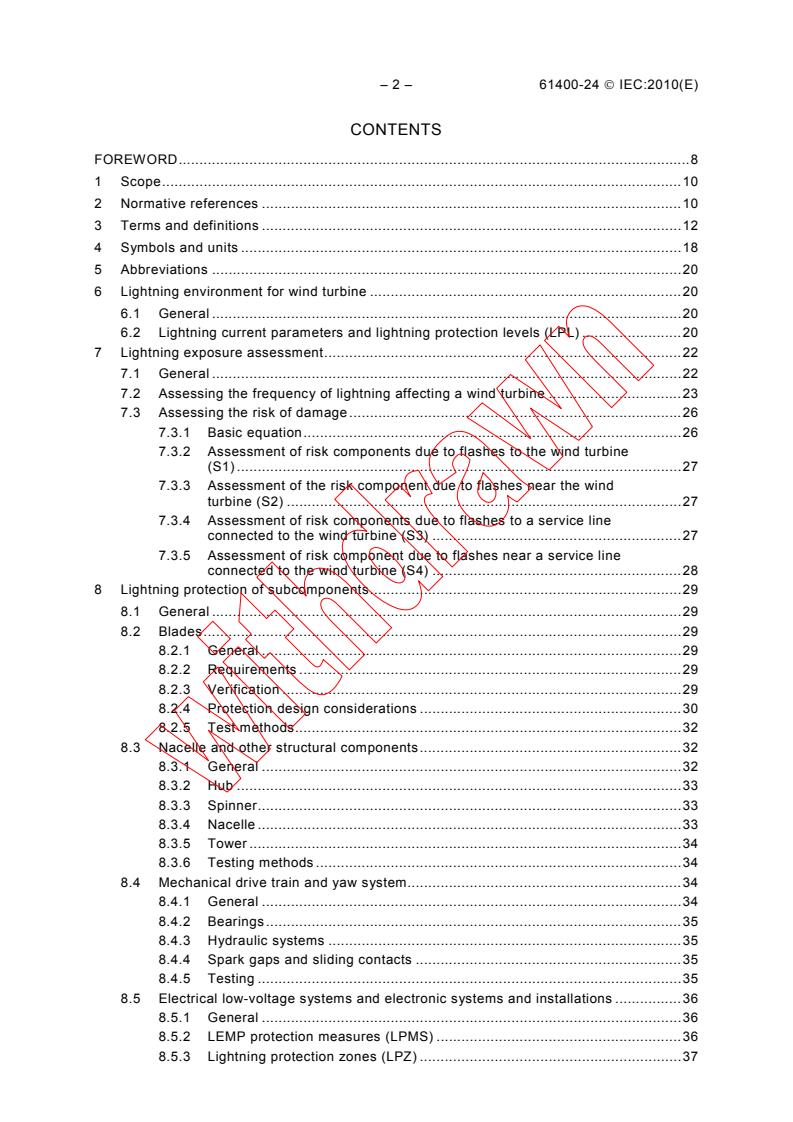
CONTENTS
FOREWORD.8
1 Scope.10
2 Normative references .10
3 Terms and definitions .12
4 Symbols and units .18
5 Abbreviations .20
6 Lightning environment for wind turbine .20
6.1 General .20
6.2 Lightning current parameters and lightning protection levels (LPL) .20
7 Lightning exposure assessment.22
7.1 General .22
7.2 Assessing the frequency of lightning affecting a wind turbine .23
7.3 Assessing the risk of damage.26
7.3.1 Basic equation.26
7.3.2 Assessment of risk components due to flashes to the wind turbine
(S1) .27
7.3.3 Assessment of the risk component due to flashes near the wind
turbine (S2) .27
7.3.4 Assessment of risk components due to flashes to a service line
connected to the wind turbine (S3) .27
7.3.5 Assessment of risk component due to flashes near a service line
connected to the wind turbine (S4) .28
8 Lightning protection of subcomponents.29
8.1 General .29
8.2 Blades.29
8.2.1 General .29
8.2.2 Requirements .29
8.2.3 Verification .29
8.2.4 Protection design considerations .30
8.2.5 Test methods.32
8.3 Nacelle and other structural components.32
8.3.1 General .32
8.3.2 Hub .33
8.3.3 Spinner.33
8.3.4 Nacelle .33
8.3.5 Tower .34
8.3.6 Testing methods .34
8.4 Mechanical drive train and yaw system.34
8.4.1 General .34
8.4.2 Bearings.35
8.4.3 Hydraulic systems .35
8.4.4 Spark gaps and sliding contacts .35
8.4.5 Testing .35
8.5 Electrical low-voltage systems and electronic systems and installations .36
8.5.1 General .36
8.5.2 LEMP protection measures (LPMS) .36
8.5.3 Lightning protection zones (LPZ) .37
61400-24 © IEC:2010(E) – 3 –
8.5.4 Equipotential bonding within the wind turbine .37
8.5.5 Shielding and line routing .37
8.5.6 Coordinated SPD protection .38
8.5.7 Testing methods for system immunity tests.41
8.6 Electrical high-voltage (HV) power systems.41
9 Earthing of wind turbines and wind farms .43
9.1 General .43
9.1.1 Basic requirements.43
9.1.2 Earth electrode arrangements.43
9.1.3 Earthing system impedance.44
9.2 Equipotential bonding.44
9.2.1 General .44
9.2.2 Lightning equipotential bonding for metal installations .44
9.2.3 Electrically insulated LPS .45
9.3 Structural components.45
9.3.1 General .45
9.3.2 Metal tubular type tower .45
9.3.3 Metal reinforced concrete towers .45
9.3.4 Lattice tower.46
9.3.5 Systems inside the tower.46
9.3.6 Concrete foundation .46
9.3.7 Rocky area foundation.47
9.3.8 Metal mono-pile foundation.47
9.3.9 Offshore foundation .47
9.4 Electrode shape dimensions.47
9.5 Wind farms.48
9.6 Execution and maintenance of the earthing system .48
10 Personal safety .49
11 Documentation of lightning protection system.50
11.1 General .50
11.2 Documentation necessary during assessment for design evaluation .50
11.2.1 General documentation.50
11.2.2 Documentation for rotor blades.51
11.2.3 Documentation of mechanical systems .51
11.2.4 Documentation of electrical and electronic systems .51
11.2.5 Documentation of earthing and bonding systems .51
11.2.6 Documentation of nacelle cover, hub and tower lightning protection
systems.51
11.3 Site specific information .52
11.4 Documentation to be provided for LPS inspections .52
11.4.1 Visual LPS inspection report.52
11.4.2 Complete LPS inspection report .52
11.5 Manuals .52
12 Inspection of lightning protection system .52
12.1 Scope of inspection .52
12.2 Order of inspections .53
12.2.1 General .53
12.2.2 Inspection during production of the wind turbine .53
12.2.3 Inspection during installation of the wind turbine.53
– 4 – 61400-24 © IEC:2010(E)
12.2.4 Inspection during commissioning of the wind turbine and periodic
inspection.53
12.2.5 Inspection after dismantling or repair of main parts.54
12.3 Maintenance.54
Annex A (informative) The lightning phenomenon in relation to wind turbines .55
Annex B (informative) Lightning exposure assessment .66
Annex C (informative) Protection methods for blades.84
Annex D (informative) Test specifications .96
Annex E (informative) Application of lightning protection zones (LPZ) concept at a
wind turbine .119
Annex F (informative) Selection and installation of a coordinated SPD protection in
wind turbines .124
Annex G (informative) Additional information on bonding and shielding and installation
technique.128
Annex H (informative) Testing methods for system level immunity tests. 133
Annex I (informative) Earth termination system . 135
Annex J (informative) Example of defined measuring points. 143
Annex K (informative) Typical lightning damage questionnaire. 145
Annex L (informative) Monitoring systems.148
Annex M (informative) Guidelines for small wind turbines – Microgeneration. 149
Bibliography.150
Figure 1 – Collection area of the wind turbine .24
Figure 2 – Effective height, H, of wind turbine exposed on a hill.24
Figure 3 – Collection area of wind turbine of height H and another structure of height
a
H connected by underground cable of length L .26
b c
Figure 4a – Squirel cage induction generator (SCIG) .42
Figure 4b – Wound rotor induction generator (WRIG).42
Figure 4 – Examples of placement of HV arresters in two typical main electrical circuits
of wind turbines .42
Figure A.1 – Processes involved in the formation of a cloud-to-ground flash .57
Figure A.2 – Typical profile of a negative cloud-to-ground flash (not to scale).58
Figure A.3 – Definitions of short stroke parameters (typically T < 2 ms).58
Figure A.4 – Definitions of long stroke parameters (typically 2 ms < T < 1 s)
long
(Figure A.2 in IEC 62305-1) .59
Figure A.5 – Possible components of downward flashes (typical in flat territory and to
lower structures) (Figure A.3 in IEC 62305-1) .60
Figure A.6 – Typical profile of a positive cloud-to-ground flash .60
Figure A.7 – Typical profile of a negative upward initiated flash .61
Figure A.8 – Possible components of upward flashes (typical to exposed and/or higher
structures) (Figure A.4 in IEC 62305-1).63
Figure C.1 – Types of wind turbine blades .85
Figure C.2 – Lightning protection concepts for large modern wind turbine blades .87
Figure C.3 – Lightning induced voltages between lightning conductor or structure and
sensor wiring .90
Figure D.1 – Initial leader attachment test setup A (specimen should be tested in
several positions representing different directions of the approaching leader).99
61400-24 © IEC:2010(E) – 5 –
Figure D.2 – Possible orientations for the initial leader attachment test setup A.100
Figure D.3 – Leader connection point must be away from test specimen. 101
Figure D.4 – Initial leader attachment test setup B. 102
Figure D.5 – Arrangement for local protection device (e.g. diverter) – Evaluations test
setup C.103
Figure D.6 – Typical switching impulse voltage rise to flashover (100 μs per division) . 104
Figure D.7 – Swept channel test arrangement.108
Figure D.8 – Lightning impulse voltage waveform (Figure 6 in IEC 60060-1) . 108
Figure D.9 – Lightning impulse voltage waveform showing flashover on the wave front
(Figure 7 in IEC 60060-1) .109
Figure D.10 – Typical jet diverting test electrodes.112
Figure D.11 – High-current test arrangement for non-conductive surfaces . 114
Figure D.12 – Example of an arrangement for conducted current tests . 117
Figure E.1 – Rolling sphere model .120
Figure E.2 – Mesh with large mesh dimension for nacelle with GFRP cover. 121
Figure E.3 – Mesh with small mesh dimension for nacelle with GFRP cover. 121
Figure E.4 – Two cabinets both defined as LPZ 2 connected via the shield of a
shielded cable.122
Figure E.5 – Example: Division of wind turbine into different lightning protection zones .123
Figure E.6 – Example of how to document LPMS division of electrical system into
protection zones with indication of where circuits cross LPZ boundaries and showing
the long cables running between tower base and nacelle.123
Figure F.1 – Point-to-point installation scheme (Figure 53E in IEC 60364-5-53). 125
Figure F.2 – Earthing connection installation scheme (Figure A.1 in IEC 60364-5-53).125
Figure G.1 – Two control cabinets located on different metallic planes inside a nacelle .128
Figure G.2 – Magnetic coupling mechanism.129
Figure G.3 – Measuring of transfer impedance. 131
Figure H.1 – Example circuit of a SPD discharge current test under service conditions. 134
Figure H.2 – Example circuit of an induction test due to lightning currents . 134
Figure I.1 – Minimum length (l ) of each earth electrode according to the class of LPS
(Figure 2 in IEC 62305-3) .138
Figure I.2 – Frequency dependence on the impedance to earth (adapted from Cigré
WG C.4.4.02 July 2005 [49]) .
Figure J.1 – Example of measuring points.143
Figure K.1 – Blade outlines for marking locations of damage . 147
Table 1 – Maximum values of lightning parameters according to LPL (Table 5 in
IEC 62305-1) .21
Table 2 – Minimum values of lightning parameters and related rolling sphere radius
corresponding to LPL (Table 6 in IEC 62305-1).22
Table 3 – Collection areas A and A of service line depending on whether aerial or
I i
buried (corresponds to Table A.3 in IEC 62305-2).26
Table 4 – Parameters relevant to the assessment of risk components for wind turbine
(corresponds to Table 8 in IEC 62305-2).28
– 6 – 61400-24 © IEC:2010(E)
Table 5 – Minimum dimensions of conductors connecting different bonding bars/points
or connecting bonding bars/points to the earth termination system (Table 8 in
IEC 62305-3) .45
Table 6 – Minimum dimensions of conductors connecting internal metal installations to
the bonding bar/point (Table 9 in IEC 62305-3).45
Table 7 – LPS General inspection intervals.54
Table A.1 – Cloud-to-ground lightning current parameters (adapted from Table A.1 in
IEC 62305-1) .59
Table A.2 – Upward initiated lightning current parameters .62
Table A.3 – Summary of the lightning threat parameters to be considered in the
calculation of the test values for the different LPS components and for the different
LPL (Table D.1 in IEC 62305-1) .64
Table B.1 – Sources of damage, types of damage and types of loss according to point
of strike (corresponds to Table 1 in IEC 62305-2) .67
Table B.2 – Risk in a wind turbine for each type of damage and of loss (corresponds
to Table 2 in IEC 62305-2).68
Table B.3 – Values of probability, P , that a lightning flash to a wind turbine will cause
A
shock to living beings due to dangerous touch and step voltages (corresponds to
Table B.1 in IEC 62305-2).71
Table B.4 – Values of probability, P , depending on the protection measures to reduce
B
physical damage (corresponds to Table B.2 in IEC 62305-2) .71
Table B.5 – Values of probability P as a function of the LPL for which the SPDs
SPD
are designed (Table B.3 in IEC 62305-2) .72
Table B.6 – Values of probability, P , depending on the resistance, R , of the cable
LD S
screen and the impulse withstand voltage, U , of the equipment (Table B.6 in
W
IEC 62305-2) .73
Table B.7 – Values of probability, P , depending on the resistance, R , of the cable
LI S
screen and the impulse withstand voltage, U , of the equipment (Table B.7 in
W
IEC 62305-2) .74
Table B.8 – Values of reduction factors r and r as a function of the type of surface of
a u
soil or floor (corresponds to Table C.2 in IEC 62305-2).76
Table B.9 – Values of reduction factor r as a function of provisions taken to reduce
p
the consequences of fire (Table C.3 in IEC 62305-2) .76
Table B.10 – Values of reduction factor r as a function of risk of fire of the wind
f
turbine (corresponds to Table C.4 in IEC 62305-2) .76
Table B.11 – Values of factor h increasing the relative amount of loss in presence of
Z
a special hazard (corresponds to Table C.5 in IEC 62305-2).77
Table B.12 – Typical mean values of L , L and L (corresponds to Table C.7 in
t f o
IEC 62305-2) .77
Table B.13 – Values of factor K as a function of the characteristics of the shielded
d
service line (corresponds to Table D.1 in IEC 62305-2).79
Table B.14 – Values of factor K as a function of the protection measures (Table D.2
p
in IEC 62305-2) .79
Table B.15 – Impulse withstand voltage U as a function of the type of cable (Table
W
D.3 in IEC 62305-2) .79
Table B.16 – Impulse withstand voltage U as a function of the type of apparatus
W
(Table D.4 in IEC 62305-2) .79
Table B.17 – Values of probability P’ , P’ , P’ and P’ as function of the failure
B C V W
current I (Table D.5 in IEC 62305-2) .80
a
Table C.1 – Material, configuration and minimum nominal cross-sectional area of air-
termination conductors, air-termination rods and down conductors (corresponds to
)
Table 6 in IEC 62305-3, future edition 2 ).92
61400-24 © IEC:2010(E) – 7 –
Table C.2 – Physical characteristics of typical materials used in lightning protection
systems (Table D.2 in IEC 62350-1) .93
Table C.3 – Temperature rise [K] for different conductors as a function of W/R (Table
D.3 in IEC 62305-1) .94
Table E.1 – Definition of lightning protection zones according to IEC 62305-1 . 119
Table F.1 – Discharge and impulse current levels for TN systems given in IEC 60364-
5-53.127
Table F.2 – Example of increased discharge and impulse current levels for TN
systems .127
Table I.1 – Impulse efficiency of several ground rod arrangements relative to a 12 m
vertical ground rod (100 %) (adapted from Cigré WG C.4.4.02 July 2005).140
Table I.2 – Symbols used in Tables I.3 to I.6 .140
Table I.3 – Formulae for different earthing electrode configurations . 141
Table I.4 – Formulae for buried ring electrode combined with vertical rods . 142
Table I.5 – Formulae for buried ring electrode combined with radial electrodes. 142
Table I.6 – Formulae for buried straight horizontal electrode combined with vertical
rods .142
Table J.1 – Measuring points and resistances to be recorded . 144
– 8 – 61400-24 © IEC:2010(E)
INTERNATIONAL ELECTROTECHNICAL COMMISSION
____________
WIND TURBINES –
Part 24: Lightning protection
FOREWORD
1) The International Electrotechnical Commission (IEC) is a worldwide organization for standardization comprising
all national electrotechnical committees (IEC National Committees). The object of IEC is to promote
international co-operation on all questions concerning standardization in the electrical and electronic fields. To
this end and in addition to other activities, IEC publishes International Standards, Technical Specifications,
Technical Reports, Publicly Available Specifications (PAS) and Guides (hereafter referred to as “IEC
Publication(s)”). Their preparation is entrusted to technical committees; any IEC National Committee interested
in the subject dealt with may participate in this preparatory work. International, governmental and non-
governmental organizations liaising with the IEC also participate in this preparation. IEC collaborates closely
with the International Organization for Standardization (ISO) in accordance with conditions determined by
agreement between the two organizations.
2) The formal decisions or agreements of IEC on technical matters express, as nearly as possible, an international
consensus of opinion on the relevant subjects since each technical committee has representation from all
interested IEC National Committees.
3) IEC Publications have the form of recommendations for international use and are accepted by IEC National
Committees in that sense. While all reasonable efforts are made to ensure that the technical content of IEC
Publications is accurate, IEC cannot be held responsible for the way in which they are used or for any
misinterpretation by any end user.
4) In order to promote international uniformity, IEC National Committees undertake to apply IEC Publications
transparently to the maximum extent possible in their national and regional publications. Any divergence
between any IEC Publication and the corresponding national or regional publication shall be clearly indicated in
the latter.
5) IEC itself does not provide any attestation of conformity. Independent certification bodies provide conformity
assessment services and, in some areas, access to IEC marks of conformity. IEC is not responsible for any
services carried out by independent certification bodies.
6) All users should ensure that they have the latest edition of this publication.
7) No liability shall attach to IEC or its directors, employees, servants or agents including individual experts and
members of its technical committees and IEC National Committees for any personal injury, property damage or
other damage of any nature whatsoever, whether direct or indirect, or for costs (including legal fees) and
expenses arising out of the publication, use of, or reliance upon, this IEC Publication or any other IEC
Publications.
8) Attention is drawn to the Normative references cited in this publication. Use of the referenced publications is
indispensable for the correct application of this publication.
9) Attention is drawn to the possibility that some of the elements of this IEC Publication may be the subject of
patent rights. IEC shall not be held responsible for identifying any or all such patent rights.
International Standard IEC 61400-24 has been prepared by IEC technical committee 88: Wind
turbines.
This first edition replaces IEC/TR 61400-24, published in 2002. It constitutes a technical
revision. It is restructured with a main normative part, while informative information is placed
in annexes.
The text of this standard is based on the following documents:
FDIS Report on voting
88/366/FDIS 88/369/RVD
Full information on the voting for the approval of this standard can be found in the report on
voting indicated in the above table.
This publication has been drafted in accordance with the ISO/IEC Directives, Part 2.
61400-24 © IEC:2010(E) – 9 –
A list of all parts of the IEC 61400 series, under the general title: Wind turbines, can be found
on the IEC website.
The committee has decided that the contents of this publication will remain unchanged until
the stability date indicated on the IEC web site under "http://webstore.iec.ch" in the data
related to the specific publication. At this date, the publication will be
• reconfirmed,
• withdrawn,
• replaced by a revised edition, or
• amended.
A bilingual version of this publication may be issued at a later date.
– 10 – 61400-24 © IEC:2010(E)
WIND TURBINES –
Part 24: Lightning protection
1 Scope
This International Standard applies to lightning protection of wind turbine generators and wind
power systems.
Normative references are made to generic standards for lightning protection, low-voltage
systems and high-voltage systems for machinery and installations and electromagnetic
compatibility (EMC).
This standard defines the lightning environment for wind turbines and application of the
environment for risk assessment for the wind turbine. It defines requirements for protection of
blades, other structural components and electrical and control systems against both direct
and indirect effects of lightning. Test methods to validate compliance are recommended.
Guidance on the use of applicable lightning protection, industrial electrical and EMC
standards including earthing is provided.
Guidance regarding personal safety is provided.
Guidelines for damage statistics and reporting are provided.
2 Normative references
The following referenced documents are indispensable for the application of this document.
For dated references, only the edition cited applies. For undated references, the latest edition
of the referenced document (including any amendments) applies.
IEC 60060-1:1989, High-voltage test techniques – Part 1: General definitions and test
requirements
IEC 60068 (all parts), Environmental testing
IEC 60071 (all parts), Insulation Co-ordination
IEC 60071-2:1996, Insulation Co-ordination – Part 2: Application guide
IEC 60099-4, Surge arresters – Part 4: Metal-oxide surge arresters without gaps for a.c.
systems
IEC 60099-5, Surge arresters – Part 5: Selection and application recommendations
IEC 60204-1, Safety of machinery – Electrical equipment of machines – Part 1: General
requirements
IEC 60204-11, Safety of machinery – Electrical equipment of machines – Part 11:
Requirements for HV equipment for voltages above 1 000 V a.c. or 1 500 V d.c. and not
exceeding 36 kV
61400-24 © IEC:2010(E) – 11 –
IEC 60243-1, Electrical strength of insulating materials – Test methods – Part 1: Tests at
power frequencies
IEC 60243-3, Electric strength of solid insulating materials – Test methods – Part 3:
Additional requirements for 1,2/50μs impulse tests
IEC 60364-4-44, Low-voltage electrical installations – Part 4-44: Protection for safety –
Protection against voltage disturbances and electromagnetic disturbances
IEC 60364-5-53:2001, Electrical installations of buildings – Part 5-53: Selection and erection
of electrical equipment – Isolation, switching and control
1)
Amendment 1(2002)
IEC 60464-2, Varnishes used for electrical insulation – Part 2: Methods of test
IEC/TS 60479-1, Effects of current on human beings and livestock – Part 1: General aspects
IEC 60479-4, Effects of current on human beings and livestock – Part 4: Effects of lightning
strokes on human beings and livestock
IEC 60587, Electrical insulating materials used under severe ambient conditions – Test
methods for evaluating resistance to tracking and erosion
IEC 60664-1, Insulation coordination for equipment within low-voltage systems – Part 1:
Principles, requirements and tests
IEC 61000-4-5, Electromagnetic compatibility (EMC) – Part 4-5: Testing and measurement
techniques – Surge immunity test
IEC/TR 61000-5-2, Electromagnetic compatibility (EMC) – Part 5: Installation and mitigation
guidelines – Section 2: Earthing and cabling
IEC/TS 61400-23, Wind turbine generator systems – Part 23: Full-scale structural testing of
rotor blades
IEC 61643-1, Low-voltage surge protective devices – Part 1: Surge protective devices
connected to low-voltage power distribution systems – Requirements and tests
IEC 61643-12, Low-voltage surge protective devices – Part 12: Surge protective devices
connected to low-voltage power distribution systems – Selection and application principles
IEC 61643-21, Low voltage surge protective devices – Part 21: Surge protective devices
connected to telecommunications and signalling networks – Performance requirements and
testing methods
IEC 61643-22, Low-voltage surge protective devices – Part 22: Surge protective devices
connected to telecommunications and signalling networks – Selection and application
principles
IEC 62153-4-3, Metallic communication cable test methods – Part 4-3: Electromagnetic
compatibility (EMC) – Surface transfer impedance – Triaxial method
IEC 62305-1:2006, Protection against lightning – Part 1: General principles
—————————
1)
There exists a consolidated edition 3.1 (2002) that comprises IEC 60364-5-53 (2001) ant its Amendment 1
(2002).
– 12 – 61400-24 © IEC:2010(E)
IEC 62305-2:2006, Protection against lightning – Part 2: Risk management
IEC 62305-3:2006, Protection against lightning – Part 3: Physical damage to structures and
life hazard
IEC 62305-4:2006, Protection against lightning – Part 4: Electrical and electronic systems
within structures
EN 50164-1, Lightning Protection Components (LPC) – Part 1: Requirements for connection
components
CLC HD 637 S1, Power installations exceeding 1kV A.C.
ITU-T K.2, Resistibility of telecommunication equipment installed in a telecommunications
centre to overvoltages and overcurrents
ITU-T K.21, Resistibility of telecommunications equipment installed in customer premises to
overvoltages and overcurrents
ITU-T K.46, Protection of telecommunication lines using metallic symmetric conductors
against lightning-induced surges
3 Terms and definitions
For the purposes of this document, the following terms and definitions apply.
3.1
air-termination system
part of an external LPS using metallic elements such as rods, mesh conductors or catenary
wires intended to intercept lightning flashes
3.2
average steepness of the front of short stroke current
average rate of change of current within a time interval Δt = t – t
2 1
NOTE It is expressed by the difference Δi= i(t ) – i(t ) of the values of the current at the start and at the end of
2 1
this interval, divided by the time interval Δt = t – t (see Figure A.3).
2 1
3.3
bonding bar
bar on which metal installations, electric power lines, telecommunication lines and other
cables can be bonded to an LPS
3.4
collection area
A
d
for a structure, area of ground surface which has the same annual frequency of direct
lightning flashes as the structure
3.5
connecting leader
lightning leader developing from a structure as a response to an external electric field
imposed either by a charged cloud overhead or by a downward leader approaching the
structure
61400-24 © IEC:2010(E) – 13 –
3.6
conventional earthing impedance
ratio of the peak values of the earth-termination voltage and the earth-termination current
which, in general, do not occur simultaneously
3.7
coordinated SPD protection
set of SPD properly selected, coordinated and installed to reduce failures of electrical and
electronic systems
NOTE Coordination of SPD protection must include the connecting circuits to provide insulation coordination of
complete systems.
3.8
down-conductor system
part of an external LPS intended to conduct lightning current from the air-termination system
to the earth-termination system
3.9
downward flash
lightning flash initiated by a downward leader from cloud to earth
NOTE A downward flash consists of a first short stroke, which can be followed by subsequent short strokes and
may include a long stroke.
3.10
earth electrode
part or a group of parts of the earth-termination system which provides direct electrical
contact with and disperses the lightning current to the earth
3.11
earth-termination system
part of an external LPS which is intended to conduct and disperse lightning current into the
earth
3.12
effective height
H
for a wind turbine, the highest point the blades reach, i.e. hub height plus rotor radius
3.13
external lightning protection system
part of the LPS consisting of an air-termination system, a down-conductor system and an
earth-termination system
NOTE The down conductor is often placed inside wind turbine blades.
3.14
flash charge
Q
flash
time integral of the lightning current for the entire lightning flash duration
3.15
foundation earth electrode
reinforcement steel of foundation or additional conductor embedded in the concrete
foundation of a structure and used as an earth electrode
– 14 – 61400-24 © IEC:2010(E)
3.16
ground flash density
N
g
the num
...