


IEC 60364-4-42:2024
(Main)Low-voltage electrical installations - Part 4-42: Protection for safety - Protection against thermal effects
Low-voltage electrical installations - Part 4-42: Protection for safety - Protection against thermal effects
IEC 60364-4-42:2024 applies to electrical installations with regard to measures for the protection of persons, livestock and property against:
• thermal effects, risk of combustion or degradation of materials, and risk of burns caused by electrical equipment,
• flames in case of a fire hazard being propagated from electrical installations to other fire compartments segregated by barriers which are in the vicinity, and
• the impairment of the safe functioning of electrical equipment, including safety services due to thermal effects.
This group safety publication (GSP) focusing on safety essential requirements is primarily intended to be used as a product safety standard for the installations mentioned in the scope, but is also intended to be used by TCs in the preparation of publications for installations similar to those mentioned in the scope of this GSP, in accordance with the principles laid down in IEC Guide 104 and lSO/lEC Guide 51.
One of the responsibilities of a TC is, wherever applicable, to make use of basic safety publications and/or group safety publications in the preparation of its publications
This fourth edition cancels and replaces the third edition published in 2010 and Amendment 1:2014. This edition constitutes a technical revision.
This edition includes the following significant technical changes with respect to the previous edition:
a) the Scope now includes a new paragraph stating that IEC 60364-4-42 has become a group safety publication (GSP) following the Advisory Committee on Safety (ACOS) recommendation for approval of the group safety function "protection against thermal effects for any kind of low-voltage electrical installations" to TC 64; this GSP is primarily intended to be used as a product safety standard for the installations mentioned in the scope, but also to be used by TCs in the preparation of publications for installations similar to those mentioned in the scope of this GSP;
b) new terms and definitions have been added;
c) a new Subclause 421.6 regarding measures for preventing fires originating from the use of an electrical stove or cooker or hob has been added;
d) the previous Subclause 421.7 was expanded and moved to a new Clause 426: Additional protective measures against thermal effect for locations where consequences of fire are severe;
e) requirements for escape routes have been expanded and modified;
f) requirements for final circuits in BE2 locations have been expanded and modified;
g) requirements for locations with irreplaceable goods or with business critical facilities have been expanded and modified;
h) a new Clause 425 for protection against fire due to fault currents has been added;
i) a new Clause 427 for protection against assembly internal arc faults has been added
Installations électriques à basse tension - Partie 4-42: Protection pour assurer la sécurité - Protection contre les effets thermiques
IEC 60364-4-42 s’applique aux installations électriques en ce qui concerne les mesures de protection des personnes, du bétail et des biens contre:
• les effets thermiques, les risques de combustion ou de dégradation des matériaux, et les risques de brûlure provoqués par un matériel électrique;
• la propagation des flammes en cas de danger d’incendie, depuis les installations électriques vers d’autres compartiments feu séparés par des barrières se trouvant à proximité; et
• les atteintes à la sécurité de fonctionnement des matériels électriques, y compris les services de sécurité, dues aux effets thermiques.
La présente publication groupée de sécurité (GSP), qui met l’accent sur les exigences essentielles de sécurité, est avant tout destinée à être utilisée en tant que norme sécurité des produits pour les installations citées dans le domaine d’application, mais elle est également destinée à être utilisée par les CE dans le cadre de l’élaboration de publications pour des installations similaires à celles mentionnées dans le domaine d’application de cette GSP, conformément aux principes établis dans l’IEC Guide 104 et l’lSO/lEC Guide 51.
L’une des responsabilités d’un CE consiste, le cas échéant, à utiliser les publications fondamentales de sécurité et/ou les publications groupées de sécurité dans le cadre de l’élaboration de ses publications.
Cette quatrième édition annule et remplace la troisième édition parue en 2010 et son Amendement 1:2014. Cette édition constitue une révision technique.
Cette édition inclut les modifications techniques majeures suivantes par rapport à l’édition précédente:
a) le Domaine d’application contient maintenant un nouvel alinéa indiquant que l’IEC 60364 4 42 est devenue une publication groupée de sécurité (GSP, Group Safety Publication) qui suit la recommandation du Comité consultatif de la sécurité (ACOS, Advisory Committee on Safety) concernant l’approbation de la fonction groupée de sécurité "protection contre les effets thermiques pour tout type d’installation électrique basse tension" conformément au TC 64; cette GSP est avant tout destinée à être utilisée en tant que norme de sécurité des produits pour les installations citées dans le domaine d’application, mais elle est également destinée à être utilisée par les comités techniques dans le cadre de l’élaboration de publications pour des installations similaires à celles mentionnées dans le domaine d’application de cette GSP;
b) de nouveaux termes et de nouvelles définitions ont été ajoutés
c) un nouveau paragraphe 421.6, qui concerne les mesures pour la prévention des incendies dus à l’utilisation d’une cuisinière, d’un réchaud ou d’un plan de cuisson électrique, a été ajouté;
d) le paragraphe 421.7 précédent a été rallongé et déplacé vers un nouvel Article 426: Mesures de protection supplémentaires contre les effets thermiques pour les emplacements dans lesquels les conséquences d’un incendie sont graves;
e) les exigences concernant les issues de secours ont été développées et modifiées;
f) les exigences concernant les circuits terminaux dans les locaux BE2 ont été développées et modifiées;
g) les exigences concernant les emplacements contenant des biens irremplaçables ou les installations essentielles pour l’activité ont été développées et modifiées;
h) un nouvel Article 425 concernant la protection contre les incendies dus aux courants de défaut a été ajouté;
i) un nouvel Article 427 concernant les défauts d’arc internes dans un ensemble a été ajouté.
General Information
- Status
- Published
- Publication Date
- 21-Nov-2024
- Technical Committee
- TC 64 - Electrical installations and protection against electric shock
- Drafting Committee
- MT 2 - TC 64/MT 2
- Current Stage
- PPUB - Publication issued
- Start Date
- 22-Nov-2024
- Completion Date
- 15-Nov-2024
Relations
- Effective Date
- 05-Sep-2023
- Effective Date
- 05-Sep-2023
Overview
IEC 60364-4-42:2024 is the fourth edition of the international standard dedicated to low-voltage electrical installations, specifically addressing protection for safety against thermal effects. Published by the International Electrotechnical Commission (IEC), this standard outlines essential safety measures to protect persons, livestock, and property from hazards such as thermal damage, combustion risks, and burns caused by electrical equipment. It also provides guidance to prevent fire propagation between fire compartments and ensures the continuous safe functioning of electrical equipment impacted by thermal effects.
The 2024 revision elevates IEC 60364-4-42 to a Group Safety Publication (GSP), enhancing its role as a primary product safety standard for low-voltage installations and a reference for technical committees (TCs) preparing related standards. This edition introduces new clauses and updated requirements tailored to emerging safety needs in electrical installation design and operation.
Key Topics
Protection against Thermal Effects: Focuses on mitigating risks of overheating, ignition of flammable materials, and burns during normal use of electrical equipment.
Fire Prevention Measures: Incorporates fire safety strategies including preventing fire initiation from electrical stoves, cookers, and hobs, as well as controlling fire spread between compartments via barriers.
New Definitions and Terminology: Includes updated and additional terms such as arcing, arc fault, assembly internal arc fault, combustion, escape route, flammable material, and others to harmonize safety language.
Enhanced Protective Measures:
- Expanded requirements for escape routes to ensure safe evacuation during fire emergencies.
- Specific provisions for final circuits in business environment (BE2) locations where fire consequences are critical.
- Protective actions for locations housing irreplaceable goods or business-critical facilities.
- New clauses addressing fire caused by fault currents and internal arc faults in electrical assemblies.
Technical Revisions: The standard cancels and replaces the 2010 edition and its 2014 amendment, reflecting current safety practice improvements and technology advances.
Applications
IEC 60364-4-42:2024 applies to a broad range of low-voltage electrical installation environments where safety against thermal effects is critical, including but not limited to:
- Residential and commercial premises with electrical heating devices.
- Industrial facilities requiring enhanced fire protection measures for critical areas.
- Business environments with sensitive or irreplaceable assets.
- Locations demanding robust escape route safety features.
- Installations where safe operation of electrical equipment must be maintained under thermal stress.
This standard is invaluable for electrical engineers, safety designers, facility managers, and regulatory bodies tasked with ensuring compliance and minimizing fire and burn hazards in low-voltage installations.
Related Standards
IEC 60364-4-42:2024 complements and references several pivotal IEC standards that collectively underpin electrical safety and fire prevention:
- IEC 60364-4-43:2023 - Protection for safety against overcurrent, ensuring fault current management to guard against thermal damage.
- IEC 60364-5-53:2019 - Selection and erection of electrical equipment, covering devices for safety protection, isolation, and control.
- IEC 60332 series - Testing cables under fire conditions, vital for assessing cable fire resistance and flame propagation.
- IEC 61084 series - Cable trunking and ducting systems for secure and fire-retardant cable management.
- IEC 61386 series - Conduit systems ensuring safe cable routing.
- IEC 61439-6 - Busbar trunking systems that require protection against internal arc faults as per the new clause in IEC 60364-4-42.
Together, these standards form an integrated framework supporting the design, verification, and maintenance of low-voltage electrical installations with robust thermal safety protocols.
By adhering to IEC 60364-4-42:2024, organizations can significantly enhance electrical installation safety, reduce the risk of fires and burns, and maintain compliance with internationally recognized best practices for thermal protection in low-voltage systems.
Frequently Asked Questions
IEC 60364-4-42:2024 is a standard published by the International Electrotechnical Commission (IEC). Its full title is "Low-voltage electrical installations - Part 4-42: Protection for safety - Protection against thermal effects". This standard covers: IEC 60364-4-42:2024 applies to electrical installations with regard to measures for the protection of persons, livestock and property against: • thermal effects, risk of combustion or degradation of materials, and risk of burns caused by electrical equipment, • flames in case of a fire hazard being propagated from electrical installations to other fire compartments segregated by barriers which are in the vicinity, and • the impairment of the safe functioning of electrical equipment, including safety services due to thermal effects. This group safety publication (GSP) focusing on safety essential requirements is primarily intended to be used as a product safety standard for the installations mentioned in the scope, but is also intended to be used by TCs in the preparation of publications for installations similar to those mentioned in the scope of this GSP, in accordance with the principles laid down in IEC Guide 104 and lSO/lEC Guide 51. One of the responsibilities of a TC is, wherever applicable, to make use of basic safety publications and/or group safety publications in the preparation of its publications This fourth edition cancels and replaces the third edition published in 2010 and Amendment 1:2014. This edition constitutes a technical revision. This edition includes the following significant technical changes with respect to the previous edition: a) the Scope now includes a new paragraph stating that IEC 60364-4-42 has become a group safety publication (GSP) following the Advisory Committee on Safety (ACOS) recommendation for approval of the group safety function "protection against thermal effects for any kind of low-voltage electrical installations" to TC 64; this GSP is primarily intended to be used as a product safety standard for the installations mentioned in the scope, but also to be used by TCs in the preparation of publications for installations similar to those mentioned in the scope of this GSP; b) new terms and definitions have been added; c) a new Subclause 421.6 regarding measures for preventing fires originating from the use of an electrical stove or cooker or hob has been added; d) the previous Subclause 421.7 was expanded and moved to a new Clause 426: Additional protective measures against thermal effect for locations where consequences of fire are severe; e) requirements for escape routes have been expanded and modified; f) requirements for final circuits in BE2 locations have been expanded and modified; g) requirements for locations with irreplaceable goods or with business critical facilities have been expanded and modified; h) a new Clause 425 for protection against fire due to fault currents has been added; i) a new Clause 427 for protection against assembly internal arc faults has been added
IEC 60364-4-42:2024 applies to electrical installations with regard to measures for the protection of persons, livestock and property against: • thermal effects, risk of combustion or degradation of materials, and risk of burns caused by electrical equipment, • flames in case of a fire hazard being propagated from electrical installations to other fire compartments segregated by barriers which are in the vicinity, and • the impairment of the safe functioning of electrical equipment, including safety services due to thermal effects. This group safety publication (GSP) focusing on safety essential requirements is primarily intended to be used as a product safety standard for the installations mentioned in the scope, but is also intended to be used by TCs in the preparation of publications for installations similar to those mentioned in the scope of this GSP, in accordance with the principles laid down in IEC Guide 104 and lSO/lEC Guide 51. One of the responsibilities of a TC is, wherever applicable, to make use of basic safety publications and/or group safety publications in the preparation of its publications This fourth edition cancels and replaces the third edition published in 2010 and Amendment 1:2014. This edition constitutes a technical revision. This edition includes the following significant technical changes with respect to the previous edition: a) the Scope now includes a new paragraph stating that IEC 60364-4-42 has become a group safety publication (GSP) following the Advisory Committee on Safety (ACOS) recommendation for approval of the group safety function "protection against thermal effects for any kind of low-voltage electrical installations" to TC 64; this GSP is primarily intended to be used as a product safety standard for the installations mentioned in the scope, but also to be used by TCs in the preparation of publications for installations similar to those mentioned in the scope of this GSP; b) new terms and definitions have been added; c) a new Subclause 421.6 regarding measures for preventing fires originating from the use of an electrical stove or cooker or hob has been added; d) the previous Subclause 421.7 was expanded and moved to a new Clause 426: Additional protective measures against thermal effect for locations where consequences of fire are severe; e) requirements for escape routes have been expanded and modified; f) requirements for final circuits in BE2 locations have been expanded and modified; g) requirements for locations with irreplaceable goods or with business critical facilities have been expanded and modified; h) a new Clause 425 for protection against fire due to fault currents has been added; i) a new Clause 427 for protection against assembly internal arc faults has been added
IEC 60364-4-42:2024 is classified under the following ICS (International Classification for Standards) categories: 29.120.50 - Fuses and other overcurrent protection devices; 91.140.50 - Electricity supply systems. The ICS classification helps identify the subject area and facilitates finding related standards.
IEC 60364-4-42:2024 has the following relationships with other standards: It is inter standard links to IEC 60364-4-42:2010, IEC 60364-4-42:2010/AMD1:2014. Understanding these relationships helps ensure you are using the most current and applicable version of the standard.
IEC 60364-4-42:2024 is available in PDF format for immediate download after purchase. The document can be added to your cart and obtained through the secure checkout process. Digital delivery ensures instant access to the complete standard document.
Standards Content (Sample)
IEC 60364-4-42 ®
Edition 4.0 2024-11
INTERNATIONAL
STANDARD
NORME
INTERNATIONALE
HORIZONTAL PUBLICATION
PUBLICATION HORIZONTALE
Low-voltage electrical installations –
Part 4-42: Protection for safety – Protection against thermal effects
Installations électriques à basse tension –
Partie 4-42: Protection pour assurer la sécurité – Protection contre les effets
thermiques
All rights reserved. Unless otherwise specified, no part of this publication may be reproduced or utilized in any form
or by any means, electronic or mechanical, including photocopying and microfilm, without permission in writing from
either IEC or IEC's member National Committee in the country of the requester. If you have any questions about IEC
copyright or have an enquiry about obtaining additional rights to this publication, please contact the address below or
your local IEC member National Committee for further information.
Droits de reproduction réservés. Sauf indication contraire, aucune partie de cette publication ne peut être reproduite ni
utilisée sous quelque forme que ce soit et par aucun procédé, électronique ou mécanique, y compris la photocopie et
les microfilms, sans l'accord écrit de l'IEC ou du Comité national de l'IEC du pays du demandeur. Si vous avez des
questions sur le copyright de l'IEC ou si vous désirez obtenir des droits supplémentaires sur cette publication, utilisez
les coordonnées ci-après ou contactez le Comité national de l'IEC de votre pays de résidence.
IEC Secretariat Tel.: +41 22 919 02 11
3, rue de Varembé info@iec.ch
CH-1211 Geneva 20 www.iec.ch
Switzerland
About the IEC
The International Electrotechnical Commission (IEC) is the leading global organization that prepares and publishes
International Standards for all electrical, electronic and related technologies.
About IEC publications
The technical content of IEC publications is kept under constant review by the IEC. Please make sure that you have the
latest edition, a corrigendum or an amendment might have been published.
IEC publications search - webstore.iec.ch/advsearchform IEC Products & Services Portal - products.iec.ch
The advanced search enables to find IEC publications by a Discover our powerful search engine and read freely all the
variety of criteria (reference number, text, technical publications previews, graphical symbols and the glossary.
committee, …). It also gives information on projects, replaced With a subscription you will always have access to up to date
and withdrawn publications. content tailored to your needs.
IEC Just Published - webstore.iec.ch/justpublished
Electropedia - www.electropedia.org
Stay up to date on all new IEC publications. Just Published
The world's leading online dictionary on electrotechnology,
details all new publications released. Available online and once
containing more than 22 500 terminological entries in English
a month by email.
and French, with equivalent terms in 25 additional languages.
Also known as the International Electrotechnical Vocabulary
IEC Customer Service Centre - webstore.iec.ch/csc
(IEV) online.
If you wish to give us your feedback on this publication or need
further assistance, please contact the Customer Service
Centre: sales@iec.ch.
A propos de l'IEC
La Commission Electrotechnique Internationale (IEC) est la première organisation mondiale qui élabore et publie des
Normes internationales pour tout ce qui a trait à l'électricité, à l'électronique et aux technologies apparentées.
A propos des publications IEC
Le contenu technique des publications IEC est constamment revu. Veuillez vous assurer que vous possédez l’édition la
plus récente, un corrigendum ou amendement peut avoir été publié.
Recherche de publications IEC - IEC Products & Services Portal - products.iec.ch
webstore.iec.ch/advsearchform Découvrez notre puissant moteur de recherche et consultez
La recherche avancée permet de trouver des publications IEC gratuitement tous les aperçus des publications, symboles
en utilisant différents critères (numéro de référence, texte, graphiques et le glossaire. Avec un abonnement, vous aurez
comité d’études, …). Elle donne aussi des informations sur les toujours accès à un contenu à jour adapté à vos besoins.
projets et les publications remplacées ou retirées.
Electropedia - www.electropedia.org
IEC Just Published - webstore.iec.ch/justpublished
Le premier dictionnaire d'électrotechnologie en ligne au monde,
Restez informé sur les nouvelles publications IEC. Just
avec plus de 22 500 articles terminologiques en anglais et en
Published détaille les nouvelles publications parues.
français, ainsi que les termes équivalents dans 25 langues
Disponible en ligne et une fois par mois par email.
additionnelles. Egalement appelé Vocabulaire
Electrotechnique International (IEV) en ligne.
Service Clients - webstore.iec.ch/csc
Si vous désirez nous donner des commentaires sur cette
publication ou si vous avez des questions contactez-nous:
sales@iec.ch.
IEC 60364-4-42 ®
Edition 4.0 2024-11
INTERNATIONAL
STANDARD
NORME
INTERNATIONALE
Low-voltage electrical installations –
Part 4-42: Protection for safety – Protection against thermal effects
Installations électriques à basse tension –
Partie 4-42: Protection pour assurer la sécurité – Protection contre les effets
thermiques
INTERNATIONAL
ELECTROTECHNICAL
COMMISSION
COMMISSION
ELECTROTECHNIQUE
INTERNATIONALE
ICS 29.120.50, 91.140.50 ISBN 978-2-8322-9909-8
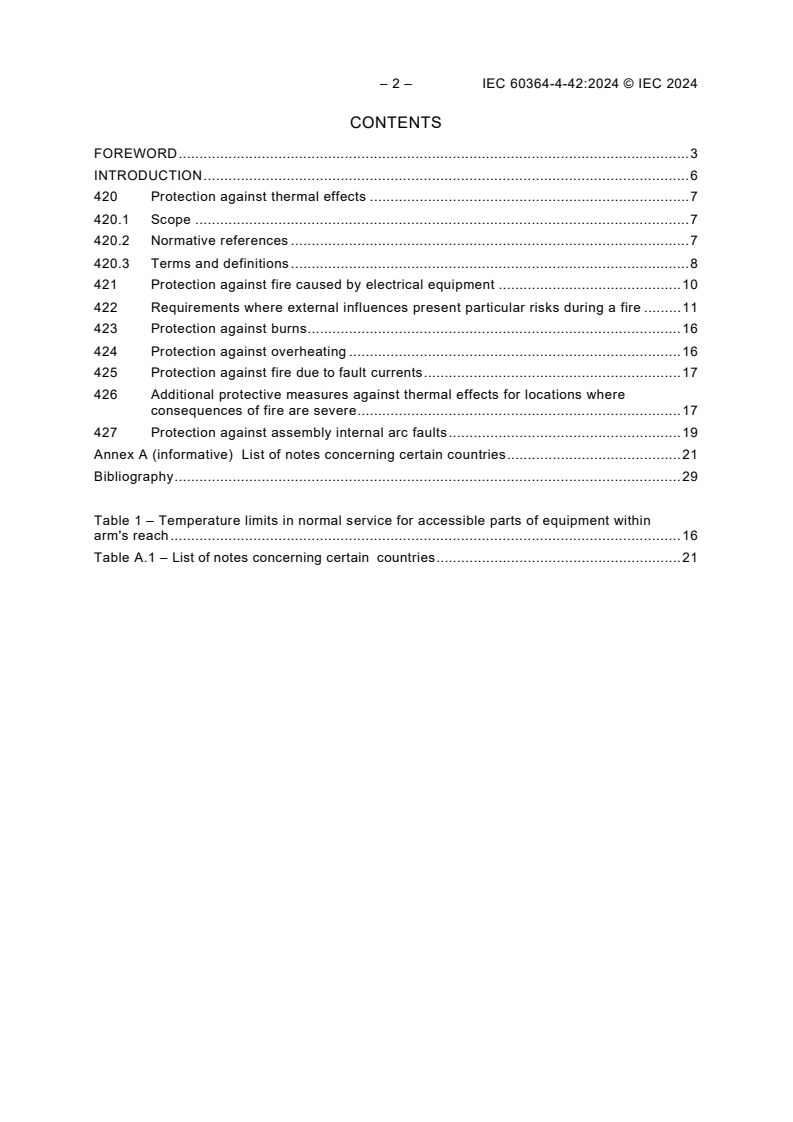
– 2 – IEC 60364-4-42:2024 © IEC 2024
CONTENTS
FOREWORD . 3
INTRODUCTION . 6
420 Protection against thermal effects . 7
420.1 Scope . 7
420.2 Normative references . 7
420.3 Terms and definitions . 8
421 Protection against fire caused by electrical equipment . 10
422 Requirements where external influences present particular risks during a fire . 11
423 Protection against burns. 16
424 Protection against overheating . 16
425 Protection against fire due to fault currents . 17
426 Additional protective measures against thermal effects for locations where
consequences of fire are severe . 17
427 Protection against assembly internal arc faults . 19
Annex A (informative) List of notes concerning certain countries . 21
Bibliography . 29
Table 1 – Temperature limits in normal service for accessible parts of equipment within
arm's reach . 16
Table A.1 – List of notes concerning certain countries . 21
INTERNATIONAL ELECTROTECHNICAL COMMISSION
____________
LOW-VOLTAGE ELECTRICAL INSTALLATIONS –
Part 4-42: Protection for safety – Protection against thermal effects
FOREWORD
1) The International Electrotechnical Commission (IEC) is a worldwide organization for standardization comprising
all national electrotechnical committees (IEC National Committees). The object of IEC is to promote international
co-operation on all questions concerning standardization in the electrical and electronic fields. To this end and
in addition to other activities, IEC publishes International Standards, Technical Specifications, Technical Reports,
Publicly Available Specifications (PAS) and Guides (hereafter referred to as "IEC Publication(s)"). Their
preparation is entrusted to technical committees; any IEC National Committee interested in the subject dealt with
may participate in this preparatory work. International, governmental and non-governmental organizations liaising
with the IEC also participate in this preparation. IEC collaborates closely with the International Organization for
Standardization (ISO) in accordance with conditions determined by agreement between the two organizations.
2) The formal decisions or agreements of IEC on technical matters express, as nearly as possible, an international
consensus of opinion on the relevant subjects since each technical committee has representation from all
interested IEC National Committees.
3) IEC Publications have the form of recommendations for international use and are accepted by IEC National
Committees in that sense. While all reasonable efforts are made to ensure that the technical content of IEC
Publications is accurate, IEC cannot be held responsible for the way in which they are used or for any
misinterpretation by any end user.
4) In order to promote international uniformity, IEC National Committees undertake to apply IEC Publications
transparently to the maximum extent possible in their national and regional publications. Any divergence between
any IEC Publication and the corresponding national or regional publication shall be clearly indicated in the latter.
5) IEC itself does not provide any attestation of conformity. Independent certification bodies provide conformity
assessment services and, in some areas, access to IEC marks of conformity. IEC is not responsible for any
services carried out by independent certification bodies.
6) All users should ensure that they have the latest edition of this publication.
7) No liability shall attach to IEC or its directors, employees, servants or agents including individual experts and
members of its technical committees and IEC National Committees for any personal injury, property damage or
other damage of any nature whatsoever, whether direct or indirect, or for costs (including legal fees) and
expenses arising out of the publication, use of, or reliance upon, this IEC Publication or any other IEC
Publications.
8) Attention is drawn to the Normative references cited in this publication. Use of the referenced publications is
indispensable for the correct application of this publication.
9) IEC draws attention to the possibility that the implementation of this document may involve the use of (a)
patent(s). IEC takes no position concerning the evidence, validity or applicability of any claimed patent rights in
respect thereof. As of the date of publication of this document, IEC had not received notice of (a) patent(s), which
may be required to implement this document. However, implementers are cautioned that this may not represent
the latest information, which may be obtained from the patent database available at https://patents.iec.ch. IEC
shall not be held responsible for identifying any or all such patent rights.
IEC 60364-4-42 has been prepared by IEC technical committee 64: Electrical installations and
protection against electrical shock. It is an International Standard.
This fourth edition cancels and replaces the third edition published in 2010 and
Amendment 1:2014. This edition constitutes a technical revision.
– 4 – IEC 60364-4-42:2024 © IEC 2024
This edition includes the following significant technical changes with respect to the previous
edition:
a) the Scope now includes a new paragraph stating that IEC 60364-4-42 has become a group
safety publication (GSP) following the Advisory Committee on Safety (ACOS)
recommendation for approval of the group safety function "protection against thermal effects
for any kind of low-voltage electrical installations" to TC 64; this GSP is primarily intended
to be used as a product safety standard for the installations mentioned in the scope, but
also to be used by TCs in the preparation of publications for installations similar to those
mentioned in the scope of this GSP;
b) new terms and definitions have been added, for:
– arcing;
– arc fault;
– assembly internal arc fault;
– burn;
– combustion;
– escape route;
– final circuit arc fault;
– flame;
– flammable;
– flaming combustion;
– low-voltage switchgear and controlgear assembly;
c) a new Subclause 421.6 regarding measures for preventing fires originating from the use of
an electrical stove or cooker or hob has been added;
d) the previous Subclause 421.7 was expanded and moved to a new Clause 426: Additional
protective measures against thermal effect for locations where consequences of fire are
severe;
e) requirements for escape routes have been expanded and modified;
f) requirements for final circuits in BE2 locations have been expanded and modified;
g) requirements for locations with irreplaceable goods or with business critical facilities have
been expanded and modified;
h) a new Clause 425 for protection against fire due to fault currents has been added;
i) a new Clause 427 for protection against assembly internal arc faults has been added.
The text of this International Standard is based on the following documents:
Draft Report on voting
64/2686/FDIS 64/2697/RVD
Full information on the voting for its approval can be found in the report on voting indicated in
the above table.
The language used for the development of this International Standard is English.
This document has the status of a group safety publication in accordance with IEC Guide 104.
This document was drafted in accordance with ISO/IEC Directives, Part 2, and developed in
accordance with ISO/IEC Directives, Part 1 and ISO/IEC Directives, IEC Supplement, available
at www.iec.ch/members_experts/refdocs. The main document types developed by IEC are
described in greater detail at www.iec.ch/publications.
A list of all parts in the IEC 60364 series, published under the general title Low-voltage electrical
installations, can be found on the IEC website.
The reader's attention is drawn to the fact that Annex A lists all of the "in-some-country" clauses
on differing practices of a less permanent nature relating to the subject of this document.
The committee has decided that the contents of this document will remain unchanged until the
stability date indicated on the IEC website under webstore.iec.ch in the data related to the
specific document. At this date, the document will be
• reconfirmed,
• withdrawn, or
• revised.
– 6 – IEC 60364-4-42:2024 © IEC 2024
INTRODUCTION
IEC 60364-1 gives the rules for the design, erection, and verification of electrical installations.
The rules are intended to provide for the safety of persons, livestock and property against
dangers and damage which can arise in the reasonable use of electrical installations and to
provide for the proper functioning of those installations.
According to IEC 60364-1:2005, 11.5, electrical equipment is dealt with only so far as its
selection and application in the electrical installation are concerned.
According to IEC 60364-1:2005, 131.3 (Protection against thermal effects), "the electrical
installation shall be so arranged to minimize the risk of damage or the risk of ignition of
flammable materials due to high temperature or electric arc. In addition, during normal operation
of the electrical equipment, there shall be no risk of persons or livestock suffering burns." These
general requirements are specified in this document.
However, there are several types of electrical installations which are not covered by the
IEC 60364 series, such as those indicated in IEC 60364-1:2005, 11.3.
The safety aspects specified in this document are also applicable to installations not covered
by the IEC 60364 series.
LOW-VOLTAGE ELECTRICAL INSTALLATIONS –
Part 4-42: Protection for safety – Protection against thermal effects
420 Protection against thermal effects
420.1 Scope
This part of IEC 60364 applies to electrical installations with regard to measures for the
protection of persons, livestock and property against:
• thermal effects, risk of combustion or degradation of materials, and risk of burns caused by
electrical equipment,
• flames in case of a fire hazard being propagated from electrical installations to other fire
compartments segregated by barriers which are in the vicinity, and
• the impairment of the safe functioning of electrical equipment, including safety services due
to thermal effects.
NOTE For explosion risks, see IEC 60079-14.
This group safety publication (GSP) focusing on safety essential requirements is primarily
intended to be used as a product safety standard for the installations mentioned in the scope,
but is also intended to be used by TCs in the preparation of publications for installations similar
to those mentioned in the scope of this GSP, in accordance with the principles laid down in
IEC Guide 104 and lSO/lEC Guide 51.
One of the responsibilities of a TC is, wherever applicable, to make use of basic safety
publications and/or group safety publications in the preparation of its publications.
420.2 Normative references
The following documents are referred to in the text in such a way that some or all of their content
constitutes requirements of this document. For dated references, only the edition cited applies.
For undated references, the latest edition of the referenced document (including any
amendments) applies.
IEC 60332 (all parts), Tests on electric and optical fibre cables under fire conditions
IEC 60364-4-43:2023, Low-voltage electrical installations – Part 4-43: Protection for safety –
Protection against overcurrent
IEC 60364-5-53:2019, Low-voltage electrical installations – Part 5-53: Selection and erection
of electrical equipment – Devices for protection for safety, isolation, switching, control and
monitoring
IEC 61084 (all parts), Cable trunking systems and cable ducting systems for electrical
installations
IEC 61386 (all parts), Conduit systems for cable management
IEC 61439-6, Low-voltage switchgear and controlgear assemblies – Part 6: Busbar trunking
systems (busways)
– 8 – IEC 60364-4-42:2024 © IEC 2024
IEC 61534 (all parts), Powertrack systems
IEC 61537, Cable management – Cable tray systems and cable ladder systems
IEC 60598-2-24, Luminaires – Part 2-24: Particular requirements – Luminaires with limited
surface temperatures
IEC 62606, General requirements for arc fault detection devices
IEC TS 63107:2020, Integration of internal arc-fault mitigation systems in power switchgear and
controlgear assemblies (PSC-assemblies) according to IEC 61439-2
IEC TR 61641, Enclosed low-voltage switchgear and controlgear assemblies – Guide for testing
under conditions of arcing due to internal fault
420.3 Terms and definitions
For the purposes of this document, the following terms and definitions apply.
ISO and IEC maintain terminology databases for use in standardization at the following
addresses:
• IEC Electropedia: available at https://www.electropedia.org/
• ISO Online browsing platform: available at https://www.iso.org/obp
420.3.1
combustible
capable of being ignited and burned
[SOURCE: ISO 13943:2023, 3.59]
420.3.2
fire
process of combustion characterized by the emission of heat and fire effluent and
usually accompanied by smoke, flame or glowing or a combination thereof
[SOURCE: ISO 13943:2023, 3.138, modified – Note 1 to entry has been deleted.]
420.3.3
fire
self-supporting combustion that has not been deliberately arranged to provide
useful effects and is not limited in its extent in time and space
[SOURCE: ISO 13943:2023, 3.140]
420.3.4
ignition
initiation of combustion
Note 1 to entry: For more information see IEC 60695-4.
[SOURCE: ISO 13943:2023, 3.242, modified – The domain and deprecated term have been
deleted and Note 1 to entry has been added.]
420.3.5
non-flame propagating
liable to ignite, as a result of an applied flame, but in which the flame does not propagate, and
which extinguishes itself within a limited time after the flame is removed
[SOURCE: IEC 60050-442:1998, 442-01-12, modified – "component" has been deleted from the
term and "a component which is" has been deleted from the start of the definition.]
420.3.6
arcing
luminous discharge of electricity across an insulating medium, usually accompanied by the
partial volatilization of the electrodes
Note 1 to entry: A complete sinusoidal current half-cycle is not considered to be an arcing half-cycle.
[SOURCE: IEC 60050-442:2019, 442-05-65]
420.3.7
arc fault
arcing fault
dangerous unintentional arc
[SOURCE: IEC 60050-442:2019, 442-05-66]
420.3.8
final circuit arc fault
arc fault occurring in a final circuit causing a fault current not exceeding the design current of
the final circuit
Note 1 to entry: The main risk of final circuit arc faults are thermal effects which can cause fire.
Note 2 to entry: Arc fault detection and protective devices (AFDD) are intended to provide protection against arc
faults in final circuits.
420.3.9
low-voltage switchgear and controlgear assembly
assembly
combination of one or more low-voltage switching devices together with associated control,
measuring, signalling, protective, regulating equipment, with all the internal electrical and
mechanical interconnections and structural parts
[SOURCE: IEC 61439-1:2020, 3.1.1, modified – The last part of the definition and the Notes to
entry have been deleted.]
420.3.10
assembly internal arc fault
free burning arc fault causing a current through air higher than the rated current of an assembly,
arising from a fault between conductive parts having different potentials within the assembly
Note 1 to entry: The initiation of a high current arc inside an assembly generates various physical phenomena,
causes potentially (very high) overheating and especially high overpressure inside the enclosure, which can endanger
people in the close proximity of the assembly (e.g. burns, but also doors sudden opening, projection of hot materials
or gases outside the enclosure) and damages the equipment.
Note 2 to entry: Protection against assembly internal arc faults is for example provided by an "internal arc-fault
mitigation system".
420.3.11
escape route
route to follow for access to a safe area in the event of an emergency
– 10 – IEC 60364-4-42:2024 © IEC 2024
420.3.12
flame
rapid, self-sustaining, sub-sonic propagation of combustion in a gaseous medium, usually with
emission of light
[SOURCE: ISO 13943:2023, 3.184]
420.3.13
combustion
exothermic reaction of a substance with an oxidizing agent
Note 1 to entry: Combustion generally emits fire effluent accompanied by flames and/or glowing.
[SOURCE: ISO 13943:2023, 3.62]
420.3.14
burn
undergo combustion
[SOURCE: ISO 13943:2023, 3.38]
420.3.15
flammable
capable of flaming combustion under specified conditions
[SOURCE: ISO 13943:2023, 3.202, modified – The deprecated term has been deleted.]
420.3.16
flaming combustion
combustion in the gaseous phase, usually with emission of light
[SOURCE: ISO 13943:2023, 3.197]
421 Protection against fire caused by electrical equipment
421.1 Persons, livestock and property shall be protected against damage and injury caused
by heat, fire or electric arcing which can be generated by electrical equipment and the
propagation of the heat, fire and electric arcing in the electrical installation by taking into
account the requirements of this document and the instructions of equipment manufacturers.
The heat generated by electrical equipment shall not cause danger or harmful effects to
adjacent fixed material or to material which can foreseeably be in proximity to such equipment.
Electrical equipment shall not present a fire hazard to adjacent materials.
NOTE Damage, injury or ignition can be caused by effects such as:
• heat accumulation, heat radiation, hot elements (faulty or loose terminal connections),
• reduction of the safe function of electrical equipment, for example protective devices such as protective
switchgear, thermostats, temperature limiters, seals of cable penetrations and wiring systems,
• overcurrents,
• insulation faults,
• parallel or series arcs between conductors and arcing faults to earth (e.g. final circuit arc faults),
• arcs together with light, gas pressure, current (e.g. assembly internal arc faults),
• harmonic currents,
• inappropriate selection or erection of equipment.
421.2 Where fixed equipment can provide temperatures on adjacent materials that can cause
a fire hazard, the equipment shall either:
• be mounted on or within materials that shall withstand such temperatures and are of low
thermal conductance, or
• be screened from the adjacent material by a barrier of a material which shall withstand such
temperatures and is of low thermal conductance, or
• be mounted so as to allow safe dissipation of heat at a sufficient distance from any material
on which such temperatures can have deleterious thermal effects, any means of support
being of low thermal conductance.
421.3 Where arcs or sparks can be emitted by permanently connected equipment in normal
service, the equipment shall either:
• be totally enclosed in arc-resistant material, or
• be screened by arc-resistant material from materials on which the emission can have
harmful effects, or
• be mounted so as to allow safe extinction of the emissions at a sufficient distance from
material upon which the emissions can have harmful effects.
421.4 Where a location contains electrical equipment with flammable liquids:
• provision should be made to disconnect (switch-off) all electrical equipment in the location
at the onset of a fire, except those installed for safety services, and
• provisions shall be made to prevent the spread of liquid, and
• where electrical equipment contains a significant quantity of flammable liquids (e.g. more
than 25 litres) provision shall be made to prevent the spread of flames and the products of
combustion.
EXAMPLE Spreading preventions include:
• a retention pit to collect any leakage of liquid and ensure extinction in the event of fire;
• installation of the equipment in a chamber of adequate fire resistance and the provision of sills or other means
of preventing liquid spreading to other parts of the building, such a chamber being ventilated solely to the external
atmosphere.
NOTE Products of combustion of liquid are: flame, smoke and gas.
421.5 The materials of enclosures erected around electrical equipment shall withstand
foreseeable temperatures likely to be generated by the electrical equipment.
421.6 In domestic and similar installations, considerations should be given to provide
measures for preventing fires originating from the use of an electrical stove or cooker or hob to
be propagated to its environment.
422 Requirements where external influences present particular risks during a
fire
422.1 General
422.1.1 The requirements of Clause 422 apply to installations in areas where the external
influences are as described in 422.2 to 422.6.
A location may be associated with more than one class of external influence. Accordingly, for
such a location, the requirements of 422.2 to 422.6 apply.
NOTE Explanation of codes for external influences are given in IEC 60364-5-51.
– 12 – IEC 60364-4-42:2024 © IEC 2024
422.1.2 Electrical equipment shall be restricted to that necessary for the use of these
locations, except wiring systems in accordance with 422.3.4.
422.1.3 Thermal cut-out devices shall not have automatic re-closure. This text is aligned
with the text in IEC 60364-5-53:2019, 532.2.1.
422.2 Locations with external influences classified as BD2, BD3 or BD4 for conditions
evacuations in emergency
of
422.2.1 General
422.2.1.1 Wiring systems of electric circuits for safety services shall have a resistance to fire
rating of at least 60 min.
422.2.1.2 Switchgear and controlgear, except certain devices to facilitate evacuation, shall be
accessible only to authorized persons.
If switchgear and controlgear are placed in passages, they shall be enclosed in cabinets or
boxes constructed of non-combustible or not readily combustible material.
NOTE 1 Some enclosures made of plastic, metallic or composite material are non-combustible or not readily
combustible.
NOTE 2 Information on whether a material is considered combustible or non-combustible can be found in ISO 1182
or ISO 1716.
422.2.1.3 Except for BD2 locations, electrical equipment containing flammable liquids shall
not be installed.
Electrical equipment where the flammable liquids are contained in capacitors are not subject to
this requirement.
NOTE This exception principally concerns discharge luminaires and motor starters with capacitors.
422.2.2 Escape routes
422.2.2.1 Wiring systems shall be provided with sheaths or enclosures, provided by the cable
management system itself or by other means.
422.2.2.2 Wiring systems shall not be within arm's reach unless they are provided with
protection against mechanical damage likely to occur during an evacuation.
422.2.2.3 Wiring systems in escape routes shall not present an obstruction to evacuation
under any circumstances.
422.2.2.4 Wiring systems shall be as short as practicable.
422.2.2.5 Compliance with this requirement may be achieved by using the following products:
• cables fulfilling the tests under fire conditions of IEC 60332-1-2, and appropriate fire
conditions as follows: IEC 60332-3-21, IEC 60332-3-22, IEC 60332-3-23, IEC 60332-3-24
and IEC 60332-3-25;
• conduit systems classified as non-flame propagating in accordance with the IEC 61386
series;
• cable trunking systems or cable ducting systems classified as non-flame propagating in
accordance with the IEC 61084 series;
• cable tray systems and cable ladder systems classified as non-flame propagating in
accordance with IEC 61537;
• powertrack systems in accordance with the IEC 61534 series.
422.2.2.6 Cables and insulated conductors shall have a limited rate of smoke production.
Consideration should be given to the installation of cables that provide at least 60 % light
transmittance in accordance with IEC 61034-2.
422.3 Locations with external influences classified as BE2, fire risks, for nature of
processed or stored materials
422.3.1 Measures shall be taken to prevent an electrical enclosure of equipment such as a
heater or resistor from exceeding the following temperatures:
• 90 °C under normal conditions, and
• 115 °C under fault conditions.
Where materials such as dust or fibres sufficient to cause a fire hazard can accumulate on an
enclosure of electrical equipment, adequate measures shall be taken to prevent that enclosure
from exceeding the temperatures stated above.
422.3.2 Switchgear for protection, control and isolation shall be placed outside locations
presenting condition BE2, unless it is in an enclosure providing a degree of protection
appropriate for such a location of at least IP4X or, in the presence of dust, IP5X or, in the
presence of conductive dust, IP6X, except where 422.3.10 applies.
422.3.3 Except where wiring and wiring systems are embedded in non-combustible material,
only non-flame-propagating wiring systems shall be used, and:
• cables shall at least satisfy the test under fire conditions specified in the IEC 60332 series;
• conduit systems shall at least satisfy the test for resistance to flame propagation specified
in the IEC 61386 series;
• cable trunking systems and cable ducting systems shall at least satisfy the test for
resistance to flame propagation specified in the IEC 61084 series;
• cable tray systems and cable ladder systems shall at least satisfy the test for resistance to
flame propagation specified in IEC 61537;
• powertrack systems shall at least satisfy the test for resistance to flame propagation
specified in the IEC 61534 series.
Where the risk of flame propagation is high, for example in long vertical runs of bunched cables,
cables should meet the flame propagation characteristics of the appropriate part in the
IEC 60332-3 series.
NOTE Only the flame propagation tests for cable management systems performed in a vertical configuration are
considered.
422.3.4 Wiring systems which traverse these locations, but are not necessary for the use of
the locations:
• shall satisfy the requirements of 422.3.3;
• shall have no connection along the route inside the locations, unless these connections are
placed in fire-resistant enclosures;
• shall be protected against overcurrent in accordance with 422.3.9; and
• bare conductors shall not be used.
422.3.5 The air intake of forced-air electrical heating systems shall be located outside the
locations where a presence of combustible dust can be expected, unless the system is
specifically designed for use in BE2 locations.
– 14 – IEC 60364-4-42:2024 © IEC 2024
The temperature of the outgoing air shall be such as not to cause fire in the location.
422.3.6 Motors which are automatically or remotely controlled, or which are not continuously
supervised, shall be protected against excessive temperature rise by temperature responsive
devices, unless specifically designed to be inherently heat-limiting.
422.3.7 Every luminaire shall:
a) be appropriate for the location, and
b) have a limited surface temperature in accordance with IEC 60598-2-24, and
c) be of a type that prevents lamp components from falling from the luminaire, and
d) be provided with an enclosure with a degree of protection of at least:
– IP4X, or
– in the presence of dust, IP5X, or
– in the presence of conductive dust, IP6X.
In locations where fire hazards due to dust or fibres can arise, luminaires shall be installed so
that dust or fibres cannot accumulate in dangerous amounts.
422.3.8 Final circuits and current-using equipment shall be protected against the thermal
effects resulting from an insulation failure by:
a) in TT, TN and IT systems earthing, installing a residual current device (RCD) with a rated
residual operating current not exceeding:
– 30 mA where the insulation failure can occur within a resistive load (e.g. in a heating
element),
– 300 mA in all other situations, or
b) in IT installations galvanically separated from a distribution system:
– installing an insulation monitoring device (IMD) monitoring the whole installation, and
– providing measures to eliminate a first earth fault with the shortest practicable delay.
For this purpose, an insulation fault location system (IFLS) may be provided.
Cables with earthed metallic coverings or equivalent solution should be used.
Mineral insulated cables and busbar trunking systems are not considered likely to cause a fire
from insulation faults and therefore they need not be protected.
422.3.9 Circuits supplying or traversing locations where condition BE2 applies, shall be
protected against overcurrent by protective devices located outside and on the supply side of
these locations.
Circuits originating inside the locations shall be protected against overcurrent by protective
devices located at their origin.
422.3.10 Where either SELV or PELV protective measures are applied, live parts shall be:
• contained in enclosures affording the degree of protection IP2X or IPXXB, or
• provided with insulation capable of withstanding a test voltage of 500 V DC for 1 min.
422.3.11 Wiring systems supplying current-using equipment in BE2 locations shall not
include a PEN conductor.
PEN conductors in wiring systems traversing BE2 locations shall not have any connection with
conductive parts in the locations.
422.3.12 Every circuit supplying equipment in locations where condition BE2 applies shall be
provided with a means of isolation in accordance with IEC 60364-5-53:2019, 536.2.2.
422.4 Locations with external influences classified as CA2, combustible, for
construction materials
422.4.1 Precautions shall be taken to ensure that electrical equipment cannot cause the
ignition of walls, floors or ceilings. This can be achieved by proper design, choice and
installation of electrical equipment.
To avoid the ingress of solid foreign objects, boxes and enclosures installed in prefabricated
hollow walls liable to be drilled during erection of the wall shall have a degree of protection of at
least IP3X.
422.4.2 Where cables are installed, consideration should be given to the use of non-flame
propagating insulated cables.
422.5 Locations with external influences classified as CB2, propagation of fire for
building design
In structures of which the shape and dimensions facilitate the spread of fire, precautions shall
be taken to ensure that the electrical installation cannot propagate a fire (e.g. chimney effect).
Fire detectors may be provided which ensure the implementation of measures for preventing
propagation of fire, for example, the closing of fire dampers in ducts, building voids and the like.
Boxes and enclosures in accordance with IEC 60670-1 for hollow walls and cables in
accordance with the IEC 60332-3 series can be used. IEC 60670-1 includes marking with the
symbol H for boxes and enclosures for hollow walls.
422.6 Locations with irreplaceable goods or with business critical facilities
The requirements given in 422.6 apply to electrical installations in locations with assets of
significant value, irreplaceable goods or with business critical facilities.
EXAMPLE National monuments, museums, certain facilities in public buildings (e.g. in railway stations and airports),
facilities such as laboratories, data centres and certain industrial and storage facilities.
Wiring systems of electric circuits for safety services (e.g. smoke extraction, centrally powered
emergency lighting system, alarms) shall have a resistance to fire rating of at least 60 min.
Wiring systems shall be non-flame propagating. Compliance with this requirement may be
achieved by using the following products:
• cables fulfilling tests under the fire conditions of IEC 60332-1-2, and appropriate fire
conditions as follows: IEC 60332-3-21, IEC 60332-3-22, IEC 60332-3-23, IEC 60332-3-24
and IEC 60332-3-25;
• conduit systems classified as non-flame propagating in accordance with the IEC 61386
series;
• cable trunking systems or cable ducting systems classified as non-flame propagating in
accordance with the IEC 61084 series;
• cable tray systems and cable ladder systems classified as non-flame propagating in
accordance with IEC 61537;
• powertrack systems in accordance with the IEC 61534 series.
Where these measures are not practicable, enhanced fire protection shall be considered.
– 16 – IEC 60364-4-42:2024 © IEC 2024
423 Protection against burns
Accessible parts of electrical equipment within arm's reach shall not attain a temperature likely
to cause burns to persons and shall comply with the appropriate limit stated in Table 1. All parts
of the installation likely in normal service to attain, even for short periods, temperatures
exceeding the limits stated in Table 1 shall be guarded so as to prevent any accidental contact.
However, the values in Table 1 do not apply to equipment complying with IEC standards for the
type of equipment concerned.
NOTE Lower temperatures can be applicable where condition BA2 (children) applies.
Table 1 – Temperature limits in normal service for
accessible parts of equipment within arm's reach
Accessible parts Material of accessible surfaces Maximum temperatures
°C
Hand-held means of operation Metallic 55
Non-metallic 65
Parts intended to be touched but Metallic 70
not hand-held
Non-metallic 80
Parts not intended to be touched Metallic 80
for normal operation
Non-metallic 90
424 Protection against overheating
424.1 Forced air heating systems
Forced air heating systems shall be such that their heating elements, other than those of
central storage heaters, cannot be activated until the specified air flow has been established
and are disactivated when the air flow is less than the specified value. In addition, they shall
have two temperature limiting devices independent of each other which prevent permissible
temperatures from being exceeded in air ducts.
It is required that one of the temperature-limiting devices is a thermal release. The thermal
release shall disconnect all live conductors and shall have manual resetting.
Supporting parts, frames and enclosures of heating elements shall be of non-combustible
material.
424.2 Appliances producing hot water or steam
All appliances producing hot water or steam shall be protected by design or erection against
overheating in all service conditions. The protection shall be by means of an appropriate non-
self-resetting device, functioning independently of the thermostat, unless the appliances comply
as a whole with the appropriate IEC standards.
If an appliance has no free outlet, it shall also be provided with a device which limits the
internal water pressure.
424.3 Space heating appliances
The frame and enclosure of space heating appliances shall be of non-combustible material.
The side walls of radiant heaters which are not touched by the heat radiation should have a
sufficient distance from flammable parts. In case of a reduction of the distance by a
non-flammable partition, this partition should have a distance of at least 1 cm to the enclosure
of the radiant heater and to flammable parts.
Radiant heaters should be mounted so that in the direction of radiation a safety distance of at
least 2 m from flammable parts is ensured, unless otherwise declared by the manufacturer.
425 Protection against fire due to fault currents
Except where IEC 60364-4-43:2023, Annex A, Annex B or Annex E apply and for a first earth
fault in an IT installation, any short circuit current shall be disconnected within 5 s, in order to
protect against fire in the case of a fault within the installation.
426 Additional protective measures against thermal effects for locations
where consequences of fire are severe
426.1 General
Appropriate protective measures specified in 426.2 and 426.3 shall be taken to mitigate the
probability of fire ignition due to an electrical
...
Questions, Comments and Discussion
Ask us and Technical Secretary will try to provide an answer. You can facilitate discussion about the standard in here.
Loading comments...