


IEC 60694:1996
(Main)Common specifications for high-voltage switchgear and controlgear standards
General Information
- Abstract
Applies, unless otherwise specified in relevant IEC standards, to all a.c. high-voltage switchgear and controlgear designed for indoor or outdoor installation, for operation at service frequencies up to and including 60 Hz, on systems having voltages above 1000 V.
- Status
- Replaced
- Publication Date
- 24-Jan-2002
- Technical Committee
- SC 17A - Switching devices
- Current Stage
- DELPUB - Deleted Publication
- Start Date
- 24-Oct-2007
- Completion Date
- 28-Aug-2026
Buy Documents
IEC 60694:1996+AMD1:2000+AMD2:2001 CSV - Common specifications for high-voltage switchgear and controlgear standards Released:1/25/2002
IEC 60694:1996+AMD1:2000+AMD2:2001 CSV - Spécifications communes aux normes de l'appareillage a haute tension Released:1/25/2002
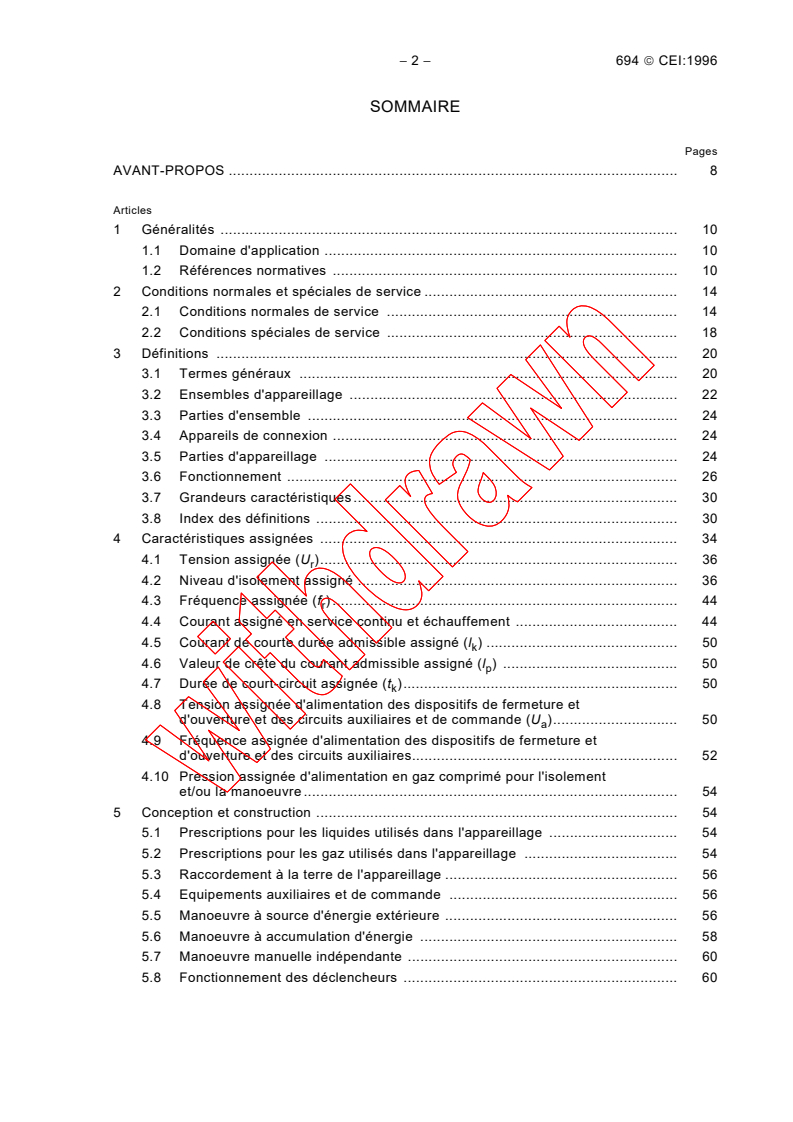
IEC 60694:1996 - Common specifications for high-voltage switchgear and controlgear standards Released:5/22/1996
IEC 60694:1996+AMD1:2000 CSV - Common specifications for high-voltage switchgear and controlgear standards Released:5/30/2001
IEC 60694:1996+AMD1:2000+AMD2:2001 CSV - Common specifications for high-voltage switchgear and controlgear standards Released:1/25/2002
Relations
- Replaced By
IEC 62271-1:2007 - High-voltage switchgear and controlgear - Part 1: Common specifications - Effective Date
- 05-Sep-2023
- Effective Date
- 05-Sep-2023
- Effective Date
- 05-Sep-2023
- Effective Date
- 05-Sep-2023
Buy Documents
IEC 60694:1996+AMD1:2000+AMD2:2001 CSV - Common specifications for high-voltage switchgear and controlgear standards Released:1/25/2002
IEC 60694:1996+AMD1:2000+AMD2:2001 CSV - Spécifications communes aux normes de l'appareillage a haute tension Released:1/25/2002
IEC 60694:1996 - Common specifications for high-voltage switchgear and controlgear standards Released:5/22/1996
IEC 60694:1996+AMD1:2000 CSV - Common specifications for high-voltage switchgear and controlgear standards Released:5/30/2001
IEC 60694:1996+AMD1:2000+AMD2:2001 CSV - Common specifications for high-voltage switchgear and controlgear standards Released:1/25/2002
Get Certified
Connect with accredited certification bodies for this standard

IMQ S.p.A. (Certification)
Italian electrical product certification.

SLG Prüf- und Zertifizierungs GmbH
German testing and certification body.

UL Solutions
Global safety science company with testing, inspection and certification.
Sponsored listings
Frequently Asked Questions
IEC 60694:1996 is a standard published by the International Electrotechnical Commission (IEC). Its full title is "Common specifications for high-voltage switchgear and controlgear standards". This standard covers: Applies, unless otherwise specified in relevant IEC standards, to all a.c. high-voltage switchgear and controlgear designed for indoor or outdoor installation, for operation at service frequencies up to and including 60 Hz, on systems having voltages above 1000 V.
Applies, unless otherwise specified in relevant IEC standards, to all a.c. high-voltage switchgear and controlgear designed for indoor or outdoor installation, for operation at service frequencies up to and including 60 Hz, on systems having voltages above 1000 V.
IEC 60694:1996 is classified under the following ICS (International Classification for Standards) categories: 29.130.10 - High voltage switchgear and controlgear. The ICS classification helps identify the subject area and facilitates finding related standards.
IEC 60694:1996 has the following relationships with other standards: It is inter standard links to IEC 62271-1:2007, IEC 60694:1996/AMD1:2000, IEC 60694:1996/AMD2:2001, IEC 60694:1996/COR1:2001. Understanding these relationships helps ensure you are using the most current and applicable version of the standard.
IEC 60694:1996 is available in PDF format for immediate download after purchase. The document can be added to your cart and obtained through the secure checkout process. Digital delivery ensures instant access to the complete standard document.
Standards Content (Sample)
INTERNATIONAL IEC
STANDARD
Edition 2.2
2002-01
Edition 2:1996 consolidated with amendments 1:2000 and 2:2001
Common specifications for high-voltage
switchgear and controlgear standards
This English-language version is derived from the original
bilingual publication by leaving out all French-language
pages. Missing page numbers correspond to the French-
language pages.
Reference number
Publication numbering
As from 1 January 1997 all IEC publications are issued with a designation in the
60000 series. For example, IEC 34-1 is now referred to as IEC 60034-1.
Consolidated editions
The IEC is now publishing consolidated versions of its publications. For example,
edition numbers 1.0, 1.1 and 1.2 refer, respectively, to the base publication, the base
publication incorporating amendment 1 and the base publication incorporating
amendments 1 and 2.
Further information on IEC publications
The technical content of IEC publications is kept under constant review by the IEC,
thus ensuring that the content reflects current technology. Information relating to this
publication, including its validity, is available in the IEC Catalogue of publications
(see below) in addition to new editions, amendments and corrigenda. Information on
the subjects under consideration and work in progress undertaken by the technical
committee which has prepared this publication, as well as the list of publications
issued, is also available from the following:
• IEC Web Site (www.iec.ch)
• Catalogue of IEC publications
The on-line catalogue on the IEC web site (www.iec.ch/searchpub) enables you to
search by a variety of criteria including text searches, technical committees and
date of publication. On-line information is also available on recently issued
publications, withdrawn and replaced publications, as well as corrigenda.
• IEC Just Published
This summary of recently issued publications (www.iec.ch/online_news/ justpub) is
also available by email. Please contact the Customer Service Centre (see below)
for further information.
• Customer Service Centre
If you have any questions regarding this publication or need further assistance,
please contact the Customer Service Centre:
Email: custserv@iec.ch
Tel: +41 22 919 02 11
Fax: +41 22 919 03 00
INTERNATIONAL IEC
STANDARD
Edition 2.2
2002-01
Edition 2:1996 consolidated with amendments 1:2000 and 2:2001
Common specifications for high-voltage
switchgear and controlgear standards
IEC 2002 Copyright - all rights reserved
No part of this publication may be reproduced or utilized in any form or by any means, electronic or mechanical,
including photocopying and microfilm, without permission in writing from the publisher.
International Electrotechnical Commission, 3, rue de Varembé, PO Box 131, CH-1211 Geneva 20, Switzerland
Telephone: +41 22 919 02 11 Telefax: +41 22 919 03 00 E-mail: inmail@iec.ch Web: www.iec.ch
PRICE CODE
CU
Commission Electrotechnique Internationale
International Electrotechnical Commission
Международная Электротехническая Комиссия
For price, see current catalogue
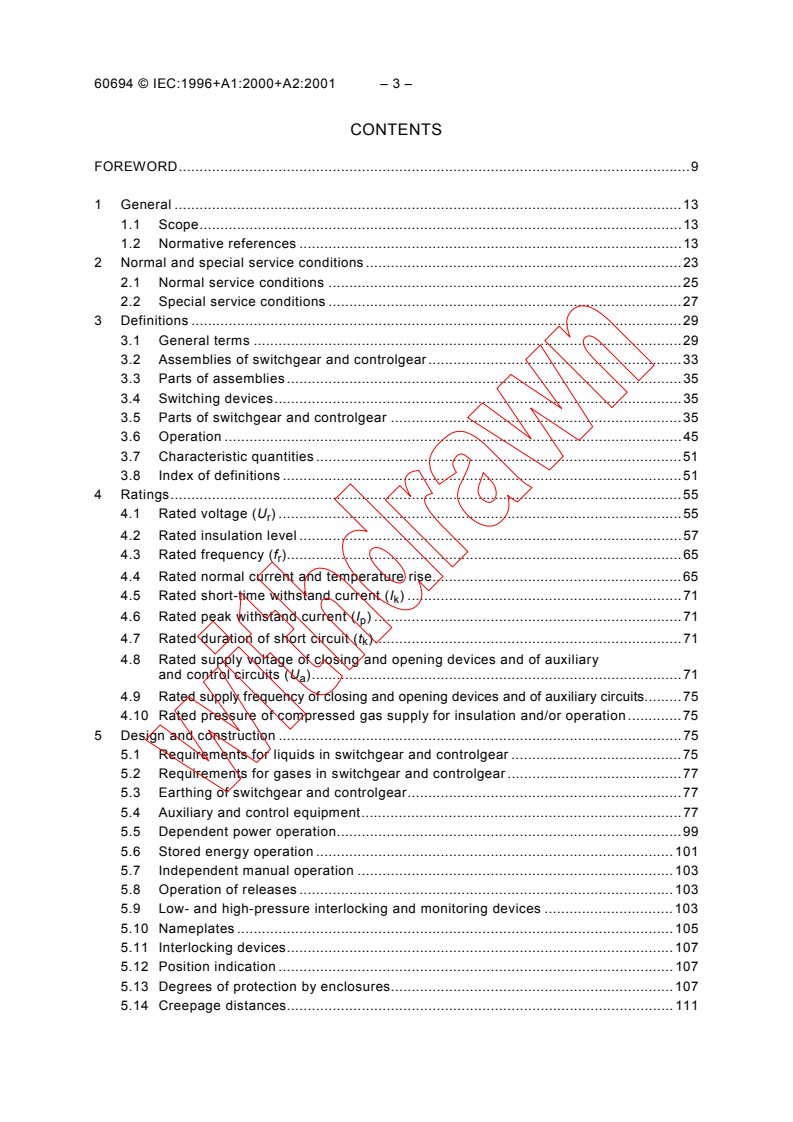
60694 © IEC:1996+A1:2000+A2:2001 – 3 –
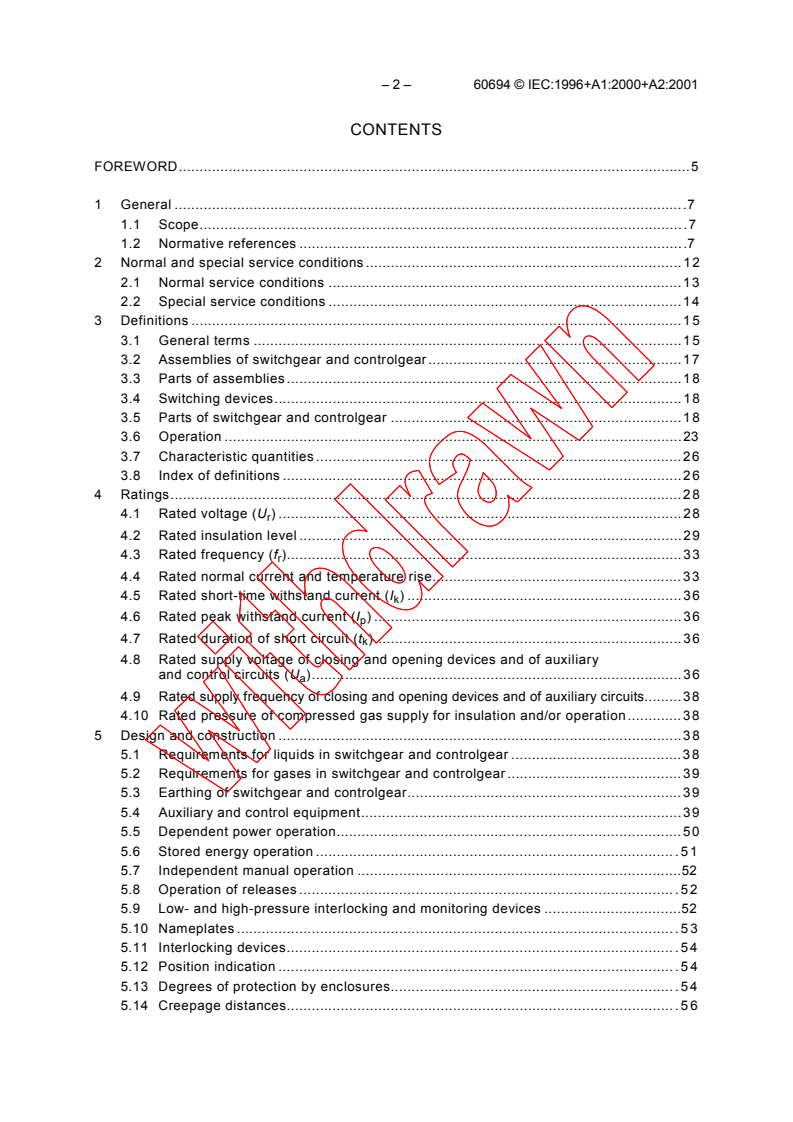
CONTENTS
FOREWORD.9
1 General .13
1.1 Scope.13
1.2 Normative references .13
2 Normal and special service conditions .23
2.1 Normal service conditions .25
2.2 Special service conditions .27
3 Definitions .29
3.1 General terms .29
3.2 Assemblies of switchgear and controlgear.33
3.3 Parts of assemblies .35
3.4 Switching devices.35
3.5 Parts of switchgear and controlgear .35
3.6 Operation .45
3.7 Characteristic quantities .51
3.8 Index of definitions .51
4 Ratings.55
4.1 Rated voltage (U ) .55
r
4.2 Rated insulation level .57
4.3 Rated frequency (f ).65
r
4.4 Rated normal current and temperature rise.65
4.5 Rated short-time withstand current (I ) .71
k
4.6 Rated peak withstand current (I ) .71
p
4.7 Rated duration of short circuit (t ).71
k
4.8 Rated supply voltage of closing and opening devices and of auxiliary
and control circuits (U ).71
a
4.9 Rated supply frequency of closing and opening devices and of auxiliary circuits.75
4.10 Rated pressure of compressed gas supply for insulation and/or operation.75
5 Design and construction .75
5.1 Requirements for liquids in switchgear and controlgear .75
5.2 Requirements for gases in switchgear and controlgear .77
5.3 Earthing of switchgear and controlgear.77
5.4 Auxiliary and control equipment.77
5.5 Dependent power operation.99
5.6 Stored energy operation .101
5.7 Independent manual operation .103
5.8 Operation of releases .103
5.9 Low- and high-pressure interlocking and monitoring devices .103
5.10 Nameplates .105
5.11 Interlocking devices.107
5.12 Position indication .107
5.13 Degrees of protection by enclosures.107
5.14 Creepage distances.111
60694 © IEC:1996+A1:2000+A2:2001 – 5 –
5.15 Gas and vacuum tightness .111
5.16 Liquid tightness .113
5.17 Flammability.113
5.18 Electromagnetic compatibility (EMC) .115
6 Type tests .115
6.1 General .115
6.2 Dielectric tests .119
6.3 Radio interference voltage (r.i.v.) test.133
6.4 Measurement of the resistance of circuits.137
6.5 Temperature-rise tests .139
6.6 Short-time withstand current and peak withstand current tests .145
6.7 Verification of the protection.149
6.8 Tightness tests .151
6.9 Electromagnetic compatibility tests (EMC).155
6.10 Additional tests on auxiliary and control circuits.163
7 Routine tests .171
7.1 Dielectric test on the main circuit.173
7.2 Tests on auxiliary and control circuits.173
7.3 Measurement of the resistance of the main circuit .175
7.4 Tightness test.175
7.5 Design and visual checks .177
8 Guide to the selection of switchgear and controlgear.177
9 Information to be given with enquiries, tenders and orders .177
10 Rules for transport, storage, installation, operation and maintenance .177
10.1 Conditions during transport, storage and installation .179
10.2 Installation.179
10.3 Operation .181
10.4 Maintenance.181
11 Safety.187
11.1 Electrical aspects .187
11.2 Mechanical aspects.187
11.3 Thermal aspects.187
11.4 Operation aspects .187
Annex A (normative) Identification of test specimens .195
Annex B (normative) Determination of the equivalent r.m.s. value of a short-time
current during a short circuit of a given duration .199
Annex C (normative) Method for the weatherproofing test for outdoor switchgear
and controlgear.201
Annex D (informative) Information about insulation levels and tests.207
Annex E (informative) Tightness (information, example and guidance).213
Annex F (informative) Dielectric testing of self-protected switchgear and controlgear .217
Annex G (informative) Bibliography.223
Annex H (informative) Electromagnetic compatibility site measurements .225
60694 © IEC:1996+A1:2000+A2:2001 – 7 –
Figure 1 – Altitude correction factor (see 2.2.1) .189
Figure 2 – Diagram of connections of a three-pole switching device (see 6.2.5.1) .191
Figure 3 – Diagram of a test circuit for the radio interference voltage test of
switching devices (see 6.3).193
Figure 4 – Examples of classes of contacts.87
Figure 5 – Example of secondary system in medium voltage cubicle.97
Figure 6 – Example of secondary system of air insulated circuit-breaker
with single mechanism .97
Figure 7 – Example of secondary system of air insulated circuit-breaker
with separate control cubicle.99
Figure 8 – Example of secondary system for GIS bay .99
Figure 9 – Example of choice of EMC severity class .115
Figure B.1 – Determination of short-time current.199
Figure C.1 – Arrangement for weatherproofing test.203
Figure C.2 – Nozzle for weatherproofing test .205
Figure E.1 – Example of a tightness coordination chart, TC,
for closed pressure systems .213
Figure E.2 – Sensitivity and applicability of different leak detection methods
for tightness tests .215
Figure F.1 – Examples of impulse voltage shapes with incorporated
voltage-limiting devices.221
Table 1a – Rated insulation levels for rated voltages of range I, series I .59
Table 1b – Rated insulation levels for rated voltages of range I, series II
(used in North America) .61
Table 2a – Rated insulation levels for rated voltages of range II .63
Table 2b – Additional rated insulation levels in North America for range II .65
Table 3 – Limits of temperature and temperature rise for various parts, materials
and dielectrics of high-voltage switchgear and controlgear.67
Tables 4 and 5 (withdrawn)
Table 6 – Degrees of protection .109
Table 7 – Application factors for creepage distances .111
Table 8 – Example of grouping of type tests .117
Table 9 – Test conditions in general case .125
Table 10 – Power-frequency test conditions for longitudinal insulation .125
Table 11 – Impulse test conditions for longitudinal insulation .127
Table 12 – Permissible temporary leakage rates for gas systems .151
Table 13 (withdrawn)
Table 14 – Direct current voltage .73
Table 15 – Alternating current voltage.73
Table 16 – Auxiliary contacts classes.87
Table 17 – Application of voltage at the fast transient/burst test.159
Table 18 – Application of voltage at the damped oscillatory wave test.161
Table 19 – Assessment criteria for transient disturbance immunity tests .163
60694 © IEC:1996+A1:2000+A2:2001 – 9 –
INTERNATIONAL ELECTROTECHNICAL COMMISSION
_________
COMMON SPECIFICATIONS FOR HIGH-VOLTAGE
SWITCHGEAR AND CONTROLGEAR STANDARDS
FOREWORD
1) The IEC (International Electrotechnical Commission) is a worldwide organization for standardization comprising
all national electrotechnical committees (IEC National Committees). The object of the IEC is to promote
international co-operation on all questions concerning standardization in the electrical and electronic fields. To
this end and in addition to other activities, the IEC publishes International Standards. Their preparation is
entrusted to technical committees; any IEC National Committee interested in the subject dealt with may
participate in this preparatory work. International, governmental and non-governmental organizations liaising
with the IEC also participate in this preparation. The IEC collaborates closely with the International
Organization for Standardization (ISO) in accordance with conditions determined by agreement between the
two organizations.
2) The formal decisions or agreements of the IEC on technical matters express, as nearly as possible, an
international consensus of opinion on the relevant subjects since each technical committee has representation
from all interested National Committees.
3) The documents produced have the form of recommendations for international use and are published in the form
of standards, technical specifications, technical reports or guides and they are accepted by the National
Committees in that sense.
4) In order to promote international unification, IEC National Committees undertake to apply IEC International
Standards transparently to the maximum extent possible in their national and regional standards. Any
divergence between the IEC Standard and the corresponding national or regional standard shall be clearly
indicated in the latter.
5) The IEC provides no marking procedure to indicate its approval and cannot be rendered responsible for any
equipment declared to be in conformity with one of its standards.
6) Attention is drawn to the possibility that some of the elements of this International Standard may be the subject
of patent rights. The IEC shall not be held responsible for identifying any or all such patent rights.
International Standard IEC 60694 has been prepared by subcommittee 17A: High-voltage
switchgear and controlgear, and subcommittee 17C: High-voltage enclosed switchgear and
controlgear, of IEC technical committee 17: Switchgear and controlgear.
This consolidated version of IEC 60694 consists of the second edition (1996) [documents
17A/458/FDIS and 17A/479/RVD, its amendment 1 (2000) [documents 17A/579/FDIS and
17A/588/RVD], its corrigendum of January 2001, its amendment 2 (2001) [documents
17A/599/FDIS and 17A/609/RVD] and its corrigendum of December 2001.
The technical content is therefore identical to the base edition and its amendments and has
been prepared for user convenience.
It bears the edition number 2.2.
A vertical line in the margin shows where the base publication has been modified by
amendment 1, amendment 2 and the corrigenda.
Annexes A, B and C form an integral part of this standard.
Annexes D to H are for information only.
The following differences exist in some countries:
6.2.11 The required test voltage for disconnectors and switch-disconnectors of all rated
voltages is 100 % of the tabulated voltage in columns 3 of tables 1a or 1b and 2a or 2b
(Canada, France, Italy).
60694 © IEC:1996+A1:2000+A2:2001 – 11 –
The committee has decided that the contents of the base publication and its amendments will
remain unchanged until 2007. At this date, the publication will be
• reconfirmed;
• withdrawn;
• replaced by a revised edition, or
• amended.
60694 © IEC:1996+A1:2000+A2:2001 – 13 –
COMMON SPECIFICATIONS FOR HIGH-VOLTAGE
SWITCHGEAR AND CONTROLGEAR STANDARDS
1 General
1.1 Scope
This International Standard applies to a.c. switchgear and controlgear, designed for indoor
and outdoor installation and for operation at service frequencies up to and including 60 Hz on
systems having voltages above 1 000 V.
This standard applies to all high-voltage switchgear and controlgear except as otherwise
specified in the relevant IEC standards for the particular type of switchgear and controlgear.
1.2 Normative references
The following normative documents contain provisions which, through reference in this text,
constitute provisions of this International Standard. At the time of publication, the editions
indicated were valid. All normative documents are subject to revision, and parties to
agreements based on this International Standard are encouraged to investigate the possibility
of applying the most recent editions of the normative documents indicated below. Members of
IEC and ISO maintain registers of currently valid International Standards.
IEC 60034-1:1996, Rotating electrical machines – Part 1: Rating and performance
IEC 60038:1983, IEC standard voltages
IEC 60050(131):1978, International Electrotechnical Vocabulary (IEV) – Chapter 131: Electric
and magnetic circuits
IEC 60050(151):1978, International Electrotechnical Vocabulary (IEV) − Chapter 151: Electrical
and magnetic devices
IEC 60050(191):1990, International Electrotechnical Vocabulary (IEV) − Chapter 191: Depen-
dability and quality of service
IEC 60050(301):1983, International Electrotechnical Vocabulary (IEV) – Chapter 301: General
terms on measurements in electricity
IEC 60050-351:1998, International Electrotechnical Vocabulary (IEV) – Part 351: Automatic
control
IEC 60050(441):1984, International Electrotechnical Vocabulary (IEV) − Chapter 441: Switchgear,
controlgear and fuses
IEC 60050(446):1983, International Electrotechnical Vocabulary (IEV) – Chapter 446: Electrical
relays
IEC 60050(581):1978, International Electrotechnical Vocabulary (IEV) – Chapter 581: Electro-
mechanical components for electronic equipment
60694 © IEC:1996+A1:2000+A2:2001 – 15 –
IEC 60050(604):1987, International Electrotechnical Vocabulary (IEV) − Chapter 604: Generation,
transmission and distribution of electricity − Operation
IEC 60050(811):1991, International Electrotechnical Vocabulary (IEV) – Chapter 811: Electric
traction
IEC 60050(826):1982, International Electrotechnical Vocabulary (IEV) − Chapter 826: Electrical
installations of buildings
IEC 60051-2:1984, Direct acting indicating analogue electrical measuring instruments and
their accessories – Part 2: Special requirements for ammeters and voltmeters
IEC 60051-4:1984, Direct acting indicating analogue electrical measuring instruments and
their accessories – Part 4: Special requirements for frequency meters
IEC 60051-5:1985, Direct acting indicating analogue electrical measuring instruments and
their accessories – Part 5: Special requirements for phase meters, power factor meters and
synchroscopes
IEC 60056:1987, High-voltage alternating-current circuit-breakers
IEC 60059:1938, IEC standard current ratings
IEC 60060-1:1989, High-voltage test techniques − Part 1: General definitions and test
requirements
IEC 60064:1993, Tungsten filament lamps for domestic and similar general lighting purposes –
Performance requirements
IEC 60068-2 (all parts), Environmental testing – Part 2: Tests
IEC 60068-2-1:1990, Environmental testing – Part 2: Tests. Tests A: Cold
IEC 60068-2-2:1974, Environmental testing – Part 2: Tests. Tests B: Dry heat
IEC 60068-2-3:1969, Environmental testing – Part 2: Tests. Test Ca: Damp heat, steady state
IEC 60068-2-17:1994, Environmental testing − Part 2: Tests − Test Q: Sealing
IEC 60068-2-30:1980, Environmental testing – Part 2: Tests. Test Db and guidance: Damp
heat, cyclic (12 + 12-hour cycle)
IEC 60068-2-63:1991, Environmental testing − Part 2: Tests − Test Eg: Impact, spring hammer
IEC 60071-1:1993, Insulation co-ordination − Part 1: Definitions, principles and rules
IEC 60071-2:1996, Insulation co-ordination − Part 2: Application guide
IEC 60073:1996, Basic and safety principles for man-machine interface, marking and
identification – Coding principles for indication devices and actuators
60694 © IEC:1996+A1:2000+A2:2001 – 17 –
IEC 60081:1997, Double-capped fluorescent lamps – Performance specifications
IEC 60083:1997, Plugs and socket-outlets for domestic and similar general use standardized
in member countries of IEC
IEC 60085:1984, Thermal evaluation and classification of electrical insulation
IEC 60115-4:1982, Fixed resistors for use in electronic equipment – Part 4: Sectional
specification: Fixed power resistors
IEC 60130 (all parts), Connectors for frequencies below 3 MHz
IEC 60227 (all parts), Polyvinyl chloride insulated cables of rated voltages up to and
including 450/750 V
IEC 60228:1978, Conductors of insulated cables
IEC 60245 (all parts), Rubber insulated cables – Rated voltages up to and including 450/750 V
IEC 60255-5:1977, Electrical relays – Part 5: Insulation tests for electrical relays
IEC 60255-8:1990, Electrical relays – Part 8: Thermal electrical relays
IEC 60255-21-1:1988, Electrical relays – Part 21: Vibration, shock, bump and seismic tests on
measuring relays and protection equipment – Section One: Vibration tests (sinusoidal)
IEC 60255-21-3:1993, Electrical relays – Part 21: Vibration, shock, bump and seismic tests on
measuring relays and protection equipment – Section 3: Seismic tests
IEC 60255-23:1994, Electrical relays – Part 23: Contact performance
IEC 60269-1:1998, Low-voltage fuses – Part 1: General requirements
IEC 60269-2:1986, Low-voltage fuses – Part 2: Supplementary requirements for fuses for use
by authorized persons (fuses mainly for industrial application)
IEC 60269-2-1:1998, Low-voltage fuses – Part 2-1: Supplementary requirements for fuses for
use by authorized persons (fuses mainly for industrial application) – Sections I to V: Examples
of types of standardized fuses
IEC 60270:1981, Partial discharge measurements
IEC 60296:1982, Specification for unused mineral insulating oils for transformers and
switchgear
IEC 60309-1:1999, Plugs, socket-outlets and couplers for industrial purposes – Part 1:
General requirements
IEC 60309-2:1999, Plugs, socket-outlets and couplers for industrial purposes – Part 2:
Dimensional interchangeability requirements for pin and contact-tube accessories
IEC 60326 (all parts), Printed boards
60694 © IEC:1996+A1:2000+A2:2001 – 19 –
IEC 60376:1971, Specification and acceptance of new sulphur hexafluoride
IEC 60393-1:1989, Potentiometers for use in electronic equipment – Part 1: Generic
specification
IEC 60417 (all parts), Graphical symbols for use on equipment
IEC 60445:1999, Basic and safety principles for man-machine interface, marking and
identification – Identification of equipment terminals and of terminations of certain designated
conductors, including general rules for an alphanumeric system
IEC 60480:1974, Guide to the checking of sulphur hexafluoride (SF ) taken from electrical
equipment
IEC 60485:1974, Digital electronic d.c. voltmeters and d.c. electronic analogue-to-digital
converters
IEC 60502-1:1997, Power cables with extruded insulation and their accessories for rated
voltages from 1 kV (U = 1,2 kV) up to 30 kV (U = 36 kV) – Part 1: Cables for rated voltages
m m
of 1 kV (U = 1,2 kV) and 3 kV (U = 3,6 kV)
m m
IEC 60507:1991, Artificial pollution tests on high-voltage insulators to be used on a.c.
systems
IEC 60512-2:1985, Electromechanical components for electronic equipment; basic testing
procedures and measuring methods – Part 2: General examination, electrical continuity and
contact resistance tests, insulation tests and voltage stress tests
IEC 60529:1989, Degrees of protection provided by enclosures (IP code)
IEC 60617, Graphical symbols for diagrams
IEC 60669-1:1998, Switches for household and similar fixed-electrical installations – Part 1:
General requirements
IEC 60721, Classification of environmental conditions
IEC 60730-2-9:1992, Automatic electrical controls for household and similar use – Part 2:
Particular requirements for temperature sensing controls
IEC 60730-2-13:1995, Automatic electrical controls for household and similar use – Part 2:
Particular requirements for humidity sensing controls
IEC 60815:1986, Guide for the selection of insulators in respect of polluted conditions
IEC 60816:1984, Guide on methods of measurement of short-duration transients on low-
voltage power and signal lines
60694 © IEC:1996+A1:2000+A2:2001 – 21 –
IEC 60947-2:1995, Low-voltage switchgear and controlgear – Part 2: Circuit-breakers
IEC 60947-3:1999, Low-voltage switchgear and controlgear – Part 3: Switches, disconnectors,
switch-disconnectors and fuse-combination units
IEC 60947-4-1:1990, Low-voltage switchgear and controlgear – Part 4: Contactors and motor-
starters – Section One: Electromechanical contactors and motor-starters
IEC 60947-4-2:1995, Low-voltage switchgear and controlgear – Part 4: Contactors and motor-
starters – Section 2: AC semiconductor motor controllers and starters
IEC 60947-5-1:1997, Low-voltage switchgear and controlgear – Part 5: Control circuit devices
and switching elements – Section One: Electromechanical control circuit devices
IEC 60947-7-1:1989, Low-voltage switchgear and controlgear – Part 7: Ancillary equipment –
Section One: Terminal blocks for copper conductors
IEC 60947-7-2:1995, Low-voltage switchgear and controlgear – Part 7: Ancillary equipment –
Section 2: Protective conductor terminal blocks for copper conductors
IEC 61000-4-1:1992, Electromagnetic compatibility (EMC) – Part 4: Testing and measurement
techniques – Section 1: Overview of immunity tests – Basic EMC publication
IEC 61000-4-4:1995, Electromagnetic compatibility (EMC) – Part 4: Testing and measurement
techniques – Section 4: Electrical fast transient/burst immunity test – Basic EMC Publication
IEC 61000-4-12:1995, Electromagnetic compatibility (EMC) – Part 4: Testing and measure-
ment techniques – Section 12: Oscillatory waves immunity test – Basic EMC Publication
IEC 61000-4-17:1999, Electromagnetic compatibility (EMC) – Part 4-17: Testing and measure-
ment techniques – Ripple on d.c. input power port immunity test
IEC 61000-4-29:—, Electromagnetic compatibility (EMC) – Part 4-29: Testing and
measurement techniques – Voltage dips, short interruptions and voltage variations on d.c.
1)
input power ports, immunity tests
IEC 61000-5 (all parts), Electromagnetic compatibility (EMC) – Part 5: Installation and
mitigation guidelines
IEC 61000-5-1:1996, Electromagnetic compatibility (EMC) – Part 5: Installation and mitigation
guidelines – Section 1: General considerations – Basic EMC publication
IEC 61000-5-2:1997, Electromagnetic compatibility (EMC) – Part 5: Installation and mitigation
guidelines – Section 2: Earthing and cabling
IEC 61000-6-5:—, Electromagnetic compatibility (EMC) – Part 6-5: Generic standards – Immunity
1)
for power station and substation environments
________
1)
To be published.
60694 © IEC:1996+A1:2000+A2:2001 – 23 –
IEC 61020-4:1991, Electromechanical switches for use in electronic equipment – Part 4:
Sectional specification for lever (toggle) switches
IEC 61166:1993, High-voltage alternating current circuit-breakers – Guide for seismic
qualification of high-voltage alternating current circuit-breakers
IEC 61180-1:1992, High-voltage test techniques for low-voltage equipment – Part 1: Defi-
nitions, test and procedure requirements
IEC 61634:1995, High-voltage switchgear and controlgear − Use and handling of sulphur
hexafluoride (SF ) in high-voltage switchgear and controlgear
IEC 61810 (all parts), Electromechanical non-specified time all-or-nothing relays
IEC 61810-1:1998, Electromechanical non-specified time all-or-nothing relays – Part 1:
General requirements
IEC 61810-7:1997, Electromechanical all-or-nothing relays – Part 7: Tests and measurement
procedures
CISPR 11:1990, Limits and methods of measurement of electromagnetic disturbance
characteristics of industrial, scientific and medical (ISM) radio-frequency equipment
CISPR 16-1:1993, Specification for radio disturbance and immunity measuring apparatus and
methods − Part 1: Radio disturbance and immunity measuring apparatus
CISPR 18-2:1986, Radio interference characteristics of overhead power lines and high-
voltage equipment – Part 2: Methods of measurement and procedure for determining limits
Amendment 1 (1993)
Other International Standards are referred to for information in this standard. They are listed
in annex G.
2 Normal and special service conditions
Unless otherwise specified, high-voltage switchgear and controlgear, including the operating
devices and the auxiliary equipment which form an integral part of them, are intended to be
used in accordance with their rated characteristics and the normal service conditions listed
in 2.1.
If the actual service conditions differ from these normal service conditions, high-voltage
switchgear and controlgear and associated operating devices and auxiliary equipment shall
be designed to comply with any special service conditions required by the user, or appropriate
arrangements shall be made (see 2.2).
NOTE 1 Appropriate action should also be taken to ensure proper operation under such conditions of other
components, such as relays.
NOTE 2 Detailed information concerning classification of environmental conditions is given in IEC 60721-3-3
(indoor) and IEC 60721-3-4 (outdoor).
60694 © IEC:1996+A1:2000+A2:2001 – 25 –
2.1 Normal service conditions
2.1.1 Indoor switchgear and controlgear
a) The ambient air temperature does not exceed 40 °C and its average value, measured over
a period of 24 h, does not exceed 35 °C.
The minimum ambient air temperature is −5 °C for class "minus 5 indoor", −15 °C for class
"minus 15 indoor" and −25 °C for class "minus 25 indoor".
b) The influence of solar radiation may be neglected.
c) The altitude does not exceed 1 000 m.
d) The ambient air is not significantly polluted by dust, smoke, corrosive and/or flammable
gases, vapours or salt.
e) The conditions of humidity are as follows:
– the average value of the relative humidity, measured over a period of 24 h, does not
exceed 95 %;
– the average value of the water vapour pressure, over a period of 24 h, does not
exceed 2,2 kPa;
– the average value of the relative humidity, over a period of one month, does not
exceed 90 %;
– the average value of the water vapour pressure, over a period of one month, does not
exceed 1,8 kPa.
For these conditions, condensation may occasionally occur.
NOTE 1 Condensation can be expected where sudden temperature changes occur in periods of high
humidity.
NOTE 2 To withstand the effects of high humidity and condensation, such as breakdown of insulation or
corrosion of metallic parts, switchgear designed for such conditions and tested accordingly should be used.
NOTE 3 Condensation may be prevented by special design of the building or housing, by suitable ventilation
and heating of the station or by the use of dehumidifying equipment.
f) Vibration due to causes external to the switchgear and controlgear or earth tremors are
negligible.
g) Induced electromagnetic disturbances at interfaces of the secondary system, as a result of
switching in the high-voltage system, do not exceed 1,6 kV common mode for normal EMC
severity class, and 0,8 kV common mode for reduced EMC severity class.
NOTE 4 The maximum induced voltage values may be exceeded at interfaces to instrument transformers.
Refer to instrument transformer standards for adequate performances of these devices.
2.1.2 Outdoor switchgear and controlgear
a) The ambient air temperature does not exceed 40 °C and its average value, measured over
a period of 24 h, does not exceed 35 °C.
The minimum ambient air temperature is −10 °C for class "minus 10 outdoor", −25 °C for
class "minus 25 outdoor" and −40 °C for class "minus 40 outdoor".
Rapid temperature changes should be taken into account.
b) Solar radiation up to a level of 1 000 W/m (on a clear day at noon) should be considered.
NOTE 1 Under certain conditions of solar radiation appropriate measures, e.g. roofing, forced ventilation, etc.
may be necessary, or derating may be used, in order not to exceed the specified temperature rises.
NOTE 2 Details of global solar radiation are given in IEC 60721-2-4.
60694 © IEC:1996+A1:2000+A2:2001 – 27 –
c) The altitude does not exceed 1 000 m.
d) The ambient air may be polluted by dust, smoke, corrosive gas, vapours or salt. The
pollution does not exceed the pollution level II – Medium according to table 1 of
IEC 60815.
e) The ice coating does not exceed 1 mm for class 1, 10 mm for class 10 and 20 mm for
class 20.
f) The wind speed does not exceed 34 m/s (corresponding to 700 Pa on cylindrical
surfaces).
NOTE 3 Characteristics of wind are described in IEC 60721-2-2.
g) Account should be taken of the presence of condensation or precipitations.
NOTE 4 Characteristics of precipitation are defined in IEC 60721-2-2.
h) Vibration due to causes external to the switchgear and controlgear or to earth tremors are
negligible.
i) Induced electromagnetic disturbances at interfaces of the secondary system, as a result of
switching in the high-voltage system, do not exceed 1,6 kV common mode for normal EMC
severity class, and 0,8 kV common mode for reduced EMC severity class.
NOTE 5 The maximum induced voltage values may be exceeded at interfaces to instrument transformers.
Refer to instrument transformer standards for adequate performances of these devices.
2.2 Special service conditions
When high-voltage switchgear and controlgear may be used under conditions different from
the normal service conditions given in 2.1, the user's requirements should refer to
standardized steps as follows.
2.2.1 Altitude
For installation at an altitude higher than 1 000 m, the insulation level of external insulation
under the standardized reference atmospheric conditions shall be determined by multiplying
the insulation withstand voltages required at the service location by a factor K in accordance
a
with figure 1.
NOTE 1 For internal insulation, the dielectric characteristics are identical at any altitude and no special
precautions need to be taken. For external and internal insulation, see IEC 60071-2.
NOTE 2 For low-voltage auxiliary and control equipment, no special precautions need to be taken if the altitude is
lower than 2 000 m. For higher altitude, see IEC 60664-1.
2.2.2 Pollution
For installation in polluted ambient air, a pollution level III – Heavy, or IV – Very heavy of
IEC 60815 should be specified.
2.2.3 Temperature and humidity
For installation in a place where the ambient temperature can be significantly outside the
normal service condition range stated in 2.1, the preferred ranges of minimum and maximum
temperature to be specified should be:
−50 °C and +40 °C for very cold climates;
−5 °C and +50 °C for very hot climates.
In certain regions with frequent occurrence of warm humid winds, sudden changes of
temperature may occur resulting in condensation even indoors.
In tropical indoor conditions, the average value of relative humidity measured during a period
of 24 h can be 98 %.
60694 © IEC:1996+A1:2000+A2:2001 – 29 –
2.2.4 Vibrations
For installations where earthquakes are likely to occur, severity level in accordance with
IEC 61166 should be specified by the user.
2.2.5 Other parameters
When special environmental conditions prevail at the location where switchgear and
controlgear is to be put in service, they should be specified by the user by reference to
IEC 60721.
3 Definitions
For the purpose of this International Standard, the definitions in IEC 60050(151);
IEC 60050(191); IEC 60050(441); IEC 60050(604) and IEC 60050(826) apply.
Some of them are recalled hereunder for easier use.
The definitions given below are also applicable. They are classified in accordance with
IEC 60050(441). The definitions of IEC 60050(441) are not repeated but reference is made to
their specific sub-clause number. References from other than IEC 60050(441) are classified
so as to be aligned with the classification used in International Electrotechnical Vocabulary
IEC 60050(441).
3.1 General terms
3.1.1
switchgear and controlgear
[IEV 441-11-01]
3.1.2
external insulation
the distances in atmosphere and the surfaces in contact with open air of solid insulation of the
equipment which are subject to dielectric stresses and to the effects of atmospheric and other
external conditions such as pollution, humidity, vermin etc.
[IEV 604-03-02]
3.1.3
IP code
a coding system to indicate the degrees of protection provided by an enclosure against
access to hazardous parts, ingress of solid foreign objects, ingress of water and to give
additional information in connection with such protection [3.4 of IEC 60529]
3.1.4
protection provided by an enclosure against access to hazardous parts
the protection of persons against:
– contact with hazardous mechanical parts;
– contact with hazardous low-voltage live parts;
– approach to hazardous high-voltage live parts below adequate clearance inside an
enclosure [3.6 of IEC 60529]
3.1.5
maintenance
the combination of all technical and administrative actions, including supervision actions, intended
to retain an item in, or restore it to, a state in which it can perform a required function
[IEV 191-07-01]
60694 © IEC:1996+A1:2000+A2:2001 – 31 –
3.1.6
scheduled maintenance
the preventive maintenance carried out in accordance with an established time schedule
[IEV 191-07-10]
3.1.7
inspection
periodic visual investigation of the principal features of the switchgear and controlgear in
service without dismantling. This investigation is generally directed toward pressures and/or
levels of fluids, tightness, positi
...
NORME CEI
INTERNATIONALE
Edition 2.2
2002-01
Edition 2:1996 consolidée par les amendements 1:2000 et 2:2001
Spécifications communes aux normes
de l'appareillage à haute tension
Cette version française découle de la publication d’origine
bilingue dont les pages anglaises ont été supprimées.
Les numéros de page manquants sont ceux des pages
supprimées.
Numéro de référence
CEI 60694:1996+A1:2000+A2:2001(F)
Numérotation des publications
Depuis le 1er janvier 1997, les publications de la CEI sont numérotées à partir de
60000. Ainsi, la CEI 34-1 devient la CEI 60034-1.
Editions consolidées
Les versions consolidées de certaines publications de la CEI incorporant les
amendements sont disponibles. Par exemple, les numéros d’édition 1.0, 1.1 et 1.2
indiquent respectivement la publication de base, la publication de base incorporant
l’amendement 1, et la publication de base incorporant les amendements 1 et 2
Informations supplémentaires sur les publications de la CEI
Le contenu technique des publications de la CEI est constamment revu par la CEI
afin qu'il reflète l'état actuel de la technique. Des renseignements relatifs à cette
publication, y compris sa validité, sont disponibles dans le Catalogue des
publications de la CEI (voir ci-dessous) en plus des nouvelles éditions, amende-
ments et corrigenda. Des informations sur les sujets à l’étude et l’avancement des
travaux entrepris par le comité d’études qui a élaboré cette publication, ainsi que la
liste des publications parues, sont également disponibles par l’intermédiaire de:
• Site web de la CEI (www.iec.ch)
• Catalogue des publications de la CEI
Le catalogue en ligne sur le site web de la CEI (www.iec.ch/searchpub) vous permet
de faire des recherches en utilisant de nombreux critères, comprenant des
recherches textuelles, par comité d’études ou date de publication. Des informations
en ligne sont également disponibles sur les nouvelles publications, les publications
remplacées ou retirées, ainsi que sur les corrigenda.
• IEC Just Published
Ce résumé des dernières publications parues (www.iec.ch/online_news/justpub)
est aussi disponible par courrier électronique. Veuillez prendre contact avec le
Service client (voir ci-dessous) pour plus d’informations.
• Service clients
Si vous avez des questions au sujet de cette publication ou avez besoin de
renseignements supplémentaires, prenez contact avec le Service clients:
Email: custserv@iec.ch
Tél: +41 22 919 02 11
Fax: +41 22 919 03 00
NORME CEI
INTERNATIONALE
Edition 2.2
2002-01
Edition 2:1996 consolidée par les amendements 1:2000 et 2:2001
Spécifications communes aux normes
de l'appareillage à haute tension
IEC 2002 Droits de reproduction réservés
Aucune partie de cette publication ne peut être reproduite ni utilisée sous quelque forme que ce soit et par aucun
procédé, électronique ou mécanique, y compris la photocopie et les microfilms, sans l'accord écrit de l'éditeur.
International Electrotechnical Commission, 3, rue de Varembé, PO Box 131, CH-1211 Geneva 20, Switzerland
Telephone: +41 22 919 02 11 Telefax: +41 22 919 03 00 E-mail: inmail@iec.ch Web: www.iec.ch
CODE PRIX
CU
Commission Electrotechnique Internationale
International Electrotechnical Commission
Международная Электротехническая Комиссия
Pour prix, voir catalogue en vigueur
– 2 – 60694 © CEI:1996+A1:2000+A2:2001
SOMMAIRE
AVANT-PROPOS.8
1 Généralités.12
1.1 Domaine d'application .12
1.2 Références normatives.12
2 Conditions normales et spéciales de service .22
2.1 Conditions normales de service.24
2.2 Conditions spéciales de service .26
3 Définitions .28
3.1 Termes généraux .28
3.2 Ensembles d'appareillage.32
3.3 Parties d'ensemble.34
3.4 Appareils de connexion .34
3.5 Parties d'appareillage.34
3.6 Fonctionnement.44
3.7 Grandeurs caractéristiques.50
3.8 Index des définitions .50
4 Caractéristiques assignées.54
4.1 Tension assignée (U ) .54
r
4.2 Niveau d'isolement assigné .56
4.3 Fréquence assignée (f ).64
r
4.4 Courant assigné en service continu et échauffement .64
4.5 Courant de courte durée admissible assigné (I ) .70
k
4.6 Valeur de crête du courant admissible assigné (I ) .70
p
4.7 Durée de court-circuit assignée (t ) .70
k
4.8 Tension assignée d'alimentation des dispositifs de fermeture et d'ouverture
et des circuits auxiliaires et de commande (U ) .70
a
4.9 Fréquence assignée d'alimentation des dispositifs de fermeture et
d'ouverture et des circuits auxiliaires.74
4.10 Pression assignée d'alimentation en gaz comprimé pour l'isolement
et/ou la manœuvre .74
5 Conception et construction .74
5.1 Prescriptions pour les liquides utilisés dans l'appareillage.74
5.2 Prescriptions pour les gaz utilisés dans l'appareillage .76
5.3 Raccordement à la terre de l'appareillage.76
5.4 Equipements auxiliaires et de commande.76
5.5 Manœuvre à source d'énergie extérieure.98
5.6 Manœuvre à accumulation d'énergie .100
5.7 Manœuvre manuelle indépendante.102
5.8 Fonctionnement des déclencheurs .102
5.9 Dispositifs de verrouillage et de surveillance basse et haute pression .102
5.10 Plaques signalétiques .104
5.11 Verrouillages .106
5.12 Indicateur de position .106
5.13 Degrés de protection procurés par les enveloppes .106
5.14 Lignes de fuite.110
– 4 – 60694 © CEI:1996+A1:2000+A2:2001
5.15 Etanchéité au gaz et au vide .110
5.16 Etanchéité au liquide.112
5.17 Ininflammabilité .112
5.18 Compatibilité électromagnétique (CEM).114
6 Essais de type.114
6.1 Généralités.114
6.2 Essais diélectriques .118
6.3 Essais de tension de perturbation radioélectrique.132
6.4 Mesurage de la résistance du circuit principal .136
6.5 Essais d'échauffement.138
6.6 Essais au courant de courte durée et à la valeur de crête du courant admissible. 144
6.7 Vérification de la protection .148
6.8 Essais d'étanchéité .150
6.9 Essais de compatibilité électromagnétique (CEM) .154
6.10 Essais additionnels des circuits auxiliaires et de commande.162
7 Essais individuels de série .170
7.1 Essais diélectriques du circuit principal .172
7.2 Essais des circuits auxiliaires et de commande .172
7.3 Mesurage de la résistance du circuit principal .174
7.4 Essais d'étanchéité .174
7.5 Contrôles visuels et du modèle.176
8 Guide pour le choix de l'appareillage selon le service.176
9 Renseignements à donner dans les appels d'offres, les soumissions
et les commandes .176
10 Règles pour le transport, le stockage, le montage, l'installation, la manœuvre
et la maintenance .176
10.1 Conditions à respecter pendant le transport, le stockage et l'installation .178
10.2 Installation.178
10.3 Fonctionnement.180
10.4 Maintenance.180
11 Sécurité.186
11.1 Aspects électriques .186
11.2 Aspects mécaniques .186
11.3 Aspects thermiques.186
11.4 Aspects opérationnels .186
Annexe A (normative) Identification des spécimens d'essai .194
Annexe B (normative) Détermination de la valeur efficace équivalente d'un courant de
courte durée admissible pendant un court-circuit de courte durée.198
Annexe C (normative) Méthode pour l'essai de protection contre les intempéries de
l’appareillage pour installation à l'extérieur .200
Annexe D (informative) Information concernant les niveaux d'isolement et leurs essais .206
Annexe E (informative) Etanchéité (information, exemple et guide).212
Annexe F (informative) Essais diélectriques de l'appareillage autoprotégé.216
Annexe G (informative) Bibliographie.222
Annexe H (informative) Mesurage de la CEM sur site .224
– 6 – 60694 © CEI:1996+A1:2000+A2:2001
Figure 1 – Facteur de correction d'altitude (voir 2.2.1) .188
Figure 2 – Schéma des connexions d'un appareil de connexion tripolaire (voir 6.2.5.1).190
Figure 3 – Schéma d'un circuit d'essais de tension de perturbation radioélectrique
des appareils de connexion (voir 6.3).192
Figure 4 – Exemples de classes de contacts.86
Figure 5 – Exemple de système secondaire dans une armoire de tension moyenne.96
Figure 6 – Exemple de système secondaire d’un disjoncteur à isolation à l’air
avec mécanisme simple .96
Figure 7 – Exemple de système secondaire d’un disjoncteur à isolation à l’air
avec armoire centrale de commande séparée .98
Figure 8 – Exemple de système secondaire dans la travée d’un poste à isolation gazeuse .98
Figure 9 – Exemple de choix de classe de sévérité CEM .114
Figure B.1 – Détermination du courant de courte durée .198
Figure C.1 – Disposition pour l'essai de protection contre les intempéries .202
Figure C.2 – Gicleur pour l'essai de protection contre les intempéries.204
Figure E.1 – Exemple de tableau de coordination des étanchéités, TC,
pour systèmes à pression de gaz autonomes.212
Figure E.2 – Sensibilité et domaine d'application des différentes méthodes
d'essai d'étanchéité .214
Figure F.1 – Exemples de forme de tension de choc avec dispositifs limiteurs
de tensions incorporés.220
Tableau 1a – Niveaux d'isolement assignés pour les tensions assignées de la gamme I, série I .58
Tableau 1b – Niveaux d'isolement assignés pour les tensions assignées de la gamme I,
série II (utilisés en Amérique du Nord) .60
Tableau 2a – Niveaux d'isolement assignés pour les tensions assignées de la gamme II.62
Tableau 2b – Niveaux d'isolement supplémentaires utilisés en Amérique du Nord
pour les tensions assignées de la gamme II.64
Tableau 3 – Limites de température et d'échauffement pour les différents organes,
matériaux et diélectriques de l'appareillage à haute tension.66
Tableaux 4 et 5 (retirés)
Tableau 6 – Degrés de protection .108
Tableau 7 – Facteurs d'application des lignes de fuite .110
Tableau 8 − Exemple de groupement des essais de type .116
Tableau 9 – Conditions d'essais dans le cas général .124
Tableau 10 – Conditions d'essais de l'isolation longitudinale à la tension
à fréquence industrielle.124
Tableau 11 – Conditions d'essai de l'isolation longitudinale à la tension de choc .126
Tableau 12 – Taux de fuite temporairement admissibles pour les systèmes à gaz .150
Tableau 13 (retiré)
Tableau 14 – Tension en courant continu.72
Tableau 15 – Tension en courant alternatif .72
Tableau 16 – Classes des contacts auxiliaires .86
Tableau 17 – Application de tension pour l’essai aux transitoires rapides en salves.158
Tableau 18 – Application de tension pour l’essai d’immunité aux ondes oscillatoires .160
Tableau 19 – Critères d’évaluation pour les essais d’immunité aux perturbations transitoires . 162
– 8 – 60694 © CEI:1996+A1:2000+A2:2001
COMMISSION ÉLECTROTECHNIQUE INTERNATIONALE
_________
SPÉCIFICATIONS COMMUNES AUX NORMES
DE L’APPAREILLAGE À HAUTE TENSION
AVANT-PROPOS
1) La CEI (Commission Électrotechnique Internationale) est une organisation mondiale de normalisation
composée de l'ensemble des comités électrotechniques nationaux (Comités nationaux de la CEI). La CEI a
pour objet de favoriser la coopération internationale pour toutes les questions de normalisation dans les
domaines de l'électricité et de l'électronique. A cet effet, la CEI, entre autres activités, publie des Normes
internationales. Leur élaboration est confiée à des comités d'études, aux travaux desquels tout Comité national
intéressé par le sujet traité peut participer. Les organisations internationales, gouvernementales et non
gouvernementales, en liaison avec la CEI, participent également aux travaux. La CEI collabore étroitement
avec l'Organisation Internationale de Normalisation (ISO), selon des conditions fixées par accord entre les
deux organisations.
2) Les décisions ou accords officiels de la CEI concernant les questions techniques représentent, dans la mesure
du possible, un accord international sur les sujets étudiés, étant donné que les Comités nationaux intéressés
sont représentés dans chaque comité d’études.
3) Les documents produits se présentent sous la forme de recommandations internationales. Ils sont publiés
comme normes, spécifications techniques, rapports techniques ou guides et agréés comme tels par les
Comités nationaux.
4) Dans le but d'encourager l'unification internationale, les Comités nationaux de la CEI s'engagent à appliquer de
façon transparente, dans toute la mesure possible, les Normes internationales de la CEI dans leurs normes
nationales et régionales. Toute divergence entre la norme de la CEI et la norme nationale ou régionale
correspondante doit être indiquée en termes clairs dans cette dernière.
5) La CEI n’a fixé aucune procédure concernant le marquage comme indication d’approbation et sa responsabilité
n’est pas engagée quand un matériel est déclaré conforme à l’une de ses normes.
6) L’attention est attirée sur le fait que certains des éléments de la présente Norme internationale peuvent faire
l’objet de droits de propriété intellectuelle ou de droits analogues. La CEI ne saurait être tenue pour
responsable de ne pas avoir identifié de tels droits de propriété et de ne pas avoir signalé leur existence.
La Norme internationale CEI 60694 a été établie par le sous-comité 17A: Appareillage à haute
tension, et par le sous-comité 17C: Appareillage à haute tension sous enveloppe, du comité
d’études 17 de la CEI: Appareillage.
La présente version consolidée de la CEI 60694 comprend la deuxième édition (1996)
[documents 17A/458/FDIS et 17A/479/RVD, son amendement 1 (2000) [documents
17A/579/FDIS et 17A/588/RVD], le corrigendum de janvier 2001, son amendement 2 (2001)
[documents 17A/599/FDIS et 17A/609/RVD] et le corrigendum de décembre 2001.
Le contenu technique de cette version consolidée est donc identique à celui de l'édition de
base et à ses amendements; cette version a été préparée par commodité pour l'utilisateur.
Elle porte le numéro d'édition 2.2.
Une ligne verticale dans la marge indique où la publication de base a été modifiée par
l’amendement 1, l'amendement 2 et les corrigenda.
Les annexes A, B et C font partie intégrante de cette norme.
Les annexes D à H sont données uniquement à titre d’information.
Les différences suivantes existent dans certains pays:
6.2.11 La tension d’essais exigée pour les sectionneurs et interrupteurs-sectionneurs de
toutes tensions assignées, est 100 % des valeurs données par les colonnes 3 des tableaux
1a ou 1b et 2a ou 2b (Canada, France, Italie).
– 10 – 60694 © CEI:1996+A1:2000+A2:2001
Le comité a décidé que le contenu de la publication de base et de ses amendements ne sera
pas modifié avant 2007. A cette date, la publication sera
• reconduite;
• supprimée;
• remplacée par une édition révisée, ou
• amendée.
– 12 – 60694 © CEI:1996+A1:2000+A2:2001
SPÉCIFICATIONS COMMUNES AUX NORMES
DE L’APPAREILLAGE À HAUTE TENSION
1 Généralités
1.1 Domaine d'application
La présente Norme internationale s'applique à l'appareillage à courant alternatif prévu pour
être installé à l'intérieur ou à l'extérieur et pour fonctionner à des fréquences de service
inférieures ou égales à 60 Hz, sur des réseaux de tension supérieure à 1 000 V.
Cette norme s'applique à tout l'appareillage à haute tension, sauf spécification contraire dans
les normes particulières de la CEI pour le type d'appareillage considéré.
1.2 Références normatives
Les documents normatifs suivants contiennent des dispositions qui, par suite de la référence
qui y est faite, constituent des dispositions valables pour la présente Norme internationale. Au
moment de la publication, les éditions indiquées étaient en vigueur. Toute document normatif
est sujet à révision et les parties prenantes aux accords fondés sur la présente Norme
internationale sont invitées à rechercher la possibilité d'appliquer les éditions les plus
récentes des documents normatifs indiqués ci-après. Les membres de la CEI et de l'ISO
possèdent le registre des Normes internationales en vigueur.
CEI 60034-1:1996, Machines électriques tournantes – Partie 1: Caractéristiques assignées et
caractéristiques de fonctionnement
CEI 60038:1983, Tensions normales de la CEI
CEI 60050(131):1978, Vocabulaire Electrotechnique International (VEI) – Chapitre 131:
Circuits électriques et magnétiques
CEI 60050(151):1978, Vocabulaire Electrotechnique International (VEI) – Chapitre 151:
Dispositifs électriques et magnétiques
CEI 60050(191):1990, Vocabulaire Electrotechnique International (VEI) – Chapitre 191:
Sûreté de fonctionnement et qualité de service
CEI 60050(301):1983, Vocabulaire Electrotechnique International (VEI) – Chapitre 301: Termes
généraux concernant les mesures en électricité
CEI 60050-351:1998, Vocabulaire Electrotechnique International (VEI) – Partie 351: Commande
et régulation automatiques
CEI 60050(441):1984, Vocabulaire Electrotechnique International (VEI) – Chapitre 441:
Appareillage et fusibles
CEI 60050(446):1983, Vocabulaire Electrotechnique International (VEI) – Chapitre 446: Relais
électriques
CEI 60050(581):1978, Vocabulaire Electrotechnique International (VEI) – Chapitre 581:
Composants électromécaniques pour équipements électroniques
– 14 – 60694 © CEI:1996+A1:2000+A2:2001
CEI 60050(604):1987, Vocabulaire Electrotechnique International (VEI) – Chapitre 604:
Production, transport et distribution de l'énergie électrique – Exploitation
CEI 60050(811):1991, Vocabulaire Electrotechnique International (VEI) – Chapitre 811:
Traction électrique
CEI 60050(826):1982, Vocabulaire Electrotechnique International (VEI) – Chapitre 826: Instal-
lations électriques des bâtiments
CEI 60051-2:1984, Appareils mesureurs électriques indicateurs analogiques à action directe
et leurs accessoires – Partie 2: Prescriptions particulières pour les ampèremètres et les
voltmètres
CEI 60051-4:1984, Appareils mesureurs électriques indicateurs analogiques à action directe
et leurs accessoires – Partie 4: Prescriptions particulières pour les fréquencemètres
CEI 60051-5:1985, Appareils mesureurs électriques indicateurs analogiques à action directe
et leurs accessoires – Partie 5: Prescriptions particulières pour les phasemètres, les
indicateurs de facteur de puissance et les synchronoscopes
CEI 60056:1987, Disjoncteurs à courant alternatif à haute tension
CEI 60059:1938, Courants normaux de la CEI
CEI 60060-1:1989, Techniques des essais à haute tension – Partie 1: Définitions et
prescriptions générales relatives aux essais
CEI 60064:1993, Lampes à filament de tungstène pour usage domestique et éclairage
général similaire – Prescriptions de performances
CEI 60068-2 (toutes les parties), Essais d'environnement – Partie 2: Essais
CEI 60068-2-1:1990, Essais d'environnement – Deuxième partie : Essais. Essais A: Froid
CEI 60068-2-2:1974, Essais d'environnement – Deuxième partie: Essais. Essais B: Chaleur
sèche
CEI 60068-2-3:1969, Essais d'environnement – Deuxième partie: Essais. Essai Ca: Essai
continu de chaleur humide
CEI 60068-2-17:1994, Essais d'environnement – Partie 2: Essais – Essai Q: Etanchéité
CEI 60068-2-30:1980, Essais d'environnement – Deuxième partie: Essais. Essai Db et guide:
Essai cyclique de chaleur humide (cycle de 12 + 12 heures)
CEI 60068-2-63:1991, Essais d'environnement – Partie 2: Essais – Essai Eg: impacts,
marteau à ressort
CEI 60071-1:1993, Coordination de l'isolement – Partie 1: Définitions, principes et règles
CEI 60071-2:1996, Coordination de l'isolement – Partie 2: Guide d'application
CEI 60073:1996, Principes fondamentaux et de sécurité pour l'interface homme-machine, le
marquage et l'identification – Principes de codage pour les dispositifs indicateurs et les
organes de commande
– 16 – 60694 © CEI:1996+A1:2000+A2:2001
CEI 60081:1997, Lampes à fluorescence à deux culots – Prescriptions de performances
CEI 60083:1997, Prises de courant pour usages domestiques et analogues, normalisées par
les pays membres de la CEI
CEI 60085:1984, Evaluation et classification thermiques de l'isolation électrique
CEI 60115-4:1982, Résistances fixes utilisées dans les équipements électroniques – Partie 4:
Spécification intermédiaire: Résistances fixes de puissance
CEI 60130 (toutes les parties), Connecteurs utilisés aux fréquences jusqu'à 3 MHz
CEI 60227 (toutes les parties), Conducteurs et câbles isolés au polychlorure de vinyle, de
tension nominale au plus égale à 450/750 V
CEI 60228:1978, Ames des câbles isolés
CEI 60245 (toutes les parties), Conducteurs et câbles isolés au caoutchouc – Tension
assignée au plus égale à 450/750 V
CEI 60255-5:1977, Relais électriques – Partie 5: Essais d'isolement des relais électriques
CEI 60255-8:1990, Relais électriques – Partie 8: Relais électriques thermiques
CEI 60255-21-1:1988, Relais électriques – Vingt et unième partie: Essais de vibrations, de
chocs, de secousses et de tenue aux séismes applicables aux relais de mesure et aux
dispositifs de protection – Section Un: Essais de vibrations (sinusoïdales)
CEI 60255-21-3:1993, Relais électriques – Partie 21: Essais de vibrations, de chocs, de
secousses et de tenue aux séismes applicables aux relais de mesure et aux dispositifs de
protection – Section 3: Essais de tenue aux séismes
CEI 60255-23:1994, Relais électriques – Partie 23: Caractéristiques fonctionnelles des
contacts
CEI 60269-1:1998, Fusibles basse tension – Partie 1: Règles générales
CEI 60269-2:1986, Fusibles basse tension – Partie 2: Règles supplémentaires pour les
fusibles destinés à être utilisés par des personnes habilitées (fusibles pour usages essen-
tiellement industriels)
CEI 60269-2-1:1998, Fusibles basse tension – Partie 2-1: Règles supplémentaires pour les
fusibles destinés à être utilisés par des personnes habilitées (fusibles pour usage
essentiellement industriels) – Sections I à V: Exemples de fusibles normalisés
CEI 60270:1981, Mesure des décharges partielles
CEI 60296:1982, Spécification des huiles minérales isolantes neuves pour transformateurs et
appareillage de connexion
CEI 60309-1:1999, Prises de courant pour usages industriels – Partie 1: Règles générales
CEI 60309-2:1999, Prises de courant pour usages industriels – Partie 2: Règles
d'interchangeabilité dimensionnelle pour les appareils à broches et alvéoles
CEI 60326 (toutes les parties), Cartes imprimées
– 18 – 60694 © CEI:1996+A1:2000+A2:2001
CEI 60376:1971, Spécifications et réception de l'hexafluorure de soufre neuf
CEI 60393-1:1989, Potentiomètres utilisés dans les équipements électroniques – Partie 1:
Spécification générique
CEI 60417 (toutes les parties), Symboles graphiques utilisables sur le matériel
CEI 60445:1999, Principes fondamentaux et de sécurité pour les interfaces homme-machines,
le marquage et l'identification – Identification des bornes de matériels et des extrémités de
certains conducteurs désignés et règles générales pour un système alphanumérique
CEI 60480:1974, Guide relatif au contrôle de l'hexafluorure de soufre (SF ) prélevé sur le
matériel électrique
CEI 60485:1974, Voltmètres numériques et convertisseurs électroniques analogiques-
numériques à courant continu
CEI 60502-1:1997, Câbles d'énergie à isolant extrudé et leurs accessoires pour des tensions
assignées de 1 kV (U = 1,2 kV) à 30 kV (U = 36 kV) – Partie 1: Câbles de tensions
m m
assignées de 1 kV (U = 1,2 kV) et 3 kV (U = 3,6 kV)
m m
CEI 60507:1991, Essais sous pollution artificielle des isolateurs pour haute tension destinés
aux réseaux à courant alternatif
CEI 60512-2:1985, Composants électromécaniques pour équipements électroniques;
procédures d'essai de base et méthodes de mesure – Deuxième partie: Examen général,
essais de continuité électrique et de résistance de contact, essais d'isolement et essais de
contrainte diélectrique
CEI 60529:1989, Degrés de protection procurés par les enveloppes (code IP)
CEI 60617, Symboles graphiques pour schémas
CEI 60669-1:1998, Interrupteurs pour installations électriques fixes domestiques et ana-
logues – Partie 1: Prescriptions générales
CEI 60721, Classification des conditions d'environnement
CEI 60730-2-9:1992, Dispositifs de commande électrique automatiques à usage domestique
et analogue – Partie 2: Règles particulières pour les dispositifs de commande thermo-
sensibles
CEI 60730-2-13:1995, Dispositifs de commande électrique automatiques à usage domestique
et analogue – Partie 2: Règles particulières pour les dispositifs de commande sensibles à
l'humidité
CEI 60815:1986, Guide pour le choix des isolateurs sous pollution
CEI 60816:1984, Guide sur les méthodes de mesure des transitoires de courte durée sur les
lignes de puissance et de contrôle basse tension
– 20 – 60694 © CEI:1996+A1:2000+A2:2001
CEI 60947-2:1995, Appareillage à basse tension – Partie 2: Disjoncteurs
CEI 60947-3:1999, Appareillage à basse tension – Partie 3: Interrupteurs, sectionneurs,
interrupteurs-sectionneurs et combinés-fusibles
CEI 60947-4-1:1990, Appareillage à basse tension – Partie 4: Contacteurs et démarreurs de
moteurs – Section un: Contacteurs et démarreurs électromécaniques
CEI 60947-4-2:1995, Appareillage à basse tension – Partie 4: Contacteurs et démarreurs de
moteurs – Section 2: Gradateurs et démarreurs à semiconducteurs de moteurs à courant
alternatif
CEI 60947-5-1:1997, Appareillage à basse tension – Partie 5: Appareils et éléments de
commutation pour circuits de commande – Section un: Appareils électromécaniques pour
circuits de commande
CEI 60947-7-1:1989, Appareillage à basse tension – Partie 7: Matériels accessoires – Section
un: Blocs de jonction pour conducteurs en cuivre
CEI 60947-7-2:1995, Appareillage à basse tension – Partie 7: Matériels accessoires – Section 2:
Blocs de jonction conducteurs de protection pour conducteurs en cuivre
CEI 61000-4-1:1992, Compatibilité électromagnétique (CEM) – Partie 4: Techniques d’essai
et de mesure – Section 1: Vue d’ensemble sur les essais d’immunité – Publication
fondamentale en CEM
CEI 61000-4-4:1995, Compatibilité électromagnétique (CEM) – Partie 4: Techniques d’essai
et de mesure – Section 4: Essais d'immunité aux transitoires électriques rapides en salves –
Publication fondamentale en CEM
CEI 61000-4-12:1995, Compatibilité électromagnétique (CEM) – Partie 4: Techniques d’essai
et de mesure – Section 12: Essai d’immunité aux ondes oscillatoires – Publication
fondamentale en CEM
CEI 61000-4-17:1999, Compatibilité électromagnétique (CEM) – Partie 4-17: Techniques
d’essai et de mesure – Essai d’immunité à l’ondulation résiduelle sur l’entrée de puissance à
courant continu
CEI 61000-4-29:—, Compatibilité électromagnétique (CEM) – Partie 4-29: Techniques d’essai
et de mesure – Essais d'immunité aux creux de tension, coupures brèves et variations de
1)
tension sur les ports d'entrée de puissance en courant continu
CEI 61000-5 (toutes les parties), Compatibilité électromagnétique (CEM) – Partie 5: Guides
d’installation et d’atténuation
CEI 61000-5-1:1996, Compatibilité électromagnétique (CEM) – Partie 5: Guides d’installation
et d’atténuation – Section 1: Considérations générales – Publication fondamentale en CEM
CEI 61000-5-2:1997, Compatibilité électromagnétique (CEM) – Partie 5: Guides d’installation
et d’atténuation – Section 2: Mise à la terre et câblage
CEI 61000-6-5:—, Compatibilité électromagnétique (CEM) – Partie 6-5: Normes génériques –
1)
Immunité des matériels pour les environnements de centrales électriques et de postes
________
1)
A publier.
– 22 – 60694 © CEI:1996+A1:2000+A2:2001
CEI 61020-4:1991, Interrupteurs électromécaniques pour équipements électroniques – Partie 4:
Spécification intermédiaire pour les interrupteurs à levier
CEI 61166:1993, Disjoncteurs à courant alternatif à haute tension – Guide pour la
qualification sismique des disjoncteurs à courant alternatif à haute tension
CEI 61180-1:1992, Techniques des essais à haute tension pour matériels à basse tension –
Partie 1: Définitions, prescriptions et modalités relatives aux essais
CEI 61634:1995, Appareillage à haute tension – Utilisation et manipulation du gaz
hexafluorure de soufre (SF ) dans l'appareillage à haute tension
CEI 61810 (toutes les parties), Relais électromécaniques de tout-ou-rien à temps non spécifié
CEI 61810-1:1998, Relais électromécaniques de tout-ou-rien à temps non spécifié – Partie 1:
Prescriptions générales
IEC 61810-7:1997, Relais électromécaniques de tout-ou-rien – Partie 7: Méthodes d'essai et
de mesure
CISPR 11:1990, Limites et méthodes de mesure des caractéristiques de perturbations
électromagnétiques des appareils industriels, scientifiques et médicaux (ISM) à fréquence
radioélectrique
CISPR 16-1:1993, Spécifications des méthodes et des appareils de mesure des perturbations
radioélectriques et de l’immunité aux perturbations radioélectriques – Partie 1: Appareils de
mesure des perturbations radioélectriques et de l'immunité aux perturbations radioélectriques
CISPR 18-2:1986, Caractéristiques des lignes et des équipements à haute tension relatives
aux perturbations radioélectriques – Deuxième partie: Méthodes de mesure et procédure
d'établissement des limites
Amendement 1 (1993)
Pour information, il est fait référence, dans la présente norme, à d'autres Normes inter-
nationales. Elles sont énumérées en annexe G.
2 Conditions normales et spéciales de service
Sauf spécification contraire, l'appareillage à haute tension, y compris les dispositifs de
commande et équipements auxiliaires qui en font partie intégrante, est prévu pour être
utilisé selon ses caractéristiques assignées et dans les conditions normales de service
énumérées en 2.1.
Lorsque les conditions réelles de service diffèrent des conditions normales de service,
l'appareillage à haute tension ainsi que les dispositifs de commande et les équipements
auxiliaires qui y sont associés devront être conçus pour satisfaire à toutes les conditions
spéciales de service fixées par l'utilisateur, sinon des dispositions appropriées devront être
prises en conséquence (voir 2.2).
NOTE 1 Il convient également de prendre des mesures appropriées pour assurer le fonctionnement correct
d'autres matériels tels que les relais dans de telles conditions.
NOTE 2 Des informations détaillées concernant la classification des conditions d'environnement sont données par
la CEI 60721-3-3 (pour l'intérieur), et la CEI 60721-3-4 (pour l'extérieur).
– 24 – 60694 © CEI:1996+A1:2000+A2:2001
2.1 Conditions normales de service
2.1.1 Appareillage pour l'intérieur
a) La température de l’air ambiant n’excède pas 40 °C et sa valeur moyenne, mesurée sur
une période de 24 h, n’excède pas 35 °C.
La température minimale de l’air ambiant est de –5 °C pour la classe «moins 5 intérieur»,
de –15 °C pour la classe «moins 15 intérieur», et de –25 °C pour la classe «moins
25 intérieur».
b) L'influence des radiations solaires peut être négligée.
c) L'altitude n'excède pas 1 000 m.
d) L'air ambiant ne contient pratiquement pas de poussière, de fumée, de gaz de corrosifs
et/ou inflammables, ni de sel.
e) Les conditions d'humidité sont les suivantes:
– la valeur moyenne de l’humidité relative, mesurée sur une période de 24 h, n’excède
pas 95 %;
– la valeur moyenne de la pression de vapeur, sur une période de 24 h, n’excède pas
2,2 kPa;
– la valeur moyenne de l’humidité relative sur une période d’un mois, n’excède pas
90 %;
– la valeur moyenne de la pression de vapeur, sur une période d’un mois, n’excède pas
1,8 kPa.
Dans ces conditions, des condensations peuvent occasionnellement se produire.
NOTE 1 La condensation est à prévoir dans les lieux où de brusques variations de température, en période
de grande humidité risquent de se produire.
NOTE 2 Pour supporter les effets d'une humidité élevée et d'une condensation occasionnelle, tels que le
claquage de l'isolation ou la corrosion des parties métalliques, il convient d'utiliser un appareillage prévu pour
de telles conditions et essayé en conséquence.
NOTE 3 La condensation peut être empêchée par une conception spéciale du bâtiment ou de l'enveloppe,
par une ventilation et un chauffage appropriés du poste, ou par l'utilisation de déshumidificateurs.
f) Les vibrations dues à des causes externes à l'appareillage ou à des tremblements de terre
sont négligeables.
g) Les perturbations électromagnétiques induites aux interfaces du système secondaire et
résultant de l’activation du système de haute tension ne dépassent pas 1,6 kV, mode
commun, pour la classe de sévérité normale CEM, et 0,8 kV, mode commun, pour la
classe de sévérité réduite CEM.
NOTE 4 Les valeurs de tension induite maximum peuvent être excédées aux interfaces des transformateurs
de mesure. Se référer aux normes des transformateurs de mesure pour leur niveau de fonctionnement
approprié.
2.1.2 Appareillage pour l'extérieur
a) La température de l'air ambiant n'excède pas 40 °C et sa valeur moyenne, mesurée sur
une période de 24 h, n'excède pas 35 °C.
La température minimale de l'air ambiant est de –10 °C pour la classe «moins 10
extérieur» de –25 °C pour la classe «moins 25 extérieur», et de –40 °C pour la classe
«moins 40 extérieur».
Il convient de tenir compte de variations rapides de la température.
b) Il convient de considérer les radiations solaires jusqu'à un niveau de 1 000 W/m (à midi
par temps clair).
NOTE 1 Dans certaines conditions de rayonnement solaire, des mesures appropriées, par exemple mise à
l'abri, ventilation forcée, etc., peuvent être rendues nécessaires, ou bien il y a lieu de procéder au
déclassement de manière à ne pas dépasser les échauffements spécifiés.
NOTE 2 Des détails sur les radiations solaires en général sont donnés dans la CEI 60721-2-4.
– 26 – 60694 © CEI:1996+A1:2000+A2:2001
c) L'altitude n'excède pas 1 000 m.
d) L'air ambiant peut être pollué par de la poussière, de la fumée, des gaz et vapeurs
corrosifs, ou du sel. Le niveau de pollution n'excède pas le niveau de pollution II – Moyen
du tableau 1 de la CEI 60815.
e) La couche de glace n'excède pas 1 mm pour la classe 1, 10 mm pour la classe 10 et 20 mm
pour la classe 20.
f) La vitesse du vent n'excède pas 34 m/s (correspondant à une pression de 700 Pa sur des
surfaces cylindriques).
NOTE 3 Les caractéristiques du vent sont décrites dans la CEI 60721-2-2.
g) Il convient de tenir compte de la présence de condensation ou de précipitations.
NOTE 4 Les caractéristiques de précipitation sont décrites dans la CEI 60721-2-2.
h) Les vibrations dues à des causes externes à l'appareillage ou à des tremblements de terre
sont négligeables.
i) Les perturbations électromagnétiques induites aux interfaces du système secondaire et
résultant de l’activation du système de haute tension ne dépassent pas 1,6 kV, mode
commun, pour la classe de sévérité normale CEM, et 0,8 kV, mode commun, pour la
classe de sévérité réduite CEM.
NOTE 5 Les valeurs de tension induite maximum peuvent être excédées aux interfaces des transformateurs
de mesure. Se référer aux normes des transformateurs de mesure pour leur niveau de fonctionnement
approprié.
2.2 Conditions spéciales de service
Lorsque l'appareillage à haute tension peut être utilisé dans des conditions différentes des
conditions normales de service décrites en 2.1, il convient que les exigences de l'utilisateur
se réfèrent aux niveaux normalisés ci-dessous:
2.2.1 Altitude
Pour une installation à une altitude supérieure à 1 000 m, le niveau d'isolement de l'isolation
externe dans les conditions atmosphériques de référence normalisées doit être déterminé en
multipliant les tensions de tenue exigées au lieu d'utilisation par un facteur K selon la figure 1.
a
NOTE 1 Pour l'isolation interne, les caractéristiques diélectriques sont identiques, quelle que soit l'altitude, et il
n'y a pas à prendre de précautions spéciales. Pour l'isolation externe et interne, voir CEI 60071-2.
NOTE 2 Pour le matériel auxiliaire et de commande à basse tension, aucune précaution spéciale n'est à prendre
si l'altitude est inférieure à 2 000 m. Pour une altitude supérieure, voir CEI 60664-1.
2.2.2 Pollution
En cas d'installation en air ambiant pollué, il convient de spécifier un niveau de pollution III –
Fort, ou IV – Très fort, de la CEI 60815.
2.2.3 Température et humidité
Pour une installation là où la température ambiante est nettement hors de la gamme des
conditions normales de service décrites en 2.1, il convient que les gammes spécifiées de
températures minimales et maximales soient:
−50 °C et +40 °C pour les climats
...
− 2 − 694 CEI:1996
SOMMAIRE
Pages
AVANT-PROPOS . 8
Articles
1 Généralités . 10
1.1 Domaine d'application . 10
1.2 Références normatives . 10
2 Conditions normales et spéciales de service . 14
2.1 Conditions normales de service . 14
2.2 Conditions spéciales de service . 18
3 Définitions . 20
3.1 Termes généraux . 20
3.2 Ensembles d'appareillage . 22
3.3 Parties d'ensemble . 24
3.4 Appareils de connexion . 24
3.5 Parties d'appareillage . 24
3.6 Fonctionnement . 26
3.7 Grandeurs caractéristiques . 30
3.8 Index des définitions . 30
4 Caractéristiques assignées . 34
4.1 Tension assignée (U ). 36
r
4.2 Niveau d'isolement assigné . 36
4.3 Fréquence assignée (f ) . 44
r
4.4 Courant assigné en service continu et échauffement . 44
4.5 Courant de courte durée admissible assigné (l ) . 50
k
4.6 Valeur de crête du courant admissible assigné (l
) . 50
p
4.7 Durée de court-circuit assignée (t ). 50
k
4.8 Tension assignée d'alimentation des dispositifs de fermeture et
d'ouverture et des circuits auxiliaires et de commande (U ). 50
a
4.9 Fréquence assignée d'alimentation des dispositifs de fermeture et
d'ouverture et des circuits auxiliaires. 52
4.10 Pression assignée d'alimentation en gaz comprimé pour l'isolement
et/ou la manoeuvre . 54
5 Conception et construction . 54
5.1 Prescriptions pour les liquides utilisés dans l'appareillage . 54
5.2 Prescriptions pour les gaz utilisés dans l'appareillage . 54
5.3 Raccordement à la terre de l'appareillage . 56
5.4 Equipements auxiliaires et de commande . 56
5.5 Manoeuvre à source d'énergie extérieure . 56
5.6 Manoeuvre à accumulation d'énergie . 58
5.7 Manoeuvre manuelle indépendante . 60
5.8 Fonctionnement des déclencheurs . 60
694 IEC:1996 − 3 −
CONTENTS
Page
FOREWORD . 9
Clause
1 General . 11
1.1 Scope . 11
1.2 Normative references . 11
2 Normal and special service conditions . 15
2.1 Normal service conditions . 15
2.2 Special service conditions . 19
3 Definitions . 21
3.1 General terms. 21
3.2 Assemblies of switchgear and controlgear . 23
3.3 Parts of assemblies . 25
3.4 Switching devices . 25
3.5 Parts of switchgear and controlgear . 25
3.6 Operation . 27
3.7 Characteristic quantities . 31
3.8 Index of definitions . 31
4 Ratings . 35
4.1 Rated voltage (U ) . 37
r
4.2 Rated insulation level . 37
4.3 Rated frequency (f ) . 45
r
4.4 Rated normal current and temperature rise . 45
4.5 Rated short-time withstand current (I . 51
k)
4.6 Rated peak withstand current (I ) . 51
p
4.7 Rated duration of short circuit (t ) . 51
k
4.8 Rated supply voltage of closing and opening devices and of auxiliary
and control circuits (U ) . 51
a
4.9 Rated supply frequency of closing and opening devices and of auxiliary circuits 53
4.10 Rated pressure of compressed gas supply for insulation and/or operation . 55
5 Design and construction . 55
5.1 Requirements for liquids in switchgear and controlgear . 55
5.2 Requirements for gases in switchgear and controlgear . 55
5.3 Earthing of switchgear and controlgear . 57
5.4 Auxiliary and control equipment . 57
5.5 Dependent power operation . 57
5.6 Stored energy operation . 59
5.7 Independent manual operation . 61
5.8 Operation of releases . 61
− 4 − 694 CEI:1996
Articles Pages
5.9 Dispositifs de verrouillage et de surveillance basse et haute pression . 62
5.10 Plaques signalétiques . 62
5.11 Verrouillages . 64
5.12 Indicateur de position . 64
5.13 Degrés de protection procurés par les enveloppes . 64
5.14 Lignes de fuite . 68
5.15 Etanchéité au gaz et au vide . 70
5.16 Etanchéité au liquide . 72
5.17 Ininflammabilité . 72
5.18 Compatibilité électromagnétique (CEM) . 72
6 Essais de type . 74
6.1 Généralités . 74
6.2 Essais diélectriques . 78
6.3 Essais de tension de perturbation radioélectrique. 92
6.4 Mesurage de la résistance du circuit principal . 96
6.5 Essais d'échauffement . 96
6.6 Essais au courant de courte durée et à la valeur de crête du
courant admissible. 104
6.7 Vérification de la protection . 108
6.8 Essais d'étanchéité . 108
6.9 Essais de compatibilité électromagnétique (CEM) . 114
7 Essais individuels de série . 122
7.1 Essais diélectriques du circuit principal . 124
7.2 Essais diélectriques des circuits auxiliaires et de commande . 124
7.3 Mesurage de la résistance du circuit principal . 124
7.4 Essais d'étanchéité . 124
7.5 Contrôles visuels et du modèle . 126
8 Guide pour le choix de l'appareillage selon le service . 126
9 Renseignements à donner dans les appels d'offres, les soumissions et les
les commandes . 126
10 Règles pour le transport, le stockage, le montage, l'installation, la manoeuvre
et la maintenance . 126
10.1 Conditions à respecter pendant le transport, le stockage et l’installation. 128
10.2 Installation . 128
10.3 Fonctionnement . 130
10.4 Maintenance . 130
11 Sécurité . 136
11.1 Aspects électriques . 138
11.2 Aspects mécaniques . 138
11.3 Aspects thermiques . 138
11.4 Aspects opérationnels . 138
694 IEC:1996 − 5 −
Clause Page
5.9 Low- and high-pressure interlocking and monitoring devices . 63
5.10 Nameplates . 63
5.11 Interlocking devices . 65
5.12 Position indication . 65
5.13 Degrees of protection by enclosures . 65
5.14 Creepage distances . 69
5.15 Gas and vacuum tightness . 71
5.16 Liquid tightness . 73
5.17 Flammability . 73
5.18 Electromagnetic compatibility (EMC) . 73
6 Type tests . 75
6.1 General . 75
6.2 Dielectric tests . 79
6.3 Radio interference voltage (r.i.v.) test . 93
6.4 Measurement of the resistance of circuits . 97
6.5 Temperature-rise tests . 97
6.6 Short-time withstand current and peak withstand current tests . 105
6.7 Verification of the protection . 109
6.8 Tightness tests . 109
6.9 Electromagnetic compatibility tests (EMC). 115
7 Routine tests . 123
7.1 Dielectric test on the main circuit . 125
7.2 Dielectric test on auxiliary and control circuits . 125
7.3 Measurement of the resistance of the main circuit . 125
7.4 Tightness test . 125
7.5 Design and visual checks . 127
8 Guide to the selection of switchgear and controlgear . 127
9 Information to be given with enquiries, tenders and orders . 127
10 Rules for transport, storage, installation, operation and maintenance . 127
10.1 Conditions during transport, storage and installation . 129
10.2 Installation . 129
10.3 Operation . 131
10.4 Maintenance . 131
11 Safety . 137
11.1 Electrical aspects . 139
11.2 Mechanical aspects . 139
11.3 Thermal aspects . 139
11.4 Operation aspects . 139
− 6 − 694 CEI:1996
Annexes Pages
A Identification des spécimens d’essai . 146
B Détermination de la valeur efficace équivalente d'un courant de courte durée
admissible pendant un court-circuit de courte durée . 150
C Méthode pour l'essai de protection contre les intempéries de l'appareillage pour
installation à l'extérieur . 154
D Information concernant les niveaux d'isolement et leurs essais . 160
E Etanchéité (information, exemple et guide) . 168
F Essais diélectriques de l'appareillage autoprotégé . 172
G Bibliographie . 178
Tableaux
1a Niveaux d'isolement assignés pour les tensions assignées de la gamme I, série I . 38
1b Niveaux d'isolement assignés pour les tensions assignées de la gamme I, série II . 40
2a Niveaux d'isolement assignés pour les tensions assignées de la gamme II . 42
2b Niveaux d'isolement assignés supplémentaires utilisés en Amérique du Nord
pour les tensions assignées de la gamme II . 44
3 Limites de température et d'échauffement pour les différents organes,
matériaux et diélectriques de l'appareillage à haute tension. 46
4 Tension en courant continu . 52
5 Tension en courant alternatif . 52
6 Degrés de protection . 68
7 Facteurs d'application des lignes de fuite . 70
8 Exemple de groupement des essais de type . 76
9 Conditions d'essais dans le cas général . 84
10 Conditions d'essais de l'isolation longitudinale à la tension à fréquence industrielle 84
11 Conditions d'essai de l'isolation longitudinale à la tension de choc . 86
12 Taux de fuite temporairement admissibles pour les systèmes à gaz . 110
13 Critères d'évaluation pour les essais d'immunité aux perturbations transitoires. 120
Figures
1 Facteur de correction d'altitude (voir 2.2.1) . 140
2 Schéma des connexions d'un appareil de connexion tripolaire (voir 6.2.5.1) . 142
3 Schéma d'un circuit d'essais de tension de perturbation radioélectrique
des appareils de connexion (voir 6.3) . 144
B.1 Détermination du courant de courte durée . 152
C.1 Disposition pour l'essai de protection contre les intempéries . 156
C.2 Gicleur pour l'essai de protection contre les intempéries . 158
E.1 Exemple de tableau de coordination des étanchéités, TC, pour systèmes à
pression de gaz autonomes . 168
E.2 Sensibilité et domaine d'application des différentes méthodes d'essai d'étanchéité 170
F.1 Exemples de forme de tension de choc avec dispositifs limiteurs de tension
incorporés . 176
694 IEC:1996 − 7 −
Annexes Page
A Identification of test specimens . 147
B Determination of the equivalent r.m.s. value of a short-time current during a
short circuit of a given duration . 151
C Method for the weatherproofing test for outdoor switchgear and controlgear . 155
D Information about insulation levels and tests . 161
E Tightness (information, example and guidance) . 169
F Dielectric testing of self-protected switchgear and controlgear . 173
G Bibliography . 179
Tables
1a Rated insulation levels for rated voltages of range I, series I . 39
1b Rated insulation levels for rated voltages of range I, series II . 41
2a Rated insulation levels for rated voltages of range II . 43
2b Additional rated insulation levels in North America for range II . 45
3 Limits of temperature and temperature rise for various parts, materials and
dielectrics of high-voltage switchgear and controlgear . 47
4 Direct current voltage . 53
5 Alternating current voltage . 53
6 Degrees of protection . 69
7 Application factors for creepage distances . 71
8 Example of grouping of type tests . 77
9 Test conditions in general case . 85
10 Power-frequency test conditions for longitudinal insulation . 85
11 Impulse test conditions for longitudinal insulation . 87
12 Permissible temporary leakage rates for gas systems . 111
13 Assessment criteria for transient disturbance immunity tests . 121
Figures
1 Altitude correction factor (see 2.2.1). 141
2 Diagram of connections of a three-pole switching device (see 6.2.5.1) . 143
3 Diagram of a test circuit for the radio interference voltage test of switching
devices (see 6.3) . 145
B.1 Determination of short-time current . 153
C.1 Arrangement for weatherproofing test . 157
C.2 Nozzle for weatherproofing test . 159
E.1 Example of a tightness coordination chart, TC, for closed pressure systems . 169
E.2 Sensitivity and applicability of different leak detection methods for tightness tests . 171
F.1 Examples of impulse voltage shapes with incorporated voltage-limiting devices . 177
− 8 − 694 CEI:1996
COMMISSION ÉLECTROTECHNIQUE INTERNATIONALE
_________
SPÉCIFICATIONS COMMUNES AUX NORMES
DE L’APPAREILLAGE À HAUTE TENSION
AVANT-PROPOS
1) La CEI (Commission Electrotechnique Internationale) est une organisation mondiale de normalisation
composée de l'ensemble des comités électrotechniques nationaux (Comités nationaux de la CEI). La CEI a
pour objet de favoriser la coopération internationale pour toutes les questions de normalisation dans les
domaines de l'électricité et de l'électronique. A cet effet, la CEI, entre autres activités, publie des Normes
Internationales. Leur élaboration est confiée à des comités d'études, aux travaux desquels tout Comité
national intéressé par le sujet traité peut participer. Les organisations internationales, gouvernementales et
non gouvernementales, en liaison avec la CEI, participent également aux travaux. La CEI collabore
étroitement avec l'Organisation Internationale de Normalisation (ISO), selon des conditions fixées par accord
entre les deux organisations.
2) Les décisions ou accords officiels de la CEI concernant les questions techniques, représentent, dans la
mesure du possible un accord international sur les sujets étudiés, étant donné que les Comités nationaux
intéressés sont représentés dans chaque comité d’études.
3) Les documents produits se présentent sous la forme de recommandations internationales. Ils sont publiés
comme normes, rapports techniques ou guides et agréés comme tels par les Comités nationaux.
4) Dans le but d'encourager l'unification internationale, les Comités nationaux de la CEI s'engagent à appliquer
de façon transparente, dans toute la mesure possible, les Normes Internationales de la CEI dans leurs
normes nationales et régionales. Toute divergence entre la recommandation de la CEI et la norme nationale
correspondante doit être indiquée en termes clairs dans cette dernière.
5) La CEI n’a fixé aucune procédure concernant le marquage comme indication d’approbation et sa
responsabilité n’est pas engagée quand un matériel est déclaré conforme à l’une de ses normes.
6) L’attention est attirée sur le fait que certains des éléments de la présente Norme internationale peuvent faire
l’objet de droits de propriété intellectuelle ou de droits analogues. La CEI ne saurait être tenue pour
responsable de ne pas avoir identifié de tels droits de propriété et de ne pas avoir signalé leur existence.
La Norme internationale CEI 694 a été établie par le sous-comité 17A: Appareillage à haute
tension, et par le sous-comité 17C: Appareillage à haute tension sous enveloppe, du comité
d’études 17 de la CEI: Appareillage.
Cette deuxième édition remplace la première édition parue en 1980, ainsi que l’amendement 3
(1995), et constitue une révision technique. Elle remplace également le rapport technique CEI
1208 (1992).
Le texte de cette norme est issu des documents suivants:
FDIS Rapport de vote
17A/458/FDIS 17A/479/RVD
Le rapport de vote indiqué dans le tableau ci-dessus donne toute information sur le vote ayant
abouti à l'approbation de cette norme.
Les annexes A, B et C font partie intégrante de cette norme.
Les annexes D à G sont données uniquement à titre d’information.
Les différences suivantes existent dans certains pays:
6.2.11 La tension d’essais exigée pour les sectionneurs et interrupteurs-sectionneurs de
toutes tensions assignées, est 100 % des valeurs données par les colonnes 3 des tableaux 1a
ou 1b et 2a ou 2b (Canada, France, Italie).
Le contenu du corrigendum de janvier 2001 a été pris en considération dans cet exemplaire.
694 IEC:1996 − 9 −
INTERNATIONAL ELECTROTECHNICAL COMMISSION
_________
COMMON SPECIFICATIONS FOR HIGH-VOLTAGE
SWITCHGEAR AND CONTROLGEAR STANDARDS
FOREWORD
1) The IEC (International Electrotechnical Commission) is a worldwide organization for standardization
comprising all national electrotechnical committees (IEC National Committees). The object of the IEC is to
promote international co-operation on all questions concerning standardization in the electrical and electronic
fields. To this end and in addition to other activities, the IEC publishes International Standards. Their
preparation is entrusted to technical committees; any IEC National Committee interested in the subject dealt
with may participate in this preparatory work. International, governmental and non-governmental organizations
liaising with the IEC also participate in this preparation. The IEC collaborates closely with the International
Organization for Standardization (ISO) in accordance with conditions determined by agreement between the
two organizations.
2) The formal decisions or agreements of the IEC on technical matters, express as nearly as possible, an
international consensus of opinion on the relevant subjects since each technical committee has representation
from all interested National Committees.
3) The documents produced have the form of recommendations for international use and are published in the form of
standards, technical reports or guides and they are accepted by the National Committees in that sense.
4) In order to promote international unification, IEC National Committees undertake to apply IEC International
Standards transparently to the maximum extent possible in their national and regional standards. Any
divergence between the IEC Standard and the corresponding national or regional standard shall be clearly
indicated in the latter.
5) The IEC provides no marking procedure to indicate its approval and cannot be rendered responsible for any
equipment declared to be in conformity with one of its standards.
6) Attention is drawn to the possibility that some of the elements of this International Standard may be the
subject of patent rights. IEC shall not be held responsible for identifying any or all such patent rights.
International Standard IEC 694 has been prepared by subcommittee 17A: High-voltage
switchgear and controlgear, and subcommittee 17C: High-voltage enclosed switchgear and
controlgear, of IEC technical committee 17: Switchgear and controlgear.
This second edition replaces the first edition published in 1980 and its amendment 3 (1995),
and constitutes a technical revision. It supersedes also the technical report IEC 1208 (1992).
The text of this standard is based on the following documents:
FDIS Report on voting
17A/458/FDIS 17A/479/RVD
Full information on the voting for the approval of this standard can be found in the report on
voting indicated in the above table.
Annexes A, B and C form an integral part of this standard.
Annexes D to G are for information only.
The following differences exist in some countries:
6.2.11 The required test voltage for disconnectors and switch-disconnectors of all rated
voltages is 100 % of the tabulated voltage in columns 3 of tables 1a or 1b and 2a or 2b
(Canada, France, Italy).
The contents of the corrigendum of January 2001 have been included in this copy.
− 10 − 694 CEI:1996
SPÉCIFICATIONS COMMUNES AUX NORMES
DE L’APPAREILLAGE À HAUTE TENSION
1 Généralités
1.1 Domaine d'application
La présente Norme internationale s'applique à l'appareillage à courant alternatif prévu pour
être installé à l'intérieur ou à l'extérieur et pour fonctionner à des fréquences de service
inférieures ou égales à 60 Hz, sur des réseaux de tension supérieure à 1000 V.
Cette norme s'applique à tout l'appareillage à haute tension, sauf spécification contraire dans
les normes particulières de la CEI pour le type d'appareillage considéré.
1.2 Références normatives
Les documents normatifs suivants contiennent des dispositions qui, par suite de la référence
qui y est faite, constituent des dispositions valables pour la présente Norme internationale. Au
moment de la publication, les éditions indiquées étaient en vigueur. Toute document normatif
est sujet à révision et les parties prenantes aux accords fondés sur la présente Norme
internationale sont invitées à rechercher la possibilité d'appliquer les éditions les plus récentes
des documents normatifs indiqués ci-après. Les membres de la CEI et de l'ISO possèdent le
registre des Normes internationales en vigueur.
CEI 38: 1983, Tensions normales de la CEI
CEI 50(151): 1978, Vocabulaire Electrotechnique International – Chapitre 151: Dispositifs
électriques et magnétiques
CEI 50(191): 1990, Vocabulaire Electrotechnique International – Chapitre 191: Sûreté de
fonctionnement et qualité de service
CEI 50(441): 1984, Vocabulaire Electrotechnique International – Chapitre 441: Appareillage et
fusibles
CEI 50(604): 1987, Vocabulaire Electrotechnique International – Chapitre 604: Production,
transport et distribution de l'énergie électrique – Exploitation
CEI 50(826): 1982, Vocabulaire Electrotechnique International – Chapitre 826: Installations
électriques des bâtiments
CEI 56: 1987, Disjoncteurs à courant alternatif à haute tension
CEI 59: 1938, Courants normaux de la CEI
CEI 60-1: 1989, Techniques des essais à haute tension – Partie 1: Définitions et prescriptions
générales relatives aux essais
CEI 68-2-17: 1994, Essais d'environnement – Partie 2: Essais – Essai Q: Etanchéité
CEI 68-2-63: 1991, Essais d'environnement – Partie 2: Essais – Essai Eg: impacts, marteau
à ressort
694 IEC:1996 − 11 −
COMMON SPECIFICATIONS FOR HIGH-VOLTAGE
SWITCHGEAR AND CONTROLGEAR STANDARDS
1 General
1.1 Scope
This International Standard applies to a.c. switchgear and controlgear, designed for indoor and
outdoor installation and for operation at service frequencies up to and including 60 Hz on
systems having voltages above 1000 V.
This standard applies to all high-voltage switchgear and controlgear except as otherwise
specified in the relevant IEC standards for the particular type of switchgear and controlgear.
1.2 Normative references
The following normative documents contain provisions which, through reference in this text,
constitute provisions of this International Standard. At the time of publication, the editions
indicated were valid. All normative documents are subject to revision, and parties to
agreements based on this International Standard are encouraged to investigate the possibility
of applying the most recent editions of the normative documents indicated below. Members of
IEC and ISO maintain registers of currently valid International Standards.
IEC 38: 1983, IEC standard voltages
IEC 50(151): 1978, International Electrotechnical Vocabulary (IEV) − Chapter 151: Electrical
and magnetic devices
IEC 50(191): 1990, International Electrotechnical Vocabulary (IEV) − Chapter 191: Depend-
ability and quality of service
IEC 50(441): 1984, International Electrotechnical Vocabulary (IEV) − Chapter 441: Switchgear,
controlgear and fuses
IEC 50(604): 1987, International Electrotechnical Vocabulary (IEV) − Chapter 604: Generation,
transmission and distribution of electricity − Operation
IEC 50(826): 1982, International Electrotechnical Vocabulary (IEV) − Chapter 826: Electrical
installations of buildings
IEC 56: 1987, High-voltage alternating-current circuit-breakers
IEC 59: 1938, IEC standard current ratings
IEC 60-1: 1989, High-voltage test techniques − Part 1: General definitions and test requirements
IEC 68-2-17: 1994, Environmental testing − Part 2: Tests − Test Q: Sealing
IEC 68-2-63: 1991, Environmental testing − Part 2: Tests − Test Eg: Impact, spring hammer
− 12 − 694 CEI:1996
CEI 71-1: 1993, Coordination de l'isolement – Partie 1: Définitions, principes et règles
*
CEI/FDIS 71-2, Coordination de l'isolement – Partie 2: Guide d'application
CEI 73: 1991, Codage des dispositifs indicateurs et des organes de commande par couleurs et
moyens supplémentaires
CEI 85: 1984, Evaluation et classification thermiques de l'isolation électrique
CEI 255-5: 1977, Relais électriques – Partie 5: Essais d'isolement des relais électriques
CEI 270: 1981, Mesure des décharges partielles
CEI 296: 1982, Spécification des huiles minérales isolantes neuves pour transformateurs et
appareillage de connexion
CEI 376: 1971, Spécifications et réception de l'hexafluorure de soufre neuf
CEI 417: 1973, Symboles graphiques utilisables sur le matériel – Index, relevé et compilation
des feuilles individuelles
CEI 480: 1974, Guide relatif au contrôle de l'hexafluorure de soufre (SF ) prélevé sur le
matériel électrique
CEI 507: 1991, Essais sous pollution artificielle des isolateurs pour haute tension destinés aux
réseaux à courant alternatif
CEI 529: 1989, Degrés de protection procurés par les enveloppes (code IP)
CEI 617: Symboles graphiques pour schémas
CEI 721: Classification des conditions d'environnement
CEI 815: 1986, Guide pour le choix des isolateurs sous pollution
CEI 816: 1984, Guide sur les méthodes de mesure des transitoires de courte durée sur les
lignes de puissance et de contrôle basse tension
CEI 1000-4-4: 1995, Compatibilité électromagnétique (CEM) – Partie 4: Techniques d'essai et
de mesure – Section 4: Essais d'immunité aux transitoires électriques rapides en salves –
Publication fondamentale en CEM
CEI 1000-4-12: 1995, Compatibilité électromagnétique (CEM) – Partie 4: Techniques d'essai et
de mesure – Section 12: Essais d’immunité aux ondes oscillatoires − Publication fondamentale
en CEM
CEI 1166: 1993, Disjoncteurs à courant alternatif à haute tension – Guide pour la qualification
sismique des disjoncteurs à courant alternatif à haute tension
_________
* 28/115/FDIS.
694 IEC:1996 − 13 −
IEC 71-1: 1993, Insulation co-ordination − Part 1: Definitions, principles and rules
*
IEC/FDIS 71-2, Insulation coordination − Part 2: Application guide
IEC 73: 1991, Coding of indicating devices and actuators by colours and supplementary means
IEC 85: 1984,Thermal evaluation and classification of electrical insulation
IEC 255-5: 1977, Electrical relays – Part 5: Insulation tests for electrical relays
IEC 270: 1981, Partial discharge measurements
IEC 296: 1982, Specification for unused mineral insulating oils for transformers and switchgear
IEC 376: 1971, Specification and acceptance of new sulphur hexafluoride
IEC 417: 1973, Graphical symbols for use on equipment − Index, survey and compilation of the
single sheets
IEC 480: 1974, Guide to the checking of sulphur hexafluoride (SF ) taken from electrical
equipment
IEC 507: 1991, Artificial pollution tests on high-voltage insulators to be used on a.c. systems
IEC 529: 1989, Degrees of protection provided by enclosures (IP code)
IEC 617, Graphical symbols for diagrams
IEC 721, Classification of environmental conditions
IEC 815: 1986, Guide for the selection of insulators in respect of polluted conditions
IEC 816: 1984, Guide on methods of measurement of short-duration transients on low-voltage
power and signal lines
IEC 1004-4-4: 1995, Electromagnetic compatibility (EMC) − Part 4: Testing and measurement
techniques – Section 4: Electrical fast transient/burst immunity test − Basic EMC publication
IEC 1004-4-12: 1996, Electromagnetic compatibility (EMC) − Part 4: Testing and measurement
techniques – Section 12: Oscillatory waves immunity test − Basic EMC publication
IEC 1166: 1993, High-voltage alternating current circuit-breakers – Guide for seismic
qualification of high-voltage alternating current circuit-breakers
_________
* 28/115/FDIS
− 14 − 694 CEI:1996
CEI 1180-1: 1992, Techniques des essais à haute tension pour matériels à basse tension –
Partie 1: Définitions, prescriptions et modalités relatives aux essais
CEI 1634: 1995, Appareillage à haute tension – Utilisation et manipulation du gaz hexafluorure
de soufre (SF ) dans l'appareillage à haute tension
CISPR 11: 1990, Limites et méthodes de mesure des caractéristiques de perturbations
électromagnétiques des appareils industriels, scientifiques et médicaux (ISM) à fréquence
radioélectrique
CISPR 16-1: 1993, Spécifications des méthodes et des appareils de mesure des perturbations
radioélectriques et de l’immunité aux perturbations radioélectriques – Partie 1: Appareils de
mesure des perturbations radioélectriques et de l'immunité aux perturbations radioélectriques
CISPR 18-2: 1986, Caractéristiques des lignes et des équipements à haute tension relatives
aux perturbations radioélectriques – Deuxième partie: Méthodes de mesure et procédure
d'établissement des limites
Amendement 1 (1993)
Pour information, il est fait référence, dans la présente norme, à d'autres Normes
internationales. Elles sont énumérées en annexe G.
2 Conditions normales et spéciales de service
Sauf spécification contraire, l'appareillage à haute tension, y compris les dispositifs de
commande et équipements auxiliaires qui en font partie intégrante, est prévu pour être
utilisé selon ses caractéristiques assignées et dans les conditions normales de service
énumérées en 2.1.
Lorsque les conditions réelles de service diffèrent des conditions normales de service,
l'appareillage à haute tension ainsi que les dispositifs de commande et les équipements
auxiliaires qui y sont associés devront être conçus pour satisfaire à toutes les conditions
spéciales de service fixées par l'utilisateur, sinon des dispositions appropriées devront être
prises en conséquence (voir 2.2).
NOTES
1 Il convient également de prendre des mesures appropriées pour assurer le fonctionnement correct
d'autres matériels tels que les relais dans de telles conditions.
2 Des informations détaillées concernant la classification des conditions d'environnement sont données
par la CEI 721-3-3 (pour l'intérieur), et la CEI 721-3-4 (pour l'extérieur).
2.1 Conditions normales de service
2.1.1 Appareillage pour l'intérieur
a) La température de l’air ambiant n’excède pas 40 °C et sa valeur moyenne, mesurée sur
une période de 24 h, n’excède pas 35 °C.
La température minimale de l’air ambiant est de –5 °C pour la classe «moins 5 intérieur»,
de –15 °C pour la classe «moins 15 intérieur», et de –25 ° C pour la classe «moins
25 intérieur».
b) L'influence des radiations solaires peut être négligée.
c) L'altitude n'excède pas 1000 m.
d) L'air ambiant ne contient pratiquement pas de poussière, de fumée, de gaz de corrosifs
et/ou inflammables, ni de sel.
694 IEC:1996 − 15 −
IEC 1180-1: 1992, High-voltage test techniques for low-voltage equipment – Part 1:
Definitions, test and procedure requirements
IEC 1634: 1995, High-voltage switchgear and controlgear − Use and handling of sulphur
hexafluoride (SF ) in high-voltage switchgear and controlgear
CISPR 11: 1990, Limits and methods of measurement of electromagnetic disturbance
characteristics of industrial, scientific and medical (ISM) radio-frequency
...
NORME CEI
INTERNATIONALE IEC
INTERNATIONAL
Edition 2.1
STANDARD
2001-05
Edition 2:1996 consolidée par l'amendement 1:2000
Edition 2:1996 consolidated with amendment 1:2000
Spécifications communes aux normes
de l'appareillage à haute tension
Common specifications for high-voltage
switchgear and controlgear standards
Numéro de référence
Reference number
CEI/IEC 60694:1996+A1:2000
Numérotation des publications Publication numbering
Depuis le 1er janvier 1997, les publications de la CEI As from 1 January 1997 all IEC publications are
sont numérotées à partir de 60000. Ainsi, la CEI 34-1 issued with a designation in the 60000 series. For
devient la CEI 60034-1. example, IEC 34-1 is now referred to as IEC 60034-1.
Editions consolidées Consolidated editions
Les versions consolidées de certaines publications de la The IEC is now publishing consolidated versions of its
CEI incorporant les amendements sont disponibles. Par publications. For example, edition numbers 1.0, 1.1
exemple, les numéros d’édition 1.0, 1.1 et 1.2 indiquent and 1.2 refer, respectively, to the base publication,
respectivement la publication de base, la publication de the base publication incorporating amendment 1 and
base incorporant l’amendement 1, et la publication de the base publication incorporating amendments 1
base incorporant les amendements 1 et 2. and 2.
Informations supplémentaires Further information on IEC publications
sur les publications de la CEI
Le contenu technique des publications de la CEI est The technical content of IEC publications is kept
constamment revu par la CEI afin qu'il reflète l'état under constant review by the IEC, thus ensuring that
actuel de la technique. Des renseignements relatifs à the content reflects current technology. Information
cette publication, y compris sa validité, sont dispo- relating to this publication, including its validity, is
nibles dans le Catalogue des publications de la CEI available in the IEC Catalogue of publications
(voir ci-dessous) en plus des nouvelles éditions, (see below) in addition to new editions, amendments
amendements et corrigenda. Des informations sur les and corrigenda. Information on the subjects under
sujets à l’étude et l’avancement des travaux entrepris consideration and work in progress undertaken by the
par le comité d’études qui a élaboré cette publication, technical committee which has prepared this
ainsi que la liste des publications parues, sont publication, as well as the list of publications issued,
également disponibles par l’intermédiaire de: is also available from the following:
• Site web de la CEI (www.iec.ch) • IEC Web Site (www.iec.ch)
• Catalogue des publications de la CEI • Catalogue of IEC publications
Le catalogue en ligne sur le site web de la CEI The on-line catalogue on the IEC web site
(www.iec.ch/catlg-f.htm) vous permet de faire des (www.iec.ch/catlg-e.htm) enables you to search
recherches en utilisant de nombreux critères, by a variety of criteria including text searches,
comprenant des recherches textuelles, par comité technical committees and date of publication. On-
d’études ou date de publication. Des informations line information is also available on recently
en ligne sont également disponibles sur les issued publications, withdrawn and replaced
nouvelles publications, les publications rempla- publications, as well as corrigenda.
cées ou retirées, ainsi que sur les corrigenda.
• IEC Just Published
• IEC Just Published
Ce résumé des dernières publications parues
This summary of recently issued publications
(www.iec.ch/JP.htm) est aussi disponible par
(www.iec.ch/JP.htm) is also available by email.
courrier électronique. Veuillez prendre contact
Please contact the Customer Service Centre (see
avec le Service client (voir ci-dessous) pour plus
below) for further information.
d’informations.
• Service clients
• Customer Service Centre
Si vous avez des questions au sujet de cette
If you have any questions regarding this
publication ou avez besoin de renseignements
publication or need further assistance, please
supplémentaires, prenez contact avec le Service
contact the Customer Service Centre:
clients:
Email: custserv@iec.ch
Email: custserv@iec.ch
Tél: +41 22 919 02 11
Tel: +41 22 919 02 11
Fax: +41 22 919 03 00
Fax: +41 22 919 03 00
.
NORME CEI
INTERNATIONALE IEC
INTERNATIONAL
Edition 2.1
STANDARD
2001-05
Edition 2:1996 consolidée par l'amendement 1:2000
Edition 2:1996 consolidated with amendment 1:2000
Spécifications communes aux normes
de l'appareillage à haute tension
Common specifications for high-voltage
switchgear and controlgear standards
IEC 2001 Droits de reproduction réservés Copyright - all rights reserved
Aucune partie de cette publication ne peut être reproduite ni No part of this publication may be reproduced or utilized in
utilisée sous quelque forme que ce soit et par aucun procédé, any form or by any means, electronic or mechanical,
électronique ou mécanique, y compris la photocopie et les including photocopying and microfilm, without permission in
microfilms, sans l'accord écrit de l'éditeur. writing from the publisher.
International Electrotechnical Commission 3, rue de Varembé Geneva, Switzerland
Telefax: +41 22 919 0300 e-mail: inmail@iec.ch IEC web site http://www.iec.ch
CODE PRIX
Commission Electrotechnique Internationale
XE
PRICE CODE
International Electrotechnical Commission
Pour prix, voir catalogue en vigueur
For price, see current catalogue
– 2 – 60694 © CEI:1996+A1:2000
SOMMAIRE
AVANT-PROPOS.8
1 Généralités.12
1.1 Domaine d'application .12
1.2 Références normatives.12
2 Conditions normales et spéciales de service .20
2.1 Conditions normales de service.22
2.2 Conditions spéciales de service .24
3 Définitions .26
3.1 Termes généraux .26
3.2 Ensembles d'appareillage.30
3.3 Parties d'ensemble.32
3.4 Appareils de connexion .32
3.5 Parties d'appareillage.32
3.6 Fonctionnement.42
3.7 Grandeurs caractéristiques.48
3.8 Index des définitions .48
4 Caractéristiques assignées.52
4.1 Tension assignée (U ) .52
r
4.2 Niveau d'isolement assigné .54
4.3 Fréquence assignée (f ).62
r
4.4 Courant assigné en service continu et échauffement .62
4.5 Courant de courte durée admissible assigné (I ) .68
k
4.6 Valeur de crête du courant admissible assigné (I ) .68
p
4.7 Durée de court-circuit assignée (t ) .68
k
4.8 Tension assignée d'alimentation des dispositifs de fermeture et d'ouverture
et des circuits auxiliaires et de commande (U ) .68
a
4.9 Fréquence assignée d'alimentation des dispositifs de fermeture et
d'ouverture et des circuits auxiliaires.72
4.10 Pression assignée d'alimentation en gaz comprimé pour l'isolement
et/ou la manœuvre .72
5 Conception et construction .72
5.1 Prescriptions pour les liquides utilisés dans l'appareillage.72
5.2 Prescriptions pour les gaz utilisés dans l'appareillage .74
5.3 Raccordement à la terre de l'appareillage.74
5.4 Equipements auxiliaires et de commande.74
5.5 Manœuvre à source d'énergie extérieure.96
5.6 Manœuvre à accumulation d'énergie .98
5.7 Manœuvre manuelle indépendante.100
5.8 Fonctionnement des déclencheurs .100
5.9 Dispositifs de verrouillage et de surveillance basse et haute pression .100
5.10 Plaques signalétiques .102
5.11 Verrouillages .104
5.12 Indicateur de position .104
5.13 Degrés de protection procurés par les enveloppes .104
5.14 Lignes de fuite.108
60694 © IEC:1996+A1:2000 – 3 –
CONTENTS
FOREWORD.9
1 General .13
1.1 Scope.13
1.2 Normative references .13
2 Normal and special service conditions .21
2.1 Normal service conditions .23
2.2 Special service conditions .25
3 Definitions .27
3.1 General terms .27
3.2 Assemblies of switchgear and controlgear.31
3.3 Parts of assemblies .33
3.4 Switching devices.33
3.5 Parts of switchgear and controlgear .33
3.6 Operation .43
3.7 Characteristic quantities .49
3.8 Index of definitions .49
4 Ratings.53
4.1 Rated voltage (U ) .53
r
4.2 Rated insulation level .55
4.3 Rated frequency (f ).63
r
4.4 Rated normal current and temperature rise.63
4.5 Rated short-time withstand current (I ) .69
k
4.6 Rated peak withstand current (I ) .69
p
4.7 Rated duration of short circuit (t ).69
k
4.8 Rated supply voltage of closing and opening devices and of auxiliary and
control circuits (U ) .69
a
4.9 Rated supply frequency of closing and opening devices and of auxiliary circuits.73
4.10 Rated pressure of compressed gas supply for insulation and/or operation.73
5 Design and construction .73
5.1 Requirements for liquids in switchgear and controlgear .73
5.2 Requirements for gases in switchgear and controlgear .75
5.3 Earthing of switchgear and controlgear.75
5.4 Auxiliary and control equipment.75
5.5 Dependent power operation.97
5.6 Stored energy operation .99
5.7 Independent manual operation .101
5.8 Operation of releases .101
5.9 Low- and high-pressure interlocking and monitoring devices .101
5.10 Nameplates .103
5.11 Interlocking devices.105
5.12 Position indication .105
5.13 Degrees of protection by enclosures.105
5.14 Creepage distances.109
– 4 – 60694 © CEI:1996+A1:2000
5.15 Etanchéité au gaz et au vide .108
5.16 Etanchéité au liquide.110
5.17 Ininflammabilité .110
5.18 Compatibilité électromagnétique (CEM).112
6 Essais de type.112
6.1 Généralités.112
6.2 Essais diélectriques .116
6.3 Essais de tension de perturbation radioélectrique.130
6.4 Mesurage de la résistance du circuit principal .132
6.5 Essais d'échauffement.134
6.6 Essais au courant de courte durée et à la valeur de crête du courant admissible . 140
6.7 Vérification de la protection .144
6.8 Essais d'étanchéité .146
6.9 Essais de compatibilité électromagnétique (CEM) .152
7 Essais individuels de série .158
7.1 Essais diélectriques du circuit principal .160
7.2 Essais diélectriques des circuits auxiliaires et de commande.160
7.3 Mesurage de la résistance du circuit principal .160
7.4 Essais d'étanchéité .160
7.5 Contrôles visuels et du modèle.162
8 Guide pour le choix de l'appareillage selon le service.162
9 Renseignements à donner dans les appels d'offres, les soumissions et les commandes.162
10 Règles pour le transport, le stockage, le montage, l'installation, la manœuvre
et la maintenance .162
10.1 Conditions à respecter pendant le transport, le stockage et l'installation .164
10.2 Installation.164
10.3 Fonctionnement.166
10.4 Maintenance.166
11 Sécurité.172
11.1 Aspects électriques .172
11.2 Aspects mécaniques .172
11.3 Aspects thermiques.172
11.4 Aspects opérationnels .172
Annexe A (normative) Identification des spécimens d'essai.180
Annexe B (normative) Détermination de la valeur efficace équivalente d'un courant
de courte durée admissible pendant un court-circuit de courte durée .184
Annexe C (normative) Méthode pour l'essai de protection contre les intempéries
de l’appareillage pour installation à l'extérieur .186
Annexe D (informative) Information concernant les niveaux d'isolement et leurs essais .192
Annexe E (informative) Etanchéité (information, exemple et guide).198
Annexe F (informative) Essais diélectriques de l'appareillage autoprotégé.202
Annexe G (informative) Bibliographie .208
Annexe H (informative) Mesurage de la CEM sur site .210
60694 © IEC:1996+A1:2000 – 5 –
5.15 Gas and vacuum tightness .109
5.16 Liquid tightness .111
5.17 Flammability.111
5.18 Electromagnetic compatibility (EMC) .113
6 Type tests .113
6.1 General .113
6.2 Dielectric tests .117
6.3 Radio interference voltage (r.i.v.) test.131
6.4 Measurement of the resistance of circuits.133
6.5 Temperature-rise tests .135
6.6 Short-time withstand current and peak withstand current tests .141
6.7 Verification of the protection.145
6.8 Tightness tests .147
6.9 Electromagnetic compatibility tests (EMC).153
7 Routine tests .159
7.1 Dielectric test on the main circuit.161
7.2 Dielectric test on auxiliary and control circuits .161
7.3 Measurement of the resistance of the main circuit .161
7.4 Tightness test.161
7.5 Design and visual checks .163
8 Guide to the selection of switchgear and controlgear.163
9 Information to be given with enquiries, tenders and orders .163
10 Rules for transport, storage, installation, operation and maintenance .163
10.1 Conditions during transport, storage and installation .165
10.2 Installation.165
10.3 Operation .167
10.4 Maintenance.167
11 Safety.173
11.1 Electrical aspects .173
11.2 Mechanical aspects.173
11.3 Thermal aspects.173
11.4 Operation aspects .173
Annex A (normative) Identification of test specimens .181
Annex B (normative) Determination of the equivalent r.m.s. value of a short-time
current during a short circuit of a given duration .185
Annex C (normative) Method for the weatherproofing test for outdoor
switchgear and controlgear .187
Annex D (informative) Information about insulation levels and tests .193
Annex E (informative) Tightness (information, example and guidance).199
Annex F (informative) Dielectric testing of self-protected switchgear and controlgear.203
Annex G (informative) Bibliography.209
Annex H (informative) Electromagnetic compatibility site measurements.211
– 6 – 60694 © CEI:1996+A1:2000
Figure 1 – Facteur de correction d'altitude (voir 2.2.1) .174
Figure 2 – Schéma des connexions d'un appareil de connexion tripolaire (voir 6.2.5.1).176
Figure 3 – Schéma d'un circuit d'essais de tension de perturbation radioélectrique
des appareils de connexion (voir 6.3).178
Figure 4 – Exemples de classes de contacts.84
Figure 5 – Exemple de système secondaire dans une armoire de tension moyenne.94
Figure 6 – Exemple de système secondaire d’un disjoncteur à isolation à l’air avec
mécanisme simple .94
Figure 7 – Exemple de système secondaire d’un disjoncteur à isolation à l’air avec armoire
centrale de commande séparée .96
Figure 8 – Exemple de système secondaire dans la travée d’un poste à isolation gazeuse .96
Figure 9 – Exemple de choix de classe de sévérité CEM .112
Figure B.1 – Détermination du courant de courte durée .184
Figure C.1 – Disposition pour l'essai de protection contre les intempéries .188
Figure C.2 – Gicleur pour l'essai de protection contre les intempéries.190
Figure E.1 – Exemple de tableau de coordination des étanchéités, TC, pour systèmes à
pression de gaz autonomes .198
Figure E.2 – Sensibilité et domaine d'application des différentes méthodes
d'essai d'étanchéité .200
Figure F.1 – Exemples de forme de tension de choc avec dispositifs limiteurs de tensions
incorporés.206
Tableau 1a – Niveaux d'isolement assignés pour les tensions assignées de la gamme I, série I .56
Tableau 1b – Niveaux d'isolement assignés pour les tensions assignées de la gamme I,
série II (utilisés en Amérique du Nord) .58
Tableau 2a – Niveaux d'isolement assignés pour les tensions assignées de la gamme II.60
Tableau 2b – Niveaux d'isolement supplémentaires utilisés en Amérique du Nord
pour les tensions assignées de la gamme II.62
Tableau 3 – Limites de température et d'échauffement pour les différents organes,
matériaux et diélectriques de l'appareillage à haute tension.64
Tableaux 4 et 5 (retirés)
Tableau 6 – Degrés de protection .106
Tableau 7 – Facteurs d'application des lignes de fuite .108
Tableau 8 − Exemple de groupement des essais de type .114
Tableau 9 – Conditions d'essais dans le cas général .122
Tableau 10 – Conditions d'essais de l'isolation longitudinale à la tension
à fréquence industrielle.122
Tableau 11 – Conditions d'essai de l'isolation longitudinale à la tension de choc .124
Tableau 12 – Taux de fuite temporairement admissibles pour les systèmes à gaz .148
Tableau 13 (retiré)
Tableau 14 – Tension en courant continu.70
Tableau 15 – Tension en courant alternatif .70
Tableau 16 – Classes des contacts auxiliaires .84
Tableau 17 – Application de tension pour l’essai aux transitoires rapides en salves.156
Tableau 18 – Application de tension pour l’essai d’immunité aux ondes oscillatoires .156
Tableau 19 – Critères d’évaluation pour les essais d’immunité aux perturbations transitoires . 158
60694 © IEC:1996+A1:2000 – 7 –
Figure 1 – Altitude correction factor (see 2.2.1) .175
Figure 2 – Diagram of connections of a three-pole switching device (see 6.2.5.1) .177
Figure 3 – Diagram of a test circuit for the radio interference voltage test of
switching devices (see 6.3).179
Figure 4 – Examples of classes of contacts.85
Figure 5 – Example of secondary system in medium voltage cubicle.95
Figure 6 – Example of secondary system of air insulated circuit-breaker with single
mechanism .95
Figure 7 – Example of secondary system of air insulated circuit-breaker with separate
control cubicle .97
Figure 8 – Example of secondary system for GIS bay .97
Figure 9 – Example of choice of EMC severity class .113
Figure B.1 – Determination of short-time current.185
Figure C.1 – Arrangement for weatherproofing test.189
Figure C.2 – Nozzle for weatherproofing test .191
Figure E.1 – Example of a tightness coordination chart, TC,
for closed pressure systems .199
Figure E.2 – Sensitivity and applicability of different leak detection methods
for tightness tests .201
Figure F.1 – Examples of impulse voltage shapes with incorporated
voltage-limiting devices.207
Table 1a – Rated insulation levels for rated voltages of range I, series I .57
Table 1b – Rated insulation levels for rated voltages of range I, series II
(used in North America) .59
Table 2a – Rated insulation levels for rated voltages of range II .61
Table 2b – Additional rated insulation levels in North America for range II .63
Table 3 – Limits of temperature and temperature rise for various parts, materials and
dielectrics of high-voltage switchgear and controlgear .65
Tables 4 and 5 (withdrawn)
Table 6 – Degrees of protection .107
Table 7 – Application factors for creepage distances .109
Table 8 – Example of grouping of type tests .115
Table 9 – Test conditions in general case .123
Table 10 – Power-frequency test conditions for longitudinal insulation .123
Table 11 – Impulse test conditions for longitudinal insulation .125
Table 12 – Permissible temporary leakage rates for gas systems .149
Table 13 (withdrawn)
Table 14 – Direct current voltage .71
Table 15 – Alternating current voltage.71
Table 16 – Auxiliary contacts classes.85
Table 17 – Application of voltage at the fast transient/burst test.157
Table 18 – Application of voltage at the damped oscillatory wave test.157
Table 19 – Assessment criteria for transient disturbance immunity tests .159
– 8 – 60694 © CEI:1996+A1:2000
COMMISSION ÉLECTROTECHNIQUE INTERNATIONALE
_________
SPÉCIFICATIONS COMMUNES AUX NORMES
DE L’APPAREILLAGE À HAUTE TENSION
AVANT-PROPOS
1) La CEI (Commission Électrotechnique Internationale) est une organisation mondiale de normalisation
composée de l'ensemble des comités électrotechniques nationaux (Comités nationaux de la CEI). La CEI a
pour objet de favoriser la coopération internationale pour toutes les questions de normalisation dans les
domaines de l'électricité et de l'électronique. A cet effet, la CEI, entre autres activités, publie des Normes
internationales. Leur élaboration est confiée à des comités d'études, aux travaux desquels tout Comité national
intéressé par le sujet traité peut participer. Les organisations internationales, gouvernementales et non
gouvernementales, en liaison avec la CEI, participent également aux travaux. La CEI collabore étroitement
avec l'Organisation Internationale de Normalisation (ISO), selon des conditions fixées par accord entre les
deux organisations.
2) Les décisions ou accords officiels de la CEI concernant les questions techniques représentent, dans la mesure
du possible, un accord international sur les sujets étudiés, étant donné que les Comités nationaux intéressés
sont représentés dans chaque comité d’études.
3) Les documents produits se présentent sous la forme de recommandations internationales. Ils sont publiés
comme normes, spécifications techniques, rapports techniques ou guides et agréés comme tels par les
Comités nationaux.
4) Dans le but d'encourager l'unification internationale, les Comités nationaux de la CEI s'engagent à appliquer de
façon transparente, dans toute la mesure possible, les Normes internationales de la CEI dans leurs normes
nationales et régionales. Toute divergence entre la norme de la CEI et la norme nationale ou régionale
correspondante doit être indiquée en termes clairs dans cette dernière.
5) La CEI n’a fixé aucune procédure concernant le marquage comme indication d’approbation et sa responsabilité
n’est pas engagée quand un matériel est déclaré conforme à l’une de ses normes.
6) L’attention est attirée sur le fait que certains des éléments de la présente Norme internationale peuvent faire
l’objet de droits de propriété intellectuelle ou de droits analogues. La CEI ne saurait être tenue pour
responsable de ne pas avoir identifié de tels droits de propriété et de ne pas avoir signalé leur existence.
La Norme internationale CEI 60694 a été établie par le sous-comité 17A: Appareillage à haute
tension, et par le sous-comité 17C: Appareillage à haute tension sous enveloppe, du comité
d’études 17 de la CEI: Appareillage.
Cette deuxième édition remplace la première édition parue en 1980, ainsi que l’amende-
ment 3 (1995), et constitue une révision technique. Elle remplace également le rapport
technique CEI 61208 (1992).
La présente version consolidée de la CEI 60694 est issue de la deuxième édition (1996)
[documents 17A/458/DIS et 17A/479/RVD, de son amendement 1 (2000) [documents
17A/579/FDIS et 17A/588/RVD] et du corrigendum de janvier 2001.
Elle porte le numéro d'édition 2.1.
Une ligne verticale dans la marge indique où la publication de base a été modifiée par
l’amendement 1 et le corrigrendum.
Les annexes A, B et C font partie intégrante de cette norme.
Les annexes D à H sont données uniquement à titre d’information.
Les différences suivantes existent dans certains pays:
6.2.11 La tension d’essais exigée pour les sectionneurs et interrupteurs-sectionneurs de
toutes tensions assignées, est 100 % des valeurs données par les colonnes 3 des tableaux
1a ou 1b et 2a ou 2b (Canada, France, Italie).
60694 © IEC:1996+A1:2000 – 9 –
INTERNATIONAL ELECTROTECHNICAL COMMISSION
_________
COMMON SPECIFICATIONS FOR HIGH-VOLTAGE
SWITCHGEAR AND CONTROLGEAR STANDARDS
FOREWORD
1) The IEC (International Electrotechnical Commission) is a worldwide organization for standardization comprising
all national electrotechnical committees (IEC National Committees). The object of the IEC is to promote
international co-operation on all questions concerning standardization in the electrical and electronic fields. To
this end and in addition to other activities, the IEC publishes International Standards. Their preparation is
entrusted to technical committees; any IEC National Committee interested in the subject dealt with may
participate in this preparatory work. International, governmental and non-governmental organizations liaising
with the IEC also participate in this preparation. The IEC collaborates closely with the International
Organization for Standardization (ISO) in accordance with conditions determined by agreement between the
two organizations.
2) The formal decisions or agreements of the IEC on technical matters express, as nearly as possible, an
international consensus of opinion on the relevant subjects since each technical committee has representation
from all interested National Committees.
3) The documents produced have the form of recommendations for international use and are published in the form
of standards, technical specifications, technical reports or guides and they are accepted by the National
Committees in that sense.
4) In order to promote international unification, IEC National Committees undertake to apply IEC International
Standards transparently to the maximum extent possible in their national and regional standards. Any
divergence between the IEC Standard and the corresponding national or regional standard shall be clearly
indicated in the latter.
5) The IEC provides no marking procedure to indicate its approval and cannot be rendered responsible for any
equipment declared to be in conformity with one of its standards.
6) Attention is drawn to the possibility that some of the elements of this International Standard may be the subject
of patent rights. The IEC shall not be held responsible for identifying any or all such patent rights.
International Standard IEC 60694 has been prepared by subcommittee 17A: High-voltage
switchgear and controlgear, and subcommittee 17C: High-voltage enclosed switchgear and
controlgear, of IEC technical committee 17: Switchgear and controlgear.
This second edition replaces the first edition published in 1980 and its amendment 3 (1995),
and constitutes a technical revision. It supersedes also the technical report IEC 61208 (1992).
This consolidated version of IEC 60694 is based on the second edition (1996) [documents
17A/458/DIS and 17A/479/RVD, its amendment 1 (2000) [documents 17A/579/FDIS and
17A/588/RVD] and its corrigendum of January 2001.
It bears the edition number 2.1.
A vertical line in the margin shows where the base publication has been modified by
amendment 1 and the corrigendum.
Annexes A, B and C form an integral part of this standard.
Annexes D to H are for information only.
The following differences exist in some countries:
6.2.11 The required test voltage for disconnectors and switch-disconnectors of all rated
voltages is 100 % of the tabulated voltage in columns 3 of tables 1a or 1b and 2a or 2b
(Canada, France, Italy).
– 10 – 60694 © CEI:1996+A1:2000
Le comité a décidé que le contenu de la publication de base et de ses amendements ne sera
pas modifié avant 2012. A cette date, la publication sera
• reconduite;
• supprimée;
• remplacée par une édition révisée, ou
• amendée.
60694 © IEC:1996+A1:2000 – 11 –
The committee has decided that the contents of the base publication and its amendments will
remain unchanged until 2012. At this date, the publication will be
• reconfirmed;
• withdrawn;
• replaced by a revised edition, or
• amended.
– 12 – 60694 © CEI:1996+A1:2000
SPÉCIFICATIONS COMMUNES AUX NORMES
DE L’APPAREILLAGE À HAUTE TENSION
1 Généralités
1.1 Domaine d'application
La présente Norme internationale s'applique à l'appareillage à courant alternatif prévu pour
être installé à l'intérieur ou à l'extérieur et pour fonctionner à des fréquences de service
inférieures ou égales à 60 Hz, sur des réseaux de tension supérieure à 1 000 V.
Cette norme s'applique à tout l'appareillage à haute tension, sauf spécification contraire dans
les normes particulières de la CEI pour le type d'appareillage considéré.
1.2 Références normatives
Les documents normatifs suivants contiennent des dispositions qui, par suite de la référence
qui y est faite, constituent des dispositions valables pour la présente Norme internationale. Au
moment de la publication, les éditions indiquées étaient en vigueur. Toute document normatif
est sujet à révision et les parties prenantes aux accords fondés sur la présente Norme
internationale sont invitées à rechercher la possibilité d'appliquer les éditions les plus
récentes des documents normatifs indiqués ci-après. Les membres de la CEI et de l'ISO
possèdent le registre des Normes internationales en vigueur.
CEI 60034-1:1996, Machines électriques tournantes – Partie 1: Caractéristiques assignées et
caractéristiques de fonctionnement
CEI 60038:1983, Tensions normales de la CEI
CEI 60050(131):1978, Vocabulaire Electrotechnique International (VEI) – Chapitre 131:
Circuits électriques et magnétiques
CEI 60050(151):1978, Vocabulaire Electrotechnique International (VEI) – Chapitre 151:
Dispositifs électriques et magnét
...
IEC 60694
Edition 2.2 2002-01
INTERNATIONAL
STANDARD
NORME
INTERNATIONALE
Common specifications for high-voltage switchgear and controlgear standards
Spécifications communes aux normes de l'appareillage à haute tension
All rights reserved. Unless otherwise specified, no part of this publication may be reproduced or utilized in any form or by
any means, electronic or mechanical, including photocopying and microfilm, without permission in writing from either IEC or
IEC's member National Committee in the country of the requester.
If you have any questions about IEC copyright or have an enquiry about obtaining additional rights to this publication,
please contact the address below or your local IEC member National Committee for further information.
Droits de reproduction réservés. Sauf indication contraire, aucune partie de cette publication ne peut être reproduite
ni utilisée sous quelque forme que ce soit et par aucun procédé, électronique ou mécanique, y compris la photocopie
et les microfilms, sans l'accord écrit de la CEI ou du Comité national de la CEI du pays du demandeur.
Si vous avez des questions sur le copyright de la CEI ou si vous désirez obtenir des droits supplémentaires sur cette
publication, utilisez les coordonnées ci-après ou contactez le Comité national de la CEI de votre pays de résidence.
IEC Central Office
3, rue de Varembé
CH-1211 Geneva 20
Switzerland
Email: inmail@iec.ch
Web: www.iec.ch
About the IEC
The International Electrotechnical Commission (IEC) is the leading global organization that prepares and publishes
International Standards for all electrical, electronic and related technologies.
About IEC publications
The technical content of IEC publications is kept under constant review by the IEC. Please make sure that you have the
latest edition, a corrigenda or an amendment might have been published.
ƒ Catalogue of IEC publications: www.iec.ch/searchpub
The IEC on-line Catalogue enables you to search by a variety of criteria (reference number, text, technical committee,…).
It also gives information on projects, withdrawn and replaced publications.
ƒ IEC Just Published: www.iec.ch/online_news/justpub
Stay up to date on all new IEC publications. Just Published details twice a month all new publications released. Available
on-line and also by email.
ƒ Electropedia: www.electropedia.org
The world's leading online dictionary of electronic and electrical terms containing more than 20 000 terms and definitions
in English and French, with equivalent terms in additional languages. Also known as the International Electrotechnical
Vocabulary online.
ƒ Customer Service Centre: www.iec.ch/webstore/custserv
If you wish to give us your feedback on this publication or need further assistance, please visit the Customer Service
Centre FAQ or contact us:
Email: csc@iec.ch
Tel.: +41 22 919 02 11
Fax: +41 22 919 03 00
A propos de la CEI
La Commission Electrotechnique Internationale (CEI) est la première organisation mondiale qui élabore et publie des
normes internationales pour tout ce qui a trait à l'électricité, à l'électronique et aux technologies apparentées.
A propos des publications CEI
Le contenu technique des publications de la CEI est constamment revu. Veuillez vous assurer que vous possédez
l’édition la plus récente, un corrigendum ou amendement peut avoir été publié.
ƒ Catalogue des publications de la CEI: www.iec.ch/searchpub/cur_fut-f.htm
Le Catalogue en-ligne de la CEI vous permet d’effectuer des recherches en utilisant différents critères (numéro de référence,
texte, comité d’études,…). Il donne aussi des informations sur les projets et les publications retirées ou remplacées.
ƒ Just Published CEI: www.iec.ch/online_news/justpub
Restez informé sur les nouvelles publications de la CEI. Just Published détaille deux fois par mois les nouvelles
publications parues. Disponible en-ligne et aussi par email.
ƒ Electropedia: www.electropedia.org
Le premier dictionnaire en ligne au monde de termes électroniques et électriques. Il contient plus de 20 000 termes et
définitions en anglais et en français, ainsi que les termes équivalents dans les langues additionnelles. Egalement appelé
Vocabulaire Electrotechnique International en ligne.
ƒ Service Clients: www.iec.ch/webstore/custserv/custserv_entry-f.htm
Si vous désirez nous donner des commentaires sur cette publication ou si vous avez des questions, visitez le FAQ du
Service clients ou contactez-nous:
Email: csc@iec.ch
Tél.: +41 22 919 02 11
Fax: +41 22 919 03 00
IEC 60694
Edition 2.2 2002-01
INTERNATIONAL
STANDARD
NORME
INTERNATIONALE
Common specifications for high-voltage switchgear and controlgear standards
Spécifications communes aux normes de l'appareillage à haute tension
INTERNATIONAL
ELECTROTECHNICAL
COMMISSION
COMMISSION
ELECTROTECHNIQUE
PRICE CODE
INTERNATIONALE
CU
CODE PRIX
ICS 29.130.10 ISBN 2-8318-5937-9
60694 © IEC:1996+A1:2000+A2:2001 – 3 –
– 2 – 60694 © IEC:1996+A1:2000+A2:2001
CONTENTS
FOREWORD.5
1 General .7
1.1 Scope.7
1.2 Normative references .7
2 Normal and special service conditions .12
2.1 Normal service conditions .13
2.2 Special service conditions .14
3 Definitions .15
3.1 General terms .15
3.2 Assemblies of switchgear and controlgear.17
3.3 Parts of assemblies .18
3.4 Switching devices.18
3.5 Parts of switchgear and controlgear .18
3.6 Operation .23
3.7 Characteristic quantities .26
3.8 Index of definitions .26
4 Ratings.28
4.1 Rated voltage (U ) .28
r
4.2 Rated insulation level .29
4.3 Rated frequency (f ).33
r
4.4 Rated normal current and temperature rise.33
4.5 Rated short-time withstand current (I ) .36
k
4.6 Rated peak withstand current (I ) .36
p
4.7 Rated duration of short circuit (t ).36
k
4.8 Rated supply voltage of closing and opening devices and of auxiliary
and control circuits (U ).36
a
4.9 Rated supply frequency of closing and opening devices and of auxiliary circuits.38
4.10 Rated pressure of compressed gas supply for insulation and/or operation.38
5 Design and construction .38
5.1 Requirements for liquids in switchgear and controlgear .38
5.2 Requirements for gases in switchgear and controlgear .39
5.3 Earthing of switchgear and controlgear.39
5.4 Auxiliary and control equipment.39
5.5 Dependent power operation.50
5.6 Stored energy operation .51
5.7 Independent manual operation .52
5.8 Operation of releases .52
5.9 Low- and high-pressure interlocking and monitoring devices .52
5.10 Nameplates .53
5.11 Interlocking devices.54
5.12 Position indication .54
5.13 Degrees of protection by enclosures.54
5.14 Creepage distances.56
60694 © IEC:1996+A1:2000+A2:2001 – 5 –
60694 © IEC:1996+A1:2000+A2:2001 – 3 –
5.15 Gas and vacuum tightness .56
5.16 Liquid tightness .57
5.17 Flammability.57
5.18 Electromagnetic compatibility (EMC) .58
6 Type tests .58
6.1 General .58
6.2 Dielectric tests .60
6.3 Radio interference voltage (r.i.v.) test.67
6.4 Measurement of the resistance of circuits.69
6.5 Temperature-rise tests .70
6.6 Short-time withstand current and peak withstand current tests .73
6.7 Verification of the protection.75
6.8 Tightness tests .76
6.9 Electromagnetic compatibility tests (EMC).78
6.10 Additional tests on auxiliary and control circuits.82
7 Routine tests .86
7.1 Dielectric test on the main circuit.87
7.2 Tests on auxiliary and control circuits.87
7.3 Measurement of the resistance of the main circuit .88
7.4 Tightness test.88
7.5 Design and visual checks .89
8 Guide to the selection of switchgear and controlgear.89
9 Information to be given with enquiries, tenders and orders .89
10 Rules for transport, storage, installation, operation and maintenance .89
10.1 Conditions during transport, storage and installation .90
10.2 Installation.90
10.3 Operation .91
10.4 Maintenance.91
11 Safety.94
11.1 Electrical aspects .94
11.2 Mechanical aspects.94
11.3 Thermal aspects.94
11.4 Operation aspects .94
Annex A (normative) Identification of test specimens .98
Annex B (normative) Determination of the equivalent r.m.s. value of a short-time
current during a short circuit of a given duration .100
Annex C (normative) Method for the weatherproofing test for outdoor switchgear
and controlgear.101
Annex D (informative) Information about insulation levels and tests.104
Annex E (informative) Tightness (information, example and guidance).107
Annex F (informative) Dielectric testing of self-protected switchgear and controlgear .109
Annex G (informative) Bibliography.112
Annex H (informative) Electromagnetic compatibility site measurements .113
60694 © IEC:1996+A1:2000+A2:2001 – 7 –
– 4 – 60694 © IEC:1996+A1:2000+A2:2001
Figure 1 – Altitude correction factor (see 2.2.1) .95
Figure 2 – Diagram of connections of a three-pole switching device (see 6.2.5.1) .96
Figure 3 – Diagram of a test circuit for the radio interference voltage test of
switching devices (see 6.3).97
Figure 4 – Examples of classes of contacts.44
Figure 5 – Example of secondary system in medium voltage cubicle.49
Figure 6 – Example of secondary system of air insulated circuit-breaker
with single mechanism .49
Figure 7 – Example of secondary system of air insulated circuit-breaker
with separate control cubicle.50
Figure 8 – Example of secondary system for GIS bay .50
Figure 9 – Example of choice of EMC severity class .58
Figure B.1 – Determination of short-time current.100
Figure C.1 – Arrangement for weatherproofing test.102
Figure C.2 – Nozzle for weatherproofing test .103
Figure E.1 – Example of a tightness coordination chart, TC,
for closed pressure systems .107
Figure E.2 – Sensitivity and applicability of different leak detection methods
for tightness tests .108
Figure F.1 – Examples of impulse voltage shapes with incorporated
voltage-limiting devices.111
Table 1a – Rated insulation levels for rated voltages of range I, series I .30
Table 1b – Rated insulation levels for rated voltages of range I, series II
(used in North America) .31
Table 2a – Rated insulation levels for rated voltages of range II .32
Table 2b – Additional rated insulation levels in North America for range II .33
Table 3 – Limits of temperature and temperature rise for various parts, materials
and dielectrics of high-voltage switchgear and controlgear.34
Tables 4 and 5 (withdrawn)
Table 6 – Degrees of protection .55
Table 7 – Application factors for creepage distances .56
Table 8 – Example of grouping of type tests .59
Table 9 – Test conditions in general case .63
Table 10 – Power-frequency test conditions for longitudinal insulation .63
Table 11 – Impulse test conditions for longitudinal insulation .64
Table 12 – Permissible temporary leakage rates for gas systems .76
Table 13 (withdrawn)
Table 14 – Direct current voltage .37
Table 15 – Alternating current voltage.37
Table 16 – Auxiliary contacts classes.44
Table 17 – Application of voltage at the fast transient/burst test.80
Table 18 – Application of voltage at the damped oscillatory wave test.81
Table 19 – Assessment criteria for transient disturbance immunity tests .82
60694 © IEC:1996+A1:2000+A2:2001 – 9 –
60694 © IEC:1996+A1:2000+A2:2001 – 5 –
INTERNATIONAL ELECTROTECHNICAL COMMISSION
_________
COMMON SPECIFICATIONS FOR HIGH-VOLTAGE
SWITCHGEAR AND CONTROLGEAR STANDARDS
FOREWORD
1) The IEC (International Electrotechnical Commission) is a worldwide organization for standardization comprising
all national electrotechnical committees (IEC National Committees). The object of the IEC is to promote
international co-operation on all questions concerning standardization in the electrical and electronic fields. To
this end and in addition to other activities, the IEC publishes International Standards. Their preparation is
entrusted to technical committees; any IEC National Committee interested in the subject dealt with may
participate in this preparatory work. International, governmental and non-governmental organizations liaising
with the IEC also participate in this preparation. The IEC collaborates closely with the International
Organization for Standardization (ISO) in accordance with conditions determined by agreement between the
two organizations.
2) The formal decisions or agreements of the IEC on technical matters express, as nearly as possible, an
international consensus of opinion on the relevant subjects since each technical committee has representation
from all interested National Committees.
3) The documents produced have the form of recommendations for international use and are published in the form
of standards, technical specifications, technical reports or guides and they are accepted by the National
Committees in that sense.
4) In order to promote international unification, IEC National Committees undertake to apply IEC International
Standards transparently to the maximum extent possible in their national and regional standards. Any
divergence between the IEC Standard and the corresponding national or regional standard shall be clearly
indicated in the latter.
5) The IEC provides no marking procedure to indicate its approval and cannot be rendered responsible for any
equipment declared to be in conformity with one of its standards.
6) Attention is drawn to the possibility that some of the elements of this International Standard may be the subject
of patent rights. The IEC shall not be held responsible for identifying any or all such patent rights.
International Standard IEC 60694 has been prepared by subcommittee 17A: High-voltage
switchgear and controlgear, and subcommittee 17C: High-voltage enclosed switchgear and
controlgear, of IEC technical committee 17: Switchgear and controlgear.
This consolidated version of IEC 60694 consists of the second edition (1996) [documents
17A/458/FDIS and 17A/479/RVD, its amendment 1 (2000) [documents 17A/579/FDIS and
17A/588/RVD], its corrigendum of January 2001, its amendment 2 (2001) [documents
17A/599/FDIS and 17A/609/RVD] and its corrigendum of December 2001.
The technical content is therefore identical to the base edition and its amendments and has
been prepared for user convenience.
It bears the edition number 2.2.
A vertical line in the margin shows where the base publication has been modified by
amendment 1, amendment 2 and the corrigenda.
Annexes A, B and C form an integral part of this standard.
Annexes D to H are for information only.
The following differences exist in some countries:
6.2.11 The required test voltage for disconnectors and switch-disconnectors of all rated
voltages is 100 % of the tabulated voltage in columns 3 of tables 1a or 1b and 2a or 2b
(Canada, France, Italy).
60694 © IEC:1996+A1:2000+A2:2001 – 11 –
– 6 – 60694 © IEC:1996+A1:2000+A2:2001
The committee has decided that the contents of the base publication and its amendments will
remain unchanged until 2007. At this date, the publication will be
• reconfirmed;
• withdrawn;
• replaced by a revised edition, or
• amended.
60694 © IEC:1996+A1:2000+A2:2001 – 13 –
60694 © IEC:1996+A1:2000+A2:2001 – 7 –
COMMON SPECIFICATIONS FOR HIGH-VOLTAGE
SWITCHGEAR AND CONTROLGEAR STANDARDS
1 General
1.1 Scope
This International Standard applies to a.c. switchgear and controlgear, designed for indoor
and outdoor installation and for operation at service frequencies up to and including 60 Hz on
systems having voltages above 1 000 V.
This standard applies to all high-voltage switchgear and controlgear except as otherwise
specified in the relevant IEC standards for the particular type of switchgear and controlgear.
1.2 Normative references
The following normative documents contain provisions which, through reference in this text,
constitute provisions of this International Standard. At the time of publication, the editions
indicated were valid. All normative documents are subject to revision, and parties to
agreements based on this International Standard are encouraged to investigate the possibility
of applying the most recent editions of the normative documents indicated below. Members of
IEC and ISO maintain registers of currently valid International Standards.
IEC 60034-1:1996, Rotating electrical machines – Part 1: Rating and performance
IEC 60038:1983, IEC standard voltages
IEC 60050(131):1978, International Electrotechnical Vocabulary (IEV) – Chapter 131: Electric
and magnetic circuits
IEC 60050(151):1978, International Electrotechnical Vocabulary (IEV) − Chapter 151: Electrical
and magnetic devices
IEC 60050(191):1990, International Electrotechnical Vocabulary (IEV) − Chapter 191: Depen-
dability and quality of service
IEC 60050(301):1983, International Electrotechnical Vocabulary (IEV) – Chapter 301: General
terms on measurements in electricity
IEC 60050-351:1998, International Electrotechnical Vocabulary (IEV) – Part 351: Automatic
control
IEC 60050(441):1984, International Electrotechnical Vocabulary (IEV) − Chapter 441: Switchgear,
controlgear and fuses
IEC 60050(446):1983, International Electrotechnical Vocabulary (IEV) – Chapter 446: Electrical
relays
IEC 60050(581):1978, International Electrotechnical Vocabulary (IEV) – Chapter 581: Electro-
mechanical components for electronic equipment
60694 © IEC:1996+A1:2000+A2:2001 – 15 –
– 8 – 60694 © IEC:1996+A1:2000+A2:2001
IEC 60050(604):1987, International Electrotechnical Vocabulary (IEV) − Chapter 604: Generation,
transmission and distribution of electricity − Operation
IEC 60050(811):1991, International Electrotechnical Vocabulary (IEV) – Chapter 811: Electric
traction
IEC 60050(826):1982, International Electrotechnical Vocabulary (IEV) − Chapter 826: Electrical
installations of buildings
IEC 60051-2:1984, Direct acting indicating analogue electrical measuring instruments and
their accessories – Part 2: Special requirements for ammeters and voltmeters
IEC 60051-4:1984, Direct acting indicating analogue electrical measuring instruments and
their accessories – Part 4: Special requirements for frequency meters
IEC 60051-5:1985, Direct acting indicating analogue electrical measuring instruments and
their accessories – Part 5: Special requirements for phase meters, power factor meters and
synchroscopes
IEC 60056:1987, High-voltage alternating-current circuit-breakers
IEC 60059:1938, IEC standard current ratings
IEC 60060-1:1989, High-voltage test techniques − Part 1: General definitions and test
requirements
IEC 60064:1993, Tungsten filament lamps for domestic and similar general lighting purposes –
Performance requirements
IEC 60068-2 (all parts), Environmental testing – Part 2: Tests
IEC 60068-2-1:1990, Environmental testing – Part 2: Tests. Tests A: Cold
IEC 60068-2-2:1974, Environmental testing – Part 2: Tests. Tests B: Dry heat
IEC 60068-2-3:1969, Environmental testing – Part 2: Tests. Test Ca: Damp heat, steady state
IEC 60068-2-17:1994, Environmental testing − Part 2: Tests − Test Q: Sealing
IEC 60068-2-30:1980, Environmental testing – Part 2: Tests. Test Db and guidance: Damp
heat, cyclic (12 + 12-hour cycle)
IEC 60068-2-63:1991, Environmental testing − Part 2: Tests − Test Eg: Impact, spring hammer
IEC 60071-1:1993, Insulation co-ordination − Part 1: Definitions, principles and rules
IEC 60071-2:1996, Insulation co-ordination − Part 2: Application guide
IEC 60073:1996, Basic and safety principles for man-machine interface, marking and
identification – Coding principles for indication devices and actuators
60694 © IEC:1996+A1:2000+A2:2001 – 17 –
60694 © IEC:1996+A1:2000+A2:2001 – 9 –
IEC 60081:1997, Double-capped fluorescent lamps – Performance specifications
IEC 60083:1997, Plugs and socket-outlets for domestic and similar general use standardized
in member countries of IEC
IEC 60085:1984, Thermal evaluation and classification of electrical insulation
IEC 60115-4:1982, Fixed resistors for use in electronic equipment – Part 4: Sectional
specification: Fixed power resistors
IEC 60130 (all parts), Connectors for frequencies below 3 MHz
IEC 60227 (all parts), Polyvinyl chloride insulated cables of rated voltages up to and
including 450/750 V
IEC 60228:1978, Conductors of insulated cables
IEC 60245 (all parts), Rubber insulated cables – Rated voltages up to and including 450/750 V
IEC 60255-5:1977, Electrical relays – Part 5: Insulation tests for electrical relays
IEC 60255-8:1990, Electrical relays – Part 8: Thermal electrical relays
IEC 60255-21-1:1988, Electrical relays – Part 21: Vibration, shock, bump and seismic tests on
measuring relays and protection equipment – Section One: Vibration tests (sinusoidal)
IEC 60255-21-3:1993, Electrical relays – Part 21: Vibration, shock, bump and seismic tests on
measuring relays and protection equipment – Section 3: Seismic tests
IEC 60255-23:1994, Electrical relays – Part 23: Contact performance
IEC 60269-1:1998, Low-voltage fuses – Part 1: General requirements
IEC 60269-2:1986, Low-voltage fuses – Part 2: Supplementary requirements for fuses for use
by authorized persons (fuses mainly for industrial application)
IEC 60269-2-1:1998, Low-voltage fuses – Part 2-1: Supplementary requirements for fuses for
use by authorized persons (fuses mainly for industrial application) – Sections I to V: Examples
of types of standardized fuses
IEC 60270:1981, Partial discharge measurements
IEC 60296:1982, Specification for unused mineral insulating oils for transformers and
switchgear
IEC 60309-1:1999, Plugs, socket-outlets and couplers for industrial purposes – Part 1:
General requirements
IEC 60309-2:1999, Plugs, socket-outlets and couplers for industrial purposes – Part 2:
Dimensional interchangeability requirements for pin and contact-tube accessories
IEC 60326 (all parts), Printed boards
60694 © IEC:1996+A1:2000+A2:2001 – 19 –
– 10 – 60694 © IEC:1996+A1:2000+A2:2001
IEC 60376:1971, Specification and acceptance of new sulphur hexafluoride
IEC 60393-1:1989, Potentiometers for use in electronic equipment – Part 1: Generic
specification
IEC 60417 (all parts), Graphical symbols for use on equipment
IEC 60445:1999, Basic and safety principles for man-machine interface, marking and
identification – Identification of equipment terminals and of terminations of certain designated
conductors, including general rules for an alphanumeric system
IEC 60480:1974, Guide to the checking of sulphur hexafluoride (SF ) taken from electrical
equipment
IEC 60485:1974, Digital electronic d.c. voltmeters and d.c. electronic analogue-to-digital
converters
IEC 60502-1:1997, Power cables with extruded insulation and their accessories for rated
voltages from 1 kV (U = 1,2 kV) up to 30 kV (U = 36 kV) – Part 1: Cables for rated voltages
m m
of 1 kV (U = 1,2 kV) and 3 kV (U = 3,6 kV)
m m
IEC 60507:1991, Artificial pollution tests on high-voltage insulators to be used on a.c.
systems
IEC 60512-2:1985, Electromechanical components for electronic equipment; basic testing
procedures and measuring methods – Part 2: General examination, electrical continuity and
contact resistance tests, insulation tests and voltage stress tests
IEC 60529:1989, Degrees of protection provided by enclosures (IP code)
IEC 60617, Graphical symbols for diagrams
IEC 60669-1:1998, Switches for household and similar fixed-electrical installations – Part 1:
General requirements
IEC 60721, Classification of environmental conditions
IEC 60730-2-9:1992, Automatic electrical controls for household and similar use – Part 2:
Particular requirements for temperature sensing controls
IEC 60730-2-13:1995, Automatic electrical controls for household and similar use – Part 2:
Particular requirements for humidity sensing controls
IEC 60815:1986, Guide for the selection of insulators in respect of polluted conditions
IEC 60816:1984, Guide on methods of measurement of short-duration transients on low-
voltage power and signal lines
60694 © IEC:1996+A1:2000+A2:2001 – 21 –
60694 © IEC:1996+A1:2000+A2:2001 – 11 –
IEC 60947-2:1995, Low-voltage switchgear and controlgear – Part 2: Circuit-breakers
IEC 60947-3:1999, Low-voltage switchgear and controlgear – Part 3: Switches, disconnectors,
switch-disconnectors and fuse-combination units
IEC 60947-4-1:1990, Low-voltage switchgear and controlgear – Part 4: Contactors and motor-
starters – Section One: Electromechanical contactors and motor-starters
IEC 60947-4-2:1995, Low-voltage switchgear and controlgear – Part 4: Contactors and motor-
starters – Section 2: AC semiconductor motor controllers and starters
IEC 60947-5-1:1997, Low-voltage switchgear and controlgear – Part 5: Control circuit devices
and switching elements – Section One: Electromechanical control circuit devices
IEC 60947-7-1:1989, Low-voltage switchgear and controlgear – Part 7: Ancillary equipment –
Section One: Terminal blocks for copper conductors
IEC 60947-7-2:1995, Low-voltage switchgear and controlgear – Part 7: Ancillary equipment –
Section 2: Protective conductor terminal blocks for copper conductors
IEC 61000-4-1:1992, Electromagnetic compatibility (EMC) – Part 4: Testing and measurement
techniques – Section 1: Overview of immunity tests – Basic EMC publication
IEC 61000-4-4:1995, Electromagnetic compatibility (EMC) – Part 4: Testing and measurement
techniques – Section 4: Electrical fast transient/burst immunity test – Basic EMC Publication
IEC 61000-4-12:1995, Electromagnetic compatibility (EMC) – Part 4: Testing and measure-
ment techniques – Section 12: Oscillatory waves immunity test – Basic EMC Publication
IEC 61000-4-17:1999, Electromagnetic compatibility (EMC) – Part 4-17: Testing and measure-
ment techniques – Ripple on d.c. input power port immunity test
IEC 61000-4-29:—, Electromagnetic compatibility (EMC) – Part 4-29: Testing and
measurement techniques – Voltage dips, short interruptions and voltage variations on d.c.
1)
input power ports, immunity tests
IEC 61000-5 (all parts), Electromagnetic compatibility (EMC) – Part 5: Installation and
mitigation guidelines
IEC 61000-5-1:1996, Electromagnetic compatibility (EMC) – Part 5: Installation and mitigation
guidelines – Section 1: General considerations – Basic EMC publication
IEC 61000-5-2:1997, Electromagnetic compatibility (EMC) – Part 5: Installation and mitigation
guidelines – Section 2: Earthing and cabling
IEC 61000-6-5:—, Electromagnetic compatibility (EMC) – Part 6-5: Generic standards – Immunity
1)
for power station and substation environments
________
1)
To be published.
60694 © IEC:1996+A1:2000+A2:2001 – 23 –
– 12 – 60694 © IEC:1996+A1:2000+A2:2001
IEC 61020-4:1991, Electromechanical switches for use in electronic equipment – Part 4:
Sectional specification for lever (toggle) switches
IEC 61166:1993, High-voltage alternating current circuit-breakers – Guide for seismic
qualification of high-voltage alternating current circuit-breakers
IEC 61180-1:1992, High-voltage test techniques for low-voltage equipment – Part 1: Defi-
nitions, test and procedure requirements
IEC 61634:1995, High-voltage switchgear and controlgear − Use and handling of sulphur
hexafluoride (SF ) in high-voltage switchgear and controlgear
IEC 61810 (all parts), Electromechanical non-specified time all-or-nothing relays
IEC 61810-1:1998, Electromechanical non-specified time all-or-nothing relays – Part 1:
General requirements
IEC 61810-7:1997, Electromechanical all-or-nothing relays – Part 7: Tests and measurement
procedures
CISPR 11:1990, Limits and methods of measurement of electromagnetic disturbance
characteristics of industrial, scientific and medical (ISM) radio-frequency equipment
CISPR 16-1:1993, Specification for radio disturbance and immunity measuring apparatus and
methods − Part 1: Radio disturbance and immunity measuring apparatus
CISPR 18-2:1986, Radio interference characteristics of overhead power lines and high-
voltage equipment – Part 2: Methods of measurement and procedure for determining limits
Amendment 1 (1993)
Other International Standards are referred to for information in this standard. They are listed
in annex G.
2 Normal and special service conditions
Unless otherwise specified, high-voltage switchgear and controlgear, including the operating
devices and the auxiliary equipment which form an integral part of them, are intended to be
used in accordance with their rated characteristics and the normal service conditions listed
in 2.1.
If the actual service conditions differ from these normal service conditions, high-voltage
switchgear and controlgear and associated operating devices and auxiliary equipment shall
be designed to comply with any special service conditions required by the user, or appropriate
arrangements shall be made (see 2.2).
NOTE 1 Appropriate action should also be taken to ensure proper operation under such conditions of other
components, such as relays.
NOTE 2 Detailed information concerning classification of environmental conditions is given in IEC 60721-3-3
(indoor) and IEC 60721-3-4 (outdoor).
60694 © IEC:1996+A1:2000+A2:2001 – 25 –
60694 © IEC:1996+A1:2000+A2:2001 – 13 –
2.1 Normal service conditions
2.1.1 Indoor switchgear and controlgear
a) The ambient air temperature does not exceed 40 °C and its average value, measured over
a period of 24 h, does not exceed 35 °C.
The minimum ambient air temperature is −5 °C for class "minus 5 indoor", −15 °C for class
"minus 15 indoor" and −25 °C for class "minus 25 indoor".
b) The influence of solar radiation may be neglected.
c) The altitude does not exceed 1 000 m.
d) The ambient air is not significantly polluted by dust, smoke, corrosive and/or flammable
gases, vapours or salt.
e) The conditions of humidity are as follows:
– the average value of the relative humidity, measured over a period of 24 h, does not
exceed 95 %;
– the average value of the water vapour pressure, over a period of 24 h, does not
exceed 2,2 kPa;
– the average value of the relative humidity, over a period of one month, does not
exceed 90 %;
– the average value of the water vapour pressure, over a period of one month, does not
exceed 1,8 kPa.
For these conditions, condensation may occasionally occur.
NOTE 1 Condensation can be expected where sudden temperature changes occur in periods of high
humidity.
NOTE 2 To withstand the effects of high humidity and condensation, such as breakdown of insulation or
corrosion of metallic parts, switchgear designed for such conditions and tested accordingly should be used.
NOTE 3 Condensation may be prevented by special design of the building or housing, by suitable ventilation
and heating of the station or by the use of dehumidifying equipment.
f) Vibration due to causes external to the switchgear and controlgear or earth tremors are
negligible.
g) Induced electromagnetic disturbances at interfaces of the secondary system, as a result of
switching in the high-voltage system, do not exceed 1,6 kV common mode for normal EMC
severity class, and 0,8 kV common mode for reduced EMC severity class.
NOTE 4 The maximum induced voltage values may be exceeded at interfaces to instrument transformers.
Refer to instrument transformer standards for adequate performances of these devices.
2.1.2 Outdoor switchgear and controlgear
a) The ambient air temperature does not exceed 40 °C and its average value, measured over
a period of 24 h, does not exceed 35 °C.
The minimum ambient air temperature is −10 °C for class "minus 10 outdoor", −25 °C for
class "minus 25 outdoor" and −40 °C for class "minus 40 outdoor".
Rapid temperature changes should be taken into account.
b) Solar radiation up to a level of 1 000 W/m (on a clear day at noon) should be considered.
NOTE 1 Under certain conditions of solar radiation appropriate measures, e.g. roofing, forced ventilation, etc.
may be necessary, or derating may be used, in order not to exceed the specified temperature rises.
NOTE 2 Details of global solar radiation are given in IEC 60721-2-4.
60694 © IEC:1996+A1:2000+A2:2001 – 27 –
– 14 – 60694 © IEC:1996+A1:2000+A2:2001
c) The altitude does not exceed 1 000 m.
d) The ambient air may be polluted by dust, smoke, corrosive gas, vapours or salt. The
pollution does not exceed the pollution level II – Medium according to table 1 of
IEC 60815.
e) The ice coating does not exceed 1 mm for class 1, 10 mm for class 10 and 20 mm for
class 20.
f) The wind speed does not exceed 34 m/s (corresponding to 700 Pa on cylindrical
surfaces).
NOTE 3 Characteristics of wind are described in IEC 60721-2-2.
g) Account should be taken of the presence of condensation or precipitations.
NOTE 4 Characteristics of precipitation are defined in IEC 60721-2-2.
h) Vibration due to causes external to the switchgear and controlgear or to earth tremors are
negligible.
i) Induced electromagnetic disturbances at interfaces of the secondary system, as a result of
switching in the high-voltage system, do not exceed 1,6 kV common mode for normal EMC
severity class, and 0,8 kV common mode for reduced EMC severity class.
NOTE 5 The maximum induced voltage values may be exceeded at interfaces to instrument transformers.
Refer to instrument transformer standards for adequate performances of these devices.
2.2 Special service conditions
When high-voltage switchgear and controlgear may be used under conditions different from
the normal service conditions given in 2.1, the user's requirements should refer to
standardized steps as follows.
2.2.1 Altitude
For installation at an altitude higher than 1 000 m, the insulation level of external insulation
under the standardized reference atmospheric conditions shall be determined by multiplying
the insulation withstand voltages required at the service location by a factor K in accordance
a
with figure 1.
NOTE 1 For internal insulation, the dielectric characteristics are identical at any altitude and no special
precautions need to be taken. For external and internal insulation, see IEC 60071-2.
NOTE 2 For low-voltage auxiliary and control equipment, no special precautions need to be taken if the altitude is
lower than 2 000 m. For higher altitude, see IEC 60664-1.
2.2.2 Pollution
For installation in polluted ambient air, a pollution level III – Heavy, or IV – Very heavy of
IEC 60815 should be specified.
2.2.3 Temperature and humidity
For installation in a place where the ambient temperature can be significantly outside the
normal service condition range stated in 2.1, the preferred ranges of minimum and maximum
temperature to be specified should be:
−50 °C and +40 °C for very cold climates;
−5 °C and +50 °C for very hot climates.
In certain regions with frequent occurrence of warm humid winds, sudden changes of
temperature may occur resulting in condensation even indoors.
In tropical indoor conditions, the average value of relative humidity measured during a period
of 24 h can be 98 %.
60694 © IEC:1996+A1:2000+A2:2001 – 29 –
...