

IEC TR 63307:2020
(Main)Measurement methods of the complex relative permeability and permittivity of noise suppression sheet
General Information
- Abstract
IEC TR 63307:2020(E) provides guidelines on the methods for measuring the frequency characteristics of permeability and permittivity in the frequency range of 1 MHz to 6 GHz for a noise suppression sheet for each electromagnetic noise countermeasure.
- Status
- Published
- Publication Date
- 26-Nov-2020
- Technical Committee
- TC 51 - Magnetic components, ferrite and magnetic powder materials
- Current Stage
- PPUB - Publication issued
- Start Date
- 27-Nov-2020
- Completion Date
- 21-Dec-2020
Overview
IEC TR 63307:2020 - "Measurement methods of the complex relative permeability and permittivity of noise suppression sheet" - is a Technical Report from the IEC that provides guidelines for measuring the frequency characteristics of complex relative permeability (μr) and complex permittivity (εr) of noise suppression sheets (NSS) used in electromagnetic noise countermeasures. The report covers measurement guidance across the 1 MHz to 6 GHz frequency range and documents practical measurement approaches, test sample preparation, test fixtures, and uncertainty considerations.
Key Topics
- Measurement scope and definitions: Terms, symbols and measurement objectives for permeability and permittivity of NSS.
- Multiple measurement methods: Detailed guidelines for a range of techniques, including:
- Inductance method (toroidal samples, lumped‑element approximation)
- Nicolson‑Ross‑Weir (NRW) method
- Short‑circuited microstrip line (MSL) method
- Short‑circuited coaxial line method
- Shielded loop coil method
- Harmonic resonance cavity perturbation method
- Test samples and fixtures: Recommendations for sample shapes (toroidal, rectangular), dimensions, and specific test jigs (MSL jig, coaxial jig, shielded loop).
- Measurement system and environment: Guidance on equipment arrangement, calibration, and test conditions to limit external influences.
- Data corrections and analysis: Treatment of demagnetization factors, permittivity corrections, DC bias effects, and methods to derive complex μr and εr from measured parameters.
- Uncertainty and accuracy: Considerations for measurement uncertainty, frequency-dependent accuracy and interpretation of results.
- Examples and annexes: Worked examples, equivalent circuit models, derivations and practical notes in informative annexes.
Applications
IEC TR 63307:2020 is practical for:
- Materials engineers characterizing magnetic and dielectric properties of EMI/EMC suppression sheets.
- R&D and test laboratories developing or validating noise suppression materials and components.
- EMC/EMI designers and product engineers selecting and qualifying NSS for enclosures, boards, or cable shielding.
- Manufacturers of absorptive/attenuative materials for quality control and product datasheets. The standard supports accurate material selection, performance prediction across 1 MHz–6 GHz, and consistent reporting of complex μr and εr for electromagnetic noise countermeasure design.
Related standards
- Complements other IEC and CISPR guidance on electromagnetic compatibility and material measurement practices (see IEC catalogue for related EMC and materials standards).
Keywords: IEC TR 63307:2020, noise suppression sheet, complex relative permeability, permittivity, measurement methods, 1 MHz–6 GHz, inductance method, Nicolson‑Ross‑Weir, microstrip, coaxial, shielded loop, cavity perturbation, EMC testing.
Get Certified
Connect with accredited certification bodies for this standard

IMQ S.p.A. (Certification)
Italian electrical product certification.

SLG Prüf- und Zertifizierungs GmbH
German testing and certification body.

UL Solutions
Global safety science company with testing, inspection and certification.
Sponsored listings
Frequently Asked Questions
IEC TR 63307:2020 is a technical report published by the International Electrotechnical Commission (IEC). Its full title is "Measurement methods of the complex relative permeability and permittivity of noise suppression sheet". This standard covers: IEC TR 63307:2020(E) provides guidelines on the methods for measuring the frequency characteristics of permeability and permittivity in the frequency range of 1 MHz to 6 GHz for a noise suppression sheet for each electromagnetic noise countermeasure.
IEC TR 63307:2020(E) provides guidelines on the methods for measuring the frequency characteristics of permeability and permittivity in the frequency range of 1 MHz to 6 GHz for a noise suppression sheet for each electromagnetic noise countermeasure.
IEC TR 63307:2020 is classified under the following ICS (International Classification for Standards) categories: 29.100.10 - Magnetic components. The ICS classification helps identify the subject area and facilitates finding related standards.
IEC TR 63307:2020 is available in PDF format for immediate download after purchase. The document can be added to your cart and obtained through the secure checkout process. Digital delivery ensures instant access to the complete standard document.
Standards Content (Sample)
IEC TR 63307 ®
Edition 1.0 2020-11
TECHNICAL
REPORT
colour
inside
Measurement methods of the complex relative permeability and permittivity of
noise suppression sheet
All rights reserved. Unless otherwise specified, no part of this publication may be reproduced or utilized in any form
or by any means, electronic or mechanical, including photocopying and microfilm, without permission in writing from
either IEC or IEC's member National Committee in the country of the requester. If you have any questions about IEC
copyright or have an enquiry about obtaining additional rights to this publication, please contact the address below or
your local IEC member National Committee for further information.
IEC Central Office Tel.: +41 22 919 02 11
3, rue de Varembé info@iec.ch
CH-1211 Geneva 20 www.iec.ch
Switzerland
About the IEC
The International Electrotechnical Commission (IEC) is the leading global organization that prepares and publishes
International Standards for all electrical, electronic and related technologies.
About IEC publications
The technical content of IEC publications is kept under constant review by the IEC. Please make sure that you have the
latest edition, a corrigendum or an amendment might have been published.
IEC publications search - webstore.iec.ch/advsearchform Electropedia - www.electropedia.org
The advanced search enables to find IEC publications by a The world's leading online dictionary on electrotechnology,
variety of criteria (reference number, text, technical containing more than 22 000 terminological entries in English
committee,…). It also gives information on projects, replaced and French, with equivalent terms in 16 additional languages.
and withdrawn publications. Also known as the International Electrotechnical Vocabulary
(IEV) online.
IEC Just Published - webstore.iec.ch/justpublished
Stay up to date on all new IEC publications. Just Published IEC Glossary - std.iec.ch/glossary
details all new publications released. Available online and 67 000 electrotechnical terminology entries in English and
once a month by email. French extracted from the Terms and Definitions clause of
IEC publications issued since 2002. Some entries have been
IEC Customer Service Centre - webstore.iec.ch/csc collected from earlier publications of IEC TC 37, 77, 86 and
If you wish to give us your feedback on this publication or CISPR.
need further assistance, please contact the Customer Service
Centre: sales@iec.ch.
IEC TR 63307 ®
Edition 1.0 2020-11
TECHNICAL
REPORT
colour
inside
Measurement methods of the complex relative permeability and permittivity of
noise suppression sheet
INTERNATIONAL
ELECTROTECHNICAL
COMMISSION
ICS 29.100.10 ISBN 978-2-8322-9085-9
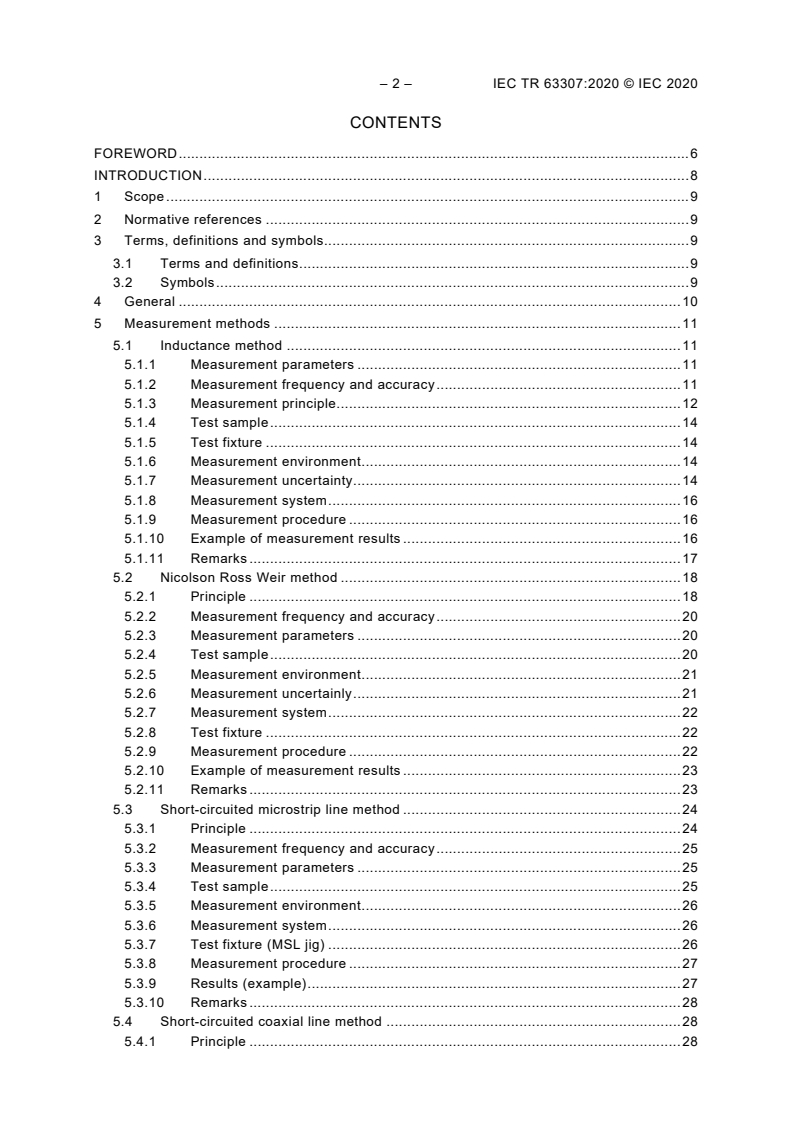
– 2 – IEC TR 63307:2020 © IEC 2020
CONTENTS
FOREWORD . 6
INTRODUCTION . 8
1 Scope . 9
2 Normative references . 9
3 Terms, definitions and symbols. 9
3.1 Terms and definitions . 9
3.2 Symbols . 9
4 General . 10
5 Measurement methods . 11
5.1 Inductance method . 11
5.1.1 Measurement parameters . 11
5.1.2 Measurement frequency and accuracy . 11
5.1.3 Measurement principle. 12
5.1.4 Test sample . 14
5.1.5 Test fixture . 14
5.1.6 Measurement environment . 14
5.1.7 Measurement uncertainty. 14
5.1.8 Measurement system . 16
5.1.9 Measurement procedure . 16
5.1.10 Example of measurement results . 16
5.1.11 Remarks . 17
5.2 Nicolson Ross Weir method . 18
5.2.1 Principle . 18
5.2.2 Measurement frequency and accuracy . 20
5.2.3 Measurement parameters . 20
5.2.4 Test sample . 20
5.2.5 Measurement environment . 21
5.2.6 Measurement uncertainly . 21
5.2.7 Measurement system . 22
5.2.8 Test fixture . 22
5.2.9 Measurement procedure . 22
5.2.10 Example of measurement results . 23
5.2.11 Remarks . 23
5.3 Short-circuited microstrip line method . 24
5.3.1 Principle . 24
5.3.2 Measurement frequency and accuracy . 25
5.3.3 Measurement parameters . 25
5.3.4 Test sample . 25
5.3.5 Measurement environment . 26
5.3.6 Measurement system . 26
5.3.7 Test fixture (MSL jig) . 26
5.3.8 Measurement procedure . 27
5.3.9 Results (example) . 27
5.3.10 Remarks . 28
5.4 Short-circuited coaxial line method . 28
5.4.1 Principle . 28
5.4.2 Measurement frequency and accuracy . 29
5.4.3 Measurement parameters . 30
5.4.4 Test sample . 30
5.4.5 Measurement environments . 30
5.4.6 Measurement system . 30
5.4.7 Test fixture (coax jig) . 31
5.4.8 Measurement procedure . 31
5.4.9 Results (example) . 32
5.4.10 Remarks . 33
5.5 Shielded loop coil method . 33
5.5.1 Measurement principle. 33
5.5.2 Measurement frequency and accuracy . 38
5.5.3 Measurement parameters . 39
5.5.4 NSS sample dimension and recommendation . 39
5.5.5 Measurement environment . 40
5.5.6 Measurement system . 40
5.5.7 Measurement procedure . 40
5.5.8 Measurement results . 41
5.5.9 Summary . 44
5.6 Harmonic resonance cavity perturbation method . 45
5.6.1 Theory . 45
5.6.2 Permeability evaluation . 46
5.6.3 Permittivity evaluation. 53
Annex A (informative) Derivation of the complex relative permeability of the
inductance method . 59
Annex B (informative) Short-circuited microstrip line method. 61
B.1 Fundamental calculation . 61
B.2 Determination of C and G . 62
S S
B.3 Determination of demagnetization factor N and coupling coefficient η . 64
B.4 Analysis with the software to determine the μ . 64
r
Annex C (informative) Short-circuited coaxial line method . 66
C.1 Fundamental calculation to determine μ . 66
r
C.2 Open-circuited coaxial line . 67
C.2.1 Measurement of effective permittivity ε (ε’ – jε” ) . 67
r r r
C.2.2 Example of the complex permittivity . 70
C.3 Remarks on lumped element approximation . 71
Bibliography . 73
Figure 1 – In-plane and perpendicular measurement direction of NSS sample . 11
Figure 2 – Toroidal-shaped sample cut from the NSS . 12
Figure 3 – Test fixture with a toroidal-shaped NSS sample . 13
Figure 4 – Equivalent circuit model of the test fixture . 13
Figure 5 – Schematic diagram of measurement system . 16
Figure 6 – Measurement results of NSS samples . 17
Figure 7 – Schematic diagram of a test fixture with a sample and signal flow graph . 18
Figure 8 – Cross section of coaxial line with NSS . 20
Figure 9 – Dimensions of test sample . 21
– 4 – IEC TR 63307:2020 © IEC 2020
Figure 10 – Schematic diagram of equipment system for measurement . 22
Figure 11 – Specification for test fixture of a 7 mm coaxial transmission line . 22
Figure 12 – Measurement results of noise suppression sheet . 23
Figure 13 – Equivalent circuits for the MSL . 25
Figure 14 – Rectangular shape of NSS sample . 26
Figure 15 – Measurement system . 26
Figure 16 – Short-circuited microstrip line test fixture (MSL jig) . 27
Figure 17 – Complex relative permeability of a NSS sample C with 0,236 mm
thickness, as measured at N = 0 (and η = 0,135 2) and corrected by demagnetization
factor N = 0,037 (and η = 0,135 2) . 28
Figure 18 – Equivalent circuits for the coax jig . 29
Figure 19 – Toroidal shape of NSS sample . 30
Figure 20 – Measurement system . 31
Figure 21 – Short-circuited coaxial line test fixture (coax jig) . 31
Figure 22 – Complex relative permeability of a NSS sample A with 0,29 mm thickness,
as measured and corrected by the permittivity . 32
Figure 23 – Complex relative permeability of a NSS sample B with 0,25 mm thickness,
as measured and corrected by the effective permittivity . 33
Figure 24 – Structure of shielded loop coil . 34
Figure 25 – Shielded loop coil and NSS sample arrangement . 34
Figure 26 – Whole structure of the measuring unit of the equipment . 35
Figure 27 – DC magnetization curve . 38
Figure 28 – Estimation of absolute value correction coefficient M’ . 38
s
Figure 29 – Recommended shape of NSS sample . 39
Figure 30 – Block diagram of measurement system . 40
Figure 31 – Measured complex relative permeability as a function of the size of a NSS
sheet (Sample A-01) . 42
Figure 32 – Measured complex relative permeability as a function of the size of a NSS
sheet (Sample B-01) . 43
Figure 33 – Measured complex relative permeability of a NSS sheet as a function of
DC bias field intensity (Sample A-02) . 43
Figure 34 – Measured complex relative permeability after absolute value calibration
(Sample A-01) . 44
Figure 35 – Measured complex relative permeability after absolute value calibration
(Sample B-01) . 44
Figure 36 – Electromagnetic flux to evaluate permeability in the harmonic resonance
cavity resonator . 47
Figure 37 – Example of the resonance characteristics change . 47
Figure 38 – Cavity resonator for 3,6 GHz to 7,2 GHz . 48
Figure 39 – Cavity resonator for 0,25 GHz to 2 GHz . 48
Figure 40 – Examples of resonance frequencies . 49
Figure 41 – Example of the resonance curves of a harmonic resonance cavity . 49
Figure 42 – Examples of samples . 50
Figure 43 – Measuring system . 50
Figure 44 – Sample installation in the cavity for the permeability measurement . 51
Figure 45 – Measured results of the permeability for Sample A and B and a copper rod . 53
Figure 46 – Electromagnetic flux to evaluate permittivity in the harmonic resonance
cavity resonator . 53
Figure 47 – Sample installation in the cavity for the permittivity measurement . 55
Figure 48 – Adjustment procedure and adjusted results . 56
Figure 49 – Measured results of the permittivity for the two samples, A and B . 58
Figure B.1 – Complex relative permeabilities of Sample C with 0,236 mm thickness for
toroidal shape and rectangular shape corrected by N = 0,037 and η = 0,135 2 . 64
Figure B.2 – Complex relative permeabilities of Sample C with 0,236 mm thickness for
rectangular shape corrected by N = 0, 0,018 5 and 0,037 with η = 0,135 2 . 65
Figure B.3 – Complex relative permeabilities of Sample C with 0,236 mm thickness for
rectangular shape corrected by η = 0,225 3, 0,169 and 0,135 2 with N = 0,037 . 65
Figure C.1 – Open-circuited coaxial line jig . 68
Figure C.2 – Equivalent circuits for the open-circuited coaxial line . 68
Figure C.3 – Complex relative permittivity of NSS Sample A with 0,29 mm thickness,
as measured and corrected by the permeability . 71
Figure C.4 – Complex relative permittivity of NSS Sample B with 0,25 mm thickness,
as measured and corrected by the permeability . 71
Figure C.5 – Dependence of phase shift βt on frequency . 72
Table 1 – Measurement method and frequency . 10
Table 2 – Measurement sample table. 42
– 6 – IEC TR 63307:2020 © IEC 2020
INTERNATIONAL ELECTROTECHNICAL COMMISSION
____________
MEASUREMENT METHODS OF THE COMPLEX RELATIVE
PERMEABILITY AND PERMITTIVITY OF NOISE SUPPRESSION SHEET
FOREWORD
1) The International Electrotechnical Commission (IEC) is a worldwide organization for standardization comprising
all national electrotechnical committees (IEC National Committees). The object of IEC is to promote international
co-operation on all questions concerning standardization in the electrical and electronic fields. To this end and
in addition to other activities, IEC publishes International Standards, Technical Specifications, Technical Reports,
Publicly Available Specifications (PAS) and Guides (hereafter referred to as “IEC Publication(s)”). Their
preparation is entrusted to technical committees; any IEC National Committee interested in the subject dealt with
may participate in this preparatory work. International, governmental and non-governmental organizations liaising
with the IEC also participate in this preparation. IEC collaborates closely with the International Organization for
Standardization (ISO) in accordance with conditions determined by agreement between the two organizations.
2) The formal decisions or agreements of IEC on technical matters express, as nearly as possible, an international
consensus of opinion on the relevant subjects since each technical committee has representation from all
interested IEC National Committees.
3) IEC Publications have the form of recommendations for international use and are accepted by IEC National
Committees in that sense. While all reasonable efforts are made to ensure that the technical content of IEC
Publications is accurate, IEC cannot be held responsible for the way in which they are used or for any
misinterpretation by any end user.
4) In order to promote international uniformity, IEC National Committees undertake to apply IEC Publications
transparently to the maximum extent possible in their national and regional publications. Any divergence between
any IEC Publication and the corresponding national or regional publication shall be clearly indicated in the latter.
5) IEC itself does not provide any attestation of conformity. Independent certification bodies provide conformity
assessment services and, in some areas, access to IEC marks of conformity. IEC is not responsible for any
services carried out by independent certification bodies.
6) All users should ensure that they have the latest edition of this publication.
7) No liability shall attach to IEC or its directors, employees, servants or agents including individual experts and
members of its technical committees and IEC National Committees for any personal injury, property damage or
other damage of any nature whatsoever, whether direct or indirect, or for costs (including legal fees) and
expenses arising out of the publication, use of, or reliance upon, this IEC Publication or any other IEC
Publications.
8) Attention is drawn to the Normative references cited in this publication. Use of the referenced publications is
indispensable for the correct application of this publication.
9) Attention is drawn to the possibility that some of the elements of this IEC Publication may be the subject of patent
rights. IEC shall not be held responsible for identifying any or all such patent rights.
The main task of IEC technical committees is to prepare International Standards. However, a
technical committee may propose the publication of a technical report when it has collected
data of a different kind from that which is normally published as an International Standard, for
example "state of the art".
IEC TR 63307, which is a technical report, has been prepared by IEC technical committee 51:
Magnetic components, ferrite and magnetic powder materials.
The text of this Technical Specification is based on the following documents:
Draft TR Report on voting
51/1349/DTR 51/1356/RVDTR
Full information on the voting for its approval can be found in the report on voting indicated in
the above table.
The language used for the development of this Technical Report is English.
This document was drafted in accordance with ISO/IEC Directives, Part 2, and developed in
accordance with ISO/IEC Directives, Part 1 and ISO/IEC Directives, IEC Supplement, available
at www.iec.ch/members_experts/refdocs. The main document types developed by IEC are
described in greater detail at www.iec.ch/standardsdev/publications.
The committee has decided that the contents of this document will remain unchanged until the
stability date indicated on the IEC website under "http://webstore.iec.ch" in the data related to
the specific document. At this date, the document will be
• reconfirmed,
• withdrawn,
• replaced by a revised edition, or
• amended.
IMPORTANT – The 'colour inside' logo on the cover page of this publication indicates
that it contains colours which are considered to be useful for the correct understanding
of its contents. Users should therefore print this document using a colour printer.
– 8 – IEC TR 63307:2020 © IEC 2020
INTRODUCTION
Noise suppression sheet (NSS) is used near the source of high frequency electromagnetic noise,
path of noise propagation and source of emission. It is used like a patch and is different from
an electromagnetic wave absorber in free space. IEC 62333-2 specifies five measurement
methods in order to estimate the effect of NSS. To evaluate the effect by computer simulation,
it is indispensable to know the frequency characteristics of both permeability and permittivity.
And to make a rough estimate of the noise suppression effect of NSS, it is useful to understand
effective permeability and effective permittivity, which are the permeability and permittivity of
an actually used shape.
As most NSSs are flexible, and both complex relative permeability and complex relative
permittivity have anisotropy, careful study and understanding of the principles are indispensable
for the measurement of the frequency characteristics of permeability and permittivity.
There are various methods to measure permeability and permittivity under the frequency range
where NSS is used. This document is intended to be used for the proper selection of the
measurement method and the preparation of the test sample to achieve the above purpose
when measuring permeability and permittivity, the two parameters which largely influence the
noise suppression effect of the NSS.
MEASUREMENT METHODS OF THE COMPLEX RELATIVE
PERMEABILITY AND PERMITTIVITY OF NOISE SUPPRESSION SHEET
1 Scope
This document provides guidelines on the methods for measuring the frequency characteristics
of permeability and permittivity in the frequency range of 1 MHz to 6 GHz for a noise
suppression sheet for each electromagnetic noise countermeasure.
2 Normative references
There are no normative references in this document.
3 Terms, definitions and symbols
3.1 Terms and definitions
For the purposes of this document, the following terms and definitions apply.
ISO and IEC maintain terminological databases for use in standardization at the following
addresses:
• IEC Electropedia: available at http://www.electropedia.org/
• ISO Online browsing platform: available at http://www.iso.org/obp
3.1.1
noise suppression
suppression which consists of signal decoupling, radiation suppression and attenuation of the
transmission power of noise by an electronic product
Note 1 to entry: Each function above is achieved by absorption and/or shielding.
3.1.2
noise suppression sheet
NSS
sheet which enables noise suppression and is composed of magnetic, dielectric or conductive
material with electromagnetic losses
EXAMPLE Sheet made of soft magnetic metal powder and resin or rubber.
3.1.3
suppression ratio
ratio of the noise level with and without suppression sheets
Note 1 to entry: The suppression ratio is classified into intra-decoupling ratio, inter-decoupling ratio, transmission
attenuation power ratio and radiation suppression ratio. It is expressed in dB.
3.2 Symbols
µ complex relative permeability
r
μ′ real part of complex relative permeability
r
μ′′ imaginary part of complex relative permeability
r
ε complex relative permittivity
r
– 10 – IEC TR 63307:2020 © IEC 2020
ε′ real part of complex relative permittivity
r
ε″ imaginary part of complex relative permittivity
r
Z impedance (Ω)
ω = 2πf angular frequency (rad/s)
I current (A)
B = µ µ H magnetic flux density (T)
0 r
H magnetic field strength (A/m)
−7
µ
permeability of vacuum (4π × 10 H/m)
f frequency
4 General
Composite materials made by embedding magnetic metal flakes in a plastic sheet are widely
used in PCs or mobile phone handsets. This sheet is well known as a noise suppression sheet
(NSS) and is used to reduce unwanted signals in transmission lines or unwanted couplings
between circuit elements in the devices described above.
Electromagnetic compatibility (EMC) designers recently have been using simulations for the
design of the circuit boards for PCs and mobile phone handsets. In these simulations, it is
important to know the complex relative permeability μ and the complex relative permittivity ε
r r
of NSS. This document shows the six measurement methods of μ and ε of NSS. The
r r
measurement frequency range is from 1 MHz to 6 GHz, as shown in Table 1. Figure 1 illustrates
the in-plane and perpendicular measurement direction of Table 1.
Table 1 – Measurement method and frequency
µ and ε
r r
Frequency
In-plane Perpendicular
Method Name
1 MHz to
ε
µ ε µ
100 MHz 1 GHz 10 GHz 100 GHz
r
r r r
10 MHz
1 MHz to 1 GHz
5.1 Inductance ○
5.2 Nicolson
500 MHz to
○ ○
Ross Weir
5.3 Short-
10 MHz to 10 GHz
circuited micro ○
strip line
5.4 Short-
1 MHz to 18 GHz
circuited coaxial ○ ○
line
5.5 Shielded
1 MHz to 10 GHz
○
loop coil
250 MHz to 18 GHz
○ ○
5.6 Harmonic
resonance cavity
perturbation
1,8 MHz
○ ○
Range of frequency (1 MHz to 6 GHz)
Figure 1 – In-plane and perpendicular measurement direction of NSS sample
5 Measurement methods
5.1 Inductance method
5.1.1 Measurement parameters
The measurement parameters of a magnetic material are defined as follows:
′ ′′ (1)
μ μμ− j
rr r
where
′ ′′
μ and μ are the real part and the imaginary part of the complex relative permeability,
r r
respectively.
5.1.2 Measurement frequency and accuracy
The objective of this method is to evaluate the in-plane permeability of toroidal-shaped thin
NSS samples shown in Figure 2 and is applicable for the measurements under the following
conditions:
frequency : 1 MHz ≤ f ≤ 1 GHz
relative permeability : ′
1 ≤ μ ≤ 1 000
r
′′
0 ≤ μ ≤ 1 000
r
accuracy : ′
value error ±20 % for μ
r
′′
value error ±20 % for μ
r
The measurement frequency range is affected by the dimensions and the permeability values
of the NSS sample. The higher the permittivity, the lower the upper limit of the frequency range
will be.
=
– 12 – IEC TR 63307:2020 © IEC 2020
Figure 2 – Toroidal-shaped sample cut from the NSS
5.1.3 Measurement principle
The test fixture shown in Figure 3 forms the ideal one-turn inductor. The self-inductance is given
by
Z 1
= B ds (2)
∫
S
jωI
where
Z is the impedance (Ω);
ω = 2πf is the angular frequency (rad/s);
I is the current (A);
B = µ µ H is the magnetic flux density (T);
0 r
H is the Magnetic field strength (A/m);
−7
µ is the permeability of vacuum (4π × 10 H/m);
S is the surface shown in Figure 3.
Therefore, the complex relative permeability is
ZZ− Z
22ππm sm NSS
μ 1 +1 (3)
r
μ jjωF μFω
or
2π xx− 2π x
m sm NSS
(4)
′
µ 11+
r
µ ωFFµω
2π rr− 2π r
m sm NSS
(5)
′′
µ
r
µ ωFFµω
where
Z = r + jx is the measured impedance with a sample;
m m m
Z = r + jx is the measured impedance without a sample (in short state);
sm sm sm
Z = r + jx is the impedance of a NSS sample;
NSS NSS NSS
==
+= =
+= =
b
is the shape factor of a sample, inner diameter a, outer diameter b, and
F=t ln
a
thickness t.
Z is used to minimize errors due to residual impedance by compensation. The equivalent
sm
circuit model of the test fixture is shown in Figure 4. g + jb is the admittance of the test fixture
p p
and its effect can be neglected in a simplified case. Therefore, the impedance Z of a NSS
NSS
sample is Z − Z .
m sm
The derivation procedure is shown in detail in Annex A.
a) Structure b) Parameters
Figure 3 – Test fixture with a toroidal-shaped NSS sample
Figure 4 – Equivalent circuit model of the test fixture
– 14 – IEC TR 63307:2020 © IEC 2020
5.1.4 Test sample
The sample shall be fabricated in the shape of a toroidal ring. A good round sample can be
obtained by a punching tool. The preferable sample size is as follows:
For the fixture of 24 mm diameter in 5.1.5:
inner diameter : a ≥ 3,1 mm
outer diameter : b ≤ 8 mm
thickness : t ≤ 3 mm
For the fixture of 30 mm diameter:
inner diameter : a ≥ 5 mm
outer diameter : b ≤ 20 mm
thickness : t ≤ 8,5 mm
Each parameter should be measured with a precision of less than 1/100 mm using a micrometer.
5.1.5 Test fixture
The structure of the test fixture is shown in Figure 3. The test fixture is a conductive shield
surrounding the central conductor and terminates in a short circuit. The connector of the test
fixture is connected through the coaxial connector to the measurement equipment. The
alignment error of the NSS sample from the centre affects the measurement results, so the use
of a sample holder is recommended to place a sample coaxially. Examples of features of a test
fixture are as follows:
diameter : b = 24 mm
height : t = 30 mm
resistance : r = 100 mΩ
sm
inductance : x /ω = 1,0 nH
sm
or
= 30 mm
diameter : b
height : t = 35 mm
resistance : r = 300 mΩ
sm
inductance : x /ω = 5,5 nH
sm
The diameter of a centre conductor is a = 3 mm for both fixtures.
5.1.6 Measurement environment
The fixture and the samples shall be kept in a clean and dry state. The room temperature and
the relative humidity shall preferably be 23 °C ± 5 °C and less than 60 %.
5.1.7 Measurement uncertainty
'
and ′′ , and , are estimated as the combined
Measurement uncertainties of u µ u µ′ u µ′′
( ) ( )
r
r r r
standard uncertainty and given respectively by
2 2
∂∂µµ′′
2 2 2
rr
u µ′= ux++ux
( ) ( ) ( )
r m sm
∂∂xx
m sm
2 22
′ ′′
∂µ 2 ∂∂µµ22
r rr
(6)
u a ++ub ut
( ) ( ) ()
∂∂ab ∂t
2 2
2 22
′′ ′′ ′′ ′′ ′′
22∂∂µµ 2 ∂µ 2 ∂∂µµ22
rr r rr
(7)
u µ′′= ur+ ur+ u a ++ub ut
( ) ( ) ( ) ( ) ( ) ()
r m sm
∂∂rr ∂∂ab ∂t
m sm
where u(x ), u(x ), u(r ), u(r ), u(a), u(b) and u(t) are standard uncertainties of x , x , r ,
m sm m sm m sm m
r , a, b and t, respectively. The sensitivity coefficients in Formulae (6) and (7) are as follows:
sm
∂µ′ 2π1
r
(8)
=
∂x µωF
m0
′
∂µ 2π1
r
(9)
−
∂x µωF
sm 0
′
∂µ 2π xx− t
r m sm
(10)
=
∂aaµω F
′ xx−
∂µ 2π t
r m sm
(11)
−
∂b µω bF
′ −
∂µ 2π1xx
m sm
r
(12)
−
∂htµω F
′′
∂µ
2π1
r
(13)
=
∂r µωF
m0
∂µ′′
2π1
r
(14)
−
∂r µωF
sm 0
∂µ′′
rr−
2π t
r
m sm
(15)
=
∂aaµω F
∂µ′′
2π rr− t
r
m sm
(16)
−
∂bbµω F
0
∂µ′′
2π1rr−
r
m sm
(17)
−
∂htµω F
0
=
=
=
=
=
=
– 16 – IEC TR 63307:2020 © IEC 2020
5.1.8 Measurement system
Figure 5 shows a schematic diagram of the measurement system. For the measurement of the
magnetic properties, the information on the ratio of the current and voltage values and the
phase difference between current and voltage are needed. An impedance analyzer, LCR meter
or vector network analyzer (VNA) can be used for the measurement.
Figure 5 – Schematic diagram of measurement system
5.1.9 Measurement procedure
1) Calibrate the measurement equipment
When the measurement equipment is turned ON, the calibration shall be performed with the
proper calibration kit to measure within its specified measurement accuracy. The
measurement system shall be warmed up sufficiently before starting the calibration.
2) Connect the test fixture
Connect the connector of the test fixture to the coaxial connector of the previously calibrated
measurement equipment.
3) Place the sample holder and measure the impedance Z
sm
Place only the sample holder in the test fixture. Enter the measurement parameters,
frequency range and oscillator output voltage level and other values, into the measurement
equipment and measure the impedance Z of the test fixture.
sm
4) Place the NSS sample and measure the impedance Z
m
Place the toroidal-shaped NSS sample with the sample holder in the test fixture coaxially
and measure the impedance Z of the test fixture with a sample.
m
5) Calculate the relative permeability µ′ and µ′′ and uncertainties ′ and ′′
u(µ) u(µ)
r r r r
Calculate the values of ′ and ′′ by using Formula (4) and Formula (5), respectively. The
µ µ
r r
measurement uncertainties are also calculated by using Formula (6) to Formula (17).
5.1.10 Example of measurement results
The measurement results of µ′ and µ′′ for a NSS (sample A and B) are shown in Figure 6. The
r r
parameters of the sample are a = 3,00 mm, b = 7,00 mm and t = 0,20 mm (sample A) or 0,25 mm
(sample B), and the oscillator output voltage level, about 0,1 V, is selected in order not to affect
the results.
a) Sample A (t = 0,20mm)
b) Sample B (t = 0,25mm)
Figure 6 – Measurement results of NSS samples
5.1.11 Remarks
Subclause 5.1 provides some helpful information on measuring the magnetic properties of
toroidal-shaped NSS samples using the inductance method.
1) The test sample should be made correctly in a toroidal shape and placed in the test fixture
coaxially.
2) The measurement accuracy depends on the measured impedance values and gets worse in
low frequencies because the measurement error increases with a decrease in the frequency.
– 18 – IEC TR 63307:2020 © IEC 2020
3) The use of an impedance analyzer is recommended to measure the impedance because the
impedance analyzer has the advantages of higher accuracy and wider impedance
measurement range than a network analyzer.
′ ′′
4) The measurement results of µ and µ may be obtained after measuring the impedance
r r
Z and Z if the material analyzer is used. The measurement results of the impedance Z
sm m sm
and Z are not displayed because the software installed on the analyzer calculates and
m
compensates the measurement results.
5) A sample with a low permeability or a thin thickness leads to measurement error. It is difficult
to measure its permeability accurately due to the low impedance Z of a NSS sample.
NSS
Stacking some samples is a better way to get the results needed.
6) When the permittivity of a NSS sample is high (more than about 10), current flows through
the space between the NSS sample and the test fixture. This introduces an equivalent
capacitance connected in parallel to the impedance of the sample Z . The resonance of
NSS
this parallel LC circuit occurs at around 1 GHz or below and precise measurements will be
difficult.
5.2 Nicolson Ross Weir method
5.2.1 Principle
The objective of this method is to evaluate the broadband properties of the complex relative
permeability and permittivity of a noise suppression sheet by using a transmission line as
coaxial line and waveguide. Measurement frequency ranges and accuracy depend on the test
fixture and electromagnetic properties of a sample. This document describes a measurement
method using a 7 mm coaxial transmission line. Complex relative permittivity and permeability
are to be derived from the reflection and transmission coefficient of a sample inserted into a
transmission line. Reflection and transmission coefficients are calculated from S-parameters
S and S measured by a vector network analyzer. Figure 7 shows a schematic diagram of a
11 21
test fixture with a sample and signal flow graph.
Figure 7 – Schematic diagram of a test fixture with a sample and signal flow graph
A signal is inserted from Port1. L and t are the length of a test fixture and sample L and L are
1 2
the length from the respective reference plane to the sample faces.
From a signal flow graph, the S-parameters on a transmission line with sample are given by
Γ−1 T
( )
S = R
(18)
11 1
1−ΓT
T 1−Γ
( )
S = RR (19)
21 1 2
1−ΓT
R exp−γ L i=1,2 (20)
( ) ( )
ii0
where
Γ is the reflection coefficient at sample faces;
T is the transmission coefficient of a sample;
γ is the propagation constant of air;
R is the transmission coefficient from the reference plane to the sample face at the respective
i
ports.
Reflection coefficient Γ is defined by
ZZ−
L0
Γ=
(21)
ZZ+
L0
µ
r
ZZ= (22)
L0
ε
r
where
Z and Z are the characteristic impedance of a sample and air in the transmission line.
L 0
The transmission coefficient and propagation constant of a sample on a transmission line are
given by
(23)
Tdexp()−γ
γ=γ µε
(24)
0 rr
where
γ is the propagation constant of a sample.
From Formula (18) to Formula (24), the complex relative permeability and permittivity of a
sample are calculated by
=
=
– 20 – IEC TR 63307:2020 © IEC 2020
1+Γ 11
µ = ln
(25)
r
1−Γ γ d T
1−Γ 11
ε = ln (26)
r
1+Γ γ d T
0
It shall be noted that the calculated value is divergent at integral multiples of half wavelength
in a sample.
5.2.2 Measurement frequency and accuracy
The objective of this method is to measure the broadband electromagnetic properties of a
sample. Measurement frequency ranges and accuracy depend on the test fixture and
electromagnetic properties of a test sample. The lower frequency is limited by the smallest
measurable phase shift through a sample. The upper frequency limit is determined by the
excitation of higher order modes that invalidates the domina
...