


IEC 61462:2023
(Main)Composite hollow insulators - Pressurized and unpressurized insulators for use in electrical equipment with AC rated voltage greater than 1 000 V AC and D.C. voltage greater than 1500V - Definitions, test methods, acceptance criteria and design recommendations
Composite hollow insulators - Pressurized and unpressurized insulators for use in electrical equipment with AC rated voltage greater than 1 000 V AC and D.C. voltage greater than 1500V - Definitions, test methods, acceptance criteria and design recommendations
IEC 61462:2023 applies to composite hollow insulators consisting of a load-bearing insulating tube made of resin-impregnated fibres, a housing (outside the insulating tube) made of elastomeric material (for example silicone or ethylene-propylene) and metal fixing devices at the ends of the insulating tube (see Figure D.1 and Figure D.2 for examples). The object of this document is to define the terms used, to specify test methods; and to specify acceptance criteria. This document distinguishes between design tests and type tests because several general characteristics of a specific design and specific combinations of materials do not vary for different insulator types. This new edition cancels and replaces the previous edition published in 2007. This edition includes the following significant technical changes with respect to the previous edition:
a) modifications of terms and definitions;
b) modifications of tests procedures included in IEC TR 62039 and IEC 62217 (Hydrophobicity transfer test; Water diffusion test on the core with housing);
c) modification of Clause 8 (type tests) to reflect common practice and to also consider tapered (conical) insulators;
modification of order of the stages of mechanical sample test (9.4) by setting the tightness test as last stage;
d) harmonization of Table 3 (Tests to be carried out after design changes) with other product standards;
e) addition of a new informative Annex D: Principle sketch of hollow insulators design assembly;
f) addition of a new informative Annex E: Type tests on tapered (conical) insulators.
Isolateurs composites creux - Isolateurs avec ou sans pression interne pour utilisation dans des appareillages électriques de tensions alternatives assignées supérieures à 1 000 V et de tensions continues supérieures à 1 500 V - Définitions, méthodes d’essai, critères d’acceptation et recommandations de conception
L'IEC 61462:2023 s’applique aux isolateurs composites creux qui sont constitués d’un tube isolant supportant la charge mécanique constitué de fibres imprégnées de résine, protégé par un revêtement en élastomère (par exemple silicone ou éthylène-propylène) et de pièces métalliques fixées à ses extrémités (voir des exemples à la Figure D.1 et à la Figure D.2). Le présent document a pour objet de définir les termes employés; de spécifier les méthodes d’essai; de spécifier les critères d’acceptation. Le présent document fait la distinction entre les essais de conception et les essais de type puisqu’une conception et une combinaison de matériaux données peuvent être utilisées pour différents types d’isolateurs. Dans ce cas, les résultats des essais de conception peuvent être considérés valables pour les différents types d’isolateurs. Cette nouvelle édition annule et remplace l’édition précédente parue en 2007. Cette édition inclut les modifications techniques majeures suivantes par rapport à l’édition précédente:
a) modifications des termes et définitions;
b) modifications des procédures d’essai incluses dans l’IEC TR 62039 et l’IEC 62217 (essai de transfert d’hydrophobicité; essai de pénétration d’eau sur noyau avec revêtement);
c) modification de l’Article 8 (essais de type) pour refléter la pratique courante et pour prendre également en compte les isolateurs à tube conique;
d) modification de l’ordre des étapes de l’essai sur prélèvements mécanique (9.4) en choisissant l’essai d’étanchéité comme dernière étape;
e) harmonisation du Tableau 3 (essais à réaliser après modifications de conception) avec d’autres normes de produit;
g) ajout d’une nouvelle Annexe D informative: Schéma de principe descriptif des isolateurs creux;
f) ajout d’une nouvelle Annexe E informative: Essais de type réalisés sur des isolateurs à tube conique.
General Information
- Status
- Published
- Publication Date
- 05-Sep-2023
- Technical Committee
- TC 36 - Insulators
- Drafting Committee
- MT 24 - TC 36/MT 24
- Current Stage
- PPUB - Publication issued
- Start Date
- 06-Sep-2023
- Completion Date
- 22-Sep-2023
Relations
- Effective Date
- 08-Sep-2023
- Effective Date
- 05-Sep-2023
Overview
IEC 61462:2023 is an International Electrotechnical Commission (IEC) standard that specifies requirements for composite hollow insulators used in electrical equipment with AC rated voltages greater than 1,000 V and DC voltages over 1,500 V. The standard applies to both pressurized and unpressurized hollow insulators comprised of a load-bearing insulating tube-typically made from resin-impregnated fibers-an external elastomeric housing (such as silicone or ethylene-propylene), and metal end fittings.
IEC 61462:2023 provides clear definitions, test methods, acceptance criteria, and design recommendations for these insulators, supporting the reliability and safety of high-voltage equipment in power transmission and distribution systems. This standard helps ensure that composite hollow insulators perform effectively throughout their service life, resisting electrical, mechanical, and environmental stresses.
Key Topics
IEC 61462:2023 covers several critical aspects for manufacturers, users, and testing organizations:
- Definitions: Comprehensive terminology for parts, materials, and mechanical concepts relating to composite hollow insulators.
- Test Methods: Detailed procedures for design, type, sample, and routine tests, including:
- Mechanical and pressure tests
- Thermal-mechanical pre-stressing
- Hydrophobicity transfer and water diffusion testing
- Tracking and erosion testing for material performance
- Acceptance Criteria: Clear pass/fail criteria for all certified tests.
- Design Recommendations: Guidance on material selection, assembly, installation, and operational pressures.
- Harmonization: Updates to align test procedures and requirements with related IEC standards.
- Revision Highlights: Modifications include updated terminology, revised test sequences, instructions for tapered (conical) designs, and new illustrative annexes improving clarity for assembly and specialized testing.
Applications
Composite hollow insulators covered by IEC 61462:2023 play a vital role in a broad range of high-voltage equipment, both indoor and outdoor, ensuring electrical insulation and mechanical support. Typical applications include:
- HV Circuit-Breakers and Switchgear: For insulation and structural integrity in high-voltage switching devices.
- Instrument and Power Transformers: Used as bushings and housings to protect critical transformer components.
- Disconnectors and Earthing Switches: Provide reliable, safe insulation in switching equipment.
- Station Posts and Cable Terminations: Used wherever robust insulation and long-term outdoor performance are required.
- Surge Arresters Housing: Offering protection against atmospheric and switching surges.
These insulators are designed to withstand environmental extremes, mechanical loads, and electrical stresses, making them essential in modern electrical infrastructure for transmission, distribution, substations, and grid interconnections.
Related Standards
IEC 61462:2023 references and aligns with several related IEC standards to ensure consistency and broad applicability:
- IEC 62155: Hollow pressurized and unpressurized ceramic and glass insulators for similar voltage applications.
- IEC 62217: Polymeric HV insulators for AC and DC equipment - provides general definitions, testing, and acceptance criteria.
- IEC TR 62039: Guidelines for selecting polymeric materials for outdoor use in HV insulation applications.
It is recommended to consult relevant product and equipment standards in addition to IEC 61462:2023 to ensure full compliance with international and project-specific requirements.
Keywords: IEC 61462, composite hollow insulators, high voltage insulation, elastomeric housing, polymeric insulators, pressurized insulators, unpressurized insulators, test methods, acceptance criteria, power equipment standards.
Buy Documents
IEC 61462:2023 - Composite hollow insulators - Pressurized and unpressurized insulators for use in electrical equipment with AC rated voltage greater than 1 000 V AC and D.C. voltage greater than 1500V - Definitions, test methods, acceptance criteria and design recommendations Released:9/6/2023
Get Certified
Connect with accredited certification bodies for this standard

IMQ S.p.A. (Certification)
Italian electrical product certification.

SLG Prüf- und Zertifizierungs GmbH
German testing and certification body.

UL Solutions
Global safety science company with testing, inspection and certification.
Sponsored listings
Frequently Asked Questions
IEC 61462:2023 is a standard published by the International Electrotechnical Commission (IEC). Its full title is "Composite hollow insulators - Pressurized and unpressurized insulators for use in electrical equipment with AC rated voltage greater than 1 000 V AC and D.C. voltage greater than 1500V - Definitions, test methods, acceptance criteria and design recommendations". This standard covers: IEC 61462:2023 applies to composite hollow insulators consisting of a load-bearing insulating tube made of resin-impregnated fibres, a housing (outside the insulating tube) made of elastomeric material (for example silicone or ethylene-propylene) and metal fixing devices at the ends of the insulating tube (see Figure D.1 and Figure D.2 for examples). The object of this document is to define the terms used, to specify test methods; and to specify acceptance criteria. This document distinguishes between design tests and type tests because several general characteristics of a specific design and specific combinations of materials do not vary for different insulator types. This new edition cancels and replaces the previous edition published in 2007. This edition includes the following significant technical changes with respect to the previous edition: a) modifications of terms and definitions; b) modifications of tests procedures included in IEC TR 62039 and IEC 62217 (Hydrophobicity transfer test; Water diffusion test on the core with housing); c) modification of Clause 8 (type tests) to reflect common practice and to also consider tapered (conical) insulators; modification of order of the stages of mechanical sample test (9.4) by setting the tightness test as last stage; d) harmonization of Table 3 (Tests to be carried out after design changes) with other product standards; e) addition of a new informative Annex D: Principle sketch of hollow insulators design assembly; f) addition of a new informative Annex E: Type tests on tapered (conical) insulators.
IEC 61462:2023 applies to composite hollow insulators consisting of a load-bearing insulating tube made of resin-impregnated fibres, a housing (outside the insulating tube) made of elastomeric material (for example silicone or ethylene-propylene) and metal fixing devices at the ends of the insulating tube (see Figure D.1 and Figure D.2 for examples). The object of this document is to define the terms used, to specify test methods; and to specify acceptance criteria. This document distinguishes between design tests and type tests because several general characteristics of a specific design and specific combinations of materials do not vary for different insulator types. This new edition cancels and replaces the previous edition published in 2007. This edition includes the following significant technical changes with respect to the previous edition: a) modifications of terms and definitions; b) modifications of tests procedures included in IEC TR 62039 and IEC 62217 (Hydrophobicity transfer test; Water diffusion test on the core with housing); c) modification of Clause 8 (type tests) to reflect common practice and to also consider tapered (conical) insulators; modification of order of the stages of mechanical sample test (9.4) by setting the tightness test as last stage; d) harmonization of Table 3 (Tests to be carried out after design changes) with other product standards; e) addition of a new informative Annex D: Principle sketch of hollow insulators design assembly; f) addition of a new informative Annex E: Type tests on tapered (conical) insulators.
IEC 61462:2023 is classified under the following ICS (International Classification for Standards) categories: 29.080.10 - Insulators. The ICS classification helps identify the subject area and facilitates finding related standards.
IEC 61462:2023 has the following relationships with other standards: It is inter standard links to IEC TS 61462:1998, IEC 61462:2007. Understanding these relationships helps ensure you are using the most current and applicable version of the standard.
IEC 61462:2023 is available in PDF format for immediate download after purchase. The document can be added to your cart and obtained through the secure checkout process. Digital delivery ensures instant access to the complete standard document.
Standards Content (Sample)
IEC 61462 ®
Edition 2.0 2023-09
INTERNATIONAL
STANDARD
NORME
INTERNATIONALE
Composite hollow insulators – Pressurized and unpressurized insulators for use
in electrical equipment with AC rated voltage greater than 1 000 V AC and D.C.
voltage greater than 1500V – Definitions, test methods, acceptance criteria and
design recommendations
Isolateurs composites creux – Isolateurs avec ou sans pression interne pour
utilisation dans des appareillages électriques de tensions alternatives assignées
supérieures à 1 000 V et de tensions continues supérieures à 1 500 V –
Définitions, méthodes d’essai, critères d’acceptation et recommandations de
conception
All rights reserved. Unless otherwise specified, no part of this publication may be reproduced or utilized in any form
or by any means, electronic or mechanical, including photocopying and microfilm, without permission in writing from
either IEC or IEC's member National Committee in the country of the requester. If you have any questions about IEC
copyright or have an enquiry about obtaining additional rights to this publication, please contact the address below or
your local IEC member National Committee for further information.
Droits de reproduction réservés. Sauf indication contraire, aucune partie de cette publication ne peut être reproduite ni
utilisée sous quelque forme que ce soit et par aucun procédé, électronique ou mécanique, y compris la photocopie et
les microfilms, sans l'accord écrit de l'IEC ou du Comité national de l'IEC du pays du demandeur. Si vous avez des
questions sur le copyright de l'IEC ou si vous désirez obtenir des droits supplémentaires sur cette publication, utilisez
les coordonnées ci-après ou contactez le Comité national de l'IEC de votre pays de résidence.
IEC Secretariat Tel.: +41 22 919 02 11
3, rue de Varembé info@iec.ch
CH-1211 Geneva 20 www.iec.ch
Switzerland
About the IEC
The International Electrotechnical Commission (IEC) is the leading global organization that prepares and publishes
International Standards for all electrical, electronic and related technologies.
About IEC publications
The technical content of IEC publications is kept under constant review by the IEC. Please make sure that you have the
latest edition, a corrigendum or an amendment might have been published.
IEC publications search - webstore.iec.ch/advsearchform IEC Products & Services Portal - products.iec.ch
The advanced search enables to find IEC publications by a Discover our powerful search engine and read freely all the
variety of criteria (reference number, text, technical publications previews. With a subscription you will always have
committee, …). It also gives information on projects, replaced access to up to date content tailored to your needs.
and withdrawn publications.
Electropedia - www.electropedia.org
IEC Just Published - webstore.iec.ch/justpublished
The world's leading online dictionary on electrotechnology,
Stay up to date on all new IEC publications. Just Published
containing more than 22 300 terminological entries in English
details all new publications released. Available online and once
and French, with equivalent terms in 19 additional languages.
a month by email.
Also known as the International Electrotechnical Vocabulary
(IEV) online.
IEC Customer Service Centre - webstore.iec.ch/csc
If you wish to give us your feedback on this publication or need
further assistance, please contact the Customer Service
Centre: sales@iec.ch.
A propos de l'IEC
La Commission Electrotechnique Internationale (IEC) est la première organisation mondiale qui élabore et publie des
Normes internationales pour tout ce qui a trait à l'électricité, à l'électronique et aux technologies apparentées.
A propos des publications IEC
Le contenu technique des publications IEC est constamment revu. Veuillez vous assurer que vous possédez l’édition la
plus récente, un corrigendum ou amendement peut avoir été publié.
Recherche de publications IEC - IEC Products & Services Portal - products.iec.ch
webstore.iec.ch/advsearchform Découvrez notre puissant moteur de recherche et consultez
La recherche avancée permet de trouver des publications IEC gratuitement tous les aperçus des publications. Avec un
en utilisant différents critères (numéro de référence, texte, abonnement, vous aurez toujours accès à un contenu à jour
comité d’études, …). Elle donne aussi des informations sur les adapté à vos besoins.
projets et les publications remplacées ou retirées.
Electropedia - www.electropedia.org
IEC Just Published - webstore.iec.ch/justpublished
Le premier dictionnaire d'électrotechnologie en ligne au monde,
Restez informé sur les nouvelles publications IEC. Just
avec plus de 22 300 articles terminologiques en anglais et en
Published détaille les nouvelles publications parues.
français, ainsi que les termes équivalents dans 19 langues
Disponible en ligne et une fois par mois par email.
additionnelles. Egalement appelé Vocabulaire
Electrotechnique International (IEV) en ligne.
Service Clients - webstore.iec.ch/csc
Si vous désirez nous donner des commentaires sur cette
publication ou si vous avez des questions contactez-nous:
sales@iec.ch.
IEC 61462 ®
Edition 2.0 2023-09
INTERNATIONAL
STANDARD
NORME
INTERNATIONALE
Composite hollow insulators – Pressurized and unpressurized insulators for use
in electrical equipment with AC rated voltage greater than 1 000 V AC and D.C.
voltage greater than 1500V – Definitions, test methods, acceptance criteria and
design recommendations
Isolateurs composites creux – Isolateurs avec ou sans pression interne pour
utilisation dans des appareillages électriques de tensions alternatives assignées
supérieures à 1 000 V et de tensions continues supérieures à 1 500 V –
Définitions, méthodes d’essai, critères d’acceptation et recommandations de
conception
INTERNATIONAL
ELECTROTECHNICAL
COMMISSION
COMMISSION
ELECTROTECHNIQUE
INTERNATIONALE
ICS 29.080.10 ISBN 978-2-8322-7403-3
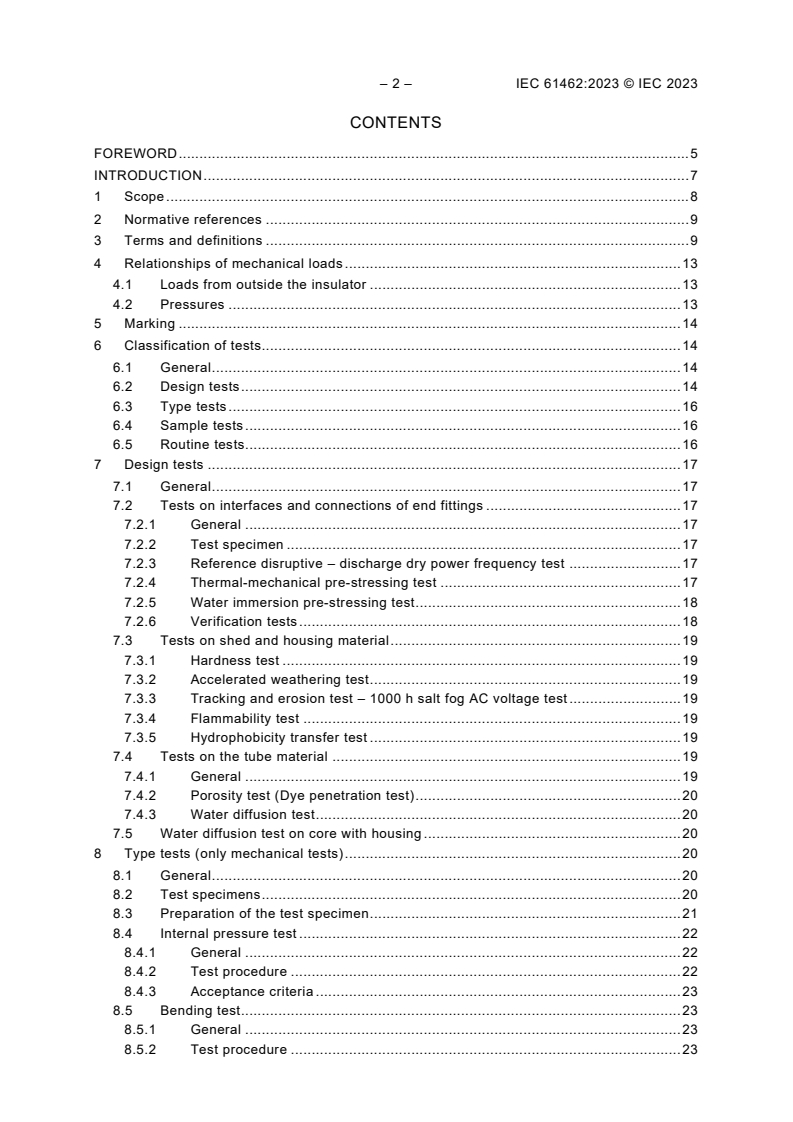
– 2 – IEC 61462:2023 © IEC 2023
CONTENTS
FOREWORD . 5
INTRODUCTION . 7
1 Scope . 8
2 Normative references . 9
3 Terms and definitions . 9
4 Relationships of mechanical loads . 13
4.1 Loads from outside the insulator . 13
4.2 Pressures . 13
5 Marking . 14
6 Classification of tests. 14
6.1 General . 14
6.2 Design tests . 14
6.3 Type tests . 16
6.4 Sample tests . 16
6.5 Routine tests. 16
7 Design tests . 17
7.1 General . 17
7.2 Tests on interfaces and connections of end fittings . 17
7.2.1 General . 17
7.2.2 Test specimen . 17
7.2.3 Reference disruptive – discharge dry power frequency test . 17
7.2.4 Thermal-mechanical pre-stressing test . 17
7.2.5 Water immersion pre-stressing test . 18
7.2.6 Verification tests . 18
7.3 Tests on shed and housing material . 19
7.3.1 Hardness test . 19
7.3.2 Accelerated weathering test . 19
7.3.3 Tracking and erosion test – 1000 h salt fog AC voltage test . 19
7.3.4 Flammability test . 19
7.3.5 Hydrophobicity transfer test . 19
7.4 Tests on the tube material . 19
7.4.1 General . 19
7.4.2 Porosity test (Dye penetration test) . 20
7.4.3 Water diffusion test . 20
7.5 Water diffusion test on core with housing . 20
8 Type tests (only mechanical tests) . 20
8.1 General . 20
8.2 Test specimens . 20
8.3 Preparation of the test specimen . 21
8.4 Internal pressure test . 22
8.4.1 General . 22
8.4.2 Test procedure . 22
8.4.3 Acceptance criteria . 23
8.5 Bending test . 23
8.5.1 General . 23
8.5.2 Test procedure . 23
8.5.3 Acceptance criteria . 24
9 Sample tests . 24
9.1 Selection and number of insulators . 24
9.2 Testing . 25
9.3 Verification of dimensions . 25
9.3.1 Test procedure . 25
9.3.2 Acceptance criteria . 25
9.4 Mechanical tests . 25
9.4.1 General . 25
9.4.2 Test procedure . 25
9.4.3 Acceptance criteria . 26
9.5 Galvanizing test . 26
9.6 Re-test procedure . 26
10 Routine tests . 27
10.1 General . 27
10.2 Visual examination . 27
10.3 Routine mechanical test . 27
10.4 Routine pressure test . 27
10.5 Routine tightness test . 28
11 Documentation . 28
Annex A (normative) Tolerances of form and position . 33
Annex B (informative) General recommendations for design and construction . 36
B.1 Guidance for design . 36
B.2 Guidance for the maximum service pressure . 36
B.3 Guidance on sample testing of tube material . 36
B.4 Guidance for the temperature required by the equipment manufacturer. 37
B.5 Guidance for the mechanical loads required by the equipment manufacturer . 37
B.6 Summary of the tests . 37
Annex C (informative) Principles of damage limit and use of reversible and irreversible
strain caused by internal pressure and/or bending loads on composite hollow insulator
tubes . 41
C.1 Overview. 41
C.2 Definition . 41
C.3 Example of determining the strain tolerance . 41
Annex D (informative) Principle sketch of hollow insulators design assembly . 44
Annex E (informative) Type tests on tapered (conical) insulators . 46
E.1 General . 46
E.2 Minimum length on the most stressed cylindrical parts on shortened test
specimens . 46
E.3 Internal pressure test . 47
E.4 Bending test . 47
E.5 References . 49
Bibliography . 50
Figure 1 – Thermal-mechanical pre-stressing test – Typical cycles . 29
Figure 2 – Thermal-mechanical pre-stressing test – Typical test arrangement . 30
Figure 3 – Test arrangement for the leakage rate test . 31
Figure 4 – Examples of sealing systems for composite hollow insulators . 32
– 4 – IEC 61462:2023 © IEC 2023
Figure A.1 – Parallelism, coaxiality and concentricity . 33
Figure A.2 – Angular deviation of fixing holes: Example 1 . 34
Figure A.3 – Angular deviation of fixing holes: Example 2 . 34
Figure A.4 – Tolerances according to standard drawing practice . 35
Figure B.1 – Relationship of bending loads . 40
Figure B.2 – Relationship of pressures . 40
Figure C.1 – Position of strain gauges for pressure load and bending load . 42
Figure C.2 – Strain/time curve, reversible elastic phase . 42
Figure C.3 – Strain/time curve, irreversible plastic phase, damage limit . 43
Figure D.1 – Interface description for insulator with housing made by modular
assembly . 44
Figure D.2 – Interface description for insulator with housing made by injection molding
and overmolded end fitting . 45
Figure E.1 – Illustration of tapered insulators in bending . 47
Figure E.2 – Illustration of axial membrane stress along the insulator when the length
of the cylindrical parts is changed . 48
Table 1 – Mechanical loads applied to the insulator . 13
Table 2 – Pressures applied to the insulator . 13
Table 3 – Tests to be carried out after design changes . 15
Table 4 – Sample sizes . 24
Table 5 – Choice of re-test procedure . 26
Table B.1 – Loads/stress and classification of tests . 38
Table B.2 – Example of pressure/bending values – Practical relationship of the values . 39
INTERNATIONAL ELECTROTECHNICAL COMMISSION
____________
COMPOSITE HOLLOW INSULATORS –
PRESSURIZED AND UNPRESSURIZED INSULATORS FOR USE
IN ELECTRICAL EQUIPMENT WITH AC RATED VOLTAGE GREATER
THAN 1 000 V AND DC VOLTAGE GREATER THAN 1 500 V –
DEFINITIONS, TEST METHODS, ACCEPTANCE CRITERIA
AND DESIGN RECOMMENDATIONS
FOREWORD
1) The International Electrotechnical Commission (IEC) is a worldwide organization for standardization comprising
all national electrotechnical committees (IEC National Committees). The object of IEC is to promote international
co-operation on all questions concerning standardization in the electrical and electronic fields. To this end and
in addition to other activities, IEC publishes International Standards, Technical Specifications, Technical Reports,
Publicly Available Specifications (PAS) and Guides (hereafter referred to as "IEC Publication(s)"). Their
preparation is entrusted to technical committees; any IEC National Committee interested in the subject dealt with
may participate in this preparatory work. International, governmental and non-governmental organizations liaising
with the IEC also participate in this preparation. IEC collaborates closely with the International Organization for
Standardization (ISO) in accordance with conditions determined by agreement between the two organizations.
2) The formal decisions or agreements of IEC on technical matters express, as nearly as possible, an international
consensus of opinion on the relevant subjects since each technical committee has representation from all
interested IEC National Committees.
3) IEC Publications have the form of recommendations for international use and are accepted by IEC National
Committees in that sense. While all reasonable efforts are made to ensure that the technical content of IEC
Publications is accurate, IEC cannot be held responsible for the way in which they are used or for any
misinterpretation by any end user.
4) In order to promote international uniformity, IEC National Committees undertake to apply IEC Publications
transparently to the maximum extent possible in their national and regional publications. Any divergence between
any IEC Publication and the corresponding national or regional publication shall be clearly indicated in the latter.
5) IEC itself does not provide any attestation of conformity. Independent certification bodies provide conformity
assessment services and, in some areas, access to IEC marks of conformity. IEC is not responsible for any
services carried out by independent certification bodies.
6) All users should ensure that they have the latest edition of this publication.
7) No liability shall attach to IEC or its directors, employees, servants or agents including individual experts and
members of its technical committees and IEC National Committees for any personal injury, property damage or
other damage of any nature whatsoever, whether direct or indirect, or for costs (including legal fees) and
expenses arising out of the publication, use of, or reliance upon, this IEC Publication or any other IEC
Publications.
8) Attention is drawn to the Normative references cited in this publication. Use of the referenced publications is
indispensable for the correct application of this publication.
9) Attention is drawn to the possibility that some of the elements of this IEC Publication may be the subject of patent
rights. IEC shall not be held responsible for identifying any or all such patent rights.
IEC 61462 has been prepared by IEC technical committee 36: Insulators. It is an International
Standard.
This new edition cancels and replaces the previous edition published in 2007. This edition
constitutes a technical revision.
This edition includes the following significant technical changes with respect to the previous
edition:
a) modifications of terms and definitions;
b) modifications of tests procedures included in IEC TR 62039 and IEC 62217 (Hydrophobicity
transfer test; Water diffusion test on the core with housing);
c) modification of Clause 8 (type tests) to reflect common practice and to also consider tapered
(conical) insulators;
– 6 – IEC 61462:2023 © IEC 2023
d) modification of order of the stages of mechanical sample test (9.4) by setting the tightness
test as last stage;
e) harmonization of Table 3 (Tests to be carried out after design changes) with other product
standards;
f) addition of a new informative Annex D: Principle sketch of hollow insulators design
assembly;
g) addition of a new informative Annex E: Type tests on tapered (conical) insulators.
The text of this International Standard is based on the following documents:
Draft Report on voting
36/567/FDIS 36/586/RVD
Full information on the voting for its approval can be found in the report on voting indicated in
the above table.
The language used for the development of this International Standard is English.
This document was drafted in accordance with ISO/IEC Directives, Part 2, and developed in
accordance with ISO/IEC Directives, Part 1 and ISO/IEC Directives, IEC Supplement, available
at www.iec.ch/members_experts/refdocs. The main document types developed by IEC are
described in greater detail at www.iec.ch/publications.
The committee has decided that the contents of this document will remain unchanged until the
stability date indicated on the IEC website under webstore.iec.ch in the data related to the
specific document. At this date, the document will be
• reconfirmed,
• withdrawn,
• replaced by a revised edition, or
• amended.
INTRODUCTION
Composite hollow insulators consist of an insulating tube bearing the mechanical load protected
by an elastomeric housing, the loads being transmitted to the tube by metal fittings. Despite
these common features, the materials used and the construction details employed by different
manufacturers may vary.
Some tests have been grouped together as "Design tests" to be performed only once for
insulators of the same design and material. The design tests are performed in order to eliminate
designs and materials not suitable for high-voltage applications.
The relevant design tests defined in IEC 62217 are applied for composite hollow insulators;
additional specific mechanical tests are given in this document. The influence of time on the
electrical and mechanical properties of the complete composite hollow insulator and its
components (tube material, housing material, interfaces, etc.) has been considered in
specifying the design tests in order to ensure a satisfactory lifetime under normal service
conditions. These conditions may also depend on the equipment inside or outside the composite
hollow insulators; however, this matter has not been covered in this document. It is possible for
test methods not specified in this document to be considered for specific combinations of
materials and specific applications, and are a matter of agreement between manufacturers and
users. In this document, the term "user" in general means the equipment manufacturer using
composite hollow insulators.
Composite hollow insulators are used in both AC and DC applications. Before the appropriate
standard for DC applications will be issued, the majority of tests listed in this document can
also be applied to DC insulators. In spite of this, a specific tracking and erosion test procedure
for DC applications as a design test is still being considered to be developed. Some information
about the difference of AC and DC material erosion test can be found in the CIGRE Technical
Brochure 611. For the time being, the 1 000 h AC tracking and erosion test of IEC 62217 is
used to establish a minimum requirement for the tracking and erosion resistance, for both AC
and DC
This document distinguishes between design tests and type tests because several general
characteristics of a specific design and specific combinations of materials do not vary for
different insulator types. In these cases results from design tests can be adopted for different
insulator types.
Pollution tests according to IEC 60507 or IEC 61245 are not included in this document since
they are designed for non-polymeric items. Specific pollution tests for polymeric insulators are
still under consideration.
The mechanical characteristics of composite hollow insulators are quite different compared to
those of hollow insulators made of ceramics. In order to determine the onset of mechanical
deterioration of composite hollow insulators under the influence of mechanical stress, strain
gauge measurements are used.
This document refers to different characteristic pressures which are used for design and testing
of composite hollow insulators. The term "maximum service pressure" (MSP) is equivalent to
the term "design pressure" which is used in other standards for ceramic hollow insulators;
however, this latter term is not used in this standard in order to avoid confusion with "design"
as used in "design tests".
General recommendations for the design and construction of composite hollow insulators are
presented in Annex B.
– 8 – IEC 61462:2023 © IEC 2023
COMPOSITE HOLLOW INSULATORS –
PRESSURIZED AND UNPRESSURIZED INSULATORS FOR USE
IN ELECTRICAL EQUIPMENT WITH AC RATED VOLTAGE GREATER
THAN 1 000 V AND DC VOLTAGE GREATER THAN 1 500 V –
DEFINITIONS, TEST METHODS, ACCEPTANCE CRITERIA
AND DESIGN RECOMMENDATIONS
1 Scope
This document, which is an International Standard, applies to composite hollow insulators
consisting of a load-bearing insulating tube made of resin impregnated fibres, a housing
(outside the insulating tube) made of elastomeric material (for example silicone or ethylene-
propylene) and metal fixing devices at the ends of the insulating tube (see Figure D.1 and
Figure D.2 for examples). Composite hollow insulators as defined in this document are intended
for general use (unpressurized) or for use with a permanent gas pressure (pressurized). They
are intended for use in both outdoor and indoor electrical equipment operating on alternating
current with a rated voltage greater than 1 000 V AC and a frequency not greater than 100 Hz
or for use in direct current equipment with a rated voltage greater than 1 500 V DC.
The object of this document is:
– to define the terms used;
– to specify test methods;
– to specify acceptance criteria.
Hollow insulators are integrated into electrical equipment which is electrically type tested as
required by the applicable equipment standard. So, it is not the object of this document to
specify dielectric type tests because the withstand voltages and flashover behaviour are not
characteristics of the hollow insulator itself but of the apparatus of which it ultimately forms a
part.
All the tests in this document, apart from the thermal-mechanical test, are performed at normal
ambient temperature. This document does not specify tests that might be characteristic of the
equipment of which the hollow insulator ultimately forms a part.
Composite hollow insulators are intended for use in electrical equipment, such as, but not
limited to:
• HV circuit-breakers,
• switch-disconnectors,
• disconnectors,
• station posts,
• disconnecting circuit breakers,
• earthing switches,
• instrument- and power transformers,
• bushings,
• housing for surge arresters,
• cable terminations.
Additional testing defined by the relevant IEC equipment standard may be required.
2 Normative references
The following documents are referred to in the text in such a way that some or all of their content
constitutes requirements of this document. For dated references, only the edition cited applies.
For undated references, the latest edition of the referenced document (including any
amendments) applies.
IEC 62155, Hollow pressurized and unpressurized ceramic and glass insulators for use in
electrical equipment with rated voltages greater than 1 000 V
IEC 62217, Polymeric HV insulators for indoor and outdoor use – General definitions, test
methods and acceptance criteria
IEC TR 62039, Selection guidelines for polymeric materials for outdoor use under HV stress
3 Terms and definitions
For the purposes of this document, the following terms and definitions apply.
ISO and IEC maintain terminological databases for use in standardization at the following
addresses:
• IEC Electropedia: available at http://www.electropedia.org/
• ISO Online browsing platform: available at http://www.iso.org/obp
3.1
composite hollow insulator
insulator consisting of at least two insulating parts, namely a tube and a housing
Note 1 to entry: The housing may consist either of individual sheds mounted on the tube, with or without an
intermediate sheath, or directly applied in one or several pieces onto the tube. A composite hollow insulator unit is
permanently equipped with fixing devices or end fittings
3.2
tube (core)
central internal insulating part of a composite hollow insulator which provides the mechanical
characteristics
Note 1 to entry: The housing and sheds are not part of the core.
Note 2 to entry: The tube is generally cylindrical or conical, but may have other shapes (for example barrel). The
tube is made of resin impregnated fibres.
Note 3 to entry: Resin impregnated fibres are structured in such a manner as to achieve sufficient mechanical
strength. Layers of different fibres may be used to fulfil special requirements.
[SOURCE: IEC 60050-471:2007, 471-01-03, modified – addition of "tube" in term, addition of
"internal", addition of "composite hollow", addition of Notes 2 and 3 to entry]
3.3
fixing device
end fitting
integral component or formed part of an insulator, intended to connect it to a supporting
structure, or to a conductor, or to an item of equipment, or to another insulator
Note 1 to entry: Where the end fitting is metallic, the term "metal fitting" is normally used.
[SOURCE: IEC 60050-471:2007, 471-01-06, modified – addition of "fixing device" in term]
– 10 – IEC 61462:2023 © IEC 2023
3.4
coupling
part of the fixing device which transmits load to the hardware external to the insulator
[SOURCE: IEC 62217:2012, 3.14]
3.5
connection zone
zone where the mechanical load is transmitted between the insulating body and the end fitting
[SOURCE: IEC 62217:2012, 3.13]
3.6
housing
external insulating part of composite hollow insulator providing necessary creepage distance
and protecting tube from environment
Note 1 to entry: If an intermediate sheath is used it forms a part of the housing.
[SOURCE: IEC 62217:2012, 3.7]
[SOURCE: IEC 60050-471:2007, 471-01-09, modified – addition of "hollow", replacement of
"core" by "tube"]
3.7
shed (of an insulator)
insulating part, projecting from the insulator trunk, intended to increase the creepage distance
Note 1 to entry: The shed can be with or without ribs.
[SOURCE: IEC 60050-471:2007, 471-01-15]
3.8
insulator trunk
central insulating part of an insulator from which the sheds project
Note 1 to entry: Also known as shank on smaller insulators.
[SOURCE: IEC 60050-471:2007, 471-01-11]
3.9
creepage distance
shortest distance or the sum of the shortest distances along the surface on an insulator between
two conductive parts which normally have the operating voltage between them
Note 1 to entry: The surface of any non-insulating jointing material is not considered as forming part of the creepage
distance.
[SOURCE: IEC 60050-471:2007, 471-01-04, modified – removal of Note 2 to entry]
3.10
arcing distance
shortest distance in the air external to the insulator between the metallic parts which normally
have the operating voltage between them
Note 1 to entry: The term "dry arcing distance" is also used.
[SOURCE: IEC 60050-471:2007, 471-01-01, modified – addition of Note 1 to entry]
3.11
tracking
process which forms irreversible degradation by formation of conductive paths (tracks) starting
and developing on the surface of an insulating material
Note 1 to entry: These paths are conductive even under dry conditions.
[SOURCE: IEC 62217:2012, 3.15]
3.12
erosion
irreversible and non-conducting degradation of the surface of the insulator that occurs by loss
of material which can be uniform, localised or tree-shaped
Note 1 to entry: Light surface traces, commonly tree-shaped, can occur on composite insulators as on ceramic
insulators, after partial flashover. These traces are not considered to be objectionable as long as they are non-
conductive. When they are conductive, they are classified as tracking.
[SOURCE: IEC 62217:2012, 3.16]
3.13
crack
any fracture or surface fissure of depth greater than 0,1 mm
[SOURCE: IEC 62217:2012, 3.17]
3.14
interface
contact surface between the different materials
Note 1 to entry: Various interfaces occur in most composite insulators, e.g.
– between housing and end fittings,
– between various parts of the housing; e.g. between sheds, or between sheath and sheds,
– between core and housing.
[SOURCE: IEC 62217:2012, 3.11, modified – addition of "contact"]
3.15
damage limit of the tube under mechanical stress
limit below which mechanical loads (pressure, bending load) can be applied, at normal ambient
temperature, without micro damage to the composite tube
Note 1 to entry: Applying such loads means that the tube is in a reversible elastic phase. If the damage limit of the
tube is exceeded, the tube is in an irreversible plastic phase, which means permanent damage to the tube which may
not be visible at a macroscopic level (for a quantitative definition see Annex C).
3.16
maximum mechanical load (MML)
highest cantilever bending load which is expected to be applied to the hollow insulator in service
and in the equipment in which it is used
Note 1 to entry: This load is specified by the equipment manufacturer.
3.17
specified mechanical load (SML)
cantilever bending load specified by the manufacturer that is used in the mechanical tests and
which is verified during a type test at normal ambient temperature
Note 1 to entry: The SML forms the basis of the selection of composite hollow insulators with regard to external
loads.
– 12 – IEC 61462:2023 © IEC 2023
3.18
deflection under bending load
displacement of a point on an insulator, measured perpendicularly to its axis, under the effect
of a load applied perpendicularly to this axis
Note 1 to entry: Deflection/load relationships are determined by the manufacturer.
[SOURCE: IEC 60050-471:2007, 471-01-05, modified – addition of Note 1 to entry]
3.19
failing load
load at ultimate failure of the insulator, maximum load that can be reached when the insulator
is tested under the specified conditions (valid for bending or pressure tests)
Note 1 to entry: Damage of the tube may occur at loads lower than the insulator failing load.
3.20
residual deflection
difference between the initial deflection of a hollow insulator prior to bending load application,
and the final deflection after release of the load
3.21
overpressure
pressure above ambient pressure within a pressurized enclosure
[SOURCE: IEC 60050-426:2020, 426-09-16]
3.22
maximum service pressure (MSP)
maximum internal overpressure in service which is specified by the equipment manufacturer
3.23
specified internal pressure (SIP)
internal overpressure specified by the equipment manufacturer which is verified during a type
test at normal ambient temperature
Note 1 to entry: The SIP is specified as the short-time withstand design limit, under which the insulator structure
stays intact, but damages may already occur. It can be higher than 4 × MSP.
3.24
pressurized insulator
insulator permanently filled with gas or liquid whose maximum service pressure is greater than
0,05 MPa overpressure
3.25
unpressurized insulator
insulator permanently filled with gas or liquid whose maximum service pressure is smaller than
or equal to 0,05 MPa overpressure
3.26
specified temperature
highest and/or lowest temperature permissible for the composite hollow insulator
Note 1 to entry: The specified temperature is specified by the manufacturer.
3.27
manufacturer
individual or organization producing the composite hollow insulators
3.28
equipment manufacturer
individual or organization producing the electrical equipment utilizing the composite hollow
insulators
3.29
lot
group of insulators offered for acceptance from the same manufacturer, of the same design and
manufactured under similar conditions of production
Note 1 to entry: One or more lots may be offered together for acceptance: the lot(s) offered may consist of the
whole, or part, of the quantity ordered.
[SOURCE: IEC 62155:2003, 3.22, modified – removal of "hollow", removal of "or hollow
insulator bodies"]
4 Relationships of mechanical loads
4.1 Loads from outside the insulator
Table 1 lists mechanical loads applied to the insulator.
Table 1 – Mechanical loads applied to the insulator
Load Relation Tube is in:
Maximum mechanical load (MML) which is the load
= 1,0 × MML reversible elastic phase
specified by the equipment manufacturer
1,5 × Maximum mechanical load (MML) which is the
= 1,5 × MML reversible elastic phase
load applied during sample and type test
Damage limit > 1,5 × MML reversible elastic phase
Type test SML bending load = 2,5 × MML irreversible plastic phase
Failing bending load > 2,5 × MML irreversible plastic phase
An overview of loads is shown in Figure B.1.
4.2 Pressures
Table 2 lists pressures applied to the insulator.
Table 2 – Pressures applied to the insulator
Pressure Relation Tube is in:
Maximum service pressure (MSP) which is the pressure
= 1,0 x MSP reversible elastic phase
specified by the equipment manufacturer
Routine test pressure = 2,0 × MSP reversible elastic phase
Damage limit > 2,0 × MSP reversible elastic phase
Type test pressure = 4,0 × MSP irreversible plastic phase
Specified internal pressure (SIP) which is an additional /
optional type test pressure specified by the equipment > 4,0 × MSP irreversible plastic phase
manufacturer
An overview of pressures is shown in Figure B.2.
– 14 – IEC 61462:2023 © IEC 2023
5 Marking
Each hollow insulator shall be marked with the name or trade mark of the manufacturer and the
year of manufacture. In addition, each hollow insulator shall be marked with the type reference
and serial numbers in order to allow identification. This marking shall be legible and indelible.
6 Classification of tests
6.1 General
The tests are divided into four groups as follows:
6.2 Design tests
These tests are intended to verify the suitability of the design, materials, formulation and
manufacturing technology.
A composite hollow insulator design is defined by:
– materials, formulation and design of the tube, housing and manufacturing method,
– material of the end fittings, their design and method of attachment,
– layer thickness of the housing over the tube (including a sheath where used).
When changes in the design occur, re-qualification shall be done according to Table 3.
Table 3 – Tests to be
...
Questions, Comments and Discussion
Ask us and Technical Secretary will try to provide an answer. You can facilitate discussion about the standard in here.
Loading comments...