

IEC TS 63414:2025
(Main)Artificial pollution tests on high-voltage polymeric insulators to be used on AC and DC systems
General Information
- Abstract
IEC TS 63414:2025 is applicable for the determination of the AC and DC pollution flashover and withstand voltage characteristics of insulators with polymeric housing, to be used outdoors in HV applications and exposed to polluted environments. This is also applicable for insulators with hydrophobic coatings. This document refers to AC systems with a rated voltage greater than 1 000 V and DC systems with a rated voltage greater than 1 500 V.
The object of this technical specification is to prescribe standardized test methods, requirements and procedures for artificial pollution tests applicable to polymeric insulators for overhead lines including traction lines, station post and hollow insulators of equipment. Available test experience with polymeric station post and hollow insulators, especially for DC applications, is limited.
The proposed tests are not applicable to ceramic and glass insulators without polymeric housing, to greased insulators or to special types of insulators (e.g., insulators with semiconducting glaze).
Differently to ceramic and glass insulators without polymeric housing:
- The pollution performance of insulators with polymeric housing varies with the hydrophobicity condition of the surface. The specific conditions simulated by standardized tests might not represent the actual dynamic field conditions.
- The determination of the flashover and/or withstand voltage under pollution conditions is not enough for dimensioning. Additional constraints related to possible ageing are also to be considered.
- If the Hydrophobicity Transfer Material (HTM) test according to IEC TR 62039 confirms that an insulator is non-HTM, it can be tested according to IEC 60507 or IEC TS 61245.
- Status
- Published
- Publication Date
- 15-Dec-2025
- Technical Committee
- TC 36 - Insulators
- Current Stage
- PPUB - Publication issued
- Start Date
- 16-Dec-2025
- Completion Date
- 19-Dec-2025
Overview
IEC TS 63414:2025 - Artificial pollution tests on high‑voltage polymeric insulators to be used on AC and DC systems defines standardized test methods, requirements and procedures to determine pollution flashover and withstand voltage characteristics of outdoor high‑voltage insulators with polymeric housings. It applies to AC systems with rated voltages >1 000 V and DC systems with rated voltages >1 500 V, and covers insulators for overhead lines (including traction lines), station posts and hollow insulators of equipment, including those with hydrophobic coatings.
Key topics and technical requirements
- Scope and applicability
- Targets polymeric insulators; excludes ceramic/glass without polymeric housing, greased insulators and special types (e.g., semiconducting glaze).
- Notes limited field and test experience for some station post and hollow insulators, particularly for DC.
- Test methods
- Two principal artificial pollution approaches: salt fog method and solid layer (kaolin/tonoko) method for both AC and DC conditions.
- Procedures for preconditioning, contamination application, wetting (steam or fog), and degree‑of‑pollution assessment.
- Test plant and measurement requirements
- Requirements for AC and DC test plants, including test voltage characteristics, measurement circuit characterization, identification of disruptive‑discharge (flashover), and minimum short‑circuit current considerations.
- Atmospheric corrections, standard reference atmosphere, and cleaning/arrangement of insulators under test.
- Acceptance criteria and procedures
- Quick flashover and withstand voltage test procedures, acceptance criteria, statistical treatment of disruptive discharge voltages, and longevity/ageing considerations.
- Hydrophobicity considerations
- Performance depends on surface hydrophobicity dynamics; if HTM testing (IEC TR 62039) shows non‑HTM behavior, the insulator can be tested according to IEC 60507 or IEC TS 61245.
Applications and who uses this standard
- Utility engineers and asset managers specifying insulators for polluted outdoor environments.
- Manufacturers of polymeric insulators and hydrophobic coatings validating product performance.
- Test laboratories conducting artificial pollution testing (salt fog, solid layer, steam fog).
- Designers of overhead and traction line systems assessing insulation coordination and environmental robustness.
- Certification bodies, procurement teams and R&D groups developing new polymeric insulating materials.
Related standards
- IEC TR 62039 (Hydrophobicity Transfer Material testing)
- IEC 60507 and IEC TS 61245 (alternative pollution test procedures where applicable)
IEC TS 63414:2025 provides a practical, standardized framework for assessing pollution flashover and withstand voltage of polymeric insulators on both AC and DC systems, helping stakeholders make informed design, procurement and maintenance decisions for polluted outdoor HV environments.
Get Certified
Connect with accredited certification bodies for this standard

IMQ S.p.A. (Certification)
Italian electrical product certification.

SLG Prüf- und Zertifizierungs GmbH
German testing and certification body.

UL Solutions
Global safety science company with testing, inspection and certification.
Sponsored listings
Frequently Asked Questions
IEC TS 63414:2025 is a technical specification published by the International Electrotechnical Commission (IEC). Its full title is "Artificial pollution tests on high-voltage polymeric insulators to be used on AC and DC systems". This standard covers: IEC TS 63414:2025 is applicable for the determination of the AC and DC pollution flashover and withstand voltage characteristics of insulators with polymeric housing, to be used outdoors in HV applications and exposed to polluted environments. This is also applicable for insulators with hydrophobic coatings. This document refers to AC systems with a rated voltage greater than 1 000 V and DC systems with a rated voltage greater than 1 500 V. The object of this technical specification is to prescribe standardized test methods, requirements and procedures for artificial pollution tests applicable to polymeric insulators for overhead lines including traction lines, station post and hollow insulators of equipment. Available test experience with polymeric station post and hollow insulators, especially for DC applications, is limited. The proposed tests are not applicable to ceramic and glass insulators without polymeric housing, to greased insulators or to special types of insulators (e.g., insulators with semiconducting glaze). Differently to ceramic and glass insulators without polymeric housing: - The pollution performance of insulators with polymeric housing varies with the hydrophobicity condition of the surface. The specific conditions simulated by standardized tests might not represent the actual dynamic field conditions. - The determination of the flashover and/or withstand voltage under pollution conditions is not enough for dimensioning. Additional constraints related to possible ageing are also to be considered. - If the Hydrophobicity Transfer Material (HTM) test according to IEC TR 62039 confirms that an insulator is non-HTM, it can be tested according to IEC 60507 or IEC TS 61245.
IEC TS 63414:2025 is applicable for the determination of the AC and DC pollution flashover and withstand voltage characteristics of insulators with polymeric housing, to be used outdoors in HV applications and exposed to polluted environments. This is also applicable for insulators with hydrophobic coatings. This document refers to AC systems with a rated voltage greater than 1 000 V and DC systems with a rated voltage greater than 1 500 V. The object of this technical specification is to prescribe standardized test methods, requirements and procedures for artificial pollution tests applicable to polymeric insulators for overhead lines including traction lines, station post and hollow insulators of equipment. Available test experience with polymeric station post and hollow insulators, especially for DC applications, is limited. The proposed tests are not applicable to ceramic and glass insulators without polymeric housing, to greased insulators or to special types of insulators (e.g., insulators with semiconducting glaze). Differently to ceramic and glass insulators without polymeric housing: - The pollution performance of insulators with polymeric housing varies with the hydrophobicity condition of the surface. The specific conditions simulated by standardized tests might not represent the actual dynamic field conditions. - The determination of the flashover and/or withstand voltage under pollution conditions is not enough for dimensioning. Additional constraints related to possible ageing are also to be considered. - If the Hydrophobicity Transfer Material (HTM) test according to IEC TR 62039 confirms that an insulator is non-HTM, it can be tested according to IEC 60507 or IEC TS 61245.
IEC TS 63414:2025 is classified under the following ICS (International Classification for Standards) categories: 29.080.10 - Insulators. The ICS classification helps identify the subject area and facilitates finding related standards.
IEC TS 63414:2025 is available in PDF format for immediate download after purchase. The document can be added to your cart and obtained through the secure checkout process. Digital delivery ensures instant access to the complete standard document.
Standards Content (Sample)
IEC TS 63414 ®
Edition 1.0 2025-12
TECHNICAL
SPECIFICATION
Artificial pollution tests on high-voltage polymeric insulators to be used on AC
and DC systems
ICS 29.080.10 ISBN 978-2-8327-0884-2
All rights reserved. Unless otherwise specified, no part of this publication may be reproduced or utilized in any form or
by any means, electronic or mechanical, including photocopying and microfilm, without permission in writing from either
IEC or IEC's member National Committee in the country of the requester. If you have any questions about IEC copyright
or have an enquiry about obtaining additional rights to this publication, please contact the address below or your local
IEC member National Committee for further information.
IEC Secretariat Tel.: +41 22 919 02 11
3, rue de Varembé info@iec.ch
CH-1211 Geneva 20 www.iec.ch
Switzerland
About the IEC
The International Electrotechnical Commission (IEC) is the leading global organization that prepares and publishes
International Standards for all electrical, electronic and related technologies.
About IEC publications
The technical content of IEC publications is kept under constant review by the IEC. Please make sure that you have the
latest edition, a corrigendum or an amendment might have been published.
IEC publications search - IEC Products & Services Portal - products.iec.ch
webstore.iec.ch/advsearchform Discover our powerful search engine and read freely all the
The advanced search enables to find IEC publications by a publications previews, graphical symbols and the glossary.
variety of criteria (reference number, text, technical With a subscription you will always have access to up to date
committee, …). It also gives information on projects, content tailored to your needs.
replaced and withdrawn publications.
Electropedia - www.electropedia.org
The world's leading online dictionary on electrotechnology,
IEC Just Published - webstore.iec.ch/justpublished
Stay up to date on all new IEC publications. Just Published containing more than 22 500 terminological entries in English
details all new publications released. Available online and and French, with equivalent terms in 25 additional languages.
once a month by email. Also known as the International Electrotechnical Vocabulary
(IEV) online.
IEC Customer Service Centre - webstore.iec.ch/csc
If you wish to give us your feedback on this publication or
need further assistance, please contact the Customer
Service Centre: sales@iec.ch.
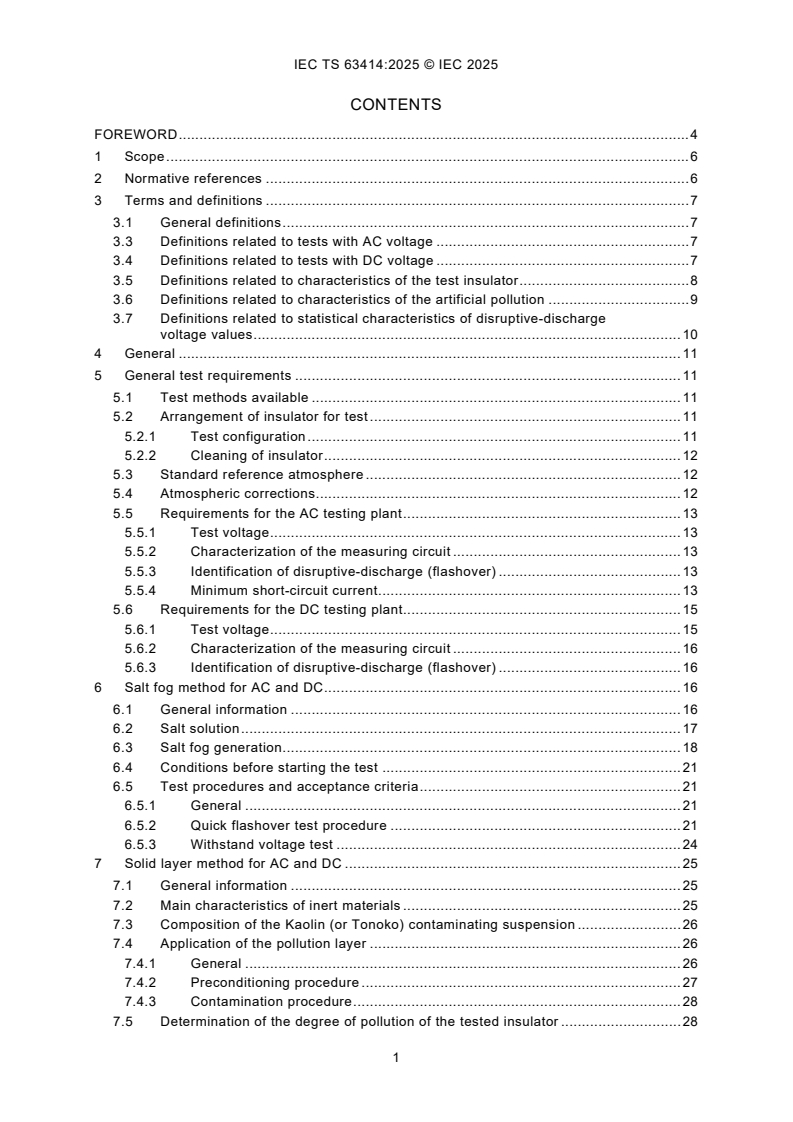
CONTENTS
FOREWORD . 4
1 Scope . 6
2 Normative references . 6
3 Terms and definitions . 7
3.1 General definitions . 7
3.3 Definitions related to tests with AC voltage . 7
3.4 Definitions related to tests with DC voltage . 7
3.5 Definitions related to characteristics of the test insulator . 8
3.6 Definitions related to characteristics of the artificial pollution . 9
3.7 Definitions related to statistical characteristics of disruptive-discharge
voltage values . 10
4 General . 11
5 General test requirements . 11
5.1 Test methods available . 11
5.2 Arrangement of insulator for test . 11
5.2.1 Test configuration . 11
5.2.2 Cleaning of insulator . 12
5.3 Standard reference atmosphere . 12
5.4 Atmospheric corrections. 12
5.5 Requirements for the AC testing plant . 13
5.5.1 Test voltage . 13
5.5.2 Characterization of the measuring circuit . 13
5.5.3 Identification of disruptive-discharge (flashover) . 13
5.5.4 Minimum short-circuit current . 13
5.6 Requirements for the DC testing plant. 15
5.6.1 Test voltage . 15
5.6.2 Characterization of the measuring circuit . 16
5.6.3 Identification of disruptive-discharge (flashover) . 16
6 Salt fog method for AC and DC . 16
6.1 General information . 16
6.2 Salt solution . 17
6.3 Salt fog generation. 18
6.4 Conditions before starting the test . 21
6.5 Test procedures and acceptance criteria . 21
6.5.1 General . 21
6.5.2 Quick flashover test procedure . 21
6.5.3 Withstand voltage test . 24
7 Solid layer method for AC and DC . 25
7.1 General information . 25
7.2 Main characteristics of inert materials . 25
7.3 Composition of the Kaolin (or Tonoko) contaminating suspension . 26
7.4 Application of the pollution layer . 26
7.4.1 General . 26
7.4.2 Preconditioning procedure . 27
7.4.3 Contamination procedure . 28
7.5 Determination of the degree of pollution of the tested insulator . 28
7.5.1 General . 28
7.5.2 SDD calculations . 28
7.5.3 NSDD calculations . 29
7.6 Steam fog generation . 29
7.7 Test procedures and acceptance criteria . 30
7.7.1 General . 30
7.7.2 Flashover test . 31
7.7.3 Withstand voltage test . 33
Annex A (informative) Additional recommendations concerning the solid layer method . 34
A.1 General . 34
A.2 Contamination practice . 34
A.3 Drying of the pollution layer . 34
A.4 Check of the wetting action of the steam fog . 34
A.5 Checking fog uniformity for large or complex test objects . 35
A.6 Fog input in the test chamber . 36
A.7 Minimum duration of the withstand test . 36
Annex B (informative) Supplementary information on artificial pollution tests on
insulators for higher system voltages (above 800 kV for AC and ± 600 kV for DC) using
the solid layer method . 37
B.1 General . 37
B.2 Test chamber . 37
B.3 Fog generator . 37
B.4 Wetting action and uniformity of fog density . 37
Annex C (informative) Alternative recommendation concerning preconditioning and
contamination procedures for solid layer method . 38
C.1 General . 38
C.2 Slurry method . 38
Bibliography . 39
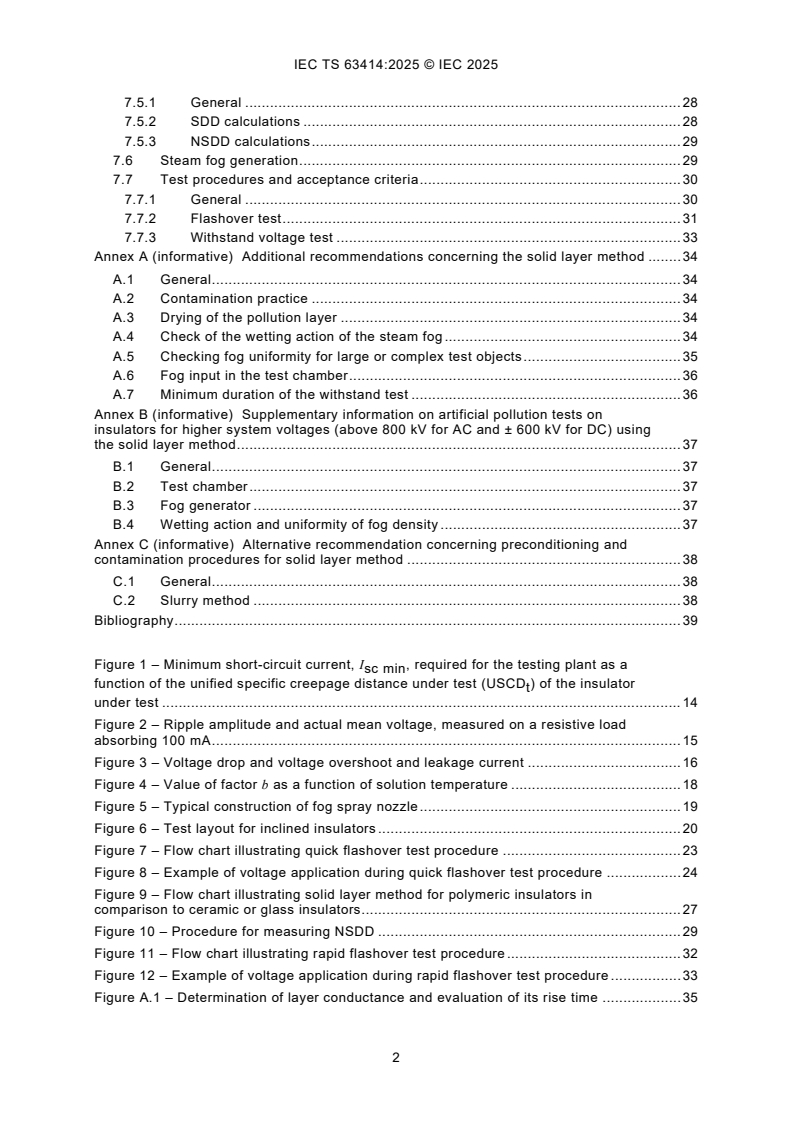
Figure 1 – Minimum short-circuit current, I , required for the testing plant as a
sc min
function of the unified specific creepage distance under test (USCD ) of the insulator
t
under test . 14
Figure 2 – Ripple amplitude and actual mean voltage, measured on a resistive load
absorbing 100 mA . 15
Figure 3 – Voltage drop and voltage overshoot and leakage current . 16
Figure 4 – Value of factor b as a function of solution temperature . 18
Figure 5 – Typical construction of fog spray nozzle . 19
Figure 6 – Test layout for inclined insulators . 20
Figure 7 – Flow chart illustrating quick flashover test procedure . 23
Figure 8 – Example of voltage application during quick flashover test procedure . 24
Figure 9 – Flow chart illustrating solid layer method for polymeric insulators in
comparison to ceramic or glass insulators . 27
Figure 10 – Procedure for measuring NSDD . 29
Figure 11 – Flow chart illustrating rapid flashover test procedure . 32
Figure 12 – Example of voltage application during rapid flashover test procedure . 33
Figure A.1 – Determination of layer conductance and evaluation of its rise time . 35
Table 1 – Salt fog method: correspondence between the value of salinity and volume
conductivity of the solution at a temperature of 20 °C . 17
Table 2 – Main characteristics of the inert materials used in solid layer suspensions . 25
Table 3 – Kaolin (or Tonoko) composition: approximate correspondence between the
reference degrees of pollution on the insulator and the volume conductivity of the
suspension at a temperature of 20 °C . 26
INTERNATIONAL ELECTROTECHNICAL COMMISSION
____________
Artificial pollution tests on high-voltage polymeric
insulators to be used on AC and DC systems
FOREWORD
1) The International Electrotechnical Commission (IEC) is a worldwide organization for standardization comprising
all national electrotechnical committees (IEC National Committees). The object of IEC is to promote international
co-operation on all questions concerning standardization in the electrical and electronic fields. To this end and
in addition to other activities, IEC publishes International Standards, Technical Specifications, Technical Reports,
Publicly Available Specifications (PAS) and Guides (hereafter referred to as “IEC Publication(s)”). Their
preparation is entrusted to technical committees; any IEC National Committee interested in the subject dealt with
may participate in this preparatory work. International, governmental and non-governmental organizations liaising
with the IEC also participate in this preparation. IEC collaborates closely with the International Organization for
Standardization (ISO) in accordance with conditions determined by agreement between the two organizations.
2) The formal decisions or agreements of IEC on technical matters express, as nearly as possible, an international
consensus of opinion on the relevant subjects since each technical committee has representation from all
interested IEC National Committees.
3) IEC Publications have the form of recommendations for international use and are accepted by IEC National
Committees in that sense. While all reasonable efforts are made to ensure that the technical content of IEC
Publications is accurate, IEC cannot be held responsible for the way in which they are used or for any
misinterpretation by any end user.
4) In order to promote international uniformity, IEC National Committees undertake to apply IEC Publications
transparently to the maximum extent possible in their national and regional publications. Any divergence between
any IEC Publication and the corresponding national or regional publication shall be clearly indicated in the latter.
5) IEC itself does not provide any attestation of conformity. Independent certification bodies provide conformity
assessment services and, in some areas, access to IEC marks of conformity. IEC is not responsible for any
services carried out by independent certification bodies.
6) All users should ensure that they have the latest edition of this publication.
7) No liability shall attach to IEC or its directors, employees, servants or agents including individual experts and
members of its technical committees and IEC National Committees for any personal injury, property damage or
other damage of any nature whatsoever, whether direct or indirect, or for costs (including legal fees) and
expenses arising out of the publication, use of, or reliance upon, this IEC Publication or any other IEC
Publications.
8) Attention is drawn to the Normative references cited in this publication. Use of the referenced publications is
indispensable for the correct application of this publication.
9) IEC draws attention to the possibility that the implementation of this document may involve the use of (a)
patent(s). IEC takes no position concerning the evidence, validity or applicability of any claimed patent rights in
respect thereof. As of the date of publication of this document, IEC had not received notice of (a) patent(s), which
may be required to implement this document. However, implementers are cautioned that this may not represent
the latest information, which may be obtained from the patent database available at https://patents.iec.ch. IEC
shall not be held responsible for identifying any or all such patent rights.
IEC TS 63414 has been prepared by subcommittee 36B: Insulators for overhead lines, of IEC
technical committee 36: Insulators. It is a Technical Specification.
The text of this Technical Specification is based on the following documents:
Draft Report on voting
36/630/DTS 36/637/RVDTS
Full information on the voting for its approval can be found in the report on voting indicated in
the above table.
The language used for the development of this Technical Specification is English.
This document was drafted in accordance with ISO/IEC Directives, Part 2, and developed in
accordance with ISO/IEC Directives, Part 1 and ISO/IEC Directives, IEC Supplement, available
at www.iec.ch/members_experts/refdocs. The main document types developed by IEC are
described in greater detail at www.iec.ch/publications.
The committee has decided that the contents of this document will remain unchanged until the
stability date indicated on the IEC website under webstore.iec.ch in the data related to the
specific document. At this date, the document will be
– reconfirmed,
– withdrawn, or
– revised.
1 Scope
This technical specification is applicable for the determination of the AC and DC pollution
flashover and withstand voltage characteristics of insulators with polymeric housing, to be used
outdoors in HV applications and exposed to polluted environments. This is also applicable for
insulators with hydrophobic coatings. This document refers to AC systems with a rated voltage
greater than 1 000 V and DC systems with a rated voltage greater than 1 500 V.
The object of this technical specification is to prescribe standardized test methods,
requirements and procedures for artificial pollution tests applicable to polymeric insulators for
overhead lines including traction lines, station post and hollow insulators of equipment.
Available test experience with polymeric station post and hollow insulators, especially for DC
applications, is limited.
The proposed tests are not applicable to ceramic and glass insulators without polymeric
housing, to greased insulators or to special types of insulators (e.g., insulators with
semiconducting glaze).
Differently to ceramic and glass insulators without polymeric housing:
– The pollution performance of insulators with polymeric housing varies with the
hydrophobicity condition of the surface. The specific conditions simulated by standardized
tests might not represent the actual dynamic field conditions.
– The determination of the flashover and/or withstand voltage under pollution conditions is
not enough for dimensioning. Additional constraints related to possible ageing are also to
be considered.
confirms
– If the Hydrophobicity Transfer Material (HTM) test according to IEC TR 62039 [1]
that an insulator is non-HTM, it can be tested according to IEC 60507 [2] or IEC TS 61245
[3].
2 Normative references
The following documents are referred to in the text in such a way that some or all of their content
constitutes requirements of this document. For dated references, only the edition cited applies.
For undated references, the latest edition of the referenced document (including any
amendments) applies.
IEC 60060-1, High-voltage test techniques - Part 1: General terminology and test requirements
IEC 60060-2, High-voltage test techniques - Part 2: Measuring systems
IEC TS 60815-1, Selection and dimensioning of high-voltage insulators intended for use in
polluted conditions - Part 1: Definitions, information and general principles
IEC TS 62073:2016, Guidance on the measurement of hydrophobicity of insulator surfaces
___________
Numbers in square brackets refer to the Bibliography.
3 Terms and definitions
For the purposes of this document, the following terms and definitions apply.
ISO and IEC maintain terminology databases for use in standardization at the following
addresses:
– IEC Electropedia: available at https://www.electropedia.org/
– ISO Online browsing platform: available at https://www.iso.org/obp
3.1 General definitions
3.1.1
individual test
single process consisting in applying to the object a specified test voltage, for a specified time
or until flashover occurs, at a specified degree of pollution
3.1.2
leakage current
current measured in series with the polluted insulator surface (pollution layer) at its grounded
end during a pollution test
3.1.3
withstand voltage
test voltage at which an insulator shall withstand at a specified degree of pollution
3.1.4
flashover voltage
test voltage at which an insulator flashes over at a specified degree of pollution
3.2 Definitions related to tests with AC voltage
3.2.1
AC short-circuit current of the testing plant
I
sc
root mean square (RMS) value of the current delivered by the testing plant when the test
insulator is short-circuited at the test voltage
3.2.2
AC test voltage
U
t AC
RMS value of the voltage with which the insulator is energized at the beginning of an individual
test
3.3 Definitions related to tests with DC voltage
3.3.1
DC test voltage
U
t DC
mean voltage with which the insulator is energized at the beginning of an individual test
3.3.2
actual mean voltage
U
am
mean value of the voltage at a given instant over a time interval ending at the instant considered
and having a duration equal to that of one cycle of the alternating voltage supplying the rectifier
Note 1 to entry: When it is not possible to determine the cycle of the supply voltage, the time interval is 20 ms.
Note 2 to entry: For more information, please refer to Figure 2.
3.3.3
ripple
periodic deviation from the arithmetic mean value of the test voltage
3.3.4
ripple amplitude
U
r
half the difference between maximum and minimum values of test voltage
3.3.5
ripple factor
ratio of the ripple amplitude to the actual mean voltage
3.3.6
voltage drop
ΔU
t DC
difference between the test voltage (U ) and the actual mean voltage (U )
t DC am
Note 1 to entry: For more information, please refer to Figure 3.
3.3.7
relative voltage drop
ratio of the voltage drop (ΔU ) to the test voltage (U ) usually expressed in percent
t DC t DC
3.3.8
voltage overshoot
difference between the actual mean voltage (U ) and the test voltage (U )
am t DC
Note 1 to entry: For more information, please refer to Figure 3.
3.3.9
relative voltage overshoot
ratio of the voltage overshoot to the test voltage (U ), usually expressed in percent
t DC
3.4 Definitions related to characteristics of the test insulator
3.4.1
unified specific creepage distance under test
USCD
t
measured creepage distance of an insulator divided by the applied test voltage across the
insulator
Note 1 to entry: Expressed in mm/kV.
3.4.2
hydrophobicity
property of a surface of a solid insulating material characterized by its ability to repel water or
aqueous electrolyte solutions
Note 1 to entry: Hydrophobicity of a polymeric insulating material is, in general, a volume property which depends
on the chemical composition of the material.
Note 2 to entry: Hydrophobicity is nonetheless strongly affected by surface effects such as:
– surface structure (i.e. roughness);
– chemical interaction between water and the solid surface (adsorption, absorption, swelling of the solid material
in contact with water);
– an accumulated pollution layer.
Note 3 to entry: Furthermore, the conditions during an evaluation of hydrophobicity (temperature, pressure,
humidity), and the method for cleaning or electrostatic charges can affect the measured degree of hydrophobicity.
Note 4 to entry: Hydrophobicity is a dynamic parameter influenced by environmental factors and surface discharge
activity.
3.4.3
hydrophobicity class
HC
specific level of the scale used in the spray method (Method C)
Note 1 to entry: Seven classes, HC1 to HC7, have been defined. HC1 corresponds to the most hydrophobic surface
and HC7 to the most hydrophilic surface.
[SOURCE: IEC TS 62073:2016, 2.6]
3.4.4
hydrophobicity transfer
phenomenon which makes the pollution layer hydrophobic due to the transfer of low molecular
weight components from the bulk of material
3.4.5
hydrophobicity transfer material
HTM
polymeric material which exhibits hydrophobicity and the capability to transfer hydrophobicity
onto the layer of pollution, which is a combined dynamic behaviour of retention and transfer of
hydrophobicity specific to different insulator materials
[SOURCE: IEC TR 62039:2021, 3.4]
3.5 Definitions related to characteristics of the artificial pollution
3.5.1
salinity
S
a
concentration of the solution of salt in tap water, expressed by the amount of salt divided by
the volume of solution
Note 1 to entry: Expressed in kg/m .
3.5.2
pollution layer
conducting electrolytic layer on the insulator surface, formed and composed by salt (salt fog
test) or by salt plus inert materials (solid layer test)
3.5.3
salt deposit density
SDD
amount of sodium chloride in an artificial deposit on a given surface of the insulator (metal parts
and assembling materials are not to be included in this surface) divided by the area of this
surface
Note 1 to entry: Expressed in mg/cm .
3.5.4
degree of pollution
value of the quantity (salinity, salt deposit density) which characterizes the artificial pollution
applied to the tested insulator
3.5.5
specified salinity
value of the salinity used to characterize an individual test
3.5.6
specified salt deposit density
value of the salt deposit density used to characterize an individual test
Note 1 to entry: This is defined as the average of the salt deposit density values measured on a few insulators (or
on parts of them), which are chosen for this purpose from among the contaminated ones prior to their submission to
any test. A minimum of three measurements are recommended.
3.5.7
non-soluble deposit density
NSDD
amount of non-soluble residue removed from a given surface of the insulator, divided by the
area of this surface
Note 1 to entry: This is expressed in mg/cm .
3.6 Definitions related to statistical characteristics of disruptive-discharge voltage
values
3.6.1
50 % flashover voltage of a test object
U
prospective voltage value which has a 50 % probability of producing a disruptive discharge on
the test object
3.6.2
arithmetic mean value of the disruptive-discharge voltage of a test object
U
a
voltage representing the disruptive voltages in a finite set or in an interval
3.6.3
standard deviation of the disruptive voltage of a test object
s
measure of the dispersion of the disruptive voltages
4 General
Artificial pollution tests prescribed by this document can be carried out for two main objectives:
– to obtain information about the comparative pollution performance of insulators, e.g., for
different insulator types/profiles/materials in the same operating position (i.e. vertical,
horizontal or inclined orientation), or for the same insulators in different operating positions.
In this case, it is critical to understand that results offer a relative ranking between possible
candidates/operating conditions but may not simulate actual service conditions.
– to provide basic information about the pollution performance under given laboratory
conditions as an input to IEC 60815-3 [4] and IEC 60815-4 [5].
Results of tests on relatively short insulator sets in vertical position, with minimum insulation
length of 1 m for AC and 1,5 m for DC, can be sufficient to represent the full-length insulator
set having the same radial geometry and profile, at least for pollution severity class ranging
from medium to heavy.
In case of hollow insulators, suitable precautions to avoid internal flashover shall be taken.
In applying described procedures to equipment incorporating hollow insulators, the relevant
technical committees should consider their effect on any internal equipment and the special
precautions which may be necessary.
Specific tests may be agreed between the manufacturer and the user whenever optimisation of
the design is necessary and/or whenever it is expected that the operating position or the inner
active parts in equipment can affect the performance. Such tests shall be performed simulating
the relevant service conditions as close as possible.
5 General test requirements
5.1 Test methods available
The two following categories of pollution test methods are described:
– the salt fog method (Clause 6) in which the insulator is subjected to salt fog with defined
salinity.
– the solid layer method (Clause 7) in which a fairly uniform layer of a defined solid pollution
is deposited on the insulator surface and wetted by steam fog.
The most relevant test can be chosen based on the type of environment and pollution flashover
mechanism, as given in IEC 60815-1.
NOTE 1 In these test methods the voltage is held constant for the prescribed time foreseen in each test method.
Variants in which the voltage is not held constant or raised in steps for the prescribed time to flashover are not
standardized but can be used for special purposes.
NOTE 2 In testing of full-scale insulators for system voltages above 800 kV for AC and ± 600 kV for DC, the solid
layer method might be the preferred choice because of lack of experience and possible difficulties for the salt fog
method due to limitations in the standardized test arrangement.
5.2 Arrangement of insulator for test
5.2.1 Test configuration
The insulator shall be erected in the test chamber, complete with the metal end fittings which
are invariably associated with it. The vertical position is in general suggested for comparison of
different insulator types. Tests in other positions (inclined, horizontal) simulating actual service
conditions may be carried out when agreed between the manufacturer and the user. When there
are special reasons not to test insulators in the vertical position only the service position shall
be considered.
The minimum clearances between any part of the insulator and any earthed object other than
the structure which supports the insulator and the columns of the nozzles, when used, shall be
not less than 0,5 m per 100 kV of the test voltage and in any case not less than 1,5 m.
5.2.2 Cleaning of insulator
Unlike ceramic and glass insulators, HTM insulators have a natural hydrophobic property.
Cleaning the surface of HTM insulators has therefore not the same goal as for ceramic and
glass insulators which can have oily deposits on their surface which could artificially generate
such hydrophobic properties.
For HTM surfaces the cleaning process is solely aimed at removing dust or other surface
deposits originated from transportation or storage. In most cases a simple rinsing with water
(conductivity below 0,1 S/m or demineralized water) should be sufficient. If rinsing with water
is not sufficient and deposits are left on the surface, the surface shall be cleaned with a suitable
solvent e.g. isopropyl alcohol. Afterwards, the surface needs to be rinsed with water.
It shall be noted that in some cases stains may be hardly removed since the HTM material by
nature will progressively encapsulate surface deposits through the transfer of low weight
molecular silicone. Care should therefore be taken not to damage the surface by excessively
scrubbing the surface of the insulator (e.g. by using brushes).
If the insulators are to be reused for several tests, the surface needs to be washed with water
before being reused. After washing, a verification of the hydrophobicity is required according to
IEC TS 62073, Method C. An insulator with an HTM surface should be HC1 or HC2 once
cleaned and verified before the new set of tests. This verification is to ensure that the used
HTM insulator is restored to the hydrophobicity condition relative of a new sample.
5.3 Standard reference atmosphere
The standard reference atmosphere is:
– temperature t = 20 °C;
– absolute pressure p = 1 013 hPa (1 013 mbar).
NOTE An absolute pressure of 1 013 hPa corresponds to the height of 760 mm of the mercury column in a mercury
barometer at 0 °C. If the barometer height is H mm of mercury, the atmospheric pressure in hectopascal is
approximately:
pH1013 / 760⋅
Correction for temperature with respect to the height of the mercury column is considered to be negligible.
Instruments automatically correcting pressure to sea level are not suitable and are not to be
used.
5.4 Atmospheric corrections
No humidity correction factor shall be applied. Test voltages shall be corrected for air density
based on IEC 60060-1.
The air density correction factor k depends on the relative air density δ and can be generally
expressed as:
m
(1)
k =δ
=
where m is a coefficient which depends on many factors such as pollution severity and insulator
characteristics. For the time being, reference can provisionally be made to value m = 0,5 for
tests with AC voltage and m = 0,35 for tests with DC voltage [6].
When the temperatures t and t are expressed in degrees Celsius and furthermore both the
atmospheric pressures p and p are expressed in the same units, the relative air density is:
273+ t
p
δ ×
pt273+
NOTE The temperature in the test chamber, required for the calculation of relative air density, is measured prior to
the test close to the middle of the test insulator.
5.5 Requirements for the AC testing plant
5.5.1 Test voltage
The insulator shall be continuously energized at the specified AC test voltage. The frequency
of the test voltage shall be between 48 Hz and 62 Hz.
5.5.2 Characterization of the measuring circuit
The systems used for measuring voltage and leakage current shall have an upper limiting
frequency of at least 1 kHz.
5.5.3 Identification of disruptive-discharge (flashover)
The complete bridging of the insulator under test by the short-circuit arc in the case of an
apparent flashover shall be demonstrated. To qualify it as a flashover, at least one of the
following criteria would be sufficient:
– the voltage recording clearly indicates a breakdown to arc-voltage;
– the current measurements indicate the short-circuit of the complete circuit by an arc;
– photographic or video recordings with sufficient resolution clearly show the complete short-
circuit arc.
5.5.4 Minimum short-circuit current
In the artificial pollution tests, the testing plant needs a short-circuit current (I ) higher than in
sc
other types of insulator tests to ensure that the voltage drop during the test is small and has no
influence on test results. This means that I shall have a minimum value which varies with the
sc
test conditions; moreover, there are also requirements on other parameters of the testing plant.
(I ) is given in Figure 1 as a function of the electrical surface
The minimum value of I
sc sc min
stress of the insulator under test, expressed in terms of its unified specific creepage distance.
Besides the above requirement of I value, the testing plant shall comply with the two
sc min
following conditions:
– resistance/reactance ratio (R/X) equal to or higher than 0,1;
I
c
– capacitive current/short-circuit current ratio ( ) within the range 0,001 to 0,1.
I
sc
When the value of I of the testing plant, although higher than 6 A, does not comply with the
sc
limits given in Figure 1, the verification of a specified withstand characteristic of a polluted
insulator (see 6.5 and 7.7) or the determination of its maximum withstand characteristic can still
be performed, provided that the source validity is directly ascertained by the following check.
=
In each individual test of this investigation, the highest leakage current pulse amplitude is
recorded, and its maximum value (I ) determined considering the three tests resulting in
h max
withstand.
The I value shall comply with the expression below:
h max
I
sc
≥ 11
I
h max
I being given in RMS and I in peak value.
sc h max
I
c
As regards the ratio the specified limits are usually met by several testing plants.
I
sc
In particular the lower limit is generally complied with due to the amount of the equivalent source
capacitance, the lumped capacitance (bushing and voltage divider) and the stray capacitances
of the circuit.
Since the leakage currents can be used for the interpretation of the results, it is recommended
that suitable devices, with typical sensitivity of 1 mA, be arranged in order to record these
currents during artificial pollution tests.
mm/kV A (RMS)
USCD < 28 I = 6
t sc min
28 ≤ USCD ≤ 45 I = |USCD /√3| - 10
t sc min t
Figure 1 – Minimum short-circuit current, I , required for the testing plant
sc min
as a function of the unified specific creepage distance
under test (USCD ) of the insulator under test
t
NOTE Currently, only test experience to give guidance to I values for tests at unified specific creepage
sc min
distances lower than 45 mm/kV is available.
5.6 Requirements for the DC testing plant
5.6.1 Test voltage
Throughout the test, the insulator shall be continuously energized at the specified DC test
voltage and polarity.
The ripple factor of the test voltage demonstrated in a suitable way shall be ≤ 3 % for a current
of 100 mA with a resistive load (Figure 2).
Figure 2 – Ripple amplitude and actual mean voltage, measured
on a resistive load absorbing 100 mA
The relative voltage drop (Figure 3) occurring during individual tests resulting in withstand shall
not exceed 10 %.
The relative voltage overshoot (Figure 3), usually due to load-release caused by extinction of
electrical discharges on the insulator surface, shall not exceed 10 %.
If a flashover occurs during the time when a relative voltage overshoot is between 5 % and
10 %, the test is not valid.
The voltage measurement shall be carried out by voltage divider according to IEC 60060-2
suitable to measure continuous voltage and transients with required accuracy.
Figure 3 – Voltage drop and voltage overshoot and leakage current
5.6.2 Characterization of the measuring circuit
The systems used for measuring voltage and leakage current shall have an upper limiting
frequency of at least 1 kHz.
5.6.3 Identification of disruptive-discharge (flashover)
The complete bridging of the insulator under test by the short-circuit arc in the case of an
apparent flashover shall be demonstrated. To qualify it as a flashover, at least one of the
following criteria would be sufficient:
– the voltage recording clearly indicates a breakdown to arc-voltage;
– the current measurements indicate the short-circuit of the complete circuit by an arc;
– the peak value of the leakage current of the test insulator, measured in the microsecond
range, is higher than 0,5 U /R (where R is the series resistance of the test circuit);
t DC s s
– photographic or video recordings with sufficient resolution clearly show the complete short-
circuit arc.
6 Salt fog method for AC and DC
6.1 General information
The salt fog test procedure simulates type B pollution (see IEC 60815-1) where a liquid
conductive layer covers the insulator surface. This layer does not contain any significant
insoluble material.
The degree of pollution in the test is defined by the salinity of the salt fog expressed in kg of
salt (NaCl) per m of water.
NOTE The salt fog test method is not recommended for tests of insulator configurations at higher system voltage
(for AC 800 kV and above, for DC ± 600 kV and above). The main reason is that the specified distance between
tested insulator and spraying nozzles (see 6.3) might be not sufficient for higher test voltages. According to the
present test experience, the specified distance between tested insulator and spraying nozzles is kept at 3 m in order
to maintain the validity of earlier test results.
6.2 Salt solution
The salt solution shall be made of sodium chloride (NaCl) of commercial purity and tap water.
Tap water with high hardness, e.g., with a content of equivalent CaCO greater than 350 g/m ,
can cause limestone deposits on the insulator surface. In this case deionized water shall be
used for preparation of the salt solution.
NOTE Hardness of tap water is measured in terms of content of equivalent CaCO [7].
The salinity used shall have one of the following values:
2,5 – 3,5 – 5 – 7 – 10 – 14 – 20 – 28 – 40 – 56 – 80 – 112 – 160 – 224 kg/m .
The maximum permissible tolerance in salinity is ± 5 % of the specified value.
It is recommended that the salinity shall be determined by measuring the conductivity of the
water solution before the test with a correction of temperature. Table 1 gives the
correspondence between the value of salinity and volume conductivity.
Table 1 – Salt fog method: correspondence between the value of salinity and volume
conductivity of the solution at a temperature of 20 °C
Salinity Volume conductivity
S σ
a 20
S/m
kg/m
2,5 0,43
3,5 0,60
5 0,83
7 1,15
10 1,6
14 2,2
20 3,0
28 4,1
40 5,6
56 7,6
80 10
112 13
160 17
224 20
When the solution temperature is not at 20 °C, conductivity values shall be corrected according
to Formula (2). The temperature of the salt solution shall be between 5 °C and 30 °C, since no
experience is available to validate tests performed outside this range of solution temperature.
The conductivity correction shall be made using the following formula:
σ= σ 1−bθ− 20 (2)
( )
20 θ
where
σ is the volume co
...