


IEC 61970-1:2005
(Main)Energy management system application program interface (EMS-API) - Part 1: Guidelines and general requirements
Energy management system application program interface (EMS-API) - Part 1: Guidelines and general requirements
Provides a set of guidelines and general infrastructure capabilities required for the application of the EMS-API interface standards. Describes typical integration scenarios where these standards are to be applied and the types of applications to be integrated. Defines a reference model and provides a framework for the application of the other parts of these EMS-API standards.
This publication is of core relevance for Smart Grid.
Interface de programmation d'application pour système de gestion d'énergie (EMS-API) - Partie 1: Lignes directrices et exigences générales
Fournit un ensemble de lignes directrices et des capacités d'infrastructure générales nécessaires à l'application des normes d'interface EMS-API. Décrit des scénarios d'intégration types pour l'application de ces normes et l'intégration des types d'applications. Définit un modèle de référence et fournit un cadre général d'application des autres parties des normes EMS-API.
General Information
- Status
- Published
- Publication Date
- 06-Dec-2005
- Technical Committee
- TC 57 - Power systems management and associated information exchange
- Drafting Committee
- WG 13 - TC 57/WG 13
- Current Stage
- PPUB - Publication issued
- Start Date
- 07-Dec-2005
- Completion Date
- 15-Jan-2006
Overview
IEC 61970-1:2005 is an international standard developed by the International Electrotechnical Commission (IEC) that defines the foundational guidelines and general requirements for the Energy Management System Application Program Interface (EMS-API). As Part 1 of the IEC 61970 series, this standard establishes a coherent framework and reference model essential for integrating and applying EMS-API interface standards in modern electrical utility environments. It is especially relevant to Smart Grid implementations, offering interoperability and integration capabilities crucial for advanced energy management.
The standard outlines typical integration scenarios and identifies the types of applications that can be integrated using EMS-API. By fostering a standardized approach, IEC 61970-1 supports the development of robust, flexible, and scalable energy management systems for utilities worldwide.
Key Topics
1. Scope and Purpose
- Provides guidelines for EMS-API interface application
- Defines infrastructure capabilities for integrating energy management applications
- Ensures alignment with the IEC 61970 series and related standards
2. System Integration
- Discusses common integration scenarios within control center environments
- Highlights component-based interfaces supporting modularity and extensibility
- Addresses legacy application integration through wrappers and adapters
3. EMS-API Reference Model
- Introduces a comprehensive reference model showing relationships among components, applications, and middleware
- Details component containers, execution systems, and communication profiles necessary for application interoperability
4. Communication and Middleware
- Specifies the role of middleware in facilitating secure, reliable communication between EMS components
- Describes communication profile services critical for consistent data exchange and operational coordination
5. Relationship to Other Standards
- Details how IEC 61970-1 interfaces with the IEC 61968 series, which focuses on distribution management system interfaces
- Offers mappings to Common Information Model (CIM) and Component Interface Specification (CIS) standards within the IEC 61970 suite
Applications
IEC 61970-1:2005 serves as a vital standard for utilities and vendors aiming to implement interoperable energy management systems with robust component-based architectures. It facilitates:
- Smart Grid Integration: Enables seamless connection of new applications and devices into existing energy management infrastructures supporting Smart Grid objectives.
- Control Center Upgrades: Assists utilities in modernizing control center software by integrating legacy and new applications using standardized interfaces.
- Application Interoperability: Supports multiple applications, such as real-time monitoring, forecasting, energy distribution, and grid stability functions, to work together effectively.
- Vendor-Neutral Solutions: Promotes open standards and reduces vendor lock-in by specifying general requirements applicable across multiple platforms and products.
The standard is ideal for utilities focused on improving operational efficiency, reducing integration costs, and enhancing system flexibility to address evolving grid demands.
Related Standards
- IEC 61970-3xx: Common Information Model (CIM) standards defining data models for energy management
- IEC 61970-4xx: Component Interface Specification (CIS) standards detailing software interface definitions
- IEC 61970-5xx: CIS Technology Mappings that provide technical implementations of interfaces in various technologies
- IEC 61968 Series: Complementary standards focused on Distribution Management Systems (DMS) interface guidelines, promoting end-to-end utility automation
- Other Smart Grid Standards: Integration with IEC and ISO standards supporting the Smart Grid ecosystem and interoperability.
By complying with IEC 61970-1, stakeholders ensure compatibility with these related standards, facilitating a unified approach to energy management system development and deployment.
Key Benefits:
- Establishes a unified framework for EMS application integration
- Supports modular, component-based software architectures
- Enhances interoperability among energy management applications
- Facilitates legacy system integration and future-proof upgrades
- Aligns with Smart Grid initiatives for modern utility operations
IEC 61970-1:2005 remains a core standard for energy management system developers, utility companies, and solution providers dedicated to advancing smart, interoperable, and efficient energy infrastructures worldwide.
Get Certified
Connect with accredited certification bodies for this standard

TL 9000 QuEST Forum
Telecommunications quality management system.

ANCE
Mexican certification and testing association.

Intertek Slovenia
Intertek testing, inspection, and certification services in Slovenia.
Sponsored listings
Frequently Asked Questions
IEC 61970-1:2005 is a standard published by the International Electrotechnical Commission (IEC). Its full title is "Energy management system application program interface (EMS-API) - Part 1: Guidelines and general requirements". This standard covers: Provides a set of guidelines and general infrastructure capabilities required for the application of the EMS-API interface standards. Describes typical integration scenarios where these standards are to be applied and the types of applications to be integrated. Defines a reference model and provides a framework for the application of the other parts of these EMS-API standards. This publication is of core relevance for Smart Grid.
Provides a set of guidelines and general infrastructure capabilities required for the application of the EMS-API interface standards. Describes typical integration scenarios where these standards are to be applied and the types of applications to be integrated. Defines a reference model and provides a framework for the application of the other parts of these EMS-API standards. This publication is of core relevance for Smart Grid.
IEC 61970-1:2005 is classified under the following ICS (International Classification for Standards) categories: 33.200 - Telecontrol. Telemetering. The ICS classification helps identify the subject area and facilitates finding related standards.
IEC 61970-1:2005 is available in PDF format for immediate download after purchase. The document can be added to your cart and obtained through the secure checkout process. Digital delivery ensures instant access to the complete standard document.
Standards Content (Sample)
NORME CEI
INTERNATIONALE
IEC
61970-1
INTERNATIONAL
Première édition
STANDARD
First edition
2005-12
Interface de programmation d'application
pour système de gestion d'énergie (EMS-API) –
Partie 1:
Lignes directrices et exigences générales
Energy management system application
program interface (EMS-API) –
Part 1:
Guidelines and general requirements
Numéro de référence
Reference number
CEI/IEC 61970-1:2005
Numérotation des publications Publication numbering
Depuis le 1er janvier 1997, les publications de la CEI As from 1 January 1997 all IEC publications are
sont numérotées à partir de 60000. Ainsi, la CEI 34-1 issued with a designation in the 60000 series. For
devient la CEI 60034-1. example, IEC 34-1 is now referred to as IEC 60034-1.
Editions consolidées Consolidated editions
Les versions consolidées de certaines publications de la The IEC is now publishing consolidated versions of its
CEI incorporant les amendements sont disponibles. Par publications. For example, edition numbers 1.0, 1.1
exemple, les numéros d’édition 1.0, 1.1 et 1.2 indiquent and 1.2 refer, respectively, to the base publication,
respectivement la publication de base, la publication de the base publication incorporating amendment 1 and
base incorporant l’amendement 1, et la publication de the base publication incorporating amendments 1
base incorporant les amendements 1 et 2. and 2.
Informations supplémentaires Further information on IEC publications
sur les publications de la CEI
Le contenu technique des publications de la CEI est The technical content of IEC publications is kept
constamment revu par la CEI afin qu'il reflète l'état under constant review by the IEC, thus ensuring that
actuel de la technique. Des renseignements relatifs à the content reflects current technology. Information
cette publication, y compris sa validité, sont dispo- relating to this publication, including its validity, is
nibles dans le Catalogue des publications de la CEI available in the IEC Catalogue of publications
(voir ci-dessous) en plus des nouvelles éditions, (see below) in addition to new editions, amendments
amendements et corrigenda. Des informations sur les and corrigenda. Information on the subjects under
sujets à l’étude et l’avancement des travaux entrepris consideration and work in progress undertaken by the
par le comité d’études qui a élaboré cette publication, technical committee which has prepared this
ainsi que la liste des publications parues, sont publication, as well as the list of publications issued,
également disponibles par l’intermédiaire de: is also available from the following:
• Site web de la CEI (www.iec.ch) • IEC Web Site (www.iec.ch)
• Catalogue des publications de la CEI • Catalogue of IEC publications
Le catalogue en ligne sur le site web de la CEI The on-line catalogue on the IEC web site
(www.iec.ch/searchpub) vous permet de faire des (www.iec.ch/searchpub) enables you to search by a
recherches en utilisant de nombreux critères, variety of criteria including text searches,
comprenant des recherches textuelles, par comité technical committees and date of publication. On-
d’études ou date de publication. Des informations en line information is also available on recently
ligne sont également disponibles sur les nouvelles issued publications, withdrawn and replaced
publications, les publications remplacées ou retirées, publications, as well as corrigenda.
ainsi que sur les corrigenda.
• IEC Just Published • IEC Just Published
Ce résumé des dernières publications parues This summary of recently issued publications
(www.iec.ch/online_news/justpub) est aussi dispo- (www.iec.ch/online_news/justpub) is also available
nible par courrier électronique. Veuillez prendre by email. Please contact the Customer Service
contact avec le Service client (voir ci-dessous) Centre (see below) for further information.
pour plus d’informations.
• Service clients • Customer Service Centre
Si vous avez des questions au sujet de cette If you have any questions regarding this
publication ou avez besoin de renseignements publication or need further assistance, please
supplémentaires, prenez contact avec le Service contact the Customer Service Centre:
clients:
Email: custserv@iec.ch Email: custserv@iec.ch
Tél: +41 22 919 02 11 Tel: +41 22 919 02 11
Fax: +41 22 919 03 00 Fax: +41 22 919 03 00
.
NORME CEI
INTERNATIONALE
IEC
61970-1
INTERNATIONAL
Première édition
STANDARD
First edition
2005-12
Interface de programmation d'application
pour système de gestion d'énergie (EMS-API) –
Partie 1:
Lignes directrices et exigences générales
Energy management system application
program interface (EMS-API) –
Part 1:
Guidelines and general requirements
IEC 2005 Droits de reproduction réservés Copyright - all rights reserved
Aucune partie de cette publication ne peut être reproduite ni No part of this publication may be reproduced or utilized in any
utilisée sous quelque forme que ce soit et par aucun procédé, form or by any means, electronic or mechanical, including
électronique ou mécanique, y compris la photocopie et les photocopying and microfilm, without permission in writing from
microfilms, sans l'accord écrit de l'éditeur. the publisher.
International Electrotechnical Commission, 3, rue de Varembé, PO Box 131, CH-1211 Geneva 20, Switzerland
Telephone: +41 22 919 02 11 Telefax: +41 22 919 03 00 E-mail: inmail@iec.ch Web: www.iec.ch
CODE PRIX
X
PRICE CODE
Commission Electrotechnique Internationale
International Electrotechnical Commission
МеждународнаяЭлектротехническаяКомиссия
Pour prix, voir catalogue en vigueur
For price, see current catalogue
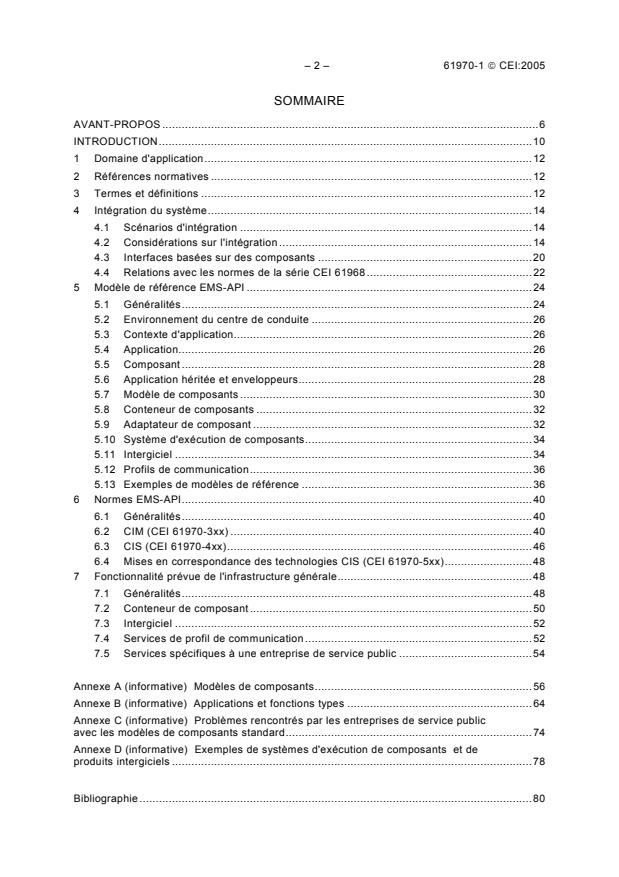
– 2 – 61970-1 CEI:2005
SOMMAIRE
AVANT-PROPOS .6
INTRODUCTION.10
1 Domaine d'application.12
2 Références normatives .12
3 Termes et définitions .12
4 Intégration du système.14
4.1 Scénarios d'intégration .14
4.2 Considérations sur l'intégration .14
4.3 Interfaces basées sur des composants .20
4.4 Relations avec les normes de la série CEI 61968 .22
5 Modèle de référence EMS-API .24
5.1 Généralités.24
5.2 Environnement du centre de conduite .26
5.3 Contexte d'application.26
5.4 Application.26
5.5 Composant.28
5.6 Application héritée et enveloppeurs.28
5.7 Modèle de composants .30
5.8 Conteneur de composants .32
5.9 Adaptateur de composant .32
5.10 Système d'exécution de composants.34
5.11 Intergiciel .34
5.12 Profils de communication.36
5.13 Exemples de modèles de référence .36
6 Normes EMS-API.40
6.1 Généralités.40
6.2 CIM (CEI 61970-3xx) .40
6.3 CIS (CEI 61970-4xx).46
6.4 Mises en correspondance des technologies CIS (CEI 61970-5xx).48
7 Fonctionnalité prévue de l'infrastructure générale.48
7.1 Généralités.48
7.2 Conteneur de composant.50
7.3 Intergiciel .52
7.4 Services de profil de communication .52
7.5 Services spécifiques à une entreprise de service public .54
Annexe A (informative) Modèles de composants.56
Annexe B (informative) Applications et fonctions types .64
Annexe C (informative) Problèmes rencontrés par les entreprises de service public
avec les modèles de composants standard.74
Annexe D (informative) Exemples de systèmes d'exécution de composants et de
produits intergiciels .78
Bibliographie .80
61970-1 IEC:2005 – 3 –
CONTENTS
FOREWORD.7
INTRODUCTION.11
1 Scope.13
2 Normative References .13
3 Terms and definitions .13
4 System integration .15
4.1 Integration scenarios .15
4.2 Integration considerations.15
4.3 Component-based interfaces .21
4.4 Relationship to IEC 61968 series of standards .23
5 EMS-API reference model.25
5.1 General .25
5.2 Control center environment.27
5.3 Application context .27
5.4 Application.27
5.5 Component.29
5.6 Legacy application and wrappers .29
5.7 Component model .31
5.8 Component container.33
5.9 Component adapter .33
5.10 Component execution system .35
5.11 Middleware .35
5.12 Communication profiles .37
5.13 Reference model examples.37
6 EMS-API standards .41
6.1 General .41
6.2 CIM (IEC 61970-3XX) .41
6.3 CIS (IEC 61970-4XX).47
6.4 CIS technology mappings (IEC 61970-5XX) .49
7 General expected infrastructure functionality.49
7.1 General .49
7.2 Component Container .51
7.3 Middleware .53
7.4 Communication Profile Services.53
7.5 Utility-specific services .55
Annex A (informative) Component models .57
Annex B (informative) Typical applications and functions .65
Annex C (informative) Utility issues with standard component models.75
Annex D (informative) Examples of component execution systems and middleware
products.79
Bibliography .81
– 4 – 61970-1 CEI:2005
Figure 1 – Modèle de référence EMS-API .24
Figure 2 – EMS utilisant des interfaces standard de composants EMS-API .38
Tableau 1 – Avantages des interfaces basées sur les composants .22
Tableau 2 – Exemples de contextes d'application EMS.26
Tableau B.1 − Applications et fonctions types .64
61970-1 IEC:2005 – 5 –
Figure 1 – EMS-API Reference Model .25
Figure 2 – EMS using EMS-API component standard interfaces.39
Table 1 – Benefits of Component-based Interfaces.23
Table 2 – Examples of EMS application contexts .27
Table B.1 – Typical applications and functions.65
– 6 – 61970-1 CEI:2005
COMMISSION ÉLECTROTECHNIQUE INTERNATIONALE
____________
INTERFACE DE PROGRAMMATION D'APPLICATION
POUR SYSTÈME DE GESTION D'ÉNERGIE (EMS-API) –
Partie 1: Lignes directrices et exigences générales
AVANT-PROPOS
1) La Commission Electrotechnique Internationale (CEI) est une organisation mondiale de normalisation composée
de l'ensemble des comités électrotechniques nationaux (Comités nationaux de la CEI). La CEI a pour objet de
favoriser la coopération internationale pour toutes les questions de normalisation dans les domaines de
l'électricité et de l'électronique. A cet effet, la CEI – entre autres activités – publie des Normes internationales,
des Spécifications techniques, des Rapports techniques, des Spécifications accessibles au public (PAS) et des
Guides (ci-après dénommés "Publication(s) de la CEI"). Leur élaboration est confiée à des comités d'études,
aux travaux desquels tout Comité national intéressé par le sujet traité peut participer. Les organisations
internationales, gouvernementales et non gouvernementales, en liaison avec la CEI, participent également aux
travaux. La CEI collabore étroitement avec l'Organisation Internationale de Normalisation (ISO), selon des
conditions fixées par accord entre les deux organisations.
2) Les décisions ou accords officiels de la CEI concernant les questions techniques représentent, dans la mesure
du possible, un accord international sur les sujets étudiés, étant donné que les Comités nationaux de la CEI
intéressés sont représentés dans chaque comité d’études.
3) Les Publications de la CEI se présentent sous la forme de recommandations internationales et sont agréées
comme telles par les Comités nationaux de la CEI. Tous les efforts raisonnables sont entrepris afin que la CEI
s'assure de l'exactitude du contenu technique de ses publications; la CEI ne peut pas être tenue responsable de
l'éventuelle mauvaise utilisation ou interprétation qui en est faite par un quelconque utilisateur final.
4) Dans le but d'encourager l'uniformité internationale, les Comités nationaux de la CEI s'engagent, dans toute la
mesure possible, à appliquer de façon transparente les Publications de la CEI dans leurs publications
nationales et régionales. Toutes divergences entre toutes Publications de la CEI et toutes publications
nationales ou régionales correspondantes doivent être indiquées en termes clairs dans ces dernières.
5) La CEI n’a prévu aucune procédure de marquage valant indication d’approbation et n'engage pas sa
responsabilité pour les équipements déclarés conformes à une de ses Publications.
6) Tous les utilisateurs doivent s'assurer qu'ils sont en possession de la dernière édition de cette publication.
7) Aucune responsabilité ne doit être imputée à la CEI, à ses administrateurs, employés, auxiliaires ou
mandataires, y compris ses experts particuliers et les membres de ses comités d'études et des Comités
nationaux de la CEI, pour tout préjudice causé en cas de dommages corporels et matériels, ou de tout autre
dommage de quelque nature que ce soit, directe ou indirecte, ou pour supporter les coûts (y compris les frais
de justice) et les dépenses découlant de la publication ou de l'utilisation de cette Publication de la CEI ou de
toute autre Publication de la CEI, ou au crédit qui lui est accordé.
8) L'attention est attirée sur les références normatives citées dans cette publication. L'utilisation de publications
référencées est obligatoire pour une application correcte de la présente publication.
9) L’attention est attirée sur le fait que certains des éléments de la présente Publication de la CEI peuvent faire
l’objet de droits de propriété intellectuelle ou de droits analogues. La CEI ne saurait être tenue pour
responsable de ne pas avoir identifié de tels droits de propriété et de ne pas avoir signalé leur existence.
La Norme Internationale CEI 61970-1 a été préparée par le comité technique CEI 57: Gestion
des systèmes de puissance et échanges d'informations associés.
Le texte de cette norme est issu des documents suivants:
FDIS Rapport de vote
57/777/FDIS 57/795/RVD
Le rapport de vote indiqué dans le tableau ci-dessus donne toute information sur le vote ayant
abouti à l'approbation de cette norme.
Cette publication a été rédigée selon les Directives ISO/CEI, Partie 2.
61970-1 IEC:2005 – 7 –
INTERNATIONAL ELECTROTECHNICAL COMMISSION
___________
ENERGY MANAGEMENT SYSTEM APPLICATION
PROGRAM INTERFACE (EMS-API) –
Part 1: Guidelines and general requirements
FOREWORD
1) The International Electrotechnical Commission (IEC) is a worldwide organization for standardization comprising
all national electrotechnical committees (IEC National Committees). The object of IEC is to promote
international co-operation on all questions concerning standardization in the electrical and electronic fields. To
this end and in addition to other activities, IEC publishes International Standards, Technical Specifications,
Technical Reports, Publicly Available Specifications (PAS) and Guides (hereafter referred to as “IEC
Publication(s)”). Their preparation is entrusted to technical committees; any IEC National Committee interested
in the subject dealt with may participate in this preparatory work. International, governmental and non-
governmental organizations liaising with the IEC also participate in this preparation. IEC collaborates closely
with the International Organization for Standardization (ISO) in accordance with conditions determined by
agreement between the two organizations.
2) The formal decisions or agreements of IEC on technical matters express, as nearly as possible, an international
consensus of opinion on the relevant subjects since each technical committee has representation from all
interested IEC National Committees.
3) IEC Publications have the form of recommendations for international use and are accepted by IEC National
Committees in that sense. While all reasonable efforts are made to ensure that the technical content of IEC
Publications is accurate, IEC cannot be held responsible for the way in which they are used or for any
misinterpretation by any end user.
4) In order to promote international uniformity, IEC National Committees undertake to apply IEC Publications
transparently to the maximum extent possible in their national and regional publications. Any divergence
between any IEC Publication and the corresponding national or regional publication shall be clearly indicated in
the latter.
5) IEC provides no marking procedure to indicate its approval and cannot be rendered responsible for any
equipment declared to be in conformity with an IEC Publication.
6) All users should ensure that they have the latest edition of this publication.
7) No liability shall attach to IEC or its directors, employees, servants or agents including individual experts and
members of its technical committees and IEC National Committees for any personal injury, property damage or
other damage of any nature whatsoever, whether direct or indirect, or for costs (including legal fees) and
expenses arising out of the publication, use of, or reliance upon, this IEC Publication or any other IEC
Publications.
8) Attention is drawn to the Normative references cited in this publication. Use of the referenced publications is
indispensable for the correct application of this publication.
9) Attention is drawn to the possibility that some of the elements of this IEC Publication may be the subject of
patent rights. IEC shall not be held responsible for identifying any or all such patent rights.
International Standard IEC 61970-1 has been prepared by IEC technical committee 57: Power
systems management and associated information exchange.
The text of this standard is based on the following documents:
FDIS Report on voting
57/777/FDIS 57/795/RVD
Full information on the voting for the approval of this standard can be found in the report on
voting indicated in the above table.
This publication has been drafted in accordance with the ISO/IEC Directives, Part 2.
– 8 – 61970-1 CEI:2005
La CEI 61970 comprend les parties suivantes, sous le titre général Interface de programmation
d'application pour système de gestion d'énergie (EMS-API:
Partie 1: Lignes directrices et exigences générales
Partie 2: Glossary
Partie 301: Base de modèle d'information commun (CIM)
Partie 302: Common information model (CIM) financial, energy scheduling and reservations
Partie 401: Spécification d'interface des composants – Cadre général
Partie 402: Component interface specification (CIS) – Common services
Partie 403: Component Interface Specification (CIS) – Generic data access
Partie 404: Component Interface Specification (CIS) – High speed data access
Partie 405: Component Interface Specification (CIS) – Generic eventing and subscription
Partie 407: Component Interface Specification (CIS) – Time series data access
Partie 453: Exchange of Graphics Schematics Definitions (Common Graphics Exchange)
Partie 501: Common Information Model (CIM) XML Codification for Programmable Reference
and Model Data Exchange
Le comité a décidé que le contenu de cette publication ne sera pas modifié avant la date de
maintenance indiquée sur le site web de la CEI sous «http://webstore.iec.ch» dans les données
relatives à la publication recherchée. A cette date, la publication sera
• reconduite;
• supprimée;
• remplacée par une édition révisée, ou
• amendée.
___________
A l’étude.
61970-1 IEC:2005 – 9 –
IEC 61970 consists of the following parts, under the general title Energy management system
application program interface (EMS-API):
Part 1: Guidelines and general requirements
Part 2: Glossary
Part 301: Common Information Model (CIM) base
Part 302: Common information model (CIM) financial, energy scheduling and reservations
Part 401: Component interface specification (CIS) framework
Part 402: Component interface specification (CIS) – Common services
Part 403: Component Interface Specification (CIS) – Generic data access
Part 404: Component Interface Specification (CIS) – High speed data access
Part 405: Component Interface Specification (CIS) – Generic eventing and subscription
Part 407: Component Interface Specification (CIS) – Time series data access
Part 453: Exchange of Graphics Schematics Definitions (Common Graphics Exchange)
Part 501: Common Information Model (CIM) XML Codification for Programmable Reference
and Model Data Exchange
The committee has decided that the contents of this publication will remain unchanged until the
maintenance result date indicated on the IEC web site under "http://webstore.iec.ch" in the data
related to the specific publication. At this date, the publication will be
• reconfirmed;
• withdrawn;
• replaced by a revised edition, or
• amended.
___________
Under consideration.
– 10 – 61970-1 CEI:2005
INTRODUCTION
La présente Norme fait partie de la série CEI 61970 qui définit les interfaces de programmation
d'application (API) pour un système de gestion d'énergie (EMS). La présente norme se fonde
en grande partie sur les travaux réalisés dans le cadre du projet de recherche (RP-3654-1) sur
les API de centres de commande (CCAPI) de l'EPRI. Le projet CCAPI de l'EPRI a
principalement pour objet de:
– réduire les coûts et les délais nécessaires à l'ajout de nouvelles applications à un EMS ou à
un autre système ;
– protéger l'investissement réalisé dans des applications actuellement existantes et
fonctionnant efficacement;
– améliorer la capacité d'échange d'informations entre des systèmes distincts situés à
l'intérieur ou à l'extérieur de l'environnement du centre de conduite.
L'approche technique doit fournir un cadre général d'intégration pour l'interconnexion
d'applications/systèmes existants qui soit:
– fondé sur une architecture et un modèle d'information communs;
– indépendant de la technologie sous-jacente.
La série de normes 61970 a pour principal objet d'élaborer un ensemble de lignes directrices et
de normes visant à faciliter 1) l'intégration d'applications développées par différents
fournisseurs dans l'environnement du centre de conduite et 2) l'échange d'informations avec
des systèmes externes à l'environnement du centre de conduite. Le domaine d'application de
ces spécifications couvre d'autres systèmes de transmission ainsi que des systèmes de
distribution et de production externes au centre de conduite et appelés à échanger en temps
réel des données opérationnelles avec le centre de conduite. De ce fait, lesdites normes ont
également pour objet de permettre l'intégration de systèmes hérités existants et de nouveaux
systèmes construits en conformité avec les normes relatives à ces domaines d'application.
L'ensemble complet des documents normatifs est constitué des parties suivantes:
Partie 1: Lignes directrices et exigences générales
Partie 2: Glossaire
Partie 3xx: Modèle d'information commun (CIM)
Partie 4xx: Spécifications d'interface de composants (CIS)
Partie 5xx: Mise en correspondance des technologies CIS
La CEI 61970-1 fournit un ensemble de lignes directrices et de capacités d'infrastructure
générales nécessaires à l'application des normes d'interface EMS-API. Le présent document
décrit le modèle de référence fournissant le cadre général d'application des autres parties des
normes EMS-API. Le modèle de référence est fondé sur une architecture à composants de
sorte que les normes portent sur les interfaces des composants pour l'échange d'informations
entre des applications dans un environnement de centre de conduite. Ce modèle peut
également s'appliquer à des échanges d'informations similaires entre des applications et des
systèmes externes à l'environnement de centre de conduite, tels que d'autres centres de
commande, des exploitants de réseau autonomes (ERA), des organisations régionales de
transport (ORT) et des systèmes de gestion de la distribution (SGD).
La CEI 61970-1 comporte également des capacités générales pour l'infrastructure d'intégration
qui, bien qu'elle soit exclue de cette partie de la norme, est destinée à fournir certains services
essentiels à l'appui des normes d'interface EMS-API.
___________
Dans l'idéal, il convient que l'installation d'une application sur un système requière un effort minimal et aucune
modification du code source, de manière similaire au mode d'installation de progiciels sur un ordinateur de
bureau. Le projet EMSAPI vise tout du moins à s'approcher de cet idéal en réduisant les efforts souvent
considérables actuellement requis pour installer des applications tierces dans un EMS.
L'environnement du centre de commande comprend une commande de transmission conventionnelle au sein
d'une entreprise de service public ainsi que les plus récents exploitants de réseau autonomes (ERA) et les
exploitants régionaux de transport qui ne sont affiliés à aucune entreprise de service public.
61970-1 IEC:2005 – 11 –
INTRODUCTION
This standard is part of the IEC 61970 series that defines application program interfaces (APIs)
for an energy management system (EMS). This standard is based to a large extent upon the
work of the EPRI Control Center API (CCAPI) research project (RP-3654-1). The principle
objectives of the EPRI CCAPI project are to:
– reduce the cost and time needed to add new applications to an EMS or other system ;
– protect the investment in existing applications that are working effectively;
– improve the capability to exchange information between disparate systems both within and
external to the control center environment.
The technical approach is to provide an integration framework for interconnecting existing
applications/systems that is
– based on a common architecture and information model;
– independent of the underlying technology.
The principal task of the IEC 61970 series of standards is to develop a set of guidelines and
standards to facilitate 1) the integration of applications developed by different suppliers in the
control center environment and 2) the exchange of information to systems external to the
control center environment. The scope of these specifications includes other transmission
systems as well as distribution and generation systems external to the control center that need
to exchange real-time operational data with the control center. Therefore, another related goal
of these standards is to enable the integration of existing legacy systems as well as new
systems built to conform to these standards in these application domains.
The complete set of standards includes the following parts:
Part 1: Guidelines and general requirements
Part 2: Glossary
Part 3XX: Common Information Model (CIM)
Part 4XX: Component Interface Specification (CIS)
Part 5XX: CIS Technology Mappings
IEC 61970-1 provides a set of guidelines and general infrastructure capabilities needed for the
application of the EMS-API interface standards. It describes the reference model that provides
the framework for the application of the other parts of the EMS-API standards. This reference
model is based on a component architecture, which places the focus of the standards on
component interfaces for information exchange between applications in a control center
environment. The model is also applicable to similar information exchanges between control
center applications and systems external to the control center environment, such as other
control centers, Independent System Operators (ISOs), Regional Transmission Organizations
(RTOs), and Distribution Management Systems (DMS).
IEC 61970-1 also includes general capabilities for the integration infrastructure, which while not
part of this standard, is expected to provide certain essential services to support the EMS-API
interface standards.
___________
Ideally, an application should be installed on a system with minimal effort and no modification of source code;
i.e., the way software packages are installed on a desktop computer. The EMS-API Project goal is to at least
approach that ideal by reducing the often significant efforts currently required to install third-party applications in
an EMS.
The control center environment includes traditional transmission control within a utility as well as the newer
Independent System Operators (ISOs) and Regional Transmission Operators (RTOs), which are not affiliated
with any one utility.
– 12 – 61970-1 CEI:2005
INTERFACE DE PROGRAMMATION D'APPLICATION POUR
SYSTÈME DE GESTION D'ÉNERGIE (EMS-API) –
Partie 1: Lignes directrices et exigences générales
1 Domaine d'application
La présente partie de la série CEI 61970 fournit un ensemble de lignes directrices et des
capacités d'infrastructure générales nécessaires à l'application des normes d'interface EMS-
API. Cette partie de la CEI 61970 décrit des scénarios d'intégration types pour l'application de
ces normes et l'intégration des types d'applications. Un modèle de référence est défini pour
fournir un cadre général d'application des autres parties des normes EMS-API. Le modèle de
référence est fondé sur une architecture à composants de sorte que les normes portent sur les
interfaces des composants pour l'échange d'informations entre des applications dans un
environnement de centre de conduite. Alors que l'EMS-API a pour principal objet de prendre en
charge l'intégration d'applications au sein du centre de conduite, le modèle de référence est
également applicable aux échanges d'informations entre des applications et des systèmes
externes à l'environnement du centre de conduite, tels que d'autres centres de commande, des
ERA, des ORT et des systèmes de distribution. La présente norme décrit l'objet des autres
parties de la norme, y compris le modèle d'information commun (CIM) dans la série CEI 61970-
3xx, les spécifications d'interface de composants (CIS) dans la série CEI 61970-4xx et la mise
en correspondance des technologies dans la série CEI 61970-5xx.
La présente partie de la série CEI 61970 couvre également des capacités générales requises
par l'infrastructure d'intégration pour faciliter l'échange d'informations par l'intermédiaire des
interfaces de composants spécifiées par les CIS. Bien que l'infrastructure d'intégration ne
fasse pas en soi partie de cette norme, elle est destinée à fournir certains services essentiels à
l'appui des normes d'interface EMS-API. Ces services sont énumérés à l'Article 6.
La présente partie de la série CEI 61970 ne spécifie aucune mise en oeuvre individuelle ni
aucun produit particulier; elle n'impose aucune restriction en matière de représentation des
informations dans une application informatique. La présente norme spécifie les interfaces
visibles de l'extérieur (y compris la sémantique et la syntaxe) nécessaires à la prise en charge
de l'interopérabilité des produits fournis par différents fournisseurs.
2 Références normatives
Les documents de référence suivants sont indispensables pour l'application du présent
document. Pour les références datées, seule l'édition citée s'applique. Pour les références non
datées, la dernière édition du document de référence s'applique (y compris les éventuels
amendements).
CEI 61970-2, Energy management system application program interface (EMS-API) − Part 2:
Glossary (disponible en anglais seulement)
CEI 61970-301, Interface de programmation d'application pour système de gestion d'énergie
(EMS-API) − Partie 301: base de modèle d'information commun (CIM)
3 Termes et définitions
Pour le besoins du présent document, les termes et définitions donnés dans la CEI 61970-2
s’appliquent.
61970-1 IEC:2005 – 13 –
ENERGY MANAGEMENT SYSTEM APPLICATION
PROGRAM INTERFACE (EMS-API) –
Part 1: Guidelines and general requirements
1 Scope
This part of the IEC 61970 series provides a set of guidelines and general infrastructure
capabilities required for the application of the EMS-API interface standards. This part of the
IEC 61970 series describes typical integration scenarios where these standards are to be
applied and the types of applications to be integrated. A reference model is defined to provide
a framework for the application of the other parts of these EMS-API standards. This reference
model is based on a component architecture that places the focus of the standards on
component interfaces for information exchange between applications in a control center
environment. While the primary objective of the EMS-API is to support the integration of
applications within the control center, the reference model is also applicable to information
exchanges between control center applications and systems external to the control center
environment, such as other control centers, ISOs, RTOs, and distribution systems. This
standard describes the role of the other parts of the standard, including the Common
Information Model (CIM) in the IEC 61970-3XX series, the Component Interface Specifications
(CIS) in the IEC 61970-4XX series, and Technology Mappings in the IEC 61970-5XX series.
This part of the IEC 61970 series also includes general capabilities that are needed by the
integration infrastructure to facilitate the exchange of information via the component interfaces
specified by the CIS. While the integration infrastructure itself is not part of this standard, it is
expected to provide certain essential services to support the EMS-API interface standards.
These services are enumerated in Clause 6.
This part of the IEC 61970 series does not specify individual implementations or products, nor
does it constrain the representation of information within a computer system application. This
standard specifies the externally visible interfaces, including semantics and syntax, required to
support the interoperability of products supplied by different vendors.
2 Normative References
The following referenced documents are indispensable for the application of this document. For
dated references, only the edition cited applies. For undated references, the latest edition of
the referenced document (including any amendments) applies.
IEC 61970-2, Energy management system application program interface (EMS-API) – Part 2:
Glossary
IEC 61970-301, Energy management system application program interface (EMS-API) –
Part 301: Common Information Model (CIM) base
3 Terms and definitions
For the purposes of this document, the terms and definitions given in IEC 61970-2 apply.
– 14 – 61970-1 CEI:2005
4 Intégration du système
4.1 Scénarios d'intégration
Les systèmes de gestion d'énergie sont un assemblage de divers sous-systèmes logiciels
(SCADA, commande de production, prévision de charge, etc.). Les lignes directrices élaborées
dans ce domaine (ou dans une partie de ce domaine) s'appliquent à plusieurs scénarios
d'intégration. Il est admis que les systèmes existants à interface unique devront évoluer pour
pouvoir utiliser les interfaces spécifiées dans les présentes. Différentes situations d'intégration
sont prises en compte; bien qu'il s'agisse de scénarios types, les exemples suivants ne
constituent que des sous-ensemble possibles.
a) Intégration d'applications développées par différents fournisseurs dans un système
homogène:
Dans ce scénario, des composants d'application développés de manière indépendante (tels
que Optimal Power Flow (OPF)) sont intégrés dans un système (y compris la prise en
charge de l'infrastructure). L'intégrateur du système peut ainsi intégrer plus facilement un
composant individuel dans un système, qu'il s'agisse d'un système existant ou récemment
développé.
b) Echange de données en ligne entre des systèmes distincts:
Le centre de conduite doit communiquer avec d'autres systèmes distincts au sein de la
société et avec d'autres entreprises. L'échange d'informations implique l'utilisation de
schémas d'intégration à couplage lâche, par exemple avec un SGD (système de gestion de
la distribution), avec le système comptable de la société ou d'autres EMS. Les scénarios
d'intégration des entreprises appartiennent généralement à cette catégorie.
c) Intégration de systèmes distincts partageant des données techniques:
Dans cette situation, des progiciels d'application provenant de différents fournisseurs
utilisent des données de modélisation techniques se chevauchant partiellement (telles que
l'impédance d'un segment de ligne).
d) Echange de données mises en série entre des applications identiques dans des systèmes
différents:
Il est possible d'obtenir une intégration limitée en utilisant des techniques de transfert de
fichiers. Ce type d'échange exportation/importation suppose qu'un format d'échange a été
convenu. L'utilisation du protocole de transfert de fichier (FTP) et un fichier (ou document)
dont le format est basé sur le lang
...
Questions, Comments and Discussion
Ask us and Technical Secretary will try to provide an answer. You can facilitate discussion about the standard in here.
Loading comments...