

IEC 60519-1:2003
(Main)Safety in electroheat installations - Part 1: General requirements
General Information
- Abstract
Lays down general safety requirements applicable to industrial electroheat installations, which may comprise electroheat equipment in the voltage range up to 3 600 V a.c. or 5 000 V d.c.
- Status
- Published
- Publication Date
- 30-Jul-2003
- Technical Committee
- TC 27 - Industrial electroheating and electromagnetic processing
- Drafting Committee
- MT 18 - TC 27/MT 18
- Current Stage
- DELPUB - Deleted Publication
- Start Date
- 29-Nov-2010
- Completion Date
- 28-Aug-2026
Buy Documents
IEC 60519-1:2003 - Safety in electroheat installations - Part 1: General requirements Released:7/31/2003
IEC 60519-1:2003 - Safety in electroheat installations - Part 1: General requirements Released:7/31/2003
Overview
IEC 60519-1:2003 - Safety in electroheat installations, Part 1: General requirements sets out the general safety framework for industrial electroheat installations. It applies to electroheat equipment with rated voltages up to 3 600 V a.c. or 5 000 V d.c. and covers normal operation as well as abnormal operation and fault conditions. The standard is intended for industrial systems such as arc furnaces, induction and resistance heating, plasma and microwave heating, electron guns and other electrothermal process equipment. It explicitly excludes household cooking/welding and space heating.
Key topics and technical requirements
The standard defines high-level safety requirements and classifications that inform detailed design and operation. Major topics include:
- Scope and classifications
- Voltage bands (including band 3 up to 3 600 V a.c. / 5 000 V d.c.)
- Frequency bands (DC, low/medium/high frequency, microwave)
- Electrical safety
- Protection against electric shock (direct and indirect contact)
- Protection against overcurrent and switching/isolation requirements
- Connection methods: fixed, removable and flexible conductors
- Equipotential bonding and earthing
- Detailed provisions on bonding for safety and operational purposes (aligned with IEC 60204-1 principles)
- Control and control circuits
- Safe design and earthing of control circuits and required control functions
- Electromagnetic and ionizing effects
- Consideration of stray fields, static charges and electromagnetic impacts
- Thermal, fire and explosion risks
- Protection against thermal influences and process-related fire/explosion hazards
- Documentation, marking and maintenance
- Requirements for marking, labelling, technical documentation
- Guidance for inspection, commissioning, operation and maintenance by skilled or instructed personnel
Practical applications and users
IEC 60519-1 is intended for professionals who design, install, operate, inspect or maintain industrial electroheat installations:
- Electrical/mechanical design engineers and system integrators
- Plant safety and compliance managers
- Equipment manufacturers and suppliers
- Commissioning engineers and maintenance teams
- Regulatory bodies and notified inspection authorities
Use cases include specifying safety requirements in procurement, preparing technical documentation and operating instructions, defining earthing and bonding schemes, and planning maintenance and commissioning protocols.
Related standards
- IEC 60519 (other parts) - particular requirements for specific electroheat equipment (resistance, induction, arc, plasma, microwave, etc.)
- IEC 60204-1 - electrical equipment of machinery (relevant bonding/earthing principles)
- IEC 60398 - general test methods for industrial electroheating installations
- EN 746-1 - safety of industrial thermoprocessing equipment (non-electrical hazards)
Keywords: IEC 60519-1, electroheat installations, industrial electroheat, safety standard, equipotential bonding, protection against electric shock, technical documentation, inspection and maintenance.
Relations
- Effective Date
- 05-Sep-2023
Buy Documents
IEC 60519-1:2003 - Safety in electroheat installations - Part 1: General requirements Released:7/31/2003
IEC 60519-1:2003 - Safety in electroheat installations - Part 1: General requirements Released:7/31/2003
Get Certified
Connect with accredited certification bodies for this standard

DVS-ZERT GmbH
German welding certification society.
CARES (UK Certification Authority for Reinforcing Steels)
UK certification for reinforcing steels and construction.
EWF/IIW (European/International Welding Federation)
International welding personnel certification.
Sponsored listings
Frequently Asked Questions
IEC 60519-1:2003 is a standard published by the International Electrotechnical Commission (IEC). Its full title is "Safety in electroheat installations - Part 1: General requirements". This standard covers: Lays down general safety requirements applicable to industrial electroheat installations, which may comprise electroheat equipment in the voltage range up to 3 600 V a.c. or 5 000 V d.c.
Lays down general safety requirements applicable to industrial electroheat installations, which may comprise electroheat equipment in the voltage range up to 3 600 V a.c. or 5 000 V d.c.
IEC 60519-1:2003 is classified under the following ICS (International Classification for Standards) categories: 25.180.10 - Electric furnaces. The ICS classification helps identify the subject area and facilitates finding related standards.
IEC 60519-1:2003 has the following relationships with other standards: It is inter standard links to IEC 60519-1:2010. Understanding these relationships helps ensure you are using the most current and applicable version of the standard.
IEC 60519-1:2003 is available in PDF format for immediate download after purchase. The document can be added to your cart and obtained through the secure checkout process. Digital delivery ensures instant access to the complete standard document.
Standards Content (Sample)
INTERNATIONAL IEC
STANDARD
60519-1
Third edition
2003-07
Safety in electroheat installations–
Part 1:
General requirements
Sécurité dans les installations électrothermiques –
Partie 1:
Exigences générales
Reference number
Publication numbering
As from 1 January 1997 all IEC publications are issued with a designation in the
60000 series. For example, IEC 34-1 is now referred to as IEC 60034-1.
Consolidated editions
The IEC is now publishing consolidated versions of its publications. For example,
edition numbers 1.0, 1.1 and 1.2 refer, respectively, to the base publication, the
base publication incorporating amendment 1 and the base publication incorporating
amendments 1 and 2.
Further information on IEC publications
The technical content of IEC publications is kept under constant review by the IEC,
thus ensuring that the content reflects current technology. Information relating to
this publication, including its validity, is available in the IEC Catalogue of
publications (see below) in addition to new editions, amendments and corrigenda.
Information on the subjects under consideration and work in progress undertaken
by the technical committee which has prepared this publication, as well as the list
of publications issued, is also available from the following:
• IEC Web Site (www.iec.ch)
• Catalogue of IEC publications
The on-line catalogue on the IEC web site (www.iec.ch/searchpub) enables you to
search by a variety of criteria including text searches, technical committees
and date of publication. On-line information is also available on recently issued
publications, withdrawn and replaced publications, as well as corrigenda.
• IEC Just Published
This summary of recently issued publications (www.iec.ch/online_news/ justpub)
is also available by email. Please contact the Customer Service Centre (see
below) for further information.
• Customer Service Centre
If you have any questions regarding this publication or need further assistance,
please contact the Customer Service Centre:
Email: custserv@iec.ch
Tel: +41 22 919 02 11
Fax: +41 22 919 03 00
INTERNATIONAL IEC
STANDARD
60519-1
Third edition
2003-07
Safety in electroheat installations–
Part 1:
General requirements
Sécurité dans les installations électrothermiques –
Partie 1:
Exigences générales
IEC 2003 Copyright - all rights reserved
No part of this publication may be reproduced or utilized in any form or by any means, electronic or
mechanical, including photocopying and microfilm, without permission in writing from the publisher.
International Electrotechnical Commission, 3, rue de Varembé, PO Box 131, CH-1211 Geneva 20, Switzerland
Telephone: +41 22 919 02 11 Telefax: +41 22 919 03 00 E-mail: inmail@iec.ch Web: www.iec.ch
PRICE CODE
Commission Electrotechnique Internationale
U
International Electrotechnical Commission
Международная Электротехническая Комиссия
For price, see current catalogue
– 2 – 60519-1 IEC:2003(E)
CONTENTS
FOREWORD . 4
1 General. 6
1.1 Scope . 6
1.2 Object. 7
2 Normative references. 7
3 Terms and definitions. 8
3.1 General terms. 8
3.2 Electrical quantities and terms .10
4 Classification of electroheat equipment according to voltage bands .13
4.1 Voltage classification .13
4.2 Voltage bands.13
5 Classification of electroheat equipment according to frequency bands .13
5.1 Direct current equipment.13
5.2 Low-frequency equipment .13
5.3 Mains-frequency equipment .13
5.4 Medium-frequency equipment .13
5.5 High-frequency equipment .14
5.6 Microwave equipment .14
6 General requirements.14
6.1 Electroheat equipment .14
6.2 Electrical equipment of electroheat installations.15
6.3 Static charges – Stray fields – Electric and/or magnetic fields.16
6.4 Impact of electromagnetic effects.16
6.5 Ionizing radiation.16
6.6 Liquid cooling.17
7 Isolation and switching .17
7.1 Switching-off of special circuits .17
7.2 Switching at high voltage levels.18
8 Connection to the supply network and internal connections.18
8.1 General requirements .18
8.2 Fixed connection.18
8.3 Removable connection and flexible conductors.18
9 Protection against electric shock .19
9.1 General .19
9.2 Direct contact – special measures.19
9.3 Indirect contact – special measures .20
9.4 Recommendations for the operating instructions .20
10 Protection against overcurrent.20
11 Equipotential bonding.20
11.1 General .20
11.2 Protective bonding circuits .20
11.3 Bonding for operational purposes .21
11.4 Prohibition of the use of earth as part of an active circuit .21
60519-1 IEC:2003(E) – 3 –
12 Control circuits and control functions .21
12.1 Control circuits.21
12.2 Earthing of control circuits.22
13 Protection against thermal influences .23
14 Risk of fire and danger of explosion .23
15 Marking, labelling and technical documentation .23
15.1 Marking .23
15.2 Labelling.24
15.3 Technical documentation .24
16 Information on inspection and commissioning, and instructions for utilization and
maintenance of electroheat installations .24
16.1 General requirements .24
16.2 Information on inspection and commissioning.25
16.3 Instructions for utilization to be given in the technical documentation .25
16.4 Instructions for maintenance work to be given in the technical documentation.25
Bibliography .27
– 4 – 60519-1 IEC:2003(E)
INTERNATIONAL ELECTROTECHNICAL COMMISSION
____________
SAFETY IN ELECTROHEAT INSTALLATIONS –
Part 1: General requirements
FOREWORD
1) The International Electrotechnical Commission (IEC) is a worldwide organization for standardization comprising
all national electrotechnical committees (IEC National Committees). The object of IEC is to promote
international co-operation on all questions concerning standardization in the electrical and electronic fields. To
this end and in addition to other activities, IEC publishes International Standards, Technical Specifications,
Technical Reports, and Guides (hereafter referred to as “IEC Publication(s)”). Their preparation is entrusted to
technical committees; any IEC National Committee interested in the subject dealt with may participate in this
preparatory work. International, governmental and non-governmental organizations liaising with the IEC also
participate in this preparation. IEC collaborates closely with the International Organization for Standardization
(ISO) in accordance with conditions determined by agreement between the two organizations.
2) The formal decisions or agreements of IEC on technical matters express, as nearly as possible, an international
consensus of opinion on the relevant subjects since each technical committee has representation from all
interested IEC National Committees.
3) IEC Publications have the form of recommendations for international use and are accepted by IEC National
Committees in that sense. While all reasonable efforts are made to ensure that the technical content of IEC
Publications is accurate, IEC cannot be held responsible for the way in which they are used or for any
misinterpretation by any end user.
4) In order to promote international uniformity, IEC National Committees undertake to apply IEC Publications
transparently to the maximum extent possible in their national and regional publications. Any divergence
between any IEC Publication and the corresponding national or regional publication shall be clearly indicated in
the latter.
5) IEC provides no marking procedure to indicate its approval and cannot be rendered responsible for any
equipment declared to be in conformity with an IEC Publication.
6) All users should ensure that they have the latest edition of this publication.
7) No liability shall attach to IEC or its directors, employees, servants or agents including individual experts and
members of its technical committees and IEC National Committees for any personal injury, property damage or
other damage of any nature whatsoever, whether direct or indirect, or for costs (including legal fees) and
expenses arising out of the publication, use of, or reliance upon, this IEC Publication or any other IEC
Publications.
8) Attention is drawn to the Normative references cited in this publication. Use of the referenced publications is
indispensable for the correct application of this publication.
9) Attention is drawn to the possibility that some of the elements of this IEC Publication may be the subject of
patent rights. IEC shall not be held responsible for identifying any or all such patent rights.
International Standard IEC 60519-1 has been prepared by IEC technical committee 27:
Industrial electroheating equipment.
This third edition cancels and replaces the second edition published in 1984. It constitutes
a technical revision.
In this third edition of IEC 60519-1 significant technical changes with respect to the previous
edition are as follows:
– the scope is now extended to cover also voltage band 3 equipment with rated voltage not
exceeding 3 600 V a.c. or 5 000 V d.c.; the relevant provisions for such equipment have
been added in clauses on, for example protection against electric shock, equipotential
bonding or maintenance work;
– requirements concerning equipotential bonding have been essentially modified and
introduced in a separate clause, based on the actual relevant provisions of IEC 60204-1;
– general provisions on the impact of electromagnetic effects have been given;
– information concerning technical documentation has been modified;
– a bibliography has been added.
60519-1 IEC:2003(E) – 5 –
The text of this standard is based on the following documents:
FDIS Report on voting
27/358/FDIS 27/377/RVD
Full information on the voting for the approval of this standard can be found in the report on
voting indicated in the above table.
This publication has been drafted in accordance with the ISO/IEC Directives, Part 2.
The committee has decided that the contents of this publication will remain unchanged until
2008. At this date, the publication will be
• reconfirmed;
• withdrawn;
• replaced by a revised edition, or
• amended.
IEC 60519 consists of the following parts, under the general title Safety in electroheat
installations:
Part 1: General requirements
Part 2: Particular requirements for resistance heating equipment
Part 3: Particular requirements for induction and conduction heating and induction melting
installations
Part 4: Particular requirements for arc furnace installations
Part 5: Specifications for safety in plasma installations
Part 6: Specifications for safety in industrial microwave heating equipment
Part 7: Particular requirements for installations with electron guns
Part 8: Particular requirements for electroslag remelting furnaces
Part 9: Particular requirements for high-frequency dielectric heating installations
Part 10: Particular requirements for electrical resistance trace heating systems for industrial
and commercial applications
Part 11: Particular requirements for installations for electromagnetic stirring, transport or
pouring of metal liquids
Part 21: Particular requirements for resistance heating equipment – Heating and melting
glass equipment
NOTE If necessary, additional parts covering particular industrial electroheat equipment may be considered.
General test methods for industrial electroheating installations are specified in IEC 60398.
Additional information on non-electrical hazards possibly arising from the utilization of industrial
electroheat equipment may be taken from European Standard EN 746-1 (see Bibliography),
which specifies common safety requirements for industrial thermoprocessing equipment, as
well as of an electrical and of a non-electrical kind.
A bilingual version of this standard may be issued at a later date.
———————
Under consideration.
– 6 – 60519-1 IEC:2003(E)
SAFETY IN ELECTROHEAT INSTALLATIONS –
Part 1: General requirements
1 General
1.1 Scope
This part of IEC 60519 is applicable to industrial electroheat installations, which may comprise
electroheat equipment in the voltage range up to 3 600 V a.c. or 5 000 V d.c., and deals with
the general safety requirements.
Where requirements given in this standard differ from those given in other IEC publications, an
equivalent degree of safety shall be ensured.
The present requirements apply to industrial electroheat and associated treatment installations
such as:
– direct arc furnaces;
– submerged arc furnaces;
– equipment for arc heating (other than arc furnaces);
– electroslag remelting furnaces;
– plasma equipment;
– induction melting furnaces;
– equipment for induction heating;
– equipment for direct resistance heating;
– equipment for indirect resistance heating;
– equipment for infra-red radiation heating;
– equipment for dielectric heating;
– equipment with electron guns;
– microwave heating equipment;
– industrial laser equipment;
– electroheat surface treatment equipment.
NOTE The list is intended to present some typical examples of installations covered by this standard. It is not
exhaustive.
This standard is not applicable to electric cooking and heating equipment for household or
welding purposes, nor does it apply to space heating of any kind.
This standard refers to the normal operation of industrial electroheat installations; it is also
intended to ensure the safety of persons in the case of abnormal operation and when faults
occur in electroheat installations. Inspection, commissioning, utilization and maintenance are
dealt with in Clause 16.
This standard assumes that the installations are operated and maintained by skilled or
instructed persons according to 3.1.8 and 3.1.9.
60519-1 IEC:2003(E) – 7 –
1.2 Object
The requirements for the safety of persons in electroheat installations are the subject, on the
one hand, of general requirements applicable to electroheat installations as a whole and, on
the other hand, of particular requirements applicable to each of them. This standard gives only
general requirements.
These safety requirements concern the protection of persons against dangers of particularly
electrical origin and also against certain dangers of non-electrical origin.
The safety requirements to be observed result from the joint application of general
requirements and particular requirements concerning the specific industrial application of the
electroheat. Where particular requirements exist they shall complete, modify or replace the
general requirements. In the absence of particular requirements, the requirements to be
complied with are those, which are specified in this standard.
In addition, for electroheat installations of voltage bands 1 and 2 and frequencies of up to
60 Hz, the following parts of IEC 60364 shall apply: IEC 60364-1, IEC 60364-4-41, IEC 60364-
4-42, IEC 60364-4-43, IEC 60364-5-53, IEC 60364-5-54.
For voltage band 3, electroheat equipment with rated voltage not exceeding 3 600 V a.c. or
5 000 V d.c., special requirements shall be complied with. Such requirements are specified in
this standard. For rated voltage exceeding 3 600 V a.c. or 5 000 V d.c., additional
specifications are under consideration.
In addition, for electrical equipment of up to 1 000 V a.c. or 1 500 V d.c. and frequencies of up
to 200 Hz, IEC 60204-1 may be taken as a guidance. IEC 60204-1 however does not cover
power circuits.
2 Normative references
The following referenced documents are indispensable for the application of this document. For
dated references, only the edition cited applies. For undated references, the latest edition of
the referenced document (including any amendments) applies.
IEC 60050-195:1998, International Electrotechnical Vocabulary (IEV) – Part 195: Earthing and
protection against electric shock
Amendment 1(2001)
IEC 60050-521:2002, International Electrotechnical Vocabulary (IEV) – Part 521: Semiconductor
devices and integrated circuits
IEC 60050-826:1982, International Electrotechnical Vocabulary (IEV) – Part 826: Electrical
installations of buildings
Amendment 1(1990), Amendment 2(1995) and Amendment 3(1999)
IEC 60050-841:1983, International Electrotechnical Vocabulary (IEV) – Part 841: Industrial
electroheating
IEC 60071-1, Insulation co-ordination – Part 1: Definitions, principles and rules
IEC 60110-1:1998, Power capacitors for induction heating installations – Part 1: General
IEC 60204-1:1997, Safety of machinery – Electrical equipment of machines – Part 1: General
requirements
———————
There is a consolidated edition 4.1 (2000) that includes IEC 60204-1 (1997) and its amendment 1 (1999).
– 8 – 60519-1 IEC:2003(E)
IEC 60364-1, Electrical installations of buildings – Part 1: Fundamental principles, assessment
of general characteristics, definitions
IEC 60364-4-41, Electrical installations of buildings – Part 4-41: Protection for safety –
Protection against electric shock
IEC 60364-4-42, Electrical installations of buildings – Part 4-42: Protection for safety –
Protection against thermal effects
IEC 60364-4-43, Electrical installations of buildings – Part 4-43: Protection for safety –
Protection against overcurrent
IEC 60364-5-53, Electrical installations of buildings – Part 5-53: Selection and erection of
electrical equipment – Isolation, switching and control
IEC 60364-5-54, Electrical installations of buildings – Part 5-54: Selection and erection of
electrical equipment – Earthing arrangements, protective conductors and protective bonding
conductors
IEC 60417-DB , Graphical symbols for use on equipment
IEC 60446, Basic and safety principles for man-machine interface, marking and identification –
Identification of conductors by colours or numerals
IEC 60529, Degrees of protection provided by enclosures (IP Code)
IEC 60664-1, Insulation coordination for equipment within low-voltage systems – Part 1:
Principles, requirements and tests
CISPR 11, Industrial, scientific and medical (ISM) radio-frequency equipment – Electro-
magnetic disturbance characteristics – Limits and methods of measurement
ISO 7000, Graphical symbols for use on equipment – Index and synopsis
3 Terms and definitions
For the purposes of this document, the terms and definitions given in IEC 60050-841 and the
following apply.
3.1 General terms
3.1.1
electrical equipment
item used for such purposes as generation, conversion, transmission, distribution or utilization
of electrical energy, such as converters, transformers, capacitors, switchgear and controlgear,
measuring instruments, protective devices, wiring systems and appliances
[IEV 826-07-01, modified]
3.1.2
electrical installation
assembly of associated electrical equipment having co-ordinated characteristics to fulfil
specific purposes
[IEV 826-01-01, modified]
———————
DB refers to the IEC on-line database.
There is a consolidated edition 1.2 (2002) that includes IEC 60664-1 (1992) and its amendment 1 (2000) and
amendment 2 (2002).
60519-1 IEC:2003(E) – 9 –
3.1.3
electroheat equipment
electrical equipment used for the conversion of electric energy into heat for useful purposes
[IEV 841-01-05, modified]
3.1.4
electroheat installation
electroheat equipment with the electrical and mechanical accessories needed for its operation
and use
[IEV 841-01-06, modified]
3.1.5
enclosure
housing affording the type and degree of protection suitable for the intended application
[IEV 195-02-35]
NOTE For the classification of degrees of protection provided by enclosures (IP Code), see IEC 60529.
3.1.6
hazard
source of possible injury or damage to health
[ISO/TR 12100-1, 3.5, modified]
3.1.7
fault
the state of an item characterized by inability to perform a required function, excluding the
inability during preventive maintenance or other planned actions, or due to lack of external
resources
NOTE 1 A fault is often the result of a failure of the item itself, but may exist without prior failure.
NOTE 2 In English, the term “fault” and its definition are identical with those given in IEV 191-05-01. In the field of
machinery, the French term “défaut” and the German term “Fehler” are used rather than the terms “panne” and
“Fehlzustand” that appear with this definition.
[IEC 60204-1, 3.24]
3.1.8
(electrically) skilled person
person with relevant education and experience to enable him or her to perceive risks and to
avoid hazards which electroheat installations can create
[IEV 826-09-01, modified]
3.1.9
(electrically) instructed person
person adequately advised or supervised by electrically skilled persons to enable him or her to
perceive risks and to avoid hazards which electroheat installations can create (operating and
maintenance staff)
[IEV 826-09-02, modified]
– 10 – 60519-1 IEC:2003(E)
3.2 Electrical quantities and terms
Unless otherwise stated, the terms "voltage" and "current" apply to the r.m.s. values in the
case of a.c.
The electrical terms and quantities associated with the word "rated" refer to the electroheat
equipment itself, unless otherwise stated.
The terms "rated voltage", "rated current" or "rated power" apply to the voltage (in the case of a
three-phase system, the voltage between phases), the current or the power specified by the
manufacturer and indicated on the electroheat equipment.
3.2.1
rated voltage
voltage for which an installation (or part of an installation) is designed
3.2.2
rated voltage range
interval between the highest and lowest voltage specified and indicated on the equipment by
the manufacturer
3.2.3
supply network
supply system
electric power transmission and distribution system that is not used exclusively for supplying
the electroheat installation
3.2.4
live part
conductor or conductive part intended to be energized in normal use, including a neutral
conductor, but, by convention, not a PEN conductor
[IEV 826-03-01]
NOTE For PEN conductor, see 3.2.12.
3.2.5
insulation
all the insulating materials necessary to ensure the proper operation of the equipment and
protection against electric shock
NOTE 1 It refers also to the action of insulating.
NOTE 2 Under certain circumstances, the heat insulation materials employed for electroheat equipment may
equally perform the function of the electrical insulation.
3.2.6
electrical connection
means or actual condition that allows or ensures the passage of electric current between two
conductive parts
3.2.7
fixed connection
connection of electroheat equipment to permanently-fixed supply circuits requiring the use of a
tool for mounting and dismantling purposes
NOTE In all other cases, the connection is removable.
60519-1 IEC:2003(E) – 11 –
3.2.8
equipotential bonding
provision of electric connections between conductive parts, intended to put them at a
substantially equal potential
[IEV 195-01-10, modified]
3.2.9
exposed-conductive part
conductive part of equipment which can be touched and which is not normally live, but which
can become live when basic insulation fails
[IEV 195-06-10]
3.2.10
protective conductor
(identification: PE)
conductor provided for the purposes of safety, for example protection against electric shock
[IEV 195-02-09, modified]
NOTE In an electrical installation, the PE conductor is normally also considered as a protective earthing
conductor.
3.2.11
protective earthing conductor
protective grounding conductor (US)
equipment grounding conductor (US)
protective conductor provided for protective earthing
[IEV 195-02-11, modified]
3.2.12
PEN conductor
conductor combining the functions of both a protective earthing conductor and a neutral
conductor
[IEV 195-02-12]
NOTE The acronym PEN results of the combination of both symbols PE for the protective conductor and N for the
neutral conductor.
3.2.13
earthing conductor
grounding conductor (US)
earth conductor (deprecated)
conductor which provides a conductive path, or part of the conductive path, between a given
point in a system or in an installation or in equipment and an earth electrode
[IEV 195-02-03]
3.2.14
leakage current (in an installation)
electric current which flows to earth or to extraneous conductive parts under normal operating
conditions
[IEV 195-05-15, modified]
NOTE 1 This current may have capacitive components including that resulting from the deliberate use of
capacitors.
NOTE 2 The value of the leakage current may differ in the hot and cold state of the installation.
– 12 – 60519-1 IEC:2003(E)
3.2.15
isolation
function intended to cut off for reasons of safety the supply from all or a discrete section of the
electrical installation by separating the electrical installation or section from every source of
electrical energy
[IEV 826-08-01, modified]
NOTE Switched-off parts are to be grounded (see 16.4).
3.2.16
switching-off for mechanical maintenance
operation intended to inactivate an item or items of electrically powered equipment for the
purpose of preventing a hazard other than that due to electric shock or to arcing, during non-
electrical work on the equipment
[IEV 826-08-02, modified]
NOTE Switched-off parts are grounded (see 16.4).
3.2.17
emergency switching-off
operation intended to remove electric power from an electrical installation to avert or alleviate a
hazardous situation
[IEV 826-08-03, modified]
3.2.18
functional switching
operation intended to switch "on" or "off" or vary the supply of electrical energy to an electrical
installation or parts of it for normal operating purposes
[IEV 826-08-05, modified]
3.2.19
photocoupler
optocoupler
optoelectronic device designed for the transfer of electrical signals by utilizing optical radiation
to provide coupling while the output is isolated from the input
[IEV 521-04-45]
NOTE This device provides immunity against electromagnetic influences as well as independence of the distance
of the two voltage system levels.
3.2.20
direct contact
electric contact of persons or animals with live parts
[IEV 195-06-03]
3.2.21
indirect contact
electric contact of persons or animals with exposed-conductive parts which have become live
under fault conditions
[IEV 195-06-04]
60519-1 IEC:2003(E) – 13 –
3.2.22
residual voltage (on a capacitor)
voltage remaining between the terminals of a capacitor at a given time after the disconnection
of the supply
[IEC 60110-1, 1.3.24, modified]
NOTE For static charges, see 6.3.1.
4 Classification of electroheat equipment according to voltage bands
4.1 Voltage classification
Electroheat equipment is classified according to the voltage(s) at which it is supplied under
normal operating conditions.
4.2 Voltage bands
According to the voltage specified in 4.1, electroheat equipment or part of it is classified as
follows:
4.2.1 Equipment of voltage band 1
Equipment with rated voltage not exceeding 50 V a.c. or 120 V smooth d.c.
4.2.2 Equipment of voltage band 2
Equipment with rated voltage above 50 V a.c. but not exceeding 1 000 V a.c. or above 120 V
smooth d.c. but not exceeding 1 500 V smooth d.c.
4.2.3 Equipment of voltage band 3
Equipment with rated voltage above 1 000 V a.c. or 1 500 V smooth d.c.
NOTE For the purpose of this standard for equipment of voltage band 3, see Clause 1 and 6.1.1.
5 Classification of electroheat equipment according to frequency bands
Electroheat equipment is classified according to frequency bands as follows:
5.1 Direct current equipment
Equipment operating at 0 Hz (direct current).
5.2 Low-frequency equipment
Equipment operating at frequencies not greater than 60 Hz (excluding mains frequency).
5.3 Mains-frequency equipment
Equipment operating at frequency of the a.c. public supply, usually 50 Hz or 60 Hz.
5.4 Medium-frequency equipment
Equipment operating at frequencies greater than mains frequency but less than or equal to
10 kHz.
– 14 – 60519-1 IEC:2003(E)
5.5 High-frequency equipment
Equipment operating at frequencies greater than 10 kHz but less than or equal to 300 MHz.
5.6 Microwave equipment
Equipment operating at frequencies greater than 300 MHz but less than or equal to 300 GHz.
6 General requirements
6.1 Electroheat equipment
6.1.1 All parts of electroheat equipment shall be designed, constructed and installed for the
voltages and frequencies used (d.c. included), taking into account the mode of operation, the
relevant IEC standards and the relevant instructions.
The equipment shall not be used under operating conditions other than those for which it has
been designed.
For voltage band 3, electroheat equipment with rated voltage not exceeding 3 600 V a.c. or
5 000 V d.c., insulation distances along surfaces and/or in air shall take into account the
ionization phenomena which could occur, at high temperatures under high electric fields, in
case of metallic vapour emission, splashes, pollution, etc.
NOTE 1 As an example, for equipment for which the rated frequency has been defined, but whose frequency may
vary within a certain range, the most unfavourable frequency for safety requirements should be considered.
NOTE 2 Special attention should be paid to the fact that in some cases, for example in equipment with resonant
circuits, the voltage may exceed its rated value due to resonance phenomena. The consequences for the
compliance with absolute maximum voltage limits are to be dealt with in the particular requirements.
6.1.2 Electroheat equipment shall be so designed and constructed that when installed and
used in accordance with the manufacturer's instructions, no hazard for the personnel or the
environment can arise.
In particular, and if necessary, by agreement between the manufacturer and user, anticipated
conditions at site leading to danger such as mechanical shocks, vibrations, excessive heating,
moisture, pressure, chemical actions, noise and dust, etc. shall be considered.
6.1.3 Electroheat equipment shall be so constructed and installed as to be sufficiently stable
during operation and in normal positions in which it may be used. Handles, operating levers
and the like shall be reliably fixed and secured.
The movement of levers and controls shall, as far as possible, correspond with the direction of
the mechanical movements they control.
6.1.4 Measures shall be taken to avoid abnormal overpressure, for example by safety valves
or temperature limiters.
6.1.5 Tilting, swivelling or movable electroheat equipment shall be so designed that the
electrical equipment and the pertinent auxiliary parts, when in either of the end positions or in
motion, are not mechanically overstressed.
60519-1 IEC:2003(E) – 15 –
6.2 Electrical equipment of electroheat installations
6.2.1 Electrical equipment shall be designed and constructed to ensure, under normal
operating conditions, the safety of personnel and the prevention of risks of fire and explosion.
The equipment shall also have sufficient mechanical strength to obviate the risks of
deterioration to which it may be liable.
Furthermore, it shall be so constructed that at all points the currents flowing under normal
operating conditions will not cause dangerous heating of conductors, insulation or nearby parts
of the electroheat installation.
Electrical equipment shall comply with the relevant IEC standards as far as they exist and
apply. It shall also comply with the requirements for electroheat installations and/or equipment.
6.2.2 Protective measures against electric shock shall be taken (see Clause 9).
6.2.3 Circuits comprising transformers, inductors and capacitors shall be designed to obviate
the occurrence of excessive voltages or currents which if maintained, could cause deterioration
of the said parts of these circuits and potentially constitute a hazard to persons.
6.2.4 Provisions to avoid hazards due to energies stored in capacitors and inductive
components during or after switch-off shall be taken. Protection against residual voltages on
capacitors shall be provided by effective discharge of capacitors. Guidance may be taken from
relevant standards, for example IEC 60110-1, IEC 60204-1 or specific standards for power
generators and/or capacitors not covered by IEC 60110-1. Appropriate instructions for the
users, if necessary, shall be given in the operating manual and according to the circumstances
by a warning label on the equipment.
6.2.5 When capacitors are assembled in banks, the manufacturer's instructions shall be
followed.
6.2.6 The electrical equipment chosen shall be so arranged that it does not deteriorate in
normal operation due to physical and chemical effects, such as those due to heat from the
environment, spatter of melted materials and salts, humidity, oil, shocks or friction. If
necessary, suitable structural measures shall be taken, for example by providing gutters,
protective channels and similar means.
6.2.7 To facilitate efficient inspection and maintenance, the various parts of the electrical
equipment, and particularly those parts liable to wear, shall as far as possible be easily
accessible.
6.2.8 Where forced cooling of components is employed, provision shall be made for
monitoring the cooling action. Should the cooling be insufficient, an alarm shall be given and, if
necessary, the electroheat equipment shall be switched off or safety otherwise ensured.
6.2.9 Sensors of temperature controllers, temperature limiters and temperature protectors
shall be attached so that they respond correctly and so that their operation is not impaired by
the temperature effect of the environment or by mechanical or inductive effects.
6.2.10 Push buttons shall be in accordance with 10.2 of IEC 60204-1.
6.2.11 Indicator lights and displays shall be in accordance with 10.3 of IEC 60204-1.
6.2.12 Devices for emergency switching-off shall be in accordance with 10.8 of IEC 60204-1.
– 16 – 60519-1 IEC:2003(E)
6.3 Static charges – Stray fields – Electric and/or magnetic fields
6.3.1 Static charges, which may impair the efficient operation of electroheat equipment or be
dangerous to persons, shall be suppressed or made harmless, for example by means of
earthing, screening or provision of sufficient distance.
6.3.2 Special precautions shall also be taken concerning the effects of electromagnetic
leakage (stray fields), for example eddy currents and/or induced voltages.
6.4 Impact of electromagnetic effects
6.4.1 Electromagnetic disturbances created by electroheat equipment shall be within the
limits given in CISPR 11, as far as it applies.
6.4.2 Effects of harmonic currents shall be taken into account, if necessary.
NOTE 1 Information on emission for low-voltage equipment with a rated input current less or equal to 16 A can be
found in IEC 61000-3-2.
NOTE 2 For the evaluation of the type and amount of harmonics, the characteristics of the supply system are to
be taken into account.
NOTE 3 Information on the limitation of harmonic currents for equipment with a rated current greater than 16 A
can be found in IEC 61000-3-4.
NOTE 4 Information on the limitation of distorting loads in medium-voltage and high-voltage power systems can be
found in IEC 61000-3-6.
6.4.3 Voltage fluctuation and flicker shall be taken into account, if necessary.
NOTE 1 Information on voltage fluctuation and flicker for equipment with a rated input current less or equal to
16 A can be found in IEC 61000-3-3.
NOTE 2 For the evaluation of voltage fluctuation and flicker the characteristics of the supply system are to be
taken into account.
NOTE 3 Information on the limitation of voltage fluctuations and flicker for equipment with a rated input current
greater than 16 A can be found in IEC 61000-3-5, and for equipment with a rated input current less or equal to 75 A,
see also IEC 61000-3-11.
NOTE 4 Information on the limitation of fluctuating loads in medium-voltage and high-voltage power systems can
be found in IEC 61000-3-7.
6.4.4 Immunity to electromagnetic fields shall be taken into account if necessary. Special
requirements are under consideration.
NOTE General information on immunity requirements for industrial equipment may be taken from IEC 61000-6-2.
6.4.5 The electroheat equipment shall be designed and operated so as to protect the
operators from any harmful effect of the electromagnetic field emitted from electroheat
equipment.
NOTE Further information can be found in, for example ICNIRP Guidelines (Basic restriction): Guidelines for
limiting exposure to time varying electric, magnetic and electromagnetic fields (up to 300 GHz), and in national
regulations.
6.5 Ionizing radiation
Devices and components for measurement or monitoring of electroheat equipment emitting
ionizing radiation shall comply with the statutory provisions for protection. This also applies to
the charge of the electroheat installations.
NOTE Further information can be found in, for example ICRP Publication 60: Recommendations of the
International Commission on Radiological Protection, and in national regulations.
60519-1 IEC:2003(E) – 17 –
6.6 Liquid cooling
6.6.1 Where live parts are liquid-cooled, for example inductors, transformers, capacitors,
busbars, cables as well as boiler or machinery parts, the quality of the coolant, the length of
the hoses and the material used for tubes and hoses shall be such that the touch voltage due
to leakage currents shall not exceed the safety level.
NOTE Special attention may need to be given to hose fittings employed.
6.6.2 The formation of bubbles in cooling systems shall be avoided as far as possible.
6.6.3 Closed circuit cooling is preferred to reduce the risk of coolant contamination and loss.
6.6.4 All parts through which the coolant flows shall be designed to withstand 1,5 times the
rated operational pressure.
NOTE Provisions for special devices, which accordingly to their manufacturers information may not withstand this
test pressure, are given in particular requirements.
6.6.5 Precautions should be taken to limit the formation of deposits, corrosion and gases. The
formation of condensation shall be avoided as far as possible. Galvanic effects on the hose
connectors shall be checked.
6.6.6 The manufacturer of the installation shall give the following cooling data:
– type and quality of the coolant (physical, chemical and electrical properties);
– required flow rate;
– minimum and maximum inlet and maximum outlet temperatures;
– required minimum pressure difference between inlet and outlet.
7 Isolation and switching
Isolation, switching-off for mechanical maintenance, emergency switching, and functional
switching (control) shall be provided and be in accordance with the relevant standards, for
example IEC 60364-4-41, IEC 60364-5-53 and IEC 60204-1.
7.1 Switching-off of special circuits
Depending on the application, there may be circuits which need not be switched off such as:
a) lighting and socket-outlet circuits for the connection of repair and maintenance tools, for
example lamps, drills (irrespective of their voltage);
b) circuits supplying undervoltag
...
IEC 60519-1
Edition 3.0 2003-07
INTERNATIONAL
STANDARD
NORME
INTERNATIONALE
Safety in electroheat installations –
Part 1: General requirements
Sécurité dans les installations électrothermiques –
Partie 1: Exigences générales
All rights reserved. Unless otherwise specified, no part of this publication may be reproduced or utilized in any form or by
any means, electronic or mechanical, including photocopying and microfilm, without permission in writing from either IEC or
IEC's member National Committee in the country of the requester.
If you have any questions about IEC copyright or have an enquiry about obtaining additional rights to this publication,
please contact the address below or your local IEC member National Committee for further information.
Droits de reproduction réservés. Sauf indication contraire, aucune partie de cette publication ne peut être reproduite
ni utilisée sous quelque forme que ce soit et par aucun procédé, électronique ou mécanique, y compris la photocopie
et les microfilms, sans l'accord écrit de la CEI ou du Comité national de la CEI du pays du demandeur.
Si vous avez des questions sur le copyright de la CEI ou si vous désirez obtenir des droits supplémentaires sur cette
publication, utilisez les coordonnées ci-après ou contactez le Comité national de la CEI de votre pays de résidence.
IEC Central Office
3, rue de Varembé
CH-1211 Geneva 20
Switzerland
Email: inmail@iec.ch
Web: www.iec.ch
About the IEC
The International Electrotechnical Commission (IEC) is the leading global organization that prepares and publishes
International Standards for all electrical, electronic and related technologies.
About IEC publications
The technical content of IEC publications is kept under constant review by the IEC. Please make sure that you have the
latest edition, a corrigenda or an amendment might have been published.
ƒ Catalogue of IEC publications: www.iec.ch/searchpub
The IEC on-line Catalogue enables you to search by a variety of criteria (reference number, text, technical committee,…).
It also gives information on projects, withdrawn and replaced publications.
ƒ IEC Just Published: www.iec.ch/online_news/justpub
Stay up to date on all new IEC publications. Just Published details twice a month all new publications released. Available
on-line and also by email.
ƒ Electropedia: www.electropedia.org
The world's leading online dictionary of electronic and electrical terms containing more than 20 000 terms and definitions
in English and French, with equivalent terms in additional languages. Also known as the International Electrotechnical
Vocabulary online.
ƒ Customer Service Centre: www.iec.ch/webstore/custserv
If you wish to give us your feedback on this publication or need further assistance, please visit the Customer Service
Centre FAQ or contact us:
Email: csc@iec.ch
Tel.: +41 22 919 02 11
Fax: +41 22 919 03 00
A propos de la CEI
La Commission Electrotechnique Internationale (CEI) est la première organisation mondiale qui élabore et publie des
normes internationales pour tout ce qui a trait à l'électricité, à l'électronique et aux technologies apparentées.
A propos des publications CEI
Le contenu technique des publications de la CEI est constamment revu. Veuillez vous assurer que vous possédez
l’édition la plus récente, un corrigendum ou amendement peut avoir été publié.
ƒ Catalogue des publications de la CEI: www.iec.ch/searchpub/cur_fut-f.htm
Le Catalogue en-ligne de la CEI vous permet d’effectuer des recherches en utilisant différents critères (numéro de référence,
texte, comité d’études,…). Il donne aussi des informations sur les projets et les publications retirées ou remplacées.
ƒ Just Published CEI: www.iec.ch/online_news/justpub
Restez informé sur les nouvelles publications de la CEI. Just Published détaille deux fois par mois les nouvelles
publications parues. Disponible en-ligne et aussi par email.
ƒ Electropedia: www.electropedia.org
Le premier dictionnaire en ligne au monde de termes électroniques et électriques. Il contient plus de 20 000 termes et
définitions en anglais et en français, ainsi que les termes équivalents dans les langues additionnelles. Egalement appelé
Vocabulaire Electrotechnique International en ligne.
ƒ Service Clients: www.iec.ch/webstore/custserv/custserv_entry-f.htm
Si vous désirez nous donner des commentaires sur cette publication ou si vous avez des questions, visitez le FAQ du
Service clients ou contactez-nous:
Email: csc@iec.ch
Tél.: +41 22 919 02 11
Fax: +41 22 919 03 00
IEC 60519-1
Edition 3.0 2003-07
INTERNATIONAL
STANDARD
NORME
INTERNATIONALE
Safety in electroheat installations –
Part 1: General requirements
Sécurité dans les installations électrothermiques –
Partie 1: Exigences générales
INTERNATIONAL
ELECTROTECHNICAL
COMMISSION
COMMISSION
ELECTROTECHNIQUE
PRICE CODE
INTERNATIONALE
U
CODE PRIX
ICS 25.180.10 ISBN 2-8318-7457-2
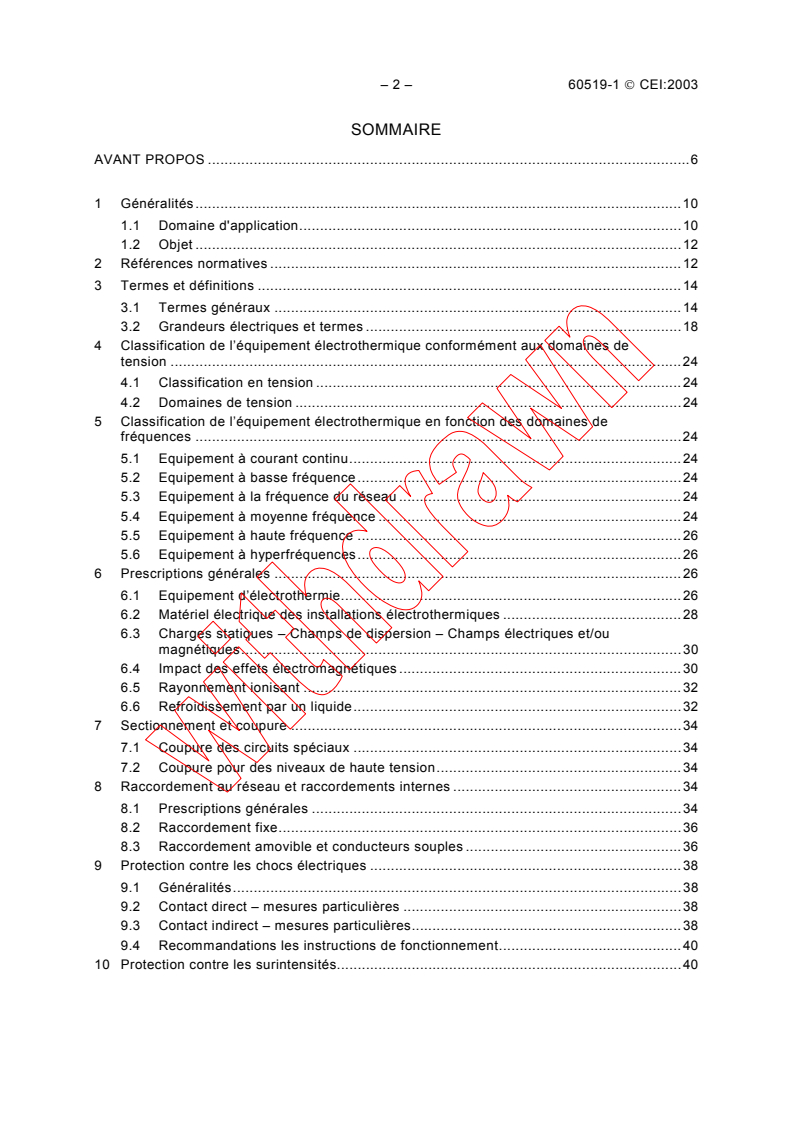
– 2 – 60519-1 © CEI:2003
SOMMAIRE
AVANT PROPOS .6
1 Généralités.10
1.1 Domaine d'application.10
1.2 Objet.12
2 Références normatives.12
3 Termes et définitions .14
3.1 Termes généraux.14
3.2 Grandeurs électriques et termes .18
4 Classification de l’équipement électrothermique conformément aux domaines de
tension .24
4.1 Classification en tension .24
4.2 Domaines de tension .24
5 Classification de l’équipement électrothermique en fonction des domaines de
fréquences .24
5.1 Equipement à courant continu.24
5.2 Equipement à basse fréquence.24
5.3 Equipement à la fréquence du réseau .24
5.4 Equipement à moyenne fréquence .24
5.5 Equipement à haute fréquence .26
5.6 Equipement à hyperfréquences.26
6 Prescriptions générales .26
6.1 Equipement d’électrothermie.26
6.2 Matériel électrique des installations électrothermiques .28
6.3 Charges statiques – Champs de dispersion – Champs électriques et/ou
magnétiques.30
6.4 Impact des effets électromagnétiques .30
6.5 Rayonnement ionisant .32
6.6 Refroidissement par un liquide.32
7 Sectionnement et coupure .34
7.1 Coupure des circuits spéciaux .34
7.2 Coupure pour des niveaux de haute tension.34
8 Raccordement au réseau et raccordements internes .34
8.1 Prescriptions générales .34
8.2 Raccordement fixe.36
8.3 Raccordement amovible et conducteurs souples .36
9 Protection contre les chocs électriques .38
9.1 Généralités.38
9.2 Contact direct – mesures particulières .38
9.3 Contact indirect – mesures particulières.38
9.4 Recommandations les instructions de fonctionnement.40
10 Protection contre les surintensités.40
60519-1 © IEC:2003 – 3 –
CONTENTS
FOREWORD.7
1 General.11
1.1 Scope.11
1.2 Object.13
2 Normative references.13
3 Terms and definitions .15
3.1 General terms.15
3.2 Electrical quantities and terms .19
4 Classification of electroheat equipment according to voltage bands .25
4.1 Voltage classification .25
4.2 Voltage bands .25
5 Classification of electroheat equipment according to frequency bands .25
5.1 Direct current equipment.25
5.2 Low-frequency equipment .25
5.3 Mains-frequency equipment .25
5.4 Medium-frequency equipment .25
5.5 High-frequency equipment .27
5.6 Microwave equipment .27
6 General requirements .27
6.1 Electroheat equipment .27
6.2 Electrical equipment of electroheat installations .29
6.3 Static charges – Stray fields – Electric and/or magnetic fields .31
6.4 Impact of electromagnetic effects .31
6.5 Ionizing radiation .33
6.6 Liquid cooling .33
7 Isolation and switching.35
7.1 Switching-off of special circuits .35
7.2 Switching at high voltage levels.35
8 Connection to the supply network and internal connections .35
8.1 General requirements .35
8.2 Fixed connection.37
8.3 Removable connection and flexible conductors .37
9 Protection against electric shock.39
9.1 General.39
9.2 Direct contact – special measures.39
9.3 Indirect contact – special measures .39
9.4 Recommendations for the operating instructions .41
10 Protection against overcurrent .41
– 4 – 60519-1 © CEI:2003
11 Liaison équipotentielle .40
11.1 Généralités.40
11.2 Circuits de liaison de protection .40
11.3 Liaison à des fins fonctionnelles .42
11.4 Interdiction d’utiliser la terre en tant que partie d’un circuit actif.42
12 Circuits de commande et fonctions de commande.42
12.1 Circuits de commande .42
12.2 Mise à la terre des circuits de commande .44
13 Protection contre les effets thermiques .46
14 Risque d’incendie et danger d’explosion.46
15 Marquage, étiquetage et documentation technique .46
15.1 Marquage.46
15.2 Etiquetage .48
15.3 Documentation technique .48
16 Informations relatives à l’inspection et la mise en marche, et instructions
concernant l’exploitation et l’entretien des installations électrothermiques .48
16.1 Prescriptions générales .48
16.2 Informations relatives à la vérification et la mise en marche .50
16.3 Instructions pour l’exploitation à faire figurer dans la documentation technique.50
16.4 Instructions pour les travaux d’entretien à faire figurer dans la documentation
technique .50
Bibliographie .54
60519-1 © IEC:2003 – 5 –
11 Equipotential bonding .41
11.1 General.41
11.2 Protective bonding circuits .41
11.3 Bonding for operational purposes.43
11.4 Prohibition of the use of earth as part of an active circuit.43
12 Control circuits and control functions.43
12.1 Control circuits .43
12.2 Earthing of control circuits .45
13 Protection against thermal influences.47
14 Risk of fire and danger of explosion .47
15 Marking, labelling and technical documentation.47
15.1 Marking.47
15.2 Labelling.49
15.3 Technical documentation .49
16 Information on inspection and commissioning, and instructions for utilization and
maintenance of electroheat installations.49
16.1 General requirements .49
16.2 Information on inspection and commissioning .51
16.3 Instructions for utilization to be given in the technical documentation.51
16.4 Instructions for maintenance work to be given in the technical documentation .51
Bibliography .55
– 6 – 60519-1 © CEI:2003
COMMISSION ÉLECTROTECHNIQUE INTERNATIONALE
____________
SÉCURITÉ DANS LES INSTALLATIONS ÉLECTROTHERMIQUES –
Partie 1: Exigences générales
AVANT PROPOS
1) La Commission Électrotechnique Internationale (CEI) est une organisation mondiale de normalisation composée
de l'ensemble des comités électrotechniques nationaux (Comités nationaux de la CEI). La CEI a pour objet de
favoriser la coopération internationale pour toutes les questions de normalisation dans les domaines de
l'électricité et de l'électronique. A cet effet, la CEI – entre autres activités – publie des Normes internationales,
des Spécifications techniques, des Rapports techniques, des Spécifications accessibles au public (PAS) et des
Guides (ci-après dénommés "Publication(s) de la CEI"). Leur élaboration est confiée à des comités d'études,
aux travaux desquels tout Comité national intéressé par le sujet traité peut participer. Les organisations
internationales, gouvernementales et non gouvernementales, en liaison avec la CEI, participent également aux
travaux. La CEI collabore étroitement avec l'Organisation Internationale de Normalisation (ISO), selon des
conditions fixées par accord entre les deux organisations.
2) Les décisions ou accords officiels de la CEI concernant les questions techniques représentent, dans la mesure
du possible, un accord international sur les sujets étudiés, étant donné que les Comités nationaux intéressés
sont représentés dans chaque comité d’études.
3) Les publications de la CEI se présentent sous la forme de recommandations internationales et sont agréées
comme tels par les Comités nationaux de la CEI. Tous les efforts raisonnables sont entrepris afin que la CEI
s'assure de l'exactitude du contenu technique de ses publications; la CEI ne peut pas être tenue responsable de
l'éventuelle mauvaise utilisation ou interprétation qui en est faite par un quelconque utilisateur final
4) Dans le but d'encourager l'unification internationale, les Comités nationaux de la CEI s'engagent à appliquer de
façon transparente, dans toute la mesure possible, les Normes internationales de la CEI dans leurs normes
nationales et régionales. Toute divergence entre la norme de la CEI et la norme nationale ou régionale
correspondante doit être indiquée en termes clairs dans cette dernière.
5) La CEI n’a fixé aucune procédure concernant le marquage comme indication d’approbation et sa responsabilité
n’est pas engagée quand un matériel est déclaré conforme à l’une de ses normes.
6) Tous les utilisateurs doivent s'assurer qu'ils sont en possession de la dernière édition de cette publication.
7) Aucune responsabilité ne doit être imputée à la CEI, à ses administrateurs, employés, auxiliaires ou
mandataires, y compris ses experts particuliers et les membres de ses comités d'études et des Comités
nationaux de la CEI, pour tout préjudice causé en cas de dommages corporels et matériels, ou de tout autre
dommage de quelque nature que ce soit, directe ou indirecte, ou pour supporter les coûts (y compris les frais
de justice) et les dépenses découlant de la publication ou de l'utilisation de cette Publication de la CEI ou de
toute autre Publication de la CEI, ou au crédit qui lui est accordé.
8) L'attention est attirée sur les références normatives citées dans cette publication. L'utilisation de publications
référencées est obligatoire pour une application correcte de la présente publication.
9) L’attention est attirée sur le fait que certains des éléments de la présente Publication de la CEI peuvent faire
l’objet de droits de propriété intellectuelle ou de droits analogues. La CEI ne saurait être tenue pour
responsable de ne pas avoir identifié de tels droits de propriété et de ne pas avoir signalé leur existence.
La norme internationale CEI 60519-1 a été établie par le comité d’études 27 de la CEI:
Chauffage électrique industriel.
Cette troisième édition annule et remplace la seconde édition publiée en 1984. Elle constitue
une révision technique.
Dans cette troisième édition de la CEI 60519-1, les modifications techniques significatives au
regard de l'édition antérieure sont les suivantes:
– le domaine d'application est maintenant étendu de façon à couvrir le matériel de domaine
de tension 3, de tension assignée ne dépassant pas 3 600 V en courant alternatif ou
5 000 V en courant continu; les dispositions appropriées à un tel matériel ont été ajoutées
dans les articles sur, par exemple la protection contre les chocs électriques, la liaison
équipotentielle ou les travaux de maintenance;
– les prescriptions concernant la liaison équipotentielle ont été essentiellement modifiées et
introduites dans un article séparé, issu des dispositions appropriées actuelles de la
CEI 60204-1;
– les dispositions générales sur l'impact des effets électromagnétiques ont été précisées;
60519-1 © IEC:2003 – 7 –
INTERNATIONAL ELECTROTECHNICAL COMMISSION
____________
SAFETY IN ELECTROHEAT INSTALLATIONS –
Part 1: General requirements
FOREWORD
1) The International Electrotechnical Commission (IEC) is a worldwide organization for standardization comprising
all national electrotechnical committees (IEC National Committees). The object of IEC is to promote
international co-operation on all questions concerning standardization in the electrical and electronic fields. To
this end and in addition to other activities, IEC publishes International Standards, Technical Specifications,
Technical Reports, Publicly Available Specifications (PAS) and Guides (hereafter referred to as “IEC
Publication(s)”). Their preparation is entrusted to technical committees; any IEC National Committee interested
in the subject dealt with may participate in this preparatory work. International, governmental and non-
governmental organizations liaising with the IEC also participate in this preparation. IEC collaborates closely
with the International Organization for Standardization (ISO) in accordance with conditions determined by
agreement between the two organizations.
2) The formal decisions or agreements of IEC on technical matters express, as nearly as possible, an international
consensus of opinion on the relevant subjects since each technical committee has representation from all
interested IEC National Committees.
3) IEC Publications have the form of recommendations for international use and are accepted by IEC National
Committees in that sense. While all reasonable efforts are made to ensure that the technical content of IEC
Publications is accurate, IEC cannot be held responsible for the way in which they are used or for any
misinterpretation by any end user.
4) In order to promote international uniformity, IEC National Committees undertake to apply IEC Publications
transparently to the maximum extent possible in their national and regional publications. Any divergence
between any IEC Publication and the corresponding national or regional publication shall be clearly indicated in
the latter.
5) IEC provides no marking procedure to indicate its approval and cannot be rendered responsible for any
equipment declared to be in conformity with an IEC Publication.
6) All users should ensure that they have the latest edition of this publication.
7) No liability shall attach to IEC or its directors, employees, servants or agents including individual experts and
members of its technical committees and IEC National Committees for any personal injury, property damage or
other damage of any nature whatsoever, whether direct or indirect, or for costs (including legal fees) and
expenses arising out of the publication, use of, or reliance upon, this IEC Publication or any other IEC
Publications.
8) Attention is drawn to the Normative references cited in this publication. Use of the referenced publications is
indispensable for the correct application of this publication.
9) Attention is drawn to the possibility that some of the elements of this IEC Publication may be the subject of
patent rights. IEC shall not be held responsible for identifying any or all such patent rights.
International Standard IEC 60519-1 has been prepared by IEC technical committee 27:
Industrial electroheating equipment.
This third edition cancels and replaces the second edition published in 1984. It constitutes
a technical revision.
In this third edition of IEC 60519-1 significant technical changes with respect to the previous
edition are as follows:
– the scope is now extended to cover also voltage band 3 equipment with rated voltage not
exceeding 3 600 V a.c. or 5 000 V d.c.; the relevant provisions for such equipment have
been added in clauses on, for example protection against electric shock, equipotential
bonding or maintenance work;
– requirements concerning equipotential bonding have been essentially modified and
introduced in a separate clause, based on the actual relevant provisions of IEC 60204-1;
– general provisions on the impact of electromagnetic effects have been given;
– 8 – 60519-1 © CEI:2003
– les informations concernant la documentation technique ont été modifiées;
– une bibliographie a été ajoutée.
Cette version bilingue, publiée en 2004-05, correspond à la version anglaise.
Le texte anglais de cette norme est issu des documents 27/358/FDIS et 27/377/RVD.
Le rapport de vote 27/377/RVD donne toute information sur le vote ayant abouti à l'approbation
de la présente norme.
La version française de cette norme n’a pas été soumise au vote.
Cette publication a été rédigée selon les Directives ISO/CEI, Partie 2.
Le comité a décidé que le contenu de cette publication ne sera pas modifié avant 2008. A cette
date, la publication sera
• reconduite;
• supprimée;
• remplacée par une édition révisée, ou
• amendée.
La CEI 60519 comprend les parties suivantes, présentées sous le titre général: Sécurité dans
les installations électrothermiques:
Partie 1: Exigences générales
Partie 2: Règles particulières pour installations de chauffage par résistance
Partie 3: Règles particulières pour les installations de chauffage par induction et par
conduction et pour les installations de fusion par induction
Partie 4: Règles particulières pour les installations des fours à arc
Partie 5: Spécifications pour la sécurité dans les installations au plasma
Partie 6: Spécifications pour les installations de chauffage industriel à hyperfréquences
Partie 7: Règles particulières pour les installations comportant des canons à électrons
Partie 8: Règles particulières pour fours de refusion sous laitier électroconducteur
Partie 9: Règles particulières pour les installations de chauffage diélectrique à haute
fréquence
Partie 10: Règles particulières concernant des systèmes de chauffage par traçage à
résistance électrique pour applications industrielles et commerciales
Partie 11: Règles particulières pour les installations pour brassage, transport ou coulée
électromagnétique de métaux liquides
Partie 21: Règles particulières pour les installations de chauffage par résistance –
Installations électrothermiques de fusion de verre
NOTE Si nécessaire, des parties supplémentaires couvrant un équipement électrothermique industriel particulier
peuvent être préparées.
Des méthodes générales d’essai pour les installations d’électrothermie industrielle sont
spécifiées dans la CEI 60398.
Des informations supplémentaires sur les dangers d’origine non électrique pouvant survenir de
l’utilisation d’un équipement d’électrothermie industrielle peuvent être prélevées de la norme
européenne EN 746-1 (voir Bibliographie), qui spécifie les prescriptions communes de sécurité
pour les équipements thermiques industriels, ainsi que celles d’un type électrique et non
électrique.
———————
A l’étude.
60519-1 © IEC:2003 – 9 –
– information concerning technical documentation has been modified;
– a bibliography has been added.
This bilingual version, published in 2004-05, corresponds to the English version.
The text of this standard is based on the following documents:
FDIS Report on voting
27/358/FDIS 27/377/RVD
Full information on the voting for the approval of this standard can be found in the report on
voting indicated in the above table.
The French version of this standard has not been voted upon.
This publication has been drafted in accordance with the ISO/IEC Directives, Part 2.
The committee has decided that the contents of this publication will remain unchanged until
2008. At this date, the publication will be
• reconfirmed;
• withdrawn;
• replaced by a revised edition, or
• amended.
IEC 60519 consists of the following parts, under the general title Safety in electroheat
installations:
Part 1: General requirements
Part 2: Particular requirements for resistance heating equipment
Part 3: Particular requirements for induction and conduction heating and induction melting
installations
Part 4: Particular requirements for arc furnace installations
Part 5: Specifications for safety in plasma installations
Part 6: Specifications for safety in industrial microwave heating equipment
Part 7: Particular requirements for installations with electron guns
Part 8: Particular requirements for electroslag remelting furnaces
Part 9: Particular requirements for high-frequency dielectric heating installations
Part 10: Particular requirements for electrical resistance trace heating systems for industrial
and commercial applications
Part 11: Particular requirements for installations for electromagnetic stirring, transport or
pouring of metal liquids
Part 21: Particular requirements for resistance heating equipment – Heating and melting
glass equipment
NOTE If necessary, additional parts covering particular industrial electroheat equipment may be considered.
General test methods for industrial electroheating installations are specified in IEC 60398.
Additional information on non-electrical hazards possibly arising from the utilization of industrial
electroheat equipment may be taken from European Standard EN 746-1 (see Bibliography),
which specifies common safety requirements for industrial thermoprocessing equipment, as
well as of an electrical and of a non-electrical kind.
———————
Under consideration.
– 10 – 60519-1 © CEI:2003
SÉCURITÉ DANS LES INSTALLATIONS ÉLECTROTHERMIQUES –
Partie 1: Exigences générales
1 Généralités
1.1 Domaine d'application
La présente partie de la CEI 60519 est applicable aux installations électrothermiques
industrielles, qui peuvent comprendre les équipements d’électrothermie dans la plage de
tensions jusqu’à 3 600 V à courant alternatif ou 5 000 V à courant continu, et traite des
exigences générales de sécurité.
Lorsque les prescriptions données dans cette norme diffèrent de celles qui figurent dans
d’autres publications CEI, un degré de sécurité équivalent doit être assuré.
Les présentes prescriptions s’appliquent aux installations électrothermiques industrielles et
installations de traitement associées, telles que:
– les fours à arc direct;
– les fours à arc submergé;
– les installations de chauffage par arc (autres que les fours à arc);
– les fours à refusion sous laitier électroconducteur;
– les installations à plasma;
– les fours de fusion par induction;
– les installations de chauffage par induction;
– les installations de chauffage direct par résistance;
– les installations de chauffage indirect par résistance;
– les installations de chauffage par rayonnement infrarouge;
– les installations de chauffage diélectrique;
– les installations à canons à électrons;
– les installations de chauffage par hyperfréquences;
– les installations industrielles à lasers;
– les installations de traitement en surface par électrothermie.
NOTE La liste est destinée à présenter des exemples types d’installations couvertes par la présente norme. Elle
n’est pas exhaustive.
La présente norme n’est pas applicable aux installations électriques de cuisson et de
chauffage à usage domestique ni aux appareils de soudage; elle ne s’applique pas non plus au
chauffage des locaux, de quelque type qu’ils soient.
La présente norme se réfère au fonctionnement normal des installations électrothermiques
industrielles; elle est également destinée à assurer la sécurité des personnes dans le cas d’un
fonctionnement anormal et dans l’éventualité de défauts pouvant se produire dans les
installations électrothermiques. L’inspection, la mise en service, l’exploitation et l’entretien sont
traités dans l’Article 16.
La présente norme suppose que les installations sont exploitées et entretenues par des
personnes qualifiées ou averties conformément à 3.1.8 et 3.1.9.
60519-1 © IEC:2003 – 11 –
SAFETY IN ELECTROHEAT INSTALLATIONS –
Part 1: General requirements
1 General
1.1 Scope
This part of IEC 60519 is applicable to industrial electroheat installations, which may comprise
electroheat equipment in the voltage range up to 3 600 V a.c. or 5 000 V d.c., and deals with
the general safety requirements.
Where requirements given in this standard differ from those given in other IEC publications, an
equivalent degree of safety shall be ensured.
The present requirements apply to industrial electroheat and associated treatment installations
such as:
– direct arc furnaces;
– submerged arc furnaces;
– equipment for arc heating (other than arc furnaces);
– electroslag remelting furnaces;
– plasma equipment;
– induction melting furnaces;
– equipment for induction heating;
– equipment for direct resistance heating;
– equipment for indirect resistance heating;
– equipment for infra-red radiation heating;
– equipment for dielectric heating;
– equipment with electron guns;
– microwave heating equipment;
– industrial laser equipment;
– electroheat surface treatment equipment.
NOTE The list is intended to present some typical examples of installations covered by this standard. It is not
exhaustive.
This standard is not applicable to electric cooking and heating equipment for household or
welding purposes, nor does it apply to space heating of any kind.
This standard refers to the normal operation of industrial electroheat installations; it is also
intended to ensure the safety of persons in the case of abnormal operation and when faults
occur in electroheat installations. Inspection, commissioning, utilization and maintenance are
dealt with in Clause 16.
This standard assumes that the installations are operated and maintained by skilled or
instructed persons according to 3.1.8 and 3.1.9.
– 12 – 60519-1 © CEI:2003
1.2 Objet
La sécurité des personnes dans les installations électrothermiques fait l’objet, d’une part de
règles générales applicables à l’ensemble des installations d’électrothermie et d’autre part de
règles particulières applicables à chacune d’elles. La présente norme ne fournit que des règles
générales.
Les règles de sécurité concernent plus particulièrement la protection des personnes contre les
dangers d’origine électrique et également contre certains dangers d’origine non électrique.
Les règles de sécurité à observer résultent de l’application conjointe des règles générales et
des règles particulières concernant l’application industrielle spécifique de l’électrothermie.
Lorsque des règles particulières existent, elles doivent compléter, modifier ou remplacer les
règles générales. En l’absence de règles particulières, les prescriptions à observer sont celles
spécifiées dans la présente norme.
En complément, pour les installations électrothermiques des domaines de tension 1 et 2 et de
fréquences jusqu’à 60 Hz, les parties suivantes de la CEI 60364 doivent s’appliquer:
CEI 60364-1, CEI 60364-4-41, CEI 60364-4-42, CEI 60364-4-43, CEI 60364-5-53 et
CEI 60364-5-54.
Pour le domaine de tension 3, les équipements d’électrothermie de tension assignée ne
dépassant pas 3 600 V à courant alternatif ou 5 000 V à courant continu, des exigences
spécifiques doivent être satisfaites. De telles exigences sont spécifiées dans la présente
norme. Pour la tension assignée supérieure à 3 600 V courant alternatif ou 5 000 V courant
continu, des spécifications supplémentaires sont à l’étude.
De plus, pour les installations électriques jusqu’à 1 000 V courant alternatif ou 1 500 V courant
continu et des fréquences jusqu’à 200 Hz, la CEI 60204-1 peut être utilisée en tant que guide.
Cependant, la CEI 60204-1 ne couvre pas les circuits de puissance.
2 Références normatives
Les documents référencés suivants sont indispensables pour l'application de ce document.
Pour des références datées, seule l'édition citée s'applique. Pour les références non datées,
c’est la dernière édition du document référencé (y compris tous les amendements) qui
s’applique.
CEI 60050-195:1998, Vocabulaire Electrotechnique International (VEI) – Partie 195: Mise à la
terre et protection contre les chocs électriques
Amendement 1 (2001)
CEI 60050-521:2002, Vocabulaire Electrotechnique International (VEI) – Partie 521: Dispositifs à
semiconducteurs et circuits intégrés
CEI 60050-826:1982, Vocabulaire Electrotechnique International (VEI) – Partie 826: Instal-
lations électriques des bâtiments
Amendement 1 (1990)
Amendement 2 (1995)
Amendement 3 (1999)
CEI 60050-841:1983, Vocabulaire Electrotechnique International (VEI) – Partie 841: Électro-
thermie industrielle
CEI 60071-1, Coordination de l'isolement – Partie 1: Définitions, principes et règles
CEI 60110-1:1998, Condensateurs de puissance pour les installations de génération de
chaleur par induction – Partie 1: Généralités
60519-1 © IEC:2003 – 13 –
1.2 Object
The requirements for the safety of persons in electroheat installations are the subject, on the
one hand, of general requirements applicable to electroheat installations as a whole and, on
the other hand, of particular requirements applicable to each of them. This standard gives only
general requirements.
These safety requirements concern the protection of persons against dangers of particularly
electrical origin and also against certain dangers of non-electrical origin.
The safety requirements to be observed result from the joint application of general
requirements and particular requirements concerning the specific industrial application of the
electroheat. Where particular requirements exist they shall complete, modify or replace the
general requirements. In the absence of particular requirements, the requirements to be
complied with are those, which are specified in this standard.
In addition, for electroheat installations of voltage bands 1 and 2 and frequencies of up
to 60 Hz, the following parts of IEC 60364 shall apply: IEC 60364-1, IEC 60364-4-41,
IEC 60364-4-42, IEC 60364-4-43, IEC 60364-5-53, IEC 60364-5-54.
For voltage band 3, electroheat equipment with rated voltage not exceeding 3 600 V a.c. or
5 000 V d.c., special requirements shall be complied with. Such requirements are specified in
this standard. For rated voltage exceeding 3 600 V a.c. or 5 000 V d.c., additional
specifications are under consideration.
In addition, for electrical equipment of up to 1 000 V a.c. or 1 500 V d.c. and frequencies of up
to 200 Hz, IEC 60204-1 may be taken as a guidance. IEC 60204-1 however does not cover
power circuits.
2 Normative references
The following referenced documents are indispensable for the application of this document. For
dated references, only the edition cited applies. For undated references, the latest edition of
the referenced document (including any amendments) applies.
IEC 60050-195:1998, International Electrotechnical Vocabulary (IEV) – Part 195: Earthing and
protection against electric shock
Amendment 1 (2001)
IEC 60050-521:2002, International Electrotechnical Vocabulary (IEV) – Part 521: Semiconductor
devices and integrated circuits
IEC 60050-826:1982, International Electrotechnical Vocabulary (IEV) – Par
...