


IEC 62859:2016
(Main)Nuclear power plants - Instrumentation and control systems - Requirements for coordinating safety and cybersecurity
General Information
- Abstract
IEC 62859:2016 provides a framework to manage the interactions between safety and cybersecurity for nuclear power plant (NPP) systems, taking into account current IEC standards addressing these issues and the specifics of nuclear I&C programmable digital systems. This standard establishes requirements and guidance to:
- integrate cybersecurity provisions in nuclear I&C architectures and systems, which are fundamentally tailored for safety;
- avoid potential conflicts between safety and cybersecurity provisions;
- aid the identification and the leveraging of the potential synergies between safety and cybersecurity.
- Status
- Published
- Publication Date
- 08-Oct-2019
- Technical Committee
- SC 45A - Instrumentation, control and electrical power systems of nuclear facilities
- Drafting Committee
- WG 9 - TC 45/SC 45A/WG 9
- Current Stage
- PPUB - Publication issued
- Start Date
- 28-Oct-2016
- Completion Date
- 15-Dec-2016
Buy Documents
IEC 62859:2016 - Nuclear power plants - Instrumentation and control systems - Requirements for coordinating safety and cybersecurity Released:10/28/2016

IEC 62859:2016+AMD1:2019 CSV - Nuclear power plants - Instrumentation and control systems - Requirements for coordinating safety and cybersecurity Released:10/9/2019
Overview
IEC 62859:2016 is an international standard developed by the International Electrotechnical Commission (IEC) that addresses the critical coordination between safety and cybersecurity in nuclear power plant (NPP) instrumentation and control (I&C) systems. Given the evolution from traditional non-digital systems to interconnected programmable digital systems within NPPs, this standard provides a structured framework to effectively manage the interactions and potential conflicts that arise between safety measures and cybersecurity controls.
Specifically tailored for nuclear I&C programmable digital systems, IEC 62859 establishes requirements and guidance for integrating cybersecurity provisions into safety-critical architectures, ensuring that these provisions complement rather than conflict with safety objectives. The standard is essential for NPP designers, operators, vendors, evaluators, and licensors to manage risks while maintaining both operational safety and system security.
Key Topics
Safety and Cybersecurity Coordination
IEC 62859 highlights the importance of integrating cybersecurity controls within safety-oriented I&C architectures without compromising safety functions. It includes methods to identify potential conflicts and leverage synergies between these domains.Architecture-Level Requirements
The standard addresses security zoning, separation provisions, and methods for handling common cause failures, particularly those that could affect both safety and cybersecurity simultaneously.System-Level Lifecycle Activities
It covers coordination throughout the I&C system lifecycle, including design, implementation, verification, validation, operation, maintenance, change management, and decommissioning to ensure ongoing safety and security compliance.Technical Controls in I&C Systems
Important aspects covered include logical access control for human-machine interfaces (HMI), software modification safeguards, logging and audit capabilities, use of cryptographic techniques, and ensuring system availability and functional continuity.Organizational and Operational Governance
IEC 62859 emphasizes governance structures that define clear responsibilities for safety and cybersecurity teams, encourages a robust safety and cybersecurity culture, and outlines emergency response management for incident preparedness.
Applications
Nuclear Power Plant Design and Operations
Ensuring that digital I&C systems meet both safety and cybersecurity requirements by following IEC 62859 can significantly reduce operational risks from cyber threats while maintaining essential safety standards.System Evaluations and Licensing
Vendors, evaluators, and licensing authorities rely on this standard as part of their compliance strategies to verify that safety and cybersecurity provisions are harmonized in digital control systems.Risk Management in Nuclear Facilities
The standard provides a framework to identify and mitigate risks stemming from interactions between safety and cybersecurity systems, improving overall resilience of nuclear power plant operations.Integration into Safety and Security Policies
Utilities and operating organizations can incorporate IEC 62859 requirements into their internal policies and procedures to foster coordinated governance and operational practices.
Related Standards
IEC 61513 – Focuses on general requirements for instrumentation and control systems important to safety in nuclear power plants and serves as a top-level document within IEC Subcommittee 45A (SC 45A).
IEC 62645 – Addresses cybersecurity specifically for nuclear I&C systems and is considered complementary to IEC 62859, with both standards forming the second tier of SC 45A’s documentation hierarchy.
Other SC 45A Standards – IEC 62859 is part of the comprehensive series developed by IEC SC 45A concerning nuclear instrumentation and control, integrating seamlessly with broader nuclear safety and cybersecurity frameworks.
Keywords: IEC 62859, nuclear power plants, instrumentation and control, I&C systems, cybersecurity, safety coordination, programmable digital systems, nuclear safety, cyber threats, safety and cybersecurity integration, nuclear I&C architecture, IEC standards, risk management, digital control systems, nuclear facility security.
Relations
- Effective Date
- 10-Feb-2026
- Referred By
EN IEC 63046:2021 - Nuclear power plants - Electrical power system - General requirements - Effective Date
- 10-Feb-2026
- Effective Date
- 10-Feb-2026
- Effective Date
- 05-Sep-2023
Buy Documents
IEC 62859:2016 - Nuclear power plants - Instrumentation and control systems - Requirements for coordinating safety and cybersecurity Released:10/28/2016
IEC 62859:2016+AMD1:2019 CSV - Nuclear power plants - Instrumentation and control systems - Requirements for coordinating safety and cybersecurity Released:10/9/2019
Get Certified
Connect with accredited certification bodies for this standard

DNV
DNV is an independent assurance and risk management provider.

Lloyd's Register
Lloyd's Register is a global professional services organisation specialising in engineering and technology.
DNV Energy Systems
Energy and renewable energy certification.
Sponsored listings
Frequently Asked Questions
IEC 62859:2016 is a standard published by the International Electrotechnical Commission (IEC). Its full title is "Nuclear power plants - Instrumentation and control systems - Requirements for coordinating safety and cybersecurity". This standard covers: IEC 62859:2016 provides a framework to manage the interactions between safety and cybersecurity for nuclear power plant (NPP) systems, taking into account current IEC standards addressing these issues and the specifics of nuclear I&C programmable digital systems. This standard establishes requirements and guidance to: - integrate cybersecurity provisions in nuclear I&C architectures and systems, which are fundamentally tailored for safety; - avoid potential conflicts between safety and cybersecurity provisions; - aid the identification and the leveraging of the potential synergies between safety and cybersecurity.
IEC 62859:2016 provides a framework to manage the interactions between safety and cybersecurity for nuclear power plant (NPP) systems, taking into account current IEC standards addressing these issues and the specifics of nuclear I&C programmable digital systems. This standard establishes requirements and guidance to: - integrate cybersecurity provisions in nuclear I&C architectures and systems, which are fundamentally tailored for safety; - avoid potential conflicts between safety and cybersecurity provisions; - aid the identification and the leveraging of the potential synergies between safety and cybersecurity.
IEC 62859:2016 is classified under the following ICS (International Classification for Standards) categories: 27.120.20 - Nuclear power plants. Safety. The ICS classification helps identify the subject area and facilitates finding related standards.
IEC 62859:2016 has the following relationships with other standards: It is inter standard links to EN IEC 61226:2021, EN IEC 63046:2021, EN IEC 62645:2020, IEC 62859:2016/AMD1:2019. Understanding these relationships helps ensure you are using the most current and applicable version of the standard.
IEC 62859:2016 is available in PDF format for immediate download after purchase. The document can be added to your cart and obtained through the secure checkout process. Digital delivery ensures instant access to the complete standard document.
Standards Content (Sample)
IEC 62859 ®
Edition 1.0 2016-10
INTERNATIONAL
STANDARD
NORME
INTERNATIONALE
Nuclear power plants – Instrumentation and control systems – Requirements for
coordinating safety and cybersecurity
Centrales nucléaires de puissance – Systèmes d'instrumentation et de contrôle-
commande – Exigences pour coordonner sûreté et cybersécurité
All rights reserved. Unless otherwise specified, no part of this publication may be reproduced or utilized in any form
or by any means, electronic or mechanical, including photocopying and microfilm, without permission in writing from
either IEC or IEC's member National Committee in the country of the requester. If you have any questions about IEC
copyright or have an enquiry about obtaining additional rights to this publication, please contact the address below or
your local IEC member National Committee for further information.
Droits de reproduction réservés. Sauf indication contraire, aucune partie de cette publication ne peut être reproduite
ni utilisée sous quelque forme que ce soit et par aucun procédé, électronique ou mécanique, y compris la photocopie
et les microfilms, sans l'accord écrit de l'IEC ou du Comité national de l'IEC du pays du demandeur. Si vous avez des
questions sur le copyright de l'IEC ou si vous désirez obtenir des droits supplémentaires sur cette publication, utilisez
les coordonnées ci-après ou contactez le Comité national de l'IEC de votre pays de résidence.
IEC Central Office Tel.: +41 22 919 02 11
3, rue de Varembé Fax: +41 22 919 03 00
CH-1211 Geneva 20 info@iec.ch
Switzerland www.iec.ch
About the IEC
The International Electrotechnical Commission (IEC) is the leading global organization that prepares and publishes
International Standards for all electrical, electronic and related technologies.
About IEC publications
The technical content of IEC publications is kept under constant review by the IEC. Please make sure that you have the
latest edition, a corrigenda or an amendment might have been published.
IEC Catalogue - webstore.iec.ch/catalogue Electropedia - www.electropedia.org
The stand-alone application for consulting the entire The world's leading online dictionary of electronic and
bibliographical information on IEC International Standards, electrical terms containing 20 000 terms and definitions in
Technical Specifications, Technical Reports and other English and French, with equivalent terms in 15 additional
documents. Available for PC, Mac OS, Android Tablets and languages. Also known as the International Electrotechnical
iPad. Vocabulary (IEV) online.
IEC publications search - www.iec.ch/searchpub IEC Glossary - std.iec.ch/glossary
The advanced search enables to find IEC publications by a 65 000 electrotechnical terminology entries in English and
variety of criteria (reference number, text, technical French extracted from the Terms and Definitions clause of
committee,…). It also gives information on projects, replaced IEC publications issued since 2002. Some entries have been
and withdrawn publications. collected from earlier publications of IEC TC 37, 77, 86 and
CISPR.
IEC Just Published - webstore.iec.ch/justpublished
Stay up to date on all new IEC publications. Just Published IEC Customer Service Centre - webstore.iec.ch/csc
details all new publications released. Available online and If you wish to give us your feedback on this publication or
also once a month by email. need further assistance, please contact the Customer Service
Centre: csc@iec.ch.
A propos de l'IEC
La Commission Electrotechnique Internationale (IEC) est la première organisation mondiale qui élabore et publie des
Normes internationales pour tout ce qui a trait à l'électricité, à l'électronique et aux technologies apparentées.
A propos des publications IEC
Le contenu technique des publications IEC est constamment revu. Veuillez vous assurer que vous possédez l’édition la
plus récente, un corrigendum ou amendement peut avoir été publié.
Catalogue IEC - webstore.iec.ch/catalogue Electropedia - www.electropedia.org
Application autonome pour consulter tous les renseignements
Le premier dictionnaire en ligne de termes électroniques et
bibliographiques sur les Normes internationales,
électriques. Il contient 20 000 termes et définitions en anglais
Spécifications techniques, Rapports techniques et autres
et en français, ainsi que les termes équivalents dans 15
documents de l'IEC. Disponible pour PC, Mac OS, tablettes
langues additionnelles. Egalement appelé Vocabulaire
Android et iPad.
Electrotechnique International (IEV) en ligne.
Recherche de publications IEC - www.iec.ch/searchpub
Glossaire IEC - std.iec.ch/glossary
65 000 entrées terminologiques électrotechniques, en anglais
La recherche avancée permet de trouver des publications IEC
en utilisant différents critères (numéro de référence, texte, et en français, extraites des articles Termes et Définitions des
comité d’études,…). Elle donne aussi des informations sur les publications IEC parues depuis 2002. Plus certaines entrées
projets et les publications remplacées ou retirées. antérieures extraites des publications des CE 37, 77, 86 et
CISPR de l'IEC.
IEC Just Published - webstore.iec.ch/justpublished
Service Clients - webstore.iec.ch/csc
Restez informé sur les nouvelles publications IEC. Just
Published détaille les nouvelles publications parues. Si vous désirez nous donner des commentaires sur cette
Disponible en ligne et aussi une fois par mois par email. publication ou si vous avez des questions contactez-nous:
csc@iec.ch.
IEC 62859 ®
Edition 1.0 2016-10
INTERNATIONAL
STANDARD
NORME
INTERNATIONALE
Nuclear power plants – Instrumentation and control systems – Requirements for
coordinating safety and cybersecurity
Centrales nucléaires de puissance – Systèmes d'instrumentation et de contrôle-
commande – Exigences pour coordonner sûreté et cybersécurité
INTERNATIONAL
ELECTROTECHNICAL
COMMISSION
COMMISSION
ELECTROTECHNIQUE
INTERNATIONALE
ICS 27.120.20 ISBN 978-2-8322-3719-9
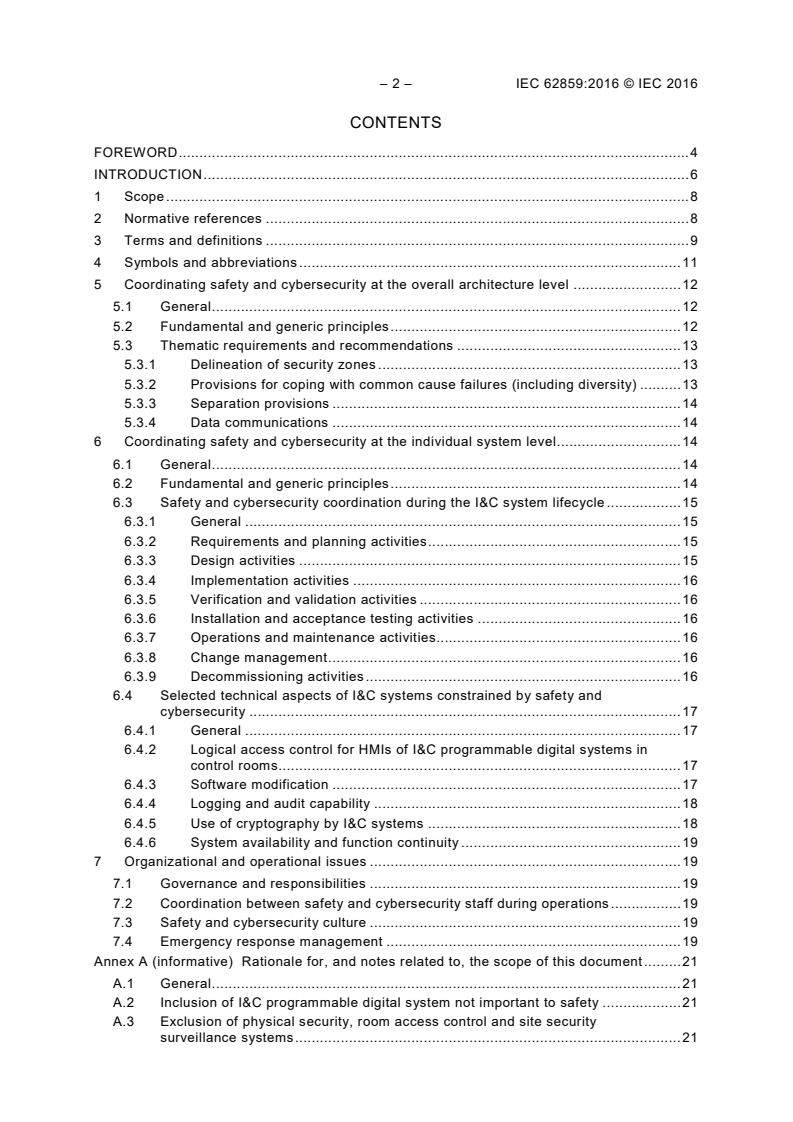
– 2 – IEC 62859:2016 © IEC 2016
CONTENTS
FOREWORD . 4
INTRODUCTION . 6
1 Scope . 8
2 Normative references . 8
3 Terms and definitions . 9
4 Symbols and abbreviations . 11
5 Coordinating safety and cybersecurity at the overall architecture level . 12
5.1 General . 12
5.2 Fundamental and generic principles . 12
5.3 Thematic requirements and recommendations . 13
5.3.1 Delineation of security zones . 13
5.3.2 Provisions for coping with common cause failures (including diversity) . 13
5.3.3 Separation provisions . 14
5.3.4 Data communications . 14
6 Coordinating safety and cybersecurity at the individual system level. 14
6.1 General . 14
6.2 Fundamental and generic principles . 14
6.3 Safety and cybersecurity coordination during the I&C system lifecycle . 15
6.3.1 General . 15
6.3.2 Requirements and planning activities . 15
6.3.3 Design activities . 15
6.3.4 Implementation activities . 16
6.3.5 Verification and validation activities . 16
6.3.6 Installation and acceptance testing activities . 16
6.3.7 Operations and maintenance activities. 16
6.3.8 Change management . 16
6.3.9 Decommissioning activities . 16
6.4 Selected technical aspects of I&C systems constrained by safety and
cybersecurity . 17
6.4.1 General . 17
6.4.2 Logical access control for HMIs of I&C programmable digital systems in
control rooms . 17
6.4.3 Software modification . 17
6.4.4 Logging and audit capability . 18
6.4.5 Use of cryptography by I&C systems . 18
6.4.6 System availability and function continuity . 19
7 Organizational and operational issues . 19
7.1 Governance and responsibilities . 19
7.2 Coordination between safety and cybersecurity staff during operations . 19
7.3 Safety and cybersecurity culture . 19
7.4 Emergency response management . 19
Annex A (informative) Rationale for, and notes related to, the scope of this document . 21
A.1 General . 21
A.2 Inclusion of I&C programmable digital system not important to safety . 21
A.3 Exclusion of physical security, room access control and site security
surveillance systems . 21
A.4 Exclusion of non-malevolent actions and events . 21
A.5 Exclusion of development tools and platforms . 22
Bibliography . 23
– 4 – IEC 62859:2016 © IEC 2016
INTERNATIONAL ELECTROTECHNICAL COMMISSION
____________
NUCLEAR POWER PLANTS –
INSTRUMENTATION AND CONTROL SYSTEMS –
REQUIREMENTS FOR COORDINATING SAFETY AND CYBERSECURITY
FOREWORD
1) The International Electrotechnical Commission (IEC) is a worldwide organization for standardization comprising
all national electrotechnical committees (IEC National Committees). The object of IEC is to promote
international co-operation on all questions concerning standardization in the electrical and electronic fields. To
this end and in addition to other activities, IEC publishes International Standards, Technical Specifications,
Technical Reports, Publicly Available Specifications (PAS) and Guides (hereafter referred to as “IEC
Publication(s)”). Their preparation is entrusted to technical committees; any IEC National Committee interested
in the subject dealt with may participate in this preparatory work. International, governmental and non-
governmental organizations liaising with the IEC also participate in this preparation. IEC collaborates closely
with the International Organization for Standardization (ISO) in accordance with conditions determined by
agreement between the two organizations.
2) The formal decisions or agreements of IEC on technical matters express, as nearly as possible, an international
consensus of opinion on the relevant subjects since each technical committee has representation from all
interested IEC National Committees.
3) IEC Publications have the form of recommendations for international use and are accepted by IEC National
Committees in that sense. While all reasonable efforts are made to ensure that the technical content of IEC
Publications is accurate, IEC cannot be held responsible for the way in which they are used or for any
misinterpretation by any end user.
4) In order to promote international uniformity, IEC National Committees undertake to apply IEC Publications
transparently to the maximum extent possible in their national and regional publications. Any divergence
between any IEC Publication and the corresponding national or regional publication shall be clearly indicated in
the latter.
5) IEC itself does not provide any attestation of conformity. Independent certification bodies provide conformity
assessment services and, in some areas, access to IEC marks of conformity. IEC is not responsible for any
services carried out by independent certification bodies.
6) All users should ensure that they have the latest edition of this publication.
7) No liability shall attach to IEC or its directors, employees, servants or agents including individual experts and
members of its technical committees and IEC National Committees for any personal injury, property damage or
other damage of any nature whatsoever, whether direct or indirect, or for costs (including legal fees) and
expenses arising out of the publication, use of, or reliance upon, this IEC Publication or any other IEC
Publications.
8) Attention is drawn to the Normative references cited in this publication. Use of the referenced publications is
indispensable for the correct application of this publication.
9) Attention is drawn to the possibility that some of the elements of this IEC Publication may be the subject of
patent rights. IEC shall not be held responsible for identifying any or all such patent rights.
International Standard IEC 62859 has been prepared by subcommittee 45A: Instrumentation,
control and electrical systems of nuclear facilities, of IEC technical committee 45: Nuclear
instrumentation.
The text of this standard is based on the following documents:
FDIS Report on voting
45A/1104/FDIS 45A/1118/RVD
Full information on the voting for the approval of this standard can be found in the report on
voting indicated in the above table.
This publication has been drafted in accordance with the ISO/IEC Directives, Part 2.
The committee has decided that the contents of this publication will remain unchanged until
the stability date indicated on the IEC website under "http://webstore.iec.ch" in the data
related to the specific publication. At this date, the publication will be
• reconfirmed,
• withdrawn,
• replaced by a revised edition, or
• amended.
– 6 – IEC 62859:2016 © IEC 2016
INTRODUCTION
a) Technical background, main issues and organisation of this standard
I&C systems have evolved during the last decades from non-digital equipment and stand-
alone environments to digital technologies and interconnected systems. Such an evolution
exposes them to risks related to cyberattacks. In addition to well-established safety-oriented
provisions, more recent cybersecurity requirements and controls now apply to the same
systems. A normative framework is needed to master the interactions and potential side-
effects when safety and cybersecurity provisions converge on the same I&C systems and
architectures, taking into account the nuclear I&C specifics and the SC 45A related standards.
This standard specifically focuses on the issue of requirements for coordinating safety and
cybersecurity provisions for I&C programmable digital systems and architectures. It defines
both generic principles and guidance for practical situations to integrate cybersecurity
requirements in nuclear I&C architectures and systems, fundamentally tailored for safety.
Technical but also conceptual, organizational and procedural aspects are covered.
It is intended that this standard be used by designers and operators of nuclear power plants
(NPPs) (utilities), systems evaluators, vendors and subcontractors, and by licensors.
b) Situation of the current standard in the structure of the IEC SC 45A standard
series
IEC 62859 is at the second level of the IEC SC 45A standard series. It is to be considered as
bridging IEC 62645 (also at the second level of the IEC SC 45A standard series) and
IEC 61513, the top level document of the IEC SC 45A standard series. Regarding the specific
theme of cybersecurity, IEC 62645 is the top-level in the SC 45A standard series. Both
IEC 62645 and IEC 62859 are considered formally as second level documents with respect to
IEC 61513, although IEC 61513:2011 does not actually ensure proper reference to and
consistency with them (this will be done in a future revision of IEC 61513).
For a generic description of the structure of the IEC SC 45A standard series, see item d) of
this introduction.
c) Recommendations and limitations regarding the application of this standard
It is important to note that this standard establishes additional requirements for I&C
programmable digital systems and architectures, with regard to the coordination between
safety and cybersecurity, and clarifies the processes by which I&C programmable digital
systems are designed, implemented and operated in nuclear power plants. Aspects for which
special requirements and recommendations have been produced are:
– IAEA guidance on I&C;
– IAEA guidance on computer security at nuclear facilities;
– regulatory interpretations for country specific requirements.
d) Description of the structure of the IEC SC 45A standard series and relationships
with other IEC documents and other bodies documents (IAEA, ISO)
The top-level documents of the IEC SC 45A standard series are IEC 61513 and IEC 63046 .
IEC 61513 provides general requirements for I&C systems and equipment that are used to
perform functions important to safety in NPPs. IEC 63046 provides general requirements for
electrical power systems of NPPs; it covers power supply systems including the supply
___________
In preparation. Stage at the time of publication: IEC ANW 63046:2016.
systems of the I&C systems. IEC 61513 and IEC 63046 are to be considered in conjunction
and at the same level. IEC 61513 and IEC 63046 structure the IEC SC 45A standard series
and shape a complete framework establishing general requirements for instrumentation,
control and electrical systems for nuclear power plants.
IEC 61513 and IEC 63046 refer directly to other IEC SC 45A standards for general topics
related to categorization of functions and classification of systems, qualification, separation,
defence against common cause failure, control room design, electromagnetic compatibility,
cybersecurity, software and hardware aspects for programmable digital systems, coordination
of safety and security requirements and management of ageing. The standards referenced
directly at this second level should be considered together with IEC 61513 and IEC 63046 as
a consistent document set.
At a third level, IEC SC 45A standards not directly referenced by IEC 61513 or by IEC 63046
are standards related to specific equipment, technical methods, or specific activities. Usually
these documents, which make reference to second-level documents for general topics, can be
used on their own.
A fourth level extending the IEC SC 45 standard series, corresponds to the Technical Reports
which are not normative.
The IEC SC 45A standards series consistently implements and details the safety and security
principles and basic aspects provided in the relevant IAEA safety standards and in the
relevant documents of the IAEA nuclear security series (NSS). In particular this includes the
IAEA requirements SSR-2/1, establishing safety requirements related to the design of nuclear
power plants (NPP), the IAEA safety guide SSG-30 dealing with the safety classification of
structures, systems and components in NPP, the IAEA safety guide SSG-39 dealing with the
design of instrumentation and control systems for NPP, the IAEA safety guide SSG-34 dealing
with the design of electrical power systems for NPP and the implementing guide NSS17 for
computer security at nuclear facilities. The safety and security terminology and definitions
used by SC 45A standards are consistent with those used by the IAEA.
IEC 61513 and IEC 63046 have adopted a presentation format similar to the basic safety
publication IEC 61508 with an overall life-cycle framework and a system life-cycle framework.
Regarding nuclear safety, IEC 61513 and IEC 63046 provide the interpretation of the general
requirements of IEC 61508-1, IEC 61508-2 and IEC 61508-4, for the nuclear application
sector. In this framework IEC 60880, IEC 62138 and IEC 62566 correspond to IEC 61508-3
for the nuclear application sector. IEC 61513 and IEC 63046 refer to ISO as well as to IAEA
GS-R-3 and IAEA GS-G-3.1 and IAEA GS-G-3.5 for topics related to quality assurance (QA).
At level 2, regarding nuclear security, IEC 62645 is the entry document for the IEC SC 45A
security standards. It builds upon the valid high level principles and main concepts of the
generic security standards, in particular ISO/IEC 27001 and ISO/IEC 27002; it adapts them
and completes them to fit the nuclear context and coordinates with the IEC 62443 series. At
level 2, regarding control rooms, IEC 60964 is the entry document for the IEC SC 45A control
rooms standards and IEC 62342 is the entry document for the IEC SC 45A ageing
management standards.
NOTE 1 It is assumed that for the design of I&C systems in NPPs that implement conventional safety functions
(e.g. to address worker safety, asset protection, chemical hazards, process energy hazards) international or
national standards would be applied.
NOTE 2 IEC SC 45A domain was extended in 2013 to cover electrical systems. In 2014 and 2015 discussions
were held in IEC SC 45A to decide how and where general requirements for the design of electrical systems were
to be considered. IEC SC 45A experts recommended that an independent standard be developed at the same level
as IEC 61513 to establish general requirements for electrical systems. Project IEC 63046 is now launched to cover
this objective. When IEC 63046 will be published this NOTE 2 of the introduction of IEC SC 45A standards will be
suppressed.
– 8 – IEC 62859:2016 © IEC 2016
NUCLEAR POWER PLANTS –
INSTRUMENTATION AND CONTROL SYSTEMS –
REQUIREMENTS FOR COORDINATING SAFETY AND CYBERSECURITY
1 Scope
This document provides a framework to manage the interactions between safety and
cybersecurity for nuclear power plant (NPP) systems, taking into account the current SC 45A
standards addressing these issues and the specifics of nuclear I&C programmable digital
systems.
NOTE In this document (as in IEC 62645), cybersecurity relates to prevention of, detection of, and reaction to
malicious acts perpetrated by digital means (cyberattacks). In this context, it does not cover considerations related
to non-malevolent actions and events such as accidental failures, natural events or human errors (except those
degrading cybersecurity). Those aspects are of course of prime importance but they are covered by other SC 45A
documents and standards, and are not considered as cybersecurity related in this document.
This document establishes requirements and guidance to:
– integrate cybersecurity provisions in nuclear I&C architectures and systems, which are
fundamentally tailored for safety;
– avoid potential conflicts between safety and cybersecurity provisions;
– aid the identification and the leveraging of the potential synergies between safety and
cybersecurity.
This document is intended to be used for designing new NPPs, or modernizing existing NPPs,
throughout I&C programmable digital systems lifecycle. It is also applicable for assessing the
coordination between safety and cybersecurity of existing plants. It may also be applicable to
other types of nuclear facilities.
This document addresses I&C programmable digital systems important to safety and I&C
programmable digital systems not important to safety. It does not address programmable
digital systems dedicated to site physical security, room access control and site security
surveillance.
This document is limited to I&C programmable digital systems of NPPs, including their on-site
maintenance and configuration tools.
Annex A provides a rationale for and comments about the scope definition and the document
application, in particular about the exclusions and limitations previously mentioned.
This document comprises three normative clauses:
• Clause 5 deals with the overall I&C architecture;
• Clause 6 focuses on the system level;
• Clause 7 deals with organizational and operational issues.
2 Normative references
The following documents are referred to in the text in such a way that some or all of their
content constitutes requirements of this document. For dated references, only the edition
cited applies. For undated references, the latest edition of the referenced document (including
any amendments) applies.
IEC 60709:2004, Nuclear power plants – Instrumentation and control systems important to
safety – Separation
IEC 60880:2006, Nuclear power plants – Instrumentation and control systems important to
safety – Software aspects for computer-based systems performing category A functions
IEC 61500:2009, Nuclear power plants – Instrumentation and control systems important to
safety – Data communication in systems performing category A functions
IEC 61513:2011, Nuclear power plants – Instrumentation and control important to safety –
General requirements for systems
IEC 62138:2004, Nuclear power plants – Instrumentation and control important for safety –
Software aspects for computer-based systems performing category B or C functions
IEC 62340, Nuclear power plants – Instrumentation and control systems important to safety –
Requirements for coping with common cause failure (CCF)
IEC 62566:2012, Nuclear power plants – Instrumentation and control important to safety –
Development of HDL-programmed integrated circuits for systems performing category A
functions
IEC 62645:2014, Nuclear power plants – Instrumentation and control systems – Requirements
for security programmes for computer-based systems
3 Terms and definitions
For the purposes of this document, the terms and definitions given in IEC 62645, in
IEC 61513 and the following apply.
NOTE If for a given term, different definitions are provided in these three sources, the definition of the present
document applies.
ISO and IEC maintain terminological databases for use in standardization at the following
addresses:
• IEC Electropedia: available at http://www.electropedia.org/
• ISO Online browsing platform: available at http://www.iso.org/obp
3.1
computer-based item
item that relies on software instructions running on microprocessors or microcontrollers
Note 1 to entry: The term item can be replaced by the terms system, or equipment, or device.
Note 2 to entry: A computer-based item is a kind of programmable digital item.
Note 3 to entry: This term is equivalent to software-based item.
3.2
cyberattack
attempt by digital means to destroy, expose, alter, disable, steal or gain unauthorized access
to or make unauthorized use of an asset
Note 1 to entry: Cyberattacks include targeted and non-targeted (e.g. malwares) attacks by digital means.
Cyberattack is synonymous with digital attack.
– 10 – IEC 62859:2016 © IEC 2016
3.3
cybersecurity
set of activities and measures the objective of which is to prevent, detect, and react to:
– malicious disclosures of information (confidentiality) that could be used to perform
malicious acts which could lead to an accident, an unsafe situation or plant performance
degradation;
– malicious modifications (integrity) of functions that may compromise the delivery or
integrity of the required service by I&C programmable digital systems (incl. loss of control)
which could lead to an accident, an unsafe situation or plant performance degradation;
– malicious withholding or prevention of access to or communication of information, data or
resources (incl. loss of view) that could compromise the delivery of the required service by
I&C systems (availability) which could lead to an accident, an unsafe situation or plant
performance degradation
Note 1 to entry: This definition is tailored with respect to this standard scope and overall SC 45A document
structure. It is recognized that the term “cybersecurity” has a broader meaning in other standards and guidance,
often including non-malevolent threats, human errors and protection against natural disasters. Those aspects –
except human errors degrading cybersecurity – are not included in the concept of cybersecurity used in the SC 45A
standard series. See Annex A.4 for more detail about such exclusions.
Note 2 to entry: Computer security, security and cybersecurity are considered synonymous in this document.
3.4
cybersecurity event
identified occurrence of a system, service or network state indicating a possible breach of
cybersecurity policy or failure of controls, or a previously unknown situation that may be
cybersecurity relevant
3.5
cybersecurity-driven software modification
software modification of which the main reason is to implement one or more cybersecurity
features, or remediate one or several security vulnerabilities in a I&C programmable digital
component, or to prevent successful exploitation of these vulnerabilities or to mitigate
attackers’ capabilities to exploit these vulnerabilities
3.6
cybersecurity feature
provision, control or function specifically designed for cybersecurity purposes
Note 1 to entry: Non-cybersecurity features implementation can have negative, neutral, but also positive impact
on cybersecurity. This is particularly the case of some safety features, as discussed in this document.
Note 2 to entry: The terms “feature” and “provision” are considered synonymous in this document.
3.7
HDL-Programmed Device
integrated circuit configured (for NPP I&C systems), with Hardware Description Languages
and related software tools
Note 1 to entry: HDLs and related tools (e.g. simulator, synthesizer) are used to implement the requirements in a
proper assembly of pre-developed micro-electronic resources.
Note 2 to entry: The development of HPDs can use pre-developed blocks.
Note 3 to entry: HPDs are typically based on blank FPGAs (Field Programmable gate Arrays) or similar
programmable integrated circuits.
[SOURCE: IEC 62566:2012, 3.7]
3.8
logical separation
separation from a digital data network perspective involving the absence of direct data
communications (i.e. without any proxy or cybersecurity filtering device)
3.9
programmable digital item
item that relies on software instructions or programmable logic to accomplish a function
Note 1 to entry: The term item can be replaced by the terms system, or equipment, or device.
Note 2 to entry: The main programmable digital items are computer-based items and programmable logic items.
Note 3 to entry: This term used by SC 45A is equivalent to Programmable Electronic item used in IEC 61508.
3.10
programmable logic item
item that relies on logic components with an integrated circuit that consists of logic elements
with an inter-connection pattern, parts of which are user programmable
Note 1 to entry: The term item can be replaced by the terms system, or equipment, or device.
Note 2 to entry: A programmable logic item is a kind of programmable digital item.
3.11
safety feature
provision, control or function specifically designed for safety purposes
Note 1 to entry: Non-safety features implementation can have negative, neutral, but also positive impact on
safety. This is particularly the case of some cybersecurity features, as discussed in this standard.
Note 2 to entry: The terms “feature” and “provision” are considered synonymous.
3.12
software modification
change in an already agreed document (or documents) leading to an alteration of the
executable code
Note 1 to entry: Software modifications may occur either during initial software development (e.g. to remove faults
found in later stages of development), or after the software is already in service.
[SOURCE: IEC 60880:2006, 3.36]
3.13
software security update
piece of software provided by a digital system supplier and designed to fix one or several
security vulnerabilities in a digital component, or implement one or more cybersecurity
features
Note 1 to entry: Security patches are considered as software security updates.
4 Symbols and abbreviations
BIOS Basic Input/Output System
CB Computer-Based
CCF Common Cause Failure
CRC Cyclic Redundancy Check
FPGA Field-Programmable Gate Array
HDL Hardware Description Language
HMI Human-Machine Interface
– 12 – IEC 62859:2016 © IEC 2016
HPD HDL-Programmed Device
I&C Instrumentation and Control
NPP Nuclear Power Plant
5 Coordinating safety and cybersecurity at the overall architecture level
5.1 General
Several safety features and architectural characteristics implemented in order to address
design basis requirements are in some cases directly beneficial to cybersecurity: this includes
some of the features that support equipment independence, system reliability or system
diversity. However, considering that the design of these features may not have adequately
taken into account potential vulnerabilities to cyberattacks, dedicated cybersecurity measures
may be needed to achieve adequate cybersecurity, without degrading safety.
This clause provides requirements and recommendations to enable a smooth integration of
cybersecurity requirements as per IEC 62645 in a nuclear I&C architecture, fundamentally
and firstly structured by safety-oriented requirements (in particular those of IEC 61513 and
several second level documents of the SC 45A series, including IEC 62340 or IEC 60709).
5.2 Fundamental and generic principles
The following principles apply for the treatment of cybersecurity at the I&C architectural level:
a) Cybersecurity shall not interfere with the safety objectives of the plant and shall protect
their realisation. It shall not compromise the effectiveness of the diversity and defence-in-
depth features implemented by the I&C architecture.
b) Cybersecurity requirements impacting the overall I&C architecture shall be addressed
after the overall I&C architecture design and assignment of the I&C functions have been
first made as per 5.4 of IEC 61513:2011. The integration of architectural cybersecurity
requirements may lead to an iterative design process.
NOTE The objective is to secure a safe I&C architecture. Such a sequence is already implicit in IEC 62645,
as the assignment of security degrees (and their associated requirements) assumes that safety categories are
already assigned to safety functions, and that the safety functions are already assigned to I&C systems.
c) Cybersecurity features shall not adversely impact the required performance (including
response time), required effectiveness, required reliability or required operation of
functions important to safety.
d) The failure modes and consequences of cybersecurity features on the functions important
to safety shall be analysed and taken into account.
e) When two architecture designs offer equivalent level of safety, priority should be given to
the most secure one. Unnecessary complexity shall be avoided as it is detrimental to both
safety and cybersecurity.
f) Any architectural property or characteristics designed for safety reason (e.g.,
independence between systems), which has value as a potential cybersecurity counter-
measure (during cybersecurity risk analysis activity for instance) should be re-examined
taking into account context-relevant cyberattacks, by staff responsible for cybersecurity, to
confirm its cybersecurity effectiveness.
A particular case corresponds to communications between systems important to safety
and systems not important to safety, or between systems of different safety classes.
IEC 61513 already requires that communication links are designed in such a way that data
communication and operation of the higher safety category function cannot be jeopardised
by data communication with lower classified systems. However, the provisions taken to
fulfil such safety requirements are not necessarily robust against malicious threats and
cyberattacks.
5.3 Thematic requirements and recommendations
5.3.1 Delineation of security zones
5.3.1.1 General
As defined in IEC 62645, security zones are practical and architectural implementations of a
graded approach to cybersecurity; they allow I&C systems with similar importance concerning
safety and plant performance (i.e. having the same security degree) to be grouped together
for administration and application of protective measures. As per IEC 62645, criteria for
defining a security zone include organizational issues (such as ownership/responsibility),
localisation, architectural or technical aspects. In practice, security zones are implemented
as means against the propagation of cyberattacks. In such context, when a zone model is
enforced as recommended by IEC 62645, the following applies:
a) The delineation of security zones, as per IEC 62645, shall take into account and leverage
independence and physical separation requirements introduced for the purpose of
enhancing safety.
b) Data communication aspects (incl. logical separation) and geographical/physical
separation as well as independence aspects shall be considered together to delineate
security zones.
NOTE Geographical separation and independence features are not sufficient to delineate security zones.
5.3.1.2 Dealing with systems with several divisions
a) The divisions (or trains) of a given I&C programmable digital system should be grouped in
the same security zone, unless the communications between divisions can be efficiently
filtered and monitored from a cybersecurity perspective.
b) The divisions (or trains) of a given I&C programmable digital system shall be grouped in
the same security zone if a common engineering tool is used to configure them.
NOTE This requirement holds even if the tool is connected only to one division at a time: if the tool is
compromised, it can support an asynchronous attack, compromising divisions one after the other.
5.3.1.3 Dealing with systems sharing common resources
a) I&C programmable digital systems sharing common computer-based tools (e.g.
configuration, testing, and/or maintenance tools) shall be grouped in the same security
zone, unless it is demonstrated from a cybersecurity perspective that the tools cannot
directly impact the systems they are connected to.
b) I&C programmable digital systems sharing a common network or communication bus
without cybersecurity technical provisions securing the communications should be
grouped in the same security zone, even if they perform functions of different safety
categories. As per IEC 62645, the security degree assignment shall take into account the
most sensitive safety category.
5.3.2 Provisions for coping with common cause failures (including diversity)
a) In some cases, provisions taken in order to cope with common cause failures (CCF),
including diversity, can be leveraged from a cybersecurity perspective, and should be
leveraged in such cases. When claimed in cybersecurity oriented analyses, the
cybersecurity benefit shall be assessed and validated by staff responsible for
cybersecurity, taking into account context-relevant malicious threats and potential
cyberattacks (consistently with 5.2 f).
NOTE 1 Provisions resulting from requirements, recommendations and associated safety practices as
per 5.4.2.6 of IEC 61513:2011 (for all I&C systems important to safety), Clause 13 of IEC 60880:2006 (for
software aspects of systems performing category A functions), IEC 62340 or equivalent (for systems
performing category A functions), are for instance directly concerned by 5.3.2a).
NOTE 2 As for safety, diversity is also commonly used in cybersecurity: examples include the use of diverse
penetration testing tools, diverse skills of cybersecurity team members or auditors. However, expecting benefit
from diversity in all situations for both safety and cybersecurity is questionable. Diversity is generally used “in
series” to bring cybersecurity benefit (involving the need to compromise one system after another to reach a
target), whereas it is generally used “in parallel” to bring benefit in safety. Such use “in parallel” is in some
– 14 – IEC 62859:2016 © IEC 2016
cases antagonistic with cybersecurity, increasing the attack surface. Moreover, even from a pure cybersecurity
perspective there are pros and cons to diversity. Used “in series” (for instance two firewalls from different
providers), diversity makes the attacker task more complex (avoiding common vulnerabilities, cybersecurity
functions completing each others), but at the same time, it introduces complexity leading to higher risk of
configuration errors, difficulty of maintenance, etc.
b) Any cybersecurity measures considered for inclusion in the design shall be assessed for
their potential to introduce fault leading to CCF between systems diversified for safety
reasons. Where such risks are found, alternative means of achieving adequate
cybersecurity shall be implemented as necessary.
5.3.3 Separation provisions
a) In some cases, provisions taken for separation purposes can be leveraged from a
cybersecurity perspective, and should be leveraged in such cases.
b) Requirements, recommendations and associated safety practices as per 5.4 of
IEC 60709:2004 on independence fro
...
IEC 62859 ®
Edition 1.1 2019-10
CONSOLIDATED VERSION
INTERNATIONAL
STANDARD
NORME
INTERNATIONALE
colour
inside
Nuclear power plants – Instrumentation and control systems – Requirements
for coordinating safety and cybersecurity
Centrales nucléaires de puissance – Systèmes d'instrumentation et de
contrôle-commande – Exigences pour coordonner sûreté et cybersécurité
All rights reserved. Unless otherwise specified, no part of this publication may be reproduced or utilized in any form
or by any means, electronic or mechanical, including photocopying and microfilm, without permission in writing from
either IEC or IEC's member National Committee in the country of the requester. If you have any questions about IEC
copyright or have an enquiry about obtaining additional rights to this publication, please contact the address below or
your local IEC member National Committee for further information.
Droits de reproduction réservés. Sauf indication contraire, aucune partie de cette publication ne peut être reproduite
ni utilisée sous quelque forme que ce soit et par aucun procédé, électronique ou mécanique, y compris la photocopie
et les microfilms, sans l'accord écrit de l'IEC ou du Comité national de l'IEC du pays du demandeur. Si vous avez des
questions sur le copyright de l'IEC ou si vous désirez obtenir des droits supplémentaires sur cette publication, utilisez
les coordonnées ci-après ou contactez le Comité national de l'IEC de votre pays de résidence.
IEC Central Office Tel.: +41 22 919 02 11
3, rue de Varembé info@iec.ch
CH-1211 Geneva 20 www.iec.ch
Switzerland
About the IEC
The International Electrotechnical Commission (IEC) is the leading global organization that prepares and publishes
International Standards for all electrical, electronic and related technologies.
About IEC publications
The technical content of IEC publications is kept under constant review by the IEC. Please make sure that you have the
latest edition, a corrigendum or an amendment might have been published.
IEC publications search - webstore.iec.ch/advsearchform Electropedia - www.electropedia.org
The advanced search enables to find IEC publications by a The world's leading online dictionary on electrotechnology,
variety of criteria (reference number, text, technical containing more than 22 000 terminological entries in English
committee,…). It also gives information on projects, replaced and French, with equivalent terms in 16 additional languages.
and withdrawn publications. Also known as the International Electrotechnical Vocabulary
(IEV) online.
IEC Just Published - webstore.iec.ch/justpublished
Stay up to date on all new IEC publications. Just Published IEC Glossary - std.iec.ch/glossary
details all new publications released. Available online and 67 000 electrotechnical terminology entries in English and
once a month by email. French extracted from the Terms and Definitions clause of
IEC publications issued since 2002. Some entries have been
IEC Customer Service Centre - webstore.iec.ch/csc collected from earlier publications of IEC TC 37, 77, 86 and
If you wish to give us your feedback on this publication or CISPR.
need further assistance, please contact the Customer Service
Centre: sales@iec.ch.
A propos de l'IEC
La Commission Electrotechnique Internationale (IEC) est la première organisation mondiale qui élabore et publie des
Normes internationales pour tout ce qui a trait à l'électricité, à l'électronique et aux technologies apparentées.
A propos des publications IEC
Le contenu technique des publications IEC est constamment revu. Veuillez vous assurer que vous possédez l’édition la
plus récente, un corrigendum ou amendement peut avoir été publié.
Recherche de publications IEC - Electropedia - www.electropedia.org
webstore.iec.ch/advsearchform Le premier dictionnaire d'électrotechnologie en ligne au
La recherche avancée permet de trouver des publications IEC monde, avec plus de 22 000 articles terminologiques en
en utilisant différents critères (numéro de référence, texte, anglais et en français, ainsi que les termes équivalents dans
comité d’études,…). Elle donne aussi des informations sur les 16 langues additionnelles. Egalement appelé Vocabulaire
projets et les publications remplacées ou retirées. Electrotechnique International (IEV) en ligne.
IEC Just Published - webstore.iec.ch/justpublished Glossaire IEC - std.iec.ch/glossary
Restez informé sur les nouvelles publications IEC. Just 67 000 entrées terminologiques électrotechniques, en anglais
Published détaille les nouvelles publications parues. et en français, extraites des articles Termes et Définitions des
Disponible en ligne et une fois par mois par email. publications IEC parues depuis 2002. Plus certaines entrées
antérieures extraites des publications des CE 37, 77, 86 et
Service Clients - webstore.iec.ch/csc CISPR de l'IEC.
Si vous désirez nous donner des commentaires sur cette
publication ou si vous avez des questions contactez-nous:
sales@iec.ch.
IEC 62859 ®
Edition 1.1 2019-10
CONSOLIDATED VERSION
INTERNATIONAL
STANDARD
NORME
INTERNATIONALE
colour
inside
Nuclear power plants – Instrumentation and control systems – Requirements
for coordinating safety and cybersecurity
Centrales nucléaires de puissance – Systèmes d'instrumentation et de
contrôle-commande – Exigences pour coordonner sûreté et cybersécurité
INTERNATIONAL
ELECTROTECHNICAL
COMMISSION
COMMISSION
ELECTROTECHNIQUE
INTERNATIONALE
ICS 27.120.20 ISBN 978-2-8322-7484-2
IEC 62859 ®
Edition 1.1 2019-10
CONSOLIDATED VERSION
REDLINE VERSION
VERSION REDLINE
colour
inside
Nuclear power plants – Instrumentation and control systems – Requirements
for coordinating safety and cybersecurity
Centrales nucléaires de puissance – Systèmes d'instrumentation et de
contrôle-commande – Exigences pour coordonner sûreté et cybersécurité
– 2 – IEC 62859:2016+AMD1:2019 CSV
© IEC 2019
CONTENTS
FOREWORD . 4
INTRODUCTION . 6
1 Scope . 8
2 Normative references . 8
3 Terms and definitions . 9
4 Symbols and abbreviations . 11
5 Coordinating safety and cybersecurity at the overall architecture level . 12
5.1 General . 12
5.2 Fundamental and generic principles . 12
5.3 Thematic requirements and recommendations . 13
5.3.1 Delineation of security zones . 13
5.3.2 Provisions for coping with common cause failures (including diversity) . 13
5.3.3 Separation provisions . 14
5.3.4 Data communications . 14
6 Coordinating safety and cybersecurity at the individual system level. 14
6.1 General . 14
6.2 Fundamental and generic principles . 14
6.3 Safety and cybersecurity coordination during the I&C system lifecycle . 15
6.3.1 General . 15
6.3.2 Requirements and planning activities . 15
6.3.3 Design activities . 15
6.3.4 Implementation activities . 16
6.3.5 Verification and validation activities . 16
6.3.6 Installation and acceptance testing activities . 16
6.3.7 Operations and maintenance activities. 16
6.3.8 Change management . 16
6.3.9 Decommissioning activities . 16
6.4 Selected technical aspects of I&C systems constrained by safety and
cybersecurity . 17
6.4.1 General . 17
6.4.2 Logical access control for HMIs of I&C programmable digital systems in
control rooms . 17
6.4.3 Software modification . 17
6.4.4 Logging and audit capability . 18
6.4.5 Use of cryptography by I&C systems . 18
6.4.6 System availability and function continuity . 19
7 Organizational and operational issues . 19
7.1 Governance and responsibilities . 19
7.2 Coordination between safety and cybersecurity staff during operations . 19
7.3 Safety and cybersecurity culture . 19
7.4 Emergency response management . 20
Annex A (informative) Rationale for, and notes related to, the scope of this document . 21
A.1 General . 21
A.2 Inclusion of I&C programmable digital system not important to safety . 21
A.3 Exclusion of physical security, room access control and site security
surveillance systems . 21
© IEC 2019
A.4 Exclusion of non-malevolent actions and events . 21
A.5 Exclusion of development tools and platforms . 22
Bibliography . 23
– 4 – IEC 62859:2016+AMD1:2019 CSV
© IEC 2019
INTERNATIONAL ELECTROTECHNICAL COMMISSION
____________
NUCLEAR POWER PLANTS –
INSTRUMENTATION AND CONTROL SYSTEMS –
REQUIREMENTS FOR COORDINATING SAFETY AND CYBERSECURITY
FOREWORD
1) The International Electrotechnical Commission (IEC) is a worldwide organization for standardization comprising
all national electrotechnical committees (IEC National Committees). The object of IEC is to promote
international co-operation on all questions concerning standardization in the electrical and electronic fields. To
this end and in addition to other activities, IEC publishes International Standards, Technical Specifications,
Technical Reports, Publicly Available Specifications (PAS) and Guides (hereafter referred to as “IEC
Publication(s)”). Their preparation is entrusted to technical committees; any IEC National Committee interested
in the subject dealt with may participate in this preparatory work. International, governmental and non-
governmental organizations liaising with the IEC also participate in this preparation. IEC collaborates closely
with the International Organization for Standardization (ISO) in accordance with conditions determined by
agreement between the two organizations.
2) The formal decisions or agreements of IEC on technical matters express, as nearly as possible, an international
consensus of opinion on the relevant subjects since each technical committee has representation from all
interested IEC National Committees.
3) IEC Publications have the form of recommendations for international use and are accepted by IEC National
Committees in that sense. While all reasonable efforts are made to ensure that the technical content of IEC
Publications is accurate, IEC cannot be held responsible for the way in which they are used or for any
misinterpretation by any end user.
4) In order to promote international uniformity, IEC National Committees undertake to apply IEC Publications
transparently to the maximum extent possible in their national and regional publications. Any divergence
between any IEC Publication and the corresponding national or regional publication shall be clearly indicated in
the latter.
5) IEC itself does not provide any attestation of conformity. Independent certification bodies provide conformity
assessment services and, in some areas, access to IEC marks of conformity. IEC is not responsible for any
services carried out by independent certification bodies.
6) All users should ensure that they have the latest edition of this publication.
7) No liability shall attach to IEC or its directors, employees, servants or agents including individual experts and
members of its technical committees and IEC National Committees for any personal injury, property damage or
other damage of any nature whatsoever, whether direct or indirect, or for costs (including legal fees) and
expenses arising out of the publication, use of, or reliance upon, this IEC Publication or any other IEC
Publications.
8) Attention is drawn to the Normative references cited in this publication. Use of the referenced publications is
indispensable for the correct application of this publication.
9) Attention is drawn to the possibility that some of the elements of this IEC Publication may be the subject of
patent rights. IEC shall not be held responsible for identifying any or all such patent rights.
This consolidated version of the official IEC Standard and its amendment has been
prepared for user convenience.
IEC 62859 edition 1.1 contains the first edition (2016-10) [documents 45A/1104/FDIS and
45A/1118/RVD] and its amendment 1 (2019-10) [documents 45A/1279/FDIS and 45A/1286/
RVD].
In this Redline version, a vertical line in the margin shows where the technical content
is modified by amendment 1. Additions are in green text, deletions are in strikethrough
red text. A separate Final version with all changes accepted is available in this
publication.
© IEC 2019
International Standard IEC 62859 has been prepared by subcommittee 45A: Instrumentation,
control and electrical systems of nuclear facilities, of IEC technical committee 45: Nuclear
instrumentation.
This publication has been drafted in accordance with the ISO/IEC Directives, Part 2.
The committee has decided that the contents of the base publication and its amendment will
remain unchanged until the stability date indicated on the IEC web site under
"http://webstore.iec.ch" in the data related to the specific publication. At this date, the
publication will be
• reconfirmed,
• withdrawn,
• replaced by a revised edition, or
• amended.
IMPORTANT – The 'colour inside' logo on the cover page of this publication indicates
that it contains colours which are considered to be useful for the correct
understanding of its contents. Users should therefore print this document using a
colour printer.
– 6 – IEC 62859:2016+AMD1:2019 CSV
© IEC 2019
INTRODUCTION
a) Technical background, main issues and organisation of this standard
I&C systems have evolved during the last decades from non-digital equipment and stand-
alone environments to digital technologies and interconnected systems. Such an evolution
exposes them to risks related to cyberattacks. In addition to well-established safety-oriented
provisions, more recent cybersecurity requirements and controls now apply to the same
systems. A normative framework is needed to master the interactions and potential side-
effects when safety and cybersecurity provisions converge on the same I&C systems and
architectures, taking into account the nuclear I&C specifics and the SC 45A related standards.
This standard specifically focuses on the issue of requirements for coordinating safety and
cybersecurity provisions for I&C programmable digital systems and architectures. It defines
both generic principles and guidance for practical situations to integrate cybersecurity
requirements in nuclear I&C architectures and systems, fundamentally tailored for safety.
Technical but also conceptual, organizational and procedural aspects are covered.
It is intended that this standard be used by designers and operators of nuclear power plants
(NPPs) (utilities), systems evaluators, vendors and subcontractors, and by licensors.
b) Situation of the current standard in the structure of the IEC SC 45A standard
series
IEC 62859 is at the second level of the IEC SC 45A standard series. It is to be considered as
bridging IEC 62645 (also at the second level of the IEC SC 45A standard series) and
IEC 61513, the top level document of the IEC SC 45A standard series. Regarding the specific
theme of cybersecurity, IEC 62645 is the top-level in the SC 45A standard series. Both
IEC 62645 and IEC 62859 are considered formally as second level documents with respect to
IEC 61513, although IEC 61513:2011 does not actually ensure proper reference to and
consistency with them (this will be done in a future revision of IEC 61513).
For a generic description of the structure of the IEC SC 45A standard series, see item d) of
this introduction.
c) Recommendations and limitations regarding the application of this standard
It is important to note that this standard establishes additional requirements for I&C
programmable digital systems and architectures, with regard to the coordination between
safety and cybersecurity, and clarifies the processes by which I&C programmable digital
systems are designed, implemented and operated in nuclear power plants. Aspects for which
special requirements and recommendations have been produced are:
– IAEA guidance on I&C;
– IAEA guidance on computer security at nuclear facilities;
– regulatory interpretations for country specific requirements.
d) Description of the structure of the IEC SC 45A standard series and relationships
with other IEC documents and other bodies documents (IAEA, ISO)
The top-level documents of the IEC SC 45A standard series are IEC 61513 and IEC 63046 .
IEC 61513 provides general requirements for I&C systems and equipment that are used to
perform functions important to safety in NPPs. IEC 63046 provides general requirements for
electrical power systems of NPPs; it covers power supply systems including the supply
___________
In preparation. Stage at the time of publication: IEC ANW 63046:2016.
© IEC 2019
systems of the I&C systems. IEC 61513 and IEC 63046 are to be considered in conjunction
and at the same level. IEC 61513 and IEC 63046 structure the IEC SC 45A standard series
and shape a complete framework establishing general requirements for instrumentation,
control and electrical systems for nuclear power plants.
IEC 61513 and IEC 63046 refer directly to other IEC SC 45A standards for general topics
related to categorization of functions and classification of systems, qualification, separation,
defence against common cause failure, control room design, electromagnetic compatibility,
cybersecurity, software and hardware aspects for programmable digital systems, coordination
of safety and security requirements and management of ageing. The standards referenced
directly at this second level should be considered together with IEC 61513 and IEC 63046 as
a consistent document set.
At a third level, IEC SC 45A standards not directly referenced by IEC 61513 or by IEC 63046
are standards related to specific equipment, technical methods, or specific activities. Usually
these documents, which make reference to second-level documents for general topics, can be
used on their own.
A fourth level extending the IEC SC 45 standard series, corresponds to the Technical Reports
which are not normative.
The IEC SC 45A standards series consistently implements and details the safety and security
principles and basic aspects provided in the relevant IAEA safety standards and in the
relevant documents of the IAEA nuclear security series (NSS). In particular this includes the
IAEA requirements SSR-2/1, establishing safety requirements related to the design of nuclear
power plants (NPP), the IAEA safety guide SSG-30 dealing with the safety classification of
structures, systems and components in NPP, the IAEA safety guide SSG-39 dealing with the
design of instrumentation and control systems for NPP, the IAEA safety guide SSG-34 dealing
with the design of electrical power systems for NPP and the implementing guide NSS17 for
computer security at nuclear facilities. The safety and security terminology and definitions
used by SC 45A standards are consistent with those used by the IAEA.
IEC 61513 and IEC 63046 have adopted a presentation format similar to the basic safety
publication IEC 61508 with an overall life-cycle framework and a system life-cycle framework.
Regarding nuclear safety, IEC 61513 and IEC 63046 provide the interpretation of the general
requirements of IEC 61508-1, IEC 61508-2 and IEC 61508-4, for the nuclear application
sector. In this framework IEC 60880, IEC 62138 and IEC 62566 correspond to IEC 61508-3
for the nuclear application sector. IEC 61513 and IEC 63046 refer to ISO as well as to IAEA
GS-R-3 and IAEA GS-G-3.1 and IAEA GS-G-3.5 for topics related to quality assurance (QA).
At level 2, regarding nuclear security, IEC 62645 is the entry document for the IEC SC 45A
security standards. It builds upon the valid high level principles and main concepts of the
generic security standards, in particular ISO/IEC 27001 and ISO/IEC 27002; it adapts them
and completes them to fit the nuclear context and coordinates with the IEC 62443 series. At
level 2, regarding control rooms, IEC 60964 is the entry document for the IEC SC 45A control
rooms standards and IEC 62342 is the entry document for the IEC SC 45A ageing
management standards.
NOTE 1 It is assumed that for the design of I&C systems in NPPs that implement conventional safety functions
(e.g. to address worker safety, asset protection, chemical hazards, process energy hazards) international or
national standards would be applied.
NOTE 2 IEC SC 45A domain was extended in 2013 to cover electrical systems. In 2014 and 2015 discussions
were held in IEC SC 45A to decide how and where general requirements for the design of electrical systems were
to be considered. IEC SC 45A experts recommended that an independent standard be developed at the same level
as IEC 61513 to establish general requirements for electrical systems. Project IEC 63046 is now launched to cover
this objective. When IEC 63046 will be published this NOTE 2 of the introduction of IEC SC 45A standards will be
suppressed.
– 8 – IEC 62859:2016+AMD1:2019 CSV
© IEC 2019
NUCLEAR POWER PLANTS –
INSTRUMENTATION AND CONTROL SYSTEMS –
REQUIREMENTS FOR COORDINATING SAFETY AND CYBERSECURITY
1 Scope
This document provides a framework to manage the interactions between safety and
cybersecurity for nuclear power plant (NPP) systems, taking into account the current SC 45A
standards addressing these issues and the specifics of nuclear I&C programmable digital
systems.
NOTE In this document (as in IEC 62645), cybersecurity relates to prevention of, detection of, and reaction to
malicious acts perpetrated by digital means (cyberattacks). In this context, it does not cover considerations related
to non-malevolent actions and events such as accidental failures, natural events or human errors (except those
degrading cybersecurity). Those aspects are of course of prime importance but they are covered by other SC 45A
documents and standards, and are not considered as cybersecurity related in this document.
This document establishes requirements and guidance to:
– integrate cybersecurity provisions in nuclear I&C architectures and systems, which are
fundamentally tailored for safety;
– avoid potential conflicts between safety and cybersecurity provisions;
– aid the identification and the leveraging of the potential synergies between safety and
cybersecurity.
This document is intended to be used for designing new NPPs, or modernizing existing NPPs,
throughout I&C programmable digital systems lifecycle. It is also applicable for assessing the
coordination between safety and cybersecurity of existing plants. It may also be applicable to
other types of nuclear facilities.
This document addresses I&C programmable digital systems important to safety and I&C
programmable digital systems not important to safety. It does not address programmable
digital systems dedicated to site physical security, room access control and site security
surveillance.
This document is limited to I&C programmable digital systems of NPPs, including their on-site
maintenance and configuration tools.
Annex A provides a rationale for and comments about the scope definition and the document
application, in particular about the exclusions and limitations previously mentioned.
This document comprises three normative clauses:
• Clause 5 deals with the overall I&C architecture;
• Clause 6 focuses on the system level;
• Clause 7 deals with organizational and operational issues.
2 Normative references
The following documents are referred to in the text in such a way that some or all of their
content constitutes requirements of this document. For dated references, only the edition
cited applies. For undated references, the latest edition of the referenced document (including
any amendments) applies.
© IEC 2019
IEC 60709:2004, Nuclear power plants – Instrumentation and control systems important to
safety – Separation
IEC 60880:2006, Nuclear power plants – Instrumentation and control systems important to
safety – Software aspects for computer-based systems performing category A functions
IEC 61500:2009, Nuclear power plants – Instrumentation and control systems important to
safety – Data communication in systems performing category A functions
IEC 61513:2011, Nuclear power plants – Instrumentation and control important to safety –
General requirements for systems
IEC 62138:2004, Nuclear power plants – Instrumentation and control important for safety –
Software aspects for computer-based systems performing category B or C functions
IEC 62340, Nuclear power plants – Instrumentation and control systems important to safety –
Requirements for coping with common cause failure (CCF)
IEC 62566:2012, Nuclear power plants – Instrumentation and control important to safety –
Development of HDL-programmed integrated circuits for systems performing category A
functions
IEC 62645:2014, Nuclear power plants – Instrumentation and control systems – Requirements
for security programmes for computer-based systems
3 Terms and definitions
For the purposes of this document, the terms and definitions given in IEC 62645, in
IEC 61513 and the following apply.
NOTE If for a given term, different definitions are provided in these three sources, the definition of the present
document applies.
ISO and IEC maintain terminological databases for use in standardization at the following
addresses:
• IEC Electropedia: available at http://www.electropedia.org/
• ISO Online browsing platform: available at http://www.iso.org/obp
3.1
computer-based item
item that relies on software instructions running on microprocessors or microcontrollers
Note 1 to entry: The term item can be replaced by the terms system, or equipment, or device.
Note 2 to entry: A computer-based item is a kind of programmable digital item.
Note 3 to entry: This term is equivalent to software-based item.
3.2
cyberattack
attempt by digital means to destroy, expose, alter, disable, steal or gain unauthorized access
to or make unauthorized use of an asset
Note 1 to entry: Cyberattacks include targeted and non-targeted (e.g. malwares) attacks by digital means.
Cyberattack is synonymous with digital attack.
– 10 – IEC 62859:2016+AMD1:2019 CSV
© IEC 2019
3.3
cybersecurity
set of activities and measures the objective of which is to prevent, detect, and react to:
– malicious disclosures of information (confidentiality) that could be used to perform
malicious acts which could lead to an accident, an unsafe situation or plant performance
degradation;
– malicious modifications (integrity) of functions that may compromise the delivery or
integrity of the required service by I&C programmable digital systems (incl. loss of control)
which could lead to an accident, an unsafe situation or plant performance degradation;
– malicious withholding or prevention of access to or communication of information, data or
resources (incl. loss of view) that could compromise the delivery of the required service by
I&C systems (availability) which could lead to an accident, an unsafe situation or plant
performance degradation
Note 1 to entry: This definition is tailored with respect to this standard scope and overall SC 45A document
structure. It is recognized that the term “cybersecurity” has a broader meaning in other standards and guidance,
often including non-malevolent threats, human errors and protection against natural disasters. Those aspects –
except human errors degrading cybersecurity – are not included in the concept of cybersecurity used in the SC 45A
standard series. See Annex A.4 for more detail about such exclusions.
Note 2 to entry: Computer security, security and cybersecurity are considered synonymous in this document.
3.4
cybersecurity event
identified occurrence of a system, service or network state indicating a possible breach of
cybersecurity policy or failure of controls, or a previously unknown situation that may be
cybersecurity relevant
3.5
cybersecurity-driven software modification
software modification of which the main reason is to implement one or more cybersecurity
features, or remediate one or several security vulnerabilities in a I&C programmable digital
component, or to prevent successful exploitation of these vulnerabilities or to mitigate
attackers’ capabilities to exploit these vulnerabilities
3.6
cybersecurity feature
provision, control or function specifically designed for cybersecurity purposes
Note 1 to entry: Non-cybersecurity features implementation can have negative, neutral, but also positive impact
on cybersecurity. This is particularly the case of some safety features, as discussed in this document.
Note 2 to entry: The terms “feature” and “provision” are considered synonymous in this document.
3.7
HDL-Programmed Device
integrated circuit configured (for NPP I&C systems), with Hardware Description Languages
and related software tools
Note 1 to entry: HDLs and related tools (e.g. simulator, synthesizer) are used to implement the requirements in a
proper assembly of pre-developed micro-electronic resources.
Note 2 to entry: The development of HPDs can use pre-developed blocks.
Note 3 to entry: HPDs are typically based on blank FPGAs (Field Programmable gate Arrays) or similar
programmable integrated circuits.
[SOURCE: IEC 62566:2012, 3.7]
© IEC 2019
3.8
logical separation
separation from a digital data network perspective involving the absence of direct data
communications (i.e. without any proxy or cybersecurity filtering device)
3.9
programmable digital item
item that relies on software instructions or programmable logic to accomplish a function
Note 1 to entry: The term item can be replaced by the terms system, or equipment, or device.
Note 2 to entry: The main programmable digital items are computer-based items and programmable logic items.
Note 3 to entry: This term used by SC 45A is equivalent to Programmable Electronic item used in IEC 61508.
3.10
programmable logic item
item that relies on logic components with an integrated circuit that consists of logic elements
with an inter-connection pattern, parts of which are user programmable
Note 1 to entry: The term item can be replaced by the terms system, or equipment, or device.
Note 2 to entry: A programmable logic item is a kind of programmable digital item.
3.11
safety feature
provision, control or function specifically designed for safety purposes
Note 1 to entry: Non-safety features implementation can have negative, neutral, but also positive impact on
safety. This is particularly the case of some cybersecurity features, as discussed in this standard.
Note 2 to entry: The terms “feature” and “provision” are considered synonymous.
3.12
software modification
change in an already agreed document (or documents) leading to an alteration of the
executable code
Note 1 to entry: Software modifications may occur either during initial software development (e.g. to remove faults
found in later stages of development), or after the software is already in service.
[SOURCE: IEC 60880:2006, 3.36]
3.13
software security update
piece of software provided by a digital system supplier and designed to fix one or several
security vulnerabilities in a digital component, or implement one or more cybersecurity
features
Note 1 to entry: Security patches are considered as software security updates.
4 Symbols and abbreviations
BIOS Basic Input/Output System
CB Computer-Based
CCF Common Cause Failure
CRC Cyclic Redundancy Check
FPGA Field-Programmable Gate Array
HDL Hardware Description Language
HMI Human-Machine Interface
– 12 – IEC 62859:2016+AMD1:2019 CSV
© IEC 2019
HPD HDL-Programmed Device
I&C Instrumentation and Control
NPP Nuclear Power Plant
5 Coordinating safety and cybersecurity at the overall architecture level
5.1 General
Several safety features and architectural characteristics implemented in order to address
design basis requirements are in some cases directly beneficial to cybersecurity: this includes
some of the features that support equipment independence, system reliability or system
diversity. However, considering that the design of these features may not have adequately
taken into account potential vulnerabilities to cyberattacks, dedicated cybersecurity measures
may be needed to achieve adequate cybersecurity, without degrading safety.
This clause provides requirements and recommendations to enable a smooth integration of
cybersecurity requirements as per IEC 62645 in a nuclear I&C architecture, fundamentally
and firstly structured by safety-oriented requirements (in particular those of IEC 61513 and
several second level documents of the SC 45A series, including IEC 62340 or IEC 60709).
5.2 Fundamental and generic principles
The following principles apply for the treatment of cybersecurity at the I&C architectural level:
a) Cybersecurity shall not interfere with the safety objectives of the plant and shall protect
their realisation. It shall not compromise the effectiveness of the diversity and defence-in-
depth features implemented by the I&C architecture.
b) Cybersecurity requirements impacting the overall I&C architecture shall be addressed
after the overall I&C architecture design and assignment of the I&C functions have been
first made as per 5.4 of IEC 61513:2011. The integration of architectural cybersecurity
requirements may lead to an iterative design process.
NOTE The objective is to secure a safe I&C architecture. Such a sequence is already implicit in IEC 62645,
as the assignment of security degrees (and their associated requirements) assumes that safety categories are
already assigned to safety functions, and that the safety functions are already assigned to I&C systems.
c) Cybersecurity features shall not adversely impact the required performance (including
response time), required effectiveness, required reliability or required operation of
functions important to safety.
d) The failure modes and consequences of cybersecurity features on the functions important
to safety shall be analysed and taken into account.
e) When two architecture designs offer equivalent level of safety, priority should be given to
the most secure one. Unnecessary complexity shall be avoided as it is detrimental to both
safety and cybersecurity.
f) Any architectural property or characteristics designed for safety reason (e.g.,
independence between systems), which has value as a potential cybersecurity counter-
measure (during cybersecurity risk analysis activity for instance) should be re-examined
taking into account context-relevant cyberattacks, by staff responsible for cybersecurity, to
confirm its cybersecurity effectiveness.
A particular case corresponds to communications between systems important to safety
and systems not important to safety, or between systems of different safety classes.
IEC 61513 already requires that communication links are designed in such a way that data
communication and operation of the higher safety category function cannot be jeopardised
by data communication with lower classified systems. However, the provisions taken to
fulfil such safety requirements are not necessarily robust against malicious threats and
cyberattacks.
© IEC 2019
5.3 Thematic requirements and recommendations
5.3.1 Delineation of security zones
5.3.1.1 General
As defined in IEC 62645, security zones are practical and architectural implementations of a
graded approach to cybersecurity; they allow I&C systems with similar importance concerning
safety and plant performance (i.e. having the same security degree) to be grouped together
for administration and application of protective measures. As per IEC 62645, criteria for
defining a security zone include organizational issues (such as ownership/responsibility),
localisation, architectural or technical aspects. In practice, security zones are implemented
as means against the propagation of cyberattacks. In such context, when a zone model is
enforced as recommended by IEC 62645, the following applies:
a) The delineation of security zones, as per IEC 62645, shall take into account and leverage
independence and physical separation requirements introduced for the purpose of
enhancing safety.
b) Data communication aspects (incl. logical separation) and geographical/physical
separation as well as independence aspects shall be considered together to delineate
security zones.
NOTE Geographical separation and independence features are not sufficient to delineate security zones.
5.3.1.2 Dealing with systems with several divisions
a) The divisions (or trains) of a given I&C programmable digital system should be grouped in
the same security zone, unless the communications between divisions can be efficiently
filtered and monitored from a cybersecurity perspective.
b) The divisions (or trains) of a given I&C programmable digital system shall be grouped in
the same security zone if a common engineering tool is used to configure them.
NOTE This requirement holds even if the tool is connected only to one division at a time: if the tool is
compromised, it can support an asynchronous attack, compromising divisions one after the other.
5.3.1.3 Dealing with systems sharing common resources
a) I&C programmable digital systems sharing common computer-based tools (e.g.
configuration, testing, and/or maintenance tools) shall be grouped in the same security
zone, unless it is demonstrated from a cybersecurity perspective that the tools cannot
directly impact the systems they are connected to.
b) I&C programmable digital systems sharing a common network or communication bus
without cybersecurity technical provisions securing the communications should be
grouped in the same security zone, even if they perform functions of different safety
categories. As per IEC 62645, the security degree assignment shall take into account the
most sensitive safety category.
5.3.2 Provisions for coping with common cause failures (including diversity)
a) In some cases, provisions taken in order to cope with common cause failures (CCF),
including diversity, can be leveraged from a cybersecurity perspective, and should be
leveraged in such cases. When claimed in cybersecurity oriented analyses, the
cybersecurity benefit shall be assessed and validated by staff responsible for
cybersecurity, taking into account context-relevant malicious threats and potential
cyberattacks (consistently with 5.2 f).
NOTE 1 Provisions resulting from requirements, recommendations and associated safety practices as
per 5.4.2.6 of IEC 61513:2011 (for all I&C systems important to safety), Clause 13 of IEC 60880:2006 (for
software aspects of systems performing category A functions), IEC 62340 or equivalent (for systems
performing category A functions), are for instance directly concerned by 5.3.2a).
NOTE 2 As for safety, diversity is also commonly used in cybersecurity: examples include the use of diverse
penetration testing tools, diverse skills of cybersecurity team members or auditors. However, expecting benefit
from diversity in all situations for both safety and cybersecurity is questionable. Diversity is generally used “in
series” to bring cybersecurity benefit (involving the need to compromise one system after another to reach a
target), whereas it is generally used “in parallel” to bring benefit in safety. Such use “in parallel” is in some
– 14 – IEC 62859:2016+AMD1:2019 CSV
© IEC 2019
cases antagonistic with cybersecurity, increasing the attack surface. Moreover, even from a pure cybersecurity
perspective there are pros and cons to diversity. Used “in series” (for instance two firewalls from different
providers), diversity makes the attacker task more complex (avoiding common vulnerabilities, cybersecurity
...