


IEC 61970-501:2006
(Main)Energy management system application program interface (EMS-API) - Part 501: Common Information Model Resource Description Framework (CIM RDF) schema
Energy management system application program interface (EMS-API) - Part 501: Common Information Model Resource Description Framework (CIM RDF) schema
Specifies the format and rules for producing a machine readable form of the Common Information Model (CIM) as specified in the IEC 61970-301 standard. Describes a CIM vocabulary to support the data access facility and associated CIM semantics.
This publication is of core relevance for Smart Grid.
General Information
- Status
- Published
- Publication Date
- 07-Mar-2006
- Technical Committee
- TC 57 - Power systems management and associated information exchange
- Drafting Committee
- WG 13 - TC 57/WG 13
- Current Stage
- PPUB - Publication issued
- Start Date
- 08-Mar-2006
- Completion Date
- 30-Apr-2006
Overview
IEC 61970-501:2006 - Energy management system application program interface (EMS‑API) Part 501: CIM RDF schema - specifies how to represent the Common Information Model (CIM) in a machine‑readable XML form using the Resource Description Framework (RDF) Schema. Intended as a Level 2 Component Interface Specification (CIS), the standard defines the format, naming conventions and rules to produce self‑describing CIM metadata that supports programmatic access, versioning and site‑specific extensions. This publication is of core relevance for Smart Grid interoperability, EMS integration and CIM‑based data exchange.
Key topics and technical requirements
- CIM → RDF/XML mapping: Defines the mapping from the UML conceptual CIM (IEC 61970‑301) to an RDF Schema expressed in XML, enabling tool‑readable CIM metadata.
- XML document structure: Specifies required elements such as the XML prolog, root rdf:RDF element, namespaces and comment conventions.
- RDF Schema vocabulary: Describes how CIM classes are modeled as RDF resources and how attributes and associations are exposed as RDF properties.
- Elements and attributes: Distinguishes XML attributes (IDs for linking) from UML attributes (modeled as elements with datatypes and constraints).
- Namespaces and extensibility: Requires explicit namespace usage to bind properties to schemas and supports local CIM RDF extensions for site‑specific needs.
- Metadata and semantics: Provides a CIM vocabulary to support data access facilities and associated CIM semantics, enabling consistent interpretation of resources.
- Practical requirements: The schema must be DOM‑accessible, self‑describing, based on current web standards (XML, RDF), and suitable for programmatic consumption.
- Versioning support: Includes mechanisms to support CIM versioning and schema evolution (metadata-level controls).
Applications and who uses it
IEC 61970‑501 is aimed at organizations and professionals working on EMS and Smart Grid integration:
- Utility companies and grid operators implementing interoperable EMS solutions
- EMS and SCADA vendors producing CIM‑aware products
- System integrators and consultants performing data model mapping and integration
- Software developers using DOM/XML/RDF toolchains to read or produce CIM metadata
- Standards bodies and implementers coordinating CIM version management
Practical uses include automated discovery of CIM metadata, machine validation of data models, consistent exchange of power system resource definitions, and enabling vendor‑neutral application interoperability in Smart Grid deployments.
Related standards
- IEC 61970‑301 (CIM base)
- IEC 61970‑1 (EMS‑API guidelines)
- IEC 61970‑2 (Glossary)
- W3C standards: XML, RDF, RDF Schema, DOM
- IEC 60050 series (electrotechnical vocabulary)
Keywords: IEC 61970-501, CIM RDF, Common Information Model, EMS-API, RDF Schema, Smart Grid, CIM metadata, XML, DOM.
Get Certified
Connect with accredited certification bodies for this standard

TL 9000 QuEST Forum
Telecommunications quality management system.

ANCE
Mexican certification and testing association.

Intertek Slovenia
Intertek testing, inspection, and certification services in Slovenia.
Sponsored listings
Frequently Asked Questions
IEC 61970-501:2006 is a standard published by the International Electrotechnical Commission (IEC). Its full title is "Energy management system application program interface (EMS-API) - Part 501: Common Information Model Resource Description Framework (CIM RDF) schema". This standard covers: Specifies the format and rules for producing a machine readable form of the Common Information Model (CIM) as specified in the IEC 61970-301 standard. Describes a CIM vocabulary to support the data access facility and associated CIM semantics. This publication is of core relevance for Smart Grid.
Specifies the format and rules for producing a machine readable form of the Common Information Model (CIM) as specified in the IEC 61970-301 standard. Describes a CIM vocabulary to support the data access facility and associated CIM semantics. This publication is of core relevance for Smart Grid.
IEC 61970-501:2006 is classified under the following ICS (International Classification for Standards) categories: 33.200 - Telecontrol. Telemetering. The ICS classification helps identify the subject area and facilitates finding related standards.
IEC 61970-501:2006 is available in PDF format for immediate download after purchase. The document can be added to your cart and obtained through the secure checkout process. Digital delivery ensures instant access to the complete standard document.
Standards Content (Sample)
INTERNATIONAL IEC
STANDARD 61970-501
First edition
2006-03
Energy management system application
program interface (EMS-API) –
Part 501:
Common Information Model Resource
Description Framework (CIM RDF) schema
Reference number
Publication numbering
As from 1 January 1997 all IEC publications are issued with a designation in the
60000 series. For example, IEC 34-1 is now referred to as IEC 60034-1.
Consolidated editions
The IEC is now publishing consolidated versions of its publications. For example,
edition numbers 1.0, 1.1 and 1.2 refer, respectively, to the base publication, the
base publication incorporating amendment 1 and the base publication incorporating
amendments 1 and 2.
Further information on IEC publications
The technical content of IEC publications is kept under constant review by the IEC,
thus ensuring that the content reflects current technology. Information relating to
this publication, including its validity, is available in the IEC Catalogue of
publications (see below) in addition to new editions, amendments and corrigenda.
Information on the subjects under consideration and work in progress undertaken
by the technical committee which has prepared this publication, as well as the list
of publications issued, is also available from the following:
• IEC Web Site (www.iec.ch)
• Catalogue of IEC publications
The on-line catalogue on the IEC web site (www.iec.ch/searchpub) enables you to
search by a variety of criteria including text searches, technical committees
and date of publication. On-line information is also available on recently issued
publications, withdrawn and replaced publications, as well as corrigenda.
• IEC Just Published
This summary of recently issued publications (www.iec.ch/online_news/ justpub)
is also available by email. Please contact the Customer Service Centre (see
below) for further information.
• Customer Service Centre
If you have any questions regarding this publication or need further assistance,
please contact the Customer Service Centre:
Email: custserv@iec.ch
Tel: +41 22 919 02 11
Fax: +41 22 919 03 00
INTERNATIONAL IEC
STANDARD 61970-501
First edition
2006-03
Energy management system application
program interface (EMS-API) –
Part 501:
Common Information Model Resource
Description Framework (CIM RDF) schema
IEC 2006 Copyright - all rights reserved
No part of this publication may be reproduced or utilized in any form or by any means, electronic or
mechanical, including photocopying and microfilm, without permission in writing from the publisher.
International Electrotechnical Commission, 3, rue de Varembé, PO Box 131, CH-1211 Geneva 20, Switzerland
Telephone: +41 22 919 02 11 Telefax: +41 22 919 03 00 E-mail: inmail@iec.ch Web: www.iec.ch
PRICE CODE
Commission Electrotechnique Internationale R
International Electrotechnical Commission
МеждународнаяЭлектротехническаяКомиссия
For price, see current catalogue
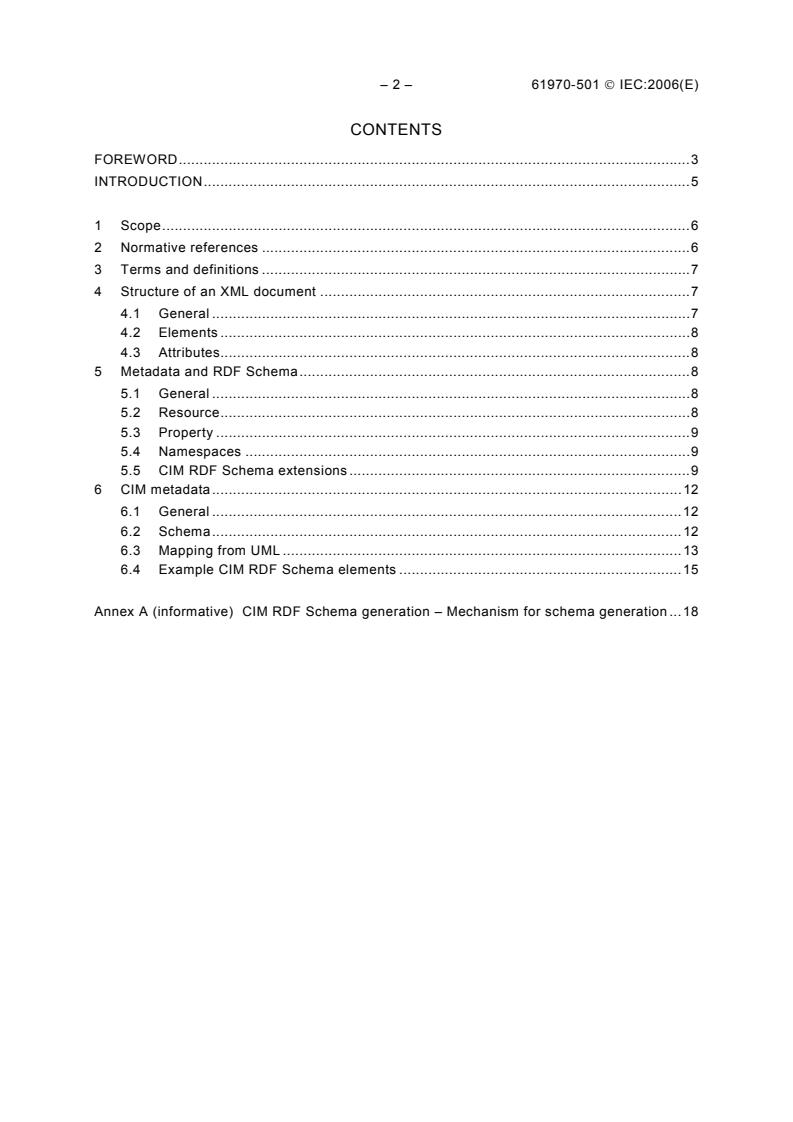
– 2 – 61970-501 IEC:2006(E)
CONTENTS
FOREWORD.3
INTRODUCTION.5
1 Scope.6
2 Normative references .6
3 Terms and definitions .7
4 Structure of an XML document .7
4.1 General .7
4.2 Elements .8
4.3 Attributes.8
5 Metadata and RDF Schema.8
5.1 General .8
5.2 Resource.8
5.3 Property .9
5.4 Namespaces .9
5.5 CIM RDF Schema extensions .9
6 CIM metadata.12
6.1 General .12
6.2 Schema.12
6.3 Mapping from UML .13
6.4 Example CIM RDF Schema elements .15
Annex A (informative) CIM RDF Schema generation – Mechanism for schema generation .18
61970-501 IEC:2006(E) – 3 –
INTERNATIONAL ELECTROTECHNICAL COMMISSION
______________
ENERGY MANAGEMENT SYSTEM APPLICATION
PROGRAM INTERFACE (EMS-API) –
Part 501: Common Information Model Resource
Description Framework (CIM RDF) schema
FOREWORD
1) The International Electrotechnical Commission (IEC) is a worldwide organization for standardization comprising
all national electrotechnical committees (IEC National Committees). The object of IEC is to promote
international co-operation on all questions concerning standardization in the electrical and electronic fields. To
this end and in addition to other activities, IEC publishes International Standards, Technical Specifications,
Technical Reports, Publicly Available Specifications (PAS) and Guides (hereafter referred to as “IEC
Publication(s)”). Their preparation is entrusted to technical committees; any IEC National Committee interested
in the subject dealt with may participate in this preparatory work. International, governmental and non-
governmental organizations liaising with the IEC also participate in this preparation. IEC collaborates closely
with the International Organization for Standardization (ISO) in accordance with conditions determined by
agreement between the two organizations.
2) The formal decisions or agreements of IEC on technical matters express, as nearly as possible, an international
consensus of opinion on the relevant subjects since each technical committee has representation from all
interested IEC National Committees.
3) IEC Publications have the form of recommendations for international use and are accepted by IEC National
Committees in that sense. While all reasonable efforts are made to ensure that the technical content of IEC
Publications is accurate, IEC cannot be held responsible for the way in which they are used or for any
misinterpretation by any end user.
4) In order to promote international uniformity, IEC National Committees undertake to apply IEC Publications
transparently to the maximum extent possible in their national and regional publications. Any divergence
between any IEC Publication and the corresponding national or regional publication shall be clearly indicated in
the latter.
5) IEC provides no marking procedure to indicate its approval and cannot be rendered responsible for any
equipment declared to be in conformity with an IEC Publication.
6) All users should ensure that they have the latest edition of this publication.
7) No liability shall attach to IEC or its directors, employees, servants or agents including individual experts and
members of its technical committees and IEC National Committees for any personal injury, property damage or
other damage of any nature whatsoever, whether direct or indirect, or for costs (including legal fees) and
expenses arising out of the publication, use of, or reliance upon, this IEC Publication or any other IEC
Publications.
8) Attention is drawn to the Normative references cited in this publication. Use of the referenced publications is
indispensable for the correct application of this publication.
9) Attention is drawn to the possibility that some of the elements of this IEC Publication may be the subject of
patent rights. IEC shall not be held responsible for identifying any or all such patent rights.
International Standard IEC 61970-501 has been prepared by IEC technical committee 57:
Power systems management and associated information exchange.
The text of this standard is based on the following documents:
FDIS Report on voting
57/801/FDIS 57/813/RVD
Full information on the voting for the approval of this standard can be found in the report on
voting indicated in the above table.
This publication has been drafted in accordance with the ISO/IEC Directives, Part 2.
– 4 – 61970-501 IEC:2006(E)
IEC 61970 consists of the following parts, under the general title Energy Management System
Application Program Interface (EMS-API):
Part 1: Guidelines and general requirements
Part 2: Glossary
Part 301: Common Information Model (CIM) base
Part 302: Common information model (CIM) financial, energy scheduling and reservations
Part 401: Component interface specification (CIS) framework
Part 402: Component interface specification (CIS) – Common services
Part 403: Component Interface Specification (CIS) – Generic data access
Part 404: Component Interface Specification (CIS) – High speed data access
Part 405: Component Interface Specification (CIS) – Generic eventing and subscription
Part 407: Component Interface Specification (CIS) – Time series data access
Part 453: Exchange of Graphics Schematics Definitions (Common Graphics Exchange)
Part 501: Common Information Model Resource Description Framework (CIM RDF) schema
The committee has decided that the contents of this publication will remain unchanged until
the maintenance result date indicated on the IEC web site under "http://webstore.iec.ch" in
the data related to the specific publication. At this date, the publication will be
• reconfirmed,
• withdrawn,
• replaced by a revised edition, or
• amended.
A bilingual edition of this standard may be issued at a later date.
—————————
Under consideration.
61970-501 IEC:2006(E) – 5 –
INTRODUCTION
This standard is part of the IEC 61970 series that define an Application Program Interface
(API) for an Energy Management System (EMS). This standard is based upon the work of the
EPRI Control Center API (CCAPI) research project (RP-3654-1).
This part specifies the mapping between the conceptual model specified as Unified Modeling
Language (UML) defined in IEC 61970-3XX series: Common Information Model and the
machine readable Extensible Markup Language (XML) representation of that schema using
the Resource Description Framework (RDF) Schema specification language.
– 6 – 61970-501 IEC:2006(E)
ENERGY MANAGEMENT SYSTEM APPLICATION
PROGRAM INTERFACE (EMS-API) –
Part 501: Common Information Model Resource
Description Framework (CIM RDF) schema
1 Scope
This International Standard specifies a Component Interface Specification (CIS) for energy
management systems application program interfaces. This part of IEC 61970 specifies the
format and rules for producing a machine readable form of the Common Information Model
(CIM) as specified in the IEC 61970-301 standard. It describes a CIM vocabulary to support
the data access facility and associated CIM semantics.
This part of IEC 61970 supports a mechanism for applications from independent suppliers to
access CIM metadata in a common format and with standard services for the purpose of
subsequent CIM data access. Secondary objectives are to provide CIM versioning capabilities
and a mechanism that is easily extensible to support site-specific needs. The proposed
solution:
• is both machine readable and human readable, although primarily intended for
programmatic access;
• can be accessed using any tool that supports the Document Object Model (DOM)
application program interface;
• is self-describing;
• takes advantage of current web standards.
This document is the Level 2 Component Interface Specification document that describes in
narrative terms (with text and examples based on the CIM), the detailed definition of the CIM
metadata interface to be standardized.
2 Normative references
The following referenced documents are indispensable for the application of this document.
For dated references, only the edition cited applies. For undated references, the latest edition
of the referenced document (including any amendments) applies.
IEC 61970-1, Energy management system application program interface (EMS-API) – Part 1:
Guidelines and general requirements
IEC 61970-2, Energy management system application program interface (EMS-API) – Part 2:
Glossary
IEC 61970-301, Energy management system application program interface (EMS-API) –
Part 301: Common Information Model (CIM) base
IEC 60050 series: International Electrotechnical Vocabulary
61970-501 IEC:2006(E) – 7 –
3 Terms and definitions
For the purposes of this part of IEC 61970, the terms and definitions given in IEC 61970-2, as
well as the following, apply.
3.1
Common Information Model
CIM
abstract model that represents all the major objects in an electric utility enterprise typically
contained in an EMS information model
NOTE By providing a standard way of representing power system resources as object classes and attributes,
along with their relationships, the CIM facilitates the integration of EMS applications developed independently by
different vendors, between entire EMS systems developed independently, or between an EMS system and other
systems concerned with different aspects of power system operations, such as generation or distribution
management.
3.2
Document Object Model
DOM
platform- and language-neutral interface defined by the World Wide Web Consortium (W3C)
that allows programs and scripts to dynamically access and exchange the content, structure
and style of documents
3.3
Resource Description Framework
RDF
language recommended by the W3C for expressing metadata that machines can process
simply. It is expressed as a special kind of XML document
3.4
RDF Schema
schema specification language expressed using RDF to describe resources and their
properties, including how resources are related to other resources, which is used to specify
an application-specific schema
3.5
Unified Modelling Language
UML
modelling language and methodology for specifying, visualizing, constructing, and
documenting the artefacts of a system-intensive process
3.6
Extensible Markup Language
XML
subset of Standard Generalized Markup Language (SGML), ISO 8879, for putting structured
data in a text file. It is an endorsed recommendation from the W3C
NOTE It is license-free, platform-independent and well-supported by many readily available software tools.
4 Structure of an XML document
4.1 General
An XML document is a set of containers. The containers can contain other containers as well
as content. The two required pieces of a well-formed XML document are the prolog and the
root element. The prolog contains statements that indicate the version of the XML standard to
which the document conforms and the encoding that is used. The prolog for the CIM RDF
Schema file is simply:
– 8 – 61970-501 IEC:2006(E)
The root element contains the XML document's actual contents, which are contained within
starting and ending tags. The CIM RDF Schema contains the root element:
.
:
The root element also contains references to namespaces, which define a context for
elements that are used within the rest of the document. The element name is preceded by the
namespace alias followed by a colon. For example, the RDF Schema namespace is declared:
xmlns:rdfs="http://www.w3.org/TR/1999/PR-rdf-schema-19990303#"
References to it within the document use the syntax:
Comments can appear anywhere within an XML document; they are delimited with characters.
4.2 Elements
An element is a container enclosed between start and stop tags. The start tag defines the
name of the element and contains any attributes of the element. In the following example,
Class is the name of the element and ID is its attribute.
The stop tag for this element is .
4.3 Attributes
The ID attribute is used for the Class elements to be able to reference other element nodes
within the CIM RDF Schema document. The element with ID="Bay" can be referenced by
other elements using the # symbol in front of the attribute's value, as "#Bay".
Note that the XML concept of attribute is not the same as the UML definition. XML attributes
store information about the element that are not directly or immediately relevant to the reader,
such as an ID which is used for linking internal elements. UML attributes are data in this
context. They shall hold structure of their own, such as datatype, constraints, and description.
Therefore, they are specified as elements in the CIM RDF Schema.
5 Metadata and RDF Schema
5.1 General
RDF Schema allows the definition of application-specific vocabularies. It is a very concise
way to represent the CIM classes and their attributes and relationships. It is designed to be
extensible, so that local extensions to the CIM can easily be referenced.
5.2 Resource
A resource is anything that can be referenced by a Uniform Resource Identifier (URI). For the
purposes of the CIM RDF Schema, a resource corresponds to a class. By convention,
resources are named with an initial uppercase letter.
61970-501 IEC:2006(E) – 9 –
5.3 Property
A property is a specific aspect, characteristic, attribute, or relation used to describe a
resource. Each property has a specific meaning, defines its permitted values, the types of
resources it can describe, and its relationship with other properties. Within the context of the
CIM RDF Schema, a property can be either a class attribute or a rolename for an association
of the class. By convention, properties are named with an initial lowercase letter.
5.4 Namespaces
Namespaces are a way to tie a specific use of a word in context to the dictionary (schema)
where the intended definition is to be found. RDF requires the XML namespace facility to
precisely associate each property with the schema that defines the property.
5.5 CIM RDF Schema extensions
5.5.1 General
The RDF Schema has been extended to support some of the UML concepts that are important
or useful in the CIM.
5.5.2 Multiplicity
A constraint property is a special kind of property that can be used to limit the values for the
named properties. A multiplicity constraint documents the CIM values for allowed cardinality
for a rolename in an association. The multiplicity resource is defined as:
multiplicity
Indicates how many instances of a given property are
allowed for a given resource. Allowed values are:
M:0.1 (zero-or-one), M:1.1 (exactly-one), M:0.n (zero-or-more),
M:1.n (one-or-more).
Multiplicity
Definition of the enumerated type which will contain
the list of valid values.
The CIM RDF Schema extensions create resources of this type which are used to express the
values for allowed CIM cardinalities. The resources are named M:0.1, M:1.1, M:0.n, and
M:1.n to correspond to the UML values in the model.
5.5.3 Inverse Rolename
The inverseRolename property provides the name of the rolename at the opposite class for
the association. This property is useful for navigating through the CIM relationships. It is
defined as:
inverseRoleName
...
Questions, Comments and Discussion
Ask us and Technical Secretary will try to provide an answer. You can facilitate discussion about the standard in here.
Loading comments...