

IEC TS 62271-318:2024
(Main)High-voltage switchgear and controlgear - Part 318: DC gas-insulated metal-enclosed switchgear for rated voltages including and above 100 kV
General Information
- Abstract
IEC TS 62271-318:2024 specifies requirements for gas-insulated metal-enclosed switchgear in which the insulation is obtained, at least partly, by an insulating gas or gas mixture other than air at atmospheric pressure, for direct current of rated voltages including and above 100 kV, for indoor and outdoor installation. This document includes rules for service conditions, ratings, design, and construction requirements. Test requirements and criteria for proof for passing type and routine tests are defined in this document for development and manufacturing of DC switchgear. For the purpose of this document, the terms "DC GIS" and "DC switchgear" are used for "DC gas-insulated metal-enclosed switchgear". This specification is applicable for both Line Commutated Converter (LCC) and Voltage Sourced Converter (VSC) for HVDC systems. The DC gas-insulated metal-enclosed switchgear covered by this document consists of individual components intended to be directly connected together and able to operate only in this manner. This document completes and amends, if applicable, the various relevant documents applying to the individual components constituting DC gas-insulated metal-enclosed switchgear.
- Status
- Published
- Publication Date
- 18-Sep-2024
- Technical Committee
- SC 17C - Assemblies
- Drafting Committee
- WG 42 - TC 17/SC 17C/WG 42
- Current Stage
- PPUB - Publication issued
- Start Date
- 19-Sep-2024
- Completion Date
- 05-Jul-2024
Buy Documents
IEC TS 62271-318:2024 - High-voltage switchgear and controlgear - Part 318: DC gas-insulated metal-enclosed switchgear for rated voltages including and above 100 kV Released:9/19/2024
IEC TS 62271-318:2024 EXV - High-voltage switchgear and controlgear - Part 318: DC gas-insulated metal-enclosed switchgear for rated voltages including and above 100 kV Released:9/19/2024
Overview
IEC TS 62271-318:2024 defines requirements for DC gas‑insulated metal‑enclosed switchgear (DC GIS) for rated direct voltages including and above 100 kV, for both indoor and outdoor installations. The Technical Specification covers DC switchgear where insulation is provided, at least partly, by an insulating gas or gas mixture (other than air at atmospheric pressure). It applies to HVDC systems using both Line Commutated Converter (LCC) and Voltage Sourced Converter (VSC) technologies and completes or amends the relevant documents for individual components that make up DC gas‑insulated switchgear.
Key topics and requirements
- Scope and terms: Definitions for DC GIS assemblies, parts, switching devices and operational characteristics tailored to high‑voltage DC.
- Normal and special service conditions: Environmental, altitude, pollution, temperature, humidity and mechanical stress considerations.
- Ratings: Rated direct voltage, insulation levels, rated continuous current, short‑time and peak withstand currents, and auxiliary supply ratings.
- Design & construction: Requirements for materials, gas handling, earthing, enclosures, partitions, creepage distances, degrees of protection (IP/IK), and interfaces for cables and bushings.
- Gas and vacuum tightness: Sealed and controlled pressure systems, leakage and gas‑handling procedures.
- Safety systems: Pressure coordination, pressure relief devices, internal arc considerations and limitation of pressure rise in internal faults.
- Operational aspects: Stored energy operation, interlocking, position indication, nameplates, locking devices and maintenance access.
- Testing: Type and routine test requirements, dielectric tests, test criteria and reporting for development and manufacturing verification.
- Additional topics: EMC, noise, fire hazard (flammability), corrosion protection, and provisions for future extensions.
Practical applications and users
IEC TS 62271-318:2024 is directly applicable to:
- Manufacturers of DC GIS equipment and components
- HVDC project engineers and system designers specifying switchgear for converter stations and high‑voltage DC transmission
- Utilities and independent transmission operators implementing HVDC links
- Testing and certification laboratories conducting type and routine tests
- Specifiers and procurement teams preparing technical contracts and installation requirements
Typical applications include HVDC converter stations, DC gas‑insulated substations, converter transformer interfaces and modular DC switching installations where compact, gas‑insulated designs are required at ≥100 kV.
Related standards
- TS IEC 62271‑5:2024 (referenced in the document)
- The broader IEC 62271 series of standards for high‑voltage switchgear and controlgear (for component‑level and general requirements)
Keywords: IEC TS 62271-318:2024, DC GIS, DC gas‑insulated switchgear, HVDC, high‑voltage switchgear, type tests, gas‑insulated metal‑enclosed switchgear, LCC, VSC.
Buy Documents
IEC TS 62271-318:2024 - High-voltage switchgear and controlgear - Part 318: DC gas-insulated metal-enclosed switchgear for rated voltages including and above 100 kV Released:9/19/2024
IEC TS 62271-318:2024 EXV - High-voltage switchgear and controlgear - Part 318: DC gas-insulated metal-enclosed switchgear for rated voltages including and above 100 kV Released:9/19/2024
Get Certified
Connect with accredited certification bodies for this standard

IMQ S.p.A. (Certification)
Italian electrical product certification.

SLG Prüf- und Zertifizierungs GmbH
German testing and certification body.

UL Solutions
Global safety science company with testing, inspection and certification.
Sponsored listings
Frequently Asked Questions
IEC TS 62271-318:2024 is a technical specification published by the International Electrotechnical Commission (IEC). Its full title is "High-voltage switchgear and controlgear - Part 318: DC gas-insulated metal-enclosed switchgear for rated voltages including and above 100 kV". This standard covers: IEC TS 62271-318:2024 specifies requirements for gas-insulated metal-enclosed switchgear in which the insulation is obtained, at least partly, by an insulating gas or gas mixture other than air at atmospheric pressure, for direct current of rated voltages including and above 100 kV, for indoor and outdoor installation. This document includes rules for service conditions, ratings, design, and construction requirements. Test requirements and criteria for proof for passing type and routine tests are defined in this document for development and manufacturing of DC switchgear. For the purpose of this document, the terms "DC GIS" and "DC switchgear" are used for "DC gas-insulated metal-enclosed switchgear". This specification is applicable for both Line Commutated Converter (LCC) and Voltage Sourced Converter (VSC) for HVDC systems. The DC gas-insulated metal-enclosed switchgear covered by this document consists of individual components intended to be directly connected together and able to operate only in this manner. This document completes and amends, if applicable, the various relevant documents applying to the individual components constituting DC gas-insulated metal-enclosed switchgear.
IEC TS 62271-318:2024 specifies requirements for gas-insulated metal-enclosed switchgear in which the insulation is obtained, at least partly, by an insulating gas or gas mixture other than air at atmospheric pressure, for direct current of rated voltages including and above 100 kV, for indoor and outdoor installation. This document includes rules for service conditions, ratings, design, and construction requirements. Test requirements and criteria for proof for passing type and routine tests are defined in this document for development and manufacturing of DC switchgear. For the purpose of this document, the terms "DC GIS" and "DC switchgear" are used for "DC gas-insulated metal-enclosed switchgear". This specification is applicable for both Line Commutated Converter (LCC) and Voltage Sourced Converter (VSC) for HVDC systems. The DC gas-insulated metal-enclosed switchgear covered by this document consists of individual components intended to be directly connected together and able to operate only in this manner. This document completes and amends, if applicable, the various relevant documents applying to the individual components constituting DC gas-insulated metal-enclosed switchgear.
IEC TS 62271-318:2024 is classified under the following ICS (International Classification for Standards) categories: 29.130.10 - High voltage switchgear and controlgear. The ICS classification helps identify the subject area and facilitates finding related standards.
IEC TS 62271-318:2024 is available in PDF format for immediate download after purchase. The document can be added to your cart and obtained through the secure checkout process. Digital delivery ensures instant access to the complete standard document.
Standards Content (Sample)
IEC TS 62271-318 ®
Edition 1.0 2024-09
TECHNICAL
SPECIFICATION
High-voltage switchgear and controlgear –
Part 318: DC gas-insulated metal-enclosed switchgear for rated voltages
including and above 100 kV
All rights reserved. Unless otherwise specified, no part of this publication may be reproduced or utilized in any form
or by any means, electronic or mechanical, including photocopying and microfilm, without permission in writing from
either IEC or IEC's member National Committee in the country of the requester. If you have any questions about IEC
copyright or have an enquiry about obtaining additional rights to this publication, please contact the address below or
your local IEC member National Committee for further information.
IEC Secretariat Tel.: +41 22 919 02 11
3, rue de Varembé info@iec.ch
CH-1211 Geneva 20 www.iec.ch
Switzerland
About the IEC
The International Electrotechnical Commission (IEC) is the leading global organization that prepares and publishes
International Standards for all electrical, electronic and related technologies.
About IEC publications
The technical content of IEC publications is kept under constant review by the IEC. Please make sure that you have the
latest edition, a corrigendum or an amendment might have been published.
IEC publications search - webstore.iec.ch/advsearchform IEC Products & Services Portal - products.iec.ch
The advanced search enables to find IEC publications by a Discover our powerful search engine and read freely all the
variety of criteria (reference number, text, technical publications previews, graphical symbols and the glossary.
committee, …). It also gives information on projects, replaced With a subscription you will always have access to up to date
and withdrawn publications. content tailored to your needs.
IEC Just Published - webstore.iec.ch/justpublished
Electropedia - www.electropedia.org
Stay up to date on all new IEC publications. Just Published
The world's leading online dictionary on electrotechnology,
details all new publications released. Available online and once
containing more than 22 500 terminological entries in English
a month by email.
and French, with equivalent terms in 25 additional languages.
Also known as the International Electrotechnical Vocabulary
IEC Customer Service Centre - webstore.iec.ch/csc
(IEV) online.
If you wish to give us your feedback on this publication or need
further assistance, please contact the Customer Service
Centre: sales@iec.ch.
IEC TS 62271-318 ®
Edition 1.0 2024-09
TECHNICAL
SPECIFICATION
High-voltage switchgear and controlgear –
Part 318: DC gas-insulated metal-enclosed switchgear for rated voltages
including and above 100 kV
INTERNATIONAL
ELECTROTECHNICAL
COMMISSION
ICS 29.130.10 ISBN 978-2-8322-9674-5
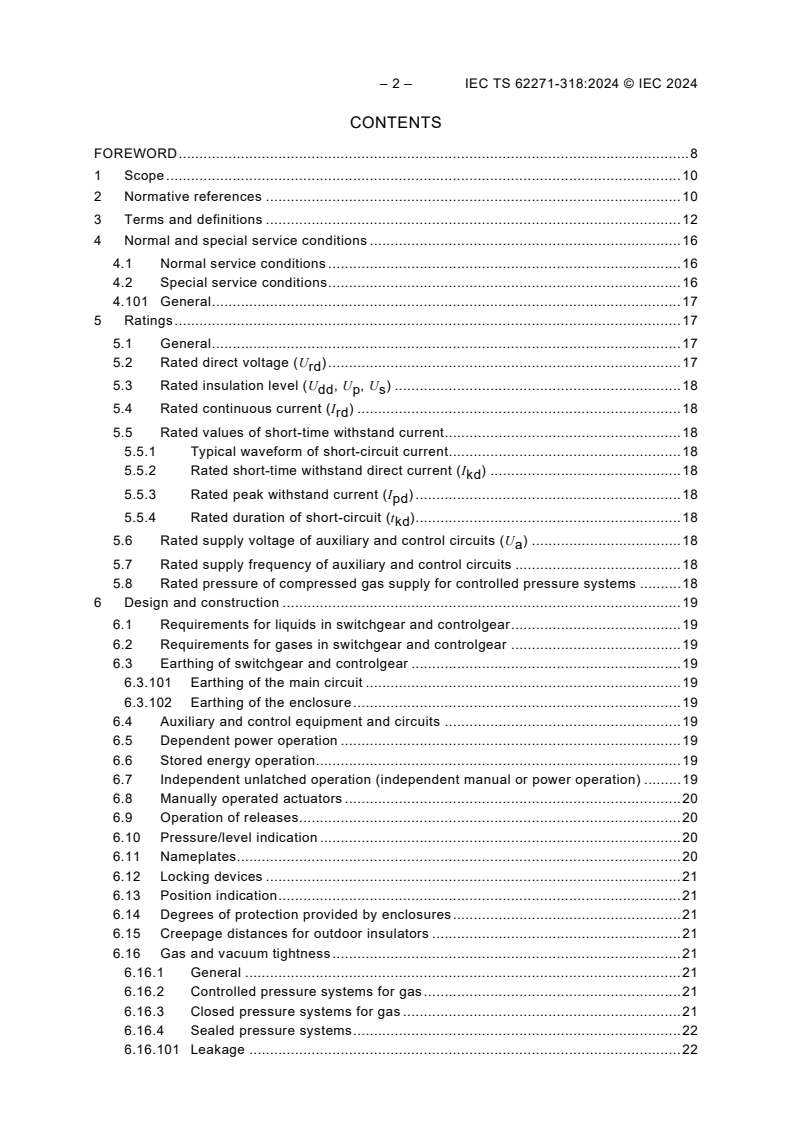
– 2 – IEC TS 62271-318:2024 © IEC 2024
CONTENTS
FOREWORD . 8
1 Scope . 10
2 Normative references . 10
3 Terms and definitions . 12
4 Normal and special service conditions . 16
4.1 Normal service conditions . 16
4.2 Special service conditions . 16
4.101 General . 17
5 Ratings . 17
5.1 General . 17
5.2 Rated direct voltage (U ) . 17
rd
5.3 Rated insulation level (U , U , U ) . 18
dd p s
5.4 Rated continuous current (I ) . 18
rd
5.5 Rated values of short-time withstand current . 18
5.5.1 Typical waveform of short-circuit current . 18
5.5.2 Rated short-time withstand direct current (I ) . 18
kd
5.5.3 Rated peak withstand current (I ) . 18
pd
5.5.4 Rated duration of short-circuit (t ) . 18
kd
5.6 Rated supply voltage of auxiliary and control circuits (U ) . 18
a
5.7 Rated supply frequency of auxiliary and control circuits . 18
5.8 Rated pressure of compressed gas supply for controlled pressure systems . 18
6 Design and construction . 19
6.1 Requirements for liquids in switchgear and controlgear . 19
6.2 Requirements for gases in switchgear and controlgear . 19
6.3 Earthing of switchgear and controlgear . 19
6.3.101 Earthing of the main circuit . 19
6.3.102 Earthing of the enclosure . 19
6.4 Auxiliary and control equipment and circuits . 19
6.5 Dependent power operation . 19
6.6 Stored energy operation . 19
6.7 Independent unlatched operation (independent manual or power operation) . 19
6.8 Manually operated actuators . 20
6.9 Operation of releases . 20
6.10 Pressure/level indication . 20
6.11 Nameplates. 20
6.12 Locking devices . 21
6.13 Position indication . 21
6.14 Degrees of protection provided by enclosures . 21
6.15 Creepage distances for outdoor insulators . 21
6.16 Gas and vacuum tightness . 21
6.16.1 General . 21
6.16.2 Controlled pressure systems for gas . 21
6.16.3 Closed pressure systems for gas . 21
6.16.4 Sealed pressure systems . 22
6.16.101 Leakage . 22
6.16.102 Gas handling . 22
6.17 Tightness for liquid systems . 22
6.18 Fire hazard (flammability) . 22
6.19 Electromagnetic compatibility (EMC) . 22
6.20 X-Ray emission . 22
6.21 Corrosion . 23
6.22 Filling levels for insulation, switching and/or operation . 23
6.101 General requirements for DC GIS . 23
6.102 Pressure coordination . 23
6.103 Internal arc fault . 24
6.103.1 General . 24
6.103.2 External effects of the arc . 25
6.103.3 Internal fault location . 26
6.104 Enclosures . 26
6.104.1 General . 26
6.104.2 Design of enclosures . 26
6.105 Partitions . 27
6.105.1 Design of partitions . 27
6.105.2 Partitioning . 27
6.106 Pressure relief . 29
6.106.1 General . 29
6.106.2 Non-reclosing pressure relief device . 29
6.106.3 Pressure relief valve . 29
6.106.4 Limitation of pressure rise in the case of an internal fault. 30
6.107 Noise . 30
6.108 Interfaces . 30
6.108.1 General . 30
6.108.2 Cable connections . 30
6.108.3 Direct transformer connections . 31
6.108.4 Bushings . 31
6.108.5 Interfaces for future extensions. 31
6.109 Interlocking . 32
7 Type tests . 32
7.1 General . 32
7.1.1 General remarks . 32
7.1.2 Information for identification of test objects . 33
7.1.3 Information to be included in type-test reports . 33
7.2 Dielectric tests . 33
7.2.1 General . 33
7.2.2 Ambient air conditions during tests . 34
7.2.3 Wet test procedure . 34
7.2.4 Arrangement of the equipment . 34
7.2.5 Criteria to pass the test . 34
7.2.6 Application of the test voltage and test conditions . 34
7.2.7 Tests of switchgear and controlgear . 35
7.2.8 Artificial pollution tests for outdoor insulators . 36
7.2.9 Partial discharge tests . 36
7.2.10 Dielectric tests on auxiliary and control circuits . 38
7.2.11 Voltage test as condition check . 38
– 4 – IEC TS 62271-318:2024 © IEC 2024
7.2.101 DC insulation system test . 38
7.2.102 Long-term energized test . 41
7.3 Resistance measurement . 41
7.3.1 Measurement of the resistance of auxiliary contacts class 1 and class 2. 41
7.3.2 Measurement of the resistance of auxiliary contacts class 3 . 41
7.3.3 Electrical continuity of earthed metallic parts test . 41
7.3.4 Resistance measurement of contacts and connections in the main
circuit as a condition check . 42
7.4 Continuous current tests . 42
7.4.1 Conditions of the test object . 42
7.4.2 Arrangement of the equipment . 42
7.4.3 Test current and duration . 42
7.4.4 Temperature measurement during test . 42
7.4.5 Resistance of the main circuit . 43
7.4.6 Criteria to pass test . 43
7.5 Short-time withstand current and peak withstand current tests . 43
7.5.1 General . 43
7.5.2 Arrangement of the equipment and of the test circuit . 43
7.5.3 Test current and duration . 43
7.5.4 Conditions of the test object after test . 43
7.5.101 Tests on the main circuits . 43
7.5.102 Tests on earthing circuits . 44
7.6 Verification of the protection . 44
7.6.1 General . 44
7.6.2 Verification of the IP coding . 44
7.6.3 Verification of the IK coding . 44
7.7 Tightness tests . 44
7.7.1 General . 44
7.7.2 Controlled pressure systems for gas . 44
7.7.3 Closed pressure systems for gas . 45
7.7.4 Sealed pressure systems . 45
7.7.5 Liquid tightness tests . 45
7.8 Electromagnetic compatibility tests (EMC) . 45
7.9 Additional tests on auxiliary and control circuits . 45
7.10 X-radiation test for vacuum interrupters . 45
7.101 Verification of making and breaking capacities . 45
7.102 Mechanical and environmental tests . 45
7.102.1 General . 45
7.102.2 Mechanical operation test at ambient temperature . 45
7.102.3 Low- and high-temperature test . 46
7.103 Proof tests for enclosures . 46
7.103.1 General . 46
7.103.2 Burst test procedure . 46
7.103.3 Strain measurement test . 47
7.104 Pressure test on partitions . 47
7.105 Test under conditions of arcing due to an internal fault . 48
7.106 Insulator tests . 48
7.106.1 General . 48
7.106.2 Thermal performance . 48
7.106.3 Tightness test for partitions . 49
7.107 Corrosion test on earthing connections . 49
7.107.1 General . 49
7.107.2 Test procedure . 49
7.107.3 Criteria to pass the test . 49
7.108 Corrosion tests on sealing systems of enclosures and auxiliary equipment . 50
7.108.1 General . 50
7.108.2 Test procedure . 50
7.108.3 Criteria to pass the test . 50
8 Routine tests . 50
8.1 General . 50
8.2 Dielectric test on the main circuit . 51
8.2.101 Alternating or direct voltage tests on the main circuit . 51
8.2.102 Partial discharge measurement . 51
8.3 Tests on auxiliary and control circuits . 51
8.4 Measurement of the resistance of the main circuit . 52
8.5 Tightness test . 52
8.6 Design and visual checks . 52
8.101 Pressure tests of enclosures . 52
8.102 Mechanical operation tests . 52
8.103 Tests on auxiliary circuits, equipment and interlocks in the control
mechanism . 53
8.104 Pressure test on partitions . 53
9 Guide to the selection of switchgear and controlgear (informative) . 53
9.1 General . 53
9.2 Selection of rated values . 53
9.3 Cable-interface considerations . 53
9.4 Continuous or temporary overload due to changed service conditions . 53
9.5 Environmental aspects . 53
10 Information to be given with enquiries, tenders and orders (informative) . 54
10.1 General . 54
10.2 Information with enquiries and orders . 54
10.3 Information with tenders . 54
11 Transport, storage, installation, operating instructions and maintenance. 54
11.1 General . 54
11.2 Conditions during transport, storage and installation . 54
11.3 Installation . 54
11.4 Operating instructions . 54
11.5 Maintenance . 54
11.101 Tests after installation on-site . 54
11.101.1 General . 54
11.101.2 Dielectric tests on the main circuits . 55
11.101.3 Dielectric tests on auxiliary circuits . 59
11.101.4 Measurement of the resistance of the main circuit . 59
11.101.5 Gas tightness tests . 59
11.101.6 Checks and verifications . 59
11.101.7 Gas quality verifications . 59
12 Safety . 60
– 6 – IEC TS 62271-318:2024 © IEC 2024
13 Influence of the product on the environment . 60
Annex A (normative) Methods for alternating current testing of DC gas-insulated
metal-enclosed switchgear under conditions of arcing due to an internal fault . 61
A.1 General . 61
A.2 Short-circuit current arcing test . 61
A.2.1 Test arrangements . 61
A.2.2 Current and voltage applied . 61
A.2.3 Test procedure . 62
A.2.4 Criteria to pass the test . 62
A.2.5 Test report . 63
A.2.6 Extension of the test results . 63
A.3 Composite verification by calculation and separate tests . 63
Annex B (informative) Technical and practical considerations of site testing . 64
B.1 Test voltage generators . 64
B.2 Locating discharges . 64
B.3 Special test procedures . 64
B.3.1 General . 64
B.3.2 Testing at reduced voltage. 65
B.3.3 Testing at reduced gas density . 65
B.4 Partial discharge measurements . 65
B.5 Electrical conditioning . 65
B.6 Repetition tests . 65
B.6.1 General . 65
B.6.2 Recommended procedure . 66
B.7 Partial discharge detection method . 66
B.7.1 General . 66
B.7.2 Conventional method according to IEC 60270 . 66
B.7.3 VHF/UHF method . 66
B.7.4 Acoustic method . 67
B.7.5 Sensitivity verification of acoustic and UHF method . 68
Annex C (informative) Calculation of pressure rise due to an internal fault . 69
Annex D (informative) Information to be given with enquiries, tenders and orders . 70
D.1 General . 70
D.2 Normal and special service conditions . 70
D.3 Ratings . 71
D.4 Design and construction . 72
D.5 Bus ducts . 72
D.6 Disconnector and earthing switch . 73
D.7 Bushing . 73
D.8 Cable connection . 73
D.9 Transformer connection . 74
D.10 Current transducer . 74
D.11 Voltage transducer . 74
D.12 Metal-oxide surge arrester . 74
D.13 Documentation for enquiries and tenders . 75
Annex E (informative) List of notes concerning certain countries . 76
Annex F (informative) Long-term energized test . 77
F.1 Test objects . 77
F.2 Test sequence . 77
F.3 Pre-test . 79
F.4 Condition check . 79
F.5 Success criteria, re-testing and interruptions . 79
Annex G (informative) Application of DC GIS under composite voltage of alternating
and direct voltage components . 81
G.1 General . 81
G.2 Composite voltage consisting of alternating and direct voltage components . 81
G.3 Recommendation for application of DC GIS in bipolar DC schemes under
composite voltage stress . 82
Annex H (informative) DC switchgear located on neutral buses . 83
Bibliography . 84
Figure 1 – Pressure coordination . 24
Figure 2 – Example of arrangement of enclosures and gas compartments . 29
Figure G.1 – Composite phase-to-earth voltage at midpoint of converter pole including
third harmonic content and simplified voltage curve . 81
Table 1 – Reference table of service conditions relevant to DC GIS . 17
Table 2 – Performance criteria . 25
Table 3 – Type tests . 33
Table 4 – Test voltage for measuring PD intensity . 37
Table 5 – Sequence of DC insulation system test . 40
Table 6 – On-site test voltages . 57
Table D.1 – Normal and special service conditions . 70
Table D.2 – Ratings . 71
Table D.3 – Design and construction. 72
Table D.4 – Bus ducts . 72
Table D.5 – Bushing . 73
Table D.6 – Cable connection . 73
Table D.7 – Transformer connection . 74
Table D.8 – Current transducer . 74
Table D.9 – Voltage transducer . 74
Table D.10 – Documentation for enquiries and tenders . 75
Table F.1 – Test sequence for long-term energized test . 77
Table F.2 – Test sequence for long-term energized test with combined switching and
lightning impulse voltage tests and changed sequence . 78
Table F.3 – Test procedure for the long-term energized test . 79
Table F.4 – Condition check for the long-term energized test . 79
– 8 – IEC TS 62271-318:2024 © IEC 2024
INTERNATIONAL ELECTROTECHNICAL COMMISSION
____________
HIGH-VOLTAGE SWITCHGEAR AND CONTROLGEAR –
Part 318: DC gas-insulated metal-enclosed switchgear
for rated voltages including and above 100 kV
FOREWORD
1) The International Electrotechnical Commission (IEC) is a worldwide organization for standardization comprising
all national electrotechnical committees (IEC National Committees). The object of IEC is to promote international
co-operation on all questions concerning standardization in the electrical and electronic fields. To this end and
in addition to other activities, IEC publishes International Standards, Technical Specifications, Technical Reports,
Publicly Available Specifications (PAS) and Guides (hereafter referred to as “IEC Publication(s)”). Their
preparation is entrusted to technical committees; any IEC National Committee interested in the subject dealt with
may participate in this preparatory work. International, governmental and non-governmental organizations liaising
with the IEC also participate in this preparation. IEC collaborates closely with the International Organization for
Standardization (ISO) in accordance with conditions determined by agreement between the two organizations.
2) The formal decisions or agreements of IEC on technical matters express, as nearly as possible, an international
consensus of opinion on the relevant subjects since each technical committee has representation from all
interested IEC National Committees.
3) IEC Publications have the form of recommendations for international use and are accepted by IEC National
Committees in that sense. While all reasonable efforts are made to ensure that the technical content of IEC
Publications is accurate, IEC cannot be held responsible for the way in which they are used or for any
misinterpretation by any end user.
4) In order to promote international uniformity, IEC National Committees undertake to apply IEC Publications
transparently to the maximum extent possible in their national and regional publications. Any divergence between
any IEC Publication and the corresponding national or regional publication shall be clearly indicated in the latter.
5) IEC itself does not provide any attestation of conformity. Independent certification bodies provide conformity
assessment services and, in some areas, access to IEC marks of conformity. IEC is not responsible for any
services carried out by independent certification bodies.
6) All users should ensure that they have the latest edition of this publication.
7) No liability shall attach to IEC or its directors, employees, servants or agents including individual experts and
members of its technical committees and IEC National Committees for any personal injury, property damage or
other damage of any nature whatsoever, whether direct or indirect, or for costs (including legal fees) and
expenses arising out of the publication, use of, or reliance upon, this IEC Publication or any other IEC
Publications.
8) Attention is drawn to the Normative references cited in this publication. Use of the referenced publications is
indispensable for the correct application of this publication.
9) IEC draws attention to the possibility that the implementation of this document may involve the use of (a)
patent(s). IEC takes no position concerning the evidence, validity or applicability of any claimed patent rights in
respect thereof. As of the date of publication of this document, IEC had not received notice of (a) patent(s), which
may be required to implement this document. However, implementers are cautioned that this may not represent
the latest information, which may be obtained from the patent database available at https://patents.iec.ch. IEC
shall not be held responsible for identifying any or all such patent rights.
IEC TS 62271-318 has been prepared by subcommittee 17C: Assemblies, of IEC technical
committee 17: High-voltage switchgear and controlgear. It is a Technical Specification.
The text of this Technical Specification is based on the following documents:
Draft Report on voting
17C/930/DTS 17C/937/RVDTS
Full information on the voting for its approval can be found in the report on voting indicated in
the above table.
The language used for the development of this Technical Specification is English.
This document was drafted in accordance with ISO/IEC Directives, Part 2, and developed in
accordance with ISO/IEC Directives, Part 1 and ISO/IEC Directives, IEC Supplement, available
at www.iec.ch/members_experts/refdocs. The main document types developed by IEC are
described in greater detail at www.iec.ch/standardsdev/publications.
The list of all parts of the IEC 62271 series under the general title, High-voltage switchgear and
controlgear, may be found on the IEC website.
This document should be read in conjunction with IEC TS 62271-5:2024, to which it refers and
which is applicable unless otherwise specified. In order to simplify the indication of
corresponding requirements, the same numbering of clauses and subclauses is used as in
IEC TS 62271-5:2024. Amendments to these clauses and subclauses are given under the same
numbering, whilst additional subclauses, are numbered from 101.
The reader's attention is drawn to the fact that Annex E lists all of the "in-some-country" clauses
on differing practices of a less permanent nature relating to the subject of this document.
The committee has decided that the contents of this document will remain unchanged until the
stability date indicated on the IEC website under webstore.iec.ch in the data related to the
specific document. At this date, the document will be
• reconfirmed,
• withdrawn, or
• revised.
IMPORTANT – The "colour inside" logo on the cover page of this document indicates
that it contains colours which are considered to be useful for the correct understanding
of its contents. Users should therefore print this document using a colour printer.
– 10 – IEC TS 62271-318:2024 © IEC 2024
HIGH-VOLTAGE SWITCHGEAR AND CONTROLGEAR –
Part 318: DC gas-insulated metal-enclosed switchgear
for rated voltages including and above 100 kV
1 Scope
This part of IEC 62271 specifies requirements for gas-insulated metal-enclosed switchgear in
which the insulation is obtained, at least partly, by an insulating gas or gas mixture other than
air at atmospheric pressure, for direct current of rated voltages including and above 100 kV, for
indoor and outdoor installation. This document includes rules for service conditions, ratings,
design, and construction requirements. Test requirements and criteria for proof for passing type
and routine tests are defined in this document for development and manufacturing of DC
switchgear.
For the purpose of this document, the terms "DC GIS" and "DC switchgear" are used for "DC
gas-insulated metal-enclosed switchgear".
This specification is applicable for both Line Commutated Converter (LCC) and Voltage Sourced
Converter (VSC) for HVDC systems.
The DC gas-insulated metal-enclosed switchgear covered by this document consists of
individual components intended to be directly connected together and able to operate only in
this manner.
This document completes and amends, if applicable, the various relevant documents applying
to the individual components constituting DC gas-insulated metal-enclosed switchgear.
2 Normative references
The following documents are referred to in the text in such a way that some or all of their content
constitutes requirements of this document. For dated references, only the edition cited applies.
For undated references, the latest edition of the referenced document (including any
amendments) applies.
IEC 60060-1:2010, High-voltage test techniques – Part 1: General definitions and test
requirements
IEC 60085:2007, Electrical insulation – Thermal evaluation and designation
IEC 60068-2-11:2021, Environmental testing – Part 2-11: Tests – Test Ka: Salt mist
IEC 60068-2-17:2023, Environmental testing – Part 2-17: Tests – Test Q: Sealing
IEC/IEEE 60076-57-129:2017, Power transformers – Part 57-129: Transformers for HVDC
applications
IEC 60099-4:2014, Surge arresters – Part 4: Metal-oxide sur
...
IEC TS 62271-318 ®
Edition 1.0 2024-09
EXTENDED VERSION
TECHNICAL
SPECIFICATION
colour
inside
This full version of IEC TS 62271-318:2024 includes the content of the references made to
TS IEC 62271-5:2024
High-voltage switchgear and controlgear –
Part 318: DC gas-insulated metal-enclosed switchgear for rated voltages
including and above 100 kV
All rights reserved. Unless otherwise specified, no part of this publication may be reproduced or utilized in any form
or by any means, electronic or mechanical, including photocopying and microfilm, without permission in writing from
either IEC or IEC's member National Committee in the country of the requester. If you have any questions about IEC
copyright or have an enquiry about obtaining additional rights to this publication, please contact the address below or
your local IEC member National Committee for further information.
IEC Secretariat Tel.: +41 22 919 02 11
3, rue de Varembé info@iec.ch
CH-1211 Geneva 20 www.iec.ch
Switzerland
About the IEC
The International Electrotechnical Commission (IEC) is the leading global organization that prepares and publishes
International Standards for all electrical, electronic and related technologies.
About IEC publications
The technical content of IEC publications is kept under constant review by the IEC. Please make sure that you have the
latest edition, a corrigendum or an amendment might have been published.
IEC publications search - webstore.iec.ch/advsearchform IEC Products & Services Portal - products.iec.ch
The advanced search enables to find IEC publications by a Discover our powerful search engine and read freely all the
variety of criteria (reference number, text, technical publications previews, graphical symbols and the glossary.
committee, …). It also gives information on projects, replaced With a subscription you will always have access to up to date
and withdrawn publications. content tailored to your needs.
IEC Just Published - webstore.iec.ch/justpublished
Electropedia - www.electropedia.org
Stay up to date on all new IEC publications. Just Published
The world's leading online dictionary on electrotechnology,
details all new publications released. Available online and once
containing more than 22 500 terminological entries in English
a month by email.
and French, with equivalent terms in 25 additional languages.
Also known as the International Electrotechnical Vocabulary
IEC Customer Service Centre - webstore.iec.ch/csc
(IEV) online.
If you wish to give us your feedback on this publication or need
further assistance, please contact the Customer Service
Centre: sales@iec.ch.
IEC TS 62271-318 ®
Edition 1.0 2024-09
EXTENDED VERSION
TECHNICAL
SPECIFICATION
colour
inside
This full version of IEC TS 62271-318:2024 includes the content of the references made to
TS IEC 62271-5:2024
High-voltage switchgear and controlgear –
Part 318: DC gas-insulated metal-enclosed switchgear for rated voltages
including and above 100 kV
INTERNATIONAL
ELECTROTECHNICAL
COMMISSION
ICS 29.130.10 ISBN 978-2-8322-9762-9
– 2 – IEC TS 62271-318:2024 EXV © IEC 2024
CONTENTS
FOREWORD . 12
INTRODUCTION to IEC TS 62271-5:2024 . 14
1 Scope . 15
2 Normative references . 15
3 Terms and definitions . 18
3.1 General terms and definitions . 19
3.2 Assemblies of switchgear and controlgear . 23
3.3 Parts of assemblies . 24
3.4 Switching devices . 24
3.5 Parts of switchgear and controlgear . 25
3.6 Operational characteristics of switchgear and controlgear . 29
3.6.5 Terms and definitions relative to pressure (or density) . 30
3.6.6 Terms and definitions relating to gas and vacuum tightness . 31
3.6.7 Terms and definitions relating to liquid tightness. 33
3.7 Characteristic quantities . 34
3.8 Index of definitions . 39
4 Normal and special service conditions . 41
4.1 Normal service conditions . 41
4.1.1 General . 41
4.1.2 Indoor switchgear and controlgear . 41
4.1.3 Outdoor switchgear and controlgear . 42
4.2 Special service conditions . 43
4.2.1 General . 43
4.2.2 Altitude . 43
4.2.3 Exposure to pollution . 43
4.2.4 Temperature and humidity . 43
4.2.5 Exposure to abnormal vibrations, shock or tilting . 44
4.2.6 Wind speed . 44
4.2.7 Other parameters . 44
4.101 General . 44
5 Ratings . 45
5.1 General . 45
5.2 Rated direct voltage (U ) . 45
rd
5.2.1 General . 45
5.2.2 Rated voltages . 46
5.3 Rated insulation level (U , U , U ) . 46
dd p s
5.4 Rated continuous current (I ) . 49
rd
5.5 Rated values of short-time withstand current . 49
5.5.1 Typical waveform of short-circuit current . 49
5.5.2 Rated short-time withstand direct current (I ) . 52
kd
5.5.3 Rated peak withstand current (I ) . 52
pd
5.5.4 Rated duration of short-circuit (t ) . 52
kd
5.6 Rated supply voltage of auxiliary and control circuits (U ) . 52
a
5.6.1 General . 52
5.6.2 Rated supply voltage (U ) . 53
a
5.7 Rated supply frequency of auxiliary and control circuits . 53
6 Design and construction . 54
6.1 Requirements for liquids in switchgear and controlgear . 54
6.2 Requirements for gases in switchgear and controlgear . 54
6.3 Earthing of switchgear and controlgear . 54
6.3.101 Earthing of the main circuit . 54
6.3.102 Earthing of the enclosure . 55
6.4 Auxiliary and control equipment and circuits . 55
6.4.1 General . 55
6.4.2 Protection against electric shock . 56
6.4.3 Components installed in enclosures . 56
6.5 Dependent power operation . 59
6.6 Stored energy operation . 59
6.6.1 General . 59
6.6.2 Energy storage in gas receivers or hydraulic accumulators . 59
6.6.3 Energy storage in springs (or weights) . 59
6.6.4 Manual charging . 59
6.6.5 Motor charging . 60
6.6.6 Energy storage in capacitors . 60
6.7 Independent unlatched operation (independent manual or power operation) . 60
6.8 Manually operated actuators . 60
6.9 Operation of releases . 60
6.9.1 General . 60
6.9.2 Shunt closing release . 60
6.9.3 Shunt opening release . 60
6.9.4 Capacitor operation of shunt releases . 61
6.9.5 Under-voltage release . 61
6.10 Pressure/level indication . 61
6.10.1 Gas pressure . 61
6.10.2 Liquid level . 62
6.11 Nameplates. 62
6.11.1 General . 62
6.11.2 Application . 62
6.12 Locking devices . 63
6.13 Position indication . 64
6.14 Degrees of protection provided by enclosures . 64
6.14.1 General . 64
6.14.2 Protection of persons against access to hazardous parts and protection
of the equipment against ingress of solid foreign objects (IP coding) . 64
6.14.3 Protection against ingress of water (IP coding) . 64
6.14.4 Protection against mechanical impact under normal service conditions
(IK coding) . 64
6.15 Creepage distances for outdoor insulators . 65
6.16 Gas and vacuum tightness . 65
6.16.1 General . 65
6.16.2 Controlled pressure systems for gas . 65
6.16.3 Closed pressure systems for gas . 66
6.16.4 Sealed pressure systems . 66
6.16.101 Leakage . 66
– 4 – IEC TS 62271-318:2024 EXV © IEC 2024
6.16.102 Gas handling . 67
6.17 Tightness for liquid systems . 67
6.18 Fire hazard (flammability) . 67
6.19 Electromagnetic compatibility (EMC) . 67
6.20 X-ray emission . 67
6.21 Corrosion . 67
6.22 Filling levels for insulation, switching and/or operation . 67
6.101 General requirements for DC GIS . 68
6.102 Pressure coordination . 68
6.103 Internal arc fault . 69
6.103.1 General . 69
6.103.2 External effects of the arc . 69
6.103.3 Internal fault location . 70
6.104 Enclosures . 70
6.104.1 General . 70
6.104.2 Design of enclosures . 70
6.105 Partitions . 71
6.105.1 Design of partitions . 71
6.105.2 Partitioning . 72
6.106 Pressure relief . 73
6.106.1 General . 73
6.106.2 Non-reclosing pressure relief device . 74
6.106.3 Pressure relief valve . 74
6.106.4 Limitation of pressure rise in the case of an internal fault. 74
6.107 Noise . 74
6.108 Interfaces . 74
6.108.1 General . 74
6.108.2 Cable connections . 75
6.108.3 Direct transformer connections . 75
6.108.4 Bushings . 76
6.108.5 Interfaces for future extensions. 76
6.109 Interlocking . 76
7 Type tests . 76
7.1 General . 76
7.1.1 Basics . 76
7.1.2 Information for identification of test objects . 78
7.1.3 Information to be included in type-test reports . 78
7.2 Dielectric tests . 78
7.2.1 General . 78
7.2.2 Ambient air conditions during tests . 79
7.2.3 Wet test procedure . 79
7.2.4 Arrangement of the equipment . 79
7.2.5 Criteria to pass the test . 80
7.2.6 Application of the test voltage and test conditions . 81
7.2.7 Tests of switchgear and controlgear . 83
7.2.8 Artificial pollution tests for outdoor insulators . 86
7.2.9 Partial discharge tests . 86
7.2.10 Dielectric tests on auxiliary and control circuits . 87
7.2.11 Voltage test as condition check . 88
7.2.101 DC insulation system test . 88
7.2.102 Long-term energized test . 91
7.3 Resistance measurement . 91
7.3.1 Measurement of the resistance of auxiliary contacts class 1 and class 2. 91
7.3.2 Measurement of the resistance of auxiliary contacts class 3 . 92
7.3.3 Electrical continuity of earthed metallic parts test . 92
7.3.4 Resistance measurement of contacts and connections in the main
circuit as a condition check . 92
7.4 Continuous current tests . 93
7.4.1 Condition of the test object . 93
7.4.2 Arrangement of the equipment . 93
7.4.3 Test current and duration . 94
7.4.4 Temperature measurement during test . 95
7.4.5 Resistance of the main circuit . 96
7.4.6 Criteria to pass test . 96
7.5 Short-time withstand current and peak withstand current tests . 100
7.5.1 General . 100
7.5.2 Arrangement of the equipment and of the test circuit . 100
7.5.3 Test current and duration . 101
7.5.4 Conditions of the test object after test . 102
7.5.101 Tests on the main circuits . 102
7.5.102 Tests on earthing circuits . 102
7.6 Verification of the protection . 102
7.6.1 Verification of the IP coding . 102
7.6.2 Verification of the IK coding . 103
7.7 Tightness tests . 103
7.7.1 General . 103
7.7.2 Controlled pressure systems for gas . 105
7.7.3 Closed pressure systems for gas . 105
7.7.4 Sealed pressure systems . 105
7.7.5 Liquid tightness tests . 106
7.8 Electromagnetic compatibility tests (EMC) . 106
7.8.1 Emission tests . 106
7.8.2 Immunity tests on auxiliary and control circuits . 109
7.8.3 Additional EMC tests on auxiliary and control circuits . 111
7.9 Additional tests on auxiliary and control circuits . 112
7.9.1 General . 112
7.9.2 Functional tests . 112
7.9.3 Verification of the operational characteristics of auxiliary contacts . 112
7.9.4 Environmental tests . 113
7.9.5 Dielectric test . 114
7.10 X-radiation test for vacuum interrupters . 114
7.10.1 General requirements . 114
7.10.2 Test voltage and measurement procedure . 116
7.10.3 Acceptance criteria . 116
7.101 Verification of making and breaking capacities . 117
7.102 Mechanical and environmental tests . 117
7.102.1 General . 117
7.102.2 Mechanical operation test at ambient temperature . 117
– 6 – IEC TS 62271-318:2024 EXV © IEC 2024
7.102.3 Low- and high-temperature test . 117
7.103 Proof tests for enclosures . 117
7.103.1 General . 117
7.103.2 Burst test procedure . 117
7.103.3 Strain measurement test . 118
7.104 Pressure test on partitions . 119
7.105 Test under conditions of arcing due to an internal fault . 119
7.106 Insulator tests . 119
7.106.1 General . 119
7.106.2 Thermal performance . 120
7.106.3 Tightness test for partitions . 120
7.107 Corrosion test on earthing connections . 120
7.107.1 General . 120
7.107.2 Test procedure . 121
7.107.3 Criteria to pass the test . 121
7.108 Corrosion tests on sealing systems of enclosures and auxiliary equipment . 121
7.108.1 General . 121
7.108.2 Test procedure . 121
7.108.3 Criteria to pass the test . 121
8 Routine tests . 121
8.1 General . 121
8.2 Dielectric test on the main circuit . 122
8.2.101 Alternating or direct voltage tests on the main circuit . 123
8.2.102 Partial discharge measurement . 123
8.3 Tests on auxiliary and control circuits . 123
8.3.1 Inspection of auxiliary and control circuits, and verification of conformity
to the circuit diagrams and wiring diagrams . 123
8.3.2 Functional tests . 124
8.3.3 Verification of protection against electrical shock . 124
8.3.4 Dielectric tests . 124
8.4 Measurement of the resistance of the main circuit . 124
8.5 Tightness test . 125
8.5.1 General . 125
8.5.2 Controlled pressure systems for gas . 125
8.5.3 Closed pressure systems for gas . 125
8.5.4 Sealed pressure systems . 125
8.5.5 Liquid tightness tests . 125
8.6 Design and visual checks . 126
8.101 Pressure tests of enclosures . 126
8.102 Mechanical operation tests . 126
8.103 Tests on auxiliary circuits, equipment and interlocks in the control
mechanism . 126
8.104 Pressure test on partitions . 126
9 Guide to the selection of switchgear and controlgear (informative) . 127
9.1 General . 127
9.2 Selection of rated values . 127
9.3 Cable-interface considerations . 127
9.4 Continuous or temporary overload due to changed service conditions . 127
9.5 Environmental aspects . 127
9.5.1 Service conditions . 127
9.5.2 Clearances affected by service conditions . 128
9.5.3 High humidity . 128
9.5.4 Solar radiation . 128
10 Information to be given with enquiries, tenders and orders (informative) . 128
10.1 General . 128
10.2 Information with enquiries and orders . 128
10.3 Information with tenders . 129
11 Transport, storage, installation, operating instructions and maintenance. 130
11.1 General . 130
11.2 Conditions during transport, storage and installation . 130
11.3 Installation . 131
11.3.1 General . 131
11.3.2 Unpacking and lifting . 131
11.3.3 Assembly . 131
11.3.4 Mounting . 131
11.3.5 Connections . 131
11.3.6 Information about gas and gas mixtures for controlled and closed
pressure systems . 131
11.3.7 Final installation inspection . 132
11.3.8 Basic input data by the user . 132
11.3.9 Basic input data by the manufacturer . 133
11.4 Operating instructions . 133
11.5 Maintenance . 133
11.5.1 General . 133
11.5.2 Information about fluids and gas to be included in maintenance manual . 133
11.5.3 Recommendations for the manufacturer . 134
11.5.4 Recommendations for the user . 135
11.5.5 Failure report . 135
11.101 Tests after installation on-site . 137
11.101.1 General . 137
11.101.2 Dielectric tests on the main circuits . 137
11.101.3 Dielectric tests on auxiliary circuits . 141
11.101.4 Measurement of the resistance of the main circuit . 141
11.101.5 Gas tightness tests . 141
11.101.6 Checks and verifications . 141
11.101.7 Gas quality verifications . 141
12 Safety . 142
12.1 General . 142
12.2 Precautions by manufacturers . 142
12.3 Precautions by users . 142
13 Influence of the product on the environment . 143
Annex A (informative) Examples of HVDC side switchgear arrangement for one pole in
an HVDC substation . 144
Annex B (informative) Exposure to pollution . 146
B.1 General . 146
B.2 Minimum requirements for switchgear in normal service condition. 146
B.3 Minimum requirements for switchgear in special service condition . 146
Annex C (informative) Preferred insulation levels for rated voltages lower than 105 kV . 147
– 8 – IEC TS 62271-318:2024 EXV © IEC 2024
Annex D (informative) Short-circuit current in HVDC systems . 148
D.1 VSC HVDC . 148
D.2 LCC HVDC . 149
D.3 Special case of LCC HVDC DC faults – LCC as diode bridge . 149
D.4 HVDC systems with DC circuit-breakers. 151
D.5 Calculation of the rated short-time withstand direct current . 152
D.6 Calculation of Joule integral value (E ) . 153
j
Annex E (informative) References for auxiliary and control circuit components . 154
Annex F (informative) List of symbols . 156
Annex G (normative) Method for the weatherproofing test for outdoor switchgear and
controlgear . 158
Annex H (normative) Tolerances on test quantities during tests . 161
Annex I (informative) Extension of validity of type tests. 164
I.1 General . 164
I.2 Dielectric tests . 164
I.3 Short-time withstand current and peak withstand current tests . 164
I.4 Electromagnetic immunity test on auxiliary and control circuits . 164
I.5 Environmental tests on auxiliary and control circuits . 164
Annex J (normative) Identification of test objects . 166
J.1 General . 166
J.2 Data . 166
J.3 Drawings. 166
Annex K (informative) Test circuit for superimposed impulse voltage tests . 168
K.1 General . 168
K.2 Test circuit using blocking capacitor . 168
K.3 Test circuit using sphere gap . 168
Annex L (informative) Information and technical requirements to be given with
enquiries, tenders and orders . 170
L.1 General . 170
L.2 Normal and special service conditions (refer to Clause 4) . 170
L.3 Ratings (refer to Clause 5) . 171
L.4 Design and construction (refer to Clause 6) . 171
L.5 System information . 172
L.6 Documentation for enquiries and tenders . 172
Annex M (informative) Electromagnetic compatibility on site . 173
Annex N (informative) Standardization activities of HVDC . 174
Annex A (normative) Methods for alternating current testing of DC gas-insulated
metal-enclosed switchgear under conditions of arcing due to an internal fault . 175
A.1 General . 175
A.2 Short-circuit current arcing test . 175
A.2.1 Test arrangements . 175
A.2.2 Current and voltage applied . 175
A.2.3 Test procedure . 176
A.2.4 Criteria to pass the test . 176
A.2.5 Test report . 177
A.2.6 Extension of the test results . 177
A.3 Composite verification by calculation and separate tests . 177
Annex B (informative) Technical and practical considerations of site testing . 178
B.1 Test voltage generators . 178
B.2 Locating discharges . 178
B.3 Special test procedures . 178
B.3.1 General . 178
B.3.2 Testing at reduced voltage. 179
B.3.3 Testing at reduced gas density . 179
B.4 Partial discharge measurements . 179
B.5 Electrical conditioning . 179
B.6 Repetition tests . 179
B.6.1 General . 179
B.6.2 Recommended procedure . 180
B.7 Partial discharge detection method . 180
B.7.1 General .
...