


IEC 62271-209:2019
(Main)High-voltage switchgear and controlgear - Part 209: Cable connections for gas-insulated metal-enclosed switchgear for rated voltages above 52 kV - Fluid-filled and extruded insulation cables - Fluid-filled and dry-type cable terminations
High-voltage switchgear and controlgear - Part 209: Cable connections for gas-insulated metal-enclosed switchgear for rated voltages above 52 kV - Fluid-filled and extruded insulation cables - Fluid-filled and dry-type cable terminations
IEC 62271-209:2019 covers the connection assembly of fluid-filled and extruded cables to gas-insulated metal enclosed switchgear (GIS), in single- or three-phase arrangements where the cable terminations are fluid-filled or dry-type and there is a separating insulating barrier between the cable insulation and the gas insulation of the switchgear. This second edition cancels and replaces the first edition published in 2007. This edition constitutes a technical revision. This edition includes the following significant technical changes with respect to the previous edition:
a) New numbering in accordance with ISO/IEC directives, Part 2 (2016) and to IEC 62271‑1:2017;
b) Clause 3: addition of a definition for plug-in cable termination, filling pressure and minimum function pressure for insulation;
c) Clause 7: An additional dielectric type test for plug-in cable termination was added; also a pressure type test as well as a leak rate test on the insulator of a cable termination was implemented;
d) Clause 12: New clause about safety practices;
e) Clause 13: New clause about influence of the product on the environment;
f) New informative Annex A: Mechanical forces applied on the flange of the cable connection enclosure.
Appareillage à haute tension - Partie 209: Raccordement de câbles pour appareillage sous enveloppe métallique à isolation gazeuse de tension assignée supérieure à 52 kV - Câbles remplis d’un fluide ou à isolation extrudée - Extrémité de câble de type sec ou remplie d'un fluide
L'IEC 62271-209:2019 est applicable à l'assemblage de raccordement de câbles remplis d’un fluide ou à isolation extrudée au poste sous enveloppe métallique (PSEM), dans une disposition unipolaire ou tripolaire. Les extrémités de câble sont remplies d’un fluide ou de type sec et une séparation isolante se trouve entre le fluide d'isolation du câble et l'isolation gazeuse de l'appareillage. Cette deuxième édition annule et remplace la première édition parue en 2007. Cette édition constitue une révision technique. Cette édition inclut les modifications majeures suivantes par rapport à l'édition précédente:
a) Nouvelle numérotation conformément aux directives ISO/IEC, Partie 2 (2016) et à l’IEC 62271‑1:2017;
b) Article 3: ajout des définitions d'extrémité de câble embrochable, de pression de remplissage et de pression minimale de fonctionnement;
c) Article 7: Un essai diélectrique de type complémentaire pour les extrémités de câbles embrochables a été ajouté; un essai de pression de type ainsi qu’un essai de taux de fuite type pour l'isolateur des extrémités de câble ont également été appliqués;
d) Article 12: Nouvel article relatif aux pratiques en matière de sécurité;
e) Article 13: Nouvel article relatif à l’influence du produit sur l’environnement;
f) Nouvelle Annexe A informative: Forces mécaniques appliquées sur la bride de l’enveloppe du raccordement de câble.
General Information
- Status
- Published
- Publication Date
- 07-Feb-2019
- Technical Committee
- SC 17C - Assemblies
- Drafting Committee
- JMT 18 - TC 17/SC 17C/JMT 18
- Current Stage
- PPUB - Publication issued
- Start Date
- 08-Feb-2019
- Completion Date
- 25-Jan-2019
Relations
- Effective Date
- 05-Sep-2023
- Effective Date
- 05-Sep-2023
Overview
IEC 62271-209:2019 is the IEC international standard that specifies requirements for cable connection assemblies between fluid-filled or extruded insulation high-voltage cables and gas-insulated metal-enclosed switchgear (GIS) for rated voltages above 52 kV. Edition 2.0 (2019) replaces the 2007 edition and provides a technical revision to ensure electrical and mechanical interchangeability between cable terminations and GIS enclosures where a separating insulating barrier exists. The standard excludes directly immersed terminations (see CIGRE brochure 89).
Key Topics and Technical Requirements
- Scope and ratings: Defines rated voltages, insulation levels, rated currents and short‑circuit withstand values relevant to cable connections for GIS.
- Design and construction: Requirements for gas and vacuum tightness, mechanical interfaces and limits of supply between cable terminations and switchgear.
- Cable termination types: Covers both fluid-filled and dry‑type terminations, including single‑phase and three‑phase arrangements and plug-in cable terminations (newly defined).
- Type and routine tests: Includes dielectric electrical type tests, plus new tests introduced in this edition for plug‑in terminations, pressure tests and leak‑rate tests on the insulator of a cable termination.
- Pressure and filling: Definitions and requirements for filling pressure, minimum function pressure for insulation, and SF6 gas pressure considerations inside the cable connection enclosure.
- Mechanical forces: Informative Annex A provides guidance on mechanical forces and moments applied on the flange of the cable connection enclosure.
- Safety and environment: New clauses address safety practices during installation and influence of the product on the environment.
- Information and dimensions: Specifies information to be provided with enquiries and orders, standard dimensions and limits for interchangeability.
Applications and Practical Value
- Ensures safe, interoperable connections between high-voltage cables and GIS across manufacturers.
- Guides design, testing and acceptance criteria for cable manufacturers, GIS vendors, utilities, substation EPC contractors, and testing laboratories.
- Used to create procurement specifications, type-test plans and installation/commissioning procedures for high-voltage substations and transmission interfaces.
- Helps mitigate gas leaks, ensure electrical insulation integrity and verify mechanical suitability during installation and service.
Who Uses This Standard
- Switchgear and cable manufacturers
- Utilities and grid operators
- Consultant and design engineers
- Testing and certification laboratories
- Procurement and contract specialists in power transmission
Related Standards
- IEC 62271-1:2017 (general requirements for high-voltage switchgear and controlgear) - IEC 62271-209 is to be read in conjunction with it.
- CIGRE brochure 89 (covers directly immersed cable terminations) - noted as excluded from this standard.
Keywords: IEC 62271-209, GIS cable connections, high-voltage cable terminations, fluid-filled cable termination, dry-type cable termination, plug-in cable termination, pressure test, leak rate test.
REDLINE IEC 62271-209:2019 - High-voltage switchgear and controlgear - Part 209: Cable connections for gas-insulated metal-enclosed switchgear for rated voltages above 52 kV - Fluid-filled and extruded insulation cables - Fluid-filled and dry-type cable terminations Released:2/8/2019 Isbn:9782832265512
IEC 62271-209:2022 EXV - High-voltage switchgear and controlgear - Part 209: Cable connections for gas-insulated metal-enclosed switchgear for rated voltages above 52 kV - Fluid-filled and extruded insulation cables - Fluid-filled and dry-type cable terminations Released:9/5/2022 Isbn:9782832256787


IEC 62271-209:2019 - High-voltage switchgear and controlgear - Part 209: Cable connections for gas-insulated metal-enclosed switchgear for rated voltages above 52 kV - Fluid-filled and extruded insulation cables - Fluid-filled and dry-type cable terminations

IEC 62271-209:2019+AMD1:2022 CSV - High-voltage switchgear and controlgear - Part 209: Cable connections for gas-insulated metal-enclosed switchgear for rated voltages above 52 kV - Fluid-filled and extruded insulation cables - Fluid-filled and dry-type cable terminations Released:3/31/2022
Get Certified
Connect with accredited certification bodies for this standard

Intertek Testing Services NA Inc.
Intertek certification services in North America.

UL Solutions
Global safety science company with testing, inspection and certification.

ANCE
Mexican certification and testing association.
Sponsored listings
Frequently Asked Questions
IEC 62271-209:2019 is a standard published by the International Electrotechnical Commission (IEC). Its full title is "High-voltage switchgear and controlgear - Part 209: Cable connections for gas-insulated metal-enclosed switchgear for rated voltages above 52 kV - Fluid-filled and extruded insulation cables - Fluid-filled and dry-type cable terminations". This standard covers: IEC 62271-209:2019 covers the connection assembly of fluid-filled and extruded cables to gas-insulated metal enclosed switchgear (GIS), in single- or three-phase arrangements where the cable terminations are fluid-filled or dry-type and there is a separating insulating barrier between the cable insulation and the gas insulation of the switchgear. This second edition cancels and replaces the first edition published in 2007. This edition constitutes a technical revision. This edition includes the following significant technical changes with respect to the previous edition: a) New numbering in accordance with ISO/IEC directives, Part 2 (2016) and to IEC 62271‑1:2017; b) Clause 3: addition of a definition for plug-in cable termination, filling pressure and minimum function pressure for insulation; c) Clause 7: An additional dielectric type test for plug-in cable termination was added; also a pressure type test as well as a leak rate test on the insulator of a cable termination was implemented; d) Clause 12: New clause about safety practices; e) Clause 13: New clause about influence of the product on the environment; f) New informative Annex A: Mechanical forces applied on the flange of the cable connection enclosure.
IEC 62271-209:2019 covers the connection assembly of fluid-filled and extruded cables to gas-insulated metal enclosed switchgear (GIS), in single- or three-phase arrangements where the cable terminations are fluid-filled or dry-type and there is a separating insulating barrier between the cable insulation and the gas insulation of the switchgear. This second edition cancels and replaces the first edition published in 2007. This edition constitutes a technical revision. This edition includes the following significant technical changes with respect to the previous edition: a) New numbering in accordance with ISO/IEC directives, Part 2 (2016) and to IEC 62271‑1:2017; b) Clause 3: addition of a definition for plug-in cable termination, filling pressure and minimum function pressure for insulation; c) Clause 7: An additional dielectric type test for plug-in cable termination was added; also a pressure type test as well as a leak rate test on the insulator of a cable termination was implemented; d) Clause 12: New clause about safety practices; e) Clause 13: New clause about influence of the product on the environment; f) New informative Annex A: Mechanical forces applied on the flange of the cable connection enclosure.
IEC 62271-209:2019 is classified under the following ICS (International Classification for Standards) categories: 29.130.10 - High voltage switchgear and controlgear. The ICS classification helps identify the subject area and facilitates finding related standards.
IEC 62271-209:2019 has the following relationships with other standards: It is inter standard links to IEC 62271-209:2019/AMD1:2022, IEC 62271-209:2007. Understanding these relationships helps ensure you are using the most current and applicable version of the standard.
IEC 62271-209:2019 is available in PDF format for immediate download after purchase. The document can be added to your cart and obtained through the secure checkout process. Digital delivery ensures instant access to the complete standard document.
Standards Content (Sample)
IEC 62271-209 ®
Edition 2.0 2019-02
REDLINE VERSION
INTERNATIONAL
STANDARD
colour
inside
High-voltage switchgear and controlgear –
Part 209: Cable connections for gas-insulated metal-enclosed switchgear for
rated voltages above 52 kV – Fluid-filled and extruded insulation cables – Fluid-
filled and dry-type cable terminations
All rights reserved. Unless otherwise specified, no part of this publication may be reproduced or utilized in any form
or by any means, electronic or mechanical, including photocopying and microfilm, without permission in writing from
either IEC or IEC's member National Committee in the country of the requester. If you have any questions about IEC
copyright or have an enquiry about obtaining additional rights to this publication, please contact the address below or
your local IEC member National Committee for further information.
IEC Central Office Tel.: +41 22 919 02 11
3, rue de Varembé info@iec.ch
CH-1211 Geneva 20 www.iec.ch
Switzerland
About the IEC
The International Electrotechnical Commission (IEC) is the leading global organization that prepares and publishes
International Standards for all electrical, electronic and related technologies.
About IEC publications
The technical content of IEC publications is kept under constant review by the IEC. Please make sure that you have the
latest edition, a corrigendum or an amendment might have been published.
IEC publications search - webstore.iec.ch/advsearchform Electropedia - www.electropedia.org
The advanced search enables to find IEC publications by a The world's leading online dictionary on electrotechnology,
variety of criteria (reference number, text, technical containing more than 22 000 terminological entries in English
committee,…). It also gives information on projects, replaced and French, with equivalent terms in 16 additional languages.
and withdrawn publications. Also known as the International Electrotechnical Vocabulary
(IEV) online.
IEC Just Published - webstore.iec.ch/justpublished
Stay up to date on all new IEC publications. Just Published IEC Glossary - std.iec.ch/glossary
details all new publications released. Available online and 67 000 electrotechnical terminology entries in English and
once a month by email. French extracted from the Terms and Definitions clause of
IEC publications issued since 2002. Some entries have been
IEC Customer Service Centre - webstore.iec.ch/csc collected from earlier publications of IEC TC 37, 77, 86 and
If you wish to give us your feedback on this publication or CISPR.
need further assistance, please contact the Customer Service
Centre: sales@iec.ch.
IEC 62271-209 ®
Edition 2.0 2019-02
REDLINE VERSION
INTERNATIONAL
STANDARD
colour
inside
High-voltage switchgear and controlgear –
Part 209: Cable connections for gas-insulated metal-enclosed switchgear for
rated voltages above 52 kV – Fluid-filled and extruded insulation cables – Fluid-
filled and dry-type cable terminations
INTERNATIONAL
ELECTROTECHNICAL
COMMISSION
ICS 29.130.10 ISBN 978-2-8322-6551-2
– 2 – IEC 62271-209:2019 RLV © IEC 2019
CONTENTS
FOREWORD . 4
1 Scope . 6
2 Normative references . 6
3 Terms and definitions . 7
4 Normal and special service conditions . 8
4.1 General . 8
4.2 Normal service conditions . 9
4.3 Special service conditions . 9
5 Ratings . 9
5.1 General . 9
5.2 Rated voltage of the equipment of the cable connection (U ) . 9
rm
5.3 Rated insulation level (U , U , U ) . 9
d p s
5.4 Rated frequency (f ) . 9
r
Rated short-time and peak withstand currents and rated duration of short
circuit .
5.5 Rated normal continuous current (I ) and temperature rise . 9
r
5.6 Rated short-time withstand current (I ) . 10
k
5.7 Rated peak withstand current (I ) . 10
p
5.8 Rated duration of short circuit (t ) . 10
k
6 Design and construction requirements . 10
6.1 Gas and vacuum tightness . 10
6.101 Limits of supply . 10
6.101.1 General . 10
6.101.2 Over-voltage protection and earthing . 11
6.102 Rated Filling pressure of insulating gas in the cable connection enclosure . 11
6.103 Pressure withstand requirements . 12
6.104 Mechanical forces on cable terminations . 12
6.105 Switchgear connection interface and cable termination connection interface . 13
7 Type Tests . 13
7.1 General . 13
7.2 Dielectric Electrical type tests of cable terminations . 14
7.2.1 General . 14
7.2.2 Dielectric Electrical type test of cable terminations in a single-phase
enclosure . 14
7.2.3 Dielectric Electrical type test of cable termination in a three-phase
enclosure . 14
7.2.4 Additional electrical type tests on the insulator to be installed by
switchgear manufacturer (plug in cable termination) . 14
7.3 Pressure test on the insulator of a cable termination . 15
7.4 Leak rate type test on the insulator of a cable termination . 15
8 Routine tests . 16
8.1 General . 16
8.2 Pressure test . 16
8.3 Visual inspection . 16
9 Standard dimensions . 16
9.1 General . 16
9.2 Fluid-filled cable terminations . 16
9.3 Dry-type cable terminations . 16
9.4 Three-phase cable termination connection enclosure . 17
10 Information to be given with enquiries, tenders and orders . 17
11 Rules for transport, storage, erection, operation service and maintenance. 17
11.1 General . 17
11.2 Tests after cable system installation . 17
12 Safety practices and constraints during installation of cable connection to
switchgear . 18
13 Influence of the product on the environment . 18
Annex A (informative) Mechanical forces applied on the flange of the cable connection
enclosure . 2
A.1 General . 2
A.2 Recommendation when connecting cable systems to switchgear . 2
Bibliography . 4
Figure 1 – Operating pressure of the SF6 gas insulation in the cable connection
enclosure . 12
Figure 2 – Fluid-filled cable connection assembly – Typical arrangement . 19
Figure 3 – Fluid-filled cable connection – Assembly dimensions . 20
Figure 4 – Dry-type cable connection assembly – Typical arrangement . 21
Figure 5 – Dry-type cable connection assembly – Assembly dimensions . 22
Table 1 – Test voltages for additional electrical type tests according to 7.2.4 . 15
Table A.1 – Moment and forces applied on the flange of the cable connection
enclosure attached to the cable termination during normal operation . 3
– 4 – IEC 62271-209:2019 RLV © IEC 2019
INTERNATIONAL ELECTROTECHNICAL COMMISSION
____________
HIGH-VOLTAGE SWITCHGEAR AND CONTROLGEAR –
Part 209: Cable connections for gas-insulated metal-enclosed
switchgear for rated voltages above 52 kV – Fluid-filled and extruded
insulation cables – Fluid-filled and dry-type cable terminations
FOREWORD
1) The International Electrotechnical Commission (IEC) is a worldwide organization for standardization comprising
all national electrotechnical committees (IEC National Committees). The object of IEC is to promote
international co-operation on all questions concerning standardization in the electrical and electronic fields. To
this end and in addition to other activities, IEC publishes International Standards, Technical Specifications,
Technical Reports, Publicly Available Specifications (PAS) and Guides (hereafter referred to as “IEC
Publication(s)”). Their preparation is entrusted to technical committees; any IEC National Committee interested
in the subject dealt with may participate in this preparatory work. International, governmental and non-
governmental organizations liaising with the IEC also participate in this preparation. IEC collaborates closely
with the International Organization for Standardization (ISO) in accordance with conditions determined by
agreement between the two organizations.
2) The formal decisions or agreements of IEC on technical matters express, as nearly as possible, an international
consensus of opinion on the relevant subjects since each technical committee has representation from all
interested IEC National Committees.
3) IEC Publications have the form of recommendations for international use and are accepted by IEC National
Committees in that sense. While all reasonable efforts are made to ensure that the technical content of IEC
Publications is accurate, IEC cannot be held responsible for the way in which they are used or for any
misinterpretation by any end user.
4) In order to promote international uniformity, IEC National Committees undertake to apply IEC Publications
transparently to the maximum extent possible in their national and regional publications. Any divergence
between any IEC Publication and the corresponding national or regional publication shall be clearly indicated in
the latter.
5) IEC itself does not provide any attestation of conformity. Independent certification bodies provide conformity
assessment services and, in some areas, access to IEC marks of conformity. IEC is not responsible for any
services carried out by independent certification bodies.
6) All users should ensure that they have the latest edition of this publication.
7) No liability shall attach to IEC or its directors, employees, servants or agents including individual experts and
members of its technical committees and IEC National Committees for any personal injury, property damage or
other damage of any nature whatsoever, whether direct or indirect, or for costs (including legal fees) and
expenses arising out of the publication, use of, or reliance upon, this IEC Publication or any other IEC
Publications.
8) Attention is drawn to the Normative references cited in this publication. Use of the referenced publications is
indispensable for the correct application of this publication.
9) Attention is drawn to the possibility that some of the elements of this IEC Publication may be the subject of
patent rights. IEC shall not be held responsible for identifying any or all such patent rights.
This redline version of the official IEC Standard allows the user to identify the changes
made to the previous edition. A vertical bar appears in the margin wherever a change
has been made. Additions are in green text, deletions are in strikethrough red text.
International Standard IEC 62271-209 has been prepared by subcommittee 17C: Assemblies,
of IEC technical committee 17: High-voltage switchgear and controlgear.
This second edition cancels and replaces the first edition published in 2007. This edition
constitutes a technical revision.
This edition includes the following significant technical changes with respect to the previous
edition:
a) New numbering in accordance with ISO/IEC directives, Part 2 (2016) and to
IEC 62271-1:2017;
b) Clause 3: addition of a definition for plug-in cable termination, filling pressure and
minimum function pressure for insulation;
c) Clause 7: An additional dielectric type test for plug-in cable termination was added; also a
pressure type test as well as a leak rate test on the insulator of a cable termination was
implemented;
d) Clause 12: New clause about safety practices;
e) Clause 13: New clause about influence of the product on the environment;
f) New informative Annex A: Mechanical forces applied on the flange of the cable connection
enclosure.
The text of this standard is based on the following documents:
FDIS Report on voting
17C/696/FDIS 17C/701/RVD
Full information on the voting for the approval of this International Standard can be found in
the report on voting indicated in the above table.
This document has been drafted in accordance with the ISO/IEC Directives, Part 2.
This standard is to be read in conjunction with IEC 62271-1:2017, to which it refers and which
is applicable unless otherwise specified in this standard. In order to simplify the indication of
corresponding requirements, the same numbering of clauses and subclauses is used as in
IEC 62271-1. Amendments to these clauses and subclauses are given under the same
references whilst additional subclauses are numbered from 101.
A list of all parts in the IEC 62271 series, published under the general title High-voltage
switchgear and controlgear, can be found on the IEC website.
The committee has decided that the contents of this document will remain unchanged until the
stability date indicated on the IEC website under "http://webstore.iec.ch" in the data related to
the specific document. At this date, the document will be
• reconfirmed,
• withdrawn,
• replaced by a revised edition, or
• amended.
IMPORTANT – The “colour inside” logo on the cover page of this publication indicates
that it contains colours which are considered to be useful for the correct understanding
of its contents. Users should therefore print this publication using a colour printer.
– 6 – IEC 62271-209:2019 RLV © IEC 2019
HIGH-VOLTAGE SWITCHGEAR AND CONTROLGEAR –
Part 209: Cable connections for gas-insulated metal-enclosed
switchgear for rated voltages above 52 kV – Fluid-filled and extruded
insulation cables – Fluid-filled and dry-type cable terminations
1 Scope
This part of IEC 62271 covers the connection assembly of fluid-filled and extruded cables to
gas-insulated metal enclosed switchgear (GIS), in single- or three-phase arrangements where
the cable terminations are fluid-filled or dry-type and there is a separating insulating barrier
between the cable insulation and the gas insulation of the switchgear.
The purpose of this document is to establish electrical and mechanical interchangeability
between cable terminations and the gas-insulated metal-enclosed switchgear and to
determine the limits of supply. It complements and amends, if necessary applicable, the
relevant IEC standards. For the purpose of this document the term "switchgear" is used for
"gas-insulated metal enclosed switchgear".
It does not cover directly immersed cable terminations, as described in CIGRE
brochure 89 [4] .
2 Normative references
The following documents are referred to in the text in such a way that some or all of their
content constitutes requirements of this document. For dated references, only the edition
cited applies. For undated references, the latest edition of the referenced document (including
any amendments) applies.
IEC 60038:1983, IEC standard voltages
Amendment 1 (1994)
Amendment 2 (1997)
IEC 60068-2-17:1994, Basic environmental testing procedures – Part 2-17:Tests – Test Q:
Sealing
IEC 60141 (all parts), Tests on oil-filled and gas-pressure cables and their accessories
IEC 60141-1:1993, Tests on oil-filled and gas-pressure cables and their accessories – Part 1:
Oil-filled, paper-insulated, metal-sheathed cables and accessories for alternating voltages up
to and including 400 kV
IEC 60141-2:1963, Tests on oil-filled and gas-pressure cables and their accessories – Part 2:
Internal gas-pressure cables and accessories for alternating voltages up to 275 kV
IEC 60376, Specification of technical grade sulphur hexafluoride (SF ) and complementary
gases to be used in its mixtures for use in electrical equipment
_____________
Numbers in square brackets refer to the Bibliography.
There exists a consolidated version (2002) including Amendment 1 and 2.
IEC 60480, Guidelines for the checking and treatment of sulphur hexafluoride (SF ) taken
from electrical equipment and specification for its re-use
IEC 60694:1996, Common specifications for high-voltage switchgear and controlgear
standards
IEC 60840:2004, Power cables with extruded insulation and their accessories for rated
voltages above 30 kV (U = 36 kV) up to 150 kV (U = 170 kV) – Test methods and
m m
requirements
IEC 62067:2001, Power cables with extruded insulation and their accessories for rated
voltages above 150 kV (U = 170 kV) up to 500 kV (U = 550 kV) – Test methods and
m m
requirements
Amendment 1 (2006)
IEC 62271-1:2017, High-voltage switchgear and controlgear – Part 1:Common specifications
for alternating current switchgear and controlgear
IEC 62271-203:2003 2011, High-voltage switchgear and controlgear – Part 203: Gas-
insulated metal-enclosed switchgear for rated voltages above 52 kV
Report of CIGRE WG 23-10, ELECTRA 151, December 1993, Earthing of GIS – An
Application Guide
CIGRE brochure 89: Accessories for HV Extruded Cables, CIGRE WG 21.06, 1995, Chapter
2.1.5 Directly Immersed Metal Enclosed GIS Termination
3 Terms and definitions
For the purposes of this document, the following terms and definitions apply.
ISO and IEC maintain terminological databases for use in standardization at the following
addresses:
• IEC Electropedia: available at http://www.electropedia.org/
• ISO Online browsing platform: available at http://www.iso.org/obp
3.1
cable termination
equipment fitted to the end of a cable to ensure electrical connection with other parts of the
system and to maintain the insulation up to the point of connection. Two types are described
in this standard.
3.1.1
fluid-filled cable termination
cable termination which comprises of a separating insulating barrier between the cable
insulation and the gas insulation of switchgear, including a fluid. The cable-termination
includes an insulating fluid as part of the cable connection assembly.
3.1.2
dry-type cable termination
cable termination which comprises an elastomeric electrical stress control component in
intimate direct contact with a separating insulating barrier (insulator) between the cable
insulation and the gas insulation of the switchgear, not requiring any fluid. The cable-
termination does not require any insulating fluid.
– 8 – IEC 62271-209:2019 RLV © IEC 2019
3.2
main circuit end terminal
part of the main circuit of a gas-insulated metal enclosed switchgear forming part of the
connection interface
3.3
cable connection enclosure
part of the gas-insulated metal-enclosed switchgear which houses the cable termination and
the main circuit end terminal
3.4
cable connection assembly
combination of a cable termination, a cable connection enclosure and a main circuit end
terminal, which mechanically and electrically connects the cable to the gas-insulated metal
enclosed switchgear
3.5
plug-in cable termination
cable termination where cable/stress cone assembly can be engaged into the insulator
assembly that is already installed into switchgear enclosure
3.6
design pressure
pressure used to determine the thickness design of the enclosure and the components of the
cable termination subjected to that pressure (according to IEC 62271-203:2003)
Note 1 to entry: It is at least equal to the maximum pressure in the enclosure at the highest temperature that the
gas used for insulation can reach under specified maximum service conditions.
3.7
fluid/insulating fluid
the term "fluid" means a liquid or a gas for insulation purposes
3.8
cable system
cable with installed accessories
3.9
filling pressure p for insulation
re
filling density ρ for insulation
re
pressure (in Pa), for insulation, referred to the standard atmospheric air conditions of 20 °C
and 101,3 kPa, which may be expressed in relative or absolute terms (or density), to which
the assembly is filled before being put into service
3.10
minimum functional pressure p for insulation
me
minimum functional density ρ for insulation
me
pressure (in Pa), for insulation, referred to the standard atmospheric air conditions of 20 °C
and 101,3 kPa, which may be expressed in relative or absolute terms (or density), at which
and above which the characteristics of the switchgear-cable connection are maintained and at
which replenishment becomes necessary
4 Normal and special service conditions
4.1 General
Clause 2 of IEC 62271-203:2011 is applicable.
4.2 Normal service conditions
Subclause 2.1 of IEC 62271-203:2011 is applicable.
4.3 Special service conditions
Subclause 2.2 of IEC 62271-203:2011 is applicable.
5 Ratings
5.1 General
When dimensioning the cable connection assembly, the following rated values shall apply:
a) rated voltage of the equipment of the cable connection (U );
rm
b) number of phases in one enclosure;
b) rated insulation level (U , U and U where applicable);
p d s
c) rated frequency (f )
r
d) rated normal current and temperature rise;
e) rated short-time and peak withstand currents;
d) rated continuous current (I );
r
e) rated short-time withstand current (I );
k
f) rated peak withstand current (I );
p
g) rated duration of short circuit (t ).
k
5.2 Rated voltage of the equipment of the cable connection (U )
rm
The rated voltage for the equipment (U ) of the cable connection (U ) is equal to the lowest
r rm
lower of the values U for the cable system and U for the gas-insulated metal-enclosed
m r
switchgear and shall be selected from the following standard values:
72,5 kV – 100 kV – 123 kV – 145 kV – 170 kV – 245 kV – 300 kV – 362 kV – 420 kV – 550 kV
For cables, the rated voltage U corresponds to the highest voltage for equipment U .
r m
NOTE 1 Values above U = 550 kV are not considered.
r
NOTE 2 U = 100 kV is not defined in IEC 60840.
m
5.3 Rated insulation level (U , U , U )
d p s
The rated insulation level for the cable connection assembly shall be selected from the values
given in IEC 60038 as well as IEC 62271-203:2003.
5.4 Rated frequency (f )
r
The preferred values of the rated frequency are 16,7 Hz, 25 Hz, 50 Hz and 60 Hz.
5.5 Rated normal continuous current (I ) and temperature rise
r
The connection interface of the main circuit shown in Figures 2 and 3 for fluid-filled cable
terminations and Figures 4 and 5 for dry-type cable terminations is applicable at rated normal
continuous currents up to 3 150 A. The normal current-carrying contact surfaces of the
connection interface shall be silver- or copper-coated or solid copper.
– 10 – IEC 62271-209:2019 RLV © IEC 2019
For full interchangeability of the cable-termination, The connection interface shall be designed
so that at a current equal to the cable rated current corresponding to a maximum temperature
of 90 °C, no heat transfer from the GIS switchgear main circuit end terminal to the cable
termination will occur.
NOTE As the maximum conductor temperature for cables is limited by the maximum operating temperature for the
insulation, there are certain cable dielectrics which cannot withstand the maximum temperature specified for gas-
insulated metal-enclosed switchgear if there is heat transfer across the connection interface to the cable
terminations.
NOTE For cases when the above design value requirement of 90 °C at rated normal
continuous current of the cable system cannot be achieved allowed because of cable design
limitations, the manufacturer of the switchgear should provide the necessary data on
temperature rise of the main circuit end terminal and of the insulating gas (SF ) as a function
of current.
5.5 Rated short-time and peak withstand currents and rated duration of short circuit
Short-time and peak withstand currents as well as the duration of short circuit shall refer to
the levels provided by the cable system, not exceeding the values given in IEC 60694.
5.6 Rated short-time withstand current (I )
k
Short-time currents of short circuit shall refer to the levels provided by the cable system, not
exceeding the values defined for the switchgear in line with IEC 62271-1.
5.7 Rated peak withstand current (I )
p
Peak withstand currents of short circuit shall refer to the levels provided by the cable system,
not exceeding the values defined for the switchgear in line with IEC 62271-1.
5.8 Rated duration of short circuit (t )
k
The duration of short circuit shall refer to the levels provided by the cable system, not
exceeding the values given in IEC 62271-1.
6 Design and construction requirements
6.1 Gas and vacuum tightness
Subclause 6.16 of IEC 62271-1:2017 is applicable with the following addition:
For conditions up to the maximum occurring gas operating pressure, the cable termination
shall prevent insulating gas from the switchgear diffusing into the interior of the cable
termination and into the cable. The cable termination shall prevent insulating fluid from the
cable termination entering the switchgear. The insulator (part 4 in Figures 2 and 4) shall be
capable of withstanding the vacuum conditions when the cable connection enclosure is
evacuated, as part of the gas filling process.
In the case of a gas insulated cable or a gas insulated termination, the gas compartment of
the cable or of the gas insulated termination shall be treated independently from the
switchgear with respect to tightness.
6.101 Limits of supply
6.101.1 General
The limits of supply of gas-insulated metal-enclosed switchgear and the cable termination
shall be in accordance with Figure 2 for fluid-filled cable terminations and Figure 4 for dry-
type cable terminations.
6.101.2 Over-voltage protection and earthing
If a metallic earth connection between parts 6 or 11 and part 13 of Figure 2 for fluid-filled
cable terminations and Figure 4 for dry-type cable-terminations is not feasible, non-linear
resistors (part 15) may be connected across the insulated junction to limit the voltage under
transient conditions. The number and characteristics of the non-linear resistors shall be
determined and supplied by the cable termination manufacturer, taking into consideration the
requirements of the user and the switchgear manufacturer. For further details refer to report of
CIGRE WG 23-10: ELECTRA 151, 1993.
It is necessary to have either a direct low resistance connection or an insulated section
bridged by non-linear resistors between part 6 and part 13 of Figure 2 for fluid-filled cable
terminations and Figure 4 for dry-type cable terminations. To enable suitable connections to
be made to the switchgear, for the purposes of this direct connection or installation of any
sheath voltage limiting device, the switchgear manufacturer shall provide four connection
points per phase (evenly spaced around each phase) each comprising an M12 threaded hole
of minimum 21 mm length (for all voltage levels). The position of these 4 connection points is
different from the mechanical connection points used for fixing the cable termination insulator.
The number of connection points used shall be determined by the cable system designer.
Where applicable, the number and characteristics of the non-linear resistors shall be
determined by the cable system designer, and they shall be supplied by the cable termination
manufacturer, taking into consideration the requirements of the user and the switchgear
manufacturer. Reference is made to CIGRE TB 44, 1993 [5], as well as to IEEE 1300-2011,
Clause 11 [3].
In addition, the installation design of the area around the cable termination shall take into
account the space required to install any non-linear resistors, including adequate clearances
to earth.
For three phases in one enclosure arrangements special clarification between the GIS
manufacturer, the cable termination manufacturer and the cable system designer may be
necessary because of limited space between the three phases.
The overvoltage protection elements, i.e. connections between part 6 and part 13 of
Figure 2 for fluid-filled cable terminations and Figure 4 for dry-type cable terminations as
described above, are not meant to serve as the cable system grounding connection.
Earthing of enclosures shall be in accordance with the relevant subclause of IEC 62271-
203:2011.
6.102 Rated Filling pressure of insulating gas in the cable connection enclosure
If SF is used as the insulating gas, the minimum functional pressure for insulation p used
6 me
to determine the design of the cable termination insulation shall not exceed p = 0,35 MPa
me
(absolute) at 20 °C for maximum rated voltages up to 300 kV. For maximum rated voltages
exceeding 300 kV the minimum functional pressure for insulation p used to determine the
me
design of the cable termination insulation shall not exceed p = 0,4 MPa (absolute) at 20°C
me
(see Figure 1).
The rated filling pressure p of insulating gas is assigned by the switchgear manufacturer but
re
shall in no case be lower than p . The service pressure is in no case higher than the design
me
pressure as per 6.103.
– 12 – IEC 62271-209:2019 RLV © IEC 2019
Maximum operating pressure
0,85
Rated operating pressure p
re
p
0,35/0,40 me
(see NOTE)
IEC 1267/07
p rated filling pressure of gas for insulating (not lower than p )
re me
p minimal functional pressure for insulation
me
NOTE 0,35 MPa for voltages up to 300 kV
0,40 MPa for voltages exceeding 300 kV
0,85 Design pressure
Service pressure range
p
me
0,35/0,40
IEC
p minimal functional pressure for insulation depending on rated voltage
me
Figure 1 – Operating pressure of the SF gas insulation
in the cable connection enclosure
If a gas other than SF or a gas mixture is used, the minimum functional pressure shall be
chosen to give the same dielectric strength while being lower than the maximum
recommended operating pressure as per 6.1. provide the same dielectric performance as in
case of SF . The minimum functional pressure shall be below the maximum service pressure
and design pressure of the enclosure as per 6.103.
6.103 Pressure withstand requirements
The design pressure (absolute) for the outside of the cable termination is 0,85 MPa (absolute)
at 20 °C independent from the GIS design pressure applied. The cable-termination shall be
capable of withstanding the vacuum conditions when the cable connection enclosure is
evacuated as part of the gas filling process.
6.104 Mechanical forces on cable terminations
The manufacturer of the cable termination in a three-phase connection shall take into account
the total dynamic forces generated during short circuit conditions. These forces consist of
Pressure (Mpa)
Pressure (MPa)
those generated within the cable termination and those coming from the main circuit of the
switchgear. The maximum additional force applied from the switchgear to the connection
interface (Figures 2 or 4) transversely and then being transferred from the main circuit end
terminal shall not exceed 5 kN for a three phase arrangement. For single-phase connections,
taking into account lack of symmetry, it is considered that this additional force is small.
However, a total mechanical force of 2 kN applied to the connection interface transversely,
should be assumed. For single-phase connections, the maximum additional force applied from
the switchgear to the connection interface (Figures 2 or 4) transversely and then being
transferred from the main circuit end terminal shall not exceed 2 kN. It is the responsibility of
the manufacturer of the switchgear to ensure that the specified forces are not exceeded or to
agree with the cable termination manufacturer that the cable termination shall withstand the
higher forces.
For both single-phase and three-phase connections, additional forces and movements from
the switchgear can be experienced due to temperature variations and vibrations in service.
These forces can act on both switchgear and cable termination and depend largely on the
switchgear layout, termination installation, cable design and the methods of mechanical
support. The design of any support structure shall take into account these forces and
movements. It is particularly important that the support for the switchgear shall not be affixed
to the insulator collar and/or clamping flange, parts 9 and 11 of Figures 2 or 4. Further
information regarding mechanical forces on the flanges of the cable connection enclosure are
given in Annex A.
For seismic requirements, the switchgear manufacturer carries out a seismic calculation in
order to identify the location of mechanical reinforcements; reference is made to IEC 62271-
207 [2].
6.105 Switchgear connection interface and cable termination connection interface
The normal current-carrying contact surfaces of the switchgear and cable termination
connection interface (refer to parts 2 and 3 of Figures 2 and 4) shall be silver coated or
copper coated or non-coated solid copper.
7 Type Tests
7.1 General
The testing of the cable-termination and the gas-insulated metal-enclosed switchgear is to be
performed for cable-terminations in accordance with IEC 60141-1:1993 for oil-filled cables,
IEC 60141-2:1963 for gas-filled cables, IEC 60840:2004 or IEC 62067:2001 (and its
amendment 1:2006) for cables with extruded insulation, IEC 62271-203:2003 for switchgear.
In addition, this standard gives recommended arrangements for dielectric tests and for the
tests after cable installation.
In case the insulator for cable termination is pre-installed during GIS manufacturing, this
insulator is subject to the GIS routine tests specified in IEC 62271-203:2003.
As such the insulator shall be designed to withstand these routine tests. The GIS
manufacturer shall follow the handling and/or assembling instructions for test preparation
provided by the cable termination manufacturer.
For type tests as per IEC 62271-1:2017, 7.1 applies. If SF is used, technical grade SF in
6 6
accordance with IEC 60376 or used SF in accordance with IEC 60480 shall be used.
– 14 – IEC 62271-209:2019 RLV © IEC 2019
7.2 Dielectric Electrical type tests of cable terminations
7.2.1 General
The dielectric type tests of the cable-termination fitted with a representative cable shall be
performed in an enclosure as per 8.2.2, filled with insulating gas at the pressure not
exceeding p +0,02 MPa as specified in 5.6. If a shield is an integral part of the cable-
me
termination design, it shall be mounted in its service position during the test.
An additional test shield may be used to screen the exposed connection interface, if required
by the cable-termination manufacturer, provided it does not overlap the connection interface
by more than the distance l in Figure 3 for fluid-filled cable-terminations and Figure 5 for dry-
type cable-terminations.
The electric type tests of the cable termination shall be carried out according to the electrical
type tests defined in IEC 60141 (all parts) or IEC 60840 or IEC 62067 as relevant for the
cable design. Where applicable the insulator shall be tested to 7.2.4.
The cable termination shall be installed in an enclosure as per 7.2.2, filled with insulating gas
at the pressure not exceeding p +0,02 MPa with filling pressure specified in 6.102.
me
The design of the main circuit end terminal (part 1 in Figures 2 or 4 respectively) used in the
test as connection to part 3 of the cable connection assembly shall comply with Figures 2
and 4 respectively of this document.
7.2.2 Dielectric Electrical type test of cable terminations in a single-phase enclosure
The cable termination is surrounded by a metal cylinder connected to earth, the maximum
internal diameter is equal to d for the four standard sizes of cable connection enclosures (d
5 5
in Figure 3 for fluid-filled cable terminations and Figure 5 for dry-type cable terminations). The
minimum length of the metal cylinder shall be in accordance with the dimension l given in
Figures 3 and 5.
7.2.3 Dielectric Electrical type test of cable termination in a three-phase enclosure
The single-phase test arrangement using the single-phase cable termination connection
enclosure from the GIS switchgear covers the test requirements of the cable termination in a
three-phase enclosure as it imposes the most a more severe dielectric stress to the test
object. It is therefore the referenced type test arrangement.
7.2.4 Additional electrical type tests on the insulator to be installed by switchgear
manufacturer (plug in cable termination)
In some applications the termination insulator is installed in the switchgear enclosure by the
switchgear manufacturer and is consequently subject to routine and on site test procedures
applicable to the switchgear. In order to cover this application the following test shall be
carried out.
The insulator shall be installed as specified by the cable termination manufacturer in order to
cover later routine test at the switchgear manufacturer’s works and on site tests. Because the
cable will not be fitted to the termination, any special devices required shall be fitted on the
cable side of the insulator. Such devices shall be provided by the cable termination supplier.
± 15) °C. Test voltages shall be applied as
The test shall be done at ambient temperature (20
specified in Table 1:
Table 1 – Test voltages for additional electrical type tests according to 7.2.4
Switching Lightning
Power-frequency
impulse impulse
voltage tests
withstand withstand
voltage voltage
U
d
Rated voltage of
U U
ss ps
the equipment of
kV (RMS value)
kV (peak value) kV (peak value)
cable connection
Test voltage for
U
Phase-to-earth withstand
rm
PD measurement
Phase-to-earth Phase-to-earth
voltage test
kV (RMS value)
U
pd-test IEC 62271- IEC 62271-
(t = 1 min)
(NOTE 1)
203:2011, 203:2011,
(>1 min)
IEC 62271-203:2011
10.2.101.2.4 10.2.101.2.4
Cl. 7.1.101
IEC 62271-203:2011,
(NOTE 3) (NOTE 3)
7.1.102
(NOTE 2)
(NOTE 2)
(1) (2) (3) (4) (5)
72,5 140 1,2 U - 260
r
100 1,2 U - 360
r
123 230 1,2 U - 440
r
145 275 1,2 U - 520
r
170 325 1,2 U - 600
r
245 460 1,2 U - 840
r
300 460 1,2 U 680 840
r
362 520 1,2 U 760 940
r
420 650 1,2 U 840 1 140
r
550 710 1,2 U 940 1 240
r
NOTE 1 The rated voltage for equipment U applies as per 5.2.
rm
NOTE 2 The AC type test voltages cover the switchgear routine test, which the insulator can be subjected to.
NOTE 3 The impulse voltage type tests cover the switchgear on site test, which the insulator can be subjected
to.
For further details and test procedure regarding dielectric tests on the insulator, reference is
made in Table 1 to the applicable clauses of IEC 62271-203:2011.
7.3 Pressure test on the insulator of a cable termination
The insulator shall be secured in exactly the same manner as in service. The test shall be
carried out at ambient temperature (20 ± 15) °C. Hydraulic pressure shall be applied to the
switchgear side of the insulator with the cable side open to atmosphere. The pressure shall be
increased at a rate of not more than 0,4 MPa/min until it
...
IEC 62271-209 EXV ®
Edition 2.1 2022-09
EXTENDED VERSION
INTERNATIONAL
STANDARD
colour
inside
This extended version of IEC 62271-209:2019+AMD1:2022 includes the content of
the references made to IEC 62271-1:2017+AMD1:2021 CSV and IEC 62271-203:2011
High-voltage switchgear and controlgear –
Part 209: Cable connections for gas-insulated metal-enclosed switchgear for
rated voltages above 52 kV – Fluid-filled and extruded insulation cables –
Fluid‑filled and dry-type cable-terminations
IEC 62271-209:2022-09 EXV(en)
All rights reserved. Unless otherwise specified, no part of this publication may be reproduced or utilized in any form
or by any means, electronic or mechanical, including photocopying and microfilm, without permission in writing from
either IEC or IEC's member National Committee in the country of the requester. If you have any questions about IEC
copyright or have an enquiry about obtaining additional rights to this publication, please contact the address below or
your local IEC member National Committee for further information.
IEC Secretariat Tel.: +41 22 919 02 11
3, rue de Varembé info@iec.ch
CH-1211 Geneva 20 www.iec.ch
Switzerland
About the IEC
The International Electrotechnical Commission (IEC) is the leading global organization that prepares and publishes
International Standards for all electrical, electronic and related technologies.
About IEC publications
The technical content of IEC publications is kept under constant review by the IEC. Please make sure that you have the
latest edition, a corrigendum or an amendment might have been published.
IEC publications search - webstore.iec.ch/advsearchform IEC Products & Services Portal - products.iec.ch
The advanced search enables to find IEC publications by a
Discover our powerful search engine and read freely all the
variety of criteria (reference number, text, technical publications previews. With a subscription you will always have
committee, …). It also gives information on projects, replaced access to up to date content tailored to your needs.
and withdrawn publications.
Electropedia - www.electropedia.org
IEC Just Published - webstore.iec.ch/justpublished
The world's leading online dictionary on electrotechnology,
Stay up to date on all new IEC publications. Just Published
containing more than 22 300 terminological entries in English
details all new publications released. Available online and once
and French, with equivalent terms in 19 additional languages.
a month by email.
Also known as the International Electrotechnical Vocabulary
(IEV) online.
IEC Customer Service Centre - webstore.iec.ch/csc
If you wish to give us your feedback on this publication or need
further assistance, please contact the Customer Service
Centre: sales@iec.ch.
IEC 62271-209 EXV ®
Edition 2.1 2022-09
EXTENDED VERSION
INTERNATIONAL
STANDARD
colour
inside
This extended version of IEC 62271-209:2019+AMD1:2022 includes the content of
the references made to IEC 62271-1:2017+AMD1:2021 CSV and IEC 62271-203:2011
High-voltage switchgear and controlgear –
Part 209: Cable connections for gas-insulated metal-enclosed switchgear for
rated voltages above 52 kV – Fluid-filled and extruded insulation cables –
Fluid‑filled and dry-type cable-terminations
INTERNATIONAL
ELECTROTECHNICAL
COMMISSION
ICS 29.130.10 ISBN 978-2-8322-5678-7
IEC 62271-1:2017/ISH1:2021 – 1 –
© IEC 2021
INTERNATIONAL ELECTROTECHNICAL COMMISSION
____________
IEC 62271-1
Edition 2.0 2017-07
HIGH-VOLTAGE SWITCHGEAR AND CONTROLGEAR –
Part 1: Common specifications for alternating
current switchgear and controlgear
INT ERPRET AT ION SHEET 1
This interpretation sheet has been prepared by IEC technical committee 17: High-voltage
switchgear and controlgear.
The text of this interpretation sheet is based on the following documents:
DISH Report on voting
17/1090/DISH 17/1095/RVDISH
Full information on the voting for the approval of this interpretation sheet can be found in the
report on voting indicated in the above table.
___________
Interpretation of 4.2.2 of IEC 62271-1:2017 regarding the altitude correction factor
Subclause 4.2.2 of IEC 62271-1:2017 contains two references for calculation of the required
insulation withstand level at altitudes higher than 1 000 m, IEC 60071-2:1996 and
IEC TR 62271-306. The two references are in conflict, as the altitude correction factor
according to IEC 60071-2:1996 starts at sea level and that of IEC TR 62271-306 starts at an
altitude of 1 000 m. This results in different altitude correction factors.
As already stated in 5.3 of IEC 62271-1:2017, the rated insulation levels refer to normal
service conditions. Altitudes up to 1 000 m above sea level are covered and need no altitude
correction.
For altitudes higher than 1 000 m the equation provided in 4.5.1.1 b) of
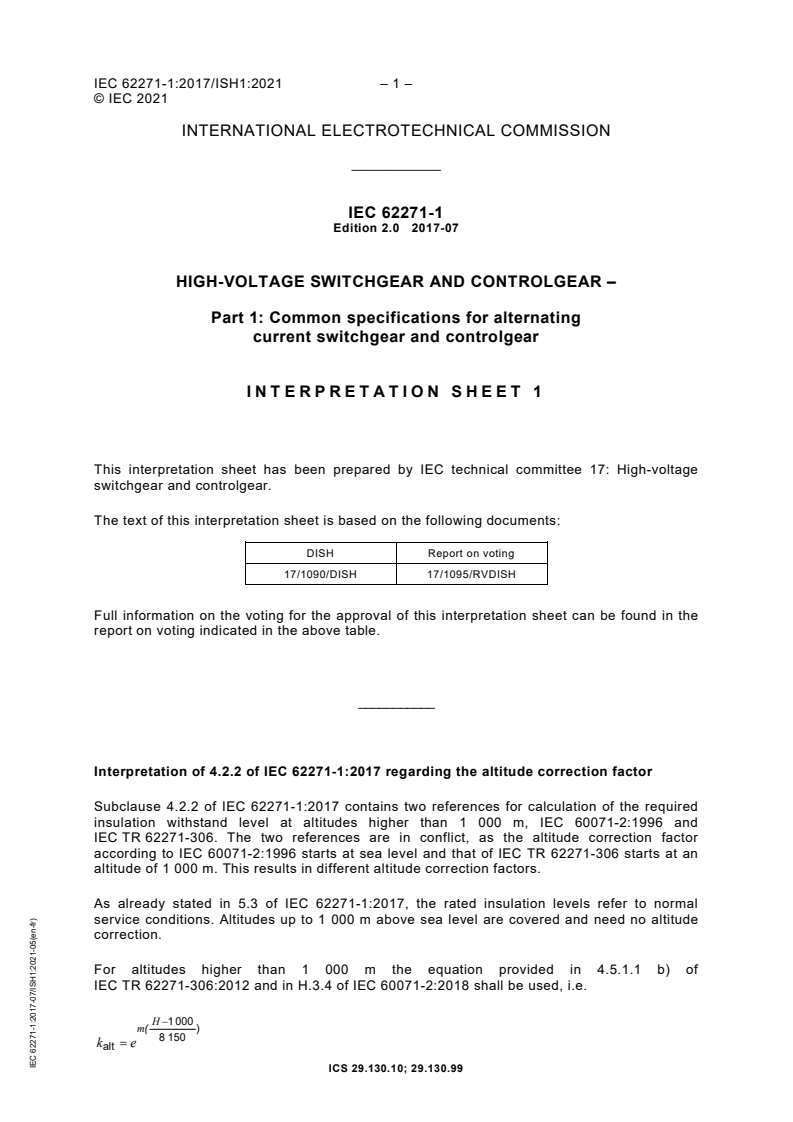
IEC TR 62271-306:2012 and in H.3.4 of IEC 60071-2:2018 shall be used, i.e.
H−1 000
m( )
8 150
k =e
alt
ICS 29.130.10; 29.130.99
IEC 62271-1:2017-07/ISH1:2021-05(en-fr)
– 2 – IEC 62271-1:2017/ISH1:2021
© IEC 2021
where
k is the altitude correction factor;
alt
H is the altitude in m above sea level;
m is an exponent.
Conservative values for the exponent m are provided in Table 4 of IEC TR 62271-306:2012.
For further details about the exponent m, see H.4 of IEC 60071-2:2018.
– 2 – IEC 62271-209:2019+AMD1:2022 EXV
© IEC 2022
CONTENTS
FOREWORD .6
INTRODUCTION TO Amendment 1.8
1 Scope .9
2 Normative references .9
3 Terms and definitions . 12
3.1 General terms and definitions . 12
3.2 Assemblies of switchgear and controlgear . 15
3.3 Parts of assemblies . 15
3.4 Switching devices . 15
3.5 Parts of switchgear and controlgear . 16
3.6 Operational characteristics of switchgear and controlgear . 19
3.7 Characteristic quantities . 23
3.8 Index of definitions . 23
4 Normal and special service conditions . 27
4.1 General . 27
4.2 Normal service conditions . 27
4.2.1 Indoor switchgear and controlgear . 27
4.2.2 Outdoor switchgear and controlgear . 28
4.3 Special service conditions . 28
4.3.1 Altitude . 28
4.3.2 Pollution . 30
4.3.3 Temperature and humidity . 30
4.3.4 Vibrations, shock or tilting . 30
4.3.5 Wind speed . 30
4.3.6 Other parameters . 30
5 Ratings . 31
5.1 General . 31
5.2 Rated voltage of the equipment of the cable connection (U ) . 31
rm
5.3 Rated insulation level (U , U , U ) . 31
d p s
5.4 Rated frequency (f ) . 31
r
5.5 Rated continuous current (I ) . 31
r
5.6 Rated short-time withstand current (I ) . 32
k
5.7 Rated peak withstand current (I ) . 32
p
5.8 Rated duration of short circuit (t ) . 32
k
6 Design and construction . 32
6.1 Gas and vacuum tightness . 32
6.1.1 General . 32
6.1.2 Controlled pressure systems for gas . 32
6.1.3 Closed pressure systems for gas . 33
6.1.4 Sealed pressure systems . 33
6.101 Limits of supply . 33
6.101.1 General . 33
6.101.2 Over-voltage protection and earthing. 33
6.102 Filling pressure of insulating gas in the cable connection enclosure. 34
6.103 Pressure withstand requirements . 35
© IEC 2022
6.104 Mechanical forces on cable terminations . 35
6.105 Switchgear connection interface and cable termination connection interface . 35
7 Type tests . 36
7.1 General . 36
7.1.1 Basics . 36
7.1.2 Information for identification of test objects . 36
7.1.3 Information to be included in type-test reports . 36
7.2 Electrical type tests of cable terminations . 37
7.2.1 General . 37
7.2.2 Electrical type test of cable terminations in a single-phase enclosure . 37
7.2.3 Electrical type test of cable termination in a three-phase enclosure . 37
7.2.4 Additional electrical type tests on the insulator to be installed by switchgear
manufacturer (plug in cable termination). 37
7.1.101 Power-frequency voltage tests on the main circuit . 38
7.1.102 Partial discharge measurement . 38
7.3 Pressure test on the insulator of a cable termination . 40
7.4 Leak rate type test on the insulator of a cable termination . 40
8 Routine tests . 40
8.1 General . 40
8.2 Pressure test . 40
8.3 Visual inspection . 40
9 Standard dimensions . 40
9.1 General . 40
9.2 Fluid-filled cable terminations . 41
9.3 Dry-type cable terminations . 41
9.4 Three-phase cable connection enclosure . 41
10 Information to be given with enquiries, tenders and orders . 41
11 Rules for transport, storage, erection, service and maintenance . 41
11.1 General . 41
11.2 Conditions during transport, storage and installation . 42
11.3 Installation . 42
11.3.1 General . 42
11.3.2 Unpacking and lifting . 42
11.3.3 Assembly . 42
11.3.4 Mounting . 42
11.3.5 Connections . 43
11.3.6 Information about gas and gas mixtures for controlled and closed pressure
systems . 43
11.3.7 Final installation inspection . 43
11.3.8 Basic input data by the user . 44
11.3.9 Basic input data by the manufacturer . 44
11.4 Operating instructions . 44
11.5 Maintenance . 45
11.5.1 General . 45
11.5.2 Information about fluids and gas to be included in maintenance manual . 45
11.5.3 Recommendations for the manufacturer . 45
11.5.4 Recommendations for the user. 46
11.5.5 Failure report . 46
– 4 – IEC 62271-209:2019+AMD1:2022 EXV
© IEC 2022
11.2 Tests after cable system installation . 48
12 Safety practices and constraints during installation of cable connection to switchgear . 48
13 Influence of the product on the environment . 48
Annex A (normative) Identification of test objects . 54
A.1 General . 54
A.2 Data . 54
A.3 Drawings . 54
Annex B (informative) Determination of the equivalent RMS value of a short-time current
during a short-circuit of a given duration . 56
Annex C (normative) Method for the weatherproofing test for outdoor switchgear and
controlgear . 57
Annex D (informative) References for auxiliary and control circuit components . 60
Annex E (normative) Tolerances on test quantities during tests . 62
Annex F (informative) Information and technical requirements to be given with enquiries,
tenders and orders . 65
F.1 General . 65
F.2 Normal and special service conditions (refer to Clause 4) . 65
F.3 Ratings (refer to Clause 5) . 66
F.4 Design and construction (refer to Clause 6) . 66
F.5 System information . 67
F.6 Documentation for enquiries and tenders . 67
Annex G (informative) List of symbols . 68
Annex H (informative) Electromagnetic compatibility on site . 69
Annex I (informative) List of notes concerning certain countries . 70
Annex J (informative) Extension of validity of type tests . 71
J.1 General . 71
J.2 Dielectric tests . 71
J.3 Short-time withstand current tests . 71
J.4 Continuous current test . 71
J.5 Electromagnetic immunity test on auxiliary and control circuits . 72
J.6 Environmental tests on auxiliary and control circuits . 72
Annex K (informative) Exposure to pollution . 73
K.1 General . 73
K.2 Pollution levels . 73
K.3 Minimum requirements for switchgear . 73
Annex A (informative) Mechanical forces applied on the flange of the cable connection
enclosure . 75
A.1 General . 75
A.2 Recommendation when connecting cable systems to switchgear . 75
Bibliography . 77
Figure 1 – Altitude correction factor . 30
Figure 1 – Operating pressure of the gas insulation in the cable connection enclosure . 34
Figure 2 – Fluid-filled cable connection assembly – Typical arrangement . 50
© IEC 2022
Figure 3 – Fluid-filled cable connection – Assembly dimensions . 51
Figure 4 – Dry-type cable connection assembly – Typical arrangement . 52
Figure 5 – Dry-type cable connection assembly – Assembly dimensions . 53
Figure B.1 – Determination of short-time current . 56
Figure C.1 – Arrangement for weatherproofing test . 58
Figure C.2 – Nozzle for weatherproofing test . 59
Table 1 – Reference table of service conditions relevant to GIS . 30
Table 1 – Test voltages for additional electrical type tests according to 7.2.4 . 38
Table 7 – On site test voltages . 39
Table D.1 – List of reference documents for auxiliary and control circuit components . 60
Table E.1 – Tolerances on test quantities for type test. 63
Table K.1 – Environmental examples by site pollution severity (SPS) class . 74
Table K.2 – Minimum nominal specific creepage distance by pollution level . 74
Table A.1 – Moment and forces applied on the flange of the cable connection enclosure
attached to the cable termination during normal operation . 76
– 6 – IEC 62271-209:2019+AMD1:2022 EXV
© IEC 2022
INTERNATIONAL ELECTROTECHNICAL COMMISSION
____________
HIGH-VOLTAGE SWITCHGEAR AND CONTROLGEAR –
Part 209: Cable connections for gas-insulated metal-enclosed
switchgear for rated voltages above 52 kV – Fluid-filled and extruded
insulation cables – Fluid-filled and dry-type cable terminations
FOREWORD
1) The International Electrotechnical Commission (IEC) is a worldwide organization for standardization comprising
all national electrotechnical committees (IEC National Committees). The object of IEC is to promote
international co-operation on all questions concerning standardization in the electrical and electronic fields. To
this end and in addition to other activities, IEC publishes International Standards, Technical Specifications,
Technical Reports, Publicly Available Specifications (PAS) and Guides (hereafter referred to as “IEC
Publication(s)”). Their preparation is entrusted to technical committees; any IEC National Committee interested
in the subject dealt with may participate in this preparatory work. International, governmental and non-
governmental organizations liaising with the IEC also participate in this preparation. IEC collaborates closely
with the International Organization for Standardization (ISO) in accordance with conditions determined by
agreement between the two organizations.
2) The formal decisions or agreements of IEC on technical matters express, as nearly as possible, an international
consensus of opinion on the relevant subjects since each technical committee has representation from all
interested IEC National Committees.
3) IEC Publications have the form of recommendations for international use and are accepted by IEC National
Committees in that sense. While all reasonable efforts are made to ensure that the technical content of IEC
Publications is accurate, IEC cannot be held responsible for the way in which they are used or for any
misinterpretation by any end user.
4) In order to promote international uniformity, IEC National Committees undertake to apply IEC Publications
transparently to the maximum extent possible in their national and regional publications. Any divergence
between any IEC Publication and the corresponding national or regional publication shall be clearly indicated in
the latter.
5) IEC itself does not provide any attestation of conformity. Independent certification bodies provide conformity
assessment services and, in some areas, access to IEC marks of conformity. IEC is not responsible for any
services carried out by independent certification bodies.
6) All users should ensure that they have the latest edition of this publication.
7) No liability shall attach to IEC or its directors, employees, servants or agents including individual experts and
members of its technical committees and IEC National Committees for any personal injury, property damage or
other damage of any nature whatsoever, whether direct or indirect, or for costs (including legal fees) and
expenses arising out of the publication, use of, or reliance upon, this IEC Publication or any other IEC
Publications.
8) Attention is drawn to the Normative references cited in this publication. Use of the referenced publications is
indispensable for the correct application of this publication.
9) Attention is drawn to the possibility that some of the elements of this IEC Publication may be the subject of
patent rights. IEC shall not be held responsible for identifying any or all such patent rights.
This extended version (EXV) of the official IEC Standard provides the user with a
comprehensive content of the Standard.
IEC 62271-1:2017+AMD1:2021 CSV and IEC 62271-203:2011.
Particular subclauses of IEC 62271-1:2017+AMD1:2021 CSV and IEC 62271-203:2011 are
displayed in the content on a blue background.
© IEC 2022
This consolidated version of the official IEC Standard and its amendment has been prepared
for user convenience.
IEC 62271-209 edition 2.1 contains the second edition (2019-02) [documents 17C/696/FDIS
and 17C/701/RVD] and its amendment 1 (2022-03) [documents 17C/833/FDIS and
17C/841/RVD].
International Standard IEC 62271-209 has been prepared by subcommittee 17C: Assemblies,
of IEC technical committee 17: High-voltage switchgear and controlgear.
This second edition constitutes a technical revision.
This edition includes the following significant technical changes with respect to the previous
edition:
a) New numbering in accordance with ISO/IEC directives, Part 2 (2016) and to
IEC 62271-1:2017;
b) Clause 3: addition of a definition for plug-in cable termination, filling pressure and
minimum function pressure for insulation;
c) Clause 7: An additional dielectric type test for plug-in cable termination was added; also a
pressure type test as well as a leak rate test on the insulator of a cable termination was
implemented;
d) Clause 12: New clause about safety practices;
e) Clause 13: New clause about influence of the product on the environment;
f) New informative Annex A: Mechanical forces applied on the flange of the cable connection
enclosure.
This document has been drafted in accordance with the ISO/IEC Directives, Part 2.
This standard is to be read in conjunction with IEC 62271-1:2017, to which it refers and which
is applicable unless otherwise specified in this standard. In order to simplify the indication of
corresponding requirements, the same numbering of clauses and subclauses is used as in
IEC 62271-1. Amendments to these clauses and subclauses are given under the same
references whilst additional subclauses are numbered from 101.
A list of all parts in the IEC 62271 series, published under the general title High-voltage
switchgear and controlgear, can be found on the IEC website.
The committee has decided that the contents of the base publication and its amendment will
remain unchanged until the stability date indicated on the IEC web site under webstore.iec.ch
in the data related to the specific publication. At this date, the publication will be
• reconfirmed,
• withdrawn,
• replaced by a revised edition, or
• amended.
IMPORTANT – The 'colour inside' logo on the cover page of this publication indicates
that it contains colours which are considered to be useful for the correct
understanding of its contents. Users should therefore print this document using a
colour printer.
– 8 – IEC 62271-209:2019+AMD1:2022 EXV
© IEC 2022
INTRODUCTION TO Amendment 1
This amendment includes the following modifications:
a) In accordance with the decision taken at IEC Plenary Meeting October 2019 in Shanghai
(17C/Shanghai/Sec07) Subclause 6.103, Figure 1 and Figure 2 have been modified;
b) The CDV was modified in accordance with the above-mentioned documents and based on
the decision taken at the virtual IEC Plenary Meeting in October 2021 (17C/823/RM).
NOTE CIGRE has published TB 784 “Standard design of a common, dry type plug-in interface for GIS and power
cables up to 145 kV describing the basis for further standardisation of such a common interface. The matter will be
dealt with during the next revision of IEC 62271-209.
© IEC 2022
HIGH-VOLTAGE SWITCHGEAR AND CONTROLGEAR –
Part 209: Cable connections for gas-insulated metal-enclosed
switchgear for rated voltages above 52 kV – Fluid-filled and extruded
insulation cables – Fluid-filled and dry-type cable terminations
1 Scope
This part of IEC 62271 covers the connection assembly of fluid-filled and extruded cables to
gas-insulated metal enclosed switchgear (GIS), in single- or three-phase arrangements where
the cable terminations are fluid-filled or dry-type and there is a separating insulating barrier
between the cable insulation and the gas insulation of the switchgear.
The purpose of this document is to establish electrical and mechanical interchangeability
between cable terminations and the gas-insulated metal-enclosed switchgear and to
determine the limits of supply. It complements and amends, if applicable, the relevant IEC
standards. For the purpose of this document the term "switchgear" is used for "gas-insulated
metal enclosed switchgear".
It does not cover directly immersed cable terminations, as described in CIGRE
brochure 89 [4] .
2 Normative references
The following documents are referred to in the text in such a way that some or all of their
content constitutes requirements of this document. For dated references, only the edition
cited applies. For undated references, the latest edition of the referenced document (including
any amendments) applies.
IEC 60038, IEC standard voltages
IEC 60050-131:2002, International Electrotechnical Vocabulary (IEV) – Part 131: Circuit
theory
IEC 60050-151:2001, International Electrotechnical Vocabulary (IEV) – Part 151: Electrical
and magnetic devices
IEC 60050-192:2015, International Electrotechnical Vocabulary (IEV) – Part 192:
Dependability
IEC 60050-351, International Electrotechnical Vocabulary (IEV) – Part 351: Control
technology
IEC 60050-441:1984, International Electrotechnical Vocabulary (IEV) – Part 441: Switchgear,
controlgear and fuses
IEC 60050-441:1984/AMD1:2000
IEC 60050-551, International Electrotechnical Vocabulary (IEV) – Part 551: Power electronics
_____________
Numbers in square brackets refer to the Bibliography.
– 10 – IEC 62271-209:2019+AMD1:2022 EXV
© IEC 2022
IEC 60050-581:2008, International Electrotechnical Vocabulary (IEV) – Part 581:
Electromechanical components for electronic equipment
IEC 60050-601, International Electrotechnical Vocabulary (IEV) – Chapter 601: Generation,
transmission and distribution of electricity – General
IEC 60050-605, International Electrotechnical Vocabulary (IEV) – Chapter 605: Generation,
transmission and distribution of electricity – Substations
IEC 60050-614:2016, International Electrotechnical Vocabulary (IEV) – Part 614: Generation,
transmission and distribution of electricity – Operation
IEC 60050-811, International Electrotechnical Vocabulary (IEV) – Part 811: Electric traction
IEC 60050-826:2004, International Electrotechnical Vocabulary (IEV) – Part 826: Electrical
installations
IEC 60060-1:2010, High-voltage test techniques – Part 1: General definitions and test
requirements
IEC 60068-2-1:2007, Environmental testing – Part 2-1: Tests – Test A: Cold
IEC 60068-2-2:2007, Environmental testing – Part 2-2: Tests – Test B: Dry heat
IEC 60068-2-17:1994, Basic environmental testing procedures – Part 2-17:Tests – Test Q:
Sealing
IEC 60068-2-30:2005, Environmental testing – Part 2-30: Tests – Test Db: Damp heat, cyclic
(12 h + 12 h cycle)
IEC 60071-1:2006, Insulation co-ordination – Part 1: Definitions, principles and rules
IEC 60071-1:2006/AMD1:2010
IEC 60071-2:1996, Insulation co-ordination – Part 2: Application guide
IEC 60085:2007, Electrical insulation – Thermal evaluation and designation
IEC 60141 (all parts), Tests on oil-filled and gas-pressure cables and their accessories
IEC 60255-21-1:1988, Electrical relays – Part 21: Vibration, shock, bump and seismic tests on
measuring relays and protection equipment – Section One: Vibration tests (sinusoidal)
IEC 60270, High-voltage test techniques – Partial discharge measurements
IEC 60296, Fluids for electrotechnical applications – Unused mineral insulating oils for
transformers and switchgear
IEC 60376, Specification of technical grade sulphur hexafluoride (SF ) and complementary
gases to be used in its mixtures for use in electrical equipment
) taken
IEC 60480, Guidelines for the checking and treatment of sulphur hexafluoride (SF
from electrical equipment and specification for its re-use
IEC 60507, Artificial pollution tests on high-voltage ceramic and glass insulators to be used
on a.c. systems
© IEC 2022
IEC 60512-2-2, Connectors for electronic equipment – Tests and measurements – Part 2-2:
Electrical continuity and contact resistance tests – Test 2b: Contact resistance – Specified
test current method
IEC 60529:1989, Degrees of protection provided by enclosures (IP Code)
IEC 60529:1989/AMD1:1999
IEC 60529:1989/AMD2:2013
IEC TS 60815-1:2008, Selection and dimensioning of high-voltage insulators intended for use
in polluted conditions – Part 1: Definitions, information and general principles
IEC TS 60815-2:2008, Selection and dimensioning of high-voltage insulators intended for use
in polluted conditions – Part 2: Ceramic and glass insulators for a.c. systems
IEC TS 60815-3:2008, Selection and dimensioning of high-voltage insulators intended for use
in polluted conditions – Part 3: Polymer insulators for a.c. systems
IEC 60840, Power cables with extruded insulation and their accessories for rated voltages
above 30 kV (U = 36 kV) up to 150 kV (U = 170 kV) – Test methods and requirements
m m
IEC 61000-4-4, Electromagnetic compatibility (EMC) – Part 4-4: Testing and measurement
techniques – Electrical fast transient/burst immunity test
IEC 61000-4-11, Electromagnetic compatibility (EMC) – Part 4-11: Testing and measurement
techniques – Voltage dips, short interruptions and voltage variations immunity tests
IEC 61000-4-17:2009, Electromagnetic compatibility (EMC) – Part 4-17: Testing and
measurement techniques – Ripple on d.c. input power port immunity test
IEC 61000-4-18, Electromagnetic compatibility (EMC) – Part 4-18: Testing and measurement
techniques – Damped oscillatory wave immunity test
IEC 61000-4-29, Electromagnetic compatibility (EMC) – Part 4-29: Testing and measurement
techniques – Voltage dips, short interruptions and voltage variations on d.c. input power port
immunity tests
IEC 61000-6-2, Electromagnetic compatibility (EMC) – Part 6-2: Generic standards –
Immunity for industrial environments
IEC 61000-6-5, Electromagnetic compatibility (EMC) – Part 6-5: Generic standards –
Immunity for equipment used in power station and substation environment
IEC 61180, High-voltage test techniques for low-voltage equipment – Definitions, test and
procedure requirements, test equipment
IEC 61810-7:2006, Electromechanical elementary relays – Part 7: Test and measurement
procedures
IEC 62067, Power cables with extruded insulation and their accessories for rated voltages
above 150 kV (U = 170 kV) up to 500 kV (U = 550 kV) – Test methods and requirements
m m
IEC 62262:2002, Degrees of protection provided by enclosures for electrical equipment
against external mechanical impacts (IK code)
IEC 62271-1:2017, High-voltage switchgear and controlgear – Part 1:Common specifications
for alternating current switchgear and controlgear
– 12 – IEC 62271-209:2019+AMD1:2022 EXV
© IEC 2022
IEC 62271-4, High-voltage switchgear and controlgear – Part 4: Handling procedures for
sulphur hexafluoride (SF ) and its mixtures
IEC 62271-203:2011, High-voltage switchgear and controlgear – Part 203:Gas-insulated
metal-enclosed switchgear for rated voltages above 52 kV
CISPR 11:2015, Industrial, scientific and medical equipment – Radio-frequency disturbance
characteristics – Limits and methods of measurement
CISPR TR 18-2, Radio interference characteristics of overhead power lines and high-voltage
equipment – Part 2: Methods of measurement and procedure for determining limits
3 Terms and definitions
For the purposes of this document, the terms and definitions given in IEC 60050-131,
IEC 60050-151, IEC 60050-192, IEC 60050-351, IEC 60050-441, IEC 60050-551,
IEC 60050-581, IEC 60050-601, IEC 60050-605, IEC 60050-614, IEC 60050-811 and
IEC 60050-826, some of which are recalled hereunder, and the following apply.
ISO and IEC maintain terminological databases for use in standardization at the following
addresses:
• IEC Electropedia: available at http://www.electropedia.org/
• ISO Online browsing platform: available at http://www.iso.org/obp
NOTE Terms and definitions are classified in accordance with IEC 60050-441. References from other parts than
IEC 60050-441 are classified so as to be aligned with the classification used in IEC 60050-441.
3.1 General terms and definitions
3.1.1
switchgear and controlgear
general term covering switching devices and their combination with associated control,
measuring, protective and regulating equipment, also assemblies of such devices and
equipment with associated interconnections, accessories, enclosures and supporting
structures
[SOURCE: IEC 60050-441:2000, 441-11-01]
3.1.2
external insulation
distances in atmospheric air and along the surfaces in contact with atmospheric air of solid
insulation of the equipment which are subject to dielectric stresses and to the effects of
atmospheric and other environmental conditions from the site
Note 1 to entry: Examples of environmental conditions are pollution, humidity, vermin, etc.
[SOURCE: IEC 60050-614:2016, 614-03-02]
3.1.3
degree of protection
extent of protection provided by an enclosure against access to hazardous parts, against
ingress of solid foreign objects and/or ingress of water and against mechanical impact
[SOURCE: IEC 60529:1989, 3.3, modified – leave out “verified by standardized test methods”
and add “against mechanical impact” after "water and".]
© IEC 2022
3.1.4
IP code
coding system to indicate the degrees of protection provided by an enclosure against access
to hazardous parts, ingress of solid foreign objects, ingress of water and to give additional
information in connection with such protection
[SOURCE: IEC 60529:1989, 3.4]
3.1.5
protection provided by an enclosure against access to hazardous parts
protection of persons against
– contact with hazardous low-voltage live parts;
– contact with hazardous mechanical parts;
– approach to hazardous high-voltage live parts below adequate clearance inside an
enclosure
Note 1 to entry: This protection may be provided:
– by means of the enclosure itself;
– by means of barriers as part of the enclosure or distances inside the enclosure.
[SOURCE: IEC 60529:1989, 3.6]
3.1.6
IK code
coding system to indicate the degree of protection provided by an enclosure against harmful
external mechanical impacts
[SOURCE: IEC 62262:2002, 3.3]
3.1.7
maintenance
combination of all technical and management actions intended to retain an item in, or restore
it to, a state in which it can perform as required
Note 1 to entry: Management is assumed to include supervision activities.
[SOURCE: IEC 60050-192:2015, 192-06-01]
3.1.8
visual inspection
visual investigation of the principal features of the switchgear and controlgear
Note 1 to entry: This inspection is generally directed toward pressures and/or levels of fluids, tightness, position
of relays, pollution of insulating parts, but actions such as lubricating, cleaning, washing, etc. which can be carried
out with the switchgear and controlgear in service are also included.
Note 2 to entry: Observations resulting from inspection can lead to the decision to carry out overhaul.
Note 3 to entry: This inspection can be used for determining the state of tested objects on e.g. cracks in solid
insulators.
3.1.9
diagnostic test
comparative test of the characteristic parameters of switchgear and controlgear to verify that
it performs its functions, by measuring one or more of these parameters
Note 1 to entry: The result from a diagnostic test can lead to the decision to carry out overhaul.
– 14 – IEC 62271-209:2019+AMD1:2022 EXV
© IEC 2022
3.1.10
overhaul
work performed with the objective of repairing or replacing parts which are found to be out of
tolerance by inspection, diagnostic test, examination or as required by manufacturer's
maintenance manual, in order to restore the component and/or the switchgear and controlgear
to an acceptable condition (within tolerance)
3.1.11
failure
loss of ability to perform as required
Note 1 to entry: A failure of an item is an event that results in a fault of that item: see fault (IEC 60050-192:2015,
192-04-01).
Note 2 to entry: Qualifiers, such as catastrophic, critical, major, minor, marginal and insignificant, can be used to
categorize failures according to the severity of consequences, the choice and definitions of severity criteria
depending upon the field of application.
Note 3 to entry: Qualifiers, such as misuse, mishandling and weakness, may be used to categorize failures
according to the cause of
...
IEC 62271-209 ®
Edition 2.0 2019-02
INTERNATIONAL
STANDARD
NORME
INTERNATIONALE
High-voltage switchgear and controlgear –
Part 209: Cable connections for gas-insulated metal-enclosed switchgear for
rated voltages above 52 kV – Fluid-filled and extruded insulation cables – Fluid-
filled and dry-type cable terminations
Appareillage à haute tension –
Partie 209: Raccordement de câbles pour appareillage sous enveloppe
métallique à isolation gazeuse de tension assignée supérieure à 52 kV – Câbles
remplis d’un fluide ou à isolation extrudée – Extrémité de câble de type sec ou
remplie d'un fluide
All rights reserved. Unless otherwise specified, no part of this publication may be reproduced or utilized in any form
or by any means, electronic or mechanical, including photocopying and microfilm, without permission in writing from
either IEC or IEC's member National Committee in the country of the requester. If you have any questions about IEC
copyright or have an enquiry about obtaining additional rights to this publication, please contact the address below or
your local IEC member National Committee for further information.
Droits de reproduction réservés. Sauf indication contraire, aucune partie de cette publication ne peut être reproduite
ni utilisée sous quelque forme que ce soit et par aucun procédé, électronique ou mécanique, y compris la photocopie
et les microfilms, sans l'accord écrit de l'IEC ou du Comité national de l'IEC du pays du demandeur. Si vous avez des
questions sur le copyright de l'IEC ou si vous désirez obtenir des droits supplémentaires sur cette publication, utilisez
les coordonnées ci-après ou contactez le Comité national de l'IEC de votre pays de résidence.
IEC Central Office Tel.: +41 22 919 02 11
3, rue de Varembé info@iec.ch
CH-1211 Geneva 20 www.iec.ch
Switzerland
About the IEC
The International Electrotechnical Commission (IEC) is the leading global organization that prepares and publishes
International Standards for all electrical, electronic and related technologies.
About IEC publications
The technical content of IEC publications is kept under constant review by the IEC. Please make sure that you have the
latest edition, a corrigendum or an amendment might have been published.
IEC publications search - webstore.iec.ch/advsearchform Electropedia - www.electropedia.org
The advanced search enables to find IEC publications by a The world's leading online dictionary on electrotechnology,
variety of criteria (reference number, text, technical containing more than 22 000 terminological entries in English
committee,…). It also gives information on projects, replaced and French, with equivalent terms in 16 additional languages.
and withdrawn publications. Also known as the International Electrotechnical Vocabulary
(IEV) online.
IEC Just Published - webstore.iec.ch/justpublished
Stay up to date on all new IEC publications. Just Published IEC Glossary - std.iec.ch/glossary
details all new publications released. Available online and 67 000 electrotechnical terminology entries in English and
once a month by email. French extracted from the Terms and Definitions clause of
IEC publications issued since 2002. Some entries have been
IEC Customer Service Centre - webstore.iec.ch/csc collected from earlier publications of IEC TC 37, 77, 86 and
If you wish to give us your feedback on this publication or CISPR.
need further assistance, please contact the Customer Service
Centre: sales@iec.ch.
A propos de l'IEC
La Commission Electrotechnique Internationale (IEC) est la première organisation mondiale qui élabore et publie des
Normes internationales pour tout ce qui a trait à l'électricité, à l'électronique et aux technologies apparentées.
A propos des publications IEC
Le contenu technique des publications IEC est constamment revu. Veuillez vous assurer que vous possédez l’édition la
plus récente, un corrigendum ou amendement peut avoir été publié.
Electropedia - www.electropedia.org
Recherche de publications IEC -
webstore.iec.ch/advsearchform Le premier dictionnaire d'électrotechnologie en ligne au
La recherche avancée permet de trouver des publications IEC monde, avec plus de 22 000 articles terminologiques en
en utilisant différents critères (numéro de référence, texte, anglais et en français, ainsi que les termes équivalents dans
comité d’études,…). Elle donne aussi des informations sur les 16 langues additionnelles. Egalement appelé Vocabulaire
projets et les publications remplacées ou retirées. Electrotechnique International (IEV) en ligne.
IEC Just Published - webstore.iec.ch/justpublished Glossaire IEC - std.iec.ch/glossary
Restez informé sur les nouvelles publications IEC. Just 67 000 entrées terminologiques électrotechniques, en anglais
Published détaille les nouvelles publications parues. et en français, extraites des articles Termes et Définitions des
Disponible en ligne et une fois par mois par email. publications IEC parues depuis 2002. Plus certaines entrées
antérieures extraites des publications des CE 37, 77, 86 et
Service Clients - webstore.iec.ch/csc CISPR de l'IEC.
Si vous désirez nous donner des commentaires sur cette
publication ou si vous avez des questions contactez-nous:
sales@iec.ch.
IEC 62271-209 ®
Edition 2.0 2019-02
INTERNATIONAL
STANDARD
NORME
INTERNATIONALE
High-voltage switchgear and controlgear –
Part 209: Cable connections for gas-insulated metal-enclosed switchgear for
rated voltages above 52 kV – Fluid-filled and extruded insulation cables – Fluid-
filled and dry-type cable terminations
Appareillage à haute tension –
Partie 209: Raccordement de câbles pour appareillage sous enveloppe
métallique à isolation gazeuse de tension assignée supérieure à 52 kV – Câbles
remplis d’un fluide ou à isolation extrudée – Extrémité de câble de type sec ou
remplie d'un fluide
INTERNATIONAL
ELECTROTECHNICAL
COMMISSION
COMMISSION
ELECTROTECHNIQUE
INTERNATIONALE
ICS 29.130.10 ISBN 978-2-8322-6405-8
– 2 – IEC 62271-209:2019 © IEC 2019
CONTENTS
FOREWORD . 4
1 Scope . 6
2 Normative references . 6
3 Terms and definitions . 7
4 Normal and special service conditions . 8
4.1 General . 8
4.2 Normal service conditions . 8
4.3 Special service conditions . 8
5 Ratings . 8
5.1 General . 8
5.2 Rated voltage of the equipment of the cable connection (U ) . 9
rm
5.3 Rated insulation level (U , U , U ) . 9
d p s
5.4 Rated frequency (f ) . 9
r
5.5 Rated continuous current (I ) . 9
r
5.6 Rated short-time withstand current (I ) . 9
k
5.7 Rated peak withstand current (I ) . 9
p
5.8 Rated duration of short circuit (t ) . 9
k
6 Design and construction . 10
6.1 Gas and vacuum tightness . 10
6.101 Limits of supply . 10
6.101.1 General . 10
6.101.2 Over-voltage protection and earthing . 10
6.102 Filling pressure of insulating gas in the cable connection enclosure . 11
6.103 Pressure withstand requirements . 11
6.104 Mechanical forces on cable terminations . 11
6.105 Switchgear connection interface and cable termination connection interface . 12
7 Type tests . 12
7.1 General . 12
7.2 Electrical type tests of cable terminations . 12
7.2.1 General . 12
7.2.2 Electrical type test of cable terminations in a single-phase enclosure . 12
7.2.3 Electrical type test of cable termination in a three-phase enclosure . 12
7.2.4 Additional electrical type tests on the insulator to be installed by
switchgear manufacturer (plug in cable termination) . 13
7.3 Pressure test on the insulator of a cable termination . 13
7.4 Leak rate type test on the insulator of a cable termination . 14
8 Routine tests . 14
8.1 General . 14
8.2 Pressure test . 14
8.3 Visual inspection . 14
9 Standard dimensions . 14
9.1 General . 14
9.2 Fluid-filled cable terminations . 14
9.3 Dry-type cable terminations . 15
9.4 Three-phase cable connection enclosure . 15
10 Information to be given with enquiries, tenders and orders . 15
11 Rules for transport, storage, erection, service and maintenance . 15
11.1 General . 15
11.2 Tests after cable system installation . 16
12 Safety practices and constraints during installation of cable connection to
switchgear . 16
13 Influence of the product on the environment . 16
Annex A (informative) Mechanical forces applied on the flange of the cable connection
enclosure . 21
A.1 General . 21
A.2 Recommendation when connecting cable systems to switchgear . 21
Bibliography . 23
Figure 1 – Operating pressure of the SF gas insulation in the cable connection
enclosure . 11
Figure 2 – Fluid-filled cable connection assembly – Typical arrangement . 17
Figure 3 – Fluid-filled cable connection – Assembly dimensions . 18
Figure 4 – Dry-type cable connection assembly – Typical arrangement . 19
Figure 5 – Dry-type cable connection assembly – Assembly dimensions . 20
Table 1 – Test voltages for additional electrical type tests according to 7.2.4 . 13
Table A.1 – Moment and forces applied on the flange of the cable connection
enclosure attached to the cable termination during normal operation . 22
– 4 – IEC 62271-209:2019 © IEC 2019
INTERNATIONAL ELECTROTECHNICAL COMMISSION
____________
HIGH-VOLTAGE SWITCHGEAR AND CONTROLGEAR –
Part 209: Cable connections for gas-insulated metal-enclosed
switchgear for rated voltages above 52 kV – Fluid-filled and extruded
insulation cables – Fluid-filled and dry-type cable terminations
FOREWORD
1) The International Electrotechnical Commission (IEC) is a worldwide organization for standardization comprising
all national electrotechnical committees (IEC National Committees). The object of IEC is to promote
international co-operation on all questions concerning standardization in the electrical and electronic fields. To
this end and in addition to other activities, IEC publishes International Standards, Technical Specifications,
Technical Reports, Publicly Available Specifications (PAS) and Guides (hereafter referred to as “IEC
Publication(s)”). Their preparation is entrusted to technical committees; any IEC National Committee interested
in the subject dealt with may participate in this preparatory work. International, governmental and non-
governmental organizations liaising with the IEC also participate in this preparation. IEC collaborates closely
with the International Organization for Standardization (ISO) in accordance with conditions determined by
agreement between the two organizations.
2) The formal decisions or agreements of IEC on technical matters express, as nearly as possible, an international
consensus of opinion on the relevant subjects since each technical committee has representation from all
interested IEC National Committees.
3) IEC Publications have the form of recommendations for international use and are accepted by IEC National
Committees in that sense. While all reasonable efforts are made to ensure that the technical content of IEC
Publications is accurate, IEC cannot be held responsible for the way in which they are used or for any
misinterpretation by any end user.
4) In order to promote international uniformity, IEC National Committees undertake to apply IEC Publications
transparently to the maximum extent possible in their national and regional publications. Any divergence
between any IEC Publication and the corresponding national or regional publication shall be clearly indicated in
the latter.
5) IEC itself does not provide any attestation of conformity. Independent certification bodies provide conformity
assessment services and, in some areas, access to IEC marks of conformity. IEC is not responsible for any
services carried out by independent certification bodies.
6) All users should ensure that they have the latest edition of this publication.
7) No liability shall attach to IEC or its directors, employees, servants or agents including individual experts and
members of its technical committees and IEC National Committees for any personal injury, property damage or
other damage of any nature whatsoever, whether direct or indirect, or for costs (including legal fees) and
expenses arising out of the publication, use of, or reliance upon, this IEC Publication or any other IEC
Publications.
8) Attention is drawn to the Normative references cited in this publication. Use of the referenced publications is
indispensable for the correct application of this publication.
9) Attention is drawn to the possibility that some of the elements of this IEC Publication may be the subject of
patent rights. IEC shall not be held responsible for identifying any or all such patent rights.
International Standard IEC 62271-209 has been prepared by subcommittee 17C: Assemblies,
of IEC technical committee 17: High-voltage switchgear and controlgear.
This second edition cancels and replaces the first edition published in 2007. This edition
constitutes a technical revision.
This edition includes the following significant technical changes with respect to the previous
edition:
a) New numbering in accordance with ISO/IEC directives, Part 2 (2016) and to
IEC 62271-1:2017;
b) Clause 3: addition of a definition for plug-in cable termination, filling pressure and
minimum function pressure for insulation;
c) Clause 7: An additional dielectric type test for plug-in cable termination was added; also a
pressure type test as well as a leak rate test on the insulator of a cable termination was
implemented;
d) Clause 12: New clause about safety practices;
e) Clause 13: New clause about influence of the product on the environment;
f) New informative Annex A: Mechanical forces applied on the flange of the cable connection
enclosure.
The text of this standard is based on the following documents:
FDIS Report on voting
17C/696/FDIS 17C/701/RVD
Full information on the voting for the approval of this International Standard can be found in
the report on voting indicated in the above table.
This document has been drafted in accordance with the ISO/IEC Directives, Part 2.
This standard is to be read in conjunction with IEC 62271-1:2017, to which it refers and which
is applicable unless otherwise specified in this standard. In order to simplify the indication of
corresponding requirements, the same numbering of clauses and subclauses is used as in
IEC 62271-1. Amendments to these clauses and subclauses are given under the same
references whilst additional subclauses are numbered from 101.
A list of all parts in the IEC 62271 series, published under the general title High-voltage
switchgear and controlgear, can be found on the IEC website.
The committee has decided that the contents of this document will remain unchanged until the
stability date indicated on the IEC website under "http://webstore.iec.ch" in the data related to
the specific document. At this date, the document will be
• reconfirmed,
• withdrawn,
• replaced by a revised edition, or
• amended.
– 6 – IEC 62271-209:2019 © IEC 2019
HIGH-VOLTAGE SWITCHGEAR AND CONTROLGEAR –
Part 209: Cable connections for gas-insulated metal-enclosed
switchgear for rated voltages above 52 kV – Fluid-filled and extruded
insulation cables – Fluid-filled and dry-type cable terminations
1 Scope
This part of IEC 62271 covers the connection assembly of fluid-filled and extruded cables to
gas-insulated metal enclosed switchgear (GIS), in single- or three-phase arrangements where
the cable terminations are fluid-filled or dry-type and there is a separating insulating barrier
between the cable insulation and the gas insulation of the switchgear.
The purpose of this document is to establish electrical and mechanical interchangeability
between cable terminations and the gas-insulated metal-enclosed switchgear and to
determine the limits of supply. It complements and amends, if applicable, the relevant IEC
standards. For the purpose of this document the term "switchgear" is used for "gas-insulated
metal enclosed switchgear".
It does not cover directly immersed cable terminations, as described in CIGRE
brochure 89 [4] .
2 Normative references
The following documents are referred to in the text in such a way that some or all of their
content constitutes requirements of this document. For dated references, only the edition
cited applies. For undated references, the latest edition of the referenced document (including
any amendments) applies.
IEC 60038, IEC standard voltages
IEC 60068-2-17:1994, Basic environmental testing procedures – Part 2-17:Tests – Test Q:
Sealing
IEC 60141 (all parts), Tests on oil-filled and gas-pressure cables and their accessories
IEC 60376, Specification of technical grade sulphur hexafluoride (SF ) and complementary
gases to be used in its mixtures for use in electrical equipment
IEC 60480, Guidelines for the checking and treatment of sulphur hexafluoride (SF ) taken
from electrical equipment and specification for its re-use
IEC 60840, Power cables with extruded insulation and their accessories for rated voltages
above 30 kV (U = 36 kV) up to 150 kV (U = 170 kV) – Test methods and requirements
m m
IEC 62067, Power cables with extruded insulation and their accessories for rated voltages
above 150 kV (U = 170 kV) up to 500 kV (U = 550 kV) – Test methods and requirements
m m
_____________
Numbers in square brackets refer to the Bibliography.
IEC 62271-1:2017, High-voltage switchgear and controlgear – Part 1:Common specifications
for alternating current switchgear and controlgear
IEC 62271-203:2011, High-voltage switchgear and controlgear – Part 203:Gas-insulated
metal-enclosed switchgear for rated voltages above 52 kV
3 Terms and definitions
For the purposes of this document, the following terms and definitions apply.
ISO and IEC maintain terminological databases for use in standardization at the following
addresses:
• IEC Electropedia: available at http://www.electropedia.org/
• ISO Online browsing platform: available at http://www.iso.org/obp
3.1
cable termination
equipment fitted to the end of a cable to ensure electrical connection with other parts of the
system and to maintain the insulation up to the point of connection
3.1.1
fluid-filled cable termination
cable termination which comprises a separating insulating barrier between the cable
insulation and the gas insulation of switchgear, including a fluid
3.1.2
dry-type cable termination
cable termination which comprises an elastomeric electrical stress control component in direct
contact with a separating insulating barrier (insulator) between the cable insulation and the
gas insulation of the switchgear, not requiring any fluid
3.2
main circuit end terminal
part of the main circuit of a gas-insulated metal enclosed switchgear forming part of the
connection interface
3.3
cable connection enclosure
part of the gas-insulated metal-enclosed switchgear which houses the cable termination and
the main circuit end terminal
3.4
cable connection assembly
combination of a cable termination, a cable connection enclosure and a main circuit end
terminal, which mechanically and electrically connects the cable to the gas-insulated metal
enclosed switchgear
3.5
plug-in cable termination
cable termination where cable/stress cone assembly can be engaged into the insulator
assembly that is already installed into switchgear enclosure
3.6
design pressure
pressure used to determine the design of the enclosure and the components of the cable
termination subjected to that pressure
– 8 – IEC 62271-209:2019 © IEC 2019
Note 1 to entry: It is at least equal to the maximum pressure in the enclosure at the highest temperature that the
gas used for insulation can reach under specified maximum service conditions.
3.7
fluid
liquid or gas for insulation purposes
3.8
cable system
cable with installed accessories
3.9
filling pressure p for insulation
re
filling density ρ for insulation
re
pressure (in Pa), for insulation, referred to the standard atmospheric air conditions of 20 °C
and 101,3 kPa, which may be expressed in relative or absolute terms (or density), to which
the assembly is filled before being put into service
3.10
minimum functional pressure p for insulation
me
for insulation
minimum functional density ρ
me
pressure (in Pa), for insulation, referred to the standard atmospheric air conditions of 20 °C
and 101,3 kPa, which may be expressed in relative or absolute terms (or density), at which
and above which the characteristics of the switchgear-cable connection are maintained and at
which replenishment becomes necessary
4 Normal and special service conditions
4.1 General
Clause 2 of IEC 62271-203:2011 is applicable.
4.2 Normal service conditions
Subclause 2.1 of IEC 62271-203:2011 is applicable.
4.3 Special service conditions
Subclause 2.2 of IEC 62271-203:2011 is applicable.
5 Ratings
5.1 General
When dimensioning the cable connection assembly, the following rated values shall apply:
a) rated voltage of the equipment of the cable connection (U );
rm
b) rated insulation level (U , U and U where applicable);
p d s
c) rated frequency (f )
r
d) rated continuous current (I );
r
e) rated short-time withstand current (I );
k
f) rated peak withstand current (I );
p
g) rated duration of short circuit (t ).
k
5.2 Rated voltage of the equipment of the cable connection (U )
rm
) is equal to the lower of the
The rated voltage for the equipment of the cable connection (U
rm
values U for the cable system and U for the gas-insulated metal-enclosed switchgear and
m r
shall be selected from the following standard values:
72,5 kV – 100 kV – 123 kV – 145 kV – 170 kV – 245 kV – 300 kV – 362 kV – 420 kV – 550 kV
NOTE 1 Values above U = 550 kV are not considered.
r
NOTE 2 U = 100 kV is not defined in IEC 60840.
m
5.3 Rated insulation level (U , U , U )
d p s
The rated insulation level for the cable connection assembly shall be selected from the values
given in IEC 60038 as well as IEC 62271-203.
5.4 Rated frequency (f )
r
The preferred values of the rated frequency are 16,7 Hz, 25 Hz, 50 Hz and 60 Hz.
5.5 Rated continuous current (I )
r
The connection interface of the main circuit shown in Figures 2 and 3 for fluid-filled cable
terminations and Figures 4 and 5 for dry-type cable terminations is applicable at rated
continuous currents up to 3 150 A.
The connection interface shall be designed so that at a current equal to the cable rated
current corresponding to a maximum temperature of 90 °C, no heat transfer from the
switchgear main circuit end terminal to the cable termination will occur.
NOTE As the maximum conductor temperature for cables is limited by the maximum operating temperature for the
insulation, there are certain cable dielectrics which cannot withstand the maximum temperature specified for gas-
insulated metal-enclosed switchgear if there is heat transfer across the connection interface to the cable
terminations.
For cases when the above design requirement of 90 °C at rated continuous current of the
cable system cannot be allowed because of cable design limitations, the manufacturer of the
switchgear should provide the necessary data on temperature rise of the main circuit end
terminal and of the insulating gas as a function of current.
5.6 Rated short-time withstand current (I )
k
Short-time currents of short circuit shall refer to the levels provided by the cable system, not
exceeding the values defined for the switchgear in line with IEC 62271-1.
5.7 Rated peak withstand current (I )
p
Peak withstand currents of short circuit shall refer to the levels provided by the cable system,
not exceeding the values defined for the switchgear in line with IEC 62271-1.
5.8 Rated duration of short circuit (t )
k
The duration of short circuit shall refer to the levels provided by the cable system, not
exceeding the values given in IEC 62271-1.
– 10 – IEC 62271-209:2019 © IEC 2019
6 Design and construction
6.1 Gas and vacuum tightness
Subclause 6.16 of IEC 62271-1:2017 is applicable with the following addition:
For conditions up to the maximum occurring gas operating pressure, the cable termination
shall prevent insulating gas from the switchgear diffusing into the interior of the cable
termination and into the cable. The cable termination shall prevent insulating fluid from the
cable termination entering the switchgear. The insulator (part 4 in Figures 2 and 4) shall be
capable of withstanding the vacuum conditions when the cable connection enclosure is
evacuated, as part of the gas filling process.
In the case of a gas insulated cable or a gas insulated termination, the gas compartment of
the cable or of the gas insulated termination shall be treated independently from the
switchgear with respect to tightness.
6.101 Limits of supply
6.101.1 General
The limits of supply of gas-insulated metal-enclosed switchgear and the cable termination
shall be in accordance with Figure 2 for fluid-filled cable terminations and Figure 4 for dry-
type cable terminations.
6.101.2 Over-voltage protection and earthing
It is necessary to have either a direct low resistance connection or an insulated section
bridged by non-linear resistors between part 6 and part 13 of Figure 2 for fluid-filled cable
terminations and Figure 4 for dry-type cable terminations. To enable suitable connections to
be made to the switchgear, for the purposes of this direct connection or installation of any
sheath voltage limiting device, the switchgear manufacturer shall provide four connection
points per phase (evenly spaced around each phase) each comprising an M12 threaded hole
of minimum 21 mm length (for all voltage levels). The position of these 4 connection points is
different from the mechanical connection points used for fixing the cable termination insulator.
The number of connection points used shall be determined by the cable system designer.
Where applicable, the number and characteristics of the non-linear resistors shall be
determined by the cable system designer, and they shall be supplied by the cable termination
manufacturer, taking into consideration the requirements of the user and the switchgear
manufacturer. Reference is made to CIGRE TB 44, 1993 [5], as well as to IEEE 1300-2011,
Clause 11 [3].
In addition, the installation design of the area around the cable termination shall take into
account the space required to install any non-linear resistors, including adequate clearances
to earth.
For three phases in one enclosure arrangements special clarification between the GIS
manufacturer, the cable termination manufacturer and the cable system designer may be
necessary because of limited space between the three phases.
The overvoltage protection elements, i.e. connections between part 6 and part 13 of
Figure 2 for fluid-filled cable terminations and Figure 4 for dry-type cable terminations as
described above, are not meant to serve as the cable system grounding connection.
Earthing of enclosures shall be in accordance with the relevant subclause of IEC 62271-
203:2011.
6.102 Filling pressure of insulating gas in the cable connection enclosure
If SF is used as the insulating gas, the minimum functional pressure for insulation p used
6 me
to determine the design of the cable termination insulation shall not exceed p = 0,35 MPa
me
(absolute) at 20 °C for maximum rated voltages up to 300 kV. For maximum rated voltages
exceeding 300 kV the minimum functional pressure for insulation p used to determine the
me
design of the cable termination insulation shall not exceed p = 0,4 MPa (absolute) at 20°C
me
(see Figure 1).
The filling pressure p of insulating gas is assigned by the switchgear manufacturer but shall
re
in no case be lower than p . The service pressure is in no case higher than the design
me
pressure as per 6.103.
Design pressure
0,85
Service pressure range
p
me
0,35/0,40
IEC
p minimal functional pressure for insulation depending on rated voltage
me
Figure 1 – Operating pressure of the SF gas insulation
in the cable connection enclosure
If a gas other than SF or a gas mixture is used, the minimum functional pressure shall be
chosen to provide the same dielectric performance as in case of SF . The minimum functional
pressure shall be below the maximum service pressure and design pressure of the enclosure
as per 6.103.
6.103 Pressure withstand requirements
The design pressure for the outside of the cable termination is 0,85 MPa (absolute) at 20°C
independent from the GIS design pressure applied.
6.104 Mechanical forces on cable terminations
The manufacturer of the cable termination in a three-phase connection shall take into account
the total dynamic forces generated during short circuit conditions. These forces consist of
those generated within the cable termination and those coming from the main circuit of the
switchgear. The maximum additional force applied from the switchgear to the connection
interface (Figures 2 or 4) transversely and then being transferred from the main circuit end
terminal shall not exceed 5 kN for a three phase arrangement. For single-phase connections,
the maximum additional force applied from the switchgear to the connection interface
(Figures 2 or 4) transversely and then being transferred from the main circuit end terminal
shall not exceed 2 kN. It is the responsibility of the manufacturer of the switchgear to ensure
that the specified forces are not exceeded or to agree with the cable termination manufacturer
that the cable termination shall withstand the higher forces.
For both single-phase and three-phase connections, additional forces and movements from
the switchgear can be experienced due to temperature variations and vibrations in service.
Pressure (MPa)
– 12 – IEC 62271-209:2019 © IEC 2019
These forces can act on both switchgear and cable termination and depend largely on the
switchgear layout, termination installation, cable design and the methods of mechanical
support. The design of any support structure shall take into account these forces and
movements. It is particularly important that the support for the switchgear shall not be affixed
to the insulator collar and/or clamping flange, parts 9 and 11 of Figures 2 or 4. Further
information regarding mechanical forces on the flanges of the cable connection enclosure are
given in Annex A.
For seismic requirements, the switchgear manufacturer carries out a seismic calculation in
order to identify the location of mechanical reinforcements; reference is made to IEC 62271-
207 [2].
6.105 Switchgear connection interface and cable termination connection interface
The normal current-carrying contact surfaces of the switchgear and cable termination
connection interface (refer to parts 2 and 3 of Figures 2 and 4) shall be silver coated or
copper coated or non-coated solid copper.
7 Type tests
7.1 General
For type tests as per IEC 62271-1:2017, 7.1 applies. If SF is used, technical grade SF in
6 6
accordance with IEC 60376 or used SF in accordance with IEC 60480 shall be used.
7.2 Electrical type tests of cable terminations
7.2.1 General
The electric type tests of the cable termination shall be carried out according to the electrical
type tests defined in IEC 60141 (all parts) or IEC 60840 or IEC 62067 as relevant for the
cable design. Where applicable the insulator shall be tested to 7.2.4.
The cable termination shall be installed in an enclosure as per 7.2.2, filled with insulating gas
+0,02 MPa with filling pressure specified in 6.102.
at the pressure not exceeding p
me
The design of the main circuit end terminal (part 1 in Figures 2 or 4 respectively) used in the
test as connection to part 3 of the cable connection assembly shall comply with Figures 2
and 4 respectively of this document.
7.2.2 Electrical type test of cable terminations in a single-phase enclosure
The cable termination is surrounded by a metal cylinder connected to earth, the maximum
internal diameter is equal to d for the four standard sizes of cable connection enclosure (d in
5 5
Figure 3 for fluid-filled cable terminations and Figure 5 for dry-type cable terminations). The
minimum length of the metal cylinder shall be in accordance with the dimension l given in
Figures 3 and 5.
7.2.3 Electrical type test of cable termination in a three-phase enclosure
The single-phase test arrangement using the single-phase cable connection enclosure from
the switchgear covers the test requirements of the cable termination in a three-phase
enclosure as it imposes a more severe dielectric stress to the test object. It is therefore the
referenced type test arrangement.
7.2.4 Additional electrical type tests on the insulator to be installed by switchgear
manufacturer (plug in cable termination)
In some applications the termination insulator is installed in the switchgear enclosure by the
switchgear manufacturer and is consequently subject to routine and on site test procedures
applicable to the switchgear. In order to cover this application the following test shall be
carried out.
The insulator shall be installed as specified by the cable termination manufacturer in order to
cover later routine test at the switchgear manufacturer’s works and on site tests. Because the
cable will not be fitted to the termination, any special devices required shall be fitted on the
cable side of the insulator. Such devices shall be provided by the cable termination supplier.
The test shall be done at ambient temperature (20 ± 15) °C. Test voltages shall be applied as
specified in Table 1:
Table 1 – Test voltages for additional electrical type tests according to 7.2.4
Switching Lightning
Power-frequency
impulse impulse
voltage tests
withstand withstand
voltage voltage
U
d
Rated voltage of
U U
ss ps
the equipment of
kV (RMS value)
cable connection kV (peak value) kV (peak value)
Test voltage for
U
Phase-to-earth withstand
rm
PD measurement
Phase-to-earth Phase-to-earth
voltage test
kV (RMS value)
U
pd-test IEC 62271- IEC 62271-
(t = 1 min)
(NOTE 1)
203:2011, 203:2011,
(>1 min)
IEC 62271-203:2011
10.2.101.2.4 10.2.101.2.4
Cl. 7.1.101
IEC 62271-203:2011,
(NOTE 3) (NOTE 3)
7.1.102
(NOTE 2)
(NOTE 2)
(1) (2) (3) (4) (5)
72,5 140 1,2 U - 260
r
100 185 1,2 U - 360
r
123 230 1,2 U - 440
r
145 275 1,2 U - 520
r
170 325 1,2 U - 600
r
245 460 1,2 U - 840
r
300 460 1,2 U 680 840
r
362 520 1,2 U 760 940
r
420 650 1,2 U 840 1 140
r
550 710 1,2 U 940 1 240
r
NOTE 1 The rated voltage for equipment U applies as per 5.2.
rm
NOTE 2 The AC type test voltages cover the switchgear routine test, which the insulator can be subjected to.
NOTE 3 The impulse voltage type tests cover the switchgear on site test, which the insulator can be subjected
to.
For further details and test procedure regarding dielectric tests on the insulator, reference is
made in Table 1 to the applicable clauses of IEC 62271-203:2011.
7.3 Pressure test on the insulator of a cable termination
The insulator shall be secured in exactly the same manner as in service. The test shall be
carried out at ambient temperature (20 ± 15) °C. Hydraulic pressure shall be applied to the
– 14 – IEC 62271-209:2019 © IEC 2019
switchgear side of the insulator with the cable side open to atmosphere. The pressure shall be
increased at a rate of not more than 0,4 MPa/min until it reaches three times the design
pressure (e.g. design pressure of 0,85 MPa absolute leads to a test pressure of
3 x 0,75 MPa = 2,25 MPa relative), which shall be held for 1 min.
7.4 Leak rate type test on the insulator of a cable termination
The test shall be performed at ambient temperature (20 ± 15) °C on an insulator of a cable
termination installed in a suitable chamber. The insulator shall be installed in a manner close
to the service conditions. The test shall be carried out in accordance with
IEC 60068-2-17:1994, Clause 8 (the test method Qm is the preferred method to determine the
relative leakage rate).
-7 3
The measured leak rate shall not exceed 10 Pa x m /s at minimal functional pressure for
insulation p (see Figure 1).
me
NOTE The volume of the cable termination compartment is unknown during type test, therefore a leak rate flux
instead of leak rate percentage is given.
8 Routine tests
8.1 General
Routine tests of a cable termination shall be carried out according to IEC 60141 (all parts) or
IEC 60840 or IEC 62067 as applicable. In addition the tests in the following 8.2 and 8.3 shall
be carried out.
If the cable termination insulator is pre-installed during switchgear manufacturing, this
insulator will be subject to routine tests and on site tests specified in IEC 62271-203 when
these are carried out on the switchgear. For these tests the insulator shall be installed and
special devices shall be fitted if required for the test, as specified by the cable termination
manufacturer. Such devices shall be provided by the cable termination supplier.
8.2 Pressure test
Routine pressure tests of the insulator of a cable termination shall be carried out at 2 times
design pressure (relative) for one minute. The insulator shall be secured in exactly the same
manner as in service and the pressure shall be applied from the switchgear side. The
insulator shall not show any signs of overstress or leakage.
8.3 Visual inspection
The visual inspection shall be made of all surfaces and shall not show any signs of significant
defects. Critical machined dimensions shall be confirmed by measurements.
9 Standard dimensions
9.1 General
Standard dimensions are specified in order to ensure compatibility between switchgear and
cable terminations conforming to this document.
9.2 Fluid-filled cable terminations
Standard dimensions for fluid-filled cable connection enclosures, main circuit end terminals
and cable terminations applied to single-phase enclosures are shown in Figure 3. Four
standard sizes cover the voltage range (U ) from 72,5 kV to 550 kV.
r
9.3 Dry-type cable terminations
Standard dimensions for dry-type cable-connection enclosures, main circuit end terminals and
cable terminations applied to single-phase enclosures are shown in Figure 5. Four standard
sizes cover the voltage range (U ) from 72,5 kV to 550 kV. Figure 4 shows the two types of
r
dry-type cable termination. Type A incorporates an elastomeric electrical stress control
component inside the insulating barrier. Type B incorporates the insula
...
IEC 62271-209 ®
Edition 2.1 2022-03
CONSOLIDATED VERSION
INTERNATIONAL
STANDARD
NORME
INTERNATIONALE
colour
inside
High-voltage switchgear and controlgear –
Part 209: Cable connections for gas-insulated metal-enclosed switchgear for
rated voltages above 52 kV – Fluid-filled and extruded insulation cables –
Fluid‑filled and dry-type cable-terminations
Appareillage à haute tension –
Partie 209: Raccordement de câbles pour appareillage sous enveloppe
métallique à isolation gazeuse de tension assignée supérieure à 52 kV – Câbles
remplis d’un fluide ou à isolation extrudée – Extrémité de câble de type sec ou
remplie d'un fluide
All rights reserved. Unless otherwise specified, no part of this publication may be reproduced or utilized in any form
or by any means, electronic or mechanical, including photocopying and microfilm, without permission in writing from
either IEC or IEC's member National Committee in the country of the requester. If you have any questions about IEC
copyright or have an enquiry about obtaining additional rights to this publication, please contact the address below or
your local IEC member National Committee for further information.
Droits de reproduction réservés. Sauf indication contraire, aucune partie de cette publication ne peut être reproduite
ni utilisée sous quelque forme que ce soit et par aucun procédé, électronique ou mécanique, y compris la photocopie
et les microfilms, sans l'accord écrit de l'IEC ou du Comité national de l'IEC du pays du demandeur. Si vous avez des
questions sur le copyright de l'IEC ou si vous désirez obtenir des droits supplémentaires sur cette publication, utilisez
les coordonnées ci-après ou contactez le Comité national de l'IEC de votre pays de résidence.
IEC Secretariat Tel.: +41 22 919 02 11
3, rue de Varembé info@iec.ch
CH-1211 Geneva 20 www.iec.ch
Switzerland
About the IEC
The International Electrotechnical Commission (IEC) is the leading global organization that prepares and publishes
International Standards for all electrical, electronic and related technologies.
About IEC publications
The technical content of IEC publications is kept under constant review by the IEC. Please make sure that you have the
latest edition, a corrigendum or an amendment might have been published.
IEC publications search - webstore.iec.ch/advsearchform IEC Products & Services Portal - products.iec.ch
The advanced search enables to find IEC publications by a Discover our powerful search engine and read freely all the
variety of criteria (reference number, text, technical publications previews. With a subscription you will always
committee, …). It also gives information on projects, replaced have access to up to date content tailored to your needs.
and withdrawn publications.
Electropedia - www.electropedia.org
IEC Just Published - webstore.iec.ch/justpublished
The world's leading online dictionary on electrotechnology,
Stay up to date on all new IEC publications. Just Published
containing more than 22 300 terminological entries in English
details all new publications released. Available online and
and French, with equivalent terms in 19 additional languages.
once a month by email.
Also known as the International Electrotechnical Vocabulary
(IEV) online.
IEC Customer Service Centre - webstore.iec.ch/csc
If you wish to give us your feedback on this publication or
need further assistance, please contact the Customer Service
Centre: sales@iec.ch.
A propos de l'IEC
La Commission Electrotechnique Internationale (IEC) est la première organisation mondiale qui élabore et publie des
Normes internationales pour tout ce qui a trait à l'électricité, à l'électronique et aux technologies apparentées.
A propos des publications IEC
Le contenu technique des publications IEC est constamment revu. Veuillez vous assurer que vous possédez l’édition la
plus récente, un corrigendum ou amendement peut avoir été publié.
Recherche de publications IEC - IEC Products & Services Portal - products.iec.ch
webstore.iec.ch/advsearchform Découvrez notre puissant moteur de recherche et consultez
La recherche avancée permet de trouver des publications IEC gratuitement tous les aperçus des publications. Avec un
en utilisant différents critères (numéro de référence, texte, abonnement, vous aurez toujours accès à un contenu à jour
comité d’études, …). Elle donne aussi des informations sur adapté à vos besoins.
les projets et les publications remplacées ou retirées.
Electropedia - www.electropedia.org
IEC Just Published - webstore.iec.ch/justpublished
Le premier dictionnaire d'électrotechnologie en ligne au
Restez informé sur les nouvelles publications IEC. Just
monde, avec plus de 22 300 articles terminologiques en
Published détaille les nouvelles publications parues.
anglais et en français, ainsi que les termes équivalents dans
Disponible en ligne et une fois par mois par email.
19 langues additionnelles. Egalement appelé Vocabulaire
Electrotechnique International (IEV) en ligne.
Service Clients - webstore.iec.ch/csc
Si vous désirez nous donner des commentaires sur cette
publication ou si vous avez des questions contactez-nous:
sales@iec.ch.
IEC 62271-209 ®
Edition 2.1 2022-03
CONSOLIDATED VERSION
INTERNATIONAL
STANDARD
NORME
INTERNATIONALE
colour
inside
High-voltage switchgear and controlgear –
Part 209: Cable connections for gas-insulated metal-enclosed switchgear for
rated voltages above 52 kV – Fluid-filled and extruded insulation cables –
Fluid‑filled and dry-type cable-terminations
Appareillage à haute tension –
Partie 209: Raccordement de câbles pour appareillage sous enveloppe
métallique à isolation gazeuse de tension assignée supérieure à 52 kV – Câbles
remplis d’un fluide ou à isolation extrudée – Extrémité de câble de type sec ou
remplie d'un fluide
INTERNATIONAL
ELECTROTECHNICAL
COMMISSION
COMMISSION
ELECTROTECHNIQUE
INTERNATIONALE
ICS 29.130.10 ISBN 978-2-8322-5290-1
IEC 62271-209 ®
Edition 2.1 2022-03
CONSOLIDATED VERSION
REDLINE VERSION
VERSION REDLINE
colour
inside
High-voltage switchgear and controlgear –
Part 209: Cable connections for gas-insulated metal-enclosed switchgear for
rated voltages above 52 kV – Fluid-filled and extruded insulation cables –
Fluid‑filled and dry-type cable-terminations
Appareillage à haute tension –
Partie 209: Raccordement de câbles pour appareillage sous enveloppe
métallique à isolation gazeuse de tension assignée supérieure à 52 kV – Câbles
remplis d’un fluide ou à isolation extrudée – Extrémité de câble de type sec ou
remplie d'un fluide
– 2 – IEC 62271-209:2019+AMD1:2022 CSV
© IEC 2022
CONTENTS
FOREWORD . 4
INTRODUCTION TO Amendment 1 . 6
1 Scope . 7
2 Normative references . 7
3 Terms and definitions . 8
4 Normal and special service conditions . 9
4.1 General . 9
4.2 Normal service conditions . 9
4.3 Special service conditions . 9
5 Ratings . 9
5.1 General . 9
5.2 Rated voltage of the equipment of the cable connection (U ) . 10
rm
5.3 Rated insulation level (U , U , U ) . 10
d p s
5.4 Rated frequency (f ) . 10
r
5.5 Rated continuous current (I ) . 10
r
5.6 Rated short-time withstand current (I ) . 10
k
5.7 Rated peak withstand current (I ) . 10
p
5.8 Rated duration of short circuit (t ) . 10
k
6 Design and construction . 11
6.1 Gas and vacuum tightness . 11
6.101 Limits of supply . 11
6.101.1 General . 11
6.101.2 Over-voltage protection and earthing . 11
6.102 Filling pressure of insulating gas in the cable connection enclosure . 12
6.103 Pressure withstand requirements . 12
6.104 Mechanical forces on cable terminations . 13
6.105 Switchgear connection interface and cable termination connection interface . 13
7 Type tests . 13
7.1 General . 13
7.2 Electrical type tests of cable terminations . 13
7.2.1 General . 13
7.2.2 Electrical type test of cable terminations in a single-phase enclosure . 14
7.2.3 Electrical type test of cable termination in a three-phase enclosure . 14
7.2.4 Additional electrical type tests on the insulator to be installed by
switchgear manufacturer (plug in cable termination) . 14
7.3 Pressure test on the insulator of a cable termination . 15
7.4 Leak rate type test on the insulator of a cable termination . 15
8 Routine tests . 16
8.1 General . 16
8.2 Pressure test . 16
8.3 Visual inspection . 16
9 Standard dimensions . 16
9.1 General . 16
9.2 Fluid-filled cable terminations . 16
9.3 Dry-type cable terminations . 16
© IEC 2022
9.4 Three-phase cable connection enclosure . 17
10 Information to be given with enquiries, tenders and orders . 17
11 Rules for transport, storage, erection, service and maintenance . 17
11.1 General . 17
11.2 Tests after cable system installation . 17
12 Safety practices and constraints during installation of cable connection to
switchgear . 18
13 Influence of the product on the environment . 18
Annex A (informative) Mechanical forces applied on the flange of the cable connection
enclosure . 24
A.1 General . 24
A.2 Recommendation when connecting cable systems to switchgear . 24
Bibliography . 26
Figure 1 – Operating pressure of the SF gas insulation in the cable connection
enclosure . 12
Figure 2 – Fluid-filled cable connection assembly – Typical arrangement . 20
Figure 3 – Fluid-filled cable connection – Assembly dimensions . 21
Figure 4 – Dry-type cable connection assembly – Typical arrangement . 22
Figure 5 – Dry-type cable connection assembly – Assembly dimensions . 23
Table 1 – Test voltages for additional electrical type tests according to 7.2.4 . 15
Table A.1 – Moment and forces applied on the flange of the cable connection
enclosure attached to the cable termination during normal operation . 25
– 4 – IEC 62271-209:2019+AMD1:2022 CSV
© IEC 2022
INTERNATIONAL ELECTROTECHNICAL COMMISSION
____________
HIGH-VOLTAGE SWITCHGEAR AND CONTROLGEAR –
Part 209: Cable connections for gas-insulated metal-enclosed
switchgear for rated voltages above 52 kV – Fluid-filled and extruded
insulation cables – Fluid-filled and dry-type cable terminations
FOREWORD
1) The International Electrotechnical Commission (IEC) is a worldwide organization for standardization comprising
all national electrotechnical committees (IEC National Committees). The object of IEC is to promote
international co-operation on all questions concerning standardization in the electrical and electronic fields. To
this end and in addition to other activities, IEC publishes International Standards, Technical Specifications,
Technical Reports, Publicly Available Specifications (PAS) and Guides (hereafter referred to as “IEC
Publication(s)”). Their preparation is entrusted to technical committees; any IEC National Committee interested
in the subject dealt with may participate in this preparatory work. International, governmental and non-
governmental organizations liaising with the IEC also participate in this preparation. IEC collaborates closely
with the International Organization for Standardization (ISO) in accordance with conditions determined by
agreement between the two organizations.
2) The formal decisions or agreements of IEC on technical matters express, as nearly as possible, an international
consensus of opinion on the relevant subjects since each technical committee has representation from all
interested IEC National Committees.
3) IEC Publications have the form of recommendations for international use and are accepted by IEC National
Committees in that sense. While all reasonable efforts are made to ensure that the technical content of IEC
Publications is accurate, IEC cannot be held responsible for the way in which they are used or for any
misinterpretation by any end user.
4) In order to promote international uniformity, IEC National Committees undertake to apply IEC Publications
transparently to the maximum extent possible in their national and regional publications. Any divergence
between any IEC Publication and the corresponding national or regional publication shall be clearly indicated in
the latter.
5) IEC itself does not provide any attestation of conformity. Independent certification bodies provide conformity
assessment services and, in some areas, access to IEC marks of conformity. IEC is not responsible for any
services carried out by independent certification bodies.
6) All users should ensure that they have the latest edition of this publication.
7) No liability shall attach to IEC or its directors, employees, servants or agents including individual experts and
members of its technical committees and IEC National Committees for any personal injury, property damage or
other damage of any nature whatsoever, whether direct or indirect, or for costs (including legal fees) and
expenses arising out of the publication, use of, or reliance upon, this IEC Publication or any other IEC
Publications.
8) Attention is drawn to the Normative references cited in this publication. Use of the referenced publications is
indispensable for the correct application of this publication.
9) Attention is drawn to the possibility that some of the elements of this IEC Publication may be the subject of
patent rights. IEC shall not be held responsible for identifying any or all such patent rights.
This consolidated version of the official IEC Standard and its amendment has been
prepared for user convenience.
IEC 62271-209 edition 2.1 contains the second edition (2019-02) [documents
17C/696/FDIS and 17C/701/RVD] and its amendment 1 (2022-03) [documents
17C/833/FDIS and 17C/841/RVD].
In this Redline version, a vertical line in the margin shows where the technical content
is modified by amendment 1. Additions are in green text, deletions are in strikethrough
red text. A separate Final version with all changes accepted is available in this
publication.
© IEC 2022
International Standard IEC 62271-209 has been prepared by subcommittee 17C: Assemblies,
of IEC technical committee 17: High-voltage switchgear and controlgear.
This second edition constitutes a technical revision.
This edition includes the following significant technical changes with respect to the previous
edition:
a) New numbering in accordance with ISO/IEC directives, Part 2 (2016) and to
IEC 62271-1:2017;
b) Clause 3: addition of a definition for plug-in cable termination, filling pressure and
minimum function pressure for insulation;
c) Clause 7: An additional dielectric type test for plug-in cable termination was added; also a
pressure type test as well as a leak rate test on the insulator of a cable termination was
implemented;
d) Clause 12: New clause about safety practices;
e) Clause 13: New clause about influence of the product on the environment;
f) New informative Annex A: Mechanical forces applied on the flange of the cable connection
enclosure.
This document has been drafted in accordance with the ISO/IEC Directives, Part 2.
This standard is to be read in conjunction with IEC 62271-1:2017, to which it refers and which
is applicable unless otherwise specified in this standard. In order to simplify the indication of
corresponding requirements, the same numbering of clauses and subclauses is used as in
IEC 62271-1. Amendments to these clauses and subclauses are given under the same
references whilst additional subclauses are numbered from 101.
A list of all parts in the IEC 62271 series, published under the general title High-voltage
switchgear and controlgear, can be found on the IEC website.
The committee has decided that the contents of the base publication and its amendment will
remain unchanged until the stability date indicated on the IEC web site under webstore.iec.ch
in the data related to the specific publication. At this date, the publication will be
• reconfirmed,
• withdrawn,
• replaced by a revised edition, or
• amended.
IMPORTANT – The 'colour inside' logo on the cover page of this publication indicates
that it contains colours which are considered to be useful for the correct
understanding of its contents. Users should therefore print this document using a
colour printer.
– 6 – IEC 62271-209:2019+AMD1:2022 CSV
© IEC 2022
INTRODUCTION TO Amendment 1
This amendment includes the following modifications:
a) In accordance with the decision taken at IEC Plenary Meeting October 2019 in Shanghai
(17C/Shanghai/Sec07) Subclause 6.103, Figure 1 and Figure 2 have been modified;
b) The CDV was modified in accordance with the above-mentioned documents and based on
the decision taken at the virtual IEC Plenary Meeting in October 2021 (17C/823/RM).
NOTE CIGRE has published TB 784 “Standard design of a common, dry type plug-in interface for GIS and power
cables up to 145 kV describing the basis for further standardisation of such a common interface. The matter will be
dealt with during the next revision of IEC 62271-209.
© IEC 2022
HIGH-VOLTAGE SWITCHGEAR AND CONTROLGEAR –
Part 209: Cable connections for gas-insulated metal-enclosed
switchgear for rated voltages above 52 kV – Fluid-filled and extruded
insulation cables – Fluid-filled and dry-type cable terminations
1 Scope
This part of IEC 62271 covers the connection assembly of fluid-filled and extruded cables to
gas-insulated metal enclosed switchgear (GIS), in single- or three-phase arrangements where
the cable terminations are fluid-filled or dry-type and there is a separating insulating barrier
between the cable insulation and the gas insulation of the switchgear.
The purpose of this document is to establish electrical and mechanical interchangeability
between cable terminations and the gas-insulated metal-enclosed switchgear and to
determine the limits of supply. It complements and amends, if applicable, the relevant IEC
standards. For the purpose of this document the term "switchgear" is used for "gas-insulated
metal enclosed switchgear".
It does not cover directly immersed cable terminations, as described in CIGRE
brochure 89 [4] .
2 Normative references
The following documents are referred to in the text in such a way that some or all of their
content constitutes requirements of this document. For dated references, only the edition
cited applies. For undated references, the latest edition of the referenced document (including
any amendments) applies.
IEC 60038, IEC standard voltages
IEC 60068-2-17:1994, Basic environmental testing procedures – Part 2-17:Tests – Test Q:
Sealing
IEC 60141 (all parts), Tests on oil-filled and gas-pressure cables and their accessories
IEC 60376, Specification of technical grade sulphur hexafluoride (SF ) and complementary
gases to be used in its mixtures for use in electrical equipment
IEC 60480, Guidelines for the checking and treatment of sulphur hexafluoride (SF ) taken
from electrical equipment and specification for its re-use
IEC 60840, Power cables with extruded insulation and their accessories for rated voltages
above 30 kV (U = 36 kV) up to 150 kV (U = 170 kV) – Test methods and requirements
m m
IEC 62067, Power cables with extruded insulation and their accessories for rated voltages
above 150 kV (U = 170 kV) up to 500 kV (U = 550 kV) – Test methods and requirements
m m
_____________
Numbers in square brackets refer to the Bibliography.
– 8 – IEC 62271-209:2019+AMD1:2022 CSV
© IEC 2022
IEC 62271-1:2017, High-voltage switchgear and controlgear – Part 1:Common specifications
for alternating current switchgear and controlgear
IEC 62271-203:2011, High-voltage switchgear and controlgear – Part 203:Gas-insulated
metal-enclosed switchgear for rated voltages above 52 kV
3 Terms and definitions
For the purposes of this document, the following terms and definitions apply.
ISO and IEC maintain terminological databases for use in standardization at the following
addresses:
• IEC Electropedia: available at http://www.electropedia.org/
• ISO Online browsing platform: available at http://www.iso.org/obp
3.1
cable termination
equipment fitted to the end of a cable to ensure electrical connection with other parts of the
system and to maintain the insulation up to the point of connection
3.1.1
fluid-filled cable termination
cable termination which comprises a separating insulating barrier between the cable
insulation and the gas insulation of switchgear, including a fluid
3.1.2
dry-type cable termination
cable termination which comprises an elastomeric electrical stress control component in direct
contact with a separating insulating barrier (insulator) between the cable insulation and the
gas insulation of the switchgear, not requiring any fluid
3.2
main circuit end terminal
part of the main circuit of a gas-insulated metal enclosed switchgear forming part of the
connection interface
3.3
cable connection enclosure
part of the gas-insulated metal-enclosed switchgear which houses the cable termination and
the main circuit end terminal
3.4
cable connection assembly
combination of a cable termination, a cable connection enclosure and a main circuit end
terminal, which mechanically and electrically connects the cable to the gas-insulated metal
enclosed switchgear
3.5
plug-in cable termination
cable termination where cable/stress cone assembly can be engaged into the insulator
assembly that is already installed into switchgear enclosure
3.6
design pressure
pressure used to determine the design of the enclosure and the components of the cable
termination subjected to that pressure
© IEC 2022
Note 1 to entry: It is at least equal to the maximum pressure in the enclosure at the highest temperature that the
gas used for insulation can reach under specified maximum service conditions.
3.7
fluid
liquid or gas for insulation purposes
3.8
cable system
cable with installed accessories
3.9
filling pressure p for insulation
re
filling density ρ for insulation
re
pressure (in Pa), for insulation, referred to the standard atmospheric air conditions of 20 °C
and 101,3 kPa, which may be expressed in relative or absolute terms (or density), to which
the assembly is filled before being put into service
3.10
minimum functional pressure p for insulation
me
for insulation
minimum functional density ρ
me
pressure (in Pa), for insulation, referred to the standard atmospheric air conditions of 20 °C
and 101,3 kPa, which may be expressed in relative or absolute terms (or density), at which
and above which the characteristics of the switchgear-cable connection are maintained and at
which replenishment becomes necessary
4 Normal and special service conditions
4.1 General
Clause 2 of IEC 62271-203:2011 is applicable.
4.2 Normal service conditions
Subclause 2.1 of IEC 62271-203:2011 is applicable.
4.3 Special service conditions
Subclause 2.2 of IEC 62271-203:2011 is applicable.
5 Ratings
5.1 General
When dimensioning the cable connection assembly, the following rated values shall apply:
a) rated voltage of the equipment of the cable connection (U );
rm
b) rated insulation level (U , U and U where applicable);
p d s
c) rated frequency (f )
r
d) rated continuous current (I );
r
e) rated short-time withstand current (I );
k
f) rated peak withstand current (I );
p
g) rated duration of short circuit (t ).
k
– 10 – IEC 62271-209:2019+AMD1:2022 CSV
© IEC 2022
5.2 Rated voltage of the equipment of the cable connection (U )
rm
) is equal to the lower of the
The rated voltage for the equipment of the cable connection (U
rm
values U for the cable system and U for the gas-insulated metal-enclosed switchgear and
m r
shall be selected from the following standard values:
72,5 kV – 100 kV – 123 kV – 145 kV – 170 kV – 245 kV – 300 kV – 362 kV – 420 kV – 550 kV
NOTE 1 Values above U = 550 kV are not considered.
r
NOTE 2 U = 100 kV is not defined in IEC 60840.
m
5.3 Rated insulation level (U , U , U )
d p s
The rated insulation level for the cable connection assembly shall be selected from the values
given in IEC 60038 as well as IEC 62271-203.
5.4 Rated frequency (f )
r
The preferred values of the rated frequency are 16,7 Hz, 25 Hz, 50 Hz and 60 Hz.
5.5 Rated continuous current (I )
r
The connection interface of the main circuit shown in Figures 2 and 3 for fluid-filled cable
terminations and Figures 4 and 5 for dry-type cable terminations is applicable at rated
continuous currents up to 3 150 A.
The connection interface shall be designed so that at a current equal to the cable rated
current corresponding to a maximum temperature of 90 °C, no heat transfer from the
switchgear main circuit end terminal to the cable termination will occur.
NOTE As the maximum conductor temperature for cables is limited by the maximum operating temperature for the
insulation, there are certain cable dielectrics which cannot withstand the maximum temperature specified for gas-
insulated metal-enclosed switchgear if there is heat transfer across the connection interface to the cable
terminations.
For cases when the above design requirement of 90 °C at rated continuous current of the
cable system cannot be allowed because of cable design limitations, the manufacturer of the
switchgear should provide the necessary data on temperature rise of the main circuit end
terminal and of the insulating gas as a function of current.
5.6 Rated short-time withstand current (I )
k
Short-time currents of short circuit shall refer to the levels provided by the cable system, not
exceeding the values defined for the switchgear in line with IEC 62271-1.
5.7 Rated peak withstand current (I )
p
Peak withstand currents of short circuit shall refer to the levels provided by the cable system,
not exceeding the values defined for the switchgear in line with IEC 62271-1.
5.8 Rated duration of short circuit (t )
k
The duration of short circuit shall refer to the levels provided by the cable system, not
exceeding the values given in IEC 62271-1.
© IEC 2022
6 Design and construction
6.1 Gas and vacuum tightness
Subclause 6.16 of IEC 62271-1:2017 is applicable with the following addition:
For conditions up to the maximum occurring gas operating pressure, the cable termination
shall prevent insulating gas from the switchgear diffusing into the interior of the cable
termination and into the cable. The cable termination shall prevent insulating fluid from the
cable termination entering the switchgear. The insulator (part 4 in Figures 2 and 4) shall be
capable of withstanding the vacuum conditions when the cable connection enclosure is
evacuated, as part of the gas filling process.
In the case of a gas insulated cable or a gas insulated termination, the gas compartment of
the cable or of the gas insulated termination shall be treated independently from the
switchgear with respect to tightness.
6.101 Limits of supply
6.101.1 General
The limits of supply of gas-insulated metal-enclosed switchgear and the cable termination
shall be in accordance with Figure 2 for fluid-filled cable terminations and Figure 4 for dry-
type cable terminations.
6.101.2 Over-voltage protection and earthing
It is necessary to have either a direct low resistance connection or an insulated section
bridged by non-linear resistors between part 6 and part 13 of Figure 2 for fluid-filled cable
terminations and Figure 4 for dry-type cable terminations. To enable suitable connections to
be made to the switchgear, for the purposes of this direct connection or installation of any
sheath voltage limiting device, the switchgear manufacturer shall provide four connection
points per phase (evenly spaced around each phase) each comprising an M12 threaded hole
of minimum 21 mm length (for all voltage levels). The position of these 4 connection points is
different from the mechanical connection points used for fixing the cable termination insulator.
The number of connection points used shall be determined by the cable system designer.
Where applicable, the number and characteristics of the non-linear resistors shall be
determined by the cable system designer, and they shall be supplied by the cable termination
manufacturer, taking into consideration the requirements of the user and the switchgear
manufacturer. Reference is made to CIGRE TB 44, 1993 [5], as well as to IEEE 1300-2011,
Clause 11 [3].
In addition, the installation design of the area around the cable termination shall take into
account the space required to install any non-linear resistors, including adequate clearances
to earth.
For three phases in one enclosure arrangements special clarification between the GIS
manufacturer, the cable termination manufacturer and the cable system designer may be
necessary because of limited space between the three phases.
The overvoltage protection elements, i.e. connections between part 6 and part 13 of
Figure 2 for fluid-filled cable terminations and Figure 4 for dry-type cable terminations as
described above, are not meant to serve as the cable system grounding connection.
Earthing of enclosures shall be in accordance with the relevant subclause of IEC 62271-
203:2011.
– 12 – IEC 62271-209:2019+AMD1:2022 CSV
© IEC 2022
6.102 Filling pressure of insulating gas in the cable connection enclosure
is used as the insulating gas, the minimum functional pressure for insulation p used
If SF
6 me
to determine the design of the cable termination insulation shall not exceed p = 0,35 MPa
me
(absolute) at 20 °C for maximum rated voltages up to 300 kV. For maximum rated voltages
exceeding 300 kV the minimum functional pressure for insulation p used to determine the
me
design of the cable termination insulation shall not exceed p = 0,4 MPa (absolute) at 20°C
me
(see Figure 1).
The filling pressure p of insulating gas is assigned by the switchgear manufacturer but shall
re
in no case be lower than p . The service pressure is in no case higher than the design
me
pressure as per 6.103.
Design pressure
0,85
Service pressure range
p
me
0,35/0,40
IEC
p minimal functional pressure for insulation depending on rated voltage
me
Figure 1 – Operating pressure of the SF gas insulation
in the cable connection enclosure
If a gas other than SF or a gas mixture is used, the minimum functional pressure shall be
chosen to provide the same dielectric performance as in case of SF . The minimum functional
pressure shall be below the maximum service pressure and design pressure of the enclosure
as per 6.103.
6.103 Pressure withstand requirements
The design pressure for the outside of the cable termination is 0,85 MPa (absolute) at 20°C
independent from the GIS design pressure applied determined by the particular GIS design
around the GIS/cable interface. Typical maximum gas pressures in service are up to 1,1 MPa
(absolute) for SF and up to 1,5 MPa (absolute) for other gases and gas mixtures.
Pressure (MPa)
© IEC 2022
The particular pressure withstand requirements coming from the specific gas and GIS design
shall be thoroughly coordinated between GIS and cable termination manufacturer as well as
the user.
NOTE Due to the lower service current of a HV-cable connection than the rated current of a GIS, the related
temperature and pressure rise within the cable compartment can be lower. The design pressure of the GIS could
be higher than the design pressure of the cable termination.
6.104 Mechanical forces on cable terminations
The manufacturer of the cable termination in a three-phase connection shall take into account
the total dynamic forces generated during short circuit conditions. These forces consist of
those generated within the cable termination and those coming from the main circuit of the
switchgear. The maximum additional force applied from the switchgear to the connection
interface (Figures 2 or 4) transversely and then being transferred from the main circuit end
terminal shall not exceed 5 kN for a three phase arrangement. For single-phase connections,
the maximum additional force applied from the switchgear to the connection interface
(Figures 2 or 4) transversely and then being transferred from the main circuit end terminal
shall not exceed 2 kN. It is the responsibility of the manufacturer of the switchgear to ensure
that the specified forces are not exceeded or to agree with the cable termination manufacturer
that the cable termination shall withstand the higher forces.
For both single-phase and three-phase connections, additional forces and movements from
the switchgear can be experienced due to temperature variations and vibrations in service.
These forces can act on both switchgear and cable termination and depend largely on the
switchgear layout, termination installation, cable design and the methods of mechanical
support. The design of any support structure shall take into account these forces and
movements. It is particularly important that the support for the switchgear shall not be affixed
to the insulator collar and/or clamping flange, parts 9 and 11 of Figures 2 or 4. Further
information regarding mechanical forces on the flanges of the cable connection enclosure are
given in Annex A.
For seismic requirements, the switchgear manufacturer carries out a seismic calculation in
order to identify the location of mechanical reinforcements; reference is made to IEC 62271-
207 [2].
6.105 Switchgear connection interface and cable termination connection interface
The normal current-carrying contact surfaces of the switchgear and cable termination
connection interface (refer to parts 2 and 3 of Figures 2 and 4) shall be silver coated or
copper coated or non-coated solid copper.
7 Type tests
7.1 General
For type tests as per IEC 62271-1:2017, 7.1 applies. If SF is used, technical grade SF in
6 6
accordance with IEC 60376 or used SF in accordance with IEC 60480 shall be used.
7.2 Electrical type tests of cable terminations
7.2.1 General
The electric type tests of the cable termination shall be carried out according to the electrical
type tests defined in IEC 60141 (all parts) or IEC 60840 or IEC 62067 as relevant for the
cable design. Where applicable the insulator shall be tested to 7.2.4.
The cable termination shall be installed in an enclosure as per 7.2.2, filled with insulating gas
at the pressure not exceeding p +0,02 MPa with filling pressure specified in 6.102.
me
– 14 – IEC 62271-209:2019+AMD1:2022 CSV
© IEC 2022
The design of the main circuit end terminal (part 1 in Figures 2 or 4 respectively) used in the
test as connection to part 3 of the cable connection assembly shall comply with Figures 2
and 4 respectively of this document.
7.2.2 Electrical type test of cable terminations in a single-phase enclosure
The cable termination is surrounded by a metal cylinder connected to earth, the maximum
internal diameter is equal to d for the four standard sizes of cable connection enclosure (d in
5 5
Figure 3 for fluid-filled cable terminations and Figure 5 for dry-type cable terminations). The
minimum length of the metal cylinder shall be in accordance with the dimension l given in
Figures 3 and 5.
7.2.3 Electrical type test of cable termination in a three-phase enclosure
The single-phase test arrangement using the single-phase cable connection enclosure from
the switchgear covers the test requirements of the cable termination in a three-phase
enclosure as it imposes a more severe dielectric stress to the test object. It is therefore the
referenced type test arrangement.
7.2.4 Additional electrical type tests on the insulator to be installed by switchgear
manufacturer (plug in cable termination)
In some applications the termination insulator is installed in the switchgear enclosure by the
switchgear manufacturer and is consequently subject to routine and on site test procedures
applicable to the switchgear. In order to cover this application the following test shall be
carried out.
The insulator shall be installed as specified by the cable termination manufacturer in order to
cover later routine test at the switchgear manufacturer’s works and on site tests. Because the
cable will not be fitted to the termination, any special devices required shall be fitted on the
cable side of the insulator. Such devices shall be provided by the cable termination supplier.
The test shall be done at ambient temperature (20 ± 15) °C. Test voltages shall be applied as
specified in Table 1:
© IEC 2022
Table 1 – Test voltages for additional electrical type tests according to 7.2.4
Switching Lightning
Power-frequency
impulse impulse
voltage tests
withstand withstand
voltage voltage
U
d
Rated voltage of
U U
ss ps
the equipment of
kV (RMS value)
kV (peak value) kV (peak value)
cable connection
Test voltage for
U
Phase-to-earth withstand
rm
PD measurement
Phase-to-earth Phase-to-earth
voltage test
kV (RMS value)
U
pd-test IEC 62271- IEC 62271-
(t = 1 min)
(NOTE 1)
203:2011, 203:2011,
(>1 min)
IEC 62271-203:2011
10.2.101.2.4 10.2.101.2.4
Cl. 7.1.101
IEC 62271-203:2011,
(NOTE 3) (NOTE 3)
7.1.102
(NOTE 2)
(NOTE 2)
(1) (2) (3) (4) (5)
72,5 140 1,2 U - 260
r
100 1,2 U - 360
r
123 230 1,2 U - 440
r
145 275 1,2 U - 520
r
170 325 1,2 U - 600
r
245 460 1,2 U - 840
r
300 460 1,2 U 680 840
r
362 520 1,2 U 760 940
r
420 650 1,2 U 840 1 140
r
550 710 1,2 U 940 1 240
r
NOTE 1 The rated voltage for equipment U applies as per 5.2.
rm
NOTE 2 The AC type test voltages cover the switchgear routine test, which the insulator can be subjected to.
NOTE 3 The impulse voltage type tests cover the switchgear on site test, which the insulator can be subjected
to.
For further details and test procedure regarding dielectric tests on the insulator, reference is
made in Table 1 to the applicable clauses of IEC 62271-203:2011.
7.3 Pressure test on the insulator of a cable termination
The insulator shall be secured in exactly the same manner as in service. The test shall be
carried out at ambient temperature (20 ± 15) °C. Hydraulic pressure shall be applied to the
switchgear side of the insulator with the cable side open to atmosphere. The pressure shall be
increased at a rate of not more than 0,4 MPa/min until it reaches three times the design
pressure (e.g. desi
...
Questions, Comments and Discussion
Ask us and Technical Secretary will try to provide an answer. You can facilitate discussion about the standard in here.
Loading comments...