


IEC TS 62271-314:2024
(Main)High-voltage switchgear and controlgear - Part 314: Direct current disconnectors and earthing switches
High-voltage switchgear and controlgear - Part 314: Direct current disconnectors and earthing switches
IEC TS 62271-314:2024, a Technical Specification, applies to high-voltage direct current disconnectors and earthing switches, designed for indoor and outdoor installations and for operation on HVDC transmission systems having direct voltages of 100 kV and above.
It also applies to the operating devices of these disconnectors and earthing switches and their auxiliary equipment.
NOTE Disconnectors in which the fuse forms an integral part are not covered by this document
General Information
- Status
- Published
- Publication Date
- 18-Jun-2024
- Technical Committee
- SC 17A - Switching devices
- Drafting Committee
- WG 66 - TC 17/SC 17A/WG 66
- Current Stage
- PPUB - Publication issued
- Start Date
- 19-Jun-2024
- Completion Date
- 17-May-2024
Overview
IEC TS 62271-314:2024 - High-voltage switchgear and controlgear - Part 314: Direct current disconnectors and earthing switches - is a Technical Specification by the IEC that defines requirements and type-test procedures for HVDC disconnectors and earthing switches intended for indoor and outdoor installations on transmission systems with direct voltages of 100 kV and above. It also covers their operating devices and auxiliary equipment.
Note: Disconnectors with an integral fuse are excluded from this document.
Key topics and technical requirements
The specification addresses functional, electrical and mechanical aspects needed for safe and reliable operation of HVDC switching devices. Major technical topics include:
Ratings and characteristics
- Rated direct voltage, insulation levels and rated continuous current
- Short‑time withstand current, rated peak withstand current and duration
- Rated auxiliary supply voltages and frequencies
Design and construction
- Requirements for liquids, gases and vacuum tightness
- Earthing arrangements and isolating distances
- Mechanical strength, dimensional tolerances and position indication
- Locking, nameplates and degree of protection for enclosures
Type tests and verification
- Dielectric tests (including wet and artificial pollution tests for outdoor insulators)
- Continuous current, short‑time and peak withstand current tests
- Capacitive current making (cable discharge) tests and classifications for earthing switches
- Mechanical and operating endurance tests, contact zone testing
- EMC tests, partial discharge, tightness, and X‑ray tests for vacuum interrupters
Special operational modes
- Stored energy, dependent/independent power operation and manual actuators
- Earthing switches with short‑circuit making capability and cable discharging making capability
Practical applications and who uses this standard
IEC TS 62271-314:2024 is intended for professionals involved in the design, manufacture, testing, installation and operation of high-voltage DC grid components, including:
- HVDC converter station designers and engineers
- Switchgear manufacturers and component suppliers
- Utilities and transmission system operators specifying HVDC switchgear
- Third‑party testing laboratories and certification bodies
- Procurement teams creating technical specifications for HVDC projects
Using this TS helps ensure interoperability, safety, predictable mechanical/electrical performance and compliance with internationally recognized test methods for HVDC disconnectors and earthing switches.
Related standards
While this TS focuses on DC disconnectors and earthing switches, implementers commonly reference other IEC 62271 series documents for complementary requirements (e.g., general switchgear requirements, AC switchgear sections) and standards on insulation coordination, EMC and testing methods.
Keywords: IEC TS 62271-314:2024, HVDC disconnectors, earthing switches, high-voltage direct current, type tests, short-time withstand current, cable discharge, switchgear standards.
Get Certified
Connect with accredited certification bodies for this standard

Intertek Testing Services NA Inc.
Intertek certification services in North America.

UL Solutions
Global safety science company with testing, inspection and certification.

ANCE
Mexican certification and testing association.
Sponsored listings
Frequently Asked Questions
IEC TS 62271-314:2024 is a technical specification published by the International Electrotechnical Commission (IEC). Its full title is "High-voltage switchgear and controlgear - Part 314: Direct current disconnectors and earthing switches". This standard covers: IEC TS 62271-314:2024, a Technical Specification, applies to high-voltage direct current disconnectors and earthing switches, designed for indoor and outdoor installations and for operation on HVDC transmission systems having direct voltages of 100 kV and above. It also applies to the operating devices of these disconnectors and earthing switches and their auxiliary equipment. NOTE Disconnectors in which the fuse forms an integral part are not covered by this document
IEC TS 62271-314:2024, a Technical Specification, applies to high-voltage direct current disconnectors and earthing switches, designed for indoor and outdoor installations and for operation on HVDC transmission systems having direct voltages of 100 kV and above. It also applies to the operating devices of these disconnectors and earthing switches and their auxiliary equipment. NOTE Disconnectors in which the fuse forms an integral part are not covered by this document
IEC TS 62271-314:2024 is classified under the following ICS (International Classification for Standards) categories: 29.130.10 - High voltage switchgear and controlgear. The ICS classification helps identify the subject area and facilitates finding related standards.
IEC TS 62271-314:2024 is available in PDF format for immediate download after purchase. The document can be added to your cart and obtained through the secure checkout process. Digital delivery ensures instant access to the complete standard document.
Standards Content (Sample)
IEC TS 62271-314 ®
Edition 1.0 2024-06
TECHNICAL
SPECIFICATION
colour
inside
High-voltage switchgear and controlgear –
Part 314: Direct current disconnectors and earthing switches
All rights reserved. Unless otherwise specified, no part of this publication may be reproduced or utilized in any form
or by any means, electronic or mechanical, including photocopying and microfilm, without permission in writing from
either IEC or IEC's member National Committee in the country of the requester. If you have any questions about IEC
copyright or have an enquiry about obtaining additional rights to this publication, please contact the address below or
your local IEC member National Committee for further information.
IEC Secretariat Tel.: +41 22 919 02 11
3, rue de Varembé info@iec.ch
CH-1211 Geneva 20 www.iec.ch
Switzerland
About the IEC
The International Electrotechnical Commission (IEC) is the leading global organization that prepares and publishes
International Standards for all electrical, electronic and related technologies.
About IEC publications
The technical content of IEC publications is kept under constant review by the IEC. Please make sure that you have the
latest edition, a corrigendum or an amendment might have been published.
IEC publications search - webstore.iec.ch/advsearchform IEC Products & Services Portal - products.iec.ch
The advanced search enables to find IEC publications by a Discover our powerful search engine and read freely all the
variety of criteria (reference number, text, technical publications previews, graphical symbols and the glossary.
committee, …). It also gives information on projects, replaced With a subscription you will always have access to up to date
and withdrawn publications. content tailored to your needs.
IEC Just Published - webstore.iec.ch/justpublished
Electropedia - www.electropedia.org
Stay up to date on all new IEC publications. Just Published
The world's leading online dictionary on electrotechnology,
details all new publications released. Available online and once
containing more than 22 500 terminological entries in English
a month by email.
and French, with equivalent terms in 25 additional languages.
Also known as the International Electrotechnical Vocabulary
IEC Customer Service Centre - webstore.iec.ch/csc
(IEV) online.
If you wish to give us your feedback on this publication or need
further assistance, please contact the Customer Service
Centre: sales@iec.ch.
IEC TS 62271-314 ®
Edition 1.0 2024-06
TECHNICAL
SPECIFICATION
colour
inside
High-voltage switchgear and controlgear –
Part 314: Direct current disconnectors and earthing switches
INTERNATIONAL
ELECTROTECHNICAL
COMMISSION
ICS 29.130.10 ISBN 978-2-8322-8938-9
– 2 – IEC TS 62271-314:2024 © IEC 2024
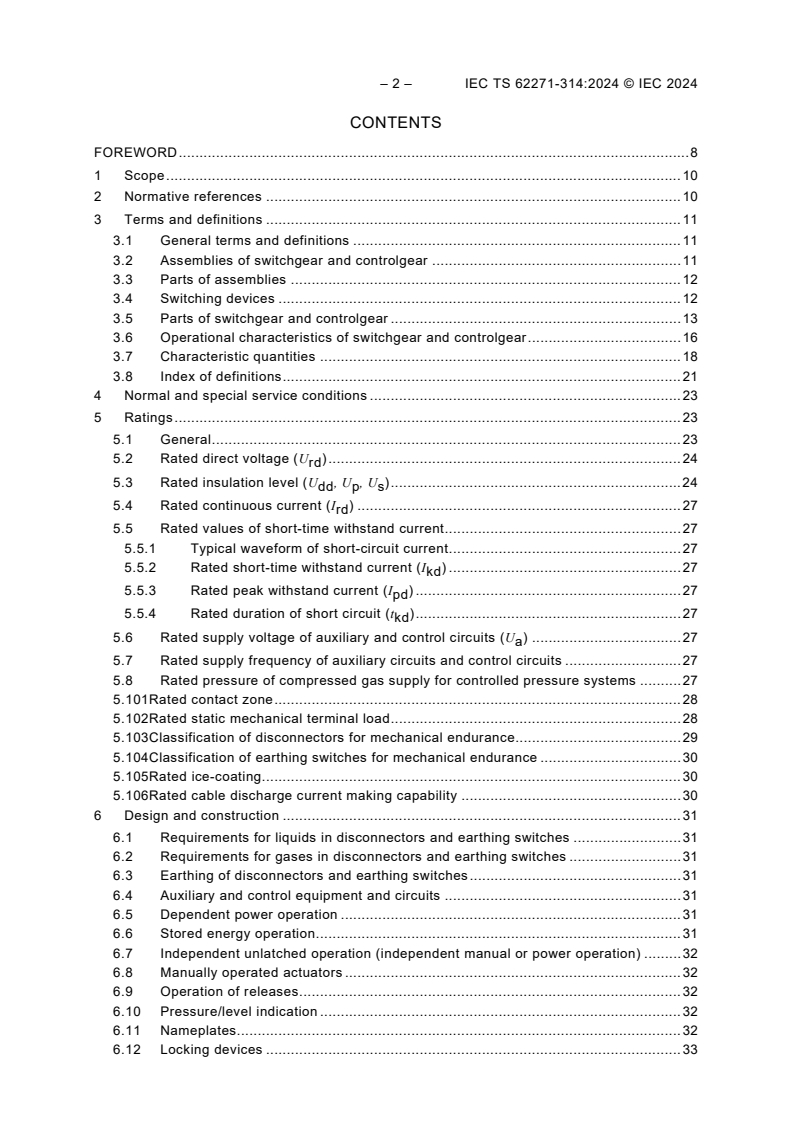
CONTENTS
FOREWORD . 8
1 Scope . 10
2 Normative references . 10
3 Terms and definitions . 11
3.1 General terms and definitions . 11
3.2 Assemblies of switchgear and controlgear . 11
3.3 Parts of assemblies . 12
3.4 Switching devices . 12
3.5 Parts of switchgear and controlgear . 13
3.6 Operational characteristics of switchgear and controlgear . 16
3.7 Characteristic quantities . 18
3.8 Index of definitions . 21
4 Normal and special service conditions . 23
5 Ratings . 23
5.1 General . 23
5.2 Rated direct voltage (U ) . 24
rd
5.3 Rated insulation level (U , U , U ) . 24
dd p s
5.4 Rated continuous current (I ) . 27
rd
5.5 Rated values of short-time withstand current . 27
5.5.1 Typical waveform of short-circuit current . 27
5.5.2 Rated short-time withstand current (I ) . 27
kd
5.5.3 Rated peak withstand current (I ) . 27
pd
5.5.4 Rated duration of short circuit (t ) . 27
kd
5.6 Rated supply voltage of auxiliary and control circuits (U ) . 27
a
5.7 Rated supply frequency of auxiliary circuits and control circuits . 27
5.8 Rated pressure of compressed gas supply for controlled pressure systems . 27
5.101Rated contact zone . 28
5.102Rated static mechanical terminal load . 28
5.103Classification of disconnectors for mechanical endurance. 29
5.104Classification of earthing switches for mechanical endurance . 30
5.105Rated ice-coating. 30
5.106Rated cable discharge current making capability . 30
6 Design and construction . 31
6.1 Requirements for liquids in disconnectors and earthing switches . 31
6.2 Requirements for gases in disconnectors and earthing switches . 31
6.3 Earthing of disconnectors and earthing switches . 31
6.4 Auxiliary and control equipment and circuits . 31
6.5 Dependent power operation . 31
6.6 Stored energy operation . 31
6.7 Independent unlatched operation (independent manual or power operation) . 32
6.8 Manually operated actuators . 32
6.9 Operation of releases . 32
6.10 Pressure/level indication . 32
6.11 Nameplates. 32
6.12 Locking devices . 33
6.13 Position Indication . 34
6.14 Degree of protection provided by enclosures . 34
6.15 Creepage distances for outdoor insulators . 34
6.16 Gas and vacuum tightness . 34
6.17 Tightness for liquid systems . 34
6.18 Fire hazard (flammability) . 34
6.19 Electromagnetic compatibility (EMC) . 34
6.20 X-ray emission . 34
6.21 Corrosion . 34
6.22 Filling levels for insulation, switching and/or operation . 34
6.101Particular requirements for earthing switches . 35
6.102Requirements in respect of the isolating distance of disconnectors . 35
6.103Mechanical strength . 35
6.104 Operation of disconnectors and earthing switches – Position of the movable
contact system and its indicating and signalling devices . 35
6.104.1Securing of position . 35
6.104.2Additional requirements for power-operated mechanisms . 35
6.104.3Indication and signalling of position . 36
6.104.3.1General requirements . 36
6.104.3.2Indication of position . 37
6.104.3.3Signalling of position by auxiliary contacts . 37
6.105Maximum force required for manual (dependent or independent) operation . 37
6.105.1General . 37
6.105.2Operation requiring more than one revolution . 37
6.105.3Operation requiring up to one revolution . 37
6.106Dimensional tolerances. 37
6.107Earthing switches with short-circuit making current capability . 38
7 Type tests . 38
7.1 General . 38
7.1.1 Basics . 38
7.1.2 Information for identification of test objects . 39
7.1.3 Information to be included in type test reports . 39
7.2 Dielectric tests . 40
7.2.1 General . 40
7.2.2 Ambient air conditions during tests . 40
7.2.3 Wet test procedure . 40
7.2.4 Arrangement of the equipment . 40
7.2.5 Criteria to pass the test . 40
7.2.6 Application of the test voltage and test conditions . 40
7.2.7 Test of disconnectors and earthing switches . 41
7.2.8 Artificial pollution tests for outdoor insulators . 41
7.2.9 Partial discharge tests . 41
7.2.10 Dielectric tests on auxiliary and control circuits . 42
7.2.11 Voltage test as condition check . 42
7.3 Resistance measurement . 42
7.4 Continuous current tests . 42
7.5 Short-time withstand current and peak withstand current tests . 42
7.5.1 General . 42
– 4 – IEC TS 62271-314:2024 © IEC 2024
7.5.2 Arrangement of the disconnectors and earthing switches and of the test
circuit . 42
7.5.3 Test current and duration . 48
7.5.4 Conditions of disconnectors and earthing switches after test . 48
7.6 Verification of the protection . 48
7.7 Tightness tests . 48
7.8 Electromagnetic compatibility tests (EMC) . 48
7.9 Additional tests on auxiliary and control circuits . 49
7.10 X-ray radiation test for vacuum interrupters. 49
7.101Capacitive current making test – Cable discharging test . 49
7.101.1General . 49
7.101.2Classification of earthing switches with cable discharging current making
capability . 49
7.101.3Discharging making tests . 49
7.101.3.1Arrangement of the earthing switch for tests . 49
7.101.3.2Earthing of the test circuit . 50
7.101.3.3Test procedure . 50
7.101.3.4Test duty 1 (without current limiting resistor) . 50
7.101.3.4.1General. 50
7.101.3.4.2Alternative test method for test-duty 1 . 50
7.101.3.4.3Test frequency test duty 1 . 50
7.101.3.4.4Test current test duty 1 . 51
7.101.3.4.5Test voltage test duty 1 . 51
7.101.3.4.6Tests at reduced voltage test duty 1 . 51
7.101.3.4.7Test circuits test duty 1 . 51
7.101.3.5Test duty 2 (with current limiting resistor) . 53
7.101.3.5.1General. 53
7.101.3.5.2Alternative test method for test duty 2 . 53
7.101.3.5.3Test frequency test duty 2 . 54
7.101.3.5.4Test current test duty 2 . 54
7.101.3.5.5Test voltage test duty 2 . 54
7.101.3.5.6Tests at reduced voltage at test duty 2. 54
7.101.3.5.7Test circuits test duty 2 . 54
7.101.4Behaviour of the earthing switch during tests . 55
7.101.5Condition of earthing switch after tests . 56
7.101.6Test reports . 56
7.102Operating and mechanical endurance tests . 56
7.102.1General test conditions . 56
7.102.2Contact zone test . 57
7.102.3Mechanical endurance test . 59
7.102.3.1Test procedure . 59
7.102.3.2Verification of successful operation . 60
7.102.4Operation during the application of rated static mechanical terminal loads . 61
7.102.5Extended mechanical endurance tests . 61
7.102.6Testing of mechanical interlocking devices . 62
7.103Operation under severe ice conditions . 62
7.103.1General . 62
7.103.2Test arrangement . 63
7.103.3Test procedure . 63
7.103.3.1Checks before the formation of ice coating . 63
7.103.3.2Formation of ice coating . 63
7.103.3.3Checks after the formation of ice coating . 64
7.104Low- and high-temperature tests . 65
7.104.1General . 65
7.104.2Measurement of ambient air temperature . 65
7.104.3Low-temperature test . 65
7.104.4High-temperature test . 67
7.105Tests to verify the proper functioning of the position-indicating device . 68
7.105.1General . 68
7.105.2Tests on the power kinematic chain and the position-indicating kinematic
chain . 69
8 Routine tests . 69
8.1 General . 69
8.2 Dielectric test on the main circuit . 70
8.3 Tests on auxiliary and control circuits . 70
8.4 Measurement of the resistance of the main circuit . 70
8.5 Tightness test . 70
8.6 Design and visual checks . 70
8.101Mechanical operating tests . 70
8.102Verification of earthing function . 71
9 Guide to the selection of disconnectors and earthing switches (informative) . 71
9.1 General . 71
9.2 Selection of rated values . 71
9.2.101General . 72
9.2.102Selection of rated voltage and preferred rated insulation level . 72
9.2.103Selection of rated continuous current . 72
9.2.104Selection of rated contact zone . 72
9.2.105Selection of rated static mechanical terminal load . 72
9.2.106Selection of rated short-time withstand current and of rated duration of
short-circuit . 73
9.2.107Selection of rated peak withstand current . 73
9.3 Cable-interface considerations . 73
9.4 Continuous or temporary overload due to changed service conditions . 73
9.5 Environmental aspects . 73
9.5.101Local environmental conditions . 73
10 Information to be given with enquiries, tenders and orders . 74
10.1 General . 74
10.2 Information with enquiries and orders . 74
10.3 Information with tenders . 75
11 Transport, storage, installation, operating instructions, and maintenance . 76
11.1 General . 76
11.2 Conditions during transport, storage and installation . 76
11.3 Installation . 76
11.4 Operating instruction . 76
11.5 Maintenance . 76
12 Safety . 77
12.1 General . 77
12.2 Precautions by manufacturers . 77
– 6 – IEC TS 62271-314:2024 © IEC 2024
12.3 Precautions by users . 77
13 Influence of the product on the environment . 77
Annex A (normative) Identification of test objects . 78
Annex B (informative) Induced current switching tests on earthing switches. 79
Annex C (normative) Tolerances on test quantities for type tests . 80
Annex D (informative) Cable discharging test . 81
D.1 General . 81
D.2 Surge impedance . 82
D.3 Cable capacity of single-core cable with radial electrical field . 82
D.4 Cable inductance of single-core cable . 82
D.5 Time constant of high-voltage cables . 84
D.6 Example and formulas according to Table D.3 . 84
Annex E (informative) Extension of validity of type tests . 86
E.1 General . 86
E.2 Dielectric tests . 87
E.3 Short-time withstand current tests . 87
E.4 Operating and mechanical endurance tests . 87
E.4.1 General . 87
E.4.2 Operation under severe ice condition test . 88
E.4.3 Low and high temperature test . 88
E.5 Cable charging / Discharging current making test . 88
Annex F (informative) Example of location of neutral bus disconnector for one pole in
an HVDC substation . 89
Bibliography . 91
Figure 1 – Position indicating/signalling device(s) . 36
Figure 2 – Examples of test arrangement from a) to g) of different type of
disconnectors (horizontal and vertical) with and without earthing switch combined. 46
Figure 3 – Typical test circuit of oscillating RLC discharge . 52
Figure 4 – Example of damped oscillating discharge of 525 kV XLPE cable of 300 km
length, cross-section 2 000 mm and with a residual voltage of U = 100 kV . 52
res
Figure 5 – Alternative test circuit of test duty 1 . 53
Figure 6 – Typical test circuit with damped RLC discharging oscillation (aperiodic) . 55
Figure 7 – Example of discharging impulse (damped discharging oscillation, aperiodic)
of 525 kV XLPE cable of 300 km length at system voltage by using a discharge
resistor of 5 kΩ . 55
Figure 8 – Fixed contact parallel to support . 57
Figure 9 – Fixed contact perpendicular to support . 58
Figure 10 – Example of the application of rated static mechanical terminal loads to a
(divided support) pantograph disconnector (or earthing switch) . 58
Figure 11 – Example of the application of rated static mechanical terminal loads to a
two-column disconnector . 59
Figure 12 – Test sequences for low and high temperature tests . 66
Figure D.1 – Oscillation with parameters of 525 kV XLPE cable . 85
Figure D.2 – Oscillation with parameters of 525 kV XLPE cable and residual voltage
values . 85
Figure F.1 – Location of (NBD) neutral bus disconnector . 89
Table 1 – Multiterminal – Preferred rated insulation levels . 24
Table 2 – Two-terminal – Preferred rated insulation levels . 26
Table 3 – Preferred contact zones for "fixed" contacts supported by flexible conductors
– outdoor installation . 28
Table 4 – Preferred contact zones for "fixed" contacts supported by rigid conductors
outdoor installation . 28
Table 5 – Preferred static mechanical terminal loads –outdoor. 29
Table 6 – Classification of disconnectors for mechanical endurance . 29
Table 7 – Classification of earthing switches for mechanical endurance . 30
Table 8 – Discharge classes based on energy amounts related to test duty 1 . 30
Table 9 – Discharge classes based on energy amounts related to test duty 2 . 30
Table 10 – Product information . 32
Table 11 – List of type tests . 38
Table 12 – Test voltages . 41
Table C.1 – Tolerances on test quantities for type tests . 80
Table D.1 – Common values of electrical characteristics of HV single-core copper
cables (type XLPE) . 81
Table D.2 – Common values of electrical characteristics of HV overhead lines . 82
Table D.3 – Calculations regarding energy classification relating to test duty 1 (direct
cable discharge) of earthing switches cable type: XLPE . 83
Table E.1 – List of type tests valid according to IEC 62271-102 . 86
Table F.1 – Neutral bus disconnector – Preferred rated insulation levels for rated
voltages . 90
– 8 – IEC TS 62271-314:2024 © IEC 2024
INTERNATIONAL ELECTROTECHNICAL COMMISSION
____________
HIGH-VOLTAGE SWITCHGEAR AND CONTROLGEAR –
Part 314: Direct current disconnectors and earthing switches
FOREWORD
1) The International Electrotechnical Commission (IEC) is a worldwide organization for standardization comprising
all national electrotechnical committees (IEC National Committees). The object of IEC is to promote international
co-operation on all questions concerning standardization in the electrical and electronic fields. To this end and
in addition to other activities, IEC publishes International Standards, Technical Specifications, Technical Reports,
Publicly Available Specifications (PAS) and Guides (hereafter referred to as "IEC Publication(s)"). Their
preparation is entrusted to technical committees; any IEC National Committee interested in the subject dealt with
may participate in this preparatory work. International, governmental and non-governmental organizations liaising
with the IEC also participate in this preparation. IEC collaborates closely with the International Organization for
Standardization (ISO) in accordance with conditions determined by agreement between the two organizations.
2) The formal decisions or agreements of IEC on technical matters express, as nearly as possible, an international
consensus of opinion on the relevant subjects since each technical committee has representation from all
interested IEC National Committees.
3) IEC Publications have the form of recommendations for international use and are accepted by IEC National
Committees in that sense. While all reasonable efforts are made to ensure that the technical content of IEC
Publications is accurate, IEC cannot be held responsible for the way in which they are used or for any
misinterpretation by any end user.
4) In order to promote international uniformity, IEC National Committees undertake to apply IEC Publications
transparently to the maximum extent possible in their national and regional publications. Any divergence between
any IEC Publication and the corresponding national or regional publication shall be clearly indicated in the latter.
5) IEC itself does not provide any attestation of conformity. Independent certification bodies provide conformity
assessment services and, in some areas, access to IEC marks of conformity. IEC is not responsible for any
services carried out by independent certification bodies.
6) All users should ensure that they have the latest edition of this publication.
7) No liability shall attach to IEC or its directors, employees, servants or agents including individual experts and
members of its technical committees and IEC National Committees for any personal injury, property damage or
other damage of any nature whatsoever, whether direct or indirect, or for costs (including legal fees) and
expenses arising out of the publication, use of, or reliance upon, this IEC Publication or any other IEC
Publications.
8) Attention is drawn to the Normative references cited in this publication. Use of the referenced publications is
indispensable for the correct application of this publication.
9) IEC draws attention to the possibility that the implementation of this document may involve the use of (a)
patent(s). IEC takes no position concerning the evidence, validity or applicability of any claimed patent rights in
respect thereof. As of the date of publication of this document, IEC had not received notice of (a) patent(s), which
may be required to implement this document. However, implementers are cautioned that this may not represent
the latest information, which may be obtained from the patent database available at https://patents.iec.ch or
www.iso.org/patents. IEC shall not be held responsible for identifying any or all such patent rights.
IEC TS 62271-314 has been prepared by subcommittee 17A: Switching devices, of IEC
technical committee 17: High-voltage switchgear and controlgear. It is a Technical Specification.
The text of this Technical Specification is based on the following documents:
Draft Report on voting
17A/1377/DTS 17A/1388B/RVDTS
Full information on the voting for its approval can be found in the report on voting indicated in
the above table.
The language used for the development of this Technical Specification is English.
This document was drafted in accordance with ISO/IEC Directives, Part 2, and developed in
accordance with ISO/IEC Directives, Part 1 and ISO/IEC Directives, IEC Supplement, available
at www.iec.ch/members_experts/refdocs. The main document types developed by IEC are
described in greater detail at www.iec.ch/publications.
This document is to be read in conjunction with IEC TS 62271-5:2024, to which it refers and
which is applicable unless otherwise specified in this document. In order to simplify the
indication of corresponding requirements, the same numbering of clauses and subclauses is
used as in IEC TS 62271-5. Modifications to these clauses and subclauses are given under the
same references whilst additional subclauses are numbered from 101.
A list of all parts of IEC 62271 series, under the general title High-voltage switchgear and
controlgear can be found on the IEC website.
The committee has decided that the contents of this document will remain unchanged until the
stability date indicated on the IEC website under webstore.iec.ch in the data related to the
specific document. At this date, the document will be
• reconfirmed,
• withdrawn, or
• revised.
IMPORTANT – The "colour inside" logo on the cover page of this document indicates
that it contains colours which are considered to be useful for the correct understanding
of its contents. Users should therefore print this document using a colour printer.
– 10 – IEC TS 62271-314:2024 © IEC 2024
HIGH-VOLTAGE SWITCHGEAR AND CONTROLGEAR –
Part 314: Direct current disconnectors and earthing switches
1 Scope
This part of IEC 62271, which is a Technical Specification, applies to high-voltage direct current
disconnectors and earthing switches, designed for indoor and outdoor installations and for
operation on HVDC transmission systems having direct voltages of 100 kV and above.
It also applies to the operating devices of these disconnectors and earthing switches and their
auxiliary equipment.
NOTE Disconnectors in which the fuse forms an integral part are not covered by this document.
2 Normative references
The following documents are referred to in the text in such a way that some or all of their content
constitutes requirements of this document. For dated references, only the edition cited applies.
For undated references, the latest edition of the referenced document (including any
amendments) applies.
IEC 60050-151, International Electrotechnical Vocabulary (IEV) – Part 151: Electrical and
magnetic devices
IEC 60050-441, International Electrotechnical Vocabulary (IEV) – Part 441: Switchgear,
controlgear and fuses
IEC 60050-471, International Electrotechnical Vocabulary (IEV) – Part 471: Insulators
IEC 60050-614, International Electrotechnical Vocabulary (IEV) – Part 614: Generation,
transmission and distribution of electricity – Operation
IEC 60071-11:2022, Insulation co-ordination – Part 11: Definitions, principles and rules for
HVDC system
IEC 60529:1989, Degrees of protection provided by enclosures (IP Code)
IEC 60529:1989/AMD1:1999
IEC 60529:1989/AMD2:2013
IEC 62262:2002, Degrees of protection provided by enclosures for electrical equipment against
external mechanical impacts (IK code)
IEC 62271-1:2017, High-voltage switchgear and controlgear – Part 1: Common specifications
for alternating current switchgear and controlgear
IEC 62271-1:2017/AMD1:2021
IEC TS 62271-5:2024, High-voltage switchgear and controlgear – Part 5: Common
specifications for direct current switchgear and controlgear
IEC 62271-200:2021, High-voltage switchgear and controlgear – Part 200: AC metal-enclosed
switchgear and controlgear for rated voltages above 1 kV and up to and including 52 kV
IEC 62271-201:2014, High-voltage switchgear and controlgear – Part 201: AC solid-insulation
enclosed switchgear and controlgear for rated voltages above 1 kV and up to and including
52 kV
IEC 62271-203:2022, High-voltage switchgear and controlgear – Part 203: AC gas-insulated
metal-enclosed switchgear for rated voltages above 52 kV
3 Terms and definitions
For the purposes of this document, the terms and definitions given in IEC 60050-151,
IEC 60050-441, IEC 60050-471, IEC 60050-614, and IEC TS 62271-5, as well as the following,
apply.
ISO and IEC maintain terminology databases for use in standardization at the following
addresses:
• IEC Electropedia: available at https://www.electropedia.org/
• ISO Online browsing platform: available at https://www.iso.org/obp
3.1 General terms and definitions
3.1.101
indoor switchgear and controlgear
switchgear and controlgear designed solely for installation within a building or other housing,
where the switchgear and controlgear is protected against wind, rain, snow, abnormal dirt
deposits, abnormal condensation, ice and hoar frost
[SOURCE: IEC 60050-441:2000, 441-11-04]
3.1.102
outdoor switchgear and controlgear
switchgear and controlgear suitable for installation in the open air, i.e. capable of withstanding
wind, rain, snow, dirt deposits, condensation, ice and hoar frost
[SOURCE: IEC 60050-441:2000, 441-11-05]
3.1.103
user
person or legal entity using the disconnectors or earthing switches
Note 1 to entry: This can include the purchaser (for example an electricity supplier), but it can also include the
contracting company, the staff responsible for erection of installation, the maintenance or operating staff or anybody
else temporarily or permanently responsible for the disconnector, earthing switch or electrical installation, or even
the operation of the switchgear.
3.2 Assemblies of switchgear and controlgear
3.2.101
test object
equipment needed to represent the switchgear and controlgear for a particular type test
[SOURCE: IEC 62271-1:2017, 3.2.1]
– 12 – IEC TS 62271-314:2024 © IEC 2024
3.3 Parts of assemblies
3.3.101
transport unit
part of switchgear and controlgear intended for transportation without being dismantled
[SOURCE: IEC 62271-1:2017, 3.3.1]
3.3.102
busbar
low-impedance conductor to which several elect
...
Questions, Comments and Discussion
Ask us and Technical Secretary will try to provide an answer. You can facilitate discussion about the standard in here.
Loading comments...