

IEC TS 63042-202:2021
(Main)UHV AC transmission systems - Part 202: UHV AC transmission line design
General Information
- Abstract
IEC TS 63042-202:2021(E) provides common rules for the design of overhead transmission lines with the highest voltages of AC transmission systems exceeding 800 kV, so as to provide safety and proper functioning for the intended use.
This technical specification aims to give the main principles for the design of UHV AC overhead transmission lines, mainly including selection of clearance, insulation coordination and insulator strings design, bundle-conductor selection, earth wire/optical ground wires selection, tower and foundation design, environmental consideration. The design criteria apply to new construction, reconstruction and expansion of UHV AC overhead transmission line.
- Status
- Published
- Publication Date
- 12-Oct-2021
- Technical Committee
- TC 122 - UHV AC transmission systems
- Drafting Committee
- WG 2 - TC 122/WG 2
- Current Stage
- PPUB - Publication issued
- Start Date
- 13-Oct-2021
- Completion Date
- 09-Nov-2021
Overview
IEC TS 63042-202:2021 - "UHV AC transmission systems – Part 202: UHV AC transmission line design" - provides common rules and main design principles for overhead AC transmission lines with highest voltages exceeding 800 kV. This IEC technical specification addresses electrical safety, reliable operation and practical engineering requirements for new construction, reconstruction and expansion of UHV AC overhead transmission lines. It consolidates guidance on clearances, insulation coordination, conductor and earth‑wire selection, tower and foundation design, and environmental performance.
Key topics and requirements
The technical specification covers core design areas engineers need for UHV AC overhead lines:
- Selection of clearances: air gaps, tower strike distances, phase‑to‑phase and ground clearances considering power‑frequency, switching and lightning overvoltages.
- Insulation coordination & insulator design: dielectric requirements, insulating materials, insulator string configurations and mechanical design of fittings.
- Bundle‑conductor selection: conductor types, number and spacing of sub‑conductors, ampacity, electromagnetic environment considerations, and mechanical strength.
- Earth wire / OPGW selection: choice of ground wire or optical ground wire, induced voltage considerations and UHV‑specific design criteria.
- Tower and foundation design: tower classification, geometry selection based on clearances, load calculations, design methodology, analysis tools and foundation types (shallow, raft, deep/pile).
- Environmental considerations: prediction and mitigation of electric and magnetic fields (EMF), corona and audible noise, radio‑interference, wind noise and landscape impacts.
- Reliability, safety and economy: general requirements to balance performance, safety limits and cost‑effective design solutions.
Annexes provide informative country‑level design practices and experimental results (examples from China, India, Japan) to inform real‑world implementation and environmental performance.
Practical applications and users
IEC TS 63042-202:2021 is intended for:
- Transmission system planners and design engineers working on UHV AC overhead lines
- Utility engineering teams upgrading or expanding extra‑high voltage networks
- Tower, conductor, insulator and OPGW manufacturers and suppliers
- Consultants performing insulation coordination, EMF/corona assessments and environmental impact studies
- Regulators and project owners developing technical specifications and procurement documents
Use cases include preparing design specifications, evaluating conductor/tower options, conducting insulation coordination studies, and assessing environmental mitigation measures for UHV projects.
Related standards
- Refer to other parts of the IEC TS 63042 series and applicable IEC/ISO standards for material tests, electromagnetic compatibility, and safety limits. Check the IEC webstore for the latest normative references and updates to ensure compliance.
Get Certified
Connect with accredited certification bodies for this standard

IMQ S.p.A. (Certification)
Italian electrical product certification.

SLG Prüf- und Zertifizierungs GmbH
German testing and certification body.

UL Solutions
Global safety science company with testing, inspection and certification.
Sponsored listings
Frequently Asked Questions
IEC TS 63042-202:2021 is a technical specification published by the International Electrotechnical Commission (IEC). Its full title is "UHV AC transmission systems - Part 202: UHV AC transmission line design". This standard covers: IEC TS 63042-202:2021(E) provides common rules for the design of overhead transmission lines with the highest voltages of AC transmission systems exceeding 800 kV, so as to provide safety and proper functioning for the intended use. This technical specification aims to give the main principles for the design of UHV AC overhead transmission lines, mainly including selection of clearance, insulation coordination and insulator strings design, bundle-conductor selection, earth wire/optical ground wires selection, tower and foundation design, environmental consideration. The design criteria apply to new construction, reconstruction and expansion of UHV AC overhead transmission line.
IEC TS 63042-202:2021(E) provides common rules for the design of overhead transmission lines with the highest voltages of AC transmission systems exceeding 800 kV, so as to provide safety and proper functioning for the intended use. This technical specification aims to give the main principles for the design of UHV AC overhead transmission lines, mainly including selection of clearance, insulation coordination and insulator strings design, bundle-conductor selection, earth wire/optical ground wires selection, tower and foundation design, environmental consideration. The design criteria apply to new construction, reconstruction and expansion of UHV AC overhead transmission line.
IEC TS 63042-202:2021 is classified under the following ICS (International Classification for Standards) categories: 29.240.20 - Power transmission and distribution lines. The ICS classification helps identify the subject area and facilitates finding related standards.
IEC TS 63042-202:2021 is available in PDF format for immediate download after purchase. The document can be added to your cart and obtained through the secure checkout process. Digital delivery ensures instant access to the complete standard document.
Standards Content (Sample)
IEC TS 63042-202 ®
Edition 1.0 2021-10
TECHNICAL
SPECIFICATION
colour
inside
UHV AC transmission systems –
Part 202: UHV AC Transmission line design
All rights reserved. Unless otherwise specified, no part of this publication may be reproduced or utilized in any form
or by any means, electronic or mechanical, including photocopying and microfilm, without permission in writing from
either IEC or IEC's member National Committee in the country of the requester. If you have any questions about IEC
copyright or have an enquiry about obtaining additional rights to this publication, please contact the address below or
your local IEC member National Committee for further information.
IEC Central Office Tel.: +41 22 919 02 11
3, rue de Varembé info@iec.ch
CH-1211 Geneva 20 www.iec.ch
Switzerland
About the IEC
The International Electrotechnical Commission (IEC) is the leading global organization that prepares and publishes
International Standards for all electrical, electronic and related technologies.
About IEC publications
The technical content of IEC publications is kept under constant review by the IEC. Please make sure that you have the
latest edition, a corrigendum or an amendment might have been published.
IEC publications search - webstore.iec.ch/advsearchform IEC online collection - oc.iec.ch
The advanced search enables to find IEC publications by a Discover our powerful search engine and read freely all the
variety of criteria (reference number, text, technical publications previews. With a subscription you will always
committee, …). It also gives information on projects, replaced have access to up to date content tailored to your needs.
and withdrawn publications.
Electropedia - www.electropedia.org
IEC Just Published - webstore.iec.ch/justpublished
The world's leading online dictionary on electrotechnology,
Stay up to date on all new IEC publications. Just Published
containing more than 22 000 terminological entries in English
details all new publications released. Available online and
and French, with equivalent terms in 18 additional languages.
once a month by email.
Also known as the International Electrotechnical Vocabulary
(IEV) online.
IEC Customer Service Centre - webstore.iec.ch/csc
If you wish to give us your feedback on this publication or
need further assistance, please contact the Customer Service
Centre: sales@iec.ch.
IEC TS 63042-202 ®
Edition 1.0 2021-10
TECHNICAL
SPECIFICATION
colour
inside
UHV AC transmission systems –
Part 202: UHV AC Transmission line design
INTERNATIONAL
ELECTROTECHNICAL
COMMISSION
ICS 29.240.20 ISBN 978-2-8322-1035-7
– 2 – IEC TS 63042-202:2021 © IEC 2021
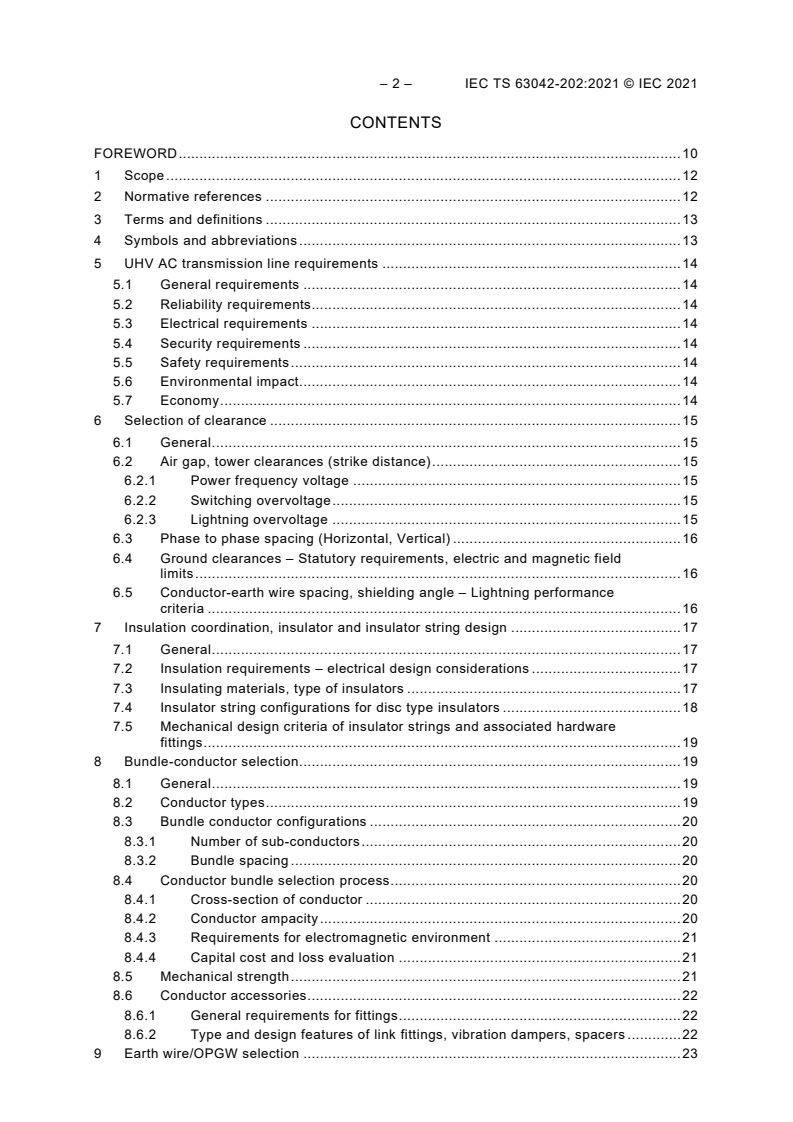
CONTENTS
FOREWORD . 10
1 Scope . 12
2 Normative references . 12
3 Terms and definitions . 13
4 Symbols and abbreviations . 13
5 UHV AC transmission line requirements . 14
5.1 General requirements . 14
5.2 Reliability requirements. 14
5.3 Electrical requirements . 14
5.4 Security requirements . 14
5.5 Safety requirements . 14
5.6 Environmental impact. 14
5.7 Economy . 14
6 Selection of clearance . 15
6.1 General . 15
6.2 Air gap, tower clearances (strike distance) . 15
6.2.1 Power frequency voltage . 15
6.2.2 Switching overvoltage . 15
6.2.3 Lightning overvoltage . 15
6.3 Phase to phase spacing (Horizontal, Vertical) . 16
6.4 Ground clearances – Statutory requirements, electric and magnetic field
limits . 16
6.5 Conductor-earth wire spacing, shielding angle – Lightning performance
criteria . 16
7 Insulation coordination, insulator and insulator string design . 17
7.1 General . 17
7.2 Insulation requirements – electrical design considerations . 17
7.3 Insulating materials, type of insulators . 17
7.4 Insulator string configurations for disc type insulators . 18
7.5 Mechanical design criteria of insulator strings and associated hardware
fittings . 19
8 Bundle-conductor selection . 19
8.1 General . 19
8.2 Conductor types . 19
8.3 Bundle conductor configurations . 20
8.3.1 Number of sub-conductors . 20
8.3.2 Bundle spacing . 20
8.4 Conductor bundle selection process . 20
8.4.1 Cross-section of conductor . 20
8.4.2 Conductor ampacity . 20
8.4.3 Requirements for electromagnetic environment . 21
8.4.4 Capital cost and loss evaluation . 21
8.5 Mechanical strength . 21
8.6 Conductor accessories . 22
8.6.1 General requirements for fittings . 22
8.6.2 Type and design features of link fittings, vibration dampers, spacers . 22
9 Earth wire/OPGW selection . 23
9.1 General . 23
9.2 Type of earth wire/OPGW . 23
9.3 Design Criteria/Requirements Specific to UHV Lines. 23
9.4 Induced voltages on earth wire . 23
10 Tower and foundation design . 24
10.1 General . 24
10.2 Tower classification . 24
10.2.1 General . 24
10.2.2 Conductor configuration . 24
10.2.3 Constructional features . 29
10.2.4 Line deviation angle . 29
10.2.5 Tower extensions . 30
10.2.6 Specific requirements . 30
10.3 Tower design . 30
10.3.1 General . 30
10.3.2 Selection of tower geometry based on electrical clearances . 30
10.3.3 Calculation of loads on tower . 31
10.3.4 Analysis using software . 31
10.3.5 Full scale tower testing . 32
10.3.6 Tower design methodology . 32
10.4 Foundation design . 33
10.4.1 General . 33
10.4.2 Open cast type foundations . 34
10.4.3 Raft type foundations . 34
10.4.4 Deep foundations (Pile/Well/Pier/Steel Anchor type) . 35
11 Environmental considerations . 35
11.1 General . 35
11.2 Electric field . 35
11.2.1 General . 35
11.2.2 Reference level of electric field . 35
11.2.3 Prediction of electric field . 36
11.2.4 Mitigation measures of electric field . 36
11.3 Magnetic field . 36
11.3.1 General . 36
11.3.2 Reference level of magnetic field . 36
11.3.3 Prediction of magnetic field . 36
11.3.4 Mitigation measures of magnetic field . 37
11.4 Corona noise (audible noise with corona discharge) . 37
11.4.1 General . 37
11.4.2 Characteristics of corona noise . 37
11.4.3 Reference level of corona noise . 37
11.4.4 Prediction of corona noise . 38
11.4.5 Mitigation measures of corona noise . 38
11.5 Radio interference with corona discharge . 38
11.5.1 General . 38
11.5.2 Characteristics of radio interference . 38
11.5.3 Reference level of radio interference . 39
11.5.4 Prediction of radio interference . 39
11.5.5 Mitigation measures of radio interference . 39
– 4 – IEC TS 63042-202:2021 © IEC 2021
11.6 Wind noise . 39
Annex A (informative) Experimental results and considerations on environmental
performance of UHV AC transmission lines in different countries . 40
A.1 General . 40
A.2 Experimental results and considerations on environmental performance of
UHV AC transmission lines in China . 40
A.2.1 Radio interference . 40
A.2.2 Audible noise . 40
A.2.3 Electric field . 41
A.3 Experimental results and considerations on environmental performance of
UHV AC transmission lines in India . 41
A.3.1 Electrical Clearances from buildings, structures, etc. . 41
A.3.2 Electric field . 41
A.3.3 Radio interference . 41
A.3.4 Audible noise . 41
A.4 Experimental results and considerations on environmental performance of
UHV AC transmission lines in Japan . 42
A.4.1 General . 42
A.4.2 AN (audible noise) . 42
A.4.3 RI (Radio Interference) . 43
A.4.4 EMF (Electromagnetic field) . 43
A.4.5 Electromagnetic induction interference, Electrostatic induction
interference . 45
A.4.6 Wind noise from conductor . 45
A.4.7 Ice and snow falling from conductor . 46
A.4.8 Landscape impact . 47
A.4.9 Nature conservation. 48
Annex B (informative) Design practice of UHV AC transmission lines in different
countries . 50
B.1 General . 50
B.2 Design practice in China . 50
B.2.1 General . 50
B.2.2 Conductor and earth wire . 50
B.2.3 Electrical clearances . 52
B.2.4 Insulation coordination . 53
B.2.5 Tower and foundation . 56
B.3 Design practice in India. 58
B.3.1 General . 58
B.3.2 Challenges in development and solutions . 58
B.3.3 Conductor selection . 58
B.3.4 Electrical clearances . 60
B.3.5 Insulation requirements . 61
B.3.6 1 200 kV test line . 62
B.3.7 400 kV double circuit (upgradable to 1 200 kV single circuit) line . 63
B.4 Design practice in Japan . 65
B.4.1 General . 65
B.4.2 Conductor and earth wire . 66
B.4.3 Insulation coordination . 67
B.4.4 Wind noise . 70
B.4.5 Tower and foundation . 71
Annex C (informative) Construction practice of UHV AC transmission lines in different
countries . 74
C.1 General . 74
C.2 Construction practice in China . 74
C.3 Construction practice in India . 75
C.4 Construction practice in Japan . 75
Annex D (informative) Flashover voltage test result for air clearances in different
countries . 77
D.1 General . 77
D.2 Flashover voltage test result for air clearances in China . 77
D.2.1 50 % Power frequency flashover voltage test results for air clearances
of transmission line structures . 77
D.2.2 50 % Switching impulse flashover voltage test results for air clearances
of transmission line structures . 80
D.2.3 50 % Lightning impulse flashover voltage test results for air clearances
of transmission line structures . 89
D.2.4 Effects of switching overvoltage time to peak on flashover voltage . 92
D.2.5 Tower width correction approaches for air clearances of transmission
line structures . 93
D.3 Flashover voltage test result for air clearances in India . 95
D.4 Flashover voltage test result for air clearances in Japan . 95
D.4.1 50 % Power frequency flashover voltage test results of transmission line
structures . 95
D.4.2 50 % Switching impulse flashover voltage test results for air clearances
of transmission line structures . 96
D.4.3 50 % lightning impulse flashover voltage test results for air clearances
of transmission line structures . 100
Annex E (informative) Restrictions on electromagnetic environment of UHV AC
transmission lines in different countries . 102
E.1 General . 102
E.2 Restrictions in China . 102
E.3 Restrictions in India . 102
E.4 Restrictions in Japan . 103
E.4.1 General . 103
E.4.2 RI (Radio Interference) . 103
E.4.3 AN (Audible Noise) . 103
E.4.4 Electric field . 103
E.4.5 Magnetic field . 104
E.4.6 Communication failure due to electromagnetic induction or electrostatic
induction . 104
E.4.7 Overvoltage due to electromagnetic induction . 104
Annex F (informative) Anti-vibration measures for conductors and earth wires in
different countries . 105
F.1 General . 105
F.2 Anti-vibration measures in China . 105
F.3 Anti-vibration measures in India . 106
F.4 Anti-vibration measures in Japan . 106
F.4.1 Conductor . 106
F.4.2 Earth wire . 106
Annex G (informative) Earth wire regulations in different countries . 108
G.1 General . 108
– 6 – IEC TS 63042-202:2021 © IEC 2021
G.2 Earth wires regulations in China . 108
G.3 Earth wires regulations in India . 108
G.4 Earth wires regulations in Japan . 108
Bibliography . 110
Figure 1 – Typical single circuit vertical configuration tower . 25
Figure 2 – Typical double circuit vertical configuration tower . 25
Figure 3 – Typical single circuit horizontal configuration tower . 26
Figure 4 – Typical single circuit delta configuration tower . 26
Figure 5 – Typical single circuit H-type tower . 27
Figure 6 – Typical double circuit danube configuration tower . 27
Figure 7 – 1 200 kV single circuit vertical configuration tower . 28
Figure 8 – 1 200 kV single circuit horizontal configuration tower . 28
Figure 9 – 1 200 kV double circuit vertical Configuration tower . 28
Figure 10 – 1 200 kV single circuit H-type tower (for gantry) . 29
Figure 11 – Tower design methodology . 33
Figure A.1 – Results of sensing tests under transmission lines . 44
Figure A.2 – Symbols related to wind noise prediction formula . 46
Figure B.1 – Composite insulator profiles . 53
Figure B.2 – 1 200 kV insulator profile . 55
Figure B.3 – 1 200 kV air-gap experimental tests . 60
Figure B.4 – 1 200 kV single circuit test line . 62
Figure B.5 – 1 200 kV double circuit test line . 63
Figure B.6 – 1 200 kV upgradable line –Suspension tower . 64
Figure B.7 – 1 200 kV upgradable line –Tension tower . 64
Figure B.8 – 1 200 kV Tower Prototype Testing . 65
Figure B.9 – UHV AC transmission lines in Japan . 66
Figure B.10 – Shape of conductor . 67
Figure B.11 – Shape of OPGW . 67
Figure B.12 – Foundation type . 73
Figure C.1 – Machinery for foundation construction . 74
Figure D.1 – The arrangement of power frequency flashover voltage test for side-
phase air clearances of 1 000 kV cat-head type towers . 77
Figure D.2 – The 50 % power frequency flashover voltage characteristic for air
clearance from side-phase conductor to tower body for 1 000 kV cat-head type towers. 77
Figure D.3 – The arrangement of power frequency flashover voltage test for side-
phase air clearances of 1 000 kV cup type towers . 78
Figure D.4 – The 50 % power frequency flashover voltage characteristic for air
clearance from side-phase conductor to tower body for 1 000 kV cup type towers 1 000
kV cup type towers . 78
Figure D.5 – The arrangement of power frequency flashover voltage test for air
clearances of 1 000 kV double-circuit lines . 79
Figure D.6 – The 50 % power frequency flashover voltage characteristic for air
clearance from middle-phase conductor with I-type string to tower body for 1 000 kV
double-circuit lines . 79
Figure D.7 – The arrangement of the power frequency flashover voltage test for air
clearances of bottom-phase with I-type string of 1 000 kV double-circuit lines. 80
Figure D.8 – The power frequency flashover voltage characteristic of air clearance
from bottom-phase conductor (with I-type string) to tower body of 1 000 kV double-
circuit lines . 80
Figure D.9 – The arrangement of switching impulse flashover voltage test for side-
phase air clearances of 1 000 kV cat-head type towers . 81
Figure D.10 – The 50 % switching impulse flashover voltage characteristic for air
clearances from conductor to tower body of 1 000 kV lines (with a time to peak of 250
µs) . 81
Figure D.11 – The arrangement of switching impulse flashover voltage test for middle-
phase air clearances of 1 000 kV cat-head type towers . 82
Figure D.12 – The arrangement of switching impulse flashover voltage test for side-
phase air clearances of 1 000 kV cup type towers . 82
Figure D.13 – The 50 % switching impulse flashover voltage characteristic for air
clearances from conductor to tower body of 1 000 kV lines (with a time to peak of
250 µs) . 83
Figure D.14 – The arrangement of switching impulse flashover voltage test for middle-
phase air clearances of 1 000 kV cup type towers . 83
Figure D.15 – The arrangement of switching impulse flashover voltage test at long
time to peak for middle-phase air clearances (with I-type string) of 1 000 kV double-
circuit lines . 84
Figure D.16 – The 50 % switching impulse (1 000 μs) flashover voltage characteristic
for air clearances from conductor to bottom crossarm of 1 000 kV double-circuit lines
(a distance of 9,0 m between conductor and middle crossarm) . 84
Figure D.17 – The arrangement of switching impulse flashover voltage test for air
clearances from middle-phase conductor (with V-type string) to bottom crossarm of
1 000 kV double-circuit lines . 85
Figure D.18 – The 50 % switching impulse (1 000 μs) flashover voltage characteristic
of air clearances from conductor to bottom crossarm of 1 000 kV double-circuit lines . 85
Figure D.19 – The arrangement of switching impulse flashover test for air clearances
from middle-phase conductor (with V-type string) to tower body of 1 000 kV double-
circuit lines . 86
Figure D.20 – The 50 % switching impulse (1 000 μs) flashover voltage characteristic
for air clearances from conductor to tower body of 1 000 kV double-circuit lines . 86
Figure D.21 – The arrangement of switching impulse flashover voltage test for air
clearances from middle-phase conductor (with V-type string) to middle crossarm of
1 000 kV double-circuit lines . 87
Figure D.22 – The 50 % switching impulse (1 000 μs) flashover voltage characteristic
for air clearances from conductor to middle crossarm of 1 000 kV double-circuit lines . 87
Figure D.23 – The arrangement of switching impulse flashover voltage test for air
clearances from bottom-phase conductor (with V-type string) to crossarm of 1 000 kV
double-circuit lines . 88
Figure D.24 – The 50 % switching impulse (1 000 μs) flashover voltage characteristic
for air clearances from conductor to crossarm of 1 000 kV double-circuit lines . 88
Figure D.25 – The arrangement of switching impulse flashover voltage test for air
clearances from bottom-phase conductor (with V-type string) to tower body of 1 000 kV
double-circuit lines . 89
Figure D.26 – The 50 % switching impulse (1 000 μs) flashover voltage characteristic
for air clearances from conductor to tower body of 1 000 kV double-circuit lines . 89
Figure D.27 – The 50 % lightning impulse flashover voltage characteristic for air
clearances from side-phase conductor to tower body of 1 000 kV single-circuit lines . 90
– 8 – IEC TS 63042-202:2021 © IEC 2021
Figure D.28 – The arrangement of lightning impulse flashover voltage test for air
clearances from middle-phase conductor (with I-type string) to bottom crossarm of
1 000 kV double-circuit lines . 90
Figure D.29 – The 50 % lightning impulse flashover voltage characteristic for air
clearances from conductor to lower crossarm of 1 000 kV double-circuit lines . 91
Figure D.30 – The arrangement of lightning impulse flashover voltage test for air
clearances from middle-phase conductor (with V-type string) to bottom crossarm of
1 000 kV double-circuit lines . 91
Figure D.31 – The 50 % positive and negative lightning impulse flashover voltage
characteristic for air clearances from conductor to lower crossarm of 1 000 kV double-
circuit lines . 92
Figure D.32 – Curve of the 50 % switching impulse flashover voltage as a function of
the time to peak for the air clearance from conductor to tower leg of 5 m . 92
Figure D.33 – Tower-width voltage correction factor . 94
Figure D.34 – Tower-width spacing correction factor . 94
Figure D.35 – Effects of tower leg width on switching impulse flashover voltage (with a
time to peak of 720 μs) . 95
Figure D.36 – The 50 % power frequency flashover voltage characteristic for air
clearance for 1 000 kV . 96
Figure D.37 – The arrangement of switching impulse flashover voltage test for air
clearances of 1 000 kV tension type towers . 97
Figure D.38 – The 50 % switching impulse flashover voltage characteristic for air
clearances of 1 000 kV tension type towers . 98
Figure D.39 – The arrangement of switching impulse flashover voltage test for air
clearances of 1 000 kV suspension I type towers . 98
Figure D.40 – The 50 % switching impulse flashover voltage characteristic for air
clearances from conductor to tower body of 1 000 kV suspension I type towers . 99
Figure D.41 – The arrangement of switching impulse flashover voltage test for air
clearances of 1 000 kV suspension V type towers . 99
Figure D.42 – The 50 % switching impulse flashover voltage characteristic for air
clearances of 1 000 kV suspension V type towers . 100
Figure D.43 – The 50 % Lightning impulse flashover voltage characteristic for air
clearance for 1 000 kV . 101
Figure F.1 – Resonance frequency type vibration damper . 105
Figure F.2 – Shape of distributed damper . 107
Table A.1 – Design limits for radio interference in China . 40
Table A.2 – Criteria for environmental noises in the five categories of areas in cities
(dB (A)) . 40
Table A.3 – Reference level of electric field and ground height of conductor . 44
Table B.1 – Conductor type selection . 50
Table B.2 – Conductor characteristics . 51
Table B.3 – Coefficient k . 52
i
Table B.4 – Recommended configuration of tension insulator string in light and medium
ice zone . 54
Table B.5 – Recommended configuration of tension insulator string in substation outlet
span . 54
Table B.6 – Recommended value of single circuit line air gap . 55
Table B.7 – Recommended value of double circuit line air gap . 55
Table B.8 – Conductor capacity . 59
Table B.9 – Conductor surface gradient . 59
Table B.10 – Conductor radio interference . 59
Table B.11 – Conductor audible noise . 59
Table B.12 – Conductor electric field . 60
Table B.13 – Salient results of the experimental tests . 61
Table B.14 – Salient features of the 1 200 kV test lines . 63
Table B.15 – Salient features of 1 200 kV upgraded transmission line . 65
Table B.16 – UHV AC transmission lines in Japan . 66
Table B.17 – Conductor configuration and AN . 66
Table B.18 – Specifications of insulator . 68
Table B.19 – Withstand voltage of single insulator in pollution [kV/unit] . 68
Table B.20 – Withstand voltage of single insulator under snow [kV/unit] . 68
Table B.21 – Altitude correction factor K . 69
Table B.22 – Loads for tower design . 72
Table D.1 – Switching impulse flashover voltages of side-phase air clearances of 1 000
kV cat-head type towers with different test time to peak . 81
Table D.2 – The switching impulse flashover voltage of air clearances from middle-
phase conductor to tower for 1 000 kV full-scale towers . 82
Table D.3 – The switching impulse flashover voltage for air clearance from the middle-
phase conductor to tower window in the arrangement shown in Figure D.14 a) and
Figure D.14 b) . 83
Table D.4 – Altitude correction factor K . 96
Table D.5 – Gap coefficient k . 96
Table D.6 – Altitude correction factor K . 97
Table D.7 – Gap coefficient k . 100
Table E.1 – Radio interference.
...