


IEC TR 62681:2022
(Main)Electromagnetic performance of high voltage direct current (HVDC) overhead transmission lines
General Information
- Abstract
IEC TR 62681:2022 provides general guidance on the electromagnetic environment issues of HVDC overhead transmission lines. It concerns the major parameters adopted to describe the electromagnetic properties of an HVDC overhead transmission line, including electric fields, ion current, magnetic fields, radio interference, and audible noise generated as a consequence of such effects. If the evaluation method and/or criteria of electromagnetic properties are not yet regulated, engineers in different countries can refer to this document to:
- support/guide the electromagnetic design of HVDC overhead transmission lines,
- limit the influence on the environment within acceptable ranges, and
- optimize engineering costs.
- Status
- Published
- Publication Date
- 24-May-2022
- Technical Committee
- TC 115 - High Voltage Direct Current (HVDC) transmission for DC voltages above 100 kV
- Drafting Committee
- WG 3 - TC 115/WG 3
- Current Stage
- PPUB - Publication issued
- Start Date
- 25-May-2022
- Completion Date
- 09-Jun-2022
Buy Documents
IEC TR 62681:2022 - Electromagnetic performance of high voltage direct current (HVDC) overhead transmission lines Released:5/25/2022
IEC TR 62681:2022 RLV - Electromagnetic performance of high voltage direct current (HVDC) overhead transmission lines Released:5/25/2022
Overview
IEC TR 62681:2022 - Electromagnetic performance of HVDC overhead transmission lines is a Technical Report that provides general guidance on the electromagnetic environment of high voltage direct current (HVDC) overhead transmission lines. It describes the major parameters used to characterize electromagnetic properties - electric fields, ion current, magnetic fields, radio interference (RI), and audible noise (AN) - and consolidates calculation methods, measurement practice and experimental results to support design and environmental assessment.
Key topics and technical content
- Scope and intent
- Guidance where evaluation methods or criteria are not yet nationally regulated; intended to support electromagnetic design, limit environmental impact, and help optimize engineering costs.
- Physical phenomena
- Descriptions of corona, space charge, static electric fields and ion currents, magnetic field distributions, RI generation mechanisms and audible-noise origins.
- Calculation methods
- Multiple modelling approaches are covered, including semi-analytic methods, finite element methods, BPA method, and empirical approaches (e.g., EPRI, IREQ, CISPR prediction formulas for RI).
- Measurement and experimental data
- Instrumentation, measurement methods and extensive experimental results (annexes) for real HVDC lines (Bonneville, FURNAS, Manitoba Hydro, Hydro-Québec, and others).
- Environmental and human implications
- Discussion of effects of electric fields, space charge and audible noise on people and nature, and national design practices and criteria.
- Audible noise & radio interference
- Lateral profiles, statistical distributions, propagation and empirical/semi-empirical prediction formulas, and national limit examples.
Practical applications and users
This TR is practical for:
- Transmission system designers and HVDC engineers - to select conductor configuration, pole spacing and insulator design considering electromagnetic emissions.
- Utilities and project planners - to assess environmental compliance, public exposure and risk of complaints related to audible noise and radio interference.
- Regulators and environmental assessors - to adopt reference methods and interpret measurement data where local criteria are absent.
- Consultants and researchers - for comparison of calculation methods, modelling best practices and benchmarking against experimental datasets.
Practical uses include electromagnetic design optimization, environmental impact assessment, measurement program development, and cost trade-off analysis between mitigation measures and line configuration.
Related standards and references
- Empirical and prediction methods referenced include EPRI, IREQ, and CISPR formulas for RI. The report complements national regulations and other IEC publications by providing a consolidated technical basis for electromagnetic performance assessment of HVDC overhead lines.
Keywords: IEC TR 62681:2022, HVDC, electromagnetic performance, electric field, ion current, magnetic field, radio interference, audible noise, overhead transmission lines.
Relations
- Effective Date
- 05-Sep-2023
Buy Documents
IEC TR 62681:2022 - Electromagnetic performance of high voltage direct current (HVDC) overhead transmission lines Released:5/25/2022
IEC TR 62681:2022 RLV - Electromagnetic performance of high voltage direct current (HVDC) overhead transmission lines Released:5/25/2022
Get Certified
Connect with accredited certification bodies for this standard

IMQ S.p.A. (Certification)
Italian electrical product certification.

SLG Prüf- und Zertifizierungs GmbH
German testing and certification body.

UL Solutions
Global safety science company with testing, inspection and certification.
Sponsored listings
Frequently Asked Questions
IEC TR 62681:2022 is a technical report published by the International Electrotechnical Commission (IEC). Its full title is "Electromagnetic performance of high voltage direct current (HVDC) overhead transmission lines". This standard covers: IEC TR 62681:2022 provides general guidance on the electromagnetic environment issues of HVDC overhead transmission lines. It concerns the major parameters adopted to describe the electromagnetic properties of an HVDC overhead transmission line, including electric fields, ion current, magnetic fields, radio interference, and audible noise generated as a consequence of such effects. If the evaluation method and/or criteria of electromagnetic properties are not yet regulated, engineers in different countries can refer to this document to: - support/guide the electromagnetic design of HVDC overhead transmission lines, - limit the influence on the environment within acceptable ranges, and - optimize engineering costs.
IEC TR 62681:2022 provides general guidance on the electromagnetic environment issues of HVDC overhead transmission lines. It concerns the major parameters adopted to describe the electromagnetic properties of an HVDC overhead transmission line, including electric fields, ion current, magnetic fields, radio interference, and audible noise generated as a consequence of such effects. If the evaluation method and/or criteria of electromagnetic properties are not yet regulated, engineers in different countries can refer to this document to: - support/guide the electromagnetic design of HVDC overhead transmission lines, - limit the influence on the environment within acceptable ranges, and - optimize engineering costs.
IEC TR 62681:2022 is classified under the following ICS (International Classification for Standards) categories: 29.240.20 - Power transmission and distribution lines. The ICS classification helps identify the subject area and facilitates finding related standards.
IEC TR 62681:2022 has the following relationships with other standards: It is inter standard links to IEC TR 62681:2014. Understanding these relationships helps ensure you are using the most current and applicable version of the standard.
IEC TR 62681:2022 is available in PDF format for immediate download after purchase. The document can be added to your cart and obtained through the secure checkout process. Digital delivery ensures instant access to the complete standard document.
Standards Content (Sample)
IEC TR 62681 ®
Edition 2.0 2022-05
TECHNICAL
REPORT
colour
inside
Electromagnetic performance of high voltage direct current (HVDC) overhead
transmission lines
All rights reserved. Unless otherwise specified, no part of this publication may be reproduced or utilized in any form
or by any means, electronic or mechanical, including photocopying and microfilm, without permission in writing from
either IEC or IEC's member National Committee in the country of the requester. If you have any questions about IEC
copyright or have an enquiry about obtaining additional rights to this publication, please contact the address below or
your local IEC member National Committee for further information.
IEC Secretariat Tel.: +41 22 919 02 11
3, rue de Varembé info@iec.ch
CH-1211 Geneva 20 www.iec.ch
Switzerland
About the IEC
The International Electrotechnical Commission (IEC) is the leading global organization that prepares and publishes
International Standards for all electrical, electronic and related technologies.
About IEC publications
The technical content of IEC publications is kept under constant review by the IEC. Please make sure that you have the
latest edition, a corrigendum or an amendment might have been published.
IEC publications search - webstore.iec.ch/advsearchform IEC Products & Services Portal - products.iec.ch
The advanced search enables to find IEC publications by a Discover our powerful search engine and read freely all the
variety of criteria (reference number, text, technical publications previews. With a subscription you will always
committee, …). It also gives information on projects, replaced have access to up to date content tailored to your needs.
and withdrawn publications.
Electropedia - www.electropedia.org
IEC Just Published - webstore.iec.ch/justpublished
The world's leading online dictionary on electrotechnology,
Stay up to date on all new IEC publications. Just Published
containing more than 22 300 terminological entries in English
details all new publications released. Available online and
and French, with equivalent terms in 19 additional languages.
once a month by email.
Also known as the International Electrotechnical Vocabulary
(IEV) online.
IEC Customer Service Centre - webstore.iec.ch/csc
If you wish to give us your feedback on this publication or
need further assistance, please contact the Customer Service
Centre: sales@iec.ch.
IEC TR 62681 ®
Edition 2.0 2022-05
TECHNICAL
REPORT
colour
inside
Electromagnetic performance of high voltage direct current (HVDC) overhead
transmission lines
INTERNATIONAL
ELECTROTECHNICAL
COMMISSION
ICS 29.240.20 ISBN 978-2-8322-3130-2
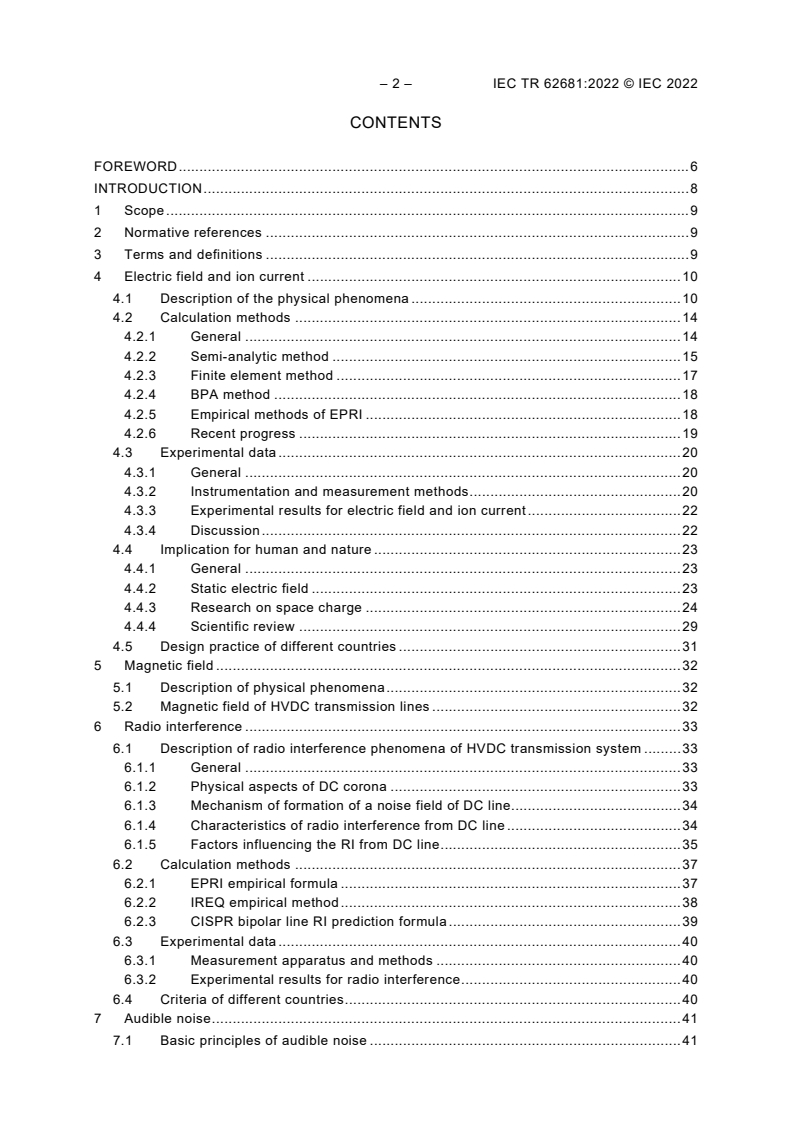
– 2 – IEC TR 62681:2022 © IEC 2022
CONTENTS
FOREWORD . 6
INTRODUCTION . 8
1 Scope . 9
2 Normative references . 9
3 Terms and definitions . 9
4 Electric field and ion current . 10
4.1 Description of the physical phenomena . 10
4.2 Calculation methods . 14
4.2.1 General . 14
4.2.2 Semi-analytic method . 15
4.2.3 Finite element method . 17
4.2.4 BPA method . 18
4.2.5 Empirical methods of EPRI . 18
4.2.6 Recent progress . 19
4.3 Experimental data . 20
4.3.1 General . 20
4.3.2 Instrumentation and measurement methods . 20
4.3.3 Experimental results for electric field and ion current . 22
4.3.4 Discussion . 22
4.4 Implication for human and nature . 23
4.4.1 General . 23
4.4.2 Static electric field . 23
4.4.3 Research on space charge . 24
4.4.4 Scientific review . 29
4.5 Design practice of different countries . 31
5 Magnetic field . 32
5.1 Description of physical phenomena . 32
5.2 Magnetic field of HVDC transmission lines . 32
6 Radio interference . 33
6.1 Description of radio interference phenomena of HVDC transmission system . 33
6.1.1 General . 33
6.1.2 Physical aspects of DC corona . 33
6.1.3 Mechanism of formation of a noise field of DC line. 34
6.1.4 Characteristics of radio interference from DC line . 34
6.1.5 Factors influencing the RI from DC line . 35
6.2 Calculation methods . 37
6.2.1 EPRI empirical formula . 37
6.2.2 IREQ empirical method . 38
6.2.3 CISPR bipolar line RI prediction formula . 39
6.3 Experimental data . 40
6.3.1 Measurement apparatus and methods . 40
6.3.2 Experimental results for radio interference . 40
6.4 Criteria of different countries . 40
7 Audible noise . 41
7.1 Basic principles of audible noise . 41
7.2 Description of physical phenomena . 43
7.2.1 General . 43
7.2.2 Lateral profiles . 44
7.2.3 Statistical distribution . 47
7.2.4 Influencing factors . 48
7.2.5 Effect of altitude above sea level . 50
7.2.6 Concluding remarks . 50
7.3 Calculation methods . 50
7.3.1 General . 50
7.3.2 Theoretical analysis of audible noise propagation . 50
7.3.3 Empirical formulas of audible noise . 51
7.3.4 Semi-empirical formulas of audible noise . 52
7.3.5 Concluding remarks . 55
7.4 Experimental data . 55
7.4.1 Measurement techniques and instrumentation . 55
7.4.2 Experimental results for audible noise . 55
7.5 Design practice of different countries . 56
7.5.1 General . 56
7.5.2 The effect of audible noise on people . 56
7.5.3 The audible noise level and induced complaints . 56
7.5.4 Limit values of audible noise of HVDC transmission lines in different
countries . 60
7.5.5 General national noise limits . 60
Annex A (informative) Experimental results for electric field and ion current. 62
A.1 Bonneville Power Administration ±500 kV HVDC transmission line . 62
A.2 FURNAS ±600 kV HVDC transmission line . 62
A.3 Manitoba Hydro ±450 kV HVDC transmission line . 63
A.4 Hydro-Québec – New England ±450 kV HVDC transmission line . 65
A.5 IREQ test line study of ±450 kV HVDC line configuration . 66
A.6 HVTRC test line study of ±400 kV HVDC line configuration . 67
A.7 Test study in China . 68
Annex B (informative) Experimental results for radio interference . 71
B.1 Bonneville power administration’s 1 100 kV direct current test project . 71
B.1.1 General . 71
B.1.2 Lateral profile . 71
B.1.3 Influence of conductor gradient . 72
B.1.4 Percent cumulative distribution . 73
B.1.5 Influence of wind . 75
B.1.6 Spectrum . 75
B.2 Hydro-Québec institute of research . 77
B.2.1 General . 77
B.2.2 Cumulative distribution . 77
B.2.3 Spectrum . 78
B.2.4 Lateral profiles . 78
B.3 DC lines of China . 79
Annex C (informative) Experimental results for audible noise . 82
Bibliography . 86
– 4 – IEC TR 62681:2022 © IEC 2022
Figure 1 – Monopolar and bipolar space charge regions of an HVDC transmission line [1] . 11
Figure 2 – Lateral profile of magnetic field on the ground of ±800 kV HVDC lines . 33
Figure 3 – The corona current I and radio interference magnetic field H . 34
Figure 4 – RI tolerance tests: reception quality as a function of signal-to-noise ratio . 41
Figure 5 – Attenuation of different weighting networks used in audible-noise
measurements [16] . 42
Figure 6 – Comparison of typical audible noise frequency spectra [131] . 44
Figure 7 – Lateral profiles of the AN . 45
Figure 8 – Lateral profiles of the AN from a bipolar HVDC-line equipped with
8 × 4,6 cm (8 × 1,8 in) conductor bundles energized with ±1 050 kV [133] . 45
Figure 9 – Lateral profiles of fair-weather A-weighted sound level [131] . 46
Figure 10 – All weather distribution of AN and RI at +15 m lateral distance of the
positive pole from the upgraded Pacific NW/SW HVDC Intertie [34] . 47
Figure 11 – Statistical distributions of fair weather A-weighted sound level measured at
27 m lateral distance from the line center during spring 1980 . 48
Figure 12 – Audible noise complaint guidelines [14] in USA . 57
Figure 13 – Measured lateral profile of audible noise on a 330 kV AC transmission line
[151] . 57
Figure 14 – Subjective evaluation of DC transmission line audible noise; EPRI test
center study 1974 [14] . 58
Figure 15 – Subjective evaluation of DC transmission line audible noise; OSU study
1975 [14] . 58
Figure 16 – Results of the operators’ subjective evaluation of AN from HVDC lines . 59
Figure 17 – Results of subjective evaluation of AN from DC lines . 59
Figure A.1 – Electric field and ion current distributions for Manitoba Hydro ±450 kV
Line [39] . 64
Figure A.2 – Cumulative distribution of electric field for Manitoba Hydro ±450 kV Line [39] . 64
Figure A.3 – Cumulative distribution of ion current density for Manitoba Hydro ±450 kV
line [39] . 65
Figure A.4 – Test result for total electric field at different humidity [119] . 69
Figure A.5 – Comparison between the calculation result and test result for the total
electric field (minimum conductor height is 18 m) [119] . 70
Figure B.1 – Connection for 3-section DC test line [123] . 71
Figure B.2 – Typical RI lateral profile at ±600 kV, 4 × 30,5 mm conductor, 11,2 m pole
spacing, 15,2 m average height [14] . 72
Figure B.3 – Simultaneous RI lateral, midspan, in clear weather and light wind for three
configurations, bipolar ±400 kV [123] . 72
Figure B.4 – RI at 0,834 MHz as a function of bipolar line voltage 4 × 30,5 mm
conductor, 11,2 m pole spacing, 15,2 m average height . 73
Figure B.5 – Percent cumulative distribution for fair weather, 2 × 46 mm, 18,3 m pole
spacing, ±600 kV . 73
Figure B.6 – Percent cumulative distribution for rainy weather, 2 × 46 mm, 18,3 m pole
spacing, ±600 kV . 74
Figure B.7 – Percent cumulative distribution for fair weather, 4 × 30,5 mm, 13,2 m pole
spacing, ±600 kV . 74
Figure B.8 – Percent cumulative distribution for rainy weather, 4 × 30,5 mm, 13,2 m
pole spacing, ±600 kV . 75
Figure B.9 – Radio interference frequency spectrum . 76
Figure B.10 – RI vs. frequency at ±400 kV [123] . 76
Figure B.11 – Cumulative distribution of RI measured at 15 m from the positive pole [124] . 77
Figure B.12 – Conducted RI frequency spectrum measured with the line terminated at
one end [124] . 78
Figure B.13 – Lateral profile of RI [124] . 79
Figure B.14 – Comparison between calculation result and test result for RI lateral
profile [119] . 80
Figure B.15 – The curve with altitude of the RI on positive reduced-scale test lines . 81
Figure C.1 – Examples of statistical distributions of fair weather audible noise. dB(A)
measured at 27 m from line center of a bipolar HVDC test line [16] . 83
Figure C.2 – AN under the positive polar test lines varying with altitude . 85
Table 1 – Electric field and ion current limits of ±800 kV DC lines in China . 31
Table 2 – Electric field limits of DC lines in United States of America [121] . 31
Table 3 – Electric field and ion current limits of DC lines in Canada . 31
Table 4 – Electric field limits of DC lines in Brazil . 31
Table 5 – Parameters of the IREQ excitation function (Monopolar) [122] . 39
Table 6 – Parameters of the IREQ excitation function (Bipolar) [122] . 39
Table 7 – Parameters defining regression equation for generated acoustic power
density [8] . 54
Table 8 – Typical sound attenuation (in decibels) provided by buildings [157] . 61
Table A.1 – BPA ±500 kV line: statistical summary of all-weather ground-level electric
field intensity and ion current density [34] . 62
Table A.2 – FURNAS ±600 kV line: statistical summary of ground-level electric field
intensity and ion current density [38] . 63
Table A.3 – Hydro-Québec–New England ±450 kV HVDC transmission line. Bath, NH;
1990-1992 (fair weather), 1992 (rain), All-season measurements of static electric E-field
in kV/m [41] . 66
Table A.4 – Hydro-Québec – New England ±450 kV HVDC Transmission Line. Bath,
NH; 1990-1992, All-season fair-weather measurements of ion concentrations in
kions/cm [41] . 66
Table A.5 – IREQ ±450 kV test line: statistical summary of ground-level electric field
intensity and ion current density [43] . 67
Table A.6 – HVTRC ±400 kV test line: statistical summary of peak electric field and ion
currents [44] . 68
Table A.7 – Statistical results for the test data of total electric field at ground (50 %
value) [119] . 69
Table B.1 – Influence of wind on RI . 75
Table B.2 – Statistical representation of the long term RI performance of the tested
conductor bundle [124] . 78
Table B.3 – RI at 0,5 MHz at lateral 20 m from positive pole (fair weather) . 79
Table B.4 – The parameters of test lines . 80
Table B.5 – Measured results of 0,5 MHz RI for the full-scale test lines at different
altitudes . 81
Table C.1 – Audible Noise Levels of HVDC Lines according to [121] and [152] . 84
Table C.2 – Test results of 50 % AN statistics for full-scale test lines . 85
– 6 – IEC TR 62681:2022 © IEC 2022
INTERNATIONAL ELECTROTECHNICAL COMMISSION
____________
ELECTROMAGNETIC PERFORMANCE OF HIGH VOLTAGE DIRECT
CURRENT (HVDC) OVERHEAD TRANSMISSION LINES
FOREWORD
1) The International Electrotechnical Commission (IEC) is a worldwide organization for standardization comprising
all national electrotechnical committees (IEC National Committees). The object of IEC is to promote international
co-operation on all questions concerning standardization in the electrical and electronic fields. To this end and
in addition to other activities, IEC publishes International Standards, Technical Specifications, Technical Reports,
Publicly Available Specifications (PAS) and Guides (hereafter referred to as “IEC Publication(s)”). Their
preparation is entrusted to technical committees; any IEC National Committee interested in the subject dealt with
may participate in this preparatory work. International, governmental and non-governmental organizations liaising
with the IEC also participate in this preparation. IEC collaborates closely with the International Organization for
Standardization (ISO) in accordance with conditions determined by agreement between the two organizations.
2) The formal decisions or agreements of IEC on technical matters express, as nearly as possible, an international
consensus of opinion on the relevant subjects since each technical committee has representation from all
interested IEC National Committees.
3) IEC Publications have the form of recommendations for international use and are accepted by IEC National
Committees in that sense. While all reasonable efforts are made to ensure that the technical content of IEC
Publications is accurate, IEC cannot be held responsible for the way in which they are used or for any
misinterpretation by any end user.
4) In order to promote international uniformity, IEC National Committees undertake to apply IEC Publications
transparently to the maximum extent possible in their national and regional publications. Any divergence between
any IEC Publication and the corresponding national or regional publication shall be clearly indicated in the latter.
5) IEC itself does not provide any attestation of conformity. Independent certification bodies provide conformity
assessment services and, in some areas, access to IEC marks of conformity. IEC is not responsible for any
services carried out by independent certification bodies.
6) All users should ensure that they have the latest edition of this publication.
7) No liability shall attach to IEC or its directors, employees, servants or agents including individual experts and
members of its technical committees and IEC National Committees for any personal injury, property damage or
other damage of any nature whatsoever, whether direct or indirect, or for costs (including legal fees) and
expenses arising out of the publication, use of, or reliance upon, this IEC Publication or any other IEC
Publications.
8) Attention is drawn to the Normative references cited in this publication. Use of the referenced publications is
indispensable for the correct application of this publication.
9) Attention is drawn to the possibility that some of the elements of this IEC Publication may be the subject of patent
rights. IEC shall not be held responsible for identifying any or all such patent rights.
IEC TR 62681 has been prepared by IEC technical committee 115: High Voltage Direct Current
(HVDC) transmission for DC voltages above 100 kV. It is a Technical Report.
This second edition cancels and replaces the first edition, published in 2014. This edition
constitutes a technical revision.
This edition includes the following significant technical changes with respect to the previous
edition:
a) the limits of total electric field in some countries have been supplemented and improved;
b) the definition of 80 %/80 % criteria of radio interference has been clarified;
c) a table has been added for bipolar excitation which shows the parameters of the IREQ radio
interference excitation function;
d) the clause of CEPRI research results of audible noise has been deleted;
e) the clause of main conclusion of audible noise has been deleted.
The text of this Technical Report is based on the following documents:
Draft Report on voting
115/289/DTR 115/292/RVDTR
Full information on the voting for its approval can be found in the report on voting indicated in
the above table.
The language used for the development of this Technical Report is English.
This document was drafted in accordance with ISO/IEC Directives, Part 2, and developed in
accordance with ISO/IEC Directives, Part 1 and ISO/IEC Directives, IEC Supplement, available
at www.iec.ch/members_experts/refdocs. The main document types developed by IEC are
described in greater detail at www.iec.ch/publications.
The committee has decided that the contents of this document will remain unchanged until the
stability date indicated on the IEC website under webstore.iec.ch in the data related to the
specific document. At this date, the document will be
• reconfirmed,
• withdrawn,
• replaced by a revised edition, or
• amended.
IMPORTANT – The “colour inside” logo on the cover page of this publication indicates that it
contains colours which are considered to be useful for the correct understanding of its
contents. Users should therefore print this publication using a colour printer.
– 8 – IEC TR 62681:2022 © IEC 2022
INTRODUCTION
Electric fields and magnetic fields are produced in the vicinity of a High Voltage Direct Current
(HVDC) overhead transmission line. When the electric field at the conductor surface exceeds a
critical value, known as the corona onset gradient, positive or negative free charges leave the
conductor and interact with the surrounding air and ionization takes place in the layer of
surrounding air, leading to the formation of corona discharges. The corona discharge will result
in corona loss but also change the electro-magnetic properties around the HVDC overhead
transmission lines.
The parameters used to describe the electromagnetic performance of an HVDC overhead
transmission line mainly include the:
1) electric field,
2) ion current,
3) magnetic field,
4) radio interference,
5) audible noise.
To control these parameters in a reasonable and acceptable range, for years, a great deal of
theoretical and experimental research was conducted in many countries, and relevant national
standards or enterprise standards were developed. This document collects and records the
status of study and progress of electric fields, ion current, magnetic fields, radio interference,
and audible noise of HVDC overhead transmission lines. It is recognised that general technical
discussion given in this document would be applicable for HVDC sub-stations as well; However,
since layout of a station differs very differently, expressions given for HVDC overhead
transmission line cannot be directly used as many assumptions would not hold good.
Furthermore, an HVDC sub-station is not accessible to the general public, thus the numbers
and limits given in this document are not applicable for HVDC sub-stations.
ELECTROMAGNETIC PERFORMANCE OF HIGH VOLTAGE DIRECT
CURRENT (HVDC) OVERHEAD TRANSMISSION LINES
1 Scope
This document provides general guidance on the electromagnetic environment issues of HVDC
overhead transmission lines. It concerns the major parameters adopted to describe the
electromagnetic properties of an HVDC overhead transmission line, including electric fields, ion
current, magnetic fields, radio interference, and audible noise generated as a consequence of
such effects. If the evaluation method and/or criteria of electromagnetic properties are not yet
regulated, engineers in different countries can refer to this document to:
– support/guide the electromagnetic design of HVDC overhead transmission lines,
– limit the influence on the environment within acceptable ranges, and
– optimize engineering costs.
2 Normative references
There are no normative references in this document.
3 Terms and definitions
For the purposes of this document, the following terms and definitions apply.
ISO and IEC maintain terminological databases for use in standardization at the following
addresses:
• IEC Electropedia: available at http://www.electropedia.org/
• ISO Online browsing platform: available at http://www.iso.org/obp
3.1
corona
set of partial discharges in a gas, immediately adjacent to an uninsulated or lightly insulated
conductor which creates a highly divergent field remote from other conductors
[SOURCE: IEC 60050-212:2010, 212-11-44, modified – Note 1 has been deleted.]
3.2
electric field
constituent of an electromagnetic field which is characterized by the electric field strength E
together with the electric flux density D
Note 1 to entry: In the context of HVDC transmission lines, the electric field is affected not only by the geometry of
the line and the potential of the conductor, but also by the space charge generated as a result of corona;
consequently, electric field distribution may vary non-linearly with the line potential.
[SOURCE: IEC 60050-121:1998, 121-11-67, modified – The original note has been deleted and
Note 1 to entry has been added.]
3.3
space-charge-free electric field
electric field due to a system of energized electrodes, excluding the effect of space charge
present in the inter-electrode space
– 10 – IEC TR 62681:2022 © IEC 2022
3.4
ion current
flow of electric charge resulting from the motion of ions
3.5
magnetic field
constituent of an electromagnetic field which is characterized by the magnetic field strength H
together with the magnetic flux density B
[SOURCE: IEC 60050-121:1998, 121-11-69, modified – Note 1 has been deleted.]
3.6
audible noise
unwanted sound with frequency range from 20 Hz to 20 kHz
[SOURCE: IEC 61973:2012, 3.1.14]
4 Electric field and ion current
4.1 Description of the physical phenomena
Electric fields are produced in the vicinity of an HVDC transmission line, with the highest electric
fields existing at the surface of the conductor. When the electric field at the conductor surface
exceeds a critical value, the air in the vicinity of the conductor becomes ionized, forming a
corona discharge. Ions of both polarities are formed, but ions of opposite polarity to the
conductor potential are attracted back towards the conductor, while ions of the same polarity
as the conductor are repelled away from the conductor. Space charges include air ions and
charged aerosols. Under the action of an electric field, space charge will move directionally,
and ion current will be formed. The physical phenomena of electric field and ion current are
described in this Subclause 4.1.
The electric field and ion current in the vicinity of an HVDC transmission line are defined mainly
by the operating voltage, line configuration, conductor radius and conductor surface. The
voltage applied to line conductors produces an electric field distribution. Unlike High-Voltage
Alternating Current (HVAC) transmission lines, the electric field produced by HVDC
transmission lines does not vary with time and, consequently, does not produce any significant
currents in humans or objects immersed in these fields.
The electric field is another aspect of the electrical property around an overhead HVDC
transmission line. An electric field is present around any charged conductor, irrespective of
whether corona discharge is taking place. However, the space charge created by corona
discharge under DC conditions modifies the distribution of an electric field. The effect of space
charge on electric fields is significant.
For the same HVDC transmission lines, the corona onset gradients of positive or negative
polarities are different and the intensity and characteristics of corona discharges on positive or
negative conductors are also different. Consequently, during the design of HVDC transmission
lines, special consideration needs to be paid to the allowable values of the maximum ground-
level electric field and ion current density [1] .
______________
Numbers in square brackets refer to the bibliography.
Corona on a conductor of either positive or negative polarity produces ions of either the positive
or negative polarities in a thin layer of air surrounding each conductor [1]. However, ions with
a polarity opposite to that of the conductor are drawn to it and are neutralized on contact. Thus,
a positive conductor in corona acts as a source of positive ions and vice-versa. For a monopolar
DC transmission line, ions having the same polarity as the conductor voltage fill the entire
inter-electrode space between the conductors and ground. For a bipolar DC transmission line,
the ions generated on the conductors of each polarity are subject to an electric field driven drift
motion either towards the conductor of opposite polarity or towards the ground plane, as shown
in Figure 1. The influence of wind or the formation of charged aerosols are not considered at
this stage. Three general space charge regions are created in this case:
a) a positive monopolar region between the positive conductor and ground,
b) a negative monopolar region between the negative conductor and ground,
c) a bipolar region between the positive and negative conductors.
For practical bipolar HVDC lines, most of the ions are directed toward the opposite polarity
conductor, but a significant fraction is also directed toward the ground. The ion drift velocity is
such that it will take at least a few seconds for them to reach ground. Actually, the molecules
travelling along ion paths are not always the same ions. In fact, collisions between ions and air
molecules occur during the travel at a rate of billions per second and cause charge transfer and
reactions between ions and neutral molecules, so the ions reaching the ground are quite
different from those that were originally formed by corona near the conductor surface. The exact
chemical identity of the ions, after a few seconds, will depend on the chemical composition and
trace gases at the location.
Electric field is another component of the electrical property around an overhead HVDC
transmission line. Electric field is caused by electrical charges, both those residing on
conductive surfaces (the transmission line conductors, the ground, and conducting objects) and
the space charges. The effect of space charge on electric field is significant.
A nonlinear interaction takes place between electric field and space charge distributions in all
three general space regions identified above in a), b), c). The nonlinearity arises because ions
flow from each conductor to ground or to the conductor of opposite polarity along the flux lines
of the electric field distribution: while at the same time, the electric field distribution is influenced
by the ionic space charge distribution. In addition to the nonlinear interaction described above,
the space charge field in the bipolar region is affected by other factors. Mixing of ions of both
polarities in the bipolar region leads firstly to a reduction in the net space charge density and,
secondly, to recombination and neutralization of ions of both polarities.
Figure 1 – Monopolar and bipolar space charge regions
of an HVDC transmission line [1]
– 12 – IEC TR 62681:2022 © IEC 2022
The corona-generated space charge, being of the same polarity as the conductor, produces a
screening effect on the conductor by lowering the electric field in the vicinity of the conductor
surface and consequently reducing the intensity of corona discharges occurring on the
conductor. In the monopolar regions, the space charge enhances the electric field at the ground
surface. The extent of electric field reduction at the conductor surface and field enhancement
at the ground surface depend on the conductor voltage as well as on the corona intensity at the
conductor surface. In the case of the bipolar region, however, the mixture of ions of opposite
polarity and ion recombination tend to reduce the screening effect on the conductor surface.
This leads to a smaller reduction in the intensity of corona activity near the conductors than in
the monopolar regions.
The electrical environment at ground level under a bipolar HVDC transmission line is, therefore
defined mainly by three quantities:
1) electric field, E,
2) ion current density, J,
3) space charge density, ρ.
The electric field produced by HVDC overhead transmission lines is a vector defined by its
components along three orthogonal axes. The space charge density is a scalar. The ion current
density is also a vector, and it is affected by the electric field and space charge density.
Very small currents in some cases can flow through an object or person located under the line
because of exposure to the electric field and ion space charge. From the point of view of
environmental impact on persons and objects located under the line, the main consideration is
the combined exposure to the electric fields and ion currents. The scientific literature indicates
that exposure to the levels of DC electric field and ion current density existing under operating
HVDC transmission lines poses no risk to public health, but may cause some induced current
and annoyance effects to humans.
Design of HVDC transmission lines requires the ability to predict ground-level electric field and
ion current distribution as functions of line design parameters such as the number and diameter
of sub-conductors in the bundle, height above ground of conductors and pole spacing.
Prediction methods are based on a combination of analytical techniques to calculate the space
charge fields and accurate long-term measurements under experimental as well as operating
HVDC transmission lines.
As described and illustrated in Figure 1, the ground-level electric field and ion current property
under a bipolar HVDC transmission line can be thought primarily as a monopolar space charge
field under each pole. The bipolar space charge field between the positive and negative
conductors, however, has no significant impact on the ground-level electrical property. For the
purpose of calculating the ground-level electric field and ion current distributions, therefore,
analytical treatment of the monopolar space charge field between each of the positive and
negative conductors and the ground plane is adequate.
Monopolar DC space charge fields are defined by the following equations:
ρ
∇⋅ E= (1)
ε
J=μρE (2)
∇⋅ J=0 (3)
where
E and J are the electric field and ion current density vectors at any point in space,
ρ is the space charge density,
µ is the ionic mobility,
ε is the permittivity of free space.
The first Equation (1) is Poisson's equation, the second Equation (2) defines the relationship
between the current density and electric field vectors, and the third Equation (3) is the continuity
equation for ions. Since electrons are existent in the zone very close to the conductors and
attached to air molecules forming negative ions, they are not considered. The solution of these
equations, along with appropriate boundary conditions, for the conductor-ground-plane
geometry of the HVDC transmission line, determines the ground-level electric field and ion
current distributions [1].
Corona activity on conductors and the resulting space charge field are influenced, in addition
to the line voltage and geometry, by ambient weather conditions such as temperature, pressure,
humidity, precipitation and wind velocity as well as by the presence of any aerosols and
atmospheric pollution. It is difficult, if not impossible, to take all these factors into account in
any analytical treatment of space charge fields. Information on the corona onset gra
...
IEC TR 62681 ®
Edition 2.0 2022-05
REDLINE VERSION
INTERNATIONAL
STANDARD
colour
inside
Electromagnetic performance of high voltage direct current (HVDC) overhead
transmission lines
All rights reserved. Unless otherwise specified, no part of this publication may be reproduced or utilized in any form
or by any means, electronic or mechanical, including photocopying and microfilm, without permission in writing from
either IEC or IEC's member National Committee in the country of the requester. If you have any questions about IEC
copyright or have an enquiry about obtaining additional rights to this publication, please contact the address below or
your local IEC member National Committee for further information.
IEC Secretariat Tel.: +41 22 919 02 11
3, rue de Varembé info@iec.ch
CH-1211 Geneva 20 www.iec.ch
Switzerland
About the IEC
The International Electrotechnical Commission (IEC) is the leading global organization that prepares and publishes
International Standards for all electrical, electronic and related technologies.
About IEC publications
The technical content of IEC publications is kept under constant review by the IEC. Please make sure that you have the
latest edition, a corrigendum or an amendment might have been published.
IEC publications search - webstore.iec.ch/advsearchform IEC Products & Services Portal - products.iec.ch
The advanced search enables to find IEC publications by a Discover our powerful search engine and read freely all the
variety of criteria (reference number, text, technical publications previews. With a subscription you will always
committee, …). It also gives information on projects, replaced have access to up to date content tailored to your needs.
and withdrawn publications.
Electropedia - www.electropedia.org
IEC Just Published - webstore.iec.ch/justpublished
The world's leading online dictionary on electrotechnology,
Stay up to date on all new IEC publications. Just Published
containing more than 22 300 terminological entries in English
details all new publications released. Available online and
and French, with equivalent terms in 19 additional languages.
once a month by email.
Also known as the International Electrotechnical Vocabulary
(IEV) online.
IEC Customer Service Centre - webstore.iec.ch/csc
If you wish to give us your feedback on this publication or
need further assistance, please contact the Customer Service
Centre: sales@iec.ch.
IEC TR 62681 ®
Edition 2.0 2022-05
REDLINE VERSION
INTERNATIONAL
STANDARD
colour
inside
Electromagnetic performance of high voltage direct current (HVDC) overhead
transmission lines
INTERNATIONAL
ELECTROTECHNICAL
COMMISSION
ICS 29.240.20 ISBN 978-2-8322-3163-0
– 2 – IEC TR 62681:2022 RLV © IEC 2022
CONTENTS
FOREWORD . 7
INTRODUCTION . 9
1 Scope . 10
2 Normative references . 10
3 Terms and definitions . 10
4 Electric field and ion current . 11
4.1 Description of the physical phenomena . 11
4.2 Calculation methods . 15
4.2.1 General . 15
4.2.2 Semi-analytic method . 16
4.2.3 Finite element method . 18
4.2.4 BPA method . 19
4.2.5 Empirical methods of EPRI . 19
4.2.6 Recent progress . 20
4.3 Experimental data . 21
4.3.1 General . 21
4.3.2 Instrumentation and measurement methods . 21
4.3.3 Experimental results for electric field and ion current . 23
4.3.4 Discussion . 23
4.4 Implication for human and natural environment nature . 24
4.4.1 General . 24
4.4.2 Static electric field . 24
4.4.3 Research on space charge . 25
4.4.4 Scientific review . 30
4.5 Design practice of different countries . 32
5 Magnetic field . 33
5.1 Description of physical phenomena . 33
5.2 Magnetic field of HVDC transmission lines . 33
6 Radio interference (radio noise) . 34
6.1 Description of radio interference phenomena of HVDC transmission system . 34
6.1.1 General . 34
6.1.2 Physical aspects of DC corona . 35
6.1.3 Mechanism of formation of a noise field of DC line. 35
6.1.4 Characteristics of radio interference from DC line . 36
6.1.5 Factors influencing the RI from DC line . 37
6.2 Calculation methods . 39
6.2.1 EPRI empirical formula . 39
6.2.2 IREQ empirical method . 40
6.2.3 CISPR bipolar line RI prediction formula . 42
5.2.4 Comparison of different prediction formula .
6.3 Experimental data . 42
6.3.1 Measurement apparatus and methods . 42
6.3.2 Experimental results for radio interference . 43
6.4 Criteria of different countries . 43
7 Audible noise . 44
7.1 Basic principles of audible noise . 44
7.2 Description of physical phenomena . 45
7.2.1 General . 45
7.2.2 Lateral profiles . 47
7.2.3 Statistical distribution . 50
7.2.4 Influencing factors . 51
7.2.5 Effect of altitude above sea level . 53
7.2.6 Concluding remarks . 53
7.3 Calculation methods . 53
7.3.1 General . 53
7.3.2 Theoretical analysis of audible noise propagation . 54
7.3.3 Empirical formulas of audible noise . 54
7.3.4 Semi-empirical formulas of audible noise . 55
6.3.5 CEPRI (China) research results .
7.3.5 Concluding remarks . 59
7.4 Experimental data . 59
7.4.1 Measurement techniques and instrumentation . 59
7.4.2 Experimental results for audible noise . 60
7.5 Design practice of different countries . 60
7.5.1 General . 60
7.5.2 The effect of audible noise on people . 60
7.5.3 The audible noise level and induced complaints . 60
7.5.4 Limit values of audible noise of HVDC transmission lines in different
countries . 64
7.5.5 Recommended General national noise level limits . 65
6.5.6 Main conclusion .
Annex A (informative) Experimental results for electric field and ion current. 67
A.1 Bonneville Power Administration ±500 kV HVDC transmission line . 67
A.2 FURNAS ±600 kV HVDC transmission line . 67
A.3 Manitoba Hydro ±450 kV HVDC transmission line . 68
A.4 Hydro-Québec – New England ±450 kV HVDC transmission line . 70
A.5 IREQ test line study of ±450 kV HVDC line configuration . 71
A.6 HVTRC test line study of ±400 kV HVDC line configuration . 72
A.7 Test study in China . 74
Annex B (informative) Experimental results for radio interference . 76
B.1 Bonneville power administration’s 1 100 kV direct current test project . 76
B.1.1 General . 76
B.1.2 Lateral profile . 76
B.1.3 Influence of conductor gradient . 78
B.1.4 Percent cumulative distribution . 79
B.1.5 Influence of wind . 80
B.1.6 Spectrum . 81
B.2 Hydro-Québec institute of research . 82
B.2.1 General . 82
B.2.2 Cumulative distribution . 82
B.2.3 Spectrum . 83
B.2.4 Lateral profiles . 84
B.2.5 Cumulative distribution under different voltage .
B.3 DC lines of China . 85
– 4 – IEC TR 62681:2022 RLV © IEC 2022
Annex C (informative) Experimental results for audible noise . 89
Bibliography . 93
Figure 1 – Unipolar Monopolar and bipolar space charge regions of an HVDC
transmission line [1] . 13
Figure 2 – Lateral profile of magnetic field on the ground of ±800 kV HVDC lines . 34
Figure 3 – The corona I and radio interference magnetic field H . 35
Figure 4 – RI tolerance tests: reception quality as a function of signal-to-noise ratio . 44
Figure 5 – Attenuation of different weighting networks used in audible-noise
measurements [16] . 45
Figure 6 – Comparison of typical audible noise frequency spectra [132] . 46
Figure 7 – Lateral profiles of the AN . 47
Figure 8 – Lateral profiles of the AN from a bipolar HVDC-line equipped with
8 × 4,6 cm (8 × 1,8 in) conductor bundles energized with ±1 050 kV [134] . 48
Figure 9 – Lateral profiles of fair-weather A-weighted sound level [132] . 49
Figure 10 – All weather distribution of AN and RI at +15 m lateral distance of the
positive pole from the upgraded Pacific NW/SW HVDC Intertie [34] . 50
Figure 11 – Statistical distributions of fair-weather A-weighted sound level measured at
27 m lateral distance from the line centre during spring 1980 . 51
Figure 12 – Audible noise complaint guidelines [14] in USA . 61
Figure 13 – Measured lateral profile of audible noise on a 330 kV AC transmission line
[152] . 62
Figure 14 – Subjective evaluation of DC transmission line audible noise; EPRI test
centre study 1974 [14] . 62
Figure 15 – Subjective evaluation of DC transmission line audible noise; OSU study
1975 [14] . 63
Figure 16 – Results of the operators’ subjective evaluation of AN from HVDC lines . 64
Figure 17 – Results of subjective evaluation of AN from DC lines . 64
Figure A.1 – Electric field and ion current distributions for Manitoba Hydro ±450 kV
Line [39] . 69
Figure A.2 – Cumulative distribution of electric field for Manitoba Hydro ±450 kV
Line [39] . 70
Figure A.3 – Cumulative distribution of ion current density for Manitoba Hydro ±450 kV
line [39] . 70
Figure A.4 – Test result for total electric field at different humidity [119] . 75
Figure A.5 – Comparison between the calculation result and test result for the total
electric field (minimum conductor height is 18 m) [119] . 75
Figure B.1 – Connection for 3-section DC test line [124] . 76
Figure B.2 – Typical RI lateral profile at ±600 kV, 4 × 30,5 mm conductor, 11,2 m pole
spacing, 15,2 m average height [14] . 77
Figure B.3 – Simultaneous RI lateral, midspan, in clear weather and light wind for three
configurations, bipolar ±400 kV [124] . 78
Figure B.4 – RI at 834kHz 0,834 MHz as a function of bipolar line voltage 4 × 30,5 mm
conductor, 11,2 m pole spacing, 15,2 m average height . 78
Figure B.5 – Percent cumulative distribution for fair weather, 2 × 46 mm, 18,3 m pole
spacing, ±600 kV . 79
Figure B.6 – Percent cumulative distribution for rainy weather, 2 × 46 mm, 18,3 m pole
spacing, ±600 kV . 79
Figure B.7 – Percent cumulative distribution for fair weather, 4 × 30,5 mm, 13,2 m pole
spacing, ±600 kV . 80
Figure B.8 – Percent cumulative distribution for rainy weather, 4 × 30,5 mm, 13,2 m
pole spacing, ±600 kV . 80
Figure B.9 – Radio interference frequency spectrum . 81
Figure B.10 – RI vs. frequency at ±400 kV [124] . 82
Figure B.11 – Cumulative distribution of RI measured at 15 m from the positive pole
[125] . 83
Figure B.12 – Conducted RI frequency spectrum measured with the line terminated at
one end [125] . 84
Figure B.13 – Lateral profile of RI [125] . 85
Figure B.14 – Annual cumulative distribution of RI measured at 15 m from the positive
pole [122] .
Figure B.14 – Comparison between calculation result and test result for RI lateral
profile [119] . 86
Figure B.15 – The curve with altitude of the RI on positive reduced-scale test lines . 87
Figure C.1 – Examples of statistical distributions of fair weather audible noise. dB(A)
measured at 27 m from line centre of a bipolar HVDC test line [16] . 90
Figure C.2 – AN under the positive polar test lines varying with altitude . 92
Table 1 – Electric field and ion current limits of ±800 kV DC lines in China . 32
Table 2 – Electric field limits of DC lines in United States of America [121] . 32
Table 3 – Electric field and ion current limits of DC lines in Canada . 32
Table 4 – Electric field limits of DC lines in Brazil . 33
Table 5 – Parameters of the IREQ excitation function .
Table 5 – Parameters of the IREQ excitation function (Monopolar) [122] . 41
Table 6 – Parameters of the IREQ excitation function (Bipolar) [122] . 41
Table 6 – Comparison of the EPRI and CISPR formula .
Table 7 – Parameters defining regression equation for generated acoustic power
density [8] . 58
Table 8 – Typical sound attenuation (in decibels) provided by buildings [158] . 65
Table A.1 – BPA ±500 kV line: statistical summary of all-weather ground-level electric
field intensity and ion current density [34] . 67
Table A.2 – FURNAS ±600 kV line: statistical summary of ground-level electric field
intensity and ion current density [38] . 68
Table A.3 – Hydro-Québec–New England ±450 kV HVDC transmission line. Bath, NH;
1990-1992 (fair weather), 1992 (rain), All-season measurements of static electric E-
field in kV/m [41] . 71
Table A.4 – Hydro-Québec – New England ±450 kV HVDC Transmission Line. Bath,
NH; 1990-1992, All-season fair-weather measurements of ion concentrations in
kions/cm [41] . 71
Table A.5 – IREQ ±450 kV test line: statistical summary of ground-level electric field
intensity and ion current density [43] . 72
Table A.6 – HVTRC ±400 kV test line: statistical summary of peak electric field and ion
currents [44] . 73
Table A.7 – Statistical results for the test data of total electric field at ground (50 %
value) [119] . 74
Table B.1 – Influence of wind on RI . 81
– 6 – IEC TR 62681:2022 RLV © IEC 2022
Table B.2 – Statistical representation of the long term RI performance of the tested
conductor bundle [125] . 83
Table B.3 – RI at 0,5 MHz at lateral 20 m from positive pole (fair weather) . 86
Table B.4 – The parameters of test lines . 87
Table B.5 – Measured results of 0,5 MHz RI for the full-scale test lines at different
altitudes . 88
Table C.1 – Audible Noise Levels of HVDC Lines according to [121] and [153] . 91
Table C.2 – Test results of 50 % AN statistics for full-scale test lines . 92
INTERNATIONAL ELECTROTECHNICAL COMMISSION
____________
ELECTROMAGNETIC PERFORMANCE OF HIGH VOLTAGE DIRECT
CURRENT (HVDC) OVERHEAD TRANSMISSION LINES
FOREWORD
1) The International Electrotechnical Commission (IEC) is a worldwide organization for standardization comprising
all national electrotechnical committees (IEC National Committees). The object of IEC is to promote international
co-operation on all questions concerning standardization in the electrical and electronic fields. To this end and
in addition to other activities, IEC publishes International Standards, Technical Specifications, Technical Reports,
Publicly Available Specifications (PAS) and Guides (hereafter referred to as “IEC Publication(s)”). Their
preparation is entrusted to technical committees; any IEC National Committee interested in the subject dealt with
may participate in this preparatory work. International, governmental and non-governmental organizations liaising
with the IEC also participate in this preparation. IEC collaborates closely with the International Organization for
Standardization (ISO) in accordance with conditions determined by agreement between the two organizations.
2) The formal decisions or agreements of IEC on technical matters express, as nearly as possible, an international
consensus of opinion on the relevant subjects since each technical committee has representation from all
interested IEC National Committees.
3) IEC Publications have the form of recommendations for international use and are accepted by IEC National
Committees in that sense. While all reasonable efforts are made to ensure that the technical content of IEC
Publications is accurate, IEC cannot be held responsible for the way in which they are used or for any
misinterpretation by any end user.
4) In order to promote international uniformity, IEC National Committees undertake to apply IEC Publications
transparently to the maximum extent possible in their national and regional publications. Any divergence between
any IEC Publication and the corresponding national or regional publication shall be clearly indicated in the latter.
5) IEC itself does not provide any attestation of conformity. Independent certification bodies provide conformity
assessment services and, in some areas, access to IEC marks of conformity. IEC is not responsible for any
services carried out by independent certification bodies.
6) All users should ensure that they have the latest edition of this publication.
7) No liability shall attach to IEC or its directors, employees, servants or agents including individual experts and
members of its technical committees and IEC National Committees for any personal injury, property damage or
other damage of any nature whatsoever, whether direct or indirect, or for costs (including legal fees) and
expenses arising out of the publication, use of, or reliance upon, this IEC Publication or any other IEC
Publications.
8) Attention is drawn to the Normative references cited in this publication. Use of the referenced publications is
indispensable for the correct application of this publication.
9) Attention is drawn to the possibility that some of the elements of this IEC Publication may be the subject of patent
rights. IEC shall not be held responsible for identifying any or all such patent rights.
This redline version of the official IEC Standard allows the user to identify the changes made to
the previous edition IEC TR 62681:2014. A vertical bar appears in the margin wherever a change
has been made. Additions are in green text, deletions are in strikethrough red text.
– 8 – IEC TR 62681:2022 RLV © IEC 2022
IEC TR 62681 has been prepared by IEC technical committee 115: High Voltage Direct Current
(HVDC) transmission for DC voltages above 100 kV. It is a Technical Report.
This second edition cancels and replaces the first edition, published in 2014. This edition
constitutes a technical revision.
This edition includes the following significant technical changes with respect to the previous
edition:
a) the limits of total electric field in some countries have been supplemented and improved;
b) the definition of 80 %/80 % criteria of radio interference has been clarified;
c) a table has been added for bipolar excitation which shows the parameters of the IREQ radio
interference excitation function;
d) the clause of CEPRI research results of audible noise has been deleted;
e) the clause of main conclusion of audible noise has been deleted.
The text of this Technical Report is based on the following documents:
Draft Report on voting
115/289/DTR 115/292/RVDTR
Full information on the voting for its approval can be found in the report on voting indicated in
the above table.
The language used for the development of this Technical Report is English.
This document was drafted in accordance with ISO/IEC Directives, Part 2, and developed in
accordance with ISO/IEC Directives, Part 1 and ISO/IEC Directives, IEC Supplement, available
at www.iec.ch/members_experts/refdocs. The main document types developed by IEC are
described in greater detail at www.iec.ch/publications.
The committee has decided that the contents of this document will remain unchanged until the
stability date indicated on the IEC website under webstore.iec.ch in the data related to the
specific document. At this date, the document will be
• reconfirmed,
• withdrawn,
• replaced by a revised edition, or
• amended.
IMPORTANT – The “colour inside” logo on the cover page of this publication indicates that it
contains colours which are considered to be useful for the correct understanding of its
contents. Users should therefore print this publication using a colour printer.
INTRODUCTION
Electric fields and magnetic fields are produced in the vicinity of a High Voltage Direct Current
(HVDC) overhead transmission line. When the electric field at the conductor surface exceeds a
critical value, known as the corona onset gradient, positive or negative free charges leave the
conductor and interact with the surrounding air and ionization takes place in the layer of
surrounding air, leading to the formation of corona discharges. The corona discharge will not
only bring out corona loss but also produce electromagnetic environment problems result in
corona loss but also change the electro-magnetic properties around the HVDC overhead
transmission lines.
The parameters used to describe the electromagnetic environment performance of an HVDC
overhead transmission line mainly include the:
1) electric field,
2) ion current,
3) magnetic field,
4) radio interference,
5) audible noise.
To control these parameters in a reasonable and acceptable range, for years, a great deal of
theoretical and experimental research was conducted in many countries, and relevant national
standards or enterprise standards were developed. This document collects and records the
status of study and progress of electric fields, ion current, magnetic fields, radio interference,
and audible noise of HVDC overhead transmission lines. It is recognised that general technical
discussion given in this document would be applicable for HVDC sub-stations as well; However,
since layout of a station differs very differently, expressions given for HVDC overhead
transmission line cannot be directly used as many assumptions would not hold good.
Furthermore, an HVDC sub-station is not accessible to the general public, thus the numbers
and limits given in this document are not applicable for HVDC sub-stations.
– 10 – IEC TR 62681:2022 RLV © IEC 2022
ELECTROMAGNETIC PERFORMANCE OF HIGH VOLTAGE DIRECT
CURRENT (HVDC) OVERHEAD TRANSMISSION LINES
1 Scope
This document provides general guidance on the electromagnetic environment issues of HVDC
overhead transmission lines. It concerns the major parameters adopted to describe the
electromagnetic environment properties of an HVDC overhead transmission line, including
electric fields, ion current, magnetic fields, radio interference, and audible noise generated as
a consequence of such effects. If the evaluation method and/or criteria of electromagnetic
properties are not yet regulated, engineers in different countries can refer to this document to:
– ensure support/guide the safe operation electromagnetic design of HVDC overhead
transmission lines,
– limit the influence on the environment within acceptable ranges, and
– optimize engineering costs.
2 Normative references
There are no normative references in this document.
3 Terms and definitions
For the purposes of this document, the following terms and definitions apply.
ISO and IEC maintain terminological databases for use in standardization at the following
addresses:
• IEC Electropedia: available at http://www.electropedia.org/
• ISO Online browsing platform: available at http://www.iso.org/obp
3.1
corona
set of partial discharges in a gas, immediately adjacent to an uninsulated or lightly insulated
conductor which creates a highly divergent field remote from other conductors
[SOURCE: IEC 60050-212:2010, 212-11-44, modified – Note 1 has been deleted.]
3.2
electric field
constituent of an electromagnetic field which is characterized by the electric field strength E
together with the electric flux density D
Note 1 to entry: In the context of HVDC transmission lines, the electric field is affected not only by the geometry of
the line and the potential of the conductor, but also by the space charge generated as a result of corona;
consequently, electric field distribution may vary non-linearly with the line potential.
[SOURCE: IEC 60050-121:1998, 121-11-67, modified – The original note has been deleted and
Note 1 to entry has been added.]
3.3
space-charge-free electric field
electric field due to a system of energized electrodes, excluding the effect of space charge
present in the inter-electrode space
3.4
ion current
flow of electric charge resulting from the motion of ions
3.5
magnetic field
constituent of an electromagnetic field which is characterized by the magnetic field strength H
together with the magnetic flux density B
[SOURCE: IEC 60050-121:1998, 121-11-69, modified – Note 1 has been deleted.]
2.6
radio interference
degradation of the reception of a wanted signal caused by RF disturbance
3.6
audible noise
unwanted sound with frequency range from 20 Hz to 20 kHz
[SOURCE: IEC 61973:2012, 3.1.14]
4 Electric field and ion current
4.1 Description of the physical phenomena
Electric fields are produced in the vicinity of an HVDC transmission line, with the highest electric
fields existing at the surface of the conductor. When the electric field at the conductor surface
exceeds a critical value, the air in the vicinity of the conductor becomes ionized, forming a
corona discharge. Ions of both polarities are formed, but ions of opposite polarity to the
conductor potential are attracted back towards the conductor, while ions of the same polarity
as the conductor are repelled away from the conductor. Space charges include air ions and
charged aerosols. Under the action of an electric field, space charge will move directionally,
and ion current will be formed. The physical phenomena of electric field and ion current are
described in this Subclause 4.1.
The electric field and ion current in the vicinity of an HVDC transmission line are defined mainly
by the operating voltage, line configuration, conductor radius and conductor surface. The
voltage applied to line conductors produces an electric field distribution. Unlike High-Voltage
Alternating Current (HVAC) transmission lines, the electric field produced by HVDC
transmission lines does not vary with time and, consequently, does not produce any significant
currents in humans or objects immersed in these fields.
The electric field is another aspect of the electrical environment property around an overhead
HVDC transmission line. An electric field is present around any charged conductor, irrespective
of whether corona discharge is taking place. However, the space charge created by corona
discharge under DC conditions modifies the distribution of an electric field. The effect of space
charge on electric fields is significant.
For the same HVDC transmission lines, the corona onset gradients of positive or negative
polarities are different and the intensity and characteristics of corona discharges on positive or
negative conductors are also different. Consequently, during the design of HVDC transmission
lines, special consideration should needs to be paid to the allowable values of the maximum
ground-level electric field and ion current density [1] .
______________
Numbers in square brackets refer to the bibliography.
– 12 – IEC TR 62681:2022 RLV © IEC 2022
Corona on a conductor of either positive or negative polarity produces ions of either the positive
or negative polarities in a thin layer of air surrounding each conductor [1]. However, ions with
a polarity opposite to that of the conductor are drawn to it and are neutralized on contact. Thus,
a positive conductor in corona acts as a source of positive ions and vice-versa. For a unipolar
monopolar DC transmission line, ions having the same polarity as the conductor voltage fill the
entire inter-electrode space between the conductors and ground. For a bipolar DC transmission
line, the ions generated on the conductors of each polarity are subject to an electric field driven
drift motion either towards the conductor of opposite polarity or towards the ground plane, as
shown in Figure 1. The influence of wind or the formation of charged aerosols are not
considered at this stage. Three general space charge regions are created in this case:
a) a positive unipolar monopolar region between the positive conductor and ground,
b) a negative unipolar monopolar region between the negative conductor and ground,
c) a bipolar region between the positive and negative conductors.
For practical bipolar HVDC lines, most of the ions are directed toward the opposite polarity
conductor, but a significant fraction is also directed toward the ground. The ion drift velocity is
such that it will take at least a few seconds for them to reach ground. Actually, the molecules
travelling along ion paths are not always the same ions. In fact, collisions between ions and air
molecules occur during the travel at a rate of billions per second and cause charge transfer and
reactions between ions and neutral molecules, so the ions reaching the ground are quite
different from those that were originally formed by corona near the conductor surface. The exact
chemical identity of the ions, after a few seconds, will depend on the chemical composition and
trace gases at the location.
Electric field is another component of the electrical environment property around an overhead
HVDC transmission line. Electric field is caused by electrical charges, both those residing on
conductive surfaces (the transmission line conductors, the ground, and conducting objects) and
the space charges. The effect of space charge on electric field is significant.
A nonlinear interaction takes place between electric field and space charge distributions in all
three general space regions identified above in a), b), c). The nonlinearity arises because ions
flow from each conductor to ground or to the conductor of opposite polarity along the flux lines
of the electric field distribution: while at the same time, the electric field distribution is influenced
by the ionic space charge distribution. In addition to the nonlinear interaction described above,
the space charge field in the bipolar region is affected by other factors. Mixing of ions of both
polarities in the bipolar region leads firstly to a reduction in the net space charge density and,
secondly, to recombination and neutralization of ions of both polarities.
Figure 1 – Unipolar Monopolar and bipolar space charge regions
of an HVDC transmission line [1]
The corona-generated space charge, being of the same polarity as the conductor, produces a
screening effect on the conductor by lowering the electric field in the vicinity of the conductor
surface and consequently reducing the intensity of corona discharges occurring on the
conductor. In the unipolar monopolar regions, the space charge enhances the electric field at
the ground surface. The extent of electric field reduction at the conductor surface and field
enhancement at the ground surface depend on the conductor voltage as well as on the corona
intensity at the conductor surface. In the case of the bipolar region, however, the mixture of
ions of opposite polarity and ion recombination tend to reduce the screening effect on the
conductor surface. This leads to a smaller reduction in the intensity of corona activity near the
conductors than in the unipolar monopolar regions.
The electrical environment at ground level under a bipolar HVDC transmission line is, therefore
defined mainly by three quantities:
1) electric field, E,
2) ion current density, J,
3) space charge density, ρ.
The electric field produced by HVDC overhead transmission lines is a vector defined by its
components along three orthogonal axes. The space charge density is a scalar. The ion current
density is also a vector, and it is determined affected by the electric field and space charge
density.
Very small currents in some cases may can flow through an object or person located under the
line because of exposure to the electric field and ion space charge. From the point of view of
environmental impact on persons and objects located under the line, the main consideration is
the combined exposure to the electric fields and ion currents. The scientific literature indicates
that exposure to the levels of DC electric field and ion current density existing under operating
HVDC transmission lines poses no risk to public health, but may cause some induced current
and annoyance effects to humans. Consequently, during designing of HVDC transmission lines,
special consideration should be paid for the allowable values of the maximum ground-level
electric field and ion current density [1].
Design of HVDC transmission lines requires the ability to predict ground-level electric field and
ion current distribution as functions of line design parameters such as the number and diameter
of sub-conductors in the bundle, height above ground of conductors and pole spacing.
Prediction methods are based on a combination of
...